Chapter XVI · A CENTURY OF OBSCURITY
Reading edition
From the fall of Siena on to the nineteenth century Italy can scarcely be said to have existed at all except as a geographical expression. Italians still ruled over certain parts of the land, but they had the vices without the virtues of their nation, and reigned more as the dependents of foreign sovereigns than as independent princes. During the seventeenth, the eighteenth, and the early part of the nineteenth centuries, Italy was made the scene of wars in which her people had no interest, and was divided by treaties which brought her no good.b—Hunt.
[1601-1700 A.D.]
The general aspect of Italy, during the whole course of the seventeenth century, remained unchanged by any signal revolution. The period which had already elapsed between the extinction of national and civil independence and the opening of the period before us had sufficed to establish the permanency of the several despotic governments of the peninsula, and to regulate the limits of their various states and provinces. If we except some popular commotions in Naples and Sicily, the struggle between the oppressed and the oppressor had wholly ceased. Servitude had become the heirloom of the people; and they bowed their necks unresistingly and from habit to the grievous yoke which their fathers had borne before them. Their tyrants, domestic and foreign, revelled or slumbered on their thrones.
The Italian princes of the seventeenth century were more voluptuous and effeminate, but perhaps less ferocious and sanguinary, than the ancient Visconti, the Scala, the Carrara, the Gonzaga. But the condition of their subjects was not the less degraded. Their sceptres had broken every mouldering relic of freedom; and their dynasties, unmolested in their seats, were left (we except that of Savoy) to that quiet and gradual extinction which was insured by the progress of mental and corporeal degeneracy—the hereditary consequences of slothful and bloated intemperance. The seventeenth century, however, saw untroubled to its close the reign of several ducal houses, which were to become extinct in the following age.
[1600-1627 A.D.]
Compared with that of the preceding century, the history of Italy at this period may appear less deeply tinged with national crime, and humiliation, and misery; for the expiring throes of political vitality had been followed by the stillness of death. But, as a distinguished writer has well remarked, we should greatly err if, in observing that history is little more than the record of human calamity, we should conclude that the times over which it is silent are necessarily less characterised by misfortune. History can seldom penetrate into the recesses of society, can rarely observe the shipwreck of domestic peace and the destruction of private virtue. The happiness and the wretchedness of families equally escape its cognisance. But we know that, in the country and in the times which now engage our attention, the frightful corruption of manners and morality had sapped the most sacred relations of life. The influence of the Spanish sovereignty over a great part of the peninsula had made way for the introduction of many Castilian prejudices; and these were fatally engrafted on the vices of a people already too prone to licentious gallantry. The merchant-noble of the Italian republics had been taught to see no degradation in commerce; and some of the numerous members of his household were always engaged in pursuits which increased the wealth and consequence of their family.
But the haughty cavalier of Spain viewed the exercise of such plebeian industry with bitter contempt. The Spanish military inundated the peninsula; and the growth of Spanish sentiment was encouraged by the Italian princes. They induced their courtiers to withdraw their capital from commerce, that they might invest it in estates, which descended to their eldest sons, the representatives of their families; and the younger branches of every noble house were condemned to patrician indolence, poverty, and celibacy. It was to recompense these younger sons, thus sacrificed to family pride, and forever debarred from forming matrimonial connections, that the strange and demoralising office of the cicisbeo, or cavaliere servente, was instituted: an office which, under the guise of romantic politeness, and fostered by the dissolute example of the Italian princes and their courts, thinly veiled the universal privilege of adultery.
This pernicious and execrable fashion poisoned the sweet fountain of domestic happiness and confidence at its sources. The wife was no longer the intimate of her husband’s heart, the faithful partner of his joys and cares. The eternal presence of the licensed paramour blasted his peace; and the emotions of paternal love were converted into distracting doubts or baleful indifference. The degraded parent, husband, son, fled from the pollution which reigned within his own dwelling, himself to plunge into a similar vortex of corruption. All the social ties were loosened: need we demand of history if public happiness could reside in that land, where private morality had perished.
GENERAL CONDITIONS
[1600-1700 A.D.]
In attempting to bring the unimportant fortunes of Italy during the seventeenth century into a general point of view, we should find considerable and needless difficulty. In the beginning of the century, a quarrel between the popedom and Venice appeared likely to kindle a general war in the peninsula; but the difference was terminated by negotiation (1627).
Twenty years later, the disputed succession of the duchy of Mantua created more lasting troubles, and involved all Lombardy in hostilities; in which the imperialists, the Spaniards, the French, and the troops of Savoy once more mingled on the ancient theatre of so many sanguinary wars and calamitous devastations. But this uninteresting struggle, if not marked by less cruelty and rapine towards the inhabitants of the country, was pursued with less destructive vigour and activity than in the preceding century; nor were the French arms attended by those violent alternations of success and failure which had formerly inflicted such woes upon the peninsula. From the epoch at which Henry IV excluded himself from Italy by the Savoyard treaty, until the ambitious designs of Cardinal Richelieu involved France in the support of the pretensions of the Grisons over the Valtelline country against Spain, the French standards had not been displayed beyond the Alps. But from the moment at which the celebrated minister of Louis XIII engaged in this enterprise, until the Peace of the Pyrenees, the incessant contest of the French and Spanish monarchies, in which the dukes of Savoy and other Italian powers variously embarked, was continually extended to the frontiers of Piedmont and Lombardy.
The arms of the combatants, however, seldom penetrated beyond the northern limits of Italy; and their rivalry, which held such a fatal influence on the peace of other parts of the European continent, can scarcely be said to have materially affected the national affairs of the peninsula. Meanwhile, the few brief and petty internal hostilities which arose and terminated among the Italian princes were of still less general consequence and interest. The subsequent gigantic wars into which Louis XIV, by his insatiable lust of conquest, forced the great powers of Europe, were little felt in Italy until the close of the century—except in the territories of the dukes of Savoy. Thus, altogether, instead of endeavouring to trace the history of Italy during the seventeenth century as one integral and undivided subject, it will be more convenient still to consider the few important events in the contemporary annals of her different provinces as really appertaining, without much connection, to distinct and separate states.
The immediate dominion of the Spanish monarchy over great part of Italy lasted during the whole of the seventeenth century. Naples, Sicily, Milan, and Sardinia were exposed alike to the oppression of the Spanish court, and to the inherent vices of its administration. Its grievous exactions were rendered more ruinous by the injudicious and absurd manner of their infliction; by the private rapacity of the viceroys, and the peculation of their officers. Its despotism was aggravated by all the wantonness of power, and all the contemptuous insolence of pride. But of these four subject states, the last two, Milan and Sardinia, suffered in silence; and except that the Lombard duchy was almost incessantly a prey to warfare and ravages from which the insular kingdom was exempted, a common obscurity and total dearth of all interest equally pervade the annals of both. But the fortunes of the two kingdoms of Naples and Sicily were more remarkable from the violent efforts of the people, ill conducted and unsuccessful though these were, to shake off the intolerable yoke of Spain.
The decline of the Spanish monarchy, which had already commenced in the reign of Philip II, continued rapidly progressive under his successors, the third and fourth Philip, and the feeble Charles II, so the necessities of the Spanish government became more pressing, and its demands more rapacious and exorbitant. Of the revenue of about 6,000,000 gold ducats, which the viceroys extorted from the kingdom, less than 1,500,000 covered the whole public charge, civil and military, of the country; and after all their own embezzlements and those of their subalterns, they sent yearly to Spain more than 4,000,000, no part of which ever returned. Thus was the kingdom perpetually drained of wealth, which nothing but the lavish abundance of nature in that most fertile of regions could in any degree have renovated. But even the luxuriant opulence of Naples could neither satisfy the avarice of the court of Madrid, nor protect the people from misery and want under a government whose impositions increased with the public exhaustion, and were multiplied with equal infatuation and wickedness upon the common necessaries of life. In this manner, duties were established upon flesh, fish, oil, and even upon flour and bread; and the people found themselves crushed under taxation, to pay the debts and to feed the armies of Spain. Their wealth and their youth were alike drawn out of their country, in quarrels altogether foreign to the national interests; in the unfortunate and mismanaged wars in the Spanish court in Lombardy and Catalonia, and in the Low Countries and Germany. Meanwhile, as during the last century, the interior of the kingdom was almost always infested with banditti, rendered daring and reckless of crime by their numbers and the defenceless state of society; and so ill-guarded were the sea coasts that the Turkish pirates made habitual descents during the whole course of the century, ravaged the country, attacked villages and even cities, and carried off the people into slavery.
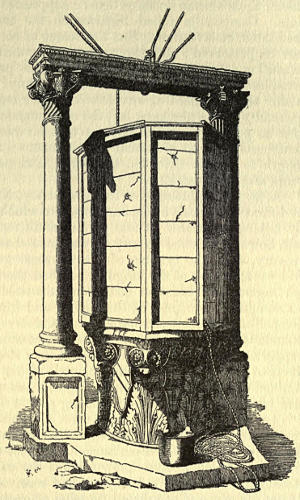
Well near the Piazza dei Signori, Verona
It cannot excite our surprise that the evils of the Spanish administration filled the Neapolitans with discontent and indignation; we may only wonder that any people could be found abject enough to submit to a government at once so oppressive and feeble. The first decided attempt to throw off the foreign yoke had its origin among an order in which such a spirit might least be anticipated. In the last year of the sixteenth century, Tommaso Campanella, a Dominican friar, had, on account, says Giannone, of his wicked life and the suspicion of infidelity, incurred the rigours of the Roman Inquisition. On his release he laboured, in revenge for the treatment which he had received at Rome, to induce the brethren of his own order, the Augustines, and the Franciscans, to excite a religious and political revolution in Calabria. He acquired among them the same reputation for sanctity and prophetic illumination which Savonarola had gained at Florence a hundred years before. He secretly inveighed against the Spanish tyranny; he declared that he was appointed by the Almighty to overthrow it, and to establish a republic in its place; and he succeeded in enlisting the monastic orders and several bishops of Calabria in the cause. By their exhortations, a multitude of people and banditti of the province were roused to second him, and his design was embraced by great numbers of the provincial barons, whose names the historian declares that he suppresses from regard to their descendants. Campanella relied likewise on the assistance of the Turks in the meditated insurrection. But the secret of so extensive a conspiracy could not be preserved; the government got notice of it before it was ripe for execution; and Campanella and his chief priestly associates, with other conspirators, were adroitly arrested. Many of them were put to death under circumstances of atrocious cruelty; but Campanella himself, in the extremity of his torments, had the consummate address to render his confession so perplexed and incoherent that he was regarded as a madman, and sentenced only to perpetual imprisonment; from which he contrived at length to escape. He fled to France, and peaceably ended his life many years afterwards at Paris.
[1600-1647 A.D.]
After the suppression of this conspiracy, Naples was frequently agitated at different intervals by commotions, into which the lower people were driven by misery and want. These partial ebullitions of popular discontent were not, however, marked by any very serious character until the middle of the century, when the tyranny of the viceregal government and the disorders and wretchedness of the kingdom reached their consummation. The Spanish resources of taxation had been exhausted on the ordinary articles of consumption; the poor of the capital and kingdom had been successively compelled to forego the use of meat and bread by heavy duties; and the abundant fruits of their happy climate remained almost their sole means of support. The duke of Arcos, who was then viceroy, could find no other expedient to meet the still craving demands of his court upon a country already drained of its life-blood, than to impose a tax upon this last supply of food; and his measure roused the famishing people to desperation.
An accidental affray in the market of Naples swelled into a general insurrection of the populace of the capital; and an obscure and bold individual from the dregs of the people immediately rose to the head of the insurgents. Tommaso Aniello, better known under the name of Masaniello, a native of Amalfi and servant of a fisherman, had received an affront from the officers of the customs and sought an occasion of gratifying his lurking vengeance. Seizing the moment when the popular exasperation was at its height, he led the rioters to the attack and demolition of the custom-house. The flames of insurrection at once spread with uncontrollable violence; the palace of the viceroy was pillaged; and Arcos himself was driven for refuge to one of the castles of Naples. The infuriated populace murdered many of the nobles, burned the houses of all who were obnoxious to them, and filled the whole capital with flames and blood. Their youthful idol Masaniello, tattered and half naked, with a scaffold for his throne and the sword for his sceptre, commanded everywhere with absolute sway.
The viceroy, terrified into virtue at these excesses, which the long oppression of his court and his own tyranny had provoked, and finding the insurrection spreading through the provinces, consented to all the demands of Masaniello and his followers. By a treaty which he concluded with the insurgents, he solemnly promised the repeal of all the taxes imposed since the time of Charles V, and engaged that no new duties should thenceforth be levied; he guaranteed the ancient and long-violated privileges of parliament; and he bound himself by oath to an act of oblivion. A short interval of calm was thus gained; but the perfidious viceroy employed it only in gratifying the vanity of Masaniello by caresses and entertainments; until, having caused a potion to be administered to him in his wine at a banquet, he succeeded in unsettling his reason. The demagogue then by his extravagances and cruelties lost the affection of the people; and Arcos easily procured his assassination by some of his own followers.
[1647-1648 A.D.]
The viceroy had no sooner thus deprived the people of their young leader, whose native talents had rendered him truly formidable, than he immediately showed a determination to break all the articles of his compact. But the people, penetrating his treachery, flew again to arms; and the insurrection burst forth in the capital and provinces with more sanguinary fury than before. Again Arcos dissembled; and again the deluded people had laid down their arms; when, on the appearance of a Spanish fleet before Naples, the citadels and shipping suddenly opened a tremendous cannonade on the city; and at the same moment some thousand Spanish infantry disembarked and commenced a general massacre in the streets. The Neapolitans were confounded and panic-stricken at the aggravated perfidy; but they were a hundred times more numerous than the handful of troops which assailed them. When they recovered from their first consternation, they attacked their enemies in every street; and after a frightful carnage on both sides, the Spaniards were driven either into the fortresses or the sea.
After this conflict, the people, who, since the death of Masaniello, had fallen under the influence of Gennaro Annese, a soldier of mean birth, resolved fiercely and fearlessly to throw off the Spanish yoke altogether. It chanced that Henry, duke of Guise, who by maternal descent from the second line of Anjou had some hereditary pretensions to the Neapolitan crown, was at this juncture at Rome on his private business; and to him the insurgents applied, with the offer of constituting him their captain-general. At the same time they resolved to erect Naples into a republic under his presidency; and the duke, a high-spirited prince, hastened to assume a command which opened so many glorious prospects of ambition. The contest with the Spanish viceroy, his fortresses, and squadron, was then resumed with new bloodshed, and with indecisive results. But though the Neapolitans had hailed the name of a republic with rapture, they were, of all people, by their inconsistency and irresolution, least qualified for such a form of government. In this insurrection, they had for some time professed obedience to the king of Spain, while they were resisting his arms; and even now they wavered, and were divided among themselves. On the one hand, the duke de Guise, outraged by their excesses, and grasping perhaps at the establishment of an arbitrary power in his own person, began to exercise an odious authority, and showed himself intolerant of the influence of Annese: on the other, that leader of the people was irritated at finding himself deprived of all command. In his jealousy of Guise, he basely resolved to betray his countrymen to the Spaniards; and in the temporary absence of the duke, who had left the city with a small force to protect the introduction of some supplies, he opened the gates to the enemy (1648 A.D.). When the Spanish troops re-entered the capital the abject multitude received them with loud acclamations; and the duke of Guise himself, in endeavouring to effect his flight, was made prisoner, and sent to Spain. In one of those gloomy Spanish dungeons he was kept a prisoner and mourned for some years the vanity of his ambition.
[1648-1674 A.D.]
Thus, in a few hours, was the Spanish yoke again fixed on the necks of the prostrate Neapolitans; and it was riveted more firmly and grievously than ever. As soon as their submission was secured, almost all the men who had taken a prominent share in the insurrection, and who had been promised pardon, were seized, and under various pretences of their having mediated new troubles, were either publicly or privately executed. The traitor Gennaro Annese himself shared the same fate—a worthy example that neither the faith of oaths, nor the memory of eminent services are securities against the jealousy and vengeance of despotism. That despotism had no longer anything to fear from the degraded people who had returned under its iron sceptre. The miseries of Naples could not increase; but they were not diminished until the death of Charles II and the extinction of the Austrian dynasty of Spain in the last year of the century.
The sister kingdom of Sicily had long shared the lot of Naples, in all the distresses which the tyrannical and impolitic government of Spain could inflict upon the people. The Sicilians were only more fortunate than their continental neighbours, as the inferior wealth and resources of their island rendered them a less inviting prey to the insatiable necessities of Spain, to the drain of her wars, and the rapacity of her ministers. But even in Sicily, which by the excellence of its soil for raising corn seems intended to be the granary of Italy, the Spanish government succeeded in creating artificial dearth and squalid penury; and in the natural seat of abundance, the people were often without bread to eat. Their misery goaded them at length nearly to the commission of the same excesses as those which have just been described at Naples. A few months earlier than the revolt under Masaniello the lower orders rose at Palermo, chose for their leader one Giuseppe d’Alessi, a person of as low condition as the Neapolitan demagogue, and under his orders put their viceroy, the marquis of los Velos, to flight. But this insurrection at Palermo was less serious than that of Naples and, after passing through similar stages, was more easily quelled. The Sicilian viceroy, like Arcos, did not scruple at premeditated violation of the solemnity of oaths. Like him, he swore to grant the people all their demands, and a total amnesty; and yet, after perfidiously obtaining the assassination of the popular leader, he caused the inhabitants to be slaughtered in the streets, their chiefs to be hanged, and the burdens which he had been forced to remove to be laid on again.
This detestable admixture of perfidy and sanguinary violence bent the spirit of the Palermitans to the yoke, and Sicily relapsed into the tameness of suffering for above twenty-seven years; until this tranquillity was broken, during the general war in Europe, which preceded the Treaty of Nimeguen, by a new and more dangerous insurrection. The city of Messina had, until this epoch, in some measure enjoyed a republican constitution and was governed by a senate of its own, under the presidency only of a Spanish lieutenant, with very limited powers. This freedom of the city had insured its prosperity: its population amounted to sixty thousand souls, its commerce flourished, and its wealth rivalled the dreams of avarice. The Neapolitan historian asserts that the privileges of the people had rendered them insolent; but there is more reason to believe that the Spanish government looked with a jealous and unfriendly eye upon a happy independence, which was calculated to fill their other Sicilian subjects with bitter repinings at the gloomy contrast of their own wretched slavery. Several differences with successive viceroys regarding their privileges had inspired the citizens of Messina with discontent; and at length they rose in open rebellion against their Spanish governor, Don Diego de Soria, and expelled him from the city (1674 A.D.). Despairing of defending their rights, without assistance, against the whole power of the Spanish monarchy, they had then recourse to Louis XIV, and tempted him with the offer of the sovereignty of their city, and the eventual union of their whole island with the French dominions. Louis eagerly closed with a proposal, which opened at least an advantageous diversion in his war against Spain. He was proclaimed king of Sicily at Messina, and immediately despatched a small squadron to take possession of the city in his name.
[1674-1679 A.D.]
The arrival of his force was succeeded, early in the following year, by that of a formidable French fleet, under the duke de Vivonne; and the Messinese, being encouraged by these succours, rejected all the Spanish offers of indemnity and accommodation. On the other hand, the court of Madrid, being roused to exertion by the danger of losing the whole island, had fitted out a strong armament to secure its preservation and the recovery of Messina; and a Dutch fleet under the famous De Ruyter arrived in the Mediterranean to co-operate with the Spanish forces. The war in Sicily was prosecuted with fury on both sides for nearly four years; and several sanguinary battles were fought off the coast, between the combined fleets and that of France. In all of these the French had the advantage: in one, the gallant De Ruyter fell; and in another, the French, under Vivonne and Duquesne, with inferior force, attacked the Dutch and Spanish squadrons of twenty-seven sail of the line, nineteen galleys, and several fire-ships at anchor, under the guns of Palermo, and gained a complete victory. This success placed Messina in security, and might have enabled both Naples and Sicily to throw off the onerous dominion of Spain. But the spiritless and subjugated people evinced no disposition to rise against their oppressors; and all the efforts of the French eventually failed in extending the authority of their monarch beyond the walls of Messina.
The French king had lost the hope of possessing himself of all Sicily, and was already weary of supporting the Messinese, when the conferences for a general peace were opened at Nimeguen. There, dictating as a conqueror, he might at least have stipulated for the ancient rights of the Messinese, and insisted upon an amnesty for the brave citizens, who, relying on the sacred obligation of protection, had utterly provoked the vengeance of their Spanish governors by placing themselves under his sceptre. But, that his pride might not suffer by a formal evacuation of the city as a condition of the approaching peace, he basely preferred the gratification of this absurd punctilio to the real preservation of honour and the common dictates of humanity. His troops were secretly ordered to abandon Messina before the signature of peace; and so precipitate was the embarkation that the wretched inhabitants, stricken with sudden terror at their impending fate, despairing of pardon from their former governors, and hopeless of successful resistance against them, had only a few hours to choose between exile and anticipated death. Seven thousand of them hurried on board the French fleet, without having time to secure even their money or portable articles, and the French commander, fearing that his vessels would be overcrowded, sailed from the harbour; while two thousand more of the fugitives yet remained on the beach with outstretched arms, in the last agonies of despair, vainly imploring him with piercing cries not to abandon them to their merciless enemies.
The condition of the Messinese who fled for refuge to France, and of those who remained in the city, differed little in the event. Louis XIV, after affording the former an asylum for scarcely more than one short year, inhumanly chased them in the last stage of destitution from his dominions. About five hundred of them, rashly venturing to return to their country, under the faith of Spanish passports, were seized on their arrival at Messina, and either executed or condemned to the galleys. Many others, even of the highest rank, were reduced to beg their bread over Europe, or to congregate in bands, and rob on the highways; and the miserable remnant, plunged into the abyss of desperation, passed into Turkey, and fearfully consummated their wretchedness by the renunciation of their faith. Their brethren, who had not quitted Messina, had meanwhile at first been deluded with the hope of pardon by the Spanish viceroy of Sicily. But the amnesty which he published was revoked by special orders from Madrid; and all, who had been in any way conspicuous in the insurrection, were either put to death or banished. Messina was deprived of all its privileges; the town-house was razed to the ground; and on the spot was erected a galling monument of the degradation of the city—a pyramid surmounted by the statue of the king of Spain, cast with the metal of the great bell which had formerly summoned the people to their free parliaments. The purposes of Spanish tyranny were accomplished: the population of Messina had dwindled from sixty to eleven thousand persons; and the obedience of the city was insured by a desolation from which it has never since risen to its ancient prosperity.
[1600-1679 A.D.]
Thus were the annals of Naples and Sicily distinguished only, during the seventeenth century, by paroxysms of popular suffering. The condition of central Italy was more obscure and tranquil; for the maladministration of its rulers did not occasion the same resistance. Yet if the papal government was less decidedly tyrannical and rapacious than that of Spain, the evils, which had become inherent in it during preceding ages, remained undiminished and incurable; and agricultural and commercial industry was permanently banished from the Roman states. Meanwhile the succession of the pontiffs was marked by few circumstances to arrest our attention. To Clement VIII, who reigned at the opening of the century, succeeded in 1604 Leo XI, of the family of Medici, who survived his election only a few weeks; and on his death the cardinal Camillo Borghese was raised to the tiara by the title of Paul V. Filled with extravagant and exploded opinions of the authority of the holy see, Paul V signalised the commencement of his pontificate by the impotent attempt to revive those pretensions of the papal jurisdiction and supremacy over the powers of the earth, which, in the dark ages, had inundated Italy and the empire with blood. He thus involved the papacy in disputes with several of the Catholic governments of Europe, and in a serious difference with Venice in particular. After his merited defeat on this occasion, he cautiously avoided to compromise his authority by the repetition of any similar efforts; and during the remainder of his pontificate of sixteen years, his only cares were to embellish the ecclesiastical capital, and to enrich his nephews with vast estates in the Roman patrimony, which thus became the hereditary possessions of the family of Borghese.
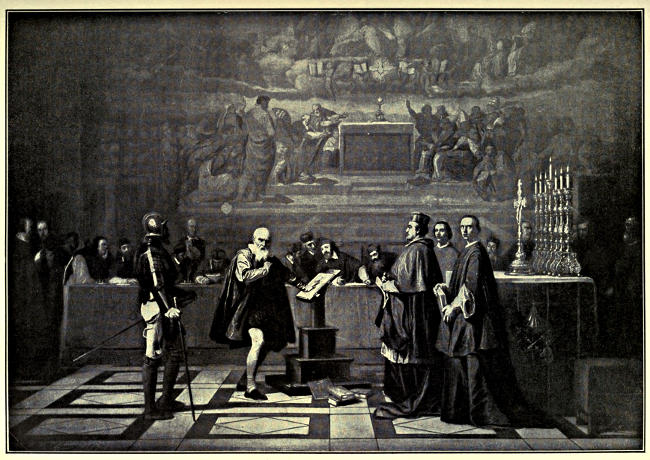
THE RECANTATION OF GALILEO
Paul V, on his death in 1621, was succeeded by Gregory XV, whose insignificant pontificate filled only two years; and in 1623 the conclave placed the cardinal Maffeo Barberini in the chair of St. Peter, under the name of Urban VIII. This pope, during a reign of twenty-one years, was wholly under the guidance of his two nephews, the cardinal Antonio and Taddeo Barberini, prefect of Rome. These ambitious relatives were not satisfied with the riches which he heaped upon them; and their project of acquiring for their family the Roman duchies of Castro and Ronciglione, fiefs held of the church by the house of Farnese, involved the papacy in a war with Parma. Odoardo Farnese, the reigning duke of Parma, had contracted immense debts to charitable foundations at Rome, of which he neglected to pay even the interest. He thus afforded Taddeo Barberini, as prefect of that capital, a pretext for summoning him before the apostolic chamber; and on his contemptuous neglect of the citation, the Barberini obtained an order for sequestrating his Roman fiefs. The duke of Parma had recourse to arms for his defence; the pope excommunicated him; and hostilities commenced between him and Taddeo, who acted as general of the church. But this war of the Barberini, as it has been named, the only strictly Italian contest of the century, produced no decisive result. It was invested with a ridiculous character by the cowardice of Taddeo and the papal troops, who, to the number of eighteen thousand, fled before a handful of cavalry under the duke Odoardo. After this disgraceful check, the Barberini were but too happy to obtain a suspension of arms; and the war was shortly terminated by a treaty, which left the combatants in their original state (1644).
Urban VIII, or rather his nephews, had thus failed in gaining possession of the fiefs of Castro and Ronciglione; but the pope had succeeded some years before in securing to the holy see a much more important acquisition, which he did not venture to appropriate to his family. This was the duchy of Urbino, which had remained under the sovereignty of the family of Rovere since the beginning of the sixteenth century, when Julius II had induced the last prince of the line of Montefeltro to adopt his nephew for a successor. The house of Rovere had for 120 years maintained the intellectual splendour of the little court of Urbino, the most polished in Italy; but Urban VIII persuaded the aged duke, Francesco Maria, who had no male heirs, to abdicate his sovereignty in favour of the church. The duchy of Urbino was annexed to the Roman states; and the industry and prosperity for which it had been remarkable under its own princes immediately withered.c
GALILEO AND THE CHURCH
[1610-1632 A.D.]
During the pontificate of Urban VIII, an interesting controversy between science and theology reached a culmination in the persecution of Italy’s most famous scientist of the century, Galileo. This great experimental philosopher had developed the telescope, and in 1610 made the discovery of the satellites of Jupiter. This discovery, along with others almost equally interesting, was announced in Galileo’s Nuncius Sidereus, published at Venice in 1610.a
The title of this work will best convey an idea of the claim it made to public notice: “The Sidereal Messenger, announcing great and very wonderful spectacles, and offering them to the consideration of everyone, but especially of philosophers and astronomers; which have been observed by Galileo Galilei, etc., by the assistance of a perspective glass lately invented by him; namely, in the face of the moon, in innumerable fixed stars in the milky-way, in nebulous stars, but especially in four planets which revolve round Jupiter at different intervals and periods with a wonderful celerity; which, hitherto not known to any one, the author has recently been the first to detect, and has decreed to call the Medicean stars.”
The interest this discovery excited was intense; and men were at this period so little habituated to accommodate their convictions on matters of science to newly observed facts that several of “the paper-philosophers,” as Galileo termed them, appear to have thought they could get rid of these new objects by writing books against them. The effect which the discovery had upon the reception of the Copernican system was immediately very considerable. It showed that the real universe was very different from that which ancient philosophers had imagined, and suggested at once the thought that it contained mechanism more various and more vast than had yet been conjectured. And when the system of the planet Jupiter thus offered to the bodily eye a model or image of the solar system according to the views of Copernicus, it supported the belief of such an arrangement of the planets, by an analogy all but irresistible.
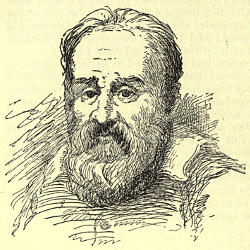
Galileo Galilei
Later in the same year Galileo observed and reported the phases of the planet Venus, thus further corroborating the Copernican doctrine. This doctrine when first promulgated by Copernicus had apparently excited no very great alarm among the theologians of the time. But its assertion and confirmation by Galileo now provoked a storm of controversy, and was visited by severe condemnation. Galileo’s own behaviour appears to have provoked the interference of the ecclesiastical authorities; but there must have been a great change in the temper of the times to make it possible for his adversaries to bring down the sentence of the Inquisition upon opinions which had been so long current without giving any serious offence.
The heliocentric doctrine had for a century been making its way into the minds of thoughtful men, on the general ground of its simplicity and symmetry. Galileo appears to have thought that now, when these original recommendations of the system had been reinforced by his own discoveries and reasonings, it ought to be universally acknowledged as a truth and a reality. And when arguments against the fixity of the sun and the motion of the earth were adduced from the expressions of Scripture, he could not be satisfied without maintaining his favourite opinion to be conformable to Scripture as well as to philosophy; and he was very eager in his attempts to obtain from authority a declaration to this effect. The ecclesiastical authorities were naturally averse to express themselves in favour of a novel opinion, startling to the common mind, and contrary to the most obvious meaning of the words of the Bible; and when they were compelled to pronounce, they decided against Galileo and his doctrines. He was accused before the Inquisition in 1615; but at that period the result was that he was merely recommended to confine himself to the mathematical reasonings upon the system, and to abstain from meddling with the Scripture. Galileo’s zeal for his opinions soon led him again to bring the question under the notice of the pope, and the result was a declaration of the Inquisition that the doctrine of the earth’s motion appeared to be contrary to the sacred Scripture. Galileo was prohibited from defending and teaching this doctrine in any manner, and promised obedience to this injunction. But in 1632 he published his Dialogo delli due Massimi Sistemi del Mondo, Tolemaico e Copernicano;g and in this, he defended the heliocentric system by all the strongest arguments which its admirers used. Not only so, but he introduced into this Dialogue a character under the name of Simplicius, in whose mouth was put the defence of all the ancient dogmas, and who was represented as defeated at all points in the discussion; and he prefixed to the Dialogue a notice, To the Discreet Reader, in which, in a vein of transparent irony, he assigned his reasons for the publication. “Some years ago,” he says, “a wholesome edict was promulgated at Rome, which, in order to check the perilous scandals of the present age, imposed silence upon the Pythagorean opinion of the motion of the earth. There were not wanting,” he adds, “persons who rashly asserted that this decree was the result, not of a judicious inquiry, but of a passion ill-informed; and complaints were heard that counsellors, utterly unacquainted with astronomical observations, ought not to be allowed, with their undue prohibitions, to clip the wings of speculative intellects. At the hearing of rash lamentations like these, my zeal could not keep silence.” And he then goes on to say that he wishes, by the publication of his Dialogue, to show that the subject had been fully examined at Rome. The result of this was that Galileo was condemned for his infraction of the injunction laid upon him in 1616; his Dialogue was prohibited; he himself was commanded to abjure on his knees the doctrine which he had taught; and this abjuration he performed.
The ecclesiastical authorities having once declared the doctrine of the earth’s motion to be contrary to Scripture and heretical, long adhered in form to this declaration, and did not allow the Copernican system to be taught in any other way than as an “hypothesis.”f
THE SUCCESSORS OF URBAN VIII
[1632-1660 A.D.]
Urban VIII was succeeded in 1644 by Innocent X, who revived with more success the pretensions of the holy see to the fiefs of Castro and Ronciglione. The unliquidated debts of the house of Farnese were still the pretext for the seizure of these possessions; but the papal officers were expelled from Castro, and the bishop, whom Innocent had installed in that see, was murdered by order of the minister of Ranuccio II, duke of Parma. The pope was so highly exasperated by these acts, that he directed his whole force against Castro; the Parmesan troops were repulsed in an attempt to succour the place; and when famine had compelled it to surrender, the pope, confounding the innocent inhabitants with the perpetrators of the assassination, caused the city to be razed to its foundations, and a pyramid to be erected on the ruins commemorative of his vengeance. The restitution of these fiefs to the house of Parma was made a condition of the peace of the Pyrenees; but Alexander VII, who succeeded Innocent X in 1656, contrived after many negotiations to obtain permission to hold them in pledge, until Ranuccio II should discharge the debts of his crown. By the failure of the duke to satisfy this engagement, the disputed states remained finally annexed to the popedom.
The pontificate of Alexander VII proved, however, an epoch of grievous humiliation for the pride of the holy see. In 1660, an affray was occasioned at Rome through the privileges, arrogantly claimed by the French ambassadors, of protecting all the quarter of the city near their residence from the usual operations of justice; and Louis XIV determined, in the insolence of his power, to support a pretension which would be intolerable to the meanest court in Europe. He sent the duke of Créqui as his ambassador to Rome, with a numerous and well-armed retinue, to brave the pope in his own capital. Créqui took formal military possession of a certain number of streets near the palace of his embassy, according to the extent over which the right of asylum had been permitted by usage to his predecessors. He placed guards throughout this circuit, as if it had been one of his master’s fortresses; and the papal government, anxious to avoid a rupture with the haughty monarch of France, overlooked the usurpation. But every effort to preserve peace was ineffectual against the resolution which had been taken on the opposite side to provoke some open quarrel. The duke of Créqui’s people made it their occupation to outrage the police of Rome, and to insult the Corsican guard of the pope. Still, even these excesses of the French were tolerated by Alexander, until they rose to such a height that the peaceful citizens dared no longer to pass through the streets by night. At length the Corsican guards were goaded into a fray with the followers of the embassy, which brought matters to the crisis desired by Louis. While the Corsicans were violently irritated by the death of one of their comrades in the broil, they happened to meet the carriage of the duchess of Créqui; they fired upon and killed two of her attendants, and the duke immediately quitted Rome, as if his master had received in his person an unprovoked and mortal affront.
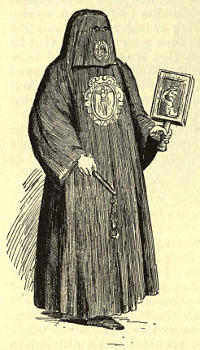
Costume worn by the Member of the Brotherhood who accompanied the condemned to the scaffold, Venice
[1660-1664 A.D.]
Alexander VII soon found that Louis XIV was resolved to avail himself of the most serious colouring which could be given to this affair. The king expelled the pope’s nuncio from France; he seized upon Avignon and its papal dependencies; and he assembled an army in Provence, which crossed the Alps to take satisfaction in Rome itself. The pope at first showed an inclination to assert the common rights of every crown with becoming spirit; and he endeavoured to engage several Catholic princes to protect the dignity of the holy see. But none of the great powers were in a condition at that juncture to undertake his defence. His own temporal strength was quite unequal to a struggle with France; the spiritual arms of the Vatican had now fallen into contempt; and he had the bitter mortification of being obliged to submit to the terms of accommodation which Louis XIV imperiously dictated. The principal of these were the banishment of all the persons who had taken a part in the insult offered to the train of the French ambassador; the suppression of the Corsican guard; the erection of a column, even in Rome, with a legend to proclaim the injury and its reparation: and, finally, the mission of one of the pope’s own family to Paris to make his apologies. All these humiliating conditions were subscribed to, and rigorously enforced. Cardinal Chigi, the nephew of Alexander VII, was the first ecclesiastic despatched to any monarch, to demand pardon for the holy see.
[1600-1700 A.D.]
Alexander VII did not survive this memorable epoch of degradation for the papacy above three years. He was succeeded in 1667 by Clement IX, who wore the triple crown over two years, and was replaced in 1670 by Clement X. The unimportant reign of this pope occupied seven years, and closed in 1676. The pontificate of his successor, Innocent XI, was more remarkable for the renewal of the quarrel respecting the privileges of the French embassy. To terminate the flagrant abuses which these privileges engendered, Innocent published a decree that no foreign minister should thenceforth be accredited at the papal court, until he had expressly renounced every pretension of the kind. This reasonable provision was admitted without opposition by all the Catholic monarchs, except Louis XIV: but he alone refused to recognise its justice; and on the death of the duke d’Estrées, his ambassador at Rome, he sent the marquis de Lavardin to succeed him, and to enforce the maintenance of the old privileges. For this purpose, Lavardin was attended by a body of eight hundred armed men; and the sovereignty of the pope was again insolently braved in his own capital. The guards of Lavardin violently excluded the papal police from all access to the quarter of the city which they occupied; and Innocent at length excommunicated the ambassador. This proceeding would at Paris have excited only ridicule; but in Rome the outraged pride of the court, and the prejudices which still enveloped the ancient throne of papal supremacy and superstition, excluded Lavardin from the pale of society; and he found the solitude in which he was left so irksome that he at last petitioned to be recalled.
The pontificate of Innocent XI terminated in 1689; and it was not until three years after his death that Louis XIV was at length persuaded to desist from the assertion of a pretended right, which could have no other object than to gratify his pride at the expense of multiplying crime and anarchy, in the chosen seat of the religion which he professed. This was the last event in the papal annals of the seventeenth century which deserves to be recorded. We have already found the reigns of several of the popes entirely barren of circumstance; and after that of Innocent XI, we should be altogether at a loss how to bestow a single comment upon the obscure pontificates of his next three successors: of Alexander VIII, who died in 1691; of Innocent XII; and of Clement XI, who was placed in the chair of St. Peter in the last year of the century.
The two contests with the popedom, which the house of Farnese maintained for the possession of the fiefs of Castro and Ronciglione, were almost the only remarkable circumstances in the annals of the duchy of Parma during this century. Ranuccio I, the son of the hero Alessandro Farnese, who wore the ducal crown at its commencement, resembled his father in no quality but mere courage. His long reign was distinguished only for its habitual tyranny and avarice; and for the wanton cruelty with which he caused a great number of his nobility and other subjects to be put to death in 1612, that he might confiscate their property under the charge of a conspiracy, which appears to have had no real existence. He was succeeded in 1622 by his son, Odoard, whose misplaced confidence in his military talents plunged his subjects into many calamities. Vainly imagining that the martial virtues of his grandfather Alessandro were hereditary in his person, he eagerly sought occasion of entering on a career of activity and distinction in the field, for which his egotistical presumption and his excessive corpulence equally disqualified him. By engaging, in 1635, in the war between France and Spain in northern Italy, as the ally of the former power, he exposed his states to cruel ravages; and though, in the subsequent war of the Barberini he was indebted to the misconduct of the papal army for the preservation of his fiefs, that contest did not terminate until he had consumed the resources of his duchy by his prodigality and ignorance.
The death of Odoard, in 1646, relieved his subjects from the apprehension of a continuance of similar evils from his restless temper; and the mild and indolent character of his son Ranuccio II seemed to promise an era of greater tranquillity. But Ranuccio was always governed by unworthy favourites, who oppressed his people; and it was one of these ministers, whose violence, as we have seen, provoked the destruction of Castro, and entailed the loss of its dependencies on the duchy of Parma. The long and feeble reign of Ranuccio II, thus marked only by disgrace, was a fitting prelude to the extinction of the sovereignty and existence of the house of Farnese. Buried in slothful indulgence and lethargy, the members of the ducal family were oppressed with hereditary obesity, which shortened their lives. Ranuccio II himself survived to the year 1694; but he might already anticipate the approaching failure of the male line of his dynasty. Odoard, the eldest of his sons, had died before him of suffocation, the consequence of corpulence; the two others, Don Francesco and Don Vincente, who were destined successively to ascend the throne after him, resembled their brother in their diseased constitutions; and the probability that these princes would die without issue rendered their niece, Elizabeth (Elisabetta) Farnese, daughter of Odoard, sole presumptive heiress of the states of her family.
LESSER PRINCIPALITIES
Of the dukes of Parma, whose reigns filled the seventeenth century, not one deserved either the love of his people or the respect of posterity. The contemporary annals of the princes of Este were graced by more ability and virtue. But the reduction of the dominion of those sovereigns to the narrow limits of the duchies of Modena and Reggio diminished the consequence which their ancestors had enjoyed in Italy during the preceding century, before the seizure of Ferrara by the Roman see. Don Cesare of Este, whose weakness had submitted to this spoliation, reigned until the year 1628. His subjects of Modena forgave him a pusillanimity which had rendered their city the elegant seat of his beneficent reign. His son, Alfonso III, who succeeded him, was stricken with such wondrous affliction for the death of his wife, only a few months after his accession to the ducal crown, that he abdicated his throne, and retired into a Capuchin convent in the Tyrol. On this event, his son Francesco I assumed his sceptre in 1629, and reigned nearly thirty years. Joining in the wars of the times in upper Italy between France and Spain, and alternately espousing their opposite causes, Francesco I acquired the reputation of one of the ablest captains of his age, as he was also one of the best sovereigns. His skilful conduct and policy in these unimportant contests were rewarded by the extension of his territories; and in 1636, the little principality of Correggio (more famous in the annals of art than of war) was annexed to his imperial fiefs. Neither the short reign of his son and successor, Alfonso IV, which commenced in 1658 and ended in 1662, nor that of his grandson, Francesco II, which began with a feeble minority and terminated after a protracted administration of the same character, demand our particular notice; and in 1694, the cardinal Rinaldo, son of the first Francesco, succeeded his nephew, and entered upon a reign which was reserved for signal calamities in the first years of the new century.
In the affairs of Parma and Modena, during the century before us, there is scarcely anything to invite our attention; but the fortunes of Mantua, so obscure in the preceding age, were rendered somewhat remarkable in this by the wars which the disputed succession to its sovereignty occasioned. The reign of Vincente I, who, having succeeded to the ducal crowns of Mantua and Montferrat in 1587, still wore them at the opening of the seventeenth century, and that of his successor Francesco IV, were equally obscure and unimportant. But, on the death of Francesco, in 1612, some troubles arose, from the pretensions which the duke of Savoy advanced anew over the state of Montferrat. It was not until after several years that negotiations terminated the indecisive hostilities which were thus occasioned, and in which Spain interfered directly against the duke of Savoy, while France more indirectly assisted him. By the Treaty of Asti in 1615, and of Madrid in 1617, the duke of Savoy engaged to leave Montferrat to the house of Gonzaga, until the emperor should decide on his claims. The last duke of Mantua, Francesco IV, had left only a daughter: but as Montferrat was a feminine fief, that state descended to her; while her father’s two brothers, Ferdinando and Vincente II, reigned successively over Mantua without leaving issue. On the death of the latter of these two princes, both of whom shortened their days by their infamous debaucheries, the direct male line of the ducal house of Gonzaga became extinct; and the right of succession to the Mantua duchy devolved on a collateral branch, descended from a younger son of the duke Federigo II, who had died in 1540. This part of the family of Gonzaga was established in France, in possession of the first honours of nobility, and was now represented by Charles, duke de Nevers. By sending his son, the duke of Rethel, to Mantua in the last illness of Vincente II, Charles not only secured the succession to that duchy, which he might lawfully claim, but reannexed Montferrat to its diadem. For, on the very same night on which Vincente II expired, the duke of Rethel received the hand of Maria, the daughter of Francesco IV, and heiress of Montferrat; and the right of inheritance to all the states of the ducal line thus centred in the branch of Nevers.
[1630-1680 A.D.]
The new ducal house of Gonzaga did not commence its sovereignty over Mantua and Montferrat without violent opposition. The duke of Savoy renewed his claim upon the latter province; and Cesare Gonzaga, duke of Guastalla, the representative of a distant branch of that family, made pretensions to the duchy of Mantua. At the same time the Spanish government thought to take advantage of a disputed succession, for the purpose of annexing the Mantuan to the Milanese states; and the emperor Ferdinand II placed the duke of Nevers under the ban of the empire for having taken possession of its dependent fiefs without waiting for a formal investiture at its hands. The objects of Ferdinand were evidently to revive the imperial jurisdiction in Italy, and to enrich the Spanish dynasty of his family by the acquisition of these states. To promote these combined plans of the house of Austria an imperial army crossed the Alps, and surprised the city of Mantua, which was sacked with merciless ferocity (1630). At the same time the duke of Savoy concluded a treaty with Spain, for the partition of Montferrat; and the new duke of Mantua seemed likely to be dispossessed of the whole of his dominions. But fortunately for him, it was at this juncture that Cardinal Richelieu had entered on his famous design of humbling the power and ambition of both the Spanish and German dynasties of the house of Austria; and a French army, under Louis XIII in person, forcing the pass at Susa, crossed the Alps to support the Gonzagas of Nevers against all their enemies. We pass over the uninteresting details of the general war, which was thus kindled in northern Italy by the Mantuan succession. When Richelieu himself appeared on the theatre of contest, at the head of a formidable French army, all resistance was hopeless; and his success shortly produced an accommodation between the belligerents in the peninsula, by which the emperor was compelled, in the settlement of the matter, to bestow the disputed investiture of Mantua and Montferrat upon Charles of Nevers (1631).
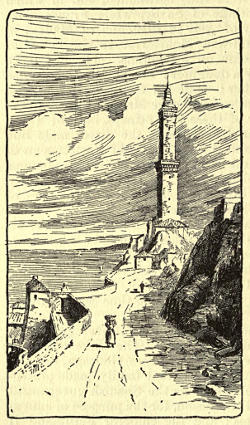
The Old Lighthouse, Genoa
This prince, who thenceforth reigned at Mantua under the title of Carlo I, retained that duchy without further opposition. But in 1635 he was drawn, by the memory of the eminent services which France had rendered him, into an alliance with that power against Spain, in the new war which broke out between the rival dynasties of Bourbon and Austria. Such a connection could serve, however, only to destroy the repose and endanger the safety of his duchies. Neither Carlo I nor his son Carlo II, who succeeded him in 1637, could prevent Montferrat from being perpetually overrun and ravaged by the contending armies of France, Spain, the empire, and Savoy; and the Mantuan dukes abandoned almost every effort to retain the possession of that province until, after being for above twenty years the seat of warfare and desolation, it was at length restored to Carlo II by the general Peace of the Pyrenees.
Carlo II died in 1665; and his son Ferdinando Carlo commenced the long and disgraceful reign with which the sovereignty and race of the Gonzagas were to terminate early in the next century. This prince, more dissolute, more insensible of dishonour, more deeply buried in grovelling vice than almost any of his predecessors, was worthy of being the last of a family which, since its elevation to the tyranny of Mantua, had, during four centuries of sovereignty, relieved its career of blood and debauchery by few examples of true greatness and virtue. To gratify his extravagance, and indulge in his low and vicious excesses, Ferdinando Carlo crushed his people under grievous taxation. To raise fresh supplies, which his exhausted states could no longer afford, he shamelessly in 1680 sold Casale, the capital of Montferrat, to Louis XIV, who immediately occupied the place with twelve thousand men under his general Catinat. The sums which the duke thus raised, either by extortion from his oppressed subjects or from this disgraceful transaction, were dissipated in abandoned pleasures in the carnivals of Venice, among a people who openly evinced their contempt for him, and whose sovereign oligarchy passed a decree forbidding any of their noble body from mingling in his society.
TUSCANY
[1600-1670 A.D.]
From the affairs of Mantua, we may pass to those of Tuscany; but the transition is attended with little augmentation of interest. A common dearth of attraction marks the annals of most of the despotisms of Italy; and when Tuscany descended to the rank of a duchy, her pre-eminence of splendour survived only in the past, and her modern story sank into the same ignominious obscurity with that of Parma, and Modena, and Mantua. We are reminded only of the existence of the solitary republic which survived in this quarter of Italy, to wonder how Lucca escaped subjugation to the power whose dominions encircled and hemmed in her narrow territory; and we are permitted to contemplate her ancient republican rivals, Florence, Siena, and Pisa, only as the capital and the provincial cities of the ducal sovereigns of Tuscany. Of these princes of the house of Medici, four reigned successively during the seventeenth century. At its commencement, the ducal crown was worn by Ferdinand I, whose personal vices and political talents have been already noticed. After the failure of his project to throw off the Spanish yoke, his efforts were exclusively devoted to the encouragement of commerce and maritime industry among his subjects; and the enlightened measures to which he was prompted by a thorough knowledge of the science of government, and a keen perception of his own interests, were rewarded with signal success. To attract the trade of the Mediterranean to the shores of Tuscany, he made choice of the castle of Livorno (Leghorn) for the seat of a free port. He improved the natural advantages of its harbour, which had already excited the attention of some of his predecessors, by several grand and useful works; he invested the town which rose on the site with liberal privileges; and from this epoch, Livorno continued to flourish, until it attained the mercantile prosperity and opulence which have rendered it one of the first maritime cities of the peninsula. The skilful policy which Ferdinand I pursued in this and other respects produced a rapid influx of wealth into his states; and before his death, which occurred in 1609, he had amassed immense treasures.
Several of the first princes of the ducal house of Medici seemed to have inherited some portion of that commercial ability by which their merchant ancestors had founded the grandeur of their house; and they profited by the contempt or ignorance which precluded other Italian princes from rivalling them in the cultivation of the same pursuits. Cosmo II, the son and successor of Ferdinand, imitated his example with even more earnest zeal, and with more brilliant success. But on his death, in 1621, the minority of his son Ferdinand II destroyed the transient prosperity of the ducal government. The rich treasury of the two preceding dukes was drained in furnishing troops and subsidies to Spain and Austria; and Ferdinand, who was left under the guardianship of his grandmother and mother, was only released from female tutelage on attaining the age of manhood, to exhibit during his long reign all the enfeebling consequences of such an education. His character was mild, peaceable, and benevolent; and his administration responded to his personal qualities. From this epoch, the political importance of Tuscany entirely ceased; the state was stricken with moral paralysis; and lethargy and indolence became the only characteristics of the government and the people.
Ferdinand II, however, was not destitute of talents; and the enthusiasm with which the grand-duke and his brother promoted the cultivation of science at least protected his inactive reign from the reproach of utter insignificance. But his son, Cosmo III, who ascended his throne in 1670, reigned with a weakness which was relieved by no intellectual tastes. Unhappy and suspicious in his temper, his life was embittered by domestic disagreements with his duchess; fanatical and bigoted, he was constantly surrounded and governed by monks; and at the close of the seventeenth century, Florence, once the throne of literature, the fair and splendid seat of all the arts which can embellish and illumine life, was converted into the temple of gloomy superstition and hypocrisy.
PIEDMONT AND SAVOY
[1027-1700 A.D.]
While the other ducal thrones of Italy were thus for the most part filled only by slothful voluptuaries, that of Savoy seemed reserved for a succession of sovereigns, whose fearless activity and political talents constantly placed their characters in brilliant contrast with the indolence and imbecility of their despicable contemporaries.c The history of this house shows in a striking manner how the destinies of a nation may depend on the fortunes of a princely family. During eight centuries the princes of Savoy have, in the words of Charles Emmanuel III, “treated Italy as an artichoke to be eaten leaf by leaf.” Their work is now perfected in the freedom of the state.
The descent of Humbert the Whitehanded, the founder of the family, is uncertain, but he was probably a son of Amadeus, the great-grandson of Boson of Provence. In reward for services rendered to Rudolf III of Arles, Humbert obtained from him in 1027 the counties of Savoy and Maurienne, and from the emperor Conrad the Salic, Chablais, and the lower Valais. On his death in 1048 he was succeeded perhaps by his eldest son, Amadeus I, but eventually by his fourth son, Otho, who, by his marriage with Adelaide of Susa, obtained the counties of Turin and the Val d’Aosta, and so acquired a footing in the valley of the Po. Otho was succeeded in 1060 by his son Amadeus II, who maintained a judicious neutrality between his brother-in-law, the emperor Henry IV, and the pope. In reward for his mediation he obtained from the former, after Canossa, the province of Bugey. The accession of his son Humbert II in 1080 brought fresh increase of territory in the valley of the Tarantaise, and in 1091 this prince succeeded to the dignities of his grandmother, Adelaide. Amadeus III came to the throne in 1103, and in 1111 his states were created counties of the empire by Henry V. On his way home from the crusades in 1149 Amadeus died at Nicosia, and was succeeded by his son Humbert III. The prince took the part of the pope against Barbarossa, who ravaged his territories until Humbert’s death in 1188. The guardians of his son Thomas reconciled their ward and the emperor. He received from Henry VI accessions of territory in Vaud, Bugey, and Valais, with the title of imperial vicar in Piedmont and Lombardy. He was followed in 1233 by Amadeus IV. A campaign against the inhabitants of Valais ended in the annexation of their district, and his support of Frederick II against the pope caused the erection of Chablais and Aosta into a duchy.
[1253-1482 A.D.]
In 1253 his son Boniface succeeded to his states at the age of nine, but after giving proofs of his valour by defeating the troops of Charles of Anjou before Turin, he was taken prisoner and died of grief (1263).
The Salic law now came into operation for the first time, and Peter, the uncle of Boniface, was called to the throne. This prince, on the marriage of his nieces, Eleanor and Sancha of Provence, with Henry III of England and Richard, earl of Cornwall, had visited England, where he had been created earl of Richmond, and built a palace in London, afterwards called Savoy House. In return he recognised the claims of Richard to the imperial throne, and received from him Kyburg, in the diocese of Lausanne. At his death in 1268 he was succeeded by his brother Philip I, who died in 1285, when their nephew Amadeus V came to the throne. This prince, surnamed the Great, united Baugé and Bresse to his states in right of his wife Sibylla, and later on lower Faucigny and part of Geneva. For his second wife he married Mary of Brabant, sister of the emperor Henry VII, from whom he received the seigniory of Aosta. His life was passed in continual and victorious warfare, and one of his last exploits was to force the Turks to raise the siege of Rhodes. He died in 1323. His son Edward succeeded him, and dying in 1329, was followed by his brother Aymon. This prince died in 1343, when his son Amadeus VI ascended the throne. His reign was, like his grandfather’s, a series of petty wars, from which he came out victorious and with extended territory, until he died of the plague (1383). The promising reign of his son Amadeus VII was cut short by a fall from his horse in 1391. Before his death, however, he had received the allegiance of Barcelonnette, Ventimiglia, Villafranca, and Nice, so gaining access to the Mediterranean.
His son Amadeus VIII now came to the throne, under the guardianship of his grandmother Bona (Bonne) de Bourbon. On attaining his majority he first directed his efforts to strengthening his power in the outlying provinces. The states of Savoy now extended from the Lake of Geneva to the Mediterranean, and from the Saône to the Sesia. Amadeus threw all the weight of his power on the side of the emperor, and Sigismund in 1416 erected the counties of Savoy and Piedmont into duchies. At this time, too, the duke recovered the fief of Piedmont, which had been granted to Philip, prince of Achaia, by Amadeus V. The county of Vercelli afterwards rewarded him for joining the league against the duke of Milan, but in 1434 a plot against his life made him put into execution a plan he had long formed, of retiring to a monastery. He accordingly made his son Louis lieutenant-general of the dukedom, and assumed the habit of the knights of St. Maurice. But he was not destined to find the repose he sought. The prelates assembled at the council of Bâle voted the deposition of Pope Eugenius IV, and elected Amadeus in his place, as Felix V. He abdicated his dukedom definitely, but without much gain in temporal honours, for the schism continued until the death of Eugenius in 1447, shortly after which it was healed by the honourable submission of Felix to Nicholas V. The early years of Louis’ reign were under the guidance of his father, and peace and prosperity blessed his people; but he afterwards made an alliance with the dauphin which brought him into conflict with Charles VII of France, though a lasting reconciliation was soon effected. His son Amadeus IX succeeded in 1465, but, though his virtues led to his beatification, his bodily sufferings made him assign the regency to his wife Yolande, a daughter of Charles VII. He died in 1472, when his son Philibert I succeeded to the throne and to his share in the contests of Yolande with her brother and brothers-in-law. His reign lasted only ten years, when he was succeeded by his brother Charles I. This prince raised for a time by his valour the drooping fortunes of his house, but he died in 1489 at the age of thirty-one, having inherited from his aunt, Charlotte of Lusignan, her pretensions to the titular kingdoms of Cyprus, Jerusalem, and Armenia. He was succeeded by his son Charles II, an infant, who, dying in 1496, was followed by Philip II, brother of Amadeus XI. He died in 1497, leaving Philibert II, who succeeded him, and Charles III, who ascended the throne on his brother’s death in 1504. In spite of himself Charles was drawn into the wars of the period, but the decisive victory of Francis at Marignano gave the duke the opportunity of negotiating the conference at Bologna which led to the conclusion of peace in 1516. Charles was less fortunate in the part he took in the wars between Francis I and Charles V, the brother-in-law of his wife. He tried to maintain a strict neutrality, but his attendance at the emperor’s coronation at Bologna in 1530 was imperative in his double character of kinsman and vassal. The visit was fatal to him, for he was rewarded with the county of Asti, and this so displeased the French king that on the revolt of Geneva to Protestantism in 1532, Francis sent help to the citizens. Berne and Fribourg did likewise, and so expelled the duke from Lausanne and Vaud. Charles now sided definitely with the emperor, and Francis at once raised some imaginary claims to his states. On their rejection the French army marched into Savoy, descended on Piedmont, and seized Turin (1536). Charles V came to the aid of his ally, and invested the city, but was obliged to make peace. France kept Savoy, and the emperor occupied Piedmont, so that only Nice remained to the duke. On the resumption of hostilities in 1541 Piedmont again suffered. In 1544 the Treaty of Crespy restored his states to Charles, but the terms were not carried out, and he died of grief in 1553. His only surviving son, Emmanuel Philibert, succeeded to the rights, but not the domains of his ancestors. On the abdication of Charles V the duke was appointed governor of the Low Countries, and in 1557 the victory of St. Quentin marked him as one of the first generals of his time. Such services could not go unrewarded, and the Peace of Cateau-Cambrésis restored him his states, with certain exceptions still to be held by France and Spain. One of the conditions of the treaty also provided for the marriage of the duke with Margaret of France, sister of Henry II. The evacuation of the places held by them was faithfully carried out by the contracting powers, and Emmanuel Philibert occupied himself in strengthening his military and naval forces, until his death in 1580 prevented the execution of his ambitious designs. His son Charles Emmanuel I, called the Great, threw in his lot with Spain, and in 1590 invaded Provence and was received by the citizens of Aix. His intention was doubtless to revive the ancient kingdom of Arles, but his plans were frustrated by the accession of Henry IV to the throne of France.e
[1482-1601 A.D.]
By his treaty with Henry, in the year 1601, Charles Emmanuel exchanged his Savoyard county of Bresse for the Italian marquisate of Saluzzo. By this arrangement, the duke of Savoy sacrificed a fertile province to acquire a barren and rocky territory; but he excluded the French from an easy access into Piedmont, and strengthened his Italian frontier. By consolidating his states, he gained a considerable advance towards the future independence of his family; and the superiority of his policy over that of Henry IV in this transaction occasioned the remark of a contemporary, that the French king had bargained like a peddler, and the Savoyard duke like a king.
From this epoch, the house of Savoy became almost exclusively an Italian power, and its princes, to use the language of one of their historians, thenceforth viewed the remains of their transmontane possessions only as a nobleman, moving in the splendour of a court, regards the ancient and neglected fief from which he derives his title. Charles Emmanuel found that the improvement effected in the geographical posture of his states immediately increased his importance; and his alliance was courted both by France and Spain. But during the remainder of his long reign, his own restless and overweening ambition, and the natural difficulties of his situation, placed as he was with inferior strength between two mighty rivals, entailed many calamities on his dominions. He made an unsuccessful attempt in 1602 to surprise Geneva by an escalade in the night, and after a disgraceful repulse concluded a peace, which recognised the independence of that republic. Ten years later, he endeavoured, as we have seen, to wrest Montferrat from the house of Gonzaga; but being violently opposed by Spain, and weakly supported by France, he was compelled, after several years of hostilities, to submit his claim to the decision of the emperor—or, in other words, to abandon it altogether. Such checks to his ambition were, however, of little importance, in comparison with the reverses consequent upon the share which he took in the war of the Mantuan succession (1628).
[1601-1634 A.D.]
In that contest he was induced, by the hope of partitioning Montferrat with the Spaniards, to unite with them against the new duke of Mantua and the French his supporters; and he suffered heavily in this alliance. When Louis XIII, at the head of a gallant army, forced the strong pass of Susa against the duke and his troops, and overran all Piedmont, Charles Emmanuel was compelled to purchase the deliverance of his states by signing a separate peace, and leaving the fortress of Susa as a pledge in the hands of the conquerors. They insisted further that he should act offensively against his former allies; but Louis XIII and his great minister Richelieu were no sooner recalled into France by the war against the Protestants, than the versatile duke, resenting their tyranny, immediately resumed his league with Spain.
The possession of Susa rendered the French masters of the gates of the Savoyard dominions; and as soon as Richelieu had triumphantly concluded the war against the Huguenots, he returned to the Alps. He was invested by his master with a supreme military command, which disgraced his priestly functions; and he poured the forces of France again into Piedmont. All Savoy was conquered by the French king in person; and above half of Piedmont was seized by his forces under the warlike cardinal. Amidst so many cruel reverses, oppressed by the overwhelming strength of his enemies, and abandoned by his Spanish allies, who made no vigorous efforts to arrest the progress of the French, Charles Emmanuel suddenly breathed his last, after a reign of fifty years (1630).
Victor Amadeus I, his eldest son and successor, was the husband of Christina, daughter of Henry IV of France, and therefore disposed to ally himself with her country. Almost immediately after his accession to the ducal crown, he entered into negotiations with Richelieu, which terminated in a truce. In the following year, the general peace, which concluded the war of the Mantuan succession, was signed at Cherasco (1631). By this treaty, the new duke of Savoy recovered all his dominions except Pinerolo (Pignerol), which he was compelled to cede to the French; who, although Richelieu restored Susa to Victor Amadeus, thus retained possession of the passes of the Alps by Briançon and the valley of Exilles. Victor Amadeus was not inferior to his father either in courage or abilities; but he was not equally restless and intriguing. Submitting to circumstances beyond his control, he endured the ascendency which France had acquired over his states, and the yet more galling pride of Richelieu, with temper and prudence. To the close of his short reign he maintained with good faith a close alliance with Louis XIII, which indeed it was scarcely optional with him to have rejected, and which, in 1634, involved him, as an auxiliary, in a new war undertaken by Richelieu against the house of Austria.
[1634-1657 A.D.]
The death of Victor Amadeus in 1637, while this contest was yet raging, was the prelude to still heavier calamities for his house and his subjects than either had known for nearly a century. He left two infant sons, the eldest of whom dying almost immediately after him, the succession devolved upon the other, Charles Emmanuel II, a boy of four years of age. By his testament, Victor Amadeus committed the regency of his states, and the care of his children, to his duchess Christina. The government of that princess was in the outset assailed by the secret machinations of Richelieu, and by the open hostility of the brothers of her late husband. Richelieu designed to imprison the sister, and to despoil the nephew of his own master; and he would have annexed their states to the French monarchy, under the plea that the care of the young prince and the regency of his duchy belonged of right to Louis XIII, as his maternal uncle. When the vigilance of Christina defeated the intention of the cardinal to surprise her at Vercelli, the sister of Louis XIII had still to endure all the despotic influence of her brother’s minister. The conduct of her husband’s relations left her however no alternative but to purchase the aid of the French against them.
Both the brothers of Victor Amadeus, the cardinal Maurice, and Prince Thomas (founder of the branch of Savoy-Carignano), had quarrelled with the late duke, and withdrawn from his court to embrace the party of his enemies; the one entered the service of the emperor, the other that of the king of Spain in the Low Countries. On the death of Victor Amadeus, they returned to Piedmont only to trouble the administration of Christina by themselves laying claim to the regency; and at length, on her resisting their pretensions, they openly asserted them in arms. The two princes were supported by the house of Austria; the duchess-regent was protected by France; and the whole country of Savoy and Piedmont was at once plunged into the aggravated horrors of foreign and civil war. In the first year of this unhappy contest, the capital was delivered into the hands of Prince Thomas by his partisans; and the regent, escaping with difficulty on this surprise into the citadel of Turin, was compelled to consign the defence of that fortress to the French, who treacherously retained the deposit for eighteen years. In like manner, they acquired possession of several important places; the Spaniards on their part became masters of others; and while the regent and her brothers-in-law were contending for the government of Piedmont, they were betrayed by the ill faith and ambition of their respective protectors.
A reconciliation in the ducal family was at length effected by the tardy discovery that mutual injuries could terminate only in common ruin. The two princes deserted the party of Spain, and succeeded in recovering for their house most of the fortresses which they had aided the Spaniards in reducing. The duchess-mother retained the regency; and the princes were gratified with the same appanages by which she had originally offered to purchase their friendship. Still the French remained all powerful in Piedmont; and if death had not interrupted the projects of Richelieu, it is probable that the ducal house of Savoy would have been utterly sacrificed to his skilful and unprincipled policy, and that its dominions would have been permanently annexed to the monarchy of France. Even under the government of his more pacific successor, Mazarin, it was not until the year 1657 that the French garrison was withdrawn from the citadel of Turin; and this act of justice was only extorted from that minister as the price of his niece’s marriage into the ducal family of Savoy. The exhaustion of Spain and the internal troubles of France had totally prevented the active prosecution in northern Italy of the long war between those powers. But the embers of hostility were not wholly extinguished in Piedmont until the Peace of the Pyrenees, by which Charles Emmanuel II recovered all his duchy except Pinerolo and its Alpine passes, and these the French still retained (1659).
[1657-1692 A.D.]
The termination of the minority of Charles Emmanuel II, in 1648, had put an end to the intrigues of his uncles. But the duke continued to submit to the ambitious and able control of his mother until her death; and his subsequent reign was in no respect brilliant. His states, however, after the Treaty of the Pyrenees, enjoyed a long interval of repose; and though the early close of his life in 1675 subjected them to another minority, it proved neither turbulent nor calamitous, as his own had done. His son, the celebrated Victor Amadeus II, was only nine years old when he nominally commenced his reign under the regency of his mother. The princess, a daughter of the French house of Nemours, had all the ambition without the talents which had distinguished the duchess Christina. Surrounded by French favourites and by the partisans of that nation, she was wholly subservient to the will of Louis XIV; and Victor Amadeus, on attaining the age of manhood, gave the first indications of the consummate political ability for which he became afterwards so famous, by his decent address in dispossessing his reluctant parent and her faction of all influence in public affairs, without having recourse to actual violence.
The policy of the duke soon excited the suspicion of Louis XIV; and after exhausting all the resources of negotiation and intrigue for some years, to gain him over to his purpose of wresting Milan from the Spaniards, the French monarch resolved to disarm him. But Victor Amadeus penetrated his designs, and anticipated their execution. He was too good a politician, and too sensible of his own weakness, not to discover that, if he consented to open a free passage to Louis XIV through his dominions, and to aid him in effecting the conquest of Lombardy, he should speedily be despoiled in his turn, and reduced to the rank of a vassal of the French crown. He therefore acceded to the league of Augsburg between the empire, England, Spain, and Holland; and his subjects eagerly seconded him in his resolution rather to encounter the dangers of a contest with the gigantic power of France, than to submit without a struggle to the imperious and humiliating demands of Louis.
The commencement of the war in Piedmont was marked by a torrent of misfortune, which might have overwhelmed a prince of less fortitude than Victor Amadeus with sudden despair. Although he was joined by a Spanish army at the opening of hostilities, the French, who commanded the gates of Italy by the possession of Pinerolo had already assembled in force in Piedmont. They were led by Catinat, who deserves to be mentioned among the most accomplished and scientific captains of his own or of any age; and the superior abilities of this great commander triumphed over the military talents of the young duke. At the battle of Staffarda (1690) in the first campaign, the allies were totally defeated; and great part both of Savoy and Piedmont was almost immediately afterwards reduced by the conquerors. Victor Amadeus was however undismayed; he continued the war with energy and skill; and the support of his allies and his own activity had the effect of balancing the fortune of the contest. Penetrating into France, in 1692, he was even enabled to retaliate upon his enemies by this diversion, for the ravage of his dominions; and although Catinat, in the fourth campaign, inflicted at Marsaglia upon the Piedmontese, Austrian, and Spanish armies, under the duke in person and the famous prince Eugene, a yet more calamitous and memorable defeat than that at Staffarda, the allies speedily recovered from the disaster.
But it comes not within our purpose to repeat the often-told tale of military operations, which belong to the general history of Europe. After six years of incessant warfare, Victor Amadeus was still in an attitude to render his neutrality an important object for France to gain, and one which he had himself every reason to desire. So that it could be attained with advantage to himself, he was little scrupulous in abandoning his allies; and the conditions which he extorted from Louis XIV had all the results of victory. By the separate peace concluded between France and Savoy at Turin, Louis XIV abandoned the possession of Pinerolo and restored all his conquests in Savoy and Piedmont; but the most material stipulation of the treaty was the neutrality of all Italy, to which the contracting parties equally bound themselves to oblige all other powers to accede. To enforce this article, Victor Amadeus did not hesitate to join his arms to those of France against his former allies; and the entrance of his forces, in conjunction with the army of Catinat, into the Milanese territories, immediately compelled the emperor and the king of Spain to consent to a suspension of arms in the peninsula.
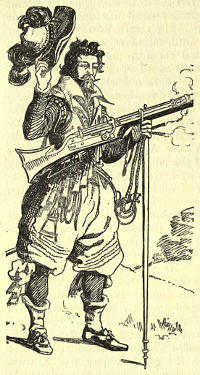
A Musketeer of the Early Seventeenth Century
The allies of Victor Amadeus might justly reproach him with a desertion of their cause, and perhaps even with the aggravation of perfidy; but he deserved the gratitude of Italy, if not for his selfish policy, at least for its fruits. In closing the gates of his own frontiers, he had skilfully provided also for the repose of the peninsula and its evacuation by the French. All Italy regarded him as a liberator; the security of his own dominions was effected, and his power and consequence were prodigiously augmented. Thus, by establishing the independence of his states, he prepared the claim of his house to the assumption of the royal title among the powers of Europe, to which he elevated it in the beginning of the new century.
The increasing power of the sovereigns of Piedmont was a foreboding of evil for the only republic of the Middle Ages which had partially escaped the storms of despotism in that quarter of Italy; and Genoa had already gained, during the seventeenth century, sufficient experience of the dangers of her vicinity to the princes of the house of Savoy. In the Grison war, between France and the house of Austria, the republic was involved by her dependence upon Spain; and the share which she took in the contest enabled the duke of Savoy, then in alliance with France, to draw down the weight of the French arms upon her. Besides being actuated by the usual rapacity of his ambition, with the hope of annexing the Genoese territory to his states, Charles Emmanuel I had several causes of offence against the republic. Her rulers had before given assistance to the Spaniards against him; they had attempted to control him in the purchase of the fief of Zucarel from the family of Carretto; and the populace of Genoa had insulted him by defacing his portrait in their city during the excesses of a riot. He therefore pointed out Genoa to his allies for an easy and important conquest; and while he overran the Ligurian country, a French army of thirty thousand men under the constable de Lesdiguières advanced to the siege of the republican capital. Though the Genoese were unprovided against this sudden attack, they were animated by the brave spirit, and the eloquence of one of their fellow-citizens, a member of the illustrious house of Doria, to oppose a firm resistance to the besiegers; and their gallant defence of the city was converted into a triumph, at the moment when they were reduced to extremity. A powerful Spanish armament, equipped with unusual vigour, arrived to their succour from Naples and Milan; the French were compelled to raise the siege; and the peace, which shortly followed these hostilities, served only to cover the duke of Savoy with the disgrace of merited failure in his designs against the existence of the republic.
[1624-1628 A.D.]
The secret hostility which Charles Emmanuel cherished against Genoa menaced her, a few years later, with more imminent perils; since the revengeful spirit of the duke was associated with the discontent of a large party in the republic. We have formerly noticed the constitution of the sovereign oligarchy of Genoa, and its tendency, by the extinction of some noble houses, and the reduction of numbers in others, to narrow the circle of political rights. The surviving body, meanwhile, were sparing in the use of the law, which authorised them to admit ten new families annually to a share in their privileges of sovereignty. The senate either began to elude it altogether, or applied it only to childless or aged individuals. Thus, before the middle of the seventeenth century, the number of persons whose names appeared in the libro d’oro—the golden volume of privileged nobility—had dwindled to about seven hundred. A law was then passed, by which the whole of these exclusive proprietors of the rights of citizenship thenceforth took their seats in the great council, on reaching the age of manhood, instead of entering it by rotation, as had formerly been the practice, when the republic was represented by a more comprehensive aristocracy.
While the arrogance and the individual importance of the members of the oligarchy were increased in proportion to this diminution in their numbers, another class, that of the unprivileged aristocracy of birth and wealth, had multiplied in the state. Many ancient houses, possessors of rural fiefs in Liguria, and invested with titles of nobility, had been originally omitted in the roll of citizenship; many other families of newer pretensions had since acquired riches and distinction by commercial industry, and accidents of fortune; and the union of all these constituted an order, which rivalled the oligarchy in the usual sources of pride, and far outweighed them in numbers. Affected superiority and contempt on the one hand, and mortification and envy on the other, produced reciprocal hatred between these branches of the Genoese aristocracy; and their divisions inspired the duke of Savoy with the hope of plunging the state into an anarchy, by which he might profit.
[1628-1672 A.D.]
Pursuing his master’s views, the ambassador of Charles Emmanuel at Genoa selected a wealthy merchant of the unprivileged aristocracy, Giulio Cesare Vachero, for the agitator and leader of a conspiracy to overthrow the oligarchical constitution. Vachero, although engaged in the occupation of commerce, aspired to move in the sphere of nobility. His immense riches, his numerous retinue, his splendid establishment, rivalled the magnificence of the Fregosi, the Adorni, the popolani grandi of other days. He always appeared armed and in martial costume—the characteristics of the gentleman of the times; he was surrounded by bravos; and he unscrupulously employed these desperate men in the atrocious gratification of his pride and his vengeance. He found sufficient occupation for their poniards in the numerous petty affronts, which the privileged nobles delighted to heap on a person of his condition. Vachero was stung to the soul by all the scorn and disdain which the highly born affect for upstart and unwarranted pretensions—by the contemptuous denial of the courtesy of a passing salutation, the supercilious stare, the provoking smile of derision, the taunting innuendo, the jest, the sneer. Every one of these slights or insults offered to himself or his wife was washed out in the blood of the noble offenders (1628).
But all these covert assassinations could not satiate the revengeful spirit nor heal the rankling irritation of Vachero; and he was easily instigated by the arts of the Savoyard ambassador to organise a plot, and to place himself at its head, for the destruction of the oligarchy. He knew that his discontent was shared by all the citizens like himself, whose names had not been admitted into the libro d’oro; and he reckoned on the co-operation of very many of the feudal seigniors of Liguria, whose ancient houses had never been inserted in that register, and who found their consequence eclipsed in the city, by their detested and more fortunate rivals of the oligarchy. He readily induced a numerous party to embrace his design; he secretly increased the force of his retainers and bravos; and he lavished immense sums among the lower people, to secure their fidelity without entrusting them with his plans. The day was already named for the attack of the palace of government: it was determined to overpower the foreign guard; to cast the senators from the windows; to massacre all the individuals embraced in the privileged order; to change the constitution of the republic; and finally, to invest Vachero with the supreme authority of the state, by the title of doge, and under the protection of the duke of Savoy. But at the moment when the conspiracy was ripe for execution, it was betrayed to the government by a retainer of Vachero, who had been appointed to act a subordinate share in it. Vachero himself, and a few other leading personages in the plot, were secured before the alarm was given to the rest, who immediately fled. The guilt of Vachero and his accomplices was clearly established; the proofs against them were even supported by the conduct of the duke of Savoy, who openly avowed himself the protector of their enterprise; and notwithstanding his arrogant threat of revenging their punishment upon the republic, the senate did not hesitate to order their immediate execution.
The insolent menaces of Charles Emmanuel were vain; and the firmness of the Genoese government produced no material consequences. During the distractions which closed his own reign, and which, filling that of his son, extended through the minority of his grandsons, the republic remained undisturbed by the aggressions of the house of Savoy. In this long period of above forty years, the repose of Genoa was disturbed neither by any other foreign hostilities, nor by intestine commotions. A second war, which at length broke out between the republic and the duchy of Savoy, during the reign of Charles Emmanuel II, scarcely merits our notice, for its circumstances and its conclusion were alike insignificant; and during the remainder of the seventeenth century, the Genoese oligarchy were only startled from their dream of pride and security by a single event—the most humiliating, until our own times at least, in the long annals of their republic.
When Louis XIV became master of Casale by purchase from the duke of Mantua, he demanded of the republic of Genoa permission to establish a depot at the port of Savona, for the free supply of salt to the inhabitants of his new city, and the transit of warlike stores and recruits for his garrison. The Genoese government were sufficiently acquainted with the character of the French monarch to anticipate that their compliance with this demand would terminate in his appropriating the port of Savona altogether to himself; and cautiously exerting the option of refusal which they unquestionably possessed, they eluded the application. With equal right and more boldness, they fitted out a few galleys to guard their coasts against any surprise, and to protect their revenue on salt. Louis imperiously required them to disarm this squadron; and then, driven beyond all the limits of endurance, and justly incensed at such an insult upon the independence of the republic, the senate treated the summons with contempt.