Chapter V · THE FREE CITIES AND THE EMPIRE
Reading edition
[1300-1350 A.D.]
From the middle of the twelfth century we have seen nearly all the towns of northern Italy shake off the imperial yoke. Towards the end of the thirteenth the emperor Rudolf, instead of disputing their independence, offered to sell it to them for money. In the franchised communes there could no longer be any pretension to enslave fellow-citizens, but one could be made of governing them. Riches became a title for taking part in authority, by reason of the greater interest which the rich had in the preservation and order of society. It may be seen that a right derived from wealth is less extended than one derived from landed property. But in towns there could hardly be landed property properly so called. One could occupy a house, but not have those lands which, by their extent, position, and the number of men cultivating them, give power to their possessor.
Moreover, the privileged classes in towns distinguished themselves from those in the country by the moderation of their pretensions. The latter were always seen on horseback, clothed in armour, helmets on their heads, and bearing arms whose use they reserved to themselves. They always recalled the fact that their right was founded on their force and valiance. In towns this apparel could have no use; riches would bring clients, and seduction gain friends. Little by little the exercise of authority, in so far as it was prolonged, happy, and met with favour, became a right to new marks of confidence, these being the supposed debt of those governed to those governing, and also supposed in the latter an increase of experience, a transmission of knowledge, of good rules, and a just ambition to make a name illustrious.
[1300-1350 A.D.]
The success of some lords had excited the ambition of all. But in the large towns the mass of the population opposed a strong resistance to them. Milan obliged its patricians to be content with a part of the magistrature. After having excited general indignation by taking every office, the Milanese nobles saw themselves reduced to signing a treaty with the plebeians by which the latter were admitted to an equal share in all public functions, from an ambassador’s charge to that of public trumpeter. The prouder ones retired to their castles and revenged themselves for their nullity by devastating the country. But even these devastations augmented the strength of the towns—that is, their population. The inhabitants, dispersed in a country open to ravages from the lords, ran to seek shelter for their families or goods in a walled city. Lordly feudal tyranny peopled the towns where so much resentment fermented against it and where increased industry and riches finally furnished the people the means of crushing these small tyrants.
When the translation of the holy see to Avignon left Rome to herself, the tocsin of the Capitol obliged the barons to leave their fortified retreats to come and humiliate themselves before the popular tribune, and history shows us the Savelli, Frangipani, Colonna, and Orsini, standing with bare heads, in a submissive attitude, subscribing tremblingly to an oath of fidelity to the “law of good estate” in the hands of an innkeeper. Their palaces were no longer their refuges, their excess had no more the privilege of impunity. An attempt to revolt forced them to hear their condemnation as though they were the lowest criminals and to receive the pardon more humiliating still. In the greater part of the republics where war demanded a leader, but where abuse of power had made all the native nobles hateful, the rival factions called on a foreign magistrate to govern Rome, demanded a head from Bologna and Venice furnished one to Padua, Pisa, and Milan.
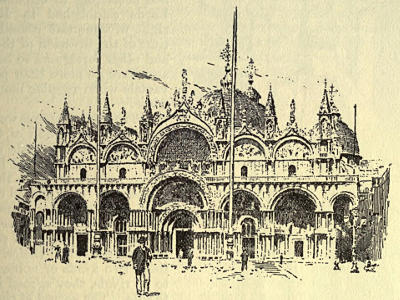
San Marco, Venice
In those states where an unfertile soil tempted but a small part of the population to agriculture, and offered no great means of power to territorial lords, these latter saw their influence decrease in proportion as other fortunes rose by means of commerce. They had, however, to maintain themselves, the resources of the military service and, above all, the faction. This was the condition of the nobles of Genoa, Pisa, and Florence. When they tried violently to reseize the power, they were suppressed and punished. Their fortresses were razed, and hatred against them was carried to an injustice by depriving them of rights which were common to all.
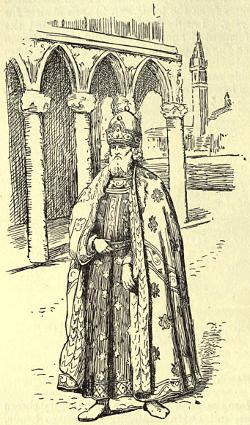
A Doge of Venice
It was in these commercial towns that the citizens, rapidly enriched by fortunate enterprise, began to compare themselves with those ancient possessors of privileges and to claim a share. A nobility sprang up of quite different origin from the first, which disputed its authority, but was disposed, like the other, to retain and abuse it. It is seen that the influence of the privileged classes was modified according to circumstances. Lords established in Italy by right of conquest ceased at the time of the invasion of the Goths and other foreigners to be rulers, and were no more than powerful vassals when regular monarchies arose.
When the commons were freed from the domination of the emperors, the feudal lords retained their power where they had sufficient land to preserve their pre-eminence. They shared or lost it from that or other causes, particularly from commerce, which brought other means of power to life which rivalled theirs. When these two kinds of nobles ceased to be rivals, they agreed in order to rule. The hatred of the people against the nobles hurried towns under the yoke of some of these powerful men, who had made it believed that they sincerely took the popular side. That is what cost the republic of Milan her proud liberty. In Genoa some ambitious nobles took the same means to preserve influence. The Dorias and Spinolas contracted an alliance with the people, and aided with feigned zeal in the introduction of democratic forms into the government. Other republics fell into an excess of distrust. Injustice nourished hatreds and deprived the state of its most illustrious citizens.b
AN EMPEROR ONCE MORE IN ITALY
On the 25th of November, 1308, the diet of Germany named Henry VII of Luxemburg as successor to Albert of Austria; and this election suddenly brought Italy back to the same struggle for her independence which she had so heroically supported against the two Fredericks. From the death of the second Frederick, fifty-eight years had passed since she had seen an emperor. Rudolf of Habsburg, Adolphus of Nassau, and Albert of Austria had too much to do in Germany to occupy themselves with this constantly agitated country, where they could demand obedience only with arms in their hands. Henry VII was a brave, wise, and just prince; but he was neither rich nor powerful. He secured to his son, by marriage, the crown of Bohemia, which had excited some jealousy among the Germans; and he believed it would be expedient, in order to avoid all quarrel in the empire, to quit it for some time. To flatter the national vanity, he determined on an expedition to Italy.
Henry, himself a Belgian, had no power but in Belgium and the provinces adjoining France. From Luxemburg he went through the county of Burgundy to Lausanne. Here he received, in the summer of 1310, the ambassadors of the Italian states, who came to do him homage. He entered Piedmont, by Mont Cenis, towards the end of September, accompanied by only two thousand cavalry, the greater part of whom were Belgians, Franc-Comtois, or Savoyards. This force would have been wholly insufficient to subdue Italy; but Henry VII presented himself there as the supporter of just rights, of order, and, to a certain degree, of liberty.
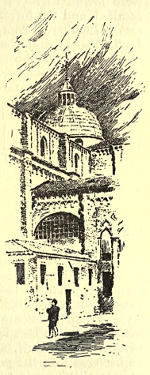
Corner of Church of San Giovanni, Venice
[1295-1311 A.D.]
The lords of all Lombardy and Piedmont came to present themselves to Henry; some at Turin, others at Asti. He received them with kindness, but declared his determination to establish legal order, such as had been settled by the Peace of Constance, in all the cities of the empire; and to name in each an imperial vicar, who should govern in concert with the municipal magistrates. Philippone di Langusco, at Pavia; Simon da Colobiano, at Vercelli; William Brusato, at Novara; Antonio Fisiraga, at Lodi, in obedience to this intimation, laid down the sovereign power. At the same time, Henry everywhere recalled the exiles, without distinction of party; at Como and Mantua, the Ghibellines; at Brescia and Piacenza, the Guelfs; leaving out, however, the exiles of Verona, a powerful city, which he did not visit, and which was governed by Can’ Grande della Scala, the most able Ghibelline captain in Italy, the best soldier, the best politician, and the person whose services and attachment the emperor most valued. The rich and populous city of Milan required also to be treated with address and consideration. The archbishop Otto Visconti had retained the principal authority in his hands to a very advanced age. But long previously to his death, which took place in 1295, he had transferred to his nephew, Matteo Visconti, the title of captain of the people, and had accustomed the Milanese to consider him as his lieutenant and successor. Matteo did, in fact, govern after him, and with almost despotic power, from 1295 to 1302. He was also named lord of several other cities of Lombardy; at the same time he strengthened his family by many rich alliances. But Visconti had not the art to conciliate either the remains of national pride, or the love of liberty which still subsisted among his subjects, or the jealousy of the other princes of Lombardy. A league to give the preponderance to the Guelf party in this province was formed by Alberto Scotto, lord of Piacenza, and by Ghiberto da Correggio, lord of Parma; they forced the Visconti to quit Milan, in 1302, and installed in their place Guido della Torre and his family, who had been exiles twenty-five years. When Henry VII presented himself before Milan, he found it governed by Guido della Torre and the Guelfs. Matteo Visconti and the Ghibellines were exiled. Henry exacted their recall; he was crowned in the church of St. Ambrose, on the 6th of January, 1311, and afterwards asked of the city a gratuity for his army of one hundred thousand florins. Till then the Italians had seen in the monarch only a just and impartial pacificator; but when he demanded money, the different parties united against him.
MILAN SEDITIONS; GENOA AND VENICE AT WAR
[1311-1312 A.D.]
A violent sedition broke forth at Milan. The Della Torres and the Guelfs were forced to leave that city. Matteo Visconti and the Ghibellines were recalled, and the former restored to absolute power. The Guelfs, too, in the rest of Lombardy, rose and took arms against the emperor. Crema, Cremona, Lodi, Brescia, and Como revolted at the same time. Henry consumed the greater part of the summer in besieging Brescia, which at last, towards the end of September, 1311, he forced to capitulate. He granted to that town equitable conditions, impatient as he was to enter Tuscany; but, although Lombardy seemed subdued to his power, he left more germs of discontent and discord in it than he had found about a year before.
Henry VII arrived with his little army at Genoa, on the 21st of October, 1311. That powerful republic now maintained at St. Jean d’Acre, at Pera opposite to Constantinople, and at Kaffa in the Black Sea, military and mercantile colonies, which made themselves respected for their valour, at the same time that they carried on the richest commerce of the Mediterranean. Several islands in the Archipelago, amongst others that of Chios, had passed in sovereignty to Genoese families. The palaces of Genoa, already called the “superb,” were the admiration of travellers. Its sanguinary rivalry with Pisa had terminated by securing to the former the empire of the Tyrrhene Sea. From that time Genoa had no other rival than Venice.
An accidental rencounter of the fleets of these two cities in the sea of Cyprus lighted up between them, in 1293, a terrible war, which for seven years stained the Mediterranean with blood, and consumed immense wealth. In 1298, the Genoese admiral Lamba Doria, meeting the Venetian commander Andrea Dandolo at Corzuola or Corcyra the Black, at the extremity of the Adriatic Gulf, burned sixty-six of his galleys, and took eighteen, which he brought into the port of Genoa, with seven thousand prisoners, suffering only twelve vessels to escape. The humbled Venetians, in the next year, asked and obtained peace. The Genoese, vanquishers in turn of the Pisans and Venetians, passed for the bravest, the most enterprising, and the most fortunate mariners of all Italy. The government of their city was entirely democratic; but the two chains of mountains which extend from Genoa, the one towards Provence, and the other towards Tuscany (called by the Italians Le Riviere di Genoa, because the foot of these mountains forms the shore of the sea), were covered with the castles of the Ligurian nobles; the peasantry were all dependent on them, and were always ready to make war for their liege lords. Four families were pre-eminent for their power and wealth—the Doria and the Spinola, Ghibellines; the Grimaldi and the Fieschi, Guelfs. These nobles, incensed against each other by hereditary enmity, had disturbed the state by so many outrages that the people adopted, with respect to them, the same policy as that of the Tuscan republics, and had entirely excluded them from the magistracy. On the other hand, they had rendered such eminent and frequent services to the republic; above all, they had produced such great naval commanders, that the people, whenever the state was in danger, had always recourse to them for the choice of an admiral.
Seduced by the glory of these chiefs, the people often afterwards shed their blood in their private quarrels; but often, also, wearied by the continual disturbances which the nobles excited, they had recourse to foreigners to subdue them to the common law. The people were in a state of irritation against the Ligurian nobles, when Henry VII arrived at Genoa, in 1311; and to oblige them to maintain a peace which they were continually breaking, the Genoese conferred on that monarch absolute authority over the republic for twenty years. But when the emperor suppressed the podesta, and then the abbate or defender of the people, and afterwards demanded of the city a gift of sixty thousand florins, the Genoese perceived that they needed a government, not only to suppress civil discord, but also to protect rights not less precious than peace; an internal fermentation of increasing danger manifested itself; and Henry was happy to quit Genoa in safety, on the 16th of February, 1312, on board a Pisan fleet, which transported him with about fifteen hundred cavalry to Tuscany.[12]
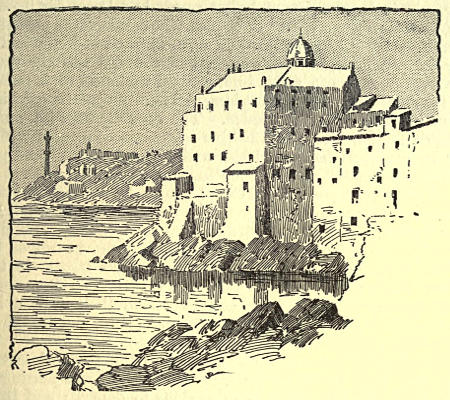
Church of St. Tommaso, Genoa
HENRY’S CORONATION AND SUDDEN DEATH
[1312-1313 A.D.]
Henry VII when he entered Italy, was impartial between the Guelfs and Ghibellines. He owed his election to the influence of the popes, and he was accompanied by cardinal legates, who were to crown him at Rome. He had no distrust either of Robert, then king of Naples, the son of Charles II, or of the Guelf cities. He had no hereditary affection for the Ghibellines, the zealous partisans of a family long extinct. He endeavoured, accordingly, to hold the balance fairly between the two parties, and to reconcile them wherever he was allowed; but experience had already taught him that the very name of elected emperor had a magic influence on the Italians, either to excite the devoted affection of the Ghibellines, or the terror and hatred of the Guelfs. It was with the latter that resistance to him had begun in the preceding year in Lombardy; and that revolt had burst forth on all sides since his departure. Robert, king of Naples, who assumed the part of champion of the Guelf party, already testified an open distrust of him; and Florence, which by its prudence, ability, wealth, and courage was the real director of that party, took arms to resist him, refused audience to his ambassadors, raised all the Guelfs of Italy against him, and finally constrained him to place that city under the ban of the empire. The republic of Pisa, on the other hand, whose affection for the Ghibelline party was connected with its hopes as well as its recollections, served him with a devotion, zeal, and prodigality which he had not met elsewhere. The Pisans had sent him, when at Lausanne, a present of sixty thousand florins, to aid him on his passage to Italy. They paid his debts at Genoa, and they gave him another present when he entered their city; finally, they placed at his disposal thirty galleys and six hundred crossbowmen, who accompanied him to Rome, where he received the golden crown of the empire from the hands of the pope’s legate, in the church of St. John Lateran, on the 29th of June, 1312. The Romans, who had taken arms against him, and had received within their walls a Neapolitan garrison, kept their gates shut during the ceremony, and would not suffer one of his soldiers to enter the city.
The coronation of the emperor at Rome was the term of service of the Germans; they took no interest afterwards in what was passing, or might be done in that country. They were anxious to depart; and Henry found himself at Tivoli, where he passed the summer, almost entirely abandoned by his transalpine soldiers. Had the Neapolitan king Robert been bolder, Henry would have been in great danger. In the autumn, however, the Ghibellines and Bianchi of central Italy rallied round him, and formed a formidable army, with which he marched to attack Florence, on the 19th of September, 1312. The Florentines, accustomed to leave their defence to mercenaries, whose valour was always ready for pay, made small account of a military courage which they saw so common among men whom they despised; but no people carried civil courage and firmness in misfortune further. Their army was soon infinitely superior in numbers to that of Henry; they carried on with perfect calmness their commerce and negotiations, as if their enemies had already departed for Germany, but they would not drive them out of their territory by giving battle; they preferred bearing patiently their depredations, and waiting till they had worn out their enthusiasm, exhausted their finances, and should depart of themselves, which they did on the 6th of January, 1313, finding they could obtain no advantage.
Henry, after giving some months of repose to his army, took the command of the militia of Pisa, and made war at their head against Lucca; at the same time, he solicited from his brother, the archbishop of Trèves, a German reinforcement, which he obtained in the following month of July. On the 5th of August, 1313, Henry VII departed from Pisa, commanding twenty-five hundred ultramontane and fifteen hundred Italian cavalry, with a proportionate number of infantry. He began his march towards Rome, having been informed that Robert, called by the Florentines to their aid, advanced with all the forces of the Guelf party to oppose him. The declining military reputation of the Neapolitans inspired the Germans with little fear, and Robert had but a small number of French cavalry to give courage to his army; but the priests and monks, animated with zeal in defence of the ancient Guelf party and the independence of the church, seconded him with their prayers, and the report soon spread that they had seconded him in another manner and in their own way. The emperor took the road of San Miniato to Castel Fiorentino, arrived at Buon Convento, twelve miles beyond Siena, and stopped there to celebrate the festival of St. Bartholomew. On the 24th of August, 1313, he received the communion from the hands of a Dominican monk, and expired a few hours afterwards. It was said the monk had mixed the juice of Napel in the consecrated cup. It was said, also, that Henry was already attacked by a malady which he concealed. A carbuncle had manifested itself below the knee; and a cold bath, which he took to calm the burning irritation, perhaps occasioned his sudden and unexpected death.
RIVAL EMPERORS; ECCLESIASTICAL DISSENSIONS
[1313-1322 A.D.]
The electors of the empire were not convoked at Frankfort to name a successor to Henry VII till ten months after his death. Ten, instead of seven princes presented themselves; two pretenders disputed the electoral rights in each of the houses of Saxony, Bohemia, and Brandenburg. The electors, divided into two colleges, named simultaneously, on the 19th of October, 1314, two emperors; the one, Ludwig IV of Bavaria; the other, Frederick III of Austria. Their rights appeared equal; their adherents in Germany were also of nearly equal strength; the sword only could decide; and war was accordingly declared and carried on till the 28th of September, 1322, when Frederick was vanquished and made prisoner at Mühldorf.
The church abstained, while the civil war lasted, from pronouncing between the two pretenders to the empire. Clement V did not witness their double election; he died on the 20th of April, 1314. It was necessary, two years afterwards, to use fraud and violence, to confine the cardinals in conclave at Lyons, for the purpose of naming his successor. They at last elected the bishop of Avignon. He was a native of Cahors, the devoted creature of King Robert of Naples, and took the name of John XXII. He was the first who made Avignon, which was his episcopal town, the residence of the Roman court, exiled from Italy. He was an intriguer, notoriously profligate, scandalously avaricious; he fancied himself, however, a philosopher, and took a part in the quarrel between the realists and nominalists; he made himself violent enemies in the schools, on the members of which he sometimes inflicted the punishment of death. While he used such violence towards his adversaries as heretics, he shook the credit of the court of Rome, by being himself accused of heresy. His great object was to raise to high temporal power the cardinal Bertrand de Poiet, whom he called his nephew, and who was believed to be his son. For that purpose he availed himself of the war between the two pretenders to the empire, regarded by him as a prolongation of the interregnum, during which he asserted all the rights of the emperors devolved on the holy see. He charged Cardinal Bertrand to exercise those rights as legate in Lombardy, crush the Ghibellines, support the Guelfs, but above all, subdue both to the authority of the church and its legate.
The cardinal Bertrand de Poiet launched his excommunications and employed the soldiers whom his father had raised for him in Provence, particularly against Matteo Visconti, lord of Milan, one of the most able and powerful of the Ghibelline chiefs. Visconti made himself beloved by the Milanese, whom he had always treated with consideration. Without being virtuous, he had preserved his reputation unstained by crime. His mind was enlightened. To a perfect knowledge of mankind, he added quick-sightedness, prompt decision, and a certain military glory, heightened by that of four sons, his faithful lieutenants, who were all distinguished among the brave. The Italians gave him the surname of Great, at a period when, it is true, they were prodigal of that epithet. Matteo Visconti, in his war with the Lombard Guelfs, took possession of Pavia, Tortona, and Alessandria. He besieged, in concert with the Genoese Ghibellines, Robert king of Naples, who had shut himself up in Genoa, desirous of making that city the fortress of the Guelfs of Lombardy. Visconti compelled the retreat of Philip of Valois, who, before he was king, had entered Italy at the solicitation of the pope, in 1320.
The following year he vanquished Raymond de Cardona, a Catalonian, and one of the pope’s generals; he persuaded Frederick of Austria, who had sent his brother to aid the pope, to recall his Germans, making him sensible it could suit neither of the pretenders to the empire to weaken the Ghibellines, who defended in Italy the interests of whoever of the two remained conqueror. But, after having made war against the church party twenty years, without ever suspecting that he betrayed his faith, for he was religious without bigotry, age awakened in him the terrors of superstition; he began to fear that the excommunications of the legate would deprive him of salvation; he abdicated in favour of his eldest son Galeazzo, and died a few weeks afterwards, on the 22nd of June, 1322. The remorse and scruples of Matteo Visconti had carried trouble and disorder into his own party, and gave boldness to that of his adversaries. A violent fermentation at Milan at length burst forth; Galeazzo was obliged to fly, and the republic was proclaimed anew; but virtue and patriotism, without which it could not subsist, were extinguished; and after a few weeks Galeazzo was recalled, and reinvested with the lordship of Milan.
The two parties of the Guelfs and Ghibellines, since the death of Henry VII, no longer nearly balanced each other in virtue, talents, and patriotism. In the beginning of their struggle, there were almost as many republics on one side as the other; and sentiments as pure and a devotion as generous equally animated the partisans of the empire and of the church. But, in the fourteenth century, the faction of the Ghibellines had become that of tyranny—of the Guelfs that of liberty. The former displayed those great military and political talents which personal ambition usually develops. In the second were to be found, almost exclusively, patriotism, and the heroism which sacrifices to it every personal interest. The republic of Pisa alone, in Italy, united the love of liberty with the sentiments of the Ghibelline party. This republic had been thunderstruck by the death of Henry VII at a moment when a career of glory and prosperity seemed to open on him. Pisa, exhausted by the prodigious efforts which she had made to serve him, was true to herself, when all the Guelfs of Tuscany rose at once, on the death of Henry, to avenge on her the terror which that monarch had inspired. She gave the command of her militia to Uguccione dà Faggiuola, a noble of the mountainous part of Romagna, which, with the March, produced the best soldiers in Italy. The Pisans, under the command of Faggiuola, obtained two signal advantages over the Guelfs. They took Lucca, on the 14th of June, 1314, while the Lucchese Guelfs and Ghibellines were engaged in battle in the streets of that city; and, on the 29th of August of the same year, they defeated, at Montecatini, the Florentines, commanded by two princes of the house of Naples, and seconded by all the Guelfs of Tuscany and Romagna. But the Pisans soon perceived that they were fighting, not for themselves, but for the captain whom they had chosen. Almost immediately after his victory, he began to exercise an insupportable tyranny over Pisa and Lucca. Fearing much more the citizens of these republics than the enemies of the states, he, on the slightest suspicion, employed the utmost severity against all the most illustrious families. At Lucca, he threw into a dungeon Castruccio Castracani, the most distinguished of the Ghibelline nobles, who had recently returned to that city with a brilliant reputation, acquired in the wars of France and Lombardy. A simultaneous insurrection at Lucca and Pisa, on the 10th of April, 1316, delivered these cities from Uguccione dà Faggiuola and his son.d
The Pisans put Uguccione’s partisans to death, and gave the government to Count Gaddo della Gherardesca. This news arrived at Lucca when the Lucchese were tumultuously demanding the liberty of Castruccio. Uguccione not daring to oppose the general wish, Castruccio was taken from prison and presented to the public loaded with chains. At this spectacle the people grew still more furious; Uguccione was obliged to fly; and the chains being taken off Castruccio, the latter, by a rare good fortune, was declared lord of Lucca on the very day which had been destined for his death.e
CASTRUCCIO CASTRACANI
Castruccio was the scion of a Ghibelline stock, and was devoted to the Ghibelline cause; for four years successively he was freely elected to command the Lucchese with almost sovereign power. He knew men and how to govern them; knew what enmities to despise or punish, and what friendships to win and retain. As a daring soldier and skilful general he was beloved by the troops, for he was not blind to merit and knew how to reward it, but cared little about the morality of his followers if they only did their duty and quietly submitted to the rigid discipline that he established and enforced. No man was more beloved by the people or more generally popular with every class of citizen; they admired his talents and were proud of his fame. In 1320 he felt so confident of his position in the public mind that he ventured to expel the Avocati, who with about 180 great Guelfic families now bid adieu to their country, and then boldly demanded the supreme authority; out of 210 senators there was but one voice against him, and the people unanimously confirmed this election. He was therefore a legitimate ruler. His economical management of the public revenue was exemplary and productive; he had amassed great treasure, and his system of military honours and rewards heightened and improved the warlike spirit of the people until it had acquired a more professional character. All the neighbouring predaceous chiefs were allured to his standard by the hope of future conquests, and rough and unscrupulous as they were he made them all bend to his discipline.
Thus prepared on every hand to begin that career of ambition to which he felt himself more than equal, Matteo Visconti’s proposal was warmly received, and Philip of Valois’ expedition with the ready assistance of the Guelfic league were together considered an infringement of the general peace, or at least a sufficient excuse for retaliation on the part of the Ghibellines. Uguccione Faggiuola was dead, a circumstance that heightened the anxiety of both Castruccio and the Florentines, particularly the latter, whose dread of this veteran chief, blinding them as it did to the dangerous ambition of his successor, had never ceased since the disaster of Montecatini.
[1320-1321 A.D.]
Such was the state of affairs in April, 1320, when Castruccio Castracani with some Pisan auxiliaries suddenly occupying Cappiano, Montefalcone, and the bridges of the Gusciano, broke into the Florentine territory carrying death and devastation as far as Cerreto Guidi, Vinci, and Empoli; then, getting possession of Santa Maria a Monte by treachery, returned in triumph to Lucca. Afterwards, invading Lunigiana and Garfagnana, he dispossessed Spinetto Malespina of several places necessary for his own military operations and then marched with all his force to aid the siege of Genoa. This city still maintained a fierce and bloody struggle with its own exiles and the Lombard Ghibellines; war raged not only round the walls but throughout the whole Riviera, or coast district; it extended to Sicily and Naples and involved even more distant countries in its action, so that the siege of Troy itself, as Villanid asserts, was hardly equal to it for heroic deeds, marvellous exploits, and hard-fought battles by land and water, without any cessation either in summer or winter.
The Florentines determined to prevent a junction that would probably have settled the fate of Genoa, therefore made a powerful diversion in the Lucchese states which compelled Castruccio to return ere he had joined the besiegers; avoiding an action they retreated to the frontier at Fucecchio while the enemy halted in front of Cappiano, both armies remaining nearly inactive until the advancing season drove them into winter quarters. To make amends for this inglorious campaign, more vigorous measures were pursued and an alliance was concluded with the marquis Spinetto Malespina, who, although a Ghibelline, had been too much injured by Castruccio on account of his friendship for Uguccione not to seize the first opportunity of revenge. Florentine troops were despatched to his aid, yet Castruccio was not apprehensive of anything in that quarter, but prepared with the help of a powerful body of Lombard Ghibellines for a more serious struggle on the side of Florence and soon marched to raise the siege of Monte Vettolini at the head of sixteen hundred men-at-arms. The Florentines, having only half that number, immediately retired and allowed him to devastate their territory with impunity for the last twenty days of June, after which he retired to chastise the Malespini in Lunigiana.
Discontent ran high in Florence and the retiring seigniory were much censured for their feeble conduct; the Agubbio faction was still powerful, and probably the inconvenience of a fluctuating administration was beginning to be felt, as the foreign affairs with a more complex character embraced a wider circle; to remedy this, twelve counsellors, two for each sesto under the denomination of “Buonuomini” were added to the new seigniory, but to continue six months in office instead of two, and without whose sanction nothing important could be undertaken. To check also the increasing intimacy, and consequent favouritism between citizens and foreign officers of state, which led to great abuse, it was decreed that no stranger who brought a kinsman in his suite could have a place in the commonwealth, and that until ten years from his resignation of office he could not be re-elected. Some taxes were then reduced, the gold and silver currency reformed, and preparations made for a fresh campaign. Azzo of Brescia was appointed captain-general; one hundred and sixteen knights and one hundred and sixty mounted crossbowmen were enlisted and under the command of Jacopo da Fontana soon checked Castruccio’s incursions so as to protect the line of the Gusciana. But Philip of Valois’ expedition had in the meanwhile failed, and in Lombardy the Tuscans were defeated at Bardo in the Val-di-Taro, their captain the marquis of Cavalcabò was killed, Cremona recaptured, and Visconti everywhere victorious.
[1321-1323 A.D.]
In Florence one of the first public measures in 1321 was to complete the whole circuit of public walls and strengthen it by flanking towers fifty-five feet high at regular intervals of more than one hundred and eighty feet apart; a work that was doubtless accelerated by their apprehension of Castruccio, which had now taken a more alarming character from some recent proceedings at Pistoia.
This ever-vexed city, harassed by external war and inward troubles, finally elected the abbate da Pacciana de’ Tedici, a tool of Castruccio, as their ruler; he was a weak intriguing man who, catching at a popular opinion, was suddenly floated into power by the stormy multitude without ballast enough to steady him. Castruccio made good use of him, and a truce was suddenly concluded with that leader against all the influence of Florence, by which, according to Villanid (though unnoticed by the anonymous author of the Istorie Pistolese),f an annual tribute of three thousand florins was to be paid by Pistoia. The dread of Castruccio was rapidly and generally spreading.
FLORENCE MENACED
He fortified Lucca, and prepared to invade Florentine territory. The Florentines sent a strong detachment of troops into Lombardy on condition that in the following summer the Genoese and other Guelfic powers were to attack Lucca on every side and annihilate the rising power of Castruccio. Scarcely had an army been assembled for this purpose, when intelligence arrived that their principal condottiere, Jacopo di Fontanabuona, had passed over with all his following to the enemy; he had been commissioned to make himself master of Buggiano and other places by treachery, but failed, and soon after joined Castruccio with two hundred men-at-arms.
Castruccio with this reinforcement and the possession of his enemy’s secrets crossed the Gusciano on the 13th of June, 1323, attacked Fucecchio and other places, ravaged the surrounding country, then passed the Arno, devastated the territory of San Miniato and Montepopoli with all the vale of Elsa, and marched quietly back to Lucca. On July 1st he suddenly reappeared in front of Prato, only ten miles from the capital, with six hundred men-at-arms and four thousand infantry; the citizens sent in terror to Florence for help, but paralysed by Fontanabuona’s treachery she was nearly destitute of regular troops. The citizens however had not quite forgotten the use of arms, and their spirit was still high; the shops were immediately closed, a candle was placed at the Prato gate, and every individual liable to serve summoned to the ranks ere it burned out, under the penalty of losing a limb; a proclamation being issued to announce that all exiles who instantly joined the army would be pardoned and restored to their country. By these prompt measures, twenty-five hundred men-at-arms and twenty thousand infantry were in the field round Prato on the 2nd of July, only one day after Castruccio’s appearance, four thousand of whom were exiles!
[1323-1324 A.D.]
Castruccio’s rash advance with so small a force might have ended disastrously if the Florentines had been well commanded; but he retired in the night and made an unmolested retreat to Serravalle, the discord in the Florentine camp, an offset from civil dissension, having saved him. Thus ended this singular campaign in which the army scarcely saw an enemy, but which brought back danger and revolution to the state. The Florentines now added three subalterns (pennoniere) to each urban company, so that the whole force became infinitely more flexible and divisible and better adapted to real service.
He soon recommenced his successful incursions, but was generally too weak to oppose the united strength of Florence; the moral effect of his character was however very imposing in both states and nothing was too daring either for his arms or conscience. His Ghibelline allies the Pisans were deeply engaged in war with the king of Aragon for the defence of Sardinia, which offered him a favourable occasion as he thought of becoming their master; the conspiracy was however discovered; the conspirator Betto or Benedetto Malepra de’ Lanfranchi with many others lost his head; all friendship or alliance with Lucca was renounced by Pisa, and 10,000 golden florins were offered for the head of Castruccio. About two months afterwards he suddenly left his capital at the head of a small detachment on the 19th of December, and by the treachery of an inhabitant of Fucecchio was admitted at night into the town during a deluge of rain, which at first concealed his aggression; the subsequent struggle was fierce and bloody; a great part of the place was taken, but alarm fires on the towers brought strong reinforcements from the neighbouring garrisons; Castruccio held on with desperate resolution against an overwhelming force of soldiers and citizens until, wounded, fatigued, and hopeless of success, he sullenly retired with the loss of banners and horses, but still unmolested; for the glory of repulsing him was deemed sufficient, and the habitual dread of his prowess left no appetite for a second encounter.
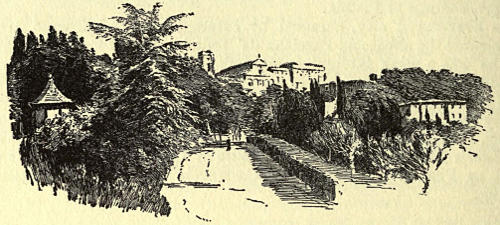
San Miniato, Florence
Nothing of importance occurred between Castruccio and the Florentines in the following year, for the former was busy with his intrigues against Pisa and Pistoia, and the latter employed reducing some petty chieftains in the Mugello, but still more seriously on the side of Arezzo where the bishop was rapidly gaining ground against the Guelfs. Five hundred men-at-arms were engaged in France, and other preparations making for the day of battle which the Florentines foresaw must come before Castruccio could be arrested in the rapid course of his ambition; a new confederacy was therefore formed in March between Florence, Bologna, Siena, Perugia, Orvieto, and Agubbio; with other communities and Guelfic lords, for the recovery of Città di Castello, which was to be effected by a combined army of three thousand men-at-arms levied for three years, a great part of which was maintained by the Florentines.
[1324-1325 A.D.]
Castruccio meanwhile had moved towards the Pistoian Mountains, and repairing the castle of Brandelli, whence there was a view of both Pistoia and Florence, called it Bellosguardo and gazed with a longing eye on either city. One was only his own in perspective, the other was almost in his grasp; and Filippo Tedici, who had driven his uncle from the government of Pistoia, and was in treaty with Castruccio and Florence, pretending the greatest alarm, demanded assistance of the latter, with whose aid he hoped to better his bargain. A body of troops was directly sent under command of the podesta, but discovering his object, this officer returned in disgust; upon which he made his terms with Castruccio, and Pistoia was suffered for a while to exist as an independent state. Florence had attempted to gain it by treachery but failed, and Castruccio, tired of Filippo’s intrigues, offered him 10,000 florins and his daughter Dialta in marriage for immediate possession of the city. This secured Filippo, who before daylight on the 5th of May, 1325, opened a gate to the Lucchese general; but the latter distrusting his ally would not enter until he had actually unhinged it, and then took possession of the place in the manner of the time by scouring the streets at the head of his cavalry and trampling upon all that came in his way.
The fall of Pistoia was an event of great importance; equally distant from Florence and Lucca and on the confines of both, it formed a rallying-point for the armies of either, and its friendship or enmity had considerable influence on every operation of the war; hence the eagerness of Florence at all times to preserve her authority there, and hence the general consternation when intelligence of its capture arrived at the capital.
THE FLORENTINE ARMY UNDER RAYMOND OF CARDONA
She might have bought it for the same price or even less than Castruccio, because Filippo felt himself too insecure not to make both friends and money by the sacrifice of his country; but failing, either from want of skill or perhaps dishonesty in her agents, she repeated her attempts to surprise the place, thus forcing him into the arms of Castruccio, and he poisoned his own wife to complete the union. Rumours of this event reached Florence while the magistrates were engaged in public festivities on the occasion of two foreign officers of state being dubbed knights by the republic, and the banquet was going on in the church of San Piero Scheraggio when the news was confirmed. In a moment the whole assembly fell into confusion, the tables were overturned, and every man was immediately armed and in his saddle; believing that a part of the town might still hold out, a rapid march was made as far as Prato, where hearing the whole truth they returned dejected and mortified to Florence. The following day brought some consolation in the arrival of Raymond of Cardona, who had been sent in the preceding November from Milan on a mission to Rome; he had promised to return, but was absolved by the pope and sent instantly to Florence as commander-in-chief of the republican forces. His presence gave new spirit to the people, which was increased by the capture of Artimino on the 22nd of May.
One of the finest armies ever assembled by the republic soon took the field at the enormous expense of 3000 florins a day; the city bells tolled as a declaration of war; the public standard waved over San Piero a Monticelli; the soldati or mercenary troops first moved to Prato, and the cavallate with all the mass of civic infantry joined them on the following morning. One of the city bells which had been captured at Montale broke while in the act of sounding; three weeks before there had been a violent earthquake in Florence, and the following evening a broad stream of fiery vapour flared over the city. All these circumstances were dwelt upon with anxious and gloomy foreboding by numbers of citizens over whose mind the talents and success of Castruccio had gained a superstitious ascendency. The cavalry consisted of 500 gentlemen of the highest rank in Florence under the name cavallate or men-at-arms on horseback, all magnificently equipped and a hundred of them mounted on destrieri, the largest and finest war-horses of the time and which few could afford to purchase; none cost less than 150 golden florins [nearly £200 or $1000], yet there were 300 of these, natives and strangers, in the Florentine army. Besides the cavallate there were 1500 foreign cavalry in the pay of Florence, of whom 800 were French and German gentlemen of the highest rank and distinction; the general-in-chief, Raymond of Cardona, a Spanish condottiere, and his lieutenant, Borneo of Burgundy, were followed by a troop of 230 Catalan and Burgundian cavalry, and lastly there were 450 Gascons, French, Flemings, Italians, and men of Provence picked with great care from the veteran companies of Masnadieri, and all experienced soldiers. Fifteen thousand well-appointed infantry, between citizens and rural troops, completed the personal force of this fine army, and 800 canvas pavilions and other great tents, with 6000 ronzini and baggage horses attended its movements.
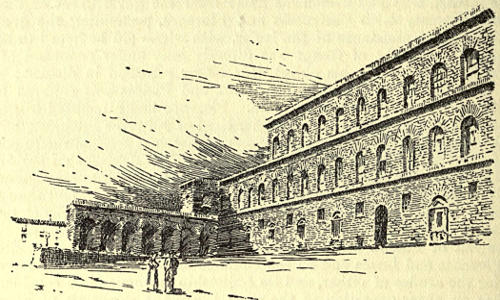
The Pitti Palace, Florence
With the exception of 200 Sienese cavalry no allies had yet joined, but hostilities commenced on the 17th of June by devastating the Pistoian territory up to the gates of the capital, capturing many small places, insulting Castruccio, who was in that city, by running for the Palio under its walls, and sending him repeated challenges to battle. Castruccio dryly answered that it was not the right time, and the Florentines marched directly to besiege Tizzano, a strong town about seven miles from Pistoia on the road to Florence; there every preparation was apparently made for a regular siege, while Cardona on the 9th of July sent his lieutenant Borneo with 500 picked men towards Fucecchio; and to engage Castruccio’s attention a strong detachment was at the same time directed to alarm Pistoia and the surrounding country. Borneo was joined at Fucecchio by 150 Lucchese exiles and a numerous infantry, besides some reinforcements from the garrisons in Val d’Arno. Carrying with him a pontoon bridge, apparently the first noticed by the early historians of these campaigns, he threw it silently over the Gusciana at Rosaiuolo during the night, and the whole division crossed that river without being perceived by the garrisons at the bridge of Cappiano or Montefalcone, scarcely a mile above and below the point of passage.
RAYMOND TEMPORISES
On hearing this, Raymond suddenly quitted Tizzano, passed the lofty range of Monte Albano, and by night-fall had joined his detachment and invested the fortified bridge and fortress of Cappiano. This was an unexpected stroke for the Lucchese general, who believed himself safe in that quarter, and would appear to have doubted the possibility of so sudden a passage of the Gusciana by any soldiers; so that this operation increased the fame of Cardona, the confidence of the league, and the spirit of the Florentines. His frontier line being thus broken, Castruccio immediately quitted Pistoia, and entering the Val di Nievole threw his army in position amongst the hills above Vivinaia, which he endeavoured to strengthen while he pressed for the co-operation of all his friends; Pisa disregarded this summons in consequence of his recent treachery; but from Lucca, Arezzo, La Marca, Romagna, and the Maremma he assembled thirteen hundred men-at-arms and a numerous infantry, with which he reinforced all his positions from Vivinaia to Porcari, strengthening the latter with additional works and troops to secure his communications with Lucca; and finally cut a trench from the hills to the marsh of Bientina which was guarded with the utmost solicitude.
The bridge of Cappiano was taken by Cardona on the 13th of July; the town itself next fell; two days after, Montefalcone was summoned and reduced in eight days, and thus the whole line of the Gusciana was cleared of the enemy. This rapid success brought numerous reinforcements from Siena, Perugia, Bologna, Agubbio, Grosseto, Montepulciano, Chiusi, Colle, San Gimignano, Volterra, San Miniato, Faenza, Imola, Count Battifolle, and the exiles from Lucca and Pistoia; all eager to assist in overwhelming this formidable chieftain; so that the army had already swelled to 3454 men-at-arms and a proportionate number of infantry. With this immense force Cardona advanced, and on the 3rd of August invested the strong fortress of Altopascio, which crowns a hill rising from the marshes north of the Bientina Lake; the place, although impregnable to an assault, was so damaged by the battering engines and so poisoned by heat, sickness, and the horrid stench of filthy matter which it was then usual to cast into besieged towns, that on hearing of the discomfiture of a Lucchese detachment sent from Pistoia to make a diversion towards Florence it immediately surrendered.
The capture of this place was succeeded by doubts, discussion, and delay; the troops had become sickly from heats and malaria, and the army proportionably reduced; discontent and intrigues were plentiful, and Castruccio, quick in the use of corruption, seized the favourable moment to bribe two Frenchmen of high rank, but was detected and baffled. Cardona himself, although proof against Castruccio’s temptations, was false and ambitious; he had seen Florence in periods of distress repeatedly surrender her liberties, and determined by getting her into difficulties to try if he also could not become her master; the fall of Altopascio elated him, his pockets were filled and his camp emptied by the bribes of rich citizens who, tired of a long campaign and alarmed at increasing sickness, cheerfully exchanged their money for leave of absence and the pleasures of the capital. The cavalry, being generally composed of these, was reduced along with the rest of the army to almost half its original number, and Cardona wished this; for his thoughts ran high, and hence his delays, discussions, and repeated demands to be invested with the same power in the city that he already exercised in the army; in order, as he said, to insure the necessary obedience. But finding that the government would not listen to his request, he lay idle amongst the Bientina marshes while Castruccio, with the eyes and activity of a lynx, strained every nerve to catch him in his toils, and succeeded; so that he who at first neglected the means of victory through bad faith, was at last through incapacity unable to save himself from destruction. Dissension arose both in the camp and city about the propriety of withdrawing the army to a more healthy quarter or boldly pushing on to Lucca; the most cautious advised the former course from a suspicion of the general’s views and the state of the troops; but their opponents prevailed both in camp and council, some of them even favouring Cardona’s wildest speculations. It was therefore resolved to advance towards Lucca; but instead of cutting through the enemy’s position while he was weak, by a direct movement, as might have been effected, a bad unhealthy post was occupied on the edge of the Sesto marsh, which decimated the troops while it still more augmented the gains of the general.
A BRILLIANT SKIRMISH
Castruccio did not fail to profit by this delay, although his army also had decreased from want of funds and sickness, and therefore could not long maintain its position without reinforcements, but he discovered in that of the enemy the seeds of certain victory. By reason, money, and promises he had already prevailed on Galeazzo Visconti to send his son with eight hundred horse into Tuscany; and with two hundred more from Passerino, lord of Mantua and Modena, he hoped soon to recover his ascendency; in the meanwhile his situation was very precarious, for Cardona by a vigorous effort might have cut his line of communication; the latter, now sensible of his errors and probably urged by the general discontent, had actually detached a hundred men-at-arms and a body of pioneers to clear a passage over the mountain. Castruccio’s outposts soon checked their progress and were followed by a stronger body then descending the hill in order of battle; skirmishing began, and voluntary reinforcements pushed out unordered from the Florentine camp below. It was entirely an encounter of cavalry; the green slopes of the hills were covered with armed and plumed knights, the whole scene resembled a tournament rather than a real battle and the effect is described as beautiful. Each party was broken four different times and each reuniting in compact order returned unconquered to the charge; many lances were shivered, many gentlemen unhorsed, and arms and wounded and expiring men lay scattered on the mountain side. The Florentines with only half its numbers for three hours sustained and repulsed the charges of Castruccio’s chivalry, and might have finally prevailed if they had been well supported; but Cardona in complete order of battle looked on inactively, his troops cooped up in a narrow angle of the plain below whence they could not move without incurring danger. This did not escape Castruccio who therefore pushed boldly on with augmenting numbers and, though unhorsed by a German knight, wounded, and some of his bravest followers slain, by night-fall had succeeded in driving the enemy back to their entrenchments in face of a much superior army.
Forty men-at-arms were either killed or taken on the side of Florence, and many wounded, but all in front; for the Florentines did not turn, but battled proudly and retreated sullenly, more angry with their own commander than with the enemy; they made no prisoners but must have smote well in the conflict, for no less than a hundred of their opponents’ horses had galloped to the plain with empty saddles from the field of battle.
THE BATTLE OF ALTOPASCIO
The trumpets of either host answered each other in defiance until after dark, and neither choosing to own a defeat both remained under arms long after night set in; but the Florentines lost their spirit from that day’s fight and no longer trusted either in the faith or talents of their general. Castruccio, being anxious to keep the Spaniard in his difficult position, directed the governors of several towns in the Val di Nievole to entangle him in a fictitious intrigue with the expectation of their surrender, and Cardona, thus duped, notwithstanding every warning, chose to continue in this state of vain inactivity.
On hearing of Azzo Visconti’s arrival at Lucca with eight hundred men-at-arms he took fright and hastily retreated to Altopascio, whilst Castruccio, apprehensive of his escape, hurried back to the capital to accelerate the march of the Lombards. Visconti was so unwilling to proceed without repose or money that it required all the influence of Castruccio’s wife, seconded by the blandishments of the most beautiful women in Lucca and the payment of 6000 florins, to gain his promise of marching on the following morning; Castruccio then departed, leaving to the women the care of keeping the young Milanese chieftain to his engagement. On the morning of the 23rd of November the allied army paraded ostentatiously in front of Castruccio’s position, with flying colours and sound of many trumpets, daring him as it were to battle, and the latter fearful of losing such a moment sent out some troops to amuse them with a prospect of victory while he kept his main body in hand awaiting the junction of Visconti. This was completed at nine in the morning, when Castruccio was seen once more descending from the hills with three-and-twenty hundred men-at-arms in majestic movement towards the plain, while the greater part of his infantry remained in the mountain and took no part in the events of this day. An advanced squadron of 150 French and Italian gentlemen began the fight by a bold charge directly through Visconti’s line; but the second line or main body of Feditori, consisting of seven hundred horsemen under Borneo of Burgundy who had been corrupted by Azzo or Castruccio, turned when it was time to charge and fled from the encounter. The whole army, whose confidence was already shaken, were confounded and some others began to fly; but had Raymond promptly moved forward to the support of his first line which had charged so effectively, the battle might still have been maintained on equal terms; instead of which he remained motionless and added to the general consternation.
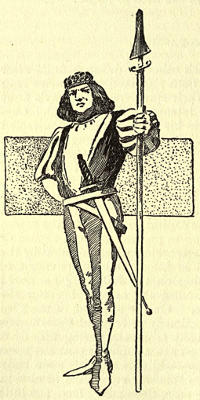
Italian Soldier of the Fourteenth Century
Presently the main body of cavalry, scarcely tarrying to exchange a single lance-thrust, hurried off in universal confusion, leaving everything to the infantry who still maintained their ground with undaunted courage; but neither their arms nor discipline was calculated to stand alone against such masses of man and steel as came successively upon them, and after an obstinate resistance they also were discomfited. The battle lasted but a short time, few were killed in the fight but many in the pursuit, for Castruccio instantly sent on a detachment to Cappiano, took possession of the bridge which had already been abandoned, and cut off all direct means of escape. The slaughter was therefore considerable but uncertain; the prisoners, amongst whom were Raymond of Cardona and his son, were numerous; the carroccio, the martinella, with all the public standards, banners, and baggage of the army, were taken; Cappiano and Montefalcone soon capitulated, and Altopascio not many days after. Thus did the tide of fortune turn and bear forward Castruccio to prouder hopes and higher dignities. On the 27th of September his whole army assembled at Pistoia and was reinforced by that garrison, while Castruccio in all the confidence of victory dismantled the bridge and forts of Cappiano and Montefalcone, and secure in the possession of Pistoia left the rest of his frontier open to the Florentines, whose territory he ravaged for nearly seven weeks without interruption. Policy and necessity dictated this course, for his funds were exhausted, Azzo Visconti was still unsatisfied, and the army in arrears of pay; so that nothing but the plunder of Florentine citizens could supply his present necessities. Carmignano was his first conquest; he then marched to Lecore, to Signa, Campi, Brozzi, and Guaracchi; all were captured or fell a prey to flames and plunder; Peretola, within two miles of Florence, became for a while his headquarters, while from the Arno to the mountains he ravaged all the plain, a plain covered, then as now, but more richly, with magnificent villas and beautiful gardens, the delight of the citizens and the admiration of the world. All was destroyed. The wealth was plundered, the monuments of then reviving art were carried away and reserved for the conqueror’s triumph. Games were celebrated and races run on the very spot time out of mind reserved by the Florentines for their public spectacles. A course of horsemen began the sports; that of footmen followed; and afterwards, to make the insult still more disgusting, a bevy of common prostitutes ran together in mockery, deriding the impotence of the Florentines, not one of whom had the courage to come forth and check these insulting spectacles. Yet the city was full of troops, and thousands had escaped from the fight, but the star of Castruccio shed its influence over them; their spirit was subdued, their courage wasted, and distrust of those great families whose kinsmen were prisoners to Castruccio, lest they should treat with him secretly, completely distracted their judgment. After another course of devastation the invaders reassembled on the 26th of October and repeated their insults to please Azzo Visconti, who thus revenged a similar proceeding of the Florentine auxiliaries, not long before, under the walls of Milan.
Castruccio next occupied Signa, as it gave him command of the Arno at this point with a free entrance into the Val di Pesa and all the southern country; he therefore reinforced and strengthened it, coined silver money there with the imperial image as an act of high sovereignty, and passed them current under the name of Castruccini.
CASTRUCCIO ADDS INSULT TO INJURY
Florence was during this time in a painful state of suspicion and dismay; all the prisoners’ kinsmen were regarded with distrust and deprived of office both within and without the city; half the Contado was a desert, its starving inhabitants huddled together in the capital where a wide-spreading mortality was the natural consequence. Deaths were so frequent that the public crier, whose business it was to proclaim the decease of a citizen according to ancient custom, was prohibited from exercising his calling during the continuance of the malady. Every precaution was adopted to secure the city; the walls were strengthened, San Miniato a Monte was fortified, and even the citadel of Fiesole repaired from mere apprehension of Castruccio, who threatened to restore it and beleaguer Florence; and this he probably would have done had not the bishop of Arezzo and the Ubaldini from incipient jealousy refused to lend their assistance. Fearful of internal war, all exiles but the regular Escettati of 1311 were restored to their country on payment of a trifling impost; assistance was demanded from King Robert and the allies, but with little success, for through terror of Castruccio only Colle and San Miniato Tedesco answered the call. King Robert afterwards sent some trifling aid; but still Florence did not despair, and a bold attempt was made to cut off Castruccio’s whole army in a pass of the Val di Marina near Calenzano. New taxes were imposed to the annual amount of 180,000 florins beyond the ordinary revenue; levies were made in Mantua and in Germany; Monte Buoni and other important posts were fortified to protect the district; yet in the middle of all this danger two hundred cavalry were magnanimously despatched to Bologna, which was sorely pressed, and its army soon after defeated at Monteveglio by Passerino lord of Mantua, with the assistance of Azzo Visconti and his followers, fresh from their Tuscan victories.
But this Milanese chief, ere he finally quitted Tuscany, offered a parting insult to Florence by holding public games in the very bed of the Arno. He then returned with 25,000 florins as his share of the general plunder, while Castruccio, loaded with prisoners and booty, resolved to enter his capital in triumph like a Roman conqueror.
The fame of this event attracted a crowd of spectators from all parts of Italy, eager to witness the revival of an ancient ceremony but more eager to behold a hero whose reputation had already become familiar to the world. On the 10th of November, being the festival of St. Martin, Castruccio made this triumphal entry into Lucca; not in a car, but on a magnificent courser, and at some distance from the gates a solemn procession of the clergy, nobility, and almost all the women of exalted rank in the city received him like a royal personage. At the head of his procession were the prisoners of least note with uncovered heads, and arms crossed upon the breast, stooping as it were in humble supplication for the mercy of their emperor; next came the Florentine carroccio rolling heavily along, drawn by the same oxen and decked with the same trappings they had borne in the field, and overhung by the reversed and now degraded standard of that republic. Then followed other Florentine banners, those of the Guelf party and the kings of Naples, with flags and pennons of inferior note, and various communities, all trailing in the dirt and as it were sweeping the path of the conqueror. Immediately after this mortifying spectacle walked the same chiefs who had so often borne these flags to victory. Here Raymond of Cardona also had full leisure to contemplate the effects of his own dishonesty; and the gallant Urlimbach, a German knight who had unhorsed Castruccio, could also muse on the instability of fortune, as despoiled of arms and spurs he swelled the train of the victor. A multitude of noble captives followed in this insulting procession, which was closed by Castruccio and his legions in all the pride and insolence of victory. But nothing mortified the prisoners so much as being compelled to bear large waxen torches as offerings to St. Martin, the tutelar saint of Lucca and dear to her troops because of the Bacchanalian license usual at his festival on pretence of tasting the various flavours of the new-made wines, and because the saint himself had once been a soldier.
FLORENCE IN DESPAIR CALLS ON THE DUKE OF CALABRIA
Thus bearded at their very gates, insulted, ridiculed, the country a desert, Signa occupied by the enemy, Prato at his mercy, Montemurlo still unsuccoured and ready to fall, the Bolognese army, their only bulwark against Lombardy, defeated, their best chieftains prisoners, their army diminished, their expenses increased, their allies daunted, death raging within the city and destruction without, all things adverse to them, and fortune courting their enemies—under such a pressure the people at last gave way, and despair once more compelled them to a temporary surrender of their independence. Charles duke of Calabria was therefore, and perhaps not unexpectedly, offered the lordship of Florence for ten years on certain conditions.
It was decreed that the prince should remain for thirty months consecutively within the Florentine state, or at war in the enemy’s dominions, and the three succeeding summer months in addition should hostilities continue. That in time of war he was to maintain one thousand transalpine cavalry and have an annual allowance from the republic of 200,000 golden florins; half that sum in peace, with the obligation of maintaining only 450 men-at-arms. If in time of peace the duke wished to be absent, he was bound to appoint a lieutenant of the blood royal or of some other great and powerful family; also to nominate a vicar for the administration of justice, who was not to alter any part of the government, but on the contrary defend and maintain the priors and gonfalonier, the executor of the ordinances of justice, and the sixteen chiefs of companies. This decree, which passed on the 23rd of December, 1325, was despatched with a solemn embassy to Naples and finished the transactions of that unfortunate year, which began so brightly for the Florentines.
[1325-1326 A.D.]
Until the dictator’s arrival Florence gave the chief command of her army to Pierre de Narsi, a French knight of exalted rank who was made prisoner at Altopascio; he had just been ransomed, and smarting under the indignity of Castruccio’s triumph sought revenge and distinction ere he was compelled to relinquish his brief and hazardous dignity. Not being able to save Montemurlo which, after a courageous resistance, honourably capitulated on the 8th of January, he exerted himself less worthily by trying to raise insurrections at Signa and Carmignano, and even attempting the life of Castruccio. But his effort came to nothing.
CHARLES AND HIS ARMY
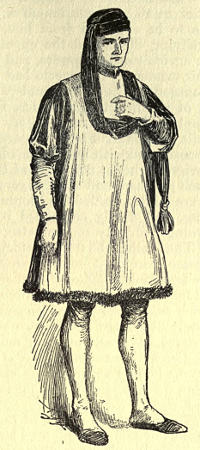
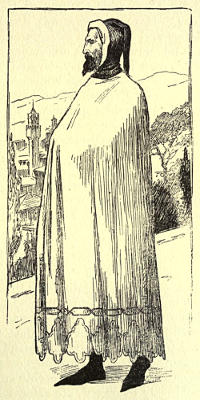
A Florentine Citizen of the Fourteenth Century
The duke of Calabria was detained for some months, but on the 30th of July he entered Florence followed by eleven hundred men-at-arms, one hundred of whom were knights of the Golden Spur. He was lodged in the podesta’s palace from whence the seat of justice was purposely, perhaps derisively removed, and formally acknowledged as lord of the Florentine Republic. It was the mark of misfortune, the stigma of disgrace; yet it excited the admiration of Italy; for Italy beheld the Florentine people, masters only of a small and not a very fruitful territory, after their repeated misfortunes, after so many defeats, such reverses and so much treasure lost—nay, at the very moment when they seemed to totter on the very brink of ruin, suddenly rise in their strength and like a giant refreshed with wine, by the power of their own resources as it were, command the service of so great a prince, and an army such as had never before been seen in Florence!
There were no less than two thousand men-at-arms assembled, most of them belonging to the highest ranks of society, independent of the cardinal legate’s court and followers which were far from trifling; and without reckoning the Florentine chivalry or a single knight of the Guelfic confederacy. So vast a development of national resources was the more remarkable because at this very time the ancient bank of the Scali and Amieri, which had already endured for 120 years with undiminished reputation, failed for the enormous sum of 400,000 florins, which being for the most part due in the city of Florence shook the republic to its centre and, excepting bloodshed, was considered equally ruinous with the battle of Altopascio itself.
The several contingents of the Guelfic league were afterwards summoned, and increased this fine army to 3450 men-at-arms besides the Florentine cavallate, never less than five hundred men, and a selection of some of the best and bravest infantry in Tuscany. Sixty thousand florins were immediately raised by a partial and extraordinary tax on the richest citizens, and every diligence was used by the Florentines to insure success; yet this great army remained entirely passive, and they had the mortification to see their time and treasure idly wasted by him to whom they had surrendered their liberties in the expectation of a very different result. Seeing that nothing was to be expected from him, the Florentines contented themselves with fortifying Signa and the opposite town of Gangalandi in order to protect the agricultural labourers, and then quietly awaited the movements of both their masters. Castruccio had already driven Spinetto Malaspina from his dominions in Lunigiana and compelled him to take refuge with the protector of all unfortunate exiles, Cane della Scala; but the duke of Calabria tempted him once more to try his fortune by the invasion of that province while he with the Florentine army marched on Pistoia. Both these plans were executed and with more hope of success because the towns of Mammiano and Gavignana in the mountain of Pistoia had just revolted. Castruccio was not much alarmed, and though very ill, reduced both places in the middle of a severe winter, baffled the Florentine army which attempted in vain to relieve them, and finally compelled it to return in disgrace to the capital; then turning suddenly on Spinetto, once more drove him into exile.
Thus failed the first dilatory attempt of this brilliant army, and Florence became more desponding than ever; those that formerly used to tremble at the formidable name of Uguccione now acknowledged that he was only a sudden and startling noise, but that Castruccio was the thunderbolt itself which had stricken and consumed their country. The citizens were now utterly distracted and knew not where to turn, such was the confusion and so great the waste of men, money, and credit occasioned by his uncommon abilities and continual success; for in the midst of all Castruccio’s good fortune he had never, it was said, committed a rash or hazardous act; every event was calculated, few mistakes made, and victory attended him as his shadow.
To prevent the people of Lunigiana from revolting he destroyed all their fenced towns and augmented his army with the garrisons; the works of Montale near Pistoia were dismantled, and Montefalcone shared the same fate; for he used to say that those strongholds were the best which could make long marches and keep themselves near or distant according as they were wanted. The awe which his character impressed on the Guelfic lords of Italy caused Robert to be blamed for opposing the inexperience of his son to the power of so accomplished a general and exposing the descendant of a line of illustrious princes to the disgrace of being killed, defeated, or made prisoner by a simple gentleman of Lucca. Such was the “form and pressure of the time”! In consequence of this, as was supposed, Charles had instructions to tell the Florentines that unless they would consent to take eight hundred of his foreign cavalry into the pay of the confederacy he must return to Naples. This unexpected demand and infringement of every compact, after all their exertions, astonished the citizens; but there was no help and 30,000 florins were added to the 450,000 they had already thrown away upon the duke of Calabria, because few of the allies would submit to the extortion. Yet this was not all, and, as if to deride their weakness, he at the capricious request of the duchess repealed some of their sumptuary laws, the solemn decrees of the state, to which the citizens held with extreme tenacity; and they had the mortification to see their wives and daughters in the midst of the country’s misery, when they should rather have been clothed in mourning for her slaughtered citizens, puffed up with such excess of vanity as to adorn their heads, says Villani,d with “long tresses of white and yellow silk instead of hair, which they wore in front; this decoration, because it displeased the Florentines as immodest and unnatural, they had already taken from the females and had made laws against it and other disorderly ornaments; but thus the inordinate appetite of women overcame the good sense of men.”
THE GHIBELLINES CALL ON LUDWIG OF BAVARIA
[1322-1327 A.D.]
The Lombard Ghibellines, seeing so formidable a display of Guelfic power together with the more intimate union between the church and Naples, in spite of Castruccio’s success could not help feeling that their cause was in jeopardy, and therefore determined to support it by the imperial power; Parma and Bologna had already given themselves to Rome, the bishop of Arezzo was excommunicated and deposed; and besides Florence and Siena, San Miniato, Colle, San Gimignato, and Prato had made Charles their lord, the last even in perpetuity. This great extension of power gave the house of Anjou command over the greater part of Italy, and therefore no time was lost in despatching an embassy to implore the “Bavarian” (as Ludwig was called by those who did not wish to be anathematised) to meet the Italian Ghibellines or their ambassadors at Trent for the purpose of considering the best means of exalting the imperial dignity.
A Florentine of the Upper Classes, Fourteenth Century
Until the year 1322 Ludwig of Bavaria had been so occupied in struggling for the crown with his rival Frederick of Austria that he had no leisure to meddle with the peninsula; but the decisive battle of Mühldorf, in which four thousand men-at-arms were killed in repeated charges on the field, and Frederick of Austria was made prisoner, left him at liberty to employ himself in foreign politics and turn his attention towards Italy. Pope John XXII, whom he informed of the victory at Mühldorf, not having before decided on the candidate he meant to support, received the letter of Ludwig as his friend, and promised to aid him in the consummation of peace; but when the pontiff heard of the assistance afforded to his worst enemy, the excommunicated Galeazzo Visconti, in 1323, and of the Bavarian’s having compelled Raymond of Cardona, the papal general, to raise the siege of Milan, his anger exceeded all bounds. He insisted that as pope he was the only legitimate ruler of the empire during a vacancy, the only judge between two competitors; and until his decision was known no king of the Romans could exist; it was, he said, a grave offence against God, and a palpable contempt of the church to have exercised the powers of royalty without its sanction, and protected its enemies, especially Galeazzo Visconti and his brothers who had been declared heretics by the definitive sentence of a competent tribunal. Ludwig was therefore excommunicated, and again more solemnly in March, 1324, when he was also declared incapable of ever ascending the imperial throne. Frederick while in prison had been visited by Ludwig and treated with so much and such unusual generosity that he acknowledged him as emperor and was immediately liberated, ever after remaining his ally and intimate friend. Germany was then pacified, the pope’s intrigues there were all baffled, and the emperor prepared to visit Italy, to confirm his imperial dignity by a public coronation, and revenge himself on the pontiff.
In this disposition an invitation from the Italian Ghibellines was peculiarly well-timed, especially as Ludwig, weakened by long wars, remained without money, and Italy was always considered as an inexhaustible mine of treasure by transalpine nations. He therefore repaired to Trent about the middle of February where he was met by Azzo and Marco Visconti of Milan, Cane della Scala of Verona, Passerino Buonacossi of Mantua, Renaldo marquis of Este, the bishop of Arezzo, and ambassadors from Frederick of Sicily, Castruccio Castracani, the exiles of Genoa and all the other Ghibellines. Here the pope was declared heretical by a considerable body of the clergy and solemnly excommunicated, ridiculed, and defied; the imputation was not new, for this ambitious and mercenary pontiff was a zealous asserter of his own infallibility, wished to dictate absolutely to the church, and had made enemies of large bodies of the clergy—amongst others, of the Franciscan or minor friars, who insisted on Christ’s poverty and therefore, following his example, condemned all property in churchmen as preposterous and unbecoming. These monks had been bold enough to denounce John as heretical and excommunicated, upon which he burned some of them and deprived others of the little they possessed conforming to their own maxims; other causes had made other enemies amongst the secular clergy; so that Ludwig found himself zealously supported by a powerful body even in the church, and it was unanimously declared that as Christ had no property all priests who had were enemies to his sacred poverty.
SUCCESSES OF COUNT NOVELLO
A conspiracy against the life of Castruccio failing in its purpose, another excommunication of Ludwig and Castruccio, with all their adherents, was solemnly pronounced on the great festival of the patron saint of Florence by Cardinal Orsini; and immediately afterwards a noble army of twenty-five hundred horse and twelve thousand infantry under Count Novello encamped at Signa for three days on purpose to perplex the enemy; but suddenly quitting this, they moved on Fucecchio and, crossing the Gusciana by a bridge of boats previously prepared, appeared before Santa Maria a Monte.
This was the strongest fortress in Tuscany, but at that time somewhat weakened, because Castruccio had withdrawn a part of its garrison to strengthen Carmignano, the supposed object of attack, and had left but five hundred veterans with the people’s aid to defend it. Novello stormed and took this fortress and gave its people over to indiscriminate slaughter. He then attacked Artimino, which Castruccio had fortified so strongly as to apprehend no danger in that quarter. But flushed with his late victory, Novello at once gave the assault which was renewed for three days successively, the last battle continuing without intermission from noon until night-fall; when, all the palisades and one of the gates being burned, the garrison, with the fate of Santa Maria before their eyes, surrendered on the 27th of August. Count Novello wished to proceed and carry Tizzano and Carmignano in the same manner, but Ludwig being now close to Pontremoli, he and his troops were ordered back to Florence.
It was now about thirteen months since the duke of Calabria had entered that city with the finest army that its vast resources had ever produced, and 500,000 florins had been expended on him by the community; yet, saving the capture of Santa Maria and Artimino, nothing had been done; wherefore the people became justly discontented, though compelled to suppress their ill-humour from a sense of present danger and the threatening progress of the emperor.
LUDWIG COMES TO ITALY
Ludwig was crowned at Milan on the 31st of May by the excommunicated Aretine prelate, the archbishop of Milan having refused to perform this office; but whether from a delay in the promised supplies accompanied by an insolent message from Galeazzo Visconti, as Villani avers, or from the complaints of Marco, Lodrisio, and Azzo Visconti against Galeazzo’s tyranny, or from suspicion of an attempt to poison the emperor,—as the sudden death of Stefano Visconti after tasting his drink, led others to suppose,—it is certain that on the 20th of July Galeazzo’s brothers, Lucchino and Giovanni, and his son Azzo were arrested along with that prince himself, and closely imprisoned; the strong castle of Monza being given up to Ludwig as the price of the latter’s safety. This revolution was effected at the public council of Milan after Visconti’s German troops had been seduced; an imperial vicar and twenty-four citizens were immediately appointed to govern the city thus suddenly restored to apparent independence, and 50,000 florins were granted to the emperor. This decided conduct pleased the Milanese and Guelfs as much as it alarmed the other Lombards, because it was Visconti himself that had brought Ludwig into Italy and he was the first to experience that monarch’s ingratitude.
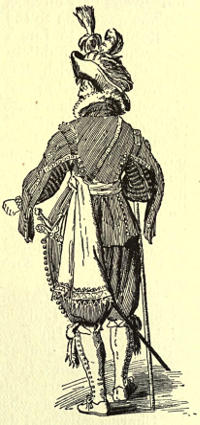
A Tuscan Officer
A diet afterwards assembled near Brescia where several new bishops were created and about 200,000 florins collected from the Ghibelline states of Lombardy; Ludwig then crossed the Po near Cremona, and with two thousand men-at-arms marched through Parma, passed the mountains without any opposition from the papal troops stationed in those parts, and halted at Pontremoli on the 1st of September, 1327. Here he was received by Castruccio, but refused to sojourn at Lucca until Pisa, which had determined to shut her gates upon him, had been reduced. This city was at once invested. The siege lasted a month, and the city might have baffled Ludwig, but fresh discord, the curse of these licentious republics, caused it to be surrendered on condition that neither their own exiles, nor Castruccio, nor any of his people should be admitted into the town; that their form of government should remain inviolate, and 60,000 florins be paid into the imperial treasury. On the 11th of October Ludwig entered Pisa, and three days after, the citizens, of their own accord but principally through fear of the populace, destroyed the capitulation and admitted both Castruccio and the exiles, while they threw themselves and their country on the emperor’s mercy. Justice was well administered, but dearly purchased by a contribution of 160,000 florins—enormous at any time, but peculiarly so at a moment when the Sardinian War and final loss of that province had reduced the whole community to the verge of ruin, and when, only a few days before, 5000 florins could not be demanded without the danger of revolution; so badly governed, or so short-sighted and capricious were the people.
CASTRUCCIO GOES TO ROME
After the settlement of Pisa, Ludwig and Castruccio repaired to Lucca, where the more powerful spirit of the latter was made manifest in its immediate ascendency and influence over his guest, whose splendid reception Castruccio followed up by a present of 50,000 florins; both chiefs then proceeded to Pistoia, from whose heights Castruccio pointed out the plain and towers of Florence, and showed the easy access which the possession of the one gave him to the territory of the other.
Returning to Lucca for the feast of St. Martin, the emperor took that opportunity of publicly placing on the head of Castruccio the ducal circle, investing him with the states of Lucca, Pistoia, Volterra, and the bishopric of Luni, conferring on him the privilege of quartering the royal arms of Bavaria with his own, besides an unscrupulous donation of the Pisan towns of Serrezzano, Rotina, Montecalvole, and Pietra Cassa. The ceremony of receiving the ducal coronet from an emperor’s hands, Castruccio’s great power, talents, and influence, and the universal feeling that this title would not long continue vain and empty, but become in substance as in name the first dukedom in Italy since the time of the ancient Lombards, altogether imparted a solemn and imposing character to the transaction which increased the apprehensions of every Italian Guelf; nor was the Ghibelline Pisa less anxious or discontented to see four of her walled towns quietly made over to Castruccio as a coronation gift—an earnest, as it seemed to be, of her own destiny.
The duke of Calabria, knowing that Castruccio was unwillingly compelled to follow Ludwig, who resumed his march towards Rome on the 15th of December, also prepared to quit Florence, leaving Philip Sanguineto with a thousand men-at-arms as his vicar. At a public feast he took leave of the Florentines, promising to return when the kingdom of Naples should be safe, and departed on the 27th of December, the same day that Castruccio by another road marched from Lucca to join the imperialists.
[1327-1328 A.D.]
Charles governed despotically, like every ruler of that age; for liberty then consisted in the privilege of being eligible to govern and choose governors, rather than in being governed well; and although in doing so he tyrannically condemned a citizen of rank who with as much reason as insolence opposed the grant of a subsidy to King Robert, thereby proving that freedom no longer existed in Florence, yet he made himself a favourite with the citizens by great personal urbanity and his endeavours to reconcile private feuds, together with considerable liberality and a generally impartial administration of justice. On the other hand, he was unpopular from his inactive, unwarlike character, and the excessive cost of his maintenance; this, according to Villani, who was employed in auditing the accounts, amounted in nine months to 900,000 florins; but as the greater part was circulated within the town, although a highly taxed people necessarily worked twice for the same money, it was still accompanied by great activity and some outward appearance of prosperity.
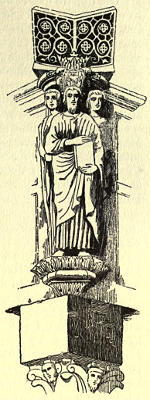
Marble Book Holder from Pistoia (1250 A.D.)
The emperor’s arrival at Viterbo was immediately felt in Rome, where a contest had previously arisen between Stefano Colonna seconded by Napoleone Orsini, who adhered to King Robert; and his own brother Sciarra Colonna, Jacobo Savelli, and Tebaldo di Santa Stazio, captains of the people; the first two had been expelled; for Castruccio’s arts and Ghibelline ducats had been long at work in that factious city which the pontiff’s absence at Avignon left in a state of continual agitation. It was generally governed by an oligarchy headed by the pope’s ministers and those of the king of Naples; by the Colonnas, Savelli, and Orsini; with occasional bursts of the most furious democracy; the senator administered justice; a council of fifty-two members nominally formed the government and was presided over by the prefect of Rome, two or three captains of the people along with the senator being elected by the popular voice. The Ghibelline chiefs sent privately to Ludwig, desiring that no heed should be given to the Roman ambassadors, who wished to settle the terms on which he was to be received, but that he should march directly to Rome; with this hint Castruccio, who was appointed to answer the embassy, immediately ordered the trumpets to sound to horse, saying courteously,“This is the emperor’s answer.” These messengers were detained, and Ludwig, suddenly appearing before the city, surprised the disaffected, confirmed the doubtful, and gave spirit to his adherents. He was crowned on the 16th of January, 1328.
During these transactions Benedetto da Orvieto, the duke of Calabria’s judicial vicar, arrived at Florence, where the citizens still found resources to complete the walls south of the Arno and erect the present Roman gate so as to secure that quarter of the town, which had been endangered by Castruccio’s late inroads on the Val di Greve. Neither was the duke’s lieutenant Philip Sanguineto inclined to sleep; by means of two Guelfic citizens of Pistoia, friends of Simone della Tosa, well acquainted with the weak points of that city, a plan was laid to surprise it and successfully executed. Having accurate measures of the walls and ditches, Sanguineto, with six hundred men-at-arms, the two Pistoians, and Simone della Tosa, but no other Florentine, repaired by night to Prato; he was there joined by two thousand infantry with the requisite besieging engines, ladders, and bridges, and continuing his march arrived under the weakest point of the Pistoian capital before daylight. The ditch was frozen hard enough to allow one man in armour to pass at a time, and thus a hundred men-at-arms gained the ramparts, unperceived until the officer of the night visited the guards with his patrol; a short conflict then took place, the officer and patrol were put to death; but an alarm was given, the garrison was immediately under arms, and the whole city in confusion.
During this time bridges had been thrown over the ditch and engines set to work at the wall which, with the assistance of some friends within, was perforated sufficiently to allow of a man-at-arms leading his horse through; the assailants were soon united and an obstinate conflict followed with various success until broad daylight, when the Florentines succeeded in overcoming all opposition, and then, driving their enemy from the strong but as yet unfinished citadel, continued the plunder of Pistoia for eight successive days. This event was known at Rome only three days afterwards and raised Castruccio’s anger against Ludwig for compelling him to leave Tuscany. He instantly set off with five hundred horse and a thousand crossbowmen, and taking the Maremma road pushed eagerly forward with only twelve followers; after some days, travelling through a very dangerous country, Castruccio reached Pisa on the 9th of February, where he soon contrived by intrigue and influence to acquire supreme authority—a tolerable compensation for the loss of Pistoia.
CASTRUCCIO’S NEW CONQUEST; HIS SUDDEN DEATH
While Castruccio was steadying himself in the government of Pisa, Sanguineto and the Florentines were in high disputation about putting their recent conquests into a proper state of defence; the former insisting that he had done his part in capturing the town, while the citizens maintained that the duke was bound to discharge such expenses from his salary. The altercation continued and Pistoia remained unvictualled; but the Florentines, having gained some trifling advantages, grew as careless and confident as if fortune had never left their arms, while Castruccio hurried on his preparations for recapturing the neglected place. Nevertheless the Pisans and even his former adherents, now disliking his arbitrary sway, offered their city to Ludwig; he, fearful of alienating Castruccio, referred them to the empress, by whom it was accepted and her vicar immediately despatched to take the reins of government. Castruccio was not thus to be despoiled; he received the officer respectfully, but scoured the city with his horsemen in the manner of the age as a mark of sovereignty; then dismissed the imperial lieutenant loaded with gifts and caused himself to be elected and proclaimed absolute lord of Pisa for two years.
Thus master of new and abundant resources, he lost no time in profiting by the disputes at Florence, and immediately invested Pistoia with a thousand men-at-arms and numerous infantry; the place was strong, encompassed by a double ditch, and defended by Simone della Tosa with a sufficient garrison besides many Guelfic citizens. There was a protecting force at Prato only ten miles off and within sight of its signals, so that if the town had been well provisioned it might have withstood all Castruccio’s efforts until sickness compelled him to retreat. This chief, who had remained at Pisa to complete his preparations, joined the army on the 30th of May bringing strong reinforcements, and surrounded the town with a palisaded ditch and lines of circumvallation. Here he resolved to remain; nor did all the Florentine stratagems succeed in turning him from his purpose, not even when they collected a formidable army of twenty-six hundred men-at-arms and for three days successively defied him to battle, which he constantly pretended to accept, while he only strengthened his camp with additional trenches, fresh palisades, and wide-branching abbati.
Seeing no chance of provoking him, the allies changed their position, and attacked the strongest point of his entrenchments with as little skill as success, instead of cutting off his supplies by Serravalle, which he would have been unable to prevent without a battle.
Sanguineto fell sick and had moreover quarrelled with some of the confederate chiefs, so that he deemed it best to retire and make a diversion elsewhere, leaving a strong convoy at Prato ready to succour the place when a fair occasion offered. On the 28th of July, after delivering another formal challenge which Castruccio was too sagacious to accept, the confederated army drew off towards Prato and thence marched in two divisions, one by Signa and the Gusciana to threaten Lucca, the other by the left bank of the Arno, which destroyed Pontadera and carried the rampart and Fosso Arnonico by storm. This was a great canal and breastwork excavated and fortified with towers by the Pisans in 1176, both as a national bulwark and an outlet for the superfluous waters of the Arno, of which river some have supposed it to be one of the three branches mentioned by Strabo. Thus was opened all the Pisan territory; San Casciano and Sansavino soon fell and Pisa saw herself insulted at her very gates with perfect impunity. Castruccio nevertheless remained immovable; he calculated on starvation and the moral effect of seeing a superior army retire without accomplishing anything, and accordingly on the 3rd of August Pistoia surrendered to sixteen hundred men-at-arms and the usual force of infantry, in face of an army of nearly double these numbers.
Thus victorious he returned in triumph to Lucca, more powerful, more dreaded, and more formidable than before; none of his important enterprises ever failed and Italy had not beheld such a captain for centuries. Lord of Pisa, Lucca, Lunigiana, and much of the eastern Riviera of Genoa, and master of three hundred walled towns, he was either courted or dreaded by every Italian prince from the emperor downwards. But Florence was in terror at his very name; and Galeazzo Visconti the once powerful lord of half Lombardy, who had been released by the emperor in the preceding March at Castruccio’s intercession, now served under his standard as a private individual. Visconti soon after expired at Pescia from the effects of a fever engendered by the labours of the Pistoian siege, and it was fatal to more than him: even Castruccio’s hour drew near; for the same fever, the consequence of his personal fatigues, was rapidly consuming him also. He feared the emperor’s resentment for the usurpation of Pisa and would have made peace with Florence, but was too much mistrusted and therefore failed. The malady increased; he informed those about him that he was going to die and that his death would be the signal for great revolutions; then, taking the necessary precautions to insure his three sons the quiet succession of his three great cities, and charging them to conceal his death until they were secure, he expired on the 3rd of September, 1328, in the forty-seventh year of his age and the twelfth of his rule over Lucca.
ESTIMATES OF CASTRUCCIO
Tegrimih his biographer says that Castruccio was a cruel avenger of his own wrongs; but as personal vengeance, never justifiable, assumes in princes a more sharp and bitter aspect, it would be difficult to say whether his conduct to his subjects merited the name of severity or cruelty. With the soldiers he was universally popular, and in speaking to them his eloquence and grace of manner and diction were wonderfully adapted as well to his own dignity as to the mind and feelings of his audience. He would often calm a tumultuous soldiery by simply calling them sons, fathers, and brothers, and no army ever mutinied under his command. He was first in every danger, first to seize the ladder and mount the wall; first to swim across a river when swelled to a torrent; first in every individual act of skill and courage, as he was first in talent and command; and he gained the hearts of soldiers by his agreeable familiarity with the meanest among them. His great reputation as a warrior secured his ascendency in field and council; and such was his soldiers’ confidence that often by his mere name and appearance the fortune of battle was restored, fugitives were arrested, and the foe defeated. His arrival alone was frequently sufficient to force an enemy from fortified places or insure their immediate surrender. Whatever were his individual sentiments he always consulted his council, composed of the ablest men of Lucca, and more especially of those most learned in history; but when it was a pure question of war he sought the opinion of old military men well acquainted with the seat of intended hostilities. Uneducated himself, he yet delighted in the company and conversation of literary men; he improved and maintained the roads and bridges of his state, had numerous spies, amongst them many women, in all parts of the world, and was properly said to have the wings of an eagle.f