A CHRONOLOGICAL RÉSUMÉ OF ITALIAN HISTORY (continued 2)
Reading edition
1495 Alfonso abdicates in favour of his son Ferdinand II and retires to a monastery. Charles enters Naples; Ferdinand flees. Lodovico now becomes alarmed at Charles’ progress and forms a league against him. Charles leaves Naples in charge of a viceroy and hurriedly returns to France. Ferdinand returns to Naples. Most of his kingdom returns to his allegiance.
1496 The viceroy dies and the French garrison leaves Naples. Venice seizes Brindisi and Otranto for debt. Death of Ferdinand, succeeded by his uncle Frederick II.
1501 Louis XII of France and Ferdinand of Spain and Sicily agree by Treaty of Granada to conquer Naples and divide it between them. The conquest is easily accomplished by the duke of Nemours and Gonsalvo de Cordova. Frederick surrenders his rights to the French king and is given the duchy of Anjou.
1502 France and Spain begin to quarrel over the partition of Naples.
1503 Ferdinand adds Naples to the kingdom of Sicily.
Sicily—the Royal Line of Aragon (1458-1503 A.D.)
1458 Juan of Aragon, hitherto known as king of Navarre, receives Sicily “beyond the Pharos,” as part of his dominions on death of his brother Alfonso. Henceforth it is ruled by viceroys.
1479 Death of Juan, succeeded by his son Ferdinand the Catholic.
1501 Treaty of Granada and conquest of Naples by Ferdinand and Louis XII.
1502 Quarrel of France and Spain over the division of Naples. The pope and Cesare Borgia side with France.
1503 Gonsalvo de Cordova wins several victories over the French, and finally utterly defeats them at Mola. The kingdoms of Sicily “on this side the Pharos” (Naples) and Sicily “beyond the Pharos” are united under Ferdinand, and the king is known as Ferdinand III.
THIRD UNION
The Royal Line of Spain (1503-1516 A.D.)
1504 Peace between France and Spain. Louis gives up all claim on Naples.
The Austro-Spanish Dynasty (1516-1700 A.D.)
1516 Death of Ferdinand. Succeeded by his grandson Charles IV (V of Germany). A revolt in Sicily is put down the following year. Sicily is used as a starting-point for the African wars.
1554 Charles gives his son Philip the title of king of Naples, on Philip’s marriage to Mary of England.
1556 Abdication of Charles V. Philip I (II of Spain) receives the Two Sicilies as part of his dominions. The kingdom becomes merely a Spanish province. Pope Paul IV wishes to drive the Spaniards from Naples and makes a league with Henry II of France for that purpose. Francis, duke of Guise, grandson of René II of Lorraine, plans to obtain the crown of Naples.
1557 The duke of Guise marches on Naples and lays siege to Civitella. The duke of Alva, Philip’s viceroy, defeats him, and he retreats northward. Henry II recalls him to France.
1565 The Inquisition is in full force throughout Philip’s dominions. Reformed opinions have spread rapidly in Naples.
1598 Death of Philip, succeeded by his son Philip II (III of Spain). The national assemblies are suppressed.
1618 Osuna, viceroy of Naples, plots with the governor of Milan and Spanish ambassador at Venice, to seize the throne of the Two Sicilies and destroy Venice. The Venetian Council of Ten frustrates the plot.
1621 Death of Philip, succeeded by his son Philip III (IV of Spain). The people are heavily taxed.
1647 Insurrection of Masaniello at Naples over a tax on fruit. The duke of Arcos, the viceroy, is driven into the castle of St. Elmo. Insurrection at Palermo. The duke of Arcos makes terms with the people. Assassination of Masaniello. The revolt subsides, but soon breaks out again. Don John of Austria sent to preserve order, but is forced to withdraw. The popular leader, Gennaro Annese, sends for the duke of Guise, who readily responds. But he ignores Annese, and the latter betrays Naples to Don John. Guise is sent a prisoner to Spain. Annese put to death.
1665 Death of Philip, succeeded by his young son Charles V (II of Spain) under the regency of his mother, Maria Anna of Austria.
1672 Rising in Messina against the oppressions of the Spanish governor. He is driven from the city.
1674 The people of Messina send to Louis XIV (whom Spain has taken sides against in the Dutch war) and proclaims him king of Sicily. Louis sends a fleet to Sicily. His troops occupy Messina.
1676 French naval victories over the Dutch allies of Spain off Stromboli, Catania, and Palermo.
1678 The Dutch war settled by the peace of Nimeguen. Louis withdraws his troops from Sicily. The Sicilians are now more oppressed than ever.
1693 Great earthquake in Sicily. Messina, Catania, and Syracuse nearly destroyed by a violent eruption of Mount Etna.
1694 Great earthquake at Naples.
1700 Death of Charles. End of the Austro-Spanish dynasty. The Two Sicilies acknowledge Philip IV (V of Spain) grandson of Louis XIV.
From the End of the Austro-Spanish Dynasty to the Peace of Utrecht (1700-1713 A.D.)
1701 The emperor Leopold claims the Two Sicilies for the archduke Charles. The war of the Spanish Succession begins.
1702 Philip arrives at Naples and marches northward.
1706 After the battle of Turin the French are driven out of Italy and Charles VI is proclaimed king of the Two Sicilies.
1708 Pope Clement XI invests Charles with the kingdom of the Two Sicilies.
THIRD SEPARATION (1713-1720 A.D.)
1713 Peace of Utrecht. Charles VI (now emperor Charles VI) receives the dominions of Sicily on this side the Pharos (Naples) together with Milan and Sardinia. The island of Sicily is given to Victor Amadeus of Savoy with the title of king.
1717 Philip V takes Sardinia from the Austrians.
1718 Philip invades Sicily. Victor Amadeus sides with him, hoping to acquire Lombardy. Formation of the Quadruple Alliance against Philip.
1719 Philip is driven from Sicily by the allies and negotiates for peace.
FOURTH UNION (1720-1806 A.D.)
1720 Philip accepts the terms of the alliance. Victor Amadeus is compelled to exchange Sicily for Sardinia. Charles VI is once more king of the Two Sicilies, which becomes part of the German Empire.
1733 War of the Polish Succession begins. Philip V leagues with France and Sardinia to drive the Austrians from Italy. Philip’s son Don Charles, the duke of Parma and heir to Tuscany, is to receive the Two Sicilies.
The Bourbons (1734-1806 A.D.)
1734 Don Charles enters Naples and is proclaimed king. An army arrives from Spain to his assistance. Defeat of the Austrians at Bitonto and capture of Gaeta by Don Charles.
1735 Don Charles crosses to Italy. The island surrenders to him and he is crowned as Charles VII.
1738 The war is settled by the Treaty of Vienna. Charles VII acknowledged king of the Two Sicilies and gives up his claim to Tuscany and to Parma.
1740 Charles joins the alliance against Maria Theresa in the struggle for the Austrian succession.
1743-1748 The Two Sicilies compelled to remain neutral in the war of the Austrian Succession by the presence of a British fleet.
1759 Charles inherits the throne of Spain and resigns the Two Sicilies to his young son Ferdinand IV.
1767 The Jesuits are expelled from the kingdom.
1782 The Inquisition is abolished.
1796 Ferdinand makes a treaty of peace with the French Republic.
1798 The French army invades Neapolitan territory.
1799 Surrender of Naples. Ferdinand flees to Sicily. Naples is formed into the Parthenopæan Republic by the French. The English fleet under Nelson appears and assists a Calabrian army under Cardinal Ruffo to regain Naples and restore Ferdinand. Ruffo works a barbarous vengeance on the republicans.
1805 The emperor Napoleon makes a treaty of neutrality with Ferdinand. Terrible earthquake at Naples.
FOURTH SEPARATION
The Kingdom of Naples (1806-1815 A.D.)
1806 Napoleon forces Ferdinand to flee and makes his brother Joseph Bonaparte king of Naples. He makes many reforms and starts to suppress the brigands, who under the Bourbons have overrun the kingdom. Ferdinand remains ruler of Sicily. The French defeated by the British at Maida. Queen Caroline of Sicily organises an insurrection in Calabria.
1808 Joseph Bonaparte is transferred to the throne of Spain and Joachim Murat is made king of Naples. He calls himself king Joachim Napoleon. He takes Capri from the British.
1810 Murat attempts to invade Sicily, but is prevented by the British.
1811 The guerilla warfare against the brigands ends in their almost entire extermination. This makes Murat unpopular.
1813 Murat becomes offended at Napoleon during the Russian campaign and returns to Naples.
1814 Murat makes alliance with Austria and seizes the principality of Benevento.
1815 Murat declares his intention of restoring the unity of Italy. The Austrians proceed against him and he is totally defeated at Tolentino and escapes to France. After Waterloo he goes to Corsica and attempts to regain Naples, is taken prisoner in Calabria and executed.
The Kingdom of Sicily (1806-1815 A.D.)
1806-1815 Ferdinand continues to rule in Sicily.
FIFTH UNION
The Bourbon Dynasty (1815-1860 A.D.)
1815 Ferdinand re-established in the Two Sicilies by the Congress of Vienna. He now calls himself Ferdinand I of the Two Sicilies and returns to his tyrannical rule.
1819 The Society of the Carbonari becomes powerful. General Pépé joins it.
1820 Sudden revolt of the Carbonari under Pépé. Ferdinand is compelled to grant a new constitution.
1821 At conference of Laibach, the great powers decide to suppress the revolutionary movement in Naples. An Austrian army invades the kingdom; Pépé is defeated and the constitutional government overthrown.
1825 Death of Ferdinand, succeeded by his son Francis I.
1828 An insurrection of the Carbonari is suppressed.
1830 Death of Francis. His son Ferdinand II, “King Bomba,” succeeds.
1840 Settlement with England of the dispute concerning the sulphur trade.
1844 Execution of the Bandiera in Calabria.
1848 Revolutionary outbreaks begin at Palermo. Ferdinand grants a constitutional government to his subjects. Violent outbreaks in Naples. The national guard is almost annihilated by the royal troops and the lazzaroni. The constitution is withdrawn. A Neapolitan army under General Pépé marches to the assistance of Charles Albert. Ferdinand bombards Messina to bring the people to terms, and earns the sobriquet of “King Bomba.”
1849 The French and English ambassadors attempt to mediate between Ferdinand and the people of Sicily; the latter reject the offered terms. Palermo surrenders. Ferdinand sends an army to assist Pius IX, but it is badly defeated by Garibaldi at Palestrina and Velletri. The liberal leaders arrested in Naples.
1850 The liberal leaders condemned to imprisonment for life.
1855 The allied powers—England, France, and Sardinia—protest in vain to Ferdinand against his misgovernment.
1856 England and France withdraw their ambassadors from the Two Sicilies. Milano attempts to assassinate the king.
1858 Amnesty granted to political offenders.
1859 Death of Ferdinand II, succeeded by his son Francis II. Diplomatic relations resumed.
1860 The foreign ambassadors petition France for reform. A revolutionary movement begins in Palermo, Messina, and Catania. Garibaldi arrives at Marsala with five thousand volunteers from Genoa and assumes title “Dictator of Sicily.” He takes Palermo and defeats the royal troops at Milazzo. All Sicily except Messina surrenders to him. Francis promises reforms. State of siege declared at Naples. Garibaldi refuses to obey Victor Emmanuel’s command to stop. He enters Messina, and the Neapolitans agree to evacuate. Francis restores the constitution of 1848. The count of Trani is proclaimed king by the army. Garibaldi crosses to Italy and defeats the royal army at Reggio and San Giovanni. Francis flees to Gaeta, and Garibaldi enters Naples, assumes the dictatorship, and institutes reforms. He defeats the royalists on the Volturno. Victor Emmanuel enters the Abruzzi. The kingdom votes for annexation to Piedmont. The Two Sicilies is annexed to the kingdom of Italy.

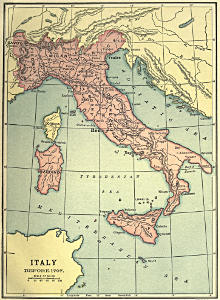
ITALY BEFORE 1797.
BORMAY & CO.