Chapter IV · THE THIRTEENTH CENTURY
Reading edition
[1197-1218 A.D.]
The death of Henry VI was followed by a general war throughout the empire, which gave fresh activity to the passions of the Italian nobles, and greater animosity to the opposing parties. The two factions in Germany had simultaneously raised to the empire the two chiefs of the houses of Guelf and Ghibelline. Philip I, duke of Swabia, and brother of Henry VI, had been named king of the Romans by the Ghibellines; and Otto IV, son of Henry the Lion, duke of Bavaria and Saxony, by the Guelfs. Their contest was prolonged to the 22nd of June, 1208, when Philip was assassinated by a private enemy. The Germans, wearied with eleven years of civil war, agreed to unite under the sceptre of his rival, Otto IV, whom they crowned anew. The following year he passed into Italy, to receive from the pope the golden crown of the empire.
But though Otto was the legitimate heir of the Guelfs of Bavaria, so long chiefs of the opposition to the imperial prerogatives, yet now wearing himself the crown, he was desirous of possessing it with these disputed rights; every one was denied him, and all his actions controlled by the pope. There was soon a declared enmity between the emperor and the pontiff who, rather than consent to any agreement, or to abate any of his pretensions, raised against the Guelf emperor the heir of the Ghibelline house, the young Frederick II, grandson of Frederick I, hardly eighteen years of age, and till then reigning under the pope’s tutelage over the Two Sicilies only. Frederick, excited and seconded by the pope, boldly passed through Lombardy in 1212, and arrived at Aachen, where the German Ghibellines awaited, and crowned him king of the Romans and Germans. Otto IV in the meantime returned to Germany, and was acknowledged by Saxony.
The civil war, carried on between the two chiefs of the empire, lasted till the 19th of May, 1218, when Otto died, without any attempt by either party to despoil his rival of his hereditary possessions. It was this civil war that caused the names of Guelf and Ghibelline to be exclusively substituted for those of party of the church and party of the empire. In fact, each noble family, and each city, seemed to consult only their hereditary affection, and not their political principles, in ranging themselves under either standard. The Guelfs placed themselves in opposition to the pope, to repel his Ghibelline candidate; and Milan, Piacenza, and Brescia braved even excommunication to resist him; while, on the contrary the Ghibellines of Pavia, Cremona, and of the marches armed themselves with zeal against an emperor of the Guelf blood.
During this period, while the minority of Frederick II left so much time to the cities of Italy to consolidate their independence, and to form real republics, the person most influential and most prominent in history was the pope, Innocent III, who reigned from 1197 to 1216. He caused his power to be felt in the remotest parts of Christendom, but he suffered to be constituted at Rome, under his own eye, a republic, the liberty of which he respected, and over which he assumed no authority. The thirteen districts of Rome each named annually four representatives or caporioni; their meeting formed the senate of the republic, who, with the concurrence of the people, exercised the sovereignty, with the exception of the judicial power. This power belonged as in other republics to a foreign military chief, chosen for one year, and assisted by civil judges, dependent on him, but bearing the name of senator, instead of podesta. We have still extant the form of oath taken by the first of these senators, named in 1207. By it he engages to guarantee security and liberty to the pope as well as to his brothers the cardinals, but promises no submission to him for himself.
In the beginning of the pontificate of Innocent III, two German generals, to whom Henry VI had given the titles of duke of Spoleto and marquis of Ancona, held in dependence and subjection the provinces nearest Rome. Innocent, to revive the spirit of liberty, sent thither two legates; and by their interference, the cities of these provinces, built for the most part in the mountains, and without any means of becoming either wealthy or populous, threw off the German yoke, and made alliance with those cities which from the preceding period had entered into the league of Lombardy; thus two Guelf leagues were formed, under the protection of the pope; one in the marches, comprehending the cities of Ancona, Fermo, Osimo, Camerino, Fano, Jesi, Sinigaglia, and Pesaro; the other in the duchy, comprehending those of Spoleto, Rieti, Assisi, Foligno, Nocera, Perugia, Agubbio, Todi, and Città di Castello. These leagues, however, in accustoming the cities of these two provinces to regard the pope as their protector, led them afterwards to submit without resistance to the sovereignty of the church.
Other legates had been about the same time sent into Tuscany by the pope; they convoked at St. Ginasio, a borough situated at the foot of the mountain of San Miniato, the diet of the towns of that country. These provincial diets were in the habit of assembling frequently, and had till then been presided over by an officer belonging to the emperor, in memory of whom the castle in which he resided is still called San Miniato al Tedesco. These diets settled the differences which arose between cities, and had succeeded in saving Tuscany from the civil wars between the Guelfs and Ghibellines. Pisa, which had been loaded with favours by the sovereigns of the house of Hohenstaufen, and which had obtained from them the dominion of sixty-four castles or fortified towns on the shores of Tuscany, and over the isles of Corsica, Elba, Capraia, and Pianosa, proclaimed its determination of remaining faithful to the Ghibelline party, and its consuls withdrew from the diet convoked at St. Ginasio; but those of the cities of Florence, of Siena, of Arezzo, of Pistoia, and of Lucca accepted the protection of the pope, offered by his two legates, and promised to coalesce in defence of their common liberty.b
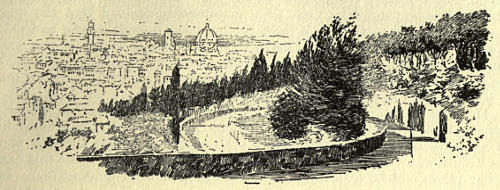
Florence
FACTIONS IN FLORENCE
[1177-1215 A.D.]
We have already seen that the spirit of political as well as religious party began to rise as early as 1177, and excepting some short intervals of uneasy repose, remained in a state of violence until 1182. From this epoch there are no accounts of actual war within the city of Florence until 1215; but nearly five years of hard fighting between two great factions of undiminished force was unlikely to be followed by a dead calm except from exhaustion; or by any oblivion of injury in an age and country where revenge was a duty, not a crime.
The great power and independence of the newly created podesta, together with external hostilities, probably assisted in maintaining peace in a city that prided itself on being founded under the protection and ascendant of Mars, and therefore doomed by fate to everlasting troubles. Hence Roccuzzo de’ Mozzi is made by Dante to say:
“Io fui della città, che nel Batista Cangiò ’l primo Padrone, onde ei per questo Sempre con l’arte sua la farà trista.”
Disputes which had so long occupied the attention of Italy were not without participation in Florence, where the quarrels of church and empire did not fail to create two adverse opinions, but as yet confined to words; the prevailing politics, being Guelfic and papal, while the opposition led by Uberti was entirely imperial, were accidental circumstances; but combined with and as it were grafted on local politics, drew a distinct line between contending factions and boded mischief.
In the year 1215, according to an ancient manuscript published from the Buondelmonti library, Messer Mazzingo Tegrini de’ Mazzinghi invited many Florentines of high rank to dine at his villa near Campi about six miles from the capital; while at table the family jester snatched a trencher of meat from Messer Uberto degli Infangati who, nettled at this impertinence, expressed his displeasure in terms so offensive that Messer Oddo Arrighi de’ Fifanti as sharply and unceremoniously rebuked him; upon this Uberto gave him the lie and Oddo in return dashed a trencher of meat in his face.
Everything was immediately in confusion; weapons were soon out, and while the guests started up in disorder young Buondelmonte de’ Buondelmonti, the friend and companion of Uberto, severely wounded Oddo Arrighi.
The party then separated and Oddo called a meeting of his friends to consider the offence; amongst them were the counts Gangalandi, the Uberti, Amidei, and Lamberti, who unanimously decided that the quarrel should be quietly settled by a marriage between Buondelmonte and Oddo’s niece, the daughter of Messer Lambertuccio di Capo di Ponte, of the Amidei family. This proposition appears to have been unhesitatingly accepted by the offender’s family as a day was immediately nominated for the ceremony of plighting his troth to the destined bride.
During the interim Madonna Aldruda or Gualdrada, wife of Forese de’ Donati, sent privately for young Buondelmonte and thus addressed him: “Unworthy knight! What! Hast thou accepted a wife through fear of the Fifanti and Uberti? Leave her that thou hast taken, choose this damsel in her place, and be henceforth a brave and honoured gentleman.” In so saying she threw open the chamber door and exposed her daughter to his view; the unexpected apparition of so much beauty, as it were soliciting his love, had its usual consequence; Buondelmonte’s better reason was overcome, yet he had resolution to answer, “Alas! it is now too late!” “No,” replied Aldruda; “thou canst even yet have her; dare but to take the step and let the consequences rest on my head.” “I do dare,” returned the fascinated youth, and stepping forward again plighted a faith no longer his to give.
Early on the 10th of February, the very day appointed for his original nuptials, Buondelmonte passed by the Porta Santa Maria amidst all the kinsfolk of his first betrothed, who had assembled near the dwellings of the Amidei to assist at the expected marriage, yet not without certain misgivings of his faithlessness. With a haughty demeanour he rode forward through them all, bearing the marriage ring to the lady of his choice and leaving her of the Amidei with the shame of an aggravated insult by choosing the same moment for a violation of one contract and the consummation of a second; for in those days, and for centuries after, the old Roman custom of presenting a ring long before the marriage ceremony took place was still in use.
Such insults were then impatiently borne; Oddo Arrighi assembled his kindred in the no longer existing church of Santa Maria sopra Porta to settle the mode of resenting this affront, and the moody aspect of each individual marked the character of the meeting and all the vindictive feeling of an injured family; there were, however, some of a more temperate spirit that suggested personal chastisement or at most the gashing of Buondelmonte’s face as the most reasonable and effectual retribution. The assembly paused, but Mosca de’ Lamberti starting suddenly forward exclaimed, “Beat or wound him as ye list, but first prepare your own graves, for wounds bring equal consequences with death.” “No. Mete him out his deserts and let him pay the penalty; but no delay. Up and be doing.”
This turned the scale and Buondelmonte was doomed, but according to the manners of that age, not in the field, which would have been hazardous, but by the sure though inglorious means of noonday murder; wherefore, at the very place where the insult was offered, beneath the battlements of the Amidei, nay under the casement of the deserted maiden, and in his way to a happy expecting bride, vengeance was prepared by these fierce barons for the perjurer.
[1215-1239 A.D.]
On Easter morning, 1215, the murderers concealed themselves within the courts and towers of the Amidei, which the young and heedless bridegroom was sure to pass, and he was soon after seen at a distance carelessly riding alone across the Ponte Vecchio on a milk-white palfrey, attired in a vest of fine woollen cloth, a white mantle thrown across his shoulders and the wedding garland on his head. The bridge was passed in thoughtless gaiety, but scarcely had he reached the time-worn image of the Roman Mars, the last relic of heathen worship then extant, when the mace of Schiatto degli Uberti felled him to the ground, and at the base of this grim idol the daggers of Oddo and his furious kinsmen finished the savage deed; they met him gay and adorned for the altar, and left him with the bridal wreath still dangling from his brow a bloody and ill-omened sacrifice. The tidings of this murder spread rapidly, and disordered the whole community of Florence; the people became more and more excited, because both law and custom had awarded due penalties for faithless men, and death was an unheard-of punishment.
Buondelmonte’s corpse was placed on a bier, with its head resting in the lap of his affianced bride, the young and beautiful Donati, who hung like a lily over the pallid features of her husband; and thus united were they borne through the streets of Florence. It was the gloomy dawning of a tempestuous day, for in that bloody moment was unchained the demon of Florentine discord; the name of Guelf and Ghibelline were then for the first time assumed by noble and commoner as the cry of faction; and long after the original cause of enmity had ceased, they continued to steep all Italy in blood.
It has been shown that there were already two parties existing in the commonwealth; but it was not until after this outrage that the whole community divided under the above appellations, one part siding with the Buondelmonti, who were for the most part Guelfic chiefs and adherents of the church; the other with the Uberti, leaders of the Ghibellines and partisans of the empire. Of seventy-two powerful families mentioned by Malespini, thirty-nine joined the Buondelmonti banner and thirty-three fought under the colours of their enemies; but many more houses of distinction took part in the civil war; many afterwards changed sides through quarrels with their chiefs; many of the Buondelmonti who before were Ghibellines now became Guelfs; the former were stigmatised with the epithet of “Paterini,” and the latter with that of “Traditori.”
Nevertheless an attempt at reconciliation was made in 1239, by marrying Neri Piccolino degli Uberti to the daughter of Rinieri Zingani de’ Buondelmonti, a lady celebrated for her wisdom, beauty, and talents. Trusting to this tie the Uberti and some friends repaired with confidence to visit Bertaldi de’ Buondelmonti of Campi, but were treacherously attacked and beaten back with some bloodshed; this renewed the war with greater violence and Neri dismissed his wife to her own relatives, declaring that he disdained to become the propagator of a traitorous brood from a deceitful stock. The unfortunate lady was then compelled by her father to marry Count Pannochino de’ Pannochieschi, on whose mercy she threw herself, imploring permission to retire into a convent; for though abandoned by her husband she protested that she was still his wife and therefore never could belong to another. Her motives were respected, her prayer generously granted, and she immediately took the veil in the convent of Montecelli.
[1215-1225 A.D.]
Immediately after Buondelmonte’s death a low and angry murmur rolled sullenly through the whole Florentine population, and instinctive preparations were everywhere in progress for some dimly apprehended danger; as yet all was calm, but dark clouds were gathering around and the echo of distant thunder marked the coming storm. Each house was armed and fortified, towers were again mounted with warlike engines, serragli (barricades) were erected, the shops all closed, the people in painful doubt, and ancient citizens who remembered the troubles of other times looked on and trembled. Nor was their apprehension vain; the curse of heaven seemed to rest on this devoted city, and with but little cessation during three and thirty years did Florence reek with the blood of her children.c
The death of Innocent III [1216] and, two years afterwards, of Otto IV broke the unnatural alliance between a pope and the heir of a Ghibelline family. The Milanese, excommunicated by Innocent for having fought against Frederick II, did not the less persist in making war on his partisans; well convinced that the new pope, Honorius III, would soon thank them for it. They refused Frederick the iron crown of Lombardy, preserved at Monza, and contracted an alliance with the count Thomas of Savoy, and with the cities of Crema, Piacenza, Lodi, Vercelli, Novara, Tortona, Como, and Alessandria, to drive the Ghibellines from Lombardy. The Ghibellines defeated them on the 6th of June, 1218, in a great battle fought against the militias of Cremona, Parma, Reggio, and Modena, before Ghibello. This reverse of fortune calmed for some time their military ardour. The citizens of every town accused the nobles of having led them into war from family enmities and interests foreign to the city; at Milan, Piacenza, Cremona, and Modena, there were battles between the nobles and the people. Laws were proposed to divide the public magistracy in due proportions between them; finally the Milanese, in the year 1221, expelled all the nobles from their city.
FREDERICK II CROWNED EMPEROR
The young Frederick re-entered Italy; and, after some differences with Honorius III, received from him, on the 22nd of November, 1220, the crown of the empire. He afterwards occupied himself in establishing order in his kingdom of the Two Sicilies, where, during his minority, the popes had encouraged a universal insubordination. Born in the march of Ancona, at Jesi, in December, 1194, he was Italian as well by language as by affection and character. The Italian language, spoken at his court, first rose above the patois in common use throughout Italy, regarded only as a corruption of Latin; he expressed himself with elegance in this language, which, from his time, was designated by the name of lingua cortigiana; he encouraged the first poets, who employed it at his court, and he himself made verses; he loved literature and encouraged learning; he founded schools and universities; he promoted distinguished men; he spoke, with equal facility, Latin, Italian, German, French, Greek, and Arabic; he had the intellectual suppleness and finesse peculiar to the men of the south, the art of pleasing, a taste for philosophy, and great independence of opinion, with a leaning to infidelity; hence he is accused of having written a book against the three revelations of Moses, Jesus, and Mohammed, entitled De Tribus Impostoribus, which no one has ever seen, and which perhaps never existed. His want of faith in the sacred character of the Roman church, and the sanctity of popes, is less doubtful; he was suspicious of them, and he employed all his address to defend himself against their enterprises. Honorius III, desirous of engaging him to recover the Holy Land from the Saracens, made him, in 1225, marry Yolande de Lusignan, heiress of the kingdom of Jerusalem; after which, Honorius and his successor Gregory IX pressed him to pass into Palestine. A malady stopped him, in 1227, just as he was about to depart; the pope, to punish him for this delay, excommunicated him. He still pursued him with his anathema when he went to the Holy Land the year following, and haughtily testified his indignation, because Frederick, in the year 1229, recovered Jerusalem from the hands of the sultan by treaty, rather than exterminate the infidels with the sword.
RENEWAL OF THE LOMBARD LEAGUE
[1225-1233 A.D.]
Meanwhile the Guelf party again raised their standard in Lombardy; the republics of Milan, Bologna, Piacenza, Verona, Brescia, Faenza, Mantua, Vercelli, Lodi, Bergamo, Turin, Alexandria, Vicenza, Padua, and Treviso assembled their consuls in council at San Zenone in the Mantuan territory, on the 2nd of March, 1226. They renewed the ancient league of Lombardy for twenty-five years; and engaged to defend in concert, their own liberty and the independence of the court of Rome. Three years afterwards, they sent succour to Gregory IX, when he was attacked by Frederick II on his return from the Holy Land; and they were included in the treaty of peace between the pope and the emperor in 1230.
The pope, however, though defended by the arms of the Lombards, made them pay dearly for the favour which he showed in naming them to the emperor as his allies. He consented to protect their civil liberty only so far as they sacrificed to him their liberty of conscience. The same spirit of reformation which animated the Albigenses had spread throughout Europe; many Christians, disgusted with the corruption and vices of the clergy, or whose minds revolted against the violence on their reason exercised by the church, devoted themselves to a contemplative life, renounced all ambition and the pleasures of the world, and sought a new road to salvation in the alliance of faith with reason. They called themselves cathari, or the purified; paterini, or the resigned. The free towns had, till then, refused permission to the tribunals of the Inquisition, instituted by Innocent III, to proceed against them within their walls; but Gregory IX declared the impossibility of acknowledging as allies of the holy see republicans so indulgent to the enemies of the faith; at the same time, he sent among them the most eloquent of the Dominicans, to rouse their fanaticism. Leo da Perego, whom he afterwards made archbishop of Milan, had an only too fatal success in that city, where he caused a great number of paterini to be burned. St. Peter Martyr, and the monk Roland of Cremona, obtained an equal triumph in the other cities of Lombardy.
The monk John of Vicenza had the cities of the march assigned to him as a province, where the heretics were in still greater numbers than in Lombardy, and included in their ranks some of the most powerful nobles in the country; among others, Ezzelino II, of Romano. The monk John announced himself the minister of peace, not of persecution. After having preached successively in every town, he assembled, on the plain of Paquara, the 28th of August, 1233, almost the whole population of the towns of the march; he exhorted them to peace in a manner so irresistible, that the greatest enemies, setting aside their animosities, pardoned and embraced each other; and all, with tears of joy, celebrated the warm charity of this man of God. This man of God, however, celebrated the festival of this reconciliation by judging and condemning to the flames sixty cathari in the single town of Verona, whose sufferings he witnessed in the public square; and afterwards obtained full power from the towns of Vicenza and Padua to act there in the like manner.
FREDERICK II AND THE LOMBARD LEAGUE
[1233-1236 A.D.]
It was only a short period after the Peace of Paquara that Frederick II, believing he had sufficiently re-established his power in southern Italy, began to turn his attention towards Lombardy; he had no intention of disputing the rights guaranteed by his grandfather at the Peace of Constance; but it was his will that the cities should remain, what they ought to be by the treaty, members of the empire, and not enemies of the emperor. He had raised an army, over which he feared neither the influence of the monks nor the pope. He had transported from the mountains of Sicily, into the city of Luceria, in the capitanate, and into that of Nocera, in the principato, two strong colonies of Saracens, which could supply him with thirty thousand Mussulman soldiers, strangers, by their language and religion, to all the intrigues of the court of Rome. There was in the Veronese march a man endowed with great military talents, ambitious, intrepid, and entirely devoted to the emperor—Ezzelino III, of Romano, already powerful by the great fiefs he held in the mountains, and the number of his soldiers, whom Frederick made still more so, by placing him at the head of the Ghibelline party in all the cities. Ezzelino, born on the 4th of April, 1194, was precisely of the same age as the emperor. The pope had summoned him to arrest his father, and deliver him to the tribunal of the Inquisition as a paterino; but though Ezzelino knew neither virtue, pity, nor remorse, he was not sufficiently depraved for such a crime.
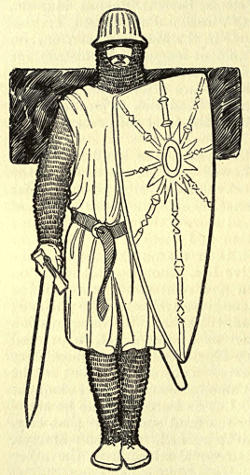
A Thirteenth-century Knight in Armour
As Frederick was on the point of attacking the Guelfs of Lombardy on the south with the Saracens, while Ezzelino advanced on the east, he learned that his son Henry, whom he had in the year 1220 crowned king of Germany, in spite of his extreme youth, seduced by the Guelfs and the agents of the pope, had revolted against him. The Milanese, in 1234, sent deputies to offer him the iron crown, which they had refused to his father. The latter hastened into Germany, and ordered his son to meet him at Worms, where he threw himself at the feet of his father, and entreated forgiveness. Frederick deprived him of the crown, and sent him to Apulia, where he died a few years afterwards. The emperor was obliged to employ two years in restoring order in Germany; he after that returned into Italy by the valley of Trento, and arrived, on the 16th of August, 1236, at Verona with three thousand German cavalry. A senate of eighty members, nobles and Ghibellines, then governed that republic; Frederick, by his address in managing men, engaged them to name Ezzelino captain of the people; this committed to him at the same time the command of the militia and the judicial power; and, in the state of excitement in which parties were much more occupied with the triumph of their faction than with the security of their liberty, gave him almost sovereign power. Frederick, obliged to return to Germany, left under the command of Ezzelino a body of German soldiers, and another of Saracens, with which this able captain made himself, the same year, master of Vicenza, which he barbarously pillaged, and the following year of Padua. This last was the most powerful city of the province, that in which the form of government was the most democratic, and in which the Guelfs had always exercised the most influence. Ezzelino judged it necessary to secure obedience by taking hostages from the richest and most powerful families; he employed his spies to discover the malcontents, whom he punished with torture, and redoubled his cruelty in proportion to the hatred which he excited.
THE BATTLE OF CORTENUOVA
[1236-1237 A.D.]
The same year, 1237, Frederick approached Mantua, and thus giving courage to the Ghibelline party, made them triumph over the Guelfs, who had, till then, the ascendant in that city; he was joined there by ten thousand Saracens, whom he summoned from Apulia, and afterwards advanced into the Cremonese territory to attack the confederate army of the Guelfs, commanded by the consuls of Milan, who knew no other art of war but the bravery evinced in battle. Frederick was a more able captain; by manœuvring between Brescia and Cremona, he drew the Milanese beyond the Oglio, and finally succeeded, as they believed the campaign finished, in placing himself between them and their country at Cortenuova near Crema. The Guelfs, although thus cut off from retreat, boldly accepted battle on the 27th of November, 1237, and long disputed the victory. Their defeat was only the more bloody; it cost them ten thousand men killed or taken prisoners, with the loss of the carroccio. The fugitives followed during the night the course of the Oglio to enter the Bergamasque Mountains; they would all, however, have fallen into the hands of the Ghibellines, if Pagan della Torre, the lord of Valsassina, and a Guelf noble, had not hastened to their assistance, opened the defiles covered by his fortresses, and brought them thus safely to Milan. The citizens of this town never forgot so important a service; and they contracted with the house of della Torre an alliance which subsequently proved dangerous to their freedom.
The defeat of the Guelfs at Cortenuova alarmed the towns of Lombardy, the greater number of which detached themselves from Milan. Frederick, entering Piedmont the following year, gave preponderance to the Ghibelline party in the cities of Turin, Asti, Novara, Alexandria, and several others. The constitution was not changed when the power in council passed from one party to another; but the emperor generally reckoned his partisans among the nobility, while the people were devoted to the church; accordingly, the triumph of the aristocracy generally accompanied that of the Ghibelline party. Four cities only, Milan, Brescia, Piacenza, and Bologna, remained at the end of the year opposed to the imperial power. Frederick began his attack on them by laying siege to Brescia; but the Brescians dared to face the storm; they supported, during sixty-eight days, the repeated attacks of the emperor, rendered all his efforts fruitless, and forced him at last to raise the siege with an army weakened and discouraged.
POPE AGAINST EMPEROR
[1238-1243 A.D.]
In the meantime, Gregory IX redoubled his efforts to save the Guelf party from ruin. He saw, with alarm, an emperor, master of the Two Sicilies and of Germany, on the point of vanquishing all resistance in upper Italy. He anticipated that this monarch, whose Mussulman soldiers were constantly passing through the states of Rome, would escape the influence of the church, and soon evince no respect whatever for a religion which he was accused of not believing. Gregory had recourse to the two maritime republics of Venice and Genoa, which, in general occupied with their conquests and commerce in the East, seldom took any part in the politics of Italy. He represented to them that they would be soon deprived of the freedom of the seas, if they did not make some effort to save the champions of liberty and of the church in Lombardy. He at length obtained their agreement to contract an alliance with the four only surviving cities of the league of Lombardy; and finally, towards the beginning of the year 1239, he fulminated another sentence of excommunication against Frederick. This had a greater effect than Gregory ventured to hope. A considerable number of nobles of Guelf origin, seduced by court favours, had been won over to the imperial party. They perceived that, after the anathema of the pope, the emperor distrusted them. The marquis d’Este and the count di San Bonifazio were even warned that their heads were in danger, and they made their escape from the imperial camp; all the other Guelf nobles followed their example, and the Guelf cities gained captains habituated to arms and familiarised with higher ideas of politics.
Gregory began to think he should give still greater weight to the anathemas which he launched against the emperor if they were sanctioned by a council. In the year 1241 he convoked at Rome all the prelates of Christendom. Frederick, who had been established at Pisa since the autumn of the year 1239, exerted himself to prevent the meeting of a council which he dreaded. While the two other maritime republics had declared for the Guelfs, Pisa was entirely of the Ghibelline party. The people were enthusiastically attached to the emperor; and among the nobles, a few only, proprietors of fiefs in Sardinia, headed by the Visconti of Gallura, had forsaken him for the Guelfs. The Pisans, further excited by their jealousy of the Genoese, promised Frederick that they would brave for him all the thunders of the church, and assured him they knew well how to hinder the meeting of the council. A considerable number of French prelates had embarked at Nice for Ostia, on board Genoese galleys. Ugolino Buzzacherino de Sismondi, admiral of the Pisans, lay in wait with a powerful fleet before Meloria, attacked them on the 3rd of May, 1241, sunk three vessels, took nineteen, and made prisoners all the French prelates who were to join the council at Pisa. The republic loaded them with chains, but they were chains made of silver, and imprisoned them in the chapter house of the cathedral. Gregory, alarmed at this reverse of fortune, survived only a few months; he died the 21st of August, 1241; and the college of cardinals, reduced to a very small number, passed nearly two years before they could agree on a new choice. At last, on the 24th of June, 1243, Senibaldi de’ Fieschi, of Genoa, who took the name of Innocent IV, was elected to the chair of St. Peter. His family, powerful in Genoa and in the Ligurian Mountains, was also allied to many noble families, who possessed castles on the northern side of the Apennines; and this position gave him great influence in the neighbouring cities of Placentia, Parma, Reggio, and Modena. The elevation of a Fieschi to the pontificate gave courage to the Guelf party in all these cities.
[1243-1245 A.D.]
Frederick had recourse in vain to the new pope to be reconciled to the church; Innocent IV was determined to see in him only an enemy of religion and of the pontifical power, and a chief of barbarians, who in turns summoned his Germans and his Saracens to tyrannise over Italy. He drew closer his alliance with the cities of the league of Lombardy, and promised them to cause the emperor to be condemned and deposed by an ecumenical council, as his predecessor would have done; but instead of convoking the council in Italy, he fixed for that purpose on the city of Lyons, one-half of which belonged to the empire and the other to the kingdom of France. He determined on placing himself with the prelates whom he had summoned under the protection of St. Louis, who then reigned in France. He went from Rome to Genoa by sea, escaping the Pisan fleet which watched to intercept his passage; he excited by his exhortations the enthusiasm of the Guelfs of Genoa, and of the cities of Lombardy and Piedmont, which he visited on his passage; and arriving at Lyons, he opened, on the 28th of June, 1245, in the convent of St. Just, the council of the universal church. He found the bishops of France, England, and Germany eager to adopt his passions; so that he obtained from them at their third sitting, on the 17th of July, a sentence of condemnation against Frederick II. The council declared that for his crimes and iniquities God had rejected him, and would no longer suffer him to be either emperor or king. In consequence, the pope and the council released his subjects from their oath of allegiance; forbade them under pain of excommunication to obey him under any title whatever; and invited the electors of the empire to proceed to the election of another emperor, while the pope reserved to himself the nomination of another king of the Two Sicilies.
Frederick at first opposed all his strength of soul against the sentence of excommunication pronounced by the council on him. Causing his jewels to be brought him, and placing the golden crown of the empire on his head, he declared before a numerous assembly that he would still wear it, and knew how to defend it; but, notwithstanding the enthusiasm of the Ghibelline party, the devotion of his friends, and the progress of philosophical opinions, which he had himself encouraged, the man whom the church had condemned was in constant danger of being abandoned or betrayed. The mendicant monks everywhere excited conspiracies against him. They took advantage of the terrors inspired by sickness and age, to make sinners return, as they said, to the ways of salvation, and desired them to make amends for their past transgressions by delivering the church of God from its most dangerous enemy. Insurrections frequently broke forth in one or other of the Two Sicilies; still oftener the emperor discovered amongst his courtiers plots to destroy him, either by the dagger or poison; even his private secretary, his intimate friend, Pietro delle Vigne, whom he had raised from abject poverty, to whom he had entrusted his most important affairs, gave ear to the counsel of the monks, and promised to poison his master.
[1245-1248 A.D.]
Frederick, on his part, became suspicious and cruel; his distrust fell on his most faithful friends; and the executions which he ordered sometimes preceded the proofs of guilt. He had confided Germany to his son Conrad, and the exclusive government of the Veronese marches to Ezzelino. The hatred which this ferocious man excited by his crimes fell on the emperor. Ezzelino imprisoned in the most loathsome dungeons those whom he considered his enemies, and frequently put them to death by torture, or suffered them to perish by hunger; he was well aware that the relatives of these victims must also be his enemies; they were, in their turn, arrested; and the more he sacrificed to his barbarity, the more he was called upon to strike. The citizens of Milan, Mantua, Bergamo, and Brescia every day heard of new and horrible crimes committed by the governor of the marches; they conceived the greater detestation of the Ghibelline party, and entertained the firmer determination to repel Frederick. He, on the contrary, had no thoughts of attacking them; he established himself during the Council of Lyons at Turin, and thence entered into a negotiation with St. Louis, to obtain by his mediation a reconciliation with the church to which he made, in token of his submission, the offer to accompany Louis to the Holy Land.
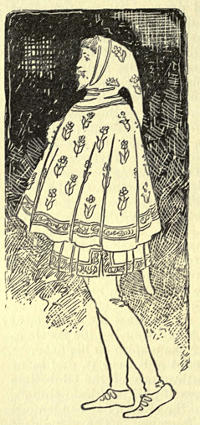
Street Costume of an Italian Nobleman, Thirteenth Century
The revolt of Parma, on the 16th of June, 1247, obliged Frederick to resume his arms at a moment when he was least disposed. The friends and relatives of Pope Innocent IV, the Guelf nobles of the houses of Corregio, Lupi, and Rossi, re-entering Parma, whence they had been exiled, triumphed over their adversaries, and in their turn expelled them from the city. Frederick was determined at any price to recover Parma. He sent for a numerous band of Saracens from Apulia, commanded by one of his natural sons, named Frederick, to whom he gave the title of king of Antioch. He assembled the Lombard Ghibellines, under the command of another of his illegitimate sons, named Hans or Hensius, called by him king of Sardinia, and whom he had made imperial vicar in Lombardy. Ezzelino arrived, too, at his camp from the Veronese march, with the militias of Padua, Vicenza, and Verona, and the soldiers whom he had raised in his hereditary fiefs.
On the other side, the Guelfs of Lombardy hastened to send succour to a city which had just sacrificed itself for them. The Milanese set the example; the militias of Mantua, Piacenza, and Ferrara followed it; and the Guelfs, who had been exiled from Reggio, Modena, and other Ghibelline cities, thinking they served their country in fighting for their faction, arrived in great numbers to shut themselves up in Parma. Frederick was prevented from hanging the hostages given previous to the revolt, before the walls of the city, by the militia of Pavia, who declared it was with the sword of Ghibelline soldiers only, and not with that of the executioner, that they would secure the throne of the emperor. The siege made little progress; the winter had begun, but Frederick persisted in his attempt. He proclaimed his determination to raze Parma to the ground, and to transfer those of the inhabitants who should be spared into his fortified camp, of which he would make a new town, called Vittoria. This camp, which he quitted on a hawking party, on the 8th of February, 1248, was in his absence surprised by a sortie of a Guelf army from Parma, taken, and pillaged; his soldiers were dispersed, and the emperor had the humiliation of being forced to raise the siege.
THE GUELFS EXPELLED FROM FLORENCE; THE BATTLE OF FOSSALTA
[1248-1249 A.D.]
Before this event, he had sent his son, the king of Antioch, into Tuscany with sixteen hundred German cavalry, to secure Florence to his party; where, since the death of Buondelmonte, the Guelfs and Ghibellines, always in opposition, had not ceased fighting. There was seldom an assembly, a festival, a public ceremony, without some offence given, either by one or other of the parties. Both flew to arms; chains were thrown across the streets; barricades were immediately formed, and in every quarter, round every noble family; the more contiguous, who had the most frequent causes of quarrel, fought at the same time in ten different places. Nevertheless the republic was supposed to lean towards the Guelf party; and the Florentine Ghibellines, in their relations with other people, had never sought to separate from their fellow-countrymen, or to place themselves in opposition to their magistrates. Frederick, fearing to lose Florence, wrote to the Uberti, the chiefs of the Ghibelline faction, to assemble secretly in their palace all their party, to attack afterwards in concert and at once all the posts of the Guelfs; whilst his son, the king of Antioch, should present himself at the gates, and thus expel their adversaries from the city. This plan was executed on the night of Candlemas, 1248; the barricades of the Guelfs were forced in every quarter, because they defended themselves in small bands against the whole of the opposite party. The Ghibellines, masters of the town, ordered all the Guelfs to quit it. They afterwards demolished thirty-six palaces belonging to the same number of the most illustrious families of that party; and intimidating the other cities of Tuscany, they constrained them to follow their example, and declare for the emperor.
Frederick II, after the check experienced by him at Parma, returned to his kingdom of Naples and Sicily, and left to his son Hensius, who established himself at Modena, the direction of the war in Lombardy. The pope, however, had sent a legate, the cardinal Octavian degli Ubaldini, to the Guelf cities, to engage them to pursue their victory, and punish the imperial party for what he called their revolt against the church. The powerful city of Bologna, already celebrated for its university, and superior to the neighbouring ones by its wealth, its population, and the zeal which a democratic government excites, undertook to make the Guelf party triumph throughout the Cispadane region. Bologna first attacked Romagna, and forced the towns of Imola, Faenza, Forlì, and Cervia to expel the Ghibellines, and declare for the church. The Bolognese next turned their arms against Modena. The Modenese cavalry, entering Bologna one day by surprise, carried off from a public fountain a bucket, which henceforth was preserved in the tower of Modena as a glorious trophy. The war which followed furnished Tassoni with the subject of his mock-heroic poem, La Secchia Rapita. The vengeance of the Bolognese was, however, anything but burlesque; after several bloody battles, the two armies finally met at Fossalta on the 26th of May, 1249. Philip Ugoni of Brescia, who was this year podesta of Bologna, commanded the Guelf army, in which was united a detachment from the militias of all the cities of the league of Lombardy. The Ghibellines were led by king Hensius; each army consisted of from fifteen to twenty thousand combatants. The battle was long and bloody, but ended with the complete defeat of the Ghibelline party; King Hensius himself fell into the hands of the conquerors; he was immediately taken to Bologna, and confined in the palace of the podesta. The senate of that city rejected all offers of ransom, all intercession in his favour. He was entertained in a splendid manner, but kept a prisoner during the rest of his life, which lasted for twenty-two years.
DEATH OF FREDERICK II: THE SUCCESSION
[1249-1250 A.D.]
This last check overwhelmed Frederick. He had now during thirty years combated the church and the Guelf party; his bodily as well as mental energy was worn out in this long contest. His life was embittered by the treason of those whom he believed his friends, by the disasters of his partisans, and by the misfortunes which had pursued him even in his own family. He saw his power in Italy decline; while the crown of Germany was disputed with his son Conrad, by competitors favoured by the church. He appeared to be at length himself disturbed by the excommunications of the pope, and the fear of that hell with which he had been so incessantly menaced. He implored anew the assistance and mediation of St. Louis of France, who was then in the isle of Cyprus. He provided magnificently for the wants of the crusade army, which this king commanded; he solicited leave to join it. He offered to engage never to return from the Holy Land, and to submit to the most humiliating expiations which the church could impose. He succeeded in inspiring St. Louis with interest and gratitude. Frederick, while waiting the effect of St. Louis’ good offices, seemed occupied solely in the affairs of his kingdom of the Two Sicilies, where he restored order, and established a prosperity not to be seen elsewhere in Europe. On the 13th of December, 1250, he was seized with a dysentery, of which he died, in the fifty-sixth year of his age, at his castle of Florentino, in the capitanate where he had fixed his residence.
The Italian cities, which for the most part date the commencement of their liberty from the conflicts between the sovereigns of Italy and Germany, or the invasion of Otto the Great, in 951, had already, at the death of Frederick II, enjoyed for three centuries the protection and progressive improvement of their municipal constitutions. These three centuries, with reference to the rest of Europe, are utterly barbarous. Their history is everywhere obscure and imperfectly known. It records only some great revolution, or the victories and calamities of princes; the people are always left in the shade: a writer would have thought it beneath him to occupy himself about the fate of plebeians; they were not supposed to be worthy of history. The towns of Italy, so prodigiously superior to all others in wealth, intelligence, energy, and independence, were equally regardless of preserving any record of past times. Some grave chroniclers preserved the memory of an important crisis, but in general the cities passed whole centuries without leaving any written memorial; thinking it perhaps good policy not to attract notice, and to envelope themselves in obscurity. They, however, of necessity departed from this system in the last century, owing to the two conflicts, in both of which they remained victorious. From 1150 to 1183, they had fought to obtain the Peace of Constance, which they regarded as their constitutional charter. From 1183 to 1250, they preserved the full exercise of the privileges which they had so gloriously acquired; but while they continually advanced in opulence, while intelligence and the arts became more and more developed, they were led by two passions, equally honourable, to range themselves under two opposite banners. One party, listening only to their faith, their attachment, and their gratitude to a family which had given them many great sovereigns, were ready to venture their all for the cause of the Ghibellines; the other, alarmed for the independence of the church, and the liberty of Italy, by the always increasing grandeur of the house of Hohenstaufen, were not less resolute in their endeavours to wrest from it the sceptre which menaced them. The cities of the Lombard League had reached the summit of their power at the period of this second conflict. During the interregnum which lasted from the death of Frederick II to the entrance into Italy of Henry VII in 1310, the Lombard republics, a prey to the spirit of faction, and more intent on the triumph of either the Guelf or Ghibelline parties, than on securing their own constitutions, all submitted themselves to the military power of some nobles to whom they had intrusted the command of their militias, and thus lost all their liberty.
[1250-1257 A.D.]
On the death of Frederick II, his son, Conrad IV, king of Germany, did not feel himself sufficiently strong to appear in Italy, and place on his head, in succession, the iron crown at Monza, and the golden crown at Rome. He wished first of all to secure that of the Two Sicilies; and embarked at some port in Istria for Naples, in a Pisan vessel, during the month of October, 1251. The remainder of his short life was passed in combating and vanquishing the Neapolitan Guelfs. He died suddenly at Lavello, on the 21st of May, 1254. His natural brother, Manfred, a young hero, hardly twenty years of age, succeeded by his activity and courage in recovering the kingdom which Innocent IV had already invaded, with the intention of subduing it to the temporal power of the holy see. But Manfred, beloved by the Saracens of Luceria, who were the first to defend him, and admired by the Ghibellines of the Two Sicilies, was for a long time detained there by the attacks of the Guelfs, before he could in his turn pursue them through the rest of Italy. Conrad had left in Germany a son, still an infant, afterwards known under the name of Conradin; he was acknowledged king of Germany, under the name of Conrad V, by a small party only. The electors left the empire without a head; and when they afterwards proceeded to elect one in the year 1257, their suffrages were divided between two princes, strangers to Germany, where they had never set foot; one, an Englishman, Richard, earl of Cornwall; the other a Spaniard, Alfonso X of Castile.
THE POPE AND THE CITIES
[1251-1253 A.D.]
Innocent IV was still in France when he learned of the death of Frederick II; he returned thence in the beginning of the spring of 1251; wrote to all the towns to celebrate the deliverance of the church; gave boundless expression to his joy; and made his entry into Milan, and the principal cities of Lombardy, with all the pomp of a triumph. He supposed that the republicans of Italy had fought only for him, and that he alone would henceforth be obeyed by them; of this he soon made them but too sensible. He treated the Milanese with arrogance, and threatened to excommunicate them for not having respected some ecclesiastical immunity. It was the moment in which the republic, like a warrior reposing himself after battle, began to feel its wounds. It had made immense sacrifices for the Guelf party; it had emptied the treasury, obtained patriotic gifts from every citizen who had anything to spare; pledged its revenues, and loaded itself with debt to the extent of its credit. For the discharge of their debts, the citizens resigned themselves to the necessity of giving to their podesta, Beno de’ Gozzadini of Bologna, unlimited power to create new imposts, and to raise money under every form he found possible. The ingratitude of the pope, at a moment of universal suffering, deeply offended the Milanese; and the influence of the Ghibellines in a city where, till then, they had been treated as enemies, might be dated from that period.
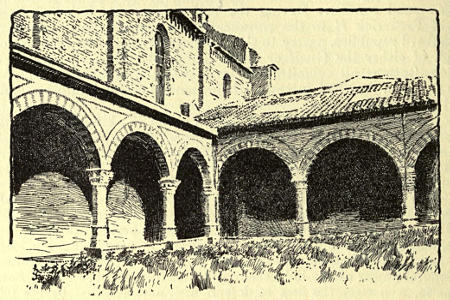
Cloisters of Santa Maria Novella, Florence
Innocent IV pursued his journey towards Rome; but found the capital of Christendom still less disposed than the first city of Lombardy to obey him. The Romans in 1253 called another Bolognese noble, named Brancaleone d’Andolo, to the government of their republic; and gave him, with the title of senator, almost unlimited authority. The citizens, continually alarmed by the quarrels and battles of the Roman nobles, who had converted the Colosseum, the tombs of Adrian, Augustus, and Cæcilia Metella, the arches of triumph and other monuments of ancient Rome, into so many fortresses, whence issued banditti, whom they kept in pay, to pillage passengers and peaceable merchants, demanded of the government above all things vigour and severity. They forgot the guarantee due to the accused, in their attention to those only which were required by the public peace. The senator Brancaleone, at the head of the Roman militia, successively attacked these monuments, become the retreat of robbers and assassins; he levelled to the ground the towers which surmounted them; he hanged the adventurers who defended them, with their commanders the nobles, at the palace windows of the latter; and thus established by terror security in the streets of Rome. He hardly showed more respect to Innocent than to the Roman nobility. The pope, in order to be at a distance from him, had transferred his court to Assisi. Brancaleone sent him word that it was not decorous in a pope to be wandering like a vagabond from city to city; and that, if he did not immediately return to the capital of Christendom of which he was the bishop, the Romans, with their senator at their head, would march to Assisi and send him out of it by setting fire to the town.
Thus, although the power of kings had given way to that of the people, liberty was in general ill understood and insecure. The passions were impetuous; a certain point of honour was attached to violence; the nobles believed they gave proof of independence by rapine and outrage; and the friends of order believed they had attained the highest purpose of government, when they made such audacious disturbers tremble. The turbulence and number of the noble criminals, the support which their crimes found in a false point of honour, form an excuse for the judicial institutions of the Italian republics, which were all more calculated to strike terror into criminals too daring to conceal themselves, than to protect the accused against the unjust suspicion of secret crimes. Order could be maintained only by an iron hand; but this iron hand soon crushed liberty. Nevertheless, among the Italian cities there was one which above all others seemed to think of justice more than of peace, and of the security of the citizen more than of the punishment of the guilty. It was Florence; its judicial institutions are, indeed, far from meriting to be held up as models; but they were the first in Italy which offered any guarantee to the citizen; because Florence was the city where the love of liberty was the most general and the most constant in every class; where the cultivation of the understanding was carried farthest; and where enlightenment of mind soonest appeared in the improvement of the laws.
FLORENTINE AFFAIRS; THE GUELFS RECALLED
[1250-1260 A.D.]
The Ghibelline nobles had taken possession of the sovereignty of Florence with the help of the king of Antioch, two years before the death of his father, Frederick II; but their power soon became insupportable to the free and proud citizens of that republic, who had already become wealthy by commerce and who reckoned amongst them some distinguished literary men, such as Brunetto Latini, and Guido Cavalcanti, without having lost simplicity of manners, their sobriety of habits, or their bodily vigour.
Frederick II still lived, when by a unanimous insurrection, on the 20th of October, 1250, they set themselves free. All the citizens assembled at the same moment in the square of Santa Croce; they divided themselves into fifty groups, of which each group chose a captain and thus formed companies of militia: a council of these officers was the first-born authority of this newly revived republic. The podesta by his severity and partiality had rendered himself universally detested: they deposed him, and supplied his place by another judge, under the name of captain of the people, but soon afterwards decreed that the podesta and the captain should each have an independent tribunal, in order that they should exercise upon each other a mutual control; at the same time, they determined that both should be subordinate to the supreme magistracy of the republic, which was charged with the administration, but divested of the judicial power. They decreed that this magistracy, which they called the signoria, should be always present, always assembled in the palace of the republic, ever ready to control the podesta or the captain, to whom they had been obliged to delegate so much power. The town was divided into six parts, each sestier, as it was called, named two anziani. These twelve magistrates ate together, slept at the public palace, and could never go out but together; their function lasted only two months. Twelve others, elected by the people, succeeded them; and the republic was so rich in good citizens, and in men worthy of its confidence, that this rapid succession of anziani did not exhaust their number. The Florentine militia at the same time attacked and demolished all the towers which served as a refuge to the nobles, in order that all should henceforth be forced to submit to the common law.
The new signoria was hardly informed of the death of Frederick, when by a decree of the 7th of January, 1251, they recalled all the Guelf exiles to Florence. They henceforth laboured to give that party the preponderance throughout Tuscany. They declared war against the neighbouring cities of Pistoia, Pisa, Siena, and Volterra; not to subjugate them, or to impose hard conditions, but to force them to rally round the party which they considered that of the church and of liberty. The year 1254, when the Florentines were commanded by their podesta, Guiscardo Pietra Santa, a Milanese, is distinguished in their history by the name of the “Year of Victories.” They took the two cities of Pistoia and Volterra; they forced those of Pisa and Siena to sign a peace favourable to the Guelf party; they refused to profit by a treason which had given them possession of the citadel of Arezzo and they restored it to the Aretini; lastly, they built in the Lunigiana, beyond the territory of Lucca, a fortress destined to shut the entry of Tuscany on the Ligurian side, which in memory of their podesta bears to this day the name of Pietra Santa. The signoria also showed themselves worthy to be the governors of a city renowned for commerce, the arts, and liberty. The whole monetary system of Europe was at this period abandoned to the depredations of sovereigns who continually varied the title and weight of coins—sometimes to defraud their creditors, at other times to force their debtors to pay more than they had received, or the tax-payers more than was due. During 150 years more the kings of France violated their faith with the public, making annually with the utmost effrontery some important change in the coins. But the republic of Florence, in the year 1252, coined its golden florin, of twenty-four carats fine, and of the weight of one drachma. It placed the value under the guarantee of publicity and of commercial good faith; and that coin remained unaltered as the standard for all other values as long as the republic itself endured.
FLORENCE AND SIENA AT WAR; THE BATTLE OF MONTAPERTI
A conspiracy of Ghibellines to recover their power in Florence and to concentrate it in the aristocratic faction, forced the republic, in the year 1258, to exile the most illustrious chiefs of that party. It was then directed by Farinata degli Uberti, who was looked upon as the most eloquent orator and the ablest warrior in Tuscany. All the Florentine Ghibellines were favourably received at Siena, although the two republics had mutually engaged in their last treaty not to give refuge to the rebels of either city. Farinata afterwards joined Manfred, whom he found firmly established on the throne of the Two Sicilies, and represented to him that, to guard his kingdom from all attack, he ought to secure Tuscany and give supremacy to the Ghibelline party. He obtained from him a considerable body of German cavalry, which he led to Siena.
[1259-1260 A.D.]
Hostilities between the two republics had already begun: the colours of Manfred had been dragged with contempt through the streets by the Florentines. Farinata resolved to take advantage of the irritation of the Germans, in order to bring the two parties to a general battle. He knew that some ignorant artisans had found their way into the signoria of Florence, and he tried to profit by their presumption. He flattered them with the hope that he would open to them one of the gates of Siena, if they ordered their army to present itself under the walls of that city. At the same time, his emissaries undertook to excite the ill will of the plebeians against the nobles of the Guelf party, who, being more clear-sighted, might discover his intrigues. Notwithstanding the opposition of the nobles in council, the signoria resolved to march a Guelf army through the territory of Siena.b
It is said[11] there were not less than thirty thousand, and auxiliary troops came from all the allied cities, or those subjected to the Florentines; but as the Ghibellines had been expelled from these cities, the latter had united at Siena and the Guelfs at Florence, and the two armies presented the sad spectacle of division and civil war in the whole of Tuscany. From Arezzo alone it is asserted that nearly five thousand came to the succour of the Florentines under the command of Donatello Tarlati, whilst another band of outlaws, conducted by their bishop, had joined in Siena, and if we are to believe Raffaello Roncioni, a chosen body of three thousand Pisans also came to Siena. The army of the Guelfs was superior in number to the Ghibellines, that faction being predominant in Tuscany, but probably there was not that disproportion which some historians wish to make us believe. The army of the Guelfs marched on as to certain victory, hoping to enter Siena without fighting; arrived upon the hills of Montaperti they halted to receive advice from the Sienese to proceed further.
Nothing is more capable of disconcerting a leader and an army than to see an enemy courageously advancing to meet them, whom they had believed either beaten or fugitive; thus the Florentine generals, who went to the certain conquest of Siena, when they perceived the enemy advancing boldly, at the head of whom was the German troop, so formidable an enemy to them, began to despair. They came to blows, and both sides fought with great valour; but the Florentines, unable to resist the attack made upon them by the Germans, gave way. Treachery aided to increase the consternation. Many Ghibellines, hidden in time of the battle, went over to the enemy. Among the rest, Bocca of the Abati, before going over to the other side, aimed a treacherous blow at Jacopo Vacca, of the family of the Pazzi, who carried the ensign of the republic, and brought him to the ground with the loss of an arm.
This act spread terror among the Florentines, who could no longer distinguish friends from foes; the only opposition was made around the triumphant chariot which contained the flags, and around the better part of the defenders, who were disposed rather to purchase for themselves an illustrious death by valour, than their safety by flight. A part of the broken army had taken refuge in the castle of Montaperti. The castle being taken by force, the refugees were cut to pieces. It is not easy to ascertain the number of killed in a battle, since the conquerors always exaggerate it, and the conquered conceal it; the latter, or the Florentine writers, acknowledge only twenty-five hundred killed, and fifteen hundred prisoners—but the number must have been far greater.
This battle is reckoned among the most bloody of those times, and was fought on the 4th of September, 1260. The Sienese celebrated the victory with solemn pomp, in which the triumphant chariot (carroccio) of the Florentines was seen dragged upon the ground, and the name of City of the Virgin was taken by Siena on this occasion, as a devout attestation of gratitude to heaven for the happy issue.d
The Florentine Guelfs found themselves too much weakened by the defeat of Montaperti to maintain themselves in Florence. The circumference of the walls was too vast, and the population too much discouraged by the enormous loss which they had experienced to admit of defending the city. All those accordingly who had exercised any authority in the republic—all those whose names were sufficiently known to discover their party—left Florence for Lucca together, on horseback. The Guelfs of Prato, Pistoia, Volterra, and San Gemignano could not hope to maintain their ground when those of Florence failed. All abandoned their dwellings and joined the Florentines at Lucca. That city granted to the illustrious fugitives the church and portico of San Friano and the surrounding quarter, where they pitched their tents. The Ghibellines entered Florence on the 27th of September, immediately abolished the popular government, and formed a new magistracy, composed entirely of nobles, who took the oath of fidelity to Manfred, king of the Two Sicilies.
At a diet of the Ghibelline cities assembled at Empoli, the ambassadors of Pisa and Siena strongly represented that whilst Florence existed, the preponderance of the Ghibelline party in Tuscany could never be secure. They affirmed that the population of that proud and warlike city was entirely devoted to the Guelf party, that there was no hope of mitigating their hatred of the nobles and of the family of the last emperor, that democratic habits were become a sort of second nature to every one of the inhabitants; they concluded with demanding that the walls of Florence should be razed to the ground, and the people dispersed among the neighbouring towns. All the Ghibellines of Tuscany, all the deputies of the cities jealous of Florence received the proposition favourably. It was about to be adopted when Farinata degli Uberti rose, and repelled with indignation this abuse of the victory which he had just gained. He protested that he loved his country far better than his party; and declared that he would, with those same companions in arms whose bravery they had witnessed at the battle of Arbia, join the Guelfs and fight for them, sooner than consent to the ruin of what was in the world most dear to him. The enemies of Florence dared not answer him; and the diet of Empoli contented itself with decreeing that the league of Tuscany should take into pay one thousand of the soldiers of Manfred, to support in that province the preponderance of the Guelf party. Dante has immortalised Farinata as the saviour of Florence, and Bocca degli Abati as the traitor who placed it on the brink of destruction. His poem is filled with allusions to this memorable epoch.
THE TYRANT EZZELINO
[1256-1260 A.D.]
While the Ghibellines thus acquired the preponderance in Tuscany, the tyrant fell who at the head of that party had caused so much blood to flow in the Trevisan march. Ezzelino was hereditary lord of Bassano and Piedmont: he succeeded in making himself named captain of the people by the republics of Verona, Vicenza, Padua, Feltre, and Belluno. By this title he united the judicial with the military power; he was subject only to councils which he might assemble or not at his pleasure. It does not appear that there was any permanent magistracy like the signoria of Florence, to repress his abuse of power. Accordingly he soon changed the authority which he derived from the people into a frightful tyranny: fixing his suspicions upon all who rose to any distinction, who in any way attracted the attention of their fellow citizens, he did not wait for any expression of discontent, or symptom of resistance in the nobles, merchants, priests, or lawyers, who by their eminence alone became suspected, to throw them into prison and there, by the most excruciating torture, extract confessions of crimes that might justify his suspicions. The names which escaped their lips in the agony of torture were carefully registered in order to supply fresh victims to the tyrant. In the single town of Padua there were eight prisons always full, notwithstanding the incessant toil of the executioner to empty them; two of these contained each three hundred prisoners. A brother of Ezzelino, named Alberic, governed Treviso with less ferocity, but with a power not less absolute. Cremona was in like manner subject to a Ghibelline chief; Milan no longer evinced any repugnance to that party. In that city, as well as in Brescia, the factions of nobles and plebeians disputed for power.
Alexander IV, to destroy the monster that held in terror the Trevisan march, caused a crusade to be preached in that country. He promised those who combated the ferocious Ezzelino all the indulgences usually reserved for the deliverers of the Holy Land. The marquis d’Este, the count di San Bonifacio, with the cities of Ferrara, Mantua, and Bologna, assembled their troops under the standard of the church; they were joined by a horde of ignorant fanatics from the lowest class, anxious to obtain indulgences, but unsusceptible of discipline and incapable of a single act of valour. Their number, however, so frightened Ezzelino’s lieutenant at Padua, that he defended but feebly the passage of the Bacchiglione and the town. The legate Philip, elected archbishop of Ravenna, entered Padua at the head of the crusaders, on the 18th of June, 1256; but he either would not or could not restrain the fanatic and rapacious rabble which he had summoned to the support of his soldiers: for seven days the city was inhumanly pillaged by those whom it had received as its deliverers. As soon as Ezzelino was informed of the loss he had sustained, he hastened to separate and disarm the eleven thousand Paduans belonging to his army; he confined them in prisons, where all, with the exception of two hundred, met a violent or lingering death.
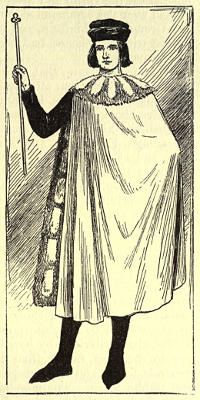
Italian Nobleman, Thirteenth Century
During the following two years the Guelfs experienced nothing but disasters: the legate whom the pope had placed at their head proved incompetent to command them; and the crowd of crusaders whom he called to his ranks served only to compromise them, by want of courage and discipline. The Ghibelline nobles of Brescia even delivered their country into the hands of Ezzelino after he had put the legate’s army to flight, in the year 1258. The following year this tyrant, unequalled in Italy for bravery and military talent, always an enemy to luxury, and proof against the seductions of women, making the boldest tremble with a look, and preserving in his diminutive person, at the age of sixty-five, all the vigour of a soldier, advanced into the centre of Lombardy in the hope that the nobles of Milan, with whom he had already opened a correspondence, would surrender this great city to him. He passed the Oglio and afterwards the Adda, with the most brilliant army he had ever yet commanded: but the marquis Palavicino, Buoso da Doara, the Cremonese chieftain, and other Ghibellines, his ancient associates, disgusted with his crimes, had secretly made an alliance with the Guelfs for his destruction.
When they saw that he had advanced so far from his home they rushed upon him from all sides. On the 16th of September, 1259, whilst he was preparing to retire, he found himself stopped at the bridge of Cassano. The Brescians, no longer obedient to his command, began their movement to abandon him; all the points of retreat were cut off by the Milanese, Cremonese, Ferrarians, and Mantuans: repulsed, pursued as far as Vimercato, and at last wounded in the foot, he was made prisoner and taken to Soncino: there, he refused to speak, rejected all aid of medicine, tore off all the bandages from his wounds, and finally expired, on the eleventh day of his captivity. His brother and all his family were massacred in the following year.
THE BEGINNING OF FEUDAL TYRANNY IN LOMBARDY
[1256-1264 A.D.]
The defeat of Ezzelino, and the destruction of the family of Romano, may be regarded as the last great effort of the Lombards against the establishment of tyranny in their country. About this time the cities began to be accustomed to absolute power in a single person. In each republic, the nobles, always divided by hereditary feuds, regarded it as disgraceful to submit to the laws, rather than do themselves justice by force of arms: their quarrels, broils, and brigandage carried troubles and disorder into every street and public place. The merchants were continually on the watch to shut their shops on the first cry of alarm; for the satellites of the nobles were most commonly banditti, to whom they gave shelter in their palaces, and who took advantage of the tumult to plunder the shops. At the same time that the nobles irritated the plebeians by their arrogance, they ridiculed their incapacity, and endeavoured to exclude them from all the public offices. The people often, in their indignation, took arms; the streets were barricaded and the nobles, besieged in their town houses, were driven to take refuge in their castles; but if the militia of the towns afterwards presumed to pursue in the plains of Lombardy the nobles whom they forced to emigrate, they soon found themselves sadly inferior. In the course of this century, the nobles had acquired the habit of fighting on horseback with a lance and covered with heavy armour. Continual exercise could alone render them expert in the manœuvres of cavalry, and accustom them to the enormous weight of the cuirass and helmet; on the other hand, this armour rendered them almost invulnerable. When they charged with couched lance, and with all the impetuosity of their war-horses, they overthrew and annihilated the ill-armed infantry opposed to them without experiencing themselves any damage. The cities soon felt the necessity of opposing cavalry to cavalry, and of taking into their pay either those nobles who made common cause with the people, or foreigners and adventurers who about this time began to exchange their valour for hire.
As the custom was prevalent of giving the command of the militia to the first officer of justice, in order to give him authority either to direct the public force against rebels or disturbers of order, or to discipline the soldier by the fear of punishment, no commander could be found who would undertake the military service of a town, without at the same time possessing the power of the judicial sword—such power as was intrusted to the podesta or captain of the people. It became necessary then to deliver into his charge what was named the signoria; and the more considerable this corps of cavalry, thus placed for a certain number of years at the service of the republic, the more this signoria, to which was attached the power of adjudging life or death in the tribunals, became dangerous to liberty.
Among the first feudal lords who embraced the cause of the people and undertook the service of a town, with a body of cavalry raised among their vassals, or among the poor nobles, their adherents, was Pagan della Torre, the lord of Valsassina. He had endeared himself to the Milanese by saving their army from the pursuit of Frederick II after the battle of Cortenuova. He was attached by hereditary affection to the Guelf party; and although himself of illustrious birth, he seemed to partake the resentment of the plebeians of Milan against the nobility who oppressed them. When he died, his brother Martino, after him Raymond, then Philip, lastly, Napoleon della Torre, succeeded each other as captains of the people, commanders of a body of cavalry which they had raised and placed at the service of the city; they were the acknowledged superiors of the podesta and the tribunals. These five lords succeeded each other in less than twenty years; and even the shortness of their lives accustomed the people to regard their election as the confirmation of a dynasty become hereditary. Other Guelf cities of Lombardy were induced to choose the same captain and the same governor as Milan, because they believed him a true Guelf, and a real lover of the people.
These towns found the advantage of drawing closer their alliance with the city which directed their party; of placing themselves under a more powerful protection; and of supporting their tribunals with a firmer hand. Martin della Torre had been elected podesta of Milan in 1256; three years later he obtained the title of elder, and lord of the people. At the same time, Lodi also named him lord. In 1263, the city of Novara conferred the same honour on him. Philip, who succeeded him in 1264, was named lord by Milan, Como, Vercelli, and Bergamo. Thus began to be formed among the Lombard republics, without their suspecting that they divested themselves of their liberty, the powerful state which a century and a half later became the duchy of Milan. But the pope, jealous of the house of della Torre, appointed archbishop of Milan Otto Visconti, whose family, powerful on the borders of Lake Maggiore, then shared the exile of the nobles and Ghibellines. This prelate placed himself at the head of their faction; and henceforward the rivalry between the families of Della Torre and Visconti made that between the people and the nobles almost forgotten.
PERENNIAL STRIFE OF GUELFS AND GHIBELLINES
[1257-1261 A.D.]
The bitter enmity between the two parties of the Guelfs and Ghibellines was fatal to the cause of liberty. With the former, the question was religion—the independence of the church and of Italy, menaced by the Germans and Saracens, to whom Manfred granted not less confidence than Frederick II; with the latter, honour and good faith towards an illustrious family, and the support of the aristocracy as well as of royalty; but both were more intent on avenging offences a thousand times repeated, and guarding against exile, and the confiscation of property.
These party feelings deeply moved men who gloried in the sacrifices which they or their ancestors had made to either party; while they regarded as entirely secondary the support of the laws, the impartiality of the tribunals, or the equal participation of the citizens in the sovereignty. Every town of Lombardy forgot itself, to make its faction triumph; and it looked for success in giving more unity and force to power. The cities of Mantua and Ferrara, where the Guelfs were far the more numerous, trusted for their defence, the one to the count di San Bonifazio, the other to the marquis d’Este, with so much constancy, that these nobles, under the name of captains of the people, had become almost sovereigns. In the republic of Verona, the Ghibellines, on the contrary, predominated; and as they feared their faction might sink at the death of Ezzelino, they called to the command of their militia, and the presidency of their tribunals, Mastino della Scala; lord of the castle of that name in the Veronese territory; whose power became hereditary in his family. The marquis Pelavicino, the most renowned Ghibelline in the whole valley of the Po, whose strongest castle was San Donnino, between Parma and Piacenza, and who had formed and disciplined a superb body of cavalry, was named, alternately with his friend, Buoso da Doara, lord of the city of Cremona. Pavia and Piacenza also chose him almost always their captain; and this honour was at the same time conferred on him by Milan, Brescia, Tortona, and Alexandria. The Ghibelline party had, since the offence given by Innocent IV to the Guelfs of Milan, obtained the ascendency in Lombardy. The house of Della Torre seemed even to lean towards it; and it was all powerful in Tuscany. The city of Lucca had been the last to accede to that party in 1263; and the Tuscan Guelfs, obliged to leave their country, had formed a body of soldiers, which placed itself in the pay of the few cities of Lombardy still faithful to the Guelf party.
The court of Rome saw, with great uneasiness, this growing power of the Ghibelline party, firmly established in the Two Sicilies, under the sceptre of Manfred. Feared even in Rome and the neighbouring provinces, master in Tuscany, and making daily progress in Lombardy, Manfred seemed on the point of making the whole peninsula a single monarchy. It was no longer with the arms of the Italians that the pope could expect to subdue him. The Germans afforded no support. Divided between Richard of Cornwall and Alfonso of Castile, they seemed desirous of delivering themselves from the imperial authority, by dividing between foreigners an empty title; while each state sought to establish a separate independence at home, and abandon the supremacy of the empire over Italy. It was accordingly necessary to have recourse to other barbarians to prevent the formation of an Italian monarchy fatal to the power of the pontiff. Alexander IV died on the 25th of May, 1261; three months afterwards, a Frenchman, who took the name of Urban IV, was elected his successor; and he did not hesitate to arm the French against Manfred.
CHARLES OF ANJOU CONQUERS SICILY
[1261-1266 A.D.]
His predecessor had already opened some negotiations, for the purpose of giving the crown of Sicily to Edmund, son of Henry III, king of England. Urban put an end to them by having recourse to a prince nearer, braver, and more powerful. He addressed himself to Charles count of Anjou, the brother of St. Louis, sovereign in right of his wife of the county of Provence. Charles had already signalised himself in war; he was, like his brother, a faithful believer, and still more fanatical and bitter towards the enemies of the church, against whom he abandoned himself without restraint to his harsh and pitiless character. His religious zeal, however, did not interfere with his policy; his interests set limits to his subjection to the church; he knew how to manage those whom he wished to gain; and he could flatter, at his need, the public passions, restrain his anger, and preserve in his language a moderation which was not in his heart. Avarice appeared his ruling passion, but it was only the means of serving his ambition, which was unbounded. He accepted the offer of the pope. His wife Beatrice, ambitious of the title of queen, borne by her three sisters, pawned all her jewels to aid in levying an army of thirty thousand men, which she led herself through Lombardy. He had preceded her. Having gone by sea to Rome, with one thousand knights, he made his entry into that city on the 24th of May, 1265. A new pope, like his predecessor a Frenchman, named Clement IV, had succeeded Urban, and was not less favourable to Charles of Anjou. He caused him to be elected senator by the Roman Republic, and invested him with the kingdom of Sicily, which he charged him to conquer; under the condition, however, that the crown should never be united to that of the empire, or to the sovereignty of Lombardy and Tuscany. A tribute of eight thousand ounces of gold, and a white palfrey, was, by this investiture, assigned to St. Peter.
The French army, headed by Beatrice, did not pass through Italy till towards the end of the summer of 1265; and in the month of February of the following year, Charles entered, at its head, the kingdom of Naples. He met Manfred, who awaited him in the plain of Grandella, near Benevento, on the 26th of February. The battle was bloody. The Germans and Saracens were true to their ancient valour; but the Apulians fled like cowards, and the brave son of Frederick II, abandoned by them on the field of battle, perished. The kingdom of the Two Sicilies was the price of this victory. Resistance ceased, but not massacre. Charles gave up the pillage of Benevento to his soldiers; and they cruelly put to death all the inhabitants. The Italians, who believed they had experienced from the Germans and Saracens of Frederick and Manfred all that could be feared from the most barbarous enemies, now found that there was a degree of ferocity still greater than that to which they had been accustomed from the house of Hohenstaufen. The French seemed always ready to give as to receive death. The two strong colonies of Saracens at Luceria and Nocera were soon exterminated, and in a few years there remained not in the Two Sicilies a single individual of that nation or religion, nor one German who had been in the pay of Manfred. Charles willingly consented to acknowledge the Apulians and Sicilians his subjects; but he oppressed them, as their conqueror, with intolerable burdens. While he distributed amongst his followers all the great fiefs of the kingdom, he so secured with a hand of iron his detested dominion that two years afterwards, when Conradin, the son of Conrad and the nephew of Manfred, arrived from Germany to dispute the crown, few malcontents in the Two Sicilies had the courage to declare for him.
[1266-1268 A.D.]
The victory of Charles of Anjou over Manfred restored the ascendant of the Guelf party in Italy. Filippo della Torre, who for some time seemed to hesitate between the two factions, at last gave passage through the Milanese territory to the army of Beatrice. Buoso da Doara was accused of having received money not to oppose her on the Oglio. The count di San Bonifazio, the marquis d’Este, and afterwards the Bolognese, openly joined her party. After the battle of Grandella, the Florentines rose, and drove out, on the 11th of November, 1266, the German garrison, commanded by Guido Novello, the lieutenant of Manfred. They soon afterwards received about eight hundred French cavalry from Charles, to whom they entrusted for ten years the signoria of Florence; that is to say, they conferred on him the rights allowed by the Peace of Constance to the emperors. At the same time they re-established, with full liberty, their internal constitution; they augmented the power of their numerous councils, from which they excluded the nobles and Ghibellines; and they gave to the corporations of trade, into which all the industrious part of the population was divided, a direct share in the government.
THE FALL OF CONRADIN; GREGORY X; OTTO VISCONTI
[1268-1278 A.D.]
It was about the end of the year 1267 that the young Conradin, aged only sixteen years, arrived at Verona, with ten thousand cavalry, to claim the inheritance of which the popes had despoiled his family. All the Ghibellines and brave captains, who had distinguished themselves in the service of his grandfather and uncle, hastened to join him, and to aid him with their swords and counsel. The republics of Pisa and Siena, always devoted to his family, but whose zeal was now redoubled by their jealousy of the Florentines, made immense sacrifices for him. The Romans, offended at the pope’s having abandoned their city for Viterbo, as well as jealous of his pretensions in the republic, from the government of which he had excluded the nobles, opened their gates to Conradin, and promised him aid. But all these efforts, all this zeal, did not suffice to defend the heir of the house of Hohenstaufen against the valour of the French. Conradin entered the kingdom of his fathers by the Abruzzi and met Charles of Anjou in the plain of Tagliacozzo, on the 23rd of August, 1268. A desperate battle ensued; victory long remained doubtful. Two divisions of the army of Charles were already destroyed; and the Germans, who considered themselves the victors, were dispersed in pursuit of the enemy; when the French prince, who, till then, had not appeared on the field, fell on them with his body of reserve, and completely routed them. Conradin, forced to fly, was arrested, forty-five miles from Tagliacozzo, as he was about to embark for Sicily. He was brought to Charles, who, without pity for his youth, esteem for his courage, or respect for his just right, exacted from the iniquitous judges before whom he subjected him to the mockery of a trial, a sentence of death. Conradin was beheaded in the market-place at Naples, on the 26th of October, 1268. With him perished several of his most illustrious companions in arms—German princes, Ghibelline nobles, and citizens of Pisa; and, after the sacrifice of these first victims, an uninterrupted succession of executions long continued to fill the Two Sicilies with dismay.
The defeat and death of Conradin established the preponderance of the Guelf party throughout the peninsula. Charles placed himself at the head of it; the pope named him imperial vicar in Italy during the interregnum of the empire, and sought to annex to that title all the rights formerly exercised by the emperors in the free cities. Clement IV died on the 29th of November, 1268—one month after the execution of Conradin. The cardinals remained thirty-three months without being able to agree on the choice of a successor. During this interregnum—the longest the pontifical chair had ever experienced—Charles remained sole chief of the Guelf party, ruling over the whole of Italy, which had neither pope nor emperor. He convoked, in 1269, a diet of the Lombard cities at Cremona, in which the towns of Piacenza, Cremona, Parma, Modena, Ferrara, and Reggio, consented to confer on him the signoria; Milan, Como, Vercelli, Novara, Alessandria, Tortona, Turin, Pavia, Bergamo, and Bologna, declared they should feel honoured by his alliance and friendship, but could not take him for master. Italy already felt the weight of the French yoke, which would have pressed still heavier if the crusade against Tunis to which Charles of Anjou was summoned by his brother, St. Louis, had not diverted his projects of ambition.
The conclave assembled at Viterbo at length raised to the vacant chair Teobaldo Visconti, of Piacenza, who was at that time in the Holy Land. On his return to Italy, in the year 1272, he took the name of Gregory X. This wise and moderate man soon discovered that the court of Rome had overreached itself; in crushing the house of Hohenstaufen, it had given itself a new master not less dangerous than the preceding. Gregory, instead of seeking to annihilate the Ghibellines, like his predecessors, occupied himself only in endeavouring to restore an equilibrium and peace between them and the Guelfs. He persuaded the Florentines and Sienese to recall the exiled Ghibellines, for the purpose, as he announced, of uniting all Christendom in the defence of the Holy Land; and testified the strongest resentment against Charles, who threw obstacles in the way of this reconciliation. He relieved Pisa from the interdict that had been laid on it by the holy see. He showed favour to Venice and Genoa; both of which, offended by the arrogance and injustice of Charles, had made common cause with his enemies. He engaged the electors of Germany to take advantage of the death of Richard of Cornwall, which took place in 1271, and put an end to the interregnum by proceeding to a new election. The electors conferred the crown, in 1273, on Rudolf of Habsburg, founder of the house of Austria. The death of Gregory X, in the beginning of January, 1276, deprived him of the opportunity to develop the projects which these first steps seem to indicate; but Nicholas III, who succeeded him in 1277, after three ephemeral popes, undertook more openly to humble Charles, and to support the Ghibelline party. He forced the king of Sicily to renounce the title of imperial vicar, to which Charles had no title except during the interregnum of the empire; he still further engaged him to resign the title of senator of Rome, and the dignity of the signoria, which had been conferred on him by the cities of Lombardy and Tuscany, by representing to him that his power over these provinces was contrary to the bull of investiture, which had put him in possession of the kingdom of Naples.
Rudolf of Habsburg, who had never visited Italy, and was ignorant of the geography of that country, was, in his turn, persuaded by the pope to confirm the charters of Louis le Débonnaire, of Otto I, and of Henry VI, of which copies were sent to him. In these charters, whether true or false, taken from the chancery at Rome, the sovereignty of the whole of Emilia or Romagna, the Pentapolis, the march of Ancona, the patrimony of St. Peter, and the Campagna of Rome, from Radicofani to Ceperano, were assigned to the church. The imperial chancery confirmed, without examination, a concession which had never been really made. The two Fredericks, as well as their predecessors, had always considered this whole extent of country as belonging to the empire, and always exercised there the imperial rights. A chancellor of Rudolf arrived in these provinces to demand homage and the oath of allegiance, which were yielded without difficulty; but Nicholas appealed against this homage, and called it a sacrilegious usurpation. Rudolf was obliged to acknowledge that it was in contradiction to his own diplomas, and resigned his pretensions. From that period, 1278, the republics held of the holy see and not of the emperor.
[1277-1280 A.D.]
A revolution, not long previous, in the principal cities of Lombardy, had secured the preponderance to the nobles and the Ghibelline party. These, having been for a considerable period exiled from Milan, experienced a continuation of disasters, and, instead of fear, excited compassion. While Napoleon della Torre, chief of the republic of Milan, was exasperating the plebeians and Guelfs with his arrogance and contempt of their freedom, he was informed that Otto Visconti, whom he had exiled, although archbishop of Milan, had assembled around him at Como many nobles and Ghibellines, with whom he intended making an attack on the Milanese territory. Napoleon marched to meet him; but, despising enemies whom he had so often vanquished, he carelessly suffered himself to be surprised by the Ghibellines at Desio, in the night of the 21st of January, 1277. Having been made prisoner, with five of his relatives, he and they were placed in three iron cages, in which the archbishop kept them confined. This prelate was himself received with enthusiasm at Milan, at Cremona, and Lodi. He formed anew the councils of these republics, admitting only Ghibellines and nobles, who, ruined by a long exile, and often supported by the liberality of the archbishop, were become humble and obsequious; their deference degenerated into submission, and the republic of Milan, henceforth governed by the Visconti, became soon no more than a principality.
GHIBELLINE SUCCESSES; THE SICILIAN VESPERS
Nicholas III, of the noble Roman family of the Orsini, felt a hereditary affection for the Ghibellines, and everywhere favoured them. A rivalry between two illustrious families of Bologna, the Gieremei and the Lambertazzi, terminated, in 1274, in the exile of the latter (who were Ghibellines) with all their adherents. The quarrel between the two families became, from that period, a bloody war throughout Romagna. Guido de Montefeltro, lord of the mountains in the neighbourhood of Urbino, who had never joined any republic, received the Ghibellines into his country; and in commanding them gained the reputation of a great captain. Nicholas III sent a legate to Romagna, to compel Bologna and all the Guelf republics to recall the Ghibellines, and establish peace throughout the province. He succeeded in 1279. Another legate on a similar mission, and with equal success, was sent to Florence and Siena. The balance seemed at last on the point of being established in Italy, when Nicholas died, on the 19th of August, 1280.