Chapter XIV · THE “LAST DAY OF ITALY”
Reading edition
[1494-1530 A.D.]
The period was at length arrived when Italy—which had restored intellectual light to Europe, reconciled civil order with liberty, recalled youth to the study of laws and of philosophy, created the taste for poetry and the fine arts, revived the science and literature of antiquity, given prosperity to commerce, manufactures, and agriculture—was destined to become the prey of those very barbarians whom she was leading to civilisation. Her independence must necessarily perish with her liberty, which was hitherto the source of her grandeur and power. In a country covered with republics three centuries before, there remained but four at the death of Lorenzo de’ Medici; and in those, although the word “liberty” was still inscribed on their banners, that principle of life had disappeared from their institutions. Florence, already governed for three generations by the family of the Medici, corrupted by their licentiousness, and rendered venal by their wealth, had been taught by them to fear and to obey. Venice with its jealous aristocracy, Siena and Lucca, each governed by a single caste of citizens, if still republics, had no longer popular governments or republican energy. Neither in those four cities, nor in Genoa, which had surrendered its liberty to the Sforzas, nor in Bologna, which yielded to the Bentivoglios, nor in any of the monarchical states, was there to be found throughout Italy that power of a people whose every individual will tends to the public weal, whose efforts are all combined for the public benefit and the common safety. The princes of that country could appeal only to order and the obedience of the subject, not to the enthusiasm of the citizen, for the protection of Italian independence and of their own.
Immense wealth, coveted by the rest of Europe, was, it is true, always accumulating in absolute monarchies, as well as in republics; but if, on the one hand, it furnished the pay of powerful armies, on the other, it augmented the danger of Italy, by exciting the cupidity of its neighbours. The number of national soldiers was very considerable; their profession was that which led the most rapidly to distinction and fortune. Engaged only for the duration of hostilities, and at liberty to retire every month, instead of spending their lives in the indolence of garrisons or abandoning the freedom of their will, they passed rapidly from one service to another, seeking only war, and never becoming enervated by idleness. The horses and armour of the Italian men-at-arms were reckoned superior to those of the transalpine nations, against which they had measured themselves in France during “the war of the public weal.” The Italian captains had made war a science, every branch of which they thoroughly knew. It was never suspected for a moment that the soldier should be wanting in courage; but the general mildness of manners and the progress of civilisation had accustomed the Italians to make war with sentiments of honour and humanity towards the vanquished. Ever ready to give quarter, they did not strike a fallen enemy. Often, after having taken from him his horse and armour, they set him free; at least, they never demanded a ransom so enormous as to ruin him. Horsemen who went to battle clad in steel were rarely killed or wounded, so long as they kept their saddles. Once unhorsed, they surrendered. The battle, therefore, never became murderous. The courage of the Italian soldiers, which had accommodated itself to this milder warfare, suddenly gave way before the new dangers and ferocity of barbarian enemies. They became terror-struck when they perceived that the French caused dismounted horsemen to be put to death by their valets, or made prisoners only to extort from them, under the name of ransom, all they possessed. The Italian cavalry, equal in courage and superior in military science to the French, were for some time unable to make head against an enemy whose ferocity disturbed their imaginations.
While Italy had lost a part of the advantages which, in the preceding century, had constituted her security, the transalpine nations had suddenly acquired a power which destroyed the ancient equilibrium. Up to the close of the fifteenth century, wars were much fewer between nation and nation than between French, Germans, or Spaniards among themselves. Even the war between the English and the French, which desolated France for more than a century, sprang not from enmity between two rival nations, but from the circumstance that the kings of England were French princes, hereditary sovereigns of Normandy, Poitou, and Guienne. Charles VII at last forced the English back beyond sea, and reunited to the monarchy provinces which had been detached from it for centuries. Louis XI vanquished the dukes and peers of France who had disputed his authority; he humbled the house of Burgundy, which had begun to have interests foreign to France. His young successor and son, Charles VIII, on coming of age, found himself the master of a vast kingdom in a state of complete obedience, a brilliant army, and large revenues; but was weak enough to think that there was no glory to be obtained unless in distant and chivalrous expeditions. The different monarchies of Spain, which had long been rivals, were united by the marriage of Ferdinand of Aragon with Isabella of Castile, and by the conquest which they jointly made of the Moorish kingdom of Granada. Spain, forming for the first time one great power, began to exercise an influence which she had never till then claimed. The emperor Maximilian, after having united the Low Countries and the county of Burgundy, his wife’s inheritance, to the states of Austria, which he inherited from his father, asserted his right to exercise over the whole of Germany the imperial authority which had escaped from the hands of his predecessors. Lastly, the Swiss, rendered illustrious by their victories over Charles the Bold, had begun, but since his death only, to make a traffic of their lives, and enter the service of foreign nations. At the same time, the empire of the Turks extended along the whole shore of the Adriatic, and menaced at once Venice and the kingdom of Naples. Italy was surrounded on all sides by powers which had suddenly become gigantic, and of which not one had, half a century before, given her uneasiness.
[1492-1494 A.D.]
France was the first to carry abroad an activity unemployed at home, and to make Italy feel the change which had taken place in the politics of Europe. Its king, Charles VIII, claimed the inheritance of all the rights of the second house of Anjou on the kingdom of Naples. Those rights, founded on the adoption of Louis I of Anjou by Joanna I, had never been acknowledged by the people or confirmed by possession. For the space of a hundred and ten years Louis I, II, and III, and René, the brother of the last, made frequent but unsuccessful attempts to mount the throne of Naples. The brother and the daughter of René, Charles of Maine and Margaret of Anjou, at last either ceded or sold those rights to Louis XI. His son, Charles VIII, as soon as he was of age, determined on asserting them. Eager for glory, in proportion as his weak frame and still weaker intellect incapacitated him for acquiring it, he, at the age of twenty-four, resolved on treading in the footsteps of Charlemagne and his paladins; and undertook the conquest of Naples as the first exploit that was to lead to the conquest of Constantinople and the deliverance of the Holy Sepulchre.
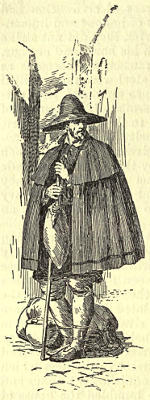
An Italian Peasant
Charles VIII entered Italy in the month of August, 1494, with thirty-six hundred men-at-arms or heavy cavalry; twenty thousand infantry, Gascons, Bretons, and French; eight thousand Swiss, and a formidable train of artillery. This last arm had received in France, during the wars of Charles VII, a degree of perfection yet unknown to the rest of Europe. The states of upper Italy were favourable to the expedition of the French. The duchess of Savoy and the marchioness of Montferrat, regents for their sons, who were under age, opened the passages of the Alps to Charles VIII. Lodovico the Moor, regent of the duchy of Milan, recently alarmed at the demand made on him by the king of Naples, to give up the regency to his nephew, Giovanni Galeazzo, then of full age, and married to a Neapolitan princess, had himself called the French into Italy; and to facilitate their conquest of the kingdom of Naples, opened to them all the fortresses of Genoa which were dependent on him. The republic of Venice intended to remain neutral, reposing in its own strength, and made the duke of Ferrara and the marquis of Mantua, its neighbours, adopt the same policy; but southern Italy formed for its defence a league, comprehending the Tuscan republics, the states of the church, and the kingdom of Naples.
At Florence, Lorenzo de’ Medici left three sons; of whom Piero II, at the age of twenty-one, was named chief of the republic. His grandfather, Piero I, son of Cosmo, oppressed with infirmities and premature old age, had shown little talent, and no capacity for the government of a state. Piero II, on the contrary, was remarkable for his bodily vigour and address; but he thought only of shining at festivals, tilts, and tournaments. It was said that he had given proofs of talent in his literary studies, that he spoke with grace and dignity; but in his public career he proved himself arrogant, presumptuous, and passionate. He determined on governing the Florentines as a master, without disguising the yoke which he imposed on them; not deigning to trouble himself with business, he transmitted his orders by his secretary, or some one of his household, to the magistrates.
Piero de’ Medici remained faithful to the treaty which his father had made with Ferdinand, king of Naples, and engaged to refuse the French a free passage, if they attempted to enter southern Italy by Tuscany. The republics of Siena and Lucca, too feeble to adopt an independent policy, promised to follow the impulse given by Medici. In the states of the church, Rodrigo Borgia had succeeded to Innocent VIII, on the 11th of August, 1492, under the name of Alexander VI. He was the richest of the cardinals, and at the same time the most depraved in morals, and the most perfidious as a politician. The marriage of one of his sons (for he had several) with a natural daughter of Alfonso, son of Ferdinand, had put the seal to his alliance with the reigning house of Naples. That house then appeared at the summit of prosperity. Ferdinand, though seventy years of age, was still vigorous: he was rich, he had triumphed over all his enemies; he passed for the most able politician in Italy. His two sons, Alfonso and Frederick, and his grandson, Ferdinand, were reputed skilful warriors; they had an army and a numerous fleet under their orders. However, Ferdinand dreaded a war with France, and he had just opened negotiations to avoid it when he died suddenly, on the 25th of January, 1494. His son, Alfonso II, succeeded him; while Frederick took command of the fleet, and the young Ferdinand that of the army, destined to defend Romagna against the French.
It was by Pontremoli and the Lunigiana that Charles VIII, according to the advice of Lodovico the Moor, resolved to conduct his army into southern Italy. This road traversing the Apennines from Parma to Pontremoli, over poor pasture lands, and descending through olive groves to the sea, the shore of which it follows at the foot of the mountains, was not without danger. The country produces little grain of any kind. Corn was brought from abroad, at a great expense, in exchange for oil. The narrow space between the sea and the mountains was defended by a chain of fortresses, which might long stop the army on a coast where it would have experienced at the same time famine and the pestilential fever of Pietrasanta. Piero de’ Medici, upon learning that the French were arrived at Sarzana, and perceiving the fermentation which the news of their approach excited at Florence, resolved to imitate that act of his father which he had heard the most praised—his visit to Ferdinand at Naples. He departed to meet Charles VIII. On his road he traversed a field of battle, where three hundred Florentine soldiers had been cut to pieces by the French, who had refused to give quarter to a single one. Seized with terror, on being introduced to Charles, he, on the first summons, caused the fortresses of Sarzana and Sarzanello to be immediately surrendered. He afterwards gave up those of Librafratta, Pisa, and Livorno (Leghorn), consenting that Charles should garrison and keep them until his return from Italy, or until peace was signed, and thus establishing the king of France in the heart of Tuscany. It was contrary to the wish of the Florentines that Medici had engaged in hostilities against the French, for whom they entertained an hereditary attachment; but the conduct of the chief of the state, who, after having drawn them into a war, delivered their fortresses, without authority, into the hands of the enemy whom he had provoked, appeared as disgraceful as it was criminal.
Piero de’ Medici, after this act of weakness, quitted Charles, to return in haste to Florence, where he arrived on the 8th of November, 1494. On his preparing, the next day, to visit the signoria, he found guards at the door of the palace, who refused him admittance. Astonished at this opposition, he returned home, to put himself under the protection of his brother-in-law, Paolo Orsini, a Roman noble, whom he had taken, with a troop of cavalry, into the pay of the republic. Supported by Orsini, the three brothers Medici rapidly traversed the streets, repeating the war-cry of their family, “Palle! Palle!”—without exciting a single movement of the populace, upon whom they reckoned, in their favour. The friends of liberty, the Piagnoni, on the other hand, excited by the exhortations of Savonarola, assembled, and took arms. Their number continually increased. The Medici, terrified, left the city by the gate of San Gallo, traversed the Apennines, retired first to Bologna, then to Venice, and thus lost, without a struggle, a sovereignty which their family had already exercised sixty years. The same day, the 19th of November, 1494, on which the Medici were driven out of Florence, the Florentines were driven out of Pisa.d
CHARLES VIII; HIS ARMY (1494 A.D.)
The French army was now ready to march on Florence. It consisted of thirty-six hundred men-at-arms; six thousand foot-archers from Brittany; six thousand crossbowmen from the central provinces; eight thousand Gascon infantry, at that time the most esteemed in France; all armed with arquebuses and two-handed swords; and eight thousand Swiss or German pikemen and halberdiers. An immense number of attendants followed and increased this splendid force which was led by the king, the duke of Orleans, afterwards Louis XII, the duke of Vendôme; the count of Montpensier; Louis de Ligne, lord of Luxemburg; Louis de la Trémouille and other great seigniors; besides the seneschal of Beaucaire, Briçonnet, bishop of St. Malo, both confidential advisers of Charles; and, though last not least, his father’s old and faithful counsellor Philip de Comines, lord of Argenton, who has left so interesting and instructive a history of his own times to posterity. The French man-at-arms or lance (a name which seems to have been gradually dropped in Italy after the disappearance of transalpine condottieri by whom it was introduced) consisted of six horsemen, of which two were archers; they were nearly all French subjects, and all gentlemen, who were neither enrolled nor removed at the general’s pleasure nor paid by him as in Italy, but received their salary direct from the crown. Their squadrons were always maintained complete, and every man was well equipped both with arms and horses, for their circumstances were equal to it, and there was a good spirit and an honourable emulation to distinguish themselves not only for the sake of glory but promotion; and the same spirit existed among the leaders and generals, who were all lords and barons or of illustrious family and nearly all native Frenchmen. None of the subordinate chiefs commanded more than a hundred lances, and when these were complete they looked only to glory and promotion, which were pursued with a singular devotion to the king whom they considered the source of both. The result of this spirit and this equality was a steadiness in their service, an absence of any desire, whether from avarice or ambition, to change their masters, and a similar absence of any rivalry with other captains for a larger command.
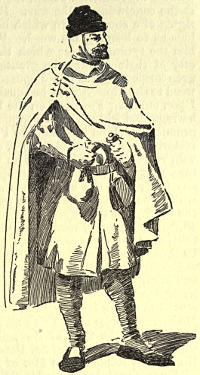
An Italian of the Middle Class, Fifteenth Century
All this differed from the Italian army in which the men-at-arms were at this time principally composed of the lower ranks of society, of strangers from other states, the subjects of other princes; all depending on the condottieri, with whom they agreed for their salary and by them alone was it paid, yet without any generous stimulus to honour, glory, or good service—but on the contrary the certainty of an unfeeling dismissal when no longer wanted. The generals themselves were rarely the subjects of those they served and frequently had different ends and interests, which were sometimes even directly inimical. Amongst them there was abundance of hatred and rivalry and consequent absence of discipline: nor had they always a prefixed period of service; wherefore being entire masters of their troops they left their numbers incomplete, though paid for; defrauded their employers; demanded shameful contributions from them in emergencies, and then tired of the service, or stimulated by ambition or avarice or some other temptation they were not only fickle but unfaithful. Nor was there less difference in the infantry of France and Italy; the latter fought in compact and well-ordered battalions, but scattered over the country and taking advantage of its banks and ditches and all its local peculiarities. The Swiss in French pay on the contrary combated in large masses of an invariable number of rank and file, and never breaking this order they presented themselves like a strong, solid, and almost unconquerable wall where there was sufficient space to deploy their battalions; with similar discipline and similar order did the French and Gascon infantry fight, but not with equal bravery. In their ordnance however the French were far superior to the Italians and sent so great a quantity both of battering and field artillery to Genoa for this war, and of so superior a nature, that the Italian officers were astonished. Hitherto in Italy this warlike arm whether used in the field or fortress had been of a very cumbrous construction; the largest were denominated bombarde and were made both of brass and iron, but of great size—difficult of transport, difficult to place, and difficult to discharge; much time was consumed in loading; a long interval passed after every round; and the effect in general was comparatively trifling with reference to the time and labour employed, there being always a sufficient interval after each discharge for the garrison to repair the damage at their leisure. The French had already cast much lighter pieces of brass ordnance to which they seem to be the first who gave the name of cannon, and used iron shot instead of stone balls: these were placed on lighter carriages, and instead of bullocks as in Italy, they were drawn by horses and kept pace with the army. They were placed in battery with a rapidity that astonished the Italians, and their fire was so quick and well-directed that what had previously been many days’ work amongst the latter was accomplished in a few hours by the Frenchmen; so that this alone made their army formidable to all Italy independent of their native ferocity and valour.e
Charles VIII, on receiving from Piero de’ Medici the fortresses of Librafratta, Pisa, and Livorno, in the Pisan states, engaged to preserve to the Florentines the countries within the range of these fortresses, and to restore them at the conclusion of the war. But Charles had very confused notions of the rights of a country into which he carried war, and was by no means scrupulous as to keeping his word. When a deputation of Pisans represented to him the tyranny under which they groaned, and solicited from him the liberty of their country, he granted their request without hesitation, without even suspecting that he disposed of what was not his, or that he broke his word to the Florentines; he equally forgot every other engagement with them. Upon entering Florence, on the 17th of November, at the head of his army, he regarded himself as a conqueror, and therefore as dispensed from every promise which he had made to Piero de’ Medici—he hesitated only between restoring his conquest to Piero, or retaining it himself. The magistrates in vain represented to him that he was the guest of the nation, and not its master; that the gates had been opened to him as a mark of respect, not from any fear; that the Florentines were far from feeling themselves conquered, whilst the palaces of Florence were occupied not only by the citizens but by the soldiers of the republic. Charles still insisted on disgraceful conditions, which his secretary read as his ultimatum. Piero Capponi suddenly snatched the paper from the secretary’s hand, and tearing it, exclaimed, “Well, if it be thus, sound your trumpets, and we will ring our bells!” This energetic movement daunted the French; Charles declared himself content with the subsidy offered by the republic, and engaged on his part to restore as soon as he had accomplished the conquest of Naples, or signed peace, or even consented to a long truce, all the fortresses which had been delivered to him by Medici. Charles after this convention departed from Florence, by the road to Siena, on the 28th of November. The Neapolitan army evacuated Romagna, the patrimony of St. Peter, and Rome, in succession, as he advanced. He entered Rome on the 31st of December, without fighting a blow.d
Some very interesting details of the king’s entry into Rome and his reception there by the pope have been preserved to us in a diary kept by one John Burchard, “master of ceremonies of the chapel of Pope Alexander VI.” A few extracts from this diary are here given:
Charles VIII in Rome: A Contemporary Account
From the diary of John Burchard, master of ceremonies of the chapel of Pope Alexander VI (1494-1495). “Book of notes collected by me, John Burchard of Strasburg, protonotary of the apostolic see, etc.”
The 19th and 21st, 22nd and 23rd of December the troops of the king of France made excursions as far as San Lazaro and across the meadows which surround the castle of St. Angelo. They had even formed the plan of seizing Rome by treachery at night in one direction, while the Colonna would enter from another with the aid of a thousand Frenchmen who were to come down the river from the environs of Ostia; but a high wind so disturbed their intentions that they could not put them into execution. They wished, in truth, to enter the city by the Porto San Paolo, fire, pillage it, and commit a thousand other atrocities, and the author of the project was, they say, Cardinal Gurck, who himself would have come to the gate of the city, had not the fierce storm compelled him to go back.
This same cardinal was one of the principal abettors of the king of France’s march upon Rome. He had, in fact, decided the inhabitants of Aquapendente and other lands of the church to grant passage to the king of France, by vaunting the liberality and affability of that prince and of the French in general; he assured them that the French would take nothing without paying for it, not even a fowl, an egg, or the slightest thing, affirming also that our holy father had promised the king he would let him cross the estates of the church. By such discourse and similar he induced the people to let the king of France and his troops in, contrary to the pope’s express wish. And to prove to the German officials who were in the city that he was looking after their interests, he wrote an open letter which he caused to be distributed among the most prominent of them in the city:
To our brothers and friends the prelates and other dignitaries of the German nation and the estates of the Most Illustrious Archduke Philip: residents of this city:
We call on God who sounds all hearts and loins to witness that we have made every effort with the Most Christian King, as well in the name of our Sovereign Pontiff and in our own, to induce friendship and good feeling between the Pope and the King; nevertheless we have not as yet been able to succeed; we do not know to whom to attribute the fault, but it certainly is not to the King of France who has no other desires than to conduct himself as a submissive son towards the Sovereign Pontiff and the Holy See according to the example of his predecessors. Doubtless the principal obstacle to this arrangement comes from the gravity of our offences towards God, and if he does not let Himself be appeased by the prayers of pious souls, this alliance and the consequent peace between Christian princes cannot take place. In any case as it is to be feared that the troops of the Most Christian King and his allies will in a few days invade the city, if the enemies, which the King has in Rome, oppose the ratification of the above mentioned agreement. I have used my influence with the Prince that his troops may cause no harm to foreigners, to whatever nation they may belong, residing for the moment in Rome, at least unless they are found in arms against his Majesty. In consequence, the King wishes and directs that all subjects of the Most Serene King of the Romans, and the Most Illustrious Prince, Archduke of Austria, be not treated by his troops with less respect than his own subjects and all the Roman citizens. To this effect he has sent me to my Lord Count of Montpensier, his relative and lieutenant-general, to let him know on the part of the King that he must take measures to prevent the troops from committing any outrage or annoyance upon the above mentioned residents of Rome and especially upon the Most Reverend Cardinals, foreigners of all nations, Roman citizens, and finally the subjects of the Emperor and the Archduke.
I have wished to make known to you this determination that in case (from which God preserve us) of the King’s troops entering Rome in arms, you would be informed of his Most Christian Majesty’s good intentions; if you would protect the more easily your persons and your property, I advise you in case of tumult, to take refuge, with the permission of the Lord Secretary, the Cardinal of Lyons, in my palace; I am writing at the moment to the said Secretary to ask that he be pleased to give you this shelter; indeed I have not forgotten that God created me out of nothing, that He raised me to the dignity and responsibilities of the Cardinalate, at the prayers of the King of the Romans and the electors of the Empire. This is why, as long as I shall live, I shall force myself, through gratitude, to render service to the Emperor, the Archduke Philip, and all their subjects with the same devotion as if I were born in their states. Adieu, dearly beloved brethren. Pray God to hear our desires which are for universal peace among all Christians and universal war against the Turks.
Your friend and brother,
Cardinal Gurck.
Formello, 23rd December.
December 25th, feast of the Nativity of our Lord Jesus Christ, the most reverend cardinal Mont-Real, who was to say high mass, was appointed by the holy father, on receipt of what had been learned of the king of France’s intentions concerning his entry into Rome, to go to that prince and beg him to send one of his men who would consult with the pope as to the manner in which he would make his entry. The morning of the same day our holy father the pope before going to his chapel called all the cardinals, with the exception of the cardinal of Alessandria who was to say mass, together in the hall known as Papagallo, and announced the arrival of the king of France, in the presence of the duke of Calabria.
On Friday the 26th of the same month, our holy father betook himself to the large chapel of the palace where he received the king’s ambassadors who, to the number of three, had been sent the night previous. They were: the grand marshal of the realm, Messire Jean de Gannay first president of the parliament of Paris, and one other—all laymen. I caused them to be placed—the grand marshal on the steps of the pontifical throne, in front and above the senator; the two others on the bench of the lay ambassadors, where were seated two ambassadors from the king of Naples, who, refusing to recognise the new-comers on pretext that they knew nothing of their characters as ambassadors, got up and left the place; but on the information I gave them by special order of the pope that they were ambassadors of the king of France, they came back to their bench and yielded the point. The king’s envoys were accompanied by a large number of Frenchmen, several of whom, forgetting all decorum, tried to place themselves close to the prelates and even in their seats. I was obliged to make them get out and assign them more suitable positions. Whereupon the pope called me to him and said in great irritation that I was compromising his interests, that the French must be let place themselves where they wished; I replied to his holiness, who thus let himself be carried away a little, that his wish being known to me I would let them place themselves where they wished without making any observation.
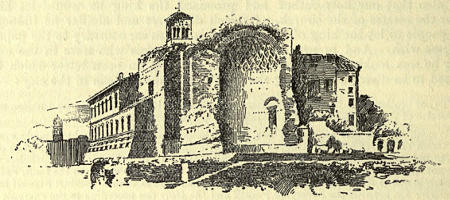
Ruins of the Temple of Venus, Rome
Wednesday December 31st, at early morning, I set out on horseback by order of our holy father the pope to meet the king of France, to inform him of the order of his reception according to the ceremonial, to learn his wishes and execute all that his majesty would prescribe for me: I was accompanied by the reverend father in Jesus Christ, the lord Bartolommeo, bishop of Nepi, the pope’s secretary; by Lord Jerome Porcario, auditor of the Rote, by the dean Coronato de Planca; and by Marius Milorius, Christopher Buzolus, chancellor of Rome, and Jacob de Sinibaldis—Roman citizens. At Galera, two miles from the city, we met the most reverend cardinals of San Pietro in Vincoli, Gurck and Savelli, to whom I made homage without descending from my horse. A short time after we came upon the king to whom we made our respectful salutations, but still remained on horseback on account of the mud and the bad weather.
[1494-1495 A.D.]
The bishop of Nepi having explained to the king what the holy father charged him with saying touching the prince’s reception, on my side I made known to his majesty the object of our errand. The king replied that he desired to enter Rome without pomp; he then listened to Lord Jerome Porcario who spoke on behalf of his Roman colleagues, placing the citizens and all they possessed at the king’s disposition. The king made a short reply without explaining what he was going to do about the offer Porcario had just made him. The Romans withdrew. On the king’s invitation I accompanied him for the space of about four miles; he questioned me on the ceremonial, the pope, and the cardinals, of Valentino’s (Cesare Borgia) rank and position, plying his questions so that I could scarce answer one satisfactorily. In the outskirts of Burghetto two Venetian ambassadors presented themselves before the king; they were soon followed by the most reverend cardinal Ascagni, who, without descending from his mule, uncovered himself before the king; the prince did the same to the cardinal; both then resumed their headgear, and the most reverend cardinal Ascagni rode on the king’s left hand and accompanied him over the Milvian bridge and as far as the palace of St. Mark, ordinary residence of the most reverend cardinal of Benevento. We arrived there towards the second hour of the night, over roads deep with mud. From the palace of the most reverend cardinal of Lisbon, close to the church of San Laurentio, to the palace of St. Mark the whole route was lighted up with fires, torches, and candles, and from nearly all the houses came shouts of “Francia! Francia! Columna! Columna! Vincula! Vincula!”
This same day before the king’s entry into Rome, the keys of all the city gates were delivered into the hands of the grand marshal of the king of France, according to the command of that prince and with the pope’s consent. The French said in fact, and indeed it was quite true, that on a former occasion the keys had been similarly turned over to the duke of Calabria during his visit to Rome, and that the king of France should have the same rights. The following days, all the most reverend cardinals residing in Rome visited the king of France in turn, according to custom, except the cardinals of Naples and of Orsini, who, lodged in the apostolic palace in apartments which the holy father had assigned them, did not leave the palace and make this visit. Before his entry I had informed the king on the way that, in receiving the cardinals’ visits, he should himself go forward to meet them, conduct them to the door on leaving, give them his hand, and I instructed him in other similar customs. But he acted entirely differently. He neither went forward to meet them nor conducted them to the door; the members of his suite did not pay the respects expected of them. The nearest courtyard to the king’s apartments in the palazzo San Marco was strewn with straw and not even cleaned; candles were fastened to the doors and chimney places—in fact, one would have thought himself in a pig pen.
Saturday, January 3rd, the partisans of the Colonna and the French wrecked the residences of the most reverend cardinal of Naples’ nephew, of Jacob de Comititibus’ son, and of Lord Bartolommeo de Lucca, valet-de-chambre of our holy father the pope. The French, that they might lodge themselves in their own fashion, forced an entrance into the houses from all sides, threw out even beasts and movables, burned the woodwork, and ate and drank their fill without paying for anything, all of which caused great talk among the people. In consequence of this, the king of France caused an order to be published all over the city forbidding the entering of houses by force under penalty of death. Monday, January 5th, pontifical vespers were said in the great chapel of the palace and in the pope’s presence. Before his holiness left the Papagallo chamber several Frenchmen were admitted to kiss his foot.
Sunday, January 11th, it was agreed between our holy father the pope and Philip de Bresse, the king of France’s uncle, that his holiness would deliver for six months the sultan Djem, brother of the Grand Turk, to the king of France, who would at once pay twenty thousand ducats to the pope and would pledge himself, under the security of the Florentine and Venetian merchants, to return the same sultan Djem to the pope immediately the six months had expired; the king of France could receive the crown of Naples without prejudice to the right of any others; and that the cardinals of San Pietro in Vincoli, Gurck, Savelli, and Colonna would be safe from all reproach.
Sunday, January 18th, the holy father sent for me by one of the pages and told me that the next day a public consistory would be held to receive the king of France. According to the wishes of his holiness, I arranged that the president of the parliament of Paris should say a few words in the king’s name, a speech in which his majesty would recognise his holiness the pope as the true vicar and successor of St. Peter. The holy father further made known to me his intention of saying mass pontifically and publicly in the basilica of St. Peter on the following Tuesday, the feast of St. Sebastian, in honour of the king, asking me what place the prince should occupy and which mass to celebrate. He counted, in fact, on saying the mass of the Holy Ghost, the office of which he knew best. I replied to his holiness that the mass to celebrate was that of St. Sebastian; and as for the king he would occupy a special seat placed in front of the cardinals’ bench, between that bench and the chair of the cardinal of Naples, who would assist. As a matter of fact, it was not the cardinal’s duty to fulfil that function on this day; but there was no objection to his doing so, as it was the custom to assist his holiness on all days when he was not familiar with the office. While we were conversing, the king of France arrived at the pontifical palace; the pope, informed of his coming, went to meet him at the palace entrance. The pope wore a white camail, a rich stole, and white cap, a costume scarcely suitable under the circumstances. His majesty came to settle definitely with the pope the articles of agreement already concluded and signed, upon which a difference had already risen between them concerning the securities to be given by the king for the return of the Turk at the end of six months.
The agreement stated, in effect, that the king would furnish several nobles and prelates of his realm of the pope’s choosing, for security; the president claimed that this clause must be limited to ten persons only, while the pope demanded thirty or forty. The discussion on this point was prolonged for three or four hours; finally the pope entered an apartment in which two papal chairs had been placed, followed by the king, whom he made sit in one of these chairs, after which he seated himself in the other, on the king’s right. On the pope’s side were the cardinals of St. Anastasia and St. Alessandria. On the king’s side, the most reverend cardinals of St. Denis and St. Malo, the two papal secretaries, the datary, and several others.
The articles of agreement were read and agreed to. Two notaries were called in—namely, the noble Stephen de Harnia for the pope, and the noble Oliver Yvan, clerk of Mans, for the king. These wrote out the treaty in French for his majesty, and in Latin for his holiness.
Monday, January 19th, the great hall of the apostolic palace was arranged in the usual manner for the public consistory, at which the reception of the king of France and the ceremony of obedience were to take place.
The king placed himself on the left of the sovereign pontiff, and I motioned him to pronounce the formula of obedience. He said that he was going to do it immediately; but at that moment the president of the parliament of Paris advanced to the pope’s feet and, kneeling, explained that the king had come in person to take the oath of obedience; but before doing so he wished to obtain three favours from his holiness, according to the customary privilege of vassals before the oath or homage of their obedience. He asked the confirmation of the rights granted to him the most Christian king, the queen his spouse, to the dauphin his son, and to all the others included in the book whose title he mentioned; next, the investiture of the kingdom of Naples for himself; and, finally, the annulling of the clause concerning the security to guarantee the return of the Grand Turk’s brother to the pope—an article agreed to the day before with the others. The pope replied that he willingly confirmed the privileges which were the subject of the first demand, as they had been established by custom; but as for the investiture of the kingdom of Naples, since that was an affair in which another was interested, it could not be decided until after mature deliberation and consultation with the cardinals, among whom he would make every effort that his majesty should receive the satisfaction he desired; and as regards Djem—the Grand Turk’s brother—he desired to agree unanimously with the king and the sacred college, hoping that there would be no point of difference between them concerning that article. After receiving this reply the king, who was standing on the pope’s left, pronounced the following words:
“Holy father, I have come to make obedience and reverence to your holiness in the manner that my predecessors the kings of France have done.”
After which the president, of whom we have spoken and who remained on his knees, got up and, standing before his holiness, enlarged in these words upon what the king had just said:
“Most holy father, there is an ancient custom among Christian princes, especially the most Christian kings, to testify through their ambassadors to their veneration for the holy see and for the popes whom the Almighty has put at the head of the church; but the king here present, having formed the design of visiting the tomb of the holy apostles, has come in person to perform this duty. Thus he recognises you, holy father, as the head of all the faithful, as the true vicar of Jesus Christ and as the legitimate successor of the holy apostles St. Peter and St. Paul, willingly granting you that filial obedience which the kings of France, his predecessors, were accustomed to profess to the popes. This is why the king offers himself and all dependent on him to the service of your holiness and of the holy see.”
Tuesday, January 27th, the sultan Djem, brother of the Grand Turk, was taken from the castle of St. Angelo to the palace of St. Mark and delivered into the hands of the king of France.
Wednesday, January 28th, the king of France and his people, all in arms, visited the pope, with whom the king of France remained alone for some time. He then withdrew, and was escorted by the pope as far as the gallery leading to the main apartments, where the king knelt and uncovered. The pope likewise bared his head in order to embrace him; the king pretended to wish to kiss the pope’s feet, but he would not allow it. The king departed and mounted the horse that was waiting for him at the entrance of the private garden, where he waited some time for Cardinal Valentino who was going with him to Naples; finally the latter, after taking leave of the pope, came to the place where the king was waiting, mounted his mule in cardinal’s robes, and presented the king with six superb horses. The king then started with Cardinal Valentino on his left; the other cardinals, whose escort the king did not wish for, retired. The king made straight for Marino, where he arrived during the course of the day. The cardinals of San Pietro in Vincoli, Savelli, and Colonna, and the auditor of the chamber also left Rome with the king. During the evening Cardinal Gurck followed the king. The Grand Turk’s brother had already left for Marino.f
Charles goes to Naples
The first resistance which Charles encountered was on the frontiers of the kingdom of Naples; and having there taken by assault two small towns, he massacred the inhabitants. This instance of ferocity struck Alfonso II with such terror, that he abdicated the crown in favour of his son, Ferdinand II, and retired with his treasure into Sicily. Ferdinand occupied Capua with his whole army, intending to defend the passage of the Volturno. He left that city to appease a sedition which had broken out at Naples; Capua, during his absence, was given up through fear to the French, and he was himself forced, on the 21st of February, to embark for Ischia. All the barons, his vassals, all the provincial cities, sent deputations to Charles; and the whole kingdom of Naples was conquered without a single battle in its defence. The powers of the north of Italy regarded these important conquests with a jealous eye; they, moreover, were already disgusted by the insolence of the French, who had begun to conduct themselves as masters throughout the whole peninsula. The duke of Orleans, who had been left by Charles at Asti, already declared his pretensions to the duchy of Milan, as heir to his grandmother, Valentina Visconti. Lodovico Sforza, upon this, contracted alliances with the Venetians, the pope, the king of Spain, and the emperor Maximilian, for maintaining the independence of Italy; and the duke of Milan and the Venetians assembled near Parma a powerful army, under the command of the marquis of Mantua.
[1495-1496 A.D.]
Charles VIII had passed three months at Naples in feasts and tournaments, while his lieutenants were subduing and disorganising the provinces. The news of what was passing in northern Italy determined him on returning to France with the half of his army. He departed from Naples, on the 20th of May, 1495, and passed peaceably through Rome, whilst the pope shut himself up in the castle of St. Angelo. From Siena he went to Pisa, and thence to Pontremoli, where he entered the Apennines. Gonzaga, marquis of Mantua, awaited him at Fornovo, on the other side of that chain of mountains. Charles passed the Taro, with the hope of avoiding him; but was attacked on its borders by the Italians, on the 6th of July. He was at the time in full march; the divisions of his army were scattered, and at some distance from each other. For some time his danger was imminent; but the impetuosity of the French, and the obstinate valour of the Swiss, repaired the fault of their general. A great number of the Italian men-at-arms were thrown in the charges of the French cavalry, many others were brought down by the Swiss halberds, and all were instantly put to death by the servants of the army. Gonzaga left thirty-five hundred dead on the field, and Charles continued his retreat. On his arrival at Asti, he entered into treaty with Lodovico Sforza, for the deliverance of the duke of Orleans, whom Sforza besieged at Novara. He disbanded twenty thousand Swiss, who were brought to him from the mountains, but to whose hands he would not venture to confide himself. On the 22nd of October, 1495, he repassed the Alps, after having ravaged all Italy with the violence and rapidity of a hurricane. He had left his relative, Gilbert de Montpensier, viceroy at Naples, with the half of his army; but the people, already wearied with his yoke, recalled Ferdinand II. The French, after many battles, successively lost their conquests, and were at length forced to capitulate at Aversa (Atella), on the 23rd of July, 1496.
The invasion of the French not only spread terror from one extremity of Italy to the other, but changed the whole policy of that country, by rendering it dependent upon that of the transalpine nations. While Charles VIII pretended to be the legitimate heir of the kingdom of Naples, the duke of Orleans, who succeeded him under the name of Louis XII, called himself heir to the duchy of Milan. Maximilian, ambitious as he was inconsistent, claimed in the states of Italy prerogatives to which no emperor had pretended since the death of Frederick II in 1250. The Swiss had learned, at the same time, that at the foot of their mountains there lay rich and feeble cities which they might pillage, and a delicious climate, which offered all the enjoyments of life; they saw neighbouring monarchs ready to pay them for exercising there their brigandage. Finally, Ferdinand and Isabella, monarchs of Aragon and Castile, announced their intention of defending the bastard branch of the house of Aragon, which reigned at Naples. But, already masters of Sicily, they purposed passing the strait and were secretly in treaty with Charles VIII, to divide with him the spoils of the relative whom they pretended to defend. Amidst these different pretensions and intrigues, in which Italian interests had no longer any share, the spirit of liberty revived in Tuscany once more, but only to exhaust itself in a new struggle between the Florentines and Pisans. The French garrisons which Charles had left in Pisa and Librafratta, instead of delivering them to the Florentines, according to his order, had given them up to the Pisans themselves on the 1st of January, 1496. The allies, who had fought Charles at Fornovo, reproached the Florentines with their attachment to that monarch, and took part against them with the Pisans. Lodovico Sforza, and the Venetians, sent reinforcements to the latter, and the emperor Maximilian himself brought them aid. Thus, the only Italians who had at heart the honour and independence of Italy exhausted themselves in unequal struggles and in fruitless attempts.d
FLORENTINE AFFAIRS; SAVONAROLA
[1494-1498 A.D.]
The Florentine Republic was the only friendly power that Charles had left in Italy; a friendship, though false, in every way important and almost indispensable to France in the prosecution of her Italian conquests, but equally so to Florence as her widest and richest field of commerce. Yet so far from trying to conciliate the latter, that monarch not only broke his oath and retained her fairest possessions, but left his wildest soldiers to protect her revolted subjects; his Gascon infantry, when unchecked by the royal presence, and imbued with all the Pisan hatred of Florence, carried on their warlike operations in a spirit of barbarity as yet unknown to the Italians. Among other excesses they fancied that the Florentines swallowed their gold and jewels before every encounter in order to preserve something if taken prisoners; wherefore all their suspected captives were killed and ripped open to make a thorough search for those embowelled treasures: for such cruelty, however, they paid full dearly when made prisoners at Ponte di Sacco, in despite of every effort of the Florentine commissaries.e
At the moment when Florence expelled the Medici, that republic was bandied between three different parties. The first was that of the enthusiasts, directed by Girolamo Savonarola; who promised the miraculous protection of the Divinity for the reform of the church and the establishment of liberty. These demanded a democratic constitution—they were called the Piagnoni. The second consisted of men who had shared power with the Medici, but who had separated from them; who wished to possess alone the powers and profits of government, and who endeavoured to amuse the people by dissipations and pleasures, in order to establish at their ease an aristocracy—these were called the Arabiati. The third party was composed of men who remained faithful to the Medici, but not daring to declare themselves, lived in retirement—they were called Bigi. These three parties were so equally balanced in the balia named by the parliament, on the 2nd of December, 1494, that it soon became impossible to carry on the government. Girolamo Savonarola took advantage of this state of affairs to urge that the people had never delegated their power to a balia which did not abuse the trust. “The people,” he said, “would do much better to reserve this power to themselves, and exercise it by a council, into which all the citizens should be admitted.” His proposition was agreed to: more than eighteen hundred Florentines furnished proof that either they, their fathers, or their grandfathers had sat in the magistracy; they were consequently acknowledged citizens, and admitted to sit in the general council. This council was declared sovereign, on the 1st of July, 1495; it was invested with the election of magistrates, hitherto chosen by lot, and a general amnesty was proclaimed, to bury in oblivion all the ancient dissensions of the Florentine Republic.
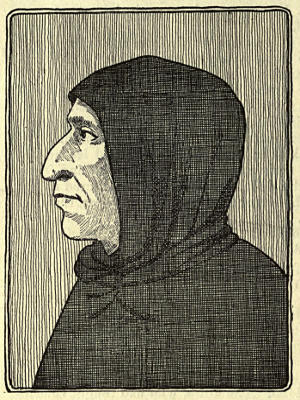
Savonarola
(From an old print)
So important a modification of the constitution seemed to promise this republic a happier futurity. The friar Savonarola, who had exercised such influence in the council, evinced at the same time an ardent love of mankind, deep respect for the rights of all, great sensibility, and an elevated mind. Though a zealous reformer of the church, and in this respect a precursor of Luther, who was destined to begin his mission twenty years later, he did not quit the pale of orthodoxy; he did not assume the right of examining doctrine; he limited his efforts to the restoration of discipline, the reformation of the morals of the clergy, and the recall of priests, as well as other citizens, to the practice of the Gospel precepts: but his zeal was mixed with enthusiasm; he believed himself under the immediate inspiration of providence; he took his own impulses for prophetic revelations, by which he directed the politics of his disciples, the Piagnoni. He had predicted to the Florentines the coming of the French into Italy; he had represented to them Charles VIII as an instrument by which the Divinity designed to chastise the crimes of the nation; he had counselled them to remain faithful to their alliance with that king, the instrument of providence, even though his conduct, especially in reference to the affairs of Pisa, had been highly culpable.
This alliance however ranged the Florentines among the enemies of Pope Alexander VI, one of the founders of the league which had driven the French out of Italy; he accused them of being traitors to the church and to their country for their attachment to a foreign prince. Alexander, equally offended by the projects of reform and by the politics of Savonarola, denounced him to the church as a heretic, and interdicted him from preaching. The monk at first obeyed, and procured the appointment of his friend and disciple the Dominican friar, Buonvicino of Pescia, as his successor in the church of St. Mark; but on Christmas Day, 1497, he declared from the pulpit that God had revealed to him that he ought not to submit to a corrupt tribunal; he then openly took the sacrament with the monks of St. Mark, and afterwards continued to preach. In the course of his sermons, he more than once held up to reprobation the scandalous conduct of the pope, whom the public voice accused of every vice and every crime to be expected in a libertine so depraved—a man so ambitious, perfidious, and cruel—a monarch and a priest intoxicated with absolute power.
In the meantime, the rivalry encouraged by the court of Rome between the religious orders soon procured the pope champions eager to combat Savonarola: he was a Dominican—the general of the Augustines, that order whence Martin Luther was soon to issue. Friar Mariano di Ghinazzano signalised himself by his zeal in opposing Savonarola. He presented to the pope Friar Francis of Apulia, of the order of minor Observantines, who was sent to Florence to preach against the Florentine monk, in the church of Santa Croce. This preacher declared to his audience that he knew Savonarola pretended to support his doctrine by a miracle. “For me,” said he, “I am a sinner; I have not the presumption to perform miracles; nevertheless, let a fire be lighted, and I am ready to enter it with him. I am certain of perishing, but Christian charity teaches me not to withhold my life, if, in sacrificing it, I might precipitate into hell a heresiarch, who has already drawn into it so many souls.”
This strange proposition was rejected by Savonarola; but his friend and disciple, Friar Domenico Buonvicino, eagerly accepted it. Francis of Apulia declared that he would risk his life against Savonarola only. Meanwhile, a crowd of monks, of the Dominican and Franciscan orders, rivalled each other in their offers to prove by the ordeal of fire, on one side the truth, on the other the falsehood, of the new doctrine. Enthusiasm spread beyond the two convents; many priests and seculars, and even women and children, more especially on the side of Savonarola, earnestly requested to be admitted to the proof. The pope warmly testified his gratitude to the Franciscans for their devotion. The signoria of Florence consented that two monks only should devote themselves for their respective orders, and directed the pile to be prepared. The whole population of the town and country, to which a signal miracle was promised, received the announcement with transports of joy.
On the 7th of April, 1498, a scaffold, dreadful to look on, was erected in the public square of Florence: two piles of large pieces of wood, mixed with fagots and broom, which should quickly take fire, extended each eighty feet long, four feet thick, and five feet high; they were separated by a narrow space of two feet, to serve as a passage by which the two priests were to enter, and pass the whole length of the piles during the fire. Every window was full; every roof was covered with spectators; almost the whole population of the republic was collected round the place. The portico called the Loggia de’ Lanzi, divided in two by a partition, was assigned to the two orders of monks. The Dominicans arrived at their station chanting canticles, and bearing the holy sacrament. The Franciscans immediately declared that they would not permit the host to be carried amidst flames. They insisted that the friar Buonvicino should enter the fire, as their own champion was prepared to do, without this divine safeguard. The Dominicans answered, that they would not separate themselves from their God at the moment when they implored his aid. The dispute upon this point grew warm. Several hours passed away. The multitude, which had waited long, and begun to feel hunger and thirst, lost patience; a deluge of rain suddenly fell upon the city, and descended in torrents from the roofs of the houses—all present were drenched. The piles were so wet that they could no longer be lighted; and the crowd, disappointed of a miracle so impatiently looked for, separated, with the notion of having been unworthily trifled with. Savonarola lost all his credit; he was henceforth rather looked on as an impostor. Next day his convent was besieged by the Arabiati, eager to profit by the inconstancy of the multitude; he was arrested, with his two friends, Domenico Buonvicino and Silvestro Marruffi, and led to prison. The Piagnoni, his partisans, were exposed to every outrage from the populace—two of them were killed; their rivals and old enemies exciting the general ferment for their destruction. Even in the signoria the majority was against them, and yielded to the pressing demands of the pope. The three imprisoned monks were subjected to a criminal prosecution. Alexander VI despatched judges from Rome, with orders to condemn the accused to death. Conformably with the laws of the church, the trial opened with the torture. Savonarola was too weak and nervous to support it: he avowed in his agony all that was imputed to him; and, with his two disciples, was condemned to death. The three monks were burned alive, on the 23rd of May, 1498, in the same square where, six weeks before, a pile had been raised to prepare them a triumph.
THE FRENCH IN MILAN
[1498-1499 A.D.]
The expedition of Charles VIII against Naples had directed towards Italy the attention of all the western powers. The transalpine nations had learned that they were strong enough to act as masters, and if they pleased as robbers, in this the richest and most civilised country of the earth. All the powers on the confines henceforth aspired to subject some part of Italy to their dominion. They coveted their share of tribute from a land so fruitful of impost, from those cities in which industry employed such numbers, and accumulated so much capital. Cupidity put arms in their hands, and smothered every generous feeling. The commanders were rapacious; the soldiers thought only of pillage. They regarded the Italians as a race abandoned to their extortions, and vied with each other in the barbarous methods which they invented for extorting money from the vanquished, until at last they completely destroyed the prosperity which had provoked their envy.
Charles VIII died at Amboise, on the 7th of April, 1498, the day destined at Florence for the trial by fire of the doctrine of Savonarola. Louis XII, who succeeded that monarch, claimed, as grandson of Valentina Visconti, to be the legitimate heir to the duchy of Milan, although, according to the law acknowledged by all Italy, and confirmed by the imperial investure granted to the father of Valentina, females were excluded from all share in the succession. This monarch, at his coronation, took with the title of king of France those of duke of Milan and king of Naples and Jerusalem. It was to the duchy of Milan that he seemed particularly attached, apparently as having been the object of his ambition before he came to the throne. He preserved during his whole reign, as if he were simply duke of Milan, a feudal respect for the emperor as lord paramount, which was as fatal to France as to Italy.
After having thus announced to the world his pretensions to the duchy of Milan, Louis hastened to secure his possession of it by arms. He easily separated his antagonist, Lodovico Sforza, from all his allies. The emperor Maximilian had married the niece of Lodovico, to whom he had granted the investure of his duchy; but Maximilian forgot, with extreme levity, his promises and alliances. A new ambition, a supposed offence, even a whim, sufficed to make him abandon his most matured projects. The Swiss had just then excited his resentment; and to attack them the more effectually, he signed with Louis XII a truce, in which Lodovico Sforza was not included, and was therefore abandoned to his enemy. The Venetians were interested still more than the emperor in defending Lodovico, but were incensed against him; they accused him of having deceived them, as well in the war against Charles VIII as in that for the defence of Pisa. They suspected him of having suggested to Maximilian the claims which he had just made on all their conquests in Lombardy, as having previously appertained to the empire. They were obliged, moreover, to reserve all their resources to resist the most formidable of their enemies. Bajazet II had just declared war against them. Bands of robbers continually descended from the mountains of Turkish Albania to lay waste Venetian Dalmatia. The Turkish pashas offered their support to every traitor who attempted to take from the Venetians any of their stations in the Levant. Corfu very nearly fell into the hands of the Turks; at length hostilities openly began. The Turks attacked Zara; all the Venetian merchants established at Constantinople were put into irons, and Scander Pasha, sanjak of Bosnia, passed the Isonzo on the 29th of September, 1499, with seven thousand Turkish cavalry. He ravaged all the rich country which extends from that river to the Tagliamento, at the extremity of the Adriatic, and spread terror up to the lagunes which surround Venice. Invaded by an enemy so formidable, against whom they were destined to support, for seven years, a relentless war, the Venetians would not expose themselves to the danger of maintaining another war against the French. On the 15th of April, 1499, they signed, at Blois, with Louis, a treaty, by which they contracted an alliance against Lodovico Sforza and abandoned the conquest of the Milanese to the king of France, reserving to themselves Cremona and the Ghiara d’Adda.
[1499-1500 A.D.]
Lodovico Sforza found no allies in any other part of Italy. Since the execution of Savonarola at Florence, the faction of the Arabiati had succeeded that of the Piagnoni in the administration, without changing its policy. The republic continued to guard against the intrigues of the Medici, who entered into an alliance with every enemy of their country, in order to bring it back under their yoke. Florence continued her efforts to subdue Pisa; but, fearing to excite the jealousy of the kings of France and Spain, did not assemble for that purpose either a numerous army or a great train of artillery. She contented herself with ravaging the Pisan territory every year, in order to reduce that city by famine. Even these expeditions were suspended when those powerful monarchs found it convenient to make a show of peace. The cities of Siena, Lucca, and Genoa, actuated by their jealousy of Florence, sent succour to Pisa. Pope Alexander VI, who had been always the enemy of Charles VIII, now entered into an alliance with Louis XII; but on condition that Cesare Borgia, son of Alexander, should be made duke of Valentinois in France and of Romagna in Italy—the French king assisting him against the petty princes, feudatories of the holy see, who were masters of that province. The king of Naples, Frederick, who had succeeded his nephew Ferdinand on the 7th of September, 1496, was well aware that he should, in his turn, be attacked by France; but although he merited, by his talents and virtues, the confidence of his subjects, he had great difficulty in re-establishing some order in his kingdom, which was ruined by war, and had neither an army nor an exchequer to succour his natural ally, the duke of Milan.
A powerful French army, commanded by the sires De Ligny and D’Aubigny, passed the Alps in the month of August, 1499. On the 13th of that month they attacked and took by assault the two petty fortresses of Arazzo and Annone, on the borders of the Tanaro; putting the garrisons, and almost all the inhabitants, to the sword. This ferocious proceeding spread terror among the troops of Lodovico Sforza. His army, the command of which he had given to Galeazzo San Severino, dispersed; and the duke, not venturing to remain at Milan, sought for himself, his children, and his treasure refuge in Germany, with the emperor Maximilian. Louis XII, who arrived afterwards in Italy, made his entry into the forsaken capital of Lodovico on the 2nd of October. The trembling people, wishing to conciliate their new master, saluted him with the title of duke of Milan, and expressed their joy in receiving him as their sovereign. The rest of Lombardy also submitted without resistance; and Genoa, which had placed itself under the protection of the duke of Milan, passed over to that of the king of France.
Louis returned to Lyons before the end of the year; the fugitive hopes which he had excited already gave way to hatred. The insolence of the French, their violation of all national institutions, their contempt of Italian manners, the accumulation of taxes, and the irregularities in the administration rendered their yoke insupportable. Lodovico Sforza was informed of the general ferment, and of the desire of his subjects for his return. He was on the Swiss frontier, with a considerable treasure; a brave but disorderly crowd of young men, ready to serve anyone for pay, joined him. In a few days five hundred cavalry and eight thousand infantry assembled under his banner; and, in the month of February, 1500, he entered Lombardy at their head. Como, Milan, Parma, and Pavia immediately opened their gates to him: he next besieged Novara, which capitulated. Louis, meanwhile, displayed great activity in suppressing the rebellion: his general, Louis de la Trémouille, arrived before Novara, in the beginning of April, with an army in which were reckoned ten thousand Swiss. The men of that nation in the two hostile camps, opposed to each other for hire, hesitated, parleyed, and finally took a resolution more fatal to their honour than a battle between fellow-countrymen could have been. Those within Novara not only consented to withdraw themselves, but to give up to the French the Italian men-at-arms with whom they were incorporated, and who were immediately put to the sword or drowned in the river. They permitted La Trémouille to arrest in their ranks Lodovico Sforza and the two brothers San Severino, who attempted to escape in disguise. They received from the French the wages thus basely won, and afterwards, rendered reckless by the sense of their infamy, they in their retreat seized Bellinzona, which they ever after retained. Thus, even the weakest of the neighbours of Italy would have their share in her conquest. Lodovico Sforza was conducted into France, and there condemned to a severe captivity, which, ten years afterwards, ended with his life. The Milanese remained subject to the king of France from this period to the month of June, 1512.
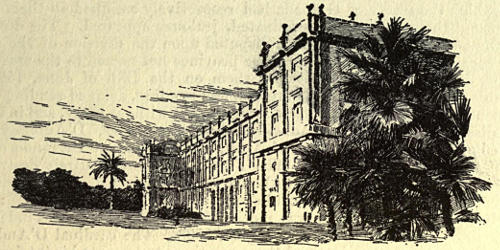
Capo di Monte Palace, Naples
The facility with which Louis had conquered the duchy of Milan must have led him to expect that he should not meet with much more resistance from the kingdom of Naples. Frederick also, sensible of this, demanded peace; and, to obtain it, offered to hold his kingdom in fief, as tributary to France. He reckoned, however, on the support of Ferdinand the Catholic, his kinsman and neighbour, who had promised him powerful aid and had given him a pledge of the future by sending into Sicily his best general, Gonsalvo de Cordova, with sixty vessels and eight thousand chosen infantry. But Ferdinand had previously proposed to Louis a secret understanding to divide between them the spoils of the unhappy Frederick. While the French entered on the north to conquer the kingdom of Naples, he proposed that the Spaniards should enter on the south to defend it; and that, on meeting, they, instead of giving battle, should shake hands on the partition of the kingdom—each remaining master of one-half. This was the basis of the Treaty of Granada, signed on the 11th of November, 1500. In the summer of 1501 the perfidious compact was executed by the two greatest monarchs of Europe.
THE FRENCH AND SPANIARDS IN NAPLES
[1500-1504 A.D.]
The French army arrived at Rome on the 25th of June, at the same time that the army of Gonsalvo de Cordova landed in Calabria. The former, from the moment they passed the frontier, treated the Neapolitans as rebels, and hanged the soldiers who surrendered to them. Arrived before Capua, they entered that city while the magistrates were signing the capitulation, and massacred seven thousand of the inhabitants. The treachery of Ferdinand inspired the unhappy Frederick with still more aversion than the ferocity of the French. Having retired to the island of Ischia, he surrendered to Louis, and was sent to France, where he died, in a captivity by no means rigorous, three years afterwards. The Spaniards and French advanced towards each other, without encountering any resistance. They met on the limits which the treaty of Granada had respectively assigned to them; but the moment the conquest was terminated, jealousy appeared. The duke de Nemours and Gonsalvo de Cordova disputed upon the division of the kingdom; each claimed for his master some province not named in the treaty.
Hostilities at last began between them on the 19th of June, 1502, at Atripalda. Louis, while the negotiation was pending, delayed sending reinforcements to his general. After a struggle, not without glory, and in which La Palisse and Bayard first distinguished themselves, D’Aubigny was defeated at Seminara on the 21st of April, and Nemours at Cerignola on the 28th of the same month, 1503. The French army was entirely destroyed, and the kingdom of Naples lost to Louis XII. Louis had sent off, during the same campaign, a more powerful army than the first, to recover it; but, on arriving near Rome, news was received of the death of Alexander VI, which took place on the 18th of August, 1503. The cardinal D’Amboise, prime minister of Louis, detained the army there to support his intrigues in the conclave: when it renewed its march, in the month of October, the rainy season had commenced. Gonsalvo de Cordova had taken his position on the Garigliano, the passage of which he defended, amidst inundated plains, with a constancy and patience characteristic of the Spanish infantry. During more than two months the French suffered or perished in the marshes: a pestilential malady carried off the flower of the army, and damped the courage and confidence of the remainder. Gonsalvo, having at last passed the river himself, on the 27th of December, attacked and completely destroyed the French army. On the 1st of January, 1504, Gaeta surrendered to him; and the whole kingdom of Naples was now, like Sicily, but a Spanish possession.
Thus the greater part of Italy had already fallen under the yoke of the nations which the Italians denominated barbarian. The French were masters of the Milanese and of the whole of Liguria; the Spaniards of the Two Sicilies; even the Swiss had made some small conquests along the Lago Maggiore; and this was the moment in which Louis XII called the Germans also into Italy. On the 22nd of September of the same year in which he lost Gaeta, his last hold in the kingdom of Naples, he signed the Treaty of Blois, by which he divided with Maximilian the republic of Venice, as he had divided with Ferdinand the kingdom of Naples. Experience ought to have taught him that Maximilian, like Ferdinand, would reserve for himself the conquests made in common. The future ought to have alarmed him; for Charles, the grandson and heir of Maximilian of Austria, and of Ferdinand of Aragon, of Mary of Burgundy, and of Isabella of Castile, was already born. It was foreseen that he would unite under his sceptre the greatest monarchies in Europe; and Louis, instead of guarding against his future greatness, had promised to give him his daughter in marriage. It was the thoughtlessness of Maximilian, and not the prudence of Louis, that delayed during four years the execution of the Treaty of Blois.
NORTHERN ITALY
[1500-1509 A.D.]
During this interval, Genoa—which had never ceased to consider herself a republic, although the signoria had been conferred first on Ludovico Sforza, and next on Louis XII, as duke of Milan—learned from experience that a foreign monarch was incapable of comprehending either her laws or liberty. According to the capitulation, one-half of the magistrates of Genoa should be noble, the other half plebeian. They were to be chosen by the suffrages of their fellow-citizens; they were to retain the government of the whole of Liguria and the administration of their own finances, with the reservation of a fixed sum payable yearly to the king of France. But the French could never comprehend that nobles were on an equality with villeins; that a king was bound by conditions imposed by his subjects; or that money could be refused to him who had force. All the capitulations of Genoa were successively violated; while the Genoese nobles ranged themselves on the side of a king against their country: they were known to carry insolently about them a dagger, on which was inscribed “Chastise villeins”; so impatient were they to separate themselves from the people, even by meanness and assassination. That people could not support the double yoke of a foreign master and of nobles who betrayed their country. On the 7th of February, 1507, they revolted, drove out the French, proclaimed the republic, and named a new doge; but time failed them to organise their defence. On the 3rd of April Louis advanced from Grenoble with a powerful army. He soon arrived before Genoa: the newly raised militia, unable to withstand veteran troops, were defeated. Louis entered Genoa on the 29th of April; and immediately sent the doge and the greater number of the generous citizens, who had signalised themselves in the defence of their country, to the scaffold.
Independent Italy now comprised only the states of the church, Tuscany, and the republic of Venice; and even these provinces were pressed by the transalpine nations on every side. The Spaniards and French alternately spread terror through Tuscany and the states of the church; the Germans and Turks held in awe the territories of Venice. The states of the church were at the same time a prey to the intrigues of the detestable Alexander, and his son Cesare Borgia. More murders, more assassinations, more glaring acts of perfidy were committed within a short space, than during the annals of the most depraved monarchies. Cesare Borgia, whom his father created duke of Romagna in 1501, had previously despoiled and put to death the petty princes who reigned at Pesaro, Rimini, Forlì, and Faenza. He had, in like manner, possessed himself of Piombino in Tuscany, the duchy of Urbino, and the little principalities of Camerino and Sinigaglia. He had caused to be strangled in this last city, on the 31st of December, 1502, four tyrants of the states of the church, who followed the trade of condottieri. These princes had served in his pay, and, alarmed by his intrigues, had taken arms against him; but, seduced by his artifices, they placed themselves voluntarily in his power. Cesare Borgia had made himself master of Città di Castello, and of Perugia; and was menacing Bologna, Siena, and Florence, when, on the 18th of August, 1503, he and his father drank, by mistake, a poison which they had prepared for one of their guests. His father died of it, and Borgia himself was in extreme danger. In thirteen months he lost all his sovereignties, the fruits of so many crimes. Attacked in turn by Pope Julius II, who had succeeded his father, and by Gonsalvo de Cordova, he was at last sent into Spain, where he died in battle, more honourably than he deserved.
In Tuscany, the republic of Florence found itself surrounded with enemies. The Medici, continuing exiles, had entered into alliances with all the tyrants in the pontifical states: they took part in every plot against their country; at the same time, they sought the friendship of the king of France, who was more disposed to favour a prince than a republic. Piero de’ Medici had accompanied the army sent, in 1508, against the kingdom of Naples, and lost his life at the defeat of the Garigliano. His death did not deliver Florence from the apprehension which he had inspired. His brothers Giovanni and Giuliano carried on their intrigues against their country. The war with Pisa, too, which still lasted, exhausted the finances of Florence. The Pisans had lost their commerce and manufactures; they saw their harvests, each year, destroyed by the Florentines: but they opposed to all these disasters a constancy and courage not to be subdued. The French, Germans, and Spaniards in turn sent them succour; not from taking any interest in their cause, but with the view of profiting by the struggle which they protracted. Lucca and Siena also, jealous of the Florentines, secretly assisted the Pisans; but only so far as they could do it without compromising themselves with neighbours whom they feared. Lucca fell, by degrees, into the hands of a narrow oligarchy. Siena suffered itself to be enslaved by Pandolfo Petrucci, a citizen, whom it had named captain of the guard, and who commanded obedience, without departing from the manners and habits of republican equality.
In the new position of Italy, continually menaced by absolute princes, whose deliberations were secret, and who united perfidy with force, the Florentines became sensible that their government could not act with the requisite discretion and secrecy, while it continued to be changed every two months. Their allies even complained that no secret could be confided to them, without becoming known, at the same time, to the whole republic. They accordingly judged it necessary to place at the head of the state a single magistrate, who should be present at every council, and who should be the depositary of every communication requiring secrecy. This chief, who was to retain the name of gonfalonier, was elected, like the doge of Venice, for life; he was to be lodged in the palace, and to have a salary of 100 florins a month. The law which created a gonfalonier for life was voted on the 16th of August, 1502; but it was not till the 22nd of September following that the grand council chose Pietro Soderini to fill that office. He was a man universally respected; of mature age, without ambition, without children; and the republic never had reason to repent its choice. The republic, at the same time, introduced the authority of a single man into the administration, and suppressed it in the tribunals. A law of the 15th of April, 1502, abolished the offices of podesta and of captain of justice, and supplied their places by the ruota; a tribunal composed of five judges, of whom four must agree in passing sentence: each, in his turn, was to be president of the tribunal for six months. This rotation caused the name of ruota to be given to the supreme courts of law at Rome and Florence.
The most important service expected from Soderini was that of subjecting Pisa anew to the Florentine Republic: he did not accomplish this until 1509. That city had long been reduced to the last extremity: the inhabitants, thinned by war and famine, had no longer any hope of holding out; but Louis XII and Ferdinand of Aragon announced to the Florentines that they must be paid for the conquest which Florence was on the point of making. Pisa had been defended by them since 1507, but only to prevent its surrendering before the amount demanded was agreed on: it was at length fixed at 100,000 florins to be paid to the king of France, and 50,000 to the king of Aragon. This treaty was signed on the 13th of March; and on the 8th of June, 1509, Pisa, which had cruelly suffered from famine, opened its gates to the Florentine army: the occupying army was preceded by convoys of provisions, which the soldiers themselves distributed to the citizens. The signoria of Florence abolished all the confiscations pronounced against the Pisans since the year 1494; they restored to them all their property and privileges. They tried, in every way, to conciliate and attach that proud people; but nothing could overcome their deep resentment, and their regret for the loss of their independence. Almost every family, which had preserved any fortune, emigrated; and the population, already so reduced by war, was still further diminished after the peace.
The republic of Venice was condemned, by the war which it had to support against the Turkish Empire, from 1499 to 1503, to make no effort for maintaining the independence of Italy against France and Aragon. It had solicited the aid of all Christendom, as if for a holy war, against Bajazet II; and, in fact, alternately received assistance from the kings of France, Aragon, and Portugal, and from the pope: but these aids, limited to short services on great occasions, were of little real efficacy. They aggravated the misery of the Greeks among whom the war was carried on, caused little injury to the Turks, and were of but little service to the Venetians. The Mussulmans had made progress in naval discipline; the Venetian fleet could no longer cope with theirs; and Antonio Grimani, its commander, till then considered the most fortunate of the citizens of Venice, already father of a cardinal, and destined, long after, to be the doge of the republic, was, on his return to his country, loaded with irons. Lepanto, Pylos, Modon, and Coron, were successively conquered from the Venetians by the Turks; the former were glad at last to accept a peace negotiated by Andrea Gritti, one of their fellow-citizens, a captive at Constantinople. By this peace they renounced all title to the places which they had lost in the Peloponnesus, and restored to Bajazet the island of Santa Maura, which they had, on their side, conquered from the Turks. This peace was signed in the month of November, 1503.
[1441-1509 A.D.]
The period in which the republic of Venice was delivered from the terror of the Turks was also that of the death of Alexander VI, and of the ruin of his son, Cesare Borgia. The opportunity appeared to the signoria favourable for extending its possessions in Romagna. That province had been long the object of its ambition. Venice had acquired by treachery, on the 24th of February, 1441, the principality of Ravenna, governed for 166 years by the house of Polenta. In 1463, it had purchased Cervia, with its salt marshes, from Malatesta IV, one of the princes of Rimini; upon the death of Cesare Borgia, it took possession of Faenza, the principality of Manfredi; of Rimini, the principality of Malatesta; and of several fortresses. Imola and Forlì, governed by the Alidosi and the Ordelaffi, alone remained to be subdued, in order to make Venice mistress of the whole of Romagna. The Venetians offered the pope the same submission, the same annual tribute, for which those petty princes were acknowledged pontifical vicars. But Julius II, who had succeeded Borgia, although violent and irascible, had a strong sense of his duty as a pontiff and as an Italian. He was determined on preserving the states of the church intact for his successors. He rejected all nepotism, all aggrandisement of his family; and would have accused himself of unpardonable weakness, if he suffered others to usurp what he refused to give his family. He haughtily exacted the restitution of all that the Venetians possessed in the states of the church; and as he could not obtain it from them, he consented to receive it from the hands of Louis and Maximilian, who combined to despoil the republic. He, however, communicated to the Venetians the projects formed against them, and it was not till they appeared resolved to restore him nothing, that he concluded his compact with their enemies.
THE LEAGUE OF CAMBRAY
[1504-1509 A.D.]
The league against Venice, signed at Cambray, on the 10th of December, 1508, by Margaret of Austria, daughter of Maximilian, and the cardinal d’Amboise, prime minister of Louis, was only the completion of the secret Treaty of Blois, of the 22nd of September, 1504. No offence had been given, to justify this perfidious compact. Maximilian, who detested Louis, had the same year endeavoured to attack him in the Milanese; but the Venetians refused him a passage; and after three months’ hostilities, the treaty between the emperor and the republic was renewed, on the 7th of June, 1508. Louis XII, whom the Venetians defended, and Maximilian, with whom they were reconciled, had no other complaint against them than that they had no king, and that their subjects thus excited the envy of those who had. The two monarchs agreed to divide between them all the Terra Firma of the Venetians, to abandon to Ferdinand all their fortresses in Apulia, to the pope the lordships in Romagna, to the houses of Este and Gonzaga the small districts near the Po; and thus to give all an interest in the destruction of the only state sufficiently strong to maintain the independence of Italy.
France was the first to declare war against the republic of Venice, in the month of January, 1509. Hostilities commenced on the 15th of April; on the 27th of the same month the pope excommunicated the doge and the republic. The Venetians had assembled an army of forty-two thousand men, under the command of the impetuous Bartolommeo d’Alviano and the cautious Pitigliano. The disagreement between these two chiefs, both able generals, caused the loss of the battle of Agnadello, fought on the 14th of May, 1509, with the French, who did not exceed thirty thousand. Half only, or less, of the Venetian army was engaged; but that part fought heroically, and perished without falling back one step. After this discomfiture, Bergamo, Brescia, Crema, and Cremona hastily surrendered to the conquerors, who planted their banners on the border of Ghiara d’Adda, the limits assigned by the treaty of partition. Louis signalised this rapid conquest by atrocious cruelties; he caused the Venetian governors of Caravaggio and of Peschiera to be hanged, and the garrison and inhabitants to be put to the sword; he ruined, by enormous ransoms, all the Venetian nobles who fell into his hands; seeking to vindicate to himself his unjust attack by the hatred which he studied to excite.
The French suspended their operations from the 31st of May; but the emperor, the pope, the duke of Ferrara, the marquis of Mantua, and Ferdinand of Aragon profited by the disasters of the republic to invade its provinces on all sides at once. The senate, in the impossibility of making head against so many enemies, took the generous resolution of releasing all its subjects from their oath of fidelity, and permitting them to treat with the enemy, since it was no longer in its power to defend them. In letting them feel the weight of a foreign yoke, the senate knew that it only rendered more dear the paternal authority of the republic; and, in fact, those citizens who had eagerly opened their gates to the French, Germans, and Spaniards, soon contrasted, in despair, their tyranny with the just and equal power which they had not had the courage to defend. The Germans, above all, no sooner entered the Venetian cities, than they plunged into the most brutal debauchery; offending public decency, and exercising their cruelty and rapacity on all those who came within their reach. Notwithstanding this, the native nobles joined them. They were eager to substitute monarchy for republican equality and freedom, but their insolence only aggravated the hatred which the Germans inspired. The army of the republic had taken refuge at Mestre, on the borders of the Lagune, when suddenly the citizen evinced a courage which the soldier no longer possessed. Treviso, in the month of June, and Padua on the 17th of July, drove out the imperialists; and the banners of St. Mark, which had hitherto constantly retreated, began once again to advance.
Doorway of St. Mark’s School, Venice
The war of the league of Cambray showed the Italians, for the first time, what formidable forces the transalpine nations could bring against them. Maximilian arrived to besiege Padua in the month of September, 1509. He had in his army, Germans, Swiss, French, Spaniards, Savoyards; troops of the pope, of the marquis of Mantua, and of the duke of Modena; in all more than one hundred thousand men, with one hundred pieces of cannon. He was, notwithstanding, obliged to raise the siege, on the 3rd of October, after many encounters, supported on each side with equal valour. But these barbarians, who came to dispute with the Italians the sovereignty of their country, did not need success to prove their ferocity. After having taken from the poor peasant, or captive, all that he possessed, they put him to the torture to discover hidden treasure, or to extort ransom from the compassion of friends. In this abuse of brute force, the Germans showed themselves the most savage, the Spaniards the most coldly ferocious. Both were more odious than the French; although the last mentioned had bands called flayers (écorcheurs), formed in the English wars, and long trained to grind the people.
[1509-1511 A.D.]
Pope Julius II soon began to hate his accomplices in the league of Cambray. Violent and irascible, he had often shown in his fits of passion that he could be as cruel as the worst of them. But he had the soul of an Italian. He could not brook the humiliation of his country, and its being enslaved by those whom he called barbarians. Having recovered the cities of Romagna, the subject of his quarrel with the Venetians, he began to make advances to them. At the end of the first campaign, he entered into negotiations; and on the 21st of February, 1510, granted them absolution. He was aware that he could never drive the barbarians out of Italy but by arming them against each other; and as the French were those whom he most feared, he had recourse to the Germans. It was necessary to begin with reconciling the Venetians to the emperor; but Maximilian, always ready to undertake everything, and incapable of bringing anything to a conclusion, would not relax in a single article of what he called his rights. As emperor, he considered himself monarch of all Italy; and although he was always stopped on its frontier, he refused to renounce the smallest part of what he purposed conquering. He asserted that the whole Venetian territory had been usurped from the empire; and before granting peace to the republic, demanded almost its annihilation.
It was with the aid of the Swiss that the pope designed to liberate Italy. He admired the valour and piety of that warlike people; he saw, with pleasure, that cupidity had become their ruling passion. The Italians, who needed the defence of the Swiss, were rich enough to pay them; and a wise policy conspired for once with avarice; for the Swiss republics could not be safe if liberty were not re-established in Italy. Louis XII, by his prejudice in favour of nobility, had offended those proud mountaineers, whom, even in his own army, he considered only as revolted peasants. Julius II employed the bishop of Sion, whom he afterwards made cardinal, to irritate them still more against France. In the course of the summer of 1510, the French, according to the plan which Julius had formed, were attacked in the Milanese by the Swiss, in Genoa by the Genoese emigrants, at Modena by the pontifical troops, and at Verona by the Venetians; but, notwithstanding the profound secrecy in which the pope enveloped his negotiations and intrigues, he could not succeed, as he had hoped, in surprising the French everywhere at the same time. The four attacks were made successively, and repulsed. The sire de Chaumont, lieutenant of Louis in Lombardy, determined to avenge himself by besieging the pope in Bologna, in the month of October. Julius feigned a desire to purchase peace at any price; but, while negotiating, he caused troops to advance; and, on finding himself the stronger, suddenly changed his language, used threats, and made Chaumont retire. When Chaumont had placed his troops in winter quarters, the pope, during the greatest severity of the season, attacked the small state of Mirandola, which had put itself under the protection of France, and entered its capital by a breach, on the 20th of January, 1511.
[1511-1512 A.D.]
The pope’s troops, commanded by the duke of Urbino, experienced in the following campaign a signal defeat at Casalecchio, on the 21st of May, 1511. It was called “the day of the ass-drivers,” because the French knights returned driving asses before them loaded with booty. The loss of Bologna followed; but Julius II was not discouraged. His legates laboured, throughout Europe, to raise enemies against France. They at last accomplished a league, which was signed on the 5th of October, and which was called “holy,” because it was headed by the pope. It comprehended the kings of Spain and England, the Swiss, and the Venetians. Louis XII, to oppose an ecclesiastical authority to that of the pontiffs, convoked, in concert with Maximilian, whom he continued to consider his ally, an œcumenical council. A few cardinals, who had separated from the pope, clothed it with their authority; and Florence dared not refuse to the two greatest monarchs of Europe the city of Pisa for its place of meeting, although the whole population beheld with dread this commencement of a new schism.d