Chapter VIII · DESPOTS AND TYRANTS OF THE FOURTEENTH AND FIFTEENTH CENTURIES
Reading edition
[ca. 1309-1496 A.D.]
In the present chapter we shall take up the history of Italy in the latter part of the fourteenth century and carry it forward to about the year 1500, with chief reference to the kingdoms of Naples and Sicily—which become united into the kingdom of the Two Sicilies—in the south, and the tyranny of the Visconti and Sforza at Milan in the north. The history of these principalities necessarily involves reference to most of the states of Italy, as they were constantly embroiled one with another. But for such incidental references, we shall reserve the more specific history of the important maritime republics, Venice and Genoa, and of the chief Tuscan republic, Florence, for separate treatment in later chapters. During the dominance of the Visconti in Milan in the latter half of the fourteenth century and the first half of the fifteenth, this principality dominated northern Italy and was much of the time in open warfare with Florence. The history of Florence will, therefore, be given considerable prominence, and our later chapters will be chiefly directed to the events of the period of the great Medici, Cosmo and Lorenzo, whose dictatorship in Florence, it will be recalled, coincides in time with the later events of the present chapter. The period now under consideration introduces a number of really important men, including Alfonso the Magnanimous, king of Sicily and Naples.
But the kingdom of the Two Sicilies and the duchy of Milan, important as they must have seemed to their Italian contemporaries, had no very direct world-historical influences. They embroiled Italy and kept her in touch with the nations of the north, to her disadvantage; but their rulers had no thought beyond self-aggrandisement, and no one of them attained sufficient influence to bring the entire peninsula under his control. Despite the picturesqueness of individual characters,[16] therefore, we shall be justified in dealing with the period somewhat briefly, reserving larger space for the more important developments that came about through the influence of the commercial republics.
THE KINGDOM OF NAPLES
[1309-1326 A.D.]
On the death of Charles II of Naples (1309) his younger son Robert succeeded to the crowns of Naples and Provence to which he had no recognised or inherited right. They belonged to Carobert, the young king of Hungary, whose father was the elder son of Charles. But Naples was a papal fief, and Robert, who hastened to Avignon, had little difficulty in obtaining from Clement V who saw in this energetic vassal a formidable opponent of the Ghibellines, a sentence setting aside the claims of his nephew. At the same time he received the government of Ferrara as viceroy of the pope. Robert was no military genius, but he possessed both wisdom and address, and at once assumed the Guelf leadership in Italy. He was a prominent member of the great league formed at Florence against the designs of Henry VII, and the Tuscan republic went so far in 1312 as to confer a temporary dictatorship upon him, in anticipation of his assistance in resisting imperial aggression.
But Robert’s ambition was none less than the general sovereignty of Italy, and to this end he opposed Henry at every step. A Neapolitan army seized the principal fortresses of Rome in an attempt to prevent the emperor’s coronation, but the struggle was brought to an unexpected end the following year (1313) by Henry’s sudden death. It seemed now as if Robert would realise his dream, but a number of truly remarkable leaders arose to meet the crisis from the Ghibelline ranks. Against the talents and energies of Uguccione della Faggiuola, Castruccio Castracani, Matteo Visconti, and Cane della Scala, whose exploits have been detailed elsewhere, the Guelfic cause went swiftly to ruin. Robert saw his armies and his allies repeatedly overcome, and when he passed into Provence in 1318 he had obtained no success but that of raising the Ghibelline siege of Genoa, for which service that city surrendered its liberties into his hands for ten years. The plight of the Guelfs became more desperate day by day, but Robert remained in Provence insensible to their disasters, and only his greed of dominion roused him to the continued appeals of the Florentines. His command over that republic had expired in 1321, and now he promised aid on condition that his son Charles be made its absolute ruler for ten years. The Florentines stipulated for the preservation of their liberties and agreed to his terms, and in 1326 the young duke of Calabria arrived in Tuscany with two thousand men.
[1285-1345 A.D.]
During these years the kingdom of Naples saw little of its ruler, and was exposed to the ambition of the Aragonese rulers of Sicily. The fortunes of this Spanish house need not detain us. When Pedro I died in 1285, Aragon and Sicily were separated, and the late king’s second son James I received Sicily. He remained there but six years when he was called to the throne of Aragon, and left his younger brother Frederick regent. But James was faithless to his island subjects, and when his long standing difficulties with the pope were settled in 1295, he agreed to restore Sicily to the house of Anjou. Frederick placed himself at once at the head of the opposition to the transfer and in 1296 was rewarded with the crown. Frederick II was the restorer of Sicilian independence; and by 1302 James gave up the attempt of forcing the Sicilians to keep his perfidious agreement. Robert made several attempts to annex Sicily to his dominions. The first in 1314 ended in a truce. Frederick, who repulsed the ambitious monarch several times, died in 1337, and the great love of his subjects established his feeble son Peter II on the throne. Robert came again at Frederick’s death and also after that of Peter five years later, but the independent spirit of the islanders was never overcome; the projects were renounced and Sicily was left the peaceful possession of its dynasty. Henceforth it sinks into obscurity until reunited with Naples in 1435.a
The kings of Naples, about the middle of the fourteenth century, had sunk very low in power and consideration. Robert died on the 19th of January, 1343, at the age of eighty. He had given his granddaughter, Joanna, in marriage to her cousin Andrew, the son of the king of Hungary. Andrew was son of the eldest son of Charles II, and had a better right than Robert himself to the crown of Naples. The latter, whom his nephew regarded as a usurper, had been desirous of compounding the rights of the two branches of his family, by marrying Joanna to Andrew, and crowning them together; but these young people felt towards each other only hatred.b
In this baneful sentiment Andrew was encouraged by his Hungarian attendants, especially by his confessor. Other circumstances added to the disagreeableness of his situation: he was rude and unpolished; the Neapolitans, on the contrary, were the most polite people in Europe; nor could he conceal from himself that he was the ridicule of the court. He had other motives of discontent; his queen was suspected of an intrigue with Louis of Tarentum, a prince of the royal family, and to him, personally, she evidently bore an aversion. That he threatened one day to be revenged, is certain; that his threats inspired several, not even excepting Joanna, with fear, is equally undoubted; a plot was formed for his destruction—whether with her privity, has been disputed by one or two modern writers; but from her conduct before and after the tragical event, there is circumstantial evidence enough to implicate her in the guilt. One night (September 18th, 1345), the court having removed to a solitary place in the vicinity of Aversa, Andrew was called by the conspirators from the queen’s bed, under pretence of urgent business of state, and murdered in the corridor. That she was aware of the plot may be inferred—first, from her momentary reluctance to allow him to depart; secondly, from her endeavours to screen the assassins from the pursuit of justice; thirdly, from her marriage with Louis of Tarentum; and fourthly, from the extreme care taken by the functionaries whom the pope ordered to inquire into the murder to prevent the confessions of the tortured from being heard—in other words, the implication of the queen. Some of the conspirators were executed; but, as the queen herself and her paramour escaped, this show of justice did not satisfy Louis, king of Hungary, who invaded Naples, expelled Joanna, punished some of the suspected nobles, and received the submission of the kingdom. Thence, however, he was soon driven by the fearful plague which devasted all Europe in its course, and which appears to have been more severely felt in Italy than anywhere else. The sway of the Hungarians was already disagreeable to the fickle Neapolitans; Joanna was recalled, and a desultory war followed. Louis returned to the scene; but as his troops, after fulfilling their usual feudal service, murmured to return, he was compelled to enter into a truce with Joanna, on the condition that her guilt or innocence should be left to the decision of the pope at Avignon; that if she were declared guilty, she would resign the crown, but that, if she were absolved, she should be allowed to retain it on paying a heavy sum as an indemnification for the expense of the war.
[1345-1386 A.D.]
The decision of one so devoted as Clement VII to the interests of France could not be doubted. Her complicity in the plot was not denied; but it was gravely contended that witchcraft had been employed to seduce her; in the end she was absolved, and the indemnity to King Louis approved. Her subsequent reign continued to be one of guilt and disgrace. The great barons were too proud to obey her husband, whose imbecility she herself despised, and whose bed she dishonoured; the Grand Company of mercenaries ravaged the kingdom to the very gates of the capital; as both he and the people were too cowardly to oppose them, their retreat was purchased by money. After his death, she married a third husband, a prince of the house of Aragon; and, on his death, a fourth, Otto of Brunswick; but, as she had issue by none of the four, the heir to the crown was Charles, duke of Durazzo, the last male of the Neapolitan branch of Anjou, who was also heir to the throne of Hungary. At the court of the latter country, Charles had imbibed a feeling of hatred against the queen, whom he resolved to dethrone—a resolution to which he was impelled by Urban VI, who could never pardon her devotion to the anti-pope Clement. Her attempt to exclude him from the succession, by the adoption of the count of Anjou, and the step of Pope Urban, who, in 1380, declared her deposed from the Neapolitan throne, and preached a crusade against her, sealed her fate. The prince advanced to Rome, received the crown from the pope, and marched on Naples, which, like the rest of that cowardly kingdom, submitted to him, as it had done to every other invader from the downfall of the Western Empire. Otto, indeed, made a show of resistance; but his men abandoned him the moment the engagement commenced, and he fell, like Joanna, into the hands of the victor. Her death was sudden and violent; probably it was caused by suffocation with a feather bolster.
He had little reason to rejoice in this barbarity. He had soon to sustain an invasion of Naples by Louis of Anjou, who, as usual, was joined by a considerable number of adherents; and, though death rid him of a formidable rival, he had to support a quarrel with an arrogant pope, who excommunicated him and his army. During these transactions, Louis of Hungary died, and the nobles, preferring the rights of his daughter Maria to those of a distant relative, proclaimed her their sovereign. But Charles had partisans, who invited him to resume the crown; he hastened to Buda, forced the queen to abdicate, and was proclaimed in her stead; but, in the height of his success, he was assassinated by the creatures of the queen and her mother. This tragical event left Naples under the regency of his widow, Margarita, during the minority of his son Ladislaus [or Lancelot], then only ten years of age; and her government was perpetually exposed to the intrigues of the French faction, which espoused the interests of a son, equally young, of Louis of Anjou, who was named after his father.h
[1386-1416 A.D.]
The reign of Ladislaus, the son and successor of Charles III, presents a continued scene of perfidy and rapine. Whilst he successfully defended his Neapolitan crown against the attempts of the duke of Anjou, he seized for a moment that of Hungary; and availed himself of the great schism and the absence of the pope from Rome continually to harass and pillage the Romans. No treaties of amity could restrain his thirst for plunder; he thrice led his troops to attack the devoted city, seized on the castle of St. Angelo, and occupied Ostia, Viterbo, and great part of the patrimony of St. Peter. His ravages were suspended by a premature death; and in him providence is said to have anticipated a pest which in the next age became the scourge of European incontinence. Though three times married, Ladislaus left no legitimate issue. Unbounded in his lust, he forsook his wives for his more libidinous paramours. Constantia, his first queen, irreproachable in her fame, was divorced by her inconstant husband; Maria of Cyprus, the second, died through an effort to stimulate her own barrenness; and the third, the widow of Orsino, prince of Tarentum, was espoused for the acquisition of her territories, and abandoned to neglect and imprisonment immediately after the nuptial ceremonies. He was succeeded by his sister, Joanna II; but the royal bed of Naples acquired little purity by the exchange (1414).
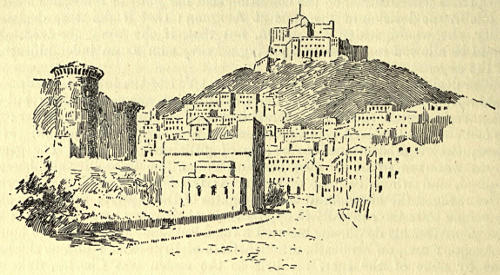
Naples.—Arch of Alfonso on the Extreme Left
Joanna II
[1416-1420 A.D.]
Joanna was already the widow of William, son of Leopold II, duke of Austria, when the death of Ladislaus exalted her to the throne of Naples. Equally devoid of personal charms and mental delicacy, the princess scorned the irksome restraints of virtue and of rank. Her lovers were selected according to her caprice without reference to their station; and the fortunate possessor of her affections, on her accession to the crown, was Pandolfello Alopo, whom she raised, from the humble station of carver, to the office of grand-chamberlain. The irregularities of her life and the default of an heir to the throne prompted her nobles to recommend a second marriage; and she fixed upon a prince of the house of Bourbon, Jacques de la Marche, the fourth in lineal succession from Robert, youngest son of St. Louis.
But if Joanna flattered herself that in her new husband she was to find a screen, and not a check to her vices, she was immediately undeceived; for no sooner was the obscure count exalted into the king of Naples, than he seized upon Alopo; and in the agonies of the rack the distracted lover betrayed his intercourse with his mistress. The grand-chamberlain was publicly beheaded, and the queen herself reduced to personal restraint of no great severity or duration. The people, indignant at seeing their queen thus imprisoned by a foreigner, burst into insurrection; and the king was compelled to seek shelter in the Castello dell’Ovo. His surrender was rewarded by the acknowledgment of his royal title, and a stipend of 40,000 ducats a year—a sum, says the historian, not exceeding the incomes of the Neapolitan gentry. The French monarch did not long enjoy this semblance of royalty. He found himself the sport of his faithless consort and her minions; his person was again insulted by imprisonment, and his countrymen were commanded to depart the kingdom. Having again recovered his liberty, he resolved no longer to be cheated by the dreams of ambition; and renouncing his adulterous queen and ungovernable subjects, he privately withdrew from Naples and retired into France, where he ended his days in the habit of a Franciscan friar (1438).
Amongst the most conspicuous of Joanna’s favourites were Giacomuzzo Attendolo, surnamed Sforza, and Ser Gianni Caracciolo, both distinguished for their personal beauty. The former, the son of a peasant of Cotignola in Romagna, had joined in early life the mercenary troops of Italy; and after serving with renown under the banners of Ferrara, of Florence, and of the church, entered the Neapolitan service, and was treated with distinction by the queen upon her accession to the throne. The jealousy of the minion Pandolfello Alopo procured the imprisonment of Sforza; but he was soon reconciled to his rival; and being released from his dungeon was created by Joanna grand constable of the kingdom. During the transient reign of Jacques de la Marche he had again languished in prison; but on his release was restored to his former dignity. Meanwhile a new favourite was daily gaining unbounded influence over the susceptible heart of Queen Joanna. Caracciolo, a man of birth and discretion, and of a handsome and graceful person, was promoted to the office of grand seneschal; and procured the removal of Sforza from court upon the honourable employment of checking the ravages of the mercenary Braccio. But the return of the victorious Sforza and the rivalry of the two favourites soon filled the city with confusion; and Joanna could only quiet the murmurs of her people by consenting to the banishment of the beloved Caracciolo. The place of his exile was, however, too near the city to prevent his interference in public affairs; and, from the island of Procida, Ser Gianni continued to exert his influence over his queen and mistress. He again procured the removal of Sforza for the purpose of dislodging Braccio from the patrimony of St. Peter; but he took care that his rival should be so poorly supported by troops that his defeat and ruin appeared inevitable.
This unfortunate collision between the favourites was destined to produce the most disastrous consequences, not merely to the kingdom of Naples but to the whole of Italy. Indignant at the preference shown to Caracciolo, Sforza abandoned his mistress, and encouraged Louis III the young duke of Anjou to make good his pretensions to the Neapolitan throne by invading the kingdom of Joanna. In Naples, a strong spirit existed favourable to the claims of Louis. The inordinate affection of the queen for Caracciolo (who was now again restored to her arms) had estranged the nobility from her cause; and she deemed it prudent to seek the support of some foreign potentate sufficiently powerful to counteract the designs of her enemies. She therefore addressed herself to Alfonso V, king of Aragon, whom she promised to adopt as her successor on the throne of Naples. This offer being accepted by Alfonso, he set sail for his new inheritance, and received the formal adoption from the childless Joanna, with the title of duke of Calabria and possession of the Castel Nuovo. By this judicious step the queen extricated herself from the pressing danger; Louis of Anjou was staggered in his hopes, and after a feeble siege of Naples, yielded to necessity and abandoned his enterprise. Sforza now found means to seal his pardon, and was received with the utmost cordiality by Joanna and Alfonso.
[1420-1435 A.D.]
The reappearance of his ancient rival at the Neapolitan court could not fail to awaken the jealous and angry feelings of Caracciolo, who had already perceived his authority endangered by the adoption of Alfonso. To sow the seeds of dissension was now his object, and the unbounded influence which he possessed over Joanna gave the utmost facility to his sinister designs. He succeeded in persuading the credulous queen that the Spaniard had resolved at once to usurp the succession, and designed to dethrone her and carry her by force into Catalonia. Terrified at this dismal suggestion, Alfonso became an object of distrust to Joanna. She shut herself up in the Castel Nuovo; and the seizure and imprisonment of the beloved Ser Gianni filled up the measure of her alarm and horror. Abjuring all further connection with the king of Aragon she summoned Sforza to her relief, and revoking her late adoption bestowed the succession upon Louis of Anjou. The partial defeat of Alfonso and the consequent exchange of prisoners once more restored Caracciolo to the queen; but the unhappy kingdom was delivered over to the miseries of war, the troops of Joanna being led by Sforza, and those of Alfonso by his rival Braccio. The disorders of his Spanish dominions withdrew the king for the present from Italy; and, with the exception of the Castel Nuovo, Joanna was left in quiet possession of the kingdom; but not before the two generals had perished in this desperate struggle. Sforza, in his eager attempt to swim the river Pescara, then unusually swollen by the influx of the sea, fell a sacrifice to his generous endeavour to save his drowning page; and borne down by the additional weight of his armour he sank to rise no more. His son Francesco Sforza narrowly escaped a similar fate, and was destined to attain a glorious and triumphant elevation. The death of Braccio was more congenial to his tumultuous life; he fell mortally wounded in a desperate conflict, wherein his forces were utterly routed.
After the retreat of Alfonso from Naples, Joanna continued to enjoy an unmolested reign. Age had quenched the fires of lust; the life of her once-loved Ser Gianni was sacrificed to jealousy and suspicion; and he was assassinated with the connivance, if not by the command, of his mistress. Her adopted son Louis expired in 1434, to the great grief of Joanna and her subjects. She herself survived but a few weeks, and died in 1435 in the sixty-fifth year of her age and twenty-first of her reign. With her ended the race of Durazzo. By her will she bequeathed the kingdom of Naples to René, duke of Anjou, brother of Louis; and the adopted heir languished in the prison of the duke of Burgundy when he was apprised of his nomination to the fairest kingdom of the earth. His wife Isabella assumed the regency in his absence, and took possession of Naples.
Alfonso the Magnanimous
[1435-1458 A.D.]
The claims of Alfonso were now again to be urged, and he marched at the head of an army to enforce his pretensions. A singular misfortune which befell the king in his progress proved highly beneficial to his cause. Whilst he laid siege to Gaeta, a fleet from Genoa despatched by order of Filippo Visconti, the reigning duke of Milan, attacked and defeated the Spanish armament; and the king, his brother Juan, king of Navarre, Henry of Aragon, and a host of nobles, were sent prisoners to Milan. By a remarkable exercise of clemency and moderation, the duke restored his captives gratuitously to liberty; and even entered into a league with Alfonso, promising to assist him in the conquest of Naples.
Whilst a new fleet from Spain was again directed against Naples, René purchased his liberty; and repairing to his new dominions, maintained a doubtful contest with his rival during four years. In the middle of the year 1442 the final blow was struck by the entry of Alfonso into the capital, through the self-same aqueduct which nearly nine hundred years before had admitted the soldiers of Belisarius. The duke of Anjou, no longer able to contend with the fortunes of his rival, withdrew into France; and Alfonso at length obtained from Pope Eugenius IV the investiture of the kingdom of Naples, which his holiness had previously conferred upon René. After a pause of eleven years René was induced to reappear in Italy at the pressing instance of the duke of Milan, who tempted him to take up arms against Venice, under a promise to afford his assistance in wresting Naples from the Spaniard. But the French prince, now advanced in years, soon grew weary of the toils of a campaign, and readily yielded to the anxiety of his troops to return to their native regions.
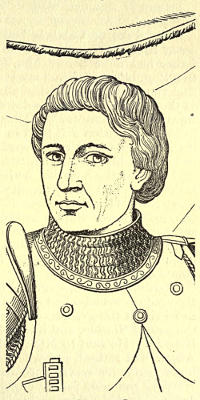
Alfonso I
(From a painting)
Alfonso survived this event only five years, and died on the 27th of June, 1458. His paternal dominions, Aragon and Sicily, vested in default of legitimate issue in his brother Juan, king of Navarre; but he bequeathed the kingdom of Naples, his conquest, to his natural son Ferdinand.c Whatever may be thought of the claims subsisting in the house of Anjou, there can be no question that the reigning family of Aragon were legitimately excluded from the throne of Naples, though force and treachery enabled them ultimately to obtain it.
Alfonso, surnamed “the magnanimous,” was by far the most accomplished sovereign whom the fifteenth century produced. The virtues of chivalry were combined in him with the patronage of letters, and with more than their patronage—a real enthusiasm for learning, seldom found in a king, and especially in one so active and ambitious. This devotion to literature was, among the Italians of that age, almost as sure a passport to general admiration as his more chivalrous perfection. Magnificence in architecture and the pageantry of a splendid court gave fresh lustre to his reign. The Neapolitans perceived with grateful pride that he lived almost entirely among them, in preference to his patrimonial kingdom, and forgave the heavy taxes, which faults nearly allied to his virtues—profuseness and ambition—compelled him to impose. But they remarked a very different character in his son. Ferdinand was as dark and vindictive as his father was affable and generous. The barons, who had many opportunities of ascertaining his disposition, began, immediately upon Alfonso’s death, to cabal against his succession, turning their eyes first to the legitimate branch of the family, and, on finding that prospect not favourable, to John, titular duke of Calabria, son of René of Anjou, who survived to protest against the revolution that had dethroned him.d
Ferdinand
[1458-1479 A.D.]
The duke of Calabria believed that he should be assisted both by Francesco Sforza—who, before he was duke of Milan, had long fought, as his father had done before him, for the party of Anjou—and by the Florentine Republic, which had always been devoted to France. But Sforza judged that the security and independence of Italy could be maintained only so long as the kingdom of Naples did not fall into the hands of France. The French were already masters of Genoa and the gates of Italy; they would traverse in every direction and hold in fear or subjection every state in the peninsula, if they should acquire the sovereignty of Naples. For these reasons Sforza resisted all his friends, dependents, and even his wife, who vehemently solicited him for the house of Anjou; he also brought Cosmo de’ Medici over to his opinion, and thus prevented the republic of Florence from seconding a party towards which it found itself strongly inclined. The duke of Calabria, who had entered Naples in 1459, had begun successfully; but, receiving no assistance from abroad, he soon wearied and exhausted the people, who alone had to furnish him with supplies. He lost, one after the other, all the provinces which had declared for him, and was finally, in 1464, constrained to abandon the kingdom.
Ferdinand, to strengthen himself, kept in dungeons or put to death all the feudatories who had shown any favour to his rival; above all, he resolved to be rid of the greatest captain that still remained in Italy, Jacopo Piccinino, the son of Niccolo, and head of what was still called the militia, or school of Braccio. He sent to Milan, whither Piccinino, who had served the party of Anjou, had retired, and where he had married a daughter of Sforza, to invite him to enter his service, promising him the highest dignities in his kingdom. He gave the most formal engagements for his safety to Sforza, as well as to Jacopo himself. He received him with honours, such as he would not have lavished on the greatest sovereign. After having entertained him twenty-seven days in one perpetual festival, he found means to separate him from his most trusty officers, caused him to be arrested in his own palace, and to be immediately strangled. This happened on the 24th of June, 1465.e
Once firmly established on the throne of Naples, Ferdinand continued to hold his position and to render it more and more secure throughout the period of his life, which terminated in 1494. He was little respected, but he made himself pretty generally feared and was accounted the most astute politician of his time. In alliance with Pope Sixtus IV he made war against Milan and Florence, and in 1479 the allied forces had reduced Lorenzo de’ Medici to such an extremity that the great Florentine was constrained to visit Naples in the hope of conciliating his enemy. Lorenzo frankly acknowledged the danger in which he found himself, but he made a shrewd political move in pointing out that he was not without resources, inasmuch as it was open to him to invite the French into Italy. He admitted that the coming of these outsiders could only benefit him through injuring his enemies, but as a last resource he professed himself ready to adopt this expedient. He strongly represented, however, that he much preferred to enter into an arrangement with Ferdinand instead of opening up their country to the incursions of what the Italians were pleased to call barbarians. Ferdinand was fully alive to his danger, and was prepared to listen to terms.a
[1479-1494 A.D.]
Finally, Lorenzo offered him an indemnity in the republic of Siena, which the duke of Calabria, son of the king, already coveted. That state had made alliance with the pope and the king of Naples against Florence; had received, without distrust, the Neapolitan troops within its fortresses; and had repeatedly had recourse to the duke of Calabria to terminate, by his mediation, the continually renewed dissensions between the different orders of the republic. The duke of Calabria, instead of reconciling them, kept up their discord; and, by alternately granting succour to each party, was become the supreme arbitrator of Siena. Lorenzo de’ Medici promised to offer no obstacle to the transferring of that state in sovereignty to the duke of Calabria. On this condition, he signed his treaty with the king of Naples on the 6th of May, 1480. The republic of Siena would have been lost, and the Neapolitans, masters of so important a place in Tuscany, would soon have subjugated the rest, when an unexpected event saved Lorenzo de’ Medici from the consequences of his impudent offer. Muhammed II charged his grand vizir, Akhmet Giedik, to attempt a landing in Italy, which the latter effected, and made himself master of Otranto on the 28th of July, 1480. Ferdinand, struck with terror, immediately recalled the duke of Calabria, with his army, to defend his own states.
The Turks had no sooner been driven from Otranto by Alfonso, the eldest son of the king of Naples, on the 10th of August, 1481, than Sixtus excited a new war in Italy. His object was to aggrandise his nephew, Girolamo Riario, for whom he was desirous of forming a great principality in Romagna. With that view, he proposed to the Venetians to divide with him the states of the duke of Ferrara; but a league was formed, in 1482, by the king of Naples, the duke of Milan, and the Florentines, to defend the dukedom. The year following, Sixtus IV, fearing that he should not obtain for his nephew the best part of the spoils of the duke of Ferrara, changed sides, and excommunicated the Venetians, intending to take from them the provinces which he destined for Girolamo Riario. The new allies, without consulting him, soon afterwards made peace with the Venetians, at Bagnolo, on the 7th of August, 1484.e
Ferdinand had reason to desire peace rather than war, and his influence was valuable in maintaining a state of relative tranquillity in Italy throughout most of the later years of his reign. But his oppressive taxation led to a momentous event in the history of Italy. The Neapolitan nobles rebelled against their burdens and again aroused the dormant Angevin claim to activity. René II neglected his opportunity, but after Ferdinand, in 1492, had strengthened himself by an alliance with Piero de’ Medici, the jealous Lodovico Sforza appealed to the King of France. Ferdinand died in 1494, a few months before Charles VIII invaded Italy.a
THE TYRANTS OF LOMBARDY
[1152-1300 A.D.]
While imperial power was declining in Italy, the free cities that had resisted it in the days of its might were gradually falling under the dominion of feudal tyrannies which rose upon the ruin of their republican institutions. The slow operation of unnoticed causes had insensibly led to the subversion of the liberties of communities once so powerful and free. In one important respect, the Italian municipalities differed essentially from those of other countries. They included in the roll of their citizens the nobility of the district in which they were situated. This, while it seemed to add, and did in fact add to the splendour of the cities, was yet one of the principal elements of their decay.
The great territorial lords of northern Italy were compelled to seek the protection and friendship of these powerful communities, and frequently submitted to their rule. Many of them were bound to reside for a certain portion of each year within the walls of the city whose citizenship they had sought or been compelled to accept. Otho Frigisensisi (Otto of Freising), the historian of the reign of Frederick I, complains: “The cities so much affect liberty, and are so solicitous to avoid the insolence of power, that almost all of them have thrown off every other authority and are governed by their own magistrates, insomuch that all that country is now filled with free cities, most of which have compelled the bishops to reside within their walls, and there is scarcely any nobleman, how great soever he may be, who is not subject to the laws and government of some city.” Elsewhere the same writer observes that the marquis of Montferrat was almost the only baron who had preserved his independence, and had not become subject to the laws of any city. The cities of Italy had been free before the institution of the feudal lordships, and were not, as in other places, dependent upon the privileges which it might suit the convenience of a baron to tolerate, or a monarch to create.
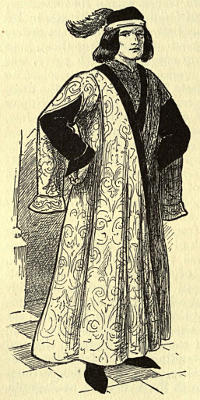
An Italian Baron, Fifteenth Century
This admission of a territorial aristocracy into the association of the burghers, if at first it gave strength and elevation to these communities, subjected them on the other hand to the danger of falling under aristocratic influence. The great nobles built palaces in these towns; these palaces became feudal fortresses in the centre of the cities. Attended by armed retainers from their estates, they fortified their mansions, and in many instances commanded the city by these military strongholds. The citizens not only tolerated but encouraged this for the sake of the strength which the retainers of these noblemen brought to their military force. In the wars in which they were frequently engaged with each other, it was of no small importance to one of these cities to command the vassals of a great lord. By the presence of such an aristocracy, sharing in all the councils of the community, the very principle of republican equality was insensibly destroyed. The nobleman who dwelt in his feudal castle frowning over the streets of the city, who was master of no inconsiderable portion of their army, and who brought into their assembly the influence both of wealth and power, was very likely to become, when any emergency gave the opportunity, the protector instead of the protected—the master instead of the subject of the state.
[1300-1531 A.D.]
As the cities fell under the rule of princes, the number of these princes was speedily reduced. The lords of the more powerful brought those of the weaker under their sway. The dominion, at first confined to a city, soon included districts containing many cities within their limits. The duchy of Milan, erected by the emperor in favour of the Visconti, represented a sovereignty extending over the whole of the Milanese. Alessandro Medici, duke of Florence, soon merged that title in the higher one, which conferred on him the grand duchy of the Tuscan states.
Companies of Adventure
With the subjection of the cities to tyrants the habit became general of employing mercenary troops. Afraid of trusting to the militia of the citizens, these petty lords employed bands of hirelings, who, under the name of “companies of adventure,” sold their swords and services to anyone who would pay them. The emperors, on their visits, were in the habit of bringing in their train German guards, who frequently were not required to return with their master to their native land. These men were too glad to accept any service which retained them in the wealthy country and luxuriant climate to which they had come. The citizens even of the free cities were flattered by the strange argument which found a justification for the employment of mercenaries, in the philosophical reflection that the citizen who thus escaped military service was, in his attention to his proper business, contributing far more to the wealth and therefore to the greatness of the community than he could do in the profession of arms. The argument was specious. It would have been true if public spirit and patriotism formed no part of the possessions of the state. With this fatal habit of substituting mercenaries for the national militia passed away the greatness of the Italian cities. Milan had far degenerated from the days of Legnano when the mercenary ferocity of hirelings was substituted for the enthusiasm of her own free youth; and, under her once proud banners, the “company of adventurers” took the place of the “company of death.”f
The Visconti and Della Scalas had sent for many of these companies to Germany, believing that these men—who did not understand the language of the country, who were bound to it by no affection, and who were accessible to no political passion—would be their best defenders. They proved ready to execute the most barbarous orders, and for their recompense demanded only the enjoyments of an intemperate sensuality.
But the Lombard tyrants were deceived in believing the German soldier would never covet power for himself, and would continue to abuse the right of the stronger for the advantage of others only. These adventurers soon discovered that it would be better to make war and pillage the people for their own profit, without dividing the spoil with a master. Some men of high rank, who had served in Italy as condottieri (hired captains), proposed to their soldiers to follow them, make war on the whole world, and divide the booty among themselves. The first company, formed by an Italian noble at the moment that the Visconti dismissed their soldiers, having made peace with their adversaries, made an attack suddenly on Milan, in the hope of plundering that great city, but was almost annihilated in a battle, fought at Parabiago, on the 20th of February, 1339. A German duke, known only by his Christian name of Werner, and the inscription he wore on his breast of “enemy of God, of pity, and of mercy,” formed, in 1343, another association, which maintained itself for a long time under the name of “the Great Company.” It in turns entered the service of princes, and, when they made peace, carried on its ravages and plunderings for its own profit. The duke Werner and his successors—the count Lando, a German, and the friar Moriale, knight of St. John—devastated Italy from Montferrat to the extremity of the kingdom of Naples. They raised contributions, by threatening to burn houses and harvests or by putting the prisoners whom they took to the most horrible tortures. The provinces of Apulia were, above all, abandoned to their devastations; and the king and queen of Naples made not a single effort to protect their people.
[1339-1359 A.D.]
There now remained no more than six independent princes in Lombardy. The Visconti, lords of Milan, had usurped all the central part of that province; the western part was held by the marquis of Montferrat, and the eastern by the Della Scalas, lords of Verona, Carrara of Padua, Este of Ferrara, and Gonzaga of Mantua. These weaker princes felt themselves in danger, and made a league against the Visconti, taking into their service the Great Company; but, deceived and pillaged by it, they suffered greater evils than they inflicted on their enemies. When at last the money of the league was exhausted, and it could no longer pay the company, this band of robbers entered into the service of the republic of Siena, to be let loose on that of Perugia, of which the Sienese had conceived a deep jealousy. But the Florentines would not consent to their entering Tuscany, where their depredations had been already felt. They shut all the passes of the Apennines; they armed the mountaineers; they made these adventurers experience a first defeat at the passage of Scalella, on the 24th of July, 1358, and obliged them to fall back on Romagna. The legate Albornoz, to deliver himself from such guests, made them enter Perugia the year following. Never had the company been so brilliant and so formidable; it levied contributions on Siena, as well as Perugia; but vengeance and cupidity alike excited them against the Florentines. They determined on pillaging those rich merchants, whom they considered far from warlike, or forcing them to ransom themselves.
The marquis of Montferrat, desirous of taking the company into his service, pressed the republic of Florence, by his ambassadors, to do what the greatest potentates had always done—pay the banditti to be rid of them. He offered himself for mediator and guarantee, and promised a prompt and cheap deliverance; but the Florentine Republic protested it would not submit to anything so base; it assembled an army purely Italian, placing it under the command of an Italian captain, who was ordered to advance to the frontier and offer battle to the company. The robbers gave way in proportion to the firmness of the republic; they made the tour of the Florentine frontier by Siena, Pisa, and Lucca, always threatening, yet never daring to violate it. On the 12th of July, 1359, they sent the Florentine commander a challenge to battle, and afterwards failed to keep the rendezvous which they had given. They escaped at last from Tuscany, without having fought, and divided themselves in the service of different princes, humbled indeed, but too much accustomed to this disorderly life not to be anxious to begin it anew.
Florence Menaced by the Visconti
[1328-1352 A.D.]
The republic of Florence was continually occupied, since the expulsion of the duke of Athens, in guarding against the ambition of the Visconti, which threatened the subjugation of all Italy. Azzo Visconti, the son of that Galeazzo who had been so treacherously used by Ludwig of Bavaria, had, in 1328, purchased the city of Milan from that emperor, and soon afterwards found himself master of ten other cities of Lombardy; but he died suddenly, in the height of his prosperity, the 16th of August, 1339. As he left no children, his uncle Lucchino succeeded him in the sovereignty. Lucchino was false and ferocious, but clever, and possessed in war the hereditary talent of the Visconti. He was called a lover of justice, probably because he punished criminals with an excess of cruelty, and maintained by terror a perfect police in his states. He died, poisoned by his wife, on the 23rd of January, 1349. His brother John, archbishop of Milan, succeeded him in power. The latter found himself master of sixteen of the largest cities in Lombardy—cities which, in the preceding century, had been so many free and flourishing republics. His ambition continually aspired to more extensive conquests; and, on the 16th of October, 1350, he engaged the brothers Pepoli to cede to him Bologna.
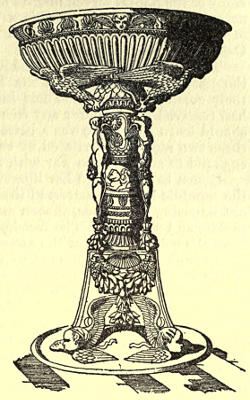
Benitier, Siena Cathedral
These nobles, who had usurped the sovereignty of their country, were at this time engaged in a quarrel with the legate, Gil Albornoz, who asserted that Bologna belonged to the holy see. The archbishop was already treated by the pope as an enemy, and preferred exciting still further his wrath, to the renunciation of so important an acquisition. When Clement VI summoned him to come and justify himself at the court of Avignon, he answered that he would present himself there at the head of twelve thousand cavalry and six thousand infantry. The pope, in his alarm, ceded to him the fief of Bologna, on the 5th of May, 1352, on condition of receiving from him an annual tribute of 12,000 florins. Florence saw with terror this city, which had so long been her most powerful and faithful ally, the Guelf city of letters, commerce, and liberty, thus pass under the yoke of a tyrant, who had designs upon her liberty also; who laid snares around her; who formed alliances against her with all the petty tyrants of Romagna, and all the Ghibelline lords of the Apennines. She was at peace with him, it was true; but she well knew that the Visconti neither believed themselves bound by any treaty, nor kept any pledge.
The number of free cities continually diminished. Pisa was still free, but had, from attachment to the Ghibelline party, made alliance with the Visconti. Siena and Perugia were free also, but weak and jealous; they were incessantly disturbed by internal dissensions. The Florentines could not reckon on them. The archbishop of Milan suddenly ordered, towards the end of the summer, 1351, Giovanni Visconti da Oleggio, his lieutenant at Bologna, to push into Tuscany at the head of a formidable army, without any declaration of war. The republic had no ally, and but slight reliance on the mercenaries in its service; but the Florentines, who showed little bravery in the open field, defended themselves obstinately behind walls; and the great village of Scarperia, in the Mugello, although so ill fortified that the walls of many of the houses served instead of a surrounding wall, and having a garrison only of two hundred cuirassiers and three hundred infantry, stopped the Milanese general sixty-one days. He was at last obliged, on the 16th of October, to retire to Bologna.
[1351-1356 A.D.]
The republics of Venice and Genoa were, it might have been thought, the natural allies to whom the Florentines should have had recourse for their common defence. Their interests were the same; and the Visconti had resolved not to suffer any free state to subsist in Italy, lest their subjects should learn that there was a better government than their own. Unhappily, these two republics, irritated by commercial quarrels in the East, were then engaged in an obstinate war with each other.
Genoa had sacrificed her liberty to her thirst of vengeance; for although the republic had not conferred the signoria on the archbishop Visconti without imposing conditions, it soon experienced that oaths are not binding on a prelate and a tyrant. The freedom of Venice also was in the utmost danger from the consequences of the same war.
Though the war of the maritime republics might have deprived Florence of the aid of Venice or Genoa, it had at least diverted the attention of Giovanni Visconti, made him direct his exertions elsewhere, and procured some repose to Tuscany. He died on the 5th of October, 1354, before he could renew his attacks; and his three nephews, the sons of his brother Stephen, agreed to succeed him in common. The eldest, who showed less talent for government and more sensuality and vice than his brothers, was poisoned by them the year following. The two survivors, Barnabò and Galeazzo, divided Lombardy between them, preserving an equal right on Milan and in the government. Their relative, Visconti da’ Oleggio, who was their lieutenant at Bologna, made himself independent in that city nearly about the same time that the Genoese, indignant at seeing all their conventions violated, rose in insurrection on the 15th of November, 1356, drove out the Milanese garrison, and again set themselves free.
Charles IV in Italy
The entry of Charles IV into Tuscany formed also a favourable diversion, by suspending the projects of the Visconti against the Florentines; but it cost them one hundred thousand florins, which they agreed to pay Charles by treaty on the 12th of March, 1355, to purchase his rights on their city, and to obtain his engagement that he should nowhere enter the Florentine territory. The republics of Pisa and Siena, who received him within their walls, paid still dearer for the hospitality which they granted him. The emperor encouraged the malcontents in both cities; he aided them to overthrow the existing governments; he hoped by so doing to make these republics little principalities, which he intended to bestow as an appanage on his brother, the patriarch of Aquileia; but after having caused the ruin of his partisans, after having ordered or permitted the execution of the former magistrates, who were innocent of any crime, insurrections of the people forced him to quit both cities, without retaining the smallest influence in either. After he had quitted Italy, the Visconti were engaged in the war to which we have already alluded, against the marquises of Este, of Montferrat, Della Scala, Gonzaga, and Carrara. The siege of Pavia and the ravages of the Great Company exhausted their resources, but did not make them abandon their projects on Tuscany. The influence which they retained in the republic of Pisa, as chiefs of the Ghibelline party, seemed to facilitate their schemes.
[1342-1364 A.D.]
Pisa, in losing its maritime power and its possessions in Sardinia, had not lost its warlike character; it was still the state in Italy where the citizens were best exercised in the use of arms, and evinced the most bravery. It had given proofs of it in conquering, under the eye of the Florentines, the city of Lucca, which it still retained. Nevertheless, since the peace made by the duke of Athens on the 14th of October, 1342, commercial interests had reconciled the two republics. The Florentines had obtained a complete enfranchisement from all imposts in the port of Pisa; they had established there their counting-houses, and attracted thither a rich trade. From that time the democratic party predominated in the Pisan Republic; at its head was a rich merchant, named Francesco Gambacorta, who attached himself to the Florentines, and to the maintenance of peace. His party was called that of the Bergolini; while that of the great Ghibelline families attached to the counts of la Gherardesca, who despised commerce and excited war, was called the Raspanti party. The Visconti sought the alliance of the latter; the moment did not appear to them yet arrived in which they could assume to themselves the dominion over all Tuscany. It was sufficient for their present views to exhaust the Florentine Republic by a war, which would disturb its commerce; to weaken the spirit of liberty and energy in the Pisans, by subduing them to the power of the aristocracy, in the hope that when once they had ceased to be free, and had submitted to a domestic tyrant, they would soon prefer a great to a little prince, and throw themselves into his arms. The revolution, which in 1355 had favoured the emperor in restoring power to the Raspanti, facilitated this project.
In pursuance of this view, the party of the Raspanti, at the suggestion of the Visconti, in 1357, began to disturb the Florentines in the enjoyment of the franchises secured to them at Pisa by the treaty of peace. The Florentines, guessing the project of the Lombard tyrant, instead of defending their right by arms, resolved on braving an unwholesome climate, and submitting to the inconvenience of longer and worse roads, transported all their counting-houses to Telamone, a port in the Maremma of Siena. They persisted till 1361 in despising all the insults of the Pisans, as well as in rejecting all their offers of reconciliation; at length, animosity increasing on both sides, the war broke out, in 1362. The Visconti supplied the Pisans with soldiers. France during this period had been laid waste by the war with the English; and as the sovereigns were rarely in a state to pay their troops, there had been formed, as in Italy, companies of adventurers, English, Gascon, and French, who lived at the cost of the country, plundering it with the utmost barbarity. The Peace of Bretigny permitted several of these companies to pass into Italy; they carried with them the plague, which made not less ravages in 1361 than it had done in 1348. The English company commanded by John Hawkwood, an adventurer, who rendered himself celebrated in Italy was sent to the Pisans by Barnabò Visconti. After various successes, the two republics, at last exhausted by the plague and by the rapacity and want of discipline of the adventurers whom they had taken into pay, made peace on the 17th of August, 1364. But the purpose of the Visconti was not the less attained. The Pisans, having exhausted their resources, were at a loss to make the last payment of thirty thousand florins to their army; they were reduced to accept the offer made them by Giovanni Agnello, one of their fellow-citizens, of advancing that sum, on condition of being named doge of Pisa. The money had for this purpose been secretly advanced by Barnabò Visconti, to whom Agnello had pledged his word never to consider himself more than his lieutenant at Pisa. Thus the field fertilised by liberty became continually more circumscribed; and Florence, always threatened by the tyrants of Lombardy, saw around her those only who had alienated their liberty, and who had no longer any sentiment in common with the republic.
[1364-1367 A.D.]
The chief magistrates of the Florentine Republic could not conceal from themselves the danger which now menaced the liberty of Italy. They found themselves closed in, blockaded as it were, by the tyrants, who daily made some new progress. The two brothers Visconti, masters of Lombardy, had at their disposal immense wealth and numerous armies; and their ambition was insatiable. They were allied, by marriage, to the two houses of France and England; their intrigues extended throughout Italy, and every tyrant was under their protection. At the same time, their own subjects trembled under frightful cruelties. They shamelessly published an edict, by which the execution of state criminals was prolonged to the period of forty days. In it the particular tortures to be inflicted, day by day, were detailed, and the members to be mutilated designated, before death was reached. On the other hand, their finances were in good order; they liberally recompensed their partisans, and won over traitors in every state inimical to them. They pensioned the captain of every company of adventurers, on condition that he engaged to return to their service whenever called upon. Meanwhile these captains with their soldiers overran, plundered, and exhausted Italy during the intervals of peace; reducing the country to such a state as to be incapable of resisting any new attack. All the Ghibellines, all the nobles who had preserved their independence in the Apennines, were allied to the Visconti. The march of these usurpers was slow, but it seemed sure. The moment was foreseen to approach when Tuscany would be theirs, as well as Lombardy; particularly as Florence had no aid to expect either from Genoa or Venice. These two maritime republics appeared to have withdrawn themselves from Italy, and to place their whole existence in distant regions explored by their commerce.
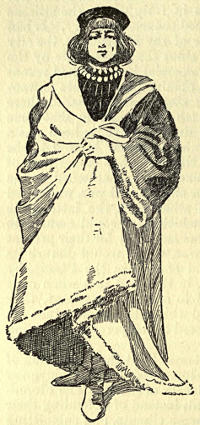
A Florentine, Fourteenth Century
For a moment, the few Italian states still free were led to believe that the succour now so necessary to enable them to resist the Visconti would arrive both from France and Germany. The pope and the emperor announced their determination to deliver the country, over which they assumed a supreme right, from every other yoke. Urban V, moved by the complaints of the Christian world, declared that his duty as bishop of Rome was to return and live there; and Charles IV protested that he would deliver his Roman Empire from the devastations of the adventurers, and from the usurpations of the Lombard tyrants. In 1367, Urban returned to Italy; and the same year formed a league with the emperor, the king of Hungary, the lords of Padua, Ferrara, and Mantua, and with the queen of Naples, against the Visconti. But when Charles entered Italy, on the 5th of May, 1368, he thought only of profiting by the terror with which he inspired the Visconti, to obtain from them large sums of money; in return for which he granted them peace. He afterwards continued his march through the peninsula, with no other object than that of collecting money.
[1367-1370 A.D.]
His presence, however, caused some changes favourable to liberty. A festival was prepared for him at Lucca, on the 7th of September; on which day he intended confirming, by his investiture, the sovereignty of the doge Giovanni Agnello over Pisa and Lucca. But the stage on which Agnello had mounted gave way, and in the fall he broke his leg. The Pisans profited by this accident to recover their freedom, and the emperor kept Lucca for himself. At Siena he favoured a revolution which overthrew the ruling aristocracy; intending, on his return to that city, after a devotional visit to Rome, to take advantage of the disturbance, and get himself appointed to the signoria; but a sedition against him broke forth on the 18th of January, 1369. Barricades were raised on all sides; his guards were separated from him, and disarmed; his palace was broken into. No attempt, indeed, was made on his person; but he was left alone several hours in the public square, addressing himself in turn to the armed troops which closed the entrance of every street, and which, immovable and silent, remained insensible to all his entreaties. It was not till he began to suffer from hunger that his equipages were restored to him, and he was permitted to leave the town. He returned to Lucca, where he had already lived, in the time of his father, as prince royal of Bohemia. The Lucchese were attached to him, and placed in him their last hope to be delivered from a foreign yoke, which had weighed upon them since the year 1314. They declared themselves ready to make the greatest sacrifices for the recovery of their freedom; and they at the same time testified to him so much confidence and affection as to touch his heart. By a diploma, on the 6th of April, 1369, Charles restored them to liberty, and granted them various privileges; but, on quitting their city, he left in it a German garrison, with orders not to evacuate that town till the Lucchese had paid the price of their liberty. It was not till the month of April, 1370, and not without the aid of Florence and their other allies, that they could acquit the enormous sum of three hundred thousand florins, the price of the re-establishment of their republic. The Guelf exiles were then immediately recalled; a close alliance was contracted with Florence; and the signoria, composed of a gonfalonier and ten anziani, to be changed every two months, was reconstituted.
Urban V, on his arrival in Italy, endeavoured also to oppose the usurpations of the Visconti, who had just taken possession of San Miniato, in Tuscany, and who, even in the states of the church, were rendering themselves more powerful than the pope himself. Of the two brothers, Barnabò Visconti was more troublesome to him, by his intrigues. Urban had recourse to a bull of excommunication, and sent two legates to bear it to him; but Barnabò forced these two legates to eat, in his presence, the parchment on which the bull was written, together with the leaden seals and silken strings. The pope, frightened at the thought of combating men who seemed to hold religion in no respect, and wearied, moreover, with his ill-success, was glad to return to the repose of Avignon, where he arrived in the month of September, 1370, and died the November following.
The “War of Liberation”
[1370-1377 A.D.]
Gregory XI, who succeeded him, was ambitious, covetous, and false. He joined the Florentines in their war against the Visconti; but the legates, to whom he had entrusted the government of the ecclesiastical states, and who had rendered themselves odious by their rapacity and immorality, formed the project of seizing for themselves Tuscany, which they had engaged to defend. All the troops of the Florentines had been placed at their disposal, for the purpose of carrying the war into Lombardy. The cardinal legate, who commanded the combined army, resided at Bologna; the church having rescued that city from the grasp of Visconti da Oleggio, on the 31st of March, 1360. He signed a truce with Barnabò Visconti, in the month of June, 1375; and, before the Florentines could recall their soldiers, sent John Hawkwood with a formidable army to surprise Florence. The Florentines, indignant at such a shameless want of good faith on the part of the church, whose most faithful allies they had always been, vowed vengeance on the see of Rome. They determined to rouse the spirit of liberty in every city belonging to it, and drive out the French legates—more odious and perfidious than the most abhorred of the Italian tyrants. They, in the month of June, 1375, without placing any confidence in Barnabò Visconti, made an alliance with him against the priests, who had just deceived them under the faith of the most solemn oaths. They admitted the republics of Siena, Lucca, and Pisa into this league; they formed a commission of eight persons, to direct the military department, called “the eight of war”; they assembled a numerous army, and gave it colours, on which was inscribed, in golden letters, the word, “Liberty!” This army entered the states of the church, proclaiming that the Florentines demanded nothing for themselves—that not only would they make no conquests, but would accept dominion over no people who might offer themselves; they were desirous only of universal liberty, and would assist the oppressed with all their power, solicitous for the recovery of their freedom.
The army of liberty carried revolution into all the states of the church with an inconceivable rapidity; eighty cities and towns, in ten days, threw off the yoke of the legates. The greater number constituted themselves republics; a few recalled the ancient families of princes, who had been exiled by Gil Albornoz, and to whom they were attached by hereditary affection. Bologna did not accomplish her revolution before the 20th of March, 1376. This ancient republic, in recovering its liberty, vowed fidelity to the Florentines, to whom it owed the restoration of its freedom. The legates, beside themselves with rage, endeavoured to restrain the people by terror. John Hawkwood, on the 29th of March, 1376, delivered up Faenza to a frightful military execution; four thousand persons were put to death, property pillaged, and women violated. The pope, not satisfied with such rigour, sent Robert of Geneva, another cardinal legate, into Italy, with a Breton company of adventurers, considered as the most ferocious of all those trained to plunder by the wars of France. The new legate treated Cesena, on the 1st of February, 1377, with still greater barbarity. He was heard to call out during the massacre, “I will have more blood—kill all—blood, blood!” Gregory XI at last felt the necessity of returning to Italy, to appease the universal revolt. He entered Rome on the 17th of January, 1377; although the Florentines, who had sent the standard of liberty to the senators and bannerets of Rome, and had made alliance with the Romans, expostulated on the danger they incurred if they admitted the pontiff within their walls.
[1377-1378 A.D.]
The two parties, however, began to be equally weary of the war. Some of the cities enfranchised by the Florentines were already detached from the league. The Bolognese had made, on the 21st of August, 1377, a separate peace with the pope, who had agreed to acknowledge their republic. Barnabò Visconti carried on with the holy see secret negotiations, in which he offered to sacrifice to the church, his ally, the republic of Florence. This republic was then pressed for its consent to the opening of a congress for restoring peace to Italy, to be held at Sarzana, in the beginning of the year 1378; the presidency of the congress was given to Barnabò Visconti. The conference had scarcely opened when the Florentines perceived, with more indignation than surprise, that the Lombard tyrant, who had fought in concert with them, intended that they should pay to him and to the pope the whole expenses of the war. The negotiations took the most alarming turn, when the unexpected news arrived of the death of Gregory XI, on the 27th of March, 1378; and the congress separated without coming to any decision. The year which now opened was destined to bring with it the most important revolutions throughout Italy. Amidst those convulsions the Peace of Florence with the court of Rome, weakened by the great western schism, was not difficult to accomplish.
The Papal Schism
The pontifical chair had been transferred to France since the year 1305. Its exile from Italy lasted seventy-three years. The Christian world, France excepted, had considered it a scandal; but the French kings hoped by it to retain the popes in their dependence; and the French cardinals, who formed more than three-fourths of the Sacred College, seemed determined to preserve the pontifical power in their nation. They were, however, thwarted in this intention by the death of Gregory XI at Rome; for the conclave must always assemble where the last pontiff dies. The clamour of the Romans and the manifestation of opinion throughout Christendom were not without influence on the conclave. On the 8th of April, 1378, it elected—not, indeed, a Roman, whom the people demanded, but an Italian—Bartolommeo Prignani; who, having lived long in France, seemed formed to conciliate the prejudices of both parties. He was considered learned and pious. The cardinals had not, however, calculated on the development of the passions which a sudden elevation sometimes gives; or on the degree of impatience, arrogance, and irritability of which man is capable, in his unexpected capacity of master, though in an inferior situation he had appeared gentle and modest. The new pope, who took the name of Urban VI, became so violent and despotic, so confident of himself, and so contemptuous of others, that he soon quarrelled with all his cardinals. They left him; assembled again at Fondi; and, on the 9th of August, declared the holy see vacant; asserting that their previous election was null, having been forced by their terror of the Romans.
Consequently, on the 20th of September, they elected another pope. Their choice, no better than the former, fell on Robert, cardinal of Geneva, who had presided at the massacre of Cesena; he took the name of Clement VII. He was protected by Queen Joanna, with whom Urban had already quarrelled. Clement established his court at Naples; but an insurrection of the people made him quit it the year following, and determined him on returning, with his cardinals, to Avignon. Urban VI, meanwhile, deposed as schismatics all the cardinals who had elected Clement, and replaced them by a new and more numerous college; but he agreed no better with these than with their predecessors. He accused them of a conspiracy against him; he caused many to be put to the torture in his presence and while he recited his breviary; he ordered others to be thrown into the sea in sacks and drowned; he quarrelled with the Romans and the new sovereign of Naples, whom he had himself named; he paraded his incapacity and rage through all Italy; and finally took refuge at Genoa, where he died, on the 9th of November, 1389. The cardinals who acknowledged him named a successor on his death, as the French cardinals did afterwards on the death of Clement VII, which took place on the 16th of September, 1394. The church thus found itself divided between two popes and two colleges of cardinals, who reciprocally anathematised each other. Whilst the Catholic faith was thus shaken, the temporal sovereignty of the pope, founded by the conquests of the cardinal Albornoz, was overthrown. Several of the cities enfranchised by the Florentines in the war of liberty, preserved their republican government; but the greater number, particularly in Romagna, fell again under the yoke of petty tyrants.
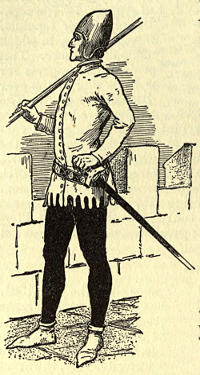
An Italian Soldier, Fourteenth Century
[1378-1394 A.D.]
The terror in which the house of Visconti had held Florence and the other Italian republics began somewhat to subside. Barnabò, grown old, had divided the cities of his dominions among his numerous children. His brother, Galeazzo, had died on the 4th of August, 1378, and been replaced by his son, Gian Galeazzo, called count de Virtù, from a county in Champagne, given him by Charles V, whose sister he had married. Barnabò would willingly have deprived his nephew of his paternal inheritance, to divide it among his children. Gian Galeazzo, who had already discovered several plots directed against him, uttered no complaint, but shut himself up in his castle of Pavia, where he had fixed his residence. He doubled his guard, and took pains to display his belief that he was surrounded by assassins. He affected, at the same time, the highest devotion; he was always at prayers, a rosary in his hand, and surrounded with monks; he talked only of pilgrimages and expiatory ceremonies. His uncle regarded him as pusillanimous, and unworthy of reigning. In the beginning of May, 1385, Gian Galeazzo sent to Barnabò to say that he had made a vow of pilgrimage to our Lady of Varese, near the Lago Maggiore, and that he should be glad to see him on his passage. Barnabò agreed to meet him at a short distance from Milan, accompanied by his two sons. Gian Galeazzo arrived, surrounded, as was his custom, by a numerous guard. He affected to be alarmed at every sudden motion made near him. On meeting his uncle, however, on the 6th of May, he hastily dismounted, and respectfully embraced him; but, while he held him in his arms, he said in German to his guards, “Strike!” The Germans, seizing Barnabò, disarmed and dragged him, with his two sons, to some distance from his nephew. Gian Galeazzo made several vain attempts to poison his uncle in the prison into which he had thrown him; but Barnabò, suspicious of all the nourishment offered him, was on his guard, and did not sink under these repeated efforts till the 18th of December of the same year.
Gian Galeazzo Visconti
[1385-1386 A.D.]
All Lombardy submitted, without difficulty, to Gian Galeazzo. His uncle had never inspired one human being with either esteem or affection. The nephew had no better title to these sentiments. False and pitiless, he joined to immeasurable ambition a genius for enterprise, and to immovable constancy a personal timidity which he did not endeavour to conceal. The least unexpected motion near him threw him into a paroxysm of nervous terror. No prince employed so many soldiers to guard his palace, or took such multiplied precautions of distrust. He seemed to acknowledge himself the enemy of the whole world. But the vices of tyranny had not weakened his ability. He employed his immense wealth, without prodigality; his finances were always flourishing; his cities well garrisoned and victualled; his army well paid; all the captains of adventure scattered throughout Italy received pensions from him, and were ready to return to his service whenever called upon. He encouraged the warriors of the new Italian school; he well knew how to distinguish, reward, and win their attachment. Many young Italians, in order to train themselves to arms, had, from about the middle of this century, engaged in the German, English, and French troops which inundated Italy; and they soon proved that Italian valour, directed by the reflection and intelligence of a highly civilised nation, who carried their arms as well as tactics to perfection, had greatly the advantage over the brute courage of barbarians.
Alberic, count of Barbiano, a Romagnole noble, and an ancestor of the princes Belgiojoso, of Milan, formed a company, under the name of St. George, into which he admitted Italians only, and which, in 1378, he placed in the service of Urban VI. This company defeated, at Ponte Molle, that of the Bretons, attached to Clement VII, and regarded as the most formidable of the foreign troops. From that time, the company of St. George was the true school of military science in Italy. Young men of courage, talent, or ambition flocked into it from all parts; and all the captains who, twenty years later, attained such high renown, gloried in having served in that company.
Gian Galeazzo was no sooner firmly established on the throne of Milan, than he resumed his project of subjugating the rest of Italy; the two principalities of the Della Scala at Verona, and of the Carrara at Padua, were the first to tempt his ambition. The house of La Scala had produced, in the beginning of the century, some great captains and able politicians; but their successors had been effeminate and vicious—princes who hardly ever attained power without getting rid of their brothers by poison or the dagger. The house of Carrara, on the contrary, which gloried in being attached to the Guelf party, produced princes who might have passed for virtuous, in comparison with the other tyrants of Italy. Francesco da Carrara, who then reigned, his son, and grandson were men of courage, endued with great capacities, and who knew how to gain the affection of their subjects. The republic of Venice never pardoned Carrara his having made alliance against her with the Genoese and the king of Hungary. After the death of the last named, Venice engaged Antonio della Scala to attack Padua, offering him subsidies to aid him in the conquest of that state. Carrara did all in his power to be reconciled to the prince, his neighbour, whom, in 1386, he repeatedly vanquished; as well as with the republic—always ready to repair the losses sustained by the lord of Verona. Unable to obtain peace, he was at last reduced to accept the proffered alliance of Gian Galeazzo Visconti, who took Verona on the 18th of October, 1387. Instead of restoring to Carrara the city of Vicenza, as he had promised, he immediately offered his assistance to the Venetians against Padua; that republic was imprudent enough to accept the offer. Padua, long besieged, was given up to Visconti on the 23rd of November, 1388. A few days afterwards, Treviso was surrendered to him; so that the frontiers of the lord of Milan’s dominions extended even to the edge of the Lagune. He had no sooner planted his standard there, than he menaced Venice, which had so unwisely facilitated his conquests.
[1386-1390 A.D.]
All the rest of Lombardy was dependent on the lord of Milan. The marquis of Montferrat was brought up at the court of Galeazzo, who governed his states as guardian of this young prince. Albert, marquis d’Este, had, on the 26th of March, 1388, succeeded his brother in the sovereignty of Ferrara, to the prejudice of his nephew Obizzo, whom he caused to be beheaded with his mother. He put to death by various revolting executions almost all his relations, at the suggestion of Gian Galeazzo, whose object was, by rendering him thus odious to the people, to make the lord of Ferrara feel that he had no other support than in him. According to the same infernal policy Gian Galeazzo accused the wife of the lord of Mantua, daughter of Barnabò, and his own cousin and sister-in-law, of a criminal intercourse with her husband’s secretary. He forged letters by which he made her appear guilty, concealed them in her apartment, and afterwards pointed out where they were to be found to Francesco da Gonzaga, who, in a paroxysm of rage, caused her to be beheaded, and the secretary to be tortured, and afterwards put to death, in 1390; it was not till after many years that he discovered the truth. Thus all the princes of Lombardy were either subdued or in discredit for the crimes which Visconti had made them commit, and by which he held them in his dependence; he then began to turn his attention towards Tuscany. In the years 1388 and 1389, the Florentines were repeatedly alarmed by his attempts to take possession of Siena, Pisa, Bologna, San Miniato, Cortona, and Perugia; not one attempt had yet succeeded; but Florence saw her growing danger, and was well aware that the tyrant had not yet attacked her, only because he reserved her for his last conquest.
The arrival at Florence of Francesco II of Carrara, who came to offer his services and his hatred of Gian Galeazzo to the republic, determined the Florentines to have recourse to arms. The lord of Milan, in receiving the capitulation of Padua, had promised to give in compensation some other sovereignty to the house of Carrara; but he had either poisoned Francesco I, or suffered him to perish in prison. Several attempts had been made to assassinate Francesco II in the province of Asti, whither he had been exiled. In spite of many dangers, he at last escaped, and fled into Tuscany, taking his wife, then indisposed, with him. He left her there, and passed into Germany, in the hopes of exciting new enemies against Gian Galeazzo; while the Florentines made alliance with the Bolognese against the lord of Milan, and placed their army under the command of John Hawkwood, who ever afterwards remained in their service. Carrara, seconded by the duke of Bavaria, the son-in-law of Barnabò, whose death the duke was desirous of avenging, re-entered Padua on the 14th of June, 1390, by the bed of the Brenta, and was received with enthusiasm by the inhabitants, who regarded him more as a fellow-citizen than a master. He recovered possession of the whole inheritance of his ancestors.
[1390-1391 A.D.]
The extensive commerce of the Florentines had accustomed them to include all Europe in their negotiations; and, as they liberally applied their wealth to the defence of their liberty, they easily found allies abroad. After having called the duke of Bavaria from Germany, in 1390, they, in the year following sent to France for the count d’Armagnac with a formidable army; but the Germans as well as the French found, with astonishment, that they could no longer cope with the new Italian militia, which had substituted military science for the routine of the transalpine soldier. Armagnac was vanquished and taken prisoner, on the 25th of July, 1391, by Jacopo del Verme, and died a few days afterwards. John Hawkwood, who, in the hope of joining him, had advanced far into Lombardy with the Florentine army, was placed in the most imminent peril.e He was in the heart of an enemy’s country; before him were the whole forces of Milan, victorious and now far superior in numbers, which approached to overpower him, and, in his rear, were three great rivers which he could not hope to pass with impunity in their presence. But the confidence which he felt in the resources of his own genius in no degree abandoned him. After remaining inactive behind his entrenchments, as if paralysed by terror, until the Milanese, their temerity and carelessness increasing as he tamely received their insults, were thrown off their guard, he suddenly fell upon them with so much impetuosity that he routed them and captured twelve hundred horse. Having thus gained his object of inspiring his enemy with respect, and deterring him from too close a pursuit, Hawkwood commenced a masterly retreat, and had repassed both the Oglio and Mincio before a single trooper of Gian Galeazzo dared appear on their banks.
But he had yet the rapid Adige to cross, and the difficulty was the greater as the enemy had already fortified themselves on the dykes, which confine the waters of that river to its bed. The Lombard plains are almost everywhere on a lower level than that of the streams which intersect them, and are only preserved from continual inundations by artificial embankments, between which the impetuous torrents that descend from the melting of Alpine snows are securely conducted to the sea. But when these dykes are burst or cut, the adjacent plains are at once flooded. Hawkwood, on reaching the range of low land which is known as the Veronese valley, found the Adige, the Po, and the Polesino before him on the north, the south, and the west, and Jacopo del Verme hanging on his rear; and in this situation the enemy suddenly cut the dykes of the Adige, and let the river loose from its bed upon him. The lower ground about the Florentine camp was at once inundated. As far as the eye could stretch, the country, in every direction but one, was converted into a vast lake of hourly increasing depth; the waters even menaced the rising spot on which the army lay; provisions began to fail; and Jacopo del Verme, his whole force guarding the only outlet, sent by a trumpet a fox enclosed in a cage to the English captain. Hawkwood received the taunting present with dry composure, and bade the messenger tell his general that his fox appeared nothing sad, and doubtless knew by what door he would quit his cage.
[1391-1402 A.D.]
A leader of less courageous enterprise and skilful resource than Hawkwood might have despaired of bursting from the toils; but the wily veteran knew both how to inspire his troops with unlimited confidence in his guidance, and to avail himself of their devotion. Leaving his tents standing, he silently and boldly led his cavalry before daylight into the inundated plain towards the Adige; and, with the waters already at the horses’ girths, marched the whole of the same day and the following night beside the dykes of that river, until he found a spot where its bed had been left dry by the escape of the waters; and crossing it at length gave repose to his wearied troops on the Paduan frontiers. Part of his infantry had perished, and he had lost many men and horses in the mud, and in canals and ditches—the danger of which could not be distinguished amidst the general inundation; but the army of the league was saved, and Jacopo del Verme dared not pursue its hazardous retreat.i
After this campaign, the republic, feeling the want of repose, made peace with Galeazzo, on the 28th of January, 1392, well knowing that it could place no trust in him, and that this treaty was no security against his intrigues and treachery.
These expectations were not belied; for one plot followed another in rapid succession. The Florentines about this time reckoned on the friendship of the Pisans, who had placed at the head of their republic Pietro Gambacorta, a rich merchant, formerly an exile at Florence, and warmly attached to peace and liberty; but he was old, and had for his secretary Jacopo Appiano, the friend of his childhood, who was nearly of his own age. Yet Galeazzo found means to seduce the secretary; he instigated him to the assassination of Gambacorta and his children, on the 21st of October, 1392. Appiano, seconded by the satellites furnished him by the duke of Milan, made himself master of Pisa; but after his death his son, who could with difficulty maintain himself there, sold the city to Gian Galeazzo, in the month of February, 1399, reserving only the principality of Piombino, which he transmitted to his descendants. At Perugia, Pandolfo Baglione, chief of the noble and Ghibelline party, had, in 1390, put himself under the protection of Gian Galeazzo, who aided him in changing the limited authority conferred on him into a tyranny; but three years afterwards he was assassinated, and the republic of Perugia, distracted by the convulsions of opposing factions, was compelled to yield itself up to Gian Galeazzo, on the 21st of January, 1400.
The Germans observed with jealousy the continually increasing greatness of Visconti, which appeared to them to annihilate the rights of the empire, and dry up the sources of tribute, on a partition of which they always reckoned. They pressed Wenceslaus to make war on Gian Galeazzo. But that indolent and sensual monarch, after some threats, gave it to be understood that for money he would willingly sanction the usurpations of Gian Galeazzo; and, in fact, on the 1st of May, 1395, he granted him, for the sum of 100,000 florins, a diploma which installed him duke of Milan and count of Pavia, comprehending in this investiture twenty-six cities and their territory, as far as the Lagune of Venice. These were the same cities which, more than three centuries before, had signed the glorious league of Lombardy. The duchy of Milan, according to the imperial bull, was to pass solely to the legitimate male heir of Gian Galeazzo. This concession of Wenceslaus caused great discontent in Germany; it was one of the grievances for which the diet of the empire, on the 20th of August, 1400, deposed the emperor, and appointed Robert elector palatine in his stead. Robert concluded a treaty of subsidy with the Florentines, or rather entered into their pay, to oppose Gian Galeazzo; but when, on the 21st of October, 1401, he met the Milanese troops, commanded by Jacopo del Verme, not far from Brescia, he experienced, to his surprise and discomfiture, how much the German cavalry were inferior to the Italian. He was saved from a complete defeat only by Jacopo da Carrara, who led a body of Italian cavalry to his aid. Robert found it necessary to retreat, with disgrace, into Germany, after having received from the Florentines an immense sum of money.
Gian Galeazzo Visconti continued his course of usurpation. In 1397, he attacked, at the same time, Francesco da Gonzaga at Mantua, and the Florentines, without any previous declaration of war. After having ravaged Tuscany and the Mantuan territory, he consented, on the 11th of May, 1398, to sign, under the guarantee of Venice, a truce of ten years, during which period he was to undertake nothing against Tuscany. That, however, did not prevent him, in 1399, from taking under his protection the counts of Poppi and Ubertini, in the Apennines; or from engaging the republic of Siena to surrender itself to him, on the 11th of November in the same year.e
In Gian Galeazzo that passion for the colossal which was common to most of the despots shows itself on the largest scale. He undertook, at the cost of 300,000 gold florins, the construction of gigantic dykes, to divert in case of need the Mincio from Mantua and the Brenta from Padua, and thus to render these cities defenceless. It is not impossible, indeed, that he thought of draining away the lagunes of Venice. He founded that most wonderful of all convents, the Certosa of Pavia, and the cathedral of Milan, “which exceeds in size and splendour all the churches of Christendom.” The palace in Pavia, which his father Galeazzo began and which he himself finished, was probably by far the most magnificent of the princely dwellings of Europe. There he transferred his famous library, and the great collection of relics of the saints, in which he placed a peculiar faith. His whole territories are said to have paid him in a single year, besides the regular contribution of 1,200,000 gold florins, no less than 800,000 more in extraordinary subsidies.g
The plague broke out anew in Tuscany, and deprived the free states of all their remaining vigour. The magistrates, on whose prudence and courage they relied, in a few days sank under the contagion, and left free scope to the poorest intriguer. This happened at Lucca to the Guelf house of Guinigi, which had produced many distinguished citizens, all employed in the first magistracies. They perished under this disease nearly about the same time. A young man of their family, named Paulo Guinigi, undistinguished either for talent or character, profited by this calamity, on the 14th of October, 1400, to usurp the sovereignty. He immediately abjured the Guelf party, in which he had been brought up, and placed himself under the protection of Gian Galeazzo. At Bologna, also, the chief magistrates of the republic were in like manner swept away by the plague.
Giovanni Bentivoglio, descended from a natural son of that king Enzio so long prisoner at Bologna, took advantage of the state of languor into which the republic had fallen, to get himself proclaimed sovereign lord, on the 27th of February, 1401. He at first thought of putting himself under the protection of the duke of Milan; but Gian Galeazzo, coveting the possession of Bologna, instead of amicably receiving, attacked him the year following. Bentivoglio was defeated at Casalecchio, on the 26th of June, 1402. His capital was taken the next day by the Milanese general, he himself made prisoner, and two days afterwards put to death. Another general of Galeazzo, in May, 1400, took possession of Assisi; the liberty of Genoa, Perugia, Siena, Pisa, Lucca, and Bologna had, one after the other, fallen a sacrifice to the usurper. The Cancellieri, in the mountains of Pistoia, the Ubaldini, in those of the Mugello, had given themselves up to the duke of Milan. The Florentines, having no longer communications with the sea, across the territories of Siena, Pisa, Lucca, and Bologna, saw the sources of their wealth and commerce dry up. Never had the republic been in more imminent danger; when the plague, which had so powerfully augmented its calamities, came to its aid. Gian Galeazzo Visconti was seized with it at his castle of Marignano, in which he had shut himself up, to be, as he hoped, secure from all communication with man. He was carried off by the pestilence, on the 3rd of September, 1402.e
[1402-1412 A.D.]
By his will he divided the greater portion of his dominions between his two legitimate sons; to the elder, Gian Maria, he bequeathed the duchy of Milan; to the second, Filippo Maria, the county of Pavia; but Pisa, Sarzana, and Crema were bestowed on his favourite bastard, Gabriello Visconti.
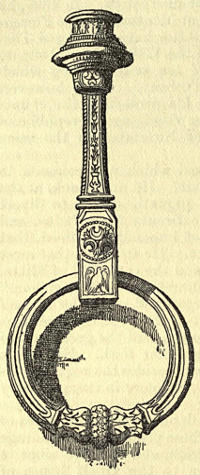
Torch Holder, Palazzo Strozzi, Florence
As the heir to the duchy had barely attained the age of fourteen, his father entrusted the government to his widow Caterina, to Francesco da Gonzaga, and to the principal commanders of his forces. But as these soldiers of fortune were interested only in their own advancement, the utmost confusion prevailed in Milan, and the duchess and her son were compelled to seek security in the citadel. The long-forgotten names of Guelf and Ghibelline again resounded through Lombardy; and in a short space of time the duchy was stripped of all its dependent cities. Some, indeed, maintained a nominal submission; but the rulers were too intent on their own interest to be relied on; and the pontifical army had little difficulty in procuring the restitution of Bologna and Perugia to the pope. Siena revolted from the ducal vicar; Cremona gave herself to Ugolino Cavalcabò; Parma and Reggio were seized by the condottiere Ottobuono de’ Terzi; Brescia, by another adventurer, Pandolfo Malatesta. Vercelli, Novara, and other towns in Piedmont fell into the hands of the marquises of Montferrat and Saluzzo. Verona, after an obstinate resistance, surrendered to Francesco da Carrara; and Vicenza escaped his power by being ceded, together with Feltre and Belluno, to the Venetians. Besides these heavy losses, domestic strife aggravated the misfortunes of Milan; and a fierce quarrel between the duchess and her son was terminated by her imprisonment and death. In the meantime the flame spread to Pavia, and the young count Filippo was consigned to a dungeon. The dominion of the bastard Gabriello over Pisa and Sarzana was of brief duration; and he was compelled to sell the former city to the Florentines, to the great indignation of her citizens.
[1412-1432 A.D.]
Amidst these disasters, the young duke, now fast attaining his majority, evinced a fierceness and brutality of disposition which detached from him the last remnant of his adherents. Amongst his favourite diversions was the pastime of beholding his well-trained bloodhounds lacerate the limbs of those subjects who incurred his displeasure; and his repeated barbarities grew past endurance. At length a conspiracy was set on foot for his destruction; and during mass in the church of St. Gothard he was despatched by two blows. After his murder a struggle prevailed between his brother Filippo Maria and Astorre, the natural son of Barnabò Visconti, whose intrepidity caused him to be styled “the soldier without fear.” His efforts, however, to supplant the legitimate heir were unavailing; whilst defending the citadel of Monza his leg was shattered by a stone; and his death, which immediately ensued, left Filippo Maria in undisputed possession of the poor remains of his father’s once extensive dukedom (1412).
Filippo Maria Visconti
It was the good fortune of the new duke to retain amongst his commanders Francesco Bussone, surnamed Carmagnola; and by the skill and prowess of this renowned general many of the lost territories of Milan were rapidly recaptured. Bergamo, Piacenza, Como, and Lodi were again annexed to the duchy; Cremona, Parma, Brescia, Crema, and Asti once more submitted; and Genoa yielded to the arms of Carmagnola. These signal services were rewarded by the duke with wealth and honours; who united the meritorious warrior to one of his natural daughters, and even adopted him as his successor in the dukedom, by the name of Francesco Visconti.
His well-earned trophies, however, were not long to be worn by the gallant Carmagnola. Every day proved to him that, having reached the highest point in his sovereign’s favour, the fickleness or jealousy of the duke forbade him to look for a continuance of his regard. Without being able to ascertain the cause of his disgrace, he found himself deprived of his command, and even excluded from the ducal presence; and he indignantly quitted the court of Milan, denouncing vengeance on the ungrateful Filippo. As Venice was now in league with Florence and some less considerable states, in order to check the increasing power of the duke, Carmagnola offered his services to the Venetian government, and was entrusted with the command of the allied army. The capture of Brescia and other considerable cities soon reduced the duke to alarming extremities, and he was happy to purchase a respite from this ruinous warfare by ceding Bergamo and great part of the Cremonese to Venice. But the good fortune of Carmagnola forsook him in a new campaign against his former master; he received a complete overthrow by the Milanese troops under Niccolo Piccinino, a defeat which was rendered doubly disastrous by its mainly contributing to the discomfiture of the Venetian fleet two days afterwards. Whilst the Venetian galleys were attacked in the Po by those of Milan, the defeated general, encamped on the neighbouring shore, was repeatedly summoned to the assistance of his naval colleague. But though Carmagnola was still at the head of a considerable armament he made no effort to accede to the call; and under the eyes of the troops of Venice their fleet was entirely destroyed, with the loss of eight thousand prisoners (1431).