Chapter V · THE FREE CITIES AND THE EMPIRE (continued 2)
Reading edition
“This Castruccio,” says Villani,d “was in person tall, dexterous, and handsome; finely made, not bulky, and of a fair complexion rather inclining to paleness; his hair was light and straight and he bore a very gracious aspect. He was a valorous and magnanimous tyrant, wise and sagacious, of an anxious and laborious mind and possessing great military talents; was extremely prudent in war and successful in his undertakings. He was much feared and reverenced and in his time performed many great and remarkable actions. He was a scourge to his fellow-citizens, to the Pisans, the Pistoians, the Florentines, and all Tuscany, during the fifteen (twelve?) years in which he held the sovereignty of Lucca. He was very cruel in executing and torturing men, ungrateful for good offices rendered to him in his necessities, partial to new people and vain of the high station to which he had mounted, so that he believed himself lord of Florence and king of Tuscany.”
Although the first warrior of his age, says Pignotti, it is doubted whether he was greater in arms than in council; although he was born and had lived in the midst of revolutions, he never shed blood unless when necessity demanded it. He was one of those great men who, although ignorant of letters himself, knew their value, and esteemed the learned. An encourager of useful arts and manufactures, he generously rewarded whoever introduced new ones. The monuments of the numerous works of public utility which he undertook are still remaining, such as bridges, roads, and fortresses.
He was certainly an extraordinary man, and had the theatre of his actions been more extensive, and his means greater, he would have distinguished himself equally with any of the celebrated men of antiquity. In the small sphere, however, in which he was obliged to act, as a private individual, he became one of the most powerful princes of Italy; since, at his death, he possessed Lucca, Pisa, Pistoia, the Lunigiana, a great part of the coast to the east of Genoa, and innumerable castles; and if he had lived longer, in those times of revolution and the division of Italy into so many small sovereignties, it may be conjectured that his greatness would not have stopped here. Henry, his eldest son, was heir to his father’s estates, but not to his father’s talents. The power of Lucca terminated with Castruccio, since shortly afterwards we see this city offered for sale, bought by a private citizen, and the cities and castles which were once occupied by Castruccio retaken by the Florentines. Upon the arrival of the emperor, the sovereignty of Pisa, and afterwards that of Lucca, were taken away from his sons.e
DUKE OF CALABRIA DIES: LUDWIG RETIRES
[1328-1329 A.D.]
The death of the formidable and ambitious Castruccio saved Florence from the greatest danger which she had yet incurred; and, to complete her good fortune, the sovereign she had chosen to oppose Castruccio, the duke of Calabria, died also about the same time. He had distinguished himself only by his vices, his want of foresight, and his depredations. Ludwig of Bavaria, too, ceased to be formidable; he completed his discredit by his perfidy towards those who had been the most devoted to him. Salvestro de’ Gatti, lord of Viterbo, had been the first Ghibelline chief to open a fortress to him in the states of the church; Ludwig arrested him and put him to the torture to force him to reveal the place where he had concealed his treasure. The emperor had rendered himself odious and ridiculous at Rome by the puerility of his proceedings against John XXII, and his vain efforts to create a schism in the church. Having returned to Tuscany, he deprived the children of Castruccio of the sovereignty of Lucca, on the 16th of March, 1329, and sold it to one of their relatives who, a month afterwards, was driven out by a troop of German mercenaries which had abandoned the emperor to make war on their own account, that is to say, to live by plunder. Ludwig passed the summer of 1329 in Lombardy. Towards the end of the autumn he returned to Germany, carrying with him the contempt and detestation of the Italians. He had betrayed all who had trusted in him; and completely disorganised the Ghibelline party which had relied on his support.
CAN’ GRANDE DELLA SCALA
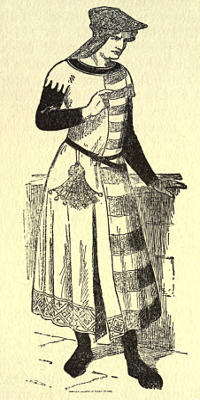
A Florentine Nobleman of the Fourteenth Century
[1314-1329 A.D.]
That party had just lost another of their most distinguished chiefs, Can’ Grande della Scala. He was the grandson of the first Mastino, whom the republic of Verona had chosen for master after the death of Ezzelino, in 1260. Can’ Grande reigned in that city from 1312 to 1329, with a splendour which no other prince in Italy equalled. Brave and fortunate in war, and wise in council, he gained a reputation for generosity, and even probity, to which few captains could pretend. Among the Lombard princes, he was the first protector of literature and the arts. The best poets, painters, and sculptors of Italy, Dante, to whom he offered an asylum, as well as Uguccione dà Faggiuola, and many other exiles illustrious in war or politics were assembled at his court. He aspired to subdue the Veronese and Trevisan marches, or what has since been called the Terra Firma of Venice. He took possession of Vicenza, and afterwards maintained a long war against the republic of Padua, the most powerful in the district, and that which had shown the most attachment to the Guelf party and to liberty. But Padua gave way to all the excesses of democracy; the people evinced such jealousy of all distinction, such inconstancy in their choice, such presumption, that the imprudence of the chiefs as well as of the mob drew down the greatest disasters on the republic. The Paduans, repeatedly defeated by Can’ Grande della Scala from 1314 to 1318, sought protection by vesting the power in a single person; and fixed for that purpose on the noble house of Carrara, which had long given leaders to the Guelf party.
The power vested in a single person soon extinguished all the courage and virtue that remained; and on the 10th of September, 1328, Padua submitted to Can’ Grande della Scala. The year following he attacked and took Treviso, which surrendered on the 6th of July, 1329. He possessed himself of Feltre and Cividale soon after. The whole province seemed subjugated to his power; but the conqueror also was subdued. Attacked in his camp with a mortal disease, he gave orders on entering Treviso that his couch should be carried into the great church, in which, four days afterwards, on the 22nd of July, 1329, he expired. He was not more than forty-one years of age; Castruccio was forty-seven at his death. Galeazzo Visconti died at about the same age, less than a year before.
JOHN OF BOHEMIA COMES TO ITALY
[1329-1335 A.D.]
The Ghibelline party, which had produced such great captains, thus saw them all disappear at once in the middle of their careers. Passerino de’ Bonacossi, tyrant of Mantua, who belonged to the same party, had been assassinated on the 14th of August, 1328, by the Gonzagas, who thus avenged an affront offered to the wife of one of them. They took possession of the sovereignty of Mantua, and kept it in their family till the eighteenth century. Of all the princes who had well received Ludwig of Bavaria in Italy, the marquis d’Este was the only one who preserved his power. He was lord of Ferrara; and even this prince, though a Guelf by birth, was forced by the intrigues of the pope’s legate to join the Ghibellines.
The Ghibelline party, which had been rendered so formidable by the ability of its captains, was now completely disorganised. The Lombards placed no confidence in those who remained, they had forgotten liberty and dared no longer aspire to it; but they longed for a prince capable of defending them, and who, by his moderation and good faith, could give them hopes of peace. They saw none such in Italy; Germany unexpectedly offered one. John, king of Bohemia, the son of Henry VII, arrived at Trent towards the end of the year 1330. The memory of his father was rendered dearer to the Italians by the comparison of his conduct with that of his successor; and John was calculated to heighten this predilection. He could not submit to the barbarism of Bohemia, and inhabited, in preference, the county of Luxemburg, or Paris; and having acquired a spirit of heroism, by his constant reading or listening to the French romances of chivalry, he aspired to the glory of being a complete knight. All that could at first sight seduce the people was united in him—beauty, valour, dexterity in all corporeal exercises, eloquence, an engaging manner. His conduct in France and Germany, where he had been by turns warrior and pacificator, was noble. He never sought anything for himself; he seemed to be actuated only by the love of the general good or glory.
The Italians, justly disgusted with their own princes, eagerly offered to throw themselves into his arms; the city of Brescia sent deputies to Trent, to offer John the sovereignty of their republic. He arrived there, to take possession of it, on the 31st of December, 1330. Almost immediately after, Bergamo, Cremona, Pavia, Vercelli, and Novara followed the example of Brescia. Azzo Visconti himself, son of Galeazzo, who, in 1328, had repurchased Milan from Ludwig of Bavaria, could not withstand the enthusiasm of his subjects; he nominally ceded the government to John, taking henceforth the title of his vicar only. Parma, Modena, Reggio, and lastly Lucca also soon gave themselves to John of Bohemia. John, in all these cities, recalled indiscriminately the Guelf and Ghibelline exiles, restored peace, and made them at last taste the first-fruits of good government.
The Florentines did not find sufficient strength in the Guelf party to oppose the menacing greatness of the king of Bohemia. Robert of Naples was become old; he wanted energy, and his soldiers courage. The republic of Bologna, formerly so rich and powerful, had lost its vigour under the government of the legate, Bertrand de Poiet; those of Perugia and Siena had within themselves few resources, and those few their jealousy of Florence prevented their liberally employing. There remained no free cities in Lombardy; and all those in the states of the church, which during the preceding century had shown so much spirit, had fallen under the yoke of some petty tyrant, who immediately declared for the Ghibelline party. The Florentines felt the necessity of silencing their hereditary enmities and their ancient repugnances, and of making an alliance with the Lombard Ghibellines against John of Bohemia, with the condition that in dividing his spoils they should all agree to prevent the aggrandisement of any single power, and preserve between themselves an exact equilibrium, in order that Italy after their conquests should incur no danger of being subjugated by one of them. The treaty of alliance against the king of Bohemia, and the partition of the states which he had just acquired in Italy, was signed in the month of September, 1332. Cremona was to be given to Visconti; Parma to Mastino della Scala, the nephew and successor of Can’ Grande; Reggio to Gonzaga; Modena to the marquis d’Este; and Lucca to the Florentines.
John did not oppose to this league the resistance that was expected from his courage and talents. Of an inconstant character, becoming weary of everything, always pursuing something new, thinking only of shining in courts and tournaments, he soon regarded all these little Italian principalities, of which he had already lost some, as too citizen-like and unlordly: he sold every town which had given itself to him, to whatever noble desired to rule over it; and he departed for Paris on the 15th of October, 1333, leaving Italy in still greater confusion than before. The Lombard Ghibellines, confederates of the Florentines, succeeded, before the end of the summer of 1335, in taking possession of the cities abandoned by the king of Bohemia. Lucca, which alone fell to the share of Florence, was defended by a band of German soldiers, who made it the centre of their depredations, and barbarously tyrannised over the Lucchese. Mastino della Scala offered to treat for the Florentines with the captains who then commanded at Lucca, and he succeeded in obtaining the surrender of the town to him, on the 20th of December, 1335. As soon as he became master of it he began to flatter himself that it would afford him the means of subjugating the rest of Tuscany; and, instead of delivering it as he had engaged to the Florentines, he sought to renew against them a Ghibelline league jointly with the Pisans and all the independent nobles of the Apennines.
LUCCA A BONE OF CONTENTION
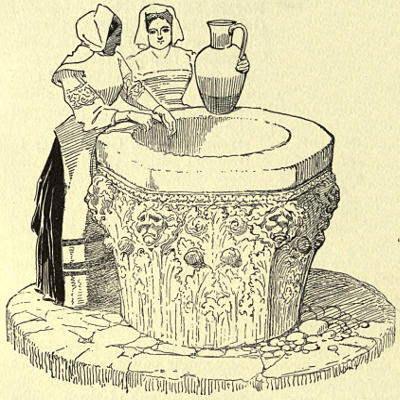
A Florentine Well Head, Fourteenth Century
[1334-1342 A.D.]
The Florentines, forced to defend themselves against their ally, who after they had contributed to his elevation betrayed them, sought the alliance of the Venetians, who also had reason to complain of Mastino. A treaty was signed between the two republics on the 21st of June, 1336. The war, to which Florence liberally contributed in money, was made only in Lombardy and was successful. Padua was taken from Mastino on the 3rd of August, 1337, and, as that town showed no ardent desire of liberty, it was given in sovereignty to the Guelf house of Carrara. The Venetians took possession of Treviso, Castelfranco, and Ceneda. It was the first acquisition they had made beyond the Lagune, their first establishment on terra firma, which henceforward was to mingle their interests with those of the rest of Italy. But their ambition at this moment extended no further. Satisfied themselves, and sacrificing their allies, they made peace with Mastino della Scala on the 18th of December, 1338, without stipulating that the city of Lucca, the object of the war, should be given up to the Florentines, for which these had contracted a debt of 450,000 florins. The Florentines, successively betrayed by all their allies, saw the danger of their position augment daily; the Guelfs lost, one after the other, every supporter of their party; the vigour of the king of Naples, now seventy-five years of age, was gone. The pope, John XXII, had died at Avignon, on the 4th of December, 1334; and his successor, Benedict XII, like him a Frenchman, neither understood nor took any part in the affairs of Italy. A few months previous, on the 17th of March, 1334, the cardinal Bertrand de Poiet had been driven by the people from Bologna; and this ambitious legate, no longer supported by the pope his father, had disappeared from the political scene.
But the Bolognese did not long preserve the liberty which they had recovered. One of their citizens, named Taddeo de Pepoli, the richest man in all Italy, had seduced the German guard which they held in pay, and by its aid took possession of the sovereignty of Bologna on the 28th of August, 1337. He then made alliance with the Ghibellines. The number of the free cities on the aid, or at least the sympathy, of which Florence could reckon continually diminished. The Genoese, from the commencement of the century, had consumed their strength in internal wars between the great Guelf and Ghibelline families; as long as they were free, however, the Florentines, without any treaty of alliance, regarded them as friendly; but the long-protracted civil wars had disgusted the people with the government; they rose on the 23rd of September, 1339, and overthrew it, replacing the signoria by a single chief, Boccanera, on whom they conferred the title of doge. It might have been feared that they had only given themselves a tyrant; but the first doge of Genoa was a friend to liberty; and the Genoese people, having imitated Venice in giving themselves a first officer in the state with that title, were not long before they carried the imitation further, by seeking to combine liberty with power vested in a single person. In the meanwhile Mastino della Scala suffered a Parmesan noble to take from him the city of Parma. As from that time he had no further communication with Lucca, he offered to sell it to the Florentines. The bargain was concluded in the month of August, 1341; but it appeared to the Pisans the signal of their own servitude, for it cut off all communication between them and the Ghibellines of Lombardy. They immediately advanced their militia into the Lucchese states, to prevent the Florentines from taking possession of the town; vanquished them in a great battle, on the 2nd of October, 1341, under the walls of Lucca; and, on the 6th of July following, took possession of that city for themselves.c
A republic like the Florentine, whose strength depends upon commerce, should take no part in wars which do not affect her. The conquests she can make are always more expensive than the revenues she can derive from them are important, and awaken the jealousy of the neighbouring states, engaging her in fresh broils with them. At the end of a war which had been carried on for the acquisition of Lucca, the republic found herself greatly in debt, without having been able to obtain the city; and the chief source of her riches, commerce, received a terrible shock in the failure of the trading firms of Peruzzi and Bardi. These commercial houses had lent to Edward III, king of England, an immense sum of money. The king was involved in a war with France; but, although he was for the most part conqueror, and had frequently invaded the French provinces, nevertheless the luxury and the magnificence of his court, the incalculable expenses of war, which are burdensome even to conquerors, rendered him unable to satisfy his creditors; and he was obliged to fail in his contracts with these merchants for 1,365,000 florins in gold. Giving money its value in those times we shall find it equivalent to about 7,000,000 sequins [about £3,052,000 or $15,260,000]; and such a sum being lost by the city of Florence, we may easily conceive what injury was done to her commerce. She might, indeed, have been given up for ruined; these temporary mischiefs, however, are easily repaired, when the primary fountains of riches are not exhausted or diverted into another channel, and as these remained untouched in Florence they very soon filled up the momentary deficiency. But this could not have happened at a more unlucky moment than when the public, which draws its revenues from private individuals, was so much in debt. To this evil was added the dearth of provisions; and, what very frequently accompanies it, a pestilential fever whereby, if the old writers have not exaggerated, no less than fifteen thousand persons died that year within the walls of Florence.
[1341-1342 A.D.]
In order somewhat to console the Florentines for these calamities, a very respectable embassy arrived from Rome. This city, in the absence of the pontiff, had been agitated by political convulsions, originating in the discord of the nobility, it having been reported that the Florentines had, in a great measure, suppressed their own discords by depriving the nobility of every share in the government. Roman ambassadors came to make themselves acquainted with the Florentine constitution, and with the means to prevent the great from disturbing the public tranquillity. But while the Romans were coming to learn the manner of living peaceably from the Florentines, domestic broils were upon the eve of recommencing in Florence. Andrea Bardi and Bardo Frescobaldi had been very much aggrieved by Jacopo Gabrielli, of Gubbio, lately created captain of the guard, and the executor of the despotic orders of those few who wished for the exclusive government in their own hands, from which both the nobility and the common people were entirely removed, as well as many of their own order. To these two, smarting under the pains of recent injuries, were united many others from the great who were deprived by law of any share in the government; together with others from the people, who, by an overbearing preponderance, were kept at a distance from it; and a conspiracy was planned to change the government. Their foreign friends, the Pazzi, Tarlati, Guidi, and Ubertini, etc., were to come to Florence, and on the 2nd of November the whole city was to rise and overturn the constitution. The conspiracy was discovered the day before its execution, by Andrea Bardi, who, either through fear or remorse, revealed the correspondence to Jacopo Alberti, one of the heads of the government. The latter, assembling, and there being no time to lose, ordered the public alarm-bell to be rung; and the people throughout the city took up arms against the traitors, whose succours had not yet arrived; hence those who were on the right bank of the Arno did not move; on the other side, too, arms were immediately taken up, and they endeavoured to defend themselves in the street called Bardi. Surrounded on every side by the armed people, they were about coming to blows, when the mayor Matteo of Ponte, a native of Brescia, a venerable man, interposed; and setting before the Bardi and Frescobaldi the imminent danger of being slaughtered with their families, he persuaded them to lay down their arms, promising them that the conspirators should leave Florence, out of which city he himself accompanied them in the night.
Fortune appeared to be playing with the Florentines, by offering and taking away from them, at the same time, the city of Lucca, always annoying them, whether they aimed at obtaining it by arms or by money. Mastino Scala, after the loss of Parma, which had been taken away from him by Azzo Correggio, seeing himself unable any longer to maintain Lucca, offered it to the Florentines for the sum of 250,000 florins in gold; the latter consented; but before it came to their hands, they were obliged to contend with the Pisans, who thought they would no longer be enabled to maintain their liberty if Lucca belonged to the Florentines. They would have been better pleased, as they were not able to conquer the Florentines by money, had Lucca remained free; various councils were held in which it was finally determined they should take up arms and contend for the possession of Lucca with the Florentines, and after some fruitless treaty with Mastino they laid siege to it. They had collected many troops both from the Tuscan Ghibellines and the lords of Lombardy, particularly from Lucchino Visconti, whose friendship they had purchased with treachery.
One of the first Milanese citizens, Francis of Postierla, had married a near relative of Lucchino, the beautiful and virtuous Margaret Visconti who had rejected Lucchino when he fell in love with her. His ill will being made known to the husband, induced him to frame a conspiracy; upon the discovery of which Francis fled to Avignon, whence he was attracted by Lucchino to Pisa by the most insidious artifices. In spite of a safe passage, of which the rulers of Pisa had assured him, he was taken and consigned to Lucchino; who, in order to crown his barbarous brutality, ordered him to be beheaded, together with his beloved and unfortunate consort. For this act of perfidy the Pisans received powerful assistance from Lucchino, and were enabled to maintain their position in front of the Florentines.
The viceroy of Mastino was treating at the same time with the Pisans and putting up Lucca at auction. After various altercations about the payment of the money, the people of the Florentines were finally introduced into Lucca; but two strong places belonging to the Lucchese, the Cerruglio and Montechiaro, still remained in the hands of the Pisans, for which 70,000 florins in gold were deducted. The Pisans, however, would not depart; and remaining immovable in the plain of Lucca, the Florentines would have shown their sense by standing upon the defensive, and either by occupying important posts prevented the transport of provisions to the Pisan army, or harassed their country with inroads; but they were ashamed of leaving them quiet; and approaching the enemy, they offered them battle near the Ghiaia, which the Pisans did not refuse; and they fought with varying fortune. The victory inclined in the beginning in favour of the Florentines, and Giovanni Visconti son of Lucchino was made prisoner; but falling into disorder, in following up the enemy, they were routed and put to flight by a band which remained in guard of the camp. The archers took a great part in this victory, amongst whom were many Genoese, greatly renowned in this manner of warfare. The cavalry of the Florentines, so much more numerous than that of the Pisans, was in a great measure disabled for action by the arrows. The loss of the Florentines, in killed and prisoners, was not less than two thousand men. The Pisans, taking courage at this advantage, again surrounded Lucca. It was singular enough to behold the ambassadors of King Robert, appearing at this moment, demanding the possession of Lucca from the Florentines, as his own property, telling them Lucca had been given over to his hands since the year 1313, when it was taken from them by Uguccione dà Faggiuola. The prompt consent of the Florentines, however, did not occasion less astonishment, who thus lost a city they had so much desired and had purchased with so much treasure and blood.
The same ambassadors, having taken possession, went to Pisa, and intimated to that republic to raise the siege of a city which belonged to the king of Naples; but the Pisans, not yielding so easily, proposed rather to send ambassadors to the king. It may be conjectured that the king, as an ancient friend of the Florentines, acted in concert with them to make the Pisans retreat as the latter really suspected. Malatesta had been made general of the Florentines, and marched in order to raise the siege of Lucca; he was however artfully held at bay by the captain of the Pisans who, not having sufficient people to cope with the Florentines, and knowing how greatly Lucca was deficient in provisions, chose to fight by temporising. The duke of Athens arrived at the Florentine army with one hundred French horse; and other reinforcements coming up, various operations took place upon the Serchio, where the Pisans, although inferior in number, made a brave defence; Malatesta, superior in force, could never dislodge them or force them to battle; and, after many attempts to relieve Lucca, he was obliged to retreat. The Lucchese, thus abandoned, were forced to come to terms with the Pisans, which were very moderate; since (having given time for the Florentines who were in it to retire) they were content to keep a garrison for fifteen years in the castle of Lucca, called Dell’Agosta in Ponte Tetto, and in the tower of Montuolo—which was to be paid, however, by the Lucchese; in all other respects they were free. Thus, after the waste of so much treasure and blood, Lucca, which had been so greatly desired, was held for a moment and again lost.
THE DUKE OF ATHENS MADE PROTECTOR OF FLORENCE
These unsuccessful events had, as usual, excited hatred against the rulers of the Florentine Republic. The latter, in order to cover themselves and distract the enemies’ attention and fury elsewhere, elected as governor and protector of the city and its states, Walter, duke of Athens and count of Brienne, of French extraction but brought up in Greece and Apulia. Since he had fulfilled the duties of the duke of Calabria in Florence, this man had acquired great reputation for wisdom and justice; and after the expiration of the period of Malatesta’s government was elected general and protector, with the most extensive power of administering justice within and without Florence. The duke was a man of vast ambition, and possessed sufficient talent to profit by the circumstances in which the city was placed, divided as it was into three orders of persons, the nobility, the rich middle class, and the common people. The government was entirely in the hands of the second; the other two orders, therefore, were necessarily discontented; and adding their old wrongs to the misfortunes which had happened to the republic from the improvident administration of those who governed, their complaints became more frequent and daring; but those most irritated, and probably with the most reason, were the nobility. The people, not content with having deprived them of every share in the government, would not even administer justice to them; they caused the laws to be put in force against them in the severest manner, which laws were silent for the most part in favour of the class that governed; and thus, even in the latter order, persons were not wanting to whom the government became odious, since the most important offices were concentrated in the hands of a few.
All these discontented persons united themselves with the duke, urgently beseeching him to make himself absolute master of the city, and promised to support him; thus preferring the slavery of their native country to a free but aristocratic government, in which they had no share. The duke both supported and fomented this good disposition towards him; and by some acts of vigour, which bore the colour of the most scrupulous justice, he drew upon himself the applauses of the discontented, and struck terror into the people, having brought to justice and made some of those persons feel the rigour of the laws, who, from being in the number who divided the principal offices amongst themselves, went unpunished and were consequently odious to the rest. Giovanni de’ Medici, among the most powerful, had been captain of Lucca. When arrested, he confessed under torture that he had permitted Tarlati to escape from the camp (although fame reported he was guilty only of bad custody), and his head was taken off. William Altoviti, accused of barter, met with the same fate. Rosso Ricci and Naldo Rucellai were also arrested; the former had appropriated to himself the pay of the soldiers; the latter had received money from the Pisans in order to second their interests. The duke did not choose to punish them with death, fearful that too much blood might disgust the people; they were therefore first sentenced to the payment of a sum of money, Ricci to perpetual imprisonment, and Rucellai was banished to the confines of Perugia. These chastisements in four of the principal families, which had been accustomed to go unpunished, and were odious to the people and the nobility, drew down great applause upon the duke, who, considering his design already mature for making himself absolute master, and conscious he possessed the power, chose nevertheless to ask the government from the gonfalonier and the priors, who denied it him with modest but firm remonstrances.
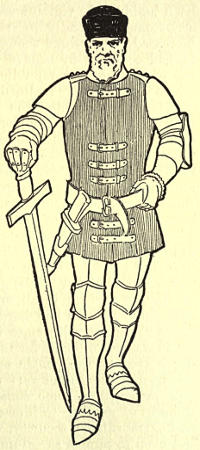
Italian Soldier of the Fourteenth Century
But the magistracy, knowing the great favour he enjoyed from the public, in order not to excite a dangerous tumult, as the people were to assemble the morning following, agreed upon giving him the government for a year, under those limitations with which King Robert and the duke of Calabria had formerly enjoyed it. The evening before, the magistracy went with other respectable citizens to the duke, who, in order to gain greater respect for piety and moderation, inhabited the convent of Santa Croce, and after many discussions they feigned to agree to it. The conditions were signed by notaries on both sides, and approved by the oath of the duke, who came to the palace of the priors on the morning of the 8th of September, accompanied by the greater part of the nobility, by an innumerable concourse of armed people, and by his own troops. The gonfalonier made known the deliberations which had been held in the evening; and when it was heard that the seigniory of Florence was given to the duke for a year, many voices from the lower order of the people cried out, “For life!” (a vita). The doors of the palace being opened, he was conducted into it by the nobility, and installed absolute master, sending away the priors and the gonfalonier, who, preserving the name only, were removed elsewhere in order to represent a scenic farce. Fireworks were set off for joy. The arms of the duke were seen hung up at every corner; at the ringing of all the bells his banners were hoisted upon the tower; and the bishop Acciajuoli pronounced a homily, wherein he loudly extolled the praises due to the supposed virtues of the duke. All the cities of the republic too surrendered to him; he became, therefore, master of Florence, not with the limited authority by which the royal family of Naples had more than once held it, but with the absolute power, partly conceded to him and partly usurped. Right of life and death over persons, distribution of employments, imposition of taxes or imposts—all were at his will; so much can a momentary delusion effect, when produced by the fury of parties!
GROWING UNPOPULARITY OF THE DUKE OF ATHENS
[1342-1343 A.D.]
Those who were to gain most by the change were the great, so-called, who, being hitherto excluded from the employments and obliged to obey a government of merchants, had now every reason to hope that the duke, to whom their rank brought them nearer than the others, would grant them his favour together with no small share in the government. One of the first acts of the duke was to make peace, and afterwards an alliance with the Pisans, thinking it necessary to confirm the dominion; which very much displeased the Florentines. It is easier to acquire states than to maintain them. The favoured by the change can be few, and these produce endless discontents among those who either expected or thought the same reward due to them. The mind too, which in the execution of the enterprise, has been assiduously vigilant and active, when once it has obtained its end, is accustomed generally to relax, at a time when its vigilance ought to be increased. The duke thought he would be able to preserve by force what he had acquired by benevolence, and took into pay many foreign troops at the expense of the republic, an insufficient means against a populous city, which may be badly inclined.
He soon neglected the friendship of the great, and began to cultivate that of the common people, extending his favours to the lowest, in order to deserve their powerful support. Principal persons were put to death upon trivial pretences; others were fined heavily in money. To this were added the insolence and dissoluteness of the duke and his dependants towards the most honest women; amongst whom they endeavoured to introduce the libertine customs and manners of the French and Neapolitan courts, and substitute them in place of the modest and decent attributes of the republican Florentines. Not only common dissoluteness degraded his courtiers, but even vices which nature abhors. The seed of discontent was sown in all orders of people—in the nobility, besides the motives we have adduced, for not being admitted to the government, as they had expected; in the people for having lost it; in all orders on account of the increased impositions, so that three months had hardly elapsed before the government of the duke became detested with more vehemence than it had been before desired.
It was not difficult for the duke to perceive the change, and the increasing hatred of the people against him; but his manner of acting in these circumstances was not very judicious. It was natural to imagine that, in a new principality, some conspiracy might be planned against him; but he thought of gaining to himself the public affection by an air of confidence and extraordinary security, which he carried so far as not only to despise, but even to punish as calumniators whoever ventured to give him salutary advice. Matthew of Morozzo, for having warned him that the family of the Medici were conspiring to kill him, was, by an act of cruelty at once useless and imprudent, flayed and hanged; this terrible example, however, did not deter others, so great is the hope and courage of informers. Lambert Abatti followed Matthew in giving information and receiving punishment; for having disclosed to the duke that some noble Florentines were conspiring for his death, and that they held a council with John Riccio, a captain of Mastino, he received the reward due to the trade of an informer. This cruel severity, without gaining him the good disposition of the Florentines, was adapted only to invite the discontented to conspire against him more openly. The duke, however, with an unexampled frivolity, appears to have cared more for words than actions; since, upon its being reported to him that Bettone of Cino, who had been already promoted by him, spoke ill of his government, he caused his tongue to be plucked out, to be stuck upon a lance, and the unfortunate Bettone to be dragged close to it upon a car through the city. He banished him afterwards to Romagna, where he died from the consequences of the wound.
Words cannot express how much, in an eloquent city, eager to examine and judge of public affairs, such a punishment at once disheartened and embittered the citizens against him, who thus saw even the liberty of speech denied them. All orders of the state were roused against the duke; three conspiracies were formed against him at the same time, and not one had any knowledge of the other. The bishop of Florence (himself Acciajuoli) was the head of the first; he had loaded the duke with excessive praises at his first installation, and was now ashamed of it. As the three conspiracies did not communicate with each other, the projects to get rid of the duke were various, none of which could be carried into execution; because, as suspicions increased, he had vigilantly put himself upon guard, although the conspirators for a considerable time remained concealed. Francis Brunelleschi, one of the adherents of the duke, received a hint of the conspiracy of the Medici from a Sienese, who came there, but who could only name Paul Marzecca, a Florentine citizen, and Simone of Monterappoli. These were arrested, and, being tormented, revealed the names of the conspirators, of whom Antonio Adimari was the ringleader, a man of great reputation, both for the qualities with which he was endowed and the greatness of his family. When summoned he appeared, and was detained; but the duke dared not put him to death.
THE DUKE DRIVEN FROM THE CITY
Frightened at the great number and the respectability of the conspirators, and not thinking he possessed a force sufficient to act against them, he sent for aid from various parts of Tuscany and to the lord of Bologna; a part of which arriving, he caused three hundred of the principal citizens to be summoned, many of whom were of the conspirators, under the pretext of wishing to consult with them, as he was sometimes wont to do. It was his intention to arrest them, put part of them to death, and keep the remainder in prison, and by this execution to terrify the rest of the city, scour it with armed men, and establish more firmly his dominion. The summons being made known, and so many being found in the list that it appeared clearly a list of proscribed, the number gave courage to each; in a short time the three conspiracies were united into one, and they determined, instead of offering their heads to the tyrant, to attack him courageously. The morning of St. Anne being arrived, which was destined for the enterprise, contentions between the people were purposely kindled, who coming to blows, all of a sudden the people appeared in arms; the streets were barricaded; the nobility and the people, forgetting their ancient contentions, embraced each other, and united in sustaining the common cause. The foreign soldiers of the duke, at the news of the rebellion, marched to his assistance; many could not gain the palace, and were either killed or made prisoners. Some, however, came up and joined the guard, which was accustomed to remain there. A few of the nobles, who had remained faithful to him, and a part of the lowest order of people whom he had endeavoured to gain over, came to him; but these, seeing that the greater part of the city was in open rebellion against him, abandoned him. The priors, who had incautiously retired to the palace for safety at the beginning of the tumult, were retained as hostages by the duke. The soldiers, part foot and part horse, who were in the square in his defence, were very soon beaten by the infuriated mob, and dismounting retired for safety within the palace. All the streets that led to it were blockaded by the people, and no hope of succour nor other defence remained to the duke but the walls. These were very strong, and sufficiently provided with defenders; provisions, however, were wanting. He remained there besieged until the 3rd of August. In the meantime, having assembled the people in Santa Raparata, he gave power to the bishop, united with fourteen citizens, to reform the government. All the agents of the duke who came into the hands of the people were cruelly murdered and torn to pieces. This fate attended a notary of the protector (Simone Norcia), Arrigo Fei, who was discovered in the act of escape, disguised as a friar, with another Neapolitan. The people were not contented with a simple death, but murdered them publicly in the most cruel manner.
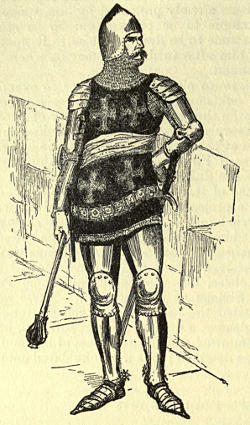
Italian Warrior of the Fourteenth Century
The duke, in the meantime, found himself pinched by hunger in the palace, and seeing himself reduced to a bad condition sought for an accommodation. The Sienese ambassadors had joined the Florentines with opportune aid. These, together with the bishop and with Count Simone, treated with the people, who, however, obstinately refused every accommodation, unless William of Assisi protector, with his son, and Cerettieri Visdomini were first given over to them. The duke refused; but the French soldiers, who were shut up there, protested they would not perish by hunger or by the sword for three persons they would not even have saved, and in the same evening threw the son of the conservatore out at the gate. He was a youth of fine aspect, of eighteen years of age, and was guilty of no other crime but that of being son of an odious man. This was sufficient for the mob to make a sacrifice of him; he was stabbed by a thousand cuts, and even torn to pieces by the teeth of the mob. The same end was made of the father, who had been spectator of the execution of his son. Being demanded by loud shouts, and driven out from the palace, he was cut to pieces, carried in triumph through the city, and his blood and flesh tasted with a savage eagerness. It is strange to see how the people, united, can commit such atrocious actions, which any individual, taken abstractedly, could not be capable of; it would appear that the passions become multiplied in proportion as the number of the mob increases; and that, thinking to do themselves justice, an emulation in cruelty arises, which makes everyone vie with another in excesses of barbarity. This brutal occupation was the cause of the safety of Visdomini, who, being forgotten in that moment, was enabled to escape in the night. After so many cruelties, the people began to attend to treaties of accommodation. The duke gave full power to enter into them by the means of the bishop of Lecce, to fourteen elect, and to the bishop Acciajuoli. By this treaty he solemnly renounced, on the 3rd of August, before the Sienese ambassadors and Count Simone, the government of Florence and the other cities of the republic; and in token of renunciation laid down his mace before witnesses. He departed, on the 6th of August, accompanied by the count, who ordered him on the confines to confirm his abdication. He at first refused; but, upon being threatened with being taken back to Florence, he was induced to ratify it. He left behind him an atrocious and infamous memory; nor is any other praise due to his government than for the care he gave himself to unite the minds of many citizens who were alienated from one another by an inveterate and hereditary hatred.e
ATTEMPTED REFORMS
These events, taking place in the city, induced all the dependencies of the Florentine state to throw off their yoke; so that Arezzo, Castiglione, Pistoia, Volterra, Colle, and San Gemigniano rebelled. Thus Florence found herself deprived of both her tyrant and her dominions at the same moment, and in recovering her liberty taught her subjects how they might become free. The duke being expelled, and the territories lost, the fourteen citizens and the bishop thought it would be better to act kindly towards their subjects in peace, than to make them enemies by war, and to show a desire that their subjects should be free as well as themselves. They therefore sent ambassadors to the people of Arezzo, to renounce all dominion over that city, and to enter into a treaty with them; to the end that, as they could not retain them as subjects, they might make use of them as friends. They also, in the best manner they were able, agreed with the other places that they should retain their freedom, and that, being free, they might mutually assist each other in the preservation of their liberties. This prudent course was attended with a most favourable result; for Arezzo, not many years afterwards, returned to the Florentine rule, and the other places in the course of a few months returned to their former obedience. Thus it frequently occurs that we sooner attain our ends by a seeming indifference to them, than by more obstinate pursuit.
Having settled external affairs, they now turned to the consideration of those within the city; and after some altercation between the nobility and the people, it was arranged that the nobility should form one-third of the seigniory and fill one-half of the other offices. The city was hitherto divided into sixths; and hence there would be six seigniors, one for each sixth, except when, from some more than ordinary cause, there had been twelve or thirteen created; but when this had occurred they were again soon reduced to six. It now seemed desirable to make an alteration in this respect, as well because the sixths were not properly divided as that, wishing to give their proportion to the great, it became desirable to increase the number. They therefore divided the city into quarters, and for each created three seigniors. They abolished the office of gonfalonier of justice, and also the gonfaloniers of the companies of the people; and instead of the twelve buonuomini, or good men, created eight counsellors, four from each party. The government having been established in this matter, the city might have been in repose if the great had been content to live in that moderation which civil society requires. But they produced a contrary result, for those out of office would not conduct themselves as citizens, and those who were in the government wished to be lords, so that every day furnished some new instance of their insolence and pride. These things were very grievous to the people, and they began to regret that for one tyrant put down there had sprung up a thousand. The arrogance of one party and the anger of the other, rose to such a degree that the heads of the people complained to the bishop of the improper conduct of the nobility, and what unfit associates they had become for the people; and begged he would endeavour to induce them to be content with their share of administration in the other offices, and leave the magistracy of the seigniory wholly to themselves.
The bishop was naturally a well-meaning man, but his want of firmness rendered him easily influenced. Hence, at the instance of his associates, he at first favoured the duke of Athens, and afterwards, by the advice of other citizens, conspired against him. At the reformation of the government he had favoured the nobility, and now he appeared to incline towards the people, moved by the reasons which they had advanced. Thinking to find in others the same instability of purpose, he endeavoured to effect an amicable arrangement. With this design he called together the fourteen who were yet in office, and in the best terms he could imagine advised them to give up the seigniory to the people, in order to secure the peace of the city; and assured them that if they refused, ruin would most probably be the result.
This discourse excited the anger of the nobility to the highest pitch, and Ridolfo de’ Bardi reproved him in unmeasured terms as a man of little faith, reminding him of his friendship for the duke, to prove the duplicity of his present conduct, and saying that in driving him away he had acted the part of a traitor. He concluded by telling him that the honours they had acquired at their own peril, they would at their own peril defend. Then they left the bishop, and in great wrath informed their associates in the government, and all the families of the nobility, of what had been done. The people also expressed their thoughts to each other, and as the nobility made preparations for the defence of their seigniors, they determined not to wait till they had perfected their arrangements; and therefore, being armed, hastened to the palace, shouting, as they went along, that the nobility must give up their share in the government. The uproar and excitement were astonishing. The seigniors of the nobility found themselves abandoned; for their friends, seeing all the people in arms, did not dare to rise in their defence, but each kept within his own house. The seigniors of the people endeavoured to abate the excitement of the multitude, by affirming their associates to be good and moderate men; but, not succeeding in their attempt, to avoid a greater evil, sent them home to their houses, whither they were with difficulty conducted. The nobility having left the palace, the office of the four councillors was taken from their party, and conferred upon twelve of the people. To the eight seigniors who remained, a gonfalonier of justice was added, and sixteen gonfaloniers of the companies of the people; and the council was so reformed, that the government remained wholly in the hands of the popular party.
WAR OF THE FACTIONS IN FLORENCE
At the time these events took place there was a great scarcity in this city, and discontent prevailed both among the highest and lowest classes; in the latter for want of food, and in the former from having lost their power in the state. This circumstance induced Andrea Strozzi to think of making himself sovereign of the city. Selling his corn at a lower price than others did, a great many people flocked to his house; emboldened by the sight of these, he one morning mounted his horse, and, followed by a considerable number, called the people to arms, and in a short time drew together about four thousand men, with whom he proceeded to the seigniory, and demanded that the gates of the palace should be opened. But the seigniors, by threats and the force which they retained in the palace, drove them from the court; and then by proclamation so terrified them, that they gradually dropped off and returned to their homes, and Andrea, finding himself alone, with some difficulty escaped falling into the hands of the magistrates.
This event, although an act of great temerity, and attended with the result that usually follows such attempts, raised a hope in the minds of the nobility of overcoming the people, seeing that the lowest of the plebeians were at enmity with them. And to profit by this circumstance, they resolved to arm themselves, and with justifiable force recover those rights of which they had been unjustly deprived. Their minds acquired such an assurance of success, that they openly provided themselves with arms, fortified their houses, and even sent to their friends in Lombardy for assistance. The people and the seigniory made preparation for their defence, and requested aid from Perugia and Siena, so that the city was filled with the armed followers of either party. The nobility on this side of the Arno divided themselves into three parts; the one occupied the houses of the Cavicciulli, near the church of St. John; another, the houses of the Pazzi and the Donati, near the great church of St. Peter; and the third, those of the Cavalcanti in the New Market. Those beyond the river fortified the bridges and the streets in which their houses stood; the Nerli defended the bridge of the Carraja; the Frescobaldi and the Manelli, the church of the Holy Trinity; and the Rossi and the Bardi, the bridge of the Rubaconte and the Ponte Vecchio. The people were drawn together under the gonfalon of justice and the ensigns of the companies of the artisans.
Both sides being thus arranged in order of battle, the people thought it imprudent to defer the contest, and the attack was commenced by the Medici and the Rondinelli, who assailed the Cavicciulli, where the houses of the latter open upon the piazza of St. John. Here both parties contended with great obstinacy, and were mutually wounded, from the towers by stones and other missiles, and from below by arrows. They fought for three hours; but the forces of the people continuing to increase, and the Cavicciulli finding themselves overcome by numbers, and hopeless of other assistance, submitted themselves to the people, who saved their houses and property; and having disarmed them, ordered them to disperse among their relatives and friends, and remain unarmed. Being victorious in the first attack, they easily overpowered the Pazzi and the Donati, whose numbers were less than those they had subdued; so that there only remained on this side the Arno, the Cavalcanti, who were strong both in respect of the post they had chosen and in their followers. Nevertheless, seeing all the gonfaloniers against them, and that the others had been overcome by three gonfaloniers alone, they yielded without offering much resistance. Three parts of the city were now in the hands of the people, and only one in possession of the nobility; but this was the strongest, as well on account of those who held it, as from its situation, being defended by the Arno; hence it was first necessary to force the bridges. The Ponte Vecchio was first assailed and offered a brave resistance; for the towers were armed, the streets barricaded, and the barricades defended by the most resolute men; so that the people were repulsed with great loss. Finding their labour at this point fruitless, they endeavoured to force the Rubaconte bridge, but no better success resulting, they left four gonfaloniers in charge of the two bridges, and with the others attacked the bridge of the Carraja. Here, although the Nerli defended themselves like brave men, they could not resist the fury of the people; for this bridge, having no towers, was weaker than the others, and was attacked by the Capponi, and many families of the people who lived in that vicinity. Being thus assailed on all sides, they abandoned the barricades and gave way to the people, who then overcame the Rossi and the Frescobaldi; for all those beyond the Arno took part with the conquerors.
[1343-1344 A.D.]
There was now no resistance made except by the Bardi, who remained undaunted, notwithstanding the failure of their friends, the union of the people against them, and the little chance of success which they seemed to have. They resolved to die fighting, and rather see their houses burned and plundered than submit to the power of their enemies. They defended themselves with such obstinacy that many fruitless attempts were made to overcome them, both at the Ponte Vecchio and the Rubaconte; but their foes were always repulsed with loss.
There had in former times been a street which led between the houses of the Pitti, from the Roman road to the walls upon Mount St. George. By this way the people sent six gonfaloniers, with orders to assail their houses from behind. This attack overcame the resolution of the Bardi, and decided the day in favour of the people; for when those who defended the barricades in the street learned that their houses were being plundered, they left the principal fight and hastened to their defence. This caused the Ponte Vecchio to be lost; the Bardi fled in all directions and were received into the houses of the Quaratesi, Panzanesi, and Mozzi. The people, especially the lower classes, greedy for spoil, sacked and destroyed their houses, and pulled down and burned their towers and palaces with such outrageous fury that the most cruel enemy of the Florentine name would have been ashamed of taking part in such wanton destruction.
The nobility being thus overcome, the people reformed the government; and as they were of three kinds, the higher, the middle, and the lower class, it was ordered that the first should appoint two seigniors, the two latter three each, and that the gonfalonier should be chosen alternately from either party. Besides this, all the regulations for the restraint of the nobility were renewed; and in order to weaken them still more, many were reduced to the grade of the people. The ruin of the nobility was so complete, and depressed them so much, that they never afterwards ventured to take arms for the recovery of their power, but soon became humbled and abject in the extreme. And thus [adds Macchiavelli] Florence lost the generosity of her character and her distinction in arms.i
THE GREAT PLAGUE
[1344-1346 A.D.]
For more than thirty years the heavy chain of misfortune had been falling, link after link, on the devoted city of Florence; wars, sickness, poverty, famines, floods, fires, and sanguinary revolutions had successively tried the spirit of her sons; yet so great was its elasticity that they still rose superior, and still held on their wonted course of national enterprise. It was hoped that misfortune had at length exhausted her quiver, when they were again stricken in common with all the world by her most deadly shaft, the great and desolating plague of 1348.
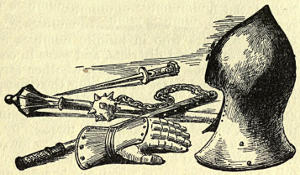
Italian Arms, Fourteenth Century
This dreadful visitation, which began in the far East and rolled dismally over the western world, pressed with unwonted weight upon Florence, where the people were predisposed for disease by a succession of events that both morally and physically had affected the whole community. As far back as the year 1345 unusual and constant rains accompanied and followed by earthquakes continued from the end of July to the beginning of November; the harvests were nearly ruined; but few grapes appeared; tillage was interrupted, and the little wine that could be made had proved unwholesome.
The Arno again swamped half Florence; streams, swelled into torrents, rolled over banks and bridges and ravaged every district; Rifredi and Borghetto were ruined by the Terzolla; the Mugnone and Rimaggio did equal mischief, and an overwhelming flood was hourly expected in the capital.
The next year’s harvest failed, and the rain still poured down through April, May, and June, 1346, with storms and tempests, and a partial destruction of the smaller seeds; misfortune seemed busily brooding, but not for Florence alone; France and the rest of Italy were struck with equal apprehensions; corn and wine again failed; the poultry perished for lack of food; cattle of every kind were fearfully diminished; the price of oil became enormous, and fruit was almost entirely extinct. Land produced at the utmost a quarter, and in some places only a sixth, of the customary crops, and even that was unwholesome; want came like an armed man; the peasants abandoned their farms and robbed each other through sheer necessity; or else begged their bread in Florence, where the concourse of starving wretches was overwhelming.
No land could be tilled unless the owner provided sustenance in kind for his labourers besides the necessary seed, and this was almost impossible even at an enormous cost; in former scarcities corn was extravagantly dear but still to be had; now there was scarcely any even for the highest offers until the government, with infinite exertion and by mere dint of money, imported it from the Maremma, Romagna, Sicily, Sardinia, Calabria, Barbary, Tunis, and the archipelago. But even the receipt of this was difficult; for Pisa, equally distressed, detained all that entered Porto Pisano until her own market was supplied. Thirty thousand florins were nominally thus spent, one-third of which was supposed to have found its way into the coffers of dishonest and heartless peculators. Ten great ovens were erected by the government and strongly barricaded, where by day and night men and women were constantly employed in making bread; this was distributed every morning at the sound of the great bell, to churches, convents, country parishes, and hungry creatures; but with exceeding difficulty, from the fierce pressure of starving multitudes. In April, 1347, it was found by the bread-tickets received that no less than ninety-four thousand people were daily furnished with two loaves each from these ovens. In this were not counted the citizens and their households who were already supplied and did not share in the public distribution, but bought better bread at more than double price from the numerous private ovens. It was exclusive also of religious mendicants and other systematic beggars who in infinite numbers crowded into Florence from the adjacent towns and districts, and were in continual altercation with the citizens. Yet none were refused, whether stranger or subject, and all classes joined hand and heart in relieving the general misery. The increase of grain from the wheat harvest of 1347 reduced the price, towards the end of June, which however soon mounted up again from the eagerness of bakers to purchase, in order to uphold the market by refusing to make more than a certain quantity. This plunged the city into confusion; tumults began, which the priors calmed by hanging the baker who commenced this system, and corn fell to its natural value which the harvest gradually diminished.
[1346-1350 A.D.]
Death and sickness of course attended this suffering, and to alleviate the general distress the priors as early as March had decreed that nobody should be arrested for any debt under one hundred golden florins until the following August; and also, with a premium for importation, put a maximum price on the bushel of wheat; this was useless; because hunger backed by money overcame law, and corn sold for double the government value. For further alleviation all the prisoners in the public jails were released on a compromise with their creditors and enemies, as mortality had already begun in these places to the number of two or three in a day; public debtors for less than one hundred florins were also set at liberty on paying fifteen per cent. of their fines; but very few could take advantage of this, for all were suffering from poverty, hunger, and distress.
The effects now began to appear; women and children of the poorest classes sank under the woeful pressure; this lasted until November and carried off about four thousand souls; but it was worse in Prato, Pistoia, and Bologna, in Romagna, and throughout all France. In Turkey, Syria, Tatary, and India, sickness raged with unheard-of violence, giving rise and currency to a thousand marvellous tales, such as fire issuing from the earth and air, and consuming men, cattle, houses, trees, and even reducing the very earth and stones to cinders: those who escaped this, died of pestilence; and on the banks of the Tanaïs, at Trebizond, and in all the neighbouring countries, only one person in five was left among the living; in other places it is said to have rained great black maggots with eight legs, some alive, some dead, whose sting was death and whose corruption poisoned the atmosphere; but these are the least incredible of the numerous fables that this universal scourge generated in morbid imaginations, and in which all men, being terror-struck, believed implicitly. Turkey, Greece, Egypt, Syria, Crete, Rhodes, and the other eastern isles bowed before the pestilence; thence it travelled with the course of trade to Sicily, Sardinia, Elba, Corsica, and throughout the coasts of Italy; four Genoese galleys carried it to that city out of eight that had fled from the Euxine; Milan scarcely felt it, but as there were then no lazarettos it swept over the Alps, searched every vale in Savoy, ravaged Provence and Dauphiné, infected Burgundy and Catalonia; missed Brabant, but holding on its course carried death and misery through the rest of Europe until 1350, when it had penetrated even the Boreal regions and nearly depopulated Iceland, which has never yet recovered from its touch.
“This disease,” says Giovanni Villani,d “was of such a nature that none survived its attack for three days; certain tumours appeared in the groins and under the arms; the patient then spit blood; and the priest that confessed him, and the neighbour who looked on him often took the malady, so that every sick creature was abandoned: no confession, no sacrament, no medicine, no attendance; yet the pope granted a pardon to every priest who administered the holy communion, or confessed, or visited and watched the dying man.”
This was in 1347, and solemn processions and offerings were made for three days together to avert the pestilence from Florence; in December the price of bread again augmented, because Romagna had absorbed every bushel of grain from the Mugello district; Venice was empty and in want; Louis of Hungary’s invasion of Apulia, together with pestilence on the coast, prevented her customary supplies from Sicily and southern Italy. Guards were placed round the Florentine state and grain was once more purchased, so that the year 1348 came in with fear and hope, but some diminution of misery. All these sufferings had painfully prepared a way for heavier calamities, and they struck with killing force on a sickly, weak, and desponding people.
Whether the great plague of 1348 fell with more fatal effects on Florence than other places may be doubtful; yet the descriptive pen of Boccaccio j has thrown a pall of immortality over this scene of universal desolation and of death.f
BOCCACCIO’S ACCOUNT OF THE PLAGUE IN FLORENCE
[1348 A.D.]
The year of our Lord’s incarnation, 1348, had already come, when in the noble city of Florence, lovely beyond all others of Italy, appeared the mortal pestilence which by the operation of superior bodies, or from wicked deeds, was by the just judgment of God for our correction let loose on mortals. It began some years before in the eastern countries and after having deprived them of an inconceivable mass of living beings rolled westward in a continued course from realm to realm with mournful augmentation. Human wisdom and human prudence availed not, for the city had already been cleansed of its impurities by officers especially appointed; entrance was denied to all infected persons, and every means employed to preserve the public health. Neither were humble supplications to the Almighty more successful, although made not once but repeatedly in religious processions and divers other ways by devout persons; for very early in spring the dismal signs glared horribly palpable and manifested themselves in wonderful ways; not as in the east where bleeding at the nose was a plain symptom of inevitable death, but at the beginning, both in male and female, there appeared about the groins and under the arm-pits certain tumours some of which increased to the size of a common apple, others to that of an egg; and those greater and these less, and were vulgarly called gavoccioli. And from the two parts of the body above mentioned these deadly gavoccioli within a brief space began to sprout and swell indiscriminately in every other; and soon after this the nature of the disease began to change into black or livid spots, which in many appeared on the arms, thighs, and other places; some large and few, others small and numerous; and as the gavocciolo at first was and always remained a certain sign of death, so also were these spots on whomsoever they appeared.
For the cure of this malady neither the advice of medical men nor the virtues of any nostrum availed or profited; on the contrary, whether it were that the nature of the illness would not permit, or that the ignorance of doctors (of whom, besides regular physicians, the number of both sexes without a particle of knowledge was enormous) could not divine the cause and therefore could apply no remedy; not only few survived, but almost all about the third day from the appearance of these symptoms, some sooner, some later, most of them without fever or any other accident, expired.
There were some who fancied that to live moderately and avoid every excess would be most efficacious in resisting contagion, and so having formed their society they shrank from all the others by shutting themselves up in those houses where no sickness as yet existed; to live better they ate the most delicate food and drank the finest wines, but in great moderation, holding no intercourse with the outward world, nor permitting tales of death or sickness to reach their ears; but with music and every other diversion that their means afforded they continued to dwell in seclusion.
Others of a contrary opinion affirmed that drinking deep, and enjoyments, and singing, and rambling about for amusement, and satisfying every appetite, and mocking and ridiculing everything, was a sovereign antidote to all existing evil; and as they said so they did; for night and day, now at one tavern, now at another, onward they went; drinking without mode or measure, but mostly at other people’s houses, whatever pleased and delighted them; and this was easily done, for almost all, as if they had deserted life, abandoned the care of themselves and everything they possessed; wherefore most dwellings remained open to the world at large, and the stranger that entered used them as if he were the lawful owner; but with all this brutish sensuality they still kept aloof from the sick.
And in such affliction and misery was also the revered authority of our laws both divine and human that, deserted by their ministers, they had fallen to ruin and dissolution; for these like the rest were either sick or dead; or if any remnants existed they were useless; wherefore all persons were left to their own imaginings.
Many other people took a middle course between these two, neither restricting themselves in their food like the former, nor running to excess in drinking and dissipation like the latter, but made use of things moderately according to their wants; and instead of shutting themselves up they rambled about the town, some with bunches of flowers, some with odoriferous herbs, and others with fragrant mixtures of spices which they carried in their hands and continually applied to the nostrils, esteeming it an excellent thing to comfort the brain by their perfume because the air was loaded and disgusting with the stench of death, disease, and offensive medicaments. Some again entertained more unfeeling sentiments (as if they were haply more secure), declaring that there was no better, nor even so good a remedy for the plague as to fly before it; so, moved by this argument and caring only for themselves, numbers of both sexes abandoned their native city, their homes, their friendly meetings, their dearest relatives, and all their property, and sought those of the stranger; or else retired to the seclusion of their own country dwellings; as if the anger of God, being once moved thus to punish human wickedness, would spare the rod to them and strike only those enclosed within the walls; or, as if they counselled everyone to fly because the final hour of Florence was arrived.
Many died that haply might have lived by timely aid; so that between a want of that assistance which sufferers could not procure, and the malignant nature of this disease, the multitudes of those who daily and nightly expired in Florence would be terrible to hear, even without beholding; wherefore, almost of necessity, things contrary to all former habits were engendered amongst the surviving citizens.
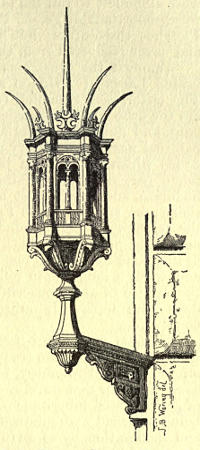
Lamp, Palazzo Strozzi, Florence
It was a custom, and we still see it maintained, that in cases of death every female relation and neighbour should assemble within the house and there weep for his loss; and before the mansion every male kinsman and nearest neighbour also assembled, with other citizens in great numbers, attended by divers of the clergy according to the dead man’s quality; thence on the shoulders of his peers, with funeral pomp of torch and music, the corpse was slowly borne away to that church which he had previously chosen for a sepulchre. But when the pestilence raged most fiercely these things almost entirely ceased, and new customs superseded them; for people then died not only without such assemblies of wailing women, but passed from the world in many instances without even a single witness; and few were those to whom the piteous sobs and tears of relatives were in mercy conceded; but instead thereof was heard the laugh or the jest, or the convivial feast! and this custom the women in general, casting aside their sex’s softness, did for their own especial advantage most quickly learn.
There were but few whose bodies were accompanied to the church by more than ten or twelve of their neighbours; nor were even these honourable citizens, but certain gravediggers from the lowest classes named becchini who performed this mercenary service; they roughly shouldered the bier and moved hastily and carelessly along, not to the church which the deceased had selected, but to the nearest cemetery, led by some half-dozen priests with few lights and sometimes none, who, assisted by the becchini, and not troubling about a funeral service, tossed the body into any empty pit that they happened to find.
The treatment of the lower and a great portion of the middle classes was still worse, because the greater part of these being confined either by hope or poverty to their houses, thousands daily sickened, and being destitute of assistance were allowed to die; and many there were who daily and nightly terminated their existence in the streets, and many that expired in their own houses, the stench of whose carcasses was the first notice of their dissolution. Of these and other victims all places were full, and the neighbours, not less moved by the fear of putrid bodies than by charity towards the dead, with the assistance of public porters when they were to be had, dragged the corpses into the street and left them before their several doors where especially in the morning they were to be seen in heaps by those who wandered through the tainted thoroughfares.j
NAPIER’S REFLECTIONS ON THE PLAGUE
In this wide and wasting pestilence all Europe was more or less immersed; she was bereft of three-fifths of her population, and excepting Milan, together with a few places at the foot of the Alps, the whole of Italy was shaken to its centre. Genoa lost 40,000, Naples 60,000; and Sicily and Apulia the incredible number of 530,000 souls! The city of Trapani was completely depopulated; all died; and her silent walls and empty dwellings were alone left to tell the tale. Throughout Tuscany the harvest of death was proportionably great: Pisa lost four-fifths or, as some say, seven-tenths; Florence three-fifths; but Siena mourned for 80,000 of her buried citizens and never recovered from the blow.
Amongst the illustrious victims of this universal sacrifice were the celebrated Laura of Avignon and the historian Giovanni Villani of Florence. The latter, says Sismondi (and his words will suit all subsequent, as they are the echo of all antecedent writers), “was the most expert, faithful, elegant, and animated historian that Italy had yet produced: we have made habitual use of his history during more than half a century with that confidence which is due to a judicious contemporary author who had himself taken part in public affairs.” Villani was in fact much more than a mere historian, and like almost all Florentines became both merchant and politician; he travelled into France and the Netherlands, was several times in the seigniory, superintended the building of the present walls, directed the mint, and filled other high offices in the commonwealth. He served also against Castruccio, was one of the hostages delivered to Mastino della Scala, and spent a long life in public and private activity; but finally, ruined by the failure of the Bonaccorsi with whom he was in partnership, his latter days were apparently unhappy and he died amidst the misfortunes of his country.
Sickness gave way before the August sun, and all that remained of the Florentine people were free from disease at the new seigniory’s inauguration on the 1st of September, but what the remnant was we are not told; so small however that poverty disappeared, and riches abounded in consequence of accumulated inheritances. Yet instead, as some expected, of men’s hearts being softened and subdued and penitent, and turned to religion and virtue and moderation by so awful a catastrophe, Florence immediately became a theatre of luxury, riot, and debauchery. As if the hand of God were tired, and death was swallowed up in victory, feasting, taverns, and every kind of licentious revel occupied the people; both sexes, high and low, with new and fanciful attire, but more especially the latter, flaunted through the streets bedizened like players in the rich garments of illustrious families, all now extirpated. And as if these saturnalia were to be everlasting, few labourers would return to agriculture, fewer still to trade, and those few insisted on exorbitant remuneration. Unbounded pride and heartless prodigality were everywhere triumphant; the hand of death had removed the burden of poverty; the departure of death had removed the weight of terror, and the rebound was startling. With feelings numbed, and passions free, no wish was too vicious to indulge, no idea too strange for belief.
Superabundance of agricultural produce was looked for because of the scarcity of mouths, and the contrary happened; for everything fell short and long continued so, in some countries even to the most biting famine; manufactures of almost all kinds, clothes, everything necessary for the human body, were in like manner expected to appear spontaneously and in profusion; but the reverse took place; most sorts of manufactured goods soon doubled their former cost, and all labour brought twice the money that it fetched before the pestilence; disputes, lawsuits, contests, disturbances of every class sprouted like nettles throughout the land, and Florence long and severely felt their evil consequences. Immense treasures too had been willed away by dying men to public charities, or in trust to corporate bodies for the poor; some directly, others after several successions, all now swept off by exterminating plague; amongst others there was left to the corporation of Orto-san-Michele alone the vast inheritance of 350,000 florins, a sum equal to one year’s revenue of the commonwealth. This was in trust for the poor; but there were no poor, no paupers, no destitution; death had murdered poverty. Money, houses, and other valuables abounded; the directors felt their hands at liberty, their conscience easy; and unbounded peculation was the result; the elections were kept close amongst themselves; they re-elected each other; power and profit moved round in a circle undisturbed by any external influence for three long years, until at last the angry voice of Florence destroyed this nefarious and disgraceful system. In a similar manner, but with better management, 25,000 florins were left to the hospital of Santa Maria Nuova, and an equal sum to the new and useful company of “Misericordia”; so that the city most abounded in charitable resources at the very time when poverty was for the moment annihilated.
Many corrective laws for the various existing evils were promulgated by those magistrates who still retained their discretion and now resumed their power; one of these was to exonerate minors and married women from any legal responsibility in affairs of pecuniary and other property, unless with the consent of their relatives or guardians declared before a judge in the court of the above corporation of Orto-san-Michele, which had ex-officio their guardianship. At the same period, and no less to encourage population by the residence of students than for the dignity of Florence, a public college was founded for the first time, and able professors were appointed to the whole range of science, besides civil and canon law and dogmatic theology.
It might have been supposed that all accounts between debtor and creditor had been cancelled by the plague; but so many fraudulent bankruptcies had previously occurred and so unwholesome a system of mercantile credits had been allowed that it became an article of swindling speculation, and large orders were frequently given on long credit with a sole view to future insolvency. As a remedy there was now published a decree forbidding any citizen to buy or sell on credit, not only in the state itself but within a hundred miles of Florence, on pain of losing his reputation and a fine equal to the amount of the purchase money. Nor were sumptuary laws forgotten; for riches and luxury required control, and a check was therefore placed on the expense of marriage ceremonies which now were frequent in consequence of augmented wealth and thin population; but as these could not at once raise citizens to the state new scrutiny-lists became requisite for three years, which from necessity admitted the nobles to many public offices both in town and country.f
FOOTNOTES