Chapter XII · FLORENCE UNDER THE MEDICI
Reading edition
[1434-1492 A.D.]
The democratic party at Florence, directed by the Alberti, Ricci, and Medici, were deprived of power in 1381, in consequence of the abuse which their associates, the ciompi, had made of their victory. From that time their rivals, the Albizzi, directed the republic for the space of fifty-three years, from 1381 to 1434, with a happiness and glory till then unexampled. No triumph of an aristocratic faction ever merited a more brilliant place in history. The one in question maintained itself by the ascendency of its talents and virtues, without ever interfering with the rights of the other citizens, or abusing a preponderance which was all in opinion. It was the most prosperous epoch of the republic—that during which its opulence acquired the greatest development; that in which the arts, sciences, and literature adopted Florence as their native country; that in which were born and formed all those great men, of whom the Medici, their contemporaries, have reaped the glory, without having had any share in producing them; that, finally, in which the republic most constantly followed the noblest policy: considering itself as the guardian of the liberty of Italy, it in turns set limits to the ambition of Gian Galeazzo Visconti, of Ladislaus, king of Naples, and of Filippo Maria, duke of Milan. Tommaso degli Albizzi, and after him Niccolo da Uzzano, had been the chiefs of the aristocracy at this period of glory and wisdom. To those succeeded Rinaldo, son of Tommaso degli Albizzi, who forgot, a little more than his predecessors, that he was only a simple citizen. Impetuous, arrogant, jealous, impatient of all opposition, he lost the pre-eminence which his family had so long maintained.
Rinaldo degli Albizzi saw, with uneasiness, a rival present himself in Cosmo, son of Giovanni de’ Medici, who revived a party formerly the vanquishers of his ancestors. This man enjoyed a hereditary popularity at Florence, because he was descended from one of the demagogues who, in 1378, had undertaken the defence of the minor arts against the aristocracy; he at the same time excited the jealousy of the latter by his immense wealth, which equalled that of the greatest princes of Italy. Although the Albizzi saw with distrust the family of their rivals attain the supreme magistracy, they could not exclude from it Giovanni de’ Medici, who was gonfalonier in 1421. His son Cosmo, born in 1389, was priore in 1416; he was the head of a commercial establishment which had counting-houses in all the great cities of Europe and in the Levant; he at the same time cultivated literature with ardour. His palace, one of the most sumptuous in Florence, was the resort of artists, poets, and learned men; of those, among others, who about this time introduced the Platonic philosophy into Italy. The opulence of Cosmo de’ Medici was always at the service of his friends. There were very few poor citizens at Florence to whom his purse was not open.e
THE RISE, REVERSES, AND POWER OF COSMO DE’ MEDICI
[1389-1433 A.D.]
Even in the lifetime of his father, Cosmo had engaged himself deeply, not only in the extensive commerce by which the family had acquired its wealth, but in the weightier concerns of government. After the death of Giovanni de’ Medici, Cosmo supported and increased the family dignity. His conduct was uniformly marked by urbanity and kindness to the superior ranks of his fellow-citizens, and by a constant attention to the interests and the wants of the lower class, whom he relieved with unbounded generosity. By these means he acquired numerous and zealous partisans of every denomination; but he rather considered them as pledges for the continuance of the power he possessed than as instruments to be employed in extending it to the ruin and subjugation of the state. “No family,” says Voltaire,f “ever obtained its power by so just a title.”
The authority which Cosmo and his descendants exercised in Florence, during the fifteenth century, was of a very peculiar nature, and consisted rather in a tacit influence on their part, and a voluntary acquiescence on that of the people, than in any prescribed or definite compact between them. The form of government was ostensibly a republic, and was directed by a council of ten citizens, and a chief executive officer called the gonfalonière, or standard-bearer, who was chosen every two months. Under this establishment the citizens imagined they enjoyed the full exercise of their liberties; but such was the power of the Medici that they generally either assumed to themselves the first offices of the state, or nominated such persons as they thought proper to those employments. In this, however, they paid great respect to popular opinion. That opposition of interests so generally apparent between the people and their rulers, was at this time scarcely perceived at Florence, where superior qualifications and industry were the surest recommendations to public authority and favour. Convinced of the benefits constantly received from this family, and satisfied that they could at any time withdraw themselves from a connection that exacted no engagements, and required only a temporary acquiescence, the Florentines considered the Medici as the fathers, and not as the rulers of the republic. On the other hand, the chiefs of this house, by appearing rather to decline than to court the honours bestowed on them, and by a singular moderation in the use of them when obtained, were careful to maintain the character of simple citizens of Florence and servants of the state. An interchange of reciprocal good offices was the only tie by which the Florentines and the Medici were bound, and perhaps the long continuance of this connection may be attributed to the very circumstance of its having been in the power of either of the parties, at any time, to dissolve it.
[1433 A.D.]
But the prudence and moderation of Cosmo, though they soothed the jealous apprehensions of the Florentines, could not at all times repress the ambitious designs of those who wished to possess or to share his authority. In the year 1433, Rinaldo de’ Albizzi, at the head of a powerful party, carried the appointment of the magistracy. At that time Cosmo had withdrawn to his seat at Mugello, where he had remained some months, in order to avoid the disturbances that he saw were likely to ensue; but at the request of his friends he returned to Florence, where he was led to expect that a union of the different parties would be effected, so as to preserve the peace of the city. In this expectation he was, however, disappointed. No sooner did he make his appearance in the palace, where his presence had been requested, on pretence of his being intended to share in the administration of the republic, than he was seized upon by his adversaries, and committed to the custody of Federigo Malavolti. He remained in this situation for several days, in constant apprehension of some violence being offered to his person; but he still more dreaded that the malice of his enemies might attempt his life by poison. During four days, a small portion of bread was the only food which he thought proper to take.
The generosity of his keeper at length relieved him from this state of anxiety. In order to induce him to take his food with confidence, Malavolti partook of it with him. In the meantime, his brother Lorenzo, and his cousin Averardo, having raised a considerable body of men from Romagna and other neighbouring parts, and being joined by Niccolo da Tolentino, the commander of the troops of the republic, approached towards Florence to his relief; but the apprehensions that, in case they resorted to open violence, the life of Cosmo might be endangered, induced them to abandon their enterprise. At length Rinaldo and his adherents obtained a decree of the magistracy against the Medici and their friends, by which Cosmo was banished to Padua for ten years, Lorenzo to Venice for five years, and several of their relations and adherents were involved in a similar punishment.
Cosmo would gladly have left the city pursuant to his sentence, had he been allowed to do so, but his enemies thought it more advisable to retain him till they had established their authority; and they frequently gave him to understand that if his friends raised any opposition to their measures, his life should answer it. He also suspected that another reason for his detention was to ruin him in his credit and circumstances, his mercantile concerns being then greatly extended. As soon as these disturbances were known, several of the states of Italy interfered in his behalf. Three ambassadors arrived from Venice, who proposed to take him under their protection, and to engage that he should strictly submit to the sentence imposed on him. The marquis of Ferrara also gave a similar proof of his attachment. Though their interposition was not immediately successful, it was of great importance to Cosmo, and secured him from the attempts of those who aimed at his life. After a confinement of nearly a month, some of his friends, finding in his adversaries a disposition to gentler measures, took occasion to forward his cause by the timely application of a sum of money to Bernardo Guadagni, the gonfalonier, and to Mariotto Baldovinetti, two of the creatures of Rinaldo. This measure was successful. He was privately taken from his confinement by night, and led out of Florence. For this piece of service Guadagni received 1,000 florins, and Baldovinetti 800. “They were poor souls,” says Cosmo in his Ricordi, “for if money had been their object, they might have had 10,000, or more, to have freed me from the perils of such a situation.”
[1434-1464 A.D.]
From Florence, Cosmo proceeded immediately towards Venice, and at every place through which he passed, experienced the most flattering attention and the warmest expressions of regard. On his approach to that city he was met by his brother Lorenzo and many of his friends, and was received by the senate with such honours as were bestowed by that stately republic only on persons of the highest quality and distinction. After a short stay there, he went to Padua, the place prescribed for his banishment; but on an application to the Florentine state, by Andrea Donato, the Venetian ambassador, he was permitted to reside on any part of the Venetian territories, but not to approach within the distance of 170 miles of Florence. The affectionate reception which he had met with at Venice induced him to fix his abode there, until a change of circumstances should restore him to his native country.
Amongst the several learned and ingenious men who accompanied Cosmo in his banishment, or resorted to him during his stay at Venice, was Michellozzo Michellozzi, a Florentine sculptor and architect, whom Cosmo (according to Vasarig) employed in making models and drawings of the most remarkable buildings in Venice, and also in forming a library in the monastery of St. George, which he enriched with many valuable manuscripts, and left as an honourable monument of his gratitude, to a place that had afforded him so kind an asylum in his adversity. During his residence at Venice, Cosmo also received frequent visits from Ambrogio Traversari, a learned monk of Camaldoli, near Florence, and afterwards superior of the monastery of that place. Though chiefly confined within the limits of a cloister, Traversari had, perhaps, the best pretensions to the character of a polite scholar of any man of that age. From the letters of Traversari,h now extant, we learn that Cosmo and his brother not only bore their misfortunes with firmness, but continued to express on every occasion an inviolable attachment to their native place. The readiness with which Cosmo had given way to the temporary clamour raised against him, and the reluctance which he had shown to renew those bloody rencounters that had so often disgraced the streets of Florence, gained him new friends. The utmost exertions of his antagonists could not long prevent the choice of such magistrates as were known to be attached to the cause of the Medici; and no sooner did they enter on their office, than Cosmo and his brother were recalled, and Rinaldo, with his adherents, was compelled to quit the city. This event took place about the expiration of twelve months from the time of Cosmo’s banishment.
From this time the life of Cosmo de’ Medici was one of almost uninterrupted prosperity. The tranquillity enjoyed by the republic, and the satisfaction and peace of mind which he experienced in the esteem and confidence of his fellow-citizens, enabled him to indulge his natural propensity to the promotion of science, and the encouragement of learned men. The study of the Greek language had been introduced into Italy, principally by the exertions of the celebrated Boccaccio, towards the latter part of the preceding century, but on the death of that great promoter of letters it again fell into neglect. After a short interval, another attempt was made to revive it by the intervention of Emmanuel Chrysoloras, a noble Greek, who, during the interval of his important embassies, taught that language at Florence and other cities of Italy, about the beginning of the fifteenth century. His disciples were numerous and respectable. Amongst others of no inconsiderable note were Ambrogio Traversari, Leonardo Bruni, Carlo Marsuppini, the two latter of whom were natives of Arezzo, whence they took the name of Aretino, Poggio Bracciolini, Guarino Veronese, and Francesco Filelfo, who, after the death of Chrysoloras, in 1415, strenuously vied with each other in the support of Grecian literature, and were successful enough to keep the flame alive till it received new aid from other learned Greeks, who were driven from Constantinople by the dread of the Turks, or by the total overthrow of the Eastern Empire. To these illustrious foreigners, as well as to those eminent Italians, who shortly became their successful rivals, even in the knowledge of their national history and language, Cosmo afforded the most liberal protection and support. Of this the numerous productions inscribed to his name, or devoted to his praise, are an ample testimony. In some of these he is commended for his attachment to his country, his liberality to his friends, his benevolence to all. He is denominated the protector of the needy, the refuge of the oppressed, the constant patron and support of learned men.
“You have shown,” says Poggio,i “such humanity and moderation in dispensing the gifts of fortune, that they seem to have been rather the reward of your virtues and merits, than conceded by her bounty. Devoted to the study of letters from your early years, you have by your example given additional splendour to science itself. Although involved in the weightier concerns of state, and unable to devote a great part of your time to books, yet you have found a constant satisfaction in the society of those learned men who have always frequented your house.” In enumerating the men of eminence who distinguished the city of Florence, Flavio Biondo (Flavius Blondus)j adverts in the first instance to Cosmo de’ Medici—“a citizen who, whilst he excels in wealth every other citizen of Europe, is rendered much more illustrious by his prudence, his humanity, his liberality, and what is more to our present purpose, by his knowledge of useful literature, and particularly of history.”
Cosmo and the Revival of Learning
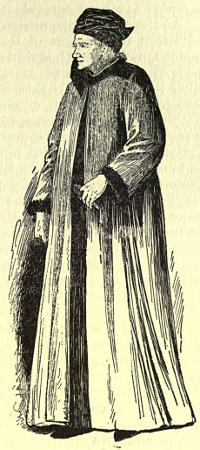
Cosmo de’ Medici
That extreme avidity for the works of the ancient writers which distinguished the early part of the fifteenth century announced the near approach of more enlightened times. Whatever were the causes that determined men of wealth and learning to exert themselves so strenuously in this pursuit, certain it is that their interference was of the highest importance to the interests of posterity, and that if it had been much longer delayed, the loss would have been in a great degree irreparable; such of the manuscripts as then existed of the ancient Greek and Roman authors being daily perishing in obscure corners, a prey to oblivion and neglect. It was therefore a circumstance productive of the happiest consequences, that the pursuits of the opulent were at this time directed rather towards the recovery of the works of the ancients than to the encouragement of contemporary merit; a fact that may serve in some degree to account for the dearth of original literary productions during this interval. Induced by the rewards that invariably attended a successful inquiry, those men who possessed any considerable share of learning devoted themselves to this occupation, and to such a degree of enthusiasm was it carried that the discovery of an ancient manuscript was regarded as almost equivalent to the conquest of a kingdom.
As the natural disposition of Cosmo led him to take an active part in collecting the remains of the ancient Greek and Roman writers, so he was enabled, by his wealth and his extensive mercantile intercourse with different parts of Europe and of Asia, to gratify a passion of this kind beyond any other individual. To this end he laid injunctions on all his friends and correspondents, as well as on the missionaries and preachers who travelled into the remotest countries, to search for and procure ancient manuscripts, in every language and on every subject. Besides the services of Poggio and Traversari, Cosmo availed himself of those of Cristoforo Buondelmonte, Antonio da Massa, Andrea de Rimino, and many others. The situation of the Eastern Empire, then daily falling into ruins by the repeated attacks of the Turks, afforded him, as Bandinik notes, an opportunity of obtaining many inestimable works in the Hebrew, Greek, Chaldaic, Arabic, and Indian languages. From these beginnings arose the celebrated library of the Medici, which, after having been the constant object of the solicitude of its founder, was after his death further enriched by the attention of his descendants, and particularly of his grandson Lorenzo; and after various vicissitudes of fortune, and frequent and considerable additions, has been preserved to the present times under the name of the Bibliotheca Mediceo-Laurentiana.
Amongst those who imitated the example of Cosmo de’ Medici was Niccolo Niccoli, another citizen of Florence, who devoted his whole time and fortune to the acquisition of ancient manuscripts; in this pursuit he had been eminently successful, having collected together eight hundred volumes of Greek, Roman, and oriental authors; a number in those times justly thought very considerable. Several of these works he had copied with great accuracy, and had diligently employed himself in correcting their defects and arranging the text in its proper order. In this respect he is justly regarded by Mehus as the father of this species of criticism. He died in 1436, having by his will directed that his library should be devoted to the use of the public, and appointed sixteen curators, amongst whom was Cosmo de’ Medici. After his death, it appeared that he was greatly in debt, and that his liberal intentions were likely to be frustrated by the insolvency of his circumstances. Cosmo therefore proposed to his associates, that if they would resign to him the right of disposition of the books, he would himself discharge all the debts of Niccolo, to which they readily acceded. Having thus obtained the sole direction of the manuscripts, he deposited them for public use in the Dominican monastery of San Marco, at Florence, which he had himself erected at an enormous expense. This collection was the foundation of another celebrated library in Florence, known by the name of the Bibliotheca Marciana, which is yet open to inspection.
In the arrangement of the library of San Marco, Cosmo had procured the assistance of Tommaso Calandrino (or Parentucelli), who drew up a scheme for that purpose, and prepared a scientific catalogue of the books it contained. In selecting a coadjutor, the choice of Cosmo had fallen upon an extraordinary man. Though Tommaso was the son of a poor physician of Sarzana, and ranked only in the lower order of the clergy, he had the ambition to aim at possessing specimens of these venerable relics of ancient genius. His learning and his industry enabled him to gratify his wishes, and his perseverance surmounted the disadvantages of his situation. In this pursuit he was frequently induced to anticipate his scanty revenue, well knowing that the estimation in which he was held by his friends would preserve him from pecuniary difficulties. With the Greek and Roman authors no one was more intimately acquainted, and as he wrote a very fine hand, the books he possessed acquired additional value from the marginal observations which he was accustomed to make in perusing them.
By rapid degrees of fortunate preferment, Tommaso was, in the short space of twelve months, raised from his humble situation in the lower orders of the church, to the chair of St. Peter, and in eight years, during which time he enjoyed the supreme dignity by the name of Nicholas V, acquired a reputation that has increased with the increasing estimation of those studies which he so liberally fostered and protected. The scanty library of his predecessors had been nearly dissipated or destroyed by frequent removals between Avignon and Rome, according as the caprice of the reigning pontiff chose either of those places for his residence; and it appears from the letters of Traversari, that scarcely anything of value remained. Nicholas V is therefore to be considered as the founder of the library of the Vatican. In the completion of this great design, it is true, much was left to be performed by his successors; but Nicholas had before his death collected upwards of five thousand volumes of Greek and Roman authors, and had not only expressed his intention of establishing a library for the use of the Roman court, but had also taken measures for carrying such intention into execution.
Whilst the munificence of the rich and the industry of the learned were thus employed throughout Italy in preserving the remains of the ancient authors, some obscure individuals in a corner of Germany had conceived, and were silently bringing to perfection, an invention which, by means equally effectual and unexpected, secured to the world the result of their labours. This was the art of printing with movable types. The coincidence of this discovery with the spirit of the times in which it had birth was highly fortunate. Had it been made known at a much earlier period, it would have been disregarded or forgotten, from the mere want of materials on which to exercise it; and had it been further postponed, it is probable that, notwithstanding the generosity of the rich and the diligence of the learned, many works would have been totally lost, which are now justly regarded as the noblest monuments of the human intellect.
Nearly the same period of time that gave the world this important discovery, saw the destruction of the Roman Empire in the East. In the year 1453, the city of Constantinople was captured by the Turks, under the command of Muhammed II, after a vigorous defence of fifty-three days. The encouragement which had been shown to the Greek professors at Florence, and the character of Cosmo de’ Medici as a promoter of letters, induced many learned Greeks to seek a shelter in that city, where they met with a welcome and honourable reception. Amongst these were Demetrius Chalcondyles, Joannes Andronicus Calistus, Constantine, and Andreas Joannes Lascaris, in whom the Platonic philosophy obtained fresh partisans, and by whose support it began openly to oppose itself to that of Aristotle. Between the Greek and Italian professors a spirit of emulation was kindled that operated most favourably on the cause of letters. Public schools were instituted at Florence for the study of the Greek tongue. The facility of diffusing their labours by means of the newly discovered art of printing stimulated the learned to fresh exertions; and in a few years the cities of Italy vied with each other in the number and elegance of works produced from the press.
Last Years of Cosmo
Towards the latter period of his life, a great part of the time that Cosmo could withdraw from the administration of public affairs, was passed at his seats at Careggi and Caffaggiolo, where he applied himself to the cultivation of his farms, from which he derived no inconsiderable revenue. But his happiest hours were devoted to the study of letters and philosophy, or passed in the company and conversation of learned men. When he retired at intervals to his seat at Careggi, he was generally accompanied by Ficino, where, after having been his protector, he became his pupil in the study of the Platonic philosophy. For his use, Ficino began those laborious translations of the works of Plato and his followers which were afterwards completed and published in the lifetime and by the liberality of Lorenzo. Amongst the letters of Ficino is one from his truly venerable patron, which bespeaks most forcibly the turn of his mind, and his earnest desire of acquiring knowledge, even at his advanced period of life.
“Yesterday,” says he, “I arrived at Careggi—not so much for the purpose of improving my fields as myself. Let me see you, Marsilio, as soon as possible, and forget not to bring with you the book of our favourite Plato, De summo bono, which I presume, according to your promise, you have ere this translated into Latin; for there is no employment to which I so ardently devote myself as to find out the true road to happiness. Come then, and fail not to bring with you the Orphean lyre.” Whatever might be the proficiency of Cosmo in the mysteries of his favourite philosopher, there is reason to believe that he applied those doctrines and precepts which furnished the litigious disputants of the age with a plentiful source of contention, to the purposes of real life and practical improvement. Notwithstanding his active and useful life, he often regretted the hours he had lost. “Midas was not more sparing of his money,” says Ficino,l “than Cosmo was of his time.”
The wealth and influence that Cosmo had acquired had long entitled him to rank with the most powerful princes of Italy, with whom he might have formed connections by the intermarriage of his children; but being apprehensive that such measures might give rise to suspicions that he entertained designs inimical to the freedom of the state, he rather chose to increase his interest among the citizens of Florence by the marriage of his children into the most distinguished families of that place. Piero, his eldest son, married Lucretia Tornabuoni, by whom he had two sons—Lorenzo, born on the first day of January, 1448, and Giuliano, born in the year 1453. Piero had also two daughters, Nannina, who married Bernardo Rucellai, and Bianca, who became the wife of Gulielmo de’ Pazzi. Giovanni, the younger son of Cosmo, espoused Cornelia de’ Alessandri, by whom he had a son who died very young. Giovanni himself did not long survive. He died in the year 1461, at forty-two years of age. Living under the shade of paternal authority, his name scarcely occurs in the pages of history; but the records of literature bear testimony that in his disposition and studies he did not derogate from the reputation of that characteristic attachment to men of learning by which his family was invariably distinguished.
Besides his legitimate offspring, Cosmo left also a natural son, Carlo de’ Medici, whom he liberally educated, and who compensated the disadvantages of his birth by the respectability of his life. The manners of the times might be alleged in extenuation of a circumstance apparently inconsistent with the gravity of the character of Cosmo de’ Medici; but Cosmo himself disclaimed such apology, and whilst he acknowledged his youthful indiscretion, made amends to society for the breach of a salutary regulation, by attending to the morals and the welfare of his illegitimate descendant. Under his countenance, Carlo became proposto of Prato, and one of the apostolic notaries; and as his general residence was at Rome, he was frequently resorted to by his father and brothers for his advice and assistance in procuring ancient manuscripts and other valuable remains of antiquity.
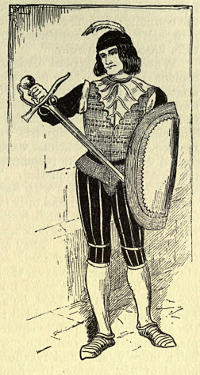
An Italian Captain, Fifteenth Century
The death of Giovanni de’ Medici, on whom Cosmo had placed his chief expectations, and the weak state of health that Piero experienced, which rendered him unfit for the exertions of public life in so turbulent a place as Florence, raised great apprehensions in Cosmo that at his decease the splendour of his family would close. These reflections embittered the repose of his latter days. A short time before his death, being carried through the apartments of his palace, after having recently lost his son, he exclaimed with a sigh, “This is too great a house for so small a family.” These apprehensions were in some degree realised by the infirmities under which Piero laboured during the few years in which he held the direction of the republic; but the talents of Lorenzo soon dispelled this temporary gloom, and exalted his family to a degree of reputation and splendour, of which it is probable that Cosmo himself had scarcely formed an idea.d
While Cosmo de’ Medici thus fixed the public attention by his private life, Neri Capponi gained the suffrages of the people by his public conduct. Charged, as ambassador, with every difficult negotiation—in war, with every hazardous enterprise—he participated in all the brilliant successes of the Florentines, as well during the domination of the Albizzi as during that of the Medici. From the year 1434 to 1455, in which Neri Capponi died, these two chiefs of the republic had six times assembled the parliament to make a balia; and, availing themselves of its authority, which was above the law, they obtained the exile of all their enemies, and filled the balloting purses of the magistracy with the names of their own partisans, to the exclusion of all others. It appears that all the efforts of their administration were directed towards calming the passions of the public, and maintaining peace without, as well as repose within, the state. They had, in fact, succeeded in preventing Florence from being troubled with new factions, or engaged in new wars; but they drew on the republic all the evils attending an aristocratic government. Medici and Capponi had not been able to find men who would sacrifice the liberties of their country without allowing them to gratify their baser passions. These two heads of the republic, therefore, suffered their subordinate agents to divide among themselves all the little governments of the subject cities, and every lucrative employment; and these men, not satisfied with this first injustice, made unequal partitions of the taxes, increasing them on the poor, lowering them on the rich, and exempting themselves. At last they began to sell their protection, as well with respect to the tribunals as the councils; favour silenced justice; and, in the midst of peace and apparent prosperity, the Florentines felt their republic, undermined by secret corruption, hastening to ruin.
[1455-1464 A.D.]
When Neri Capponi died, the council refused to call a new parliament to replace the balia, whose power expired on the 1st of July, 1455. It was the aristocracy itself, comprehending all the creatures of Cosmo de’ Medici, that, from jealousy of his domination, wished to return to the dominion of the laws. The whole republic was rejoiced, as if liberty had been regained. The election of the signoria was again made fairly by lot—the catasto was revised, the contributions were again equitably apportioned, the tribunals ceased to listen to the recommendations of those who, till then, had made a traffic of retributive justice. The aristocracy, seeing that clients no longer flocked to their houses with hands full, began to perceive that their jealousy of Cosmo de’ Medici had only injured themselves. Cosmo, with his immense fortune, was just as much respected as before; the people were intoxicated with joy to find themselves again free; but the aristocracy felt themselves weak and abandoned. They endeavoured to convoke a parliament without Cosmo; but he baffled their efforts, the longer to enjoy their humiliation. He began to fear, however, that the Florentines might once more acquire a taste for liberty; and when Lucas Pitti, rich, powerful, and bold, was named gonfalonier, in July, 1458, he agreed with him to reimpose the yoke on the Florentines. Pitti assembled the parliament; but not till he had filled all the avenues of the public square with soldiers or armed peasants. The people, menaced and trembling within this circle, consented to name a new balia, more violent and tyrannical than any of the preceding. It was composed of 352 persons, to whom was delegated all the power of the republic. They exiled a great number of the citizens who had shown the most attachment to liberty, and they even put some to death.e
Cosmo now approached the period of his mortal existence, but the faculties of his mind yet remained unimpaired. About twenty days before his death, when his strength was visibly on the decline, he entered into conversation with Ficino, and whilst the faint beams of a setting sun seemed to accord with his situation and his feelings, began to lament the miseries of life and the imperfections inseparable from human nature. As he continued his discourse, his sentiments and his views became more elevated, and from bewailing the lot of humanity, he began to exult in the prospect of that happier state towards which he felt himself approaching. Ficino replied by citing corresponding sentiments from the Athenian sages, and particularly from Xenocrates; and the last task imposed by Cosmo on his philosophic attendant was to translate from the Greek the treatise of that author on death. Having prepared his mind to wait with composure the awful event, his next concern was the welfare of his surviving family, to whom he was desirous of imparting, in a solemn manner, the result of the experience of a long and active life. Calling into his chamber his wife Contessina, and his son Piero, he entered into a narrative of all his public transactions; he gave a full account of his extensive mercantile connections, and adverted to the state of his domestic concerns. To Piero he recommended a strict attention to the education of his sons. He requested that his funeral might be conducted with as much privacy as possible, and concluded his paternal exhortations by declaring his willingness to submit to the disposal of providence whenever he should be called upon. These admonitions were not lost on Piero, who communicated by letter to Lorenzo and Giuliano the impression which they had made upon his own mind. At the same time, sensible of his own infirmities, he exhorted them to consider themselves not as children but as men, seeing that circumstances rendered it necessary to put their abilities to an early proof. “A physician,” says Piero, “is hourly expected to arrive from Milan, but, for my own part, I place my confidence in God.” Either the physician did not arrive, or Piero’s distrust of him was well founded, for, about six days afterwards, being the first day of August, 1464, Cosmo died, at the age of seventy-five years, deeply lamented by a great majority of the citizens of Florence, whom he had firmly attached to his interest, and who feared for the safety of the city from the dissensions that were likely to ensue.
Roscoe’s Estimate of Cosmo
The character of Cosmo de’ Medici exhibits a combination of virtues and endowments rarely to be found united in the same person. If in his public works he was remarkable for his magnificence, he was no less conspicuous for his prudence in private life. Whilst in the character of chief of the Florentine Republic he supported a constant intercourse with the sovereigns of Europe, his conduct in Florence was divested of all ostentation, and neither in his retinue, his friendships, nor his conversation, could he be distinguished from any other respectable citizen. He well knew the jealous temper of the Florentines, and preferred the real enjoyment of authority to that open assumption of it which could only have been regarded as a perpetual insult by those whom he permitted to gratify their own pride in the reflection that they were the equals of Cosmo de’ Medici.
In affording protection to the arts of architecture, painting, and sculpture, Cosmo set the great example to those who by their rank and their riches could alone afford them effectual aid. The countenance shown by him to those arts was not of that kind which their professors generally experience from the great; it was not conceded as a bounty, nor received as a favour, but appeared in the friendship and equality that subsisted between the artist and his patron. In the erection of the numerous public buildings in which Cosmo expended incredible sums of money, he principally availed himself of the assistance of Michellozzo Michellozzi and Filippo Brunelleschi—the first of whom was a man of talents, the latter of genius. Soon after his return from banishment, Cosmo engaged these two artists to form the plan of a mansion for his own residence. Brunelleschi gave scope to his invention, and produced the design of a palace which might have suited the proudest sovereign in Europe; but Cosmo was led by that prudence which, in his personal accommodation, regulated all his conduct, to prefer the plan of Michellozzi, which united extent with simplicity, and elegance with convenience. With the consciousness, Brunelleschi possessed also the irritability of genius, and in a fit of vexation he destroyed a design which he unjustly considered as disgraced by its not being carried into execution. Having completed his dwelling, Cosmo indulged his taste in ornamenting it with the most precious remains of ancient art, and in the purchase of vases, statues, busts, gems, and medals, expended no inconsiderable sum.
Nor was he less attentive to the merits of those artists whom his native place had recently produced. With Masaccio, a better style of painting had arisen; and the cold and formal manner of Giotto and his disciples had given way to a more natural and expressive composition. In Cosmo de’ Medici this rising artist found his most liberal patron and protector. Some of the works of Masaccio were executed in the chapel of the Brancacci, where they were held in such estimation that the place was regarded as a school of study by the most eminent artists who immediately succeeded him. Even the celebrated Michelangelo, when observing these paintings many years afterwards, in company with his honest and loquacious friend Vasari, did not hesitate to express his decided approbation of their merits. The reputation of Masaccio was emulated by his disciple, Filippo Lippi, who executed for Cosmo and his friends many celebrated pictures, of which Vasarig has given a minute account. Cosmo, however, found no small difficulty in controlling the temper and regulating the eccentricities of this extraordinary character. If the efforts of these early masters did not reach the true end of the art, they afforded considerable assistance towards it; and whilst Masaccio and Filippo decorated with their admired productions the altars of churches and the apartments of princes, Donatello gave to marble a proportion of form, a vivacity of expression, to which his contemporaries imagined that nothing more was wanting; Brunelleschi raised the great dome of the cathedral of Florence; and Ghiberti cast in bronze the stupendous doors of the church of St. John, which Michelangelo deemed worthy to be the gates of paradise.
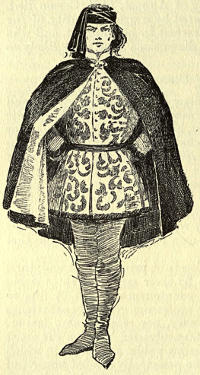
A Florentine of the Fifteenth Century
In his person, Cosmo was tall; in his youth, he possessed the advantage of a prepossessing countenance; what age had taken from his comeliness it had added to his dignity; and in his latter years, his appearance was so truly venerable as to have been the frequent subject of panegyric. His manner was grave and complacent, but upon many occasions he gave sufficient proofs that this did not arise from a want of talents for sarcasm; and the fidelity of the Florentine historians has preserved many of his shrewd observations and remarks. When Rinaldo de’ Albizzi, who was then in exile, and meditated an attack upon his native place, sent a message to Cosmo, importing that the hen would shortly hatch, he replied, “She will hatch with an ill grace out of her own nest.” On another occasion, when his adversaries gave him to understand that they were not sleeping, “I believe it,” said Cosmo, “I have spoiled their sleep.” “Of what colour is my hair?” said Cosmo, uncovering his head to the ambassadors of Venice, who came with a complaint against the Florentines. “White,” they replied. “It will not be long,” said Cosmo, “before that of your senators will be so, too.” Shortly before his death, his wife inquiring why he closed his eyes, “That I may accustom them to it,” was his reply.
If, from considering the private character of Cosmo, we attend to his conduct as the moderator and director of the Florentine Republic, our admiration of his abilities will increase with the extent of the theatre upon which he had to act. So important were his mercantile concerns, that they often influenced in a very remarkable degree the politics of Italy. When Alfonso, king of Naples, leagued with the Venetians against Florence, Cosmo called in such immense debts from those places as deprived them of resources for carrying on the war. During the contest between the houses of York and Lancaster, one of his agents in England was resorted to by Edward IV for a sum of money, which was furnished to such an extraordinary amount, that it might almost be considered as the means of supporting that monarch on the throne, and was repaid when his successes enabled him to fulfil his engagement. The alliance of Cosmo was sedulously courted by the princes of Italy; and it was remarked that by a happy kind of fatality, whoever united their interests with his, was always enabled either to repress or to overcome their adversaries. By his assistance the republic of Venice resisted the united attacks of Filippo, duke of Milan, and of the French nation; but when deprived of his support, the Venetians were no longer able to withstand their enemies. Whatever difficulties Cosmo had to encounter, at home or abroad, they generally terminated in the acquisition of additional honour to his country and to himself. The esteem and gratitude of his fellow-citizens were fully shown a short time before his death, when by a public decree he was honoured with the title of Pater Patriæ, Father of his Country, an appellation which was inscribed on his tomb, and which, as it was founded on real merit, has ever since been attached to the name of Cosmo de’ Medici.d
“With all his faults,” says Von Reumont,c “Cosmo was certainly a remarkable man. More than anyone else he contributed to keep alive not only the forms but much of the spirit of civil equality and dignity, after it had become impossible to avoid a party government leading sooner or later to the preponderance of one family.”
Marsilio Ficinol described Cosmo as “a man intelligent above all others, pious before God, just and high-minded towards his fellow-men, modest in everything that concerned himself, active in his private affairs, but still more careful and prudent in public ones. He did not live for himself alone,” adds the eulogist, “but for the service of God and his country.”
COSMO’S SUCCESSOR
During the later years of Cosmo’s life Lucas Pitti came to regard himself as the future chief of the state. It was about this time that he undertook the building of that magnificent palace which formed the residence of the grand dukes. The republican equality was not only offended by the splendour of this regal dwelling, but the construction of it afforded Pitti an occasion for marking his contempt of liberty and the laws. He made of this building an asylum for all fugitives from justice, whom no public officer dared pursue when once he took part in the labour. At the same time individuals, as well as communities, who would obtain some favour from the republic, knew that the only means of being heard was to offer Lucas Pitti some precious wood or marble to be employed in the construction of his palace.
[1464-1466 A.D.]
When Cosmo de’ Medici died, on the 1st of August, 1464, Lucas Pitti felt himself released from the control imposed by the virtue and moderation of that great citizen. Cosmo’s son, Piero de’ Medici, then forty-eight years of age, supposed that he should succeed to the administration of the republic, as he had succeeded to the wealth of his father, by hereditary right; but the state of his health did not admit of his attending regularly to business, or of his inspiring his rivals with much fear. To diminish the weight of affairs which oppressed him, he resolved on withdrawing a part of his immense fortune from commerce, recalling all his loans made in partnership with other merchants, and laying out this money in land. But this unexpected demand of considerable capital occasioned a fatal shock to the commerce of Florence, at the same time that it alienated all the debtors of the house of Medici, and deprived it of much of its popularity. The death of Sforza also, which took place on the 8th of March, 1466, deprived the Medicean party of its firmest support abroad. Francesco Sforza, whether as condottiere or duke of Milan, had always been the devoted friend of Cosmo. His son, Galeazzo Sforza, who succeeded him, declared his resolution of persisting in the same alliance; but the talents, the character, and, above all, the glory of his father, were not to be found in him. Galeazzo seemed to believe that the supreme power which he inherited brought him the right of indulging every pleasure—of abandoning himself to every vice without restraint. He dissipated by his ostentation the finances of the duchy of Milan; he stained by his libertinism the honour of almost all the noble families; and he alienated the people by his cruelty.
The friends of liberty at Florence soon perceived that Lucas Pitti and Piero de’ Medici no longer agreed together; and they recovered courage when the latter proposed to the council the calling of a parliament, in order to renew the balia, the power of which expired on the 1st of September, 1465: his proposition was rejected. The magistracy began again to be drawn by lot from among the members of the party victorious in 1434. This return of liberty, however, was but of short duration. Pitti and Medici were reconciled; they agreed to call a parliament, and to direct it in concert; to intimidate it, they surrounded it with foreign troops.
But Medici, on the nomination of the balia, on the 2nd of September, 1466, found means of admitting his own partisans only, and excluding all those of Lucas Pitti. The citizens who had shown any zeal for liberty were all exiled; several were subjected to enormous fines. Five commissioners, called accoppiatori, were charged to open, every two months, the purse from which the signoria were to be drawn, and choose from thence the names of the gonfalonier and eight priori, who were to enter office. These magistrates were so dependent on Piero de’ Medici, that the gonfalonier went frequently to his palace to take his orders, and afterwards published them as the result of his deliberations with his colleagues, whom he had not even consulted. Lucas Pitti ruined himself in building his palace. His talents were judged to bear no proportion to his ambition; the friends of liberty, as well as those of Medici, equally detested him, and he remained deprived of all power in a city which he had so largely contributed to enslave.
Italy became filled with Florentine emigrants; every revolution, even every convocation of parliament, was followed by the exile of many citizens. The party of the Albizzi had been exiled in 1434; but the Alberti, who had vanquished it, were, in turn, banished in 1466; and among the members of both parties were to be found almost all the historical names of Florence—those names which Europe had learned to respect, either for immense credit in commerce, or for the lustre which literature and the arts shed on them.
[1466-1470 A.D.]
Italy was astonished at the exile of so many illustrious persons. At Florence, the citizens who escaped proscription trembled to see despotism established in their republic; but the lower orders were in general contented, and made no attempt to second Bartolommeo Colleoni, when he entered Tuscany, in 1467, at the head of the Florentine emigrants, who had taken him into their pay. Commerce prospered; manufactures were carried on with great activity; high wages supported in comfort all who lived by their labour; and the Medici entertained them with shows and festivals, keeping them in a sort of perpetual carnival, amidst which the people soon lost all thought of liberty.
Piero de’ Medici was always in too bad a state of health to exercise in person the sovereignty he had usurped over his country; he left it to five or six citizens who reigned in his name. Tommaso Soderini, Andrea de’ Pazzi, Luigi Guicciardini, Matteo Palmieri, and Pietro Minerbetti, were the real chiefs of the state. They not only transacted all business, but appropriated to themselves all the profit; they sold their influence and credit; they gratified their cupidity or their vengeance: but they took care not to act in their own names, or to pledge their own responsibility; they left that to the house of Medici. Piero, during the latter months of his life, perceived the disorder and corruption of his agents. He was afflicted to see his memory thus stained, and he addressed them the severest reprimands; he even entered into correspondence with the emigrants, whom he thought of recalling, when he died, on the 2nd of December, 1469. His two sons, Lorenzo and Giuliano, the elder of whom was not twenty-one years of age, were presented by Tommaso Soderini to the foreign ambassadors, to the magistrates, and to the first citizens of the ruling faction; which last he warned, that the only means of maintaining their party was to preserve the respect of all for its chiefs. But the two younger Medici, given up to all the pleasures of the age, had yet no ambition. The power of the state remained in the hands of the five citizens who had exercised it under Piero.
PIERO’S SONS AND THE CONSPIRACIES
Italy had reached the fatal period at which liberty can no longer be saved by a noble resistance, or recovered by open force. There remained only the dangerous and, most commonly, the fatal resource of conspiracy. So far from experiencing the repugnance we now feel to assassination as a means of delivering our country, men of the fifteenth century perceived honour in a murder, virtue in the sacrifice, and historic grandeur in conspiracy. Danger alone stopped them; but that danger must be terrible. Tyrants, feeling themselves at war with the universe, were always on their guard; and as they owed their safety only to terror, the punishment which they inflicted, if victorious, was extreme in its atrocity. Yet these terrors did not discourage the enemies of the existing order, whether royalist or republican. Never had there been more frequent or more daring conspiracies than in this century. The ill success of some never deterred others from immediately treading in their steps.
The first plot was directed against the Medici. Bernardo Nardi, one of the Florentine citizens, who had been exiled from his country in the time of Piero de’ Medici, accompanied by about a hundred of his partisans, surprised the gate of Prato, on the 6th of April, 1470. He made himself master of the public palace, and arrested the Florentine podesta; he took possession of the citadel and afterwards, traversing the streets, called on the people to join him, and fight for liberty. He intended to make this small town the stronghold of the republican party, whence to begin his attack on the Medici. But although he had succeeded by surprise in making himself master of the town, the inhabitants remained deaf to his voice, and not one answered his call—not one detested tyranny sufficiently to combat it, at the peril of the last extremity of human suffering. The friends of the government, seeing that Nardi remained alone, at last took arms, attacked him on all sides, and soon overpowered him by numbers. Nardi was made prisoner, led to Florence, and there beheaded with six of his accomplices; twelve others were hanged at Prato.
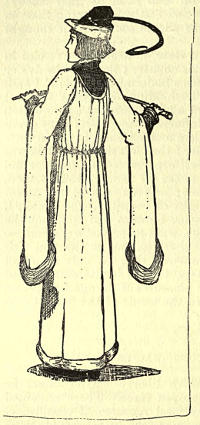
Street Costume of an Italian Nobleman, Fifteenth Century
[1476 A.D.]
In 1476 a conspiracy was formed, at Milan, against Galeazzo Sforza, whose yoke became insupportable to all who had any elevation of soul. There was no crime of which that false and ferocious man was not believed to be capable. Among other crimes, he was accused of having poisoned his mother. It was remarked of him that, enjoying the spectacle of astonishment and despair, he always preferred to strike the most suddenly and cruelly those whom he had given most reason to rely on his friendship.
Not satisfied with making the most distinguished women of his states the victims of his seduction or his violence, he took pleasure in publishing their shame—in exposing it to their brothers or husbands. He not unfrequently gave them up to prostitution. His extravagant pomp exhausted his finances, which he afterwards recruited by the most cruel extortion on the people. He took pleasure in inventing new and most atrocious forms of capital punishment; even that of burying his victims alive was not the most cruel. At last, three young nobles, of families who had courageously resisted the usurpation of Francesco Sforza, and who had themselves experienced the injustice and outrages of his son, resolved to deliver their country from this monster; not doubting that, when he had fallen, the Milanese would joyfully unite in substituting a free government for a tyranny.
Girolamo Olgiati, Carlo Visconti, and Andrea Lampugnani resolved, in concert, to trust only to themselves, without admitting one other person into their secret. Their enthusiasm had been excited by the lessons of their literary instructor, Colas di Montano, who continually set before them the grandeur of the ancient republics, and the glory of those who had delivered them from tyranny. Determined on killing the duke, they long exercised themselves in the handling of the dagger, to be more sure of striking him, each in the precise part of the tyrant’s body assigned to him. Animated with a religious zeal, not less ardent than their republican enthusiasm, they prepared themselves by prayer, by vows to St. Stephen, and by the assistance of the mass, for the act which they were about to perform. They made choice of the 26th of December, 1476, St. Stephen’s Day, on which they knew that the duke Galeazzo would go in state to the church of the saint. They waited for him in that church; and when they saw him advance between the ambassadors of Ferrara and Mantua, they respectfully approached him, their caps in hand. Feigning to keep off the crowd, they surrounded him, and struck him all at the same instant, in the midst of his guards and courtiers. Galeazzo Sforza fell dead under their weapons; and the crowd which filled the church saw the tumult and heard the cries, without comprehending the cause.
[1476-1478 A.D.]
The three conspirators endeavoured to escape from the church, to call the people to arms and liberty; but the first sentiments which they encountered were astonishment and terror. The guards of the duke drew their swords only to avenge him. Lampugnani, in attempting to avoid them, got entangled in the trains of the kneeling women, was thrown down, and killed by an esquire of Galeazzo; a few steps from him, Visconti also was put to death by the guards. But Olgiati had the misfortune to escape, in this first moment, from all who pursued him; and, running through the streets, called loudly to arms and liberty; not one person answered the call. He afterwards sought to conceal himself, but was discovered, seized, and put to the most excruciating torture. In the interval between that infliction and his death, he wrote or dictated the narrative demanded of him, and which has been handed down to us. It is composed in a strain of the noblest enthusiasm, with a deep religious feeling, with an ardent love of liberty, and with the firm persuasion that he had performed a good action. He was again delivered to the executioner to have his flesh torn with red-hot pincers. At the time of his martyrdom he was only twenty-two years of age.e
The Pazzi Conspiracy
The public agitation excited by the assassination of the duke of Milan had scarcely subsided, before an event took place at Florence of a much more atrocious nature, inasmuch as the objects destined to destruction had not afforded a pretext, in any degree plausible, for such an attempt. Accordingly, we have now to enter on a transaction that has seldom been mentioned without emotions of the strongest horror and detestation; and which, as has justly been observed, is an incontrovertible proof of the practical atheism of the times in which it took place—a transaction in which a pope, a cardinal, an archbishop, and several other ecclesiastics associated themselves with a band of ruffians, to destroy two men who were an honour to their age and country; and purposed to perpetrate their crime at a season of hospitality, in the sanctuary of a Christian church, and at the very moment of the elevation of the Host, when the audience bowed down before it, and the assassins were presumed to be in the immediate presence of their God.
At the head of this conspiracy were Sixtus IV and his nephew, Girolamo Riario. Raffaello Riario, the nephew of this Girolamo, who, although a young man then pursuing his studies, had lately been raised to the dignity of cardinal, was rather an instrument than an accomplice in the scheme. The enmity of Sixtus to Lorenzo had for some time been apparent, and if not occasioned by the assistance which Lorenzo had afforded to Niccolo Vitelli, and other independent nobles, whose dominions Sixtus had either threatened or attacked, was certainly increased by it. The destruction of the Medici appeared, therefore, to Sixtus as the removal of an obstacle that thwarted all his views, and by the accomplishment of which the small surrounding states would soon become an easy prey. There is, however, great reason to believe that the pope did not confine his ambition to these subordinate governments, but that if the conspiracy had succeeded to his wish, he meant to have grasped at the dominion of Florence itself. The alliance lately formed between the Florentines, the Venetians, and the duke of Milan, which was principally effected by Lorenzo de’ Medici, and by which the pope found himself prevented from disturbing the peace of Italy, was an additional and powerful motive of resentment. One of the first proofs of the displeasure of the pope was his depriving Lorenzo of the office of treasurer of the papal see, which he gave to the Pazzi, a Florentine family, who, as well as the Medici, had a public bank at Rome, and who afterwards became the coadjutors of Sixtus in the execution of his treacherous purpose.
The conspiracy, of which Sixtus and his nephew were the real instigators, was first agitated at Rome, where the intercourse between the count Girolamo Riario and Francesco de’ Pazzi, in consequence of the office held by the latter, afforded them an opportunity of communicating to each other their common jealousy of the power of the Medici, and their desire of depriving them of their influence in Florence; in which event it is highly probable that the Pazzi were to have exercised the chief authority in the city, under the patronage, if not under the avowed dominion, of the papal see. The principal agent engaged in the undertaking was Francesco Salviati, archbishop of Pisa, to which rank he had lately been promoted by Sixtus, in opposition to the wishes of the Medici, who had for some time endeavoured to prevent him from exercising his episcopal functions. If it be allowed that the unfavourable character given him by Politian is exaggerated, it is generally agreed that his qualities were the reverse of those which ought to have been the recommendations to such high preferment. The other conspirators were Jacopo Salviati, brother of the archbishop; Jacopo Poggio, one of the sons of the celebrated Poggio Bracciolini, and who, like all the other sons of that eminent scholar, had obtained no small share of literary reputation; Bernardo Bandini, a daring libertine, rendered desperate by the consequences of his excesses; Giovan Battista Montesicco, who had distinguished himself by his military talents as one of the condottieri of the armies of the pope; Antonio Maffei, a priest of Volterra, and Stefano de Bagnone, one of the apostolic scribes, with several others of inferior note.
In the arrangement of their plan, which appears to have been concerted with great precaution and secrecy, the conspirators soon discovered that the dangers which they had to encounter were not so likely to arise from the difficulty of the attempt, as from the subsequent resentment of the Florentines, a great majority of whom were strongly attached to the Medici. Hence it became necessary to provide a military force, the assistance of which might be equally requisite whether the enterprise proved abortive or successful. By the influence of the pope, the king of Naples, who was then in alliance with him, and on one of whose sons he had recently bestowed a cardinal’s hat, was also induced to countenance the attempt.
These preliminaries being adjusted, Girolamo wrote to his nephew, the cardinal Riario, then at Pisa, ordering him to obey whatever directions he might receive from the archbishop. A body of two thousand men were destined to approach by different routes towards Florence, so as to be in readiness at the time appointed for striking the blow.
Shortly afterwards, the archbishop requested the presence of the cardinal at Florence, whither he immediately repaired, and took up his residence at a seat of the Pazzi, about a mile from the city. It seems to have been the intention of the conspirators to effect their purpose at Fiesole, where Lorenzo then had his country residence, to which they supposed that he would invite the cardinal and his attendants. Nor were they deceived in this conjecture, for Lorenzo prepared a magnificent entertainment on this occasion; but the absence of Giuliano, on account of indisposition, obliged the conspirators to postpone the attempt. Being thus disappointed in their hopes, another plan was now to be adopted; and on further deliberation it was resolved that the assassination should take place on the succeeding Sunday, in the church of the Reparata, since called Santa Maria del Fiore, and that the signal for execution should be the elevation of the Host. At the same moment, the archbishop and others of the conspirators were to seize upon the palace, or residence of the magistrates, whilst the office of Jacopo de’ Pazzi was to endeavour, by the cry of “Liberty!” to incite the citizens to revolt.
The immediate assassination of Giuliano was committed to Francesco de’ Pazzi and Bernardo Bandini, and that of Lorenzo had been intrusted to the sole hand of Montesicco. This office he had willingly undertaken whilst he understood that it was to be executed in a private dwelling, but he shrank from the idea of polluting the house of God with so heinous a crime. Two ecclesiastics were therefore selected for the commission of a deed from which the soldier was deterred by conscientious motives. These were Stefano da Bagnone, the apostolic scribe, and Antonio Maffei.
The young cardinal having expressed a desire to attend divine service in the church of the Reparata, on the ensuing Sunday, being the 26th day of April, 1478, Lorenzo invited him and his suite to his house in Florence. He accordingly came with a large retinue, supporting the united characters of cardinal and apostolic legate, and was received by Lorenzo with that splendour and hospitality with which he was always accustomed to entertain men of high rank and consequence. Giuliano did not appear, a circumstance that alarmed the conspirators, whose arrangements would not admit of longer delay. They soon, however, learned that he intended to be present at the church. The service was already begun, and the cardinal had taken his seat, when Francesco de’ Pazzi and Bandini, observing that Giuliano was not yet arrived, left the church and went to his house, in order to insure and hasten his attendance. Giuliano accompanied them, and as he walked between them they threw their arms round him with the familiarity of intimate friends, but in fact to discover whether he had any armour under his dress; possibly conjecturing, from his long delay, that he had suspected their purpose. At the same time, by their freedom and jocularity, they endeavoured to obviate any apprehensions which he might entertain from such a proceeding. The conspirators, having taken their stations near their intended victims, waited with impatience for the appointed signal. The bell rang, the priest raised the consecrated wafer, the people bowed before it, and at the same instant Bandini plunged a short dagger into the breast of Giuliano.
On receiving the wound, he took a few hasty steps and fell, when Francesco de’ Pazzi rushed upon him with incredible fury, and stabbed him in different parts of his body, continuing to repeat his strokes even after he was apparently dead. Such was the violence of his rage that he wounded himself deeply in the thigh. The priests who had undertaken the murder of Lorenzo were not equally successful. An ill-directed blow from Maffei, which was aimed at the throat, but took place behind the neck, rather roused him to his defence than disabled him. He immediately threw off his cloak, and holding it up as a shield in his left hand, with his right he drew his sword, and repelled his assailants. Perceiving that their purpose was defeated, the two ecclesiastics, after having wounded one of Lorenzo’s attendants who had interposed to defend him, endeavoured to save themselves by flight. At the same moment, Bandini, his dagger streaming with the blood of Giuliano, rushed towards Lorenzo; but meeting in his way with Francesco Nori, a person in the service of the Medici, in whom they placed great confidence, he stabbed him with a wound instantaneously mortal. At the approach of Bandini, the friends of Lorenzo encircled him, and hurried him into the sacristy, where Politian and others closed the doors, which were of brass. Apprehensions being entertained that the weapon which had wounded him was poisoned, a young man attached to Lorenzo sucked the wound. A general alarm and consternation commenced in the church; and such was the tumult that ensued that it was at first believed that the building was falling in; but no sooner was it understood that Lorenzo was in danger, than several of the youth of Florence formed themselves into a body, and receiving him into the midst of them, conducted him to his house, making a circuitous turn from the church, lest he should meet with the dead body of his brother.
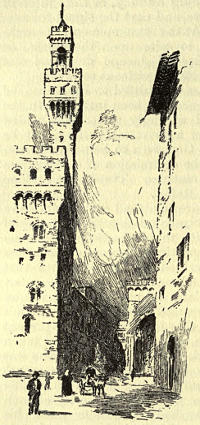
Palazzo Vecchio, Florence
While these transactions passed in the church, another commotion arose in the palace, where the archbishop, who had left the church, as agreed upon before the attack on the Medici, and about thirty of his associates, attempted to overpower the magistrates, and to possess themselves of the seat of government. Leaving some of his followers stationed in different apartments, the archbishop proceeded to an interior chamber, where Cesare Petrucci, then gonfalonier, and the other magistrates were assembled. No sooner was the gonfalonier informed of his approach than, out of respect to his rank, he rose to meet him. Whether the archbishop was disconcerted by the presence of Petrucci, who was known to be of a resolute character, of which he had given a striking instance in frustrating the attack of Bernardo Nardi upon the town of Prato, or whether his courage was not equal to the undertaking, is uncertain; but instead of intimidating the magistrates by a sudden attack, he began to inform Petrucci that the pope had bestowed an employment on his son, of which he had to deliver to him the credentials. This he did with such hesitation, and in so desultory a manner, that it was scarcely possible to collect his meaning. Petrucci also observed that he frequently changed colour, and at times turned towards the door, as if giving a signal to someone to approach.
Alarmed at his manner, and probably aware of his character, Petrucci suddenly rushed out of the chamber, and called together the guards and attendants. By attempting to retreat, the archbishop confessed his guilt. In pursuing him, Petrucci met with Jacopo Poggio, whom he caught by the hair, and throwing him on the ground, delivered him into the custody of his followers. The rest of the magistrates and their attendants seized upon such arms as the place supplied, and the implements of the kitchen became formidable weapons in their hands. Having secured the doors of the palace, they furiously attacked their scattered and intimidated enemies, who no longer attempted resistance. During this commotion, they were alarmed by a tumult from without, and perceived from the windows Jacopo de’ Pazzi, followed by about one hundred soldiers, crying out, “Liberty!” and exhorting the people to revolt. At the same time they found that the insurgents had forced the gates of the palace, and that some of them were entering to defend their companions. The magistrates, however, persevered in their defence, and repulsing their enemies, secured the gates till a reinforcement of their friends came to their assistance. Petrucci was now first informed of the assassination of Giuliano, and the attack made upon Lorenzo. The relation of this treachery excited his highest indignation. With the concurrence of the state counsellors, he ordered Jacopo Poggio to be hung in sight of the populace, out of the palace windows, and secured the archbishop, with his brother, and the other chiefs of the conspiracy. Their followers were either slaughtered in the palace, or thrown half alive through the windows. One only of the whole number escaped. He was found some days afterwards concealed in the wainscots, perishing with hunger, and in consideration of his sufferings received his pardon.
The young cardinal Riario, who had taken refuge at the altar, was preserved from the rage of the populace by the interference of Lorenzo, who appeared to give credit to his asseverations that he was ignorant of the intentions of the conspirators. Ammiratom asserts that his fears had so violent an effect upon him that he never afterwards recovered his natural complexion. His attendants fell a sacrifice to the resentment of the citizens. The streets were polluted with the dead bodies and mangled limbs of the slaughtered. With the head of one of these unfortunate wretches on a lance, the populace paraded the city, which resounded with the cry of “Palle! Palle!” (Perish the traitors.) Francesco de’ Pazzi, being found at the house of his uncle, Jacopo, where on account of his wound he was confined to his bed, was dragged out naked and exhausted by loss of blood, and being brought to the palace, suffered the same death as his associate. His punishment was immediately followed by that of the archbishop, who was hung through the windows of the palace, and was not allowed even to divest himself of his prelatical robes. The last moments of Salviati, if we may credit Politian, were marked by a singular instance of ferocity. Being suspended close to Francesco de’ Pazzi, he seized the naked body with his teeth, and relaxed not from his hold even in the agonies of death.
Jacopo de’ Pazzi had escaped from the city during the tumult, but the day following he was made a prisoner by the neighbouring peasants, who, regardless of his entreaties to put him to death, brought him to Florence, and delivered him up to the magistrates. As his guilt was manifest, his execution was instantaneous, and afforded from the windows of the palace another spectacle that gratified the resentment of the enraged multitude. His nephew Renato, who suffered at the same time, excited in some degree the commiseration of the spectators. Devoted to his studies, and averse to popular commotions, he had refused to be an actor in the conspiracy, and his silence was his only crime. The body of Jacopo had been interred in the church of Santa Croce, and to this circumstance the superstition of the people attributed an unusual and incessant fall of rain that succeeded these disturbances. Partaking in their prejudices, or desirous of gratifying their revenge, the magistrates ordered his body to be removed without the walls of the city. The following morning it was again torn from the grave by a great multitude of children who, in spite of the restrictions of decency and the interference of some of the inhabitants, after dragging it a long time through the streets, and treating it with every degree of wanton opprobrium, threw it into the river Arno. Such was the fate of a man who had enjoyed the highest honours of the republic, and for his services to the state had been rewarded with the privileges of the equestrian rank. The rest of the devoted family were condemned either to imprisonment or to exile, excepting only Guglielmo de’ Pazzi, who, though not unsuspected, was first sheltered from the popular fury in the house of Lorenzo, and was afterwards ordered to remain at his own villa, about twenty-five miles distant from Florence.
[1478-1480 A.D.]
Although most diligent search was made for the priests who had undertaken the murder of Lorenzo, it was not till the third day after the attempt that they were discovered, having obtained a shelter in the monastery of the Benedictine monks. No sooner were they brought from the place of their concealment, than the populace, after cruelly mutilating them, put them to death, and with difficulty were prevented from slaughtering the monks themselves. Montesicco, who had adhered to the cause of the conspirators, although he had refused to be the active instrument of their project, was taken a few days afterwards, as he was endeavouring to save himself by flight, and beheaded, having first made a full confession of all the circumstances attending the conspiracy, by which it appeared that the pope was privy to the whole transaction. The punishment of Bernardo Bandini was longer delayed. He had safely passed the bounds of Italy, and had taken refuge at length in Constantinople; but the sultan Muhammed, being apprised of his crime, ordered him to be seized and sent in chains to Florence, at the same time alleging as the motive of his conduct the respect which he had for the character of Lorenzo de’ Medici. He arrived in the month of December in the ensuing year, and met with the due reward of his treachery. An embassy was sent from Florence to return thanks to the sultan, in the name of the republic.d
LORENZO THE MAGNIFICENT IN POWER
The ill success of the conspiracy of the Pazzi strengthened, as always happens, the government against which it was directed. The Medici had been content till then to be the first citizens of Florence: from that time Lorenzo looked upon himself as the prince of the city; and his friends, in speaking of him, sometimes employed that title. In addressing him, the epithet of “most magnificent lord” was habitually employed. It was the mode of addressing the condottieri, and the petty princes who had no other title. Lorenzo affected in his habits of life an unbounded liberality, pomp, and splendour, which he believed necessary to make up for the real rank which he wanted. The Magnificent, his title of honour, is become, not without reason, his surname with posterity. On the failure of the conspiracy, he was menaced by all Italy at once. The pope fulminated a bull against him on the 1st of June, 1478, for having hanged an archbishop. He demanded that Lorenzo de’ Medici, the gonfalonier, the priori, and the balia of Eight should be given up to him, to be punished according to the enormity of their crime. At the same time he published a league, which he had formed against them with Ferdinand of Naples and the republic of Siena. He gave the command of the army of the league to Federigo di Montefeltro, duke of Urbino, and ordered him to advance into Tuscany.e
The Florentines now prepared for war, by raising money and collecting as large a force as possible. Being in league with the duke of Milan and the Venetians, they applied to both for assistance. As the pope had proved himself a wolf rather than a shepherd, to avoid being devoured under false accusations they justified their cause with all available arguments, and filled Italy with accounts of the treachery practised against their government, exposing the impiety and injustice of the pontiff, and assured the world that the pontificate which he had wickedly attained he would as impiously fill.
The two armies, under the command of Alfonso, eldest son of Ferrando and duke of Calabria, who had as his general Federigo, count of Urbino, entered the Chianti, by permission of the Sienese, who sided with the enemy, occupied Radda with many other fortresses, and having plundered the country, besieged the Castellina. The Florentines were greatly alarmed at these attacks, being almost destitute of forces, and finding their friends slow to assist; for though the duke sent them aid, the Venetians denied all obligation to support the Florentines in their private quarrels, since the animosities of individuals were not to be defended at the public expense. The Florentines, in order to induce the Venetians to take a more correct view of the case, sent Tommaso Soderini as their ambassador to the senate, and, in the meantime, engaged forces, and appointed Ercole, marquis of Ferrara, to the command of their army. Whilst these preparations were being made, the Castellina were so hard pressed by the enemy, that the inhabitants, despairing of relief, surrendered, after having sustained a siege of forty-two days.
The enemy then directed their course towards Arezzo, and encamped before San Savino. The Florentine army, being now in order, went to meet them, and having approached within three miles, caused such annoyance that Federigo d’Urbino demanded a truce for a few days, which was granted, but proved so disadvantageous to the Florentines that those who had made the request were astonished at having obtained it; for, had it been refused, they would have been compelled to retire in disgrace. Having gained these few days to recruit themselves, as soon as they were expired they took the castle in the presence of their enemies. Winter being now come, the forces of the pope and the king retired for convenient quarters to the Sienese territory. The Florentines also withdrew to a more commodious situation, and the marquis of Ferrara, having done little for himself and less for others, returned to his own territories.
At this time, ambassadors came to Florence from the emperor, the king of France, and the king of Hungary, who were sent by their princes to the pontiff. They solicited the Florentines also to send ambassadors to the pope, and promised to use their utmost exertion to obtain for them an advantageous peace. The Florentines did not refuse to make trial, both for the sake of publicly justifying their proceedings, and because they were really desirous of peace. Accordingly, the ambassadors were sent, but returned without coming to any conclusion of their differences. The Florentines, to avail themselves of the influence of the king of France, since they were attacked by one part of the Italians and abandoned by the other, sent to him as their ambassador Donato Acciajuoli, a distinguished Latin and Greek scholar, whose ancestors had always ranked high in the city; but whilst on his journey he died at Milan. To relieve his surviving family and pay a deserved tribute to his memory, he was honourably buried at the public expense, provision was made for his sons, and suitable marriage portions given to his daughters, and Guid’ Antonio Vespucci, a man well acquainted with pontifical and imperial affairs, was sent as ambassador to the king in his stead.
The attack of Signor Roberto upon the Pisan territory, being unexpected, greatly perplexed the Florentines; for having to resist the foe in the direction of Siena, they knew not how to provide for the places about Pisa. To keep the Lucchese faithful, and prevent them from furnishing the enemy either with money or provisions, they sent as ambassador Piero di Gino Capponi, who was received with so much jealousy, on account of the hatred which that city always cherishes against the Florentines from former injuries and constant fear, that he was on many occasions in danger of being put to death by the mob; and thus his mission gave fresh cause of animosity rather than of union. The Florentines recalled the marquis of Ferrara, and engaged the marquis of Mantua; they also as earnestly requested the Venetians to send them Count Carlo, son of Braccio, and Deifobo, son of Count Jacopo, and after many delays, they complied; for having made a truce with the Turks, they had no excuse to justify a refusal, and could not break through the obligation of the league without the utmost disgrace. The counts Carlo and Deifobo came with a good force, and being joined by all that could be spared from the army, which, under the marquis of Ferrara, held in check the duke of Calabria, proceeded towards Pisa, to meet Signor Roberto, who was with his troops near the river Serchio, and who, though he had expressed his intention of awaiting their arrival, withdrew to the camp at Lunigiana, which he had quitted upon coming into the Pisan territory, while Count Carlo recovered all the places that had been taken by the enemy in that district.
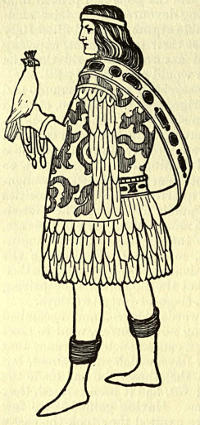
Hunting Costume of an Italian Baron
The Florentines, being thus relieved from the attack in the direction of Pisa, assembled the whole force between Colle and Santo Geminiano. But the army, on the arrival of Count Carlo, being composed of Sforzeschi and Bracceshi, their hereditary feuds soon broke forth, and it was thought that if they remained long in company they would turn their arms against each other. It was therefore determined, as the smaller evil, to divide them; to send one party, under Count Carlo, into the district of Perugia, and establish the other at Poggibonzi, where they formed a strong encampment in order to prevent the enemy from penetrating the Florentine territory. By this they also hoped to compel the enemy to divide their forces; for Count Carlo was understood to have many partisans in Perugia, and it was therefore expected either that he would occupy the place, or that the pope would be compelled to send a large body of men for its defence. To reduce the pontiff to greater necessity, they ordered Niccolo Vitelli, who had been expelled from Città di Castello, where his enemy Lorenzo Vitelli commanded, to lead a force against that place, with the view of driving out his adversary and withdrawing it from obedience to the pope. At the beginning of the campaign, fortune seemed to favour the Florentines; for Count Carlo made rapid advances in the Perugino, and Niccolo Vitelli, though unable to enter Castello, was superior in the field, and plundered the surrounding country without opposition. The forces also at Poggibonzi constantly overran the country up to the walls of Siena.
These hopes, however, were not realised; for, in the first place, Count Carlo died while in the fullest tide of success, though the consequences of this would have been less detrimental to the Florentines had not the victory to which it gave occasion been nullified by the misconduct of others. The death of the count being known, the forces of the church, which had already assembled in Perugia, conceived hopes of overcoming the Florentines, and encamped upon the lake, within three miles of the enemy. On the other side, Jacopo Guicciardini, commissary to the army, by the advice of Roberto da Rimino, who, after the death of Count Carlo, was the principal commander, knowing the ground of their sanguine expectations, determined to meet them; and coming to an engagement near the lake, upon the site of the memorable rout of the Romans by Hannibal, the Carthaginian general, the papal forces were vanquished. The news of the victory, which did great honour to the commanders, diffused universal joy at Florence, and would have insured a favourable termination of the campaign, had not the disorders which arose in the army at Poggibonzi thrown all into confusion; for the advantage obtained by the valour of the one was more than counterbalanced by the disgraceful proceedings of the other. Having made considerable booty in the Sienese territory, quarrels arose about the division of it between the marquis of Mantua and the marquis of Ferrara, who, coming to arms, assailed each other with the utmost fury; and the Florentines, seeing they could no longer avail themselves of the services of both, allowed the marquis of Ferrara and his men to return home.
The Florentines Routed at Poggibonzi
The army being thus reduced, without a leader, and disorder prevailing in every department, the duke of Calabria, who was with his forces near Siena, resolved to attack them immediately. The Florentines, finding the enemy at hand, were seized with a sudden panic; neither their arms nor their numbers, in which they were superior to their adversaries, nor their position, which was one of great strength, could give them confidence; but observing the dust occasioned by the enemy’s approach, without waiting for a sight of them, they fled in all directions, leaving their ammunition, carriages, and artillery to be taken by the foe. Such cowardice and disorder prevailed in the armies of those times that the turning of a horse’s head or tail was sufficient to decide the fate of an expedition. This defeat loaded the king’s troops with booty and filled the Florentines with dismay, for the city, besides the war, was afflicted with pestilence, which prevailed so extensively that all who possessed villas fled to them to escape death. This occasioned the defeat to be attended with greater horror; for those citizens whose possessions lay in the Val di Pesa and the Val d’Elsa, having retired to them, hastened to Florence with all speed as soon as they heard of the disaster, taking with them not only their children and their property, but even their labourers; so that it seemed as if the enemy were expected every moment in the city.
Those who were appointed to the management of the war, perceiving the universal consternation, commanded the victorious forces in the Perugino to give up their enterprise in that district and march to oppose the enemy in the Val d’Elsa, who, after their victory, plundered the country without opposition; and although the Florentine army had so closely pressed the city of Perugia that it was expected to fall into their hands every instant, the people preferred defending their own possessions to endeavouring to seize those of others. The troops, thus withdrawn from the pursuit of their good fortune, were marched to San Casciano, a castle within eight miles of Florence, the leaders thinking they could take up no other position till the relics of the routed army were assembled. On the other hand, the enemy being under no further restraint at Perugia, and emboldened by the departure of the Florentines, plundered to a large amount in the districts of Arezzo and Cortona; whilst those who under Alfonso, duke of Calabria, had been victorious near Poggibonzi, took the town itself, sacked Vico and Certaldo, and after these conquests and pillagings encamped before the fortress of Colle, which was considered very strong; and as the garrison was brave and faithful to the Florentines, it was hoped they would hold the enemy at bay till the republic was able to collect its forces. The Florentines being at San Casciano, and the enemy continuing to use their utmost exertions against Colle, they determined to draw nearer, that the inhabitants might be the more resolute in their defence and the enemy assail them less boldly. With this design they removed their camp from San Casciano to Santo Geminiano, about five miles from Colle, and with light cavalry and other suitable forces were able every day to annoy the duke’s camp.
All this, however, was insufficient to relieve the people of Colle; for, having consumed their provisions, they were compelled to surrender on the 13th of November, to the great grief of the Florentines and joy of the enemy, more especially of the Sienese, who, besides their habitual hatred of the Florentines, had a particular animosity against the people of Colle.
It was now the depth of winter, and the weather so unsuitable for war that the pope and the king, either designing to hold out a hope of peace or more quietly to enjoy the fruit of their victories, proposed a truce for three months to the Florentines, and allowed them ten days to consider the reply. The offer was eagerly accepted; but as wounds are well known to be more painful after the blood cools than when they were first received, this brief repose awakened the Florentines to a consciousness of the miseries they had endured; and the citizens openly laid the blame upon each other, pointing out the errors committed in the management of the war, the expenses uselessly incurred, and the taxes unjustly imposed. These matters were boldly discussed, not only in private circles, but in the public councils; and one individual even ventured to turn to Lorenzo de’ Medici and say, “The city is exhausted and can endure no more war; it is therefore necessary to think of peace.”
Lorenzo was himself aware of the necessity, and assembled the friends in whose wisdom and fidelity he had the greatest confidence, when it was at once concluded that, as the Venetians were lukewarm and unfaithful, and the duke in the power of his guardians, and involved in domestic difficulties, it would be desirable by some new alliance to give a better turn to their affairs. They were in doubt whether to apply to the king or to the pope; but having examined the question on all sides, they preferred the friendship of the king as more suitable and secure; for the short reigns of the pontiffs, the changes ensuing upon each succession, the disregard shown by the church towards temporal princes, and the still greater want of respect for them exhibited in her determinations, rendered it impossible for a secular prince to trust a pontiff, or safely to share his fortune; for an adherent of the pope would have a companion in victory, but in defeat must stand alone, whilst the pontiff was sustained by his spiritual power and influence.
Lorenzo’s Embassy to Naples
Having therefore decided that the king’s friendship would be of the greatest utility to them, they thought it would be most easily and certainly obtained by Lorenzo’s presence; for in proportion to the confidence they evinced towards him, the greater they imagined would be the probability of removing his impressions of past enmities. Lorenzo, having resolved to go to Naples, recommended the city and government to the care of Tommaso Soderini, who was at that time gonfalonier of justice. He left Florence at the beginning of December, and having arrived at Pisa, wrote to the government to acquaint them with the cause of his departure. The seigniory, to do him honour, and enable him the more effectually to treat with the king, appointed him ambassador from the Florentine people, and endowed him with full authority to make such arrangements as he thought most useful for the republic.
At this time Roberto da San Severino, with Lodovico and Ascanio (Sforza, their elder brother, being dead), again attacked Milan, in order to recover the government. Having taken Tortona, and the city and the whole state being in arms, the duchess Bona was advised to restore the Sforzeschi, and to put a stop to civil contentions by admitting them to the government. The person who gave this advice was Antonio Tassino, of Ferrara, a man of low origin, who, coming to Milan, fell into the hands of the duke Galeazzo, and was given by him to his duchess for her valet. He, either from his personal attractions, or some secret influence, after the duke’s death attained such influence over the duchess, that he governed the state almost at his will. This greatly displeased the minister Cecco, whom prudence and long experience had rendered invaluable; and who, to the utmost of his power, endeavoured to diminish the authority of Tassino with the duchess and other members of the government. Tassino, aware of this, to avenge himself for the injury, and secure defenders against Cecco, advised the duchess to recall the Sforzeschi, which she did, without communicating her design to the minister, who, when it was done, said to her, “You have taken a step which will deprive me of my life, and you of the government.” This shortly afterwards took place, for Cecco was put to death by Lodovico, and Tassino being expelled from the dukedom, the duchess was so enraged that she left Milan, and gave up the care of her son to Lodovico who, becoming sole governor of the dukedom, caused, as will be hereafter seen, the ruin of Italy.
Lorenzo de’ Medici had set out for Naples, and the truce between the parties was in force, when, quite unexpectedly, Lodovico Fregoso, being in correspondence with some persons of Sarzana, entered the place by stealth, took possession of it with an armed force, and imprisoned the Florentine governor. This greatly offended the seigniory, for they thought the whole had been concerted with the connivance of King Ferdinand. They complained to the duke of Calabria, who was with the army at Siena, of a breach of the truce; and he endeavoured to prove, by letters and embassies, that it had occurred without either his own or his father’s knowledge. The Florentines, however, found themselves in a very awkward predicament, being destitute of money, the head of the republic in the power of the king, themselves engaged in a long-standing war with the latter and the pope, in a new one with the Genoese, and entirely without friends; for they had no confidence in the Venetians, and on account of its changeable and unsettled state they were rather apprehensive of Milan. They had thus only one hope, and that depended upon Lorenzo’s success with the king.
Lorenzo arrived at Naples by sea, and was most honourably received, not only by Ferdinand, but by the whole city, his coming having excited the greatest expectation; for it being generally understood that the war was undertaken for the sole purpose of effecting his destruction, the power of his enemies invested his name with additional lustre. Being admitted to the king’s presence, he spoke with so much propriety upon the affairs of Italy, the disposition of her princes and people, his hopes from peace, his fears of the results of war, that Ferdinand was more astonished at the greatness of his mind, the promptitude of his genius, his gravity and wisdom, than he had previously been at his power. He consequently treated him with redoubled honour, and began to feel compelled rather to part with him as a friend, than detain him as an enemy. However, under various pretexts he kept Lorenzo from December to March, not only to gain the most perfect knowledge of his own views, but of those of his city; for he was not without enemies, who would have wished the king to detain and treat him in the same manner as Jacopo Piccinino; and, with the ostensible view of sympathising for him, pointed out all that would, or rather what they wished should result from such a course; at the same time opposing in the council every proposition at all likely to favour him. By such means as these the opinion gained ground that, if he were detained at Naples much longer, the government of Florence would be changed. This caused the king to postpone their separation more than he would have otherwise done, to see if any disturbance were likely to arise. But finding everything going quietly on, Ferdinand allowed him to depart on the 6th of March, 1479, having, with every kind of attention and token of regard, endeavoured to gain his affection, and formed with him a perpetual alliance for their mutual defence. Lorenzo returned to Florence, and upon presenting himself before the citizens, the impressions he had created in the popular mind surrounded him with a halo of majesty brighter than before. He was received with all the joy merited by his extraordinary qualities and recent services, in having exposed his own life to the most imminent peril, in order to restore peace to his country. Two days after his return, the treaty between the republic of Florence and the king, by which each party bound itself to defend the other’s territories, was published. The places taken from the Florentines during the war were to be given up at the discretion of the king; the Pazzi confined in the tower of Volterra were to be set at liberty, and a certain sum of money, for a limited period, was to be paid to the duke of Calabria.