Chapter VI · THE VANGUARD OF THE RENAISSANCE
Reading edition
[ca. 1250-1400 A.D.]
We have seen much in recent chapters of the trials and disasters of Florence. We now have the more agreeable task of recording her triumphs. The record of petty quarrels and more pretentious warrings, through which Florence has thus far been called to our attention, might well have blinded our eyes to the observation of a remarkable culture development which went on coincidentally with these political jarrings. In point of fact, there was a most extraordinary intellectual development taking place in Italy in the later centuries of the so-called dark ages, and the focus and centre of that development was Florence; in proof of which that city now gave to the world within a single century a school of writers, led by Dante, Petrarch, and Boccaccio, who virtually stamped the Italian language for the first time as a literary medium, and whose works marked the highest development of Italian creative genius. And contemporaneous with these writers were the artists Cimabue and Giotto, who gave an altogether similar impulse to art. All these men were Florentines, and so greatly did their influence preponderate over that of any other Italians of the epoch that Symondsb is fully justified in saying: “It may be affirmed without exaggeration that, prior to the close of the fifteenth century, what we called Italian genius was in truth the genius of Florence.”
This seemingly sudden efflorescence of genius had its origin, as has been intimated, in a gradual development, which now for the first time produced tangible results. If, on the one hand, it may be urged that these great men were spontaneously creative, it must not be forgotten that their genius was nurtured in a bed of classicism. Dante and Petrarch and Boccaccio were all classical scholars, the last named being a student of Greek as well as of Latin. All of them harked back to the great Roman writers as their models of style, and founded their culture on a study of ancient literature. But each of them in turn broke away spontaneously from these ancient models when he came to his really creative efforts, and each put forth in the vernacular the works that were destined to give him perpetuity of fame. In their own day, to be sure, their Latin works were regarded as having great importance. Boccaccio never dreamed of placing his Italian writings on a par with his learned treatises on mythology, geography, and biography; and we are assured that for two centuries his name was famous all over Europe on account of these scientific works, while the Decameron was hardly known north of the Alps. “Petrarch himself,” says Burckhardt,c “trusted and hoped that his Latin writings would bring him fame with his contemporaries and with posterity, and thought so little of his Italian poems that, as he often tells us, he would gladly have destroyed them if he could have succeeded thereby in blotting them out from the memory of man.” Yet these would-be forgotten poems became a standard of taste for all the world, and have kept their position in the estimate of critics of each succeeding generation.
This sudden outburst of creative genius of a high order in Italy, while the rest of the western world was bound by uncreative traditions, has been variously explained. Burckhardt finds the explanation in circumstances that led, in Italy earlier than elsewhere, to the emancipation of the individual.a
In the Middle Ages, he says, both sides of human consciousness—that which was turned within as that which was turned without—lay dreaming or half awake beneath a common veil. The veil was woven of faith, illusion, and childish prepossession, through which the world and history were seen clad in strange hues. Man was conscious of himself only as member of a race, people, party, family, or corporation—only through some general category. In Italy this veil first melted into air; an objective treatment and consideration of the state and of all the things of this world became possible. The subjective side at the same time asserted itself with corresponding emphasis; man became a spiritual individual, and recognised himself as such. In the same way the Greek had once distinguished himself from the barbarian, and the Arabian had felt himself an individual at a time when other Asiatics knew themselves only as members of a race. It will not be difficult to show that this result was owing above all to the political circumstances of Italy.
In far earlier times we can here and there detect a development of free personality which in northern Europe either did not occur at all, or could not display itself in the same manner. The band of audacious wrong-doers in the sixteenth century described to us by Liutprand, some of the contemporaries of Gregory VII, and a few of the opponents of the first Hohenstaufen show us characters of this kind. But at the close of the thirteenth century Italy began to swarm with individuality; the charm laid upon human personality was dissolved; and a thousand figures meet us each in its own special shape and dress. Dante’s great poem would have been impossible in any other country of Europe, if only for the reason that they all still lay under the spell of race. For Italy the august poet, through the wealth of individuality which he set forth, was the most national herald of his time. This fact appears in the most decisive and unmistakable form. The Italians of the fourteenth century knew little of false modesty or of hypocrisy in any shape; not one of them was afraid of singularity, of being and seeming unlike his neighbours. By the year 1390 there was no longer any prevailing fashion of dress for men at Florence, each preferring to clothe himself in his own way.
Despotism, as we have already seen, fostered in the highest degree the individuality not only of the tyrant or condottiere himself, but also of the men whom he protected or used as his tools—the secretary, minister, poet, and companion. These people were forced to know all the inward resources of their own nature, passing or permanent; and their enjoyment of life was enhanced and concentrated by the desire to obtain the greatest satisfaction from a possibly very brief period of power and influence.
But even the subjects whom they ruled over were not free from the same impulse. Leaving out of account those who wasted their lives in secret opposition and conspiracies, we speak of the majority who were content with a strictly private station, like most of the urban population of the Byzantine Empire and the Mohammedan states. No doubt it was often hard for the subjects of a Visconti to maintain the dignity of their persons and families, and multitudes must have lost in moral character through the servitude they lived under. But this was not the case with regard to individuality; for political impotence does not hinder the different tendencies and manifestations of private life from thriving in the fullest vigour and variety. Wealth and culture, so far as display and rivalry were not forbidden to them, a municipal freedom which did not cease to be considerable, and a church which, unlike that of the Byzantine or of the Mohammedan world, was not identical with the state—all these conditions undoubtedly favoured the growth of individual thought, for which the necessary leisure was furnished by the cessation of party conflicts. The private man, indifferent to politics, and busied partly with serious pursuits, partly with the interests of a dilettante, seems to have been first fully formed in these despotisms of the fourteenth century. Documentary evidence cannot, of course, be required on such a point. The novelists, from whom we might expect information, describe to us oddities in plenty, but only from one point of view and in so far as the needs of the story demand. Their scene, too, lies chiefly in the republican cities.
In the latter, circumstances were also, but in another way, favourable to the growth of individual character. The more frequently the governing party was changed, the more the individual was led to make the utmost of the exercise and enjoyment of power. The statesmen and popular leaders, especially in Florentine history,[13] acquired so marked a personal character, that we can scarcely find, even exceptionally, a parallel to them in contemporary history, hardly even in Jacob van Artevelde.
The members of the defeated parties, on the other hand, often came into a position like that of the subjects of the despotic states, with the difference that the freedom or power already enjoyed, and in some cases the hope of recovering them, gave a higher energy to their individuality. Among these men of involuntary leisure we find, for instance, an Agnolo Pandolfini (died 1446), whose work on domestic economy is the first complete programme of developed private life. His estimate of the duties of the individual as against the dangers and thanklessness of public life is in its way a true monument of the age.
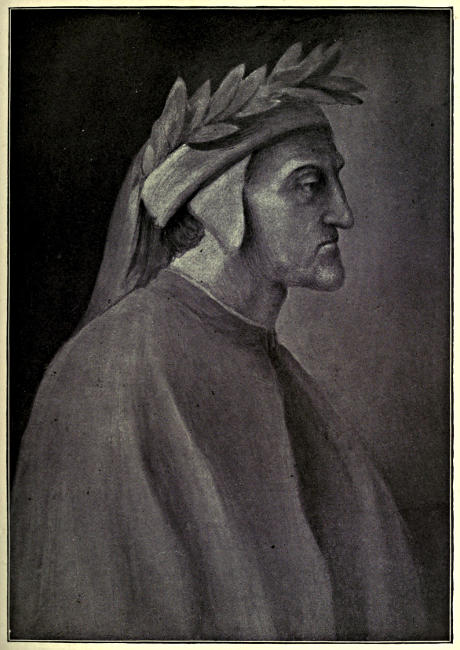
DANTE
Banishment, too, has this effect above all, that it either wears the exile out or develops whatever is greatest in him. “In all our more populous cities,” says Giovanni Pontano, “we see a crowd of people who have left their homes of their own free will; but a man takes his virtues with him wherever he goes.” And, in fact, they were by no means only men who had been actually exiled, but thousands left their native place voluntarily, because they found its political or economical condition intolerable. The Florentine emigrants at Ferrara and the Lucchese in Venice formed whole colonies by themselves.
The cosmopolitanism which grew up in the most gifted circles is in itself a high stage of individualism. Dante, as we have already said, finds a new home in the language and culture of Italy, but goes beyond even this in the words, “My country is the whole world.” And when his recall to Florence was offered him on unworthy conditions, he wrote back: “Can I not everywhere behold the light of the sun and the stars, everywhere meditate on the noblest truths, without appearing ingloriously and shamefully before the city and the people? Even my bread will not fail me.” The artists exult no less defiantly in their freedom from the constraints of fixed residence. “Only he who has learned everything,” says Ghiberti, “is nowhere a stranger; robbed of his fortune and without friends, he is yet the citizen of every country, and can fearlessly despise the changes of fortune.” In the same strain an exiled humanist writes: “Wherever a learned man fixes his seat, there is home.”c
EUROPEAN CULTURE IN GENERAL
The oppression which weighed upon the rest of Europe contributed to the maintenance of barbarism, less by rendering difficult and sometimes dangerous the acquisition of knowledge, than by taking away all attraction from the exercise of the mind. Thought was a pain to those capable of judging the state of the human species; of studying the past, of comparing it with the present; and of thus foreseeing the future. Danger and suffering appeared on all sides. The men who, in France, Germany, England, and Spain, felt themselves endued with the power of generalising their ideas, either smothered them, not to aggravate the pain of thought, or directed them solely to speculations the farthest from real life—towards that scholastic philosophy which so vigorously exercised the understanding, without bringing it to any conclusion.
In Italy, on the contrary, liberty secured the full enjoyment of intellectual existence. Everyone endeavoured to develop the powers which he felt within him, because each was conscious that the more his mind opened the greater was his enjoyment; everyone directed his powers to a useful and practical purpose, because each felt himself placed in a state of society in which he might attain some influence, either for his own benefit or that of his fellow creatures. The first want which towns had experienced was that of their defence. Accordingly, military architecture had taken precedence in the arts. From its exercise the transition was easy to that of religious architecture, at a time when religion was indispensable to every heart—to civil architecture, then encouraged by a government in which everything was for all. The study and pursuit of the beautiful in this first of the fine arts had paved the way to all the others. From the pleasures of the imagination through the eye, men ascended to those derived from the soul; and hence the birth of poetry.d
The language of Provence had attained its highest degree of cultivation; Spain and Portugal had already produced more than one poet; and the langue d’Oil, in the north of France, was receiving considerable attention, while the Italian was not yet enumerated amongst the languages of Europe, and the richness and harmony of its idiom, gradually and obscurely formed amongst the populace, were not as yet appreciated. But in the thirteenth century Dante arose to immortalise this hitherto neglected tongue, and, aided by his single genius, it soon advanced with a rapidity which left all competition at a distance.
The Lombardian duchy of Benevento, comprising the greater part of the modern kingdom of Naples, had preserved, under independent princes, and surrounded by the Greeks and the Saracens, a degree of civilisation which, in the earlier part of the Middle Ages, was unexampled throughout the rest of Italy. Many of the fine arts, and some branches of science, were cultivated there with success. The schools of Salerno communicated to the West the medical skill of the Arabs, and the commerce of Amalfi introduced into those fertile provinces not only wealth but knowledge. From the eighth to the tenth century, various historical works, written, it is true, in Latin, but distinguished for their fidelity, their spirit, and their fire, proceeded from the pen of several men of talent, natives of that district, some of whom clothed their compositions in hexameter verses, which, compared with others of the same period, display superior facility and fancy.
The influx of foreigners consequent upon the invasion of the Norman adventurers, who founded a sovereignty in Apulia, was not sufficiently great to effect a change in the language; and, under their government, the Italian or Sicilian tongue first assumed a settled form. The court of Palermo, early in the twelfth century, abounded in riches, and consequently indulged in luxurious habits; and there the first accents of the Sicilian muse were heard. There, too, at the same period, the Arabs acquired a degree of influence and credit which they have never possessed in any other Christian court. The palace of William I, like those of the monarchs of the East, was guarded by Mohammedan eunuchs. From them he selected his favourites, his friends, and sometimes even his ministers. To attach themselves to the arts and to the various avocations which contribute to the pleasures of life, was the peculiar province of the Saracens, by whom half of the island is still occupied. When Frederick II, at the end of the twelfth century, succeeded to the throne of the Norman monarchs, he transported numerous colonies of Saracens into Apulia and the principality, but he did not banish them from either his service or his court. Of them his army was composed; and the governors of his provinces, whom he denominated justiciaries, were chosen almost exclusively from their number. Thus was it the destiny of the Arabians, in the east as well as in the west of Europe, to communicate to the Latin nations their arts, their science, and their poetry.
From the history of Sicily, we may deduce the effects produced by Arabian influence on the Italian, or as it was then considered, the Sicilian poetry, with no less certainty than that with which we trace its connection, in the county of Barcelona and in the kingdom of Castile, with the first efforts of the Provençal and Spanish poets. William I, an effeminate and voluptuous prince, forgot, in his palace of Palermo, amidst his Moorish eunuchs, in the song and the feast, those commotions which agitated his realms. The regency of the kingdom devolved, at his decease, upon his widow, who entrusted the government to Gayto Petro, the chief of the eunuchs, connected with the Saracens of Africa. All the commerce of Palermo was monopolised by the infidels. They were the professors of every art, and the inventors of every variety of luxury. The nation accommodated itself to their customs; and in their public festivals it was usual for Christian and Moorish women to sing in concert to the music of their slaves. We may safely conclude that on these occasions each party adopted their mother-tongue; and that the Italian females who, in the words of Hugo Falcandus,m responded, in melancholy cadence to the tambours of their Moorish attendants, would, in all probability, adapt Sicilian words to African airs and measures.
THE UNIVERSITIES AND NASCENT SCHOLARSHIP
The universities and schools which were already founded obtained more fame and became more active. The clash of arms, which had not prevented their flourishing, did not prevent new ones being formed. That same spirit of rivalry which armed one against the other, princes and nations, led them to vie one with the other in seeking, by every means, greater renown and greater glory for their little states. At one time professors were seen quietly continuing their lectures while fighting was going on under the walls of the town, or even in the streets and squares; at another time, the rostrum was overthrown, the professors were driven away, the scholars put to flight; but they soon returned, either under the same government or under the new one which had taken its place, and studies continued their course.
The University of Bologna suffered continual vicissitudes. At one time excommunicated by Clement V, the greater number of the scholars passed to the University of Padua, Bologna’s rival; at another time, in consequence of quarrels which broke out between the professors and the magistrates, or between the scholars and the citizens, whole classes deserted and settled in the neighbouring towns. But all these wrongs were righted. John XXII withdrew Clement’s interdict, and confirmed and increased the privileges of the university; the magistrates and citizens granted the amends demanded by professors and pupils; and this school, which was already famous, became more brilliant and more famous. A short time later, Milan, Pisa, Pavia, Piacenza, Siena, but especially Florence, rivalled with Padua, Bologna, and the University of Naples founded by Frederick II, which had so vastly increased under Robert of Naples. Boniface VIII had founded the University of Rome, his successors confirmed and even extended its privileges; but their bulls could not repair the harm done to the new university by their absence; it could not do aught but decline so long as their residence at Avignon left the unfortunate town of Rome almost deserted, and, as a climax, always a prey to sedition and torn by internal factions.
It must be remembered that in these universities and schools nothing was taught except, as in the preceding century, what were commonly called the seven arts. Literature, properly so called, was almost entirely ignored. The ancient authors, who, later on, formed the base of literary study, were scarcely beginning to be discovered. Libraries of schools and monasteries, even those which several princes had worked to form, mostly contained some of the works of the fathers, books on theology, law, medicine, astrology, and scholastic philosophy; and even these were few in number. It was in the course of the century then beginning that a praiseworthy eagerness for the discovery of ancient manuscripts arose in Italy, and, following Italy’s example, spread throughout Europe. The most deserted and dusty corners of private houses and convents were searched for the works of these authors, of whom till then nothing remained but the name, and of those who had left many works of which only the smallest part was known. This revolution was principally due to Petrarch, and it is one of his strongest claims to glory.
One single example will prove the vastness of his work and how little advanced even the learned of that time were. A professor of the University of Bologna, writing to him on the subject of ancient authors, especially of poets, and wishing to include among the latter Plato[14] and Cicero, was ignorant of the name of Nævius, and even Plautius, and thought that Ennius and Statius were contemporaries. The ignorance of the copyists must be added to the imperfection of knowledge and the scarcity of books. In transcribing the best books they frequently disfigured them in such a manner that their authors themselves would have had trouble to recognise them. All this must be remembered to tone down the accounts found in histories of literature of the fine libraries given to certain universities, or founded in certain towns, formed by a certain prince and thrown open by his orders to the learned and to the public. When compared with our large libraries, they are insignificant book-cupboards—an absolute famine compared with appalling superabundance.
The science which obtained most assistance from them, and which was the most abundantly provided with books, was scholastic theology; it was therefore pursued more eagerly than ever. It was no longer the century of men like Thomas Aquinas and Bonaventura; but their example was quite recent, and their admirers and disciples entertained the hope of equalling them and even surpassing them in glory. Hence among theologians arose that eagerness, that general fervour to interpret the same books that their predecessors had interpreted, to explain the explanations themselves, to commentate the commentaries; to deepen the shadows while attempting to cast light upon them, and to obscure by explanation what was at first clear. These are not only the ideas, but the very words of the wise Tiraboschi; he added the very natural wish that none would disturb the repose of these indefatigable commentators in the profound oblivion and dust of the libraries where they lie buried. However, he does not include among them about a dozen doctors, whose fame it appears was very great in that century. We will only mention one of them—an Augustine monk named Denis, a native of St. Sépulcre—because he was the friend and spiritual adviser of Petrarch; this much may be said of him, all the rest may be relegated to the same place of refuge whose inviolability Tiraboschi reclaims for the mob of theologians of the century. There should be no rank in dust and oblivion. All authors of books which are unreadable or which teach nothing should sleep there alike.
LATIN AND THE VERNACULAR
A complete separation had now taken place between the ordinary language of the country and the Latin tongue. Of the latter, the women were ignorant. The general adoption of the language to which their delicacy gave new graces, and in which alone they were accessible to the gallantry of their admirers, was a necessary result. It was now submitted to rules, and enlivened by that sensibility of expression, of which a dead and pedantic language ceases to be susceptible. For a century and a half, in fact, it would seem that the Sicilians confined themselves to the composition of love-songs alone. These primitive specimens of Italian poetry have been studiously preserved, and they have been analysed by M. Ginguené, with equal talent and learning. To his work, such of our readers as may wish to obtain a more particular knowledge of these relics will have satisfaction in referring; nor can they apply to a better source of information for more complete and profound details on the subject of Italian poetry than can possibly find a place in a condensed history of the general literature of the south.
Portion of Bronze Architrave of South Door, Baptistery, Florence
The merit of amatory poetry consists, almost entirely, in its expression. Its warmth and tenderness of sentiment is injured by any exertion of mere ingenuity and fancy, in the pursuit of which the poet, or the lover, seems to lose sight of his proper object. Little more is required from him than to represent with sensibility and with truth the feelings which are common to all who love. The harmony of language is the best means of expressing that of the heart. But this principle seems almost entirely to have escaped the notice of the first Sicilian and Italian writers. The example of the Arabs and of the Provençals induced them to prefer ostentation to simplicity, and to exercise a false and affected taste in the choice of their poetical ornaments. In the best specimens of this school, we should find little to reward the labour of translating them; and we feel less inclined to draw the inferior pieces from their deserved obscurity. It is, therefore, principally with a view to the history of the language, and of the versification, that we turn over the pages of Ciullo d’Alcamo the Sicilian, those of Frederick II, and of his chancellor, Pietro delle Vigne, of Oddo delle Colonne, of Mazzeo di Ricco, and of other poets of the same class.
The language employed by the Sicilians in their poetical attempts was not the popular dialect, as it then existed among the natives of the island and as we still find it preserved in some Sicilian songs, scarcely intelligible to the Italians themselves. From the imperial court and that of the kings of Sicily, it had already received a more elegant form; and those laws of grammar which were originally founded upon custom had now obtained the ascendency over it, and prescribed their own rules. The lingua cortigiana, the language of the court, was already distinguished as the purest of the Italian dialects. In Tuscany it came into general use; and previous to the end of the thirteenth century it received great stability from several writers of that country, in verse as well as in prose, who carried it very nearly to that degree of perfection which it has ever since maintained. For elegance and purity of style, Ricordano Malaspina, who wrote the History of Florence in 1280, may be pronounced, at the present day, to be in no degree inferior to the best writers now extant.
THE MASTER POET, AND HIS THEME
No poet, however, had yet arisen, gifted with absolute power over the empire of the soul; no philosopher had yet pierced into the depths of feeling and of thought, when Dante, the greatest name of Italy, and the father of her poetry, appeared, and demonstrated the mightiness of his genius by availing himself of the rude and imperfect materials within his reach, to construct an edifice resembling, in magnificence, that universe whose image it reflects. Instead of amatory effusions addressed to an imaginary beauty, instead of madrigals full of sprightly insipidity, sonnets laboured into harmony, and strained or discordant allegories, the only models, in any modern language, which presented themselves to the notice of Dante, that great genius conceived, in his vast imagination, the mysteries of the invisible creation, and unveiled them to the eyes of the astonished world.
In the century immediately preceding, the energy of some bold and enthusiastic minds had been directed to religious objects. A new spiritual force, surpassing in activity and fanaticism all monastic institutions before established, was organised by St. Francis and St. Dominic, whose furious harangues and bloody persecutions revived that zeal which, for several centuries past, had appeared to slumber. In the cells of the monks, nevertheless, the first symptoms of reviving literature were seen. Their studies had now assumed a scholastic character. To the imagination of the zealot, the different conditions of a future state were continually present; and the spiritual objects which he saw with the eyes of faith were invested with all the reality of material forms, by the force with which they were presented to his view in detailed descriptions and in dissertations displaying a scientific acquaintance with the exact limit of every torment, and the graduated rewards of glorification.
A very singular instance of the manner in which these ideas were impressed upon the people is afforded by the native city of Dante, in which the celebration of a festival was graced by a public representation of the infernal tortures; and it is not unlikely that the first circulation of the work of that poet gave occasion to this frightful exhibition. The bed of the Arno was converted into the gulf of perdition, where all the horrors coined by the prolific fancy of the monks were concentrated. Nothing was wanting to make the illusion complete; and the spectators shuddered at the shrieks and groans of real persons, apparently exposed to the alternate extremes of fire and frost, to waves of boiling pitch, and to serpents. This scene occurred at Florence on the 1st of May, 1304.
It appears, then, that when Dante adopted, as the subject of his immortal poem, the secrets of the invisible world, and the three kingdoms of the dead, he could not possibly have selected a more popular theme. It had the advantage of combining the most profound feelings of religion with those vivid recollections of patriotic glory and party contentions which were necessarily suggested by the reappearance of the illustrious dead on this novel theatre.
At the close of the century, in the year 1300, and in the week of Easter, Dante supposes himself to be wandering in the deserts near Jerusalem, and to be favoured with the means of access to the realm of shadows. He is there met by Virgil, the object of his incessant study and admiration, who takes upon himself the office of guide, and who, by his own admirable description of the heathen hell, seems to have acquired a kind of right to reveal the mysteries of these forbidden regions. The two bards arrive at a gate, on which are inscribed these terrific words:e
“Through me you pass into the city of woe: Through me you pass into eternal pain: Through me, among the people lost for aye. Justice the founder of my fabric mov’d: To rear me was the task of power divine, Supremest wisdom, and primeval love. Before me things create were none, save things Eternal, and eternal I endure. All hope abandon, ye who enter here.”o
The theme of the poem is too familiar to need further exposition here. It may be interesting to note, however, that the sequence of regions through which the poet journeys in witnessing the rewards of paradise is suggested by the ideas of cosmology that were prevalent in Dante’s time. The poem thus has interest from a scientific as well as from an artistic standpoint—an interest that is enhanced by the reflection that the time was almost at hand when a new system of cosmology would supplant the Ptolemaic one here suggested, and in so doing usher in a new scientific era, somewhat as the poem itself ushered in a new era of literature.a
The power of the human mind was never more forcibly demonstrated, in its most exquisite masterpieces, than in the poem of Dante. Without a prototype in any existing language, equally novel in its various parts and in the combination of the whole, it stands alone as the first monument of modern genius, the first great work which appeared in the reviving literature of Europe. In its composition, it is strictly conformable to the essential and invariable principles of the poetical art. It possesses unity of design and of execution; and bears the visible impress of a mighty genius, capable of embracing, at once, the parts and the whole of its scheme; of employing, with facility, the most stupendous materials, and of observing all the required niceties of proportion, without experiencing any difficulty from the constraint. In all other respects, the poem of Dante is not within the jurisdiction of established rules. It cannot with propriety be referred to any particular class of composition, and its author is only to be judged by those laws which he thought fit to impose upon himself. His modesty induced him to give his work the title of a comedy, in order to place it in a rank inferior to the epic, to which he conceived that Virgil had exclusive claims. Dante had not the slightest acquaintance with the dramatic art, of which he had, in all probability, never met with a single specimen; and from this ignorance proceeded that use of the word which now appears to us to be so extraordinary. In his native country, the title which he gave to his work was always preserved, and it is still known as The Divine Comedy. A name so totally different from every other seems to be happily bestowed upon a production which stands without a rival.
Dante the Man
The glory which Dante acquired, which commenced during his lifetime, and which raised him, in a little time, above the greatest names of Italy, contributed but little to his happiness. He was born in Florence in 1265, of the noble and distinguished family of the Alighieri, which was attached, in politics, to the party of the Guelfs.
Whilst yet very young, he formed a strong attachment to Beatrice, the daughter of Folco de’ Portinari, whom he lost at the age of twenty-five years. Throughout his future life, he preserved a faithful recollection of the passion which, during fifteen years, had essentially contributed to the happy development of his feelings, and which was thus associated with all his noblest sentiments and his most elevated thoughts. It was probably about ten years after the death of Beatrice when Dante commenced his great work, which occupied him during the remainder of his life, and in which he assigned the most conspicuous station to the woman he had so tenderly loved. In this object of his adoration, he found a common point of union for images both human and divine; and the Beatrice of his paradise appears to us sometimes in the character of the most beloved of her sex, and sometimes as an abstract emblem of celestial wisdom. Far from considering the passion of love in the same light as the ancients, the father of modern poetry recognises it as a pure, elevated, and sacred sentiment, calculated to ennoble and to sanctify the soul; and he has never been surpassed, by any who have succeeded him, in his entire and affecting devotion to the object of his attachment. Dante was, however, induced by considerations of family convenience to enter into a new engagement. In 1291, a year after the death of Beatrice, he married Gemma de’ Donati, whose obstinate and violent disposition embittered his domestic life. It is remarkable that, in the whole course of his work, into which he introduces the whole universe, he makes no personal allusion to his wife; and he was actuated, no doubt, by motives of delicacy towards her and her family, when he passed over, in similar silence, Corso Donati, the leader of the faction of his enemies, and his own most formidable adversary.
Torch Holder, Palazzo Strozzi, Florence
In the battle of Campaldino, in 1289, Dante bore arms for his country against the Aretini, and also against the Pisans in the campaign of 1290—the year subsequent to that in which the catastrophe of Count Ugolino occurred. He subsequently assumed the magisterial functions, at the period so fatal to the happiness of his country, when the civil wars between the Bianchi and the Neri broke out. He was accused of a criminal partiality to the interest of the former faction, during the time when he was a member of the supreme council; and when Charles de Valois, the father of Philip VI, proceeded to Florence, to appease the dissensions of the two parties, Dante was sentenced, in the year 1302, to the payment of an oppressive fine and to exile. By the subsequent sentence of a revolutionary tribunal, he was condemned, during his absence, to be burned alive, with all his partisans.
From that period, Dante was compelled to seek an asylum at such of the Italian courts as were attached to the Ghibelline interest, and were not unwilling to extend their protection to their ancient enemies. To that party, which he had opposed in the outset of his career, his perpetual exile and his misfortune compelled him, ultimately, to become a convert. He resided, for a considerable time, with the marquis Malaspina, in the Lunigiana, with the count Busone da Gubbio, and with the two brothers Della Scala, lords of Verona. But, in every quarter, the haughty obstinacy of his character, which became more inflexible in proportion to the difficulties with which he was surrounded, and the bitterness of his wit, which frequently broke out in caustic sarcasms, raised up against him new enemies. His attempts to re-enter Florence with his party, by force of arms, were successively foiled; his petitions to the people were rejected; and his last hope, in the emperor Henry VII, vanished on the death of that monarch. His decease took place at Ravenna, on the 14th of September, 1321, whilst he was enjoying the hospitable protection of Guido Novello da Polenta, the lord of that city, who had always treated him rather as a friend than as a dependant, and who, a short time before, had bestowed upon him an honourable mark of his confidence by charging him with an embassy to the republic of Venice.
On the death of her great poet, all Italy appeared to go into mourning. On every side copies of his work were multiplied, and enriched with numerous commentaries. In the year 1350, Giovanni Visconti, archbishop and prince of Milan, engaged a number of learned men in the laborious task of illustrating and explaining the obscure passages of the Divina Commedia. Six distinguished scholars, two theologians, two men of science, and two Florentine antiquaries united their talents in this undertaking. Two professorships were instituted for the purpose of expounding the works of Dante. One of these, founded at Florence, in the year 1373, was filled by the celebrated Boccaccio. The duties of the other, at Bologna, were no less worthily discharged by Benvenuto d’Imola, a scholar of eminence. It is questionable whether any other man ever exercised so undisputed an authority and so direct an influence over the age immediately succeeding his own.
An additional proof of the superiority of this great genius may be drawn from the commentaries upon his works. We are there surprised to see his most enthusiastic admirers incapable of appreciating his real grandeur. Dante himself, in his Latin treatise entitled De Vulgari Eloquentia, appears to be quite unconscious of the extent of his services to the literature of his country. Like his commentators, he principally values himself upon the purity and correctness of his style. Yet he is neither pure nor correct; but, what is far superior to either, he had the powers of creative invention. For the sake of the rhyme, we find him employing a great number of barbarous words, which do not occur a second time in his verses. But, when he is himself affected, and wishes to communicate his emotions, the Italian language of the thirteenth century, in his powerful hands, displays a richness of expression, a purity, and an elegance which he was the first to elicit, and by which it has ever since been distinguished. The personages whom he introduces are moving and breathing beings; his pictures are nature itself; his language speaks at once to the imagination and to the judgment; and it would be difficult to point out a passage in his poem which would not form a subject for the pencil. The admiration of his commentators has also been abundantly bestowed upon the profound learning of Dante, who, it must be allowed, appears to have been master of all the knowledge and accomplishments of the age in which he lived. Of these various attainments, his poem is the faithful depository, from which we may infer, with great precision, the progress which science had at that time made, and the advances which were yet necessary to afford full satisfaction to the mind.e
The importance ascribed by Dante’s contemporaries to his writings other than the famous poem is well illustrated in the comment of the historian Giovanni Villani who, commenting on the death and burial of Dante, says: “This was a great and learned person in almost every science, although a layman; he was a consummate poet and philosopher and rhetorician; as perfect in prose and verse as he was in public speaking a most noble orator; in rhyming excellent, with the most polished and beautiful style that ever appeared in our language up to his time or since. He wrote in his youth the book of The Early Life of Love, and afterwards when in exile made twenty moral and amorous canzonets very excellent, and amongst other things three noble epistles; one he sent to the Florentine government complaining of his undeserved exile; another to the emperor Henry when he was at the siege of Brescia, reprehending him for his delay and almost prophesying; the third to the Italian cardinals during the vacancy after the death of Pope Clement, urging them to agree in electing an Italian pope—all in Latin, with noble precepts and excellent sentences and authorities, which were much commended by the wise and learned. And he wrote the Commedia where, in polished verse and with great and subtile arguments, moral, natural, astrological, philosophical, and theological, with new and beautiful figures, similes, and poetical graces, he composed and treated in a hundred chapters, or cantos, of the existence of hell, purgatory, and paradise, so loftily as may be said of it that whoever is of subtile intellect may by his said treatise perceive and understand. He was well pleased in this poem to blame and cry out in the manner of poets, in some places perhaps more than he ought to have done; but it may be that his exile made him do so. He also wrote the Monarchia, where he treats of the office of popes and emperors. And he began a comment on fourteen of the above-named moral canzonets in the vulgar tongue, which in consequence of his death is found imperfect except on three, which to judge from what is seen would have proved a lofty, beautiful, subtile, and most important work, because it is equally ornamented with noble opinions and fine philosophical and astrological reasoning. Besides these he composed a little book which he entitled De Vulgari Eloquentia, of which he promised to make four books (but only two are to be found, perhaps in consequence of his early death), where in powerful and elegant Latin and good reasoning he rejects all the vulgar tongues of Italy.
“This Dante,” continues Villani, “from his knowledge, was somewhat presumptuous, harsh, and disdainful, like an ungracious philosopher; he scarcely deigned to converse with laymen; but for his other virtues, science, and worth as a citizen, it seems but reasonable to give him perpetual remembrance in this our chronicle; nevertheless his noble works left to us in writing bear true testimony of him and honourable fame to our city.”f
LESSER CONTEMPORARIES OF DANTE
To the same period with Dante belongs Francesco Barberini, the disciple, like Dante, of Brunetto Latini, and author of a treatise in verse on moral philosophy, which, in conformity with the affected spirit of the times, he entitled I Documenti d’Amore. Cecco d’Ascoli was also the contemporary of Dante, and his personal enemy. His poem in five books, called L’Acerba, or rather, according to M. Ginguené, L’Acerva, “the heap,” is a collection of all the sciences of his age, including astronomy, philosophy, and religion. It is much less remarkable for its intrinsic merit than for the lamentable catastrophe of its author, who was burned alive in Florence as a sorcerer, in 1327, at the age of seventy years, after having long held the professorship of judicial astrology in the University of Bologna.
Cino da Pistoia, of the house of the Sinibaldi, was the friend of Dante, and was equally distinguished by the brilliancy of his talents in two different departments: as a lawyer, by his commentary on the first nine books of the code, and, as a poet, by his verses addressed to the beautiful Selvaggia de’ Vergiolesi, of whom he was deprived by death, about the year 1307. As a lawyer, he was the preceptor of the celebrated Bartolo, who, if he has surpassed his master, yet owed much to his lessons. As a poet, he was the model which Petrarch loved to imitate; and, in this view, he perhaps did his imitator as much injury by his refinement and affectation as he benefited him by the example of his pure and harmonious style. Fazio de’ Uberti, grandson of the great Farinata, who, in consequence of the hatred which the Florentines entertained for his ancestor, lived and died in exile, raised himself to equal celebrity at this period by his sonnets and other verses. At a much later time of life, he composed a poem of the descriptive kind, entitled Dettamondo, in which he proposed to imitate Dante, and to display the real world, as that poet had portrayed the world of spirits. But it need hardly be said that the distance between the original and the imitation is great indeed.
In some respects all these poets, and many others whose names are yet more obscure, have common points of resemblance. We find, in all, the same subtlety of idea, the same incoherent images, and the same perplexed sentiments. The spirit of the times was perverted by an affected refinement; and it is a subject of just surprise that, in the very outset of a nation, simplicity and natural feeling should have been superseded by conceit and bombast. It is, however, to be considered that this nation did not form her own taste, but adopted that of a foreign country, before she was qualified, by her own improved knowledge, to make a proper choice. The verses of the troubadours of Provence were circulated from one end of Italy to the other. They were diligently perused and committed to memory by every poet who aspired to public notice, some of whom exercised themselves in compositions in the same language; and although the Italians, if we except the Sicilians, had never any direct intercourse with the Arabians, yet they derived much information from them by this circuitous route. The almost unintelligible subtleties with which they treated of love passed for refinement of sentiment; while the perpetual rivalry which was maintained between the heart and the head, between reason and passion, was looked upon as an ingenious application of philosophy to a literary subject. The causeless griefs, the languors, the dying complaints of a lover became a constituent portion of the consecrated language in which he addressed his mistress, and from which he could not without impropriety depart. Conventional feelings in poetry thus usurped the place of those native and simple sentiments which are the offspring of the heart.
PETRARCH
But, instead of dwelling upon these defects in the less celebrated poets, we shall attempt to exhibit the general spirit of the fourteenth century, as displayed in the works of the greatest man whom Italy, in that age, produced, whose reputation has been most widely spread, and whose influence has been most extensively felt, not only in Italy but in France, in Spain, and in Portugal. The reader will easily imagine that it is Petrarch, the lover of Laura, to whom we here allude.
Petrarch was the son of a Florentine, who, like Dante, had been exiled from his native city. He was born at Arezzo, on the night of the 19th of July, 1304, and he died at Arqua, near Padua, on the 18th of July, 1374. During the century of which his life occupied the greater portion, he was the centre of Italian literature. Passionately attached to letters, and more especially to history and to poetry, and an enthusiastic admirer of antiquity, he imparted to his contemporaries by his discourses, his writings, and his example that taste for the recovery and study of Latin manuscripts which so eminently distinguished the fourteenth century; which preserved the masterpieces of the classical authors, at the very moment when they were about to be lost forever; and gave a new impulse, by the imitation of those admirable models, to the progress of the human intellect.
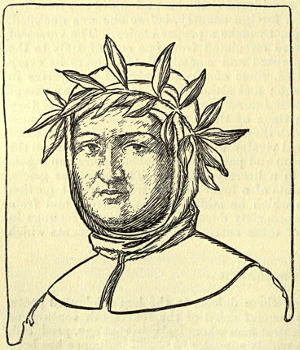
Petrarch
Petrarch, tortured by the passion which has contributed so greatly to his celebrity, endeavoured, by travelling during a considerable portion of his life, to escape from himself and to change the current of his thoughts. He traversed France, Germany, and every part of Italy; he visited Spain; and, with incessant activity, directed his attention to the examination of the remains of antiquity. He became intimate with all the scholars, poets, and philosophers from one end of Europe to the other, whom he inspired with his own spirit. While he imparted to them the object of his own labours, he directed their studies; and his correspondence became a sort of magical bond, which, for the first time, united the whole literary republic of Europe. At the age in which he lived, that continent was divided into petty states, and sovereigns had not yet attempted to establish any of those colossal empires, so dreaded by other nations. On the contrary, each country was divided into smaller sovereignties. The authority of many a prince did not extend above thirty leagues from the little town over which he ruled; while at the distance of a hundred, his name was unknown. In proportion, however, as political importance was confined, literary glory was extended; and Petrarch, the friend of Azzo di Correggio, prince of Parma, of Lucchino and of Galeazzo Visconti, princes of Milan, and of Francesco di Carrara, prince of Padua, was better known and more respected, throughout Europe, than any of those petty sovereigns. This universal reputation, to which his high acquirements entitled him, and of which he frequently made use in forwarding the interests of literature, he occasionally turned to account for political purposes. No man of letters, no poet was doubtless ever charged with so many embassies to great potentates—to the emperor, the pope, the king of France, the senate of Venice, and all the princes of Italy. It is very remarkable that Petrarch did not fulfil these duties merely as a subject of the state which had committed its interests to his hands, but that he acted for the benefit of all Europe. He was intrusted with such missions on account of his reputation; and when he treated with the different princes, it was, as it were, in the character of an arbitrator, whose suffrage everyone was eager to obtain, that he might stand high in the opinion of posterity.
The prodigious labours of Petrarch to promote the study of ancient literature are, after all, his noblest title to glory. Such was the view in which they were regarded by the age in which he lived, and such also was his own opinion. His celebrity, notwithstanding, at the present day depends much more on his Italian lyrical poems than on his voluminous Latin compositions. These lyrical pieces, which were imitated from the Provençals, from Cino da Pistoia, and from the other poets who flourished at the commencement of that century, have served, in their turn, as models to all the distinguished poets of the south.
The Latin compositions upon which Petrarch rested his fame, and which are twelve or fifteen times as voluminous as his Italian writings, are now only read by the learned. The long poem entitled Africa, which he composed on the victories of the elder Scipio, and which was considered, in his own age, as a masterpiece worthy of rivalling the Æneid, is very fatiguing to the ear. The style is inflated, and the subject so devoid of interest and so exceedingly dull as absolutely to prevent the perusal of the work. His numerous epistles in verse, instead of giving interest to the historical events to which they allude, acquire it from that circumstance. The imitation of the ancients, and the fidelity of the copy, which in Petrarch’s eyes constituted their chief merit, deprive these productions of every appearance of truth. The invectives against the barbarians who had subjugated Italy are so cold, so bombastic, and so utterly destitute of all colouring suited to the time and place, that we might believe them to have been written by some rhetorician who had never seen Italy; and we might confound them with those which a poetic fury dictated to Petrarch himself, against the Gauls who besieged the capital.
His philosophical works, amongst which may be mentioned a treatise on Solitary Life, and another on Good and Bad Fortune, are scarcely less bombastic. The sentiments display neither truth nor depth of thought. They are merely a show of words on some given subject. The author pre-determines his view of the question, and never examines the arguments for the purpose of discovering the truth, but of vanquishing the difficulties which oppose him, and of making everything agree with his own system. His letters, of which a voluminous collection has been published—which is, however, far from being complete—are perhaps more read than any other of his works, as they throw much light upon a period which is well worthy of being known. We do not, however, discover in them either the familiarity of intimate friendship or the complete openness of an amiable character. They display great caution and studied propriety, with an attention to effect which is not always successful. An Italian would never have written Latin letters to his friends, if he had wished only to unfold the secrets of his heart; but the letters of Cicero were in Latin, and with them Petrarch wished to have his own compared. He was, evidently, always thinking more of the public than of his correspondent; and in fact the public were often in possession of the letter before his friend. The bearer of an elegantly written epistle well knew that he should flatter the vanity of the writer by communicating it; and he therefore often openly read it, and even gave copies of it, before it reached its destination.
It is difficult to say whether the extended reputation which Petrarch enjoyed, during the course of a long life, is more glorious to himself or to his age. We have elsewhere mentioned the faults of this celebrated man—that subtlety of intellect which frequently led him to neglect true feeling, and to abandon himself to a false taste; and that vanity which too often induced him to call himself the friend of cruel and contemptible princes, because they flattered him. But, before we part with him, let us once more take a view of those great qualities which rendered him the first man of his age—that ardent love for science to which he consecrated his life, his powers, and his faculties; and that glorious enthusiasm for all that is high and noble in the poetry, the eloquence, the laws, and the manners of antiquity. This enthusiasm is the mark of a superior mind. To such a mind, the hero becomes greater by being contemplated; while a narrow and sterile intellect reduces the greatest men to its own level, and measures them by its own standard.
This enthusiasm was felt by Petrarch, not only for distinguished men, but for everything that is great in nature, for religion, for philosophy, for patriotism, and for freedom. He was the friend and patron of the unfortunate Rienzi, who, in the fourteenth century, awakened for a moment the ancient spirit and fortunes of Rome. He appreciated the fine arts as well as poetry, and he contributed to make the Romans acquainted with the rich monuments of antiquity, as well as with the manuscripts which they possessed. His passions were tinctured with a sense of religion which induced him to worship all the glorious works of the Deity, with which the earth abounds; and he believed that, in the woman he loved, he saw the messenger of that heaven which thus revealed to him its beauty. He enabled his contemporaries to estimate the full value of the purity of a passion so modest and so religious as his own; while to his countrymen he gave a language worthy of rivalling those of Greece and Rome, with which, by his means, they had become familiar. Softening and ornamenting his own language by the adoption of proper rules, he suited it to the expression of every feeling, and changed, in some degree, its essence. He inspired his age with that enthusiastic love for the beauty, and that veneration for the study of antiquity, which gave it a new character, and which determined that of succeeding times. It was, it may be said, in the name of grateful Europe that Petrarch, on the 8th of April, 1341, was crowned by the senator of Rome, in the Capitol; and this triumph, the most glorious which was ever decreed to man, was not disproportioned to the authority which this great poet was destined to maintain over future ages.e
EARLY ITALIAN PROSE
Already, for half a century, Italian poetry had been cultivated with ardour and with success, and in Dante’s time there was scarcely a well-educated Florentine who could not at need rhyme a sonnet or write a short song in the vulgar tongue. It was not so easy to write in prose; for if the poet had a language and rules of style, there had not yet been a learned time for the prose writer; he had no fixed rules, the form in short which allows a writer to express his thought in the logical order necessary to convey all its shades of meaning, to show up its striking points, artistically to subordinate the less important or purely expletive parts. The poet, on the contrary, at his first attempt met with metrical forms, long adopted and practised in Provençal, a parent idiom, whose rules could, without any difficulty, be applied to Italian. He found moreover that the Provençal poetry, whose prosody he borrowed, had taken with slight differences the same subjects which he wished to sing in Italian; so that he found a poetical storehouse, if the expression may be allowed, of comparisons, epithets, connecting links, phrases, and permissible inversions.
It was not so with prose. The Italian language, which could without difficulty adopt the Provençal metrical system, found no prose developed which it could take as a model. Latin was the only perfect type which it could imitate; but the complete absence of any declension, the relatively limited number of conjunctions, the impossibility of freeing itself completely from analytical order, which it experienced in common with all modern languages, did not allow it to be modelled on Cicero, as poetry was modelled on Bertrand de Born or Sordello. To reach this point of perfection two or three more centuries were needed, during which deep thinkers and great artists moulded this refractory material.
It is true that the Latin historians, who were perfectly known, might have been taken as examples to be copied and even imitated; for these writers had treated the same kinds of subject which were again about to be attempted. However, there was one difference: ancient history, after all, was far distant, and the resemblance between the subjects was more apparent than real; or at least, if this resemblance really existed, men were too interested in the events to be able to judge them and compare them with others as coldly as we are accustomed to do. To sing the praises of his lady’s eyes, to express sentiments of fidelity or sadness, to paint chivalrous tournaments, it suffices to have read or to have listened to the Provençal troubadours, and the same words, with very few changes, can almost be transported from one language into the other. Imagine, on the other hand, a poor chronicler of the Middle Ages imitating Sallust or Titus Livius: could the vernacular furnish him with a single word to render those of his model—and the prose writer, accustomed to think in Latin, could he find in Italian a single expression equivalent to his thought? Whence could he have drawn that common fund of ideas and formulas which is so necessary to write a real history, however matter of fact, however little philosophic it might be? Even in order to relate facts, putting aside all thought of interest, one must have ideas.
But the difficulty was far greater when abstract subjects were treated. There is even some confusion in the beautiful prose of Dante’s Convito, and even in the scholastic digressions of The Divine Comedy, although at the beginning of the fourteenth century the Italian language was already far more developed than one hundred years before; and, to go no further, some idea of the extreme difficulty of such an enterprise may be found by calling to mind the obstacles which had to be overcome by the first French and German philosophers who had the courage and self-denial to expose in their mother-tongues (which were then nearly formed) ideas reasoned in Latin; for a certain effort is needed to follow the French and German writings of Descartes and Wolff, while their Latin works present no difficulty. Therefore, besides the general and constant causes for the priority of poetry to prose, there was in Italy a special cause which contributed to develop poetry first in the vulgar tongue; this cause was the existence of Provençal poetry, already flourishing and cultivated.
A fact common alike to the literary history of Italy and to that of all other nations is that the first attempts in prose were generally historical writings. In fact, among all primitive people we see that the first use they made of free speech was to decompose the epic poems, to give the importance of historical tradition to stories of popular imagination. Thus we see the Ionian chroniclers, up to Herodotus, add the history of contemporary events to the deeds of heroes of fable, just as the first Florentine chroniclers, till Villani, trace back the origin of their native town and its early history to Roman names whose traditions were doubtless retained in the popular poems prior to the Provençal school which reigned in Italy towards the middle of the fourteenth century, and relate, without metre or rhythm, what the Florentine woman of the time of Frederick Barbarossa sang, seated at her spindle:
“Favoleggiava con la sua famiglia De’ Trojani, di Fiesole, e di Roma.” —Dante.
However this may be, it was only about this time that the use of the vernacular spread little by little; that public treaties and commercial correspondence began to be written in this language, and the public already preferred to read in the Italian language stories and other works written originally in Latin or sometimes in Provençal. But these writings can scarcely be considered literary works; they cannot, therefore, be taken as the starting-point of a history of Italian prose.
Just as the first Italian poems had been written in Sicilian dialect, soon replaced by the Tuscan dialect, so the first somewhat important and truly literary work in Italian prose was written in Sicilian dialect, while nearly all the prose writers of the following period were Tuscans; and this fact is sufficiently explained by the general history of Italy in the thirteenth century.
While Florence and all the centre of the peninsula were in a state of civil war, or painfully working to attain an independent municipal life, Naples, the home of the Hohenstaufens and the capital of the kingdom of the Two Sicilies, was enjoying profound peace, royal luxury, great freedom of thought, and all the refinements of life, in the midst of institutions which may be considered perfect for their time. Queen Constanza had already granted special protection to the Provençal poets, and her son, Frederick II, only placed above the troubadours of the south of France the learned philosophers of Baghdad and Cordova, as if the great man only believed himself understood or appreciated by those whose glance was not troubled by religious, political, or local passions. The influence of this brilliant court, which united taste for science with frivolity, where serious discussions on law and philosophy alternated with the gay Provençal wisdom, and where displays of chivalry and love songs diverted the greatest statesmen of the Middle Ages after the fatigues or annoyances of politics, this preponderant influence made the Sicilian nation for a time the chief actor in the history of Italy, and their language the dominant organ of the rising literature; and it is not surprising that the first great work in Italian prose was written in the dialect made popular by the beautiful songs of the emperor Frederick II and his famous chancellor Pietro delle Vigne, King Enzio, and the brave Manfred, his half-brother.
Matteo Spinelli, the contemporary of these poets of noble birth, has left a chronicle under the very characteristic title “journal,” which enables us to judge at once what Italian prose was at that period. If we quote this work of Spinelli’s first, it is not because we are unaware of the numerous and often vague attempts which preceded him; but all previous writings may be considered as uncertain groping. The language of these works is not even completely Italian yet, and the true modern idiom has been considered to rise in all its individuality in the poems of Ciullo d’Alcamo and in the Journals of Spinelli. Moreover, the work of the Sicilian chronicler (although, as its name seems to indicate, it was a diary scarcely intended for publication) offers by its very extent more ample matter for literary and philological study than certain inscriptions, deeds, laws, decrees, and other documents of similar nature.
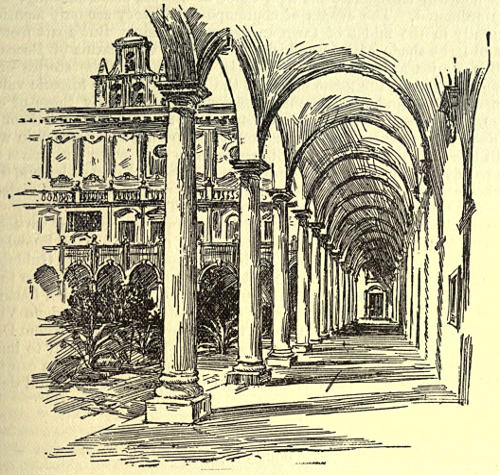
San Martino, Naples
We do not mean to say that the Journals have nothing Latin about them, or that they are written in pure Italian or Sicilian. Latin words, even phrases, which recall the customs of a dead language, are frequently found in the midst of a speech in all other respects purely Italian; but these souvenirs are always isolated, and do not alter the general character of the tongue, which is essentially Sicilian. But what distinguishes the style of this delightful teller of stories is not only the sweetness characteristic of the dialect he employed, but also a certain carelessness, a certain freedom in the construction of his sentences. In the first prose writer of a language one certainly does not expect Ciceronian periods; it appears perfectly natural that all his sentences should be co-ordinate, instead of being subordinate to one another, and that he should simply join his propositions by copulative conjunctions, instead of arranging them in incidental phrases; but with Spinelli, we simply find conversational language, and nothing more; that is to say, his style is wanting in clearness. He writes as he would have spoken to an attentive audience, with all the assistance to be derived from gesture, intonation, and expressive glance. This conversational style, applied to written works of great length, is often unintelligible unless interpreted by a clever reader, who recites it as an actor recites his rôle in a comedy. In the end it becomes wearisome by the very fact that the necessary explanation, which recitation would give, is wanting. But, on the other hand, there is an animation which the finest art could not produce—each word, each expression creates a picture. One might be listening to a loquacious barber, on the lookout for the gossip of the day, serving up hot the talk of the town.
This is Spinelli’s specialty; he must not be looked on as a historian, not even a political chronicler, but as a teller of stories, often amusing, nearly always animated. The events of contemporary history are only mentioned incidentally in the midst of town and country gossip. But apart from the style and light shade of irony which form one of the charms of Boccaccio, Spinelli’s stories are not less wanting in interest than the stories of the Decameron. This is the great merit of the Journals; their historic value is almost worthless, and, on account of serious errors (chiefly those of chronology), they become dangerous guides for the reader who takes them seriously and refers to them for information on the period and country in which Spinelli lived. There is a great difference to be seen when one passes from this expansive and unpretentious gossip to professional men of letters, to the somewhat pedantic orators of Florence, from the neglected Sicilian dialect to the already majestic and developed language of Tuscany.
The study of rhetoric was first cultivated in Florence, and we see, by Dante’s education, the importance attached to this branch of knowledge. However, the earliest rhetoricians, such as Buoncompagni and Guidotto of Bologna, seldom employed the vernacular. The honour of fixing, so to say, the Tuscan dialect, of raising the Italian patois to the rank which Latin had occupied exclusively till then, belongs to Brunetto Latini, of whom Villani tells us that he was “the first to polish the Florentines,” and to whom Dante, his pupil, raised a monument more durable than any other claim to immortality which the poor orator possessed: “You taught me how man can make himself immortal, and it is right that while I live my tongue should declare the gratitude which I feel.”g
BOCCACCIO
But these after all are only tentative efforts. The first writer to make use of the new vehicle as a medium for really artistic prose of a creative type was a Florentine of a slightly later epoch, the contemporary of Petrarch, Giovanni Boccaccio, the famous author of the Decameron. Boccaccio was born at Paris, in 1313, and was the natural son of a merchant of Florence, himself born at Certaldo, a castle in the Val d’Elsa, in the Florentine territory. His father had intended him for a commercial life, but before devoting him to it, indulged him with a literary education. From his earliest years, Boccaccio evinced a decided predilection for letters. He wrote verses, and manifested an extreme aversion to trade. He revolted equally at the prospect of a commercial life, and the study of the canon law, which his father was desirous of his undertaking. To oblige his father, however, he made several journeys of business; but he brought back with him, instead of a love for his employment, a more extended information, and an increased passion for study.
He at length obtained permission to devote himself wholly to literature, and fixed on Naples as his place of residence, where letters then flourished under the powerful protection of Robert, the reigning monarch. He was quickly initiated in all the sciences at that time taught. He acquired also the rudiments of the Greek tongue, which, though then spoken in Calabria, was an abstruse study with the early scholars. In 1341, he assisted at the celebrated examination of Petrarch, which preceded his coronation at Rome; and, from that time, a friendship arose between him and the poet, which terminated only with their lives. At this period, Boccaccio, distinguished no less for the elegance of his person than for the brilliancy of his wit, and devoted to pleasure, formed an attachment to a natural daughter of King Robert, named Maria, who for several years had been the wife of a Neapolitan gentleman. This lady he has celebrated in his writings, under the name of Fiammetta. In the attachment of Boccaccio, we must not look for that purity or delicacy which distinguished Petrarch in his love for Laura. This princess had been brought up in the most corrupt court of Italy; she herself partook of its spirit, and it is to her depraved taste that the exceptionable parts of the Decameron, a work undertaken by Boccaccio in compliance with her request, and for her amusement, are to be attributed. On his side, Boccaccio probably loved her as much from vanity as from real passion; for, although distinguished for her beauty, her grace, and her wit, as much as for her rank, she does not seem to have exercised any extraordinary influence on his life; and neither the conduct nor the writings of Boccaccio afford evidence of a sincere or profound attachment.
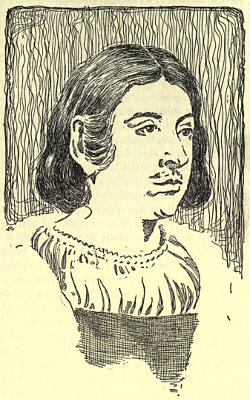
Boccaccio
Boccaccio quitted Naples in 1342, to return to Florence. He came back again in 1344, and returned for the last time in 1350. From that year, he fixed himself in his native country, where his reputation had already assigned him a distinguished rank. His life was thenceforth occupied by his public employments in several embassies; by the duties which his increasing friendship to Petrarch imposed on him; and by the constant and indefatigable labours to which he devoted himself for the advancement of letters, the discovery of ancient manuscripts, the elucidation of subjects of antiquity, the introduction of the Greek language into Italy, and the composition of his numerous works. After taking the ecclesiastical habit, in 1361, he died at Certaldo, in the mansion of his ancestors, on the 21st of December, 1375.
The Decameron, the work to which Boccaccio is at the present day indebted for his highest celebrity, is a collection of one hundred novels or tales. He has ingeniously united them, under the supposition of a party formed in the dreadful pestilence of 1348, composed of a number of cavaliers, and young, intelligent, and accomplished women, retired to a delightful part of the country, to escape the contagion. It was there agreed that each person, during the space of ten days, should narrate, daily, a fresh story. The company consisted of ten persons, and thus the number of stories amounted to one hundred. The description of the enchanting country in the neighbourhood of Florence, where these gay recluses had established themselves; the record of their walks, their numerous fêtes, and their repasts, afforded Boccaccio an opportunity of displaying all the treasures of his powerful and easy pen.
These stories, which are varied with infinite art, as well in subject as in style, from the most pathetic and tender to the most sportive, and, unfortunately, the most licentious, exhibit a wonderful power of narration; and his description of the plague in Florence, which serves as an introduction to them, may be ranked with the most celebrated historical descriptions which have descended to us. The perfect truth of colouring; the exquisite choice of circumstances, calculated to produce the deepest impression, and which place before our eyes the most repulsive scenes, without exciting disgust; and the emotion of the writer, which insensibly pervades every part, give to this picture that true eloquence of history which, in Thucydides, animates the relation of the plague in Athens. Boccaccio had, doubtless, this model before his eyes; but the events, to which he was a witness, had vividly impressed his mind, and it was the faithful delineation of what he had seen, rather than the classical imitation, which served to develop his talent.
The praise of Boccaccio consists in the perfect purity of his language, in his elegance, his grace, and above all in that naïveté which is the chief merit of narration, and the peculiar charm of the Italian tongue.
Unfortunately Boccaccio did not prescribe to himself the same purity in his images as in his phraseology. The character of his work is light and sportive. He has inserted in it a great number of tales of gallantry; he has exhausted his powers of ridicule on the duped husband, on the depraved and depraving monks, and on subjects, in morals and religious worship, which he himself regarded as sacred; and his reputation is thus little in harmony with the real tenor of his conduct. The Decameron was published towards the middle of the fourteenth century (in 1352 or 1353), when Boccaccio was at least thirty-nine years of age; and from the first discovery of printing, was freely circulated in Italy, until the Council of Trent proscribed it in the middle of the sixteenth century. At the solicitation of the grand duke of Tuscany, and after two remarkable negotiations between this prince and popes Pius V and Sixtus V, the Decameron was again published, in 1573 and 1582, purified and corrected.
Many of the tales of Boccaccio appear to be borrowed from popular recitation, or from real occurrences. We trace the originals of several, in the ancient French fabliaux; of some, in the Italian collection of the Centi Novelli; and of others, again, in an Indian romance, which passed through all the languages of the East, and of which a Latin translation appeared as early as the twelfth century, under the name of Dolopathos, or The King and the Seven Wise Men. Invention, in this class of writing, is not less rare than in every other; and the same tales, probably, which Boccaccio had collected in the gay courts of princes, or in the squares of the cities of Italy, have been repeated to us anew in all the various languages of Europe. They have been versified by the early poets of France and England, and have afforded reputation to three or four imitators of Boccaccio. But, if Boccaccio cannot boast of being the inventor of these tales, he may still claim the creation of this class of letters. Before his time, tales were only subjects of social mirth. He was the first to transport them into the world of letters; and, by the elegance of his diction, the just harmony of all the parts of his subject, and the charm of his narration, he superadded the more refined gratifications of language and of art, to the simpler delight afforded by the old narrators.
It is unnecessary to speak here of Boccaccio’s other Italian works, beyond naming his romances Fiammetta and Filocopo, and his heroic poems La Teseide and Filostrato. The Latin compositions of Boccaccio are voluminous, and materially contributed, at the time they were written, to the advancement of letters. The most celebrated of these works are two treatises; the one on the genealogy of the gods, and the other on mountains, forests, and rivers. In the first, he gave an exposition of the ancient mythology; and in the second, rectified many errors in geography. These two works have fallen into neglect, since the discovery of manuscripts then unknown, and in consequence of the facilities which the art of printing, by opening new sources, has afforded to the study of antiquity. In the age in which they were composed, they were, however, equally remarkable for their extensive information and for the clearness of their arrangement; but the style is by no means so pure and elegant as that of Petrarch. But, while the claim to celebrity, in these great men, is restricted to the Italian poetry of Petrarch and to the novels of Boccaccio, our gratitude to them is founded on stronger grounds. They felt more sensibly than any other men that enthusiasm for the beauties of antiquity, without which we in vain strive to appreciate its treasures; and they each devoted a long and laborious life to the discovery and the study of ancient manuscripts. The most valued works of the ancients were at that time buried among the archives of convents, scattered at great distances, incorrect and incomplete, without tables of contents or marginal notes. Nor did those resources then exist, which printing supplies, for the perusal of works with which we are not familiar; and the facilities which are afforded by previous study, or the collation of the originals with each other, were equally wanting. It must have required a powerful intellect to discover, in a manuscript of Cicero, for example, without title or commencement, the full meaning of the author, the period at which he wrote, and other circumstances, which are connected with his subject; to correct the numerous errors of the copyists; to supply the chasms, which, frequently occurring at the beginning and the end, left neither title nor divisions nor conclusions, nor anything that might serve as a clew for the perusal; in short, to determine how one manuscript, discovered at Heidelberg, should perfect another, discovered at Naples. It was, in fact, by long and painful journeys that the scholars of those days equipped themselves for this task. The copying a manuscript, with the necessary degree of accuracy, was a work of great labour and expense. A collection of three or four hundred volumes was, at that time, considered an extensive library; and a scholar was frequently compelled to seek, at a great distance, the completion of a work, commenced under his own roof.
Petrarch and Boccaccio, in their frequent travels, obtained copies of such classics as they found in their route. Among other objects, Petrarch proposed to himself to collect all the works of Cicero; in which he succeeded after a lapse of many years. Boccaccio, with a true love of letters, introduced the study of the Greek to the Italians, not only with the view of securing the interests of commerce or of science, but of enriching their minds, and extending their researches to the other half of the ancient world of letters, which had, till then, remained hidden from his contemporaries. He founded, in Florence, a chair for the teaching of the Greek language; and he himself invited thither, and installed as professor, Leontius Pilatus, one of the most learned Greeks of Constantinople. He received him into his own house, although he was a man of a morose and disagreeable temper; placed him at his table, as long as this professor could be induced to remain at Florence; inscribed himself among the first of his scholars, and procured at his own expense, from Greece, the manuscripts, which were thus distributed in Florence, and which served as subjects for the lectures of Leontius Pilatus. For the instruction of those days consisted in the public delivery of lectures with commentaries, and a book, of which there perhaps existed only a single copy, sufficed for some thousand scholars.
LESSER CONTEMPORARIES OF PETRARCH AND BOCCACCIO
There is an infinite space between the three great men whose works we have just enumerated, and even the most esteemed of their contemporaries; and, though these latter have preserved, until the present day, a considerable reputation, yet we shall only pause to notice their existence, and the epoch to which they belong. Perhaps the most remarkable are the three Florentine historians of the name of Villani. Giovanni, the eldest, who died in the first plague, in 1348; Matteo, his brother, who died in the second plague, in 1361; and Filippo, the son of Matteo, who continued the work of his father to the year 1364, and who wrote a history of the literature of Florence, the first attempt of this kind in modern times. Two poets of this age shared with Petrarch the honours of a poetic coronation: Zanobi di Strada, whom the emperor Charles IV crowned at Pisa in 1355, with great pomp, but whose verses have not reached us; and Coluccio Salutati, secretary of the Florentine Republic, one of the purest Latinists, and most eloquent statesmen whom Italy in that age produced. The latter, indeed, did not live to enjoy the honour which had been accorded him by the emperor, at the request of the Florentines. Coluccio died in 1406, at the age of seventy-six, before the day appointed for his coronation, and the symbol of glory was deposited on his tomb; as, at a subsequent period, a far more illustrious crown was placed on the tomb of Tasso.
Of the prose writers of Tuscany, Franco Sacchetti, born at Florence about the year 1335, and who died before the end of the century, after filling some of the first offices in the republic, approaches the nearest to Boccaccio. He imitated Boccaccio in his novels, and Petrarch in his lyric poems; but the latter were never printed, while of his tales there have been several editions. Whatever praise be due to the purity and eloquence of his style, we find his pages more valuable as a history of the manners of the age, than attractive for their powers of amusement, even when the author thinks himself most successful. His 258 tales consist, almost entirely, of the incidents of his own time, and of his own neighbourhood; domestic anecdotes, which in general contain little humour; tricks, exhibiting little skill, and jests of little point; and we are often surprised to find a professed jester vanquished by the smart reply of a child or a clown, which scarcely deserves our attention. After reading these tales, we cannot help concluding that the art of conversation had not made, in the fourteenth century, an equal progress with the other arts; and that the great men, to whom we owe so many excellent works, were not so entertaining in the social intercourse of life as many persons greatly their inferiors in merit.
Two poets of this time, of some celebrity, chose Dante for their model, and composed after him in terza rima, long allegories, partly descriptive, partly scientific. Fazio de’ Uberti, in his Dettamondo, undertook the description of the universe, of which the different parts, personified in turns, relate their history. Federigo Frezzi, bishop of Foligno, who died in 1416, at the Council of Constance, has, in his Quadriregio, described the four empires of Love, Satan, Virtue, and Vice. In both of these poets we meet, occasionally, with lines not unworthy of Dante; but they formed a very false estimate of the works of genius, when they regarded the Divina Commedia not as an individual poem, but as a species of poetry which anyone might attempt.
The passionate study of the ancients, of which Petrarch and Boccaccio had given an example, suspended, in an extraordinary manner, the progress of Italian literature, and retarded the perfection of that tongue. Italy, after having produced her three leading classics, sank, for a century, into inaction. In this period, indeed, erudition made wonderful progress; and knowledge became much more general, but sterile in its effects. The mind had preserved all its activity, and literary fame all its splendour; but the unintermitted study of the ancients had precluded all originality in the authors. Instead of perfecting a new language, and enriching it with works in unison with modern manners and ideas, they confined themselves to a servile copy of the ancients. A too scrupulous imitation thus destroyed the spirit of invention; and the most eminent scholars may be said to have produced, in their eloquent writings, little more than college themes. In proportion as a man was qualified by his rank, or by his talents, to acquire a name in literature, he blushed to cultivate his mother-tongue. He almost, indeed, forced himself to forget it, to avoid the danger of corrupting his Latin style; and the common people thus remained the only depositaries of a language which had exhibited so brilliant a dawn, and which had now again almost relapsed into barbarism.e
ART IN THE THIRTEENTH AND FOURTEENTH CENTURIES
Turning from literature to the not distantly related field of art, let us glance at some of the tentative efforts which prepared the way for the succession of Florentine masters that were presently to take the lead in this field and hold it for some centuries.
The Renaissance, that is, the resurrection, in the beginning of the fifteenth century, of ideas and forms of classic antiquity, was preceded by individual efforts which, though often failing to reach the mark, ought to be taken account of in the history of this great revolution. The plastic memories of the Græco-Roman world have played in the preoccupation of the Middle Ages a more considerable rôle than is usually thought. Mere force of events put our ancestors in the presence of ancient chefs-d’œuvre, and they had to look at them whether they would or not. Some saw in them only idolatrous monuments, and have found fault with them as such. Others attributed to them magic virtues; some have given themselves up to the admiration they felt in looking at the immensity of Roman ruins, the richness of early materials, the perfection of the handiwork. These latter, it might be affirmed, are the most numerous. Even during the most sombre period of the Middle Ages, all Europe felt the fascination that Rome, the oldest city par excellence, exercised for twenty centuries. That which attracted from far and near thousands of visitors to the banks of the Tiber was not only the promise of indulgencies, a desire to pray on the tomb of martyrs, to contemplate basilics resplendent with gold and precious stones, but also memories left by the cæsars.
After having heard with a kind of incredulity the marvels of this incomparable city, one is further amazed by the number of its temples, palaces, baths, and amphitheatres. Have not reliable authors told us that she lately possessed thirty-six triumphal arches, twenty-eight libraries, 856 public baths, twenty-two equestrian statues in gilded bronze, eighty-four of the same in ivory, obelisks, and innumerable colossi?
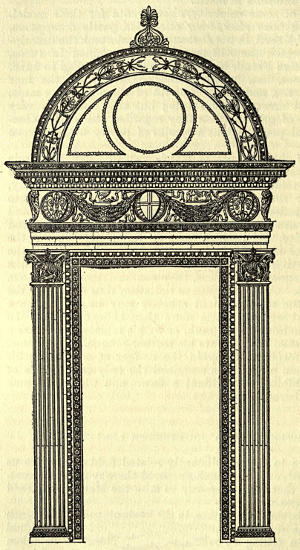
Doorway, Palazzo Vecchio, Florence
From the twelfth century popular imagination laid hold of these pictures, transforming and amplifying them. Wondrous tales became current and were incorporated in works received as authoritative—the Descriptis plenaria Votius Urbis, the Graphia aurea urbis Romæ, and lastly the Mirabilia civitatis Romæ. Again at the end of the fifteenth century the valiant Charles VIII, wanting to give his subjects some idea of the town into which he had lately entered lance in hand, caused one of these records of another age to be translated for them. A few extracts will show with what strong faith these stories worthy of The Thousand and One Nights were received before the Renaissance:
“Inside the capital was the greater part of a golden palace adorned with precious stones and said to equal the third part of the world, in which there were as many statues of images as there are provinces in all the world. Each image had a tambourine round its neck, placed with mathematical art, so that if any region was in rebellion against the Romans, immediately the image of the province turned its back to the image of the city of Rome, which was the largest and dominated the others, and the tambourine at its neck sounded. Then immediately the Capitol guards told this to the senate, and people were forthwith sent to expugn that province.
“The horses and nude men denote that in the time of the emperor Tiberius there were two young philosophers, that is, Praxiteles and Phitas, who said they were so wise that anything the emperor said in his room, they not being there, could report word for word. And they did as they said, not demanding money for it, but to be always remembered, so the philosophers have two marble horses with their feet on the ground, which denote the princes of this century. And they who are naked on the horses denote that their arm, high and held out, and their bent backs speak of things to come, and as they are naked, so the science of this world was naked and open to their understanding.”
From admiration to imitation is only one step. Artists in their turn went to work and took without scruple from what was a common heritage. Doubtless many of these borrowings are unconscious or really only show up the immense inferiority of the copyist. But is the influence of the antique less striking? One must recall in this order of ideas the splendid creations of architects in the Roman period—the duomo, the campanile, and the baptistery of Pisa, the baptistery of Florence, and the basilica of San Miniato, the duomo of Lucca, and so many chefs-d’œuvre raised according to principles that innovators of the following age, the champions of Gothic style, were so audaciously to trample underfoot.
Nicholas Crescentius (son of the celebrated tribune) in the eleventh century, impelled by a desire to renew the ancient splendour of Rome, had the elegant little house at Ponte Rotto built of antique fragments. Similarly the emperor Frederick Barbarossa (1121-1190) had these former glories in mind, when he had graven on his seal a view of Rome with the Colosseum. But it was to his illustrious grandson Frederick II (1184-1250) that the honour is due of first pleading the cause of the Renaissance, and he should rightly be placed at the head of the precursors. We possess numerous witnesses of his love for the monuments of ancient art.
Now we see him striking Augustales, those curious imitations of Roman imperial money, bearing on one side an effigy crowned with laurels, with the epigraph AVG. IMP. ROM. and draped in the fashion of the cæsars; on the reverse an eagle with outspread wings with the epigraph FREDERICVS. Again he buys for a considerable sum (230 oz. of gold) an onyx cup and other curiosities. From Grotta Ferrata he takes away two bronzes, statues of a man and of a cow serving for a fountain, and carries them to Lucera. The church of St. Michael of Ravenna furnishes the monolithic columns he requires for his buildings at Palermo. Near Augusta in Sicily, he caused excavations to be made in the hope of discovering ancient remains. Once, it is true, yielding to urgent necessity he had several Roman monuments at Brindisi destroyed that he might use the materials in constructing a citadel. He tried just as he was departing for Palestine to make the town safe from any attacks, but political reasons outweighed his antiquarian scruples.
The work dreamed of by Frederick II as amateur was realised by his contemporary Nicholas of Pisa (1207?-1278) who, in the thirteenth century, held imitation of the antique as a principle, and used it as a mirror by which nature might be the more clearly shown. His attempt seems prodigious to us to-day; it supposes a power of initiative which Giotto, Brunelleschi, Donatello, and Van Eyck have hardly equalled. Imitation with him was not confined to accessories—ornaments, costumes, armour—nor to types, nor to proportions of figures, which are all stumpy, as in the Roman sarcophagi of the decadence. The spirit of his work recalls ancient models.
“Nicholas,” says M. Gebhardt,n “in the pulpits of Pisa and Siena, and in the shrine of San Dominico at Bologna, recalls the traditions of a great art with a naïve gravity and assured taste. He is hardly a neo-Greek or a superstitious antiquary, but is imbued with the most generous principles of antique sculpture—the harmonious ordering of the scenes, the skilful employ of space where many persons move in a narrow frame, the majestic tranquillity of pose, the finely ordered draperies, the noble heads. But his eye and hand still express the fashion of primitive sculpture; the movements express awkward timidity, the faces are sometimes heavy. He gives an impression of Roman work at the end of the empire. Nicholas of Pisa (Niccolo Pisano), if he discovered and studied the Greek, did not renounce nature, and, in his best pieces, he has returned to a study of life. It is in this that he shows himself an intelligent disciple of the ancients. Apart from Nicholas of Pisa, the Italian masters each put their own personality in the antique; none were servile copyists, and it is Nicholas, the first and consequently the least learned, whose chisel has left the most instructive reminiscences.”
One of the most noted pupils and collaborators of Nicholas, Brother Guglielmo of Pisa (born about 1238, died after 1313), was inspired with like principles, but not so strongly. In the pulpit of San Giovanni Fuorcivitas at Pistoia, he has succeeded better than his master, in reconciling pagan reminiscences with Christian ideas.