Chapter XIV · THE “LAST DAY OF ITALY” (continued 2)
Reading edition
The combined forces were to be placed under the command of Raymond de Cardona, viceroy of Naples, a person of polished and engaging address, but without the resolution or experience requisite to military success. The rough old pope sarcastically nicknamed him “Lady Cardona.” It was an appointment that would certainly never have been made by Queen Isabella. Indeed, the favour shown this nobleman on this and other occasions was so much beyond his deserts as to raise a suspicion in many that he was more nearly allied by blood to Ferdinand than was usually imagined.
THE BATTLE OF RAVENNA
[1512 A.D.]
Early in 1512, France, by great exertions and without a single confederate out of Italy, save the false and fluctuating emperor, got an army into the field superior to that of the allies in point of numbers, and still more so in the character of its commander. This was Gaston de Foix, duke of Nemours and brother of the queen of Aragon. Though a boy in years—for he was but twenty-two—he was ripe in understanding, and possessed consummate military talents. He introduced a severer discipline into his army, and an entirely new system of tactics. He looked forward to his results with stern indifference to the means by which they were to be effected. He disregarded the difficulties of the roads and the inclemency of the season, which had hitherto put a check on military operations. Through the midst of frightful morasses, or in the depth of winter snows, he performed his marches with a celerity unknown in the warfare of that age. In less than a fortnight after leaving Milan he relieved Bologna (February 5th), then besieged by the allies, made a countermarch on Brescia, defeated a detachment by the way, and the whole Venetian army under its walls, and, on the same day with the last event, succeeded in carrying the place by storm. After a few weeks’ dissipation of the carnival, he again put himself in motion, and, descending on Ravenna, succeeded in bringing the allied army to a decisive action under its walls. Ferdinand, well understanding the peculiar characters of the French and of the Spanish soldier, had cautioned his general to adopt the Fabian policy of Gonsalvo, and avoid a close encounter as long as possible.
This battle, fought with the greatest numbers, was also the most murderous which had stained the fair soil of Italy for a century (April 11th, 1512). No less than eighteen or twenty thousand, according to authentic accounts, fell in it, comprehending the best blood of France and Italy. The viceroy Cardona went off somewhat too early for his reputation. But the Spanish infantry, under the count Pedro Navarro, behaved in a style worthy of the school of Gonsalvo. During the early part of the day, they lay on the ground, in a position which sheltered them from the deadly artillery of Este, then the best mounted and best served of any in Europe. When at length, as the tide of battle was going against them, they were brought into the field, Navarro led them at once against a deep column of lansquenets who, armed with the long German pike, were bearing down all before them. The Spaniards received the shock of this formidable weapon on the mailed panoply with which their bodies were covered, and, dexterously gliding into the hostile ranks, contrived with their short swords to do such execution on the enemy, unprotected except by corselets in front, and incapable of availing themselves of their long weapon, that they were thrown into confusion and totally discomfited. It was repeating the experiment more than once made during these wars, but never on so great a scale, and it fully establishes the superiority of the Spanish arms.
The Italian infantry, which had fallen back before the lansquenets, now rallied under cover of the Spanish charge; until at length the overwhelming clouds of French gendarmerie headed by Ives d’Alègre, who lost his own life in the mêlée, compelled the allies to give ground. The retreat of the Spaniards, however, was conducted with admirable order, and they preserved their ranks unbroken, as they repeatedly turned to drive back the tide of pursuit. At this crisis, Gaston de Foix, flushed with success, was so exasperated by the sight of this valiant corps going off in so cool and orderly a manner from the field, that he made a desperate charge at the head of his chivalry, in hopes of breaking it. Unfortunately, his wounded horse fell under him. It was in vain his followers called out, “It is our viceroy, the brother of your queen!” The words had no charm for a Spanish ear, and he was despatched with a multitude of wounds. He received fourteen or fifteen in the face; “good proof,” says Bayard’s secretary and biographer, called the loyal serviteur,j “that the gentle prince had never turned his back.”
There are few instances in history, if indeed there be any, of so brief and at the same time so brilliant a military career as that of Gaston de Foix; and it well entitled him to the epithet his countrymen gave him of “the thunderbolt of Italy.” He had not merely given extraordinary promise, but in the course of a very few months had achieved such results as might well make the greatest powers of the peninsula tremble for their possessions. His precocious military talents, the early age at which he assumed the command of armies, as well as many peculiarities of his discipline and tactics, suggest some resemblance to the beginning of Napoleon’s career.
Unhappily, his brilliant fame is sullied by a recklessness of human life, the more odious in one too young to be steeled by familiarity with the iron trade to which he was devoted. It may be fair, however, to charge this on the age rather than on the individual, for surely never was there one characterised by greater brutality and more unsparing ferocity in its wars. So little had the progress of civilisation done for humanity. It is not until a recent period that a more generous spirit has operated; that a fellow-creature has been understood not to forfeit his rights as a man because he is an enemy; that conventional laws have been established, tending greatly to mitigate the evils of a condition which, with every alleviation, is one of unspeakable misery; and that those who hold the destinies of nations in their hands have been made to feel that there is less true glory, and far less profit, to be derived from war than from the wise prevention of it.
The defeat at Ravenna struck a panic into the confederates. The stout heart of Julius II faltered, and it required all the assurances of the Spanish and Venetian ministers to keep him staunch to his purpose. King Ferdinand issued orders to the great captain to hold himself in readiness for taking the command of forces to be instantly raised for Naples. There could be no better proof of the royal consternation.
The victory of Ravenna, however, was more fatal to the French than to their foes. The uninterrupted successes of a commander are so far unfortunate, that they incline his followers, by the brilliant illusion they throw around his name, to rely less on their own resources than on him whom they have hitherto found invincible; and thus subject their own destiny to all the casualties which attach to the fortunes of a single individual. The death of Gaston de Foix seemed to dissolve the only bond which held the French together. The officers became divided, the soldiers disheartened, and, with the loss of their young hero, lost all interest in the service.g
The ministers of Louis thought they might, after the battle of Ravenna, safely dismiss a part of their army; but Maximilian, betraying all his engagements, abandoned the French to their enemies. Without consenting to make peace with Venice, he gave passage through his territory to twenty thousand Swiss, who were to join the Venetian army, in order to attack the French. He, at the same time, recalled all the Germans who had enlisted under the banner of France. Ferdinand of Aragon and Henry VIII of England almost simultaneously attacked Louis, who, to defend himself, was obliged to recall his troops from Italy. In the beginning of June, they evacuated the Milanese; of which the Swiss took possession, in the name of Massimiliano Sforza, son of Lodovico il Moro (the Moor). On the 29th of the same month, a revolution drove the French out of Genoa; and the republic and a new doge were again proclaimed. The possessions of France were soon reduced to a few small fortresses in that Italy which the French thought they had subdued. But the Italians did not recover their liberty by the defeat of only one of their oppressors. From the yoke of France, they passed under that of the Swiss, the Spaniards, and the Germans; and the last they endured always seemed the most galling. To add to their humiliation, the victory of the Holy League enslaved the last and only republic truly free in Italy.
Florence was connected with France by a treaty concluded in concert with Ferdinand the Catholic. The republic continued to observe it scrupulously, even after Ferdinand had disengaged himself from it. Florence had fulfilled towards all the belligerent powers the duties of good neighbourhood and neutrality, and had given offence to none; but the league, which had just driven the French out of Italy, was already divided in interest, and undecided on the plan which it should pursue. It was agreed only on one point, that of obtaining money. The Swiss lived at discretion in Lombardy, and levied in it the most ruinous contributions: the Spaniards of Raymond de Cardona insisted also on having a province abandoned to their inexorable avidity; Tuscany was rich and not warlike. The victorious powers who had assembled in congress at Mantua proposed to the Florentines to buy themselves off with a contribution; but the Medici, who presented themselves at this congress, asked to be restored to their country, asserting that they could extract much more money by force, for the use of the Holy League, than a republican government could obtain from the people by gentler means. Raymond de Cardona readily believed them, and in the month of August, 1512, accompanied them across the Apennines, with five thousand Spanish infantry as inaccessible to pity as to fear. Raymond sent forward to tell the Florentines that, if they would preserve their liberty, they must recall the Medici, displace the gonfalonier Soderini, and pay the Spanish army 40,000 florins. He arrived at the same time before the small town of Prato, which shut its gates against him; it was well fortified, but defended only by the ordinanza, or country militia. On the 30th of August, the Spaniards made a breach in the wall, which these peasants basely abandoned. The city was taken by assault; the militia, which would have incurred less danger in fighting valiantly, were put to the sword; five thousand citizens were afterwards massacred, and others, divided among the victors, were put to lingering tortures, either to force them to discover where they had concealed their treasure, or to oblige their kinsmen to ransom them out of pity; the Spaniards having already pillaged all they could discover in holy as well as profane places.
The terror caused at Florence, by the news of the massacre of Prato, produced next day a revolution. A company of young nobles, belonging to the most illustrious families, who, under the title of Society of the Garden Ruccellai, were noted for their love of the arts, of luxury and pleasure, took possession, on the 31st of August, of the public palace; they favoured the escape of Soderini, and sent to tell Raymond de Cardona that they were ready to accept the conditions which he offered. But all treaties with tyrants are deceptions. Giuliano de’ Medici, the third son of Lorenzo, whose character was gentle and conciliatory, entered Florence on the 2nd of September, and consented to leave many of the liberties of the republic untouched. His brother, the cardinal Giovanni, afterwards Leo X, who did not enter till the 14th of the same month, forced the signoria to call a parliament on the 16th. In this pretended assembly of the sovereign people, few were admitted except strangers and soldiers: all the laws enacted since the expulsion of the Medici in 1494 were abolished. A balia, composed only of the creatures of that family, was invested with the sovereignty of the republic. This balia showed itself abjectly subservient to the cardinal Giovanni de’ Medici, his brother Giuliano, and their nephew Lorenzo, who now returned to Florence after eighteen years of exile, during which they had lost every republican habit, and all sympathy with their fellow-citizens. None of them had legitimate children; but they brought back with them three bastards,—Giulio, afterwards Clement VII, Ippolito, and Alessandro,—who had all a fatal influence on the destiny of their country. Their fortune, formerly colossal, was dissipated in their long exile; and their first care, on returning to Florence, was to raise money for themselves, as well as for the Spaniards, who had re-established their tyranny.
[1512-1513 A.D.]
The three destructive wars—viz., that of the French and Swiss in the Milanese, that of the French and Spaniards in the kingdom of Naples, that of the French, Spaniards, Germans, and Swiss, in the states of Venice—robbed Italy of her independence. The country to which Europe was indebted for its progress in every art and science, which had imparted to other nations the medical science of Salerno, the jurisprudence of Bologna, the theology of Rome, the philosophy, poetry, and fine arts of Florence, the tactics and strategy of the Bracceschi and Sforzeschi schools, the commerce and banks of the Lombards, the process of irrigation, the scientific cultivation both of hills and plains—that country now belonged no more to its own inhabitants! The struggle between the transalpine nations continued, with no other object than that of determining to which of them Italy should belong; and bequeathed nothing to that nation but long-enduring, hopeless agonies. Julius II in vain congratulated himself on having expelled the French, who had first imposed a foreign yoke on Italy; he vowed in vain that he would never rest till he had also driven out all the barbarians; but he deceived himself in his calculations: he did not drive out the barbarians, he only made them give way to other barbarians; and the new-comers were ever the most oppressive and cruel. However, this project of national liberation, which the pope alone could still entertain in Italy with any prospect of success, was soon abandoned. Eight months after the expulsion of the French from the Milanese, and five months after the re-establishment of the Medici at Florence, Julius II, on the 21st of February, 1513, sank under an inflammatory disease. On the 11th of March, Giovanni de’ Medici succeeded him, under the name of Leo X—eleven months after the latter had been made prisoner by the French at the battle of Ravenna, and six months after the Spanish arms had given him the sovereignty of his country, Florence.
THE AGE OF LEO X
It has been the singular good fortune of Leo X to have his name associated with the most brilliant epoch of letters and the arts since their revival. He has thus shared the glory of all the poets, philosophers, artists, men of learning and science, his contemporaries. He has been held up to posterity as one who formed and raised to eminence men who were in fact his elders, and who had attained celebrity before the epoch of his power. His merit consisted in showering his liberality on those whose works and whose fame had already deserved it. His reign, on the other hand, which lasted nine years, was marked by fearful calamities, which hastened the destruction of those arts and sciences to which alone the age of Leo owes its splendour. The misfortunes which he drew down on his successor was still more dreadful. The pope was himself a man of pleasure, easy, careless, prodigal; who expended in sumptuous feasts the immense treasures accumulated by his predecessors. He had the taste to adorn his palace with the finest works of antiquity, and the sense to enjoy the society of philosophers and poets; but he had never the elevation of soul to comprehend his duties, or to consult his conscience. His indecent conversation and licentious conduct scandalised the church; his prodigality led him to encourage the shameful traffic in indulgences, which gave rise to the schism of Luther; his thoughtlessness and indifference to human suffering made him light up wars the most ruinous, and which he was utterly unable to carry on; he never thought of securing the independence of Italy, or of expelling the barbarians: it was simply for the aggrandisement of his family that he contracted or abandoned alliances with the transalpine nations: he succeeded, indeed, in procuring that his brother Giuliano should be named duke of Nemours, and he created his nephew duke of Urbino; but he endeavoured also to erect for the former a new state, composed of the districts of Parma, Piacenza, Reggio, and Modena; for the latter, another, consisting of the several petty principalities which still maintained themselves in the states of the church. His tortuous policy to accomplish the first object, his perfidy and cruelty to attain the second, deserved to be much more severely branded by historians.
The sovereign pontiff and the republic of Venice were the only powers in Italy which still preserved some shadow of independence. Julius II had succeeded in uniting Romagna, the Marches, the patrimony and campagna of Rome, to the holy see. Amongst all the vassals of the church, he had spared only his own nephew, Gian Maria della Rovere, duke of Urbino. On the defeat of the French, he further seized Parma and Piacenza, which he detached from the Milanese, without having the remotest title to their possession, as he also took Modena from the duke of Ferrara, whom he detested. Leo X found the holy see in possession of all these states, and was at the same time himself all-powerful at Florence. Even the moment of his elevation to the pontificate was marked by an event which showed that every vestige of liberty had disappeared from that republic. The partisans of the Medici pretended to have discovered at Florence a conspiracy, of which they produced no other proofs than some imprudent speeches, and some wishes uttered for liberty. The most illustrious citizens were, nevertheless, arrested; and Macchiavelli, with several others, was put to the torture. Pietro Boscoli and Agostino Capponi were beheaded; and those who were called their accomplices exiled. The two republics of Siena and Lucca were in a state of trembling subjection to the pontiff; so that all central Italy, peopled with about four million inhabitants, was dependent on him: but the court of Rome, since it had ceased to respect the ancient municipal liberties, never extended its authority over a new province without ruining its population and resources. Law and order seemed incompatible with the government of priests: the laws gave way to intrigue and favour; commerce gave way to monopoly. Justice deserted the tribunals, foresight the councils, and valour the armies. It was proverbially said that the arms of the church had no edge. The great name of pope still moved Europe at a distance, but it brought no real force to the allies whom he adopted.
[1513-1515 A.D.]
The republic of Venice, with a smaller territory, and a far less numerous population, was in reality much more powerful than the church. Venetian subjects, if they did not enjoy liberty, had at least a government which maintained justice, order, and the law; their material prosperity was judiciously protected. They in return were contented, and proved themselves devotedly attached to their government; but the wars raised by the league of Cambray overwhelmed that republic with calamity. The city of Venice, secure amidst the waters, alone escaped the invasion of the barbarians; though, even there, the richest quarters had been laid waste by an accidental fire. The country and the provincial towns experienced in turn the ferocity of the French, Swiss, Germans, and Spaniards. Three centuries and a half had elapsed since this same Veronese march, the cradle of the Lombard League, had repelled the invasion of Frederick Barbarossa. But while the world boasted a continual progress, since that period, in civilisation,—while philosophy and justice had better defined the rights of men,—while the arts, literature, and poetry had quickened the feelings, and rendered man more susceptible of painful impressions,—war was made with a ferocity at which men in an age of the darkest barbarism would have blushed. The massacre of all the inhabitants of a town taken by assault, the execution of whole garrisons which had surrendered at discretion, the giving up of prisoners to the conquering soldiers in order to be tortured into the confession of hidden treasure, became the common practice of war in the armies of Louis XII, Ferdinand, and Maximilian. Kings were haughty in proportion to their power; they considered themselves at so much the greater distance above human nature: they were the more offended at all resistance, the more incapable of compassion for sufferings which they did not see or did not comprehend. The misery which they caused presented itself to them more as an abstraction; they regarded masses, not individuals; they justified their cruelties by the name of offended majesty; they quieted remorse by considering themselves, not as men, but as scourges in the hand of God. Centuries have elapsed, and civilisation has not ceased to march forward; the voice of humanity has continued to become more and more powerful; no one now dares to believe himself great enough to be dispensed from humanity; nevertheless, those who would shrink with horror from witnessing the putting to death of an individual do not hesitate to condemn whole nations to execution. The crimes which remain for us to relate do not merit more execration than those of which we are ourselves the witnesses at this day. Kings, in their detestation of freedom, let loose upon unhappy Italy, in the sixteenth century, famine, war, and pestilence; as, from the same motive in a later time, they loosed upon heroic Poland, famine, war, and the cholera.
Louis XII, after having lost the Milanese, through his infatuated ambition to reconquer the small province of the Cremonese, which he had himself ceded to the republic of Venice, felt anew the desire of being reconciled with that republic, his first ally in Italy. The Venetians, who knew that without their money, artillery, and cavalry, the Swiss could never have faced the French, much less have driven them out of Italy, saw that their allies did not appreciate their efforts and sacrifices. Maximilian, who in joining never granted them peace, but only a truce, reasserted his claims on Verona and Vicenza, and would not consent to allow the Venetians any states in terra firma but such as they purchased from him at an enormous price. The pope, to enforce the demands of Maximilian, threatened the Venetians with excommunication; and their danger after victory appeared as great as after defeat. Andrea Gritti, one of their senators,—made prisoner after the battle of Agnadello, and the same who, during his captivity at Constantinople, had signed the peace of his country with the Turks,—again took advantage of his captivity in France to negotiate with Louis. He reconciled the republic with that monarch, who had been the first to attack it; and a treaty of alliance was signed at Blois, on the 24th of March, 1513. This was, however, a source of new calamity to Venice. A French army, commanded by La Trémouille, entered the Milanese, and on its approach the Germans and Spaniards retired. The Swiss, who gloried in having re-established Massimiliano Sforza on the throne of his ancestors, were, however, resolved not to abandon him. They descended from their mountains in numerous bodies, on the 6th of June, 1513; attacked La Trémouille at the Riotta, near Novara; defeated him, and drove him back with all the French forces beyond the Alps. The Spaniards and the soldiers of Leo X next attacked the Venetians without any provocation: they were at peace with the republic, but they invaded its territory in the name of their ally Maximilian. They occupied the Paduan state, the Veronese, and that of Vicenza, from the 13th of June till the end of autumn. It was during this invasion the Spaniards displayed that heartless cruelty which rendered them the horror of Italy; that cupidity which multiplied torture, and which invented sufferings more and more atrocious, to extort gold from their prisoners. The Germans in the next campaign overran the Venetian provinces; and, notwithstanding the savage cruelties and numerous crimes of which the country had just been the theatre, yet the German commander found means to signalise himself by his ferocity.
The Battle of Marignano; Last Years of Leo
Francis I succeeded Louis XII on the 1st of January, 1515; on the 27th of June he renewed his predecessor’s treaty of alliance with Venice; and on the 15th of August entered the plains of Lombardy, by the marquisate of Saluzzo, with a powerful army. He met but little resistance in the provinces south of the Po; but the Swiss meanwhile arrived in great force to defend Massimiliano Sforza, whom, since they had reseated him on the throne, they regarded as their vassal. Francis in vain endeavoured to negotiate with them: they would not listen to the voice of their commanders; democracy had passed from their landsgemeinde into their armies, popular orators roused their passions; and on the 13th of September they impetuously left Milan to attack Francis I at Marignano (Melegnano). Deep ditches lined with soldiers bordered the causeway by which they advanced; their commanders wished by some manœuvre to get clear of them, or make the enemy change his position; but the Swiss, despising all the arts of war, expected to command success by mere intrepidity and bodily strength.d
As soon as Francis I became aware that the Swiss were marching against him he made vigorous preparations to receive them. The duchy of Milan, which with prudent negotiation he hoped to obtain, could only be gained by a complete victory.
His army was drawn up on three lines on the road leading from Marignano to Milan; the advance-guard, commanded by the high constable of Bourbon, encamped in the village of San Giuliano, a short distance below San Donato; the main body of the army, the command of which the king had reserved for himself, was at Santa Brigitta, within bowshot of the high constable; the rear-guard, placed under the command of the duke of Alençon, was at about the same distance from the king’s main body. The army, thus disposed in echelons, held the highway of Milan on its left, and protecting its right by the river Lambro, occupied a territory covered with trenches and intersected with small irrigation canals, which would guard it from the sudden attacks of the Swiss infantry, and also sometimes be inconvenient for the deploying and the charges of its own cavalry, wherein lay a principal portion of its strength.
Francis I hastily made his arrangements to face the danger, and withstand the shock of an encounter with the Swiss army. As he himself said in the animated description of the battle he sent to his mother, the regent, he “placed his German foot-soldiers in order.” He had formed two corps of them, each nine thousand strong, and placed them on the sides of the avenue by which the Swiss were advancing, besides the picked corps of six thousand lansquenets of the Black Companies. The Gascon archers and the French adventurers, under Pedro Navarro, occupied, not far from there, a very strong position near the heavy artillery, which was ably led by the seneschal of Armagnac.
The Swiss then came up. They had made the distance between Milan and the French camp without stopping. “It is not possible,” says the king, “to advance with greater fury or more boldly.” The discharge of the artillery forced them to take shelter for a moment in a hollow. Then, with levelled pikes, they fell upon the French army. The high constable of Bourbon, and Marshal de la Palice at the head of the men-at-arms of the advance-guard, charged, but were not able to break through them. Thrown back themselves upon their infantry, they were pursued by the Swiss, who attacked the lansquenets with fury and put them to rout. The day was declining, and the battle, begun late (between four and five o’clock), was assuming the same appearance as at Navarre. The largest company of Swiss, having driven back the men-at-arms and overthrown the lansquenets, was marching upon the guns to seize them, turn them against the French army, and thus complete her defeat.
But there were braver hearts and more resolute spirits amongst those commanding at Marignano than at Navarre. Francis I, armed cap-à-pie, mounted on a great charger whose caparison was covered in fleur-de-lis and his initial, F, crowned, had flung himself in this victorious moment before the Swiss at the head of two hundred men-at-arms, as well as eight hundred horsemen. After having valiantly charged one of their companies and forced them to throw down their pikes, he had attacked a large company which he was not able to overcome but compelled to retreat. Then, proceeding in the direction of his threatened artillery, he there rallied five or six thousand lansquenets, and more than three thousand men-at-arms, with whom he made a firm stand against the largest detachment of the Swiss, who were not able to seize and remove the pieces of cannon as they intended. The better to impede these Swiss, Francis I discharged a charge of artillery upon them, which dislodged them and obliged them to return to a trench they had crossed and there take shelter.
The high constable, on his side, having rallied a large company of men-at-arms and the majority of the infantry, had attacked five or six thousand Swiss with much vigour, and had driven them back to their own places. Night fell whilst both sides were fighting thus—the Swiss without succeeding in carrying the French camps, the French unable to completely repulse the attacks of the Swiss. They continued fighting with pertinacity and no little confusion for several hours by the dim light of the moon, still veiled by the clouds of dust. The hostile troops had some difficulty in recognising each other in this vast and confused struggle. Towards eleven o’clock at night, the moonlight having failed them, darkness prevented their continuing this desperate conflict. The Swiss had had the advantage at the commencement of the battle, as they had broken through the French lines, but things had been less favourable to them at the finish, as they had been partly driven back to their own. In spite of their efforts, having attacked that day without vanquishing, they awaited the morrow to recommence the battle.
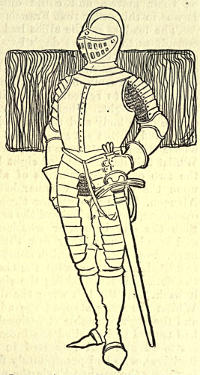
Italian Armour, First Half of the Sixteenth Century
Both sides passed the night under arms in the position occupied at the cessation of action owing to the darkness, and not far from each other. Francis I, after many charges, had returned to the artillery, who, firing opportunely upon the Swiss battalions, had several times broken through them, and were shortly to prove to be of even more powerful assistance. Showing the foresight of a general after showing the intrepidity of a soldier, he caused Duprat, the chancellor, who had followed him on this campaign, to write three most important letters, which were confided to trusty messengers. The first was addressed to the Venetian general, Bartolommeo d’Alviano, whom he enjoined to set out immediately, and to come from Lodi with his customary promptitude, so as to join the forces he commanded to those of Francis on the following day. The second exhorted Louis d’Ars, who occupied Pavia, to carefully guard his stronghold which might, in case of disaster, serve as a point of retreat. In the third he warned Lautrec of the attack of the Swiss, and advised him not to remit or allow to be taken the money he carried about him, in execution of the violated treaty of Gallarate. These precautions taken, he “spent the rest of the night,” so he wrote after the battle, “in the saddle, his lance in hand, and his helmet on his head,” and only rested for a few moments, leaning on a gun-carriage.
An hour before dawn he prepared everything for the coming battle. He took up a position slightly in the rear, and more favourable than the one he had occupied the preceding day. Instead of leaving his army drawn up in three lines, he placed his men abreast in only one line. Remaining in the centre of his battle array, he called upon the high constable of Bourbon to form his right wing with the advance-guard, and his brother-in-law, the duke of Alençon, to form his left wing with the rear-guard. The guns, well placed and defended, were by well-directed firing, to harass the enemy on their march, and could only be approached by them with difficulty. It was in this order that Francis I awaited the attack of the Swiss.
The leaders of the allies had held a council of war during the night, to consult as to the next day’s battle and how to render it more decisive. At daybreak they closed up their huge battalions and set out somewhat ponderously. They seemed at first to be proceeding in a body towards the centre of the French army, but some discharges of artillery which pierced their ranks caused them to retreat in the direction of the positions they had occupied during the night. There they formed into three detachments which marched on the main body and the two wings of the French. The first detachment, supported by the six small guns of the Swiss, advanced towards Francis I, whose steadfast attitude and powerful artillery kept it at a certain distance. Whilst this detachment of eight hundred men faced and attacked the king, the two other detachments of about equal strength had flung themselves upon the two wings commanded by the high constable and the duke of Alençon, hoping to scatter them, so as to then surround, and thus easily overcome, the main body of the army. Whether the Swiss had less confidence than the day before, or whether they were met with even more courage and steadfastness, they saw their enemies facing their pikes as they had never done yet. The high constable with his lansquenets and men-at-arms, and Pedro Navarro with the Gascon archers and the adventurers, resisted the detachment attacking the right wing, and, after a sharp struggle, drove it back. In the left wing the duke of Alençon was at first less fortunate. Whilst the king stopped the advance of the central column of the Swiss, and the high constable victoriously drove back the left one, the right column had turned and assailed the forces of the duke of Alençon, which had been scattered and had retreated in confusion. In spite of the terror of the fugitives, who had precipitately fled from the field of battle, and were spreading along the road to Pavia the news of the victory of the Swiss, the conflict remained at this point.
D’Aubigny and Aymar de Prie, having rallied the troops, did their utmost to repair the disaster of the duke of Alençon, and bravely charged the enemy. They were struggling with them when Bartolommeo d’Alviano, who had started early from Lodi, arrived about ten o’clock from that side of the battle-field. At the head of his armed men and his light cavalry, he at once fell upon the Swiss with the cry of “Saint Mark!” This unexpected attack disconcerted them. They feared the whole Venetian army would be upon them, and they retreated. Closely pursued, they fell back towards the centre, where the allies’ battalions, placed opposite Francis I, had not been able to make any progress. They discharged and received cannon-shots during several hours, possibly awaiting the victorious issue of the two attacks of the right and left wings to attempt more securely to break through the main body of the army. They made one last and vigorous effort. A company of five thousand men were told off, and marched with the resolution of despair as far as the French lines. But, taken obliquely by the artillery, charged by Francis I and his men-at-arms, attacked with hatchets and pikes by the valiant lansquenets of the Black Company, stationed in the centre with the king, pierced by the arrows of the Gascon archers, who had hastened from the right side where they had gained the mastery, the Swiss company was cut to pieces and none escaped.
[1515-1516 A.D.]
The king, with a decisive movement, then bore down with his cavalry upon the other confederates, who abandoned their position and their guns. The Swiss, driven back or vanquished on every side, gave the signal for retreat, and retired from the battle-field, leaving from seven to eight thousand dead. Carrying their wounded, they retook the Milan road in fairly good order and without pursuit, and entered that town with a haughty demeanour, and not as a defeated army. They were beaten, nevertheless, for they had just lost at Marignano that prestige, which, since Sempach, Granson, and Morat, and as late as at Novara, had made them invincible.h
This horrible butchery, however, hastened the conclusion of the wars which arose from the league of Cambray. The Swiss were not sufficiently powerful to maintain their sway in Lombardy; eight of their cantons, on the 7th of November, signed, at Geneva, a treaty of peace with Francis I, who compensated with considerable sums of money all the claims which they consented to abandon. On the 29th of November the other cantons acceded to this pacification, which took the name of “Paix perpétuelle,” and France recovered the right of raising such infantry as she needed among the Swiss. Raymond de Cardona, alarmed at the retreat of the Swiss, evacuated Lombardy with the Spanish troops. The French recovered possession of the whole duchy of Milan. Massimiliano Sforza abdicated the sovereignty for a revenue of 30,000 crowns secured to him in France. Leo X, ranging himself on the side of the victors, signed, at Viterbo, on the 13th of October, a treaty, by which he restored Parma and Piacenza to the French.
In a conference held with Francis at Bologna, between the 10th and 15th of the following December, Leo induced that monarch to sacrifice the liberties of the Gallican church by the concordat, to renounce the protection he had hitherto extended to the Florentines and to the duke of Urbino, although the former had always remained faithful to France. The pope seized the states of the duke of Urbino, and conferred them on his nephew, Lorenzo II de’ Medici. Amidst these transactions, Ferdinand the Catholic died, on the 15th of January, 1516, and his grandson Charles succeeded to his Spanish kingdoms. On the 13th of August following, Charles signed, at Noyon, a treaty, by which Francis ceded to him all his right to the kingdom of Naples as the dower of a newborn daughter, whom he promised to Charles in marriage. From that time Maximilian remained singly at war with the republic of Venice and with France. During the campaign of 1516, his German army continued to commit the most enormous crimes in the Veronese march; but Maximilian had never money enough to carry on the war without the subsidies of his allies; remaining alone, he could no longer hope to be successful. On the 14th of December he consented to accede to the treaty of Noyon; he evacuated Verona, which he had till then occupied, and the Venetians were once more put by the French in possession of all the states of which the league of Cambray had proposed the partition: but their wealth was annihilated, their population reduced to one-half, their constitution itself shaken, and they were never after in a state to make those efforts for the defence of the independence of Italy, which might have been expected from them before this devastating war.
[1516-1519 A.D.]
Had Italy been allowed to repose after so many disasters, she might still have recovered her strength and population; and when the struggle should have recommenced with the transalpine nations, she would have been found prepared for battle; but the heartless levity and ambition of Leo did not give her time. While the family of the Medici was becoming extinct around him, he dreamed only of investing it with new dignities; he refused the Florentines permission to re-establish their republic, and offered his alliance to whatever foreign monarch would aid him in founding on its ruins a principality for the bastard Medici. His third brother Giuliano, duke of Nemours, whom he had at first charged with the government of Florence, died on the 17th of March, 1516. Lorenzo II, son of his eldest brother Piero, whom he had made duke of Urbino, and whom he sent to command at Florence after Giuliano, rendered himself odious there by his pride and by his contemptible incapacity—he too died only three years afterwards, on the 28th of April, 1519. Leo supplied his place by Cardinal Giulio de’ Medici, afterwards Clement VII. This prelate was the natural son of the first Giuliano killed in the Pazzi conspiracy of 1478. He was considered the most able of the pope’s ministers, and the most moderate of his lieutenants. Giuliano II had also left an illegitimate son, Ippolito, afterwards cardinal; and Lorenzo II had a legitimate daughter, Catherine, afterwards queen of France, and an illegitimate son, Alexander, destined to be the future tyrant of Florence. Leo, whether desirous of establishing these descendants, or carried away by the restlessness and levity of his character, sighed only for war.
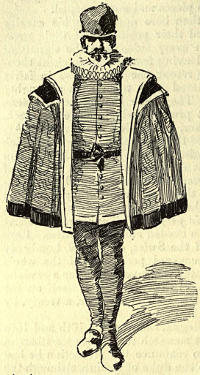
An Attendant of an Italian Prince, First Half of Sixteenth Century
[1519-1522 A.D.]
The emperor Maximilian died on the 19th of January, 1519, leaving his hereditary states of Austria to his grandson Charles, already sovereign of all Spain, of the Two Sicilies, of the Low Countries, and of the county of Burgundy. Charles and Francis both presented themselves as candidates for the imperial crown; the electors gave it to the former, on the 28th of June, 1519; he was from that period named Charles V. Italy, indeed the whole of Europe, was endangered by the immeasurable growth of this young monarch’s power. The states of the church, over which he domineered by means of his kingdom of the Two Sicilies, could not hope to preserve any independence but through an alliance with France. Leo at first thought so, and signed the preliminary articles of a league with Francis; but, suddenly changing sides, he invited Charles V to join him in driving the French out of Italy. A secret treaty was signed between him and the emperor, on the 8th of May, 1521. By this the duchy of Milan was to be restored to Francesco Sforza, the second son of Louis the Moor. Parma, Piacenza, and Ferrara were to be united to the holy see: a duchy in the kingdom of Naples was to be secured to the bastard Alessandro de’ Medici. The pope united his army to that of the emperor in the kingdom of Naples; the command of it was given jointly to Prospero Colonna and the marquis Pescara: war was declared on the 1st of August, and the imperial and pontifical troops entered Milan on the 19th of November: but in the midst of the joy of this first success, Leo X died unexpectedly, on the 1st of December, 1521.
SUCCESSORS OF LEO; FRANCIS I AND CHARLES V
Death opportunely delivered Leo from the dangers and anxieties into which he had thoughtlessly precipitated himself. His finances were exhausted; his prodigality had deprived him of every resource; and he had no means of carrying on a war which he had only just begun. He left his successors in a state of distress which was unjustly attributed to them, and which rendered them odious to the people; for the war into which he had plunged them, without any reasonable motive, was the most disastrous of all those which had yet afflicted unhappy Italy. There remained no power truly Italian that could take any part in it for her defence. Venice was so exhausted by the war of the league of Cambray that she was forced to limit her efforts to the maintenance of her neutrality, and was hardly powerful enough to make even her neutral position respected. Florence remained subject to the cardinal Giulio de’ Medici. The republics of Siena and Lucca were tremblingly prepared to obey the strongest: all the rest depended on the transalpine power; for an unexpected election, on the 9th of January, 1522, had given a Flemish successor to Leo X, under the name of Adrian VI. This person had been the preceptor of Charles V, and had never seen Italy, where he was regarded as a barbarian. The kingdom of Naples was governed and plundered by the Spaniards. After the French had lost the duchy of Milan, Francesco Sforza, who had been brought back by the imperialists, possessed only the name of sovereign. He had never been for a moment independent; he had never been able to protect his subjects from the tyranny of the Spanish and German soldiers, who were his guards. Finally, the marquis de Montferrat and the duke of Savoy had allowed the French to become masters in their states, and had no power to refuse them passage to ravage oppressed Italy anew.
[1522-1525 A.D.]
The marshal Lautrec, whom Francis I had charged to defend the Milanese, and who still occupied the greater part of the territory, was forced by the Swiss, who formed the sinews of his army, to attack the imperialists on the 29th of April, 1522, at Bicocca. Prospero Colonna had taken up a strong position about three or four miles from Milan, on the road to Monza: he valued himself on making a defensive war—on being successful without giving battle. The Swiss attacked him in front, throwing themselves, without listening to the voice of their commander, into a hollow way which covered him, and where they perished, without the possibility of resistance. After having performed prodigies of valour, the remainder were repulsed with dreadful loss. In spite of the remonstrances of Lautrec, they immediately departed for their mountains; and he for his court, to justify himself. Lescuns, his successor in the command, suffered the imperialists to surprise and pillage Lodi; and was at last forced to capitulate at Cremona on the 6th of May, and evacuate the rest of Lombardy. Genoa was not comprehended in the capitulation, and remained still in possession of the French; but, on the 20th of May, that city was also surprised by the Spaniards, and pillaged with all the ferocity which signalised that nation. It was one of the largest depots of commerce in the West, and the ruin of so opulent a town shook the fortune of every merchant in Europe. The general of Charles then, judging Lombardy too much exhausted to support his armies, led them to live at discretion in the provinces of his ally, the pope. They raised among the states still calling themselves independent enormous subsidies to pay the soldiers, for which purpose Charles never sent money. The plague, breaking out at the same time at Rome and Florence, added to the calamities of Italy so much the more that Adrian VI abolished, as pagan superstition or acts of revolt against providence, all the sanitary measures of police which had been invented to stop the spread of contagion. The pope died on the 14th of September, 1523; and the Romans, who held him in horror, crowned his physician with laurel, as the saviour of his country.
The death of Adrian, however, saved no one. The cardinal Giulio de’ Medici was chosen his successor, on the 18th of November, under the name of Clement VII. This man had passed for an able minister under his cousin Leo X, because prosperity still endured, and the pontifical treasury was not exhausted; but when he had to struggle with a distress which he, however, had not caused, his ignorance in finance and administration, his sordid avarice, his pusillanimity, his imprudence, his sudden and ill-considered resolutions, his long indecisions, made him alike odious and contemptible. He was not strong enough to resist the tide of adversity. He found himself, without money and without soldiers, engaged in a war without an object; he was incapable of commanding, and nowhere found obedience.
The French were not disposed to abandon their title to Lombardy, the possession of which they had just lost. Before the end of the campaign, Francis sent thither another army, commanded by his favourite, the admiral Bonnivet. This admiral entered Italy by Piedmont; passed the Ticino on the 14th of September, 1523; and marched on Milan. But Prospero Colonna, who had chosen, among the great men of antiquity, Fabius Cunctator for his model, was admirable in the art of stopping an army, of fatiguing it by slight checks, and at last forcing it to retreat without giving battle. Bonnivet, who maintained himself on the borders of Lombardy, was forced, in the month of May following, to open himself a passage to France by Ivrea and Mont St. Bernard. The chevalier Bayard was killed while protecting the retreat of Bonnivet, in the rear-guard. The imperialists had been joined, the preceding year, by a deserter of high importance, the constable Bourbon, one of the first princes of the blood in France, who was accompanied by many nobles. Charles V put him, jointly with Pescara, at the head of his army, and sent him into Provence in the month of July; but, after having besieged Marseilles, he was soon constrained to retreat. Francis I, who had assembled a powerful army, again entered Lombardy, and made himself master of Milan: he next laid siege to Pavia, on the 28th of October. Some time was necessary for the imperialists to reassemble their army, which the campaign of Provence had disorganised. At length it approached Pavia, which had resisted through the whole winter. The king of France was pressed by all his captains to raise the siege, and to march against the enemy; but he refused, declaring that it would be a compromise of the royal dignity, and foolishly remained within his lines. He was attacked by Pescara on the 24th of February, 1525; and, after a murderous battle, made prisoner.
For several months, while Francis I was besieging Pavia, he appeared the strongest power in Italy; and the pope and the Venetians, alarmed at his proximity, had treated with him anew, and pledged themselves to remain neutral. The imperial generals, after their victory, declared that these treaties with the French were offences against their master, for which they should demand satisfaction. Always without money, and pressed by the avidity of their soldiers, they sought only to discover offenders, as a pretence to raise contributions, and to let their troops live at free quarters. The pope and the Venetians were at first disposed to join in a league for resisting these exactions; and they offered Louise of Savoy, regent of France, their aid to set her son Francis at liberty. But Clement VII had not sufficient courage to join this league; he preferred returning again to the alliance of the emperor and the duke of Milan, for which he paid a considerable sum. As soon as the imperial generals had received the money, they refused to execute the treaty which they had made with him, and the pope was obliged to go back to the Venetians and Louise of Savoy.
Meanwhile Girolamo Morone, chancellor of the duke of Milan, an old man regarded as the most able politician of his time, made overtures, which revived the hope of arming all Italy for her independence. Francesco Sforza found himself treated by the Germans and Spaniards with the greatest indignity in his own palace: his subjects were exposed to every kind of insult from an unbridled soldiery; and when he endeavoured to protect them, the officers took pleasure in making him witness aggravations of injustice and outrage. The man, however, who made the German yoke press most severely on him was the marquis Pescara, an Italian, but descended from the Catalonian house of Avalos, established in the kingdom of Naples for more than a century. He manifested a sort of vanity in associating himself with the Spaniards: he commanded their infantry; he adopted the manners as well as pride of that nation. Morone, nevertheless, did not despair of awakening his patriotism, by exciting his ambition. The kingdom of Naples, which had flourished under the bastard branch of the house of Aragon when the family of Avalos first entered it, had sunk, since it had been united to Spain, into a state of the most grievous oppression. Morone determined on offering Pescara the crown of Naples, if he would join his efforts to those of all the other Italians, for the deliverance of his country. Success depended on him: he could distribute the imperial troops, which he commanded, in such a manner as that they could oppose no resistance. The duke of Milan had been warned that Charles V intended taking his duchy from him to confer it on his brother Ferdinand of Austria. The kingdom of Naples and the duchy of Milan were ready to pass over from the emperor’s party to that of France, provided the French king would renounce all his claims to both, acknowledge Pescara king of Naples, Francesco Sforza duke of Milan; and restore to Italy her independence, after having delivered her from her enemies.
[1525-1526 A.D.]
This negotiation was at first successful; each of the governments to which the proposition of concurring in the independence of Italy was addressed, seemed to agree to it. France renounced all pretensions to Lombardy and the Two Sicilies; Switzerland promised to protect, on its side, the land of ancient liberty, and to furnish it with soldiers; Henry VIII of England promised money; Pescara coveted the crown, and Sforza was impatient to throw off a yoke which had become insupportable to him; but, unhappily, the negotiation was intrusted to too many cabinets, all jealous, perfidious, and eager to obtain advantages for themselves by sacrificing their allies. Clement was desirous of obtaining from the emperor a more advantageous treaty, by threatening him with France; the queen regent of France endeavoured to engage Charles to relax his rigour towards her son, by threatening him with Italy; Pescara, reserving the choice of either betraying his master or his allies, as should prove most profitable to him, had warned Charles that he was engaged in a plot which he would reveal as soon as he had every clew to it. The duchess of Alençon, sister of Francis, sent by her mother to negotiate at Madrid, spoke still more clearly. She offered Charles to abandon Italy, the project respecting which she disclosed, provided the emperor, in restoring her brother to liberty, would renounce his purpose of making him purchase it at the price of one of the provinces of France. Pescara, finding that his court knew more than he had told, determined on adopting the part of provocative agent instead of rebel; he had only to choose between them. On the 14th of October, 1525, he invited Morone to a last conference in the castle of Novara. After having made him explain all his projects anew, while Spanish officers hid behind the arras heard them, he caused him to be arrested, seized all the fortresses in the state of Milan, and laid siege to the castle, in which the duke had shut himself up. He denounced to the emperor as traitors the pope, and all the other Italians his accomplices; but while he played this odious part, he was attacked by a slow disease, of which he died on the 30th of November, 1525, at the age of thirty-six, abhorred by all Italy.
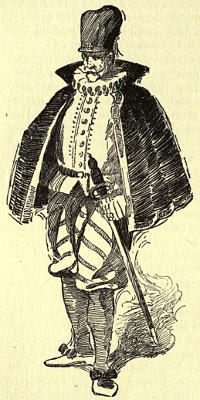
An Italian Captain, First Half of Sixteenth Century
Charles, abusing the advantages which he had obtained, imposed on Francis the treaty of Madrid, signed on the 14th of January, 1526; by which the latter abandoned Italy and the duchy of Burgundy. He was set at liberty on the 18th of March following; and almost immediately declared to the Italians that he did not regard himself bound by a treaty extorted from him by force. On the 22nd of May, he joined a league for the liberty of Italy with Clement VII, the Venetians, and Francesco Sforza, but still did not abandon the policy of his mother: instead of thinking in earnest of restoring Italian independence, and thus securing the equilibrium of Europe, he had only one purpose—that of alarming Charles with the Italians; and was ready to sacrifice them as soon as the emperor should abandon Burgundy. At the same time, his supineness, love of pleasure, distrust of his fortune, and repugnance to violate the Treaty of Madrid, hindered him from fulfilling any of the engagements which he had contracted towards the Italians; he sent them neither money, French cavalry, nor Swiss forces. Charles, on the other hand, sent no supplies to pay his armies to Antonio de Leyva, the constable Bourbon, and Hugo de Monçada, their commanders. These troops were therefore obliged to live at free quarters, and the oppression of the whole country was still more dreadful than it had ever yet been.
[1526-1527 A.D.]
The defection of the duke of Milan, in particular, gave a pretence to Antonio de Leyva to treat the wretched Milanese with redoubled rigour, as if they could be responsible for what Leyva called the treachery of their master. The Spanish army was quartered on the citizens of Milan; and there was not a soldier who did not make his host a prisoner, keeping him bound at the foot of the bed, or in the cellar, for the purpose of having him daily at hand, to force him, by blows or fresh torture, to satisfy some new caprice. As soon as one wretched person died under his sufferings, or broke his bonds and ended his sufferings by voluntary death, either precipitating himself through a window or into a well, the Spaniard passed into another house to recommence on its proprietor the same torture.
The Venetians and the pope had united their forces, under the command of the duke of Urbino, who, exaggerating the tactics of Prospero Colonna, was ambitious of no other success in war than that of avoiding battle. He announced to the senate of Venice that he would not approach Milan till the French and Swiss, whose support he had been promised, joined him. His inaction, while witnessing so many horrors, reduced the Italians to despair. Sforza, who had been nine months blockaded in the castle of Milan, and who always hoped to be delivered by the duke of Urbino, whose colours were in sight, supported the last extremity of hunger before he surrendered to the Spaniards, on the 24th of July, 1526. The pope, meanwhile, was far from suspecting himself in any danger; but his personal enemy, Pompeo Colonna, took advantage of the name of the imperial party to raise in the papal state eight thousand armed peasants, with whom, on the 20th of September, he surprised the Vatican, pillaged the palace, as well as the temple of St. Peter, and constrained the pope to abjure the alliance of France and Venice. About the same time, George of Frundsberg, a German condottiere, entered Lombardy with thirteen thousand adventurers, whom he had engaged to follow him, and serve the emperor without pay, contenting themselves with the pillage of that unhappy country.
The constable Bourbon, to whom Charles had given chief command of his forces in Italy, determined to take advantage of this new army, and unite it to that for which at Milan he had now no further occasion; but it was not without great difficulty that he could persuade the Spaniards to quit that city where they enjoyed the savage pleasure of inflicting torture on their hosts. At length, however, he succeeded in leading them to Pavia. On the 30th of January, 1527, he joined Frundsberg, who died soon after of apoplexy. Bourbon now remained alone charged with the command of this formidable army, already exceeding twenty-five thousand men, and continually joined on its route by disbanded soldiers and brigands intent on pillage. The constable had neither money, equipments, nor artillery, and very few cavalry; every town shut its gates on his approach, and he was often on the point of wanting provisions. He took the road of southern Italy, and entered Tuscany, still uncertain whether he should pillage Florence or Rome. The marquis of Saluzzo, with a small army, retreated before him; the duke of Urbino followed in his rear, but always keeping out of reach of battle. At last, Bourbon took the road to Rome, by the valley of the Tiber. On the 5th of May, 1527, he arrived before the capital of Christendom. Clement had on the 15th of March signed a truce with the viceroy of Naples and dismissed his troops. On the approach of Bourbon the walls of Rome were again mounted with engines of war.d
CAPTURE AND SACK OF ROME
[1527 A.D.]
Bourbon encamped in the fields near Rome on the 5th of May and with military insolence sent a trumpeter to the pope to ask for passage through the city, that he might lead his army into the kingdom of Naples. The next day at daybreak he attacked Borgo on the side of the mountain and the church of Santo Spirito, resolved to conquer or die (for indeed no other hope was left him) and a fierce battle was begun. Fortune favoured him in approaching, for a thick fog arose before day which enabled him more securely to establish his army in the place where the battle commenced. From the first Bourbon fought desperately at the head of his troops, not only because he had no refuge if the victory failed him but also because it appeared to him that the German infantry proceeded coldly to the assault. The assault was but begun when he was wounded by an arquebuse and fell dead.b The fall of Bourbon was due to Benvenuto Cellini, if we may accept the statements of that somewhat egotistical autobiographer. Cellini was participating in the defence of Rome and has left us a vivid account of many of its incidents. He tells us that he had gone with one Alexander del Bene to the walls of Campo Santo, and that finding the enemy irresistible they had determined to return with the utmost speed, but that before doing so he was determined to perform some manly action.a “Having taken aim with my piece,” he says, “where I saw the thickest crowd of the enemy, I fixed my eye on a person who seemed to be lifted up by the rest: but the misty weather prevented me from distinguishing whether he was on horseback or on foot. Then turning suddenly about to Alexander and Cecchino, I bade them fire off their pieces, and showed them how to escape every shot of the besiegers. Having accordingly fired twice for the enemy’s once, I softly approached the walls, and perceived that there was an extraordinary confusion among the assailants, occasioned by our having shot the duke of Bourbon: he was, as I understood afterwards, that chief personage whom I saw raised by the rest.”c The fall of Bourbon, far from cooling the ardour of his soldiers did but increase it, and after fighting furiously for two hours they entered Borgo at last, assisted by the weakness of the defences and the faint resistance of the enemy.
As it is always difficult to carry an assault without cannon, the besiegers lost about a thousand men. As soon as the imperial army had forced an entrance, everyone took to flight, and many made for the castle, leaving the suburbs at the mercy of the conquerors. The pope, who awaited the event in the Vatican, when he heard that the enemy was in the city, immediately fled to the castle with many cardinals. Here he considered whether he should stay where he was, or if he might escape through Rome with the light cavalry of his guard and reach a place of safety.
News was brought him by Berard de Padone, of the imperial army, of the death of Bourbon and that the troops, full of consternation at their loss, were disposed to come to terms. The pope sent an envoy to their chiefs and unfortunately gave up the idea of flight, while he and his captains had never been so irresolute in taking measures for their own defence as they were on this occasion. The Spaniards, finding no attempt was made to defend the Trastevere, entered it at noon without any resistance. They had no difficulty in entering Rome by the Ponte Sisto at five o’clock the same evening. Here, as is usual in such cases, everything was in confusion, and all the court and citizens had taken to flight except those who trusted in the name of their party, and certain cardinals who were known for their adherence to Cesare, and therefore thought themselves safer than the rest. Then the soldiers sacked the city on every side without distinction of friend or foe.
It is impossible to estimate the extent of the spoil because of the accumulation of riches, and rare and precious things belonging to the courtiers and merchants, and of the quality and number of the prisoners for whom heavy ransoms were paid. But worst of all, the soldiers, especially the Germans, who were rendered cruel and insolent by their hatred for the Roman church, seized several prelates and having dressed them in their pontifical robes and the insignia of their office, mounted them on asses and led them with scorn and derision through the streets of Rome.
Four thousand men or thereabout perished in the battle or in the fury of pillage. The palaces of the cardinals were all sacked (including that of Cardinal Colonna, who was not with the army) excepting those palaces in which the merchants had taken refuge with their personal effects and those of many others, and which were spared from pillage upon payment of large sums of money. Many who had thus compounded with the Spaniards were pillaged by the Germans or obliged to compound with them also. The marchioness of Mantua paid 50,000 ducats to save her palace, this sum being furnished by the merchants who had taken refuge there; it was rumoured that 10,000 went to her son Don Ferrand. The cardinal of Siena, who had inherited his adherence to the emperor from his ancestors, was taken prisoner by the Germans, who sacked his palace though he had compounded for it with the Spaniards. They led him bareheaded through Borgo with many blows, and he only escaped from their hands by payment of 5,000 ducats. The cardinals of Minerva and Ponzetto met with a similar misfortune; they were taken prisoner by the Germans and paid their ransom, but they were first led through Rome in a vile procession. The Spanish and German prelates, who did not expect insult from their compatriots, were taken prisoner and treated as cruelly as the rest.
On every side arose the cries and lamentations of Roman ladies and nuns dragged off by bands of soldiers to satisfy their lust. Everywhere arose the wails of those who were being horribly tortured to force them to pay ransom, and reveal where their property was concealed. All the holy things, the sacrament, and relics of saints, of which the churches were full, lay scattered on the ground stripped of their ornaments and further outraged by the barbarous Germans. Whatever escaped the soldiers (which was everything of little value) was pillaged by the peasants of the lands of Colonna who arrived later; but Cardinal Colonna who arrived next day saved many ladies who had taken refuge in his palace. It was said that the spoil in money, gold, silver, and precious stones amounted to 1,000,000 ducats, and that the ransoms amounted to a much higher sum.
While the imperial army was taking Rome, Count Guido at the head of the light cavalry and eight hundred arquebusiers appeared on the Ponte de Salara, expecting to enter the city that evening; for in spite of the letter of the bishop of Verona he had continued on his way, not wishing to lose the glory of having helped to save the capital. But being informed of what had occurred, he resolved to withdraw to Orticoli where he rejoined the rest of his troops. As it is human nature to judge mildly and favourably of one’s own actions and to look with the utmost severity on the actions of others, there were some who greatly blamed the count for having missed so good an opportunity; for the imperial troops all intent on pillage, ransacking the houses, seeking hidden treasures, taking prisoners and removing their booty to a safe place, were scattered about the city in disorder, heedless of their banners and of the commands of their captains. Therefore many believed that if Count Guido had promptly led his men into Rome and marched upon the castle, which was not besieged nor guarded by any from without, he might not only have liberated the pope but also have achieved a more glorious success. The enemy was so intent on plunder that it would have been difficult to assemble a large number upon any sudden alarm. This was most certainly proved a few days later when by command of the captains, or upon some alarm, the call to arms was sounded and not a soldier rallied to his banner. However, men often persuade themselves that if a certain act had been done or omitted, certain results would have followed; whereas if the matter had been put to the proof, experience would often show them their mistake.b
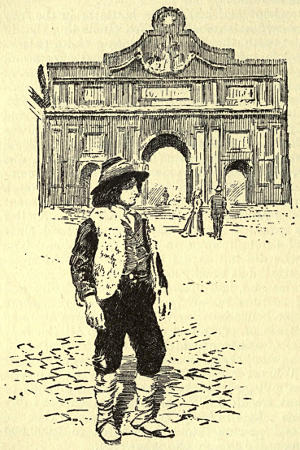
Porta del Popolo, Rome
[1527-1528 A.D.]
The capital of Christendom was thus abandoned to a pillage unparalleled in the most calamitous period—that of the first triumph of barbarism over civilisation: neither Alaric the Goth nor Genseric the Vandal had treated it with like ferocity. This dreadful state of crime and agony lasted not merely days, but was prolonged for more than nine months: it was not till the 17th of February, 1528, that the prince of Orange, one of the French lords who had accompanied Bourbon in his rebellion, finally withdrew from Rome all of this army that vice and disease had spared. The Germans, indeed, after the first few days, had sheathed their swords, to plunge into drunkenness and the most brutal debauchery; but the Spaniards, up to the last hour of their stay in Rome, indefatigable in their cold-blooded cruelty, continued to invent fresh torture to extort new ransoms from all who fell into their hands; even the plague, the consequence of so much suffering, moral and physical, which broke out amidst all these horrors, did not make the rapacious Spaniard loose his prey.
The struggle between the Italians, feebly seconded by the French, and the generals of Charles V, was prolonged yet more than two years after the sack of Rome; but it only added to the desolation of Italy, and destroyed alike in all the Italian provinces the last remains of prosperity. On the 18th of August, 1527, Henry VIII of England and Francis I contracted the Treaty of Amiens, for the deliverance, as the two sovereigns announced, of the pope. A powerful French army, commanded by Lautrec, entered Italy in the same month, by the province of Alessandria. They surprised Pavia on the 1st of October, and during eight days barbarously pillaged that great city, under pretence of avenging the defeat of their king under its walls. After this success, Lautrec, instead of completing the conquest of Lombardy, directed his march towards the south; renewed the alliance of France with the duke of Ferrara, to whose son was given in marriage a daughter of Louis XII, sister of the queen of France. He secured the friendship of the Florentine Republic, which, on the 17th of the preceding May, had taken advantage of the distress and captivity of the pope to recover its liberty and to re-establish its government in the same form in which it stood in 1512. The pope, learning that Lautrec had arrived at Orvieto, escaped from the castle of St. Angelo on the 9th of December, and took refuge in the French camp. The Spaniard Alarcon had detained him captive, with thirteen cardinals, during six months, in that fortress; and, though the plague had broken out there, he did not relax in his severity. After having received 400,000 ducats for his ransom, instead of releasing him, as he had engaged to the next day, it is probable that he suffered him to escape, lest his own soldiers should arrest him in order to extort a second ransom.
Lautrec passed the Tronto to enter the Abruzzi with his powerful army on the 10th of February, 1528. The banditti whom Charles V called his soldiers, whom he never paid, and who showed no disposition to obedience, were cantoned at Milan, Rome, and the principal cities in Italy: they divided their time between debauchery and the infliction of torture on their hosts; their officers were unable to induce them to leave the towns and advance towards the enemy. The people, in the excess of suffering, met every change with eagerness, and received Lautrec as a deliverer. He would probably have obtained complete success, if Francis had not just at this moment withheld the monthly advance of money which he had promised. That monarch, identifying his pride of royalty with prodigality, exhausted his finances in pleasures and entertainments; his want of economy drew on him all his disasters.
Lautrec, on his side, although he had many qualities of a good general, was harsh, proud, and obstinate: he piqued himself on doing always the opposite of what he was counselled. Disregarding the national peculiarities of the French, he attempted in war to discipline them in slow and regular movements. He lost valuable time in Apulia, where he took and sacked Melfi, on the 23rd of March, with a barbarity worthy of his adversaries, the Spaniards: he did not arrive till the 1st of May before Naples. The prince of Orange had just entered that city with the army which had sacked Rome, but of which the greater part had been carried off by a dreadful mortality, the consequence and punishment of its vices and crimes. Instead of vigorously attacking them, Lautrec, in spite of the warm remonstrances of his officers, persisted in reducing Naples by blockade; thus exposing his army to the influence of a destructive climate. The imperial fleet was destroyed, on the 28th of May, in the gulf of Salerno, by Filippino Doria, who was in the pay of France. The inhabitants of Naples experienced the most cruel privations, and sickness soon made great havoc amongst them: but a malady not less fatal broke out at the same time in the French camp. The soldiers, under a burning sun, surrounded with putrid water, condemned to every kind of privation, harassed by the light cavalry of the enemy, infinitely superior to theirs, sank, one after the other, under pestilential fevers. In the middle of June, the French reckoned in their camp twenty-five thousand men; by the 2nd of August there did not remain four thousand fit for service. At this period all the springs were dry, and the troops began to suffer from hunger and thirst. Lautrec, ill as he was, had till then supported the army by his courage and invincible obstinacy; but, worn out at last, he expired in the night of the 15th of August: almost all the other officers died in like manner. The marquis of Saluzzo, on whom the command of the army devolved, felt the necessity of a retreat, but knew not how to secure it in presence of such a superior force. He tried to escape from the imperialists, by taking advantage of a tremendous storm, in the night of the 29th of August; but was soon pursued, and overtaken at Aversa, where, on the 30th, he was forced to capitulate. The magazines and hospitals at Capua were, at the same time, given up to the Spaniards. The prisoners and the sick were crowded together in the stables of the Magdalen, where contagion acquired new force. The Spaniards foresaw it, and watched with indifference the agony and death of all; for nearly all of that brilliant army perished—a few invalids only ever returning to France.
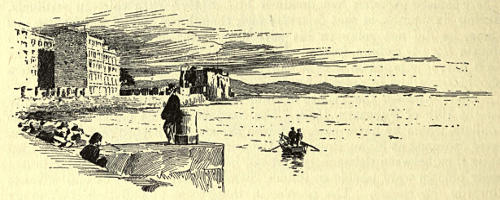
Castel dell’Ovo, Naples
[1528-1529 A.D.]
During the same campaign another French army, conducted by François de Bourbon, count of St. Pol, had entered Lombardy, at the moment when Henry, duke of Brunswick, led thither a German army. Henry, finding nothing more to pillage, announced that his mission was to punish a rebellious nation, and put to the sword all the inhabitants of the villages through which he passed. Milan was at once a prey to famine and the plague, aggravated by the cupidity and cold-blooded ferocity of Leyva, who still commanded the Spanish garrison. Leyva seized all the provisions brought in from the country; and, to profit by the general misery, resold them at an enormous price. Genoa had remained subject to the French, and was little less oppressed; none of its republican institutions was any longer respected: but a great admiral still rendered it illustrious. Andrea Doria had collected a fleet, on board of which he summoned all the enterprising spirits of Liguria: his nephew Filippino, who had just gained a victory over the imperialists, was his lieutenant. The Dorias demanded the restoration of liberty to their country as the price of their services: unable to obtain it from the French, they passed over to the imperialists. Assured by the promises of Charles, they presented themselves, on the 12th of September, before Genoa, excited their countrymen to revolt, and constrained the French to evacuate the town: they made themselves masters of Savona on the 21st of October, and a few days afterwards of Castelletto. Doria then proclaimed the republic, and re-established once more the freedom of Genoa, at the moment when all freedom was near its end in Italy. The winter passed in suffering and inaction. The following year, Antonio de Leyva surprised the count de St. Pol at Landriano, on the 21st of June, 1529, and made him prisoner, with all the principal officers of the French army. The rest dispersed or returned to France. This was the last military incident in this dreadful war.
Peace was ardently desired on all sides; negotiations were actively carried on, but every potentate sought to deceive his ally in order to obtain better conditions from his adversary. Margaret of Austria, the sister of the emperor’s father, and Louise of Savoy, the mother of the king of France, met at Cambray; and, in conference to which no witnesses were admitted, arranged what was called “le traité des dames.” Clement VII had at the same time a nuncio at Barcelona, who negotiated with the emperor. The latter was impatient to arrange the affairs of Italy, in order to pass into Germany. Not only had Suleiman invaded Austria, and, on the 13th of September, arrived under the walls of Vienna, but the reformation of Luther excited in all the north of Germany a continually increasing ferment. On the 20th of June, 1529, Charles signed at Barcelona a treaty of perpetual alliance with the pope: by it he engaged to sacrifice the republic of Florence to the pope’s vengeance, and to place in the service of Clement, in order to accomplish it, all the brigands who had previously devastated Italy. Florence was to be given in sovereignty to the bastard Alessandro de’ Medici, who was to marry an illegitimate daughter of Charles V. On the 5th of August following, Louise and Margaret signed the Treaty of Cambray, by which France abandoned, without reserve, all its Italian allies to the caprices of Charles; who, on his side, renounced Burgundy, and restored to Francis his two sons, who had been retained as hostages.
Charles arrived at Genoa, on board the fleet of Andrea Doria, on the 12th of August. The pope awaited him at Bologna, into which he made his entry on the 5th of November. He summoned thither all the princes of Italy, or their deputies, and treated them with more moderation than might have been expected after the shameful abandonment of them by France. As he knew the health of Francesco Sforza, duke of Milan, to be in a declining state, which promised but few years of life, he granted him the restitution of his duchy for the sum of 900,000 ducats, which Sforza was to pay at different terms: they had not all fallen due when that prince died, on the 24th of October, 1535, without issue, and his estates escheated to the emperor. On the 23rd of December, 1529, Charles granted peace to the Venetians; who restored him only some places in Apulia, and gave up Ravenna and Cervia to the pope. On the 20th of March, Alfonso d’Este also signed a treaty, by which he referred his differences with the pope to the arbitration of the emperor. Charles did not pronounce on them till the following year. He conferred on Alfonso the possession of Modena, Reggio, and Rubiera, as fiefs of the empire; and he made the pope give him the investiture of Ferrara. On the 25th of March, 1530, a diploma of the emperor raised the marquisate of Mantua to a duchy, in favour of Federigo de Gonzaga. The duke of Savoy and the marquis of Montferrat, till then protected by France, arrived at Bologna, to place themselves under the protection of the emperor. The duke of Urbino was recommended to him by the Venetians, and obtained some promises of favour. The republics of Genoa, Siena, and Lucca had permission to vegetate under the imperial protection; and Charles, having received from the pope, at Bologna, on the 22nd of February and 24th of March, the two crowns of Lombardy and of the empire, departed in the beginning of April for Germany, in order to escape witnessing the odious service in which he consented that his troops should be employed against Florence.
THE FALL OF FLORENCE
[1527-1530 A.D.]
The Florentines who, from 1512, had been victims of all the faults of Leo X and Clement VII, who had been drawn into all the oscillations of their policy, and called upon to make prodigious sacrifices of money for projects with which they had not even been made acquainted, were taught under these popes to detest the yoke of the Medici. When the constable of Bourbon approached their walls in his march to Rome, on the 26th of April, 1527, they were on the point of recovering their liberty; the cardinal De Cortona, who commanded for the pope at Florence, had distributed arms among the citizens for their defence, and they determined to employ them for their liberation; but the terror which this army of brigands inspired did the cardinal the service of repressing insurrection. When, however, they heard soon after of the taking of Rome, and of the captivity of the pope, all the most notable citizens presented themselves in their civic dress to the cardinal De Cortona; declared firmly, but with calmness, that they were henceforth free; and compelled him, with the two bastard Medici whom he brought up, to quit the city. It was on the 17th of May, 1527, that the lieutenant of Clement obeyed; and the constitution, such as it existed in 1512, with its grand council, was restored without change, except that the office of gonfalonier was declared annual. The first person invested with this charge was Niccolo Capponi, a man enthusiastic in religion, and moderate in politics; he was the son of Pietro Capponi, who had braved Charles VIII. In 1529, he was succeeded by Baldassare Carducci, whose character was more energetic, and opinions more democratic. Carducci was succeeded, in 1530, by Raffaelle Girolami, who witnessed the end of the republic.
Florence, during the whole period of its glory and power, had neglected the arts of war; it reckoned for its defence on the adventurers whom its wealth could summon from all parts to its service; and set but little value on a courage which men, without any other virtue, were so eager to sell to the highest bidder. Since the transalpine nations had begun to subdue Italy to their tyranny, these hireling arms sufficed no longer for the public safety. Statesmen began to see the necessity of giving the republic a protection within itself. Macchiavelli, who died on the 22nd of June, 1527, six weeks after the restoration of the popular government, had been long engaged in persuading his fellow citizens of the necessity of awakening a military spirit in the people; it was he who caused the country militia, named l’ordinanza, to be formed into regiments. A body of mercenaries, organised by Giovanni de’ Medici, a distant kinsman of the popes, served at the time as a military school for the Tuscans, among whom alone the corps had been raised; it acquired a high reputation under the name of bande nere. No infantry equalled it in courage and intelligence. Five thousand of these warriors served under Lautrec in the kingdom of Naples, where they almost all perished. When, towards the year 1528, the Florentines perceived that their situation became more and more critical, they formed, among those who enjoyed the greatest privileges in their country, two bodies of militia, which displayed the utmost valour for its defence. The first, consisting of three hundred young men of noble families, undertook the guard of the palace, and the support of the constitution; the second, of four thousand soldiers drawn only from among families having a right to sit in the council general, were called the civic militia; both soon found opportunities of proving that generosity and patriotism suffice to create, in a very short period, the best soldiers. The illustrious Michelangelo was charged to superintend the fortifications of Florence; they were completed in the month of April, 1529. Lastly, the ten commissioners of war chose for the command of the city Malatesta Baglioni of Perugia, who was recommended to them as much for his hatred of the Medici, who had unjustly put his father to death, as for his reputation for valour and military talent.
Clement VII sent against Florence, his native state, that very prince of Orange, the successor of Bourbon, who had made him prisoner at Rome; and with him that very army of robbers which had overwhelmed the holy see, and its subjects, with misery and every outrage. This army entered Tuscany in the month of September, 1529, and took possession of Cortona, Arezzo, and all the upper Val d’Arno. On the 14th of October the prince of Orange encamped in the plain of Ripoli, at the foot of the walls of Florence; and, towards the end of December, Ferdinando di Gonzaga led on the right bank of the Arno another imperial army, composed of twenty thousand Spaniards and Germans, which occupied without resistance Pistoia and Prato. Notwithstanding the immense superiority of their forces, the imperialists did not attempt to make a breach in the walls of Florence; they resolved to make themselves masters of the city by a blockade. The Florentines, on the contrary, animated by preachers who inherited the zeal of Savonarola, and who united liberty with religion as an object of their worship, were eager for battle; they made frequent attacks on the whole line of their enemies, led in turns by Malatesta Baglioni and Stefano Colonna. They made nightly sallies, covered with white shirts to distinguish each other in the dark, and successively surprised the posts of the imperialists; but the slight advantages thus obtained could not disguise the growing danger of the republic. France had abandoned them to their enemies; there remained not one ally either in Italy or the rest of Europe; while the army of the pope and emperor comprehended all the survivors of those soldiers who had so long been the terror of Italy by their courage and ferocity, and whose warlike ardour was now redoubled by the hope of the approaching pillage of the richest city in the West.
The Florentines had one solitary chance of deliverance. Francesco Ferrucci, one of their citizens, who had learned the art of war in the bande nere, and joined to a mind full of resources an unconquerable intrepidity and an ardent patriotism, was not shut up within the walls of Florence; he had been named commissary-general, with unlimited power over all that remained without the capital. Ferrucci was at first engaged in conveying provisions from Empoli to Florence; he afterwards took Volterra from the imperialists, and, having formed a small army, proposed to the signoria to seduce all the adventurers and brigands from the imperial army, by promising them another pillage of the pontifical court, and succeeding in that, to march at their head on Rome, frighten Clement, and force him to grant peace to their country. The signoria rejected this plan as too daring. Ferrucci then formed a second, which was little less bold. He departed from Volterra, made the tour of Tuscany, which the imperial troops traversed in every direction, collected at Livorno, Pisa, the Val di Nievole, and in the mountains of Pistoia, every soldier, every man of courage, still devoted to the republic; and, after having thus increased his army, he intended to fall on the imperial camp before Florence and force the prince of Orange, who began to feel the want of money, to raise the siege. Ferrucci, with an intrepidity equal to his skill, led his little troop, from the 14th of July to the 2nd of August, 1530, through numerous bodies of imperialists, who preceded, followed, and surrounded him on all sides, as far as Gavinana, four miles from San Marcello, in the mountains of Pistoia. He entered that village about midday, on the 2nd of August, with three thousand infantry and five hundred cavalry. The prince of Orange at the same time entered by another gate, with a part of the army which besieged Florence. The different corps, which had on every side harassed Ferrucci in his march, poured in upon him from all quarters; the battle instantly began, and was fought with relentless fury within the walls of Gavinana. Philibert de Châlons, prince of Orange, in whom that house became extinct, was killed by a double shot, and his corps put to flight, but other bands of imperialists successively arrived, and continually renewed the attack on a small force exhausted with fatigue; two thousand Florentines were already stretched on the field of battle, when Ferrucci, pierced with several mortal wounds, was borne bleeding to the presence of his personal enemy, Fabrizio Maramaldi, a Calabrese, who commanded the light cavalry of the emperor. The Calabrese stabbed him several times in his rage, while Ferrucci calmly said, “Thou wouldst kill a dead man!” The republic perished with him.
[1530-1531 A.D.]
When news of the disaster at Gavinana reached Florence, the consternation was extreme. Baglioni, who for some days had been in treaty with the prince of Orange, and who was accused of having given him notice of the project of Ferrucci, declared that a longer resistance was impossible, and that he was determined to save an imprudent city, which seemed bent upon its own ruin. On the 8th of August he opened the bastion, in which he was stationed, to an imperial captain, and planted his artillery so as to command the town. The citizens in consternation abandoned the defence of the walls to employ themselves in concealing their valuable effects in the churches; and the signoria acquainted Ferdinando di Gonzaga, who had succeeded the prince of Orange in the command of the army, that they were ready to capitulate. The terms granted on the 12th of August, 1530, were less rigorous than the Florentines might have apprehended. They were to pay a gratuity of 80,000 crowns to the army which besieged them, and to recall the Medici. In return, a complete amnesty was to be granted to all who had acted against that family, the pope, or the emperor. But Clement had no intention to observe any of the engagements contracted in his name. On the 20th of August, he caused the parliament, in the name of the sovereign people, to create a balia, which was to execute the vengeance of which he would not himself take the responsibility; he subjected to the torture, and afterwards punished with exile or death, by means of this balia, all the patriots who had signalised themselves by their zeal for liberty. In the first month 150 illustrious citizens were banished; before the end of the year there were more than one thousand sufferers; every Florentine family, even among those most devoted to the Medici, had some one member among the proscribed.
Alessandro, the bastard Medici, whom Clement had appointed chief of the Florentine Republic in preference to his cousin Ippolito, did not return to his country till the 5th of July, 1531; he was the bearer of a rescript from the emperor, which gave Florence a constitution nearly monarchial; but, so far from confining himself within the limits traced, Alessandro oppressed the people with the most grievous tyranny. Cruelty, debauchery, and extortion marked him for public hatred. On the 10th of August, 1535, he caused to be poisoned his cousin, the cardinal Ippolito, who undertook the defence of his fellow countrymen against him. He at last, on the 6th of January, 1537, was himself assassinated by his kinsman and companion in licentiousness, Lorenzino de’ Medici.
[1531-1737 A.D.]
But the death of Alessandro did not restore freedom to his country. The agents of his tyranny, the most able but also the most odious of whom was the historian Guicciardini, needed a prince for their protector. They made choice of Cosmo de’ Medici, a young man of nineteen, descended in the fourth generation from Lorenzo, the brother of the former Cosmo. On the 9th of January, 1537, they proclaimed him duke of Florence, hoping to guide him henceforth at their pleasure; but they were deceived. This man, false, cool-blooded, and ferocious, who had all the vices of Filippo II, and who shrank from no crime, soon got rid of his counsellors, as well as of his adversaries. Cosmo I, in 1569, obtained from the pope, Pius V, the title of grand duke of Tuscany, a title that the emperor would not then acknowledge, though he afterwards, in 1575, granted it to the son of Cosmo. Seven grand dukes of that family reigned successively at Florence. The last, Gian Gastone, died on the 9th of July, 1737.d
Right had disappeared, cries Quinet, leaving an immense gap—in fact a gulf which opened under the nation’s feet and into which she went head foremost, almost dragging her conquerors after her. To understand these times we must remember that there had been no real conquest because no national resistance. No one in the fifteenth century had really defended the sovereignty of Italy. When Europe presented herself she entered as into a vacant heritage, devoid of humanity. Italy did not defend herself, because practically non-existent. She had not been able to pull herself together. Never has such a thing been seen on the earth: a great people invaded, and this invasion finding no obstacle. The foreigners who entered, by the always open breach of the papacy, came with precaution. They sounded the land, thinking to find a people, and only found an illusion. Reassured, they came on restrainedly. Europe overflowed the empty places.