Chapter VII
Reading edition
THE ORDER APTERA–DEFINITION–CHIEF CHARACTERISTICS–THYSANURA–CAMPODEA–JAPYX–MACHILIS–LEPISMA–DIVERSITY OF INTERNAL STRUCTURE IN THYSANURA–ECTOTROPHI AND ENTOTROPHI–COLLEMBOLA–LIPURIDAE–PODURIDAE–SMYNTHURIDAE–THE SPRING–THE VENTRAL TUBE–ABDOMINAL APPENDAGES–PROSTEMMATIC ORGAN–TRACHEAL SYSTEM–ANURIDA MARITIMA–COLLEMBOLA ON SNOW–LIFE-HISTORIES OF COLLEMBOLA–FOSSIL APTERA–APTERYGOGENEA–ANTIQUITY AND DISTRIBUTION OF CAMPODEA.
Order I. Aptera.
Small Insects with weak outer skin, destitute throughout life of wings or their rudiments, but with three pairs of legs; antennae large or moderate in size.
The above definition is the only one that can at present be framed to apply to all the Insects included in our Aptera. Unfortunately it is far from diagnostic, for it does not enable us to distinguish the Aptera from the larvae or young individuals of many Insects of other Orders. There are, however, certain characters existing in many species of Aptera that enable their possessors to be recognised with ease, though, as they are quite wanting in other members, they cannot correctly be included in a definition applying to the whole of the Order.
We are thus brought in view of two of the most important generalisations connected with the Aptera, viz. that these Insects in their external form remain throughout their life in a condition resembling the larval state of other Insects, and that they nevertheless exhibit extreme variety in structural characters.
The more important of the special characters alluded to above as being possessed by some but not by all members of the Order are (1) a remarkable leaping apparatus, consisting of two elongate processes at the under side of the termination of the body; (2) a peculiar ventral tube, usually seen in the condition of a papilla with invaginated summit, and placed on the first abdominal segment (see Fig. 100, p. 194); (3) the scales covering the body; (4) the existence of abdominal appendages in the form of long cerci or processes at the termination of the body, or of short processes on the sides of the under surface of the abdominal segments.
Throughout the Order the general shape approximates to that of a larva; this is shown by the diagrammatic section of the body of Machilis (Fig. 90). There is a succession of rings differing little from one another, except so far as the head is concerned; even the division of thorax from abdomen is but little evident, and although in some of the forms the three thoracic segments may differ considerably among themselves, yet they never assume the consolidated form that they do to a greater or less extent in the imago stage of the other Orders. Fig. 90 shows the larva-like structure of the body, and also exhibits the inequalities in size between some of the dorsal and the corresponding ventral plates. This phenomenon is here displayed only to a small extent, so that the true relations of the dorsal and ventral plates can be readily detected; but in the higher Insects want of correspondence of this kind may be much more extensive.
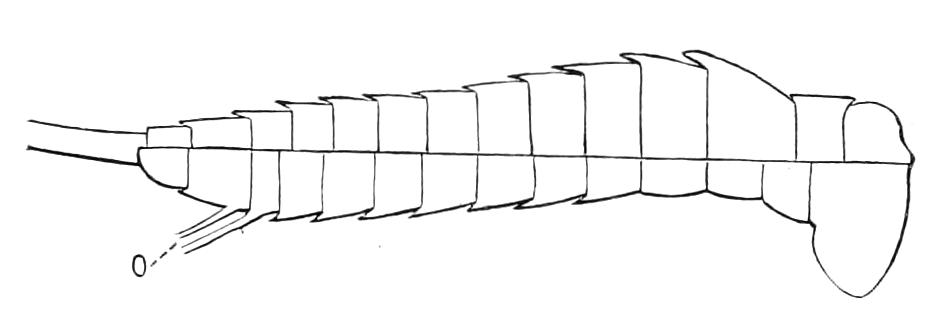
Fig. 90.--Section of body of Machilis: o, ovipositor. (After Oudemans.)
The respiratory system is in many of these Insects very inferior in development, and may even be, so far as tracheae and spiracles are concerned, entirely absent, but in other members of the Aptera it is well developed. In the other internal organs there is also great variety, as there is in the external structure.
A brief explanation as to the term Aptera, which we have adopted as the name of this Order, is necessary. This name was used by Linnaeus for our Insects, but as he associated with them various other heterogeneous forms which were afterwards separated, his "Aptera" became completely broken up and ceased to be recognised as an Order of Insects. The term was, however, revived by Haeckel and Balfour several years since, and applied quite properly to the Insects we have in view. Subsequently Packard and Brauer, recognising the claims of these Insects to an isolated position, proposed for them the names Synaptera and Apterygogenea, and Packard has also used the term Cinura. There is, however, clearly an advantage in retaining the termination "ptera" for each of the Orders of Insects; and as the fact that "Aptera" of Linnaeus included many Insects is not a sufficient reason for refusing to apply the term to a portion of the forms he used it for, we may, it is clear, make use of the Linnaean name with propriety, it being explicitly stated that the Order does not include by any means all the apterous forms of Insects.
The Order includes two sub-orders, viz. (1) Thysanura, in which the hind body (abdomen) is composed of ten segments, and there is no ventral tube on its first segment; and (2) Collembola, in which the hind body consists of not more than six segments, the first of which is furnished beneath with a peculiar tube or papilla.
Thysanura.
Our knowledge of this important sub-order has been recently much increased by the works of Grassi[115] and Oudemans.[116] Very little is known, however, of the extra-European forms, there being great difficulties in the way of collecting and preserving specimens of these Insects in such a way as to render them available for study and accurate comparison. Grassi and Rovelli[117] recognise four families among the few European species of Thysanura, viz. Campodeidae, Japygidae, Machilidae, Lepismidae. Campodeidae is perhaps limited to a single species, only one having been satisfactorily established, though several descriptions have been made of what are supposed to be other species.
This Insect (Campodea staphylinus) is, so far as external form goes, well known, from its having been figured in many works on natural history on account of its having been supposed to be the nearest living representative of a primitive or ancestral Insect. The creature itself is but little known even to entomologists, although it is one of the commonest of Insects over a large part of Europe. It is numerous in the gardens and fields about London and Cambridge, and abounds in damp decaying wood in the New Forest; if there be only one species, it must possess an extraordinary capacity for adapting itself to extremes of climate, as we have found it at midsummer near the shores of the Mediterranean in company with the subtropical white ants, and within a day or two of the same time noticed it to be abundant on the actual summit of Mount Canigou, one of the higher Pyrenees, where the conditions were almost arctic, and it was nearly the only Insect to be found. The species is said to exist also in North America and in East India. It is a fragile, soft Insect of white colour, bending itself freely to either side like a Myriapod; the legs are rather long, the antennae are long and delicate, and the two processes, or cerci, at the other extremity of the body are remarkably similar to antennae. It has no eyes and shuns the light, disappearing very quickly in the earth after it has been exposed. If placed in a glass tube it usually dies speedily, and is so extremely delicate that it is difficult to pick it up even with a camel's hair brush without breaking it; so that we may fear it to be almost hopeless to get enough specimens from different parts of the world to learn what differences may exist amongst the individuals of this so-called primitive Insect. Meinert, a very able entomologist, considers that there is really more than one species of Campodea.
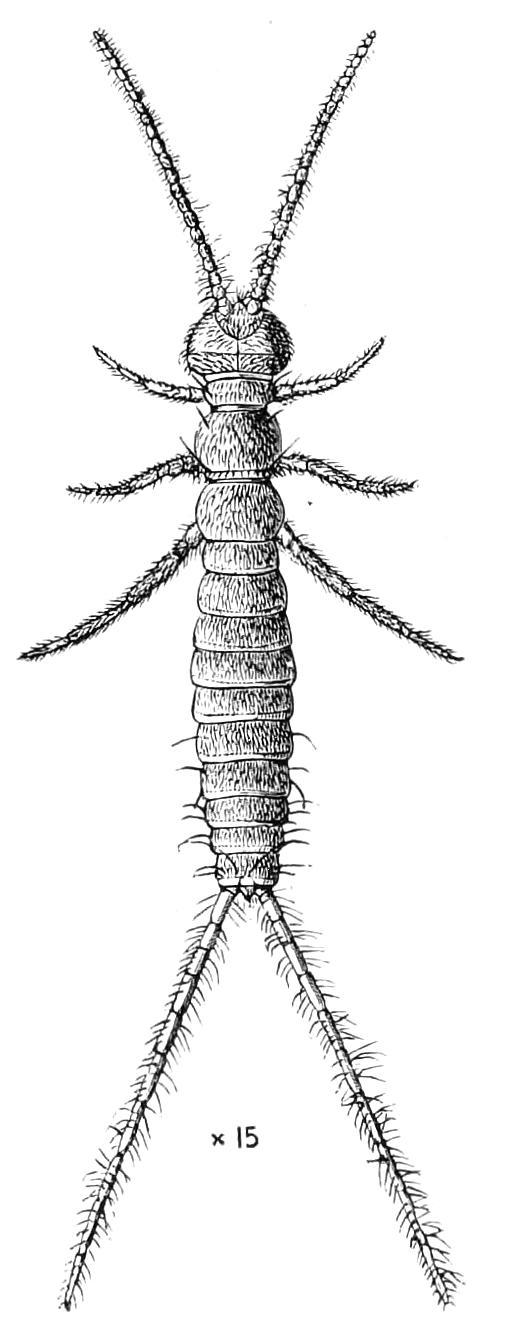
Fig. 91.—Campodea staphylinus. (After Lubbock, × 15.)
Campodeidae as a family may be briefly defined as Thysanura with the trophi buried in the head and with the body terminated by antenna-like processes. We shall consider some of the anatomical peculiarities of this interesting Insect after we have briefly reviewed some of the external characters of the other Thysanura.
The second family (Japygidae) consists of one genus Japyx, of which there are, no doubt, several different species in various parts of the world, such having already been detected in tropical Africa, in Malasia, and in Mexico, as well as in Madeira and Europe. The commoner species of the latter continent, Japyx solifugus, lives in moss or in shady places on the edges of woods. It possesses a great resemblance to a newly-hatched earwig, and the writer has found it in France under a stone in company with a number of the tiny creatures it was so much like. This species has been found as far north as Paris, but has not been met with in Britain. The family Japygidae is, like the Campodeidae, entotrophous, and is distinguished by the body being terminated behind by a pair of forceps instead of antennary organs.
The other two families of Thysanura, Machilidae and Lepismidae, are ectotrophous—that is, the parts of the mouth are not buried in the head, but are arranged in the fashion usual in mandibulate Insects.
Only one genus of Machilidae is known, but it is no doubt very numerous in species, and probably is distributed over most of the globe. Machilis maritima is common in some places on the coast of England. Another species (M. polypoda) occurs amongst dead leaves in the New Forest, and we have also observed a species of the genus under the loose stones that frequently form the tops of the "dykes" or piled walls in Scotland. In more southern Europe species of Machilis are commonly met with on the perpendicular faces of very large stones or rocks, over which they glide with wonderful facility. The scales on the bodies of these rock-inhabiting species form pretty patterns, but are detached with such facility that it is almost impossible to obtain specimens in satisfactory condition for examination.
In Machilidae the dorsal plates of the hind body are reflexed to the under surface so as to form an imbrication covering the sides of the ventral plates, and the eyes are largely developed; by which characters the family is distinguished from the Lepismidae. The pair of large compound eyes (Fig. 92, O) is a remarkable feature, being indeed unique in the Aptera. The structures (o, o′) that Oudemans considers to be simple eyes have, in external appearance, a resemblance to the fenestrae of the Blattidae; Grassi states, however, that not only are they eyes, but that they are of almost unique structure, being, in fact, intermediate between simple and compound eyes.
The mode of development of the compound eyes of Machilis is of considerable interest, but unfortunately very little is known about it, even the period at which the eyes appear being uncertain. Judging from analogy with the Orthoptera, we should suppose them to be present when the Insect leaves the egg, and Oudemans apparently considers this to be the case, but Bolivar states[118] that in the early stages of Machilis the eyes are only simple eyes; these being replaced by compound eyes in the later life. The writer has observed very young individuals of Machilis polypoda, and found the eyes to be evidently compound.
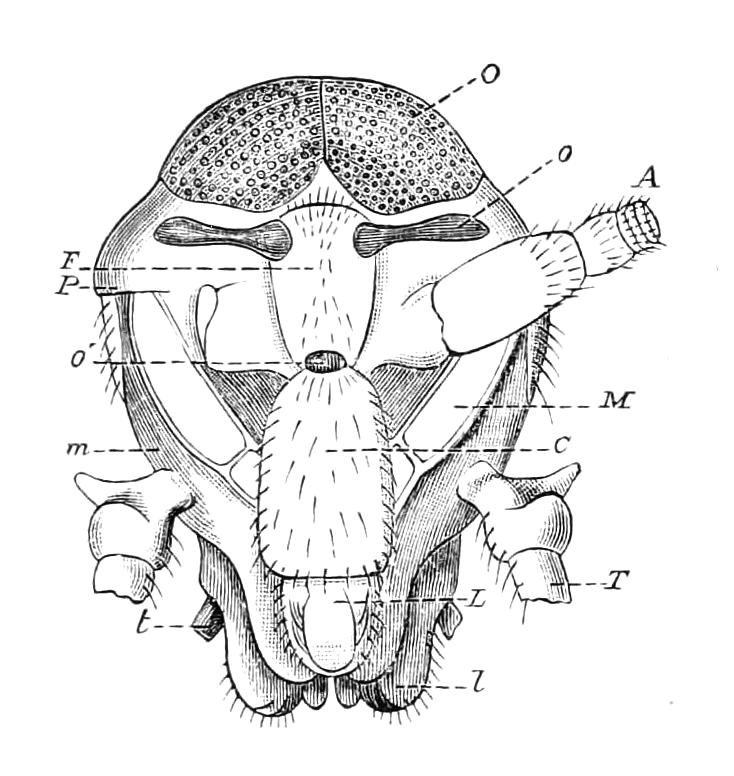
Fig. 92.—Head of Machilis maritima (after Oudemans): A, base of antenna; C, clypeus; F, vertex; P, fold; O, eye; o, o′, supposed simple eye; M, mandible; m, maxilla; L, upper lip; l, lower lip; T, portion of maxillary palp; t, of labial palp. × 20.
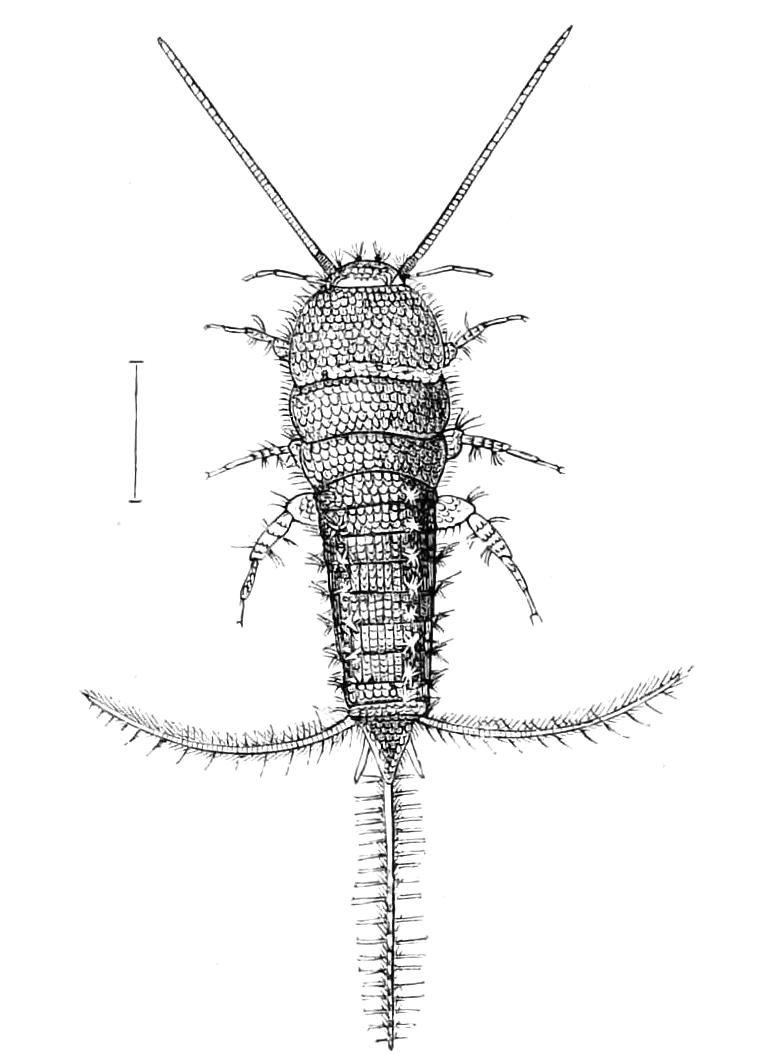
Fig. 93.—Lepisma cincta. (After Oudemans.) × 4. (The line indicates the natural length.)
The remaining family of Thysanura, the Lepismidae, is in certain respects the most highly developed of the Order. The covering of scales found on the body is very remarkable in some of the species, especially in the genus Lepisma (Fig. 93, L. cincta); the thoracic segments are different from one another and from those of the abdomen, and the tracheal system is more highly developed than it is in the Machilidae. Several genera are known, but only two members of the family have yet been detected in Britain. One of them (Lepisma saccharina), occurs only in houses, and is sometimes called the silver fish; it is, when full grown, less than half an inch long, and is covered with scales that give it a feebly metallic lustre. Like the other Thysanura, its movements are very perfect. It is said that it is occasionally injurious by nibbling paper, but the writer's observations lead him to doubt this; its usual food is doubtless farinaceous or saccharine matter. Thermobia furnorum, our other British Lepismid, has only recently been discovered; it is found in bakehouses at Cambridge and elsewhere. The bakers call these Insects fire-brats, apparently considering them to be fond of heat.
Much valuable information as to the anatomy of Thysanura has been obtained by Grassi and Oudemans, and is of great interest. Taking four genera, viz. Campodea, Japyx, Machilis, and Lepisma, to represent the four families constituting the sub-order, we will briefly enumerate some of the more remarkable of the characters of their internal anatomy. Campodea has a very inferior development of the tracheal system; there are three pairs of spiracles, which are situate on the thoracic region; the tracheae connected with each spiracle remain distinct, not uniting with those coming from another spiracle; there are thus six separate small tracheal systems, three on each side of the body. Japyx solifugus has eleven pairs of spiracles, of which four are thoracic; the tracheae are united into one system on each side by means of lateral tubes; thus there are two extensive tracheal systems situate one on each side of the body, there being a single transverse tube, placed near the posterior extremity, uniting the two lateral systems. In Machilis there are nine pairs of stigmata, two of them thoracic, seven abdominal; the tracheae from each spiracle remain unconnected, so that there are eighteen separate tracheal systems, some of which are considerably more developed than others. The Lepismidae have ten pairs of stigmata, and the tracheae connected with them are completely united into one system by longitudinal and transverse tubes. Besides these differences there are others, of considerable importance, in the position of the stigmata.
All the Thysanura possess salivary glands. In Campodea there are about sixteen extremely short Malpighian tubules, or perhaps glands representing these organs; Japyx is destitute of these structures; Machilis maritima has twenty elongate tubules; in Lepisma also they are long, and apparently vary in number from four to eight in different species. The proportions of the three divisions of the alimentary canal differ extremely; there is a very large proventriculus in Lepisma, but not in the other families; coecal diverticula are present on the anterior part of the true stomach in Machilis and in Lepisma, but are wanting in Campodea and in Japyx.
The dorsal vessel seems not to present any great differences in the sub-order. Grassi says there are no alary muscles present, but Oudemans describes them as existing in Machilis, but as being excessively delicate.
The ventral chain of nerve-ganglia consists in Campodea of one cephalic ganglion, one sub-oesophageal (which clearly belongs to the ventral series of ganglia), three thoracic, and seven abdominal. In the other families there are eight instead of seven abdominal ganglia.
The structure of the internal sexual organs is very remarkable in the Thysanura. In Campodea there is one extremely large, simple tube on each side of the body. In Japyx there are seven small tubes on each side, placed one in each of the successive abdominal segments, and opening into a common duct. In Machilis there are also seven tubes opening into a common duct, but the arrangement is no longer a distinctly segmental one. In Lepisma there are five egg-tubes on each side, the arrangement being segmental in the young state but not in the adult condition. In Campodea nutrient cells alternate with the eggs in the tubes, but this is not the case in the other families. Fig. 94 shows the ovaries in three of the Thysanura; in the drawing representing this part in Machilis (C), one of the two ovaries is cut away for the sake of clearness.
The male organs in Campodea are very similar in size and arrangement to the ovaries, there being a single large tube or sac and a short vas deferens on each side of the body. In Japyx there is a sac on each side, but it is rendered double by a coecum at its base, and there are long and tortuous vasa deferentia. In Lepisma there are three pairs of coeca on each side, segmentally placed and opening into a common duct. In Machilis there are three retort-shaped sacs on each side opening near one another into a common duct, the vasa deferentia are elongate, and are very curiously formed, being each double for a considerable length, and the separated portions connected at intervals by five transverse commissural ducts.
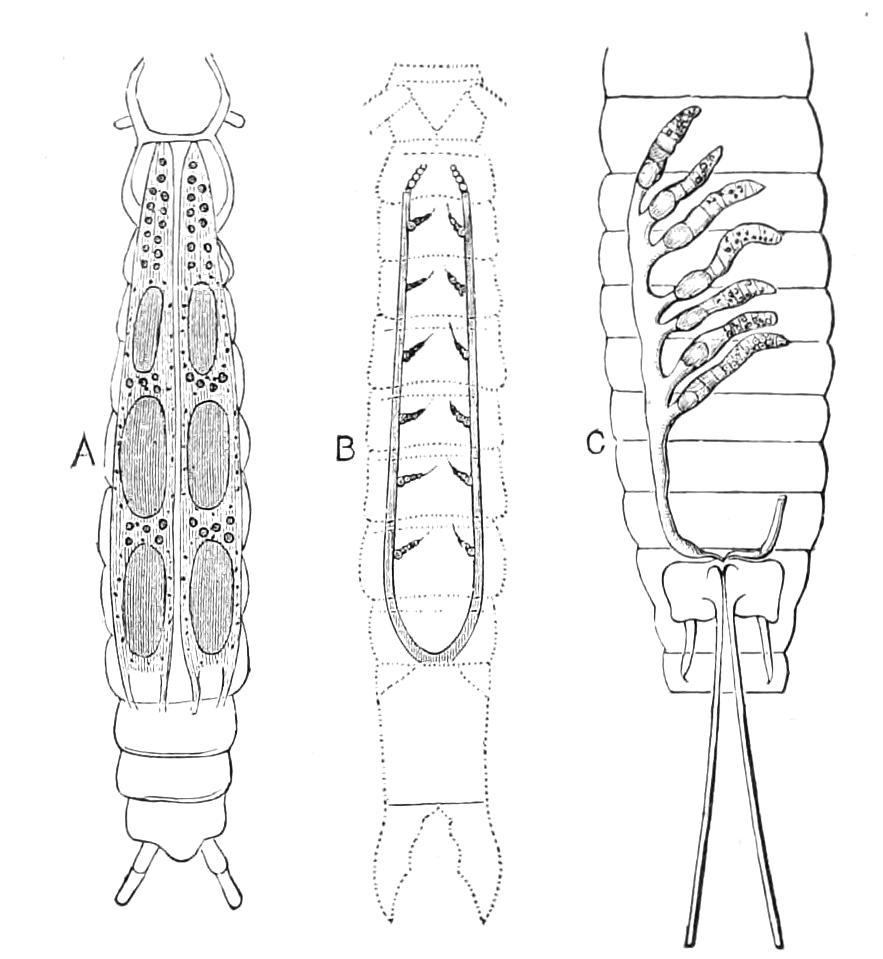
Fig. 94.—Ovaries of Thysanura: A, of Campodea; B, of Japyx; C, of Machilis. (After Grassi and Oudemans.)
One of the characteristic features of Insect structure is the restriction of articulated legs to the thoracic region. In the Thysanura there exist appendages occupying a position on the hind body somewhat similar to that of the legs on the thorax. These appendages are quite small bodies, and are placed at the hind margins of the ventral plates of the abdomen, one near each side; they are connected by a simple joint to the sternite and are provided with muscles. They are found in Campodea on segments 2 to 7; in Lepisma on 8 and 9, in the allied Nicoletia on 2 to 9; in Japyx on 1 to 7, being, however, more rudimentary than they are in Campodea. In Machilis they attain perhaps their greatest development and exist on segments 2 to 9; moreover, in this genus such appendages occur also on the coxae of the second and third pairs of thoracic legs. Oudemans thinks they help to support the abdomen, and that they also assist in leaping; Grassi considers that they are supporting agents to some extent, but that they are essentially tactile organs. He calls them false legs "Pseudozampe."
Still more remarkable and obscure in function are the vesicles found near the appendages; we figure a pair after Oudemans, showing them in the exserted state. In the retracted state the outer portion of the vesicles is withdrawn into the basal part P (Fig. 95), so that the vesicles are then only just visible, being concealed by the ventral plate. The abdominal appendage is not retractile. In Machilis there are twenty-two of these vesicles, arranged either two or four on one ventral plate of the hind body. They are also present in Campodea, where there are six pairs. They are usually said to be absent in Japyx and in Lepisma, but Haase shows[119] that Japyx possess a pair placed behind the second ventral plate of the abdomen. The vesicles appear to be exserted by the entrance of blood into them, and to be retracted by muscular agency. Much difference of opinion prevails as to their function; it appears probable that they may be respiratory, as suggested by Oudemans.
The scales found on the bodies of the Ectotrophous Thysanura may be looked on as modified hairs, and are essentially similar to those of the Lepidoptera, and they drop off as readily as do those of the Lepidoptera.
Stummer-Traunfels, who has recently published[120] the results of his researches on the mouth-organs of Thysanura and Collembola, confirms the division of the Thysanura into Entotrophi and Ectotrophi, and considers that the Collembola agree with the former group. The German author therefore proposes to divide our Aptera, not into Thysanura and Collembola, but into Ectognathi and Entognathi, the former group consisting of Machilidae and Lepismidae, the latter of Campodeidae, Japygidae and the various families of Collembola. We think it far more natural, however, to retain the older division into Thysanura and Collembola.
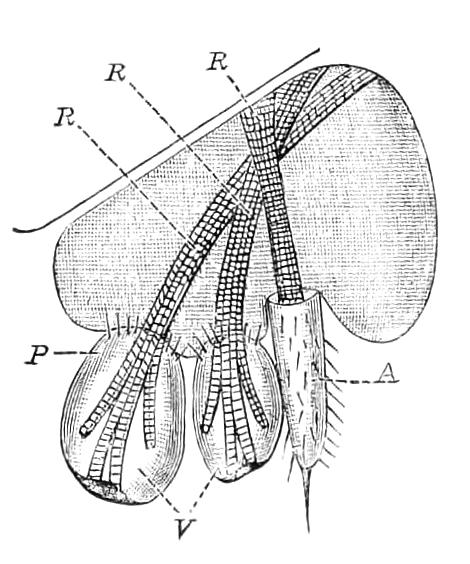
Fig. 95.—Abdominal appendage and exsertile vesicles of Machilis. A, appendage; V, vesicles protruded; P, basal portion; R, muscles, × 70.
Collembola.
The sub-order Collembola, which we have defined on p. 182, consists of small Insects, many of which possess the capacity of leaping, or springing suddenly, and when disturbed or alarmed naturally make use of this means of escaping. Their leaps, however, appear to be made quite at random, and very frequently do not have the result of taking the creature into concealment, and in such circumstances they may be rapidly and frequently repeated until the Insect feels itself, as we may suppose, in a position of safety. Three families may be very readily distinguished, viz. (1) Lipuridae, in which no leaping apparatus is present; (2) Poduridae, a leaping apparatus exists near the extremity of the abdomen; the body is subcylindric and evidently segmented; (3) Smynthuridae, a leaping apparatus exists: the body is sub-globular with comparatively large head and abdomen, the intervening thoracic region being small; the segmentation of the body is obscure.
The study of the Collembola is much less advanced than that of the Thysanura, comparatively little having been added to our knowledge of the group since Lubbock's monograph of the British forms was published by the Ray Society in 1873. Why the Collembola should be neglected when the Thysanura attract so much attention is as inexplicable as many other fashions are.
The family Lipuridae consists of a few very small and obscure Insects of soft consistence. They move slowly, and, owing to the absence of any leaping power, attract attention less readily than the other Collembola do. Two genera are generally recognised, and they should probably form separate families; indeed, in Lubbock's arrangement they do so. In one of the genera (Anoura) the mouth is very imperfect, no mandibles or maxillae having been detected, while in the other genus (Lipura) these organs exist.
In the members of the family Poduridae, including the Degeeriidae of Lubbock, a saltatory apparatus is present in the form of appendages attached to the fifth abdominal segment (Degeeriides), or to the fourth (Podurides). These appendages are during life flexed beneath the body, but in dead specimens usually project backwards, having the appearance of a bifid tail. Poduridae are of elongate form, somewhat like small caterpillars, and are frequently prettily marked with variegate colours. Fig. 97 represents an arctic form closely allied to our native genus Isotoma.
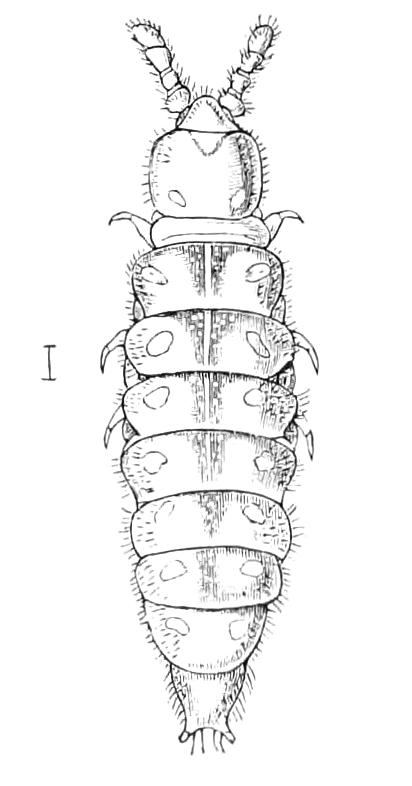
Fig. 96.—Lipura burmeisteri. (After Lubbock.)
The peculiar shape of the members of the Smynthuridae is sufficient for their identification. They possess a very convex abdomen, and very near to it a large head, the intervening chink being occupied by the small thorax. The segmentation of the body is not easily distinguished. Nicolet states that the thorax consists of three segments and the abdomen of the same number, and that when the Insect emerges from the egg these divisions can be perceived. In after life the posterior part of the thorax becomes amalgamated with the abdomen, so that it is difficult to trace the divisions, but there appears to be no information as to the manner in which this change occurs. Some of these minute Insects frequent trees and bushes, and their leaping powers are very perfect, so that it is difficult to capture them. The family includes both the Smynthuridae and the Papiriidae of Lubbock.
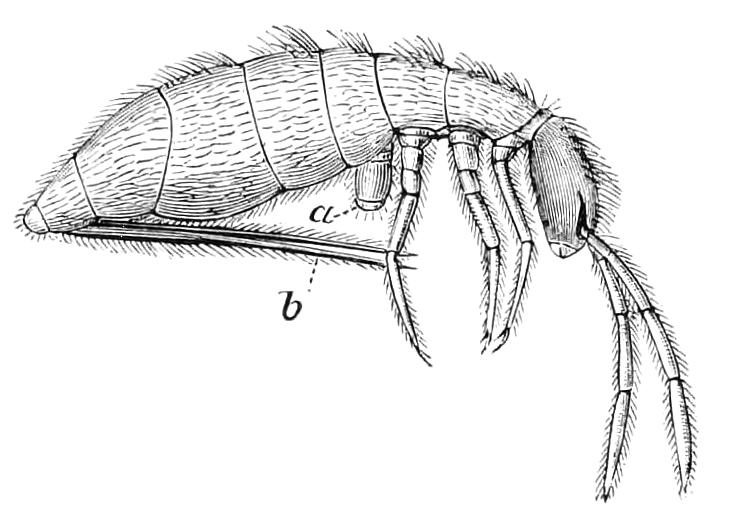
Fig. 97.—Corynothrix borealis: a, ventral tube; b, the spring. (After Tullberg.)
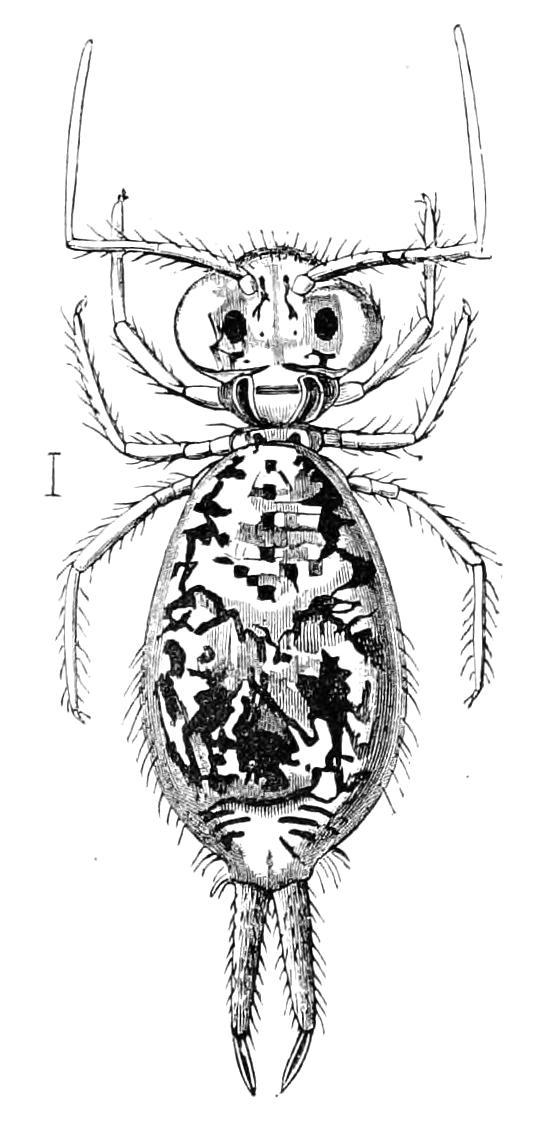
Fig. 98.—Smynthurus variegatus, with spring extended. (After Tullberg.)
The two most characteristic organs of the Collembola are the spring and the ventral tube. The first of these is an elongate structure attached to the underside of the abdomen near its extremity, either on the penultimate or ante-penultimate segment. It consists of a basal part, and of two appendages attached thereto. It is carried under the Insect bent forwards, and is retained in this position by means of a catch which projects from the under surface of the third segment of the body, descending between the two branches of the spring, and passing under the extremity of its basal segment. It is considered that the spring is elastic, is flexed under the body by muscular action, and, being retained in this position of restraint by the catch, when the latter is removed the spring extends by reason of its elasticity, and the leap is thus executed. Whether this is really the exact method of leaping is, however, doubtful, for Lubbock says that the catch "only exists in certain genera"; while in its structure it does not appear to be well calculated to retain in position an organ that by virtue of its elasticity is constantly exerting a considerable force.
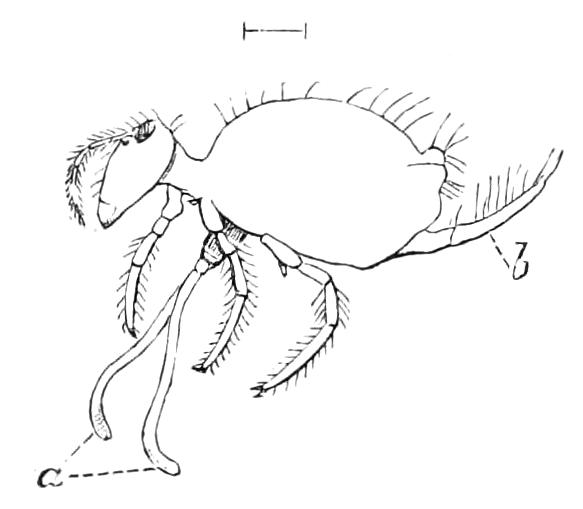
Fig. 99.—Smynthurus fuscus, with exsertile vesicle (a) protruded from ventral tube; b, the spring extended.
The ventral tube is an anomalous and enigmatic structure. In the lower forms, such as Lipura or Anurida, it consists merely of a papilla (Fig. 100, A, a) more or less divided by fissure into two parts. In the Smynthuridae it is more highly developed, and protects two long delicate tubes that are capable of being protruded, as shown in the outline profile of Smynthurus fuscus (Fig. 99), which is taken from specimens preserved in balsam by Mr. J. J. Lister. The nature and use of this ventral tube have given rise to much discussion. Lubbock considered, and others have agreed with him, that it serves to attach the Insect to bodies to which it may be desirable the Insect should, when in the perpendicular position, adhere. Reuter[121] assigns a quite different function to this singular structure. He states that the hairs of the body are hygroscopic, and that the peculiar claws of the Insect having collected the moisture from the hairs, the ventral tube becomes the means of introducing the liquid into the body. These Insects possess, however, a mouth, and there seems to be no reason why a complex apparatus should be required in addition to it for so simple a purpose as the introduction of moisture to the interior of the body. Haase finds[122] that Collembola can crawl on glass without the aid of the ventral tube; he considers its function to be physiological, and that it may probably be respiratory as it has been suggested is the case with the vesicles of Thysanura. The function of the ventral tube is certainly not yet satisfactorily elucidated. The vesicles contained in it are said to be extruded by blood-pressure, and withdrawn by muscular action in a manner similar to that which we have described as occurring in the case of the exsertile vesicles of the Thysanura. The processes in Smynthurus bear glandular structures at their extremities. It has been suggested that the ventral tube of Collembola is the homologue of a pair of ventral appendages. The term Collophore has been applied to it somewhat prematurely, seeing the doubt that still exists as to its function.
Some of the Collembola possess a very curious structure called the prostemmatic or ante-ocular organ; its nature and function have been very inadequately investigated. The ocular organs of the Collembola consist, when they are present, of isolated ocelli placed at the sides of the head like the corresponding organs of caterpillars; the prostemmate is placed slightly in front of the group of ocelli, and has a concentric arrangement of its parts, reminding one somewhat of the compound eyes of the higher Insects. This structure is represented in Fig. 100, B, C; it is said by Sir John Lubbock to be present in some of the Lipuridae that have no ocelli, and he therefore prefers to speak of it as the "post-antennal" organ.
A very characteristic feature in the Collembola is the slight development of the tracheal system. Although writers are far from being in accord as to details, it seems that stigmata and tracheae are usually absent. In Smynthurus there are, however, according to Lubbock,—whose statement is confirmed by Meinert and Tullberg,—a pair of stigmata situate on the head below the antennae, and from these there extends a tracheal system throughout the body. Such a position for stigmata is almost, if not quite unique in Insects; Grassi, however, seems to have found something of the kind existing in the embryo of the bee.
At present only a small number of species of the Order Aptera are known; Lubbock recognised about sixty British species, and Finot sixty-five as found in France. The North American forms have not received so much attention as the European, and the Aptera of other countries, though they are probably everywhere fairly numerous, are scarcely known at all. A few have been described from the Indo-Malayan region and some from Chili, and the writer has seen species from the West Indian and Sandwich Islands. All the exotic forms as yet detected are very similar to those of Europe.
The Thysanura are probably not very numerous in species, and appear to be in general intolerant of cold. With the Collembola the reverse is the case. They are excessively numerous in individuals; they are found nearly everywhere on the surface of the ground in climatic conditions like those of our country, while no less than sixteen species have been found in Nova Zembla and one each in Kerguelen and South Georgia. One species, if not more, of Podura, lives on the surface of stagnant waters, on which the minute creatures may frequently be seen leaping about in great numbers after being disturbed.
In 1874 the plain of Gennevilliers in France was copiously irrigated; in the following year the soil was still very damp, and there existed numerous pools of stagnant water, on the surface of which Podura aquatica was developed in such prodigious quantity as to excite the astonishment of the inhabitants of the region.
Accounts have been frequently given of the occurrence on snow and glaciers of Insects spoken of as snow-fleas, or snow-worms. These mostly relate to Poduridae, which are sometimes found in countless number in such situations. The reason for this is not well understood. According to F. Löw,[123] on the 17th of March at St. Jacob in Carinthia, Parson Kaiser observed, on the occurrence of the first thaw-weather, enormous numbers of a Podura (? Achorutes murorum) on the surface of the snow for an extent of about half a mile, the snow being rendered black in appearance by them; eleven days afterwards they were found in diminished numbers on the snow, but in large quantity on the water left by its melting. This account suggests that the occurrence of the Insects on the snow was merely an incident during their passage from the land, where they had been hibernating, to the surface of the water.
One little member of the Lipuridae, Anurida maritima (Lipura maritima of Lubbock), has the habit, very unusual for an Insect, of frequenting salt water. It lives amongst the rocks on the shores of the English Channel, between high and low tide-marks. Its habits have been to some extent observed by Laboulbène[124] and Moniez[125]; it appears to be gregarious, and when the tide is high, to shelter itself against the commotions of the water in chinks of the rocks and other positions of advantage. When the tide is out the Insects apparently delight to congregate in masses on the surface of the rock pools. This Anurida can endure prolonged immersion; but both the observers we are quoting say that it is, when submerged, usually completely covered with a coat of air so that the water does not touch it. The little creature can, however, it would appear, subsist for some time in the pools of salt water, even when it is not surrounded by its customary protecting envelope of the more congenial element. Its food is said, on very slender evidence, to consist of the remains of small marine animals, such as Molluscs. We reproduce some of Laboulbène's figures (Fig. 100); the under-surface shows at a the divided papilla of the ventral tube; B, C represent the peculiar prostemmatic organ, alluded to on p. 193, in its mature and immature states.
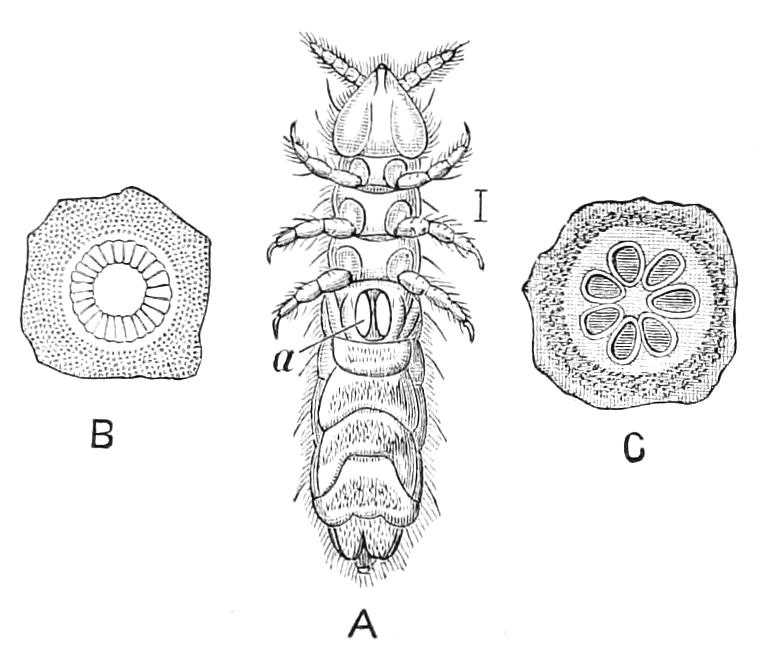
Fig. 100.—Anurida maritima: A, under-surface; a, papilla of ventral tube; B, prostemmatic organ of young; C, of adult. (After Laboulbène.)
Very little information exists as to the life-history of the Aptera; as for their food, it is generally considered to consist of refuse vegetable or animal matter. It is usual to say that they are completely destitute of metamorphosis, but Templeton says of Lepisma niveo-fasciata that "the young differ so much from the mature Insect that I took them at first for a distinct species; the thoracic plates are proportionately less broad, and the first is devoid of the white marginal band." As regards the moults, it would appear that in this, as in so many other points, great diversity prevails, Grassi stating that in Campodea there is a single fragmentary casting of the skin; and Sommer informing us that in Macrotoma plumbea the moults are not only numerous, but continue, after the creature has attained its full growth, throughout life.
A very marked feature of the Aptera is their intolerance of a dry atmosphere. Although Campodea can exist under very diverse conditions, it dies very soon after being placed in a dry closed tube; and the same susceptibility appears to be shared by all the other members of the Order, though it is not so extreme in all; possibly it may be due to some peculiarity in the structure of the integument. So far as tolerance of heat and cold goes, the Aptera can apparently exist in any climate, for though some of the species extend to the Arctic regions, others are peculiar to the tropics.
Thysanura are recorded by Klebs and Scudder as occurring commonly in amber; the latter author has described a fossil, supposed to be a Lepisma, found in the Tertiary deposits at Florissant. Scudder has also described another fossil, likewise from Florissant, which he considers to form a special sub-order of Thysanura—Ballostoma—but it is extremely doubtful whether this anomalous creature should be assigned to the Order at all. A still older fossil, Dasyleptus lucasii Brongniart, from the Carboniferous strata in France, is considered to belong to the Order Aptera, but it must be admitted there is some doubt on this point.
The interest aroused in the minds of naturalists by the comparatively simple forms of these purely wingless and therefore anomalous Insects has been accompanied by much discussion as to their relations to other Insects, and as to whether they are really primitive forms, or whether they may perhaps be degenerate descendants from some less unusual states of Insect-life. Mayer and Brauer dissociated our Aptera entirely from other Insects, and proposed to consider the Hexapoda as being composed of two groups—(1) the Apterygogenea, consisting of the few species we have been specially considering; and (2) the Pterygogenea, including all the rest of the immense crowd of Insect forms. They were not, however, able to accompany their proposed division by any satisfactory characters of distinction, and the subsequent progress of knowledge has not supported their view, all the best investigators having found it necessary to recognise the extremely intimate relations of these Insects with the Orthoptera. Meinert thought that Lepisma must be included in the Orthoptera; Grassi proposes to consider the Thysanura as a distinct division of Orthoptera; and Oudemans recognises the close relations existing between Machilis and Orthoptera proper. Finot includes the Aptera in his Orthoptères de la France, and a species of Japyx has actually been described by a competent entomologist as an apterous earwig. At present, therefore, we must conclude that no good distinction has been found to justify the separation of the Aptera from all other Insects.
The taxonomy of the Collembola has not yet been adequately treated, and it is possible that more grounds will be found for separating them as a distinct Order from the Thysanura,—a course that was advocated by Lubbock,—than exist for dividing these latter from the Orthoptera proper. There are apparently no grounds for considering the Aptera to be degenerate Insects, and we may adopt the view of Grassi, that they are primitive, or rather little evolved forms. It must be admitted that there are not at present any sufficient reasons for considering these Insects to be "ancient" or "ancestral." The vague general resemblance of Campodea to many young Insects of very different kinds is clearly the correlative of its simple form, and is no more proof of actual ancestry to them than their resemblances inter se are proofs of ancestry to one another. But even if deprived of its claim to antiquity and to ancestral honours, it must be admitted that Campodea is an interesting creature. In its structure one of the most fragile of organisms, with a very feeble respiratory system, inadequate organs of sense, only one pair of ovarian tubes, very imperfect mouth-organs, and a simple alimentary canal, it nevertheless flourishes while highly-endowed Insects become extinct. In the suburban gardens of London, on the shores of the Mediterranean, on the summits of the higher Pyrenees, in North America even it is said in the caves of Kentucky, and in India, Campodea is at home, and will probably always be with us.