Chapter XV
Reading edition
NEUROPTERA—MALLOPHAGA—EMBIIDAE
Order III. Neuroptera.
Imago with biting mouth; with two pairs of wings, the anterior as well as the posterior membranous, usually with extensive neuration, consisting of elongate nervures and either of short cross-nervules forming numerous cells or of a complex minute mesh-work. (One division, Mallophaga, consists entirely of wingless forms; in Termitidae some of the individuals of each generation become winged, but others do not: except in these cases adult wingless forms are few.) The metamorphosis differs in the several divisions.
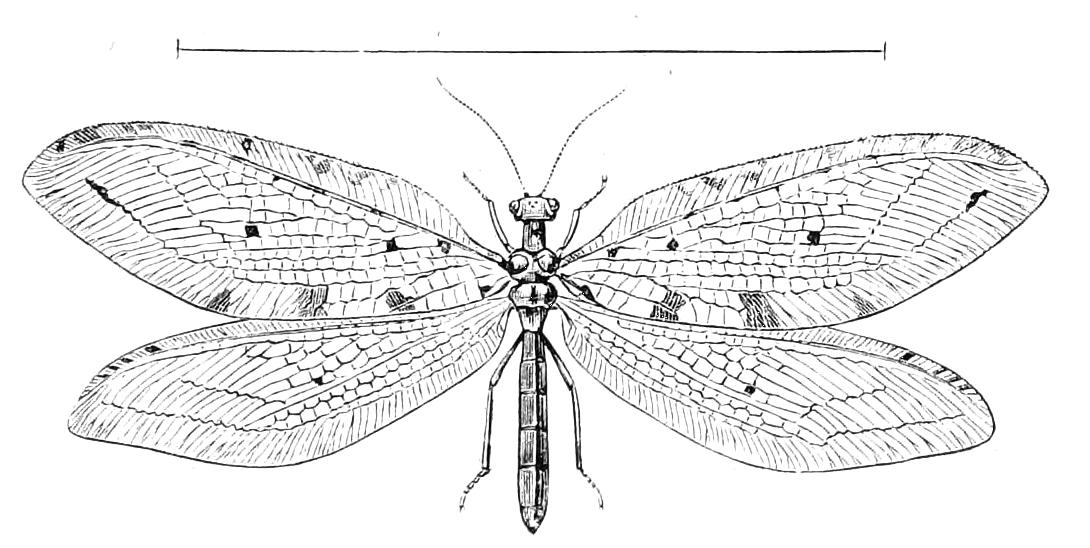
Fig. 212.—Osmylus chrysops, New Forest.
The Neuroptera form a heterogeneous, though comparatively small, Order of Insects, including termites, stone-flies, dragon-flies, may-flies, caddis-flies, lace-wings, scorpion-flies, ant-lions, etc. Bird-lice are also included in Neuroptera, though they have no trace of wings.
We treat the Order as composed of eleven distinct families, and, as a matter of convenience, arrange them in five divisions:—
1. Mallophaga.—Permanently wingless Insects, living on the bodies of birds or mammals. (Development very imperfectly known.) Fam. 1. Mallophaga.
2. Pseudoneuroptera.—Insects with wings in adult life (in some cases wings are never acquired). The wings are developed in a visible manner outside the body. There is no definite pupa. Live entirely on land. Fam. 2. Embiidae; 3. Termitidae; 4. Psocidae.
3. Neuroptera amphibiotica.—Wings developed as in division 2. Three ocelli usually exist. Life aquatic in the early stages. Fam. 5. Perlidae; 6. Odonata; 7. Ephemeridae.
4. Neuroptera planipennia.—Wings developed internally; not visible in early stages, but becoming suddenly evident when the pupal form is assumed. Mandibles present in the adult Insect. Life in early stages aquatic or terrestrial. Fam. 8. Sialidae; 9. Panorpidae; 10. Hemerobiidae.
5. Trichoptera.—Development as in division 4. Mandibles absent in the adult Insect. Life aquatic in the early stages. Fam. 11. Phryganeidae.
The families we have enumerated in the preceding scheme are now generally adopted by entomologists. Great difference of opinion exists, however, as to the groups of greater value than the family, and for a long time past various schemes have been in vogue. Though it is necessary to allude to the more important of these systems, we can do so only in the briefest manner.
Some of the families of Neuroptera are similar in many points of structure and development to Insects of other Orders; thus Termitidae are somewhat allied to Blattidae, Perlidae to Phasmidae in Orthoptera, while the Phryganeidae or Trichoptera make a considerable approach to Lepidoptera. Some naturalists—among whom we may mention Burmeister and Grassi—unite our Aptera, Orthoptera, and most of our Neuroptera into a single Order called Orthoptera. Others treat our Neuroptera as consisting of eight or nine distinct Orders; these, together with the names proposed for them, we have already alluded to in our chapter on classification, pp. 171-177.
Erichson, impressed by the variety existing in Neuroptera, separated some of the groups into a sub-Order called Pseudoneuroptera; this sub-Order comprised our Termitidae, Psocidae, Ephemeridae, and Libellulidae. This division is still adopted in several treatises; the Pseudoneuroptera are indeed by some naturalists retained as an Order distinct from both Orthoptera and Neuroptera. Gerstaecker subsequently made use of a system somewhat different from that of Erichson, uniting the Perlidae, Ephemeridae, and Odonata into a group called Orthoptera amphibiotica, from which the Termitidae and Psocidae were excluded. The divisions we have here adopted differ but little from those of Gerstaecker, though we have arranged them in a very different manner. It is probable that not one-tenth part of the Neuroptera existing in the world have yet been examined by entomologists, and of those that are extant in collections, the life-histories and development are very imperfectly known. We have, therefore, not considered it wise to adopt a system that would involve great changes of nomenclature, while there can be little hope of its permanency.
Fossils.—When considering the subject of fossil Insects we briefly alluded to the discussions that have occurred as to whether the fossils of the palaeozoic period should be referred to existing Orders. Since the pages we allude to were printed, M. Brongniart's very important work[269] on the Insects of that epoch has appeared. He considers that these ancient fossils may be classified with the existing Orders of Insects, though they cannot be placed in existing families; and he assigns the palaeozoic fossil Insects at present known, to the Orders Neuroptera and Orthoptera, and to the homopterous division of Hemiptera. The greater part of the species he looks on as Neuroptera, and places in six families—Megasecopterides, Protephemerides, Platypterides, Stenodictyopterides, Protodonates, and Protoperlides. Of these he considers the ancient Protephemerides, Protodonates, and Protoperlides as the precursors, which, we presume, we may interpret as the actual ancestors, of our existing Ephemeridae, Odonata, and Perlidae.
Some of the fossils restored and described by the French entomologist are of great interest. We shall notice the Protephemerides, Protodonates, and Protoperlides in connexion with the families to which they are specially allied, and shall now only allude to the quite extinct families of Neuroptera, the Megasecopterides, Platypterides, and Stenodictyopterides.
It is a peculiarity of these ancient Insects that they were much larger creatures than the corresponding forms that now exist. This may be due, to some extent, to the fact that tiny, fragile forms have not been preserved in the rocks, or have not attracted the attention of collectors; but as some of the palaeozoic Insects were absolutely the largest known—surpassing considerably in size any Insects at present existing—it is probable that, even if small forms existed at the remote epoch we are alluding to, the average size of the individual was greater than it is at present. The Megasecopterides of the carboniferous epoch were Insects of large size, with long, narrow wings, a small prothorax, and large meso- and meta-thorax, these two segments being equal in size; the abdomen was elongate and moderately voluminous, and was terminated by a pair of very elongate, slender filaments like those of the may-flies. The family includes several genera and species found at Commentry. One of these forms, Corydaloides scudderi, is of great interest, as it is believed by Brongniart that the imago possessed tracheal gills situated on the sides of the abdomen, analogous with those that exist at present in the immature condition of certain Ephemeridae. They are of interest in connexion with the gills found at the present time in the imagos of Pteronarcys (see p. 401). Although these fossils are of such enormous antiquity, the tracheae can, M. Brongniart says, be still perceived in these processes.
The Platypterides include also a considerable number of Insects of large size, with four large equal wings, frequently spotted or variegate. Some of these Insects were provided with expansions or lobes on the sides of the prothorax (Fig. 213); these are looked on as analogous to the expansions of meso- and meta-thorax, which are supposed by some writers to have been the rudiments from which wings were developed. These prothoracic wing-rudiments, if such they be, are said to have a system of nervures similar to what we find in true wings. The genus Lithomantis includes a Scotch fossil, and has already been mentioned by us on p. 259.
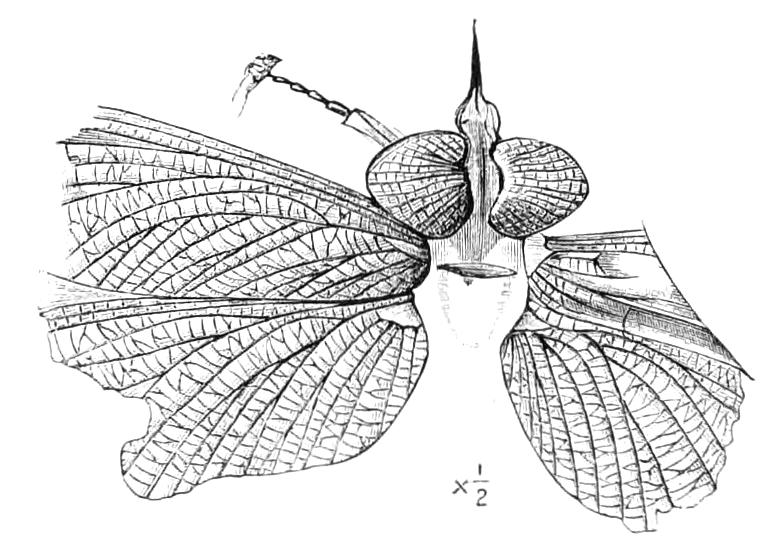
Fig. 213.—Lithomantis carbonaria. Carboniferous strata of Commentry, France. (After Brongniart.)
The third family of extinct carboniferous Neuroptera is the Stenodictyopterides, in which Brongniart places the Dictyoneura of Goldenberg, the North American Haplophlebium, and several genera from Commentry. Some of them were very large Insects, with robust bodies, and possessed wing-like expansions on the prothorax, and lateral gill-like appendages on the sides of the abdomen.
It is worthy of note that though so large a number of carboniferous Neuroptera have now been discovered, no larvae or immature forms have been found.
We now pass to the consideration of the divisions of Neuroptera still living.
Fam. I. Mallophaga—Bird-Lice or Biting Lice.
Small Insects, wingless, with large head; thorax usually of two, rarely of one or three segments; prothorax always distinct; hind body consisting of eight to ten segments, in addition to the posterior two thoracic segments which usually are but little or not at all separated from it. The metamorphosis is very slight. The creatures live on the skins of birds or mammals, finding nourishment in the epidermal products.
The whole of the Insects of this family live a parasitic, or rather epizoic, life. They all creep about those parts that are near to the skin, the feathers of birds or the hair of mammals; they rarely come quite to the surface, so that they are not detected on a superficial examination. It is curious that under these circumstances they should exhibit so great a variety of form and of anatomical characters as they do.
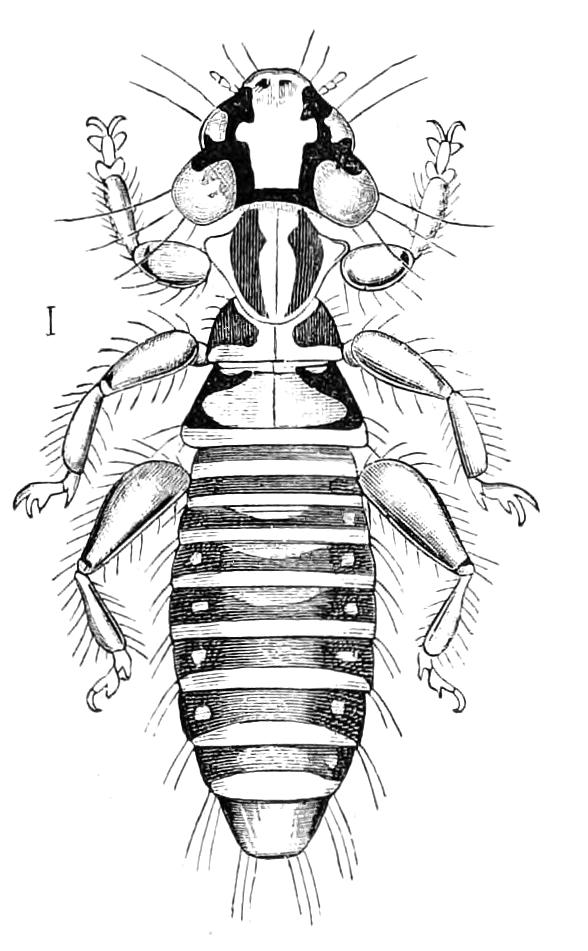
Fig. 214.—Trinoton luridum. Lives on the common duck and various species of Anas. (After Giebel.)
They are very depressed, that is, flat, Insects, with a large head, which exhibits a great variety of shape; frequently it is provided in front of the antennae with some peculiar tubercles called trabeculae, which in some cases are mobile. The antennae are never large, frequently very small; they consist of from three to five joints, and are sometimes concealed in a cavity on the under side of the head.
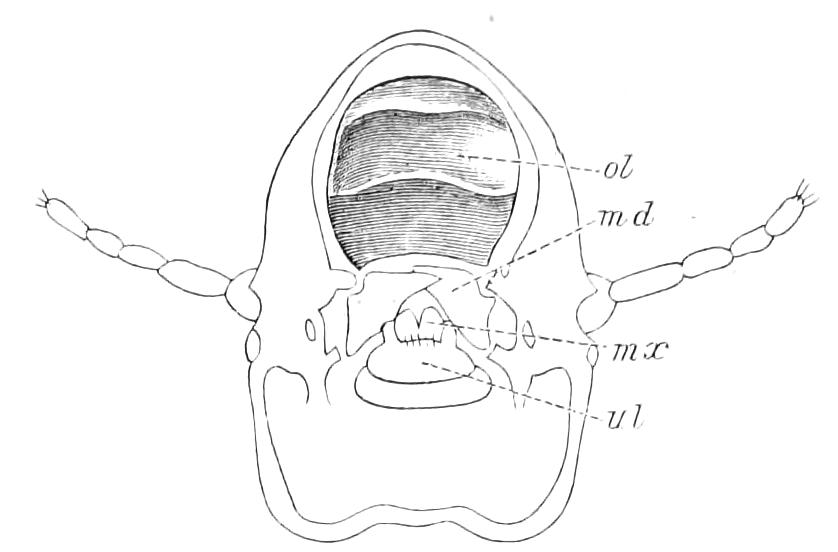
Fig. 215.—Under-surface of head of Lipeurus heterographus. (After Grosse.) ol, Labium; md, mandible; mx, maxilla; ul, labium.
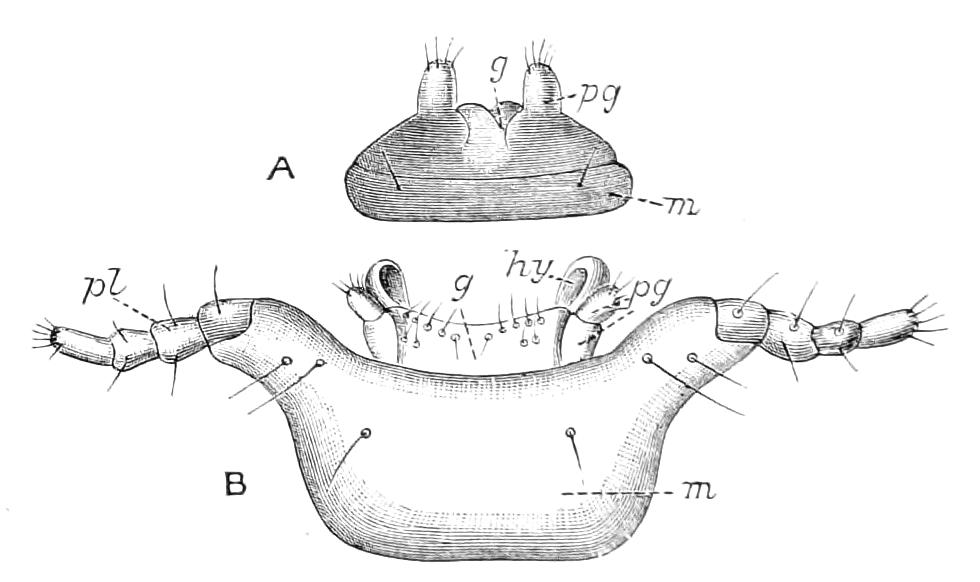
Fig. 216.—Under lip of Nirmus, A; and of Tetrophthalmus chilensis, B. (After Grosse.) m, Mentum; g, ligula; pl, palp; pg, paraglossa; hy, lingua.
The eyes are very rudimentary, and consist of only a small number of isolated facets placed behind the antennae; sometimes they are completely absent. The mouth parts are situated entirely on the under-surface of the head and in a cavity. The upper lip is frequently of remarkable form, as if it were a scraping instrument (ol, Fig. 215). The mandibles are sharply toothed and apparently act as cutting instruments. The maxillae have been described in the principal work on the family[270] as possessing in some cases well-developed palpi. According to Grosse[271] this is erroneous; the maxillae, he says, are always destitute of palpi, and are of peculiar form, being each merely a lobe of somewhat conical shape, furnished on one aspect with hooks or setae. The under lip is peculiar, and apparently of very different form in the two chief groups of Mallophaga. The large mentum bears, in Liotheides (Fig. 216, B), on each side a four-jointed palpus, the pair of palps being very widely separated; the ligula is broad and undivided; on each side there is a paraglossa bearing an oval process, and above this is a projection of the hypopharynx. In Philopterides (Fig. 216, A) the palpi are absent, and the parts of the lower lip are—with the exception of the paraglossae—but little differentiated. The lingua (hypo-pharynx) in Mallophaga is largely developed, and bears near the front a chitinous sclerite corresponding with another placed in the epipharynx.
The prothorax in Mallophaga is a distinct division of the body even when the meso- and meta-thorax appear to be part of the abdomen. The mesothorax is frequently very small; it and the metathorax are sometimes intimately connected. In other cases (Laemobothrium) the metathorax appears to differ from the following abdominal segment only by having the third pair of legs attached to it. In Trinoton (Fig. 214) the three thoracic segments are well developed and distinct. The abdominal segments visible, vary in number from eight to ten; there is sometimes a difference according to sex, the male having one segment taken into the interior in connexion with the reproductive organs. The legs have short, broad coxae and small tarsi of one or two joints; very rarely three joints are present; there are either one or two claws; the legs with one claw being adapted for clinging to or clutching hairs. The front pair of legs is used not for locomotion so much as for grasping the food and bringing it within the range of the mouth. No trace of wings has been detected in any species.
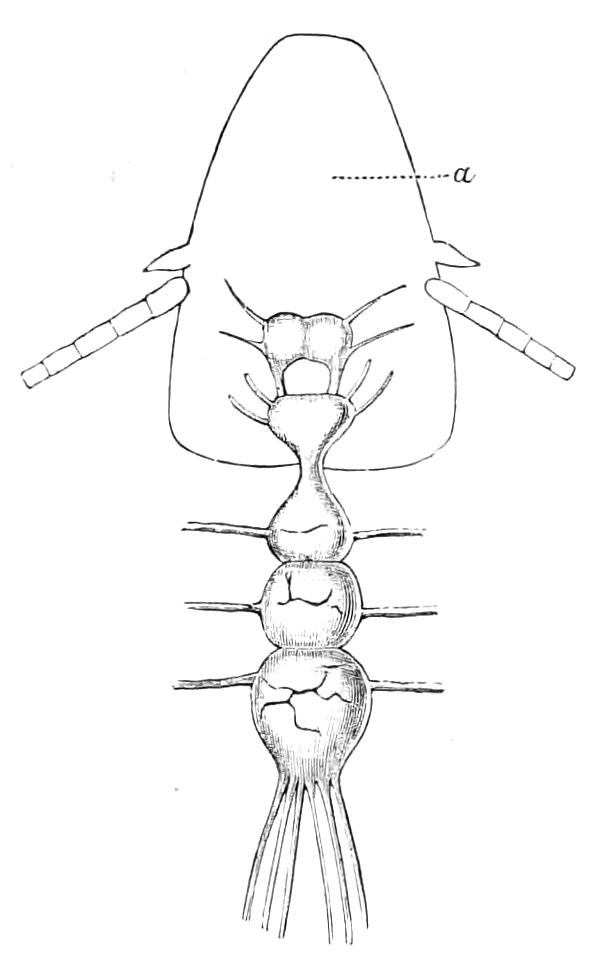
Fig. 217.—Ganglia of nervous system of Lipeurus bacillus. (After Giebel.) a, Cavity of head.
The nervous system has been examined by Giebel in Lipeurus bacillus; there is a supra- and an infra-oesophageal ganglion, and three thoracic, but no abdominal ganglia. The supra-oesophageal is remarkably small, in fact not larger than the infra-oesophageal; it consists evidently of two conjoined halves. The alimentary canal has a slender, elongate oesophagus, dilated behind into a crop; this is frequently received between two cornua formed by the anterior part of the stomach, which, except for these, is simply tubular in form, though somewhat narrower at the posterior extremity. In some forms—Philopterides—the crop is of a very peculiar nature (Fig. 218), forming an abrupt paunch separated from the stomach by the posterior portion of the oesophagus. There are only four Malpighian tubes; in some species the basal half of each tube is much dilated. The two divisions of the intestine are short and are separated by the intervention of a glandular girdle. Salivary glands exist; Giebel figures what we may consider to be an enormous salivary reservoir as existing in Menopon leucostomum.
The testes and ovaries are of a simple nature. The former consist of two or three capsules, each having a terminal thread; the vasa deferentia are tortuous and of variable length; they lead into the anterior part of the ejaculatory duct, where also opens the elongate duct proceeding from the bicapsular vesicula seminalis; these structures have been figured by Grosse[272] as well as by Giebel. The ovaries consist of three to five short egg-tubes on each side; the two oviducts combine to form a short common duct with which there is connected a receptaculum seminis.
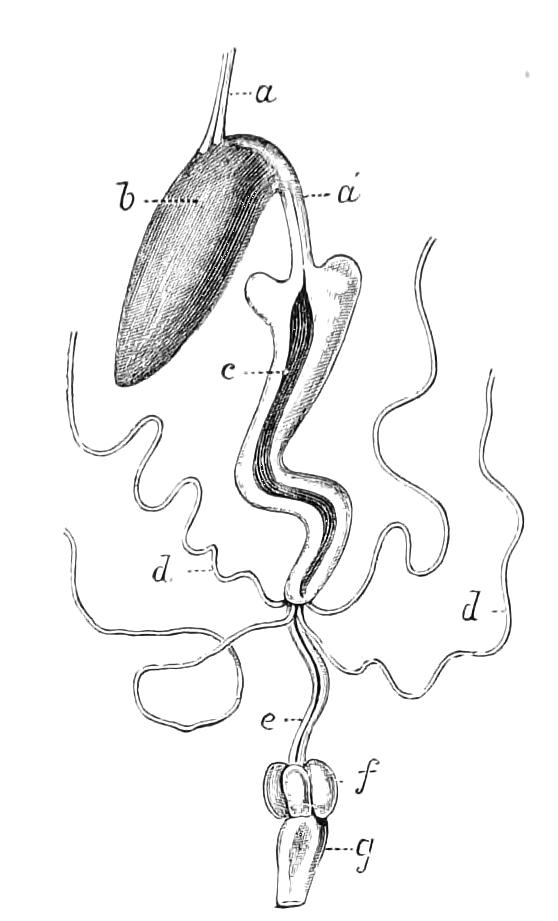
Fig. 218.—Alimentary canal of Docophorus fuscicollis. (After Giebel.) a, Oesophagus; b, paunch; a′, posterior division of oesophagus; c, chylific ventricle or stomach; d, Malpighian tubes; e, small intestine; f, glandular girdle; g, rectum.
The eggs of some Mallophaga have been figured by Melnikow;[273] they possess at one extremity a cover with a multiple micropyle-apparatus, and at the opposite pole are provided with seta-like appendages. They are very like the eggs of the true lice, and are said in some cases to be suspended by threads to the hairs or feathers after the fashion of the eggs of Pediculi.
Little is known as to the development; the young are extremely like the adult, and are thought to moult frequently; the duration of life is quite unknown.
It has been stated by some writers that the mouth is truly of the sucking kind, and that the Mallophaga feed on the blood of their hosts. This is, however, erroneous; they eat the delicate portions of the feathers of birds, and of mammals perhaps the young hair. Their fertility is but small, and it is believed that in a state of nature they are very rarely an annoyance to their hosts. The majority of the known species live on birds; the forms that frequent mammals are less varied and have been less studied; most of them have only one claw to the feet (Fig. 220), while the greater portion of the avicolous species have two claws.
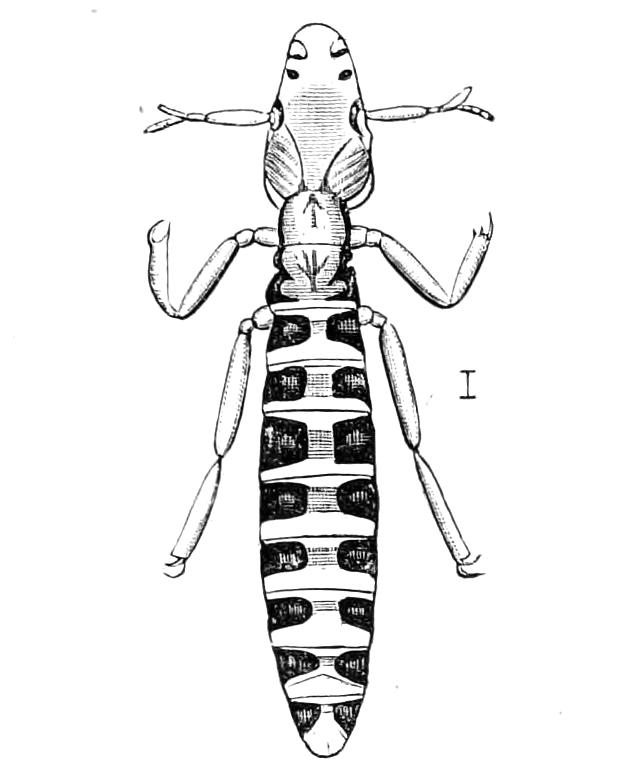
Fig. 219.—Lipeurus ternatus, male; inhabits Sarcorhamphus papa. (After Giebel.)
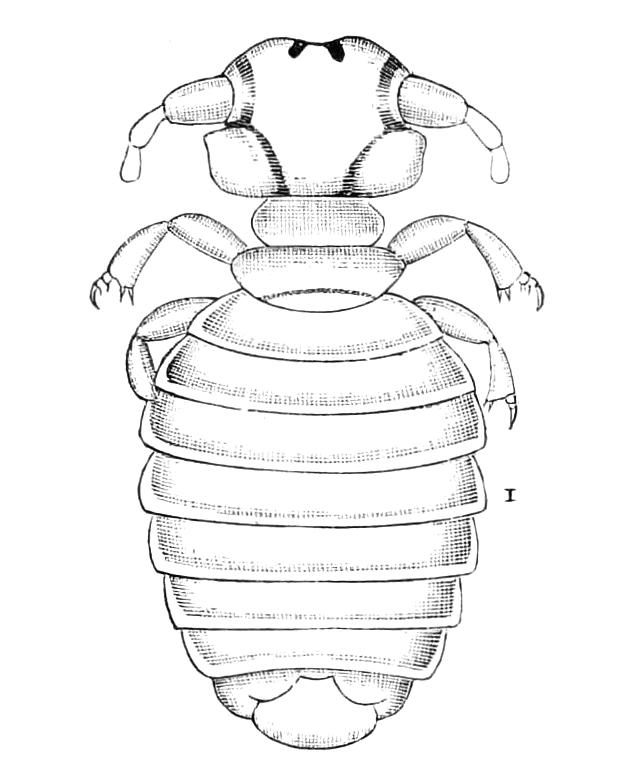
Fig. 220.—Trichodectes latus, male; inhabits the dog, Canis familiaris.
Most of the forms have the anterior legs small, and they are usually drawn towards the mouth, owing, it is believed, to their being used after the manner of hands to bring the food to the mouth; hence in some of our figures (219, 220) the body looks as if it had only four legs.
Very diverse statements have been made as to whether allied forms of Mallophaga are found only on allied birds. It would appear that this is the case only to a limited extent, as certain species are found on quite a variety of birds; moreover, some birds harbour several species of bird-lice, even five genera having been found, it is said, on one species of bird. Docophorus icterodes has been recorded as occurring on many kinds of ducks and geese; the swan, however, harbours a distinct species, Docophorus cygni, and this is said to have also been found on the bean-goose.
At least five species, belonging to three distinct genera, have been found on the common fowl. The parasite most frequently met with on this valuable creature is Menopon pallidum (Fig. 221), which is said to have been figured by Redi two hundred years ago under the name of Pulex capi. This species multiplies to a considerable extent; it is of very active habits, and passes readily from one bird to another, so that it is found on other species besides the domestic fowl. It is even said that horses kept near hen-roosts have been seriously troubled by Menopon pallidum, but it is suggested by Osborn that these attacks may perhaps have been really due to itch-mites. There is, however, no doubt that this species may infest poultry, especially if sickly, to an enormous extent. The dust-baths in which poultry are so fond of indulging are considered to be of great use in keeping down the numbers of this Insect.
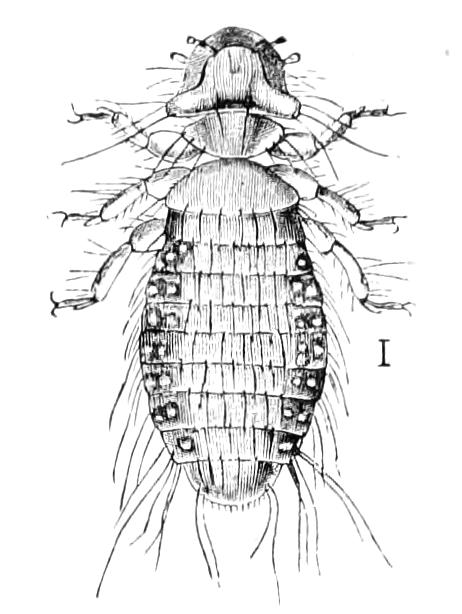
Fig. 221.—Menopon pallidum; inhabits the common fowl, Gallus domesticus. (After Piaget.)
A table of the birds and mammals on which Mallophaga have been found, together with the names of the latter, has been given by Giebel.[274] The classification of the group, so far as the principal divisions are concerned, by no means accords with the kind of animals that serve as hosts, for the only two genera peculiar to quadrupeds (Trichodectes, Fig. 220; and Gyropus) belong to the two chief divisions of Mallophaga. The genus Menopon includes numerous species found on birds, and three or four others peculiar to mammals.
Two very natural divisions, Philopterides and Liotheides, were adopted by Giebel and Nitzsch, but unfortunately the chief character they made use of for diagnosing the two groups—the presence or absence of maxillary palpi—was illusory. Apparently the labial palps will serve the purpose of distinguishing the two divisions, they being present in the Liotheides and absent in the Philopterides. A table of the characters of the avicolous genera of these two groups is given by Grosse.[275]
The Liotheides are more active Insects, and leave their host after its death to seek another. But the Philopterides do not do so, and die in about three days after the death of their host. Possibly Mallophaga may be transferred from one bird to another by means of the parasitic two-winged flies that infest birds. The writer has recorded[276] a case in which a specimen of one of these bird-flies captured on the wing was found to have some Mallophaga attached to it.
We should perhaps point out that these Mallophaga, though called bird-lice, have nothing to do with the true lice which are so frequently found with them, and that live by sucking the blood of their hosts. It would in fact be better to drop the name of bird-lice altogether, and call the Mallophaga biting lice. Trichodectes latus, according to this method, would be known as the biting louse of the dog, the true or sucking louse of which animal is Haematopinus piliferus, and belongs to the anoplurous division of Hemiptera.
Fam. II. Embiidae.
Elongate feeble Insects; with small prothorax, elongate meso- and meta-thorax, which may either bear wing or be without them. In the former case these organs are not caducous, are delicately membranous, and all of one consistence, with three or four indefinite longitudinal nervures and a few cross-veinlets. The development is incompletely known. The individuals do not form organised societies.
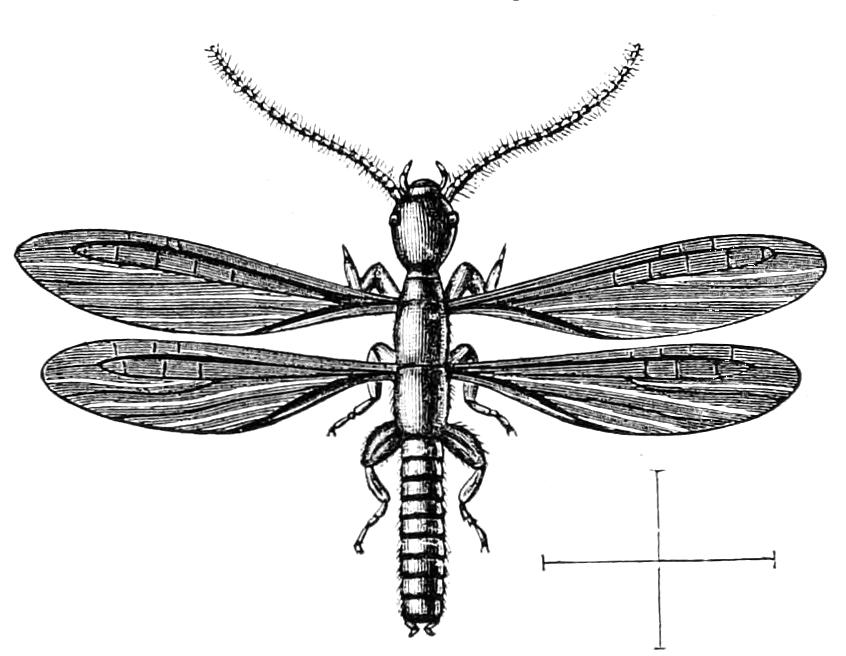
Fig. 222.—Oligotoma michaeli. (After M‘Lachlan.)
The Embiidae are one of the smallest families of Insects; not more than twenty species are known from all parts of the world, and it is probable that only a few hundred actually exist. They are small and feeble Insects of unattractive appearance, and shrivel so much after death as to render it difficult to ascertain their characters. They require a warm climate. Hence it is not a matter for surprise that little should be known about them.
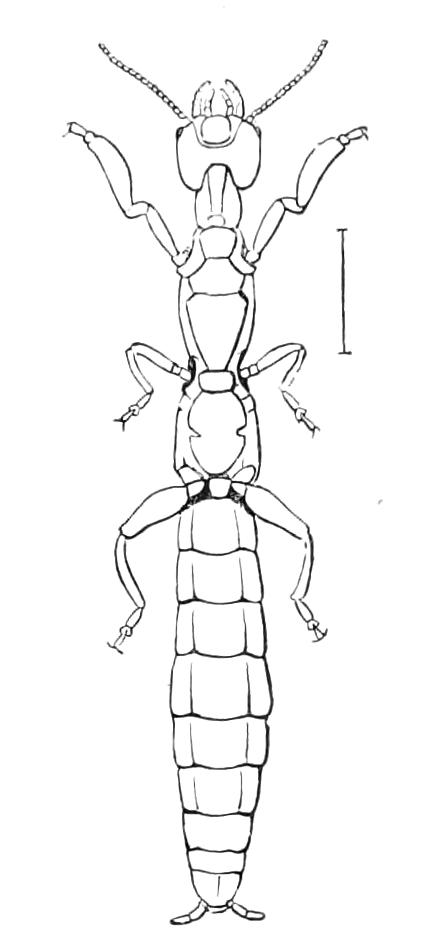
Fig. 223.—Under-surface of Embia sp. Andalusia.
The simple antennae are formed of numerous joints, probably varying in number from about fifteen to twenty-four. The mouth is mandibulate. Chatin states[277] that the pieces homologous with those of a maxilla can be detected in the mandible of Embia. The labium is divided. The legs are inserted at the sides of the body, the coxae are widely separated (Fig. 223), the hind pair being, however, more approximate than the others. The abdomen is simple and cylindrical, consisting of ten segments, the last of which bears a pair of biarticulate cerci. In the male sex there is a slight asymmetry of these cerci and of the terminal segment. The thorax is remarkable on account of the equal development of the meso- and meta-thorax and their elongation in comparison to the prothorax. When they bear wings there is no modification or combination of the segments for the purposes of flight, the condition of these parts being, even then, that of wingless Insects; so that the Embiidae that have wings may be described as apterous-like Insects provided with two pairs of inefficient wings. The wings are inserted on a small space at the front part of each of the segments to which they are attached. The legs have three-jointed tarsi, and are destitute of a terminal appendage between the claws.
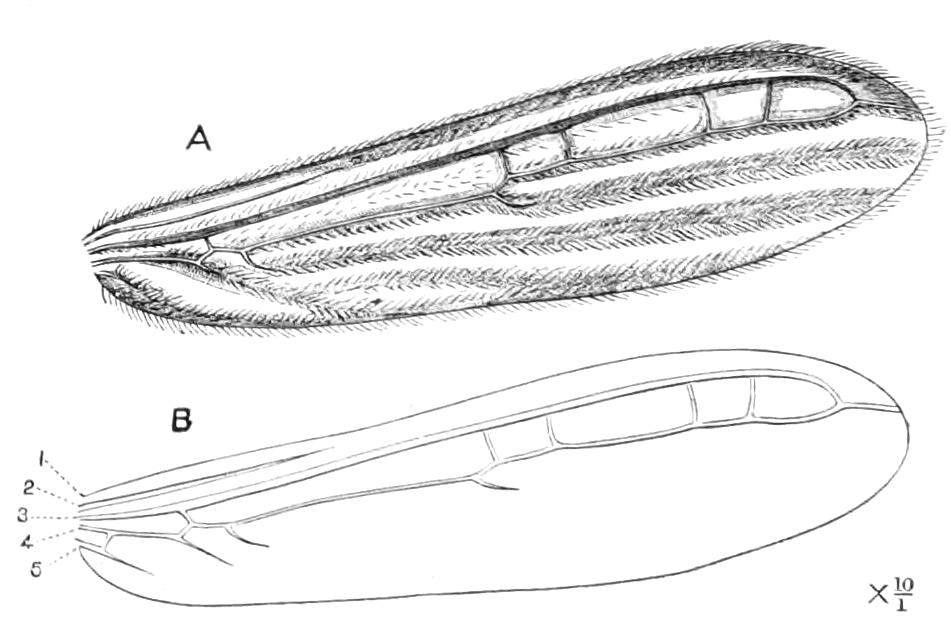
Fig. 224.—Anterior wing of Oligotoma saundersii: A, the wing; B, outline of the wing, showing nervures. (After Wood-Mason.) 1, Costal; 2, subcostal; 3, radial; 4, discoidal; 5, anal nervure.
The wings in Embiidae are very peculiar; they are extremely flimsy, and the nervures are ill-developed; stripes of a darker brownish colour alternate with pallid spaces. We figure the anterior wing of Oligotoma saundersii, after Wood-Mason; but should remark that the neuration is really less definite than is shown in these figures; the lower one represents Wood-Mason's interpretation of the nervures. He considers[278] that the brown bands "mark the original courses of veins which have long since disappeared." A similar view is taken by Redtenbacher,[279] but at present it rests on no positive evidence.
One of the most curious features of the external structure is the complex condition of the thoracic sternal sclerites. These are shown in Fig. 223, representing the under-surface of an Embia of uncertain species recently brought by Mr. Bateson from Andalusia.
According to Grassi[280] there are ten pairs of stigmata, two thoracic and eight abdominal; these are connected by longitudinal and transverse tracheae into a single system. The ganglia of the ventral chain are, one suboesophageal, three thoracic, and seven abdominal; these are segmentally placed, except that there is no ganglion in the fifth abdominal segment. There is a stomato-gastric system but no "sympathetic." Salivary glands are present. The stomodaeal portions of the alimentary canal are remarkably capacious; the stomach is elongate and slender, without diverticula; the Malpighian tubes are elongate and slender; they vary in number with the age of the individual, attaining that of twenty in the adult. The ovaries are arranged somewhat after the fashion of those of Japyx, there being in each five short egg-tubes, opening at equal intervals into a straight duct. The testes are remarkably large; each one consists of five masses of lobules, and has a large vesicula seminalis, into the posterior part of which there open the ducts of two accessory glands. The large joint of the front tarsus includes glands whose secretion escapes by orifices at the tips of certain setae interspersed between the short spines that are placed on the sole.
Species of this genus occur in the Mediterranean region, but their characters have not yet been examined. Our information as to these is chiefly to be found in Grassi's work. The two species studied by him were wingless. They live under stones, where they spin webs by means of the front feet, whose first joint is, as we have said, enlarged and contains glands; the Insect uses the webs as a means of support in progression, acting on them by means of papillae and a comb-like structure placed on the four posterior feet.
Grassi informs us that these Insects are not uncommon under stones in Catania; they require moisture as well as warmth, but not too much; sometimes there is only one individual found under a stone, at others eight or ten. In the winter and spring their galleries are found on the surface of the earth, but in the hot months of summer they secure the requisite amount of moisture by sinking their galleries to the depth of ten or fifteen centimetres. Their food consists chiefly of vegetable matter. They may be reared with ease in glass vessels. Other species of the family attain wings; the details of the process are not well known. Oligotoma michaeli (Fig. 222) was discovered in a hothouse in London among some orchid roots brought from India, and was found in more than one stage of development; the young greatly resemble the adult, except in the absence of wings. A nymph-form is described by M‘Lachlan[281] as possessing wings of intermediate length, and Hagen has suggested that this supposed nymph is really an adult female with short wings. If this latter view be correct, nothing is known as to the mode of development of wings in the family. It is still uncertain whether female Embiidae ever possess wings. Wood-Mason and Grassi have shown that there are wingless females in some species, and we know that there are winged males in others, but what the usual relation of the sexes may be in this respect is quite uncertain. These Insects have been detected in various parts of the world. In the Sandwich Islands Oligotoma insularis was discovered by the Rev. T. Blackburn in the wood and thatch forming the roofs of natives' houses. A species has been found in Prussian amber, and Grassi thinks that Embia solieri—one of the Mediterranean species—is not to be distinguished with certainty from the Insect found in amber.
Embiidae still remains one of the most enigmatic of the families of Insects. Although Grassi's recent observations are of great value from an anatomical point of view, they rather add to, than diminish, the difficulties we encounter in endeavouring to understand the lives of these obscure creatures. That Embiidae form webs has long been known, and it was thought by some that the webs, like those of spiders, might be of assistance in procuring food. We may, however, infer from Grassi's observations that this is not the case, but that the silken tunnels or galleries—as he calls them—serve chiefly as a means of locomotion and protection, the feet of the Insects being highly modified in conformity with this mode of life. Grassi seems to be of opinion that the galleries are also useful in preserving a proper degree of humidity round the Insects. We have already alluded to the mystery that surrounds the mode of growth of their wings. Nearly all that is known as to the Embiidae is contained in Grassi's paper, or is referred to in Hagen's monograph of the family.[282]
Considerable difference of opinion has prevailed as to the allies of these obscure Insects. It would seem that they are most nearly allied to Termitidae and Psocidae. Grassi, however, considers these affinities only remote, and suggests that Embiidae should form a separate Order, to be placed in a super-Order Orthoptera, which would include our Aptera, the two families mentioned above, Mallophaga, Embiidae, and the ordinary Orthoptera. Brauer places the family in his Orthoptera genuina.