Chapter XXII
Reading edition
HYMENOPTERA—HYMENOPTERA SESSILIVENTRES—CEPHIDAE—ORYSSIDAE—SIRICIDAE—TENTHREDINIDAE OR SAWFLIES
Order IV. Hymenoptera.
Wings four, membranous, without scales, usually transparent, never very large, the posterior pair smaller than the anterior; the cells formed by the nervures irregular in size and form, never very numerous (less than twenty on the front, than fifteen on the hind, wing). Mandibles conspicuous even when the other parts of the mouth form a proboscis. The side-pieces of the prothorax are disconnected from the pronotum and overlap the prosternum, usually entirely concealing it. The females are furnished at the extremity of the body with either saw, sting, or ovipositor; these parts may either be withdrawn into the body or be permanently protruded. The metamorphosis is great and abrupt, the chief changes being revealed in the pupa disclosed at the last moult of the larva; this moult is frequently delayed till long after growth has been completed. In the pupa the parts of the perfect Insect are seen nearly free, each covered in a very delicate skin.
The term Hymenoptera includes ants, bees, wasps, sawflies, and the tribes of innumerable Ichneumon-flies. The Order is of enormous extent, consisting even at present of tens of thousands of described and named species, and yet these are but few in comparison with those that remain unknown. It has good claims to be considered the "highest" Order of Insects. Sir John Lubbock says: "If we judge animals by their intelligence as evinced in their actions, it is not the gorilla and the chimpanzee, but the bee, and above all the ant, which approach nearest to man."[409] The mechanical perfection of the structures of the individuals, and the rapid and efficient manner in which their functions are discharged, are very remarkable. In many species of Hymenoptera the individuals have the habit of living together in great societies, in which the efforts of the members are combined for the support of the whole society and for the benefit of a younger generation. To fit them for this social life the bodies of the larger number of the individuals are more or less changed in structure, so that they become workers. These workers are in all cases imperfect females; besides carrying on the ordinary work of the society, they tend and feed the young. The duty of reproduction is restricted to a single female, called a queen, or to a small number of such individuals in each society. The males occupy an unimportant position in the society, and are usually much shorter-lived than the workers and queens. The social Hymenoptera do not form a single zoological group, but are of three different kinds—wasps, bees, and ants. There are numerous non-social, or solitary, wasps and bees.
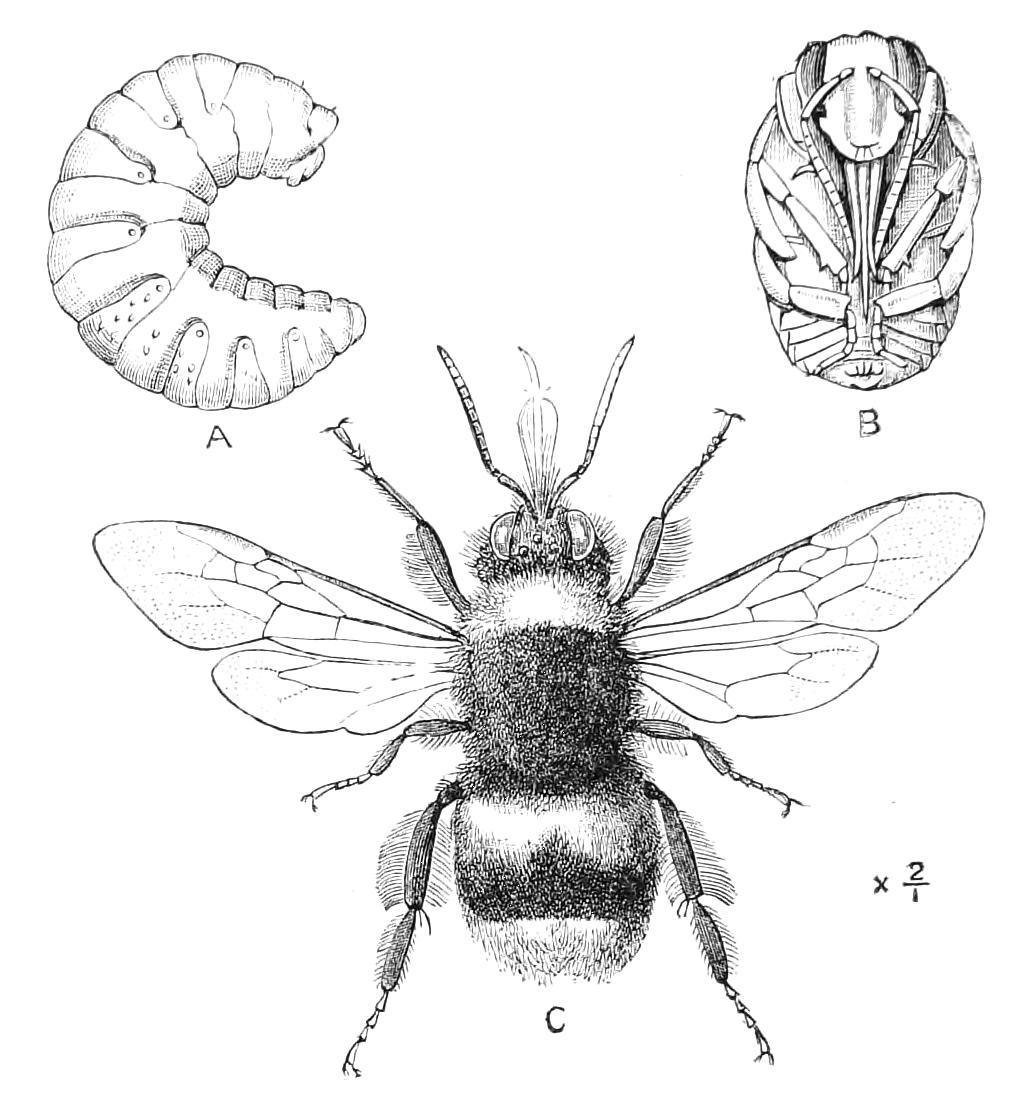
Fig. 331.—Bombus lucorum. A, Adult larva; B, pupa; C, imago, female. Britain.
In the Order Hymenoptera—especially in the higher forms—the males and females are often different in appearance and structure. In the ants, one of the social groups, the workers, or imperfect females, are quite wingless. There are numerous other groups in which species, not social, are found, having the females wingless while the males have wings. In a few species there is an apterous condition of the male, perhaps usually only as a dimorphic form. In the parasitic division there are species that are apterous in both sexes. The structure of the outer skeleton, or external part of the body, exhibits some peculiarities, the chief of which is the detachment of the side-pieces of the prothorax and their great development. Not less remarkable is the abstraction of a segment from the abdomen to become, as it were, part of the thorax; while between the first and second true segments of the abdomen there exists a joint, or articulation, of the utmost mechanical perfection, enabling the operations of stinging and piercing to be executed with an accuracy that cannot be surpassed.
As a result of the detachment of the thoracic side-pieces, the front legs and the structures connected with them are disjoined from the notum, as shown in Fig. 332, and act in connexion with the head, while the dorsal portion of the segment remains attached to the great thoracic mass. The head is quite free from the thorax and very mobile; the upper organs of the mouth—the labrum and the mandibles—are not subject to modifications equal to those exhibited by the maxillae and lower lip, which parts in the bees are prolonged to form a suctorial apparatus that may exceed in length the whole body of the Insect. The mandibles remain cutting or crushing implements even when the maxillae and lower lip are modified to form a suctorial apparatus of the kind we have mentioned; so that in the higher forms—ants, bees, and wasps—the mouth-pieces are completely differentiated for two sets of functions, one industrial, the other nutritive.
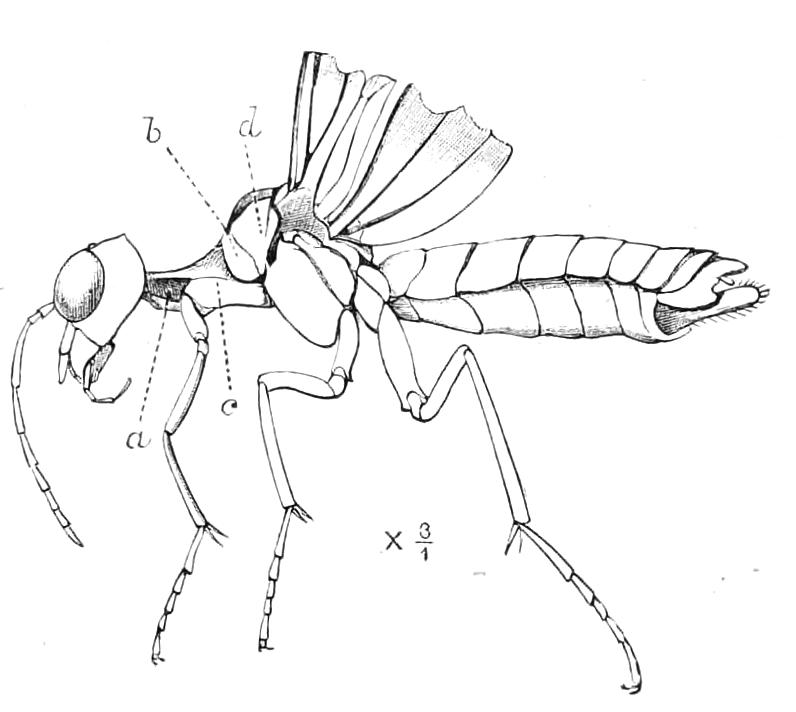
Fig. 332.—Tenthredo, with head fully extended: a, pleuron; b, pronotum; c, membrane; d, mesonotum.
Behind the head there is a large consolidated mass representing the thorax of other Insects, but made up, as we have already indicated, in an unusual manner, and which therefore may be called by a special name, the alitrunk (Fig. 333). The pronotum forms the anterior part of the alitrunk, with which it is usually very closely connected, being indeed frequently immovably soldered thereto. It exhibits, however, considerable variety, and is seen in its simplest and least soldered state in Cephus. In the higher bees the pronotum takes on a form not seen in any other Insects, being one of the most beautiful sclerites to be found in the class (Fig. 334, pronotum of Xylocopa). We have already remarked that in Hymenoptera the lower portions of the prothoracic segment are detached from the upper, so that the pronotum is not supported beneath by a sternum as usual. In the bees in question the pronotum makes up for the removal of the corresponding side-pieces and sternum, by becoming itself a complete ring, its sides being prolonged and meeting in the middle line of the under surface of the body. At the same time a large lobe is developed laterally on each side, overlying and protecting the first breathing orifice. The intermediate stages of this remarkable modification may be observed by dissecting a small series of genera of bees.
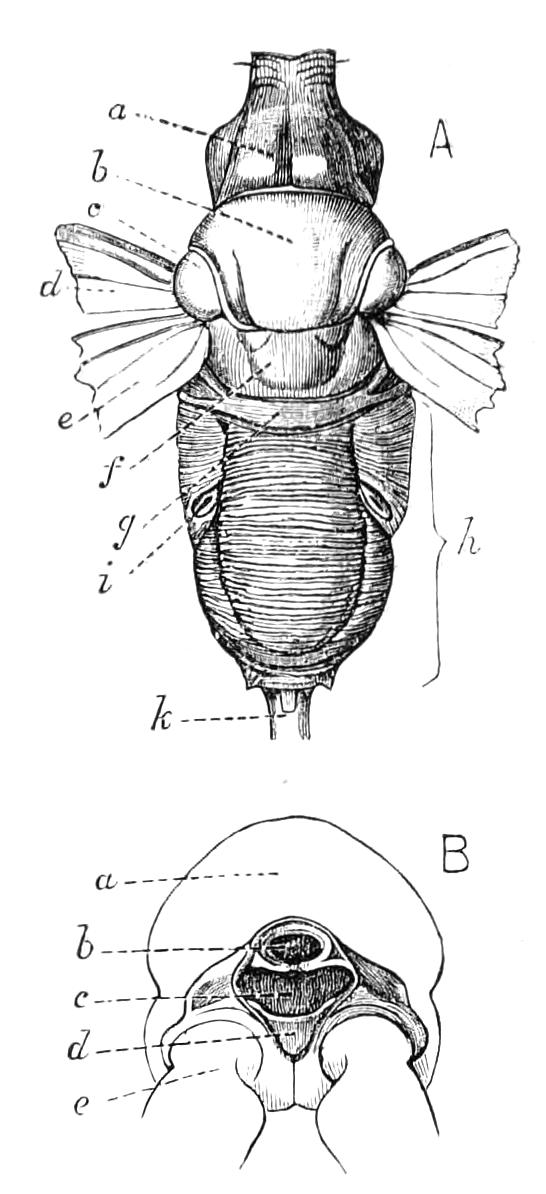
Fig. 333.—Alitrunk of Sphex chrysis. A, Dorsal aspect: a, pronotum; b, mesonotum; c, tegula; d, base of anterior, e, of posterior, wing; f, g, divisions of metanotum; h, median (true first abdominal) segment; i, its spiracle; k, second abdominal segment, usually called the petiole or first abdominal segment. B, Posterior aspect of the median segment: a, upper part; b, superior, c, inferior abdominal foramen; d, ventral plate of median segment; e, coxa.
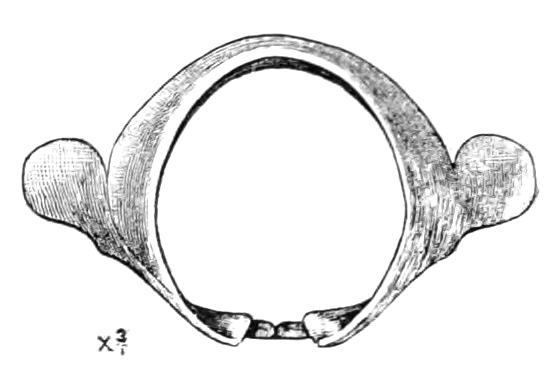
Fig. 334.—Pronotum of a carpenter bee, Xylocopa sp. East India.
Although the prosternum of a Hymenopterous Insect is not usually visible owing to its being overwrapped by the side-pieces, it is really, as shown in Fig. 335, B, of complicated form. In Cimbex and some other sawflies the side-pieces are not so large as usual, but the prosternum is larger and is exposed. The prothoracic spiracle is rarely visible externally, but its position is remarkably constant, and is usually indicated by a peculiar lobe or angle of the pronotum projecting backwards just below the insertion of the front wing. This stigmatic lobe is frequently fringed with short hairs.
The mesothorax is the largest of the three divisions of the thorax proper; its notum is large, and usually divided into two parts by a transverse suture. The side-pieces are so placed that the epimeron is rather behind than below the episternum. The mesosternum forms the larger part of the under-surface of the alitrunk. A very large phragma projects from the mesothorax into the interior of the body. The mesothoracic spiracle is usually not visible; its existence was unknown to the older entomotomists, who were in consequence led to consider the spiracle of the median segment as belonging to the thorax. The mesothoracic spiracle is, however, easily seen in Cimbex, placed in the suture between the mesothoracic epimeron and the metathoracic episternum, a little below the insertion of the front wing; close to this spot the mesophragma, just spoken of, comes, in Cimbex, to the surface. The mesothoracic spiracle is generally conspicuous in the worker ant. The parts of the metathorax are usually small, but so much variety prevails in this respect that no general description can be given.
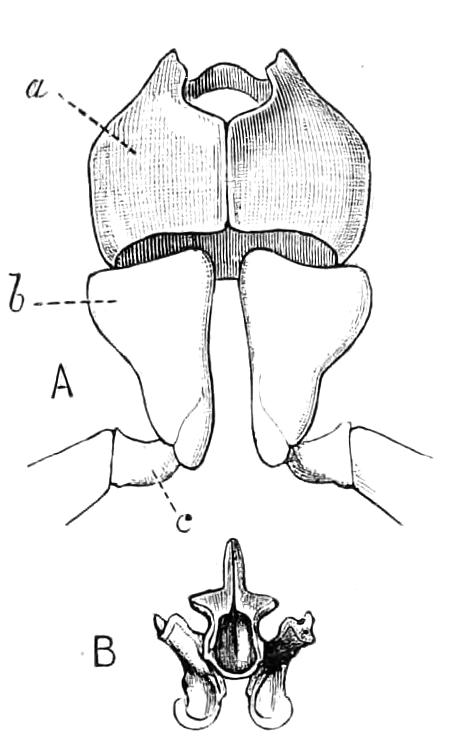
Fig. 335.—Articulation of front legs of the hornet (Vespa crabro, ♀). A: a, side-piece of prothorax overlying the prosternum; b, coxa; c, trochanter. B, prosternum proper, as seen from front when extracted.
The structure of the posterior part of the alitrunk has given rise to an anatomical discussion that has extended over three-quarters of a century,[410] with the result that it is now clear that the posterior part of what appears to be thorax in Hymenoptera is composed of an abdominal segment. This part has been called "Latreille's segment," the "median segment," and the "propodeum." The latter term was proposed by Newman, under the form of propodeon,[411] and appears to be on the whole the most suitable term for this part, which is of great importance in systematic entomology, owing to the extreme variety of characters it affords. Although it is clear that the propodeum is, in large part, an abdominal segment, yet its morphology is still uncertain; what parts are pleural, what tergal, and what may be chitinised spiracular area, or portions of the metathorax, being undetermined. The ventral portion of the propodeum affords a strong contrast to the dorsal part, being so small that it has frequently been described as absent; it is, however, not difficult to detect it in the position shown at d, Fig. 333, B.
Although the true first segment of the abdomen is detached from its normal position and added to the thorax, yet the term abdomen is conventionally restricted to the part that commences with the true second segment, which, in counting the number of abdominal segments, is reckoned as being the first. There are two modes of articulation of the Hymenopterous abdomen with the alitrunk; in one (Fig. 336, A) the base of the abdomen remains of the calibre usual in Insects, while in the other (Fig. 336, B) it is greatly contracted, so that the two parts are connected only by a slender stalk, the petiole. The petiole, besides articulating in a very perfect manner with the propodeum by means of certain prominences and notches, is also connected therewith by means of a slender ligament placed on its dorsal aspect and called the funiculus, shown in Fig. 333, A, just at the extremity of the pointing line k. This mode of articulation gives great freedom of motion, so that in some Petiolata (Ampulex) the abdomen can be doubled under the body and the sting brought to the head. It is worthy of note that even in the Sessiliventres—as the sub-Order with broad-based abdomen is called—some amount of movement exists at the corresponding spot; while, as shown in Fig. 336, A, between a and b, there exists an exposed membrane, the homologue of the funiculus.
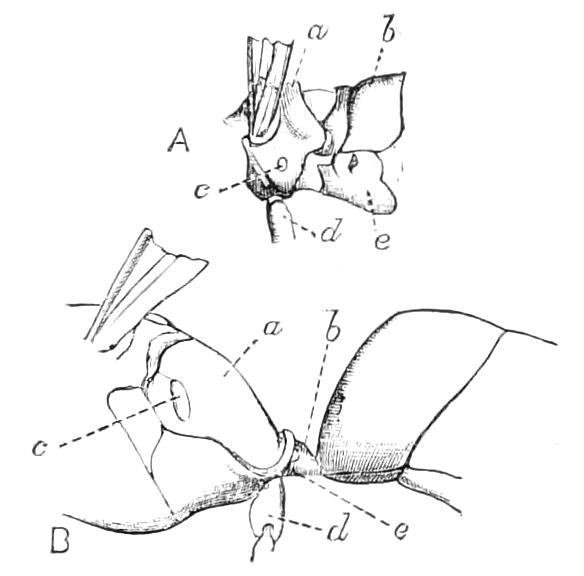
Fig. 336.—Articulation of abdomen and alitrunk of, A, Cimbex, B, Vespa. a, Propodeum or median segment; b, dorsal plate of first (second true) abdominal segment or petiole; c, spiracle of the propodeum; d, hind coxa; e, ventral plate of first (second true) abdominal segment.
The number of abdominal segments that can be seen in the perfect Insect varies greatly. In Tenthredinidae nine can be distinguished, while in some of the Chrysididae it is difficult to detect more than three behind the petiole. These distinctions are, however, superficial or secondary, being due to changes in the later life in connexion with the stings or borers; in the larvae that have been examined thirteen segments behind the head have usually been detected.
Nothing is more remarkable in the Hymenoptera than the great differences that exist in the form of the petiole. This may be very short, as in the bees, so that the abdomen when not deflexed does not appear to be separated from the thorax (Fig. 331, C); in this condition it is said to be sessile, a term which it would be well to replace by that of pseudosessile. In many of the solitary wasps the petiole is very long. In ants it is replaced by one or two curiously-shaped small segments called nodes (Fig. 60, B, 2, 3), and in many ants these are provided with structures for the production of sound. The abdomen is formed by a system of double imbrications; each dorsal plate overlaps each ventral plate, and the hind margin of each segment embraces the front part of the one following; thus this part of the body has not only great mobility, but is also capable of much distension and extension. The pleura are apparently absent, but each one has really become a part of the dorsal plate of the segment to which it belongs. This is shown to be the case by Cimbex, where the division between pleuron and dorsal plate exists on each segment except the basal one. Owing to this arrangement, the abdominal stigmata in Hymenoptera appear to be placed on the dorsal plates.
The organs for mechanical purposes existing at the extremity of the body in Hymenoptera exhibit a great diversity of form; they are saws, borers, piercers, or stings. Notwithstanding their great differences they are all, in their origin, essentially similar, and consist of six parts developed from limb-like prolongations on the penultimate and antepenultimate segments of the larva, as described by Packard and Dewitz.[412] These processes have by some been thought to be not essentially different from abdominal legs, and Cholodkovsky has recently advocated this opinion.[413]
The legs of bees exhibit modifications for industrial purposes. In the stinging Hymenoptera the trochanters are usually of a single piece, and these Insects are called monotrochous; but in most of the other forms the trochanters are more or less distinctly divided into two parts (Fig. 345, b). The usual number of joints in the tarsus is five, but is subject to diminution in many cases. In the bees and ants the first joint is altered in form; in the bees to act as an instrument for gathering or carrying pollen; in the ants to act, as it were, as a second tibia. Between the claws there is a very perfect pad, already described and figured on p. 106.
The wings are remarkable for the beautiful manner in which the hinder one is united to the anterior, so that the two act in flight as a single organ. The hind wing is furnished with a series of hooks, and the hind margin of the front wing is curled over so that the hooks catch on to it. In some of the parasitic forms the wings are almost destitute of nervures, and have no hooks. The powers of flight in these cases are probably but small, the wings merely serving to float the Insect in the air. In some Hymenoptera, especially in Pompilides and Xylocopa, the wings may be deeply pigmented or even metallic; and in some forms of Tenthredinidae, Ichneumonidae, and Braconidae the pigmentation assumes the form of definite patterns.
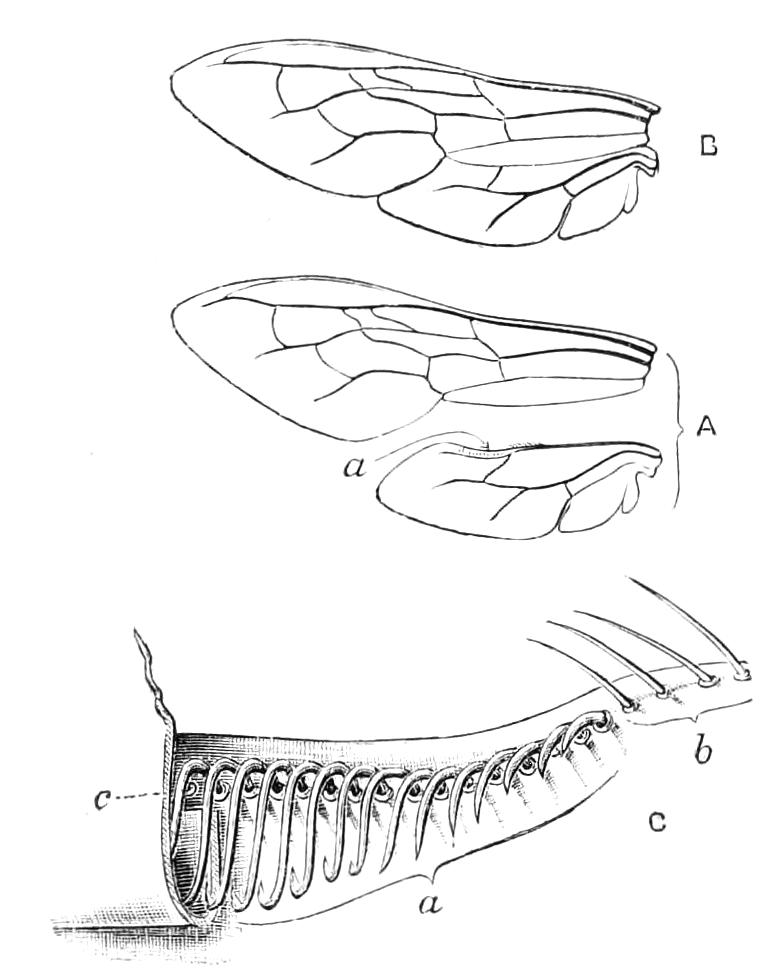
Fig. 337.—Wings of a carpenter bee. A, The pair of wings separated; a, position of the hooks: B, the same wings when united by the hooks. C, Portions of the two wings: a, the series of hooks; b, marginal hairs; c, portion of edge of front wing, of which the other part has been broken away in order to show the hooks.
The studies of the internal anatomy of Hymenoptera are at present by no means numerous or extensive. The alimentary canal (Fig. 69) possesses a crop, gizzard, and chylific stomach in addition to the oesophagus and intestine. The social Hymenoptera have the power of disgorging matter from the alimentary canal for the purpose of supplying food for their young.
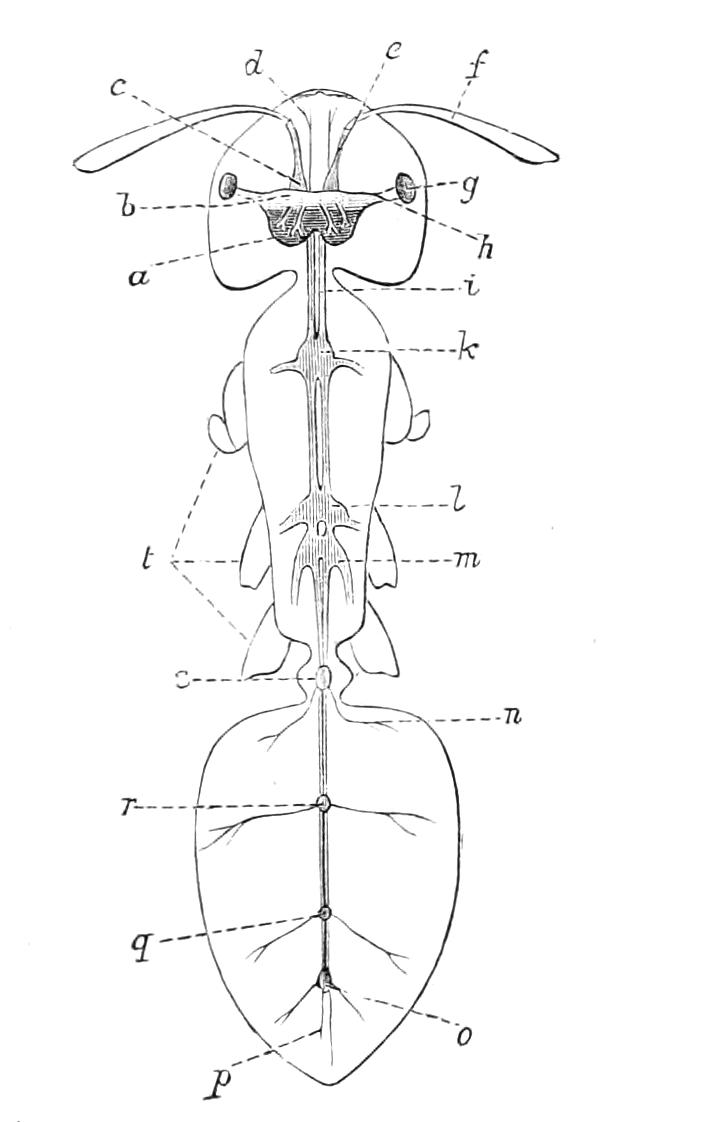
Fig. 338.—Central nervous system (supra-oesophageal ganglion and ventral chain) of a worker ant, Camponotus ligniperdus. (After Forel.) a, Cerebral hemisphere; b, primordial cerebral lobe or pedunculate body (depressed so as to show other parts); c, olfactory lobe (raised from natural position); d, nerve to labrum; e, antennary nerve; f, scape of antenna; g, eye; h, optic nerve; i, longitudinal commissures connecting the hidden sub-oesophageal ganglion with k, the prothoracic ganglion; l, mesothoracic, m, metathoracic ganglion; s, ganglion of the petiole; n, nerve from petiole to other part of abdomen; r, q, o, 2nd, 3rd, 4th abdominal ganglia; p, terminal nerve to cloaca; t, bases of legs.
The crop—which is situated in the anterior part of the abdomen—is the reservoir that contains this matter. The mode of disgorgement is believed to be pressure exerted on the crop by contraction of the abdomen. Salivary glands are present in remarkable variety. The tracheal system possesses, in the higher winged forms, large saccular dilatations situated at the side of the abdomen. The nervous system is of peculiar interest on account of the high intelligence of many of the members of this Order; and on this point of the anatomy, Brandt[414] has made rather extensive investigations, having examined it in the adult of seventy-eight species, and in the larva of twenty-two. In the adult there are two cephalic—the supra- and the sub-oesophageal—two or three thoracic, and from three to seven abdominal ganglia. The bees, wasps, and some other of the Aculeata have only two thoracic ganglia, while some ants have three. The supra-oesophageal ganglion is very large. The most remarkable fact revealed by Brandt's investigations is the great difference that exists between the sexes and the worker caste in the same species. The pedunculate bodies of the supra-oesophageal ganglion are considered to be in their development correlative with that of the intelligence or instinct. In the workers of the social Hymenoptera these bodies are very large, while in the males and females they are small. The workers and females of Bombus have six abdominal ganglia, while the males have only five; and the worker of the honey-bee has five abdominal ganglia, while the male and the queen-bee have but four. In the leaf-cutting bee (Megachile) the male has four abdominal ganglia and the female five, and in the wasps the workers have five, the males and females six. The nervous system in the larvae shows but little difference between the ganglia, which are thirteen in number, eight being abdominal. In the embryo of the bee Kowalewsky has observed seventeen ganglia. The changes that take place from the embryonic to the imago condition are therefore directed to the reduction in number of the ganglia, which is accomplished by the fusion of some of them. In the adult Hymenopterous Insect it would appear that the first abdominal ganglion is always joined with the last thoracic.
Sub-Orders.—The distinction in the form of the abdominal articulation, previously alluded to (p. 492, Fig. 336, A, B), divides the Hymenoptera into two great sub-Orders, the members of which are very different in their habits and life-histories. The Sessiliventres are plant-eaters; their larvae (Fig. 343, A) are provided with legs, and are able to procure their vegetable food for themselves. The larvae of the Petiolata are maggot-like and helpless, and are dependent for food on supplies afforded them by their parents or companions. It is said by Dewitz that although the larvae of the Petiolata appear to be legless, there are thoracic legs within the body. The metamorphosis, so far as it is known, and the early life-history of the Sessiliventres are very similar to those of butterflies and moths, except that the pupa is soft and has no hard external skin. A few of these plant-eating Sessiliventres become carnivorous in the perfect state—a change of habit that is most unusual in Insects, though the reverse occurrence is common. The larvae of the Petiolata exhibit, in the cases that have been examined, the peculiarity that the alimentary canal has not any outlet posteriorly until the termination of the larval stage of existence is approaching. In some cases there is no anal orifice; in others this orifice exists, but there is no communication between the stomach and the posterior intestine.
Packard informs us[415] that in Bombus the larva, after it is full fed, passes into the pupa state (Fig. 331, A, B) by a series of transformations accompanied by moultings of the skin. Packard's statements have been confirmed by others, but details have not been fully given, so that the number of the moults, their intervals and other particulars, are still unknown. We have remarked that the pupal instar is very like the perfect instar, except that it is colourless and soft, and that each of the members is wrapped in a very delicate skin; the colour appears gradually. This metamorphosis exhibits important differences from that of the Lepidoptera. Packard calls the Insect, during the stages of transformation from the full-fed larva to the pupa, the semi-pupa; the later stages of the pupa, when the colouring has appeared, he terms the subimago. Altogether he considers there is a series of at least ten moultings of the skin. His ideas were apparently derived from examination of a series of specimens after death rather than from observation of the development in living individuals. The parasitic forms of Hymenoptera have apparently extraordinary metamorphoses of very varied kinds.
Parthenogenesis.—One of the most remarkable facts connected with this Order is the prevalence of parthenogenesis in a considerable number of widely separated species. In many of these Hymenoptera it is not a mere occasional occurrence, but plays an important part in the continuity of the species; indeed, it is believed that in some members of the Order the reproduction is entirely parthenogenetic. We shall give particulars as to some of these cases in subsequent chapters, and will here make some remarks on the different forms of parthenogenesis existing in the Order. The three forms of parthenogenesis mentioned on p. 141 all occur in Hymenoptera. In the gall-making Cynipidae parthenogenesis is frequently accompanied with alternation of generations, a generation consisting of the two sexes being followed by another consisting entirely of females, which in its turn gives origin to a bisexual generation. In this case deuterotokous parthenogenesis is established as a part of the normal economy of the species. This same form of parthenogenesis also occurs in other species of Cynipidae unaccompanied by alternation of generations. Thus in Rhodites rosae the generations resemble one another, and the male is very rare, but is still occasionally produced,[416] and the same condition exists in other Cynipidae. According to the observations of Adler, we may assume that the male, in the latter cases, is useless, the continuation of the species being effected by virgin females although males exist. Deuterotokous parthenogenesis also occurs in the sawflies, but as a comparatively rare phenomenon.[417]
Thelyotokous parthenogenesis is common in sawflies, and it also occurs in some Cynipidae. There are several species of this latter family in which no males have ever been found.[418] The phenomena in Rhodites rosae we have mentioned, give rise to the idea that in that species deuterotokous parthenogenesis occurs as an exception, the species being usually thelyotokous. A most remarkable case of thelyotokous parthenogenesis is said to exist in the case of the parasitic ant Tomognathus. This species is said to be monomorphic, only the female existing, and reproducing by uninterrupted parthenogenesis.
Arrhenotokous parthenogenesis—i.e. parthenogenesis in which the progeny is entirely of the male sex—occurs in several species of sawflies. We find it also occurring in the case of the social Hymenoptera; the workers of ants, bees, and wasps occasionally produce eggs parthenogenetically, and the progeny in these cases is always of the male sex. In the honey-bee the queen sometimes produces eggs before she has been fertilised, and the parthenogenetic young are then always of the male sex.
Some species of Hymenoptera exhibit two forms of parthenogenesis. In Nematus curtispina the parthenogenetic generation is generally of the male sex, but a female is occasionally produced;[419] while in Hemichroa rufa parthenogenesis may result in either deuterotokous or thelyotokous progeny. No case is yet known of a species exhibiting the three forms of parthenogenesis. From this review we may conclude that parthenogenesis does not favour the formation of one sex more than another; but it is clear that it decidedly favours the production of a brood that is entirely of one sex, but which sex that is differs according to other circumstances.
Production of Sex.—It is believed that a very peculiar form of parthenogenesis exists in the honey-bee, and it is confidently stated that the drones, or males, of that species are always produced from unfertilised eggs. These views are commonly called the Dzierzon theory, and are widely accepted. They assume that the eggs are male till fertilised, and then become female. After the queen-bee is fertilised most of the spermatozoa soon find their way into a small chamber, the spermatheca, near the posterior orifice of the body; it is believed that each egg may be fertilised as it passes the door of this chamber, and that the eggs that produce females (i.e. workers or queens) are so fertilised, but that the eggs that produce drones are not fertilised. Hence it is supposed that the sex is determined by this act of fertilisation, and Cheshire has described what he calls an apparatus for differentiating the sexes. It is also confidently stated that no male honey-bee ever has a father.
The facts we have stated as to the sexes resulting from parthenogenetic reproduction in Hymenoptera generally, are extremely opposed to the Dzierzon theory, in so far as this relates to the production of sex. There have always been entomologists[420] who have considered this view unsatisfactory, and the observations of several recent French naturalists[421] are unfavourable to the idea that the sex of an egg is determined by its fertilisation.
There can be no doubt that the queen honey-bee frequently produces males parthenogenetically, and the error of the views we are alluding to consists in taking the parthenogenesis to be the cause of the sex of the individual. It must be recollected that the laying of an unfertilised egg by a fertilised female may be different physiologically from the laying of an egg by an unfertilised female; for, though both have as result an unfertilised egg, it is possible that the fertilisation of the female may initiate processes that modify the sex of the eggs produced by the ovaries, so that though these may produce previous to fertilisation only male eggs, yet after fertilisation they may produce eggs of the opposite sex or of both sexes. In other words, the act of fertilisation may initiate a different condition of nutrition of the ovaries, and this may determine the sex of the eggs produced.
Polymorphism, or Castes.—The question of the causes of the modified individuals forming the various castes of the social Hymenoptera has been much discussed. These individuals are many of them very different in size and structure from either of their parents, and are also different in their habits and instincts. This difficult subject is far from being completely elucidated. In the case of the honey-bee it is well established that an egg of the female sex can, after deposition, be made either into a queen or a worker-bee by the mode of nutrition—using that word in the largest sense. On the other hand, Dewitz thought that in the case of the ant Formica rufa, the caste—whether worker or winged female—is already determined in the Insect before leaving the egg.[422] Weismann and others associate the caste with some hypothetic rudiments they consider to exist at the very earliest stage of the embryonic, or oogenetic process.
Herbert Spencer says:[423] "Among these social Insects the sex is determined by degree of nutrition while the egg is being formed," and "after an egg, predetermined as a female, has been laid, the character of the produced Insect as a perfect female or imperfect female is determined by the nutrition of the larva. That is, one set of differences in structure and instincts is determined by nutrition before the egg is laid, and a further set of differences in structures and instincts is determined by nutrition after the egg is laid."
Spencer's generalisation is not inconsistent with the facts hitherto brought to light, though it is possible that the progress of knowledge may show some variety as to the periods of the development at which the commencements of the modifications occur.
Fig. 339 represents the chief castes, or adult forms, existing in a community of one of the most highly developed of the species of social Hymenoptera, the leaf-cutting ant, Atta cephalotes. We shall, when dealing with Formicidae, enter into some details as to these and other cases of polymorphism.
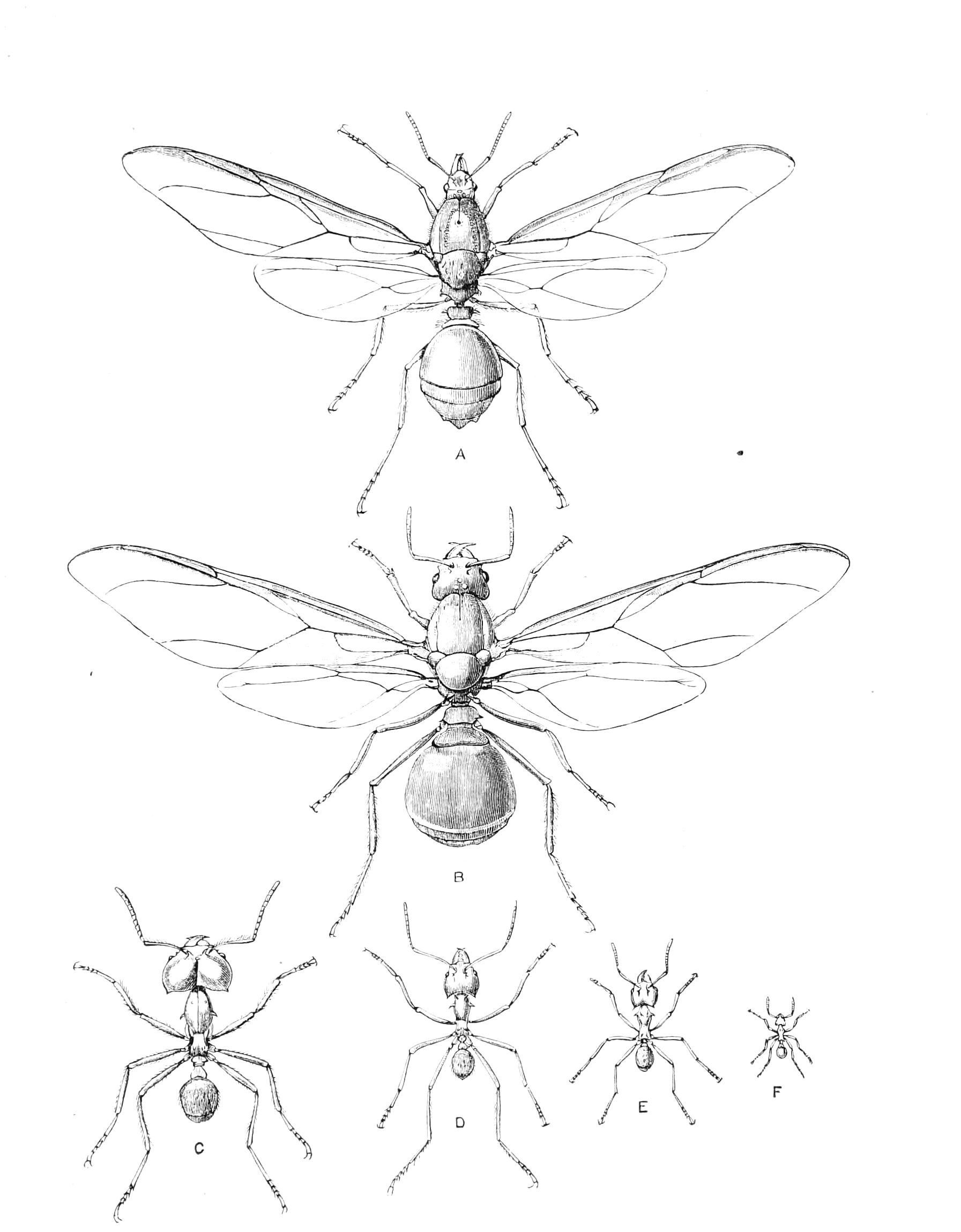
Fig. 339.—Adult forms of Atta (Oecodoma) cephalotes, taken from a nest in Trinidad by Mr. J. H. Hart, 25th June 1895. A, male; B, winged female; C-F, various forms unwinged; C, so-called soldier; D, large worker; E, smaller worker; F, smallest worker or nurse. All equally magnified (one and half times).
Our object at present is to bring to the eye of the reader the great diversity of outer form that is believed, rightly or wrongly, to result from the mode of treatment of the young. And we will also take this opportunity of more fully illustrating the remark we made on p. 85 as to the profound distinctions that exist between ants and white ants, or Termites, notwithstanding the remarkable analogies that we shall find to exist in many of their social arrangements.
The analogies we allude to, coupled with the fact that there is a certain general resemblance in outer form between the workers of Termites and ants, and even between the extraordinary castes called soldiers in the two groups, have given rise to the idea that there is a zoological relationship between the social forms of Neuroptera and Hymenoptera. The two are, however, zoologically amongst the most different of Insects. The external skeleton in Termites is remarkable for its imperfect development, the sclerites being small and isolated, while the segmental differentiation of the body is low (Fig. 225, etc.), so that there is no difficulty in counting the segments. In ants the reverse is the case as regards both these facts, the various segments being most unequal, so that their homologies have only been detected after prolonged studies, while the chitinisation and articulation of the various parts is so complete that the ant may be described as cased in armour, fitting together so exactly that it is difficult anywhere to introduce the point of a needle into its chinks. The wings of the two kinds of Insects are also extremely different. The differences between the modes of growth and development of the two sets of Insects are as profound as the distinctions in their anatomy. Termitidae belong to the division of Insects in which the wings are developed outside the body; Hymenoptera to the division in which they are developed inside the body. In Termites the growth of the individual is slow, and the final form is reached gradually. In the ants the growth is carried on with great rapidity, and during it the Insect is a helpless maggot absolutely dependent on the attentions of its seniors, while the difference in form and structure between the ant-larva and the ant are enormous. Both anatomy and ontogeny are profoundly different in ants and Termites. To these distinctions must be added, as of much importance, the fact that in Hymenoptera only the female sex is modified for the division of labour, while in Termites both sexes undergo this change. Hence it is impossible to suppose that the remarkable analogies that exist between the societies of ants and those of Termites are due to any common origin. It is probably to some similar physiological susceptibilities in the ancestors, at an extremely remote epoch, of both groups that we must look for an explanation of the interesting resemblances in the social lives of ants and Termites.
The Hymenoptera are no doubt one of the largest Orders of Insects, the species of the parasitic tribes being apparently innumerable. No doubt 250,000 species of the Order exist, and possibly the number may prove to be very much larger. Up to the present time 25,000 or 30,000 have been discovered. No remains of Insects of this Order, of older age than the Lias, have been brought to light; it is indeed doubtful whether the fossils considered to be Hymenopterous of the period referred to are really such.
The Order, as already mentioned, consists of two very distinct sub-Orders, viz.:—
1. Hymenoptera Sessiliventres.—Insects with the abdomen broad at the base, its first segment not completely amalgamated with the thorax.
2. Hymenoptera Petioliventres or Petiolata.—The abdomen connected with what appears to be the thorax by a slender joint, the posterior part of the apparent thorax consisting of an abdominal segment.
Hymenoptera Sessiliventres.—This group has been variously called Hymenoptera phytophaga, H. securifera, H. sessiliventres, H. serrifera, H. symphyta. We prefer an old term, taken from a character that enables us to recognise at a glance which group a species belongs to. The division or sub-Order may be formally defined as follows:—
Abdomen nearly continuous in outline with the thorax, the two parts having a broad connexion instead of a small highly mobile articulation. Anal lobe of hind wings usually of considerable size. Trochanters ditrochous (transversely divided into two, Fig. 345). Extremity of body of female furnished with saws or boring instruments, usually concealed, in some cases visible in part. Larvae with complex mouth-parts; three pairs of thoracic legs (imperfect in Cephidae and Siricidae), and frequently with numerous abdominal legs, which are destitute of hooks. Food vegetable.
The Insects of this sub-Order never exhibit the highly specialised habits and activity of the better known petiolate Hymenoptera. Though the food in the larval stages is always vegetable, there is considerable variety in the larvae and their habits; some feed in galls, some in the twigs of plants, some in the hard wood of trees and shrubs. The majority, however, live on the leaves of plants. Those that live in wood (Fig. 342, C) resemble in appearance Coleopterous larvae that have similar habits, and those that live on leaves (Fig. 343, A) resemble Lepidopterous larvae that do likewise. There are four families included in the sub-Order, viz. Cephidae, Oryssidae, Siricidae, Tenthredinidae.
The British Sessiliventres—under the name Phytophagous Hymenoptera—have recently been monographed by Mr. Peter Cameron in a series of vols. published by the Ray Society.[424] These contain many figures and many details relating to natural history, in addition to the descriptions of genera and species.
Fam. I. Cephidae—Stem Sawflies.
Slender Insects, with weak integument; free, more or less elongate pronotum; one spine on the front tibia. Larvae living in the stems of plants or in the tender shoots of trees and shrubs.
The obscure little Insects composing this family have slender antennae of peculiar form, composed of eighteen to thirty joints, two of which are short and stout; then come several long joints, with more or less power of movement, the terminal portion consisting of an elongate club of many joints with little power of movement. The pronotum is longer than is usual in the Hymenoptera, and instead of being very closely connected with the mesonotum, it is free and mobile, although its base overwraps the front of the mesonotum. The median plate (i.e. the dorsal plate connecting the thorax and abdomen) is divided to the base along the middle, the divisions being separated by a membranous piece broader behind; the anal lobe of the posterior wings is small but distinct. The female bears a saw at the extremity of the body, but it is covered by two flaps; these form a short, terminal projection. Although too much neglected, the Cephidae are really of great interest as being of more imperfect or primitive structure than any of the other families of Hymenoptera. The larval history has been traced in several species. C. pygmaeus is sometimes very injurious to corn crops on the continent of Europe, and even in our own country its effects in this respect are considered to be occasionally serious. The egg is laid in the stem of the corn plant; the larva soon hatches and eats its way upwards in the stem. It is a soft grub, apparently footless, but really possessing six small projections in place of thoracic legs. It occupies all the summer in feeding, and when full fed and about to prepare for its metamorphosis, it weakens the stem by a sort of girdling process below the ear; it then descends in the stem to near the root, where it constructs a transparent cocoon, in which it passes the winter as a larva, changing to a chrysalis in the month of May, and completing its development by appearing as a perfect Insect shortly thereafter. The girdling operation is very injurious, and causes the corn stem, when ripe or nearly so, to break in two under the influence of a strong wind, so that the ears fall to the ground.
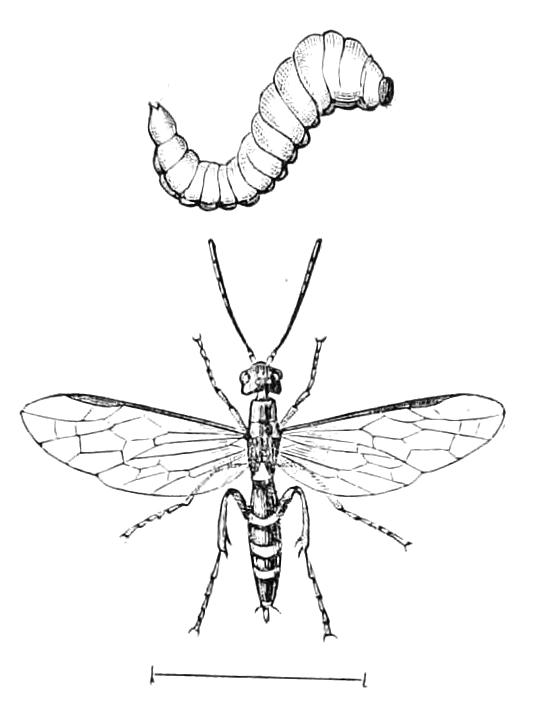
Fig. 340.—Cephus pygmaeus. Upper figure, larva; lower, female imago. Britain. (After Curtis.)
The history of C. integer has been given by Riley. This Insect attacks the young shoots of willows in North America. Riley states[425] that by a wonderful instinct the female, after she has consigned her egg to the twig, girdles the latter, preventing it from growing any further, and from crushing the egg by so doing. The larva after hatching eats downwards, sometimes destroying a length of two feet of the twig; when full grown it fills the bottom of the burrow with frass, and then previous to making its cocoon eats a passage through the side of the shoot about a quarter of an inch above the spot where the cocoon will be placed, thus making it easy for the perfect Insect to effect its escape; it leaves the bark, however, untouched, and is thus protected in its retreat. A delicate transparent cocoon is then spun in which the larva passes the winter, changing to a pupa in the following March, and emerging as a perfect Insect about six weeks thereafter.
Somewhat less than 100 species of this family are at present known; the great majority are found in the Mediterranean region, but there are several in North America. As a single species is known from Mexico and another from Japan, it is probable that the family may prove to have a wider geographical extension than at present appears to be the case.
Fam. II. Oryssidae.
The median plate behind the metanotum entire, not divided in the middle; antennae inserted below the eyes immediately above the mandibles, under a sharp edge.
This family consists of the genus Oryssus, and includes only about twenty species, but is nevertheless very widely distributed over the world. They are very rare Insects, and little is known as to their habits; one species, O. abietinus, was formerly found in England. Should any one be so fortunate as to meet with it, he can scarcely fail to recognise it on noticing the peculiar situation of the base of the antennae. In this respect the Chrysididae somewhat resemble Oryssus, but in that group of Hymenoptera the hind body or abdomen is remarkably mobile, so that the Insects can coil themselves up by bending at this joint; whereas in Oryssus the hind body is very closely amalgamated with the thorax—more so, in fact, than in any other Hymenopterous Insect—and has no power of independent movement.
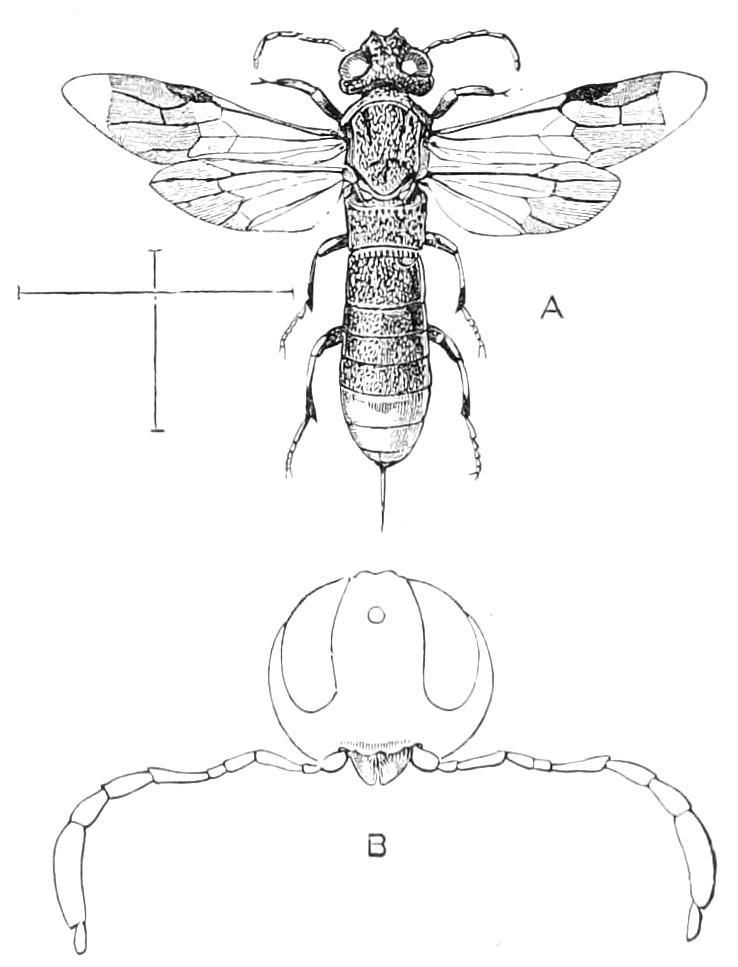
Fig. 341.—Oryssus sayi. North America. A, The female Insect; B, head seen from the front.
Oryssus abietinus very closely resembles C. sayi (Fig. 341); it has indeed been recently suggested by Mr. Harrington that the two supposed species may really be identical.
Fam. III. Siricidae or Uroceridae.
Pronotum closely connected with the mesonotum, perpendicular in front; the anterior lobe of the latter not separated by the lateral lobes from the posterior lobe: the median plate (behind the metathorax) is divided longitudinally along the middle. The female is provided at the extremity of the body with an elongate, cylindrical boring instrument. The larvae live in the wood of trees.
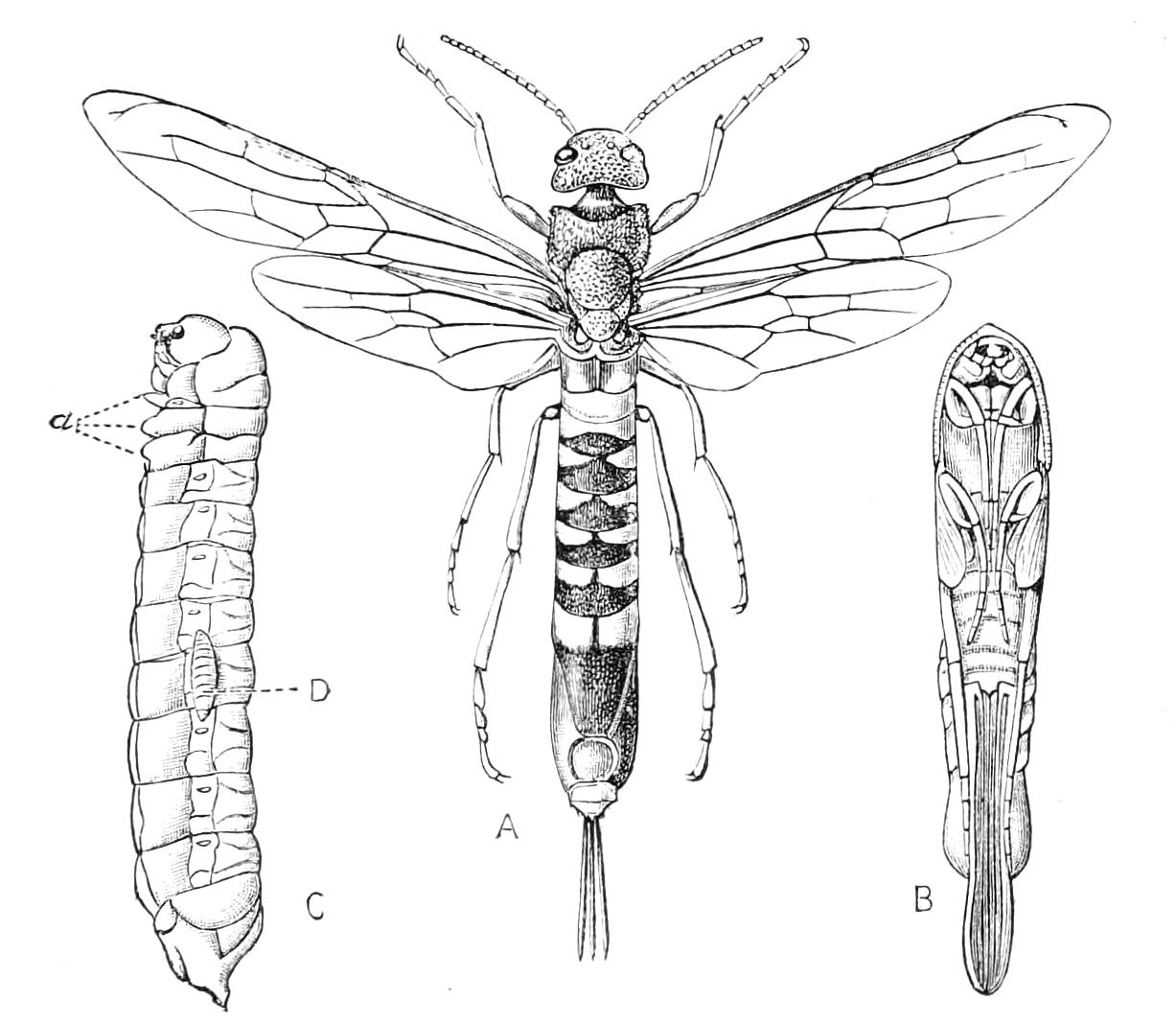
Fig. 342.—Tremex columba. North America. A, Imago, female: B, pupa, female, ventral aspect: C, larva; a, imperfect legs: D, parasitic larva of Thalessa. (B and D after Riley.)
The Insects of this family are usually of large size and of bright conspicuous colours; these, however, frequently differ greatly in the sexes of the same species, and may be very variable even in one sex. The antennae are filiform and usually elongate; the head is usually contiguous with the thorax, but in one division, Xyphidriides, it is exserted and separated from the thorax by a well-marked neck. The pronotum is attached to the mesonotum, and possesses very little, if any, freedom of movement; it varies in its size, being sometimes conspicuous from above; in the Xyphidriides it is smaller, and in the middle is entirely vertical in its direction. The mesonotum is moderate in size, and its divisions are delimited by broad vague depressions. The prosternum appears to be entirely membranous, but the prosternal plates (pleura) are large, and meet together accurately in the middle, so as to protect the greater part of the under-surface of the neck. The abdomen is cylindrical or somewhat flattened above; it has seven dorsal plates in addition to the spine-bearing terminal segment. The trochanters are double, the outer division being, however, short; the anterior tibia has only one spur; the anal lobe of the posterior wings is large. The "borer" or ovipositor of the female is a remarkable organ; it is held projecting directly backwards from the extremity of the body, and has the appearance of being a powerful sting. The apparatus is much longer than it appears, for it proceeds not from the apex of the body, but from the under-surface far forwards, so that the part exposed is only about one-half of the total length; it consists of a pair of elongate sheaths, which are easily separable though they wrap together, and enclose a slender tube. This tube is rigid and quite straight; though appearing solid, it is really composed of two very perfectly adjusted laminae and a third arched piece or roof. The two lower laminae are called the spiculae; they are serrated or grooved in a peculiar manner near the tip, and although so closely adjusted to the borer or upper piece of the tube as to appear to form one solid whole with it, they are said to be capable of separate motion. In addition to these parts, the termination of the abdomen bears above a shorter piece that projects in a parallel plane, and forms a sort of thick spine above the ventral pieces we have described; this process is very strong, and has in the middle of its under-face in Sirex gigas a membranous cavity, replaced in S. juvencus, according to Westwood, by a pair of minute pilose styles. The Insect, by means of this powerful apparatus, is enabled to deposit her eggs in the solid wood of trees, in which the larva sometimes penetrates to the depth of eight inches.
Sirex gigas is one of the most remarkable of our British Insects, but is little known except to entomologists, being usually rare. On the continent of Europe it is, however, an abundant Insect, especially in the neighbourhood of forests of fir-trees, and is a cause of considerable terror. As the Insect is not capable of inflicting much injury to the person, it is probable that the peculiar ovipositor is believed to be a sting. The eggs are laid—it is said to the number of 100—in the solid wood of fir-trees, but not in perfectly healthy wood; the reason for this, it is thought, being that in a healthy tree the great affluence of sap caused by the burrows and presence of the Insect would be injurious to the latter. The Sirex will, however, attack a perfectly healthy tree immediately after it has been felled. The larva, small at first, enlarges its burrows as itself grows larger, and thus the wood of a tree may be rendered completely useless for trade purposes, although there may be very little outward indication of unsoundness. The larva (Fig. 342, C, larva of Tremex) is a pallid, maggot-like creature, with six projections representing thoracic legs; there are no other legs behind these, but some slight protuberances take their place; the terminal segment is enlarged, and bears a hard spine. There is a difference of opinion as to the duration of the life of the larva, Kollar saying that in seven weeks after the deposition of the egg the maggot is full fed, while others consider that it takes two years to attain this condition; the latter statement is more probably correct, it being the rule that the life of wood-feeding larvae is more than usually prolonged. After becoming full fed, the Insect may still pass a prolonged period in the wood before emerging as a perfect Insect. As a result of this it not infrequently happens that the Insect emerges from wood that has been carried to a distance, and used for buildings or for furniture. A case is recorded in which large numbers of a species of Sirex emerged in a house in this country some years after it was built, to the great terror of the inhabitants. The wood in this case was supposed to have been brought from Canada.
Fabre has studied[426] the habits of the larva of Sirex augur, and finds that it forms tortuous galleries in the direction of the longitudinal axis of the tree or limb, and undergoes its metamorphosis in the interior, leaving to the perfect Insect the task of finding its way out; this the creature does, not by retracing its path along the gallery formed by the larva, but by driving a fresh one at right angles to the previous course, thus selecting the shortest way to freedom. By what perception or sense it selects the road to the exterior is quite unknown. Fabre is not able to suggest any sort of perception that might enable the larva to pursue the right course, and considers it must be accomplished by means of some sensibility we do not possess. Fabre's observation is the opposite of what has been recorded in the case of S. gigas, where the larva is said to prepare the way for the exit of the perfect Insect.
Individuals of Sirex are often found in dried and solid wood, encased by metal. When the Insect finds itself so confined, it gnaws its way through the metal, if this be lead, and escapes. The perseverance displayed by the Insect in these circumstances seems to indicate a knowledge of the direction in which liberty is to be found.
About 100 species of Siricidae are known. They form two sub-families:—
1. Siricides: back of head nearly or quite contiguous with the pronotum.
2. Xyphidriides: back of head separated from the pronotum by an elongate neck.
We are reputed to possess in Britain two species of each of these sub-families, but it is doubtful whether more than one Siricid is truly native. Sirex gigas is frequently brought over in timber, and certainly breeds at times freely in Britain. Mr. Leech has recorded the occurrence of the larvae in abundance in fir-trees in the neighbourhood of Dublin. Sirex juvencus is more rarely met with. Xyphidria camelus is doubtless a native, though now apparently rare. It used to occur about old willows, near London, in the New Forest, and, I believe, also in the neighbourhood of Cambridge.
Fam. IV. Tenthredinidae—Sawflies.
Hymenoptera Sessiliventres, having the pronotum small, accurately adapted to the mesonotum; the anterior lobe of the latter is widely separated from the posterior; there are two spurs on the anterior tibiae. The larvae usually live on leaves after the manner of caterpillars, but a few inhabit galls.
The sawflies are an important family of Insects, their species being numerous, while some of them are, in the larval state, very destructive to vegetables and fruit. Being quiet creatures, rarely seen on the wing, they are, though common Insects in this country, but little known, and few persons recognise a sawfly as such. They are usually of small or moderate size, and the numerous species have a great family resemblance. This remark requires some qualification in the case of the Cimbicides, they being Insects of larger size—usually surpassing the honey-bee—of more robust structure, and with greater powers of flight.
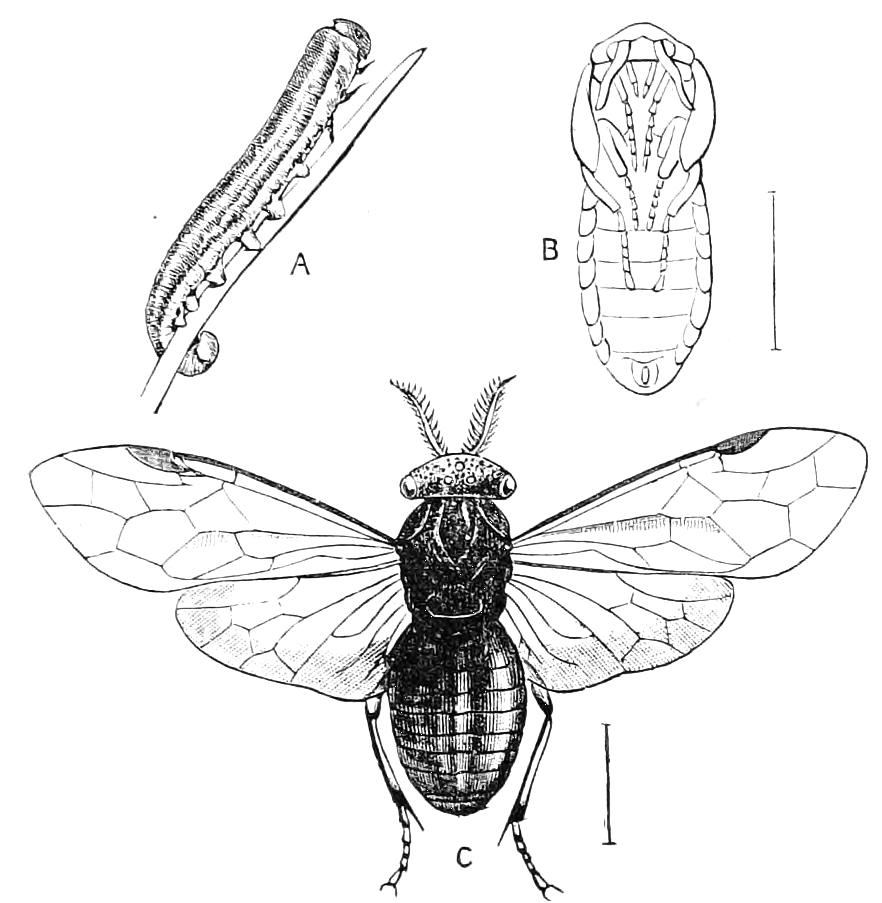
Fig. 343.—Lophyrus pini. Britain. A, Larva; B, ventral aspect of pupa; C, imago, male. (After Vollenhoven.)
The antennae are remarkably variable in form and structure. Cameron considers that nine should be taken as the normal number of their joints; but there are only three in Hylotoma, while in Lyda there may be forty or more. The head is usually held closely applied to the thorax, but is really borne on a neck capable of much elongation (Fig. 332). The pronotum forms a part of the alitrunk, but is not soldered thereto. Usually the prosternum is more or less completely concealed by the side-pieces, but in Cimbicides it is larger and conspicuous, the side-pieces being in this group smaller than usual. The dorsal pieces of the mesothorax have their relative proportions different to what we find them in the other families of Sessiliventres, and even in most of the other Hymenoptera. There is first an antero-median lobe of triangular shape projecting, like a wedge, far backwards, into the great lateral lobes. These latter form the larger part of the area of the mesonotum; they meet together in the middle line, and behind are separated by a deep depression from the posterior lobe, or scutellum of the mesothorax, which is frequently divided into two parts, the anterior being the so-called scutum. The pieces of the metanotum are short and obscure, owing to the great unevenness of their parts; on each side of the middle there is a small membranous space of pallid colour. The cenchri, as these spaces are called, are, in Lyda, delicate, membranous, depressed spaces, in front of each of which there stands up a flap of membrane. The function of the cenchri is quite unknown. The median plate is fastened to the hind margin of the metanotum, and looks quite like one of the dorsal plates of the following abdominal segments, from which, however, it is separated by a more or less conspicuous membrane. In the majority of the Tenthredinidae the median plate is divided along the middle, but in the Cimbicides this is not the case. The mesosternum is very large, and the metasternum small, so that the middle and hinder pairs of coxae are placed close together. The abdomen consists of nine segments, there being eight dorsal plates in addition to the median plate, and seven ventral plates besides the terminal armature. There is a pair of short cerci, each of a single segment. The trochanters are divided; each tibia bears two spurs at the extremity, and the tarsi are 5-jointed.
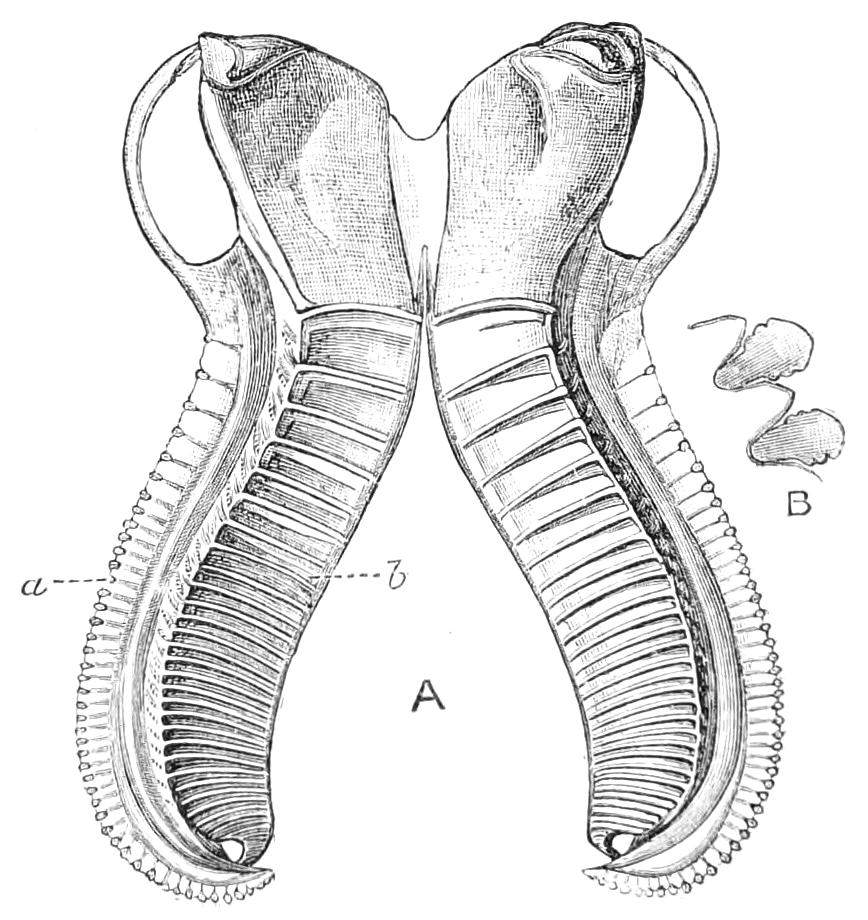
Fig. 344.—Saws of Cimbex sylvarum. A, The pair spread out and placed in a horizontal position; a, the lower margin of the saw proper; b, the upper margin of the support: B, two teeth of the saw more highly magnified.
The most characteristic and interesting of the structures with which the Insects of this family are provided is the apparatus from which the name of sawfly is derived. As long as two centuries ago these instruments excited the admiration of Vallisnieri and of Réaumur, who described them at length; and it is truly astonishing that any part of a living being should be changed into tools so mechanically perfect as these saws are (Fig. 344). They serve the purpose of assisting the female in depositing the eggs in a suitable situation, the place selected being frequently the tender stems of shrubs or other plants, or the interior of leaves. These organs are therefore of course possessed only by the female. They are placed on the lower aspect of the hinder extremity of the body, where they are enclosed and protected by a pair of sheaths, from which they can be made to protrude by a little pressure exercised on the parts immediately in front of them. Each female possesses a pair of these saws; they consist of thin laminae of very hard consistence, and are not only toothed at their edge, but in many cases each tooth is itself serrate; at the same time the outer face of the saw is sculptured or plicate in a remarkable manner, so that the saw in this way acts as a file or rasp. The Insect having selected a suitable place, uses the saws by placing the extremity of the abdomen against a twig or leaf, protruding the blades, which, moving with an alternate motion, one being thrust forward while the other is retracted, act on the plant so as to make an incision. Each saw is directed in its movement by the support, the pair of supports being united at the base by membrane as shown in Fig. 344. In the case of some species,—Hylotoma rosae, the common sawfly of our rose-bushes, for instance—there is no difficulty in observing the operation; indeed old Réaumur, when speaking of the placid disposition of the sawflies, suggests that it was given them so that we may easily observe their charming operations. We cannot but regret that in these days we are unable to take so complacent a view of the arrangements of nature. There is much variety in the details of the structure of these saws; so much indeed that it is possible to identify most of the species by means of the saw alone. According to certain observers, the eggs are laid by some kinds on, not in, the leaves, so that we may conclude that in these cases the saws are not used by their possessors. An incision having been made, an egg is placed in it, and also a drop of some liquid matter. The egg is at first small, but soon increases till it becomes twice or three times its former size, and the development of the embryo commences.
The larvae of the Tenthredinidae exhibit great variety, and are indeed in this respect more interesting than the perfect Insects. The usual rule is that the larvae much resembles those of Lepidopterous Insects, and feed exposed on plants in the same way as Lepidopterous larvae do. But the exceptions are numerous; sometimes the larva is covered with slime, and thus protected from various enemies. In other cases it is very depressed, a broad creature, of irregular outline, living closely attached to the leaf, somewhat after the fashion of a huge scale-Insect. Some larvae mine between the layers of a leaf, others roll up leaves; a few live in the stems of plants, and one or two inside fruits. Even this does not complete the list of their habits, for a few species of Nematus live in galls caused by the deposition of the egg. A species of Lyda forms for itself a case out of bits of leaves, and carries this habitation about with it after the fashion of the Phryganeidae. The number of legs in these larvae is unusually great, varying from eighteen to twenty-two—that is, three pairs of thoracic legs and eight of abdominal or pro-legs. This character offers a ready means of distinguishing, in the majority of cases, these larvae from those of the Lepidoptera in which the number of legs varies, but is only from ten to sixteen; moreover, the pro-legs in sawflies are destitute of the circles of hooklets that exist in Lepidoptera. This mode of identifying the immature stages of the Tenthredinidae is not, however, always satisfactory, as there are some of these larvae that have no pro-legs at all, but only the three thoracic pairs. Another point of distinction exists, inasmuch as the larvae of the sawflies have only one ocellus on each side of the head, whereas in the Lepidopterous caterpillars the rule is that there are several of these little eyes on each side. In addition to this, we should mention that the Lepidopterous larva never has any pro-legs on the fifth body-segment, whereas in the sawflies when pro-legs are present there is always a pair on the segment in question.
These larvae are of various colours, but the patterns and markings they exhibit are not quite like those of the Lepidoptera, though it would be difficult to make any correct general statement as to the nature of the differences. The variety of their postures is very remarkable; and in respect of these also Tenthredinidae differ considerably from Lepidoptera. Some of them hold the posterior part of the body erect, clasping the leaf by their anterior legs; others keep the posterior part of the body curled up (Fig. 343, A), and some combine these methods by curving the posterior part of the body and holding it away from the food. These attitudes, like the general form, are characteristic for each species. The Nematus larvae that inhabit galls possess all the characteristics of those that feed externally. As a rule the skin of the larva is naked and free from hair, but it is often minutely tuberculate, and in a few species it is armed with remarkable forked spines. These spines may exist during part of the larval life, and completely disappear at one of the moults. The creatures are as a rule very sluggish, and move about much less than Lepidopterous larvae; many of them, when alarmed, have the power of exuding a disagreeable liquid, either from the mouth or from pores in the skin; in the latter case it may be sent as a sort of spray to some little distance from the body. This operation is said to be very efficacious as a means of protecting the larvae from the attacks of parasitic flies that are desirous of laying eggs in their bodies. One peculiarity as to their colour has attracted the attention of Réaumur and subsequent naturalists, namely, that in the case of many species a great change takes place in the colour during the life of the larva, and more especially at the period of the last moult. The change to the pupal state usually takes place in a cocoon, and some species have the peculiar habit of forming a double cocoon, the outer one being hard and coarse, while the inner is beautifully delicate. The cocoon is sometimes formed in the earth, and in that case it may be to a large extent composed of earthy matter. The Insect frequently remains a long time in its cocoon before emerging as a perfect Insect; however long this time may be, it is nearly all of it passed in the larval state; when the Insect does change to a pupa it speedily thereafter emerges as a perfect Insect. In the pupa the parts of the imago may be seen enveloped in a very delicate, transparent skin.
In Brazil Dielocerus ellisii, a sawfly allied to Hylotoma, constructs a nest in which the cocoons of many specimens are crowded together, being packed side by side like the cells in the comb of the bee, while the whole mass is protected by a thick outer wall. It is not known in what manner this communal work is carried out, but it is interesting to note that the cocoons assume to a considerable extent the hexagonal form of the cells in the comb of the bee. Some doubt was expressed as to the interpretation put on this structure by Curtis, but his observations have been confirmed by Smith and Peckholt.
Several species of sawflies are known to be very injurious to crops. One of these—the sawfly of the turnip, Athalia spinarum (centifoliae Panz.)—sometimes commits excessive depredations on the turnip crops in this country as well as on the continent of Europe; its life-history and anatomy were described by Newport in an essay published by the Entomological Society in 1838. The eggs, it appears, are laid singly at the edges of the leaves in the month of May, as many as 200 or 300 being deposited by one female; as the parent flies are usually gregarious, appearing in large numbers in fields of turnips, it is not difficult to form an idea of the serious nature of their depredations. The egg grows very considerably; the development of the embryo is rapid, occupying, even in unfavourable weather, only seven or eight days, while in quite congenial circumstances it is probable that the eggs may hatch about the fourth day after their deposition. The young grub immediately begins to feed, and in about five days changes its skin for the first time; it repeats this operation twice at similar or slightly longer intervals, the third moult thus occurring when the larva is three or four weeks old; it is then that the larva begins to be most destructive. Sunshine and warm weather are very favourable to it, and under their influence it grows so rapidly that in a few days a field may be almost completely stripped of its foliage. This larva is of a sooty black colour, and will live on other Cruciferous plants quite as well as on the turnip. When full grown it buries itself to a slight depth under the surface of the earth, and forms an oval cocoon of a firm texture, and with many particles of earth closely adherent to it. The perfect fly emerges towards the end of July, and a second brood will be produced in the same season if circumstances are favourable; in that case the resulting larvae enter the ground for the formation of their cocoons in September or October, and pass the winter in their cocoons, but still in the larval state; changing to pupae in the following spring, and appearing as perfect Insects in May. From this account it appears not improbable that the offspring of a single female existing in the April of one year may amount by the following May—three generations having been passed through in the interval—to as many as 27,000,000 larvae. Fortunately the creatures are, as Frauenfeld observed, destroyed in very large numbers by a parasitic fungus and by a Nematode (Filaria).
We have, earlier in the chapter, alluded to the fact that the phenomena of parthenogenesis prevail somewhat extensively among sawflies. It is the rule in the family that males are very much less numerous than females, and there are some species of which no males have been discovered. This would not be of itself certain evidence of the occurrence of parthenogenesis, but this has been placed beyond doubt by taking females bred in confinement, obtaining unfertilised eggs from them, and rearing the larvae produced from the eggs. This has been done by numerous observers with curious results. In many cases the parthenogenetic progeny, or a portion of it, dies without attaining full maturity. This may or may not be due to constitutional weakness arising from the parthenogenetic state. Cameron, who has made extensive observations on this subject, thinks that the parthenogenesis does involve constitutional weakness, fewer of the parthenogenetic young reaching maturity. This he suggests may be compensated for—when the parthenogenetic progeny is all of the female sex—by the fact that all those that grow up are producers of eggs. In many cases the parthenogenetic young of Tenthredinidae are of the male sex, and sometimes the abnormal progeny is of both sexes. In the case of one species—the common currant sawfly, Nematus ribesii—the parthenogenetic progeny is nearly, but not quite, always, entirely of the male sex; this has been ascertained again and again, and it is impossible in these cases to suggest any advantage to the species to compensate for constitutional parthenogenetic weakness. On the whole, it appears most probable that the parthenogenesis, and the special sex produced by it, whether male or female, are due to physiological conditions of which we know little, and that the species continue in spite of the parthenogenesis, rather than profit by it. It is worthy of remark that one of the species in which parthenogenesis with production of males occurs—Nematus ribesii—is perhaps the most abundant of sawflies.
Although many kinds of Insects display the greatest solicitude and ingenuity in providing proper receptacles for their eggs, and in storing food for the young that will be produced, there are extremely few that display any further interest in their descendants; probably, indeed, the majority of Insects die before the eggs are hatched, one generation never seeing the individuals of another. It is therefore interesting to find that a fairly well authenticated case of maternal attachment, such as we have previously alluded to as occurring in earwigs, has been recorded in Perga lewisii, an Australian sawfly of the sub-family Cimbicides. The mother, having deposited about eighty eggs on the leaf of a Eucalyptus, remains with them until they hatch, after which she sits over her brood with outstretched legs, and with admirable perseverance protects them, so far as she is able, from the attacks of parasites and other enemies; she quite refuses to be driven away from her charges. Mr. Lewis, to whom we are indebted for this account,[427] states that the sawfly does not recognise her own special brood, but will give equal attention to another brood if she be transferred thereto; and he adds that many of the batches of larvae were destitute of any maternal guardian.
There are about 2000 species of sawflies known. A large majority of them are found in the European and North American regions; still, a good many are known to live in South America, and Perga—one of the genera of the family containing many species of large size—is peculiar to the Australian region. Although the family includes so many species, very few anomalies of structure have been detected in it; one species, Pompholyx dimorpha Freymuth, is described as being apterous in the female, and as having the thorax curiously modified in its form. There are no very small Insects in the family, and none over the middle size. Nearly 400 species have been detected in Britain; this number could certainly be increased by persevering researches. The palaeontological record has hitherto given only a very meagre evidence about sawflies. Several species have been preserved in amber, and three or four are known from Tertiary strata in Europe and North America.