Chapter XVI
Reading edition
NEUROPTERA CONTINUED—TERMITIDAE, TERMITES OR WHITE ANTS
Fam. III. Termitidae—White Ants, Termites.
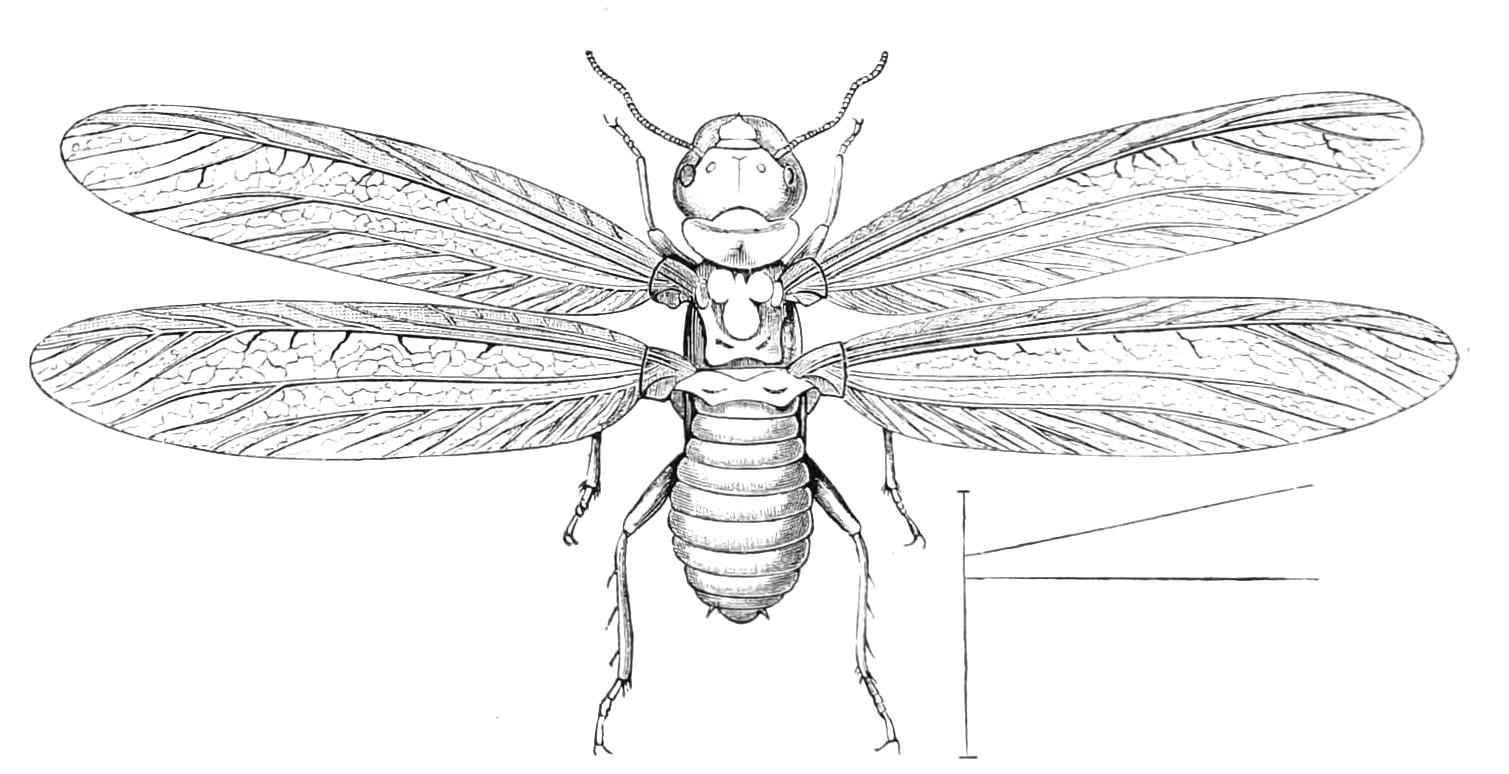
Fig. 225.—Termes (Hodotermes) mossambicus. Winged adult. (After Hagen.)
Each species is social, and consists of winged and wingless individuals. The four wings are, in repose, laid flat on the back, so that the upper one only is seen except just at the bases; they are membranous and very elongate, so that they extend far beyond the apex of the abdomen; the hind pair is remarkably similar in size, form, and consistence to the front pair: near the base of each wing there is a suture, or line of weakness, along which the wings can be broken off, the stumps in that case remaining as short horny flaps reposing on the back. Ligula channelled but not divided into two parts. The wingless individuals are very numerous, and have the head and thirteen body segments distinct; the body is terminated by a pair of short cerci. The metamorphosis is slight and gradual, and in some individuals is dispensed with.
The term White Ants has been so long in use for the Termitidae that it appears almost hopeless to replace it in popular use by another word. It has, however, always given rise to a great deal of confusion by leading people to suppose that white ants differ chiefly from ordinary ants by their colour. This is a most erroneous idea. There are scarcely any two divisions of Insects more different than the white ants and the ordinary ants. The two groups have little in common except that both have a social life, and that a very interesting analogy exists between the forms of the workers and soldiers of these two dissimilar Orders of Insects, giving rise to numerous analogies of habits. The word Termites—pronounced as two syllables—is a less objectionable name for these Insects than white ants.
The integument in Termites is delicate, and the chitinous plates are never very hard; frequently they are so slightly developed that the creature appears to consist of a single membranous sac with creases in it, the head alone being very distinct. The head is exserted, frequently of large size, sometimes as large as all the rest of the body together. Termites may be quite blind, or possess facetted and simple eyes, the latter when present being two in number and always accompanied by facetted eyes. The antennae are simple, consisting of from nine to thirty-one joints, which differ but little from one another; the number in each individual increases as the development progresses. The parts of the mouth are large, the ligula consists of one piece (Fig. 226, A), but often has the appearance of being formed by two united pieces; on its extremity are seated two pairs of lobes.
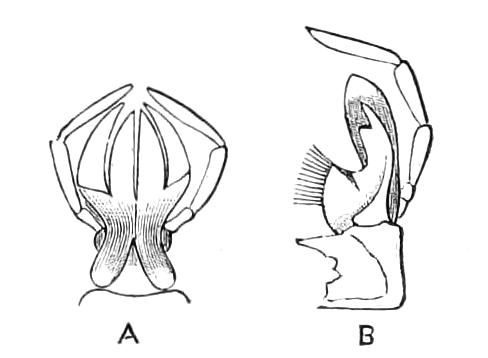
Fig. 226.—Termes bellicosus. Labium, A, maxilla, B, of winged adult; lower face of each. (After Hagen.)
The head is articulated to the thorax by means of two very large cervical sclerites on each side, placed at right angles to one another, and visible on the under-surface. The prothorax is well developed and distinct from the parts behind it. The pronotum, of variable form and size, is very distinct in the perfect Insects; with it are connected the largely developed pleura. The episternum is very peculiar, consisting of an elongate chitinous slip on each side hanging downwards, the two not quite meeting in the middle; they thus form the margin of the very large anterior orifice, and are in contiguity with the cervical sclerites; behind them are the very large epimera. The prosternum appears to be usually entirely membranous; in some cases the sclerite in it is small and delicate, and apparently differs according to the species. The meso- and meta-thorax are sub-equal in size; the mesosternum forms a peculiar, large, adpressed fold. The metasternum is membranous, but is terminated behind by a sclerite apparently of variable form. The hind body is voluminous, simple in form, consisting of ten segments and bearing at the extremity two short distant cerci of a variable number of joints. The terminal ventral sclerites differ greatly in form according to the species and sometimes according to the sex; there are sometimes, if not always, present near the extremity two peculiar minute biarticulate styles, called appendices anales. The coxae are all large, free, and exserted; at the base of each is a transverse trochantin. The femora are articulated with the trochanters, not with the coxae; both femora and tibiae are slender, the tarsi small, four-jointed; the terminal joint elongate.
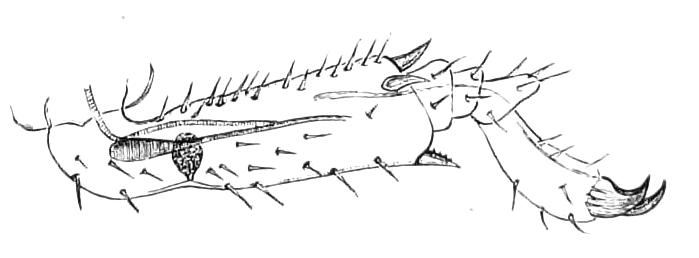
Fig. 227.—Front tibia and tarsus of Calotermes rugosus larva, showing auditory organ. × 90. (After F. Müller.)
It is now well established that Termites have a means of communication by sounds. The individuals have a peculiar way of jerking themselves, as has been frequently noticed by observers of the Insects; these convulsive movements may possibly be connected with the production of sound, which may perhaps be evoked by contact between the back of the head and the pronotum; the exact mode by which the sounds are produced is not, however, known. The existence of an auditory organ in the front tibia has been demonstrated by Fritz Müller,[283] and we reproduce (Fig. 227) one of his figures. The structure seems to be in plan and position similar to the ear of Locustidae, though much less perfect.
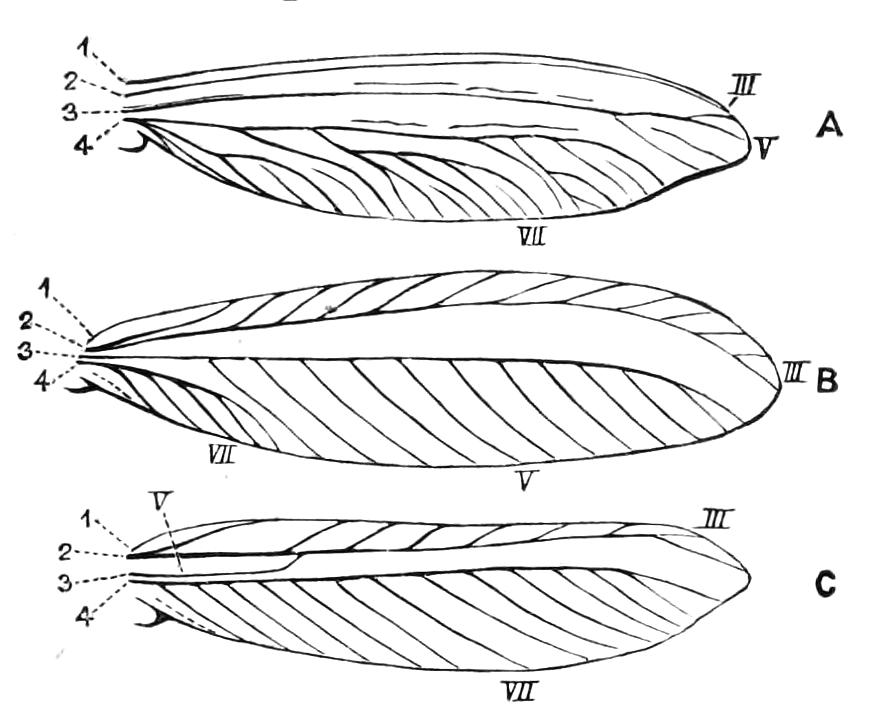
Fig. 228.—Wings of Termites: A, Termes lucifugus; B, Hodotermes brunneicornis; C, Culotermes nodulosus. (After Redtenbacher: B and C diagrammatic.) III, V, VII, homologous areas and nervures according to Redtenbacher. 1, Costal; 2, subcostal; 3, median; 4, submedian nervures according to Hagen.
The wings of Termitidae are not like those of any other Insects; their neuration is very simple, but nevertheless the wings of the different forms exhibit great differences in the extent to which they are made up of the various fields. This is shown in Fig. 228, where the homologous nervures are numbered according to the systems of both Hagen and Redtenbacher. The area, VII, that forms the larger part of the wing in C, corresponds to the small portion at the base of the wing in B. The most remarkable feature of the wing is, however, its division into two parts by a suture or line of weakness near the base, as shown in Fig. 225. The wings are used only for a single flight, and are then shed by detachment at this suture; the small basal portion of each of the four wings is horny and remains attached to the Insect, serving as a protection to the dorsal surface of the thorax.
The nature of the suture that enables the Termites to cast their wings with such ease after swarming is not yet understood. There are no true transverse veinlets or nervules in Termites. Redtenbacher suggests[284] that the transverse division of the wing at its base, as shown in Fig. 225, along which the separation of the wing occurs at its falling off, may have arisen from a coalescence of the subcostal vein with the eighth concave vein of such a wing as that of Blattidae. The same authority also informs us that the only point of resemblance between the wings of Termitidae and those of Psocidae is that both have an unusually small number of concave veins.
The information that exists as to the internal anatomy of Termites is imperfect, and refers, moreover, to different species; it would appear that considerable diversity exists in many respects, but on this point it would be premature to generalise. What we know as to the respiratory system is chiefly due to F. Müller.[285] The number of spiracles is ten; Hagen says three thoracic and seven abdominal, Müller two thoracic and eight abdominal. In fertile queens there usually exist only six abdominal stigmata. There is good reason for supposing that the respiratory system undergoes much change correlative with the development of the individual; it has been suggested that the supply of tracheae to the sexual organs is deficient where there is arrest of development of the latter.
The alimentary canal is only of moderate length. Salivary glands exist, as also do salivary reservoirs; these latter are large, in some species remarkably so. The oesophagus is slender, but abruptly enlarged behind to form a large crop; a proventriculus is apparently either present or absent; the chylific ventricle, or stomach, is slender and simple. The Malpighian tubules are very long; their number is probably from four to eight in the adult, and in the earlier stages less. Behind the tubes the alimentary canal forms a large paunch, and after this there is a small intestine and rectum. The paunch is a peculiar structure, and probably of great importance in the economy of Termites.
These creatures emit minute quantities of a secretion that is corrosive, and can act on metal and even glass;[286] its nature and source are not understood. Hagen describes peculiar structures in the rectum to which he is inclined[287] to ascribe the origin of this substance, but this is very uncertain.
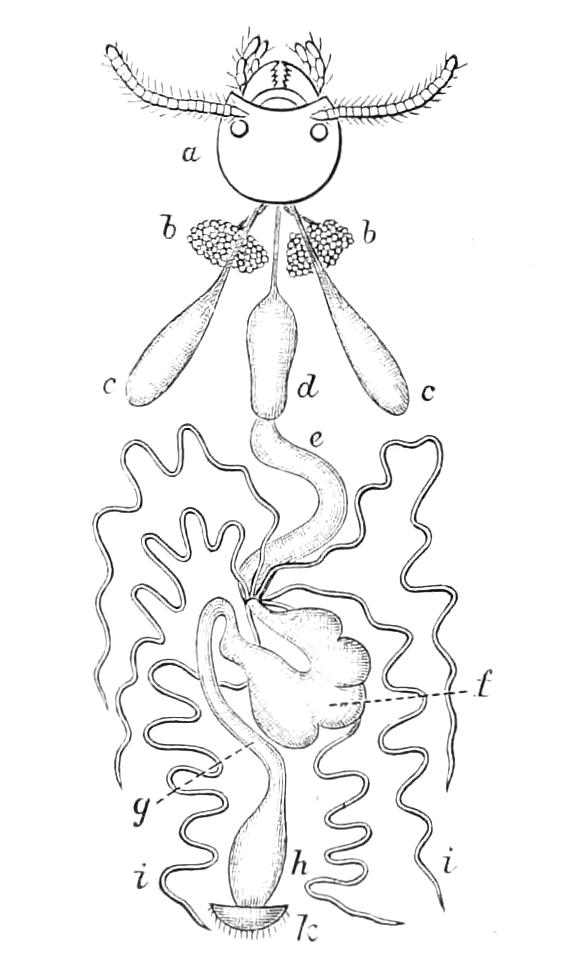
Fig. 229.—Head and alimentary canal of Termes lucifugus (nymph). a, head; b, salivary glands; c, salivary receptacles; d, crop; e, stomach; f, intestinal paunch; g, small, h, large intestine; i, Malpighian tubes; k, extremity of body. (After Dufour.)
The brain is small; the infra-oesophageal ganglion is placed immediately under the supra-oesophageal; there are three thoracic and six abdominal ganglia. The nervous system apparently differs but little in the various forms, or in the different stages of life, except that in the fertile females the abdominal ganglia become so much enlarged that they even exceed the brain in size.
The testes are unusually simple; each consists of eight capsules opening into the vas deferens; the two vasa converge and are continued as a short ejaculatory duct; at the point of convergence there is a pair of curled vesiculae seminales.
The ovarian system is also simple; there is a variable number of elongate egg-tubes, each of which opens separately into the oviduct; the two ducts unite to form a short uterus, on which there is placed first a spermatheca, and near the extremity a convolute tubular sebific gland. The number of egg-tubes is subject to extraordinary variation, according to the species, and according to the age of the fertilised individual.
Social Life.—Termites live in communities that consist sometimes of enormous numbers of individuals. The adult forms found in a community are (1) workers; (2) soldiers; (3) winged males and females; (4) some of these winged forms that have lost their wings. Some species have no worker caste. The individuals of the third category are only present for a few days and then leave the nest in swarms. In addition to the adult individuals there are also present various forms of young. The individuals that have lost their wings are usually limited to a single pair, king and queen; there may be more than one king and queen, but this is not usual. The king and queen may be recognised by the stumps of their cast wings, which exist in the form of small triangular pieces folded on the back of the thorax (Fig. 235). The continuance of the community is effected entirely by the royal pair; they are the centres of activity of the community, which is thrown into disorder when anything happens to them. Usually the pair are physically incapable of leaving the nest, especially the queen, and frequently they are enclosed in a cell which they cannot leave. In consequence of the disorganisation that arises in the community in the absence of a royal pair, Termites keep certain individuals in such a state of advancement that they can rapidly be developed into royalties should occasion require it. These reserve individuals are called complementary by Grassi; when they become royalties they are usually immature as regards the condition of the anterior parts of the body, and are then called by Grassi and others neoteinic, as is more fully explained on p. 380.
Swarms.—As a result of the Termite economy large numbers of superfluous individuals are frequently produced; these, in the winged state, leave the community, forming swarms which are sometimes of enormous extent, and are eagerly preyed on by a variety of animals including even man. Hagen has given particulars[288] of a swarm of T. flavipes in Massachusetts, where the Insects formed a dark cloud; they were accompanied by no less than fifteen species of birds, some of which so gorged themselves that they could not close their beaks.
There is but little metamorphosis in Termitidae. Young Termites are very soft; they have a thin skin, a disproportionately large head, and are of a peculiar white colour as if filled with milk. This condition of milkiness they retain, notwithstanding the changes of form that may occur during their growth, until they are adult. The wings first appear in the form of prolongations of the meso- and meta-nota, which increase in size, the increment probably taking place at the moults. The number of joints of the antennae increases during the development; it is effected by growth of the third joint and subsequent division thereof; hence the joints immediately beyond the second are younger than the others, and are usually shorter and altogether more imperfect. The life-histories of Termites have been by no means completely followed; a fact we can well understand when we recollect that these creatures live in communities concealed from observation, and that an isolated individual cannot thrive; besides this the growth is, for Insects, unusually slow.
Natural History.—The progress of knowledge as to Termites has shown that profound differences exist in the economy of different species, so that no fair general idea of their lives can be gathered from one species. We will therefore briefly sketch the economy, so far as it has been ascertained, in three species, viz. Calotermes flavicollis, Termes lucifugus, and T. bellicosus.
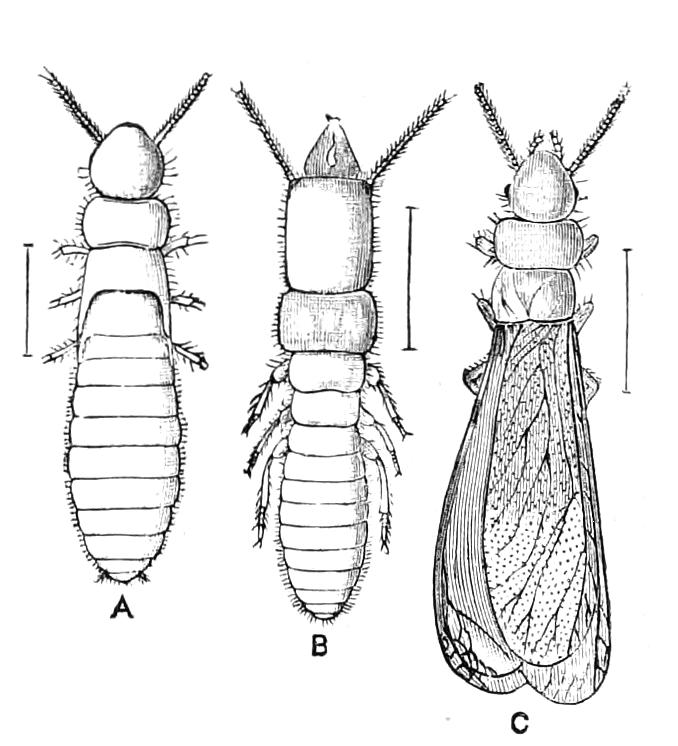
Fig. 230.—Some individuals of Calotermes flavicollis: A, nymph with partially grown wing-pads; B, adult soldier; C, adult winged individual. (After Grassi.)
Calotermes flavicollis inhabits the neighbourhood of the Mediterranean Sea; it is a representative of a large series of species in which the peculiarities of Termite life are exhibited in a comparatively simple manner. There is no special caste of workers, consequently such work as is done is carried on by the other members of the community, viz. soldiers, and the young and adolescent. The habits of this species have recently been studied in detail in Sicily by Grassi and Sandias.[289] The Insects dwell in the branches and stems of decaying or even dead trees, where they nourish themselves on those parts of the wood in which the process of decay is not far advanced; they live in the interior of the stems, so that frequently no sign of them can be seen outside, even though they may be heard at work by applying the ear to a branch. They form no special habitation, the interior of the branch being sufficient protection, but they excavate or increase the natural cavities to suit their purposes. It is said that they line the galleries with proctodaeal cement; this is doubtful, but they form barricades and partitions where necessary, by cementing together the proctodaeal products with matter from the salivary glands or regurgitated from the anterior parts of the alimentary canal. The numbers of a community only increase slowly and remain always small; rarely do they reach 1000, and usually remain very much below this. The king and queen move about, and their family increases but slowly. After fifteen months of their union they may be surrounded by fifteen or twenty young; in another twelve months the number may have increased to fifty, and by the time it has reached some five hundred or upwards the increase ceases. This is due to the fact that the fertility of the queen is at first progressive, but ceases to be so. A queen three or four years old produces at the time of maximum production four to six eggs a day. When the community is small—during its first two years—the winged individuals that depart from it are about eight or ten annually, but the numbers of the swarm augment with the increase of the population. The growth of the individuals is slow; it appears that more than a year elapses between the hatching of the egg and the development of the winged Insect. The soldier may complete its development in less than a year; the duration of its life is not known; that of the kings and queens must be four or five years, probably more. After the winged Insects leave the colony they associate themselves in pairs, each of which should, if all goes well, start a new colony.
The economy of Termes lucifugus, the only European Termite besides Calotermes flavicollis, has been studied by several observers, the most important of whom are Lespès[290] and Grassi and Sandias. This species is much more advanced in social life than Calotermes is, and possesses both workers and soldiers (Fig. 231, 2, 3); the individuals are much smaller than those of Calotermes. Burrows are made in wood of various kinds, furniture being sometimes attacked. Besides making excavations this species builds galleries, so that it can move from one object to another without being exposed; it being a rule—subject to certain exceptions—that Termites will not expose themselves in the outer air. This is probably due not only to the necessity for protection against enemies, but also to the fact that they cannot bear a dry atmosphere; if exposed to a drying air they speedily succumb. Occasionally specimens may be seen at large; Grassi considers these to be merely explorers. Owing to the extent of the colonies it is difficult to estimate with accuracy the number of individuals composing a community, but it is doubtless a great many thousands. Grassi finds the economy of this species in Sicily to be different from anything that has been recorded as occurring in other species; there is never a true royal pair. He says that during a period of six years he has examined thousands of nests without ever finding such a pair. In place thereof there are a considerable number of complementary queens—that is, females that have not gone through the full development to perfect Insects, but have been arrested in various stages of development. In Fig. 231, Nos. 4 and 5 show two of these abnormal royalties; No. 4 is comparatively juvenile in form, while No. 5 is an individual that has been substituted in an orphaned nest, and is nearer to the natural condition of perfect development. We have no information as to whether any development goes on in these individuals after the state of royalty is assumed, or whether the differences between these neoteinic queens are due to the state of development they may happen to be in when adopted as royalties. Kings are not usually present in these Sicilian nests; twice only has Grassi found a king, but he thinks that had he been able to search in the months of August and September he would then have found kings. It would appear therefore that the complementary kings die, or are killed after they have fertilised the females. Parthenogenesis is not thought to occur, as Grassi has found the spermathecae of the complementary queens to contain spermatozoa.
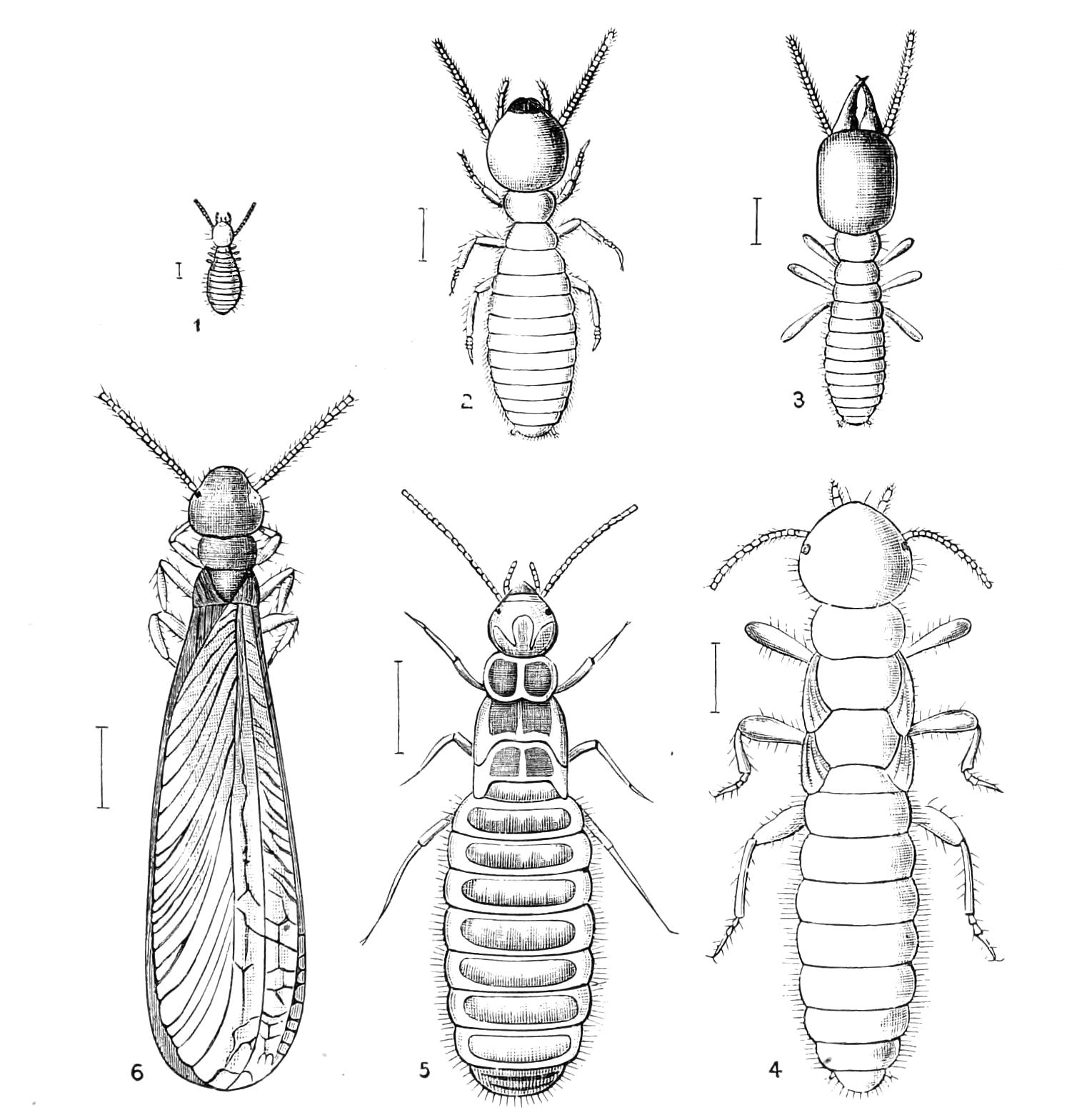
Fig. 231.—Some of the forms of Termes lucifugus. 1, Young larva; 2, adult worker; 3, soldier; 4, young complementary queen; 5, older substitution queen; 6, perfect winged Insect. (After Grassi.)
The period of development apparently occupies from eighteen to twenty-three months. At intervals swarms of a great number of winged individuals leave the nest, and are usually promptly eaten up by various animals. After swarming, the wings are thrown off, and sometimes two specimens or three may be seen running off together; this has been supposed to be preliminary to pairing, but Grassi says this is not the case, but that the object is to obtain their favourite food, as we shall mention subsequently.
Although these are the usual habits of Termes lucifugus at present in Sicily, it must not be concluded that they are invariable; we have in fact evidence to the contrary. Grassi has himself been able to procure in confinement a colony—or rather the commencement of one—accompanied by a true royal pair; while Perris has recorded[291] that in the Landes he frequently found a royal pair of T. lucifugus under chips; they were accompanied in nearly every case by a few eggs. And Professor Perez has recently placed a winged pair of this species in a box with some wood, with the result that after some months a young colony has been founded. It appears probable therefore that this species at times establishes new colonies by means of royal pairs derived from winged individuals, but after their establishment maintains such colonies as long as possible by means of complementary queens. It is far from improbable that distinctions as to the use of true and complementary royalties may be to some extent due to climatic conditions. In some localities T. lucifugus has multiplied to such an extent as to be very injurious, while in others where it is found it has never been known to do so.
The Termitidae of Africa are the most remarkable that have yet been discovered, and it is probably on that continent that the results of the Termitid economy have reached their climax. Our knowledge of the Termites of tropical Africa is chiefly due to Smeathman, who has described the habits of several species, among them T. bellicosus. It is more than a century since Smeathman travelled in Africa and read an account of the Termites to the Royal Society.[292] His information was the first of any importance about Termitidae that was given to the world; it is, as may be well understood, deficient in many details, but is nevertheless of great value. Though his statements have been doubted they are truthful, and have been confirmed by Savage.[293]
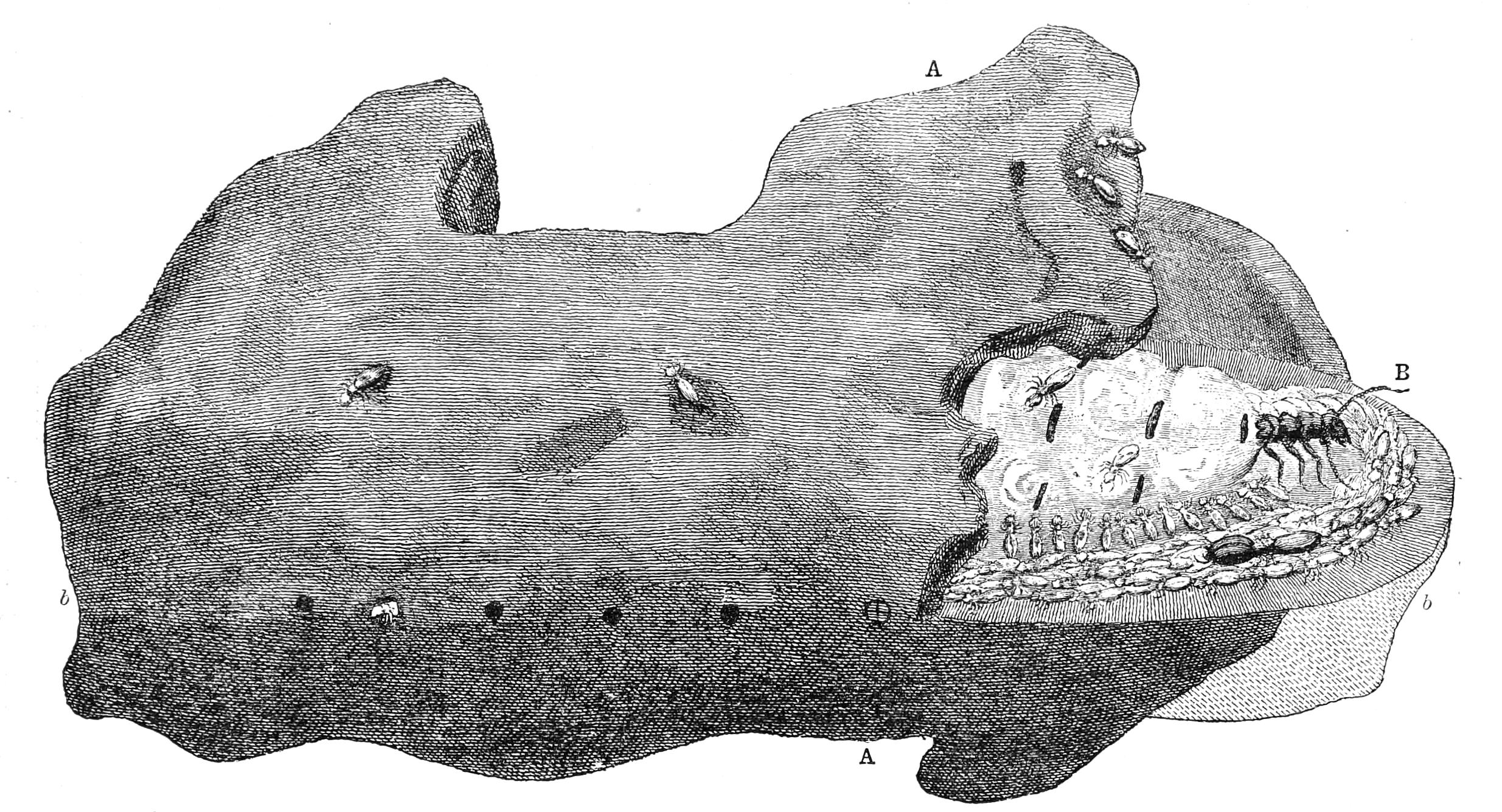
Fig. 232.—Royal cell of Termes bellicosus, partially broken open to show the queen and her attendants. (After Smeathman.) B, Antenna of the queen; b, b, line of entrances to the cell; A, A, an entrance, in this line, closed by the Termites. × ⅞.
T. bellicosus forms buildings comparable to human dwellings; some of them being twenty feet in height and of great solidity. In some parts of West Africa these nests were, in Smeathman's time, so numerous that they had the appearance of villages. Each nest was the centre of a community of countless numbers of individuals; subterranean passages extended from them in various directions. The variety of forms in one of these communities has not been well ascertained, but it would seem that the division of labour is carried to a great extent. The soldiers are fifteen times the size of the workers. The community is dependent on one royal couple. It is the opinion of the natives that if that couple perish so also does the community; and if this be correct we may conclude that this species has not a perfect system of replacing royal couples. The queen attains an almost incredible size and fertility. Smeathman noticed the great and gradual growth of the abdomen, and says it enlarges "to such an enormous size that an old queen will have it increased so as to be fifteen hundred or two thousand times the bulk of the rest of her body, and twenty or thirty thousand times the bulk of a labourer, as I have found by carefully weighing and computing the different states." He also describes the rate at which the eggs are produced, saying that there is a constant peristaltic movement[294] of the abdomen, "so that one part or other alternately is rising and sinking in perpetual succession, and the matrix seems never at rest, but is always protruding eggs to the amount (as I have frequently counted in old queens) of sixty in a minute, or eighty thousand and upward in one day of twenty-four hours."
This observer, after giving an account of the great swarms of perfect winged Insects that are produced by this species, and after describing the avidity with which they are devoured by the Hymenopterous ants and other creatures, adds: "I have discoursed with several gentlemen upon the taste of the white ants; and on comparing notes we have always agreed that they are most delicious and delicate eating. One gentleman compared them to sugared marrow, another to sugared cream and a paste of sweet almonds."
From the preceding brief sketch of some Termitidae we may gather the chief points of importance in which they differ from other Insects, viz. (1) the existence in the community of individuals—workers and soldiers—which do not resemble their parents; (2) the limitation of the reproductive power to a single pair, or to a small number of individuals in each community, and the prolongation of the terminal period of life. There are other social Insects besides Termitidae: indeed, the majority of social Insects—ants, bees, and wasps—belong to the Order Hymenoptera, and it is interesting to note that analogous phenomena occur in them, but nevertheless with such great differences that the social life of Termites must be considered as totally distinct from that of the true ants and other social Hymenoptera.
Development.—Social Insects are very different to others not only in the fact of their living in society, but in respect of peculiarities in the mode of reproduction, and in the variety of habits displayed by members of a community. The greatest confusion has arisen in reference to Termitidae in consequence of the phenomena of their lives having been assumed to be similar to those of Hymenoptera; but the two cases are very different, Hymenoptera passing the early parts of their lives as helpless maggots, and then undergoing a sudden metamorphosis to a totally changed condition of structure, intelligence, and instinct.
The development of what we may look on as the normal form of Termitidae—that is, the winged Insects male and female—is on the whole similar to that we have sketched in Orthoptera; the development in earwigs being perhaps the most similar. The individuals of Termitidae are, however, in the majority of cases if not in all, born without eyes; the wing-rudiments develop from the thoracic terga as shorter or longer lobes according to the degree of maturity; as in the earwigs the number of joints in the antennae increases as development advances. All the young are, when hatched, alike, the differences of caste appearing in the course of the subsequent development; the most important of these differences are those that result in the production of two special classes—only met with in social Insects—viz. worker and soldier. Of these the workers are individuals whose development is arrested, the sexual organs not going on to their full development, while other organs, such as the eyes, also remain undeveloped; the alimentary canal and its adjuncts occupy nearly the whole of the abdominal cavity. The adult worker greatly resembles—except in size—the young. Grassi considers that the worker is not a case of simple arrest of development, but that some deviation accompanies the arrest.
The soldier also suffers an arrest of development in certain respects similar to the worker; but the soldier differs in the important fact that the arrest of the development of certain parts is correlative with an extraordinary development of the head, which ultimately differs greatly from those of either the worker or of the sexual males and females.
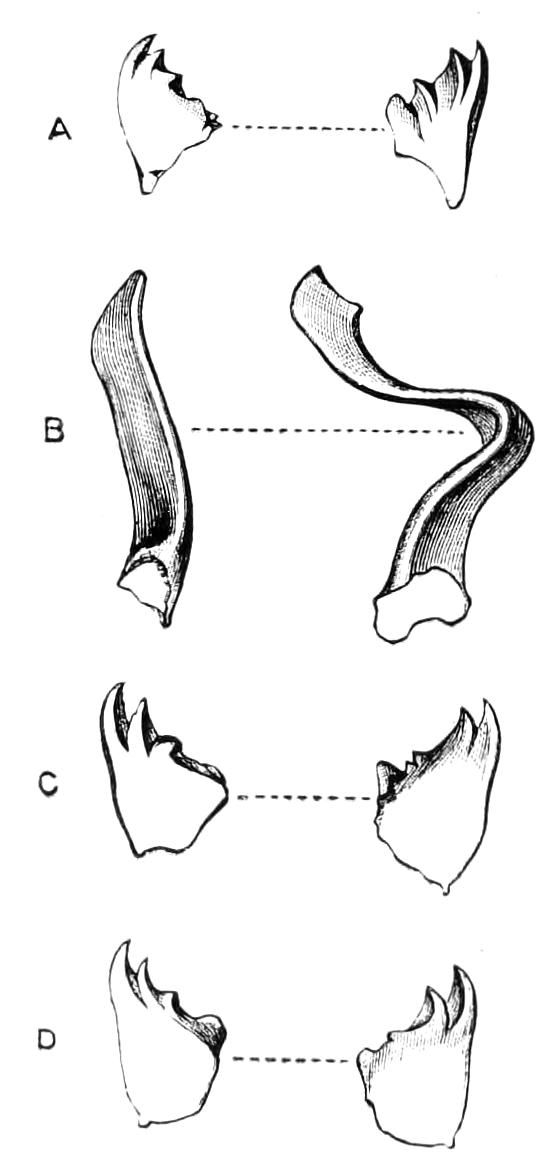
Fig. 233.—The pairs of mandibles of different adult individuals of Termes sp. from Singapore. A, Of worker; B, of soldier; C, of winged male; D, of winged female.
Soldier.—All the parts of the head of the soldier undergo a greater or less change of form; even the pieces at its base, which connect it by means of the cervical sclerites with the prothorax, are altered. The parts that undergo the greatest modification are the mandibles (Fig. 233, B); these become much enlarged in size and so much changed in form that in a great many species no resemblance to the original shape of these organs can be traced. It is a curious fact that the specific characters are better expressed in these superinduced modifications than they are in any other part of the organisation (except, perhaps, the wings). The soldiers are not alike in any two species of Termitidae so far as we know, and it seems impossible to ascribe the differences that exist between the soldiers of different species of Termitidae to special adaption for the work they have to perform. Such a suggestion is justifiable only in the case of the Nasuti (Fig. 234, 1), where the front of the head is prolonged into a point: a duct opens at the extremity of this point, from which is exuded a fluid that serves as a cement for constructing the nest, and is perhaps also used to disable enemies. Hence the prolongation and form of the head of these Nasuti may be fairly described as adaptation to useful ends. As regards the great variety exhibited by other soldiers—and their variety is much greater than it is in the Nasuti—it seems at present impossible to treat it as being cases of special adaptations for useful purposes. On the whole it would be more correct to say that the soldiers are very dissimilar in spite of their having to perform similar work, than to state that they are dissimilar in conformity with the different tasks they carry on.
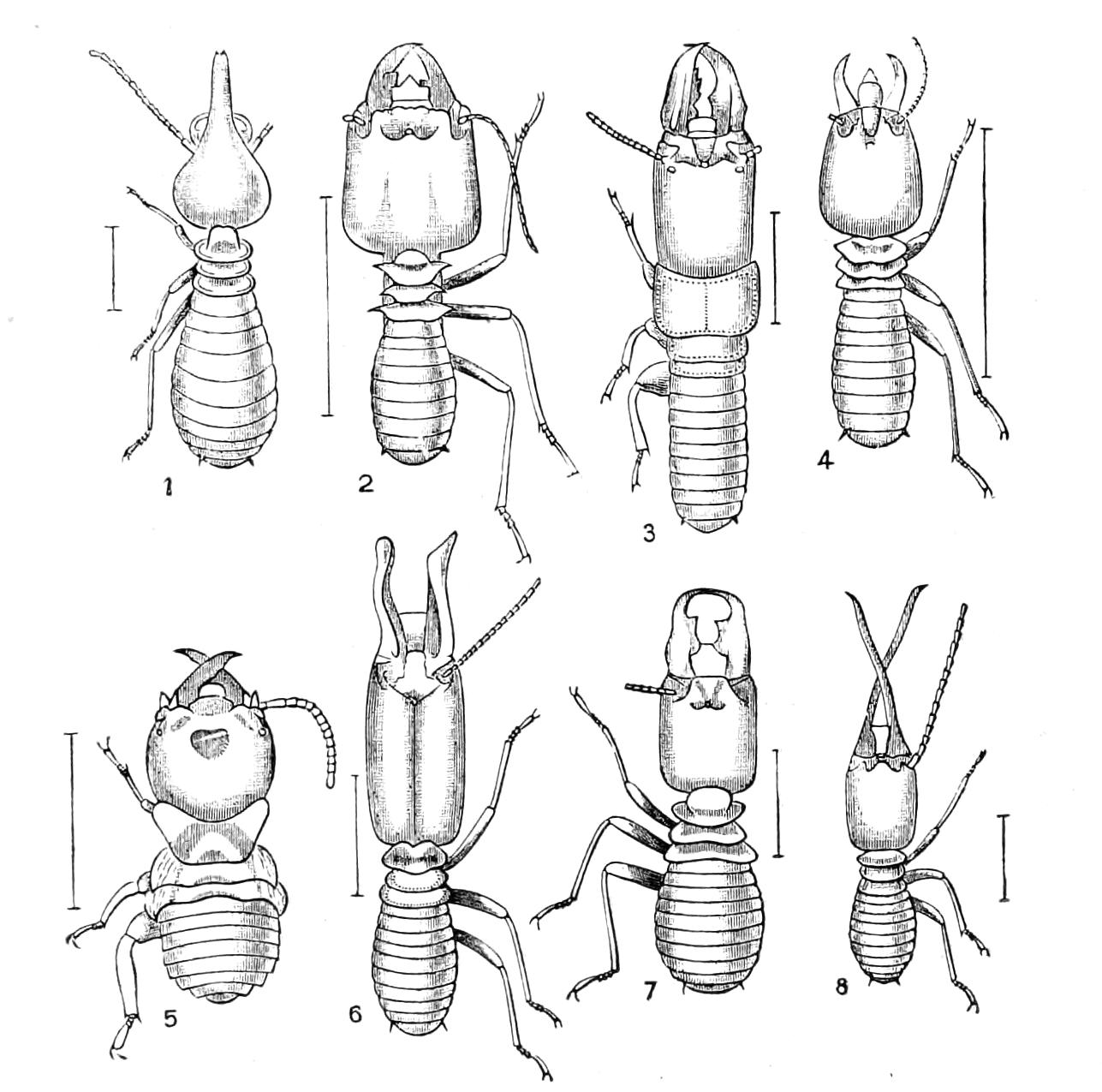
Fig. 234.—Soldiers of different species of Termites. (After Hagen.) 1, Termes armiger; 2, T. dirus; 3, Calotermes flavicollis; 4, T. bellicosus; 5, T. occidentis; 6, T. cingulatus (?); 7, Hodotermes quadricollis (?); 8, T. debilis (?), Brazil.
The Termite soldier is a phenomenon to which it is difficult to find a parallel among Insects. The soldier in the true ants is usually not definitely distinguished from the worker, but it is possible that in the leaf-cutting ants, the so-called soldier may prove to be more similar in its nature to the Termite soldier. The soldiers of any one species of Termite are apparently extremely similar to one another, and there are no intermediates between them and the other forms, except in the stages of differentiation. But we must recollect that but little is yet known of the full history of any Termite community, and it is possible that soldiers which in the stage of differentiation promise to be unsatisfactory may be killed and eaten,—indeed there is some evidence to this effect. There is too in certain cases some difference—larger or smaller size being the most important—between the soldiers of one species, which may possibly be due to the different stage of development at which their differentiation commenced.
It would at present appear that, notwithstanding the remarkable difference in structure of the soldiers and workers of the white ants, there is not a corresponding difference of instinct. It is true that soldiers do more of certain things than workers do, and less of others, but this appears to be due solely to their possession of such very different structures; and we are repeatedly informed by Grassi that all the individuals in a community take part, so far as they are able, in any work that is going on, and we find also in the works of other writers accounts of soldiers performing acts that one would not have expected from them. The soldiers are not such effective combatants as the workers are. Dudley and Beaumont indeed describe the soldiers as merely looking on while the workers fight.[295] So that we are entitled to conclude that the actions of the soldiers, in so far as they differ from those of the rest of the community, do so because of the different organisation and structures of these individuals. We shall, when speaking of food, point out that the condition of the soldier in relation to food and hunger is probably different from that of the other forms.
Various Forms of a Community.—The soldiers and workers are not the only anomalous forms found in Termitid communities; indeed on examining a large nest a variety of forms may be found that is almost bewildering. Tables have been drawn up by Grassi and others showing that as many as fifteen kinds may be found, and most of them may under certain circumstances coexist. Such tables do not represent the results of actual examination in any one case, and they by no means adequately represent the number that, according to the most recent observations of Grassi, may be present; but we give one taken from Grassi, as it conveys some idea of the numerous forms that exist in certain communities. In this table the arrangement, according to A, B, C, D, E, represents successive stages of the development:—
Forms of Termes lucifugus. (After Grassi.) Zool. Anz. xii. 1889, p. 360.
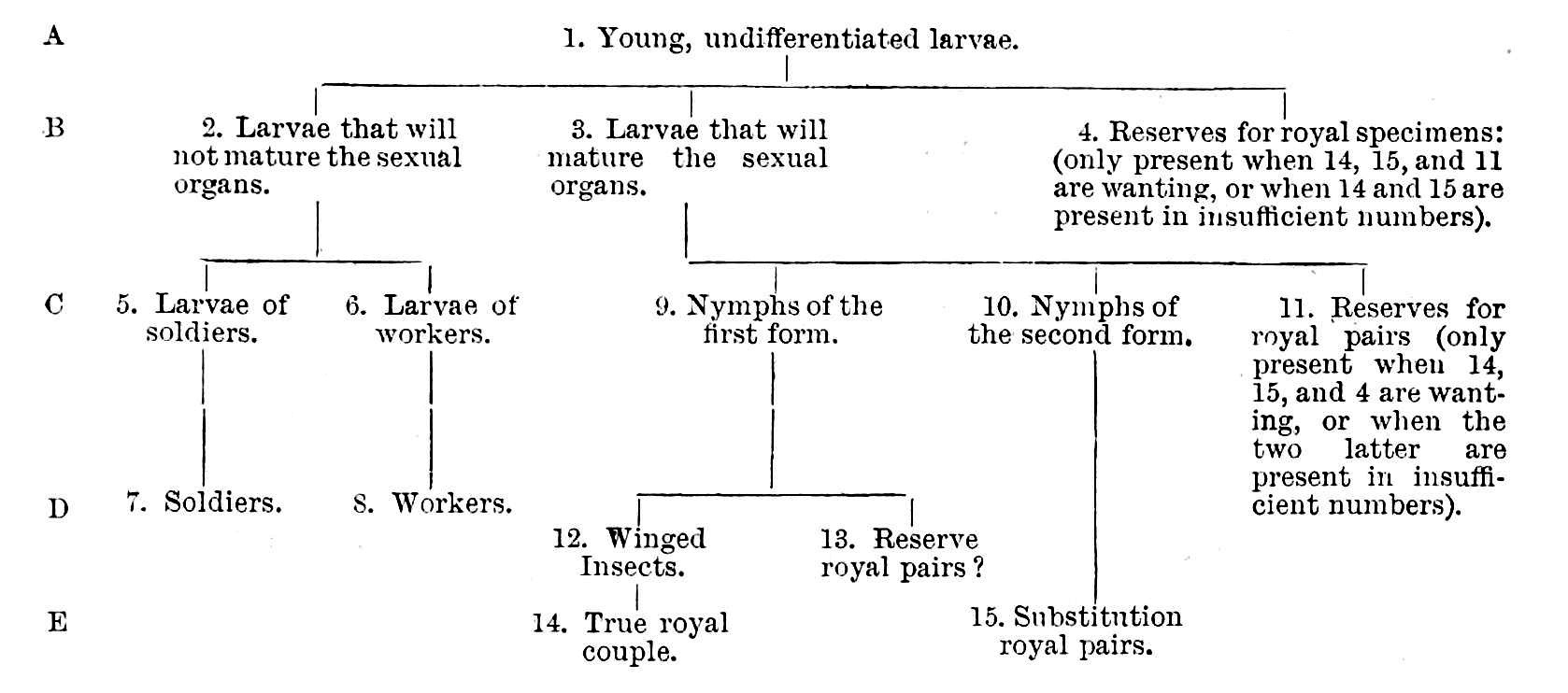
On inspecting this table it will be perceived that the variety of forms is due to three circumstances—(1) the existence of castes that are not present in ordinary Insects; (2) the coexistence of young, of adolescents, and of adults; and (3) the habit the Termites have of tampering with forms in their intermediate stages, the result of which may be the substitution of neoteinic individuals in place of winged forms.
This latter procedure is far from being completely understood, but to it are probably due the various abnormal forms, such as soldiers with rudiments of wings, that have from time to time been discovered in Termite communities, and have given rise to much perplexity.
In connexion with this subject we may call attention to the necessity, when examining Termite nests, of taking cognisance of the fact that more than one species may be present. Bates found different Termites living together in the Amazons Valley, and Mr. Haviland has found as many as five species of Termitidae and three of true ants in a single mound in South Africa. In this latter case observation showed that, though in such close proximity, there was but little further intimacy between the species. There are, however, true inquiline, or guest, Termites, of the genus Eutermes, found in various parts of the world living in the nests of other Termitidae.
Origin of the Forms.—The interest attaching to the various forms that exist in Termites, more particularly to the worker and soldier, is evident when we recollect that these never, so far as we know, produce young. In the social Hymenoptera it has been ascertained that the so-called neuters (which in these Insects are always females) can, and occasionally do, produce young, but in the case of the Termites it has never been suggested that the sexual organs of the workers and soldiers, whether male or female, ever become fruitful; moreover, the phenomena of the production of young by the white ants are of such a nature as to render it in the highest degree improbable that either workers or soldiers ever take any direct part in it. Now the soldier is extremely different from the sexual individuals that produce the young, and seeing that its peculiarities are not, in the ordinary sense of the word, hereditary, it must be of great interest to ascertain how they arise.
Before stating the little information we possess on this subject, it is necessary to reiterate what we have already said to the effect that the soldiers and workers are not special to either sex, and that all the young are born alike. It would be very natural to interpret the phenomena by supposing the workers to be females arrested in their development—as is the case in social Hymenoptera—and by supposing the soldiers to be males with arrested and diverted development.
The observations already made show that this is not the case. It has been thoroughly well ascertained by Lespès and Fritz Müller that in various species of Calotermes the soldiers are both males and females. Lespès and Grassi have shown that the workers of Termes lucifugus are of male and female sex, and that this is also true of the soldiers. Although the view of the duality of the sexes of these forms was received at first with incredulity, it appears to be beyond doubt correct. Grassi adds that in all the individuals of the workers and soldiers of Termes lucifugus the sexual organs, either male or female, are present, and that they are in the same stage of development whatever the age of the individual. This statement of Grassi's is of importance because it seems to render improbable the view that the difference of form of the soldier and worker arises from the arrest of the development of their sexual organs at different periods. The fact that sex has nothing whatever to do with the determination of the form of workers and soldiers may be considered to be well established.
The statement that the young are all born alike is much more difficult to substantiate. Bates said that the various forms could be detected in the new-born. His statement was made, however, merely from inspection of the nests of species about which nothing was previously known, and as it is then very difficult to decide that a specimen is newly hatched, it is probable that all he meant was that the distinction of workers, soldiers, and sexual forms existed in very small individuals—a statement that is no doubt correct. Other observers agree that the young are in appearance all alike when hatched, and Grassi reiterates his statement to this effect. Hence it would appear that the difference of form we are discussing arises from some treatment subsequent to hatching. It may be suggested, notwithstanding the fact that the young are apparently alike when hatched, that they are not really so, but that there are recondite differences which are in the course of development rendered conspicuous. This conclusion cannot at present be said with certainty to be out of the question, but it is rendered highly improbable by the fact ascertained by Grassi that a specimen that is already far advanced on the road to being an ordinary winged individual can be diverted from its evident destination and made into a soldier, the wings that were partially developed in such a case being afterwards more or less completely absorbed. This, as well as other facts observed by Grassi, render it probable that the young are truly, as well as apparently, born in a state undifferentiated except as regards sex. Fig. 230 (p. 363) is designed to illustrate Grassi's view as to this modification; the individual A is already far advanced in the direction of the winged form C, but can nevertheless be diverted by the Termites to form the adult soldier B.
According to the facts we have stated, neither heredity nor sex nor arrest of development are the causes of the distinctions between worker and soldier, though some arrest of development is common to both; we are therefore obliged to attribute the distinction between them to other influences. Grassi has no hesitation in attributing the anatomical distinctions that arise between the soldiers, workers, and winged forms to alimentation. Food, or the mode of feeding, or both combined, are, according to the Italian naturalist, the source of all the distinctions, except those of sex, that we see in the forms of any one species of Termite.
Feeding.—Such knowledge as we possess of the food-habits of Termitidae is chiefly due to Grassi; it is of the very greatest importance, as giving a clue to much that was previously obscure in the Natural History of these extraordinary creatures.
In the abodes of the Termites, notwithstanding the enormous numbers of individuals, cleanliness prevails; the mode by which it is attained appears to be that of eating all refuse matter. Hence the alimentary canal in Termitidae contains material of various conditions of nutritiveness. These Insects eat their cast skins and the dead bodies of individuals of the community; even the material that has passed through the alimentary canal is eaten again, until, as we may presume, it has no further nutritive power. The matter is then used for the construction of their habitations or galleries, or is carried to some unfrequented part of the nest, or is voided by the workers outside of the nests; the pellets of frass, i.e. alimentary rejectamenta, formed by the workers frequently betraying their presence in buildings when none of the Insects themselves are to be seen. The aliments of Calotermes flavicollis are stated by Grassi and Sandias to be as follows: (1) wood; (2) material passed from the posterior part of the alimentary canal or regurgitated from the anterior part; (3) the matter shed during the moults; (4) the bodies of other individuals; (5) the secretion of their own salivary glands or that of their fellows; (6) water. Of these the favourite food is the matter passed from the posterior part of the alimentary canal. We will speak of this as proctodaeal food. When a Calotermes wishes food it strokes the posterior part of another individual with the antennae and palpi, and the creature thus solicited yields, if it can, some proctodaeal food, which is then devoured. Yielding the proctodaeal food is apparently a reflex action, as it can be induced by friction and slight pressure of the abdomen with a small brush. The material yielded by the anterior part of the alimentary canal may be called stomodaeal product. It makes its appearance in the mouth in the form of a microscopic globule that goes on increasing in size till about one millimetre in diameter, when it is either used for building or as food for another individual. The mode of eating the ecdysial products has also been described by Grassi and Sandias. When an individual is sick or disabled it is frequently eaten alive. It would appear that the soldiers are great agents in this latter event, and it should be noticed that owing to their great heads and mandibles they can obtain food by other means only with difficulty. Since they are scarcely able to gnaw wood, or to obtain the proctodaeal and stomodaeal foods, their condition may be considered to be that of permanent hunger, only to be allayed by carnivorous proceedings. When thrown into a condition of excitement the soldiers sometimes exhibit a sort of Calotermiticidal mania, destroying with a few strokes five or six of their fellows. It is, however, only proper to say that these strokes are made at random, the creature having no eyes. The carnivorous propensities of Calotermes are apparently limited to cannibalism, as they slaughter other white ants (Termes lucifugus) but never eat them.
The salivary food is white and of alkaline nature; when excreted it makes its appearance on the upper lip. It is used either by other individuals or by the specimen that produced it; in the latter case it is transferred to the lower lip and swallowed by several visible efforts of deglutition. The aliments we have mentioned are made use of to a greater or less extent by all the individuals except the very young; these are nourished only by saliva: they commence taking proctodaeal and stomodaeal food before they can eat triturated wood.
Royal Pairs.—The restriction of the reproductive powers of a community to a single pair (or to a very restricted number of individuals) occurs in all the forms of social Insects, and in all of them it is concomitant with a prolongation of the reproductive period far exceeding what is natural in Insects. We are not in a position at present to say to what extent the lives of the fertile females of Termitidae are prolonged, there being great difficulties in the way of observing these Insects for long periods owing to their mode of life; living, as they do, concealed from view, light and disturbance appear to be prejudicial to them. We have every reason to believe, however, that the prolongation extends as a rule over several years, and that it is much greater than that of the other individuals of the community, although the lives of even these latter are longer than is usual in Insects; but this point is not yet satisfactorily ascertained. As regards the males there is reason to think that considerable variety as to longevity prevails. But the belief is that the royal males of Termitidae also form an exception to other Insects in the prolongation of the terminal periods of their lives. In Hymenoptera, male individuals are profusely produced, but their lives are short, and their sole duty is the continuation of the species by a single act. We have seen that Grassi is of opinion that a similar condition of affairs exists at present with Termes lucifugus in Sicily, but with this exception it has always been considered that the life of the king Termite is, roughly speaking, contemporaneous with that of the queen; it is said that in certain species the king increases in bulk, though not to an extent that can be at all compared with the queen.
It must be admitted that the duration of life of the king has not been sufficiently established, for the coexistence of a king with a queen in the royal cell is not inconsistent with the life of the king being short, and with his replacement by another. Much that is imaginary exists in the literature respecting Termites, and it is possible that the life of the king may prove to be not so prolonged as has been assumed.
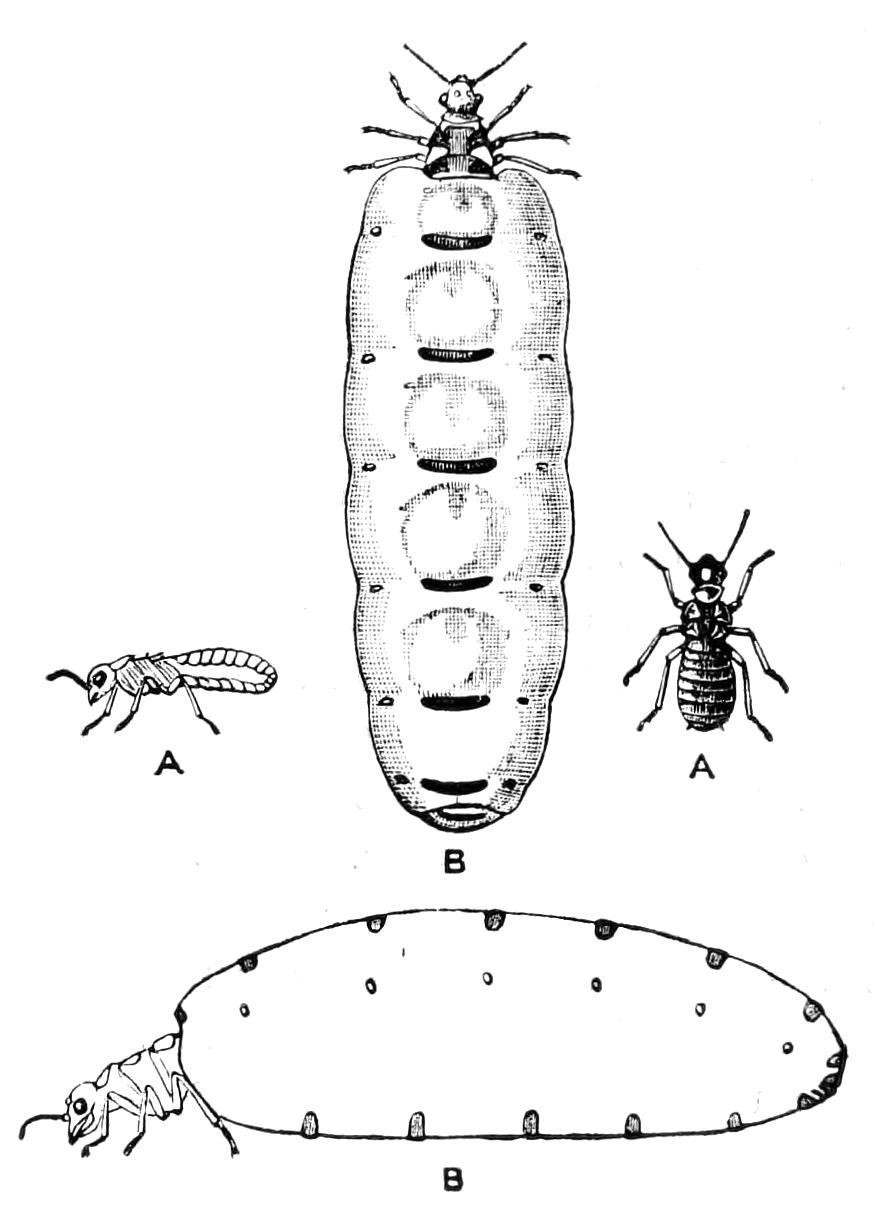
Fig. 235.—Royal pair of Termes sp. from Singapore, taken out of royal cell. A, A, King, lateral and dorsal views; B, B, queen, dorsal and lateral views. Natural sizes.
Returning to the subject of the limitation of the reproduction of the community to a single pair, we may remark that a priori one would suppose such a limitation to be excessively unfavourable to the continuation of the species; and as it nevertheless is the fact that this feature is almost, if not quite, without exception in Insect societies, we may conclude that it is for some reason absolutely essential to Insect social life. It is true that there are in Termitidae certain partial exceptions, and these are so interesting that we may briefly note them. When a royal cell is opened it usually contains but a single female and male, and when a community in which royal cells are not used is inspected it is usually found that here also there are present only a single fertile female and a single king. Occasionally, however, it happens that numerous females are present, and it has been noticed that in such cases they are not fully matured females, but are imperfect, the condition of the wings and the form of the anterior parts of the body being that of adolescent, not adult Insects. It will be recollected that the activity of a community of Termites centres round the great fertility of the female; without her the whole community is, as Grassi graphically puts it, orphaned; and the observations of the Italian naturalist make it clear that these imperfect royalties are substitution queens, derived from specimens that have not undergone the natural development, but have been brought into use to meet the calamity of orphanage of the community. The Termites apparently have the power of either checking or stimulating the reproductive organs apart from other organs of the body, and they appear to keep a certain number of individuals in such a condition that in case of anything going wrong with the queen, the reserves may be brought as soon as possible into a state of reproductive activity. The individuals that are in such a condition that they can become pseudo-royalties are called complementary or reserve royalties, and when actually brought into use they become substitution royalties. It is not at present quite clear why the substitution royalties should be in such excess of numbers as we have stated they were in the case we have figured (Fig. 236), but it may be due to the fact that when the power of the community is at a certain capacity for supporting young a single substitution royalty would not supply the requisite producing power, and consequently the community adopts a greater number of the substitution forms. Termites are utterly regardless of the individual lives of the members of the community, and when the reproductive powers of the company of substitution royalties become too great, then their number is reduced by the effective method of killing and eating them.
According to Grassi's observations, the communities of Termes lucifugus are now kept up in Sicily almost entirely by substitution royalties; the inference being that the age of each community has gone beyond the capacity for life of any single royal queen.
The substitution royalties are, as we have said, called neoteinic (νεος, youthful, τείνω, to belong to), because, though they carry on the functions of adult Insects, they retain the juvenile condition in certain respects, and ultimately die without having completed the normal development. The phenomenon is not quite peculiar to Insects, but occurs in some other animals having a well-marked metamorphosis, notably in the Mexican Axolotl.[296]
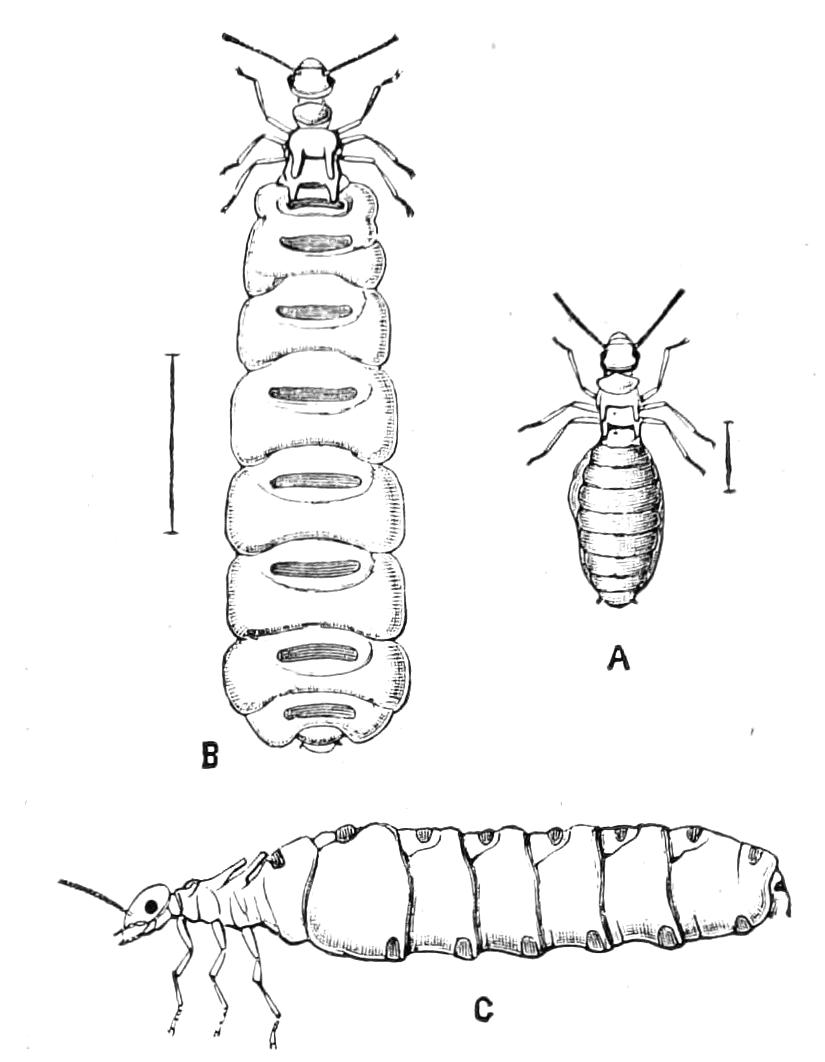
Fig. 236.—Pair of neoteinic royalties, taken from the royal chamber of Termes sp. at Singapore by Mr. G. D. Haviland. The queen was one of thirteen, all in a nearly similar state. A, king; B, C, queen.
A point of great importance in connexion with the neoteinic royalties is that they are not obtained from the instar immediately preceding the adult state, but are made from Insects in an earlier stage of development. The condition immediately preceding the adult state is that of a nymph with long wing-pads; such specimens are not made into neoteinic royalties, but nymphs of an earlier stage, or even larvae, are preferred. It is apparently by an interference with one of these earlier stages of development that the "nymphs of the second form," which have for long been an enigma to zoologists, are produced.
Post-metamorphic Growth.—The increase of the fertility of the royal female is accompanied by remarkable phenomena of growth. Post-metamorphic growth is a phenomenon almost unknown in Insect life, except in these Termitidae; distension not infrequently occurs to a certain extent in other Insects, and is usually due to the growth of eggs inside the body, or to the repletion of other parts. But in Termitidae there exists post-metamorphic growth of an extensive and complex nature; this growth does not affect the sclerites (i.e. the hard chitinous parts of the exo-skeleton), which remain of the size they were when the post-metamorphic growth commenced, and are consequently mere islands in the distended abdomen (Fig. 236, B, C). The growth is chiefly due to a great increase in number and size of the egg-tubes, but there is believed to be a correlative increase of various other parts of the abdominal as distinguished from the anterior regions of the body. A sketch of the distinctions existing between a female of a species at the time of completion of the metamorphosis and at the period of maximum fertility does not appear to have been yet made.
New Communities.—The progress of knowledge in respect of Termitidae is bringing to light a quite unexpected diversity of habits and constitution. Hence it is premature to generalise on important matters, but we may refer to certain points that have been ascertained in connexion with the formation of new communities. The duration of particular communities and the modes in which new ones are founded are still very obscure. It was formerly considered that swarming took place in order to increase the number of communities, and likewise for promoting crossing between the individuals of different communities. Grassi, however, finds as the result of his prolonged observations on Termes lucifugus that the swarms have no further result than that the individuals composing them are eaten up. And Fritz Müller states[297] that in the case of the great majority of forms known to him the founding of a colony by means of a pair from a swarm would be just about as practicable as to establish a new colony of human beings by placing a couple of newly-born babes on an uninhabited island. It was also thought that pairs, after swarming, re-entered the nests and became royal couples. It does not, however, appear that any one is able to produce evidence of such an occurrence. The account given by Smeathman of the election of a royal couple of Termes bellicosus is imperfect, as, indeed, has already been pointed out by Hagen. It suggests, however, that a winged pair after leaving the nest do again enter it to become king and queen. The huge edifices of this species described by Smeathman are clearly the result of many years of labour, and at present substitution royalties are not known to occur in them, so that it is not improbable Smeathman may prove to be correct even on this point, and that in the case of some species mature individuals may re-enter the nest after swarming and may become royal couples. On the whole, however, it appears probable that communities of long standing are kept up by the substitution royalty system, and that new communities when established are usually founded by a pair from a swarm, which at first are not in that completely helpless condition to which they come when they afterwards reach the state of so-called royalty. Grassi's observations as to the sources of food remove in fact one of the difficulties that existed previously in regard to the founding of new colonies, for we now know that a couple may possibly bear with them a sufficient supply of proctodaeal and stomodaeal aliment to last them till workers are hatched to feed them, and till soldiers are developed and the community gradually assumes a complex condition. Professor Perez has recently obtained[298] the early stages of a community from a winged pair after they had been placed in captivity, unattended by workers. Müller's observation, previously quoted, is no doubt correct in relation to the complete helplessness of royal pairs after they have been such for some time; but that helplessness is itself only gradually acquired by the royal pair, who at first are able to shift for themselves, and produce a few workers without any assistance.
Anomalous Forms.—Müller has described a Calotermes under the name of C. rugosus, which is interesting on account of the peculiar form of the young larva, and of the changes by which it subsequently becomes similar in form to other species of the genus. We represent the development of this larva in Fig. 237. We may call attention to the fact that this figure illustrates the large size of the paunch, which is so extraordinary in some of the states of the Termitidae.
It will be recollected that the genus Calotermes is destitute of workers. There is another genus, Anoplotermes, in which the reverse condition prevails, and the soldier is absent; this is the only case yet known in which such a state of affairs exists. The species is called A. pacificus by Fritz Müller; it differs from other Termitidae in possessing a proventriculus destitute of triturating ridges. The nests of this species are utilised by a little Eutermes (E. inquilinus Müller) for its own advantage; whether by first destroying the Anoplotermes or whether by merely taking possession of the nests abandoned by their owners is not known. It is a most remarkable fact that the Eutermes resembles the Anoplotermes so extremely that the two can scarcely be distinguished, though anatomically they are quite different. The resemblance is indeed so great that it deceived Von Jhering into supposing that the two genera were alternate generations of a single species, one generation possessing soldiers, the other being without them. Subsequently, by anatomical investigation, he recognised[299] the error into which he had fallen—an error that, under such peculiar circumstances, was quite pardonable.
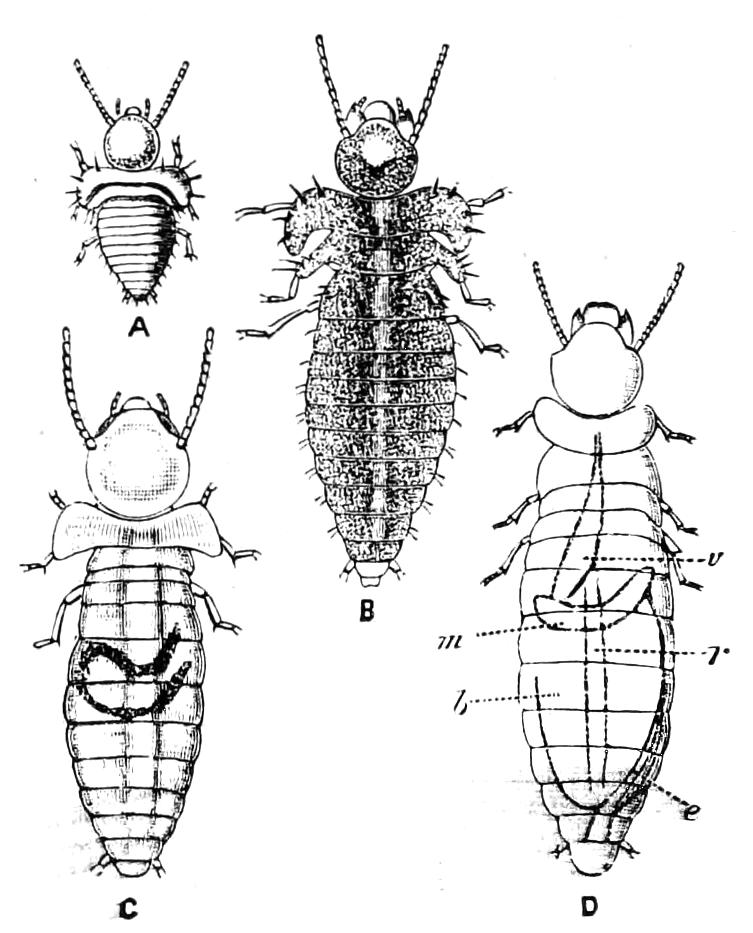
Fig. 237.—Changes in external form of the young larva of Calotermes rugosus. A, Newly hatched with nine joints in antennae, × 8; B, older larva with ten joints, × 8; C, next stage with eleven joints, × 8; D, larva with twelve joints; the position of the parts of the alimentary canal are shown—v, crop; m, stomach; b, paunch; e, intestine; r, dorsal vessel, × 16⁄3 (After Fritz Müller.)
Hagen has suggested[300] that Hodotermes japonicus never produces winged forms. Very little, however, is actually known as to this species.
Marching and Harvesting Termites.—Smeathman alluded to a remarkable Termes seen by him in Africa, giving it the name of T. viarum. Nothing further is known of this Insect, which, according to Smeathman's account, may possibly be the most remarkable of the family. T. viarum is said to be larger than T. bellicosus, and was discovered issuing in large numbers from a hole in the ground and marching in columns consisting of workers directed by soldiers of enormous size, some of whom climbed up plants and gave audible signals to the army, which immediately responded with a hissing noise and by increasing their pace with the utmost hurry; they continued marching by the spot where Smeathman observed them for upwards of an hour. He was not able to find their nests, and no specimens have been preserved; both soldiers and workers possessed eyes. Marching in this way by daylight is contrary to the nature of ordinary Termites, and some doubt has existed as to the correctness of Smeathman's observation, which has in fact remained for upwards of a century without confirmation.
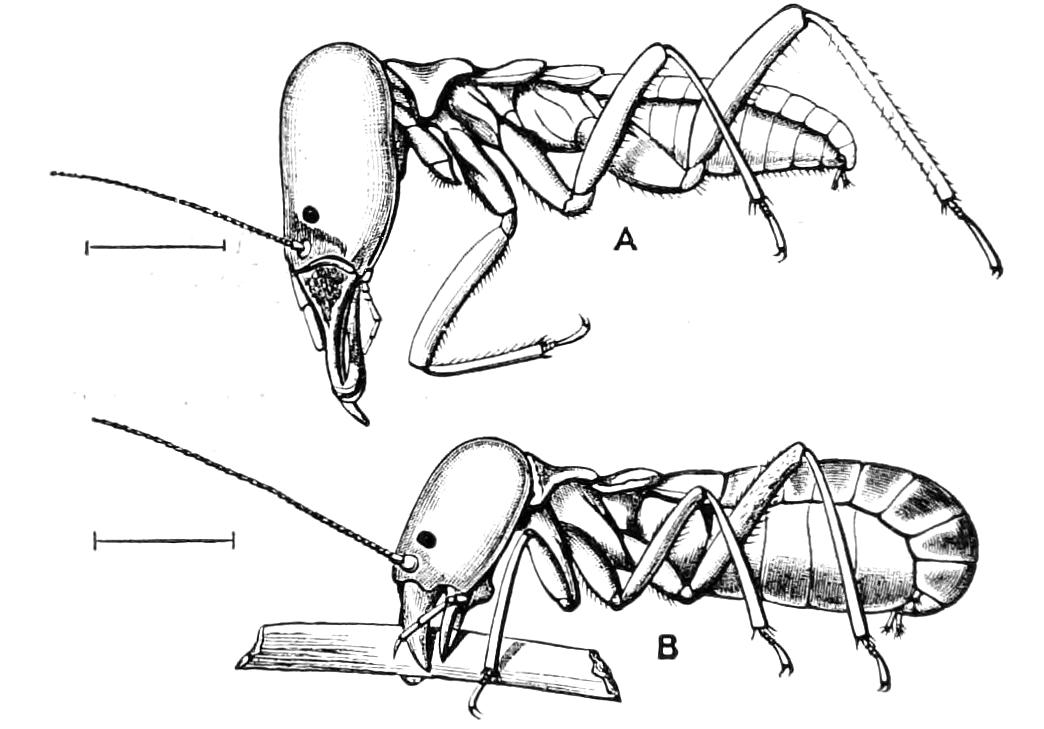
Fig. 238.—Eyed, grass-cutting Termite, Hodotermes havilandi, A, soldier; B, worker. South Africa. In life the head is carried horizontally, so the piece of grass sticks up like a flag-pole.
Mr. G. D. Haviland has, however, this year discovered in Natal a Termite which shows that there are species in Africa of the kind described by Smeathman, the workers and soldiers being possessed of facetted eyes. Mr. Haviland states that the workers of this species issue from holes in the ground during the heat of the day and cut grass both dead and green. They carry it, in lengths of about two inches, to the mouths of the holes, often leaving it there and going at once to fetch more. Under acacia bushes they carry acacia leaflets as well as grass. In the middle of the day more grass accumulates at the entrance to the holes than can be taken in, but as the heat of the day diminishes the workers cease to forage and take in the accumulation. When the grass is all in they sometimes close the mouth of the hole with moistened pellets of earth brought in their mouths. The soldiers remain in the holes; when disturbed they jerk themselves like soldiers of other species to frighten away the intruder; when they bite, their grip is very tenacious. The holes are about ⅓ of an inch in diameter, and there are usually several of them a few yards apart; around each of them is a patch over which the grass has been cut quite short. Mr. Haviland followed these holes by digging for a distance of 20 feet and to a depth of 5½ feet; they remain uniform in size except that near the entrance there may be one or two chambers in which the grass is temporarily stored, but these do not hold more than would be collected in an hour or two. As the burrow descends it is occasionally joined by another, and at the point of junction there is usually a considerable widening. Sometimes they run straight for 6 or 7 feet, sometimes they curve abruptly, sometimes they are nearly horizontal, but near the mouth may be almost vertical in direction. These Termites are very local, but the specimens are numerous when found. Mr. Haviland dug for these Insects at two places on the Tugela river, one of them being at Colenso. It is much to be regretted that he was unable to reach the nest. We figure a soldier selected from specimens sent by Mr. Haviland to the Cambridge University Museum. This Insect is apparently much smaller than Smeathman's T. viarum. Other species of Termitidae have been described[301] as forming underground tunnels in Africa, but none of the species have yet been satisfactorily identified.
It was stated by Smeathman that some species of Termites had chambers in their habitations in which grew a kind of fungus used by the Insects for food; Mr. Haviland is able to confirm Smeathman in this particular; he having found fungus-chambers in the nests of more than one species both in Singapore and South Africa (Fig. 240).
Habitations.—In nothing do Termites differ more than in the habitations they form. Sometimes, as we have mentioned in the case of Calotermes, there is no real structure formed; only a few barriers being erected in burrows or natural hollows in wood. In other cases very extensive structures are formed, so that the work of the Termites becomes a conspicuous feature in the landscape. This is of course only the case in regions that are not much interfered with by man; the great dwellings spoken of by Smeathman and others soon disappear from the neighbourhood of settlements, but in parts of Africa and in Australia large dwellings are still formed by these creatures. In the latter part of the world there exists a very remarkable one, formed by an undetermined species called by the officers and crew of her Majesty's ship Penguin the "compass ant." The outline of one of the structures formed by this Termite we represent in Fig. 239. Mr. J. J. Walker, to whom we are indebted for the sketch from which this figure is taken, has also favoured us with the following extract from his diary, of date 4th August 1890: "The most interesting feature in the scenery (about forty miles inland from Port Darwin) was the constant succession of huge mounds raised by the Termites, of which I had seen some comparatively small examples in my rambles near Port Darwin; but these exceeded in dimensions all I had ever seen. The most frequent as well as the largest kind was usually of a reddish or ferruginous colour outside, and generally almost cylindrical in shape with obtusely-pointed top, but nearly always more or less weather-worn, with great irregular buttresses and deep ruts down the sides; many of them look like ruined towers in miniature. Their usual height was from 8 to 10 feet, but many were much higher, and some attained an (estimated) elevation of at least 20 feet. Another kind, seen only in one or two places along the line, was of a much more singular character; they averaged only 4 to 5 feet high, were built of a dark-gray mud, and in shape were like thin flat wedges set upright (see Fig. 239), reminding one of tombstones in a churchyard. But the most remarkable feature about these mounds was that they had all the same orientation, viz. with the long faces of the wedge pointing nearly north and south. Why this is so I am quite at a loss to imagine, and I much regret that I had no opportunity of closely examining these most singular structures. A third kind of mound, usually not exceeding 2 feet in height, was of a simple, acute, conical figure, and generally of a gray colour somewhat paler than the last."
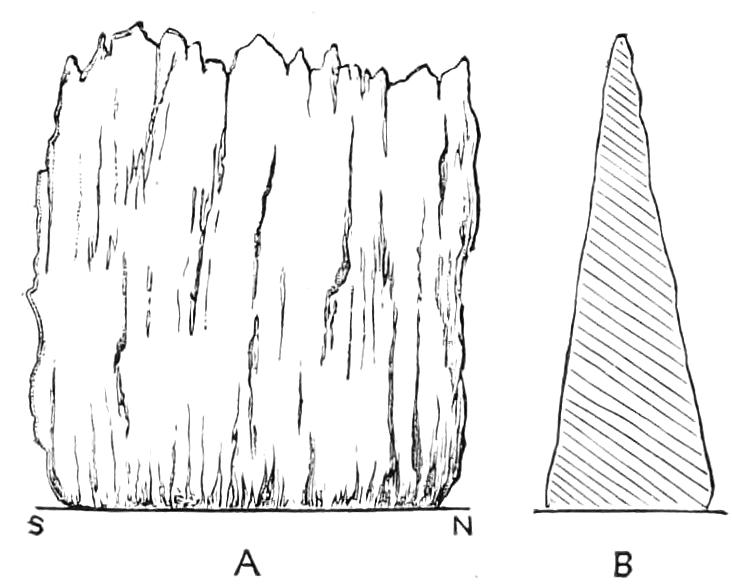
Fig. 239.—Termitarium of compass or meridian Termite of North Australia. A, face extending south and north; B, cross-section.
The material used for the construction of the dwellings is either earth, wood, or the excrement of the Termites. The huge edifices mentioned by Smeathman are composed of earth cemented together so as to look like stone or brick, and the buildings appear to be almost as strong as if they were actually constructed with these materials. In many cases the substance used is comminuted wood that has passed one or more times through the alimentary canal of the Insects, and may therefore be called excrement. Whether the stone-like material is made from earth that has passed through the alimentary canal or from grains gathered for the purpose has not been well ascertained. In any case the material is cemented together by means of the secretions of glands. Dudley and Beaumont have described the process of construction, in a species observed by them, saying that earth is brought and placed in position by the mandibles, and cemented by liquid from the abdomen.[302] Von Jhering says[303] that some species form the exterior walls of their dwellings of stone-like material, but make use of woody matter for the construction of the interior. Smeathman has described the nest of Termes bellicosus. The whole of the very strong external wall consists of clay-like material, cemented by the secretions of the Termites to a very firm consistence. The royal cell is built of the same material as the framework of the nest; whilst the nurseries in which the young are chiefly found are built of woody material, and are always covered with a kind of mould—the mycelium of a fungus—and plentifully sprinkled with small white bodies, which, under the microscope, are found to be filled with a number of oblong, spore-like cells.
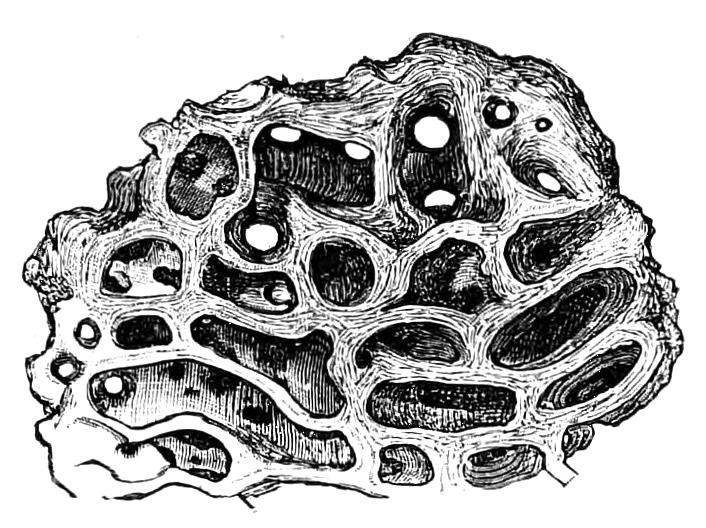
Fig. 240.—Fragment of Termitarium of Termes angustatus, S. Africa, showing fungus chambers and orifices of communication.
These nurseries rest on the clay-like framework of the nest, but are not attached thereto; they in no way support it, or one another, indeed they have the appearance of being constantly added to on their upper margins and constantly eaten away on their under parts. Fig. 240 represents the appearance of the upper boundary of a nursery taken from a nest of Termes angustatus. The small white bodies, mentioned above, have disappeared: the mycelium of the fungus, though not shown in the figure, is still visible on the specimen from which it was drawn, and gives rise to a whitish, glaucous appearance.
In various parts of the world nests formed on trees by Termites are to be seen; these tree nests are, it would appear, in some cases only parts of a community, and are connected with the main body by galleries. In other cases nests are formed in various positions of advantage; Messrs. Hubbard and Hagen have given us an account[304] of some of these—probably the work of Eutermes ripperti—as seen in Jamaica. They describe the nests as spherical or conical masses, looking externally as if composed of loamy earth; they are placed on trees, fences, or walls; they vary in size from that of a man's fist to that of a hogshead; they appear to be composed of finely comminuted wood fastened together by saliva. These nests are formed on the same principle as those of the wasps that make nests hanging to trees and bushes, as they consist of an external protecting envelope covering a comb-like mass in the interior. At the bottom of the nest there is a covered gallery leading to the earth, where the main nest appears to be situate; galleries also are constructed so as to lead to the tops of trees and other places, in such a manner that the Termite can still keep up its peculiarity of working and travelling in tunnels and yet roam over a large area; the activity of these Termites continues day and night. In each nest there is a queen, who lays eggs that are removed by the worker Termites to the bottom of the nest. The young are fed on a prepared food, consisting apparently of comminuted vegetable matter, of which considerable masses are laid in store. Some of the nests are rich in containing many pounds' weight of this material, while others are apparently quite destitute of it. There is a soldier form and at least two kinds of workers. Some species of true ant frequently shares the nest of these white ants, but on what terms the two kinds of Insects live together is not stated.
Termite Ravages.—In countries whose climate is favourable to their constitutions certain kinds of Termites become of great importance to our own species. Owing to their taste for woody matter and to their habit of working in concealment, it is no uncommon thing for it to be discovered that Termites have obtained access to a building and have practically destroyed the wooden materials used in its construction; all the interior of the wood being eaten away and only a thin outer shell left intact. A Termite, T. tenuis, was introduced—in what manner is not certainly known[305]—to the Island of St. Helena, and committed such extensive ravages there that Jamestown, the capital, was practically destroyed and new buildings had to be erected. Other such cases are on record. Destructive species can sometimes be destroyed by placing in the nests a portion of arsenicated food. This is eaten by some individuals, who perish in consequence; and their dead bodies being consumed by their comrades, the colony becomes checked if not exterminated.
The number of described species of Termitidae does not much exceed 100, but this is certainly only a small portion of those existing, the total of which may probably reach 1000 species.
Termitidae are classed by some naturalists with the Orthoptera, and they have a great deal in common with some of the cursorial division of that Order, more particularly Forficulidae and Blattidae; but they differ from Orthoptera in the nature and form of the wings. They are also classed by some, with a few other forms, as a separate Order of Pseudo-Neuroptera called Corrodentia, but this is not a very satisfactory course, as the Termitidae do not agree closely with the forms associated with them, while the aggregate so formed is far from being very distinct from other forms of Neuroptera. On the whole the best plan appears to be to treat the Termitidae as forming a distinct family of the Order Neuroptera, or to make it a distinct Order, as proposed by Grassi. Packard now associates Termites in an Order with the biting-lice, and calls it Platyptera.
Fossil Termites.—Termitidae were very abundant in Tertiary times, and the genera appear to have been then much the same as at present. In Mesozoic strata the remains of true Termitidae apparently exist in the Lias in Europe, but farther back than this the family has not been satisfactorily traced. It was formerly supposed that Termitidae existed in the Carboniferous strata, but this appears to be very doubtful; and the fossil remains of that epoch, which were presumed to be those of Termites, are now referred by Scudder and others to the Neuropteroid division of the Order Palaeodictyoptera, an Order which is formed entirely of Palaeozoic fossil remains.