Chapter XVIII
Reading edition
AMPHIBIOUS NEUROPTERA CONTINUED—ODONATA, DRAGON-FLIES
Fam. VI. Odonata—Dragon-flies.
(LIBELLULIDAE OF SOME AUTHORS)
Elongate Insects with very mobile head and large eyes, with small and inconspicuous antennae ending in a bristle; with four elongate wings sub-equal in size and similar in texture, of papyraceous consistency and having many veinlets, so that there exists a large number of small cells. All the legs placed more anteriorly than the wings. The earlier stages of the life are aquatic; there is great change in the appearance of the individual at the final ecdysis, but there is no pupal instar.
The dragon-flies form a very natural and distinct group of Insects. All the species are recognised with ease as belonging to the family. They are invariably provided with wings in the perfect state, and many of them are amongst the most active of Insects. Their anatomy is, in several respects, very remarkable.
The head is large and is concave behind; it is attached to the thorax in such a way that it rotates on two cervical sclerites that project forwards, and in some cases almost meet in a point in front; hence it possesses extreme mobility, the power of rotation being very great.
The eyes are always large; in some cases they are even enormous, and occupy the larger part of the area of the head: the upper facets of the eye are in many cases larger than the lower, and in a few forms the line of division is sharply marked transversely. There are three ocelli, which, when the size of the compound eyes is not too great, are placed in the usual manner as a triangle on the vertex; but in the forms where the compound eyes are very large the portion of the head between is, as it were, puffed out so as to form a projection just in front of where the eyes meet, and one ocellus is then placed on each side of this projection, an antenna being inserted quite close to it; the third ocellus is placed in front of the projection we have mentioned, by which it is often much concealed; this anterior ocellus is in some cases of unusually large size, and oval or transverse in form.
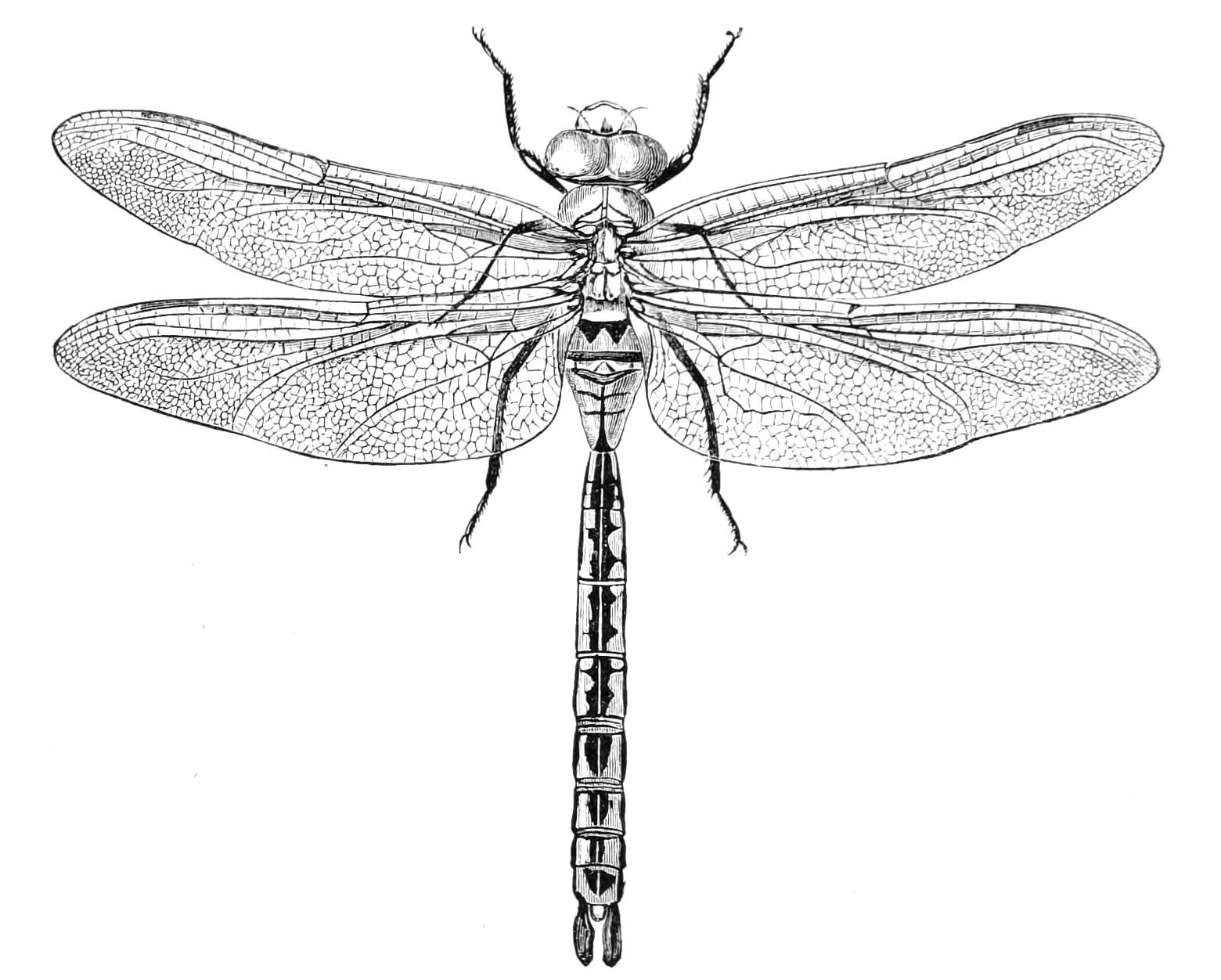
Fig. 260.—Anax formosus, Britain. (After Migneaux.) (The legs are not in a natural position.)
The parts of the mouth are very peculiar, especially the lower lip: we will briefly allude to its characters in the highly modified forms, premising that in the smaller and less active species it is less remarkable. The Libellulidae are carnivorous, their prey being living Insects which are captured by the dragon-fly on the wing; it is believed that the mouth is largely instrumental in the capture, though the flight of these Insects is so excessively rapid that it is difficult, if not impossible, to verify the action of the mouthpieces by actual observation.
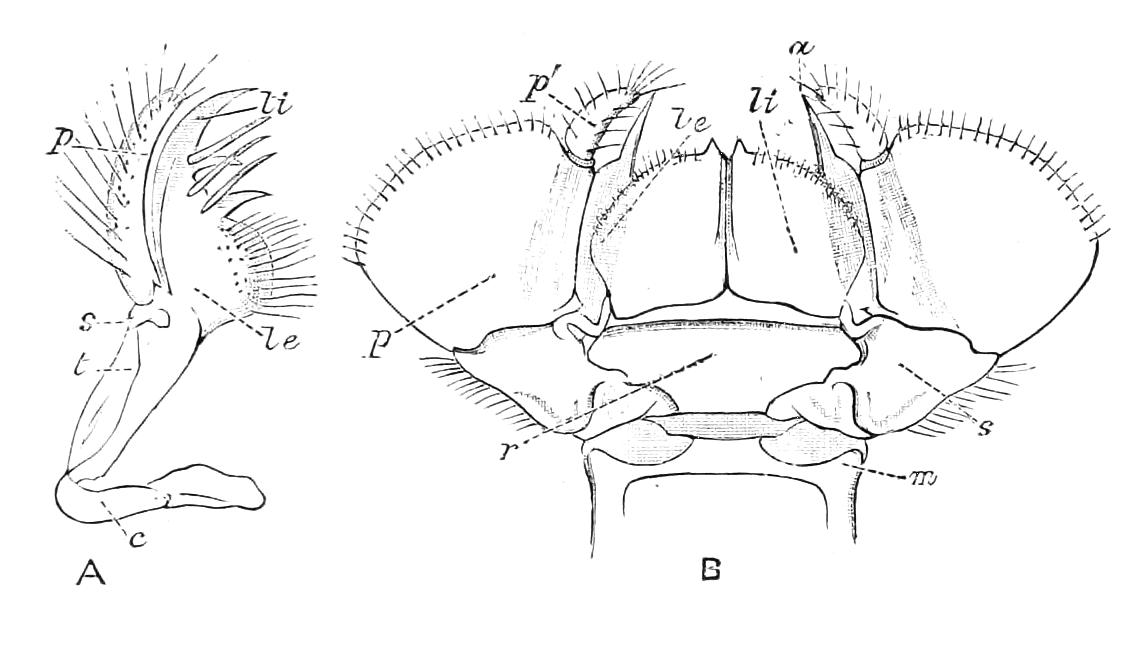
Fig. 261.—A, Maxilla of Libellula quadrimaculata; B, labium of Aeschna grandis. p, p′, Palpus; a, terminal spine of palpus; c, cardo; t, stipes; s, squama; le, outer lobe of maxilla, partly covered by, li, inner lobe; m, mentum; r, intervening lobe. (After Gerstaecker.)
For the purpose of securing the prey a mouth that can change its capacity to a considerable extent and with rapidity is a desideratum, and these qualities are present in the mouths of those Libellulidae that capture their prey while hawking. The upper lip is very mobile, is pendent, and closes the mouth above, while the lower lip entirely closes the under part by means of two mobile plates; these in some forms (Libellula) meet together in the mesial line, while in others a third plate separates them in the middle (Fig. 261, B, li). These plates are, according to Gerstaecker's view,[331] portions of the much changed labial palpi, the part that separates them in Aeschna being the inner lobes of the labial maxillae; in Libellula, where the dilated and valve-like joints of the palpi meet in the middle line, the labial lobes remain small and are overlapped by the dilated portions of the palpi. The maxillae proper (Fig. 261, A) are less peculiar, their chief character being that the inner and outer lobes are not separated, and that the palpus is of only one joint. Some entomologists take, however, another view of this structure, looking on the palp-like outer part (p of our figure) as the true outer lobe of the maxillae, the palpus proper being in that case considered to be entirely absent. The mandibles are very powerful, and armed with largely developed teeth. In the interior of the mouth there is a large, free, semi-membranous lingua, the posterior part of its delicate inferior lamina being connected with the mentum; the upper lamina of the lingua is stronger and is pilose. The antennae of the dragon-flies are always small, and consist of two stouter joints at the base, and a terminal part which is very slender and pointed, and formed of four or five joints.
The prothorax is always small; the pronotum is distinct, though in some forms it is quite concealed in the concavity of the back of the head; the sternum is small; the anatomy of the pleura and basal pieces of the legs is obscure.
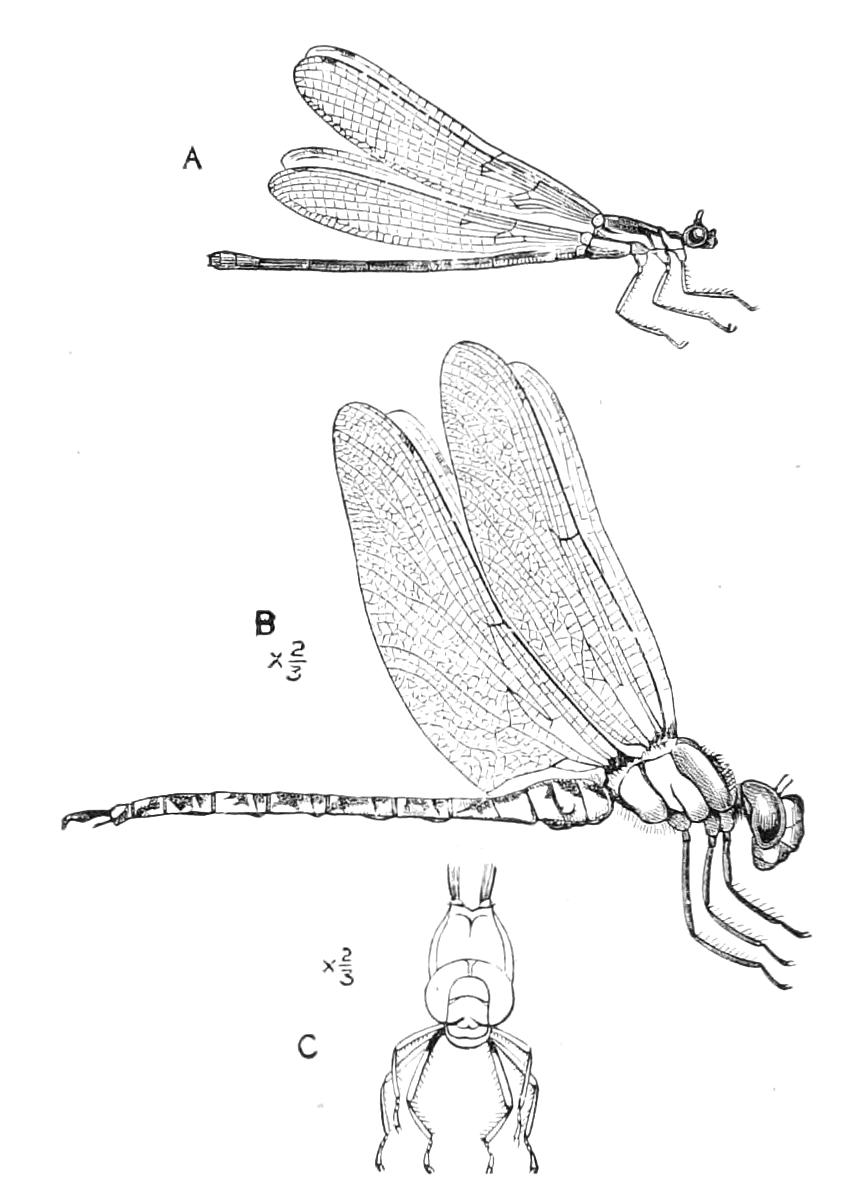
Fig. 262.—A, Agrion pulchellum, natural size; B, Aeschna cyanea, profile; C, same from front to show position of legs. ⅔ natural size.
The meso- and meta-thorax are very intimately combined, and their relations are such that the former is placed much above the latter. This peculiarity is carried to its greatest extent in some of the Agrioninae (Fig. 262, A), where not only are the wings placed at a considerable distance behind the three pairs of legs, but also the front pair of wings is placed almost directly above the hind pair. In the Anisopterides these peculiarities are much less marked (Fig. 262, B), nevertheless even in them the three pairs of legs are placed quite in front of the wings. This peculiar structure of the wing-bearing segments is accompanied by an unusual development of the pleura, which, indeed, actually form the larger part, if not nearly the whole, of the front region of the dorsal aspect of these two segments. We shall not enter into more minute particulars as to the structure of the thorax, for difference of opinion prevails as to the interpretation of the parts.[332] The abdomen is remarkable for its elongation; it is never broad, and in some genera—Mecistogaster, e.g.—it attains a length and slenderness which are not reached by any other Insects. It consists of ten segments and a pair of terminal calliper-like or flap-like processes of very various sizes and forms.
The wings of the dragon-flies are usually transparent and provided with a multitude of small meshes. The hind wings are about as large as the front pair, or even a little larger; the main nervures have a sub-parallel course, and are placed in greater part on the anterior region of each wing. The relations of the more constant nervures and the cells of which they are parts form a complex subject, and are amongst the most important of the characters used in classifying these Insects. The wings are always elongate in comparison to their breadth and have no folds; they are held partially extended, or are placed so as to project backwards, or backwards and outwards. They exhibit another peculiarity, inasmuch as the front or costal margin is slightly uneven before or near the middle, giving rise to an appearance such as might result from the breaking and subsequent mending of the marginal rib at the spot in question, which is called the nodus. In some forms a peculiar character exists in the shape of a small opaque space called the membranule, lying close to the body of the Insect in the anal area of the wing, as shown in Fig. 260.
The legs are slender and are chiefly remarkable for the beautiful series of hair-like spines with which they are armed, and which in some forms (e.g. Platycnemis, Fig. 264) are of considerable length. We believe that the legs are of great importance in capturing the prey, they being held somewhat in the position shown in Fig. 262, C. The tarsi are three-jointed. In the male of Libellago caligata the legs exhibit a remarkable condition, the tibiae being dilated, and on the upper side of a vivid red colour, while below they are white. This coloration and form are each unusual in the family. The male of Platycnemis pennipes, a British species (Fig. 264), shows a similar dilatation of the tibiae, but to a less extent and without any great difference in the colour of the two faces of the dilatation. This dilatation reaches its maximum in Psilocnemis dilatipes M‘Lach. The position of the legs in relation to the other parts of the body is peculiar to the dragon-flies; the legs seem to be unfit for walking, the Insects never using them for that purpose.
Several peculiarities in the internal anatomy deserve notice. The alimentary canal in Libellula is about as long as the body, the oesophagus and chylific stomach being elongate, while the intestine is short and divided into only two parts; there is no definite proventriculus. The Malpighian tubules are shorter than usual; they are about forty in number. The male has no vesiculae seminales; the vasa deferentia are elongate, and the ejaculatory duct is very short, being in fact merely a common sinus formed by the terminations of the vasa deferentia. The opening of this duct is situated on the penultimate ventral plate; the organs of intromission are, however, placed much anterior to this, on the under side of the second segment. The mode in which the fertilising fluid is transferred from the ninth to the second segment is not well understood, but it is known that the abdomen is flexed by the Insect so as to bring the ninth ventral plate into contact with the second. The three thoracic ganglia of the nervous chain are all contiguous, though not completely amalgamated; the abdominal ganglia are seven in number, and are all separated, the terminal one being larger than the others. Dufour, after repeated dissections, was unable to find any salivary glands, but Olga Poletajewa[333] states that they exist.
The Odonata must be ranked among the most highly-organised Insects so far as external structure and powers of locomotion are concerned; the peculiar modifications of the thoracic segments and the relative positions of the wings and legs mark a great departure from the normal type of Insect structure. Their prey consists of living Insects, which they capture on the wing by their own superior powers of flight. They destroy a great many Insects, their appetite for food being, as in the cases of the Mantidae and of the tiger-beetles, apparently almost insatiable. They are admirably constructed for the purposes of their predatory lives; they fly with great swiftness and change the direction of their flight with admirable facility. They are, however, dependent on sunshine, and conceal themselves in dull and cloudy weather. The larger Insects of the family belong to the division Anisopterides (Fig. 260, Anax formosus) and some of these may, in our own country, usually be seen, in the bright sunshine of the summer and autumn, engaged in hawking in their favourite haunts. Places where other Insects abound are naturally those most frequented; the glades of woods, country lanes and hedge-sides, the borders of streams and the margins of sheets of water are the places they most affect. They inspire the rustics with some feeling of fear, and hence have received the name of "horse-stingers," and in North America are called "devil's darning-needles." The aversion to dragon-flies may perhaps be due to their appearance, which is certainly, in the case of some of our species of Aeschna, Cordulegaster, and Gomphus, very remarkable, consisting of a dark ground-colour with bars and spots of vivid green or yellow, giving, it must be admitted, a peculiar, even savage appearance to the Insects. Whatever the reason may be, they are, it is certain, held in much fear, and it is difficult to induce a country lad to touch one even when it is captured and held by another person. The idea of dragon-flies being dangerous to anything but their Insect victims is, however, entirely erroneous; they may be captured and handled without their inflicting any injury. It is probable that the life of the imago may endure for several weeks if not months. It is known that Sympycna fusca—a common European though not British dragon-fly—hibernates in the imago state.
In the case of the large dragon-flies we have mentioned, each individual appears to have a domain, as it were, of its own. Westwood tells us that he has seen what he believed to be the same individual hawking daily for several weeks together over a small pond. The writer observed a specimen of Cordulegaster annulatus to frequent a particular bush, to which it returned—frequently to the same leaf—after an excursion in search of food. The way in which these Insects actually seize their prey has not yet been made clear; it is certain that they capture flying Insects, and it seems most probable, as we have already said, that this is done by means of the legs. These, as we have said, are inserted so as to be very near to the mouth; they are directed forwards, and are held bent at right angles so as to form a sort of net, and are armed with a beautiful system of fine spines; it is probable that if the dragon-fly pursue an Insect on the wing and strike it with the trap, formed by its six legs (Fig. 262, C), then these immediately come together under the mouth, so that the victim, directly it is captured by the leg-trap of its pursuer, finds itself in the jaws of its destroyer. It is perhaps impossible to verify this by actual observation, as the act of capture and transfer is so very brief and is performed in the midst of a rapid dash of flight, but it seems more probable that the prey is first struck by the legs than that the mouth is the primary instrument of capture. The excessive mobility of the head permits the victim to be instantly secured by the mouth, and the captured fly is turned about by this and the front pair of legs, and is nipped rapidly so that the wings and drier parts fall off; the more juicy parts of the prey are speedily squeezed into a little ball, which is then swallowed, or perhaps we should rather say that the mouth closes on it, and submits it to further pressure for the extraction of the juices. We have already noted that many of these large and active dragon-flies, particularly in the Libellulinae and Aeschninae, have their eyes distinctly divided into two parts, the facets in the lower part of the eye being different from those of the upper part. Exner considers[334] that the upper division is for the perception of movement, the lower for the perception of the form of resting objects. Plateau thinks[335] that the dragon-flies perceive only movement, not form.
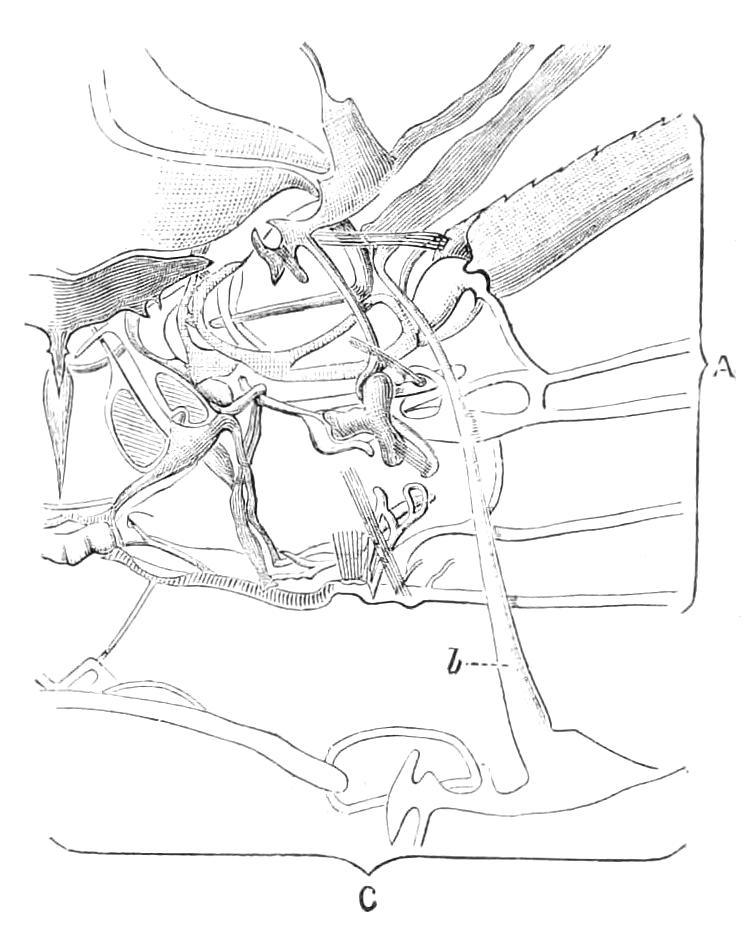
Fig. 263.—Inner view of a portion of the left side of body of Libellula depressa, showing a part of the mechanism of flight, viz. some of the chitinous ridges at base of the upper wing, and some of the insertions of the tendons of muscles. A, line of section through base of upper wing, the wing being supposed to be directed backwards; C, upper portion of mechanism of the lower wing; b, lever extending between the pieces connected with the two wings. (After von Lendenfeld.)
The splendid acts of flight of the Anisopterid Odonata are accomplished by the aid of a complex arrangement of chitinous pieces at the bases of the wings (Fig. 263). In Insects with considerable powers of flight the hind wings are usually subordinate in functional importance to the anterior, to which they are attached by a series of hooks, or some other simple mechanism, on the wings. In the Odonata the two wings of each pair are quite free, but they are perhaps brought into correlative action by means of a lever of unusual length existing amongst the chitinous pieces in the body wall at the base of the wings (Fig. 263, b). The wing muscles are large; according to von Lendenfeld[336] there are three elevator, five depressor, and one adductor muscles to each wing: he describes the wing movements as the results of the correlative action of numerous muscles and ligaments, and of a great number of chitinous pieces connected in a jointed manner.
Amans[337] has suggested that the mechanism of flight of the dragon-fly would form a suitable model for a flying-machine, to be propelled by electricity.
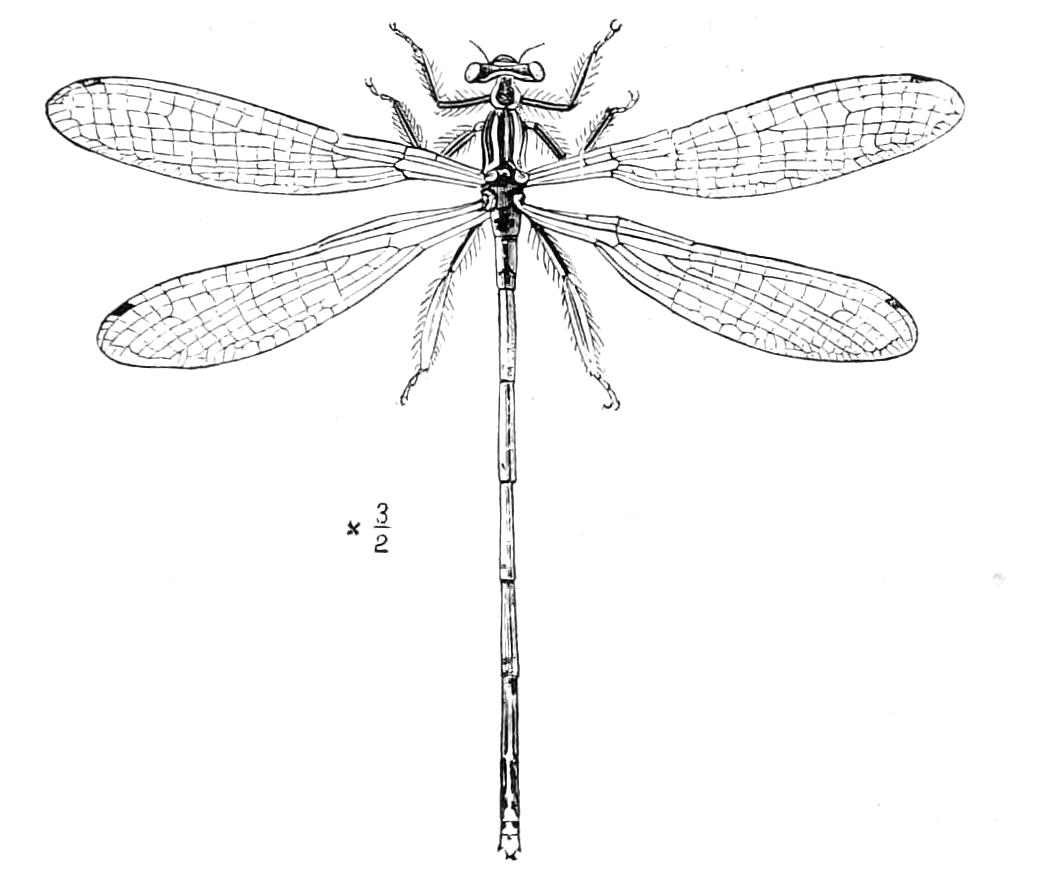
Fig. 264.—Platycnemis pennipes, ♂, Britain.
The Zygopterides—the second of the two divisions of the Odonata—are Insects different in many respects from the large and robust Anisopterides. The division comprises the delicate Insects called "demoiselles," damsel-flies, by the French (Fig. 262, A, and Fig. 264). Great power of flight is not possessed by these more fragile Insects; they flit about in the most gentle and airy manner from stem to stem of the aquatic plants and grasses that flourish in the localities they love. To this group belong the fairy-like Insects of the genus Calepteryx, in which various parts of the body and wings are suffused with exquisite metallic tints, while sometimes the two sexes of one species have differently coloured wings. The smallest and most delicate dragon-flies that are known are found in the tropics; some of the genera allied to Agrion consist of Insects of extraordinary fragility and delicacy.
Although the mature Odonata are so pre-eminently endowed for an aerial and active life, yet in the earlier stages of their existence they are very different; they are then, without exception, of aquatic habits; though carnivorous also in this period of their existence, they are sluggish in movement, lurking in concealment and capturing their prey by means of a peculiar conformation of the mouth, that we shall subsequently describe. Their life-histories are only very imperfectly known.
The eggs are deposited either in the water or in the stem of some aquatic plant, the female Insect occasionally undergoing submersion in order to accomplish the act. The young on hatching are destitute of any traces of wings (Fig. 265), and the structure of the thoracic segments is totally different from what it is in the adult, the rectal respiratory system (Fig. 265, x) to which we shall subsequently allude, being, however, already present. The wings are said to make their first appearance only at the third or fourth moult. At this time the pleura of the second and third thoracic segments have grown in a peculiar manner so as to form a lateral plate (Fig. 266, B, shows this plate at a later stage), and the wing-pads appear as small projections from the membranes at the upper margins of these pleural plates (Fig. 266, A, B). The plates increase in size during the subsequent stadia, and meet over the bases of the wing-pads, which also become much longer than they were at first. The number of moults that occur during growth has not been observed in the case of any species, but they are believed to be numerous. There is no pupa, nor is there any well-marked quiescent stage preceding the assumption of the winged form at the last ecdysis, although at the latter part of its life the nymph appears to be more inactive than usual. When full grown, the nymph is more like the future perfect Insect than it was at first, and presents the appearance shown in Figs. 266 and 270. At this stage it crawls out of the water and clings to some support such as the stem or leaf of an aquatic plant; a few minutes after doing so the skin of the back of the thoracic region splits, and the imago emerges from the nymphal skin.
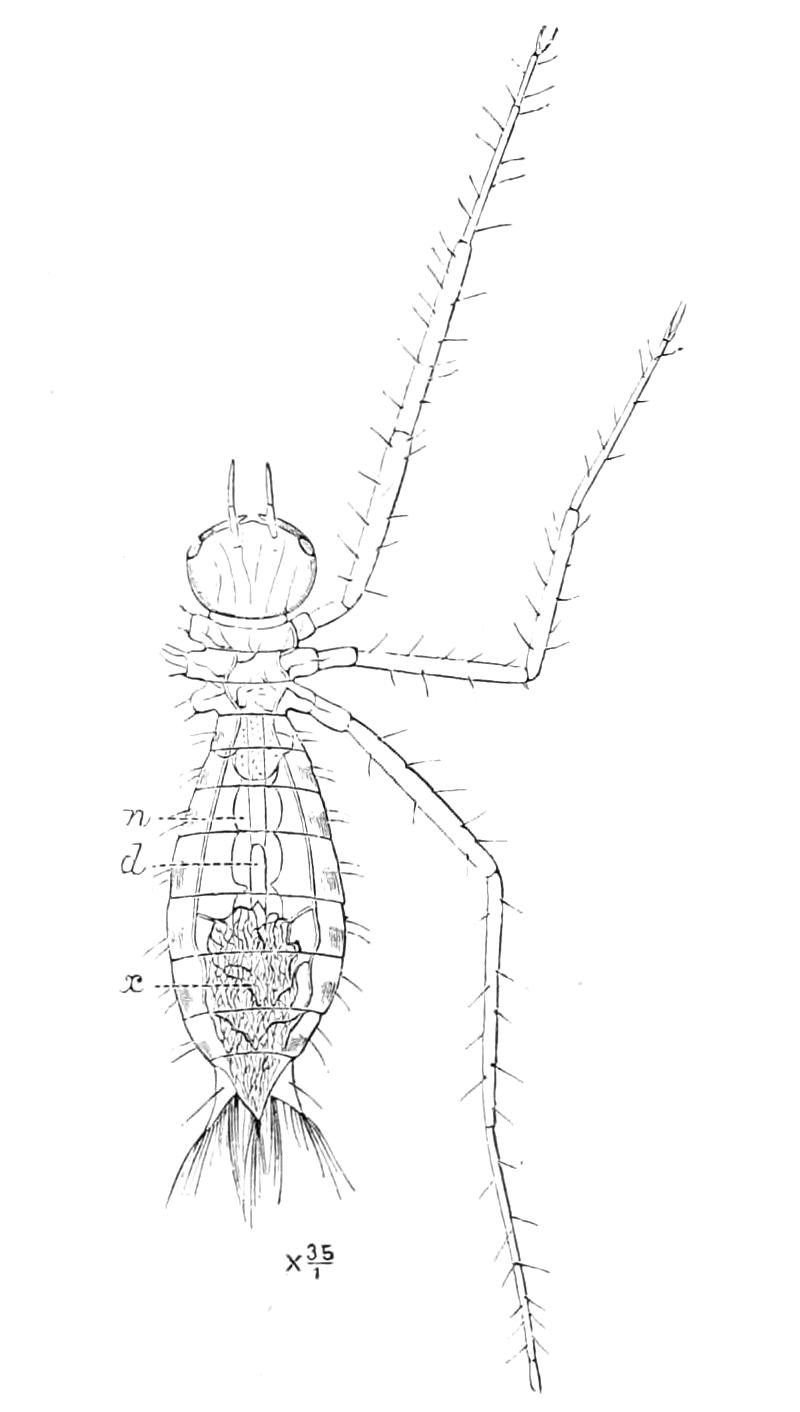
Fig. 265.—Larva of Diplax just hatched. n, a ganglion of the ventral chain; d, dorsal vessel; x, tracheal network round rectum. (After Packard, P. Boston Soc. xi. 1868, p. 365.)
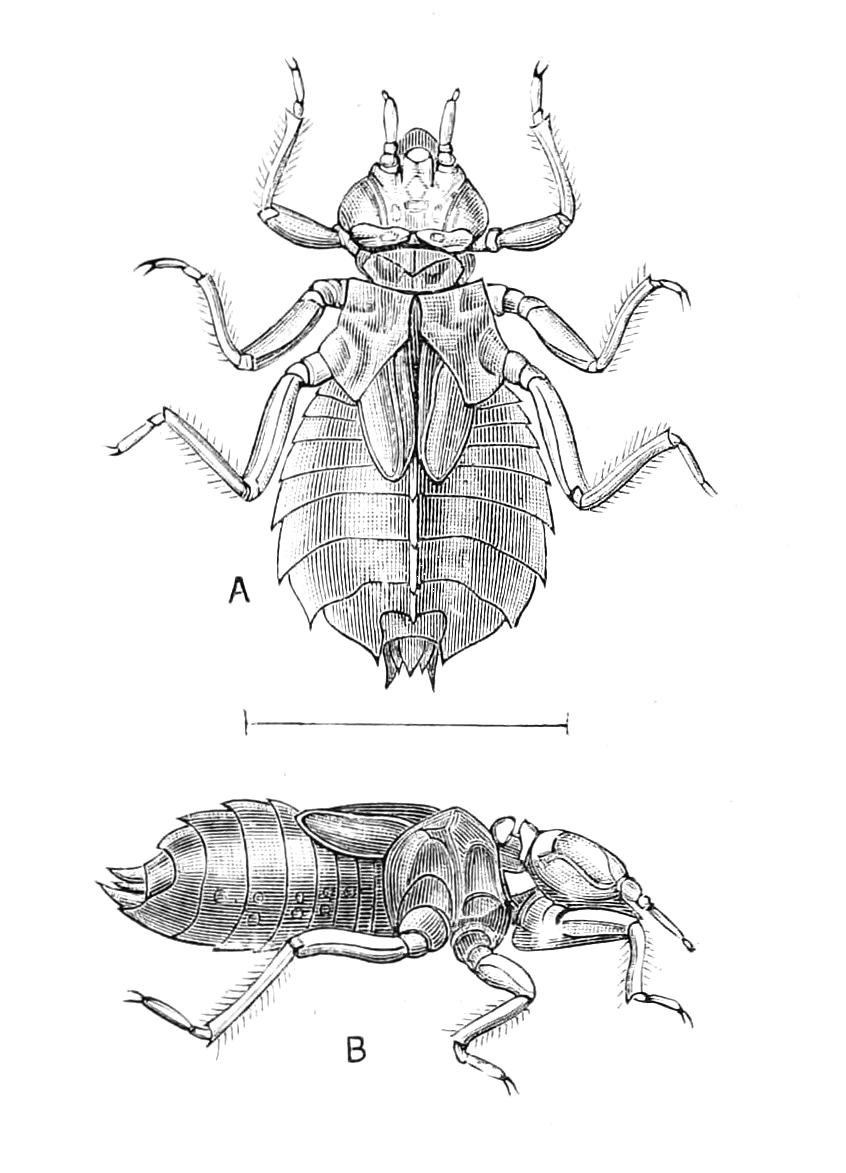
Fig. 266.—Ictinus sp., nymph, Himalaya. A, Dorsal, B, lateral view. (After Cabot.)
The nymphs never have the body so elongate as the perfect Insect, the difference in this respect being frequently great, and the nymphs of the subfamily Libellulinae being very broad (Fig. 266, nymph of Ictinus sp.); consequently the creature on emergence from the nymph-skin is very much shorter than it will soon become. Extension begins to take place almost immediately; it has been thought by some that this is accomplished by swallowing air; this is, however, uncertain. At first the wings have only the length of the wing-pads of the nymph, and their apical portion is an unformed mass. The colour of the perfect Insect is not present when the emergence takes place. The wing grows quickly until the full length is attained. In the genus Agrion the expansion of the wings is accompanied by frequent elevations and depressions of the body, and occupies an hour or so; the elongation of the abdomen is not so soon completed, and its brilliant colours do not appear for several hours.
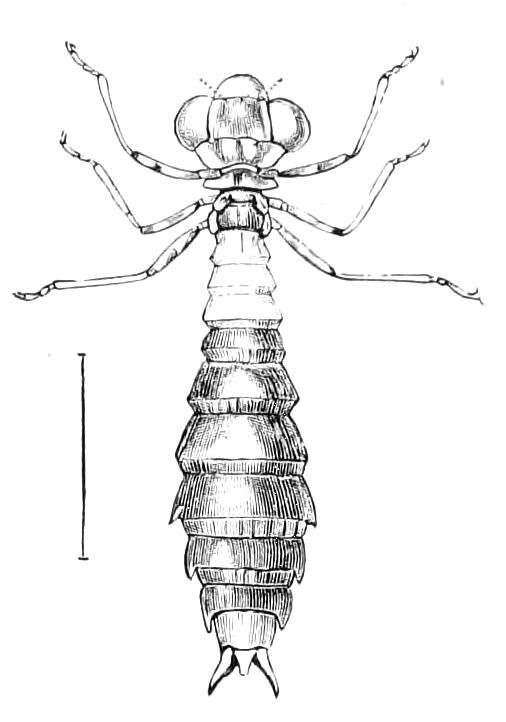
Fig. 267.—Young nymph of Aeschna sp. (Cambridge) about fourth moult.
The mouth of the nymph bears a remarkable structure called the mask (Fig. 268). It is apparently formed by a backward growth of the bases of the labium and lingua, a hinge being formed between the two at the most posterior point of their growth. The prolonged portions of these parts are free: usually the mask is folded under the head, but it can be unfolded and thrust forward, remaining then attached to the head by means of the more anterior parts of the lingua and by the maxillae, the whole of the elongate apparatus being, when used, extended from this anterior part of its attachment. The front parts of the labium form a prehensile apparatus armed with sharp teeth, so that the structures make altogether a very effectual trap, that can be extended in order to secure the prey.
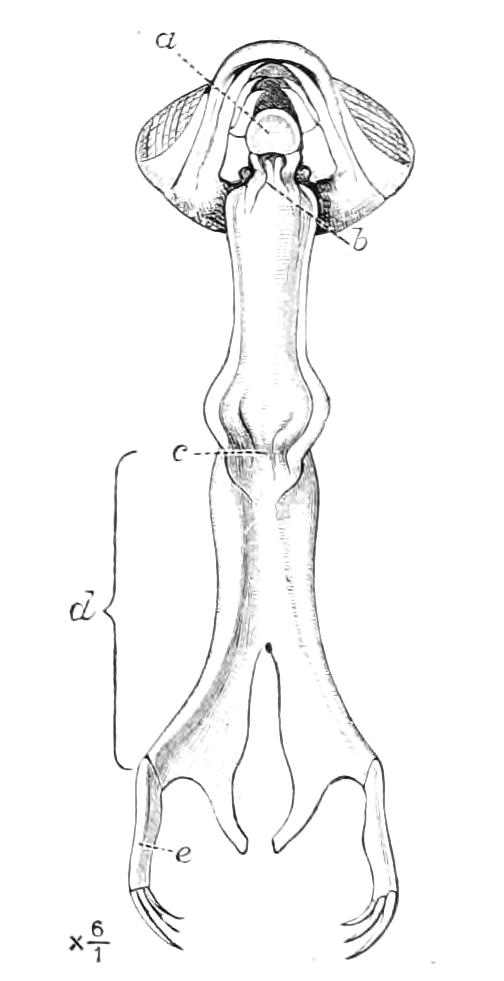
Fig. 268.—Under side of head of Calepteryx virgo, nymph, with mask unfolded. a, Lingua; b, line from which the mask swings; c, line of doubling up; d, lower lip proper; e, articulated lateral processes thereof.
The fact that the dragon-fly passes suddenly, in the middle of its existence, from an aquatic to an aerial life, makes the condition of its respiratory organs a subject for inquiry of more than usual interest. Réaumur was of opinion that the nymph was, in spite of its aquatic existence, provided with an extensive system of stigmata or orifices for breathing air; this was, however, denied by Dufour, and his opinion seemed to be supported by the fact that other means of obtaining air were discovered to exist in these nymphs. The inquiries connected with the respiration of Odonata are still very incomplete, but some interesting points have been ascertained, the most important of which is perhaps the existence in some forms of a respiratory system in connexion with the posterior part of the alimentary canal (Fig. 269). In the nymphs of Anisopterides the system consists of four main tracheal trunks, traversing the length of the body, and by their ramifications and inosculations forming an extensive apparatus. Connected with the four main trunks we have described, there is a shorter pair confined to the abdomen, where it supplies a large number of branches to the walls of the stomach. The dorsal pair of the main tubes give numerous subsidiary branches to the outside of the rectum, and the ventral pair furnish a smaller number. The walls of the gut are penetrated by the branches, which inside the rectum form numerous loops; these, covered by a membrane, project into the interior in the form of multitudinous papillae (Æschninae). In the Libellulinae the papillae are replaced by more flattened processes or lamellae. The structures attain a remarkable development, there being in Aeschna cyanea upwards of 24,000 papillae.
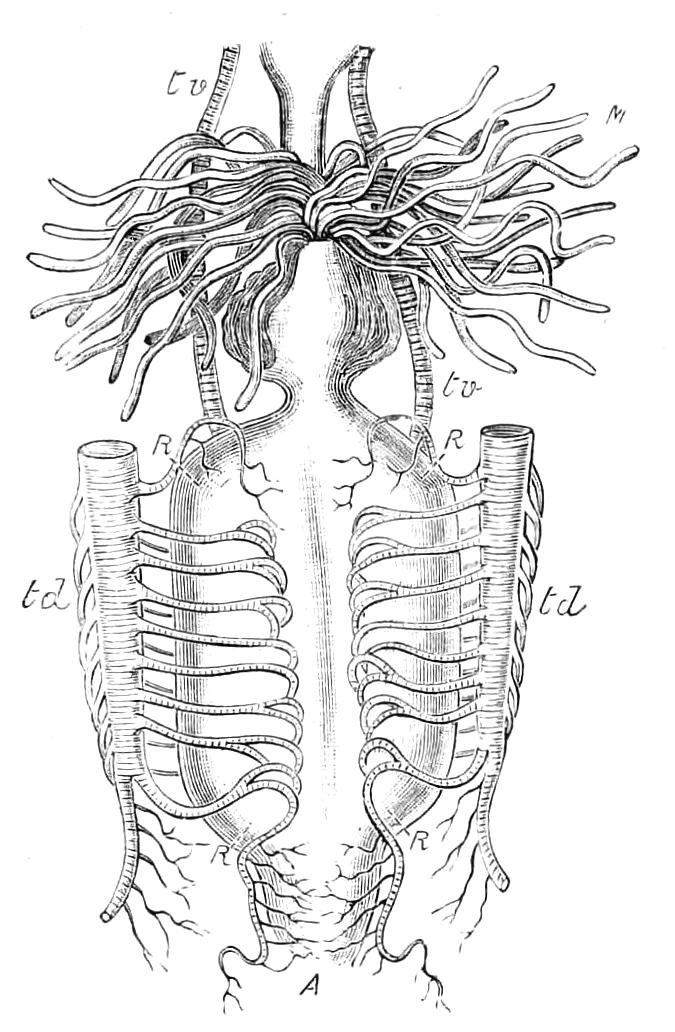
Fig. 269.—Portion of tracheal system of nymph of Aeschna cyanea. R, R, R, R, rectum; A, anus; td, dorsal; tv, ventral, tracheal tubes; M, Malpighian tubes. (After Oustalet.)
These rectal gills obtain air from water admitted into the rectum for the purpose; the extremity of the body being armed with projections of variable form, that can be separated to allow ingress and egress of the fluid, or brought into close apposition so as to close the orifice. The water so taken in can, by some species, be ejected with force, and is used occasionally as a means of locomotion. These rectal branchiae can absorb free air, as well as air dissolved in water. If the fluid in which the creatures are placed has been previously boiled, so as to expel the air from it, the nymphs then thrust the extremity of the body out of the water and so obtain a supply of air.
Oustalet and Palmén state that at the last ecdysis the lamellae, or the papillae, do not disappear, but remain quite empty, and are consequently functionless, while on the tracheal trunks there are developed air vesicles to fit the creature for its aerial career. Hagen says that in Epitheca the whole structure of the gills is shed at the final moult.
The subject of the rectal branchiae of Libellula has been discussed and illustrated by Chun,[338] who states that Leydig has made known that in Phryganea grandis a structure is found connecting the rectal branchiae of Libellula with the rectal glands of some other Insects. We have not been able to find a confirmation of this in the writings of Leydig or elsewhere.
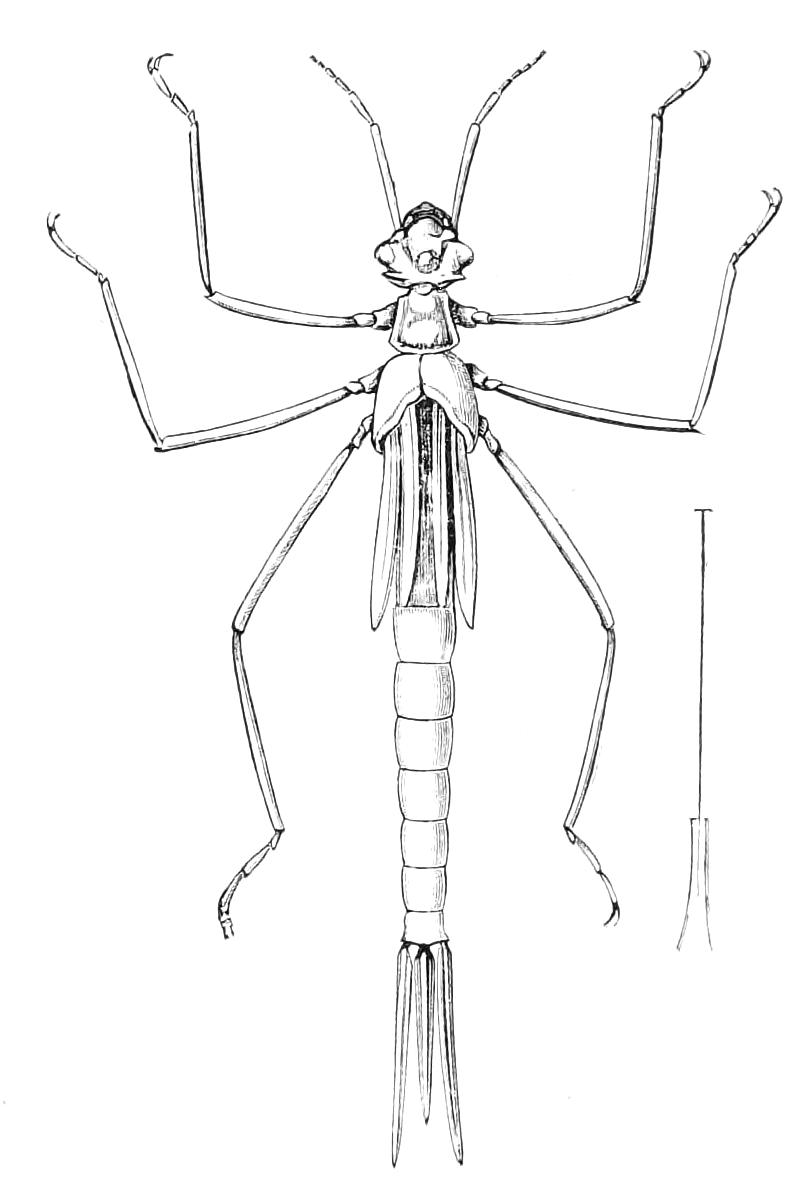
Fig. 270.—Calepteryx virgo, mature nymph, Britain.
In the nymphs of the Zygopterides the highly-developed rectal branchiae found in the Aeschninae and Libellulinae do not exist, and the respiration seems to be of a complex character. In one division of the Zygopterides—Calepteryginae—rectal gills of an imperfect character are said by Hagen and others to exist.[339] The nymphs of the Zygopterides are provided with three mobile processes at the extremity of the body (Fig. 270); these serve the purposes of locomotion. They are believed to possess also a respiratory function, but this must be of an accessory nature, for the nymphs live after the removal of the processes, and indeed reproduce them; the skin of these processes is harder than is usual in Insect gills. In the nymph of Euphaea—a genus of Calepteryginae found in tropical Asia—there are also external abdominal gills, and in this case respiration may, according to Hagen,[340] take place in four different manners: (1) by ten pairs of stigmata; (2) by lateral branchiae well furnished with tracheae; (3) by caudal branchiae; (4) by rectal branchiae. It is further said that in this Insect the lateral branchiae persist in the imago.
Although the means of respiration of the nymphs have been fairly well ascertained, yet the mode in which the nymph is prepared for the sudden change from the aquatic to aerial life is still obscure, the condition of the stigmata not being thoroughly elucidated. It appears probable, however, that the young nymph has no stigmata; that these organs appear in the course of its development, being at first quite impervious, but becoming—at any rate in the case of the larger and more important pair—open previous to the final ecdysis. We have mentioned the contradictory opinions of Réaumur and Dufour, and will now add the views of some modern investigators. Oustalet says[341] that there are two pairs of spiracles in the nymphs; the first pair is quite visible to the naked eye, and is situate between pro- and meso-notum; it is in the nymph closed by a membrane. The other pair of spiracles is placed above the posterior pair of legs, is small and completely closed. He does not state what stage of growth was attained by the nymphs he examined. Palmén was of opinion that not only thoracic but abdominal spiracles exist in the nymph,[342] and that they are completely closed so that no air enters them; he says that the spiracles have tracheae connected with them, that at each moult the part closing the spiracles is shed with some of the tracheal exuviae attached to it. The breathing orifices are therefore for a short time at each ecdysis open, being subsequently again closed by some exudation or secretion. This view of Palmén's has been thought improbable by Hagen and Dewitz, who operated by placing nymphs in alcohol or warm water and observing the escape of bubbles from the spots where the supposed breathing orifices are situate. Both these observers found much difference in the results obtained in the cases of young and of old nymphs. Hagen concludes that the first pair of thoracic spiracles are functionally active, and that abdominal stigmata exist though functionless; he appears to be of opinion that when the first thoracic stigma is closed this is the result of the abutting against it of a closed trachea. Dewitz found[343] that in the adult nymph of Aeschna the thoracic stigma is well developed, while the other stigmata—to what number and in what position is not stated—are very small. In a half-grown Aeschnid nymph he found the thoracic stigma to be present in an undeveloped form. On placing a full-grown nymph in alcohol, gas escaped from the stigma in question, but in immature nymphs no escape of gas occurred although they were subjected to a severe test. A specimen that, when submitted to the above-mentioned immersion, emitted gas, subsequently moulted, and thereafter air escaped from the spiracle previously impervious. The observations of Hagen and Dewitz are perhaps not so adverse to the views of Palmén as has been supposed, so that it would not be a matter for surprise if Palmén's views on this point should be shown to be quite correct.
The number of species of Odonata or Libellulidae that have been described is somewhat less than two thousand, but constant additions are made to the number, and when the smaller and more fragile forms from the tropics are collected and worked out it will probably be found that the number of existing species is somewhere between five and ten thousand. They are distributed all over the world, but are most numerous in species in the warmer regions, and their predominance in any one locality is very much regulated by the existence of waters suitable for the early stages of their lives.
A good work on the British Odonata is still a desideratum.[344] In Britain about forty-six species are believed to be native. They are said to be of late years less numerous than they used to be. Notwithstanding their great powers of flight, dragon-flies are destroyed by birds of various kinds; several hawks are said to be very fond of them, and Merops persicus to line its nest with their wings. The number of Insects killed by dragon-flies in places where they are abundant must be enormous; the nymphs, too, are very destructive in the waters they inhabit, so that dragon-flies have no doubt been no mean factor in maintaining that important and delicate balance of life which it is so difficult for us to appreciate. The nymphs are no doubt cannibals, and this may perhaps be an advantage to the species, as the eggs are sometimes deposited in large numbers in a limited body of water, where all must perish if the nymphs did not, after exhausting other food, attack one another. Martin, speaking of the Odonata of the Département de l'Indre in France, says:[345] "The eggs, larvae, and nymphs are the prey of several fishes, snakes, newts, Coleoptera, aquatic Hemiptera, and of some diving birds. Sometimes the destruction is on a considerable scale, and one may notice the dragon-flies of some piece of water to diminish gradually in numbers, while the animals that prey on them increase, so that a species may for a time entirely disappear in a particular spot, owing to the attacks of some enemy that has been specially prosperous, and also eager in their pursuit. De Selys found that from a pond filled with carp, roach, perch, and eels, several of the dragon-fly denizens disappeared directly the bream was introduced." On the other hand, there can be little doubt that the nymphs are sometimes injurious to fish; it has been recorded that in a piscicultural establishment in Hungary 50,000 young fishes were put into a pond in spring; in the following autumn only fifty-four fish could be found, but there were present an enormous quantity of dragon-fly nymphs.
Odonata are among the few kinds of Insects that are known to form swarms and migrate. Swarms of this kind have been frequently observed in Europe and in North America; they usually consist of species of the genus Libellula, but species of various other genera also swarm, and sometimes a swarm may consist of more than one species. L. quadrimaculata is the species that perhaps most frequently forms these swarms in Europe; a large migration of this species is said to occur every year in the Charente inférieure from north to south.[346] It is needless to say that the instincts and stimuli connected with these migrations are not understood.
The nymphs are capable, under certain circumstances, of accommodating themselves to very peculiar conditions of life. The Sandwich Islands are extremely poor in stagnant waters, and yet there exist in this remote archipelago several highly peculiar species of Agrioninae. Mr. R. C. L. Perkins has recently discovered that the nymphs of some of these are capable of maintaining their existence and completing their development in the small collections of water that accumulate in the leaves of some lilies growing on dry land. These nymphs (Fig. 271) have a shorter mask than occurs, we believe, in any other Odonata, and one would suppose that they must frequently wait long for a meal, as they must be dependent on stray Insects becoming immersed in these tiny reservoirs. The cannibal habits of the Odonata probably stand these lily-dwellers in good stead; Mr. Perkins found that there were sometimes two or three nymphs of different sizes together, and we may suspect that it sometimes goes hard with the smaller fry. The extension in the length of the body of one of these lily-frequenting Agrions when it leaves the water for its aerial existence is truly extraordinary.
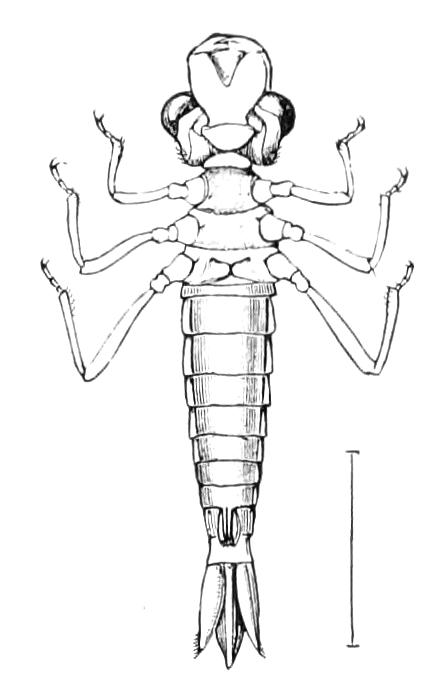
Fig. 271.—Under side of Agrionid nymph, with short mask, living in water in lilies. Hawaiian Islands. × 3.
The Odonata have no close relations with any other group of Insects. They were associated by Latreille with the Ephemeridae, in a family called Subulicornia. The members of the two groups have, in fact, a certain resemblance in some of the features of their lives, especially in the sudden change, without intermediate condition, from aquatic to aerial life; but in all important points of structure, and in their dispositions, dragon-flies and may-flies are totally dissimilar, and there is no intermediate group to connect them. We have already, said that the Odonata consist of two very distinct divisions—Anisopterides and Zygopterides. The former group comprises the subfamilies Gomphinae, Cordulegasterinae, Aeschninae, Corduliinae, and Libellulinae,—Insects having the hinder wings slightly larger than the anterior pair; while the Zygopterides consist of only two subfamilies—Calepteryginae and Agrioninae; they have the wings of the two pairs equal in size, or the hinder a little the smaller. The two groups Gomphinae and Calepteryginae are each, in several respects, of lower development than the others, and authorities are divided in opinion as to which of the two should be considered the more primitive. It is therefore of much interest to find that there exists an Insect that shares the characters of the two primitive subfamilies in a striking manner. This Insect, Palaeophlebia superstes (Fig. 272), has recently been discovered in Japan, and is perhaps the most interesting dragon-fly yet obtained. De Selys Longchamps refers it to the subfamily Calepteryginae, on account of the nature of its wings; were the Insect, however, deprived of these organs, no one would think of referring Palaeophlebia to the group in question, for it has the form, colour, and appearance of a Gomphine Odonate. Moreover, the two sexes differ in an important character,—the form of the head and eyes. In this respect the female resembles a Gomphine of inferior development; while the male, by the shape and large size of the ocular organs, may be considered to combine the characters of Gomphinae and Calepteryginae. The Insect is very remarkable in colour, the large eyes being red in the dead examples. We do not, however, know what may be their colour during life, as only one pair of the species is known, and there is no record as to the life-history and habits. De Selys considers the nearest ally of this Insect to be Heterophlebia dislocata, a fossil dragon-fly found in the Lower Lias of England.
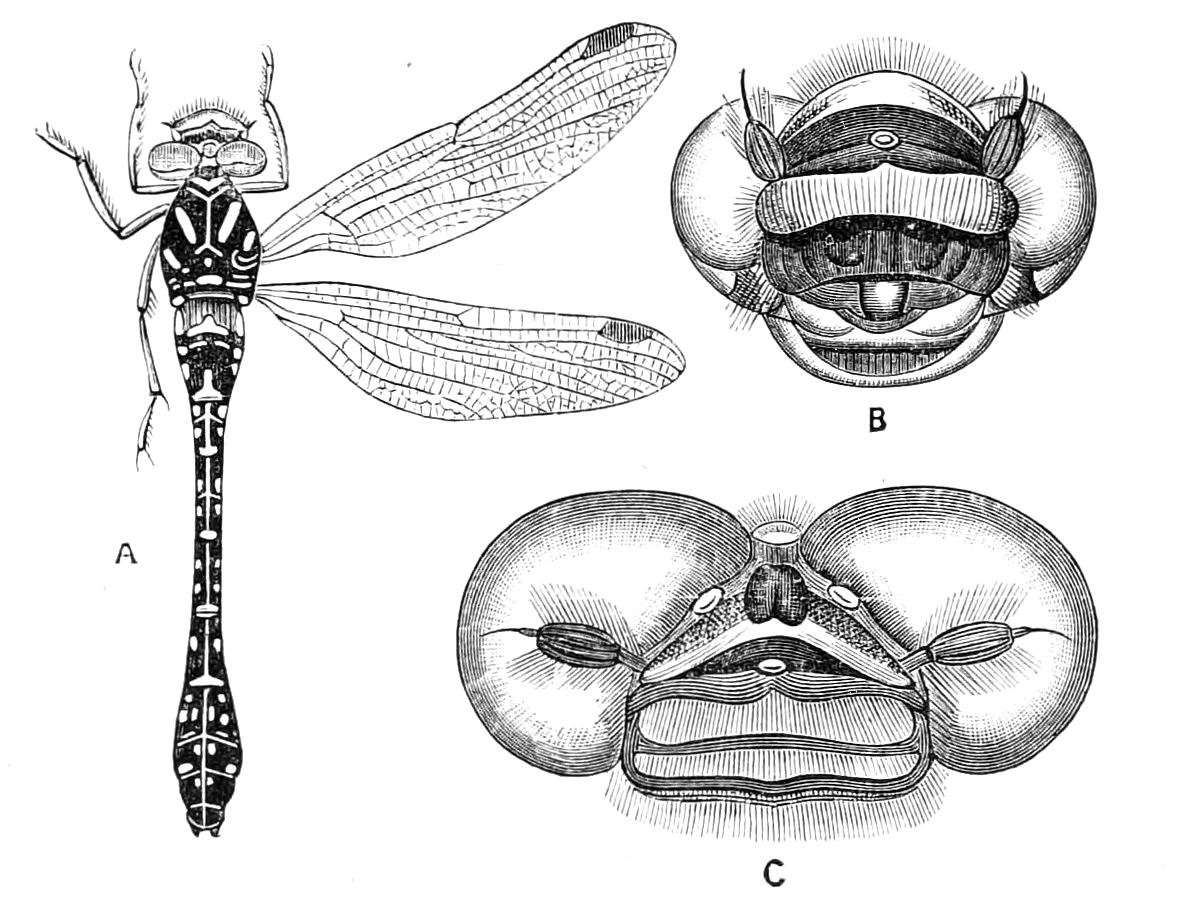
Fig. 272.—Palaeophlebia superstes. A, The Insect with wings of one side and with two legs removed; B, front view of head of female; C, of male. (After De Selys.)
Numerous fossil dragon-flies are known; the group is well represented in the Tertiary strata, and specimens have been found in amber. In strata of the Secondary age these Insects have been found as far back as the Lower Lias; their remains are said to exist in considerable variety in the strata of that epoch, and some of them to testify to the existence at that period of dragon-flies as highly specialised as those now living. According to Hagen[347] Platephemera antiqua and Gerephemera simplex, two Devonian fossils, may be considered as dragon-flies; the evidence as to this appears inadequate, and Brongniart refers the latter Insect to the family Platypterides, and considers Platephemera to be more allied to the may-flies.
One of the most remarkable of the numerous discoveries lately made in fossil entomology is the finding of remains of huge Insects, evidently allied to dragon-flies, in the Carboniferous strata at Commentry. Brongniart calls these Insects Protodonates,[348] and looks on them as the precursors of our Odonata. Meganeura monyi was the largest of these Insects, and measured over two feet across the expanded wings. If M. Brongniart be correct in his restoration of this giant of the Insect world, it much resembled our existing dragon-flies, but had a simple structure of the thoracic segments, and a simpler system of wing-nervures. On p. 276 we figured Titanophasma fayoli, considered by Scudder and Brongniart as allied to the family Phasmidae, and we pointed out that this supposed alliance must at best have been very remote. This view is now taken by M. Brongniart himself,[349] he having removed the Insect from the Protophasmides to locate it in the Protodonates near Meganeura. There appears to be some doubt whether the wings supposed to belong to this specimen were really such, or belonged rather to some other species.