Chapter XVII
Reading edition
NEUROPTERA CONTINUED—PSOCIDAE (BOOK-LICE AND DEATH-WATCHES)—THE FIRST FAMILY OF AMPHIBIOUS NEUROPTERA (PERLIDAE, STONE-FLIES).
Fam. IV. Psocidae—Book-Lice, Death-Watches.
Minute Insects with slender, thread-like, or hair-like antennae; four delicate membranous wings, the front pair of which are the larger; their neuration is not abundant and is irregular, so that the cells are also irregularly arranged; the transverse nervules are only one or two in number.[306] Prothorax very small, in the winged forms quite concealed between the head and the large mesothorax; this latter closely connected with, or fused with, the metathorax. Species quite wingless, or with wings unfitted for flight, exist; in them the prothorax is not so extremely small, while the mesothorax is smaller than in the winged forms. Tarsi of two or three segments. Metamorphosis slight, marked chiefly by the development of wings and ocelli.
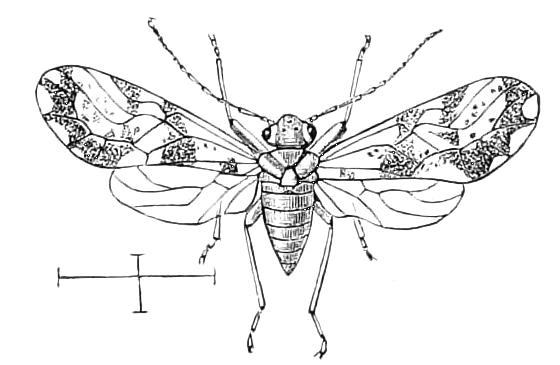
Fig. 241.—Psocus fasciatus, England. (After M‘Lachlan.)
The Psocidae are without exception small and soft-bodied Insects, and are only known to those who are not entomologists by the wingless forms that run about in uninhabited or quiet apartments, and are called dust-lice or book-lice. They are perhaps more similar to Termitidae than to any other Insects, but the two families differ much in the structure of their wings, and are totally dissimilar in the nature of their lives.
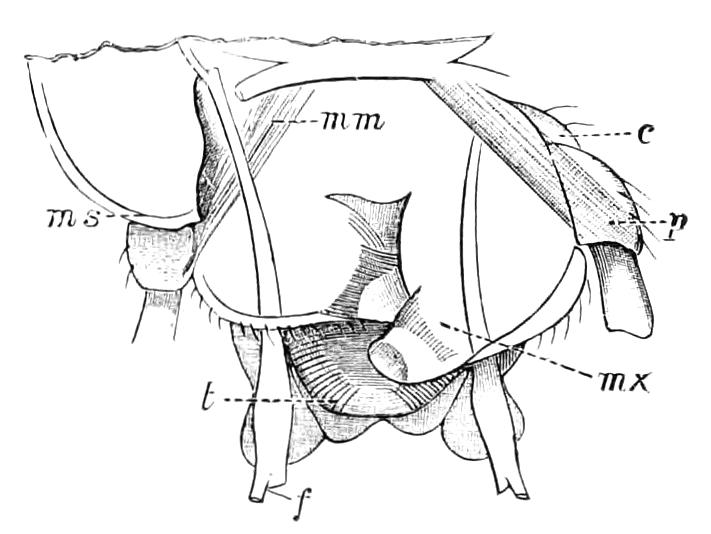
Fig. 242.—Transverse horizontal section of head of Psocus: f, fork or pick; t, lingua; mx, left maxilla; c, cardo; p, stipes; m.m, muscles; m.s, socket of mandible.
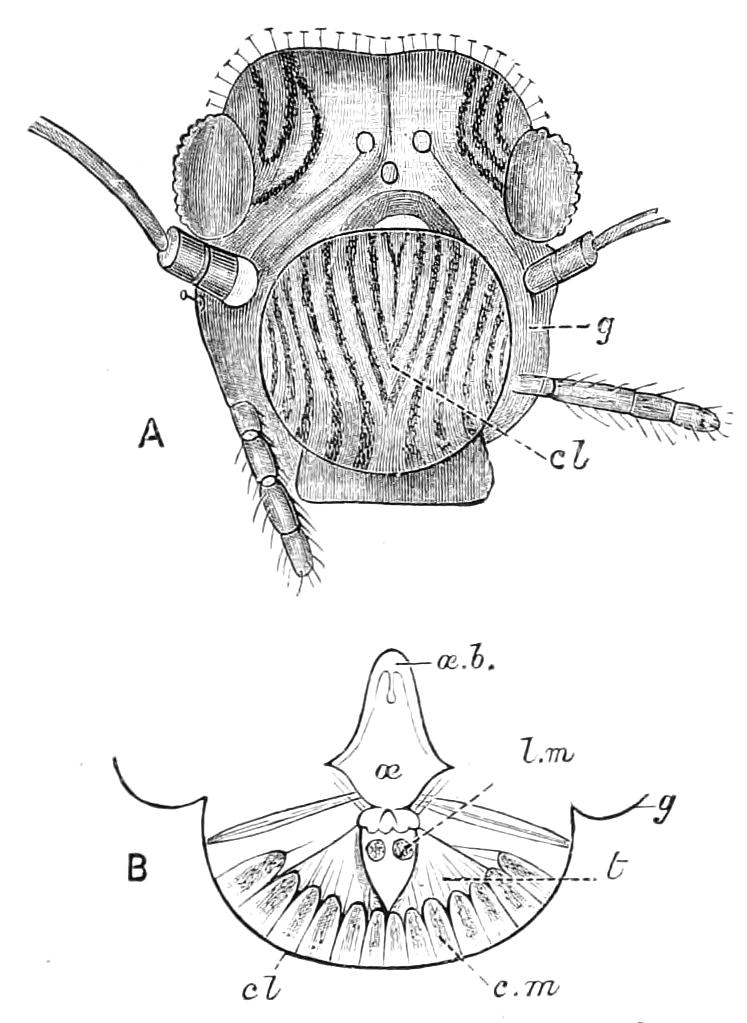
Fig. 243.—A, Front of head of Psocus heteromorphus; cl, post-clypeus; g, epicranium: B, transverse horizontal section of post-clypeus of Psocus: cl, post-clypeus; c.m, clypeal muscles; g, epicranium; t, tendons; l.m, labial muscle in section; oe, oesophagus; oe.b, oesophageal bone. (After Burgess and Bertkau.)
The antennae consist of eleven to twenty-five joints, or even more, about thirteen being the usual number; the basal two are thicker than the others, and are destitute of setae or pubescence such as the others possess. The maxillae and labium are remarkable. The former possesses a peculiar hard pick or elongate rod; this is considered by many naturalists to be the inner lobe, but Burgess thinks it more probably an independent organ,[307] as it has no articulation of any kind with the outer lobe. The latter is remarkably thick and fleshy; the palpus is 5-jointed. Other authorities consider the pick to be certainly the inner lobe; if it be not, the latter is quite wanting. Hagen agrees with Burgess in stating that the pick slides in the outer lobe as in a sheath. The labium has a large mentum and a ligula divided anteriorly into two lobes; at each outer angle in front there is a globular projection, which is doubtless the labial palpus; reposing on the labium there is a large free lingua. The labrum is large, attached to a distinct clypeus, behind which there is a remarkable post-clypeus, which is usually prominent as if inflated; to its inner face are attached several muscles which converge to be inserted on a plate placed below the anterior part of the oesophagus, and called by Burgess the oesophageal bone; under or within the lingua there is a pair of lingual glands. Judging from Grosse's study of the mouth of Mallophaga, we may conclude that the oesophageal bone will prove to be a sclerite of the hypopharynx. The eyes of the winged forms are frequently remarkably convex, and there are also three ocelli, triangularly placed on the vertex. The head is free and very mobile. The coxae are rather small, exserted, contiguous; the sterna small. The abdomen has usually ten segments, though sometimes only nine can be detected.
The thorax in Psocidae usually looks as if it consisted of only two segments. This is due to two opposite conditions: (1) that in the winged forms the prothorax is reduced to a plate concealed in the fissure between the head and the mesothorax bearing the first pair of wings; (2) that in the wingless forms (Fig. 247), though the prothorax is distinct, the meso- and metathorax are fused into one segment.
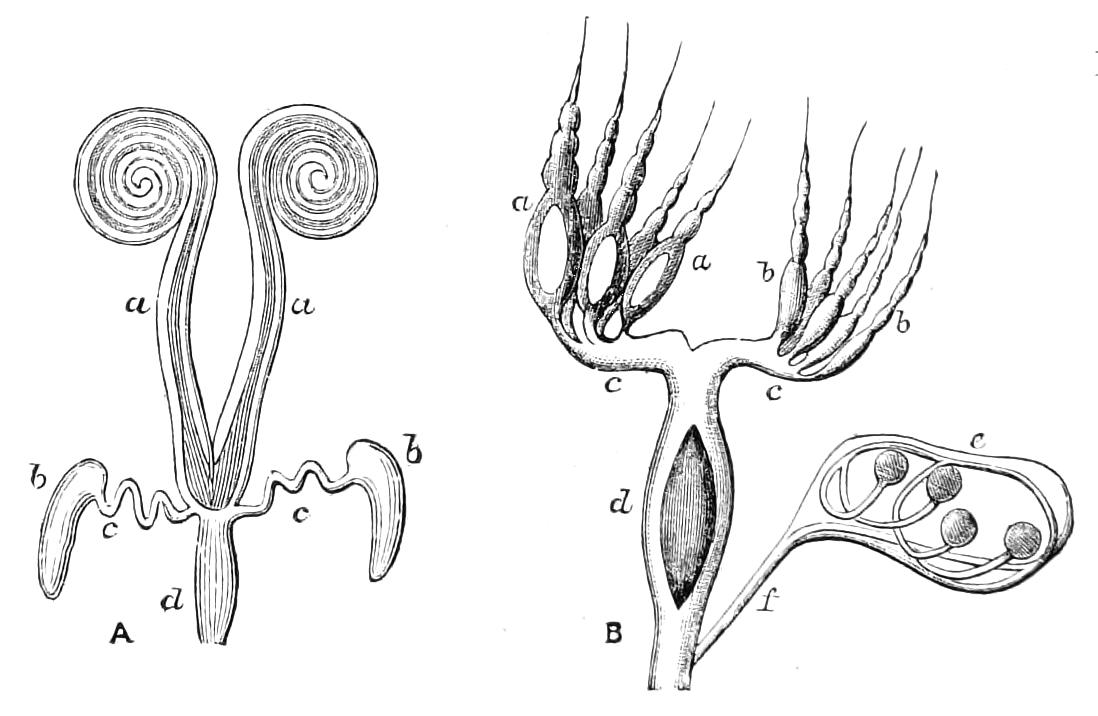
Fig. 244.—Reproductive organs of Clothilla pulsatoria. A, Male; a, vesiculae seminales; b, testes; c, vasa deferentia; d, ejaculatory duct. B, Female; a, b, egg-tubes; c, oviduct; d, uterus, containing egg; e, accessory gland (the enveloping sac in section); f, its duct. (After Nitzsch.)
The internal anatomy is only very incompletely known. Nitzsch[308] has, however, described the alimentary canal and the reproductive organs of Clothilla pulsatoria. The former is remarkably simple: no proventriculus or crop was found; the stomach is very elongate, and consists of a sac-like anterior portion and an elongate, tubular posterior part. There are four Malpighian tubes. The posterior part of the canal is remarkably short, the small intestine being scarcely as long as the rectum. The ovaries (Fig. 244, B) consist of five egg-tubes on each side; connected with the oviduct there is a peculiar accessory gland consisting of a sac containing other small sacs each with an elongate efferent duct; the number of the secondary sacs varies from one to four according to the individual. The testis (Fig. 244, A, b) is a simple capsule; connected with the base of the ejaculatory duct there is a pair of elongate accessory glands or vesiculae seminales.
The life-history has never been satisfactorily sketched. The young greatly resemble the old, but have no ocelli or wings, and sometimes the tarsi are of two joints, while in the adult they have three. The antennae have also in these cases a less number of joints in the young stage. The food is animal or vegetable refuse substances; many live on fungoid matter of various kinds, mouldy chaff being, it is said, a favourite pabulum; the mould on palings is a source of food to many; others live on the rust-fungi of leaves, and many frequent the bark of trees. They are able to spin webs, probably by the aid of the lingual glands; the eggs are deposited, in some cases, on leaves and covered with a web. Hagen says that a peculiar organ, possibly a gland—he calls it a hose[309]—exists at the base of the tarsal claws. In our climate most of the species pass the winter in the egg-state. There may be two generations in a year, perhaps more.
The nomenclature of the wing-veins of Psocidae has given rise to much discussion.[310] The system shown in the accompanying figure is probably the most convenient; the subcostal vein (2) is always obscure, and sometimes can only be detected by very minute examination. Some interesting information as to the minute structure and mode of formation of the wings and their nervures has been given by Hagen.[311]
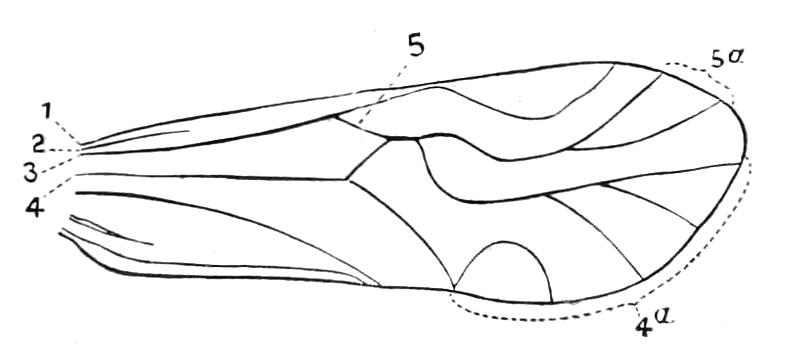
Fig. 245.—Anterior wing of Elipsocus brevistylus. (After Reuter.) 1, Costal vein; 2, subcostal; 3, radial; 4, cubitus; 4a, branches of cubitus; 5, sector of the radius; 5a, forks thereof.
In the young the wings first appear as buds, or outgrowths of the sides of the meso- and meta-thorax; afterwards the prothorax decreases, while the other two thoracic segments and the wing-rudiments attached to them increase. The wings from their very origin appear to be different from those of the Orthoptera, and the changes that take place in the thoracic segments in the course of the development, differ from those that occur in Orthoptera.
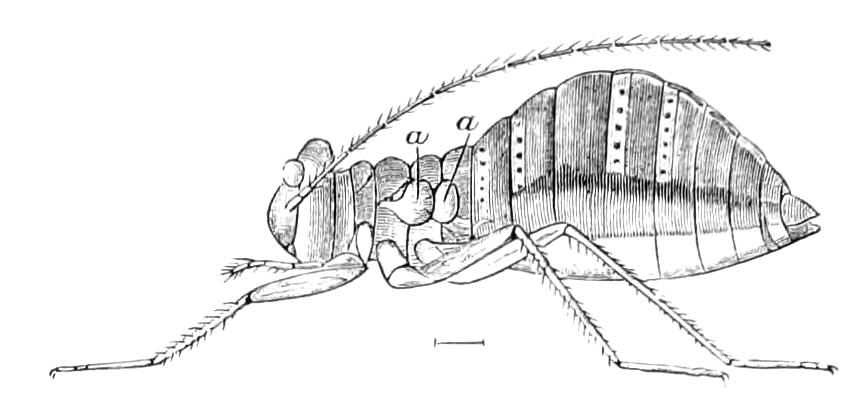
Fig. 246.—Micropterous form of Mesopsocus unipunctatus. a, a, Wings. (After Bertkau.)
There are several peculiarities connected with the wings. Frequently they exist, though of no use for flight; some Psocidae that have perfectly-formed wings are so reluctant to use them that, M‘Lachlan says, they will allow themselves to be crushed without seeking to escape by flight. At certain periods, however, some Psocidae float on the wing in considerable numbers, especially in a moist still atmosphere, and then drift about like the winged Aphididae, which are frequently found with them. There is evidence that individuals, or generations, of some of the winged species occur with only rudimentary wings; although this has been denied by Kolbe, there can be no doubt about it. The form figured above (Fig. 246) was described by Bertkau[312] as a distinct genus, but was afterwards recognised by him[313] to be a short-winged form of Mesopsocus unipunctatus. It is probable that the adult female of this species has the wings always micropterous, while the male has these organs of the full size. In other species the condition of the rudimentary wings seems to be quite constant. The facts concerning the wings of Psocidae are so peculiar that Kolbe came to the conclusion that the organs exist not because they are of use for flight, so much as because it is the nature of an Insect to develop wings.[314]
Some of the species of Psocidae have never any trace of wings. These apterous forms are mostly included in the division Atropinae, and are usually very minute; it has been again and again erroneously stated that they are the young state of winged forms. Hagen kept a large colony of Atropos divinatoria for some years in confinement, so that he saw numerous generations as well as many specimens. He found the apterous condition quite constant.
The association of ocelli with wings is nearly constant in Psocidae. The genus Clothilla—allied to Atropos—possesses very rudimentary wings but no ocelli. Hagen, however, found[315] that in a certain locality no less than 12 per cent of the individuals of this species were provided with ocelli,—a most extraordinary variation.
In some of these apterous forms there is found on each side of the prothorax a tubercular prominence which, according to Hagen, can be considered only as the rudiment of a wing that never develops. Though no existing Insect is known to possess rudimentary wings on the prothorax, we have previously mentioned (p. 344) that in the Carboniferous epoch appendages of the nature alluded to were not very rare.
A genus of living forms—Hyperetes—in which the three thoracic segments are well developed, but in which there are no alar appendages or rudiments, is considered by Hagen to be more primitive than the Psocidae found in amber to which we shall subsequently allude.
The number of described species of Psocidae does not reach two hundred; we have, however, thirty species or more in Britain.[316] Nietner observed about the same number in the immediate vicinity of his house in Ceylon. The isolated and remote Hawaiian group of islands is remarkably rich in Psocidae. Two thousand is a moderate estimate of the number of existing species. The largest forms yet discovered belong to the Brazilian genus Thyrsophorus; they attain, however, a breadth of only about one inch with the wings fully expanded. The Cuban genus Embidopsocus is said to be of great interest from its approximation to Embiidae. It is at present very inadequately known.
One (or more) very minute Insects of this family—Clothilla pulsatoria according to Hagen, Atropos[317] divinatoria according to some other authors—is widely known under the name of the death-watch, owing to its being believed to make a peculiar ticking noise, supposed to be prophetic of the decease of some individual—a human being we fancy, not a death-watch. It is difficult to believe that so minute and soft an Insect can produce a sound audible to human ears, and many entomologists are of opinion that the sound in question is really produced by a beetle—of the genus Anobium—which lives in wood, and that as the beetle may be concealed in a hole, while the Clothilla is seen running about, the sound is naturally, though erroneously, attributed to the latter. But the rapping of the Anobium is well known, is produced while the Insect is at large, and is said to be a different noise from that of the Psocid; evidence too has been given as to the production of the sound in a workbox when the Psocid was certainly present, and the most careful search failed to reveal any beetle.
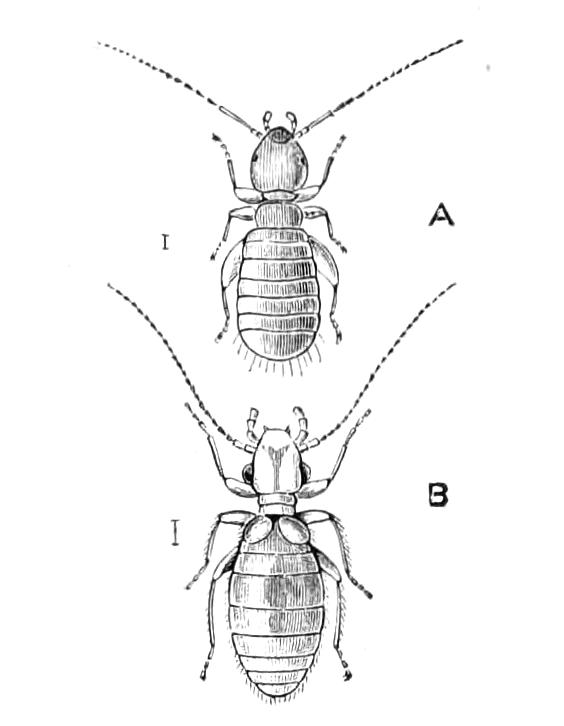
Fig. 247.—A, Atropos divinatoria; B, Clothilla pulsatoria. (After M‘Lachlan.)
The Rev. W. Derham, who two hundred years ago was Rector of Upminster, in Essex, and was well known as a distinguished writer and philosopher, gave an account of the ticking of death-watches to the Royal Society.[318] This gentleman was a most accurate and minute observer; he was well acquainted with the ticking of the greater death-watch—Anobium—which he describes very accurately, as well as the acts accompanying it, the details he mentions being exactly such as occur at the present time. He not only heard the ticking of the Psocid or lesser death-watch, but repeatedly witnessed it. He says: "I am now so used to, and skilful in the matter as to be able to see, and show them, beating almost when I please, by having a paper with some of them in it conveniently placed and imitating their pulsation, which they will readily answer." He also states that he could only hear them beating when it was done on paper, and that this death-watch will tick for some hours together without intermission, with intervals between each beat, so that it much resembles the ticking of a watch. The act of ticking was accompanied by rapping the front of the head on the paper, but Mr. Derham could not be sure that the sound was produced in that manner, because each stroke was also accompanied by a peculiar shudder, or recoil. After a prolonged ticking he observed that another individual of the other sex made its appearance. The species figured by Mr. Derham more resembles a Hyperetes than it does either of our two known book-lice, Atropos and Clothilla.
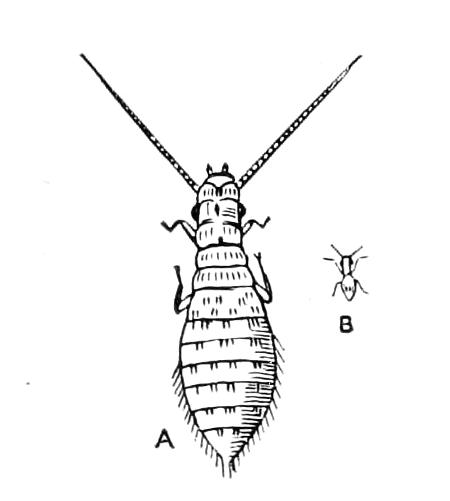
Fig. 248.—The lesser death-watch of Upminster. (After Derham.) A, magnified; B, natural size.
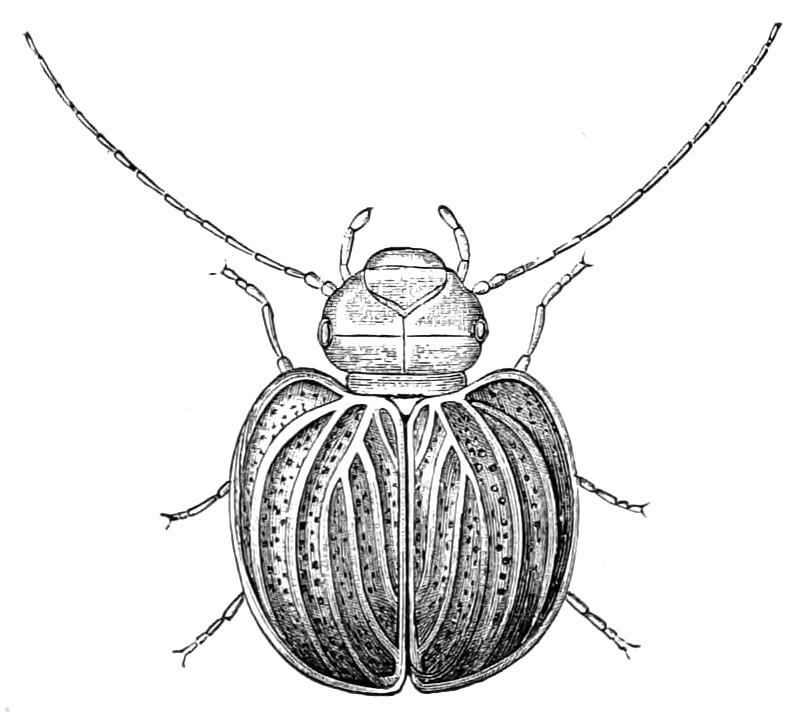
Fig. 249.—Sphaeropsocus kunowii. From amber. × 30. (After Hagen.)
Numerous species of Psocidae are preserved in amber; Hagen[319] has made a careful study, based on a considerable number of specimens, of about thirteen such species. They belong to no less than nine genera and five sub-families. Sphaeropsocus is the most remarkable; this Insect has a well-developed prothorax, as is the case in the wingless Psocids, and a pair of large wings or tegmina meeting by a straight suture along the back, as is usual in beetles, though quite unknown in existing Psocidae. Another species, Amphientomum paradoxum, has the body and appendages covered with scales like a butterfly or moth; other species, found in gum-copal or still living, have scales on various parts of the body, but not to so great an extent as this amber species. The genus Amphientomum is still represented in Ceylon and elsewhere by living forms; Packard has figured some of the scales;[320] they appear to be extremely similar to those of Lepidoptera or Thysanura. The facts connected with this fauna of amber Psocidae would seem to show that the family was formerly more extensive and important than it is at present; we should therefore expect to find numerous fossil forms in strata of date anterior to that of the amber; but this is not the case, all that is known as to fossil Psocidae being that Scudder has recently ascribed traces of an Insect found in the Tertiary rocks of Utah to this family as a distinct genus.
Fam. V. Perlidae.
Insects of moderate or large size, furnished with four membranous wings; these are usually complexly reticulate; the hind pair are much the larger, and have a large anal area of more simple venation, which becomes plicate when folded. The coxae are small, the legs widely separated. The larvae are aquatic in habits; the metamorphosis is slight.
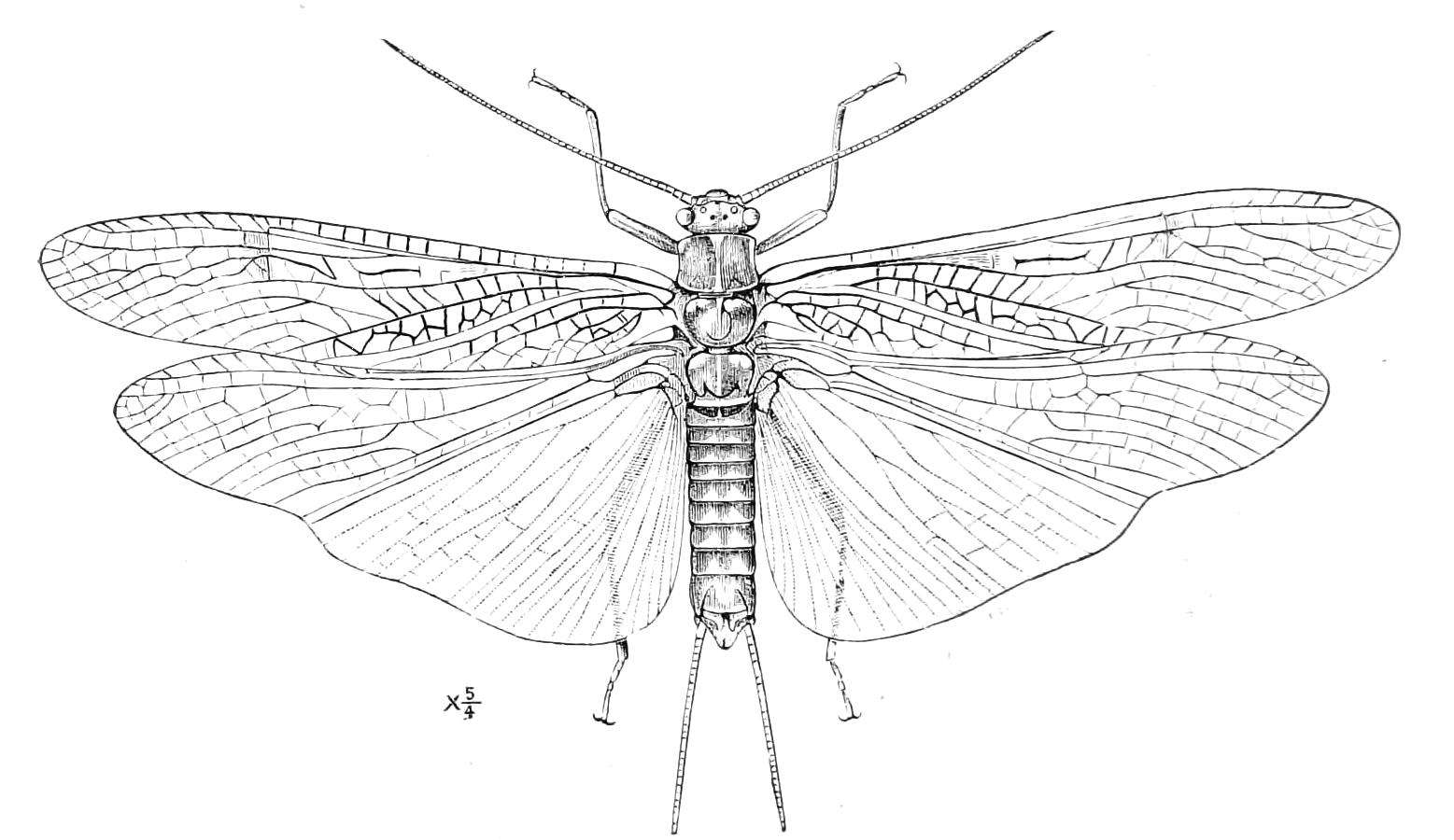
Fig. 250.—Pteronarcys frigida, male. (After Gerstaecker.)
The Perlidae form a small family of Insects unattractive in their general appearance. The life-history of each individual consists of two abruptly contrasted portions; the earlier stage being entirely aquatic, the later aerial. Hence the Perlidae come into the amphibious division of Neuroptera. The definition we have given above would, except as regards the texture of the front wings and the aquatic habits of the larvae, apply to many Insects of the Order Orthoptera. The Phryganeidae, another family of Neuroptera, have aquatic larvae and wings somewhat similar in form to those of the Perlidae, but the members of the two families cannot be confounded, as the Phryganeidae have hairy front wings and large and contiguous coxae.
The antennae of the Perlidae are long, very flexible, and composed of a very large number of joints. The parts of the mouth vary a good deal. The mandibles and maxillae are usually rather small, and all the parts of the mouth are of feeble consistence or even membranous; the maxillary palpi are, however, well developed and exserted from the mouth, five-jointed. The labium is short and but little conspicuous. The mandibles in some forms are almost membranous, but in other genera they are firmer and are toothed. The labium is composed of a very large mentum, beyond which is a large piece, usually undivided, bearing the four terminal lobes; the three-jointed palpus is seated on the side of the large middle sclerite, which is no doubt of composite nature. Considerable variety as to the lower lip prevails. The head is broad and flat; there is an indistinctly-indicated clypeus, three—more rarely two—ocelli, and on each side an eye neither very large nor perfect. The prothorax is free, and has a flat, margined notum. The meso- and the meta-thorax are large, equal segments. The pro-, meso-, and meta-sternum are large pieces; between the first and second, and between the second and third there is an intervening membrane. The metasternum is much prolonged backwards, and has on each side a peculiar slit; similar orifices exist on the other sterna (Fig. 254, o). Newport, who has examined them in Pteronarcys, says that they are blind invaginations of the integument; he calls them the sternal or furcal orifices.[321] According to this naturalist these very peculiar openings pass into the body "as strong bone-like tubes, diverging from the axis to the periphery of the body in the immediate vicinity of some of the principal tracheae, but that they do not in any way communicate with them, as they terminate abruptly as caecal structures." He thinks them analogous with the endo-skeleton of other Insects; a view which cannot be considered sufficiently established. Laboulbène states[322] that when Perla parisina is seized and placed on its back, it does not move, but emits a liquid at the base of the articulation of the legs. This suggests that it may come from these sternal orifices. The abdomen consists of ten dorsal plates, the first being short, and of nine ventral; the dorsal plates are much more ample transversely than the ventral. Frequently the hind body is terminated by two long, many-jointed cerci, looking like antennae. The coxae are small, not prominent, and are directed outwards. The legs are slender, the tibiae often grooved. The tarsi are three-jointed, terminating in two claws and a more or less distinct pad. In the genus Isopteryx an auditory organ has been described as existing in the legs, in a position similar to that of the analogous structures in Termitidae and Blattidae. The wings when closed repose flat on the back, and fold and overlap so that only one is seen (Fig. 251); in this state the costal portion of each front wing is turned downwards, so as to protect to some extent, the sides of the body.
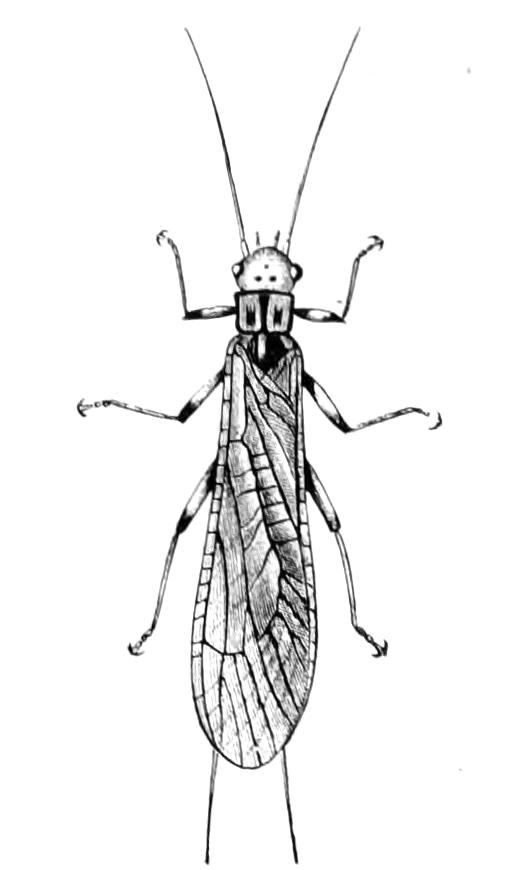
Fig. 251.—Perla maxima. (After Pictet.)
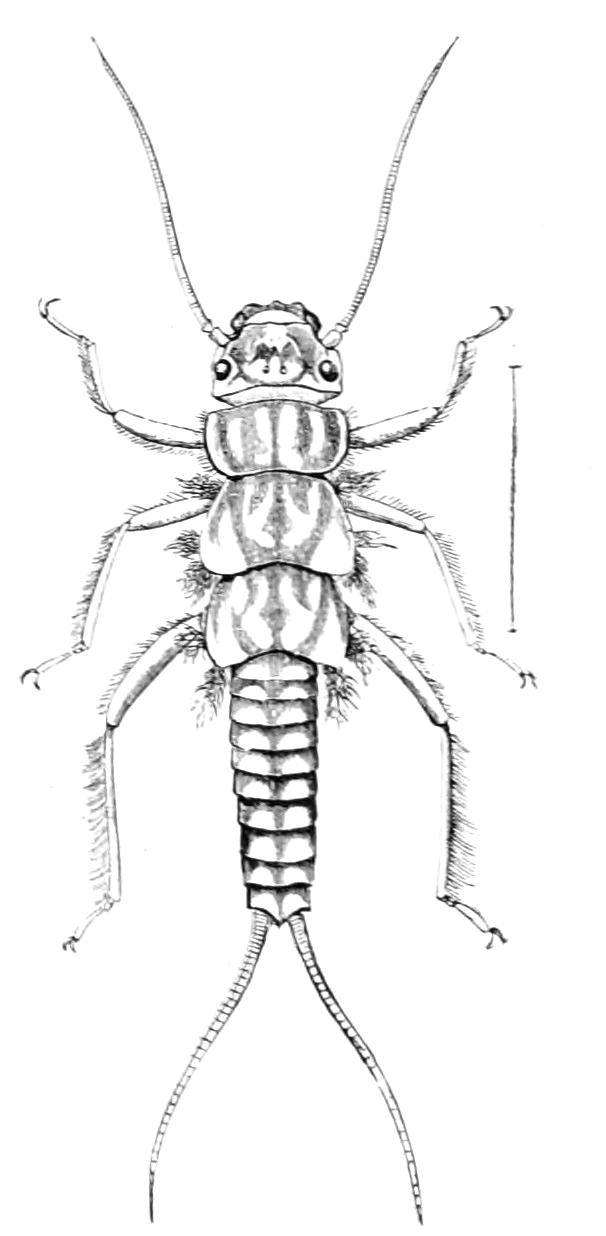
Fig. 252.—Perla sp., nymph, showing tracheal gills. Pyrénées orientales.
The early stages are known, but have not been described minutely, and there appears to be very little information as to the youngest life. All the species are, when immature, aquatic in their habits; the larvae greatly resemble the perfect Insects in form, though differing in not possessing wings and in the ocelli being merely opaque spaces. They have rather large compound eyes; the future wings are represented by lobe-like prolongations—varying in length according to age—of the meso- and meta-notum. In the Nemourae the cerci are absent in the imago though present in the young. The larvae of Perlidae are carnivorous and are able to swim well, the legs being provided with abundant swimming hairs; they, however, as a rule, prefer to walk at the bottom of the pool, or on rocks or boulders in the water they live in.
One of the most peculiar features of the Perlidae is their respiratory system. Unfortunately the greatest differences of opinion have prevailed on various matters in connexion with this subject, and there are several points about which it is not possible at present to express a decided opinion.
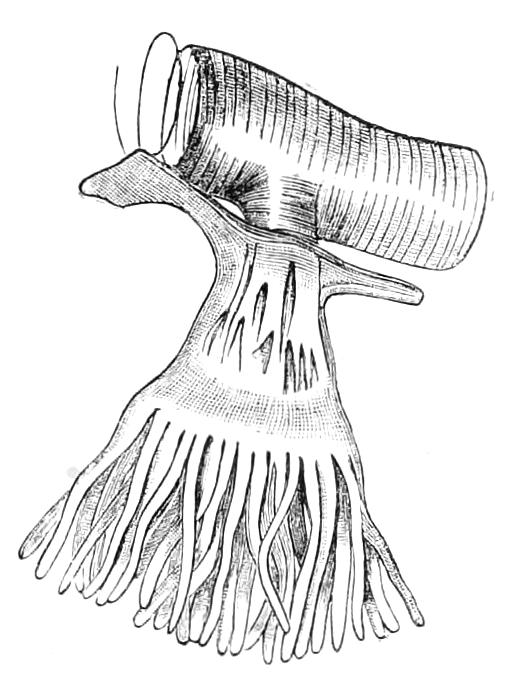
Fig. 253.—Tracheal gill and portion of a trachea of Pteronarcys. (After Newport.)
The larvae have no stigmata; it appears to be generally agreed that there is in them no means of admitting air to the tracheal system by means of orifices. Some breathe entirely through the integument, the process being aided by the accumulation of tracheae at the spots where the breathing orifices should be, and where the integument is more delicate. Others, however, possess gills in the form of protruded bunches of filaments, connected with tracheae in the manner shown in Fig. 253. These filamentous branchiae occur in numerous species of the family, and are situate on various parts of the body, but many species are destitute of them in genera, other members of which possess the filaments. In some Nemourae instead of bunches of filaments there are tubular projections on the prothoracic segment; and in Dictyopteryx signata similar structures occur even in the cephalic region, Hagen stating[323] that there exists a pair on the submentum and another on the membrane between the head and the thorax. In the imago state, stigmata are present in the normal fashion, there being two thoracic and six abdominal pairs. In several species the filaments persist in the imago, so that in these cases we meet with the curious condition of the coexistence of branchiae with a well-developed and functionally active system of spiracles; this is the more curious because the creatures usually have then nothing to do with the water, it having been ascertained that in these cases the species live out of the water as other terrestrial and aerial Insects do. These instances of persistence of branchiae during the aerial life have been the source of some perplexity; the condition was shown to exist in Pteronarcys by Newport, and has since been demonstrated in various other forms. Newport believed that the imago of Pteronarcys breathes by means of the gills, although it lives out of the water and possesses spiracles; and he informs us that Mr. Barnston observed the Insect when on the wing "constantly dipping on the surface of the water." Hence Newport concluded that Pteronarcys in the winged state is "an amphibious animal." That a winged Insect should live in the air and yet breathe by means of gills would be truly extraordinary, and there can be little doubt that Newport's idea was erroneous. Hagen[324] was able to examine living imagos of the species in question. He found that they avoided the water, and though he placed some individuals therein, yet they did not use the gills. He also informs us that the branchiae have, during life, a shrivelled appearance, indicating that they are not functionally active, but are merely useless organs carried over to the imago from the previous instar, in which they were truly the means of obtaining air. Hagen also ascertained that the spiracles of the imago are in a normal state, being adapted for breathing, even as far back as the seventh abdominal segment.
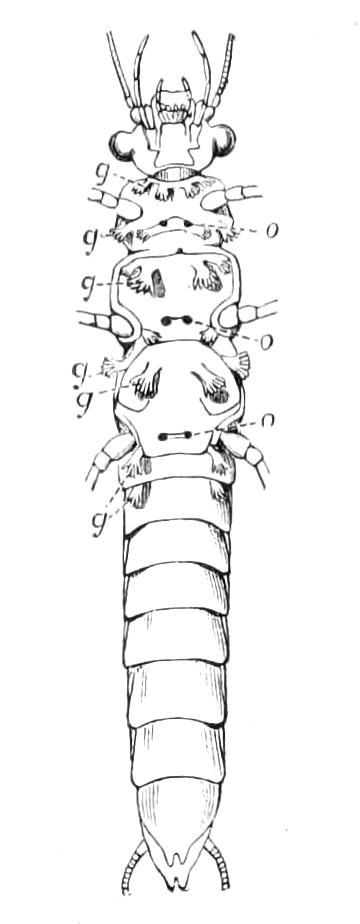
Fig. 254.—Under side of body of Pteronarcys regalis, imago. (After Newport.) g, Tracheal gills; o, sternal orifices.
Great difference of opinion has prevailed as to the relations of the branchiae to the stigmata, it having been contended that the falling off of some of the branchiae left the stigmatic orifices. The facts appear to be only consistent with the conclusion that the two are totally independent organs. This subject has been investigated by Palmén,[325] who finds that in Perlidae—contrary to what occurs in may-flies—the species are either entirely destitute of gills, or these organs are persistent throughout life. It is not to be inferred from this that the gills in the perennibranchiate Perlidae are as conspicuous as they are in the exceptional Pteronarcys: for it appears that at the final moult the gills usually become very much contracted and concealed by the new integument; in some cases they merely appear as slight prominences in the neighbourhood of the stigmata.
Pictet, Dufour, Newport, and Imhof[326] have studied the internal anatomy. The alimentary canal is remarkable for the enormous oesophagus; there is no distinction between this and the crop. A proventriculus is quite absent, and there are no chitinous folds in the position it usually occupies. The true stomach is small, and only commences in the fourth abdominal segment. It has a prolonged lobe on each side in front, and in addition to this eight sacs; thus there are formed ten diverticula, fastened to the posterior part of the oesophagus by ligaments. The terminal portion of the stomach is small, and apparently only distinguished from the short intestine by the point of insertion of the Malpighian tubes; these vary in number from about twenty to sixty. There are two pairs of large salivary glands. In Pteronarcys the caecal diverticula of the stomach are wanting. In some Perlidae the terminal parts of the gut are more complex than in Perla maxima; Newport figures both an ilium and colon very strongly differentiated, and states that these parts differ much in Perla and Pteronarcys. According to him the stomach is embraced by a network of tracheae, and Imhof tells us that he found the stomach to contain only air.
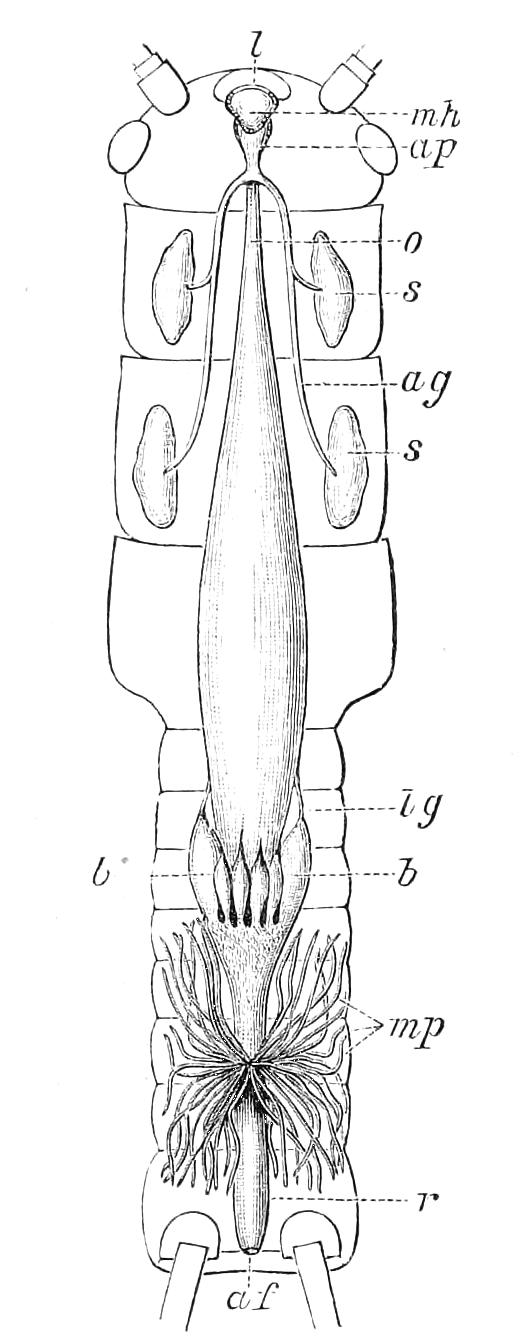
Fig. 255.—Alimentary canal and outline of body of Perla maxima. (After Imhof.) l, Upper lip; mh, buccal cavity; ap, common termination of salivary ducts; o, oesophagus; s, salivary glands; ag, duct of salivary gland; b, anterior diverticula of stomach; lg, their ligaments of attachment; mp, Malpighian tubes; r, rectum; af, anal orifice.
The brain is small, but, according to Imhof, consists of four amalgamated divisions; the infra-oesophageal ganglion is small, and placed very near the brain. There are three thoracic and six abdominal ganglia on the ventral chain. The nerves to the wings are connected with the longitudinal commissures of the ventral chain by peculiar, obliquely-placed, short commissures. The reproductive glands are peculiar, inasmuch as in each sex the pair of principal glands is connected together in the middle. The testes thus form an arch consisting of a large number of sub-spherical or pear-shaped follicles; the vasa deferentia are short in Perla maxima, and there are no vesiculae seminales; the ejaculatory duct is divided into three parts by constrictions. In Pteronarcys and in Perla bicaudata, according to Newport and Dufour, the vasa deferentia are very long and tortuous, and there are elongate vesiculae seminales. The arrangement of the extremely numerous egg-tubes is analogous to that of the follicles of the testes, so that, as Dufour says, there is but a single ovary; connected with the short, unpaired portion of the oviduct, there is a large receptaculum seminis, and near the terminal orifice of the duct there is in P. maxima an eight-lobed accessory gland.
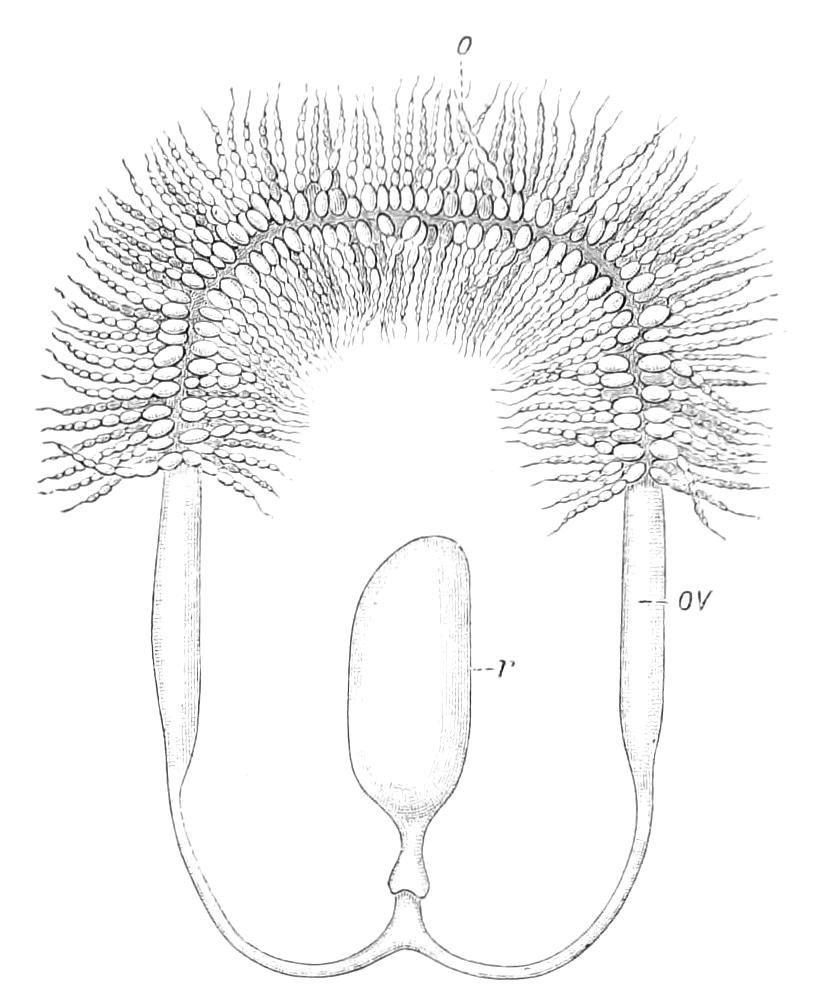
Fig. 256.—The pair of united ovaries of Perla maxima: o, egg-tubes; ov, oviduct; r, receptaculum seminis concealing the orifice of the duct and an accessory gland.
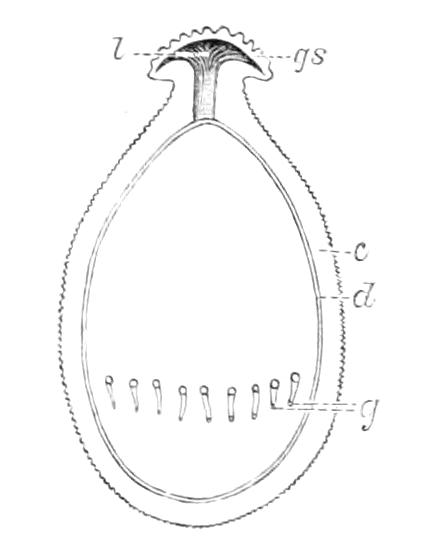
Fig. 257.—Egg of Perla maxima. (After Imhof.) c, chorion; d, oolemn; gs, glass-like covering of micropyle apparatus; l, cavity under same; g, canals penetrating chorion.
The eggs are produced by Perlidae in enormous numbers: they are rather small, but peculiar in form, and possess at one extremity a micropyle apparatus, covered by a glassy substance through which Imhof could find no orifice. On the other hand, the chorion on another part of the egg is perforated by several canals.
The Perlidae being of aquatic habits in their early stages, and, notwithstanding their ample wings, very poor adepts in the art of flying, are rarely found at any considerable distance from their native element. They are specially fond of running water, and delight in the neighbourhood of waterfalls, or other spots where the current is broken by obstacles so that a foaming water results. It is probable that the larvae which breathe by means of gills find an advantage in living in strongly-aerated water. Mountain streams and torrents are therefore specially affected by them; but Pictet informs us that they do not like the waters descending from glaciers. The food of the larvae is believed to be chiefly young may-flies, or other small, soft creatures, and it may possibly be owing to the absence of these that the Perlidae do not affect the glacier streams. Although Perlidae are remarkable for their capacity for enduring cold, it is possible that they may require warmth of the water at some period of their development, and this the glacier-streams cannot offer to them. They are among the earliest Insects to appear in the spring in Europe. Mr. Barnston says that on the Albany river in Canada the nymph of Capnia vernalis comes up frequently in the cracks of the ice and casts its skin there; "it frequently comes up when the thermometer stands at freezing." Of Nemoura glacialis, which inhabits similar localities, he says that "it appears in the spring (end of March or beginning of April) when the ice becomes honeycombed, and even before then, at the same time as Capnia vernalis. It pairs in the crevices of decaying ice. The male has long antennae, and his wings are generally rumpled as if glued together." Newport entertained the idea that those Perlidae that live at low temperatures are of lower organisation than the other forms of the family.
It is a remarkable fact that several Perlidae frequently have—like Nemoura glacialis—the wings of the male much reduced in size; this being the contrary of the rule that usually prevails among Insects to the effect that, when there is a difference in the powers of flight, or even in the size of the wings, it is the male that is superior. Mr. J. J. Lister met with a very interesting Perlid at Loch Tanna in Arran at the beginning of April 1892. In this Insect, which is, according to Mr. M‘Lachlan, a form of Isogenus nubecula, the wings of the female (Fig. 258, B) are reduced to a size much less than those of ordinary Perlidae, while those of the male (Fig. 258, A) are mere useless rudiments. Morton has pointed out that in Scotland more than one species of Taeniopteryx occasionally produces micropterous males, and he associates this phenomenon with the early time of their appearance "almost in winter."[327] In Nemoura trifasciata this reduction of the wings takes another but equally curious form; the hind wings of the male being long enough to cover the body, while the anterior pair are reduced to mere rudiments.
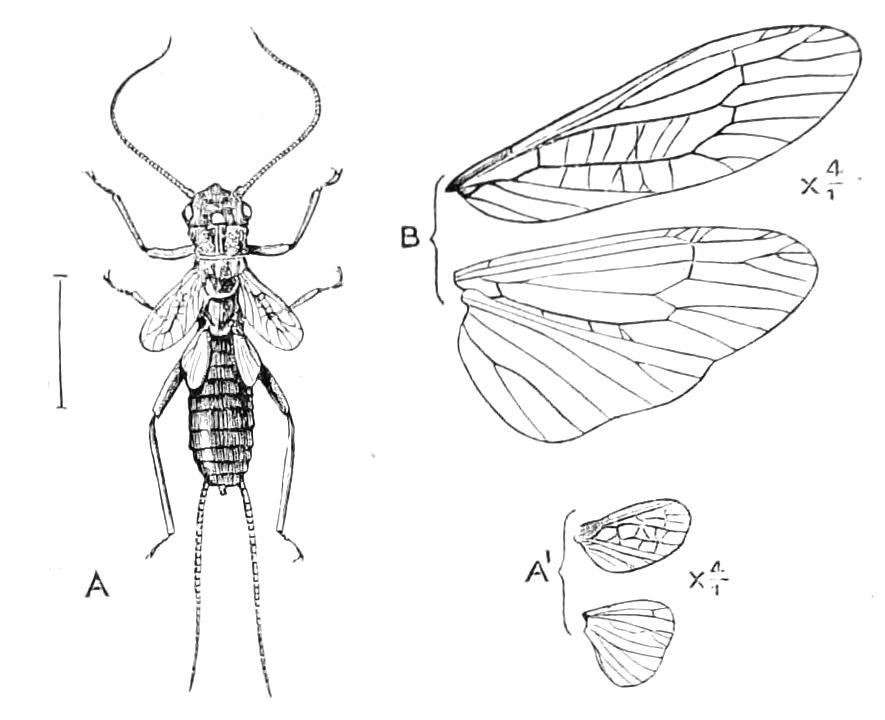
Fig. 258.—Isogenus nubecula, Loch Tanna. A, Male; A', wings of male more magnified; B, wings of female.
The phenomena of micropterism in Perlidae are well worthy of more detailed investigation. Mr. Morton informs the writer that the male of Perla maxima (Fig. 251) in North Britain has the wings so short that they cannot be of any use as organs of flight. In Central Europe the wings are ample, as shown in our figure. In Perla cephalotes the male is short-winged in both Britain and Central Europe; of the male of Dictyopteryx microcephala only the micropterous form is known to exist. In Isogenus nubecula (Fig. 258) it appears that the wings of the female are always more ample than those of the male of the same locality, and that local micropterism affects the two sexes unequally. Within the Arctic circle this Insect is usually of the Scotch form, though the male there occasionally has more ample wings.
It has been observed that in some Perlidae the eggs, after they have been extruded, are carried about by the female; for what reason is not at all known. They are said to be enclosed in a membranous capsule at the apex of the abdomen. The number of eggs deposited is sometimes very large, amounting to five or six thousand, and they are often of very minute size.
About twenty-four species of Perlidae occur in Britain.[328] The species from all parts of the world existing in collections probably scarcely exceed two hundred. The insignificance of this number is no doubt chiefly due to the fact that these unattractive Insects are rarely captured by collectors, and are so fragile that unless good care is taken of them, specimens soon go to destruction after being dried. Perlidae are known to occur in most parts of the world, so that the number of species really existing may reach two or three thousand. They are known to anglers as stone-flies and creepers and are a favourite bait for trout.
The family in its character comes near to the Orthoptera, especially to the more simple forms of Phasmidae, but the two groups differ in the texture of the front wings and in the structure of the mouth-parts, as well as in the different proportions of the mesothorax and metathorax. According to Pictet, in the Australian genus Eusthenia the trophi (Fig. 259) approach nearer to those of the Orthoptera, so that it appears possible that a more intimate connexion will be found to exist as more forms are discovered. Of the groups we include in Neuroptera, Perlidae are in structure most allied to Sialidae, but the development in the two groups exhibits very important distinctions. Brauer treats the Perlidae as forming a distinct Order called Plecoptera, a name applied to the family by Burmeister many years ago.
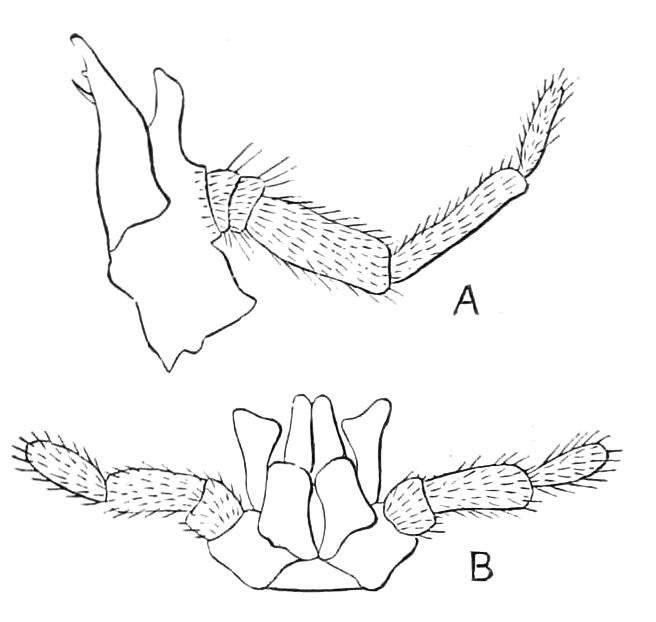
Fig. 259.—A, Maxilla, B, labium of Eusthenia spectabilis. (After Pictet.)
Several species of Perlidae, considered to belong to existing genera, have been found in amber. A fossil from the Eocene deposits in the Isle of Wight and another from the Miocene of Continental Europe are referred to the family. Brauer has recently described[329] some fossils from the Jurassic formation in East Siberia as forming three genera, now extinct, of Perlidae.
Brongniart informs us[330] that several fossils have been found in the Carboniferous strata of Commentry that justify us in asserting that allies of Perlidae then existed. He considers these Carboniferous Insects to have belonged to a separate family, Protoperlides. The fragments are, however, so small that we must await further information before forming a definite opinion as to these Protoperlides.