Chapter XX
Reading edition
NEUROPTERA PLANIPENNIA—SIALIDAE, ALDER-FLIES, SNAKE-FLIES—PANORPIDAE, SCORPION-FLIES—HEMEROBIIDAE, ANT-LIONS, LACEWINGS, ETC.
Fam. VIII. Sialidae—Alder-flies and Snake-flies.
Four wings of moderate size, meeting in repose over the back at an angle; the hinder of the two pairs slightly the smaller; the anal area small or nearly absent, not plicate. Nervures moderately numerous, transverse veinlets moderately numerous, forming irregularly disposed cells. The metamorphosis is great; there is a quiescent pupa. The larva has the mandibles formed for biting, armed with strong teeth.
The Sialidae, though but a small family of only some six or eight genera, comprise a considerable variety of forms and two sub-families—Sialides and Raphidiides. The former group has larvae with aquatic habits possessed of branchiae but no spiracles.
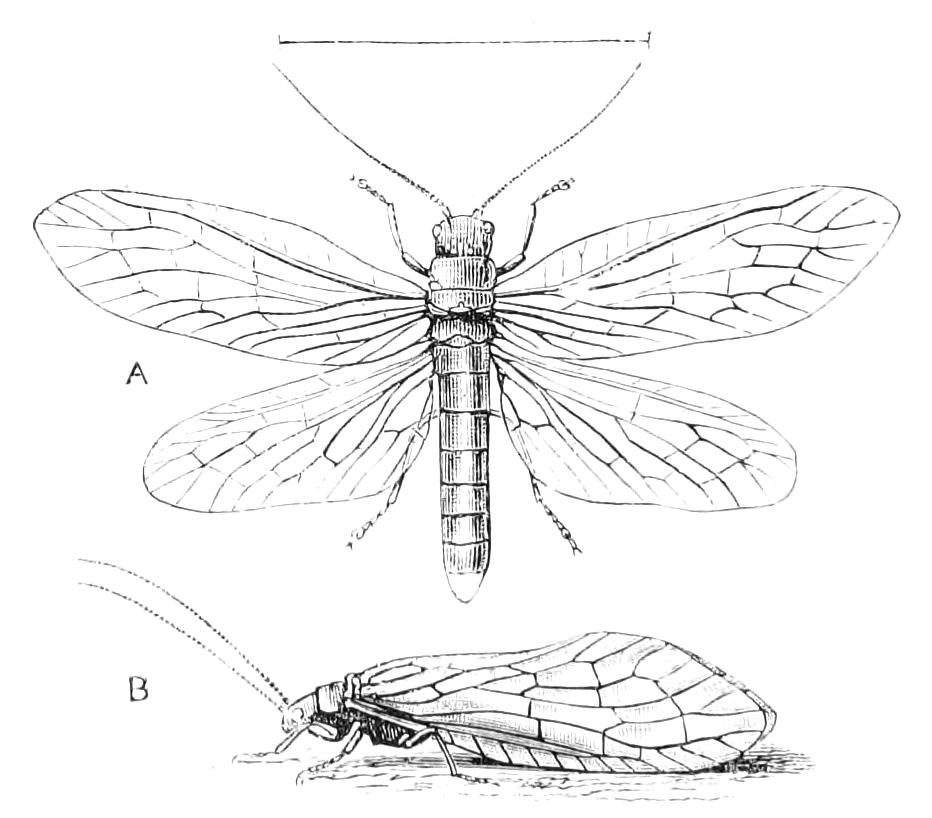
Fig. 286.—The alder-fly, Sialis lutaria. Britain. A, With wings expanded; B, in profile.
Sialis lutaria is one of the commoner British Insects frequenting the vegetation about the banks of tranquil streams; it is well known to anglers, being used by them for a bait. According to Ronalds it is called the alder or orl-fly, and in Wales the humpback.
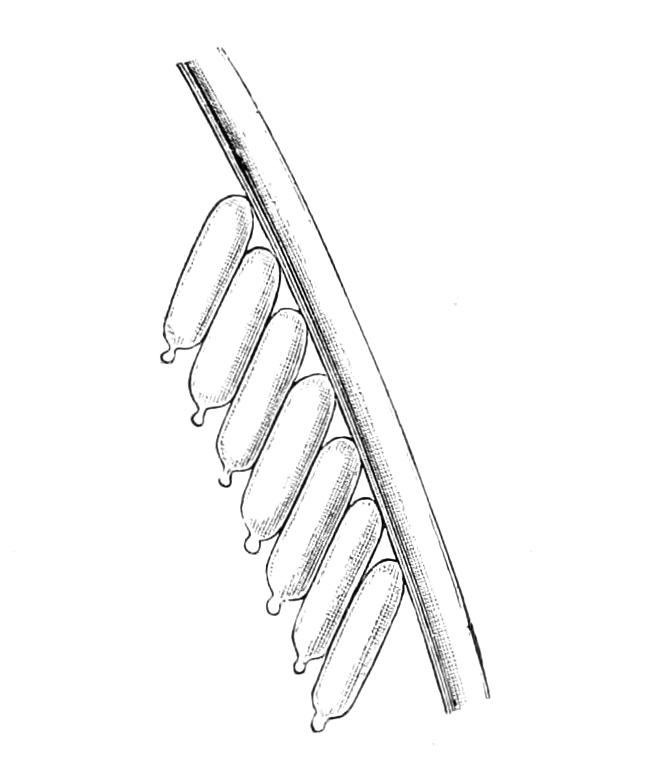
Fig. 287.—Portion of a row of eggs of Sialis lutaria. (After Evans.)
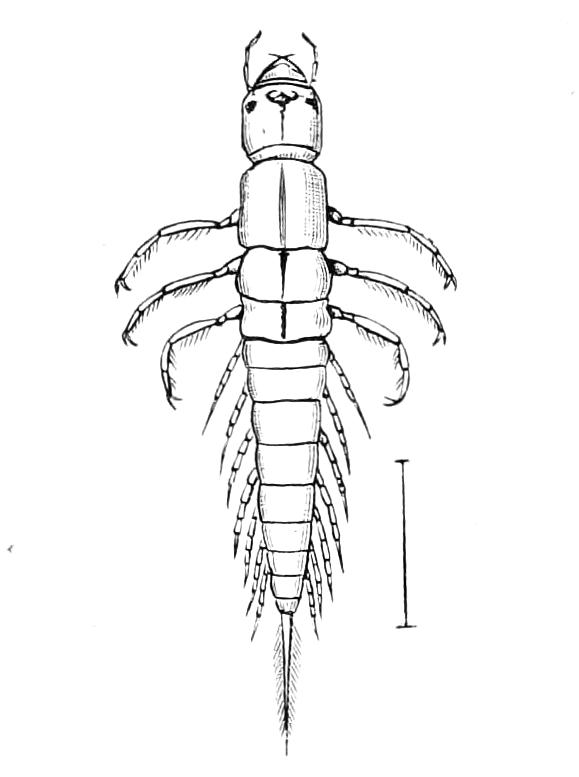
Fig. 288.—Sialis lutaria, larva.
It is very unattractive in appearance, being of a blackish colour, with wings of a yellow-brown tinge, and makes but a poor show when flying. The female deposits patches of elongate eggs, placed on end and packed together in a very clever manner (Fig. 287). These patches of eggs, of a stone-gray colour, are common objects on rushes or stems of grass near water, and it is stated that there may be no less than 2000 or 3000 eggs in one of them. Our figure gives some idea of the mode in which the eggs are arranged, and the curious narrow process that exists at the end of each. The eggs are said to be sometimes placed at a considerable distance from water, so that when the tiny larvae are hatched they must begin their lives by finding the way to a suitable pool or stream. The larvae (Fig. 288) are objects of very great interest owing to each of segments 1 to 7 of the hind body being furnished on each side with a jointed filament, while the last segment ends in a still longer, but unjointed process. These filaments are branchiae by means of which the Insect obtains air, being, as we have said, destitute of spiracles. It is an active creature and waves its filaments in a very graceful manner; this process no doubt aids the branchiae in their respiratory work. These larvae are well able to exist out of water if they have a sufficiently damp environment. They live on animal matter, but their life-history has not been followed in much detail and it is not known how many moults they make. The young larva has the head disproportionately large and the branchial filaments longer. When the growth is completed the larva returns to land, seeks a suitable situation in the soil, and after an interval changes to a pupa, in which the characters of the perfect Insect are plainly visible. Subsequently, without becoming again active, it changes to the perfect Insect, and enjoys, for a few days only, an aerial life.
The anatomy of the larva has been treated by Dufour.[370] The supra-oesophageal ganglion is remarkably small; nothing is said as to the existence of an infra-oesophageal ganglion; there are three thoracic and eight abdominal ganglia; the first pair of these latter are nearer together than the others, and this is also the case with the last three. The alimentary canal in the adult is provided with a large paunch attached to the crop by a narrow neck,[371] but Dufour could find no trace of this in the larva. The structure of the branchiae has also been described by the indefatigable French entomotomist. A tracheal tube sends a branch into one of the appendages (Fig. 289); the branch gives off numerous smaller tracheae, which at their extremities break up into branchlets close to the integument. The tracheal tube that receives each main branchial trachea, sends off from near the point of entry of the latter another trachea, that distributes its branchlets on the alimentary canal. The margins of each appendage are set with swimming hairs, so that the branchiae act as organs of locomotion as well as of respiration, and by their activity in the former capacity increase the efficiency of their primary function.
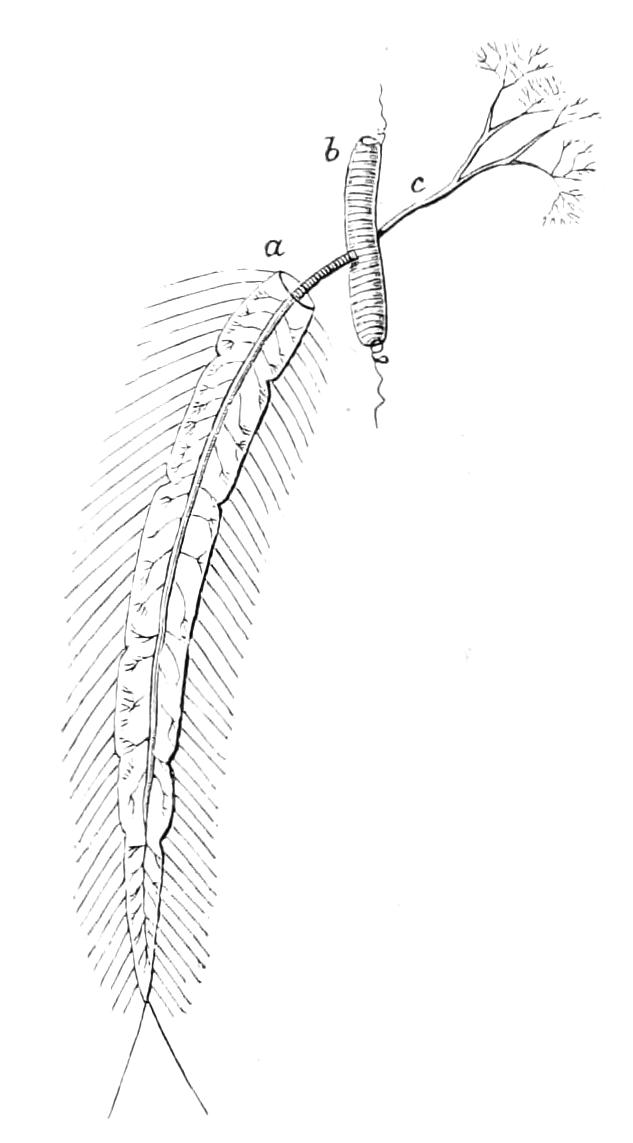
Fig. 289.—Structure of tracheal gill of Sialis lutaria. (After Dufour.) a, Base of the gill; b, tracheal trunk with which it is connected; c, trachea given off to alimentary canal.
The genus Sialis occurs in a few species only, throughout the whole of the Palaearctic and Nearctic regions, and reappears in Chili,[372] though absent in all the intervening area. Several other genera of Insects exhibit the same peculiarity of distribution.
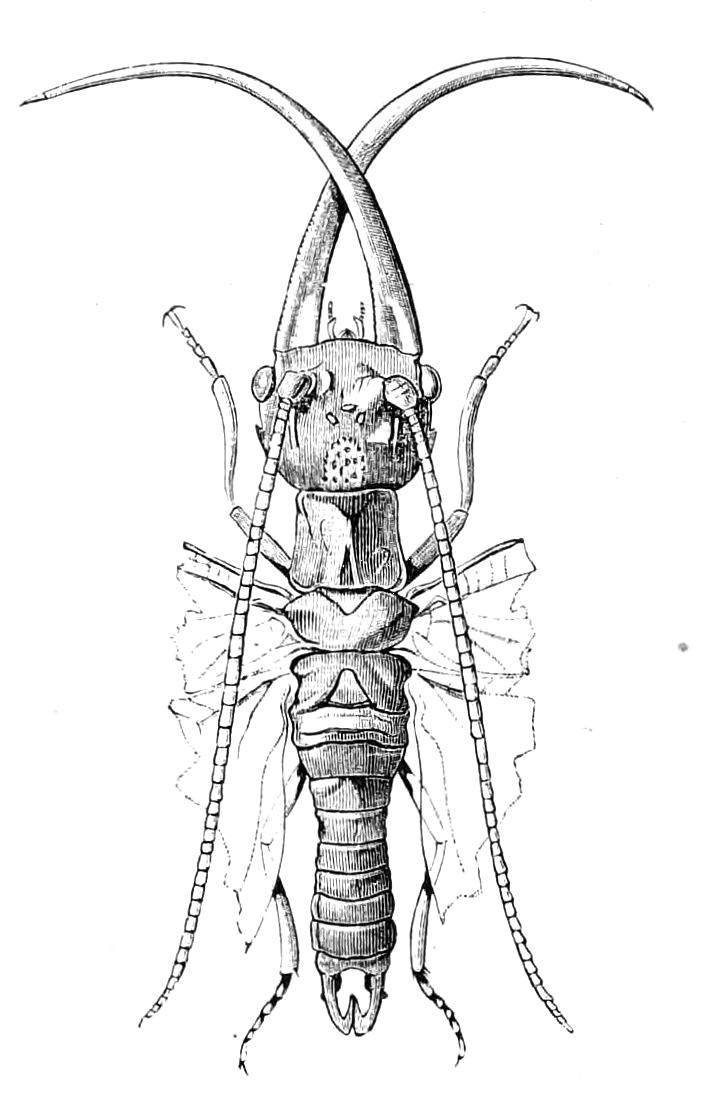
Fig. 290.—Corydalis crassicornis, male, with greater portions of the wings removed. Texas. (After M‘Lachlan.)
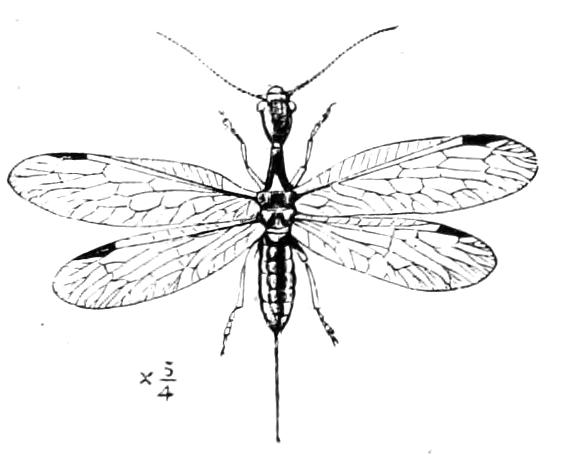
Fig. 291.—Raphidia notata, female. Britain. (After Curtis.)
The genera Corydalis and Chauliodes form a group distinct from Sialis, and are totally different in appearance, being gigantic Insects, sometimes with the mandibles of the male enormously elongated (Fig. 290). The species of Corydalis are called in North America Hellgrammites; Riley has described and figured the metamorphosis of C. cornutus,[373] the life-history being very similar to that of our little Sialis. A mass consisting of two or three thousand eggs is formed by the female, and the young larva has long filaments at the sides of the body like Sialis. These in the later larval life are comparatively shorter, but the Insect is then provided with another set of gills in the form of spongy masses on the under-side of the body. Riley, however, considers that these organs serve the purpose of attachment rather than of respiration. The larvae are known to the Mississippi fishermen as crawlers, and are greatly esteemed as bait.
The Raphidiides or snake-flies form the second tribe of Sialidae. There are only two genera, Raphidia and Inocellia, peculiar to the Palaearctic and Nearctic regions. The perfect Insects are chiefly remarkable for the elongation of the prothorax and back of the head to form a long neck, and for the existence in the female of an elongate exserted ovipositor. The species are rather numerous, and have been recently monographed by Albarda.[374] The three or four British species of the genus are all rare Insects, and occur only in wooded regions.
The Raphidiides, like the Sialides, have a carnivorous larva, which, however, is terrestrial in habits, feeding, it would appear, chiefly on Insects that harbour in old timber. The snake-fly larvae (Fig. 292) are very ingenious in their manner of escaping, which is done by an extremely rapid wriggling backwards. They are capable of undergoing very prolonged fasts, and then alter in form a good deal, becoming shorter and more shrivelled; Fig. 292 is taken from a specimen that had been fasting for several weeks. They are excessively voracious, and hunt after the fashion of beasts of prey; their habits have been described by Stein,[375] who states that he kept a larva from August to the end of May of the following year without food; it then died in a shrivelled-up state. The larva of the snake-fly changes to a pupa that is remarkably intermediate in form between the perfect Insect and the larva; the eyes, legs, wing-pads, and ovipositor being but little different from those of the imago, while the general form is that of the larva, and the peculiar elongation of the neck of the imago is absent. This pupa differs from that of Sialis in the important particular that before undergoing its final ecdysis it regains its activity and is able to run about.
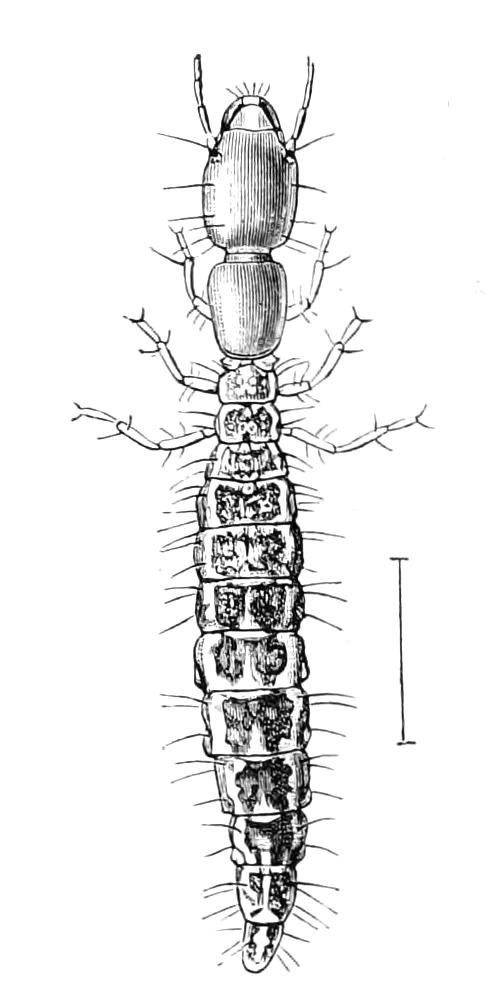
Fig. 292.—Raphidia notata, larva. New Forest.
The internal anatomy of Raphidia has been treated by Loew,[376] and is of a very remarkable character; we can here only mention that the salivary glands consist of a pair of extremely elongate tubes, that there is a very definite paunch attached as an appendage to one side of the crop, and that the most peculiar character consists of the fact that, according to Loew, four of the six Malpighian tubes have not a free extremity, being attached at each end so as to form elongate loops; the mesenteron is very complex in character.
A considerable number of fossil remains from both Tertiary and Mesozoic strata are referred to Sialidae; and a larval form from the red sandstone of Connecticut has been considered by Scudder to be a Sialid, and named Mormolucoides articulatus, but the correctness of this determination is very doubtful (Fig. 293). These fossils are, however, of special interest as being the most ancient Insect larvae yet brought to light. A still older fossil, from the Carboniferous strata of Illinois called Miamia bronsoni, is considered by Scudder to have several points of resemblance to Sialidae.
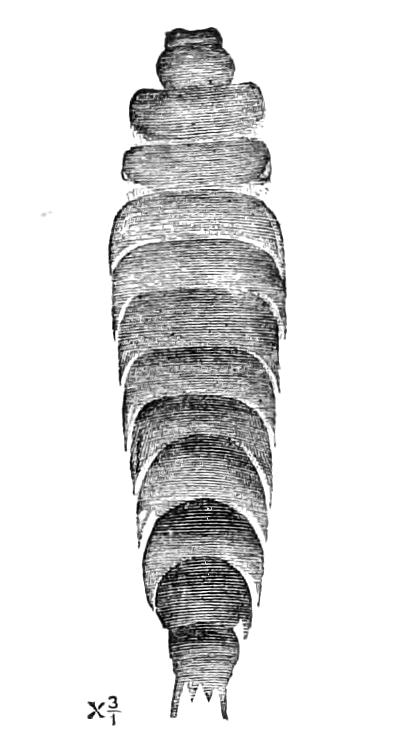
Fig. 293.—Mormolucoides articulatus, larva. Trias of Connecticut. (After Scudder.)
Fam. IX. Panorpidae—Scorpion-flies.
Head prolonged to form a deflexed beak, provided with palpi near its apex; wings elongate and narrow, shining and destitute of hair, with numerous, slightly divergent veins and moderately numerous transverse veinlets (in one genus the wings are absent). Larvae provided with legs, and usually with numerous prolegs like the saw-flies: habits carnivorous.
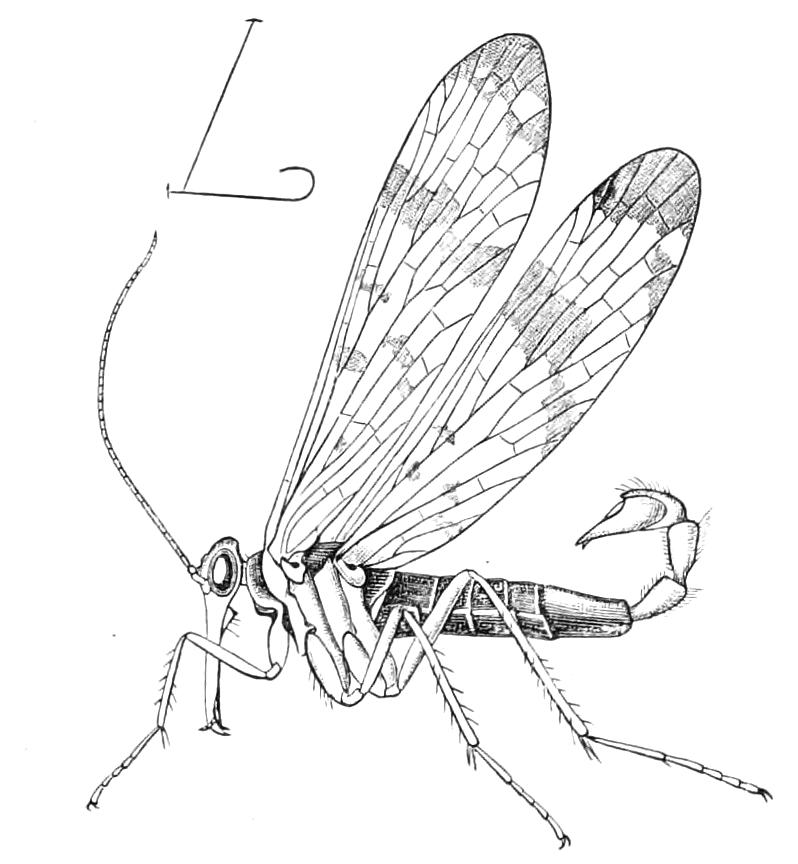
Fig. 294.—Panorpa communis, male. Cambridge.
The majority of the members of this family are very readily distinguished by the beak-like front of the head, this being chiefly due to enlargement of parts of the head itself, and in a less degree to prolongation of the mouth-parts. The upper (or front) face of the beak is formed entirely by the clypeus, the labrum being scarcely visible, though it may be detected at the sides of the tip of the beak; the sutures between the various parts of the head are nearly or quite obliterated, but it is probable that the sides of the beak are formed by the genae and by the stipites of the maxillae, and its under-surface chiefly by the submentum: the mentum itself is but small, the ligula is small, bifid at the extremity, and each branch bears a two-jointed palpus, the basal article being of very peculiar structure in Panorpa. The mandibles are but small, and are placed at the apex of the beak; they have each the form of an oblong plate armed with two very sharp teeth, and they cross freely. The maxillae are the only parts of the mouth-pieces that are very elongated; each cardo is articulated at the base of the head, and the stipes extends all the length of the side of the beak; each maxilla bears a five-jointed palpus and two small but very densely ciliated lobes. The antennae are long, very slender, and flexible, and are many-jointed; they are inserted between the eyes in large foramina; there are three ocelli, or none, and the compound eyes are moderately large. The prothorax is small, its notum is quite small or moderate in size, and the prothoracic stigma is placed behind it; the side-pieces are small, and there is no chitinous prosternum except a small longitudinal strip placed in the membrane between the coxae; these latter are of only moderate size, and are free and dependent. The meso- and meta-thorax are large, their side-pieces are of considerable dimensions and bear large, dependent coxae and supporting-pieces (Fig. 58); there is a stigma placed between the meso- and meta-thorax at the hind margin of the upper part of the meso-trochantin; both meso- and meta-notum are transversely divided. The abdomen is elongate, slender, conico-cylindrical, consisting of nine segments; the basal segment is membranous and concealed; the terminal appendages are of variable nature according to the species and sex. The legs are elongate and slender, the tarsi five-jointed. The internal anatomy of Panorpa communis has been examined by Dufour[377] and Loew.[378] They agree in describing the alimentary canal as being of peculiar structure: there is a short, slender oesophagus leading to an organ in which there is seated a remarkable arrangement of elongate hairs; this structure might be looked on as the proventriculus, but Loew considers it to be rather a division of the true stomach. The particulars given by these two anatomists as to some other parts of the internal anatomy are very discrepant.
The Panorpidae form a small family of only nine or ten genera, two or three of these being exotic and only imperfectly known; the three genera found in Europe are composed of very curious Insects. The scorpion-flies—Panorpa proper—are very common Insects, and have received their vernacular name from the fact that the males have the terminal segments elongate and slender and very mobile, and carry them curved up somewhat after the fashion of the scorpions (Fig. 294). It is said that Aristotle was acquainted with these Insects, and considered them to be really winged scorpions.
A second European genus, Boreus, is still more peculiar; it is destitute of wings, and has the appearance of a minute wingless grasshopper; it is found from late autumn to early spring in moss and under stones, and is said to be sometimes found disporting itself on the surface of the snow: the female of this Insect has an exserted ovipositor. The writer has found this little creature in Scotland among moss in November, and under stones early in March (Fig. 295). The third European genus, Bittacus, does not occur in our islands, but is common on many parts of the Continent; the perfect Insect has a great resemblance to a Tipula, or "daddy-long-legs" fly, and attaches itself to the stems of grasses, and preys on flies; according to Brauer it has the peculiar habit of using the hind pair of legs as hands (Fig. 296), instead of the front pair, as is usual in Insects. This remarkable genus is widely distributed, and species of it are found even in the Antipodes. A species inhabiting caves has been mentioned by M‘Lachlan.[379]
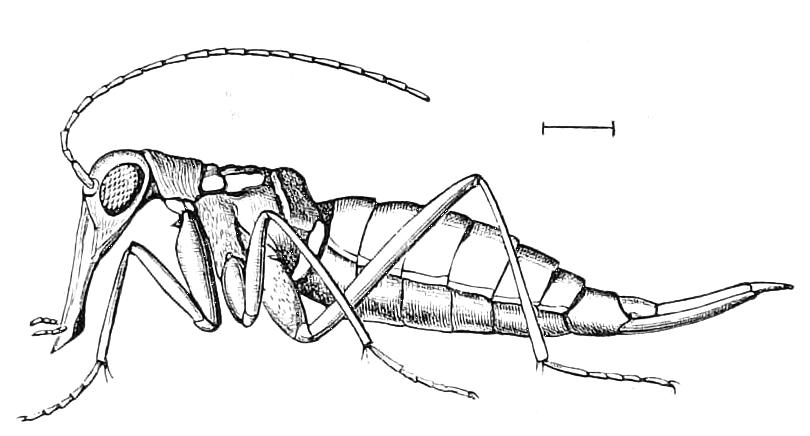
Fig. 295.—Boreus hiemalis, female. Dumfriesshire.
The early stages of the Panorpidae were for long unknown, but have recently been discovered by Brauer: he obtained eggs of Panorpa by confining a number of the perfect flies in a vessel containing some damp earth on which was placed a piece of meat; when the young larvae were hatched they buried themselves in the earth and nourished themselves with the meat or its juices.
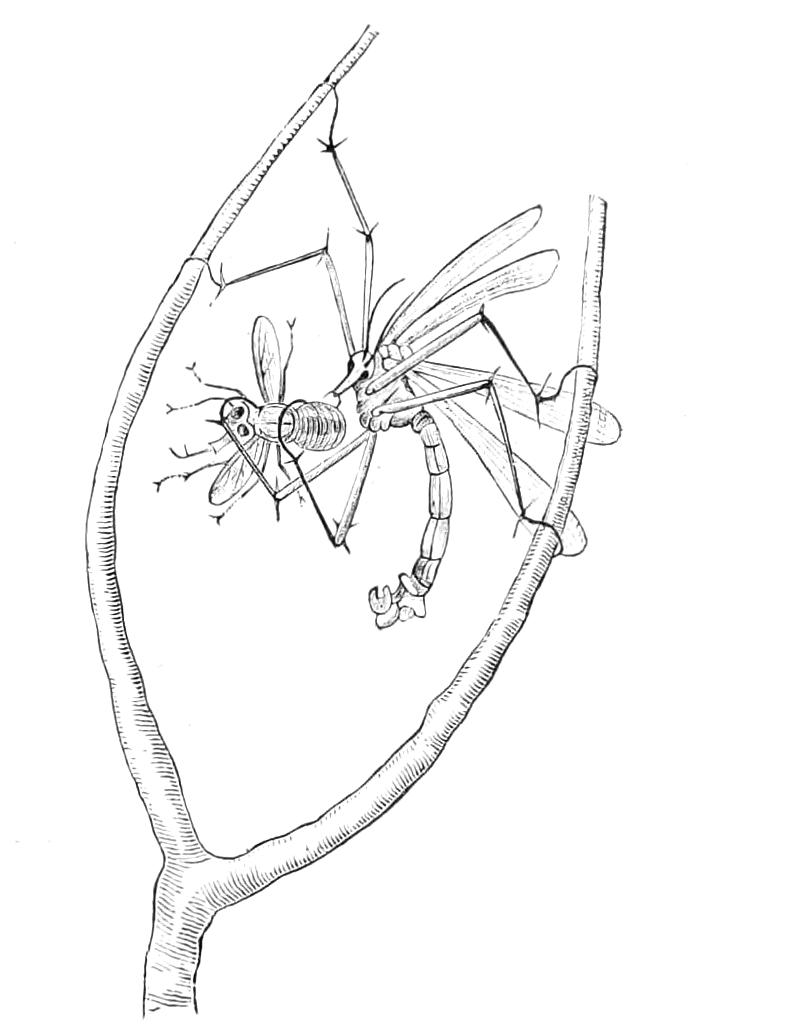
Fig. 296.—Bittacus tipularius holding a fly in its hind legs. Austria. (After Brauer.)
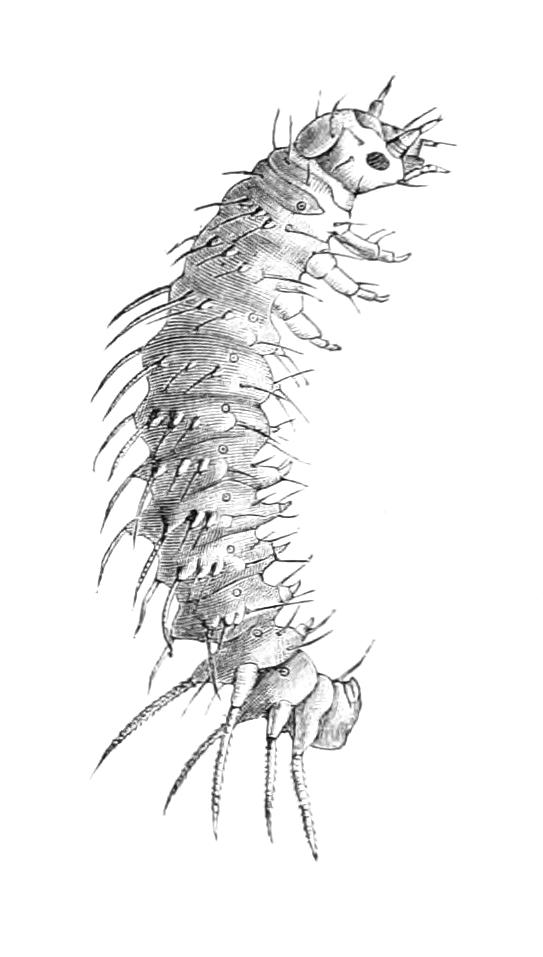
Fig. 297.—Young larva of Panorpa communis. (After Brauer.)
These larvae (Fig. 297) bear a great resemblance to those of the Hymenopterous family Tenthredinidae; they have biting mandibles and palp-bearing maxillae, and show no approach to the peculiar mouth structure found in the Hemerobiidae; there are three pairs of feet placed on the three thoracic segments, and there is also a pair of less perfect feet on each of the first eight abdominal segments, those behind being the larger. The upper surface of the body bears spines, which, however, disappear after the first change of skin, with the exception of the larger processes on the posterior segment, which persist throughout the life of the larva. The larvae are active for about one month; after this they become quiescent, but do not change to the pupa state for several weeks; when this happens they change in form and cannot creep, although their limbs are not enclosed in any pupa case. Brauer also discovered larvae of Panorpa communis at large in numbers in an old tree stump that was quite covered with moss, and contained many ants in the mouldering wood. The ants appeared to be on friendly terms with the Panorpa larvae. The earlier stages of Boreus and Bittacus were also observed by Brauer; they are essentially similar to those of Panorpa, but the larva in Boreus is not provided with abdominal prolegs. The Panorpidae have been separated from the other Neuroptera by certain naturalists as a distinct Order, called Panorpatae by Brauer, Mecaptera by Packard; but in their structure as well as in their metamorphoses they are not so distinct from the Phryganeidae and the Hemerobiidae as to justify this step.
Fossil forms of Bittacus and of Panorpa have been found in amber and in the Tertiary strata, and Scudder has described some forms from Florissant in which there are no cross-veinlets in the wings. Some remains from the English Lias have been referred to Panorpidae by Westwood under the name Orthophlebia, but it is by no means certain that they really belong to the family.
Fam. X. Hemerobiidae—Ant-lions, Lacewing-flies, etc.
Head vertical; maxillae free, with five-jointed palpi; labial palpi three-jointed. Wings subequal in size, with much reticulation, without anal area. Tarsi five-jointed. Metamorphosis great; the larvae with mandibles and maxillae coadapted to form spear-like organs that are suctorial in function. Pupa, similar in general form to the imago, enclosed in a cocoon.
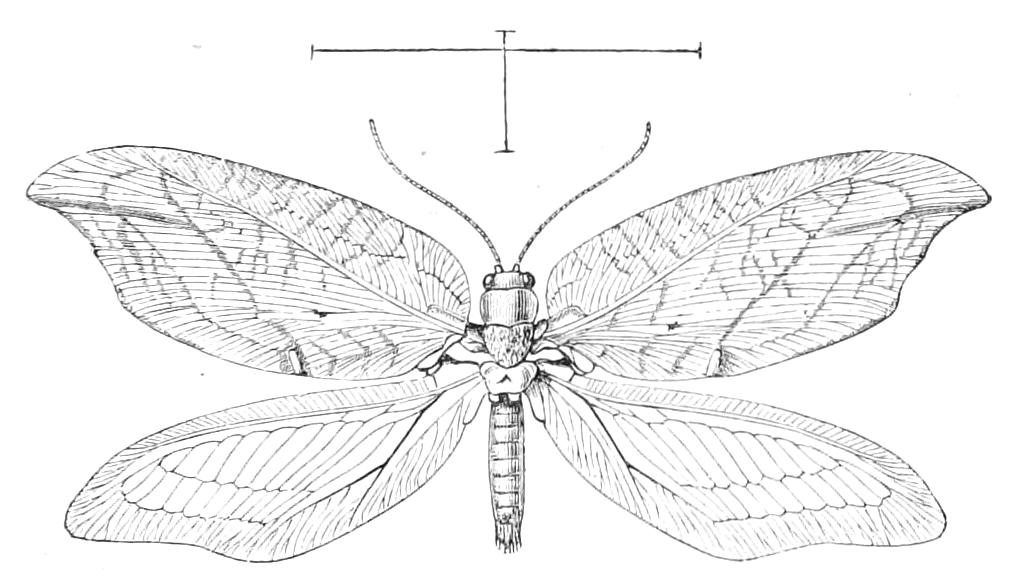
Fig. 298.—Drepanepteryx phalaenoides. Scotland.
The Hemerobiidae are an extremely varied assemblage of Neuroptera; the perfect Insects of the various sub-families are very different in appearance, but the family as a whole is naturally defined by the very peculiar structure of the mouth-organs of the larvae. These Insects have, in fact, a suctorial mouth in their early life, and one of the ordinary biting type in adult life.
This is a very unusual condition, being the reverse of what we find in Lepidoptera and some other of the large Orders, where the mouth is mandibulate in the young and suctorial in the adult. The suctorial condition is in Hemerobiidae chiefly due to modification of the mandibles; but this is never the case in the Insects that have a suctorial mouth in the imaginal instar. Nearly all the Hemerobiidae are terrestrial Insects in all their stages; a small number of them are, to a certain extent, amphibious in the larval life, while one or two genera possess truly aquatic larvae. The metamorphosis is, so far as the changes of external form are concerned, quite complete. There are no wingless forms in the adult stage.
The classification given by Hagen[380] and generally adopted recognises seven sub-families. These we shall mention seriatim.
Sub-Fam. 1. Myrmeleonides or Ant-lions.—Antennae short, clubbed, the apical space of the wing with regular, oblong cellules.
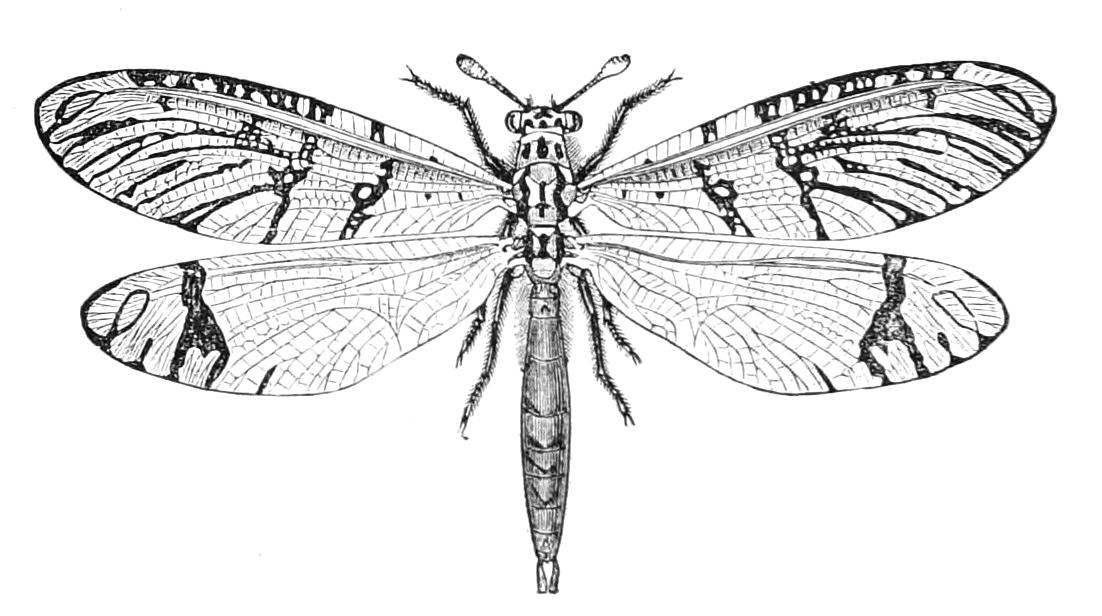
Fig. 299.—Tomateres citrinus. S. E. Africa. (After Hagen.)
The ant-lions in their perfect state are usually unattractive Insects, and many are nocturnal in their habits; the species of the genus Palpares and allies (Fig. 299) are, however, of more handsome appearance, and attain a large expanse of wing. No member of the sub-family is an inhabitant of Britain, though species of the typical genus Myrmeleon are common in Central and Northern Europe. The remarkable habits of their larvae attracted the attention of naturalists so long ago as two hundred years. We owe to Réaumur an accurate and interesting account of M. formicarius, the species found in the neighbourhood of Paris. The larvae are predaceous, and secure their prey by means of pitfalls they excavate in the earth, and at the bottom of which they bury themselves, leaving only their elongate jaws projecting out of the sand at the bottom of the pit. They move only backwards, and in forming their pit use their broad body as a plough, and throw out the sand by placing it on the head and then sending it to a distance with a sudden jerk. When about to construct its trap the larva does not commence at the centre, but makes first a circular groove of the full circumference of the future pit. Burying its abdomen in the surface of the earth, the Insect collects on to its head, by means of the front leg, the sand from the side which is nearest to the centre, and then jerks the sand to a distance. By making a second circuit within the first one, and then another, the soil is gradually removed, and a conical pit is formed, at the bottom of which the ant-lion lurks, burying its body but leaving its formidable mandibles widely extended and projecting from the sand. In this position the young ant-lion waits patiently till some wandering Insect trespasses on its domains. An ant or fly coming over the edge of the pitfall finds the sand of the sloping sides yielding beneath its body, and in its effort to secure itself probably dislodges some more of the sand, which, descending to the bottom of the pit, brings the lurking lion into activity. Availing himself of his power of throwing sand with his head, the ant-lion jerks some in the neighbourhood of the trespasser, and continues to do so until the victim is brought to the bottom of the pit and into the very jaws of its destroyer; then there is no further hope of escape; the mandibles close, empale their prey, and do not relax their hold till the body of the victim is exhausted of its juices. The position chosen is in a place that will keep dry, as the larva cannot carry on its operations when the sand is wet or damp, hence the soil at the base of a high wall or a rock frequently harbours these Insects.
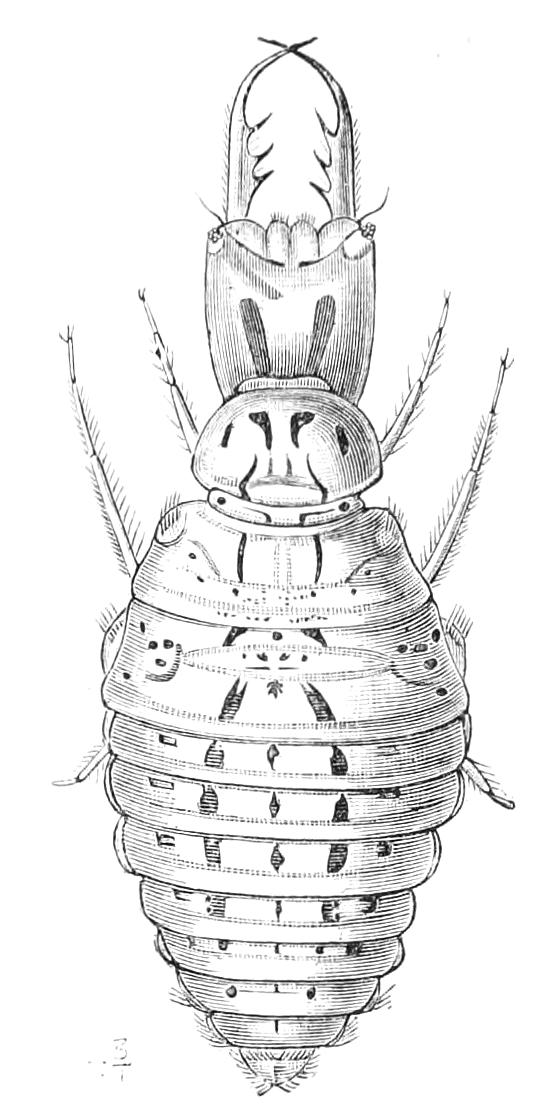
Fig. 300.—Larva of Myrmeleon pallidipennis. (After Meinert.)
The parts of the mouth of the Myrmeleon are perfectly adapted for enabling it to empty the victim without for a moment relaxing its hold. There is no mouth-orifice of the usual character, and the contents of the victim are brought into the buccal cavity by means of a groove extending along the under side of each mandible; in this groove the elongate and slender lobe that replaces the maxilla—there being no maxillary palpi—plays backwards and forwards, probably raking or dragging backwards to the buccal cavity at each movement a small quantity of the contents of the empaled victim. The small lower lip is peculiar, consisting in greater part of the two lobes that support the labial palpi. The pharynx is provided with a complex set of muscles, and, together with the buccal cavity, functions as an instrument of suction. After the prey has been sucked dry the carcass is jerked away to a distance. When the ant-lion larva is full grown it forms a globular cocoon by fastening together grains of sand with fine silk from a slender spinneret placed at the posterior extremity of the body; in this cocoon it changes to an imago of very elongate form, and does not emerge until its metamorphosis is quite completed, the skin of the pupa being, when the Insect emerges, left behind in the cocoon. The names by which the European ant-lion has been known are very numerous. It was called Formicajo and Formicario by Vallisneri about two hundred years ago; Réaumur called it Formica-leo, and this was adopted by some modern authors as a generic name for some other of the ant-lions. The French people call these Insects Fourmilions, of which ant-lion is our English equivalent. The Latinised form of the term ant-lion, Formicaleo, is not now applied to the common ant-lion as a generic term, it having been proposed to replace it by Myrmecoleon, Myrmeleo, or Myrmeleon; this latter name at present seems likely to become generally adopted. There are several species of the genus found in Europe, and their trivial names have been confounded by various authors in such a way as to make it quite uncertain, without reference to a synonymic list, what species is intended by any particular writer. The species found in the neighbourhood of Paris, and to which it may be presumed Réaumur's history refers, is now called Myrmeleon formicarium by Hagen and others; M‘Lachlan renamed it M. europaeus, but now considers it to be the M. nostras of Fourcroy. The popular name appears to be due to the fact that ants—Formica in Latin, Fourmi in French—form a large part of the victims; while lion—the other part of the name—is doubtless due to its prowess as a destroyer of animal life, though, as Réaumur long ago remarked, it is a mistake to apply the term lion to an Insect that captures its prey by strategy and by snares rather than by rapidity and strength. The imago of Myrmeleon is of shy disposition, and is rarely seen even in localities where the larva is abundant. It is of nocturnal habits, and is considered by Dufour to be carnivorous.
Considerable difference of opinion has existed as to the structure of the mouth and of the alimentary canal in these larvae. Réaumur was of opinion that there exists no posterior orifice to the alimentary canal, but Dufour ridiculed this idea, and stated positively that such an orifice undoubtedly exists. It is also usually said that the mouth is closed by a membrane. Meinert has recently examined these points,[381] and he states that the mouth is not closed by any membrane, but is merely compressed. He finds that there is no posterior exit from the stomach; that there is a compact mass without any cavity between the stomach and the point where the Malpighian tubes connect with the small intestine. The portions of aliment that are not assimilated by the larva collect in the stomach and are expelled as a mass, but only after the Insect has become an imago. This peculiar excrementitious mass consists externally of uric acid, and from its form and appearance has been mistaken for an egg by several naturalists. The posterior portions of the alimentary canal are, according to Meinert, of a remarkable nature. The small intestine is elongate, slender, and is coiled. There are eight very long and slender Malpighian tubes; a pair of these have free extremities, but the other six in the posterior part of their course are surrounded by a common membrane, and, following the course of the intestine, form ultimately a dilated body seated on a coecum. These six Malpighian tubes are considered to be partially, if not entirely, organs for the secretion of silk for forming the cocoon, the coecum being a reservoir. The canal terminates as a slender tube, which acts as a spinneret and is surrounded by a sheath. A complex set of muscles completes this remarkable spinning apparatus. The alimentary canal of the imago has been described and figured by Dufour[382]; it is very different from that of the larva.
The ant-lion is capable of sustaining prolonged fasts. Dufour kept specimens for six months without any food. These Insects are said to give off a peculiar ant-like odour, due, it is thought, to their ant-eating habits. Although no species inhabits Great Britain, yet one is found in Southern Sweden. Introduced specimens get on very well in confinement in our country,[383] and would probably flourish at large for some years if they were liberated.
Although the number of known species and genera of Myrmeleonides is considerable—that of the species being now upwards of 300—the members of the small genus Myrmeleon are the only forms that are known to make pits of the kind we have described. Other larvae[384] are known similar in general form to the common ant-lion, but they walk forwards in the normal manner, and apparently hunt their prey by lurking in a hidden place and, when a chance occurs, rushing on the victim with rapidity. Brauer has observed this habit in the case of Dendroleon pantherinus in the Prater at Vienna.
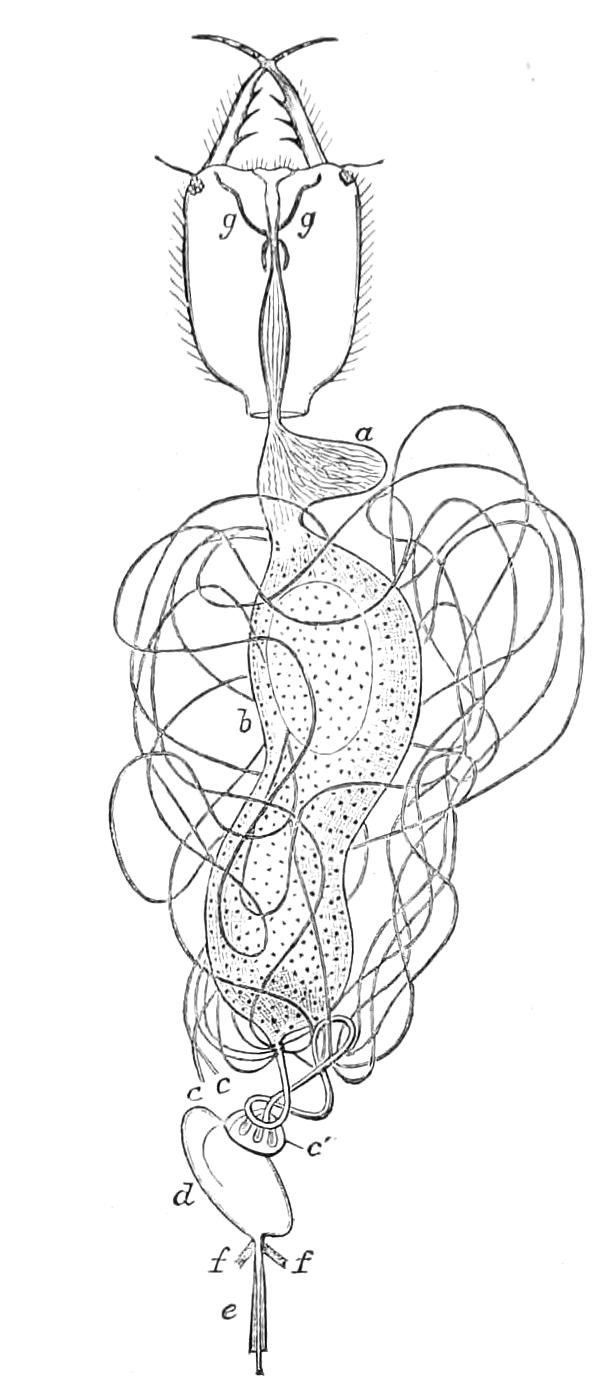
Fig. 301.—Upper aspect of head and alimentary canal of Myrmeleon: a, crop; b, stomach; c, free extremities of two Malpighian tubes; c′, terminal common portion of other six tubes; d, coecum; e, spinneret; f, f, muscles for protruding its sheath; g, g, maxillary glands. (After Meinert.)
The most remarkable forms of Myrmeleonides are contained in the genus Palpares. We figure Tomateres citrinus (Fig. 299), an allied genus found in Eastern Africa as far south as Natal. These Insects have conspicuous blotches and marks on their wings. The species of Myrmeleon are similar in form, but are smaller, more feeble, and less ornate in appearance.
Pitfalls, formed in all probability by ant-lions, have been noticed in the Galapagos islands and in Patagonia, though none of the Insects forming them have been found.
Sub-Fam. 2. Ascalaphides.—Antennae elongate, with a knob at the tip; the apical area of the wing with irregular cellules.
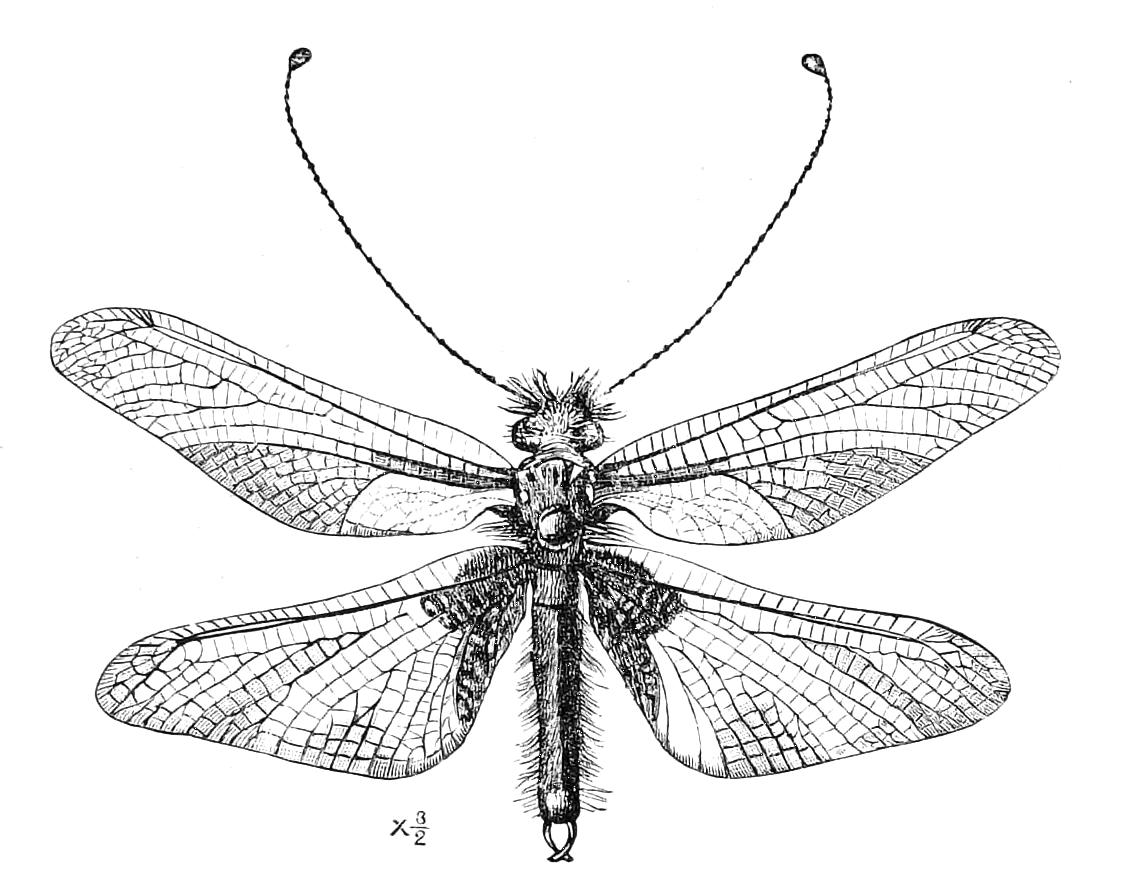
Fig. 302.—Ascalaphus coccajus. East Pyrenees.
The sub-family Ascalaphides is not represented by any species in Britain, though Ascalaphus longicornis occurs as far north as Paris. In the mountainous regions of Central and Southern Europe some species of the group form a conspicuous part of the Insect fauna, owing to their bold and active flight; they are predaceous in their habits, and fly about in a hawking fashion somewhat like that of dragon-flies. Some of the larger of the numerous exotic species of the group are very like dragon-flies, but can be distinguished by a glance at the elongate antennae with a knob at the end. The sub-family consists of two groups—Holophthalmi and Schizophthalmi. M‘Lachlan says[385]: "The eyes in the Schizophthalmous division are really double, the upper portion overlapping the under; if the upper portion be separated the lower division looks like a small spherical ordinary eye." There appears, however, to be considerable differences in the genera in this respect.
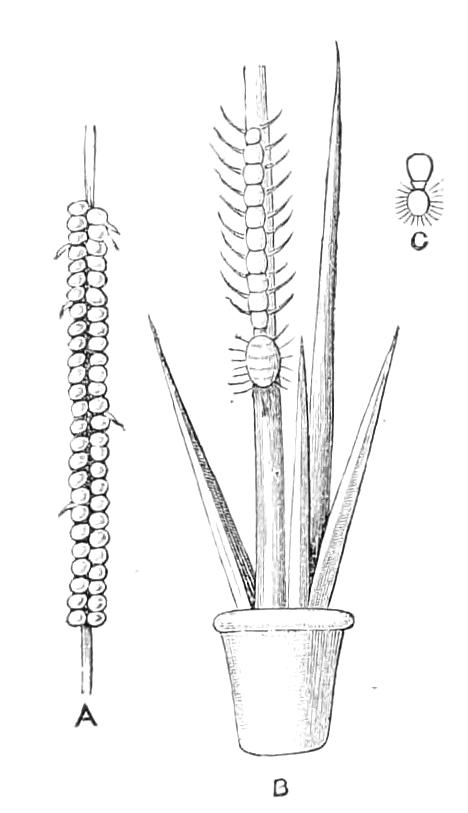
Fig. 303.—A, Eggs of Ascalaphus macaronius. B, Sketch of position of the young larvae of Helicomitus insimulans (?); C, outline of natural size. (After Westwood.)
When the weather is wet or cold the Ascalaphi repose on the stems of grass, with their wings placed in a roof-like manner, with the head downwards, and are then very successful in concealing themselves by the positions they assume, and by sidling round the stems to escape from enemies. Some information as to their metamorphosis has been obtained, though knowledge of this point is far from complete even as regards our European species of the typical genus Ascalaphus. For a long time it was supposed that a larva mentioned by Bonnet in his writings was that of Ascalaphus, but Brauer[386] is of opinion that such is not the case, and as he has described the metamorphoses of A. macaronius he is no doubt correct. The eggs (Fig. 303, A), forty or fifty in number, are laid in two parallel rows on the stems of grass. The larvae (Fig. 304, larva of Helicomitus ?) are in general appearance somewhat like those of Myrmeleon; they are carnivorous in their habits, like the ant-lions, and have similar extraordinarily developed mandibles. Efforts to rear the young larvae failed, but they were kept alive for some time by supplying them with Aphidides found on Centaurea jacea. The cocoon is globular, and the change from the nymph state to the imago is made in the cocoon, the structure of the mandibles of the pupa being peculiar, and specially adapted to the purpose of opening the cocoon.[387] The larvae of Ascalaphides, although so like the ant-lions in appearance, do not form pitfalls for the capture of their prey, but lurk under leaves on the ground, or under stones; they do not move backwards, but progress forwards in an ordinary manner; the habit of backward movement that we noticed in Myrmeleon being probably correlative with the habit of forming pitfalls. Hagen states[388] that the larvae of Ascalaphides and Myrmeleonides, in addition to their peculiarities of form and mandibular structure, are distinguished from those of other Hemerobiidae by the hind legs having the tibia and tarsus united without articulation. Westwood[389] has recently given an account of the young larvae of a Ceylonese Ascalaphid of doubtful species, but possibly Helicomitus insimulans; these were observed by Mr. Staniforth Green to have the very peculiar habit of sitting together in a long row on the stem of a plant, with the jaws widely extended and the body of each one covered by the head of the individual next it (Fig. 303, B). The little creatures waited patiently in this position until a fly walked between the mandibles of one of them, then these formidable weapons immediately closed, and did not relax their hold until the fly was sucked dry. If Westwood is correct, the young larva of this species differs much from the adult one, the back of the head being broad and the setigerous processes of the body very much more developed. Nearly thirty genera of Ascalaphides are known.[390] In the genus Haplogenius we find an exception to the usual rule that the wings in repose are held in a roof-like manner, it having been noticed by Bates that in the species in question the wings are held expanded as in the dragon-flies.
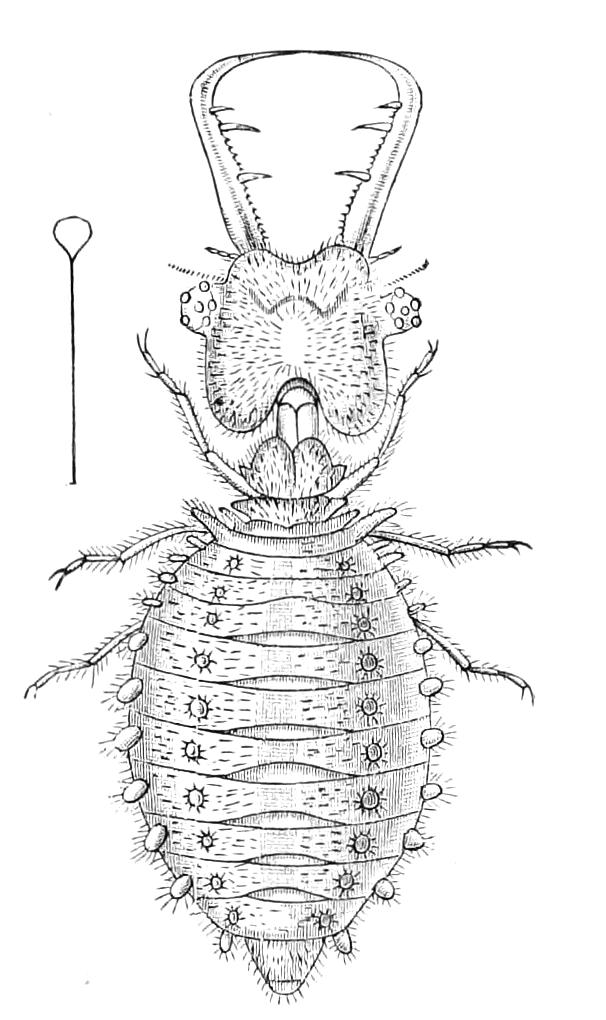
Fig. 304.—Larva of Helicomitus insimulans (?). (After Westwood.)
Guilding has described[391] a very peculiar mode of oviposition on the part of Ulula macleayana in the island of St. Vincent; the eggs are said to be deposited by the female in circles on the extremity of a twig, and nearer the base of this there is placed a kind of barrier to repel intruders. "The female may be seen expelling from her ovary these natural barriers with as much care as her real eggs." Guilding's description was accompanied by drawings of the eggs, barriers and larvae, but unfortunately these were never published, and no further information has been obtained on the subject. Hagen[392] suggests that the barriers may be somewhat similar to the long stalks on which the eggs of Chrysopa (Fig. 314) are placed.
Sub-Fam. 3. Nemopterides.—Head more or less produced and beak-like. Hind wings of peculiar form, being elongate and somewhat strap-like.
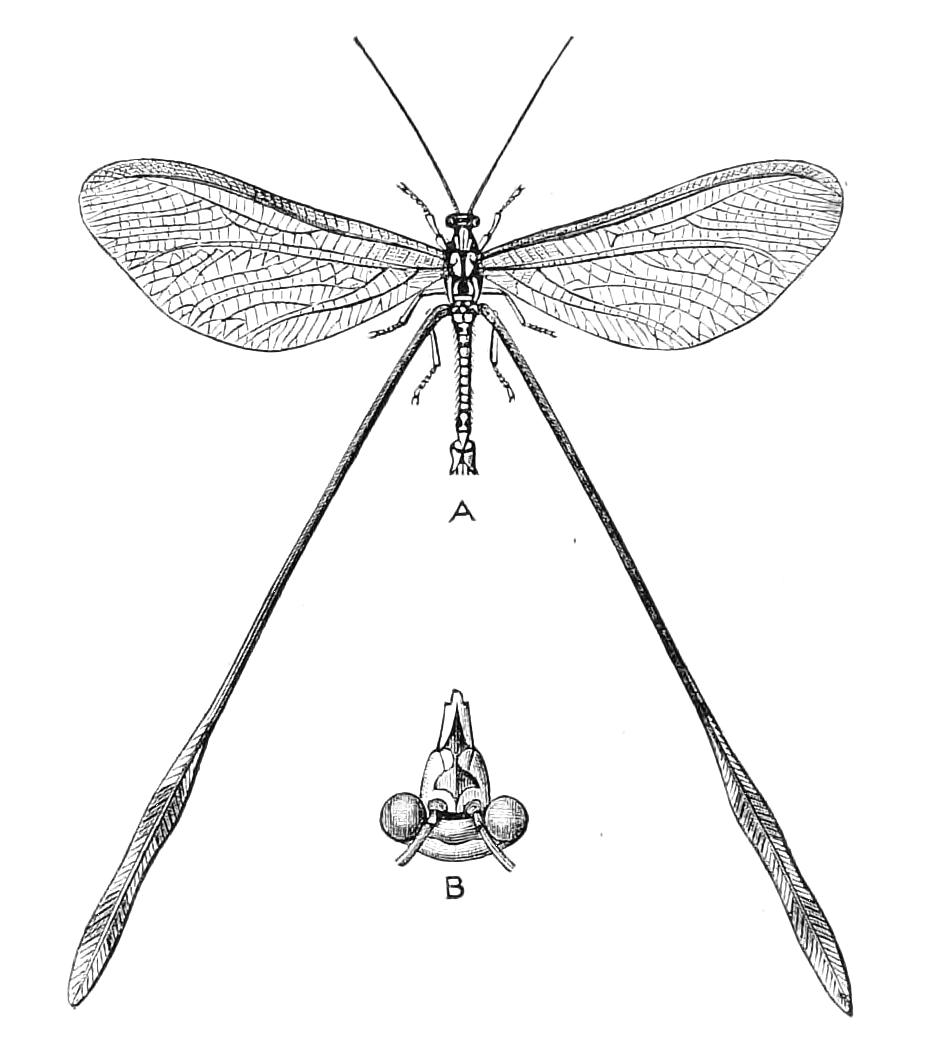
Fig. 305.—Nemoptera ledereri. Asia Minor. (After Selys.) A, The imago; B, its head seen from in front and magnified.
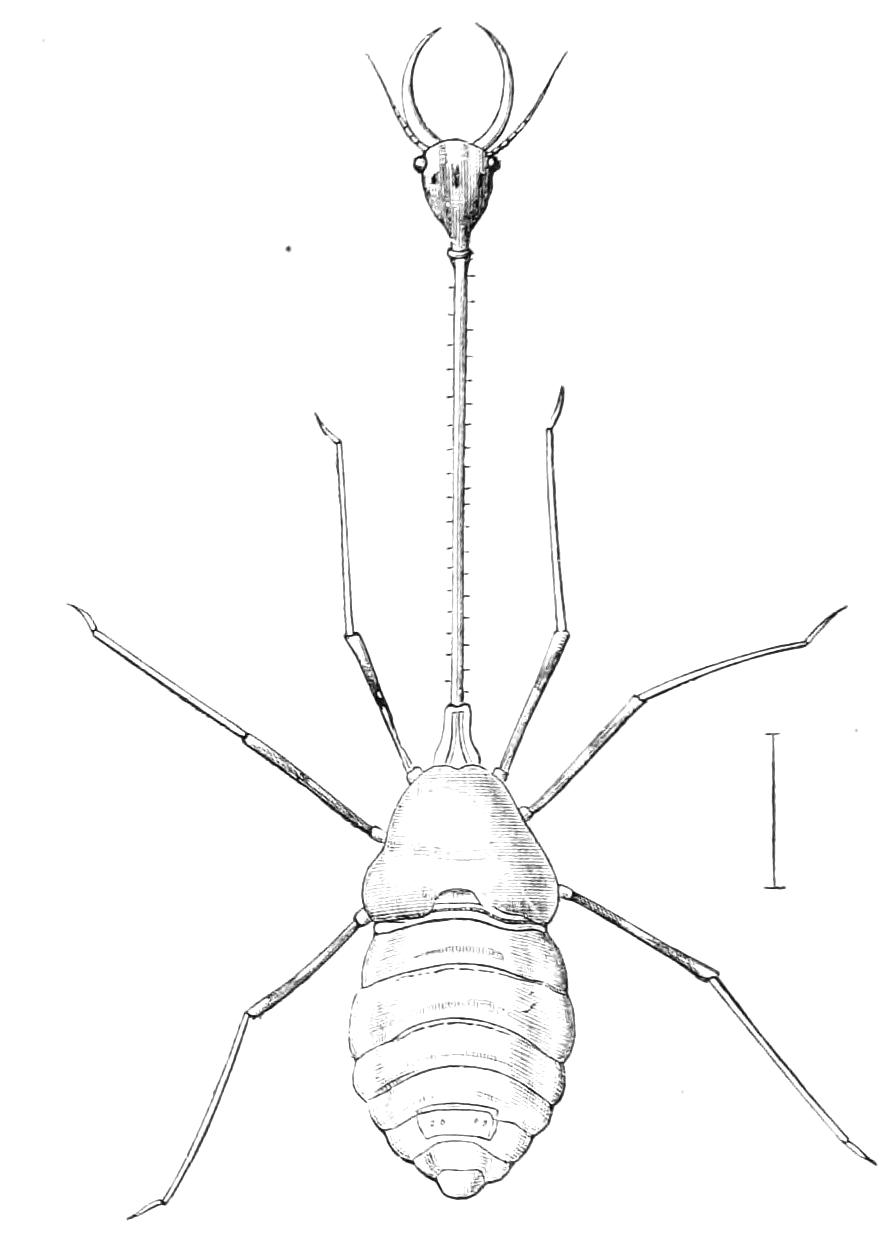
Fig. 306.—Presumed larva of Nemoptera (Necrophilus arenarius). After Roux. Pyramids of Egypt.
The Nemopterides are a small group of delicate, graceful Insects. About thirty species are known. Knowledge of the group is still very imperfect. A larva has been found of a most remarkable nature that probably belongs to it; it was described under the name of Necrophilus arenarius, and considered to be a fully-developed Insect. This larva occurs in the tombs and pyramids of Egypt where sand has accumulated. The perfect Insects of the genus Nemoptera are, however, found in open places amongst bushes, and flit about in a very graceful manner. Several species are found in Southern Europe and the Mediterranean region (Fig. 305, N. ledereri), but none come so far north as Central Europe. Formerly the genus Nemoptera was considered to be allied to Panorpa on account of the beak-like front of the head. The parts of the mouth are, however, different from those of Panorpa, and it seems more probable that if the Nemopterides have to be merged in any of the divisions of Hemerobiidae, they will be placed in Chrysopides or Osmylides. The species of the sub-family were for a long time believed to be peculiar to the continental regions of the Old World, but a species has recently been discovered in Northern Chili.[393]
Sub-Fam. 4. Mantispides.—Prothorax elongate; the raptorial front legs inserted at its anterior part.
The members of this small group are readily recognised by the peculiar structure of the front legs; these organs resembling those of the Orthopterous family Mantidae, so that the earlier systematic entomologists, deceived by this resemblance, placed the Mantispides in the Order referred to.
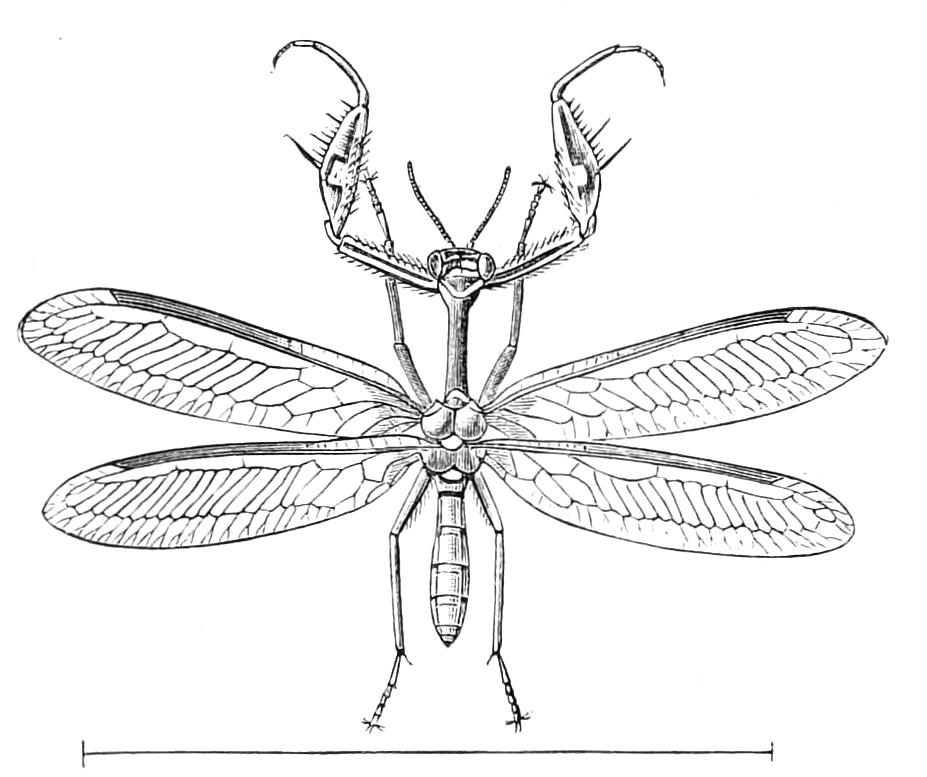
Fig. 307.—Mantispa areolaris. Brazil. (After Westwood.)
The Mantispides possess four membranous wings, either sub-equal in size or the posterior pair smaller than the front pair and not folded; the veins of these wings are rather numerous, as are also the cells they form; there is considerable difference amongst the species in this latter respect, owing to the transverse veinlets differing in their abundance. The antennae are short, not in the least thickened at the tip. The head is not produced into a beak. The anterior legs, placed quite at the front part of the thorax, have the coxae very long; the femur is somewhat incrassate, and is armed on one side with spines; the tibia is shaped and articulated so as to fold closely on to the spines, and to thus constitute a formidable and perfect prehensile organ, the tarsus being merely a small appendage.
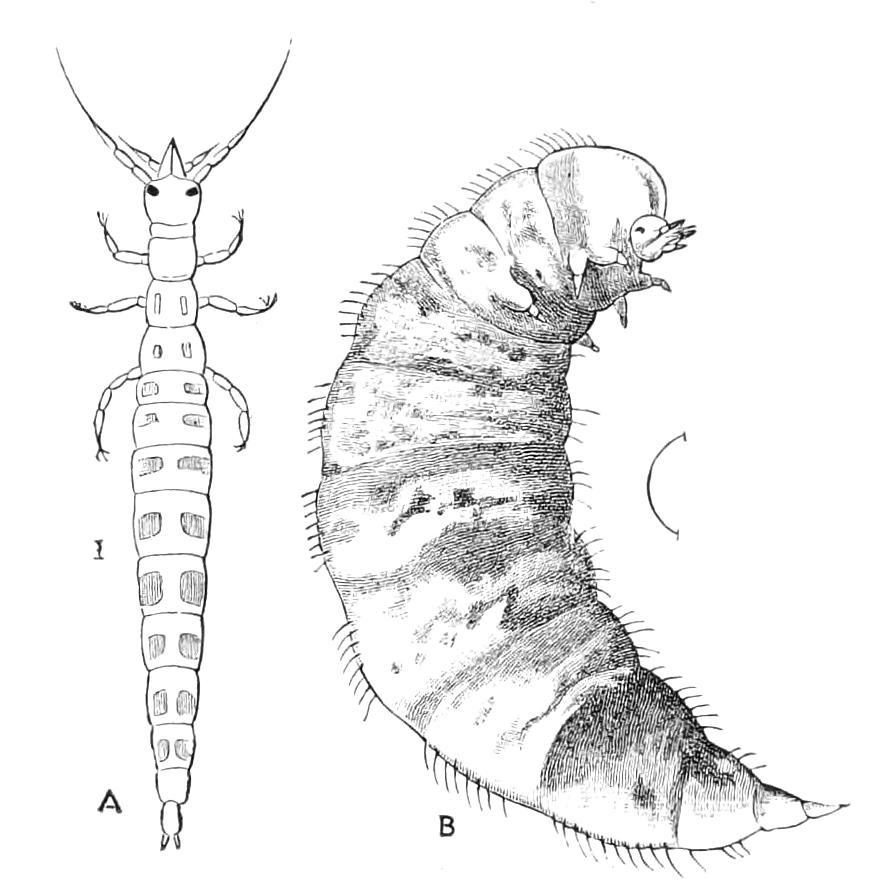
Fig. 308.—Mantispa styriaca. A, Larva newly hatched, or first form; B, mature larva. (After Brauer.)
Only a few species of Mantispa are found in Southern Europe; but the group has representatives in most of the warmer regions of the world, and will probably prove to be rather numerous in species. The front legs are used for the capture of prey in the same way as the somewhat similar front legs of the Mantidae. The transformations have been observed by Brauer[394] in the case of one of the European species, M. styriaca. The eggs are numerous but very small, and are deposited in such a manner that each is borne by a long slender stalk, as in the lacewing flies. The larvae are hatched in autumn; they then hibernate and go for about seven months before they take any food. In the spring, when the spiders of the genus Lycosa have formed their bags of eggs, the minute Mantispa larvae (Fig. 308, A) find them out, tear a hole in the bag, and enter among the eggs; here they wait until the eggs have attained a fitting stage of development before they commence to feed. Brauer found that they ate the spiders when these were quite young, and then changed their skin for the second time, the first moult having taken place when they were hatched from the egg. At this second moult the larva undergoes a considerable change of form; it becomes unfit for locomotion, and the head loses the comparatively large size and high development it previously possessed. The Mantispa larva—only one of which flourishes in one egg-bag of a spider—undergoes this change in the midst of a mass of dead young spiders it has gathered together in a peculiar manner. It undergoes no further change of skin, and is full fed in a few days; after which it spins a cocoon in the interior of the egg-bag of the spider, and changes to a nymph inside its larva-skin. Finally the nymph breaks through the barriers—larva-skin, cocoon, and egg-bag of the spider—by which it is enclosed, and after creeping about for a little, appears in its final form as a perfect Mantispa. Thus in this Insect hypermetamorphosis occurs; the larval life consisting of two different instars, one of which is specially adapted for obtaining access to the creature it is to prey on. It should be noticed that though this Insect is so destructive to the young spiders, the mother spider shows no hostility to it, but allows the destroying larva to enter her bag of eggs without any opposition; she appears, indeed, to be so unconscious of the havoc that is going on amongst her young that in one case she continued to watch over and protect the egg-bag in which the destruction was taking place during the whole of the period of the larval development and half the period of pupation of the Mantispa.
The larval history of a second species of the Mantispides, Symphrasis varia, is partially known;[395] this Insect lives parasitically in the nests of a South American wasp, and each larva when full fed spins a cocoon in one of the cells of the Hymenopteron.
Sub-Fam. 5. Hemerobiides.—Wings in repose forming an angular roof over the body; the antennae moniliform or pectinate, not clavate.
The Hemerobiides consist of several minor groups about whose number and characters systematists are not very well agreed, and about some of which very little is known. We merely mention the latter, giving details as to some of the better known only.
1. The Dilarina are a small group found chiefly in the Old World, where, however, they have a wide distribution. North and South America have each one species. They are distinguished by their antennae, which, in the male, are pectinate somewhat like those of many Lepidoptera, this character being of extremely rare occurrence in the Neuroptera; the abdomen of the female terminates in a long ovipositor. The metamorphoses are not known.
2. Nymphidina: Australian Insects resembling Myrmeleonides, but having antennae without club. Metamorphoses not known.
3. Osmylina: a group of delicate and elegant Insects of small or moderate size, distinguished by the possession of three simple eyes placed on the middle of the head just above the antennae. A species of this group, Osmylus chrysops (maculatus of some authors), is an inhabitant of Britain (Fig. 212); its larva is to some extent amphibious. The metamorphoses have been observed by Dufour, Brauer, and Hagen;[396] it lurks under stones in or close to the water, or in moss, or on the stems of aquatic plants, and pierces and empties small Insects with its sucking-spears, which are very elongate. The young are hatched from the egg in the autumn and hibernate before becoming full grown; when this moment arrives the larva spins a round cocoon of silk mixed with sand. The pupa, or nymph, in general appearance somewhat resembles the perfect Insect, except that it is shorter and has the short wing-pads clinging close to the body. Dufour denied the existence of abdominal spiracles in either larva or imago, but, according to Hagen, they are certainly present in both. It would appear that in the larva the alimentary canal is not open beyond the chylific ventricle, and that its terminal section is modified to form a spinning apparatus.
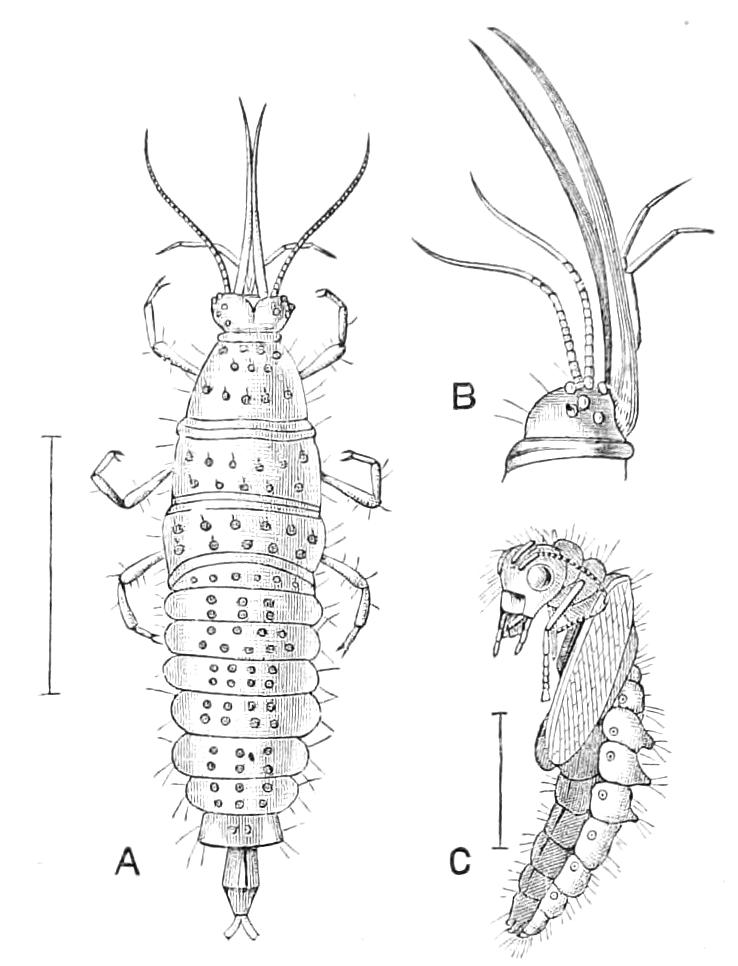
Fig. 309.—Osmylus chrysops. A, Larva; B, side view of head of larva (after Brauer); C, pupa (after Hagen).
Osmylus and its allies, including Sisyra, are now frequently treated as a separate sub-family, Osmylides, equivalent to the Chrysopides. In it is placed a very anomalous Insect—Psectra dispar—of great rarity. The male has only two wings, the posterior pair being the merest rudiments, though the female has the four wings normally developed. Individuals of the male have been found[397] in widely separated localities in the Palaearctic region—Somersetshire being one of them—and also in North America.
The genus Sisyra forms for some Neuropterists the type of a separate group called Sisyrina, though by others it is placed, as we have said, with the Osmylina, though it is destitute of ocelli. The larvae of at least one species of this genus are aquatic, and have been found in abundance living in Spongilla (Ephydatia) fluviatilis, a fresh-water sponge; when discovered their nature was not at first recognised, as they possess on each ventral segment a pair of articulated appendages, looking like legs, but which are considered to be more of the nature of gills. The sucking-spears of this Insect are so long and slender as to look like hairs; whether the little animal draws its nutriment from the sponge, or merely uses this latter as a place of shelter, is not ascertained.
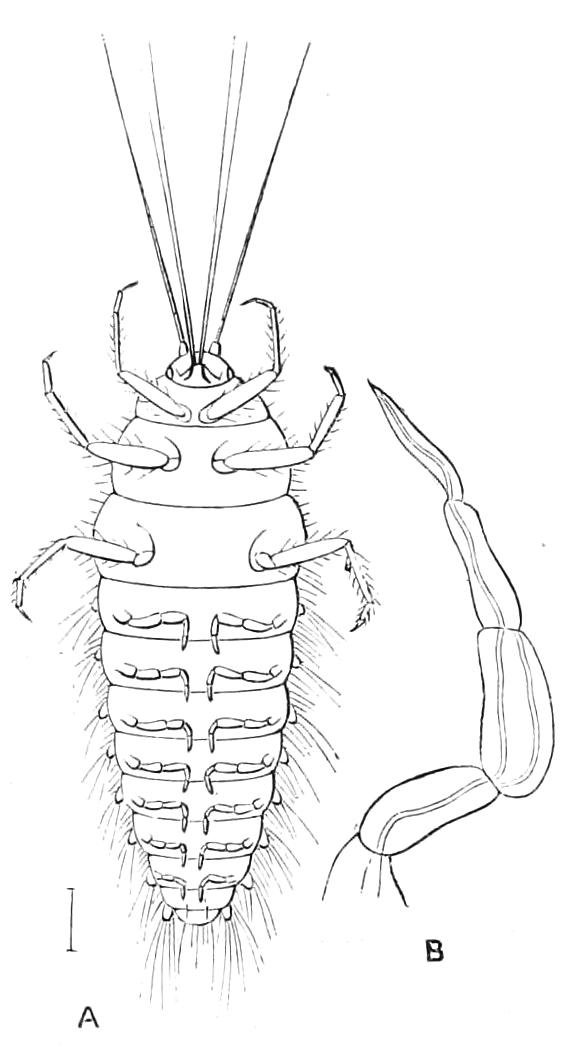
Fig. 310.—A, Larva of Sisyra fuscata, ventral aspect; B, an abdominal appendage. (After Westwood.)
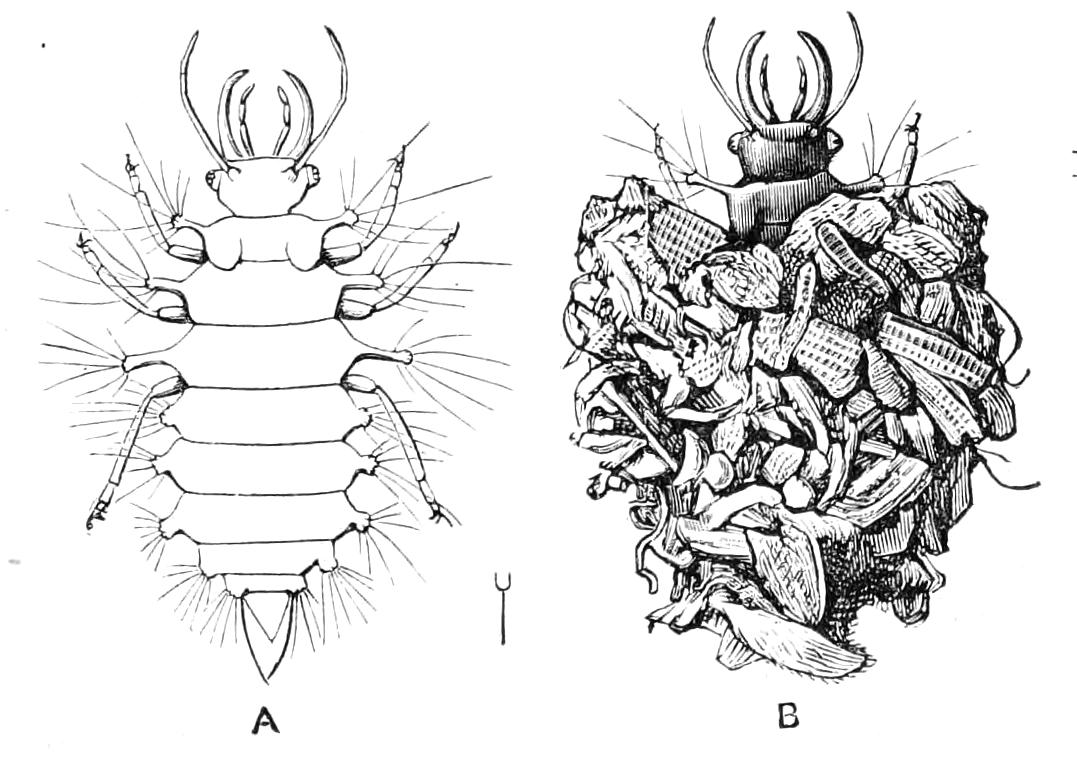
Fig. 311.—Larva of Hemerobius sp. from Kent. A, The larva bare; B, the same, partially concealed by the remains of its victims, etc.; a portion of the covering has been removed in order to show the head.
4. Hemerobiina: a somewhat numerous group of small or more rarely moderate-sized Insects, with moniliform antennae, no ocelli, a complex and comparatively regular system of wing-nervures; the veinlets are especially numerous at the margins, owing to the mode of forking of the nervures there (Fig. 298, Drepanepteryx phalaenoides). The larvae of most of the species of which the habits are known live on Aphides, which they suck dry, and at least one species, in all probability several, has the habit of covering itself with the skins of the victims it has sucked; to these remains it adds other small debris, and the whole mass completely covers and conceals the Insect (Fig. 311, B). The larva is furnished at the sides with projections which serve as pedicels to elongate divergent hairs, and these help to keep the mass in place on the back of the Insect; some fine threads are distributed through this curious mantle and serve to keep it from disintegration, but whether they are fragments of spiders' webs or are spun by the Insect itself is not quite clear.
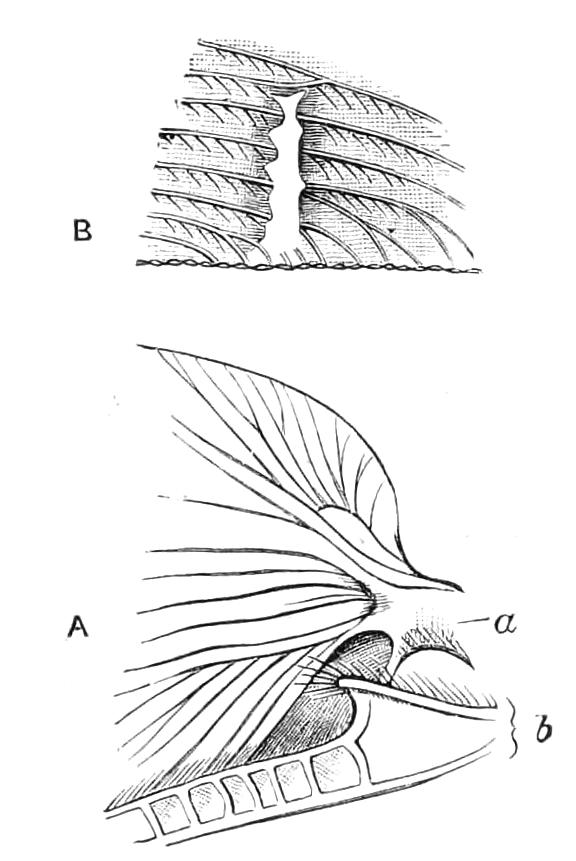
Fig. 312.—Portions of wings of Drepanepteryx phalaenoides. A, Under-face of basal parts of the two wings; a, base of front wing; b, of hind wing. B, Portion of front wing, showing the apparent interruption of nervures.
The genus Drepanepteryx consists of several species, and appears to be best represented in the Antipodes; we have, however, one species in Britain—D. phalaenoides (Fig. 298)—an extremely interesting member of our fauna. This Insect has, like several of its congeners, a moth-like appearance, and it has a peculiar structure for bringing the hind and fore wings into correlation, the costa at the base of the hind wing being interrupted and prominent, furnished with setae (Fig. 312, A), and playing in a cavity on the under-surface of the front wing. This character is of great interest in connexion with analogous structures of a more perfect nature existing in various moths. M‘Lachlan has described and figured[398] a more primitive, though analogous, condition of the wings in Megalomus hirtus, also a species of British Hemerobiina. Another very curious feature of D. phalaenoides is shown in Fig. 312, B, there being a narrow space on the hind part of the front wing from which the colour is absent, while the nervures appear to be interrupted; they are, however, really present, though transparent; the nature of this peculiar mark is quite unknown, but is of considerable interest in connexion with the small transparent spaces that exist on the wings of some butterflies.
Sub-Fam. 6. Chrysopides, Lacewing-flies.—Fragile Insects with elongate, setaceous antennae.
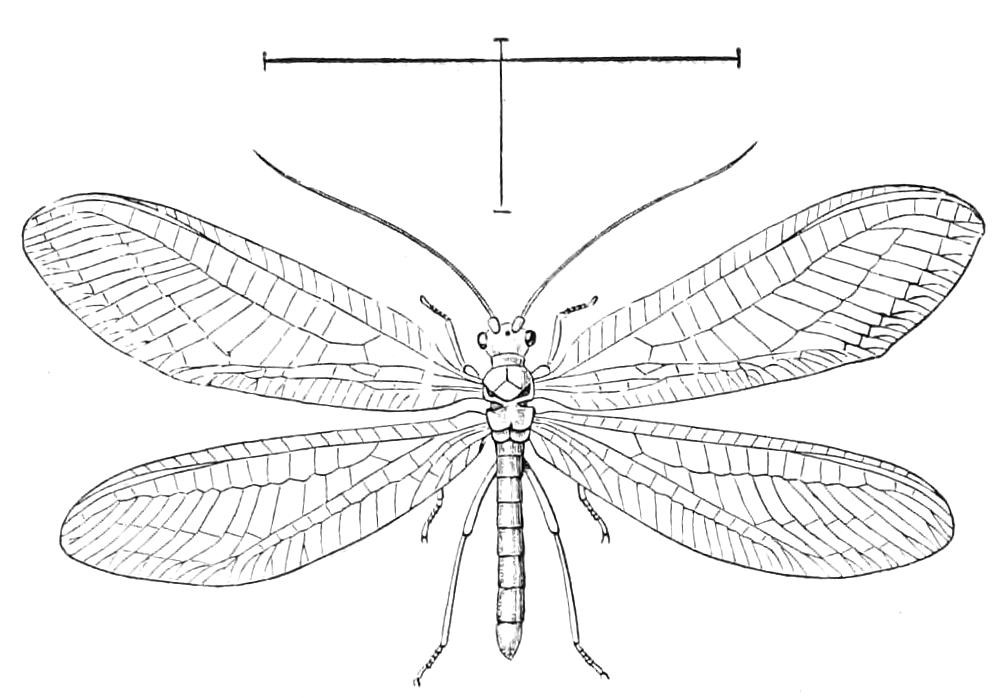
Fig. 313.—Chrysopa flava. Cambridge.
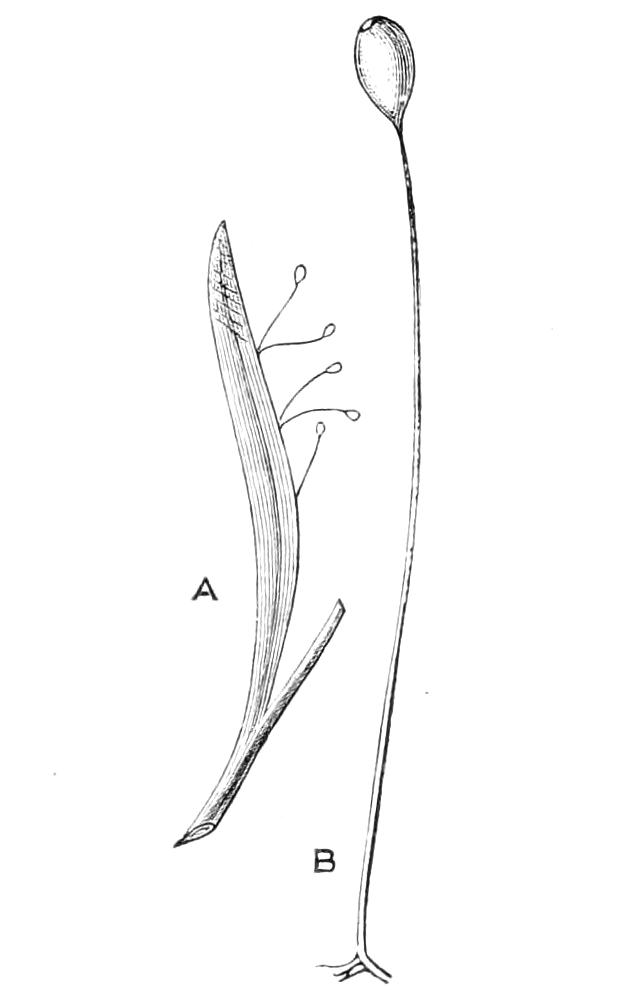
Fig. 314.—Eggs of Chrysopa. A, Five eggs on a leaf; B, one egg, more magnified. (After Schneider.)
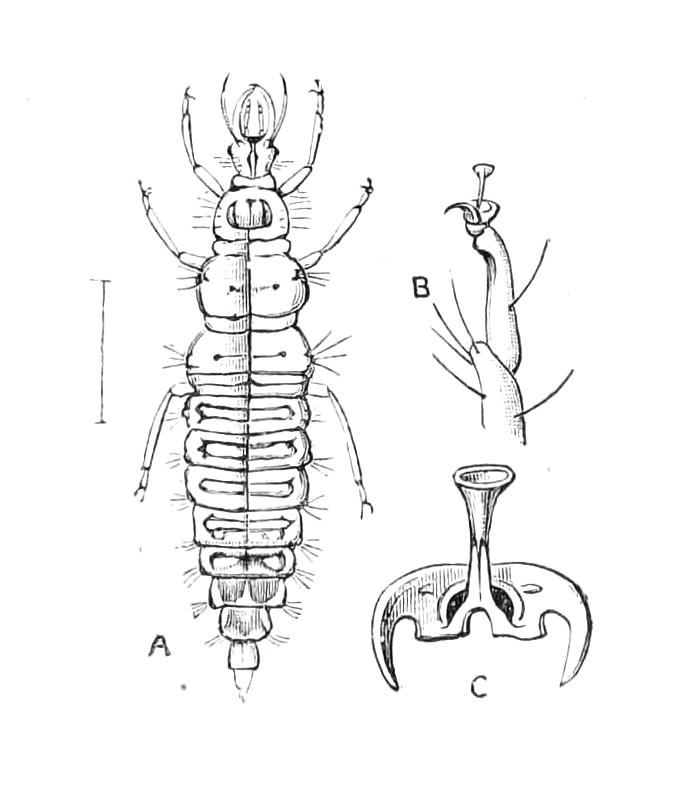
Fig. 315.—Larva of Chrysopa sp. Cambridge. A, The Insect magnified; B, foot more magnified; C, terminal apparatus of the claws, highly magnified.
The lacewing-flies—also called stink-flies and golden-eyes—are excessively delicate Insects, of which we possess about 15 species in Britain. Their antennae are more slender and less distinctly jointed than they are in Hemerobiides, and the Chrysopides are more elongate Insects. The peculiar metallic colour of their eyes is frequently very conspicuous, the eyes looking, indeed, as if they were composed of shining metal; this fades very much after death. Although not very frequently noticed, the Chrysopides are really common Insects, and are of considerable importance owing to their keeping "greenfly" in check.
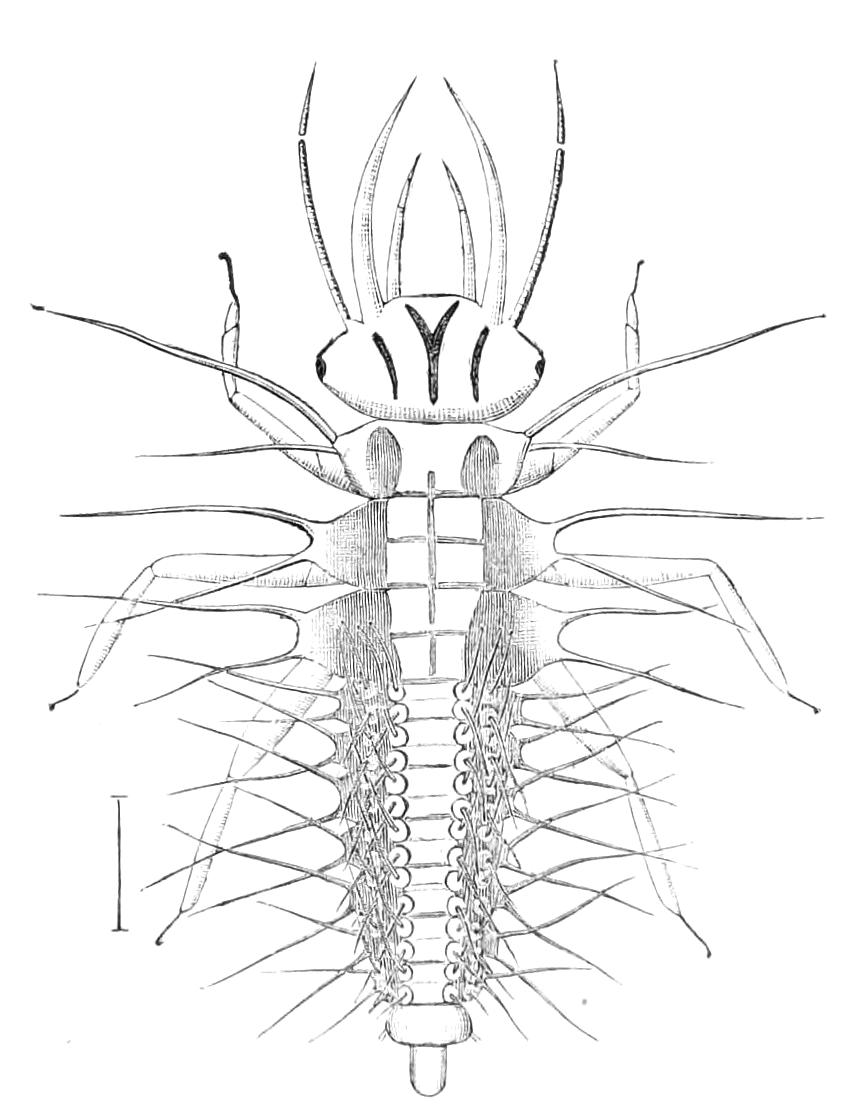
Fig. 316.—Chrysopa (Hypochrysa) pallida, larva. (After Brauer.)
The eggs are very remarkable objects (Fig. 314), each one being supported at the top of a stalk many times as long as itself; in some species (C. aspersa) the eggs are laid in groups, those of each group being supported on a common stalk. The larvae (Fig. 315) are of a very voracious disposition, and destroy large quantities of plant-lice by piercing them with sucking-spears, the bodies of the victims being afterwards quickly exhausted of their contents by the action of the apparatus connected with the spears. The larvae of two or three species of Chrysopa cover themselves with the skins of their victims after the manner of the larvae of Hemerobius; but most of the larvae of Chrysopa are unclothed, and hunt their victims after the fashion of the larvae of Coccinellidae, to which these Chrysopa larvae bear a considerable general resemblance. These larvae have a remarkable structure at the extremity of their feet, but its use is quite unknown (Fig. 315, B, C). Some larvae of the genus make use of various substances as a means of disguise or protection. Dewitz noticed[399] that some specimens he denuded of their clothing and placed in a glass, seized small pieces of paper with their mandibles and, bending the head, placed the morsels on their backs; here the pieces remained in consequence of the existence of hooked hairs on the skin. Green algae or cryptogams are much used for clothing, and Dewitz supposes that the Insect spins them together with webs to facilitate their retention. According to Constant and Lucas[400] the larvae of Chrysopa attack and kill the larvae of Lepidoptera and Phytophagous Hymenoptera. The curious form we figure (Fig. 316) has been hatched from eggs found by Brauer on Pinus abies in Austria. The eggs were of the stalked kind we have described; the young escaped from them in the autumn, twelve days after deposition, but did not take any food till the following spring.
The Chrysopides are widely distributed over the earth's surface. They form an important part of the fauna of the Hawaiian islands.
Sub-Fam. 7. Coniopterygides.—Minute Insects with very few transverse nervules in the wings; having the body and wings covered by a powdery efflorescence.
These little Insects are the smallest of the Order Neuroptera, and have the appearance of winged Coccidae; their claim to be considered members of the Neuroptera was formerly doubted, but their natural history is quite concordant with that of the Hemerobiid groups, near which they are now always placed. Löw has made us acquainted with the habits and structure of an Austrian species, Coniopteryx lutea Wallg., but for which he has proposed the new generic name Aleuropteryx; the larvae are found on Pinus mughus at Vienna feeding on Aspidiotus abietis, which they pierce with sucking-spears, after the fashion of the Hemerobiides; when full fed they spin a cocoon formed of a double layer of silk, in which metamorphosis takes place in a manner similar to that of other Hemerobiidae. The better-known genus Coniopteryx differs from Aleuropteryx in having the sucking-spears short and nearly concealed by the front of the head, which is somewhat prolonged.
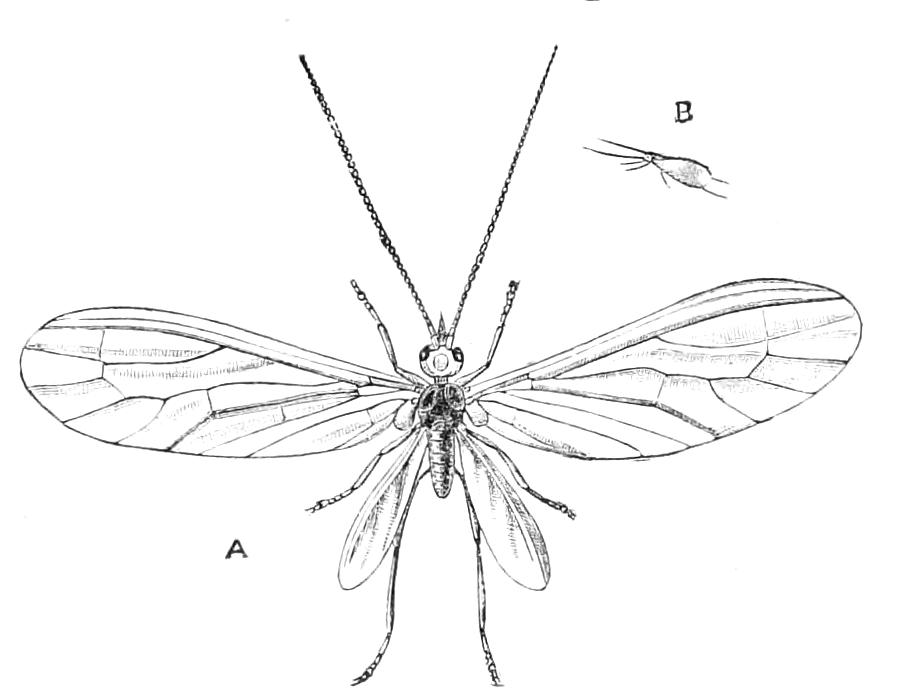
Fig. 317.—Coniopteryx psociformis. Cambridge. (After Curtis.) A, The insect with wings expanded, magnified; B, with wings closed, natural size.
We may conclude this sketch of the Hemerobiid groups by remarking that fossil remains of specimens of most of them have been detected in the Tertiary strata, and that in the Secondary strata these groups are represented by only a small number of fossils, which are referred specially to Hemerobiina, Nymphidina, and Chrysopides.
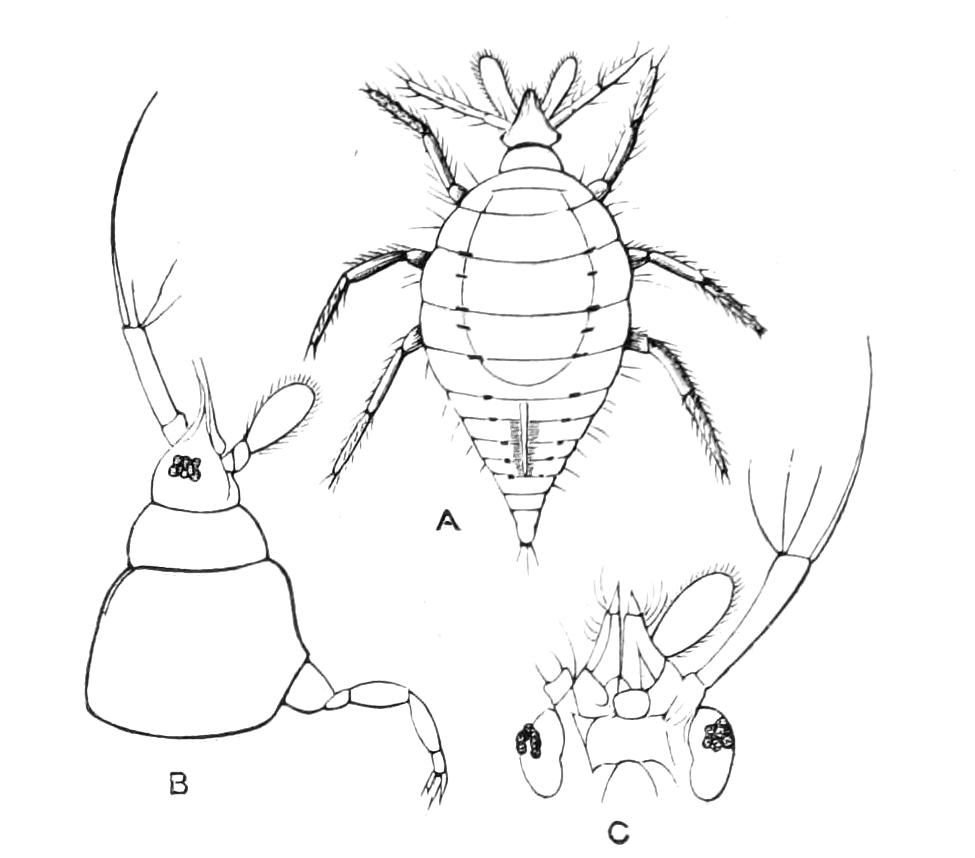
Fig. 318.—A, Larva of Coniopteryx tineiformis (?). (After Curtis.) B, Head and prothorax of larva of Coniopteryx sp.; C, upper surface of head of larva of Coniopteryx (after Löw), much magnified.