Chapter XV · FOOD. (Solid.)
Reading edition
English fare — Time of dining — Pontack's — Other ordinaries — Books on Cookery — Receipts — Pudding — Fish — Oysters — Poultry — Assize of bread — Markets — Vegetables — Lambeth gardeners — Fruit — Dried fruit.
In the matter of food, people were not gourmets as a rule. The living was plentiful, but plain, and a dinner was never more than two courses; as Addison wrote, 'two plain dishes, with two or three good natured, chearful, ingenious friends, would make me more pleased and vain than all that pomp and luxury can bestow;' and this sentiment pervaded the whole of society. Dinner is almost the only meal ever mentioned, and one looks in vain for details of breakfast or supper. They were taken, of course, but men, then, did not sufficiently deify their stomachs, as to be always talking about them: dinner was the meal of the day, and there is no doubt that the most was made of that opportunity. Misson says: 'The English eat a great deal at dinner; they rest a while, and to it again, till they have quite stuff'd their Paunch. Their Supper is moderate: Gluttons at Noon, and abstinent at Night. I always heard they were great Flesh eaters, and I found it true. I have known several people in England that never eat any Bread, and universally they eat very little: they nibble a few crumbs, while they chew the Meat by whole Mouthfuls. Generally speaking, the English Tables are not delicately serv'd. There are some Noblemen that have both French and English Cooks, and these eat much after the French manner; but among the middling Sort of People they have ten or twelve Sorts of common Meats, which infallibly take their Turns at their Tables, and two Dishes are their Dinners: a Pudding, for instance, and a Piece of Roast Beef; another time they will have a piece of Boil'd Beef, and then they salt it some Days before hand, and besiege it with five or six Heaps of Cabbage, Carrots, Turnips, or some other Herbs or Roots, well pepper'd and salted, and swimming in Butter: A Leg of roast or boil'd Mutton, dish'd up with the same dainties, Fowls, Pigs, Ox Tripes, and Tongues, Rabbits, Pidgeons, all well moistened with Butter, without larding: Two of these Dishes, always serv'd up one after the other, make the usual Dinner of a Substantial Gentleman, or wealthy Citizen. When they have boil'd Meat, there is sometimes one of the Company that will have the Broth; this is a kind of Soup, with a little Oatmeal in it, and some Leaves of Thyme or Sage, or other such small Herbs. They bring up this in as many Porringers as there are People that desire it; those that please, crumble a little Bread into it, and this makes a kind of Potage.'
There were others nearly as good.
Ward describes a tavern ordinary well; he is in his element; but to give his description would take up too much room. On entering the bar, the principal person visible was the dame de comptoir, 'all Ribbons, Lace and Feathers.' Having passed her, and taken a seat at the table, he had 'a Whet of Old Hock' to sharpen his appetite for dinner, which consisted of two calves' heads, a couple of geese, and Cheshire cheese; after which they all fell to a-drinking wine.
Perhaps few people now would care to make Mr. Lamb's 'Patty of Calves' Brains.—The Calves Brains being clean, scald them, then blanch some Asparagus, and put it in a Sauce pan, with a little Butter and Parsley; being Cold, put the Brains in the Patty, with the Asparagus, five or six Yolks of hard Eggs, and Forc'd Meat; season it with Pepper and Salt. When it is bak'd, add the Juce of a Lemon, drawn Butter and Gravy. So serve it.'
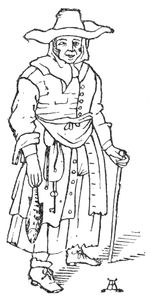
'FOUR FOR SIXPENCE, MACKERELL.'
Of fish he says: 'In Proportion Fish is dearer than any other Belly-timber at London;' and as a matter of fact we hear very little about it as an article of food. The country, inland, was of course entirely dependent upon fresh-water fish, such as carp, jack, perch, etc. The London market was at Billingsgate (which kept up its reputation for its peculiar vernacular), but that was also waterman's stairs, and a place of departure for boats; and here was sold whatever fish was brought to London. A little before every Lent came vessels loaded with salt cod, which were sold at 1s. 6d. to 2s. a couple, and sometimes at 1d. per lb. Mackerel, on account of its perishable nature, was allowed to be sold on Sunday, as Gay notes, 'Ev'n Sundays are prophan'd by Mackrell cries.'
From Billingsgate the fish was distributed to the various stalls throughout London:—
You'll see a draggled Damsel, here and there, From Billingsgate her fishy Traffick bear.
And these stalls are thus described:—
When fishy Stalls with double Store are laid; The golden belly'd Carp, the broad-finn'd Maid, Red speckled Trouts, the Salmon's silver Soul, The jointed Lobster, and unscaly Soale, And luscious 'Scallops, to allure the Tastes Of rigid Zealots to delicious Fasts; Wednesdays and Fridays you'll observe from hence, Days, when our Sires were doom'd to Abstinence.
It causes a sigh of regret to read of the great plenty, and wonderful cheapness, of real native oysters. They were then, as now, only considered fit to eat during the months with R in them; and Gay, speaking of autumn, says, as a sign of its arrival, 'And Damsels first renew their Oyster Cries'; and in another part of 'Trivia' he gives the following sound advice:—
If where Fleet Ditch with muddy Current flows, You chance to roam; where Oyster Tubs in Rows Are rang'd beside the Posts; there stay thy Haste, And with the sav'ry Fish indulge thy Taste: The Damsel's Knife the gaping Shell commands, While the salt Liquor streams between her Hands.
And they were wonderfully cheap, sold in the streets by the wheelbarrow men at 'Twelve Pence a Peck.' There was keen competition in them, and rival fishmongers advertised the superior excellence of their oysters. One will serve as a sample of the whole. 'Thomas West Fishmonger in Honey Lane Market near Blossom's Inn, gives notice, That all Persons who have occasion for the Choicest of Oysters called Colchester Oysters, may be supplied for this Season with the largest pick't Fat and Green for 3s. a Barrel; Those somewhat smaller at 2s. 6d. of the same sort; Fat and Green, of a lesser size for 2s. the Barrel: The large pickt, white, fat Oysters for 2s. 6d. The smaller white fat Oysters 1s. 8d. At all these Prizes I will sell the right Colchester Oysters, which, without considering their goodness beyond other sorts, are cheaper than the Town Wheel barrow Oysters: And that all Persons in City or Country, that send for them, may no ways be deceived of having the right sort, the prizes are all branded on the side of the Cask. Note, they are all branded at the Pits, where they are pickt, so that if there be any Cheat, it must be by the Oyster Man, which hath been too often practised to my Loss and their shameful Gain. My Oysters Comes in on Monday's, Wednesdays, Thursdays and Fridays by Water Carriage. No Trader in the City or Suburbs having them come in so often, by reason of which, they will hold good the farthest Journey, to please the nicest Eater. Those that are not bought at my own Shop, will, by reason of the Extraordinary Charge be 2d. in a Barrel advanc'd; and all that are desirous to have them from my Shop, the same day that they come in of, they shall be delivered, if desired, as far as St. James for 2d. Temple Bar 1d. And all other places proportionable, and when all is said, I hope tryal will be your Satisfaction.'
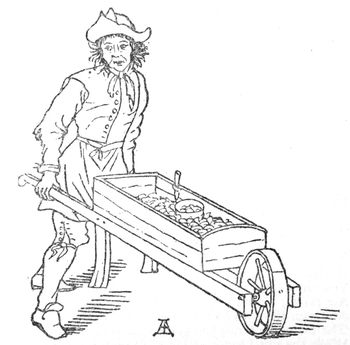
'TWELVE PENCE A PECK, OYSTERS!'
Bread, as usual, was made the subject of legislation, and the following proclamation was issued:—
'London May 3.
'GARRARD. MAYOR.
'Martis 2 do die Maii 1710. Annoque Reginæ 'Annæ Magnæ Britanniæ &c. Nono.
By Virtue of an Act Passed in the last Session of Parliament, Intituled, An Act to Regulate the Price and Assize of Bread, This Court doth Order and Appoint, That the Assize of all White, Wheaten and Household Bread, to be made of Wheat for Sale within this City and Liberties thereof, shall for the future be Penny, Two Penny, Six Penny, Twelve Penny, and Eighteen Penny Loaves, and no other; and that on every Loaf be fairly Imprinted or Marked, several Letters for Knowing the Price and Sort thereof, as followeth, that is to say
Finestor White. Wheaten. Houshold.
On every Penny Loaf I. F. I. W. I. H.
Two Penny Loaf II. F. II. W. II. H.
Six Penny Loaf VI. W. VI. H.
Twelve Penny Loaf XII. W. XII. H.
Eighteen Penny Loaf XVIII. W. XVIII. H.
And in further Pursuance of the said Act, this Court doth appoint, That the Assize and Weight of the said Bread shall be as followeth.
White. Wheaten. Houshold.
Lb. Oz. Dr. Lb. Oz. Dr. Lb. Oz. Dr.
The Penny Loaf to Weigh by Avoirdepois or Common Weight — 4. 3. — 6. 5. — 8. 7.
The Two Penny Loaf — 8. 7. — 12. 10. 1. 0. 14.
The Six Penny Loaf — — — 2. 5. 15. 3. 2. 9.
The Twelve Penny Loaf — — — 4. 11. 13. 6. 5. 2.
The Eighteen Penny Loaf — — — 7. 1. 11. 9. 7. 11.
Whereof all Bakers and others concern'd are to take Notice, and to Observe the same under the Penalties in the said Act contained to be inflicted on all such who shall Neglect so to do.
'Note, That 16 Drams make One Ounce and 16 Ounces One Pound.
'GIBSON.'
And so they continued to regulate the price, according to the fluctuations of the corn market.
Milk was produced from cows kept in London, and was carried round by women, or milkmaids, as they were called.
On Doors the sallow Milkmaid chalks her Gains; Ah! how unlike the Milkmaid of the Plains!
And the milch-asses went their daily rounds. Asses' milk was in great request, and many were the advertisements of milch-asses for sale. Its price was 3s. 6d. per quart.
Before proud Gates attending Asses bray, Or arrogate with solemn pace the Way; These grave Physicians with their milky Chear, The Love sick Maid, and dwindling Beau repair.
Butter was got from the surrounding villages, but already there was a trade in this article with Ireland, for on August 14, 1705, was sold at the Marine Coffee House thirty-eight casks of Irish butter and forty-nine casks of Irish beef.
There were several markets in London, each with its specialty.
Shall the large Mutton smoke upon your Boards? Such Newgate's copious Market best affords; Would'st thou with mighty Beef augment thy Meal? Seek Leaden hall; Saint James's sends thee Veal. Thames street gives Cheeses; Covent garden Fruits; Moor fields old Books; and Monmouth Street old Suits.
Misson says, 'Fruit is brought only to the Tables of the Great, and of a small number even among them. The Desert they never dream of, unless it be a Piece of Cheese.' That possibly was correct, but still a great deal of fruit was eaten. The Daily Courant of Feb. 20, 1714, mentions the following—Pears: 'Bon chrestien,' 'Mesir jean,' 'Beuré.' Apples: 'Pomme Royal,' 'Pomme Dâpy,' 'Reinette Grise,' and the 'Magdelaine' peach. We also see that
Wallnutts the Fruit'rer's Hand, in Autumn stain, Blue Plumbs, and juicy Pears augment his Gain; Next Oranges the longing Boys entice, To trust their Copper Fortunes to the Dice.
'Lisbon, China Oranges, and Sower Oranges' were sold in Love Lane, near Billingsgate; as were also 'a Parcel of Pot China Oranges, of a pleasant taste and flavour, landed out of the Lisbon Fleet, now a delivering.' Oranges were favourite trees to grow here, and one advertisement mentions 7,000 of them for sale. The retail price of oranges was not excessive, considering the restricted commerce, and the small tonnage of the shipping. 'We have the finest oranges for two pence a piece,' writes Swift.
The foreign fruit market was, as now, near Billingsgate, and here were sold olives, raisins, currants, French 'Pruants,' and the choicer sorts of French dry fruits, 'Pears of Rousselet, of Champagne, Prunes of Tours, and Muscadine Grapes,' 'Candid Maderas Citrons, and Sweet Barbary Almonds.'