Chapter VIII · DAILY LIFE. (Women.)
Reading edition
Receiving in bed — A lady's life — A fine lady's diary — Walking — Visiting — Tea-table scandal — Shopping — Daily church — Pets — Dancing — Books on ditto — A dancing master.
'How do you employ your time now?'
'I lie in Bed till Noon, dress all the Afternoon, Dine in the Evening, and play at Cards till Midnight.'
'How do you spend the Sabbath?
'In Chit Chat.'
'What do you talk of?'
'New Fashions and New Plays.'
'How often do you go to Church?'
'Twice a year or oftener, according as my Husband gives me new Cloaths.'
'Why do you go to Church when you have new Cloaths?'
'To see other Peoples Finery, and to show my own, and to laugh at those scurvy, out of fashion Creatures that come there for Devotion.'
'Pray, Madam, what Books do you read?'
'I read lewd Plays and winning Romances.'
'Who is it you love?'
'Myself.'
'What! nobody else?'
'My Page, my Monkey, and my Lap Dog.'
'Why do you love them?'
'Would not they have pleased you as well if they had been English?'
'No, for I hate everything that Old England brings forth, except it be the temper of an English Husband, and the liberty of an English wife; I love the French Bread, French Wines, French Sauces, and a French Cook; in short, I have all about me French or Foreign, from my Waiting Woman to my Parrot.'
'Wednesday From Eight 'till Ten. Drank two Dishes of Chocolate in Bed, and fell asleep after 'em.
'From Ten to Eleven. Eat a Slice of Bread and Butter, drank a Dish of Bohea, read the Spectator.
'From Eleven to One. At my Toilet, try'd a new Head. Gave orders for Veney to be combed and washed. Mem. I look best in Blue.
'From One till Half an Hour after Two. Drove to the Change. Cheapned a couple of Fans.
'Till Four. At Dinner. Mem. Mr. Froth passed by in his new Liveries.
'From Four to Six. Dressed, paid a Visit to old lady Blithe and her Sister, having heard they were gone out of Town that Day.
'From Six to Eleven. At Basset. Mem. Never set again upon the Ace of Diamonds.
'Thursday. From Eleven at Night to Eight in the Morning. Dream'd that I punted to Mr. Froth.
'From Ten to Eleven. Tea Table. Sent to borrow Lady Faddle's Cupid for Veney. Read the Play-Bills. Received a letter from Mr. Froth. Mem. Locked it up in my strong box.
'Rest of the Morning. Fontange the Tire woman, her Account of my Lady Blithe's Wash. Broke a Tooth in my little Tortoise-shell Comb. Sent Frank to know how my Lady Hectick rested after her Monky's leaping out at Window. Looked pale. Fontange tells me my Glass is not true. Dressed by Three.
'From Three to Four. Dinner cold before I sat down.
'From Four to Eleven. Saw Company. Mr. Froth's opinion of Milton. His Account of the Mohocks. His Fancy for a Pincushion. Picture in the Lid of his Snuff-box. Old Lady Faddle promises me her Woman to cut my Hair. Lost five Guineas at Crimp.
'Twelve a Clock at Night. Went to Bed.
'Friday. Eight in the Morning. Abed. Read over all Mr. Froth's Letters. Cupid and Veney.
'Ten a Clock. Stay'd within all day—not at home.
'From Ten to Twelve. In Conference with my Mantua Maker. Sorted a Suit of Ribbands. Broke my Blue China Cup.
'From Twelve to One. Shut myself up in my Chamber, practised Lady Betty Modely's Skuttle.
'One in the Afternoon. Called for my flowered Handkerchief. Worked half a Violet Leaf in it. Eyes aked and Head out of Order. Threw by my Work, and read over the remaining Part of Aurenzebe.
'From Three to Four. Dined.
'From Four to Twelve. Changed my Mind, dressed, went abroad, and play'd at Crimp till Midnight. Found Mrs. Spitely at home. Conversation: Mrs. Brilliant's Necklace false Stones. Old Lady Loveday going to be married to a young Fellow that is not worth a Groat. Miss Prue gone into the Country. Tom Townley has red Hair. Mem. Mrs. Spitely whispered in my Ear that she had something to tell me about Mr. Froth, I am sure it is not true.
'Saturday. Rose at Eight a Clock in the Morning. Sate down to my Toilet.
'From Eight to Nine. Shifted a Patch for Half an Hour before I could determine it. Fixed it above my left Eye-brow.
'From Nine to Twelve. Drank my Tea and Dressed.
'From Twelve to Two. At Chappel. A great deal of good Company. Mem. The third Air in the new Opera. Lady Blithe dressed frightfully.
'From Three to Four. Dined. Miss Kitty called upon me to go to the Opera before I was risen from Table.
'From Dinner to Six. Drank Tea. Turned off a Footman for being rude to Veney.
'Six a Clock. Went to the Opera. I did not see Mr. Froth till the beginning of the second Act. Mr. Froth talked to a gentleman in a black Wig. Bowed to a Lady in the Front Box. Mr. Froth and his Friend clapp'd Nicolini in the third Act. Mr. Froth cried out Ancora. Mr. Froth led me to my Chair. I think he squeezed my Hand.
'Eleven at Night. Went to Bed. Melancholy Dreams. Me-thought Nicolini said he was Mr. Froth.
'Sunday. Indisposed.
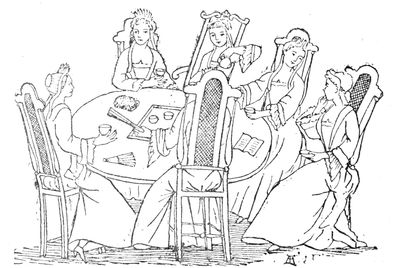
A TEA PARTY.
Tea was then in its infancy, but it was an extremely fashionable beverage, in spite of its expense, and the tea-table was the very centre of scandal and gossip.
How see we Scandal (for our sex too base),
Seat in dread Empire in the Female Race,
'Mong Beaus and Women, Fans and Mechlin Lace,
Chief seat of Slander, Ever there we see
Thick Scandal circulate with right Bohea.
There, source of black'ning Falshood's Mint of Lies,
Each Dame th' Improvement of her Talent tries,
And at each Sip a Lady's Honour dies;
Truth rare as Silence, or a Negro Swan,
Appears among those Daughters of the Fan.
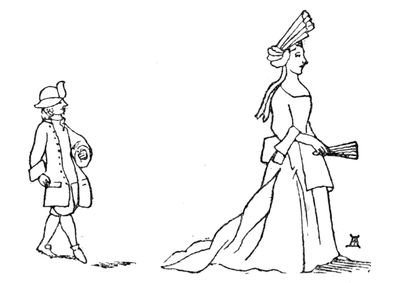
A LADY AND FOOTMAN.
This was the universal description of the New Exchange, and the character of their wares has been immortalised in a song by Ward:—
Fine Lace or Linnen, Sir, Good Gloves or Ribbons here; What is't you please to Buy, Sir? Pray what d'ye ask for this? Ten Shillings is the Price; It cost me, sir, no less, I Scorn to tell a Lye, Sir. Madam, what is't you want, Rich Fans of India paint? Fine Hoods or Scarfs, my Lady? Silk Stockings will you buy, In Grain or other Dye? Pray, Madam, please your Eye; I've good as e'er was made ye. My Lady, feel the Weight, They're Fine, and yet not Slight; I'd with my Mother trust 'em. For Goodness and for Wear, Madam, I Vow and Swear, I show'd you this same Pair In hopes to gain your Custom. Pray tell me in a Word, At what you can afford, With Living Gain to sell 'em: The price is one Pound five, And as I hope to Live, I do my Profit give, Your Honour's very welcome. Knives, Penknives, Combs or Scissors, Tooth Pickers, Sirs, or Tweesers; Or Walking Canes to Ease ye. Ladies, d'ye want fine Toys, For Misses or for Boys? Of all sorts I have Choice, And pretty things to please ye. I want a little Babye, As pretty a one as may be, With Head dress made of Feather: And now I think again, I want a Toy from Spain, You know what 'tis I mean: Pray send 'em home together.
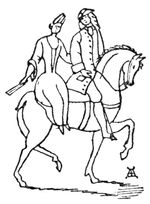
When not walking, ladies used either a coach or a sedan chair, and but seldom rode on horseback; but, when they did so, they generally preferred the pillion to the side-saddle, as in the accompanying illustration, and held on by the belt either of her cavalier or groom.
In the country, horse exercise was much more in vogue, and Swift repeatedly alludes to, and reminds Stella of, her riding. When riding, ladies very frequently wore masks to protect the countenance from the rays of the sun.
RIDING PILLION.
Frequent allusions are made to a lady's pets, her lap-dog or her parrot; but very few people know the very wide range of choice she had in the selection of those pets. Needless to say there were monkeys, both Marmoset and other kinds; there were paroquets, paroquets of Guinea, cockatoos and macaws, scarlet nightingales from the West Indies, lorries or lurries, canaries, both ash and lemon colour, white and grey turtle doves from Barbary, white turtle doves, and the turtle doves from Moco, no bigger than a lark, spotted very fine. There were milk-white peacocks, white and pyed pheasants, bantams, and furbelow fowls from the East Indies, and top-knot hens from Hamburg. She would hardly want the 'Parcel of living Vipers, fresh taken, fat and good, are to be sold by the dozen,' nor would she care about the 'fine Tyger from the East Indies, who was brought over together with some fine geese from the same part of the world,' and some 'Amedawares.' In fact there were 'Jamrachs' then as now, and many of the bird shops were in St. Martin's Lane, near which locality they still abound. There is a curious advertisement in the Postman, January 12/15, 1706, which settles the date of bird-seed glasses. 'The so much approved and most convenient new fashion Crystal Bird Glasses, which effectually prevent the Littering of the Seeds into the Rooms.'
An innocent amusement, of which they were very fond, was dancing. And of dances there were a considerable quantity: country dances and jigs, of which there was an infinite variety, and minuets, rigadoons, and other more stately and stagey dances, as the 'Louvre and the French Brittagne.' These latter were elaborate, and absolutely inaugurated a fresh literature devoted to their cult. This seems to have been started by one Thoinet Arbeau, in a book published by him in 1588, and he may be called the originator of the ballet. Both Beauchamp and Feuillet wrote on this subject in French. Feuillet's book was translated and improved upon by Siris, in 1706. John Weaver wrote on this subject (in his 'Orchesography') about 1708, and John Essex (in the 'Treatise of Chorography') in 1710. The object was to teach the different steps and dances, by means of diagrams. Thus coupées, bourées, fleurets, bounds or tacs, contretemps, chasses, sissones, pirouettes, capers, entrechats, etc., all had their distinguishing marks.
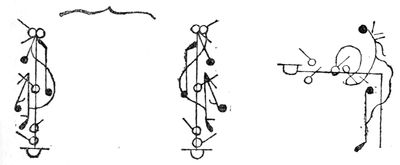
A BOURÉE AND A CONTRETEMPS.
'I looked in at the keyhole, and there I saw a well-made man look with great attention on a book, and on a sudden jump into the air so high, that his head almost touched the ceiling. He came down safe on his right foot, and again flew up, alighting on his left; then looked again at his book, and holding out his right leg, put it into such a quivering motion, that I thought he would have shaked it off. He then used the left after the same manner, when on a sudden, to my great surprise, he stooped himself incredibly low, and turned gently on his toes. After this circular motion, he continued bent in that humble posture for some time, looking on his book. After this, he recovered himself with a sudden spring, and flew round the room in all the violence and disorder imaginable, until he made a full pause for want of breath.
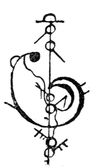
A SISSONE.
'In this interim, my women asked "what I thought." I whispered, "that I thought this learned person an enthusiast, who possibly had his first education in the Peripatetic way, which was a sect of Philosophers, who always studied when walking." But observing him much out of breath, I thought it the best time to master him if he were disordered, and knocked at his door. I was surprized to find him open it, and say with great civility and good mien, "that he hoped he had not disturbed us." I believed him in a lucid interval, and desired "he would please to let me see his book." He did so, smiling. I could not make anything of it, and therefore asked "in what language it was writ." He said, "it was one he studied with great application; that it was his profession to teach it, and he could not communicate his knowledge without a consideration." I answered "that I hoped he would hereafter keep his thoughts to himself, for his meditation this morning had cost me three coffee dishes and a clean pipe." He seemed concerned at that, and told me "he was a dancing master, and had been reading a dance or two before he went out, which had been written by one who had been taught at an Academy in France." He observed me at a stand, and went on to inform me, "that now Articulate MOTIONS as well as SOUNDS were expressed by Proper CHARACTERS, and that there is nothing so common as to communicate a Dance by a letter." I besought him hereafter to meditate in a ground room.'
The public dancers were utilised in rather a curious way, if we may credit Mrs. Centlivre—who certainly ought to know. She says, in 'Love at a Venture,' 'Sir Paul Cautious, Go to the Play House, and desire some of the Singers and Dancers to come hither,' and the servant, later on in the play, announces, 'The Singers and Dancers are come, Sir. (Here is songs and dances.)'