Chapter X · SUPERSTITION.
Reading edition
Astrologers — Their advertisements — Their tricks — Witchcraft — Cases of witchcraft.
It is not for us to decry the superstition of that age—we should look to ourselves in this matter. Perhaps they were more open in their expression of belief in the supernatural, and perhaps that belief was wider spread than at present. The seventh Spectator gives a very good account of the minor superstitions, but does not touch on the grosser ones, such as the consulting of astrologers, and the belief in witches. These two things still exist in England, though nothing like to the extent they did in the early part of the last century. In spite of Hudibras and Sidrophel, an astrologer was a very important entity. He published his almanacs—he drew horoscopes; and, as to witches, why, of course there were plenty of them. An old, ugly, soured, and malevolent woman earned a right to be considered such.
As for the astrologers, it is needless to say they were unscrupulous, needy sharpers, who lived 'in all the By-Allies in Moorfields, White Chappel, Salisbury Court, Water Lane, Fleet Street, and Westminster.' Their advertisements have come down to us, and a selection of two or three of them will furnish both amusement and information.
'In Cripplegate Parish, in Whitecross Street, almost at the farther End near Old Street (turning in by the sign of the Black Croe in Goat Alley, straight forward down three steps, at the sign of the Globe) liveth one of above Thirty Years Experience, and hath been Counsellor to Counsellors of several Kingdoms, who resolveth these Questions following—
'Life Happy or Unhappy? If Rich, by what means attain it. What manner of Person one shall Marry? If Marry the Party desired. What part of the City or Country is best to live in? A Ship at Sea, if safe or not. If a Woman be with Child, with Mail or Female, and whether Delivered by Night or by Day? Sickness, the Duration, and whether end in life or death? Suits at Law, who shall overcome, With all lawful Questions, that depend on that most Noble Art of CHRISTIAN ASTROLOGY.
'Likewise, he telleth the Meaning of all Magical Panticles, Sigils, Charms, and Lamens, and hath a Glass, and helpeth to further Marriages.
'He hath attained to the Signet Star of the Philosopher.
'He likewise hath attained to the Green, Golden, and Black Dragon, known to none but Magicians, and Hermetick Philosophers; and will prove he hath the true and perfect Seed and Blossom of the Female Fern, all for Physician's uses. And can tell concerning every serious Person, what their Business is on every Radical figure, before they speak one Word; secondly, What is past in most of their Life, What is present, and what is to come; where that they have Moles, what colour they are, and what is the meaning of them, &c.
In this case we see the astrologer using the jargon of the alchemists, to enhance his value in the eyes of his dupes. It was still familiar to the ears of the people, and Jonson's 'Alchemist' was a popular play. The succeeding examples are more commonplace:—
'To be spoken with every day in the Week except Saturday at the Golden Ball (being the Third House on the Left Hand) in Gulstone Square, next Turning beyond Whitechappel Bars: And for the convenience of those who live in Westminster, Southwark, &c., He is to be spoken with every Saturday at the Golden Ball and 2 Green Posts, (There being a Hatch with Iron spikes at the door) near the Watch House in Lambeth Marsh.
'A Person who by his Travels in many Remote parts of the World, has obtained the Art of Presaging or Foretelling all Remarkable Things, that ever shall happen to Men or Women in the whole course of their Lives, to the great Admiration of all that ever came to him; and this he does by a Method never yet practised in England: He might give Multitudes of Examples, but will give but one of a Sort.
'A Young Woman, who had a Person pretended Love to her for many Years; I told her, she would find him False and Deceitful to her, and that he never design'd to Marry her, which was a great Trouble to her to hear, by reason she had plac'd her Affection on him, but she found it True, for shortly after he Marryed another: Soon after she had several Sweethearts at a Time, and came to me again for Advice; I told her, there was but one of those she could be happy with, and describ'd him to her; she took my Advice and Marryed him, and they prove a very Happy Couple.
'I have prevented the Ruin of Hundreds of Young Men and Women, by advising them to whom to dispose of themselves in Marriage.
'No common Errours, Frauds, or Fallacies, in the World, have so far subdued the Weaker, and Consequently the Greater part of Mankind, as the Juggles and Deceits practicable in a parcel of pretending Astrologers; who undertake to resolve all manner of Lawful Questions, by Jumbling together those distant Bodies, in whose Nature or Influence they have just as much Knowledge, as a Country Ale Woman has of Witchcraft, or a German Juggler of Necromancy. In the first place, I have had an opportunity of examining several Nativities Calculated by those who have had the Reputation of being the best Artists of this Age; wherein I have observ'd Sickness, Length of Days, and all other Fortunate and Unfortunate Contingencies assign'd the Natives, have been as directly opposite to what has happen'd thro' the whole Course of their Lives, as if the Fumbling Star Groper had rather, thro' an Aversion to Truth, study'd the Rule of Contraries, that he might always be found in the Wrong on't.
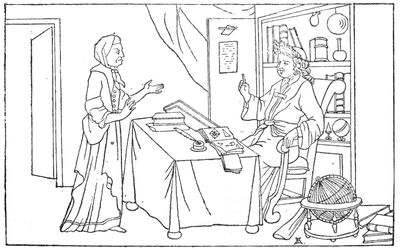
AN ASTROLOGER.
'In the next place, their method in deceiving people who come to enquire after Stolen Goods, is such a bare fac'd ridiculous piece of Banter, that I wonder any Creature that bears Humane Shape, can be so stupidly Ignorant, as not to plainly discern the Impositions that are put upon them by their canting Albumazer; Who, in the first place, enquires about what time, and in what manner the things were lost; and what strangers they had in the House? From whence he reasonably infers, whether the Spoon, Cup, Tankard, or whatsoever it be, was taken away by the Common Thief, or stolen by a Servant, or Person that uses the House, or whether Conceal'd by the Master or Mistress on purpose to make the Servants more diligent. If his Conjecture be, that it was taken by a Common Thief, he describes a Swarthy Black Ill looking Fellow, with a down look, or the like; most wisely considering That such sort of Rogues are seldom without a Gallows in their Countenances: Telling withall, That the Goods are Pawn'd, and will scarcely be recoverable, without they take the Thief speedily, in order to effect which, he will give them his best Directions; which the credulous Ignoramus desires in Writing, for fear he should forget; which the Sower look'd Conjurer gives him accordingly, after the following manner:—Go a quarter of a Mile from your own Dwelling, and then turn Easterly, and walk forward till you come to the Sign of a large Four Footed Beast, and Search within three or four Doors of that Sign, and you will go near to take him, if you go soon enough, or hear of him, who is of a middle Stature and in poor Habit. Away goes the Fool, as well satisfied with the Note, as if he had the Rogue by the Elbow, and if by any Accident they do hear of the Thief, all is ascrib'd to the wonderful Cunning of their Wissard: But if on the contrary, he believes it to be taken by a Servant, or any Body that uses the House, he bids 'em, hab nab at a venture, Go home satisfied, for they shall certainly find the Spoon, &c. in three or four days' time, hid in a private Hole, in such a part of the Kitchen, or he'll make the Devil to do with those that have it; and force them to bring it in open shame and disgrace at Dinner time, and lay it down upon the Table in the Sight of the whole Family. Away goes the Person well satisfied with what their Ptolomist had told 'em: and declares to every one in the House how the Thief was Threaten'd, and after what manner the Spoon should be found within the time appointed, or else woe be to them that have it. This Frightful Story coming to the Ears of the Guilty, brings 'em under such dreadful Apprehensions of the Conjuror's Indignation, if they do not lay what they've taken within the time, according to the Direction; that the first opportunity they have, they will place it to the utmost exactness in whatever Hole or Corner he has appointed for the finding of it.'
A little before this was written, two women had been executed at Northampton for witchcraft, and at that very time an old woman named Jane Wenham, living at a little village in Hertfordshire called Walkerne, was charged with, and next year tried for, witchcraft. She was condemned, reprieved, and pardoned. But in 1716 Mrs. Hicks and her daughter were executed at Huntingdon, and their crime was that of selling their souls to the devil, etc. Indeed, the capital sentence against witchcraft was only abolished by an Act 9 Geo. II. cap. 5.
'Sarah Griffith who Lived in a Garret in Rosemary lane was a long time suspected for a bad Woman, but nothing could be prov'd against her that the Law might take hold of her. Tho' some of the Neighbours' Children would be strangely effected with unknown Distempers, as Vomiting of Pins, their Bodies turn'd into strange Postures and such like, many were frighted with strange Apperitions of Cats, which of a sudden would vanish away, these and such like made those who lived in the Neighbourhood, both suspicious and fearful of her: Till at last the Devil (who always betrays those that deal with him) thus brought the Truth to Light. One Mr. John —— at the Sugar loaf had a good jolly fellow for his Apprentice: This Old Jade came into his Shop to buy a quartern of Sope, the young fellow happened to Laugh, and the Scales not hanging right, cryed out he thought that they were be Witch'd; The Old Woman hearing him say so, fell into a great Passion, judging he said so to Ridicule her, ran out of the Shop and threatned Revenge. In the Night was heard a lumbring noise in the Shop, and the Man coming down to see, found a strange Confusion, every thing turn'd topsy turvy, all the goods out of order; but what was worse, the next day the poor fellow was troubled with a strange Disease, but (by) the good Prayers of some Neighbouring Divines the power of the Devil was restrain'd.
'Two or three days after it happened, that the Young Man with two or three more walking up to the New River Head, who should they see but Mother Griffith walking that way. They consulted together to try her, and one of them said let us toss her into the River, for I have heard that if she Swims 'tis a certain sign of a Witch; in short they put their design in Execution, for coming up to her, they tossed her in; but like a Bladder when forc'd under Water pops up again, so this Witch was no sooner in but Swam like a Corke; they kept her in some time, and at last let her come out again; she was no sooner out but she smote that Young Man on the Arm, and told him he should pay dear for what he had done. Immediately he found a strange pain on his Arm, and looking on it found the exact mark of her Hand and Fingers as black as a Cole; he went home where he lay much Lamented and wonderfully affrighted with the Old Woman coming to afflict him, and at last died with the pain, and (was) Buried in St. Pulchers Church Yard.
'Mr. John —— fearing some further mischief, takes a Constable and goes to her Lodging, where he finds the Old Woman, and charges the Constable with her. She made many attempts to escape, but the Devil who owed her a shame had now left her, and she was apprehended. As she was conducted towards the Justices' House she tried to leap over the Wall, and had done it, had not the Constable knocked her down. In this manner she was carried before the Justice, there was Evidence that was with him in his Sickness could Witness that he had unaccountable Fits, Vomitted up Old Nails, Pins and such like, his body being turned into strange postures, and all the while nothing but crying out of Mother Griffith that she was come to torment him, his Arm rotted almost off, Gangreen'd, and Kill'd him. When she came before the Justice she pleaded innocence, but the Circumstances appeared so plainly that she was committed to Bridewel, where she now remains.
'Witness my Hand, 'July 24, 1704.' 'Thos. Greenwel.
And Thoresby, in his semi-pious way, mentions (Feb. 18, 1712), 'With Mrs. Neville, Cousin Cookson, and others of the Grand Jury to see a reputed witch, who, though aged, could not repeat the Lord's Prayer; a fit instrument for Satan.'