Chapter XIII · MEN'S DRESS.
Reading edition
A beau — An inventory of him — Hats — Wigs: their price: varieties — Hair powder — Robbery of wigs — Natural hair — Neck cloths — Shirts — Open waistcoats — Colonel Edgworth — Coats — Cheap clothiers — Stockings — Boots and shoes — Shoeblacks and blacking — Handkerchiefs — Muffs — Swords — Walking sticks — Watches — Over coats — Night caps — Night gowns.
Ward naturally loves him—impales him on his entomological pin—and enjoys his wriggles. He puts him under his microscope and minutely observes him, and then gives us the benefit of his description: 'A Beau is a Narcissus that is fallen in Love with himself and his own Shadow. Within Doors he is a great Friend to a great Glass, before which he admires the Works of his Taylor more than the whole Creation. His Body's but a Poor Stuffing of a Rich Case, like Bran to a Lady's Pincushion; that when the outside is stript off, there remains nothing that's Valuable. His Head is a Fool's Egg, which lies hid in a Nest of Hair; His Brains are the Yolk which Conceit has Addled. He's a strolling Assistant to Drapers and Taylors, showing every other Day a New Pattern, and a New Fashion. He's a Walking Argument against Immortality; For no Man by his Actions, or his Talk can find he has more Soul than a Goose. He's a very Troublesome Guest in a Tavern; and must have good Wine chang'd three or four Times till they bring him the worst in the Cellar, before he'll like it. His Conversation is as intolerable as a young Councel's in Term Time. Talking as much of his Mistresses, as the other does of his Motions; and will have the most Words, tho' all he says is nothing. He's a Bubble to all he deals with, even to his Periwig Maker; and hates the sordid Rascal that won't Flatter him. He scorns to condescend so low, as to speak of any Person beneath the dignity of a Noble man; the Duke of such a Place, and my Lord such one, are his common Cronies, from whom he knows all the Secrets of the Court, but dares not impart 'em to his best Friends, because the Duke enjoyn'd him to Secrecie. He is always furnish'd with new Jests from the last New Play, which he most commonly spoiles with repeating. His Watch he compares with every Sun Dial, Swears it corrects the Sun; and plucks it out so frequently in Company, that his Fingers go oftener in a Day to his Fob, than they do to his Mouth, spending more time every Week in showing the Rarity of the Work, than the Man did in making on't; being as forward to tell the Price without desiring, as he is to tell you the Hour without asking; he is a constant Visitor of a Coffee house, where he Cons over the News Papers with much indifference; Reading only for Fashion's sake and not for Information. He's commonly of a small standing at one of the Universities, tho' all he has learnt there, is to Know how many Taverns there are in the Town, and what Vintner has the handsom'st Wife.... He's a Coward amongst Brave men, and a Brave fellow among Cowards; a Fool amongst Wise men, and a Wit in Fool's company.'
'Four pounds of scented snuff, with three gilt snuff boxes; one of them with an invisible hinge, and a looking glass in the lid.
'Two more of ivory, with the portraitures on their lids of two ladies of the town; the originals to be seen every night in the side boxes of the play house.
'A sword with a steel diamond hilt, never drawn but once at May fair.
'Six clean packs of cards, a quart of orange flower water, a pair of French scissors, a toothpick case, and an eye brow brush.
'A large glass case, containing the linen and cloaths of the deceased; among which are two embroidered suits, a pocket perspective, a dozen pairs of red heeled shoes, three pairs of red silk stockings, and an amber headed cane.
'The strong box of the deceased, wherein were found five billet doux, a Bath shilling, a crooked sixpence, a silk garter, a lock of hair, and three broken fans.
'A press for books; containing on the upper shelf Three bottles of diet drink—Two boxes of pills.
'On the second shelf are several miscellaneous works; as Lampoons, Plays, Taylor's Bills, And an Almanack for the year 1700.
'On the third shelf, a bundle of letters unopened, indorsed, in the hand of the deceased "Letters from the old Gentleman," Lessons for the flute, Toland's "Christianity not mysterious," and a paper filled with patterns of several fashionable stuffs.
'On the lower shelf, one shoe, a pair of snuffers, a French Grammar, a mourning hatband; and half a bottle of usquebaugh.
'There will be added to these goods, to make a complete auction, a collection of gold snuffboxes and clouded canes, which are to continue in fashion for three months after the sale.'
I have come across one mention of a 'Spanish Wigg,' but as this was worn by a runaway ship's apprentice, it was probably of foreign manufacture, and the species had no place here. Lastly, there was the 'Bob' wig, or attempt to imitate the natural head of hair. This wig was mostly in use among the lower orders; and many are the descriptions of it, and its various colours, in the advertisements for army deserters. But the better class also used it. We have seen, in the Spectator, No. 319, how a man wore 'a thin Natural' wig; so also we read in Steele's 'Lying Lover,' 'What shall I do for powder for this smart Bob?'
The proper quality, and quantity, of his powder, must have been a serious weight upon the mind of a beau. Its groundwork, or basis, was starch, very finely ground and sifted; but this was adulterated with burnt alabaster, plaster of Paris (which was called in the trade Old Doctor), whitening, fine flour, flour from pearl barley, and other things; and it was scented—well, we should think to a sickening degree—with ambergris, musk and civet, violets, orris root, rose, bergamot, orange flowers, and jessamine. And there were different coloured hair powders. The black was made with starch, Japan ink, and ivory black; a cheaper sort was made of pounded coal-dust. Brown was made with starch and umber—according to the shade required. Grey was produced by mixing some of the black powder with more starch, and adding a little smalts.
Gay presents us with a curious little piece of economy:—
Nor is thy Flaxen Wigg with Safety worn; High on the Shoulder, in the Basket born, Lurks the sly Boy; whose Hand to Rapine bred, Plucks off the curling Honours of the Head.
This was an ingenious plan, but it was almost equalled in the very early years of George I. by a practice which sprang up, of cutting a hole in the leather backs of the carriages, boldly clutching the occupant's wig, and dragging it through the hole.
We next come to the neckcloth, as no collar or band of the shirt was shown; and the one most in fashion was the 'Steinkirk, so called from the battle of that name, which was fought on Aug. 3, 1692, when the English under William III. were defeated, and the campaign broken up. This style of neckcloth was introduced from Paris, and it was highly fashionable there, because its negligent style was popularly supposed to imitate the disordered dress of the victorious French generals, who were so eager to rush into the fight that they did not stop to finish dressing—or, at all events, to tie their neckcloths. It was a very graceful fashion, and the ends, which were laced or fringed, were sometimes tucked in the waistcoat or shirt. They are frequently alluded to as 'snuff grimed.' Ladies also wore them, as in 'The Careless Husband' Lady Easy 'takes her Steinkirk from her Neck and lays it gently over his Head.'
The Daily Courant, Nov. 4, 1708, says: 'Also very fine Muslin Neckcloths to be sold at 5s. a Piece.'
'"Sir,
"From the twentieth instant to the first of May next, both days inclusive, I beg of you to button your waistcoat from your collar to your waistband."'
We have seen that there was a great variety of colours in men's clothing. A little curiosity in colour must not pass unnoticed.
—a colour which might puzzle for some time, were it not for the huge quantity of snuff captured at Vigo in 1702.
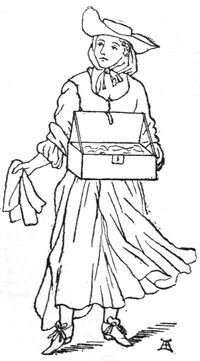
'4 PAIRE FOR A SHILLING, HOLLAND SOCKS!'
When the Black Youth at chosen Stands rejoice, And Clean your Shoes resounds from ev'ry Voice; When late their miry Sides Stage Coaches show, And their stiff Horses thro' the Town move slow; When all the Mall in leafy Ruin lies, And Damsels first renew their Oyster Cries: Then let the prudent Walker Shoes provide Not of the Spanish or Morocco Hide; The wooden Heel may raise the Dancer's Bound, And with the 'scallop'd Top his Step be crown'd: Let firm, well hammer'd Soles protect thy Feet Thro' freezing Snows, and Rains, and Soaking Sleet. Should the big Laste extend the Shoe too wide, Each Stone will wrench th' unwary Step aside: The sudden Turn may stretch the swelling Vein, Thy cracking Joint unhinge, or Ankle sprain; And when too short the modish Shoes are worn, You'll judge the Seasons by your shooting Corn.
Shoe-strings had gone out, and buckles were in fashion; but they had not assumed the proportions they did in after years. Boots were never worn except for riding; and there was in this reign very little improvement on the heavy and clumsy riding-boot of William the Third's time, which was still worn by Marlborough and his cavalry. Many are the pairs, with their spurs, that are advertised for as being left in coaches.
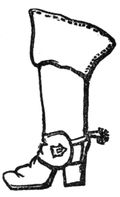
JACK BOOT.
In those days of bad pavements and defective sewage, when men had hardly begun the general use of the chair, and a coach was, as now, the luxury of the few, shoeblacks were a necessity; and, although a man might, like the Templar in 'Sir Roger de Coverley,' 'have his shoes rubbed and his periwig powdered at the Barber's, as you go unto the Rose,' yet a large number of 'Black Youth at chosen Stands rejoice; and Clean your Shoes resounds from ev'ry Voice.' They were very numerous; and from them is derived our word blackguard, for so were they called about Charing Cross and White Hall.
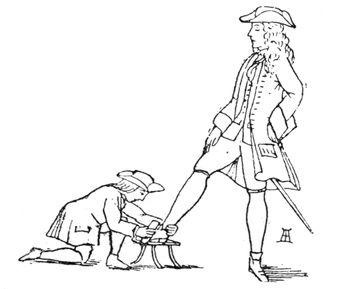
SHOE-BLACK.
There were different kinds of blacking, but, judging from the dispraise awarded to each other's goods by rival manufacturers, they could have been neither pleasant nor effective. 'London Fucus for Shoes; being an unparallel'd Composition of the most pure and rich Blacks, Choice Oils, &c., and is a thing so adapted to this Use, that the World never yet produc'd the like Invention, having gain'd a General Applause, causing the straitest Shooes to wear with delight and ease; beautifies them to admiration, preserves the Leather from cracking or rotting to the very last; and frees the Feet from all Pains, Corns, Swellings, &c.... Price 12d. a Roll. Note, one Roll serves one Person near half a year.' And then the famous 'Spanish Blacking' advertised, and called the poor 'Fucus' names.
The little odds and ends of male attire must be noted. Gloves, for instance, were in constant use, and we have seen how prodigally they were given away at funerals. The ire of the Spectator was aroused by a custom, then just brought up, of edging them with silver fringe, but this luxurious practice does not seem to have obtained for very long.
The pocket-handkerchiefs, owing to the prevalence of the practice of snuff-taking, were nearly always of silk, though cambric was used; and although we do not hear of 'Moral Pocket-handkerchiefs,' they were somewhat similarly utilised, as the following advertisement shows: 'A Silk Handkerchief Printed, with a Draught of the Roads of England according to Mr. Ogleby's Survey, shewing the Roads and distance in measured Miles from London to the several Cities and Towns in England. Also the Victory Handkerchief, which gives an account of the Success of 5 most glorious Victories obtain'd by the Confederates over the French. Ornamented with the Arms of the Empire and Great Britain, Prussia and Holland: They will both Wash in a weak Lather of Soap without Prejudice. Price 2s. 6d.' Others were printed with the Queen's Speech to Parliament, April 5, 1710; the standards and ensigns taken from the French, with the queen's effigies at full length; Dr. Sacheverell and the six bishops who voted with him; the four seasons of the year with the sun in the centre, curiously ornamented; and the last one I can find advertised in Anne's reign was one printed on white silk with 'An Abstract of the Peace made between England and France, with the lively Effigies of all the Confederates, Princes and the several Plenipotentiaries at Utrecht.'
In the early part of Anne's reign it was fashionable for men to wear muffs, as it had been ever since Charles the Second's time. Ward (1703) says: 'What is he in the long Whig, with his Fox skin Muff upon his Button, and his Pocket book in his Hand? Why he (replied my schoolfellow) is a Beau.' But they seem to have become less popular in 1710 (vide Tatler, No. 155). 'I saw he was reduced to extreme poverty, by certain shabby superfluities in his dress: for, notwithstanding that it was a very sultry day for the time of the year, he wore a loose great Coat and a Muff,' etc. Yet in 1711 Addison writes (Spectator, No. 16): 'I have receiv'd a Letter, desiring me to be very satyrical upon the little Muff that is now in Fashion.'
Every gentleman carried a sword, and we are able to get accurate descriptions of them, from the very numerous descriptions of them in the advertisements of lost and stolen swords—how they used to lose them! Probably the company at the tavern or club was jovial, the claret good, and the way home was badly lit, and in the morning the silver-hilted sword was a-missing. I wonder if they ever got them back? They cried after them loudly enough, although they did not offer great rewards, a guinea or so at the outside. Gay thus warns the walker in the streets:—
Where the Mob gathers, swiftly shoot along, Nor idly mingle in the noisy Throng. Lur'd by the Silver Hilt, amid the Swarm, The subtil Artist will thy Side disarm.
With a beau, his sword, as every other part of his dress, received his special attention, and he very seldom was without it, except when dancing. His sword-knot was of some gay colour, and was very long; and he was solicitous as to the carriage of his sword. 'But my sword—does it hang careless?' asks Bookwit in the 'Lying Lover'; and yet withal the hilts very seldom seem to have been of much value, either diamond-cut steel, gilt, or plain silver hilts. The following are some of the better sort, and of the most artistic merit. 'A large plain Silver hilted Sword with Scrowls and gilt in parts, with a broad gutter'd hollow Blade gilt at the shoulder, and the edges ground very sharp and a strong silver gilt handle.' 'A Hanger with a fine Aggat Haft, Belt, and Silver buckle.' 'A Silver gilt Sword, done with several Figures, with a Chequer Gold handle done one half of it with a Black Ribbon.' 'A Silver and Gold Hilted Sword wrought with Figures and Images about the handle, being tyed with a broad black Ribbon, the Blade broad from the Hilt halfway, and stain'd with blew and Gold.' 'A Silver and Gold hilted Sword of a Trophy Pattern, with a man on Horseback on the Middle of the Pommel, and the same in the Shell, with the Figures lying down on each side of the Horse, the Button of the Pommel being in Squares.'
Here is an advertisement which shows how a poor innocent was led astray: 'June 24, 1712. Whereas a Gentleman coming to Bradbery's Hazard Table last Night, and not a Gamester, but brought by an Acquaintance to see the Nature of it, lost his Silver hilted Sword, which some of the Company took from his side; This is to give Notice that any body that produces the Sword to Mr. John Waters, Perfumer, in the Strand, over against the Talbot Inn; or to Mr. Hosier, over against the Bunch of Grapes in New Street, Fetter Lane, shall have 10s. Reward, and no Questions ask'd; and if the Sword is not produc'd, the Man that keeps the Table will be indited.'
Equal, at least, in importance to the sword, was the cane, 'the nice conduct' of which was part of a gentleman's education—and, if swords were plentifully lost or stolen, how many more despairing owners mourned their canes? There were useful, as well as ornamental canes.
The majority of those lost were hardly worth advertising for; but we will pick out a few, as specimens of what the better sort were like: 'A fine Cane with a Gold Head, engraved with a Cypher and Crown on the top of it.[210] 'A Cane with an Aggot head.' 'A small cane with an Amber head and a Black Silk Ribbond in it, a Princes Metal Hoop, and a Silver Ferril at the bottom.' 'A Cane with a Silver Head and a Black Ribbon in it, the top of it Amber, crack'd in two or three places, part of the Head to turn round, and in it a Perspective Glass.' 'A Cane with a croched Head, a Silver Ferrel and a Silver ring.' 'A Cane with a Silver Head, with the Figure of the Tower of Babel upon it, done in Chaced Work.' 'A Cane with a Silver Head and Scent Box, and a Ferril of Silver at the Bottom.'
His snuff-box, too, was an object of his solicitude, though, as the habit of taking snuff had but just come into vogue, there were no collections of them, and no beau had ever dreamed of criticising a box as did Lord Petersham, as 'a nice Summer box.' So many of them have come down to us that they need no description, and I may merely say that those of the middle classes were chiefly of silver, or tortoise-shell, or mother-of-pearl; sometimes of 'Aggat'—or with a 'Moco Stone' in the lid. A beau would sometimes either have a looking-glass, or the portrait of a lady inside the lid.
We have seen how proud the beau was of his watch, which he wore in a fob, or pocket, in his breeches. A seal or two, generally of small value, and a watch key, were attached to it by a ribbon; chains, either of gold, silver, or steel, being sparingly used. The seals, of course, were then necessary, as, there being no gummed envelopes, every letter had to be properly sealed, either by wax or wafer. Tompion was the great watch-maker, and he lived at the Three Crowns, at the corner of Water Lane in Fleet Street, where he was afterwards succeeded by George Graham. The value of Tompion's watches may be gathered from the fact that from seven to ten guineas were generally offered for their recovery when lost, or from eighteen to twenty-five guineas of our money.
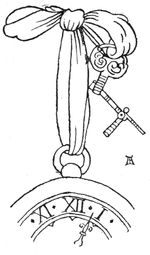
A WATCH RIBAND.
The watch of that day, and indeed of the whole Georgian era, consisted of the watch proper, and an outer ornamental case, which was lined with a pad of coloured velvet or satin, to make it fit tight to the watch. We now never see watch-cases made of other materials than the precious metals, or imitations thereof; but then, beautiful cases were made of shagreen of various colours, or tortoiseshell inlaid, or studded, with gold. Some beautiful specimens may be seen in the library of the Corporation of the City of London, in the Clockmakers' Company's collection.
As umbrellas were not used by men, as being too effeminate, and india-rubber waterproofing was only to be discovered more than a century later, men, in Anne's reign, had to put their trust in good broadcloth coats or cloaks.
Scarlet seems to have been the favourite colour for the roquelaure or cloak, and some must have been 'exceeding magnifical, scarlet rocklows and rocliers, with gold buttons and loops, being advertised as lost. Ah! the men of that time! they were always losing something.
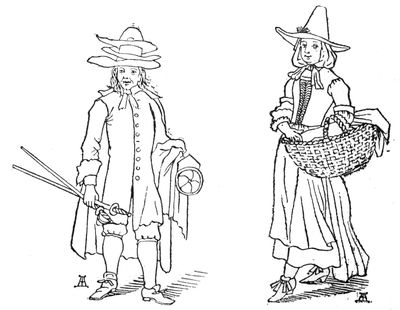
'OLD CLOAKS, SUITS, OR COATS!' 'OLD SATIN, OLD TAFFETY, OR VELVET!'
As the ultimate fate of all these fine clothes was the old clothes man, a picture of him will as appropriately close this portion of the disquisition on male dress, as one of his mate will open that on female costume.