Chapter IV · DEATH AND BURIAL.
Reading edition
Longevity — Undertakers' charges — Costliness of funerals — Mourning — Burial in woollen — Burial societies — Burial by night — A cheat — Mourning rings — Funeral pomp — Monuments — Description of a funeral — A Roman Catholic funeral — Widows.
And this brings us—
Sable. You don't consider the Charges I have been at already.
Lord Brampton. Charges? For what?
Sable. First, Twenty Guineas to my Lady's Woman for notice of your Death (a Fee I've, before now, known the Widow herself go halfs in), but no matter for that. In the next place, Ten Pounds for watching you all your long Fit of Sickness last Winter.
Lord B. Watching me? Why I had none but my own Servants by Turns.
Sable. I mean attending to give notice of your Death. I had all your long fit of Sickness last Winter, at Half a Crown a day, a fellow waiting at your Gate, to bring me Intelligence, but you unfortunately recovered, and I Lost all my Obliging pains for your Service.
This, of course, is exaggeration, but although, as we have seen, people were sparing in expense over births or marriages, they were absolutely lavish over funerals, and the undertaker could well afford to disgorge some of his gains. Was it the funeral of a rich man, the corpse must straightway be embalmed, roughly though it may be. 'Have you brought the Sawdust and Tar for embalming? Have you the hangings and the Sixpenny nails for my Lord's Coat of Arms?' The hatchment must be put up, and mutes must be stationed at intervals from the hall door to the top of the stairs. 'Come, you that are to be Mourners in the House, put on your Sad Looks, and walk by Me that I may sort you. Ha you! a little more upon the Dismal. This Fellow has a good Mortal look, place him near the Corps; That Wanscoat Face must be o' top of the Stairs: That Fellow's almost in a Fright (that looks as if he were full of some strange misery) at the Entrance of the Hall. So!—but I'll fix you all myself. Let's have no Laughing now on any Provocation; Look Yonder, at that Hale, Well looking Puppy! You ungrateful Scoundrel, Did not I pity you, take you out of a Great Man's Service, and show you the Pleasure of receiving Wages? Did not I give you Ten, then Fifteen and Twenty Shillings a Week to be Sorrowful? and the more I give you, I think the Glader you are!'
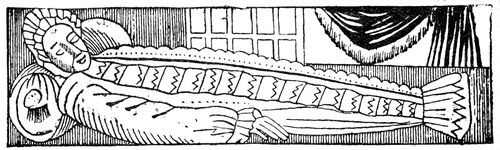
A CORPSE.
The undertaker issued his handbills—gruesome things, with grinning skulls and shroud-clad corpses, thigh bones, mattocks and pickaxes, hearses, and what not. 'These are to Notice, that Mr. John Elphick, Woollen Draper, over against St. Michael's Church in Lewes, hath a good Hearse, a Velvet Pall, Mourning Cloaks, and Black Hangings for Rooms to be Lett at Reasonable Rates.
'He also Sells all sorts of Mourning and Half Mourning, all sorts of Black Cyprus for Scarfs and Hatbands, and White Silks for Scarfs and Hoods at Funerals; Gloves of all sorts and Burying Cloaths for the Dead.
'He sells likewise all sorts of Woollen Cloth Broad and Narrow, Silks and Half Silks, Worsted Stuffs of all Sorts, and Prices of the Newest Fashions, and all sorts of Ribbons, Bodies and Hose, very good Penny worths.'
'Eleazar Malory, Joiner at the Coffin in White Chapel, near Red Lion Street end, maketh Coffins, Shrouds, letteth Palls, Cloaks, and Furnisheth with all other things necessary for Funerals at Reasonable Rates.'
The dead were then buried in woollen, which was rendered compulsory by the Acts 30 Car. II. c. 3 and 36 ejusdem c. 1. The first Act was entitled 'An Act for the lessening the importation of Linnen from beyond the Seas, and the encouragement of the Woollen and Paper Manufactures of the Kingdome.' It prescribed that the curate of every parish shall keep a register, to be provided at the charge of the parish, wherein to enter all burials and affidavits of persons being buried in woollen; the affidavit to be taken by any justice of the peace, mayor, or such like chief officer in the parish where the body was interred; and if there be no officer, then by any curate within the county where the corpse was buried (except him in whose parish the corpse was buried), who must administer the oath, and set his hand gratis.
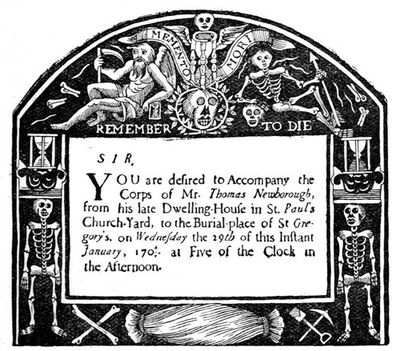
MEMENTO MORI REMEMBER TO DIE
SIR.
You are desired to Accompany the Corps of Mr. Thomas Newborough, from his late Dwelling-House in St. Paul's Church-Yard, to the Burial-place of St Gregory's, on Wednesday the 29th of this Instant January, 1704 at Five of the Clock in the Afternoon.
INVITATION TO A FUNERAL.
No affidavit to be necessary for a person dying of the plague. It imposed a fine of 5l. for every infringement, one half to go to the informer, and the other half to the poor of the parish.
This Act was only repealed by 54 Geo. III. c. 108, or in the year 1815.
The material used was flannel, and such interments are frequently mentioned in the literature of the time, and Luttrell mentions in his diary (Oct. 9, 1703) that the Irish Parliament had just brought in bills 'for encouraging the linnen manufacture, and to oblige all persons to bury in woollen.'
Funeral invitations were sent out—ghastly things, such as the foregoing.
Elegies, laudatory of the deceased, were sometimes printed and sent to friends: these were got up in the same charnel-house style. Indeed, no pains were spared to make a funeral utterly miserable and expensive. Hatbands were costly items. 'For the encouragement of our English silk called Alamodes, His Royal Highness the Prince of Denmark, the Nobility, and other persons of Quality appear in Mourning Hatbands made of that Silk, to bring the same in fashion, in the place of Crapes, which are made in the Pope's Country where we send our Money for them.' Gloves, of course, had to be given to every mourner. Indeed it is refreshing among the universal spoiling of the deceased's survivors to find that one man advertises cheap mourning and funeral necessaries. 'For the good of the Publick, I Edward Evans, at the Four Coffins in the Strand, over against Somerset House; Furnish all Necessaries for all sorts of Funerals, both great and small. And all sorts of set Mourning both Black and Gray and all other Furniture sutable to it, fit for any person of Quality. Which I promise to perform 2s. in the Pound cheaper than any of the Undertakers in Town or elsewhere.'
Of course these remarks do not apply to the poor: they had already started burial clubs or societies, and very cheap they seem to have been. 'This is to give Notice, that the Office of Society for Burials, by mutual Contribution of a Halfpenny or Farthing towards a Burial, erected upon Wapping Wall, is now removed into Katherine Wheel Alley in White Chappel, near Justice Smiths, where subscriptions are taken to compleat the number, as also at the Ram in Crucifix lane in Barnaby Street, Southwark; to which places notice is to be given of the death of any Member, and where any Person may have the Printed Articles after Monday next. And this Thursday about 7 o'clock Evening will be Buried by the Undertakers the Corpse of J. S., a Glover over against the Sun Brewhouse, in Golden Lane; as also a Child from the Corner of Acorn Alley in Bishopsgate Street, and another Child from the Great Maze Pond, Southwark.'
We get a curious glimpse of the paraphernalia of a funeral in the Life of a notorious cheat, 'The German Princess' who lived, and was hanged, in the latter part of the seventeenth century, and the same funeral customs therein described obtained in Anne's time. She took a lodging at a house, in a good position, and told the landlady that a friend of hers, a stranger to London, had just died, and was lying at 'a pitiful Alehouse,' and might she, for convenience sake, bring his corpse there, ready for burial on the morrow. The landlady consented, and 'that Evening the Corps in a very handsome Coffin was brought in a Coach, and plac'd in the Chamber, which was the Room one pair of Stairs next the street and had a Balcony. The Coffin being cover'd only with an ordinary black Cloth, our Counterfeit seems much to dislike it; the Landlady tells her that for 20s. she might have the Use of a Velvet Pall, with which being well pleas'd, she desir'd that the Landlady would send for the Pall, and withal accommodate the Room with her best Furniture, for the next Day but one he should be bury'd; thus the Landlady perform'd, getting the Velvet Pall, and placing on a Side-Board Table 2 Silver Candlesticks, a Silver Flaggon, 2 Standing gilt Bowls, and several other Pieces of Plate; but the Night before the intended Burial, our counterfeit Lady and her Maid within the House, handed to their Comrades without, all the Plate, Velvet Pall, and other Furniture of the Chamber that was Portable and of Value, leaving the Coffin and the suppos'd Corps, she and her Woman descended from the Balcony by Help of a Ladder, which her Comrades had brought her.' It is needless to say that the coffin contained only brickbats and hay, and a sad sequel to this story is, that the undertaker sued the landlady for the loss of his pall, which had lately cost him 40l.
Naturally, a great many must have come to a man in the course of his life, as we may see by the contents of a box lost out of a waggon between Stamford and London: '3 Hair Rings, 6 with a Death's Head, about 2 penny weight apiece the Posie (Prepared be to follow me); 3 other mourning rings with W. C. ob. 18 Dec. 1702; 1 Ennamelled Ring, 3 Pennyweight twelve grains. W. Heltey, ob. 5 July, Æt. 61.' And their value may be guessed from 'Lost on Thursday, the 8th Instant one of the late Lord Huntingdon's Funeral Rings. Whoever brings it to Mr. White's at the Chocolate House in St. James's shall have two Guineas reward.'
The pomp of funerals was outrageous. Gay, observant as he always was, notes this in 'Trivia,' book 3:—
Why is the Herse with 'Scutcheons blazon'd round, And with the nodding Plume of Ostrich crown'd? No, the Dead know it not, nor profit gain: It only serves to prove the Living vain. How short is Life! how frail is human Trust! Is all this Pomp for laying Dust to Dust?
But there was one thing they did not spend so much money upon as their forefathers did, i.e. on monumental statuary, &c. In this age the bust, or 'busto,' was used in preference to the recumbent, or half-figures, of the previous century; but by far the greater number of mortuary memorials took the form of mural tablets, more or less ornate, according to the taste and wealth of the parties concerned. As a rule the epitaph was in Latin—this classical age, and the somewhat pedantic one that followed, could brook no meaner tongue in which to eulogise its dead; and their virtues were pompously set forth in that language which is common to the whole of the civilised world.
No account of the funerals of this age would be complete without seeing what Misson says on the subject:—'As soon as any Person is dead, they are oblig'd to give Notice thereof to the Minister of the Parish, and to those who are appointed to visit dead Bodies. This Custom of visiting dead Bodies was establish'd after the dreadful Plague that ravag'd London in 1665, to the Intent that it might be immediately known if there was any Contagious Distemper, and proper Methods taken to put a Stop to it. They are generally two Women that do this. The Clerk of the Parish receives their Certificate, and out of these is form'd an Abridgment that is publish'd every Week. By this Paper you may see how many Persons of both Sexes dy'd within that Week, of what Distemper, or by what Accident.
'There is an Act of Parliament which ordains, That the Dead shall be bury'd in a Woollen Stuff, which is a Kind of a thin Bays, which they call Flannel; nor is it lawful to use the least Needleful of Thread or Silk. (The Intention of this Act is for the Encouragement of the Woollen Manufacture.) This Shift is always White; but there are different Sorts of it as to Fineness, and consequently of different Prices. To make these Dresses is a particular Trade, and there are many that sell nothing else; so that these Habits for the Dead are always to be had ready made, of what Size or Price you please, for People of every Age and Sex. After they have wash'd the Body thoroughly clean, and shav'd it, if it be a Man, and his Beard be grown during his Sickness, they put it on a Flannel Shirt, which has commonly a Sleeve purfled about the Wrists, and the Slit of the Shirt down the Breast done in the same Manner. When these Ornaments are not of Woollen Lace, they are at least edg'd, and sometimes embroider'd with black Thread. The Shirt shou'd be at least half a Foot longer than the Body, that the Feet of the Deceas'd may be wrapped in it as in a Bag. When they have thus folded the End of the Shirt close to the Feet, they tye the Part that is folded down with a Piece of Woollen Thread, as we do our Stockings; so that the End of the Shirt is done into a Kind of Tuft.
'Upon the Head they put a Cap, which they fasten with a very broad Chin Cloth, with Gloves on the Hands, and a Cravat round the Neck, all of Woollen. That the Body may ly the softer, some put a Lay of Bran, about four inches thick, at the Bottom of the Coffin. Instead of a Cap, the Women have a Kind of Head Dress, with a Forehead Cloth. The Body being thus equipp'd and laid in the Coffin (which Coffin is sometimes very magnificent), it is visited a second time, to see that it is bury'd in Flannel, and that nothing about it is sowed with Thread. They let it lye three or four Days in this Condition; which Time they allow, as well to give the dead Person an Opportunity of Coming to Life again, if his Soul has not quite left his Body, as to prepare Mourning, and the Ceremonies of the Funeral.
'They send the Beadle with a List of such Friends and Relations as they have a Mind to invite; and sometimes they have printed Tickets, which they leave at their Houses. A little before the Company is set in Order for the March, they lay the Body into the Coffin upon two Stools, in a Room where all that please may go and see it; they then take off the Top of the Coffin, and remove from off the Face a little square Piece of Flannel, made on Purpose to cover it, and not fastened to any Thing; Upon this Occasion the rich Equipage of the Dead does Honour to the Living. The Relations and chief Mourners are in a Chamber apart, with their more intimate Friends; and the rest of the Guests are dispersed in several Rooms about the House.
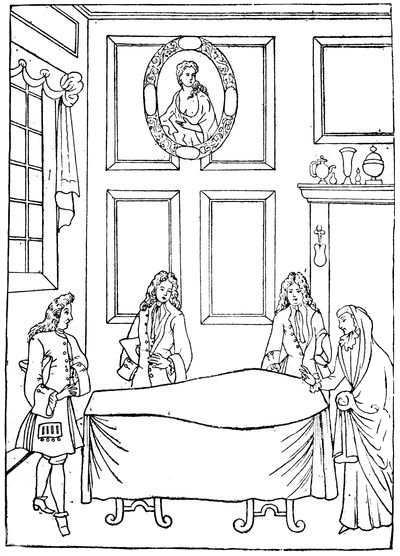
LYING IN STATE.
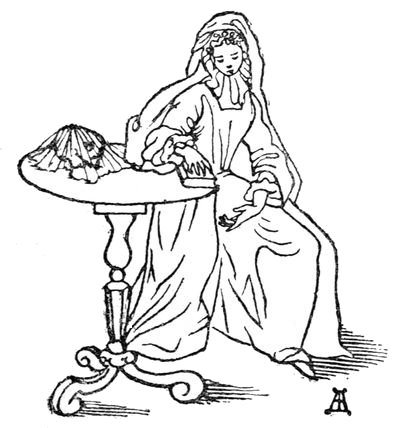
Widows wore black veils, and a somewhat peculiar cap, and had long trains—allusions to which are very frequent in the literature of the time. That they were supposed to seclude themselves for six weeks, and debar themselves of all amusement for twelve months, is shown by the two following extracts from Steele's 'Funeral, or Grief à la Mode.'
'But, Tatty, to keep house 6 weeks, that's another barbarous Custom.'
'Oh, how my head runs my first Year out, and jumps to all the joys of widowhood! If, Thirteen Months hence, a Friend should haul one to a Play one has a mind to see!'