Chapter IX · GAMBLING AND SPECULATION.
Reading edition
Games at cards — Curious cards — Price — Tax on Cards — Female passion for gambling — The Groom Porter's — Gaming houses — Gamesters — Noted gamesters — Debts of honour — Speculation — Life insurances — Marine and other insurances — Shopkeepers' lotteries — Government lotteries — Prizes and winners.
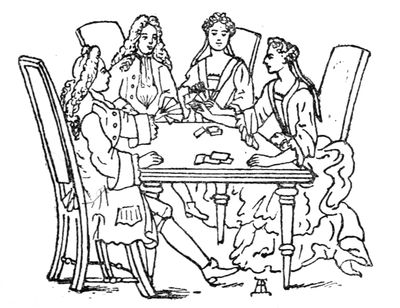
A CARD TABLE.
The implements of gaming, the cards themselves, were much smaller and thinner than those we are accustomed to play with. They were not always confined to the prosaic display of the pips and Court cards, as ours are, but took a far more fanciful flight. 'Geographical, Geometrical, Astronomical and Carving Cards, each Pack price 1s.' 'Orange Cards, Representing the late King James's Reign and Expedition of the Prince of Orange, Plots of the Papists, Bishops in the Tower and Trial, Consecrated mock Prince of Wales, Popish Midwife, Fight at Reading, Pope's Nuncio, Captain Tom, Essex's Murder, burning Mass Houses, Army going over to the Prince of Orange, etc.'; cards delineating the victories of Marlborough and other events in Anne's reign; Sacheverel cards; and anything for fashion—cards from Vigo—in 1702—after the great victory there; proverb cards; all kinds of cards. The ordinary playing cards were cheap enough in all conscience, 'the best Principal superfine Picket Cards at 2s. 6d. a Dozen; the best Principal superfine Ombro Cards at 2s. 9d. a Dozen; the best Principal superfine Basset Cards at 3s. 6d. a dozen' (packs understood). The price to retailers averaged 1-1/2d. per pack, and it is marvellous how they could, at that time, be made for the money.
By an Act of 10 Anne, c. 18, s. 176, etc., a duty of sixpence per pack for cards, and five shillings a pair for dice, was imposed; and all cards made and unsold before June 12, 1711, were to be brought in to be stamped, and pay a duty of one halfpenny per pack, and dice 6d. a pair.
Nay, worse subterfuges than these are more than openly hinted at in divers authors. One or two examples will suffice.
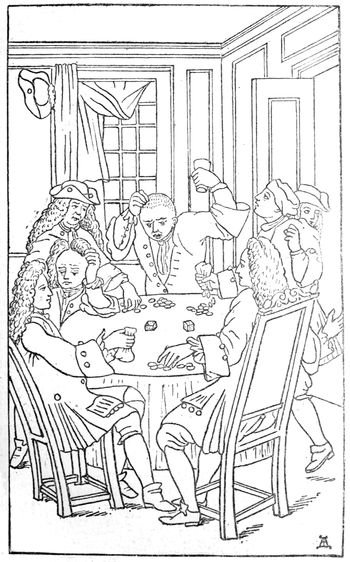
A GAMBLING SCENE.
Sir Geo. Airy. Oh, I honour Men of the Sword; and I presume this Gentleman is lately come from Spain or Portugal—by his Scars.
Marplot. No, really, Sir George, mine sprung from civil Fury: Happening last night into the Groom Porter's—I had a strong Inclination to go ten Guineas with a sort of a—sort of a—kind of a Milk Sop, as I thought; A Pox of the Dice, he flung out, and my Pockets being empty, as Charles knows they sometimes are, he prov'd a Surly North Briton, and broke my face for my Deficiency.
If scenes like this were enacted at the Groom Porter's, what must have taken place at the other gaming houses? Let two contemporary writers, whose language, though rough, is trustworthy, answer the question. 'Gaming is an Estate to which all the World has a Pretence, tho' few espouse it that are willing to keep either their Estates, or Reputations. I knew two Middlesex Sharpers not long ago, that inherited a West Country Gentleman's Estate, who I believe, wou'd have never made them his Heirs in his last Will and Testament.
'Lantrillou is a kind of Republick very ill ordered, where all the World are Hail Fellow well met; no distinction of Ranks, no Subordination observed. The greatest Scoundrel of the Town, with Money in his Pockets, shall take his Turn before the best Duke or Peer in the Land, if the Cards are on his side. From these Privileg'd Places not only all Respect and Inferiority is Banish'd; but every thing that looks like Good Manners, Compassion, or Humanity: Their Hearts are so Hard and Obdurate, that what occasions the Grief of one Man, gives Joy and Satisfaction to his next Neighbour....
'In some Places they call Gaming Houses Academies; but I know not why they should inherit that Honourable Name, since there's nothing to be learn'd there, unless it be Slight of Hand, which is sometimes at the Expence of all our Money, to get that of other Men's by Fraud and Cunning. The Persons that meet are generally Men of an Infamous Character, and are in various Shapes, Habits and Employments. Sometimes they are Squires of the Pad, and now and then borrow a little Money upon the King's High Way, to recruit their losses at the Gaming House, and when a Hue and Cry is out, to apprehend them, they are as safe in one of these Houses as a Priest at the Altar, and practise the old trade of Cross biting Cullies, assisting the Frail Square Dye with high and low Fullums, and other Napping Tricks, in comparison of whom the common Bulkers, and Pickpockets, are a very honest Society. How unaccountable is this way to Beggary, that when a Man has but a little Money, and knows not where in the World to compass any more, unless by hazarding his Neck for't, will try an Experiment to leave himself none at all: Or, he that has Money of his own, should play the Fool, and try whether it shall not be another Man's. Was ever any thing so Nonsensically Pleasant.
'Once Mr. Bourchier going over to Flanders, with a great Train of Servants, set off in such a fine Equipage, that they drew the Eyes of all upon them wherever they went, to admire the Splendor and Gaiety of their Master, whom they took for no less than a Nobleman of the first Rank. In this Pomp, making his Tour at K. William's Tent, he happen'd into Play with that great Monarch, and won of him above £2,500. The Duke of Bavaria being also there, he took up the cudgels, and losing £15,000 the Loss put him into a great Chafe, and doubting some foul Play was put upon him, because Luck went so much against him, quoth Mr. Bourchier: Sir, if you have any suspicion of the least Sinister Trick put upon your Highness, if you please I'll give you a Chance for all your Money at once, tossing up at Cross and Pile, and you shall have the Advantage too of throwing up the Guinea yourself. The Elector admir'd at his bold Challenge, which never the less accepting, he tost up for £15,000, and lost the Money upon Reputation, with which Bourchier was very well satisfied, as not doubting in the least; and so taking his leave of the King, and those Noblemen that were with him, he departed. Then the Elector of Bavaria enquiring of his Majesty, who that Person was, that could run the Hazard of playing for so much Money at a time, he told him it was a subject of his in England, that though he had no real Estate of his own, yet was he able to play with any Sovereign Prince in Germany. Shortly after Bourchier returning into England, he bought a most rich Coach and Curious Sett of Six Horses to it, which cost him above £3,000, for a present to the Elector of Bavaria, who had not as yet paid him any thing of the £30,000 which he had won of him. Notice hereof being sent to his Highness, the generous Action incited him to send over his Gentleman of Horse into England, to take care of this Present, which he receiv'd Kindly at Bourchier's Hands, to whom he return'd Bills of Exchange also, drawn upon several eminent Merchants in London, for paying what Money he had lost with him at Play.'
Bourchier became very rich, and purchased an estate near Pershore, in Worcestershire, where he was buried—although he died in London.
Losses at cards, or debts of honour, as they were then and are now called, were supposed to be punctually paid. See 'The Gamester.'
Hector. Then, Sir, here is two Hundred Guineas lost to my Lord Love-game, upon Honour.
Sir Thos. Valere. That's another Debt I shall not pay.
Hector. How, not pay it, Sir. Why, Sir, among Gentlemen, that Debt is look'd upon the most just of any: you may Cheat Widows, Orphans, Tradesmen without a Blush; but a Debt of Honour, Sir, must be paid. I cou'd name you some Noblemen that pays no Body—yet a Debt of Honour, Sir, is as sure as their Ready Money.
Sir Thos. He that makes no Conscience of Wronging the Man whose Goods have been deliver'd for his use can have no pretence to Honour, whatever Title he may wear.
There was a speculating mania arising, which boded ill for the future. In this reign was born the 'South Sea Bubble,' which burst so disastrously in the next, and involved thousands in ruin. Perhaps the mildest form it took was in insurances. We have already glanced at the fire insurances in Queen Anne's time; they now began to think of life insurance, and the first advertisement on this subject that I have noticed is in 1709. 'The Office of Assurance of Money upon Lives is at the Rainbow Coffee House in Cornhill, where Men or Women may Subscribe on their own Lives for the benefit of their Children, or other Person's Lives for the benefit of themselves, and have them approv'd without their Knowledge, paying 10s. Entrance, and 10s. towards the first Claim for each Life, and shall have a Policy for £1,000 for each Life subscribed upon in the said Society. This Office may be proper for such Persons as have Annuities, Estates, or Places for Life; and for such Persons to make Assurance upon Lives where Debts are dubious if the Person die. This Office will assure Money much Cheaper per cent. than private Persons.' This looks very much as if it were the first life insurance company that was started, in lieu of private enterprise; and as this is the only company that is advertised in Queen Anne's reign, it was probably the sole forerunner of the numerous similar enterprises now in existence.
Hatton says, 'Offices that Insure Ships or their Cargo are many about the Royal Exchange, as Mr. Hall's, Mr. Bevis's, etc., who for a Premium paid down procure those that will subscribe Policies for Insuring Ships (with their Cargo) bound to or from any part of the World, the Premium being proportioned to the Distance, Danger of Seas, Enemies, etc. But in these Offices 'tis Customary upon paying the Money on a Loss to discount 16 per cent.'
A curious marine insurance was in existence early in 1711, of which the following is the advertisement; but it seems a sporting insurance, and only meant to cover the war risk. 'For the Encouragement of Navigation for Masters, Mates and other Seafaring Men that are Burnt, Sunk or Taken. That 4,000 Persons by paying 2s. 6d. for a Policy, and 5s. to the 1st Quarter, which will be paid 21 days after Midsummer for the Lady Day Quarter, to the Sufferer or Sufferers £1,000 in full, or in proportion to what is paid in, and continuing to pay 5s. every Quarter or 14 days after; likewise if 4,000 persons by paying 2s. 6d. for a Policy, and 2s. for the 1st if full, £400 or in proportion to be paid 21 days after Midsummer for this Lady Day Quarter, and likewise 4,000 by paying 2s. 6d. for Policies and 1s. per Quarter, the Sufferer or Sufferers to receive the benefit of £200 if full, or else in proportion, to be paid in 21 days after Midsummer; the Office was opened on Saturday last, the 27th past, by Hen Willson, Gent, in Jacob Street, Southwark. Note. When 1,000 Policies are taken out, Trustees will be Chosen and Land Security given. Any Person may Insure in all 3 Offices. Proposals at large may be had at the Office. Note, that £6 per cent. will be deducted out of the Money paid for the trouble and charges.'
There were besides—and they sprang up as if by magic—insurances for everything: for marriages, for births, for baptisms—rank swindles all. And lotteries! why, every thing, unsaleable otherwise, was tried to be got rid of by lottery. The papers teemed with advertisements. Take one newspaper haphazard; for example, the Tatler, Sept. 14/16, 1710: 'Mr. Stockton's Sale of Jewels, Plate, &c., will be drawn on Michaelmas Day.' 'The Lottery in Colson's Court is to be drawn the 21st Inst.' 'The Sale of Goods to be seen at Mrs. Butler's, &c., will certainly be drawn on Tuesday the 19th Inst.' 'Mrs. Povy's Sale of Goods is put off to Saturday 23rd Inst. 'Mrs. Symond's Sale of Goods will begin, &c., on Wednesday the 20th of this Instant.' 'Mrs. Guthridge's Sixpenny Sale of Goods, &c., continues to be drawn every Day.'
Of course, morally speaking, the Government had no right to complain, for they had begun the system—by legalising a lottery for £1,500,000 in 1709—from which time until 1824 no year passed without Parliament sanctioning a Lottery Bill. It is not worth while going into the schemes of the various lotteries in Queen Anne's reign, but it may be interesting to note the constitution of the one which inaugurated an indefensible system of immoral finance, which lasted over a century. There were 150,000 tickets at £10 each, making £1,500,000, the principal of which was to be sunk, and 9 per cent. to be allowed on it for 32 years. Three thousand seven hundred and fifty tickets were prizes from £1000 to £5 per annum; the rest were blanks—a proportion of thirty-nine to one prize, but, as a consolation, each blank was entitled to fourteen shillings per annum during the thirty-two years.
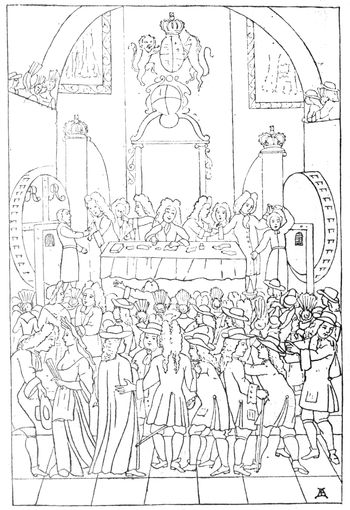
A LOTTERY.
Among the prize-holders of the next lottery (at least, so Swift writes Stella, Aug. 29, 1711) was a son of Lord Abercorn's. 'His second son has t'other day got a prize in the lottery of four Thousand pounds, beside two small ones of two hundred pounds each; nay, the family was so fortunate, that my lord bestowing one ticket, which is a hundred pounds, to one of his servants, who had been his page, the young fellow got a prize, which has made it another hundred.'
In some of the lotteries the prizes were very valuable, for we read in the Post Boy, Jan. 6/8, 1713, that 'Yesterday was drawn No. 22858, which entitles the Bearer to £36,000.'
The accompanying engraving shows us exactly how the lotteries were drawn; and, as it is taken from a book published in 1710, in all probability it is a correct representation of the famous first State lottery of 1709. Bluecoat boys, then, as in 1824, drew out the tickets.
As in all lotteries, superstition attaches a peculiar value to some number, or combination of numbers, in the ticket: so it was in Anne's time, and the Spectator (191) comments on an advertisement in the Post Boy of Sept. 27, 1711—'This is to give notice, That Ten Shillings over and above the Market Price will be given for the Ticket in the £1,500,000 Lottery No. 132, by Nath. Cliff, at the Bible and Three Crowns in Cheapside.'