Chapter XXXV · THE STREETS.
Reading edition
Size of London — Pall Mall — London in wet weather — Early morning — Street cries: a list of them — Roguery in the streets — Orderly regulations — State of the roads — Rule of the road — Street signs — Description of the streets — Milkmaids on May Day — Hyde Park; its regulations — Lighting the streets — The streets at night.
London, it is scarcely necessary to remark, was very circumscribed in its area compared to its overgrown present dimensions. The northern bank of the river was well occupied from Shadwell to Westminster, opposite Lambeth. On the west the houses went down the northern side of Piccadilly, as far as Apsley House; but Bond Street was only partially built, and there were no houses westward of it. The Edgware Road and Tottenham (or, as it was then called, Hampstead) Road were in existence, but few were the houses in either of them. At the Back of Montague and Southampton Houses, and generally north of Theobald's Road and Clerkenwell, there was nought but fields, dotted here and there with farmhouses—with the hills of Hampstead and Highgate for a background. Houses ceased, on the eastern side, after Shoreditch, and shortly after passing Whitechapel Church; so that a walk all round inhabited London—skirting the north bank of the river to begin with—might be done in about twelve miles.
Covent Garden was the centre of social life. Soho and Leicester Squares, and thence westward, comprised the limits of the court and fashionable society—that land of luxury for which Gay sighed, but which yet was not perfect.
O bear me to the Paths of fair Pell Mell, Safe are thy Pavements, grateful is thy Smell! At distance, rolls along the gilded Coach, Nor sturdy Carmen on thy Walks encroach; No Less would bar thy Ways, were Chairs deny'd, The soft Supports of Laziness and Pride; Shops breathe Perfumes, thro' Sashes Ribbons glow, The Mutual Arms of Ladies, and the Beau.— Yet still ev'n Here, when Rains the Passage hide Oft' the loose Stone spirts up a Muddy Tide, Beneath thy careless Foot; and from on high, Where Masons mount the Ladder, Fragments fly; Mortar, and crumbled Lime in Show'rs descend, And o'er thy Head destructive Tiles impend.
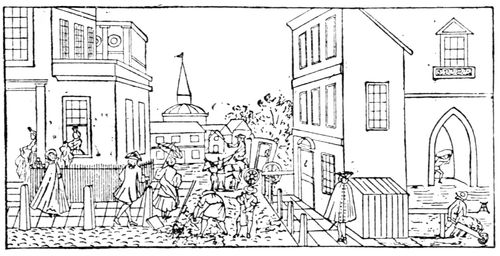
A STREET SCENE.
Now in contiguous drops the flood comes down, Threatening with deluge this devoted town. To shops in crouds the draggled females fly, Pretend to cheapen goods, but nothing buy. The Templar spruce, while every spout's abroach, Stays till 'tis fair, yet seems to call a Coach. The tuck'd up sempstress walks with hasty Strides, While streams run down her oil'd umbrella's sides. Here various kinds, by various fortunes led, Commence acquaintance underneath a shed. Triumphant Tories and desponding Whigs Forget their feuds, and join to save their wigs. Box'd in a Chair the Beau impatient sits, While spouts run clattering o'er the roof by fits; And ever and anon with frightful din The leather sounds; he trembles from within.
Those gutter spouts, sending their streams not quite clear of the pavement, must have been a terrible nuisance to a generation of men innocent of umbrella or Mackintosh; and Gay advises anyone, in wet weather, to maintain his privilege of taking the wall, but not to quarrel for it.
When from high Spouts the dashing Torrents fall, Ever be watchful to maintain the Wall; For should'st thou quit thy Ground, the rushing Throng Will with impetuous Fury drive along; All press to gain those Honours thou hast lost, And rudely shove thee far without the Post. Then to retrieve the Shed you strive in vain, Draggled all o'er, and soak'd in Floods of Rain. Yet rather bear the Show'r, and Toils of Mud, Than in the doubtful Quarrel risque thy Blood.
Now hardly here and there an hackney Coach Appearing, show'd the ruddy morn's approach. The slipshod 'prentice, from his master's door, Had par'd the street, and sprinkled round the floor; Now Moll had whirl'd her mop with dextrous airs, Prepar'd to scrub the entry and the Stairs. The youth with broomy stumps began to trace The kennel edge, where wheels had worn the place. The small coal man was heard with cadence deep, Till drown'd in shriller notes of Chimney sweep. Duns at his Lordship's gates began to meet; And brick dust Moll had scream'd thro' half a street: The turnkey now his flock returning sees, Duly let out a' nights to steal for fees. The watchful bailiffs take their silent stands; And school boys lag with satchels in their hands.
Any Card Matches or Save Alls.
Pretty Maids, Pretty Pins, Pretty Women.
Ripe Strawberryes.
A Bed Matt or a Door Matt.
Buy a fine Table Basket.
Old Shoes for some Broomes.
Small Coale.
Buy a Rabbet, a Rabbet.
Buy a Fork or a Fire Shovel.
Chimney Sweep.
Crab, Crab, any Crab.
Lilly White Vinegar 3 pence a quart.
Buy my Dutch biskets.
Ripe Speragas.
Maids, buy a Mopp.
Buy my fat Chickens.
Buy my flounders.
Old Cloaks Suits or Coats.
Fair Lemons and Oranges.
Old Chairs to mend.
Twelve pence a peck Oysters.
Troope, every One.
Old Satten, Old Taffety or Velvet.
Ha, Ha, Ha, Poor Jack.
Buy my Dish of great Eeles.
Buy a fine Singing bird.
Buy any Wax or Wafers.
Fine Writeing Inke.
A Merry new Song.
Buy a new Almanack.
Any Kitchen Stuffe have you, Maids.
Knives, Combs or Ink hornes.
Four for six pence, Mackrell.
Any Work for John Cooper.
Four paire for a Shilling, Holland Socks.
Six pence a pound fair Cherryes.
Knives or Cissors to grinde.
Long thread Laces, long and Strong.
Remember the Poor prisoners.
A Brass Pott, or an Iron Pott to mend.
Buy my four Ropes of Hard Onyons.
London Gazettes here.
Buy a White line, a Jack line, or a Cloathe line.
Any old Iron, take money for.
Delicate Cowcumbers to pickle.
Any Baking Pears.
New River Water.
This does not pretend to be an exhaustive list; in fact, they were so numerous and varied that, as Addison says (Spectator, 251), 'There is nothing which more astonishes a Foreigner, and frights a Country Squire, than the Cries of London. My good friend Sir Roger often declares, that he cannot get them out of his Head, or go to sleep for them, the first Week that he is in Town. On the contrary, Will. Honeycomb calls them the Ramage de la Ville, and prefers them to the sounds of Larks and Nightingales, with all the Musick of the Fields and Woods.' The whole of this Spectator is on street cries, and is very interesting reading.
Trim, in Steele's comedy of 'The Funeral' tells a lot of ragged soldiers: 'There's a thousand things you might do to help out about this Town, as to cry—Puff—Puff Pyes. Have you any Knives or Scissors to grind—or, late in an Evening, whip from Grub Street strange and bloody News from Flanders—Votes from the House of Commons—Buns, rare Buns—Old Silver Lace, Cloaks, Sutes or Coats—Old Shoes, Boots or Hats.
Successive Crys the Season's Change declare, And mark the Monthly Progress of the Year.
There was yet another noise in the streets, that of the ballad-singer, or singers, for they generally went in couples. People were warned against them.
Let not the Ballad-Singer's shrilling Strain Amid the Swarm thy list'ning Ear detain: Guard well thy Pocket; for these Syrens stand, To aid the Labours of the diving hand; Confed'rate in the Cheat, they draw the Throng, And Cambrick Handkerchiefs reward the Song.
The streets ought to have been kept in fair order, if the inhabitants had complied with the law; but they evidently neglected it, and had to be reminded of their duties by a notice in the Gazette, April 12/14, 1711. According to 8 & 9 Will. III. cap. 37, everyone had, on Wednesdays and Saturdays, to sweep and cleanse the road in front of his house, building, or wall, and heap up the dirt for the scavenger to remove, under penalty of 10s.
That no one should throw any ashes, dirt, etc., into the open street before his house, under penalty of 5s., or if it was thrown before any other building, 20s.; but they must deliver the dust to the scavenger (2 Will. and Mary, cap. 8), who must come round daily to collect it, giving notice by ringing a bell or otherwise, or penalty 40s.
All householders, or, if empty, the owners of house, to keep the pavement before said house in repair, or pay 20s. per rod, and 20s. per week, till the same be sufficiently repaired.
While it was being done, the self-same sign was hung out as now—
Does not each Walker know the Warning Sign, When Wisps of Straw depend upon the Twine 'Cross the Close Street; that then the Pavior's Art Renews the Ways, deny'd to Coach and Cart.
The dust carts were not unmixed blessings—
The Dustman's Cart offends thy Cloaths and Eyes When through the Street a Cloud of Ashes flies.
And there were other ways of 'offending Cloaths.'
When Drays bound high, they never cross behind, Where bubbling Yest is blown by Gusts of Wind: And when up Ludgate Hill huge Carts move slow, Far from the straining Steeds, securely go, Whose dashing Hoofs, behind them, fling the Mire, And mark, with muddy Blots, the gazing Squire.
In walking the rule was the same as now: everyone should take the right-hand side of the path; and the courtesies of giving way on special occasions are clearly pointed out in the following lines, showing there was a time to concede and a time to retain the right to the wall:—
Let due Civilities be strictly paid. The Wall surrender to the hooded Maid; Nor let thy sturdy Elbow's hasty Rage Jostle the feeble Steps of trembling Age: And when the Porter bends beneath his Load, And pants for Breath; clear thou the crouded Road. But above all, the groaping Blind direct, And from the pressing Throng the Lame protect. You'll sometimes meet a Fop, of Nicest Tread, Whose mantling Peruke veils his empty Head, At ev'ry Step he dreads the Wall to lose, And risques, to save a Coach, his red heel'd Shoes; Him like the Miller, pass with Caution by, Lest from his Shoulder Clouds of Powder fly. But when the Bully, with assuming Pace Cocks his Broad Hat, edg'd round with tarnished Lace, Yield not the Way; defie his strutting Pride, And thrust him to the Muddy Kennel's side; He never turns again, nor dares oppose, But mutters Coward Curses as he goes.
The shops were low, and mostly with overhanging pent-houses, which were inconvenient.
Where the low Penthouse bows the Walker's head, And the rough Pavement wounds the yielding Tread: Where not a Post protects the narrow Space, And strung in Twines, Combs dangle in thy Face.
The street signs, which were necessary, as houses were not numbered, were very numerous and large, and some were exceedingly costly. Misson was very much struck with them. 'At London they are commonly very large, and jutt out so far, that in some narrow Streets they touch one another; nay, and run across almost quite to the other Side. They are generally adorn'd with Carving and Gilding; and there are several that, with the Branches of Iron which support them, cost above a hundred Guineas. They seldom write upon the Sign the Name of the Thing represented in it; so that here is no need of Molière's Inspector. Out of London, and particularly in Villages, the Signs of Inns are suspended in the middle of a great Wooden Portal, which may be look'd upon as a Kind of triumphal Arch to the Honour of Bacchus.'
'Here a sooty Chimney Sweeper takes the Wall of a grave Alderman, and a Broom man justles the Parson of the Parish. There a fat greasie Porter runs a Trunk full butt upon you, while another salutes you with a Flasket of Eggs and Butter. Turn out there you Country Putt, says a Bully with a Sword two yards long jarring at his heels, and throws him into the Kennel. By and by comes a Christning, with the Reader screwing up his Mouth to deliver the Service a la mode de Paris, and afterwards talk immoderately nice and dull with the Gossips, and the Midwife strutting in the front, and young Original Sin as fine as Fippence, follow'd with the Vocal Musick of Kitchen Stuff ha' you Maid, and a damn'd Trumpeter calling in the Rabble to see a Calf with Six Legs and a Top Knot. There goes a Funeral with the Men of Rosemary after it, licking their Lips after three hits of White, Sack and Claret at the House of Mourning, and the Sexton walking before, as big and bluff as a Beef Eater at a Coronation. A Poet Scampers for 't as fast as his Legs will carry him, and at his heels a brace of Bandog Bailiffs, with open Mouths ready to devour him and all the Nine Muses.'
Let us turn to a prettier street scene. It is May Day, and, although maypoles are banished to the country, where they still hold their own, London celebrates it in another fashion. The milkmaids hold their festival, and even Gay's 'Sallow Milkmaid's' cheeks must have brightened at the prospect of such a treat. Confiding customers lent them silver plate, and women's taste and a few ribbons make a gorgeous trophy. Misson could not help being struck with it: 'On the First of May, and the five or six Days following, all the pretty young Country girls that serve the Town with Milk, dress themselves up very neatly, and borrow abundance of Silver Plate, whereof they make a Pyramid, which they adorn with Ribbands and Flowers, and carry upon their Heads, instead of their common Milk Pails. In this Equipage, accompany'd by some of their fellow Milk Maids, and a Bag pipe or a Fiddle, they go from Door to Door, dancing before the Houses of their Customers, in the Midst of Boys and Girls that follow them in Troops, and every Body gives them something.'
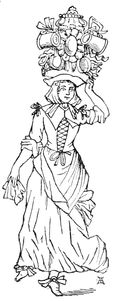
MILKMAID ON MAY DAY.
But it evidently was falling into evil habits, for on July 1, 1712, the Queen found it necessary to issue some rules and directions 'for the better keeping Hyde Park in good Order.' The gate-keepers were to be always on duty, and not to sell ale, brandy, or other liquors. No one should leap over the ditches, or fences, or break the latter down. 'No Person to ride over the grass on the South side of the Gravelled Coach Road ... excepting Henry Wise, who is permitted to pass cross that Part of the Park leading from the Door in the Park Wall, next his Plantation.' No grooms or others were to ride over the banks, or slopes, of any pond. No stage coach, hackney coach, chaise with one horse, cart, waggon, or funeral should pass through the park; and no one should cut or lop any of the trees.
As evening drew on the lamps were lit, i.e. if there were not a full moon, or in the summer time; but should the pavement be up, or a sewer open, a lantern was specially provided.
Where a dim Gleam the paly Lanthorn throws O'er the mid' Pavement; heapy Rubbish grows, Or arched Vaults their gaping Jaws extend, Or the dark Caves to Common Shores descend. Oft' by the Winds, extinct the Signal lies. Or smother'd in the glimm'ring Socket dies, E'er Night has half roll'd round her Ebon Throne; In the wide Gulph the shatter'd Coach o'erthrown, Sinks with the Snorting Steeds; the Reins are broke, And from the cracking Axle flies the Spoke.
There was an improvement on the convex lamp, a new one, called the conic lamp, being introduced, and apparently answering very well. In the Gazette, Dec. 30 to Jan. 2, 1706-7, is this advertisement: 'Whereas Her most Gracious Majesty Queen Anne has been pleased to grant her Letters Patent for enlightening the Suburbs of London and City of Westminster, and all other Cities and Places in England, by new Invented Lights or Lamps called Conic Lamps, for 14 years; and whereas the Letters Patent for the Convex Lamps are long since expired; These are to certify whom it may concern, That by an Act of Parliament made in the 2d Year of their late Majesties King William and Queen Mary of ever Glorious Memory, all persons paying to any Lamps, distanced by two of Her Majesty's Justices of the Peace, are exempted from hanging out a Lanthorn and Candle and indemnified from the Penalties contained in the said Act.'
Ward draws a picture of the streets at night, too repulsive for reproduction—doubtless a true one—but one taken from the very lowest haunts. Gay's gentle verse, on the contrary, depicts more the inconveniences of the badly lit streets, and their results:—
That Walker, who regardless of his Pace, Turns oft' to pose upon the Damsel's Face From Side to Side by thrusting Elbows tost, Shall strike his aking Breast against the Post; Or Water, dash'd from fishy Stalls, shall stain His hapless Coat with Spirts of Scaly Rain. But if unwarily he chance to stray, Where twirling Turnstiles intercept the Way, The thwarting Passenger shall force them round, And beat the Wretch half breathless to the Ground. Let constant Vigilance thy Footsteps guide, And wary circumspection guard thy Side; Then shalt thou walk unharm'd the dang'rous Night, Nor need th' officious Link-Boy's smoaky Light. Thou never wilt attempt to cross the Road, Where Alehouse Benches rest the Porter's load, Grievous to heedless Shins; No Barrow's Wheel, That bruises oft the Truant School Boy's Heel, Behind thee rolling, with insidious Pace, Shall mark thy Stocking with a miry Trace. Let not thy vent'rous Steps approach too nigh, Where gaping wide, low steepy Cellars lie; Should thy Shoe wrench aside, down, down you fall And overturn the scolding Huckster's Stall. The scolding Huckster shall not o'er thee moan, But Pence exact for Nuts and Pears o'er thrown. ......... Where the nail'd Hoop defends the painted Stall Brush not thy sweeping Skirt too near the Wall; Thy heedless Sleeve will drink the colour'd Oil, And Spot indelible thy Pocket soil.