Chapter XVIII · COFFEE-HOUSES AND TAVERNS.
Reading edition
Universal use of coffee-houses — Their convenience — Company — First coffee-house — Number of them — Anecdote of Bishop Trelawney — Description of interior — The news — Advance in price — Chocolate-houses — Famous coffee-houses — Button's Lion — Lloyd's — Sales by candle — Jenny Man — Don Saltero's collection — Taverns — Noblemen frequenting them — Drinking own wine — Purl houses — List of old taverns.
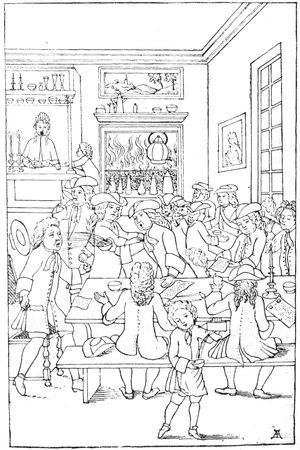
A COFFEE HOUSE.
A man with leisure got rid of some hours daily at the coffee-house, or houses, and such a one would spend from 10 A.M. till noon, and again, after his two-o'clock dinner, would be there from 4 to 6, when he would leave for the theatre, or his turn in the park.
The illustration gives us an excellent idea of the interior of a coffee-house, and its domestic economy—the dame de comptoir, the roaring fire with its perpetual supply of hot water, and its coffee and tea pots set close by, so as to be kept warm, and the very plain tables and stools, show the accommodation that was required, and accepted, by the very plain-living people of that day.
A coffee-house is necessarily a pièce de résistance with Ward. He describes it graphically, though somewhat roughly, and he brings the scene of the interior vividly before our eyes. 'Come, says my Friend, let us step into this Coffee House here; as you are a Stranger in the Town, it will afford you some Diversion. Accordingly in we went, where a parcel of Muddling Muckworms were as busy as so many Rats in an old Cheese Loft; some Going, some Coming, some Scribling, some Talking, some Drinking, some Smoaking, others Jangling; and the whole Room stinking of Tobacco, like a Dutch Scoot or a Boatswain's Cabbin. The Walls being hung with Gilt Frames, as a Farriers shop with Horse shooes; which contain'd abundance of Rarities, viz. Nectar and Ambrosia, May Dew, Golden Elixirs, Popular Pills, Liquid Snuff, Beautifying Waters, Dentifrisis, Drops, Lozenges, all as infallible as the Pope,
Where every one above the rest Deservedly has gain'd the Name of Best
(as the famous Saffold has it).'
The chocolate-houses seem to have been a specialty, and they were few in number. In the commencement of the reign, in 1702, chocolate was sold at 12d. the quart, 2d. the dish. I can only find the names of five chocolate-houses (describing themselves as such), and but two of them are of any note, White's and the Cocoa Tree. White's was started in 1698, and was, in Queen Anne's reign, situated five doors from the bottom of the west side of St. James's Street, ascending from St. James's Palace. It had a small garden attached to it. This house was burnt down in 1733, the King and Prince of Wales looking on. Hogarth has immortalised this event in Plate 6 of the 'Rake's Progress.' It was to all intents and purposes a gambling house. When White died is not known, but Mrs. White had it in March 1712. Afterwards it passed into the hands of Arthur, who had it when it was burnt down; and he removed next door to the St. James's Coffee House. It soon ceased to be a chocolate-house, and became a club. In 1755 it was removed to No. 38, on the opposite or east side of St. James's Street. White's Club is supposed to be political; but, apart from its members being Conservative, it takes no leading part, contenting itself with being extremely aristocratic.
The Cocoa Tree Chocolate House stood at the end of Pall Mall, on the site of what now is 87 St. James's Street. It was a Tory house; indeed, Defoe says, 'A Whig will no more go to the Cocoa Tree or Ozinda's, than a Tory will be seen at the Coffee house of St. James's.' The Cocoa Tree Club is now held at 64 St. James's Street.
As the coffee-houses occupied so prominent a part in the social economy of the time, a very brief notice of some of the best known will be of interest. Anderton's is still in Fleet Street, beloved of Freemasons and literary men. Batson's, in Cornhill, was a famous meeting-place for physicians. The Bay Tree still stands in St. Swithin's Lane. Button's, which was opposite Tom's, in Russell Street, Covent Garden, was a great resort of Addison's; and here contributions to the Guardian could be received. The lion's head which served as a letter-box has been immortalised in that paper. It was in imitation of the famous lion at Venice. The original is still in existence, but is not always accessible to the curious. It was removed from Button's when that coffee-house was taken down, and took refuge in the Shakespeare's Head Tavern, Covent Garden. For a time it was placed in the Bedford Coffee House, and was used as a letter box for contributions to The Inspector. It returned to the Shakespeare's Head in 1769, and remained there till 1804. It was then bought by Charles Richardson, the proprietor of Richardson's Hotel, and at his death it came into the possession of his son, who sold it to the Duke of Bedford, and it is now preserved in Woburn Abbey.
Child's was in St. Paul's Churchyard, and was famous for its learned frequenters. It was not far from the College of Physicians, which was then in Warwick Lane, so doctors came there, and, chief among them, Dr. Mead. Sir Hans Sloane and other members of the Royal Society dropped in, and the house was a noted resort of clergymen—so much so, that it is mentioned as such in the Spectator (No. 609): 'For that a young Divine, after his first Degree in the University, usually comes hither only to shew himself, and on that Occasion is apt to think he is but half equipp'd with a Gown and Cassock for his publick Appearance, if he hath not the additional Ornament of a Scarf of the first Magnitude to entitle him to the appellation of Doctor from his Landlady, and the Boy at Child's.'
The Camisards was in St. Martin's Lane, and took its name from the Camisars, who were French religious fanatics, who, being persecuted in their own country, came over here in 1707. They claimed the gifts of prophecy, and of working miracles. The sect soon died out. Dick's, in Fleet Street, still stands, and was so called from its first proprietor, Richard Turner, in 1680.
Garraway's is famous, and derived its name from its original proprietor, Thomas Garway, a tobacconist and coffeeman, who had it in the middle of the 17th century. He is said to have been the first to retail tea. It was always a mercantile resort, and here were sold wines, etc., by auction. The Grecian, in Devereux Court, Temple, was chiefly visited by learned men; it was from this place that Steele, in his scheme of the Tatler, said that all accounts of learning should appear under the title of Grecian. It was not, however, because of this proclivity that it obtained its classical name: it was kept by a Greek named Constantine. Apart from its being naturally frequented by the lawyers, the scientific élite went there, as we gather from Thoresby, June 12, 1712: 'Attended the Royal Society, where I found Dr. Douglas dissecting a dolphin, lately caught in the Thames, where were present the President, Sir Isaac Newton, both the Secretaries, the two Professors from Oxford, Dr. Halley and Keil, with others, whose company we afterwards enjoyed at the Grecian Coffee House.' The Guildhall Coffee House still survives.
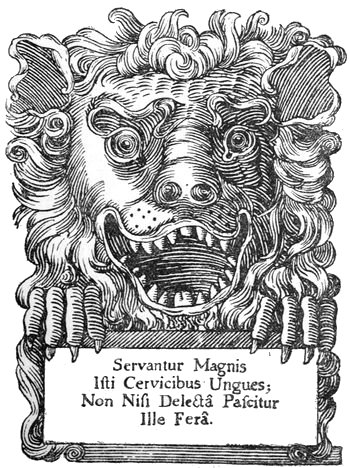
THE LION AT BUTTON'S.
Servantur Magnis Isti Cervicibus Ungues; Non Nisi Delectâ Pascitur Ille Ferâ.
A curious custom obtained in this reign—that of selling goods, notably wines, by 'the Candle.' Pepys notes it in his diary as being new to him, so that it had not been long in vogue. Lloyd's and the Marine Coffee Houses were the principal places where these singular auctions were held.
When the custom died out I cannot learn, but probably it was during the first quarter of this century. The latest account I can find of its being practised is in The Saturday Bristol Times and Mirror of March 29, 1873. 'Sale by Candle. The practice of letting by inch of Candle still prevails in the County of Dorset. At the annual letting of the parish meadow of Broadway, near Weymouth, which occurred a few weeks ago, an inch of candle was placed on a piece of board nine inches square, and lighted by one of the parish officers. The biddings were taken down by one of the parish officers, and the chance of taking the meadow was open to all while the candle was burning. The last bidder before the candle went out was the incoming tenant. This year the candle was extinguished suddenly. The land, about two acres in extent, was in 1624 presented to the poor by William Gould, the object of the gift being to keep the poor from working on the highways.' The custom, for aught I know, may still exist in some out-of-the-way places.
Young Man's was at Charing Cross, and was a fashionable lounge. It was also a gambling house, for Brown says of it: 'Young Man's Coffee House threw it self in my way, and very kindly offer'd its Protection. I acquiesced then, knowing myself secure from more Dangers than one, and immediately upon my entrance mounted the Stairs, and mingled my Person with the Knights of the Round Table, who hazard three Months Revenue at a single Cast.' Ward is disgusted with the superfine air of the place, and says of its frequenters, 'their whole Exercise being to Charge and Discharge their Nostrils; and keep the Curles of their Periwigs in proper Order.... They made a Humming, like so many Hornets in a Country Chimney, not with their talking, but with their Whispering over their New Minuets and Bories, with their Hands in their Pockets, if freed from their Snush Box.... Amongst them were abundance of Officers, or Men who by their Habit appear'd to be such; but look'd as tenderly, as if they Carried their Down beds with them into the Camp, and did not dare to come out of their Tents, in a cold morning, till they had Eat a Mess of Plum Panada for Breakfast, to defend their Stomachs from the Wind.... Having sat all this while looking about us, like a Couple of Minerva's Birds, among so many Juno's Peacocks, admiring their Gaiety; we began to be thoughtful of a Pipe of Tobacco, which we were not assur'd we could have the liberty of Smoaking, lest we should offend those Sweet Breath Gentlemen. But, however, we Ventur'd to call for some Instruments of Evaporation, which were accordingly brought us, but with such a Kind of unwillingness, as if they would much rather have been rid of our Company; for their Tables were so very Neat, and Shin'd with Rubbing, like the Upper Leathers of an Alderman's shoes. The floor as clean Swept, as a Sir Courtly's Dining Room, which made us look round, to see if there were no Orders hung up to impose the Forfeiture of so much Mop Money upon any Person that should spit out of the Chimney Corner.'
Nando's was in Fleet Street, at the corner of Inner Temple Gate, the house wrongly described as being formerly the palace of Cardinal Wolsey, and now a hairdresser's. It was not particularly famous for anything in Anne's time, only the name is familiar to students of that epoch, as being next door to the shop of Bernard Lintot the bookseller, and mentioned by him in all his advertisements.
'N.B. The seat of learning is now removed from the corner of the chimney on the left hand towards the window, to the round table in the middle of the floor over against the fire; a revolution much lamented by the porters and chairmen, who were much edified through a pane of glass that remained broken all the last summer.'
These rather detract from the possible authenticity of the historical relics, which were numerous, and, if genuine, were curious and valuable. '(15) A Wooden Shoe put under the Speaker's Chair in K. James IId's Time.' '(37) Gustavus Adolphus's Gloves.' '(38) Harry VIIIth's Coat of Mail.' '(39) Queen Elizabeth's Stirrup.' '(41) Katherine Q. Dowager's Coronation Shoes.' '(42) King Charles IId's Band, which he wore in Disguise in the Royal Oak.' '(43) William the Conqueror's Flaming Sword.' '(44) Oliver's Sword.' '(45) King James IId's Coronation Shoes.' '(46) King William the IIId's Coronation Sword.' '(47) King William's Coronation Shoes.' '(49) Queen Anne's Testament.' '(50) Henry the VIIIth's Gloves.' '(51) The Czar of Moscow's Gloves;' and last but not least—an undeniable forgery, '(242) Robinson Crusoe's and his Man Friday's Shirts.'
Slaughter's Coffee House in St. Martin's Lane afterwards superseded Old Man's as a military meeting-place, and in the latter half of the century it was frequented by artists and sculptors. Searle's, or Serle's, was a legal coffee-house, and was situated at the corner of Lincoln's Inn Fields. Of Tom's—I have a list of six—perhaps the best known was that in St. Martin's Lane, where, as we have seen, was one of the first insurance offices. The Virginia, which was in St. Michael's Alley, and afterwards in Cornhill, has disappeared within the last few years.
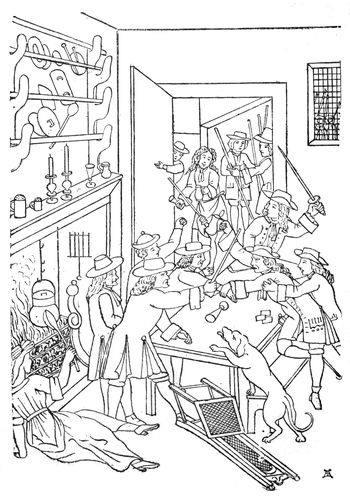
A TAVERN SCENE.
But the frequenters of taverns were not all so respectable as these examples; and Brown supplies particulars of another section of society. 'A Tavern is a little Sodom, where as many Vices are daily practised, as ever were known in the great one; Thither Libertines repair to drink away their Brains, Aldermen to talk Treason, and bewail the loss of Trade; Saints to elevate the Spirit, hatch Calumnies, coin false News, and reproach the Church; Gamesters to shake their Elbows; Thither Sober Knaves walk with Drunken Fools to make Cunning Bargains and overreach them in their Dealings; Thither Young Quality retire to spend their Tradesmens Money; Thither Bullies Coach it to Kick Drawers, and invent new Oaths and Curses; Thither run Sots purely to be drunk, Beaux to shew their Vanity, Cowards to make themselves valiant by the Strength of their Wine, Fools to make themselves witty in their own Conceits, and Spendthrifts to be made Miserable by a Ridiculous Consumption of their own Fortunes.'
This tavern was so popular that a rival sprang up on the other side of the street, the 'Young Devil,' and here, for a year or so, from the beginning of 1708, till some time in or about 1709, the Society of Antiquaries held their meetings, afterwards at the 'Fountain' tavern, Inner Temple Gate. The 'Cock,' in Fleet Street, has only just been demolished. There was another famous tavern which was near St. Dunstan's Church, in Fleet Street, called 'The Hercules' Pillars,' which was visited by Pepys, as appears by four entries in his diary. Another tavern of this name, at Charing Cross, will be noted when treating of the amusements of the people. The 'Mitre' tavern must not be confounded with the coffee-house of that name in Mitre Court, but was the one frequented by Dr. Johnson, and so often referred to by Boswell.
The 'Palsgrave's Head,' on the south side of the Strand, near Temple Bar, was then a coffee-house, and was so named from the Palsgrave Frederick, afterwards King of Bohemia, who married the Princess Elizabeth, daughter of James I. The 'Crown and Anchor,' which stretched along the Strand from Arundel Street to Milford Lane, was famous as being the place where the Academy of Music was instituted in 1710. The 'Rose' tavern in Drury Lane is frequently mentioned in the literature of this time. It was afterwards absorbed into Drury Lane Theatre, when Garrick enlarged it in 1776. The 'Rummer Tavern,' at Charing Cross, near Locket's Ordinary, is often mentioned in advertisements, and Brown and Ward speak of 'Heaven' and 'Hell,' which were two ale-houses near Westminster Hall. Pepys notices one of them on January 28, 1660—'And so I returned, and went to Heaven, where Ludlin and I dined.' And last, not least, was the 'Bumper' tavern, which 'Dick Estcourt,' the actor, opened on January 1, 1712, and which Steele so kindly puffed in Spectator No. 264. An exhaustive catalogue of the taverns in the City is given by Ward in his 'Vade Mecum for Maltworms,' a very curious and now rare book; but it is hardly worth while to reproduce their names, even in an appendix.