Chapter XXXVIII · DUELLING.
Reading edition
Its prevalence — Bullying — Fielding's duels — Favourite localities — Its illegality — Col. Thornhill and Sir Cholmley Dering: their quarrel and duel — Duke of Hamilton and Lord Mohun—Story of their duel.
The senseless custom of duelling was much in vogue in this reign, although perhaps it had not reached to the height it afterwards did. The custom of wearing swords rendered the arbitrament of every dispute liable to be settled by those weapons. A few hasty words and the sword was whipped out, and probably one or other of the combatants had reason to regret his loss of temper. Indeed, to such a pitch had it come that the Code of Old John Selden, 'The duels or single combat,' printed in 1610, was reprinted in 1711 for the benefit of Queen Anne's subjects, as was also Sir William Hope's 'New Method of Fencing &c.' Fencing-masters naturally advertised. 'Peter Besson a Waldense, born in Piedmont, teaches the use of the Italian Spadroon; and does invite all Gentlemen that are curious in the Sword to see him perform his Exercises at St. Amant's Coffee House by Charing Cross, Tuesdays, Thursdays, and Saturdays, from 10 of the Clock in the Morning till 1. He hath been in most Princes Courts of Europe, from whom he hath ample Certificates of his great Dexterity and Ability this Way, and in a very short time can make Gentlemen compleat Masters of this sort of Sword.' There were also the numerous fencing-masters who performed at Hockley in the Hole, who were always available as teachers.
Steele, who had himself fought his man and run him through the body, did all he could to discountenance the practice; as he says in Tatler 25: 'I shall talk very freely on a Custom which all men wish exploded, though no man has courage enough to resist it.' And not only does he write against it in that number, but also in Nos. 26, 28, 29, 38, and 39.
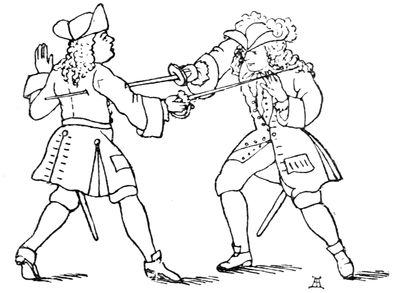
A DUEL.
Very early in the reign we hear of duels. The Flying Post, Dec. 15/17, 1702, tells us of two. 'On Monday last Col. Fielding, commonly called Handsom Fielding, was dangerously wounded in a Quarrel with one Mr. Gudgeon, a Gentleman, at the Theatre Royal, Drury Lane.... On Tuesday night last, one Mr. Cusaick, an Irish Gentleman, and Capt Fullwood, quarrelled at the New Theatre in Lincoln's Inn Fields, and afterwards fought; Captain Fullwood fell on the Spot, and Mr. Cusaick was dangerously wounded.'
In the same paper for Dec. 22/24, 1702, we read: 'Mr. Fullwood, who fought with Mr. Cusaick last Week in Lincoln's Inn Fields, was very decently buried on Sunday last in the Evening at St. Clement's Danes in the Strand. His Corps was brought from the Hay Market in a Hearse, attended by many Gentlemen of Note, and some of Quality; they had all Favours and Gloves.... Two Gentlemen of the Guards fought a Duel in the Meuse; one was kill'd upon the Spot, and the other dangerously wounded.'
It was illegal to fight duels, but the law was seldom acted on. Still, it was put in force when appealed to. '25 Feb. 1703. Upon Notice given, that Sir Stafford Fairborn and admiral Churchill designed to fight a Duel, they were both Confined, to prevent the same.'
Whilst on this subject, notice of two famous duels fought in this reign must not be omitted—those between Col. Thornhill and Sir Cholmley Dering, and between the Duke of Hamilton and Lord Mohun; because they throw so much light on the then procedure in these matters.
'It appeared that after this the Deceas'd made overtures of Accommodation.'
At the trial the doctors deposed that Thornhill's injuries were very severe, that he had had fever, and might have died, had he not had an excellent constitution. As soon as he recovered a little, he sent his antagonist the following challenge.
'May the 8th, 1711.
'Sir, I shall be able to go Abroad to Morrow Morning, and desire you would give me a Meeting with your Sword and Pistols, which I insist on; the Worthy Gentleman my Friend, who brings this, will concert with you for the Time and Place. I think Tuttle Fields will do well, Hide Park will not, this Time of the Year being full of Company.
'I am, Your Humble Servant, 'Richard Thornhill.'
His servant deposed that on the morning of the 9th of May 'Sir Cholmley came into his Master's dining Room with a Brace of Pistols in his Hands; upon which he inform'd his Master, Sir Cholmley was there; who thereupon came to him, and ask'd Sir Cholmley if he would drink a Dish of Tea, which he refus'd, but drank a Glass of Small beer. Mr. Thornhill having dress'd himself, they went together in a Hackney Coach to Tuttle Fields. Upon their being there, the Evidence depos'd, That they Came up like Two Lions with their Pistols advanc'd, and when within Four Yards of each other, discharg'd so equally together, that it could not well be discover'd who Shot first.'
Sir Cholmley fell, and the usual scene took place; the quondam friend rushed forward, and regretfully wished to be of service to the dying man. A surgeon was sent for, and before his death Sir Cholmley not only freely forgave his adversary, but admitted that 'this Misfortune was my own Fault, and of my own Seeking.'
For the defence 'Several Persons of Quality and Worth declared as to Mr. Thornhill's Character, That they never knew him to be of a Quarrelsome Disposition; but that on the Contrary, Sir Cholmley Deering was given to be unwarrantably Contentious.'
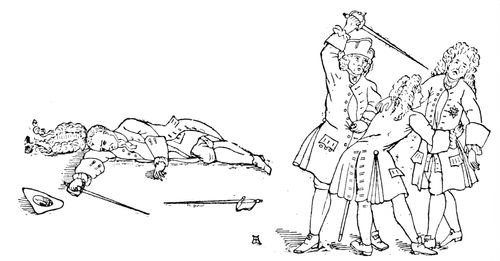
DUEL BETWEEN DUKE OF HAMILTON AND LORD MOHUN.
The judge summed up very clearly, but against the prisoner, pointing out to the jury the difference between manslaughter and murder; but the jury brought in a verdict of manslaughter.
Thornhill did not survive his adversary long. Swift writes Stella, Aug. 21, 1711: 'Thornhill, who killed Sir Cholmley Dering, was murdered by two men on Turnham Green last Monday Night. As they stabbed him, they bid him remember Sir Cholmley Dering. They had quarrelled at Hampton Court, and followed and stabbed him on horseback.'
His remorse at his killing Dering is commented on by Steele in Spectator 84, under the name of Spinamont.
The story of the duel is briefly this. The two noblemen were opposing parties in a lawsuit, and on Nov. 13, 1712, met in the chambers of a Master in Chancery, when the Duke remarked of a witness—'There is no truth or justice in him.' Lord Mohun replied, 'I know Mr. Whitworth; he is an honest Man, and has as much truth as your Grace.' This, fanned into flame by officious friends, was enough; and on Nov. 15, or two days afterwards, they fought, early in the morning, in Hyde Park; their seconds—Col. Hamilton and General Macartney—also fighting, or, as they expressed it, 'taking their share in the dance.' Lord Mohun fell, dead, and the Duke atop of him, mortally wounded. The seconds left off fighting, and went to the assistance of their principals; and it was then, it was averred, that Gen. Macartney treacherously stabbed the Duke.
Macartney fled; but Col. Hamilton remained, took his trial, and was only found guilty of manslaughter. He accused Macartney of the foul deed, and great was the hue and cry after him. The Duchess was naturally enraged, and offered a reward of 300l. for his apprehension, and the Government offered 500l. more, but he got off safely. When things were quieter, he returned, stood his trial at the Queen's Bench, Colonel Hamilton's testimony was contradicted, and he was acquitted of the murder—but found guilty of manslaughter. The punishment for this, by pleading benefit of clergy, which of course was always done, was reduced to a very minimum, something amounting to the supposed burning of the hand with a barely warm or cold iron—and he was restored to his rank in the army and had a regiment given him.