Chapter XXIV · SWORD-PLAY AND OTHER SPORTS. GARDEN, ETC.
Reading edition
Challenges — The stakes — The combatants — Description of fights — General combativeness — Boxing — Cudgel-playing — Pedestrianism — Tennis — Cricket — Football — Skating — Billiards — Country wakes — Bowling — Bowling greens — Formal gardening — Clipping trees — Books on gardening — Trees and flowers — Town and country life — Country labourers.
'At the Bear Garden in Hockley in the Hole.
A Tryal of Skill to be Performed between two Profound Masters of the Noble Science of Defence on Wednesday next, being this 13th of the instant July 1709 at Two of the Clock precisely.
'I, George Gray, born in the City of Norwich, who has Fought in most Parts of the West Indies viz. Jamaica, Barbadoes, and several other Parts of the World; in all Twenty-five times, upon a Stage, and was never yet Worsted, and now lately come to London; do invite James Harris, to meet and Exercise at these following Weapons viz.:—
Back Sword, Single Falchon
Sword and Dagger, AND
Sword and Buckler, Case of Falchons.
'I, James Harris, Master of the said Noble Science of Defence, who formerly rid in the Horse guards, and hath Fought a Hundred and Ten Prizes, and never left a Stage to any Man: will not fail (God Willing) to meet this brave and bold Inviter at the Time and Place appointed, desiring Sharp Swords, and from him no Favour.
'☞ Note. No person to be upon the Stage but the Seconds. Vivat Regina.'
'At the Bear Garden in Hockley in the Hole.
A Tryal of Skill to be Performed between these two following Masters of the Noble science of Defence, on Wednesday the Fifth of April, 1710, at Three of the Clock precisely.
'I, John Parkes from Coventry, Master of the Noble Science of Defence, do Invite you Thomas Hesgate, to meet me and Exercise at these following Weapons, viz.:—
Back Sword, Single Falchon,
Sword and Dagger, Case of Falchons,
Sword and Buckler, And Quarterstaff.
'I, Thomas Hesgate, a Barkshire Man, Master of the said Science, will not fail (God willing) to meet this brave and bold Inviter, at the Time and Place appointed; desiring Sharp Swords, and from him no Favour.
There is one remarkable exception, I have found, to this monetary arrangement, but it is the only one in my experience. For, in an advertisement of the usual character, there comes: 'Note. That John Stokes fights James Harris, and Thomas Hesgate fights John Terriwest three Bouts each at Back Sword, for Love.'
I have been, to my great regret, unable to find a contemporary print of one of these combats; the nearest approach to it being the fight between Dr. Sacheverell and Dr. Hoadley, which furnishes a graphic, though burlesque, representation of the scene.
This sword-fighting, however, was seeing its last days, and was, in the next reign, to be superseded by pugilistic encounters. At present, boxing, although extensively practised, had not been reduced to a science. Whatever was it made everybody so pugnacious? 'Anything that looks like fighting,' says Misson, 'is delicious to an Englishman. If two little Boys quarrel in the Street, the Passengers stop, make a Ring round them in a Moment, and set them against one another, that they may come to Fisticuffs. When 'tis come to a Fight, each pulls off his Neckcloth and his Waistcoat, and give them to hold to some of the Standers by; then they begin to brandish their Fists in the Air; the Blows are aimed all at the Face, they Kick one another's Shins, they tug one another by the Hair &c. He that has got the other down may give him one Blow or two before he rises, but no more; and let the Boy get up ever so often, the other is obliged to box him again as often as he requires it. During the Fight, the Ring of Bystanders encourage the Combatants with great Delight of Heart, and never part them while they fight according to the Rules. The Father and Mother of the Boys let them fight on as well as the rest, and hearten him that gives Ground or has the Worst.
'These Combats are less frequent among grown Men than Children, but they are not rare. If a Coachman has a Dispute about his Fare with a Gentleman that has hired him, and the Gentleman offers to fight him to decide the Quarrel, the Coachman consents with all his Heart: The Gentleman pulls off his Sword, lays it in some Shop, with his Cane, Gloves and Cravat, and boxes in the same Manner as I have describ'd above. If the Coachman is soundly drubb'd, which happens almost always, that goes for payment; but if he is the Beator, the Beatee must pay the Money about which they quarrell'd. I once saw the late Duke of Grafton at Fisticuffs in the open Street, with such a Fellow whom he lamb'd most horribly.'
Tennis was a fashionable game, although I only find one public court mentioned, 'facing Oxenden Street near the Haymarket.' Ward gets quite moral on the subject of this game: 'Rightly considered, it's a good Emblem of the World. As thus: the Gamesters are the Great Men, the Rackets are the Laws, which they hold fast in their Hands, and the Balls are we little Mortals which they bandy backwards or forwards from one to t'other as their own Wills and Pleasure directs 'em.'
Cricket was played, and sufficient interest was felt in the matches: on one or two occasions they were advertised in the newspapers. In 1705: 'This is to give notice, That a Match at Cricket is to be plai'd between 11 Gentlemen of the West part of the County of Kent against as many of Chatham for 11 Guineas a man, at Mauldon in Kent on the 7th of August next.' And in 1707: 'There will be two great Matches at Cricket plaid, between London and Croydon; the first at Croydon on Tuesday July 1, and the other to be plaid in Lamb's Conduit Fields near Holborn, on the Thursday following, being the 3rd of July.'
On the approach of winter football came into vogue, and it was played in the streets.
Skating, although practised here in the time of Fitz-Stephen, had fallen into desuetude, until it was reintroduced by the Cavaliers who had been with Charles II. in Holland. Pepys thought it was 'a very pretty art,' yet got very nervous over the Duke of York's skating. 'To the Duke, and followed him into the Parke, where, though the ice was broken and dangerous, yet he would go slide upon his scates, which I did not like, but he slides very well.' Skating was popular in London in Anne's reign, but it is doubtful whether it obtained in the remote parts of the country. Writes Swift to Stella, Jan. 31, 1711: 'The Canal and Rosamonds Pond full of the rabble sliding, and with skates, if you know what those are.'
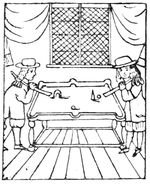
'The Gentile, cleanly and most ingenious Game at Billiards' was a resource at home; and it was played on a table like ours—an oblong wooden table, covered with green cloth, and with pockets of netting, in precisely the same position as now, the cushions being stuffed with fine flax or cotton. The game was not played as we play it, but there were two balls, a port or archway at one end, and a king or cone at the other. The cues were not like ours, but more like maces, only much heavier. 'Your Sticks ought to be heavy, made of Brazile Lignum Vitæ, or some other weighty wood which at the broad end must be tipt with Ivory.' The game was not only played in private, but in coffee houses. 'At the Greyhound Coffee House near Monmouth Street in Soho, are to be sold two new Billiard Tables, and all other goods and conveniences fit for a Coffee House,' etc. And again: 'A very good French Billiard Table little the worse for wearing, full size, with all the Materials fit for French or English play &c. Enquire at Scot's Coffee House.' Indeed Cotton says there were few towns of note in England which had not a public billiard-table. He, however, warns people against 'those spunging Caterpillars, which swarm where any Billiard Tables are set up, who make that single room their Shop, Kitching and Bed Chamber.'
Near London these wakes, like Hampstead or Deptford wakes, were well kept up; and there was my Lady Butterfield in Epping Forest, of whose entertainment and calf-roasting, we have already had a description through Ward's instrumentality. Here is one of her advertisements: 'My Lady Butterfield gives a Challenge to all England, to Ride a Horse, Leap a Horse, Run on Foot or Hallow with any Woman in England Ten years younger, but not a Day older, because she would not under value herself. Gentlemen and Ladies, whilst in the Spring 'tis worth your while to come to hear the Nightingal Sing in Wanstead within a Mile of the Green Man, in Essex, at my Lady Butterfield's at Nightingal Hall. This is to give notice to all Gentlemen and Ladies, and all the best of my Friends, that on the last Wednesday of April is my feast, where is very good Entertainment for that Day, and for all the Year after from my Lady Butterfield.'
Or another:—
To all Gentlemen and Ladies.
If Rare Good young Beans and Pease can Tempt Ye, Pray pass not by my Hall with Bellies Empty; For Kind Good Usage every one can tell, My Lady Butterfield does al excell; At Wanstead Town, a Mile of the Green Man, Come if you dare and stay away if you can.
She had a rival later on, in 1713. 'This is to acquaint all Jolly Lads and Lasses. That on Monday the 28th Instant, there will be a Meeting of several Gentlemen and Ladies at the Opening of Mr. Tucker's new House upon Epping Forest, where the Company will be provided with good Music and Dancing, and be likewise entertain'd by Country People with the following Diversions, viz. A Beaver Hat to be Cudgell'd for, A Pair of Buckskin Breeches to be wrestled for; and a lac'd Holland Smock to be danced for, by 6 young Women. N.B. The Sport begins at 10 a Clock in the Morning; and such care is taken that the Company may not return a hungry, One Ox will then be roasted and given gratis.'
Women raced for smocks, silk stockings, or topknots; whilst one would surely have won Sir John Astley's heart. 'This is to give Notice, That there is a young Woman, born within 30 Miles of London, will run, for Fifty or a Hundred Pounds, a Mile and an half, with any other Woman that has liv'd a Year within the same Distance; upon any good Ground, as the Parties concern'd shall agree to.'
Even a woman's suspected infidelity was turned into sport. 'At Hammersmith near Kensington, to morrow, being Friday, will be rode a Skimmington Triumph, according to the Manner described in Hudibras,' which the reader will find, if he be curious in the matter, in Part. II. Canto II. of Butler's immortal poem.
One harmless diversion should not be passed over. 'At Epsom Old Wells ... on Whitsun Tuesday will be Moris Dancing Set against Set, for Lac'd Hats, at 10 a Clock, with other Diversions.'
But the game, par excellence, which combined out-of-door sport with the minimum of fatigue, suitable alike to the mercurial young, and the steady middle-aged, was bowling; and the bowling greens multiplied exceedingly in this reign, especially (judging by the advertisements) after 1706. We hear of them starting up in all the suburbs: at Putney, Hoxton, Maribone, Hampstead, Stoke Newington, Ham Lane, etc.
That the bowls were the same as are now played with we see by the following advertisement: 'Lost out of the Bowl House belonging to Pemlico Green in Hogsdon near Shoreditch two pair of Lignum Vitæ Bowls and one pair of a reddish Wood.' It was not an expensive recreation. 'The New Green over against Bunhill fields will be open'd on Saturday next, and the Old Green to be Bowled on for Six Pence and One Penny for taking up.' Sometimes there were prizes bowled for, as 'At the Black Gray hound Dog at Bristow Causey, will be a Silver Tobacco Box Bouled for, value 30s.'
In the Guardian (No. 173) this practice of clipping trees is ridiculed most unmercifully. 'I know an eminent cook, who beautified his Country seat with a Coronation dinner in greens; where you see the Champion flourishing on horseback at one end of the table, and the queen in perpetual youth at the other. For the benefit of all my loving Countrymen of this Curious taste, I shall here publish a Catalogue of greens to be disposed of by an eminent town gardener ... Adam and Eve in Yew; Adam a little Shattered by the fall of the Tree of Knowledge in the great Storm; Eve and the Serpent very flourishing.
'St. George in box; his arm scarce long enough, but will be in a Condition to Stick the dragon by next April.
'A Green dragon of the same with a tail of ground Ivy for the present.—N.B. These two not to be sold separately.
'A pair of Giants stunted, to be sold Cheap.
'A quickset hedge, shot up into a porcupine, by its being forgot a week in rainy weather,' etc.
There were many works on gardening published in this reign, notably that by James, which was a translation from the French. It is enriched with beautiful designs for parterres, etc., and is undoubtedly the handsomest work on the subject. Van Oosten's 'Dutch Gardener' is another translation, as is 'the Retir'd Gard'ner' of London and Wise. The latter is a book of about 800 pages, with several woodcuts and copperplate engravings, and consists of two parts—one a translation of 'Le Jardinier Solitaire,' and the other from the work of the Sieur Louis Ligers. This was edited by George London and Henry Wise, who are more than once mentioned in the Spectator. They were practical gardeners, and their nurseries far surpassed all others in England. London was chief gardener to William and Mary, and afterwards to Anne. During her reign the nurseries were let to a man named Swinburne, but the name of the original firm was still kept up.
There is, however, an excellent book in English called 'the Clergy Man's Recreation,' by John Laurence, A.M., 1714, but it is all about the cultivation of fruit trees.
Plants would even grow out of doors in the City then, and we find the fore courts of houses planted, or at all events the walls covered with jasmines, vines, etc. Whilst the newspapers advertise for sale, 'Yews, Hollys and all sorts of Fillbrea Laurell &c. with all sorts of Fine Flowering Trees as Honi suckles, Cittisus, Roses, Sævays both Headed and Pyramid, Orange Trees, and Spanish Jesemins, Gilded Hollys Pyramid and Headed, Filleroys, Lawrel Tines, and Arbour Vitæ,' and amongst the flowers were 'Double Emonies, Ranckilos, Tulips, Aurickelouses, Double Anemonies, Double Ranunculos and Double Junquils.' Ranunculus seems to have been a puzzling word, for once again we find it spelt 'Renunculices.'
Town and country were eminently antagonistic. The want of means of communication kept country people in a state of stagnation, compared to their brethren of the town, whose more fastidious taste could not brook the boorish behaviour, and coarse pleasures, of the countryman.
'Woodcock. No Londiner shall either ruin my Daughter, or waste my Estate—If he be a Gamester 'tis rattl'd away in two Nights—If a lewd fellow, 'tis divided into Settlements—If a nice Fop, then my Cherry trees are cut down to make Terras-Walks, my Ancient Mannor House, that's noted for good Eating, demolish'd to Build up a Modem Kickshaw, like my Lord Courtair's Seat about a Mile off, with Sashes, Pictures and China; but never any Victuals drest in the House, for fear the Smoke of the Chimney should Sully the New Furniture.
'Reynard. So that instead of providing her a Gentleman, you'd Sacrifice her to a Brute; who has neither Manners enough to be thought Rational, Education enough for a Justice of the Peace, nor wit enough to distinguish fine Conversation from the Yelping of Dogs; Hunts all the Morning, topes all the Afternoon, and then goes lovingly Drunk to Bed to his Wife.
But if the country aristocracy were so behindhand, in what state were the labourers? Their lot was hard work and scant wage, only relieved by a village wake or a country fair; no education, no hope of any better position, of the earth, earthy; a man rose at early morning, worked hard all day, came home to sleep, and so on without intermission. Gay thus describes him and his labours:—
The dress of the labourer at this time was a broad-brimmed flap felt hat, a jerkin, or short coat, knee breeches and stockings; whilst the women wore their dresses very plainly made—necessarily without furbelows and hoops, and, for headgear, had a very sensible broad-brimmed straw hat, or, on holidays, the high-crowned felt hat.