Chapter XIV · WOMEN'S DRESS.
Reading edition
The commode — Description of ladies' dress — The petticoat — The bodice — A costly wardrobe — Underlinen — Dressing like men — Scents — Patches — Patching Whig and Tory — Masks — The hood — High-crowned hats — Furs — Umbrellas — Pattens — The fan — Mobs — Shopping — Stuffs — List of Indian stuffs — Lace — Linens — Tallymen — Jewellery — Diamonds — Plate — Children's jewellery.
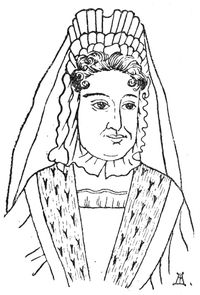
A COMMODE.
Ward gives us his definition of a Belle, or 'Modish Lady,' as he prefers to call her, who was—
At Hackney, Stepney, or at Chealsea Bred,
In Dancing perfect and in Plays well Read.
........
Impatient of Extreams, with Pride half Craz'd,
Then must her Head, a Story higher be rais'd.
In her next Gaudy Gown, her Sweeping Train
Is order'd to be made as long again;
All things must vary from the common Rode,
And reach a Size beyond the Decent Mode:
Thus Monstrously Adorn'd, to make a show,
She walks in State, and Courtsies very low,
And is a proper Mistress for the Fool, a Beau.[217]
We get a very good, and at the same time humorous, description of female dress in 1707 out of Mrs. Centlivre's play of 'The Platonick Lady,' wherein one of the characters is Mrs. Dowdy, 'a Somersetshire Widow, come to Town to learn Breeding.'
Act. 3. Enter Mrs. Dowdy, Mrs. Brazon the Matchmaker, Mrs. Wheedle the Milliner, Mrs. Turnup the Manto Maker, Mrs. Crispit the Tire Woman, and Peeper, her Maid. They all seem Talking to her.
Mrs. Dowdy. We'l, we'l la you now, la you now, Shour and Shour you'l Gally me.
Turnup. Here's your Ladyships Manto and Petticoat.
Mrs. Dowdy. Ladyship, why what a main difference is here between this Town and the Country. I was never call'd above Forsooth in all my Life. Mercy on me, why you ha spoil'd my Petticoat, mum: zee, Peeper, she has cut it in a Thousand Bits.
Peeper. Oh, that's the Fashion, these are Furbelows Madam—'tis the prettiest made Coat.
Mrs. Dowdy. Furbelows, a murrain take 'em, they spoil all the Zilk. Good strange, shour London Women do nothing but study Vashions, they never mind their Dairy I warrant 'em.
Turnup. Ladies have no other employment for their Brain—and our Art lies in hiding the defects of Nature. Furbelows upwards, were devised for those that have no hips, and too large ones, brought up the full bottom'd Furbelows.
Milliner. And a long Neck and a hollow Breast, first made use of the Stinkirk—and here's a delicate one for your Ladyship. I have a Book in my pocket just come from France, Intituled, The Elements of the Toylet.
Mrs. Dowdy. Elements, mercy on me! what do they get up in the Sky now?
Peeper. A Learned Author to be sure,—let me see that, Mrs. Wheedle.
Milliner. Here, Mrs. Peeper, 'tis the Second Volume; the first only shews an Alphabetical Index of the most notable Pieces which enter into the Composition of a Commode.
Mrs. Dowdy. Well, I shall ne'er mind these hard Names; Oh Sirs, Peeper, what swinging Cathedral Headgeer is this?
Peeper. Oh, Modish French Night Clothes; Madam, what's here—all sorts of dresses painted to the Life. Ha, ha, ha, head cloaths to shorten the Face. Favourites to raise the Forehead—to heighten flat cheeks flying Cornets—four Pinners to help narrow Foreheads and long Noses, and very forward, to make the Eyes look Languishing.
Mrs. Dowdy. Ay—that, Peeper, double it down, I love Languishing.
Peeper. Take it and read it at your leisure, Madam.
Mrs. Dowdy. I shall never ha done shour zeeing all my vine things. Hy day, what's these two pieces of Band Box for?
Mrs. Dowdy. A Rump, ho, ho, ho, has Cousin Isbel a Rump, Peeper?
Peeper. Certainly Madam.
Mrs. Dowdy. If Cousin has one, as I hope to be kiss'd, I'll have it, Mrs. Turnup.
It is hardly within the scope of this work to follow the varying fashions of the reign, so one more extract must suffice. It is from 'The Humours of the Army,' by Charles Shadwell (a son, or nephew, of the Poet Laureate, 1713): 'But there are some fashionable Creatures at the other End of the Town, that give great Hopes of their being very odd and Whimsical; for their Head dresses are no bigger than the Skull-caps they us'd to wear; their Petticoats are up to their knees; their Stays up to their chins; and their Fans up to their Nostrils; and the mody Shrug makes 'em wear their shoulders up to their Ears; their Lappets reach down to the Frenching of their Petticoats, which are widen'd with Abundance of Whalebone; They stoop forward when they should walk upright; they shuffle along a tip Toe, curtsey on one Side, smile on those they would ridicule, and look very grave on their intimate acquaintances.'
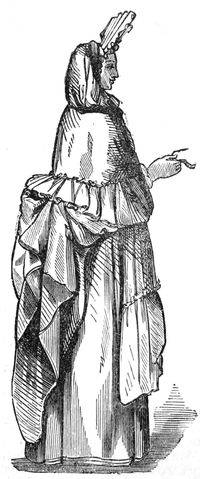
The bodices were laced, open in front, over very tight stays, showing them; and they varied in material from 'a pair of stays cover'd with Black Tabby Stitched, lin'd with Flannel,' to one 'with 8 diamond Buckles and Tags,' for which Sir Richard Hoare, of the Golden Bottle in Fleet Street, would give the finder twelve guineas. The bodices were worn low, showing the bosom—which, however, was partially concealed by the 'tucker' or 'modesty piece,' which was an edging going round the top of the dress and front of the bosom. In 1713 this was beginning to be discontinued, and deep, and many, were the growls over it in the Guardian.
The sleeves of the bodice were somewhat short (only coming a little below the bend of the arm), and were worn hanging, to show the white muslin, or lace, hanging sleeve, which came nearly to the wrist—a very pretty fashion; and an apron was worn, made somewhat ornamental by frilling, etc.
This formed the outward costume of a lady; only sometimes it was of extremely rich material, vide the following: 'Stolen out of the house of Mr. Peter Paggen in Love Lane near Eastcheap ... One Isabella colour Kincob Gown flowered with Green and Gold, one Silver lace half Ell deep; One Silver Orrice a quarter of a Yard deep; A large Parcel of Black and Silver Fringe; One dark colour Cloth Gown and Petticoat with 2 Silver Orrices; One Purple and Gold Atlas Gown; One Scarlet and Gold Atlas Petticoat edged with Silver; One wrought under Petticoat edged with Gold; one Black Velvet Petticoat; three Black and White Norwich Stuff Gowns and Petticoats; one Black fine Cloth Gown and 2 Petticoats; One White Satin Gown lined with Black Silk; One Alejah Petticoat striped with Green, Gold, and White; One Silver Net half Yard deep; One White Sarsnet Scarf; Two Yards of White and Gold Atlas; one Blue and Silver Silk Gown and Petticoat; One Blue and Gold Atlas Gown and Petticoat; Two Silver Laces each a quarter of a Yard deep, One yellow Chintz Gown and Petticoat, one Workt Petticoat; one White Holland Gown and Petticoat drawn for Stitchin; One pair of Shoes and Clogs laced with Silver; One dark Colour Cloth Petticoat with a Silver Orrice, one White Sarsnet Scarf,' etc.
Of ladies' underlinen we get a glimpse in the following: 'Lost &c., a deal box containing 4 fine Holland Shifts, 7 fine Cambric Handkerchiefs, 2 Night rails and Aprons, one with edging and the other flowered, 2 yards of fine loopt Macklen Lace, one Suit of Muslen Lace Night Cloaths, 2 Holland Wastcoats, 3 Diaper Towels, One Powder Box and 6 combs.'
The stockings were either of thread or silk; in the latter case they were sometimes of bright colours. We have already seen how the little temptress of the New Exchange asked, 'Does not your Lady want ... fine green Silk Stockings?' The shoes were beautifully made, of satin or silk, embroidered, or of fine Morocco leather, with high heels.
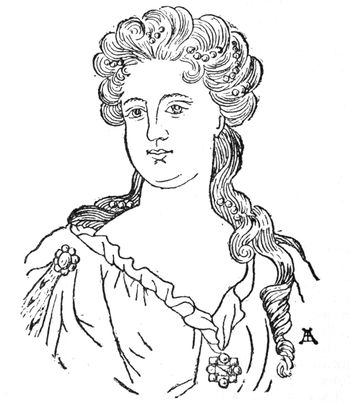
COIFFURE.
The mode of coiffure was far less pretentious than in succeeding reigns. When a cap or commode was worn, the hair, except in front, was almost entirely concealed. When worn without a cap, as in the house—especially for dress occasions—it was rolled, as in the accompanying illustration, in a style both elegant and informal.
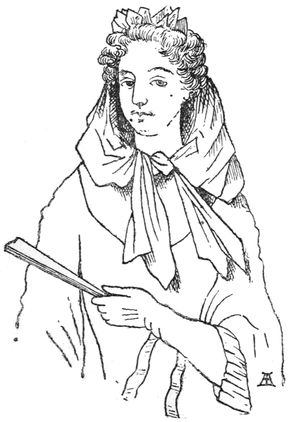
PATCHING.
That curious practice of patching the face was in force, but was used in greater moderation than either in the reign of Charles I., when suns, moons, stars, and even coaches and four were cut out of sticking plaister, and stuck on the face, and even the mercers patched, to show the effect to their customers—or in the Georgian era, when the face was covered with a sooty eruption. The effect on a pretty face, as shown in the accompanying illustration, is far from unpleasant. But it was an art, and required judgment.
Penelope. But alas, Madam, who patch'd you to Day? Let me see. It is the hardest thing in Dress. I may say without Vanity I know a little of it. That so low on the Cheeks pulps the Flesh too much. Hold still, my dear, I'll place it just by your Eye—(Aside) Now she downright squints.
Victoria. There's nothing like a sincere Friend; for one is not a judge of one's self. I have a Patch box about me. Hold, my dear, that gives you a sedate Air, that large one near your Temples.
Penelope. People, perhaps, don't mind these things: But if it be true, as the Poet finely sings, That all the Passions in the Features are, We may show, or hide 'em, as we know how to affix these pretty artificial Moles.
Misson notes the difference between his countrywomen and ours. 'The Use of Patches is not unknown to the French Ladies; but she that wears them must be young and handsome. In England, young, old, handsome, ugly, all are bepatch'd till they are Bed-rid. I have often counted fifteen Patches or more upon the swarthy wrinkled Phiz of an old Hag threescore and ten, and upwards. Thus the English Women refine upon our Fashions.'
It has been noticed that masks were used in the country by ladies when taking horse exercise; in fact, it was a substitute for the modern veil; and, in previous reigns, it had been used generally out of doors. But in Anne's time it had got to be associated with disreputable females, so much so that at concerts, and at Powel's puppet show, no person wearing a mask was admitted. They were still worn at the theatres, but scarcely by ladies. Still they were worn sometimes even by them, on the first night of a play, in case there might be any allusion, which might afterwards be excised, which would make them blush. They were not expensive luxuries.
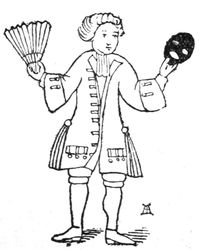
A MASK OR VIZARD.
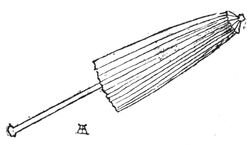
AN UMBRELLA.
Furs were worn, and of course duly lost. From one advertisement we get to know the name of 'a Sable Tippit or Zar;' and from another we learn something of its shape, 'a round Sable Tippet, about 2 yards long, the Sable pretty deep and dark, with a piece of black Silk in the Square of the neck.' They also had muffs, not only of feathers, as we have already seen, but of fur of all sorts, from otter skin to 'the Cats' fur. But ladies did not go out more than they could help, either in cold or wet weather. The streets were so bad, and, although to them was accorded the 'umberellow' (for it was far too effeminate a thing for men to carry, no Jonas Hanway having yet arisen), yet they did not stir out unless obliged; and it was only
And then Gay tells the legend of how Vulcan fell in love with Martha (or Patty), the daughter of a Lincolnshire yeoman; how to save her feet from the cold and wet he studded her shoes with nails; but still she had a cold and lost her voice, until he hit upon the happy idea of the 'patten' the use of which completely restored her to health, and
The Patten now supports each frugal Dame, Which from the blue ey'd Patty takes the name.
But we must not forget that potent weapon in woman's armoury, the fan.
To anyone interested in the use of the fan at this period, a perusal of Addison's article in the Spectator (No. 102) is recommended: it is too long for reproduction here, and would be thoroughly spoilt by merely making use of extracts from it. They seem to have been seldom lost, or if so, were not of sufficient value to advertise—in fact, I have only met with one advertisement, 'A painted Landskip Fann, cutt, gilded Sticks,' and for this a reward of 7s. 6d. was offered. That they were largely imported is evident by the following notice: 'For Sale by the Candle, at the Marine Coffee House in Birchin Lane &c.—Forty Thousand Fans of Sundry Sorts;' but these most probably were either Chinese, Japanese, or Indian palm fans.
What woman could exist without shopping nowadays? And the habit was the same among the ladies of Queen Anne's time. The Female Tatler (1709) gives us the following graphic description of shopping: 'This afternoon some ladies, having an opinion of my fancy in Cloaths, desired me to accompany them to Ludgate Hill, which I take it to be as agreeable an amusement as a lady can pass away three or four hours in. The shops are perfect gilded theatres, the variety of wrought silks so many changes of fine scenes, and the Mercers are the performers in the Opera; and instead of "vivitur ingenio," you have in gold capitals "No trust by retail." They are the sweetest, fairest, nicest, dished out creatures; and by their elegant and soft speeches, you would guess them to be Italians. As people glance within their doors, they salute them with—Garden silks, ladies, Italian Silks, brocades, tissues, cloth of Silver, or cloth of Gold, very fine Mantua Silks, any right Geneva velvet, English velvet, velvet embossed. And to the meaner sort—Fine thread satins both striped and plain, fine mohair silk, satinnets, burdets, Persianets, Norwich Crapes, anterines, silks for hoods and scarves, hair camlets, druggets or sagathies, gentlemen's nightgowns ready made, shallons, durances, and right Scotch plaids.
'We went into a shop which had three partners; two of them were to flourish out their silks; and after an obliging smile and a pretty mouth made, Cicero like, to expatiate on their goodness; and the other's sole business was to be gentleman usher of the shop, to stand completely dressed at the door, bow to all the coaches that pass by, and hand ladies out and in.
'These fellows are positively the greatest fops in the kingdom; they have their toilets and their fine night gowns; their chocolate in the morning, and their green tea two hours after; Turkey polts for their dinner; and their perfumes, washes, and clean linen, equip them for the Parade.'
We get a glimpse at the prices of silk dresses in the following advertisement: 'The Silk Gowns formerly sold in Exchange Alley, are removed to the sign of the Hood and Scarf, directly over against Will's Coffee House in Cornhill, where any Gentleman or Lady may be furnished with any Size or Price, there being all Sorts of Silks, from rich Brocades of 7 Guineas Price to Thread Sattin Gowns of 37s.,' etc.
Besides the stuffs described in the Female Tatler, there were 'Silver Tishea, Pudsway Silks, Shaggs, Tabbeys, Mowhairs, Grazets, Brochés, Flowered Damasks, Flowered Lustrings, ditto striped and plain, Sarsnets, Italian Mantuas, Silk Plushes, Farendines, Shagreen, Poplins, Silk Crapes and Durants'; whilst among the woollen goods were 'Hair and Woollen Camlets, Hair Plushes, Spanish and English Druggets, Serge Denims, Calamancoes, Russels, Serges, Shalloons, Tammeys, Ratteens, and Salapeens.' Ladies' black broadcloth cost 13s. 6d. per yard, fine scarlet 15s. 6d., and superfine do. 17s. 6d.
Of Indian stuffs there is a formidable list, and as the names are curious, and are probably lost and forgotten, I reproduce them:—
Bafts
Baguzzees
Ponabaguzzees
Chelloes
Chints
Do. Persia
Do. Culme
Do. Mamoodies
Do. Romalls
Betellees. Oringal
Coopees
Doreas
Gorgorans
Mahmudhiattees
Peniascoes
Seersuckers
Terrindams
Callowaypoose
Deribands
Guinea stuffs
Mamoodies
Niccannees
Pallampores
Quilts
Sallampores
Sovaguzzees
Tapsiels
Byrampants
Cuttannees
Doorguzzees
Gurrahs
Mickbannies
Rehings
Tepoys
Jamwars
Romalls
Nillaes
Soofeys
China cherrys
Goaconcheleras
Cherriderrys
Elatches
Gurracs
Humhums
Bulchauls
Cushlahs
Emerties
Humadees
Moorees
Seerbettees
Tanjeebs
Anjengo
Izzarees
Sannoes
Coffees
Allejars
Atlasses
Cuttances
Carradarries
Photaes
Pelongs
Cheaconines
Chucklaes
Gelongs
Jamdannies
Mulmuls
Shalbafts
Tainsooks
Brawles
Seerbetties
Paunches
Palampores
Sooseys
Addatties
Allibannies
Aubrowahs
Bafraes
Bejurapauts
Betellees
Chowtars
Culgees
Ginghams
Luckhouries
Neganepants
Seerbands
Taffaties
Doodamies
Succatums
Having a Queen upon the throne—one that kept her Court, and dressed well—lace was naturally an article in demand. The Queen was somewhat moderate at her Coronation, for her point lace only came to £64 13s. 9d. It was Flanders lace, and was allowed to be imported, provided it was not made in 'the dominions of the French king.' Mechlin and Brussels lace first made their appearance in this reign, and, in 1710, the Queen paid £151 for twenty-six yards of fine edged Brussels lace. Indeed, Brussels lace was somewhat dear: 'One Brussels Head is valued at £40; a grounded Brussels head £30; one looped Brussels £30.' 'Lost betwixt Hemming's Row and Owin Street near Leicester Fields, a Tin Box with Lace; whoever brings it to Mrs. Beck at the Angel and Star in Fleet Street shall have £10 Reward and no Questions ask'd.' '9 pieces of fine Bone Lace belonging to a Person of Quality' were also lost, and £10 reward offered. This lace does not always seem to have been made of thread, for, 'Whereas two pieces of Silver Bone lace, was brought to a shop in Winchester Street to be weighed, the Lace being suppos'd to be stol'n, is stoped.' Four pieces of 'Macklin' lace, lost, induced a reward of five guineas, and the finder of three pieces of 'Brussels edging Lace' is supposed to be tempted by the offer of 10s. to bring them back.
We have read in the robbery from Mr. Paggen's of a number of garments with gold and silver lace, and with silver 'Orrices,' and the use of bullion lace grew to such an extent, that in 1711, its entry was forbidden under pain of forfeiture, and a fine of £100.
The linen of this reign was finer, and better, than in those preceding, and one linen draper of the time has handed his name down to posterity, viz. 'Thomas Doyley at the Nun in Henrietta Street, Covent Garden.' A list of the linens then in vogue, is, as far as I can learn, as follows: 'White and Brown Osnabrigs, Dowlas's, Kentings, Muslins, Bed ticks, Garlets, Spotted Lawns, Sletias, Harford Blue, White Shorks, Holland, Cambricks, Gentings, Callicoes, Damask, Diaper, Huckabacks, Dimmities.'
Of these 'fine double threaded Cottons for Sheetings' was 12d. per yard and muslin 5s. 6d.
The 'Tally Man' was an institution in those days, and was well known. His handbills remain, and there is a singular unanimity among them; with one voice they make Monday the day for purchases and payments. The reason for this is obvious; at that early period of the week the Saturday's earnings ought not to be spent. As a rule, the terms were, 'Paying one shilling a Week for Thirty Shillings, untill the Sum is paid for which they Contract.' One gentleman sticks up for his dignity, and begs you to 'Note. That these goods are not to be sold by a Tally man, but the Money is to be taken by Weekly, or Monthly Payments, according as it shall be agreed upon for the Ease of the Customers.' This system was as pernicious then as now, only, as the law of arrest for debt was in full force, the prisons held plenty of victims.
There was lost a very interesting memorial ring, to which, in those Jacobite days, no doubt a particular value was attached. 'A Gold ring with 7 Diamonds in the form of a Rose, which opens, and within the effigies of K. Charles I. Enamelled, next the finger is C. R. with a Death's Head in the middle.'
Diamonds were much worn, and frequently lost. For the following, a reward of 10 per cent. of their value was offered. 'Lost &c. 42 loose Diamonds, some of them large, belonging to a Necklace, and two with holes made behind for Screws to be put in, all strung on a white silk; and two Tags with 16 small Diamonds.' For the next 100l. was offered, or proportionate sums for portions. 'Lost by a Person of Quality, a Diamond Cross of 6 Brilliant Diamonds and a large Brilliant Stone loose in a Collet. The middle stone in the Cross weighs 10 grains, and the other 5 together 29 grains, and the Diamond in the Collet 15 grains or there abouts.'
'Lost April 23 (1702) upon the day of Her Majesty's Coronation, in or near Westminster Hall, a Diamond Stomacher, with a Row of Rose Diamonds down the Middle, with knots of small Rose Diamonds on each side; in the setting there being a joint between each knot; they being all set in Silver, and sow'd upon black Ribbon. Lost also at the same time one large Rose Diamond set in Silver, and fastened to a Bodkin.'
The plate of this reign was heavy and cumbrous, and of very little artistic merit. It was greatly in use, and was an outward and visible sign of its owner's wealth. To such an extent did its use obtain, that taverns were ordered not to have silver tankards, the temptation to steal them being so great.
COSTUME OF A LADY.
Ladies occasionally wore chatelaines in the street, and lost them, whilst they seem only to have worn their watches for the sake of losing their outer case, judging by the numbers of advertisements. Being worn outside, there was nothing easier to steal. Not the whole watch; oh no! but gently to press the spring, and the gold case was in the thief's possession, with next door to no risk. They were absolutely asking to be stolen. Even the little children must needs be decked out with watches and chains. 'Whereas a Gold Watch, with a Gold Chain with 6 lockets, one of them with a Cypher L. T. set with Pearl and Green Stones, was lost from a Childe 11 years old.' 'Stop't, a Child's Gold Chain suppos'd to be stolen.' 'Cut off from a Child's neck yesterday, a Gold Chain, four times about her Neck.' 'Taken from a Child, a Gold Chain with this Motto, Memento Mori.' 'Lost from a Child's side, a Silver Scissor Case, Open Work, with Scissors in them; to it a Chain and flat Hook gilt with Gold.'