Chapter V · HOUSES, FURNITURE, ETC.
Reading edition
'Queen Anne' houses — Vanbrugh's house — Real 'Queen Anne' houses — Hangings and wall papers — Letting and rent — Prevention of fire — A fire — Insurance companies — Water supply — Thames Water Works — New River — Coals — Furniture — China — Bedsteads.
But when he found the Boys at Play, And Saw 'em dabling in their Clay; He stood behind a Stall to lurk, And mark the Progress of their Work; With true Delight observ'd 'em All Raking up Mud to build a Wall; The Plan he much admir'd, and took The Model in his Table-Book; Thought himself now exactly skill'd, And so resolv'd a House to build. A real House, with Rooms and Stairs, Five Times at least as big as Theirs; Taller than MISS'S by two Yards; Not a sham Thing of Clay, or Cards; And so he did: For in a while, He built up such a monstrous Pile, That no two Chairmen cou'd be found, Able to lift it from the Ground; Still at White Hall it Stands in View, Just in the Place where first it grew; There all the little School Boys run, Envying to see themselves outdone.
But should any reader wish to see good specimens of real Queen Anne's houses, I would recommend a visit to Nos. 10 and 11 Austinfriars. They are undoubtedly genuine (mark the date 1704 on the waterspout); and the staircase of No. 10, with its beautifully turned and carved balusters, and boldly yet easily carved soffits, is a real treat to see; and were it to be cleansed from its many coats of paint, and appear in its original state, it would be an almost matchless specimen of the domestic building of the time. The ceiling, too, at the top of the staircase is very beautifully painted, and was most probably the work either of Laguerre or Thornhill. It is good enough for either of them. No. 11 is inferior to No. 10, but were its neighbour away it would be looked upon as a very good type of a house in the reign of Queen Anne. See also an old house, now used as a Ward School, formerly the residence of Sir C. Wren, in a courtyard in Botolph Lane, Eastcheap.
But a good plan is to judge of the houses by contemporary evidence and description. 'To be Let, a New Brick House, Built after the Newest Fashion, the Rooms wainscotted and Painted, Lofty Stories, Marble Foot paces to the Chimneys, Sash Windows, glaised with fine Crown Glass, large half Pace Stairs, that 2 People may go up on a Breast, in a new pleasant Court planted with Vines, Jesamin, and other Greens, next Door to the Crown near the Sarazen's Head Inn in Carter Lane, near St. Paul's Church Yard, London.' So we see even as late as 1710 that a staircase capable of accommodating two people abreast was a novelty, only to be found in 'the last thing out' in houses. The windows of these houses were long but narrow; the smallness of the panes being rendered necessary by the fact that no large size could be made in window-glass, it being only of late years that the manufacture has improved to that extent. Here is another house described, temp. 1712. 'To be Lett, near Cheapside, A large new-built House that fronts two Streets of great Trade: The Shop is lined with Deal all round, and is about 60 Foot deep one way. There is under the Shop a very good dry Warehouse that is brickt at Bottom. Joyce and boarded over it, the Sides and Top is lined with Deal, it is 9 foot between Floor and Top. There is above Stairs 4 Rooms on a Floor, almost all Wainscotted, and a large Staircase all Wainscotted. All the Flat is covered with very thick Lead, with Rails and Bannisters round the Leads and a large Cupolo on the Top. Inquire of Mr. Richard Wright at the Perriwig in Bread Street.'
This must have been an extra good house, for they were mostly roofed with tiles, a fact which has practical demonstration, for after the terrible storm of Nov. 26, 1703, which damaged London alone to the extent of a million sterling, and cost us many men-of-war, the loss of over 1,500 sailors of the navy, and an unnumbered quantity of merchant seamen, the price of tiles rose tremendously. On Dec. 7 'there is to be sold Plain Tiles 50s. a Thousand, and Pan Tiles for 6l. a Thousand.' The plain tiles went still higher, for on Dec. 24 they were 65s. a thousand.
Houses were not always let by Agreement, but the leases were sold; and it is by means of such advertisements that we are able to get at the rents, which seem to have been very low—even reckoning the difference of value in money. Certainly they had none of our modern appliances and conveniences, which add so considerably to the cost of buildings, nor do they seem to have been saddled with exorbitant ground rents. 'To be sold a lease of 33 years to come in 5 Houses standing together on the North side of the Pall Mall, whereon 25l. per Ann. Rent is reserved. The Houses are let at 200l. a year.' 'A Gentleman has occasion for a lightsome fashionable House in some Genteel part of the Town, or very nigh the Town, and if accommodated with Coach House and Stables it will be better lik'd, of about 30l., 40l., or 50l. a year Rent.'
It is needless to say that there was more danger of fire then than now; and the inhabitants of London, very many of whom must have had a vivid remembrance of that awful fire in 1666, were not altogether neglectful of their interests in this matter. In 1710 an Act was passed amending an Act made in the sixth year of Anne's reign, 'for the better preventing of Mischiefs that may happen by Fire.' This Act dealt with parochial fire-engines, rewards, rates for water supply and maintenance of same, the thickness of party walls,' etc., and contained one very useful little clause. 'It is further enacted, That there shall be left at the House, upon which there is a Notice of a Fire Plug, a Key to open the Stop Cock, and also a Pipe for the Water to come thereout, to be made use of as Occasion shall require.'
They were also fully alive to the necessity of keeping life-saving appliances in their houses. 'This is to give Notice, That the Rope Ladders and other Ropes, so useful for preserving whole Families from the dismal Accidents of Fire, are to be sold,' etc.
There were three fire insurance companies, whose leaden badges used to be nailed on to the houses, to show they were insured, and in what office; and a reward was offered by the Friendly Society on July 14, 1705, for the discovery of persons who had stolen some of them.
These three insurance companies were: first, the Phœnix, which was at the Rainbow Coffee House, Fleet Street, and also by the Royal Exchange, established about the year 1682, and the assurers in 1710 numbered about 10,000. The system was to pay 30s. down, and insure 100l. for seven years. Second, the Friendly Society, in Palsgrave Court, without Temple Bar, which was the first (in 1684) that insured by mutual contribution, where you could insure 100l. for seven years by paying 6s. 8d. down, and an annual subscription of 1s. 4d. In 1710 the number of assured was 18,000. And thirdly, the Amicable Contributors, at Tom's Coffee House in St. Martin's Lane (commenced about 1695). Here a payment of 12s. would insure 100l. for seven years, at the expiration of which time 10s. would be returned to the assured—who in 1710 numbered over 13,000. This society seems to have changed its name to the Hand-in-Hand Fire Office, who gave up their two establishments at Tom's Coffee House and the Crown Coffee House, behind the Exchange, for more suitable premises in Angel Court, Snow Hill, and notified the change in the Gazette of Jan. 1, 1714.
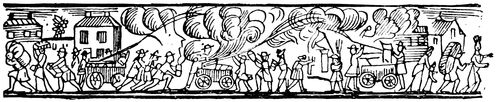
A FIRE.
All these employed several men in liveries, and with badges on their arms, to extinguish fire. The accompanying contemporary illustration is very rude, but it gives a vivid representation of a fire at that time.
Gay gives the following graphic description of a fire, so that we may almost fancy we see the firemen at work.
But hark! Distress with Screaming Voice draws nigh'r, And wakes the slumb'ring Street with Cries of Fire. At first a glowing Red enwraps the Skies, And borne by Winds the scatt'ring Sparks arise; From Beam to Beam, the fierce Contagion spreads; The Spiry Flames now lift aloft their Heads, Through the burst Sash a blazing Deluge pours, And splitting Tiles descend in rattling Show'rs. Now with thick Crouds th' enlighten'd Pavement swarms, The Fire-man sweats beneath his crooked Arms, A leathern Casque his vent'rous Head defends, Boldly he climbs where thickest Smoak ascends; Mov'd by the Mother's streaming Eyes and Pray'rs, The helpless Infant through the Flame he bears; With no less Virtue, than through hostile Fire, The Dardan Hero bore his aged Sire. See forceful Engines spout their levell'd Streams, To quench the Blaze that runs along the Beams; The grappling Hook plucks Rafters from the Walls, And Heaps on Heaps the smoaky Ruine falls. Blown by strong Winds the fiery Tempest roars, Bears down new Walls, and pours along the Floors: The Heav'ns are all a blaze, the Face of Night Is cover'd with a sanguine dreadful Light. ........ Hark! the Drum thunders! far, ye Crouds retire; Behold the ready Match is tipt with Fire, The Nitrous Store is laid, the smutty Train With running Blaze awakes the barrell'd Grain; Flames sudden wrap the Walls; with sullen Sound, The shatter'd Pile sinks on the smoaky Ground.
The sanitary arrangements of these houses were very defective, and the streets at night time must have been anything but pleasant walks.
The water supply, too, was not good. Old-fashioned wells and pumps, sunk in a crowded city full of cesspools and graveyards, could not have furnished a healthy supply. Of course there was the water brought by the city from Highgate and Hampstead, and there was the New River, but it evidently was not sufficient for the use of the inhabitants, or it would not have been hawked about.
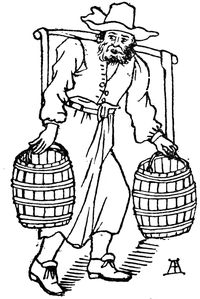
'NEW RIVER WATER!'
More was furnished by the Thames Water Works by means of a huge water-wheel, which worked many force-pumps, and which was erected by a Dutchman named Peter Morrice, in 1582. This occupied a position on the old bridge, similar to its being placed close to the stairs by Fishmongers' Hall at the present time. Although the river was infinitely purer than at present, yet, being tidal, and the supply being taken from in shore, it could not have been good for drinking purposes. There was a new company formed to work this machine, and in the London Gazette, Oct. 28/ Nov. 1, 1703, is an advertisement: 'This is to give Notice to such Persons as have subscribed for Shares in the Thames Water, That the Transfers of the said Shares will be ready to be made to the respective Subscribers to-morrow the 2nd Instant, being the last day limited in the Contract, at Mr. Nicholas Opie's in Bartholomew Lane, where the said Contract or Subscription Roll now lies.'
Hatton says in his 'New View of London' that 'besides the old work erected by Mr. Morris, the New placed in the 4th Arch of the Bridge consists of 2 Wheels with 7 Engines set up about the Year 1702, so there are in all 13 Engines.
'They are the contrivance of that great English Engineer Mr. Sorocold, whereby the Thames Water is raised from the N. end of the Bridge to a very great altitude, by which means many parts of the City &c. are served with the Thames Water. The Flux and Reflux of the Water worketh the Engine. Here are several Proprietors who serve Houses for the most part at 20s. per Ann. paid quarterly, and they have proportionately more from Brewhouses, &c., according to what they Consume. To this Company also belongs the Works at Broken Wharf and the City Conduit Water.
'The Old Stock was 500 Shares, and valued at 500l. a Share, since which those Shares were divided into 1,500 Shares, each valued at about 100l. per Share. They pay the City 700l. per Ann. for the Conduit Water, and about 10l. per Ann. for the Bridge; Also 300l. to Sir Benj. Ayloff or his Assignees for the Broken Wharf, to which place 2 of the Engines at the Bridge do Work, and there are also at that Wharf 2 Horse Works.
'They chiefly serve Goodman's Fields, Minories, Houndsditch, White Chapel, and Birchin Lane.
'Mill Bank Water is raised and laid into Houses in the Parish of St. Margaret's, Westminster, from the Thames. The Water House is situate on the E. side of Mill Bank, for which the Proprietors, who are in Number 5, had a Patent granted them by K. Charles 2 about the Year 1673. Their Stock and Income is divided into 8 Shares. Rates are at least 10s. per Ann., but commonly 20s., and for Brewers and extraordinary Occasions more than so many Pounds.'
An adventurer's share in the New River Water Company was then worth 4,500 guineas; and Hatton, in his 'New View of London,' says: 'They now Let the Water to most Houses without Fine or Lease, according as they Consume Water, to none less than 22s. 8d. per Ann., but to some Brewers, &c., for 40l. per Ann., which, and all common Cocks, they Let by Lease and Fine.'
The river was scoured out twice a year, and a staff was kept of '12 Walkers between Ware and London (who daily take care that no Infectious or other thing be thrown into the River that might in any way prejudice it, whereby it is kept Sweet and Wholesome).'
The following advertisement appears in the London Gazette, April 20/May 3, 1703: 'The Governor and Company of the New River brought from Chadwell and Amwell to London, having from time to time made several Orders and Regulations for the Ease and Benefit of those who make use of their Water; but being informed, that several Misrepresentations are Industriously spread abroad to their Prejudice, they have thought fit to publish the following Orders, which have been made from time to time since at several Courts. Viz:
'Ordered. That no Private Family that is served with the Water of the New River, shall be required to take a Lease of the said Water; but that what Rent shall be agreed on with the Collectors to be paid, shall be received by them without the Charge of a Lease.
'Whereas Strict Charge hath been given to the Collectors, and all other Officers of the said New River, That they behave themselves Civilly and Respectfully to such as use the said Water: If any do otherwise
'Ordered. That upon any Complaints to the Meetings of the Company every Thursday at Three in the Afternoon, at their Office at Puddle Dock, Reparation shall forthwith be made to the Party grieved.
'Ordered. That any Tenant may employ their own Plummer to do their Work in mending, or laying any Branch, such Plummer first acquainting the Collector, and making use of the Company's Paviour of that Walk to dig the same.'
The leaden cisterns for holding the family supply were often very artistically and elaborately ornamented, either with flowers or classical subjects, and are nearly all dated. The few now spared in London are of course extremely curious, as being exemplars of the art manufactures of the time.
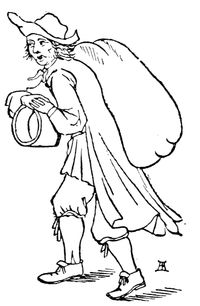
'SMALL COALE!'
But if they were this high price, ex ship, and wholesale, those who bought in small quantities had to pay very heavily. Swift in his letters to Stella is always grumbling at the expense of his modicum of coals, and would stop longer in, and go earlier to, bed, in order to save. Then was it that the cry of 'Small coale!' was heard in the streets—a cry that will always be associated with the memory of Thomas Britton, the 'musical small coal man,' who died Sept. 14, 1714.
The stoves used to burn coal were small and portable, taking the place of the old andirons, and standing unfixed in the somewhat wide chimney-pieces. It is needless to say that the modern 'Queen Anne' stoves bear very little likeness to the genuine article. The back plates were frequently very ornamental, sometimes having the arms of the owner of the house upon them. The accompanying illustration, being taken from an ironmonger's handbill, is probably copied from one he had in stock—if not, it most certainly represented those in use.
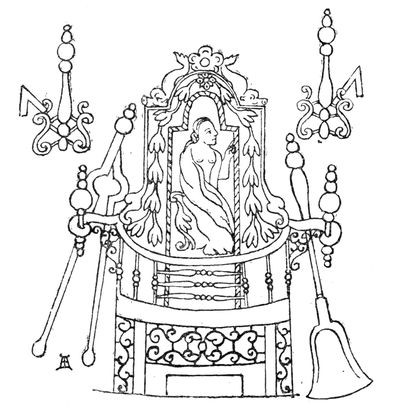
FIREPLACE AND UTENSILS.
'The Thieves observe those Houses whose Window-shutters, either outward or inward, reach not up to the top of the Windows; and taking out some Quaries of the Glass, put their Hands in and rob the Houses of their Window Curtains.'
Without doubt, the houses of the wealthy were better furnished, and more artistically. The virtuoso would bring with him on his return from his 'grand tour' some specimens, both of pictures and furniture, of the lands he visited. Of the former, they were invariably originals or copies of the Caracci, Titian, Palma, Van Dyck, etc., and they were always being imported or changing hands; but of good furniture we seldom find any to be sold, such as, for instance, 'Two Cabinets, the one of 48 drawers, containing great variety of curious Shells, Agates, Corals, Mocus's' (the Mocha or Moco Stone), 'Medals, Minerals, and other Rarities. The other finely inlaid with Flowers and Birds of Stone by Baptist.'
None of these wares were remarkable at that time for their beauty, and so the oriental porcelain was naturally the most admired, and consequently bore away the palm, both for beauty of form and design. The use of tea, too, largely helped the consumption of oriental China. The cups and teapots were home articles for the Chinese to make, and it was very many years before we, in England, were even nearly rivalling them.
Tea necessitated a smaller and more elegant table, so we find the want supplied by tea and Dutch tables. Lacquer ware was also in much request, as well for 'Tea Tables, Bowls, Dressing Suites, Cabinets, and Bellows Boards,' as for screens to keep off draughts.
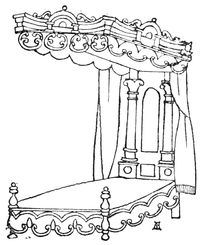
A BED.