Chapter I · CHILDHOOD AND EDUCATION. (Boys.)
Reading edition
The Duke of Gloucester — The Queen's refusal to marry again — Treatment of children after birth — Baptismal feasts — A christening — 'Daffy's Elixir' — Treatment of infantile diseases — The nursery — Toys — Children's books — Horn books — Private tuition — Boarding and day schools — Free schools — Classical education — School books — Penmanship — Runaway boys — College education — Charity schools.
In all climes, and in all ages, since Man's creation, he has been subject to the same conditions, modified only by circumstances. He has been born—has had to receive some education (if only taught to fish and hunt for his subsistence), which was to fit him for the position he was to occupy in this life. This was absolutely necessary, for it is scarcely possible to imagine a more helpless being than an infant. In most cases he married, and so helped to preserve his species, and most certainly he died.
'I lay very quiet, but the witch, for no manner of reason or provocation in the world, takes me, and binds my head as hard as possibly she could; then ties up both my legs, and makes me swallow down an horrid mixture. I thought it an harsh entrance into life, to begin with taking physic; but I was forced to it, or else must have taken down a great instrument in which she gave it to me. When I was thus dressed, I was carried to a bedside, where a fine young lady (my mother, I wot) had liked to have hugged me to death. From her they faced me about, and there was a thing with quite another look from the rest of the company, to whom they talked about my nose. He seemed wonderfully pleased to see me; but I know since, my nose belonged to another family.
'That into which I was born is one of the most numerous among you; therefore crowds of relations came every day to congratulate my arrival; amongst others, my cousin Betty, the greatest romp in nature; she whisks me such a height over her head, that I cried out for fear of falling. She pinched me and called me squealing chit, and threw me into a girl's arms that was taken in to tend me. The girl was very proud of the womanly employment of a nurse, and took upon her to strip and dress me anew, because I made a noise, to see what ailed me; she did so, and stuck a pin in every joint about me. I still cried; upon which she lays me on my face in her lap; and to quiet me, fell to a-nailing in all the pins, by clapping me on the back, and screaming a lullaby. But my pain made me exalt my voice above hers, which brought up the nurse, the witch I first saw, and my grandmother. The girl is turned downstairs, and I stripped again, as well to find what ailed me as to satisfy my granam's farther curiosity. This good woman's visit was the cause of all my troubles. You are to understand that I was hitherto bred by hand, and anybody that stood next me gave me pap if I did but open my lips; insomuch, that I was grown so cunning as to pretend myself asleep when I was not, to prevent my being crammed.
'At last the Babe was put into my hands to deliver, tho' not as my Act and Deed, to the Parson, who having consecrated some New River water for his purpose, wash'd away Original Sin from my new Nephew, and brought him amongst us Christians into a state of Salvation. But when my froward Godson felt the Cold Water in his face, he threaten'd the Priest with such a parcel of Angry Looks, that if he had been strong enough I dare swear he would have serv'd him the same Sauce, and under the same Ignorance would have return'd him but little thanks for his Labour. After we had joined together in a Petition for the good of the infant Christian, the Religious part was concluded.... As soon as the Parson had refreshed his Spirits with a bumper of Canary, dedicated to the Mother; and the Clerk had said Amen to his Master's good Wishes, after the like manner, each of 'em accepted of a Paper of Sweetmeats for his Wife or his Children, and away they went, leaving the Company behind.' They then seem to have drunk a full quantity of wine, and the women having eaten, drank, and gossiped sufficiently, were each presented with 'a Service of Sweetmeats, which every Gossip carried away in her Handkerchief.... Having now struggled through every difficult part of these Accustomary Formalities, I had nothing to do but to Thank them for our Liberal Entertainment, Wish the Women well again, and both much Happiness in their Male Offspring, and so take my Leave, which I did accordingly; and was as greatly overjoyed when I got out of the House as ever Convict was that had broke Gaol or Detected Pick Pocket that had Escaped a Horse Pond.'
Having launched our baby thus far in life, we will see how he was treated when suffering from any of the numerous ailments which infancy is subject to. The marvel is that so many grew up. It was eminently 'the survival of the fittest.' Sanitary arrangements were extremely rudimentary; little care being taken either as to the purity of the water supply, or the efficiency of drainage. Fever was always in their midst, and, neither inoculation nor vaccination being known, or practised, smallpox was rampant, and spared no class, from the Queen (Mary) to the beggar. Was the child fretful, there was that cordial dear to old nurses of the Gamp school—Daffy's Elixir. This remedy, which has survived as a popular nostrum to our own time, was not new in Queen Anne's reign. It must even then have been a profitable property, for rivals could afford to quarrel over it, as the following advertisements show:—
The Finest now expos'd to Sale, prepar'd from the best Druggs, according to Art, and the Original Receipt, which my Father Mr. Thomas Daffy, late Rector of Redmile, in the Valley of Belvoir, having experienc'd the Virtue of it, imparted to his Kinsman Mr. Anthony Daffy, who publish'd the same to the Benefit of the Community, and his own great Advantage. This Very Original Receipt is now in my possession, left to me by my Father aforesaid, under his own Hand. My own Brother Mr. Daniel Daffy, formerly Apothecary in Nottingham, made this ELIXIR from the same Receipt, and Sold it there during his Life. Those who know me will believe what I Declare; and those who do not may be convinc'd that I am no counterfeit, by the Colour, Tast, Smell, and just Operation of my ELIXIR. To be had at the Hand and Pen in Maiden Lane, Covent Garden, London; and many other Places in Town and Country.'
'Advertisement.
'Forasmuch as Mrs. Elizabeth Daffy has lately Published an Advertisement containing Invidious Reflections upon me, in relation to my Elixir Salutis, I should be wanting to my Self if I should not obviate them in the like public manner, to let the World see they are Malicious, unreasonable, and false.
'In the first place she charges me with Clandestinely taking the House in Prugeon's Court; which, by her leave, is equally absurd and unjust; for the House was to be Lett a long time before I took it (nor had she any lease of the House, or any Power to Lett it), so consequently any one else might have taken the same. As for my pretending to have been her Husband's Assistant in preparing the Elixir, I will only say this is just as true as the former Story; and I challenge her to produce one single Evidence of Refutation to prove her Assertion: nor had I need of any such trifling pretence, having known the Secret some time before the Death of his Father Dr. Anthony Daffy; which I presume was before the said Elias Daffy was privy to the preparing of the said Elixir (he being then a Cambridge scholar), and the same was communicated to me in the year 1684, at the time I was going to travel beyond Sea, where, in divers Countries, considerable Quantities of my Elixir has been taken by Persons of the greatest Rank, Quality, and Note, to their great Satisfaction.
'And whereas the said Mrs. Daffy is pleased to call my Elixir Spurious, and Insinuates as if it were hazardous to the Lives of Men; the numerous Instances of Good it has done, both here and abroad, do manifestly evince the Contrary. And I appeal to all who have taken it in this City, or elsewhere, whether they have not found at least as much Benefit from This as from any Thing of the like Nature they have ever taken; insomuch that I am well assured that those who have tried mine will apply themselves to nobody else for Elixir Salutis.
'John Harrison.
'From my House in Prujean's Court in the Great Old Baly (The Original and famous Elixir Salutis) being wrote in Golden Characters over the Door fronting the Court Gate. March the 31st, 1709.'
Horehound, ℥ix; Liquorice, Maidenhair, Hyssop, Wild Thyme, Coltsfoot, Penny royal, ana ℥iij. Aniseeds and Fennel seeds ana ℥iss. Raisins of the Sun ℥vj. Figs, Jujubes ana ℥iv. Elecampane ℥ij, boil all in lb. vj. of water to 1/2. Strain, and add Honey, Sugar, ana lb. j. Boil to a Syrup; and when almost cold add Orrice, Woodlice, both in fine powder, ana ℥j.'
This mixture might not have been bad, but why add powdered woodlice?
There was also advertised 'A necklace that cures all sorts of Fits in children occasioned by Teeth or any other Cause; as also all fits in Men and Women. To be had at Mr. Larance's in Somerset Court, near Northumberland House in the Strand; price 10s. for 8 days, though the cure will be performed immediately;' and there was a palatable medium for the little ones in 'the so-much approved Purging Sugar Plumbs.'
Of the Nursery we know very little; indeed children are very seldom mentioned. It is most likely that, in well-to-do families, they were relegated to the nursery, and the care of their mothers, until they were of fit age to go to school. The accompanying illustration, taken from 'The Ladies' Library,' ed. 1714, by Steele, gives us an excellent view of the nursery.
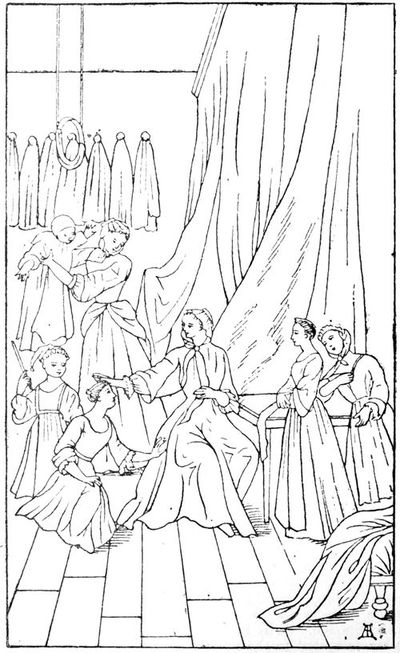
THE NURSERY.
The very babies were amused much as now—for Addison, Spectator, No. 1, speaking of his natural gravity, says, 'I threw away my rattle before I was two Months old, and would not make use of my Coral till they had taken away all the Bells from it.' Some of these corals were very beautiful and costly, even being made of gold.
We know how, from the earliest ages, a doll has been the favourite toy with girls, and the reign of 'Good Queen Anne' was no exception to the general rule—but they were not then called Dolls, but 'Babies'; so, indeed, were Powel's Marionettes—as also the milliner's models. 'On Saturday last, being the 12th instant, there arrived at my House in King Street, Covent Garden, a French Baby for the year 1712' &c. Some were made of wax, but these were, of course, of the expensive sort, as must also have been those in Widow Smith's raffle—'large joynted dressed Babies.' Probably, dolls were the girls' only playthings. As to the boys, history records very little of their amusements. Give a boy in the nursery a whip, or a stick, to beat somebody, or something, he generally is content. How superlatively happy, however, must he have been in the possession of one of these wonderful horses?—warranted chargers—troop horses, every one! They also had card-board windmills on the end of sticks. We hear nothing of marbles, tops, or any other toys; but, doubtless, children's ingenuity supplied any defects that way, then as now, and made shift to play, and amuse themselves, until the time of enfranchisement came, and the boy could wander in the streets and see the marvels of the raree show, and buy 'hot baked wardens—hot,' or some of old 'Colly Molly Puffe's' pastry—or, should his tastes be simpler, there were 'Ripe Strawberryes,' or 'Sixpence a pound fair Cherryes.'
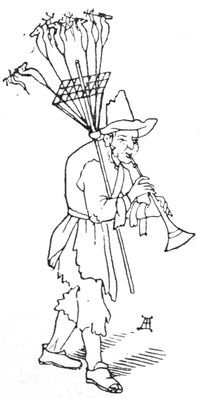
'TROOPE, EVERY ONE.'
These little folk, however, had their special literature. For there was compiled and printed 'A Play book for Children, to allure them to read as soon as they can speak plain; composed of small Pages so as not to tire children; printed with a fair and pleasing Letter, the Matter and Method plainer and easier than any yet extant.' The price of this was fourpence, and it must have been a favourite, for it is advertised as being in its second edition in 1703. Certainly, the little ones then lacked many advantages in this way that ours possess—but, on the other hand, so much was not required of them. There was no dreaded 'Exam.' to prepare for—no doing lessons all day long, and then working hard at night to get ready for the next day's toil. They were not taught half a dozen languages, and all the ologies, whilst still in the nursery; but, were the suggestions and advice given to 'the Mother' in Steele's 'Lady's Library' thoroughly carried out, they would grow up good men and women.
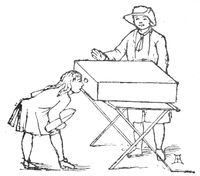
A RAREE SHOW.
The boys, however, had strong meat provided for them in such tales as 'Jack and the Giants,' &c. Steele, in Tatler 95, says, speaking of a little boy of eight years old, 'I perceived him a very great historian in "Æsop's Fables," but he frankly declared to me his mind "that he did not delight in that learning, because he did not believe they were true," for which reason I found he had very much turned his studies for about a twelvemonth past unto the lives and adventures of Don Bellianis of Greece, Guy of Warwick, the Seven Champions, and other historians of that age.... He would tell you the mismanagements of John Hickerthrift, find fault with the passionate temper in Bevis of Southampton, and loved Saint George for being the champion of England.... I was extolling his accomplishments, when his mother told me that the little girl who led me in this morning was in her way a better scholar than he. "Betty," says she, "deals chiefly in Fairies and Sprights; and sometimes in a winter night will terrify the maids with her accounts, until they are afraid to go up to bed."'
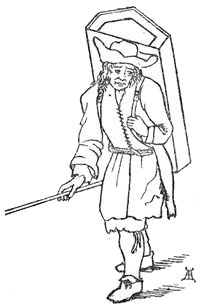
'OH, RAREE SHOW.'
In all probability the child learned his letters in the first instance from a 'Hornbook,' such as were then commonly used and sold—as the following excerpt from an advertisement shows: 'Joseph Hazard at the Bible, in Stationers Court, near Ludgate, sells ... Spelling books, Primers, Hornbooks, &c.' Hornbooks are now very scarce indeed, and the man lucky enough to possess a genuine one must feel proud of his rarity. It consisted of a small sheet of paper, generally about 4 in. × 3 in. or so—sometimes smaller—on which was printed the alphabet, both in capitals and small text, the vowels, and a few simple combinations, such as ab, eb, ib, ob, ub,—ba, be, bi, bo, bu, &c., and the Lord's Prayer. This was laid on a flat piece of board with a roughly shaped handle, and covered with a thin plate of horn, fastened to the board by copper tacks driven through an edging of thin copper. It therefore would stand a vast amount of rough usage before it would be destroyed—a fact of great importance in elementary education.
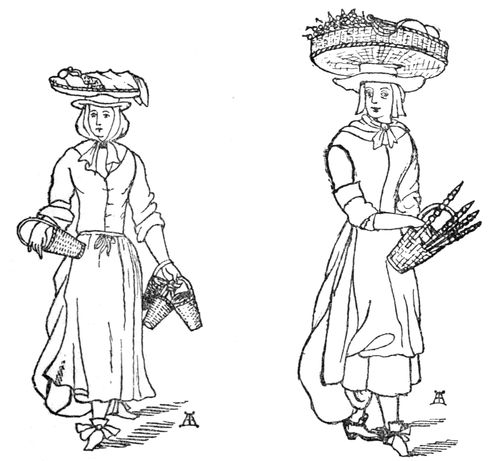
'RIPE STRAWBERRYES!' 'SIX PENCE A POUND FAIR CHERRYES!'
Private tuition existed then as now. 'A Grave Gentlewoman of about 50 years of age desires to be Governess to any Gentleman's Children; she can give a very good account of herself,' and 'Whereas in this degenerate Age Youth are kept for so many Years in following the Latin Tongue, and many of them are quite discourag'd, Mr. Switterda (who was formerly recommended to the late King William, and well known by their Excellences my Lord Sparkein and my Lord Methuen) offers a very easy and delightful Method, by which any Person of tolerable Capacity, who can but spare time to be twice a Week with him, and an Hour at a Time, nay, Children of ten Years of Age, may in one Year learn to speak Latin and French fluently, according to the Grammar rules, and to understand a Classical Author; and if they are not compleat in that time, he will teach them without any farther Charge, provided they will be manag'd.' Another gentleman, living in Abchurch Lane, offered to do the same, and, moreover, 'he offereth to be bound to every one for the performance thereof, and to give a Month's trial.'
But a Day School was the normal institution for a boy, although there were Boarding Schools. Judging by the advertisements, these must have been but few in the beginning of the reign, as they gradually become more numerous towards its close. A record of one or two will suffice to show what kind of education they gave. 'At the upper end of Knights Bridge, near the Salutation, there is a Boarding School for young Gentlemen, where, besides French, are carefully taught, after the best English method, Latin, Greek, Writing, Arithmetic, Geography, &c.' And again, 'At Lady Day next will be open'd a Boarding School for young Gentlemen at Kensington Gravel Pits, by Richard Johnson, A.M., author of the Grammatical Commentaries.... There will be taught also French, Writing, Arithmetick, and Mathematicks;' whilst another takes a wider range: 'A boarding School will be open'd after Easter, at Chertsey ... for the Instruction of Youth in the English, French, Latin, Greek, and Hebrew Tongues, besides Geography, History, Mathematicks, Writing, and Accompts; to fit 'em either for the University, Study of the Law, or other Business.'
In London, too, were many free schools. There were Westminster, Merchant Taylors', Paul's, Greyfriars, Christ's Hospital, and St. Olave's, Southwark. There were three free schools in Westminster besides the Queen's School; these were, Palmer's in Tuttlefields, Almery School, and Hill's School. Besides which were Lady Owen's School, Islington, and Bunhill School—and there were free schools in Cherrytree Alley, Castle Street (Tennyson's), Great Queen Street, Parker's Lane, Church Entry, Old Jewry, Whitechapel, Ratcliffe, Foster Lane, Hoxton, St. Saviour's, Southwark, Plough Yard, Rotherhithe, and East Smithfield—and this probably is not an exhaustive list.
As may be supposed, when so much pains was taken in writing, there were many curiosities of caligraphic art. Here is one: 'A piece of close Knotting, viz. 2 Boys holding Circles in their Hands, either being less than a Silver Penny, in which are perspicuously wrote the Lords Prayer in Latin and English. Invented and perform'd by John Dundas (who will shortly publish a Copy book with about 50 new Fancies).... N.B. Any Gentleman or Lady that desires small Writing for a Ring, Locket, or other Curiosity, may be furnished by the Author.'
That pens other than quill were in use is evidenced by an advertisement re a lost pocket-book, which contained 'a Brass Pen.'
Stenography was practised somewhat extensively, to judge by the numerous advertisements; but William Mason, living at the Hand and Pen, in the Poultry, claimed to be 'the Author and Teacher of the shortest Shorthand extant.'
And yet, with all these scholastic advantages, some boys would not be happy; but, as boys have done ever since boarding schools have been invented, they sometimes ran away. Vide the following advertisements: 'A Gentleman's only Child is run from School; he is about 12 years of Age, with light Cloaths lin'd with red, a well favour'd brisk Boy, with a fair old Wig: speaks a little thro' the Scots, his Name Alex Mackdonald: he has been in Spain and Portugal, which makes his Parents fear that some Ship may entertain him.' Whoever captured this lad was to be 'sufficiently rewarded,' whilst the next runaway was only valued at 'half a guinea and charges,' although he was dressed so smartly: 'A little slim, fair hair'd handsome English Boy, who speaks French very well, between 11 and 12 Years of Age, with a sad colour, coarse Kersay Coat trim'd with flat new Gilded Brass Buttons, with a whitish Calla-manca Waistcoat with round Plate Silver Buttons, and a little Silver Edging to his Hat, with fine white Worsted rowl'd Stockings, and with Silver Plate Buttons to his sad colour Sagathy Stuff Britches: went away from School on Thursday, the 6th Inst. Supposed to be gone towards Wapping, Rotherif, Greenwich, or Gravesend, he having been seen near the Thames Side asking for a Master to go to sea.' Curious how, in every century since Elizabeth's time, the runaway English boy naturally flies to the water. Always the same tale: ran away and went to sea. Here were two well-nurtured lads, more than ordinarily accomplished, yet they were bitten by this same tarantula.
Let the Spectator describe the rising generation of that time after they had finished their academic career and had gone to the university. In No. 54, attributed to Steele, speaking of Cambridge, he says, 'Now for their manner of living: and here I shall have a large field to expatiate in; but I shall reserve particulars for my intended discourse, and now only mention one or two of their principal exercises. The elder proficients employ themselves in inspecting mores hominum multorum, in getting acquainted with all the signs and windows in the town. Some have arrived to so great knowledge, that they can tell every time a butcher kills a calf, every time any old woman's cat is in the straw; and a thousand matters as important. One ancient philosopher contemplates two or three hours every day over a sun-dial; and is true to the dial.
As the dial to the sun, Although it be not shone upon.
Our younger students are content to carry their speculation as yet no further than bowling greens, billiard tables, and such like places.'
Of the reading men, he says, 'They were ever looked upon as a people that impaired themselves more by their strict application to the rules of their order than any other students whatever. Others seldom hurt themselves any further than to gain weak eyes, and sometimes headaches; but these philosophers are seized all over with a general inability, indolence, and weariness, and a certain impatience of the place they are in, with an heaviness in removing to another.
'The loungers are satisfied with being merely part of the number of mankind, without distinguishing themselves from amongst them. They may be said rather to suffer their time to pass than to spend it, without regard to the past or prospect of the future. All they know of life is only in the present instant, and do not taste even that. When one of this order happens to be a man of fortune, the expense of his time is transferred to his coach and horses, and his life is to be measured by their motion, not his own enjoyments or sufferings. The chief entertainment one of these philosophers can possibly propose to himself is to get a relish of dress. This, methinks, might diversify the person he is weary of, his own dear self, to himself. I have known these two amusements make one of these philosophers make a tolerable figure in the world; with variety of dresses in public assemblies in town, and quick motion of his horses out of it, now to Bath, now to Tunbridge, then to Newmarket, and then to London, he has, in process of time, brought it to pass, that his coach and his horses have been mentioned in all these places.' And this description, with a little alteration, would pass as a fair reflex of modern undergraduate existence at either Oxford or Cambridge.
Before closing the question of male education, we must not forget that in Queen Anne's time was inaugurated that system of charity schools which has played so prominent a part in our national system of education, and which has not yet been superseded by our Board Schools. Steele (Spectator, 380) notices this movement—
'St. Bride's, May 15, 1712.
'Sir,—'Tis a great deal of Pleasure to me, and I dare say will be no less Satisfaction to you, that I have an Opportunity of informing you that the Gentlemen and others of the Parish of St. Brides have raised a Charity School of fifty Girls as before of fifty Boys. You were so kind to recommend the Boys to the Charitable World, and the other Sex hope you will do them the same Favour in Fridays Spectator for Sunday next, when they are to appear with their humble Airs at the Parish Church of St. Brides. Sir, the Mention of this may possibly be serviceable to the Children: and sure no one will omit a good Action attended with no expence.
'I am, Sir, 'Your very humble Servant,
'The Sexton.'
'Hymns to be sung by the Charity Children upon the 7th of July, 1713, being the Thanksgiving Day for the PEACE.
'As Her MAJESTY goes to St. Paul's—
Lord give the QUEEN Thy saving Health, Whose Hope on Thee depends: Grant Her Increase of Fame and Wealth, With Bliss that never ends! Allelujah, Allelujah, Allelujah, Allelujah! Allelujah, Allelujah, Allelujah, Allelujah, Allelujah! For Her our fervent Vows aspire, Our Praises are Address'd; Thou hast fulfill'd Her Heart's Desire And granted Her Request. Allelujah, &c. A Nursing Mother to Thy Fold, Long, long may She remain, And then with Joy Thy Face behold, And with Thee ever Reign. Allelujah, &c.
As Her MAJESTY returns from St. Paul's—
Glory to GOD who Reigns on High, Whom Saints and Angels praise; Who from His Throne above the Sky, The Sons of Men surveys. Allelujah, &c. PEACE, His best Gift, to Earth's return'd, Long may it here remain; As we too long its Absence mourn'd, Nor sigh'd to Heav'n in vain. Allelujah, &c. Good Will, Fair Friendship (Heavenly Guest!) And Joy and Holy Love, Make all Mankind completely bless'd, Resembling Those above. Allelujah, &c.