Chapter XXIX · LITERATURE, THE PRESS, ETC.
Reading edition
Authors — Public libraries — Their condition — George Psalmanazar — Hack writers — Poverty of authors — Their punishment — The press — Daily Courant — List of newspapers — London Gazette — Postboy — Postman — Dawk's News Letter — Dyer's — Evening papers — Dearth of domestic news — Amenities of the press — Roper and Redpath — Tutchin — His trial — Press remuneration — Mrs. Manley — The Essay papers — The halfpenny stamp — Its effect — Advertising — Almanacs — List of them — Moore's — The Ladies' Diary — Poor Robin's Almanack — Merlinus Liberatus — The Essayists and Partridge — His false death — His elegy and epitaph — An amateur magazine.
Well might the time of Anne be called the Augustan age of literature. The writers of that day have lived till ours, and will live and be quoted as models of purity of style, as long as, and wherever, the English language is spoken. In what other age can such a wealth of literary names be found as Addison, Steele, Swift, Pope, Warburton, Gay, Prior, Parnell, Defoe, Vanbrugh, Congreve, Rowe! It was the grand awakening of letters; and, having good food provided for them, the people appreciated it, and it undoubtedly laid the foundation of the present reading age. Before this time there had been no books, i.e. adapted to the general public, to read. Truly, there were scholars here and there, and the Universities were ever fountains of learning; but literature had not entered into every-day life, and we have to thank Steele and Addison, who charmed the public taste by their social and moral essays, into becoming first a reading, and then a thinking people.
We learn from Misson the state of our public libraries. He says: 'At present I know but three publick ones in this City; those of the Chapter at Westminster, and Sion College (which are very much neglected, and in a sorry Condition in all Respects) and that which Dr. Tenison, Archbishop of Canterbury, has lately founded. The two former are going to Decay, and the latter is not yet quite form'd. Neither the one nor the other are much frequented. The King's Library at St. James's is also in a miserable state; I am told that Dr. Bentley, who has the keeping of it, in the room of Mr. Instel, does all he can to restore it; but his Endeavours will be to no purpose, unless the Master of it has Leisure and Will to have an Eye to it himself. There have been Books in Pawn in the Hands of the Binders, I know not how many Years. King Charles II. did but laugh at it. It is, nevertheless, a Pity that so many good Books, and so well bound, should be given up to the Mould and Moisture of the Air, to Moths and to Dust. The Library of Sir Robert Cotton is particularly famous for Manuscripts. The Royal Society have begun to Collect a pretty good one: the late Duke of Norfolk, who was of it, left them his. There are a great many Noble men in England that love Books, and have good Collections of them.'
A literary curiosity of this reign deserves to be, and must be, noticed. It is George Psalmanazar, the impostor who, for a while, deceived the majority of the English literati. He seems to have been born in France in 1679, and to have received a good education. He wandered about as a pilgrim, and that either not paying, or else being dissatisfied with the life, he hit upon the extraordinary idea of passing himself off as a Formosan, and to do this he actually had to invent a new language and grammar. Accompanied by a clergyman named Innes, he came over to England, where he translated the Church Catechism into pretended Formosan, and he published a History of Formosa, and of his own adventures; but the suspicions of the learned were aroused, and he was unmasked. He tried to fight against it for some time, and issued advertisements in the papers, that he could be seen, spoken with, and catechised, but to no purpose. He afterwards lived by doing hack work for the booksellers, and at his death he thoroughly confessed his imposture.
The hack writers of the time are thus humorously described in the Guardian (No. 58): 'According as my necessities suggest it to me, I hereby provide for my being. The last summer I paid a large debt for brandy and tobacco, by a wonderful description of a fiery dragon, and lived for ten days together upon a whale and a mermaid. When winter draws near, I generally conjure up my spirits, and have my apparition ready against long dark evenings. From November last to January I lived solely upon murders; and have since that time, had a comfortable subsistence from a plague and a famine. I made the Pope pay for my Beef and Mutton last Lent, out of pure spite to the Romish Religion; and at present my good friend the King of Sweden finds me in clean linen, and the Mufti gets me credit at the Tavern.'
Literary men had their money troubles then as now—probably not more so—as many a melancholy tale of modern Grub Street could tell. Swift's society did some good. Take his Journal to Stella, Feb. 12 and 13, 1713, as an example: 'I gave an account of Sixty guineas I had collected, and am to give them away to two Authors to-morrow, and lord Treasurer has promised me a hundred pounds to reward some others.... I found a letter on my table last night to tell me that poor little Harrison ... was ill, and desired to see me at night.... I went in the morning, and found him mighty ill, and got thirty guineas for him from Lord Bolinbroke, and an order for a hundred pounds from the treasury to be paid him to-morrow.... I was to see a poor poet, one Mr. Diaper, in a nasty garret, very sick. I gave him twenty guineas from Lord Bolinbroke, and disposed the other sixty to two other authors.' This was practical benevolence, but its record only shows the sad necessity there was for its exercise.
In what condition was the press of that day? Let Pope's bitter pen answer—
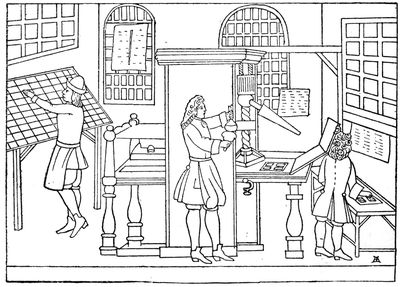
A PRINTING PRESS.
When Anne succeeded to the throne on March 8, 1702, the following newspapers were in existence: The London Post, English Post, Postman, Postboy, Flying Post, London Gazette, Post Angel, New State of Europe, and Dawks's and Dyer's News Letter (the former of which was printed in script letters, to look as much as possible like writing). The whole of these were issued three times a week; but three days after Anne's accession came out the first daily paper in England. The Daily Courant was born March 11, 1702, and this little fledgling, the precursor of the mighty daily press, measures but 14 in. by 8 in. It is printed only on one side of the sheet: the reason given for which is, to say the least, peculiar, reminding one of the lines:—
My wound is great, because it is so small, Then were it greater, were it none at all.
The other papers born in this reign, including the Satirical and Essay papers, are The Observator, Gazette de Londres, Monthly Register, Letter Writer, Whitehall, Rehearsal, Diverting Post, A Weekly Review of the Affairs of France, by Daniel De Foe, Whipping Post, News Letter, General Remarks on Trade, Mercurius Politicus, St. James's, Kensington, Evening Post, A Review of the State of the British Nation, The Weekly Comedy, Generous Advertiser, Humours of a Coffee House, The British Apollo, Tatler, Athenian News, Examiner, Medley, Moderator, Evening Courant, British Mercury, Protestant Postboy, Hermit, Useful Intelligencer, Night Post, Spectator, Plain Dealer, Guardian, The Reconciler, The Mercator, Englishman, Britain, The Lover, The Patriot, Controller, Weekly Packet, Monitor.
It would be a waste of time to follow the fortunes of all these papers; suffice it to say, that the majority of them had but a brief existence, and let us note only a few of the prominent ones. First of all the London Gazette, of which Misson says 'it is the truest and most Cautious of all the Gazettes that I know. It inserts no news but what is Certain, and often waits for the Confirmation of it, before it publishes it.' It was first published on Feb. 1, 1666, and still continues to this day as the official newspaper. It was first printed by Thomas Newcomb, of the Savoy, then by Edward Jones, who died in 1705. From Feb. 18 of that year to Feb. 26, 1708, it was printed by his widow, M. Jones. At the latter date, it appears as printed by J. Tonson, at Gray's Inn Gate, who, although he moved into the Strand, continued to print it during the remainder of the reign. It was somewhat smaller than the other papers, and its normal price was 1d., but, if of extra size, owing to addresses to the Queen, etc., it was 2d. It was published twice weekly, and was the only one of the newspapers that kept up the old style of reckoning time. It did not begin the new year till after March 25; thus, for the year 1702, all the Gazettes would be 1701 till March 25, after which they would be 1702 till that same date in 1703.
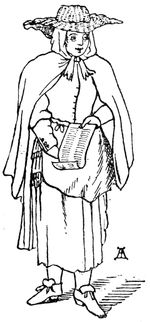
'LONDON GAZETTES HERE!'
Dunton thought the Postboy was the best for English and Spanish news, but the Postman was the best for everything. A French Protestant, named Fonvive, wrote the latter, and in the early part of Anne's reign the Postboy was written by Thomas, afterwards by Boyer, also a foreigner, who had been tutor to the young Duke of Gloucester. Swift writes of him: 'One Boyer, a French dog, has abused me in a pamphlet, and I have got him up in a Messenger's hands. The secretary promised me to swinge him. I must make that rogue an example to others.'
In the early days of the reign both these papers had manuscript postscripts, or supplements, when any fresh news arrived that was not in their last edition, they being published thrice weekly. 'This is to give Notice, that the Post Boy, with a Written Postscript, containing all the Domestick Occurrences, with the Translations of the Foreign News that arrives after the Printing of the said Post Boy, is to be had only of Mr. John Shank, at Nandoe's Coffee house, between the two Temple Gates; and at Mr. Abel Roper's at the Black Boy, over against St. Dunstan's Church in Fleet Street.' 'The Author of this Paper having several times declared in Print that he is no ways directly nor indirectly concerned in the Written Postscripts to the Post Man, nor any other News but what is printed therein; he thinks he has reason to complain of several People, who write to him from the Country about faults and mistakes contained in those Written Postscripts, putting him thereby to unnecessary Charges. He desires those Persons to forbear the same for the future, but if they are not satisfied with their written News (seeing they are not Contented with what is Printed), they may be furnished with written Postscripts at Tom's Coffee House in St. Martin's Lane, by a Person, who the Author hopes, will give them entire satisfaction.'
Later on in the century they printed these postscripts, but they were not safe even then. 'There being a Sham Postscript published last night, with an Advertisement, intending to impose the same upon people as a Postscript to the Postman, We think fit to desire again our readers to buy no Postscripts to the Postman, but from the Hawkers they know, as the only means to stop that Villanous practice; and when there is any material New, we shall take care to publish a Postscript, provided it be a Post Day, and not too Late.' The Post Boy had two rough woodcuts, one on each side of the title: one of a Post boy on horseback, blowing his horn; the other a Fame, blowing a trumpet, on the banner of which is inscribed Viresque acquirit eundo; whilst the Postman has two woodcuts occupying the same position: one of a ship in full sail; the other of a post boy on horseback, blowing his horn. They are the same size as the Daily Courant.
'Dawks's News Letter, For Thirty Shillings a Year, paying a Quarter before Hand to J. Dawks at the West End of Thames Street by Wardrobe Stairs, near Puddle Dock,' was, as before said, printed in imitation of writing. It generally contained a little more domestic news than the other papers, and may be said to be the first evening paper. 'This News Letter continues to be published every Tuesday, Thursday, and Saturday, in the Evening, and contains what is most Remarkable, in any (or all) of the other News Papers; to which is added the Occurrences of the Day, and the Heads of the Foreign Mails, which come in many times after the publication of the Printed Papers; and is so contrived, that a Blank Space is left for any Gentleman, or others, to write their private Business to their Friends in the Country, so that they may have therewith the Chiefest News stirring.' Ichabod Dawks started his News Letter on Aug. 4, 1696. Steele mentions it more than once in the Tatler, notably No. 178, where he says: 'But Mr. Dawkes concluded his paper with a courteous sentence, which was very well taken, and applauded by the whole company. "We wish," says he, "all our Customers a merry Whitsuntide, and many of them." Honest Ichabod is as extraordinary a man as any of our fraternity, and as particular.'
The proprietor of the other news-letter, Dyer, got into trouble more than once. In 1694 he was summoned before the Parliament, and reprimanded by the Speaker 'for his great presumption' in printing the proceedings of the House. And once again, in 1702, he was ordered to attend the House to answer for his presuming to misrepresent the proceedings. He did not attend, and the attorney-general was instructed 'to find out and prosecute him.'
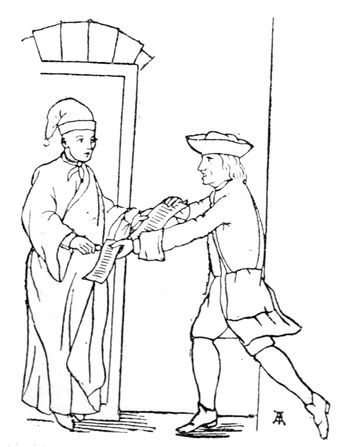
A NEWS MAN.
The Evening Post came out in Aug. 1706, and was 'Published by John Morphew near Stationers' Hall.' It seems to have been then a failure, but it was started again in 1709. The Evening Courant, which started July 1711, seems also to have had a very brief existence, as did also the Night Post, which was born the same year, but this latter seems to have had a longer life than its sister the Courant.
The domestic news in them was nearly nil—principally of the sailing of ships or bringing in of prizes. Foreign news was taken bodily from the foreign papers, as we see in the Daily Courant, in the Appendix; and the home news was left to take care of itself. The Gazette generally had the Queen's Speech to Parliament, and sometimes the other newspapers would also have it, if on very special occasions, say on June 6, 1712, when the Queen communicated to Parliament the terms on which a peace might be made; yet the only reference the Flying Post of June 5/7 has on the subject is, 'Yesterday Her Majesty went to the House of Peers, and made a long speech to both Houses.'
In fact, in all the twelve years of this reign, I only remember meeting with one long account of any piece of home news, and I cannot help thinking that was manufactured, as it is decidedly of the catchpenny and chapbook order. It was 'An Account of the Apprehending and taking of Thomas Wallis, alias Whipping Tom,' a wicked villain who got hold of unprotected females, when crossing the unfrequented fields near Hackney, and administered a fearful thrashing to them, 'with a great Rodd of Birch, that the Blood ran down their tender Bodies in a sad and dreadful manner.' His only excuse was his 'being resolved to be Revenged on all the Women he could come at after that manner, for the sake of one Perjur'd Female, who had been Barbarously False to him.' He 'believed that he had Whip'd from the 10th of October last to the 1st of December, about Three Score and Ten, including Widdows, Wives and Maids, and did intend, if he had not been taken, to have made them up to a Hundred betwixt this and Christmas, at which time he then intended to keep Hollyday till after Twelfday, and then began his Whipping Work.' And once, too, the Postboy (Jan. 27/29, 1713) broke out in a sarcastically humorous vein: 'On Monday last that Facetious and Merry Gentleman in the Pulpit, Mr. Daniel Burgess, departed this Life to the great Mortification of his Female Auditors.'
'Esq: Thomas Burnet (S-n of that vertuous, orthodox, pious, forgiving, impartial, sincere, never wav-ri-g (always standing to his T-x-t) modest, conscientious Di—ne, and by the Gr— of G—d in the fere of the L—d) was on Saturday last taken up, and carried to the Lord Viscount Bolinbroke's Office, for being the Author of that seditious and scandalous Pamphlet, call'd A certain Information of a certain Discourse, &c. (of which Libel Mr. Baker the Publisher lately swore he was the Author) and gave sureties to appear the last Day of this Term; his Bail were Guy Neville and Geo Trenchard Esqs: What's bred in the B-ne will never be out of the Fl-sh.'
Talk about the amenities of the press! Here are one or two samples:—
Titus was a Foul Mouth Slanderer,—so is Abel.
Titus openly traduced the next Heir to this Crown—So has Abel.
Titus deserv'd to be Hang'd—So does Abel.
Titus was low in Stature, but of Outrageous Principles—So is Abel.
Titus was protected in his Impudence—So is Abel.
But the Time's coming to change, Titus was call'd to Account for it—so will Abel.
Titus was flogg'd and Pilloried—So will Abel.
Titus was despised by both Parties—So will Abel.
Titus died unpittied;—So will Abel.
'Lynn Regis in Norfolk, Sept 22.
'Sir,
'Having observ'd the false Account which that Scandalous Wretch Abel Roper gave some time ago in his Post Boy, about the Reception of Mr. Walpole here; This is to inform you 'tis a notorious Lye; for that worthy Gentleman had a very honourable Reception, answerable to the just Esteem which this Corporation has for him.'
Of Tutchin's trial in 1704 we have the following contemporary evidence from Luttrell: '18 May. Mr. Tutchin, author of the Observator, against whom a proclamation was out at the desire of the House of Commons, has given 1000l. bail to answer what shall be objected against him'; and on May 29 he gave fresh bail. His trial began, as we know, on Nov. 4, and he was found guilty, but sentence was deferred. On the 14th we hear 'Yesterday, Mr. Tutchin, found guilty of publishing the Observator, appeared at the Queen's bench Court, when his council inform'd the Court of an error in the information, and the Attorney General desiring time to consider of it, Tutchin is to attend again on Saturday.' The point was the false dating of the writ; and he attended on the 20th and 23rd, when it was argued; and on Nov. 28 judgment was given in Tutchin's favour, 'the Attorney General at liberty to try him again,' which he never did.
This trial is interesting, as it furnishes us with evidence as to the pay of an editor, or rather author (for Tutchin wrote the whole paper), of that time. John How was the proprietor of the paper, which appeared first on April 1, 1702. In his evidence is the following:—
How. About the latter end of March, 1702, I treated with Mr. Tutchin about writing an Observator, to be published weekly: the first of which was published in April 1702. And all that have been printed since, I had from him to this year.
Att. Gen. You looked on these papers here: were those printed by the direction of Mr. Tutchin?
How. To the best of my knowledge, they were. They were always brought from him to me.
Att. Gen. Was there any agreement made between you about the writing of it?
Sir T. Powis. Did you pay him for the Preface?
L. C. Justice. What did you give him for that Preface and Index?
How. I think it was ten shillings.
In 1709 Luttrell tells us: '15 Oct. The Authors of the Review and Female Tatler were presented by the grand jury as scandalous and a publick nuisance, and were ordered to be prosecuted. 1 Nov. This day the printer and publisher of the New Atlantis were examined touching the author Mrs. Manley; they were discharged, but she remains in custody. 5 Nov. One Ball is taken up for writing scandalous papers on persons of quality; but Mrs. Manley, the author of the New Atlantis, is admitted to Bayl.'
Few would be inclined to pity the profligate Mrs. Manley for any punishment she might have received for her scandalous libels in both the Female Tatler and the New Atlantis; but she was not punished. On the contrary, the Ministry gave her employment for her pen.
The Tatler commenced the series of Essay papers. Steele is almost apologetic, in its first number, for having to make any charge. He elaborately calls attention to the expenses incurred in getting up such a paper, and adds 'these considerations will I hope make all persons willing to comply with my humble request (when my gratis stock is exhausted) of a penny a piece.' And an advertisement at the end of No. 4 says, 'Upon the humble petition of Running Stationers &c. this Paper may be had of them, for the future, at the price of one penny.' But there was a more expensive edition, whole-sheet Tatlers, having a double quantity of paper, with one half-sheet blank 'to write business on, and for the convenience of the post,' and they, of course, were more expensive. The Tatler, Spectator, and Guardian were all of Steele's creation; they were born, and died, at his discretion; and the Spectator, at least, was always laid on the Royal breakfast table. Their imitators were numerous, but short-lived; in fact, the imposition of a halfpenny stamp massacred the innocents of the press in a wholesale manner.
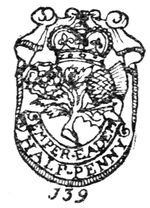
NEWSPAPER STAMP.
All the papers, except the Spectator, rose their price just the value of the stamps; but that 'Society Journal' charged 1d. extra—a fact which caused no little grumbling—and which made Addison put forth all his powers of special pleading to vindicate (see No. 488).
The imposition of 1s. duty on advertisements had no deterrent effect upon them; this 'backbone of the paper' continued as before. There is nothing that I have found to guide us as to the prices of advertisements, except in one case—and I hardly think that can be called a representative one. It is that of a short-lived paper called 'THE GENEROUS ADVERTISER OR Weekly Information of TRADE and BUSINESS. To be published every Tuesday, and Friday, and 4000 of them always carefully Distributed and Given away Gratis each Day, in and about the City's of London and Westminster.' It enjoyed its brief existence in 1707. The terms were not excessive under the circumstances; 'Advertisements ... will be taken by the Men who carry this Paper about; Who will take them in very Carefully and Cheap viz. after the Rate of 3d. for every Fifty letters.'
Advertisements, with the exception of those of quack doctors and their medicines, were very much as now. Booksellers, public amusements, things lost, things for sale, etc., give those old sheets a strange similarity to those we are so familiar with.
Even the poor almanacs were taxed. The Protestant Post Boy, Nov. 15/17, 1711, says, 'Whereas, by an Act made last Sessions of Parliament, a Duty was laid on all Almanacks, and a Penalty of Ten Pounds is for any one that shall Sell any Almanacks without being first Stampt as the Law directs; and whereas the said Tax &c. has made a great Attraction in the Price, this is to give Notice to all Retale Buyers, or others that the Prices are as follows.
'An Almanack Bound in Red Leather, with Paper to Write on of any Sort. Ninepence.
'An Almanack of any Sort Sticht. Six Pence.
'Any Sheet Almanack Four Pence.'
Out of which, that by Francis Moore, physician, the 'Vox Stellarum,' is still published. Doubts have been thrown on the reality of this gentleman, but it is certain that he did live, and Lysons speaks of him as having lived in Calcotts Alley, High Street (then called Back Lane), Lambeth, where he practised the combined professions of astrologer, physician, and schoolmaster. He also lived in Southwark and in Westminster. There is an engraving of him extant, evidently done in Queen Anne's reign, by Drapentier, who also engraved the portrait of Dr. Burgess. Moore is represented as a fat-faced man in a full-bottomed wig. The legend is 'Francis Moore, born in Bridgenorth, in the County of Salop, the 29th of January 1656/7.' His almanac was first published in 1698.
The Ladies' Diary, which commenced in 1704, was only suspended in 1841, when it was incorporated in the Gentleman's Diary.
'Poor Robin, an Almanack of the Old and New Fashion; or an Ephemeris of the best and newest Edition; wherein the Reader may find (that is to say if he reads over the Almanack) many most excellent remarkable things worthy his and others choicest Observation. Containing a Two-fold Calendar, viz., The Old, Honest, Julian, or English Account, and the Round head's, Whimzey heads, Maggot heads, Paper-scull'd, Slender-witted, Muggletonian, or Fanatick Account, with their several Saints Days, and Observations upon every Month. Being the Bissextile or Leap Year. Written by Poor Robin Knight of the Burnt Island, a Well-wisher to the Mathematicks.'
The Two and Fortieth Impression.
Reader, this is the two and Fortieth Year, Since first our Book did to the World appear: And we do think 'tis stored with more knacks Than may be found in other Almanacks. Laugh if you will, but yet this always mind, If you your Eyes laugh out, you will be blind.
London: Printed by W. Bowyer for the Company of Stationers, 1704.
Such is a title-page of this almanac, which, when first started, is thought to have been written by Herrick. It only ceased its publication in 1828. As this was a genuinely humorous book, in a time when pure fun was hardly understood, a very brief description may be permitted. It had a comic chronology, such as:—
Years since
Geese without or Hose or Shoes went bare. 5603
Maids did Plackets in their Coats first wear. 4805
Plumbs were first put into Christmas Pies. 1472
The Hangman did the riding Knot devise. 3999
Coffee came first to be us'd in London. 0049
By Rebellion many a Man was undone. 0050
Women did at Billingsgate first scold. 0973
Summer was hot Weather, Winter cold. 5782 &c. &c.
And every month had its appropriate poem, thus:—
This is the merry Month of May, When as the Fields are fresh and gay; And in each Place where 'ere you go Are people walking to and fro. On every Place you cast your Eye, Hundreds of people you may Spy, The Fields bestrewed all about, Some pacing home, some passing out; Some woo their Lovers in the Shadows, Some stragling to and fro the Meadows. Some of this Chat, some of that Talk, Some Coacht, some horst, some afoot Walk. Some by Thames Bank their Pleasure taking, Some Silabubs 'mong Milkmaids making; With Musick some on Waters rowing; Some to the adjoining Towns are going. To Hogsdon, Islington, Tottenham Court, For Cakes and Cream is great Resort, &c.
Also each month has its appropriate prose.
Besides these, there was plenty of proverbial philosophy, interspersed with divers merry tales, and eccentric receipts, the whole going to form a compilation perfectly unique for its time.
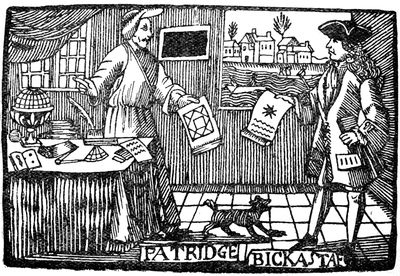
PARTRIDGE AND BICKERSTAFF.
Perhaps the chief among the serious astrological, and predicting, almanacs was 'Merlinus Liberatus, by John Partridge, Student in Physick and Astrology, at the Blue Ball in Salisbury Street, in the Strand, London.' Not, perhaps, that he would have lived in story, much more than his fellows, had it not been for the fun that Swift, Steele, and Addison made of him. Swift set the ball rolling, in his sham 'Predictions for the year 1708, by Isaac Bickerstaff' (his pseudonym), in which he says: 'My first prediction is but a trifle, and yet I will mention it to show how ignorant those sottish pretenders to astronomy are in their own concerns. It relates to Partridge the Almanack maker. I have consulted the star of his nativity by my own rules, and find he will infallibly die on the 29th of March next, about eleven at night, of a raging fever; therefore, I advise him to consider of it, and settle his affairs in time.' This was a happy thought, born of the fact that Partridge had prophesied the downfall and death of Louis XIV. Early in April 1708 Swift published 'The accomplishment of the first part of Mr. Bickerstaff's predictions, being an account of the death of Mr. Partridge, the Almanac maker, on the 29th of March, 1708, in a letter to a person of honour.'
From that moment Partridge was dead. It was no use his publicly stating that he was alive. The wits had decreed his fate, and dead he was. His elegy and epitaph were printed, in the grisly manner common to those productions. They are too long for reproduction, but are too good not to quote from.
Well, 'tis as Bickerstaff has guest, Tho' we all took it for a Jest; Patrige is Dead, nay more, he dy'd E'er he could prove the good Squire ly'd. Strange, an Astrologer should Die, Without one Wonder in the Sky; Not one of all his Crony Stars, To pay their Duty at his Hearse! No Meteor, no Eclipse appear'd! No Comet with a flaming Beard! The Sun has rose, and gone to Bed, Just as if Patrige were not Dead; Not hid himself behind the Moon, To make a dreadful Night at Noon: He at fit Periods walks through Aries, Howe'er our Earthly Motion varies, And twice a Year he'll cut th' Æquator, As if there had been no such Matter. Some Wits have wondered what Analogy There is 'twixt Cobling and Astrology; How Patrige made his Opticks rise From a Shoe Sole to reach the Skies; ....... Besides, that slow pac'd Sign Bootes As 'tis miscall'd, we know not who 'tis; But Patrige ended all Disputes, He knew his Trade, and call'd it Boots. The Horned Moon which heretofore Upon their Shoes the Romans wore, Whose wideness kept their Toes from Corns And whence we claim our Shoeing Horns, Shews how the Art of Cobling bears A near Resemblance to the Spheres, &c.
The Epitaph.
Congreve, or Rowe, took up cudgels for the poor man, and wrote and published 'Squire Bickerstaff detected, or the astrological impostor convicted, by John Partridge, student in Physick, and Astrology.' What was the use? Not only were the above squibs being sold about the streets for a halfpenny, but Swift had to annihilate his opponents by his 'Vindication of Isaac Bickerstaff Esq. against what is objected to him by Mr. Partridge, in his Almanack for the present year, 1709.'
Steele, even in the very first Tatler, could not forbear poking fun at Partridge. 'I have, in another place, and in a paper by itself, sufficiently convinced this man that he is dead, and, if he has any shame, I do not doubt but that by this time he owns it to all his acquaintance; for though the legs and arms and whole body of that man may still appear, and perform their animal functions; yet since, as I have elsewhere observed, his art is gone, the man is gone.' And so the banter was kept up, at intervals, all through the Tatler.
As an almanac writer he, in fact, did die in 1709, for that was the last he really published—although an almanac is still sold bearing the same title. He really, and corporeally, died in 1715, and was buried in Mortlake Churchyard, where, on a flat black marble stone, was the following inscription:—
'Johannes Partridge Astrologus, et Medicinæ Doctor. Natus est apud East Sheen, in Comitatu Surrey, 18 Januarii, 1641, et mortuus est Londini 24 Junii, 1715. Medicinam fecit duobus regibus, unæque Reginæ; Carolo scilicet secundo, Willielmo Tertio, Reginæque Mariæ. Creatus est Medicinæ Doctor Luguduni Batavorum.'
The almanac stamps seem to have prompted crime and forgery, owing to their price; for the London Gazette, Feb. 7/10, 1713 has, 'Whereas divers Almanacks, or Papers serving the purpose of an Almanack, with false Stamps, have been lately Printed and Sold in several Parts of England, contrary to a late Act of Parliament, and prejudicial to Her Majesty's Revenue; and others, tho' with the true Stamps, have been Printed and Sold Contrary to the Right of the Company of Stationers, for which Divers Persons are now under Prosecution, and all others will be Prosecuted when discover'd: This notice is given to prevent all Persons incurring the like Trouble and Penalties.'