Volume 25 — OUR YOUNG LADY AT SPITHEAD.
Reading edition
Miss Laura Tremaine to her Sister, the Wife of Augustus Flopp, Esq., M.P.
"My Dearest Louisa,
"Certainly, of all the unkind, and churlish creatures that ever lived, the House of Commons contains the very worst specimens, and, my dear, they are all alike, so there is no use in your making a protest on behalf of your own Honourable Member. Not to take you to the Spithead Review, and then to plead, as an apology, that there were no ships for your accommodation! And this is the omnipotent Parliament, that has only to say that coals shall not smoke, and they instantly emit nothing but perfumed incense; that cabmen shall not cheat, and they at once become as polite as guardsmen (and a great deal politer); that candidates shall not bribe, and they immediately begin to pay the voters who have opposed them, just to prevent the poor men from being unlawfully rewarded by their own friends. And yet this wonderful Parliament pretends that it cannot find a ship or two to take its own wives to see the Queen review the fleet! The men must think you are perfect geese, my dear Loo, to offer you such rubbishing excuses. It is very well for Augustus that he married you and not me, as he was once inclined to do (he was, so you need not make a face), for you accept 'the House' as an excuse for everything, and are afraid to look at the newspaper in the morning to see what hour Parliament rose, for fear you should discover that he could not have been waiting for a division at three. And you believe, too, that it is necessary for him to be full dressed for a debate, and that it produces just the same effect upon him as champagne does upon ordinary men. O, Louisa! But you like it, I believe.
Well, as I have not got an Augustus to tell me stories and leave me at home, I went with Lady de Gules and her sister to Portsmouth, and every kind of care was taken of us. We went from the hotel (where I hear they were demanding unheard-of prices from strangers, and charging them five guineas for leave to pass the night on a hob, with the run of the fender for a dressing-room), and some naval officers whom Lady de Gules ordered up for our service—her brother, you know, is a Lord of Admiralty—escorted us through the dockyard, and had a boat waiting at the stairs to take us to a great steamship lying in the harbour. Now, I should like to know why the wives of Parliament could not have had this very ship. There was plenty of room, nothing could be nicer. We had an awning over us, and the Captain ordered one of the cannons to be taken in, so that we had the porthole for a window, and there we clustered, Lady de Gules having shawls and things put upon the cannon, and perching herself on the top. There were a few good people on board, but I rather think that at the last moment, when the Admiralty authorities found that they did not want the tickets, they flung them to the local folks, who came on board very fussy and angular—horrid men, all in black at ten in the morning, and women covered with jewellery, which one of the little middies said they bought cheap of the Jews in the High Street—it did look like it. However, they kept at a respectful distance, and sneered at one another. Some of the officers on board were very attentive, and if I wanted to marry a man in uniform, I would sooner have the sea-livery than the land. They are fresher, and much pleasanter to talk to than the hardened army men, and really think more of you than the other spoiled creatures do. It was quite delightful to see them fly about to make you comfortable, doing things the soldier-officers, as your dreadful child calls them, would faint at the idea of—except at Chobham, where I admit they behave very decently. I should think it was not impossible for a woman to get to like a sailor pretty well, if she saw nobody else.
About the sight itself, my dear Loui, you had better ask somebody who understood it—your husband, perhaps, for he was in the Bulldog, which behaved dreadfully ill, breaking the line, or some fearful seawater crime. First, when the Queen came in her yellow yacht, the guns were fired, and then there was a long pause, while she visited the Duke of Wellington, a monster of a ship with, I think they said, eleven hundred and thirty-one guns, or tons, or something; but you must not take figures from me. Then we all went away in a sea-procession, which was very pretty, the great ships in long lines in the middle, hundreds of steamboats and thousands of yachts following in a miscellaneous crowd, the sun shining very brightly, and the sea as green as grass. Lady de Gules, like a goose, fancied herself sea-sick, which I believe she would do if a glass of salt-water were set upon her dressing-table; but we would not pity her, and she thought better of it. While we were at lunch—at which the officers behaved with great devotion, and a disinterestedness remarkably unlike something you and I have seen—it seems that the fleet was cannonading an enemy, but I looked out of window and could see nothing but smoke, so we stayed where we were.
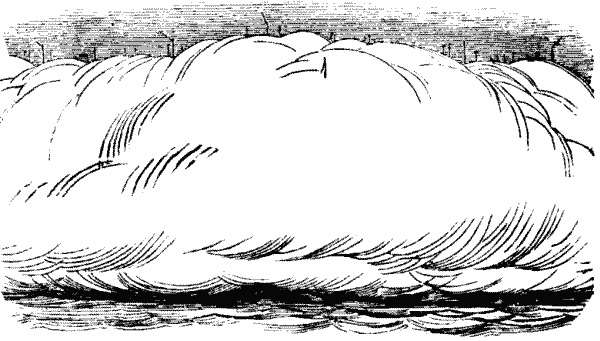
I send you a sketch of it from memory. Entre nous, I was not quite unprofitably engaged. I do not know whether it will come to anything, but just ask Augustus, from yourself, whether the Shropshire branch of the Lartonbury family is the right one, and if he knows Henry Lartonbury. Swanby House, or Hall, or something, is, I think, the family place, but I have some idea that my Lartonburys don't live there. Until I know this, of course, I can say nothing, but it is a strong case, and he can wait with great safety. Be sure you ask Augustus, and write to me directly to Lady de Gules's.
"We came to town by a special train with lots of Members of Parliament. I could not see Augustus, my dear, but the others did not look so unhappy at being without their wives as you pathetically tell me he looked on leaving you. O you silly Louisa!
"I hope I have given you a full account of the day's proceedings, but the newspapers will tell you the rest—one of the writers was in the carriage with us—I had no idea they were such nice clean people, and he knew more than all the Members put together—there, don't look angry.
"Ever your affectionate,
"Laura."
"Gules House, Saturday."
"P.S.—Be particular about the Shropshire branch, because there are some Hereford Lartonburys who won't do at all, and who ought to be made to change their name. Light hair, dark eyes, and a very affected manner, but not a bad style."
The Fashionable Epidemic.
There is a curious epidemic flying about—we hardly know what it is—but it attacks principally the highest and the middle classes. So very contagious is it, and so certain in its effects, that, to our knowledge alone, no less than 5632 families, principally residing at the West-end, have been ordered by their physicians to leave town immediately for "change of air."
Screaming.—A term generally applied to refractory children, and Adelphi farces!
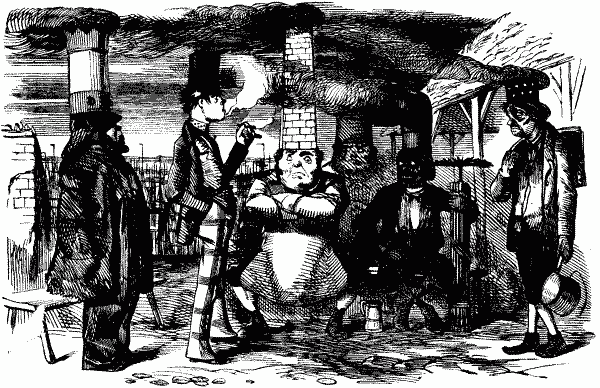
IMPORTANT MEETING OF SMOKE MAKERS.
Immense excitement prevails among an important class of manufacturers—those engaged in the manufacture of that atmospheric canopy, the sable expanse of which extends over London and its environs, serving the inhabitants of the whole metropolitan district as a parasol. The cause of this commotion is the Smoke Nuisance Bill—so called; against which a number of gentlemen, and others, professing the principles of Free Carbon, met last night to protest, at the Hole-and-Corner.
The chair having been taken by Mr. Sutkins, the business of the meeting commenced with uproar. Comparative silence having been obtained, Mr. Longshaft, brewer, rose to move a resolution, that the principle of the Smoke Bill was at variance with the constitution of England. At a time when London was much more smoky than it is now, it was said that "Liberty is like the air we breathe." Could any atmosphere be more salubrious than that air? Smoke possessed curative properties, especially in reference to hams; and the very essence of smoke was applied for the cure of kippered salmon. He had sent some bottles of smoke from his own brew-house to a celebrated German chemist, who had written him a certificate in the form of a letter, to the effect that he had analysed the smoke, and found it to consist principally of carbon, which possessed antiseptic properties; sulphurous and carbonic acid gases: the former of which acted as a tonic, whilst the latter constituted the enlivening element of bottled ale and stout, ginger beer and soda water. The philosopher had accompanied this statement by a declaration that he, for his part, liked the smoke as a perfume, and would be glad to be supplied with a few more bottles of it for his personal use. Hitherto this beautiful smoke had been allowed to waste its sweetness on the London air, which was now threatened with the deprivation of that singular advantage. The loss of the smoke would not affect him individually much, as he lived some distance out of town; and could only indulge in a whiff now and then, when he went to his place of business. He regarded the attack upon their chimneys as the commencement of an invasion of their hearths; and exhorted all who meant to defend the latter to rally round the former. (Great applause.)
Mr. Funnell, Captain of a Thames steamer, seconded the resolution. In his situation he had good opportunities of hearing the expression of public opinion about the Smoke Bill. People said if Parliament objected to volumes of smoke, why did they publish so many Blue Books? If they wanted to prevent chimneys from puffing they shouldn't have took off the Advertisement duty. What was the use of emancipating Blacks abroad if they wasn't to enjoy freedom at home? That was what the Public had to say about the matter. For his part he looked on the separation of fire and smoke as a unnatural divorce. Consume his own smoke! Why they might as well ask him to consume his own wife. Fire without smoke—by-and-bye, he supposed, it would be bread without butter. What? he expected the next thing would be your scientific legislators would bring in a bill for dividing thunder and lightning. He called this here Smoke Bill the Repeal of the Union. A little smoke on the river was wholesome. A stream that had such a lot of sewers flowing into it required fumigation. He had heard passengers returning from Kew Gardens talk about plants there that lived upon air. In course, the more substance there was in the air the more nutritions it must be both for wegetable and hanimal life. Legislation was going too fast. Ease her! stop her! take a turn astarn! As to this tyrannical and arbitrary Bill of Lord Palminster's for the consumption of smoke, he should give it every opposition: and he hoped through their united efforts it would be brought to end in that wery identical object it was directed agin. (Much cheering.)
Mr. Cowl had the honour to belong to a branch of the medical profession. His practice was the cure of smoky chimneys. He protested against a measure which would deprive him of his patients; and if the Smoke Act was enforced he hoped at least he should receive compensation.
Mr. Gentlet was a producer of smoke. He supposed his interests were affected by this measure, which required the producer to be also the consumer, but did they call that political economy? To be sure he was not the proprietor of a chimney; but he possessed a nose: which came to the same thing. The very occupation he pursued was that of smoking. It was the employment of his life. It might not be a very useful branch of industry: but it was an ornamental one. They knew by the smoke that so gracefully curled from the end of his weed that a Pickwick was near. They knew that a gent of fashionable exterior and elegant manners was nigh likewise. If he was obliged to consume his own smoke, how could he continue to diffuse fragrance in society? He identified himself with the party of smokers; as he was a smoking party himself. If smoke was such a nuisance, why did they make so much the other day at the review at Spithead? Let them put that question in their pipe—and, he would add, smoke it. Talking of pipes, he would tell Palmerston that his idea of a chimney consuming its own smoke was a mere sham.
[The speaker resumed his seat amid great laughter, principally from himself, and the meeting terminated as it began, with clamour.