Volume 25 — MR. PETERLOO BROWN'S EXAMINATION OF THE OXFORD STATUTES.
Reading edition
LETTER II.
"Dear Mr. Punch,
"In my last letter to you, I mentioned a few of the Statutum ests of 'Tit. XIV.' of the Oxford Statutes; and I now come to consider 'Tit. XV.' of the same amusing work, premising that I shall confine my remarks to this Tit., as it would be a task of insufferable weariness—and one, I suppose, which like the discovery of the source of the Nile, no philanthropist would ever live to carry out—to attempt to explore the twenty-one Tits., which, with their appendices branches, run through that immense tract of paper intended for the use of the academic youth (in usum juventutis academicaæ). But I may remark, en passant, as our 'lively neighbours' say—(I don't know French, Mr. Punch, but I like to quote it occasionally, as it shows refinement and education, and that you read the Morning Post, and all that sort of thing)—I may remark, that for the Vice-Chancellor to drive twenty-one of these Tits. in hand, and keep them well together, must be no ordinary act of Jehu-ism; and I think it would have added greatly to the effect of the late Commemoration, if they had put out illustrated posters, that the new Chancellor, 'acknowledged by the Press to be the premier jockey of the day, and without a Peer in the Westminster Circle,' would make his 'first public entrance into Oxford, driving TWENTY-ONE TITS IN HAND!' after which would, of course, follow 'the performances in the Theatre,' with 'the drolleries of the Caucasian Clown,' and 'the laughable farce of The Phenomenon in a Doctor's gown.' I think something might have been made of that; but the hint may perhaps be taken against the next opportunity.
"Tit. XV. treats 'De moribus conformandis;" and it first orders that all juniors should pay due respect to their seniors—their seniors that is, in academical rank, for age does not come before dignity in Oxford—the undergraduates to the B.A.'s, the B.A.'s to the M.A.'s, the M.A.'s to the D.C.L.'s, and so on, according to the standing of the 'Man of letters;' (a phrase which evidently refers to those mysterious decimations of the alphabet, which some people delight to put after their names). And the 'due respect' is to be shown, firstly, by yielding up the best seats, (locum potiorem cedendo) which, they tell me, was done in the theatre at the late Commemoration, by putting the undergraduates in the gallery, the M.A.'s in the pit, and reserving the boxes and dress circle for the 'Dons' and the ladies; and secondly, by giving the wall, and by capping, or, as the Statute more expressively says, 'by uncovering the head at a proper distance,' (ad justum intervallum caput aperiendo) though what this proper distance may be, appears to be left to the taste of the capper, the rank of the cappee, the force of the wind, the length of the arm, or any other directing influence. Probably the distance is measured by the relative dignity of the wearers of the cap, so that an undergraduate would have to uncover himself as soon as the Vice-Chancellor came in sight; and, in the event of a dispute as to the proper distance, the matter would probably be settled as they arrange similar differences of opinion under the new Cab Act, and would be brought before the Vice-Chancellor's Court, who would, doubtless, order the distance to be measured. At any rate, it appears that my son Peterloo will have to learn to keep his distance, and this inclines me to think favourably of this Statute; for I have always been of opinion (since I made money by it) that there is nothing like being 'umble' to your superiors, and showing them all that respect which they desire, even if they don't deserve. But I am glad that the Oxford authorities enforce this Statute by wisely ordaining that those who neglect the proper marks of respect, shall be punished with impositions, loss of terms, and the setting down of their names in the Proctor's Black Book, (in Libro Nigro Procuratorum), which I have no doubt is the Bogy with which the nurses of Alma Mater terrify and awe her refractory children. But moreover, if they should still contumaciously persist in their conduct, (si contumaces perstiterint), they shall be fined in addition, not more than five pounds for each offence. It does not say what is done with the money, but it probably goes towards purchasing a plaister for wounded dignity. Now, Mr. Punch, as touching this healthy Statute, I am rather curious to know how many undergraduates, B.A.'s, or M.A.'s, were, during the late Commemoration, castigated by the Proctors (Procuratoribus castigentur), or fined this five pounds, or had their names put down in that terrible Black Book, or done anything else to, for not capping at a proper distance, or yielding the wall to Dr. Samuel Warren, D.C.L., F.R.S., &c. &c., when they met that talented author of The Lily and the Bee, (that sweet, thoughtful poem, as Mrs. Brown calls it,) when he promenaded the High Street in all the scarlet glories of his new D.C.L.-ship? For, if the Proctors' Black Book be innocent of names branded therein for the dire offences mentioned, of course there would not be such a Statute for matriculating members to swear to obey.
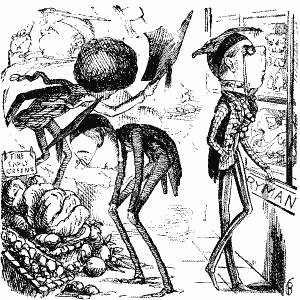
No one shall Loiter about the Streets or the Public Market-Place.
"It is next ordered that nobody should wander idly about the city or its suburbs, or be seen loitering about the streets, or the public market-place; (neque in Plateis, aut publico Foro, stantes aut commorantes conspiciantur,) just as though Oxford was always in a state of insurrection, and it was feared that if groups of students lounged in the streets, the Riot Act would have to be read, and the military called out. But, on the whole, I admire this rule also; for I know that when young men hang about in front of attractive shop-windows, the natural result is the running up of bills; and my son, Peterloo, has rather a pretty taste for jewellery and pictures. I am glad to think, therefore, that the authorities put a stop to these expensive lounges, and even punish them 'pro arbitrio Vice-Cancellarii, vel Procuratorum.' But I cannot help thinking, Mr. Punch, how greatly painters must draw on their own imaginations, when they represent the High Street of Oxford as always enlivened by several of these condemned groups: clearly an artistic license, as the authorities would have immediately dispersed them, in accordance with their Statute.
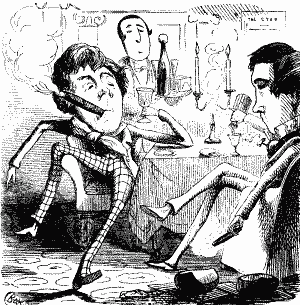
Nobody shall frequent where the Herb Nicotiana is sold.
"The next Statute that says nobody must frequent the houses of the townspeople and the workshops of artificers, without reasonable cause, I pass over with the simple remark, that it would have been better to have avoided the gratuitous insult that places respectable houses in the same clause with others that are both shameless and nameless; and I come to the next Statute, which says that Nobody shall frequent the taverns, wine-shops, or places within the city and University precincts, where wine, or any other liquor, or the herb Nicotiana or 'Tobacco,' is commonly sold. ('Cauponis, Ænopoliis ac domibus * * * in quibus vinum, aut quivis alius potus, aut herba Nicotiana sive Tobacco, ordinarie venditur, abstineant), and that the townspeople who admit the students to such houses shall be heavily fined, or punished with loss of custom for a certain time.
"Bless me, Mr. Punch! to think that I have smoked tobacco all my life, and called it by its wrong name! But, as Sam Slick observes of the Frenchman, 'Blow'd if he didn't call a hat a shappo! This comes of his not speaking English!' so, I suppose, I fell into the mistake of calling the herb Nicotiana by its vulgar name of Tobacco, from not having had the advantage of an Oxford education. The Statute speaks for itself. It entirely sets at rest those absurd reports that we hear and read of the great consumption in Oxford of wines and spirituous liquors, pale ale, and the herb Nicotiana; and when my neighbour's son, Bellingham Grey, of Christchurch, has the politeness to offer me a 'weed' (he does not call it a 'herb,' I observe, so I suppose the plant has degenerated,) which he says he purchased at Castle's, or some other great stronghold for Oxford smokers; and when he further entertains me with accounts of snug little undergraduate dinners at the Star, or Mitre, and how from the effects of an injudicious mixture of liquors the waiter's face came to be artistically corked and otherwise taken liberties with; and when he narrates other anecdotes of a like pleasant nature, I must suppose that he takes me for a Marine, and tells his tales accordingly. For it is very evident to all sensible persons, that when the authorities require the students to swear not to do these things, and to receive certain punishments if they do them, that they would be strict in enforcing the Statute, and would not tamely suffer either thoughtless undergraduates to break their oaths, or the unfortunate tavern and shop-keepers, and vendors of the herb Nicotiana, to run a risk of fines and loss of custom. Would they, Mr. Punch? I should rayther think not, says
"Your Constant Reader,
Peterloo Brown."
A Bare Possibility.—The Russian Bear keeping the peace in Europe for long.