Volume 25 — MRS. MAGNALL'S HISTORICAL QUESTIONS
Reading edition
(As they should be written for Young Ladies).
A history of England for young ladies remains yet to be written. The usual ingredients of a reign cannot be interesting to the youthful female mind. Battles, with the number of killed and wounded; party feuds, with the names of the ministers who succeed one another in place; the slow march of public events, and the men who march slowly with them; the eternal round of diplomatic and political relations—which, as they never marry, are the last relations a lady cares for; these, we say, are not exactly the subjects that would engage the sympathies or the attention of a young girl. What romance, what possible interest is there in any one of them? No! we would change all that, and have our English History written in a style popular, easy, and graceful, and alluding only to such subjects as ladies understand, or can best appreciate.
Our proposal, however, will be at once apparent by the nature of the following questions, which we have extracted from a History supposed to be written according to our sensible plan;—
HISTORICAL QUESTIONS FOR LADIES.
(Taken principally from the Reign of queen Victoria.)
What do you mean by the "Crush-Room of the Opera;" and why is it so called?
When did gigot sleeves go out of fashion, and did such sleeves have anything to do with the popular French phrase of "Revenons à nos Moutons?"
What do you mean by "Crochet Work"? and can you set the pattern for ladies of "How to make a purse for your brother?"
Who edited the "Book of Beauty?" and mention a few of the aristocratic names whose portraits have had the honour of appearing in its splendid pages.
Can you describe the habits and haunts of the "Swedish Nightingale?" and can you mention the highest note it ever reached, and also why it sang in a Haymarket?
State the name of the "Bohemian nobleman" who first brought over the Polka to England.
In what year of Victoria's reign was the celebrated Bal Costumé given at Buckingham Palace? and describe the dress that Her Majesty wore on that interesting occasion.
Give the names of the principal singers who distinguished themselves at the two Italian Operas during the rival administrations of Gye and Lumley, and describe the nature of the feud that existed between those two great men.
Give a description of "Pop Goes the Weasel," and state all you know about the "Weasel," and what was the origin of his going "Pop."
Who succeeded Wigan in the Corsican Brothers?
Mention the names of the principal watering-places, and say which was considered the more fashionable of the two—Margate, or Gravesend?
When did flounces come into fashion, and state the lowest and the highest number a lady could wear?
Describe the position of Chiswick—and give a short account of its Gardens, and the Fêtes that were held there every year.
What were the duties of the Ladies of the Bedchamber, and in what respects did they differ from the Maids of Honour at Richmond?
Mention the names of the most delicious novels that were published between the years 1840 and 1853, and name the character and scene that pleased you the most.
Whose gloves do you consider were the best?
What was the last elopement that created any sensation at Gretna Green?
State who was Jullien? also, whether he had anything to do with the soup that bears his celebrated name?
Tea-Table Talk.
A lady living at Peckham Rise has nearly ruined her husband by the enormous prices she has been giving for Cochin-China fowls. The poor fellow is always pointed at in the neighbourhood, so the story goes, as "the Cochin-China-pecked husband."
A gentleman at a party, where table-turning was the principal amusement of the evening, upon hearing that the power of turning mainly depended upon the will, instantly recommended his wife, as he "begged to assure the company she had a very strong one, and he had never known anything able to resist it."
A Good Dirty Job.
It is pleasant to find that the Commissioners of Sewers are stirring; notwithstanding the result proverbially ascribed to stirring in such matters: and we hope we shall soon be enabled to expect that the Metropolis will be drained with some degree of rational assewerance. If this great object is successfully accomplished, we take the liberty of recommending that the Chairman of the Commission should be raised to the Peerage, by the title of Lord Scavenger.
Test of Good Humour.—Wake a man up in the middle of the night, and ask him to lend you five shillings.
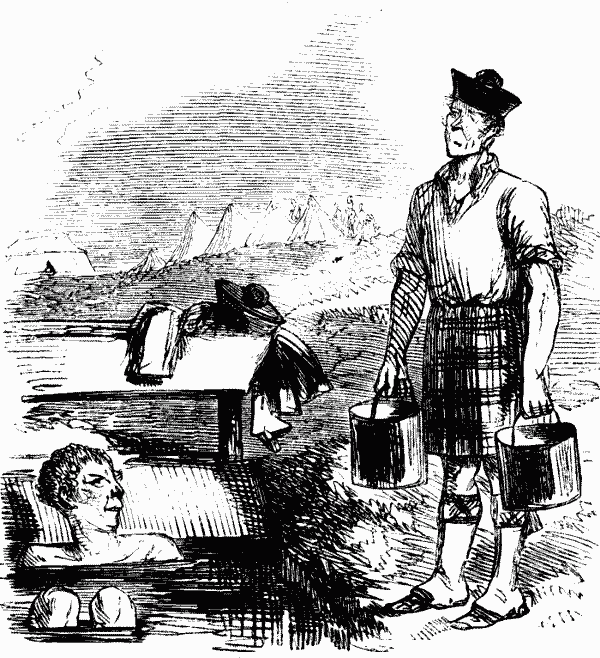
THE CAMP.
"HEY, COLIN! DINNA YE KEN THE WATTER'S FOR DRINK, AND NAE FOR BATHIN?"