Volume 25 — MR. PETERLOO BROWN'S EXAMINATION OF THE OXFORD STATUTES.
Reading edition
"Dear Mr. Punch,
"I venture but once again to trouble you with a few remarks; and, as I am looking forward to my lad matriculating this next October, I shall be glad of your speedy advice as to whether I ought to send him to a place where he will have to swear to observe Statutes like those I have spoken of, and those I am now about to mention.
"The next Statute after 'the herb Nicotiana,' is about the closing of the College gates at 9 o'clock, and says, that if circumstances should call for it (si res ita postulet), the Heads of the Houses shall then go round to each chamber (perlustratis singulorum cubiculis), to see if their tenants are there. This is a delightful rule; and, if circumstances do not call for the Heads to make their rounds, it only shows that the Statute is obeyed without such supervision. Early to bed, you know, Mr. Punch, not only leads to salubriousness of body and purse, but also conduces to wisdom of intellect; and, doubtless, much of the success of the 'Oxford discipline' that we hear so much about may be traced to this 'early-closing movement.' I am glad to find that my son Peterloo will not have to carry out the popular idea of a student, by burning 'the midnight oil'—which you and I, as men of the world, know is a mere figure of speech, and only leads to biliousness of body and cutting of morning chapels—but that he will have to be in bed by 9 o'clock, and, possibly, may be tucked up by the Head of the College himself, attended, of course, by bedels and 'holy pokers,' and all the paraphernalia of Collegiate grandeur. And, Mr. Punch, what an instructive subject 'Alma Mater putting her children to bed' would be for Mr. Tenniel to turn into a cartoon for the new Houses of Parliament; where, in spite of the exertions of Mrs.—I mean Mr.—Brotherton, the Members will waste the gas and their health in keeping late hours—a thing they were plainly never allowed to do as long as they were at Oxford!
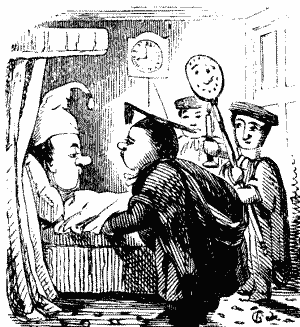
Nobody must be out of his chamber after nine o'clock in the evening.
"The next Statute not only forbids the students to indulge in all games that might be hurtful to themselves (abstineant ab omni lusus genere, in quo de pecuniâ concertatur), but also requires them to abstain from every kind of game or sport which might cause any danger, injury, or inconvenience to others; as, for example, from the hunting of wild beasts with dogs of all kinds, with ferrets, nets, or snares (item quod abstineant ab omni genere lusus vel exercitu, ex quo aliis periculum, injuria, vel incommodum creatur: veluti a venatione ferarum cum canibus cujuscunque generis, viverris, retibus, aut plagis). Oh, Mr. Punch, does Oxford still keep the same position it held in dark centuries ages ago, that it is forced to make its matriculating candidates swear to abstain from the sports of a savage life, which may be all very well for a Gordon Cumming, but do not accord with the peaceful pursuits of a cloistered student? And what, I would ask, are the wild beasts for which Oxford is famous? Are they of the same genus as those which my young neighbour Bellingham Grey speaks of? He tells me that Oxford is infested with the varied species of the Ornithorhyncus—the Beast with a Bill—which usually lurk in dens to which they endeavour, by many allurements, to entice their victims; and that, so cunning are they, that they will even steal within the College walls and attack a Student in his own private room, and cannot be got away before they have made him bleed freely. He says that there is no way of capturing these beasts, and that they can only be kept off by Degrees; but, that when once you have found means to settle them, their Bill immediately drops off; and that they are not seen again until their bill has been curiously renewed. I wonder that the manager of the Zoological Gardens don't get hold of specimens of this very curious beast, the Oxford Ornithorhyncus; more especially as they seem to be so common. But I suppose that their difficulty of capture at present stands in the way. But, who knows, but what we shall see them next season among the 'lions' of the Gardens, and eclipsing in interest even the vivarium and the hippopotamus?
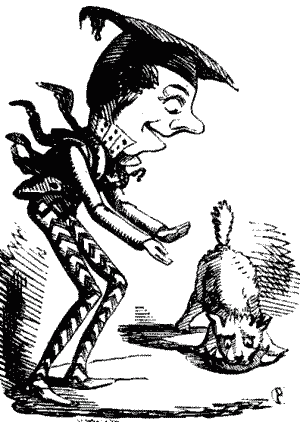
Nobody must indulge in sports which may cause hurt or inconvenience to others.
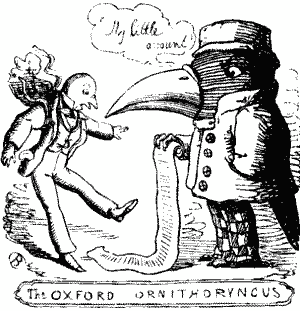
The OXFORD ORNITHORYNCUS
"But to return to the Statute. Though I think I smell a badger, yet the word 'ferrets' seems to point at rats. But if, in their humanity, the authorities discourage rat-hunting—which, of course, must be an 'inconvenience' to the rat, even if it cause him no 'danger or injury'—why do they shut their eyes to the legions of terriers, and other rat-killing dogs, that are openly possessed by the members of the University? I am at a loss to know for what species of wild beasts the 'snares and nets' are intended, unless the young men poach for rabbits and hares. But as for fox-hunting, I shall know now how far I may believe young Bellingham Grey when he says that he, and more than a score of 'pinks' may be seen in a morning, setting off from the Canterbury Gate of Christ Church! And as for the loo, and whist, and 'Van John' that he speaks of, not to mention écarté, and the money that changes hands in one evening, why I am sadly afraid that the young gentleman has been imposing upon my credulity.
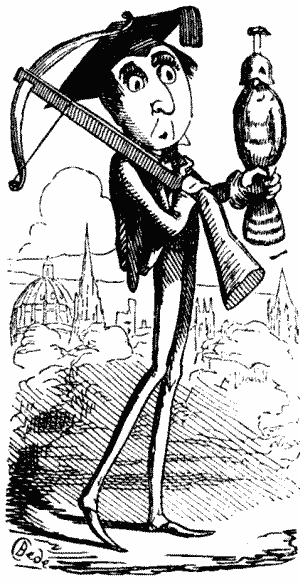
Nobody must carry a cross-bow, and a hawk for fowling.
"The Statute goes on to forbid the boys—I beg pardon, the 'men!'—from the use of hawks for fowling, and from the carrying of cross-bows and 'Bombardarum' (necnon ab omni apparatu et gestatione Bombardarum, et arcubalistarum; sive etiam accipitrum usu ad aucupium). Now, I am aware that the old noble sport of hawking is being revived, because I take in The Field (for, of course, I look upon myself as a 'country gentleman,' and do everything that country gentlemen ought to do), and in The Field I sometimes read about it; and I suppose the Oxford gentlemen are assisting in the revival. But, in the name of wonder, Mr. Punch, what can be meant by 'Bombardarum?' Has it anything to do with your Austrian friend 'Bomba?' Or does it mean that the young men must not carry about mortars for the discharge of bombs, or battering-rams, or some 'bombarding' implement 'of that ilk?' But no. 'Town and Gown' disturbances can never need such warlike preparations as these. I suppose I must write to your facetious contemporary Notes and Queries, and ask what 'Bombardarum' really does mean; for no Latin Dictionary that I have access to is able to inform me. Really, Mr. Punch, my Lord Chancellor Derby ought to publish either a translation of the Statutes of his University or a dictionary of these 'Oxford mixture' phrases, 'canino Anglico Latine reddita:' for how can young men be expected to obey Statutes which are made up of words of which the meaning can only be conjectured? And if, Mr. Punch, you take up the cudgels for the Oxford Statutes, and tell me that they are thus purposely framed, and after the fashion of the Statutes of the country, I beg to observe that the seat of learning ought to be stuffed with other stuff than that which fills the woolsack, and that the framers of its laws should not be like the noble and versatile Lord of the Upper House, to whom we might say, in the words of Coleridge:—
"'You can utter, with a solemn gesture, Oracular sentences of deep no-meaning, Wear a quaint garment, make mysterious antics!'[4]
"The statutes next call upon the matriculating candidate to swear that he will keep aloof from all rope-dancers and actors, and from the strifes and shows of—gladiators! (Item quod, intra Universitatem Oxoniensem aut Præcinctum, absque speciali veniá Vice-Cancellarii, nec Funambuli nec Histriones, qui quæstús causâ in Scenam prodeunt, nec Gladiatorum certamina sive spectacula permittantur; nec Academici eisdem intersint.) Good gracious, Mr. Punch! is this the nineteenth century—is Punch an institution of our land; have we got a Camp at Chobham, and a Fleet at Spithead, or are we Rip Van Winkles in an inverse degree, who have slept backwards into the past? My brain is fairly muddled, Sir, with the thought that I am about to send my son Peterloo to a place which I had fondly imagined to be the centre of all enlightenment, and which I now find retains the barbarities of the darkest ages. I don't object to the rope-dancers and actors—although I might perhaps be inclined to ask why Shakspeare, and Sheridan, and Bulwer-Lytton should be condemned as improper; and Plautus, Terence, and Juvenal decided to be the only pure and proper dramatic guides of youth—I don't object, I say, to my lad going to see the rope-dancing and acting, but I do decidedly object to his even having a chance of obtaining 'the special permission of the Vice-Chancellor' to be present at such degrading exhibitions as the 'sports of the Gladiators.' I shudder to think (and so does Mrs. Brown, Sir), that my lad, who has been so carefully brought up, will really 'see before him the Gladiator lie, his manly form all cover'd o'er with wounds;' and that he will, perhaps—(I can assure you, Sir, that Mrs. Brown is obliged to have recourse to her smelling salts at the bare thought of such horrors)—that he will perhaps set his own slave (or scout) to fight for his amusement, and, like those frightful Romans that he is obliged to read about, will be turning up his thumbs to give the dreadful signal for his wretched servant's death! I must really pause a moment to recover my equanimity. Yet a bright thought strikes me! Perhaps, after all, Mr. Punch, these gladiatorial exhibitions are only intended to assist the students in their classical pursuits, the mind being, we know, often more speedily instructed through an appeal to the eye. And this idea is supported by the words of the Statute that the Students must not be present at such shows without the special permission of the Vice-Chancellor. For, of course, if there are no gladiatorial exhibitions in Oxford, the candidates for matriculation would not be required to take oaths about them.
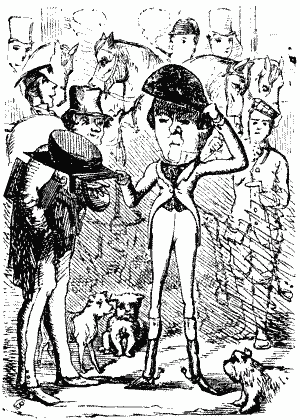
Nobody must hunt wild beasts.
"It would fatigue both you and me, Mr. Punch (weakened as I feel by these gladiatorial prospects), were I to make more lengthy observations on the Oxford Statutes; for the subject is so copious, that it would take me some time to travel through all the Statutum ests, and stop at each. Yet I think I have told you enough about them to enable you to give me your valuable opinion on the propriety and wisdom of suffering my son Peterloo to enter an university, to the privileges of which he will only be admitted on the condition that he swears to observe all the foregoing Statutes, and a host of others, to the utmost of his power: 'Scito te,' says the Vice-Chancellor, as he gives the young man a copy of the book which I have now been considering, 'Scito te in matriculam Universitatis hodie relatum esse, sub hac conditione, sempe, ut omnia Statuta, hoc libro comprehensa, pro virili observes.'
"But I will add one word in favour of a few more Statutes of this 'Tit. XV.' I am glad to see that, while my son will not be permitted to draw a weapon upon another, or threaten him with a knife, dagger, sword, or other species of weapon (cultellum, pugionem, gladium, aut aliquot aliud genus teli aut distrinxerit, aut intentaverit, cum minis, &c.), yet, that he will be allowed to bear a bow and arrow for the sake of honest recreation (qui honestæ recreationis causá arcus cum sagittis portaverint), and will not be suffered to ride in, or be the charioteer of, any vehicle, unless he is permitted to do so by the Proctors or the Heads of his College, on account of his infirm health, or some other reasonable cause (nisi cui propter infirmam valetudinem aut rationabilem aliquam causam licentia, &c.). And yet, Mr. Punch, why does young Bellingham Grey tell me tales of Traps, and Dog-carts, and Tandems, and Teams? Have all their charioteers infirm health? or has that young gentleman, in this as in other things, been practising upon the credulity of
"Dear Mr. Punch, "Your constant reader,
Peterloo Brown."