Chapter VIII · (continued 3)
Reading edition
Another main source for these preliminaries, as well as for the routine of the campaign later in Albany and at Lake George is the Journal of General John Winslow, who, after some coquetting with Pepperrell on Shirley’s part, was finally selected for the command of the expedition against Crown Point.[1401] The second volume of this journal, which is in the library of the Mass. Hist. Society, covers Feb.-Aug., and the third, Aug.-Dec., 1756. They consist of transcripts of letters, orders, etc., chronologically arranged.
The volumes labelled “Letters” in the Massachusetts Archives (MSS.) contain various letters, which depict the condition of the camps and the progress of the campaign. Parkman[1402] refers to them, as well as to a report of Lieut.-Col. Burton to Loudon on the condition of the camps,[1403] and to the journal of John Graham, a chaplain in Lyman’s Connecticut regiment.[1404]
Shirley rightfully understood the value of Oswego to the colonies. As Parkman[1405] says, “No English settlement on the continent was of such ill omen to the French. It not only robbed them of the fur-trade, but threatened them with military and political, no less than commercial ruin.” The previous French governor, Jonquière, had been particularly instructed to compass its destruction, above all by inciting the Iroquois to do it, if possible, for the post was a menace in the eyes of the Indians. Shirley hoped to redeem the failure of last year, and he had the satisfaction of hearing of Bradstreet’s success in the midst of the personal detraction which assailed him.[1406] The military interest of the year, however, centres in the siege and fall of Oswego (Aug. 14), introducing Montcalm on the scene.[1407] Capt. John Vicars, a British officer who was with Bradstreet, gives an account of the fortifications, which Parkman[1408] uses. The correspondence of Loudon and Shirley in the English archives marks the progress of events.[1409] Respecting the siege itself there is a letter, from an officer present, in the Boston Evening Post, May 16, 1757. Stone[1410] uses MS. depositions of two of the English prisoners who escaped from the French.[1411] A declaration by soldiers of Shirley’s regiment is printed in the N. Y. Col. Docs., vii. 126.
Of the contemporary printed sources, note must be made of the “State of facts” in the Lond. Mag., 1757, p. 14; of the Conduct of General Shirley, etc., p. 110; of Livingston’s Review; of The military history of Great Britain for 1756-57. Containing a letter from an English officer at Canada, taken prisoner at Oswego, exhibiting the cruelty of the French. Also a journal of the Siege of Oswego, London, 1757.[1412]
Of somewhat less authority is a popular book, French and Indian cruelty exemplified in the life of Peter Wilkinson, with “accurate detail of the operations of the French and English forces at the siege of Oswego.”[1413] Of a more general character are the accounts in Mante,[1414] Smith,[1415] and Hutchinson.[1416]
Parkman, who sketches the early career of Montcalm,[1417] surveys the chief French authorities on the siege, as gathered mainly from the Archives of the Marine and those of War, at Paris;[1418] the Livre des Ordres; Vaudreuil’s instructions to Montcalm, July 21; the journal of Bougainville; the letters of Vaudreuil, Bigot, and Montcalm. The N. Y. Col. Docs. (vol. x.) contain various translations of these,[1419] including (p. 440) a journal of the siege transmitted by Montcalm; other versions are in the Doc. Hist. N. Y., vol. i.
There was printed at Grenoble, in 1756, a Relation de la prise des forts de Choueguen, ou Oswego, & de ce qui s’est passée cette année en Canada. A small edition was privately reprinted in 1882, from a copy belonging to Mr. S. L. M. Barlow, of New York.[1420] Martin, in his De Montcalm en Canada, ch. iii., presents the modern French view, as also does Garneau, Hist. du Canada, 4th ed., vol. ii. 251. Maurault, in his Hist. des Abénakis (1866), tells the part of the Indians in the siege.
Of the partisan warfare conducted by Rogers and Putnam, we have the best accounts in the reports which the former made to his commanding officer.[1421] These various reports constitute the volume which was published in London in 1765 “for the author,” called Journals of Major Robert Rogers, containing an account of the several excursions he made under the generals who commanded, during the late war.[1422] Rogers’ Journals are written in a direct way, apparently without exaggeration, but sometimes veil the atrocities which he had not screened in the original reports.[1423] Parkman points out that the account of his scout of Jan. 19, 1756, is much abridged in the composite Journals.
The exploits of Rogers are frequently chronicled in Winslow’s Journal, and there are other notes in the Mass. Archives, vol. lxxvi. Parkman cites Bougainville’s Journal as giving the French record.[1424] There is a contemporary account of one of Rogers’ principal actions, in what Trumbull[1425] calls “perhaps the rarest of all narratives of Indian captivities.” The edition which is mentioned is a second one, published at Boston in 1760, and Sabin[1426] does not record the first. It is called A plain narrative of the uncommon sufferings and remarkable deliverance of Thomas Brown, of Charlestown in New England, who returned to his father’s house the beginning of Jan., 1760, after having been absent three years and about eight months; containing an account of the engagement, Jan., 1757, in which Captain Spikeman was killed and the author left for dead.
Of Putnam’s exploits there is a report (Oct. 9, 1755) in the Doc. Hist. N. Y., iv. p. 172. The Life of Putnam by Humphreys chronicles his partisan career, while that by Tarbox passes it over hurriedly. Hollister’s and other histories of Connecticut give it in outline.
The circulars of Pitt to the colonies, asking that assistance be rendered to Loudon, and (Feb. 4, 1757) urging the raising of additional troops, is in New Jersey Archives, viii. Pt. ii. pp. 209, 241. There are in the Israel Williams MSS. (Mass. Hist. Soc.) letters of Loudon, dated Boston, Jan. 29 and Feb., 1757, respecting the organization of the next campaign.
For the attack on Fort William Henry (1757) conducted by Rigaud, Parkman[1427] cites, as usual, his MS. French documents,[1428] but gives for the English side a letter from the fort (Mar. 26, 1757), in the Boston Gazette, no. 106, and in the Boston Evening Post, no. 1,128; with notes of other letters in the Boston News-Letter, no. 2,860.
The best account yet published of Montcalm’s later campaign against Fort William Henry (the Fort George of the French) is contained in the last chapter of the first volume of Parkman’s Montcalm and Wolfe.[1429]
On the French side there is the work of Pouchot, and Dr. Hough’s translation of it (i. 101). The Rough List of Mr. Barlow’s library (no. 941) shows, as the only copy known, a Relation de la prise du Fort Georges, ou Guillaume Henry, situé sur le lac Saint-Sacrement, et de ce qui s’est passé cette année en Canada (12 pp.), Paris, 1757.
Of the documentary evidence of the time Parkman makes full use. He secured from the Public Record Office in London the correspondence of Webb and a letter and journal of Colonel Frye, who commanded the Massachusetts troops, and from these he gives extracts in his Appendix F.[1430]
In the Paris documents as gathered (copies) in the archives at Albany,[1431] and in the copies of other documents from France, supplementing these, and contained in the series of MSS. given by Mr. Parkman to the Mass. Historical Society, there are the Journal of Bougainville, “a document,” says Parkman, “hardly to be commended too much,” the diary of Malartic, the correspondence of Montcalm, Lévis, Vaudreuil, and Bigot. In adding to the graphic details of the theme, there is a long letter of the Jesuit Roubaud, which is printed in the Lettres Edifiantes et Curieuses.[1432]
Jonathan Carver, who was a looker-on, has given an account in his Travels, which Parkman thinks is trustworthy so far as events came under Carver’s eye.[1433]
The journals of the Montresors, father and son, Colonels James and John, during their stay in 1757-59 in the neighborhood of Forts William Henry and Edward, throw light upon the spirit of the time.[1434] They are preserved in the family in England, and, edited by G. D. Scull, have been printed in the N. Y. Hist. Coll., 1881, accompanied by heliotypes of portraits of the two engineers.[1435]
Living at the time, and enjoying good advantages for acquiring knowledge, Hutchinson, in his Massachusetts (vol. iii. p. 60), might have given us more than he does, but his purpose was mainly to show the effect of the campaign upon that colony. It is noticeable, however, that he says the victims of the massacre were not many in number. Most later writers on the English side add little or nothing not elsewhere obtainable.[1436]
Bancroft[1437] made use of a considerable part of the material available to Parkman; but his latest revision does not add to his earlier account.
Dwight, in his Travels in New England and New York,[1438] who remembered the event as a child, expresses the view which long prevailed in New England, that Montcalm made no reasonable effort to check the Indians, and emphasizes the timidity and imbecility of Webb, who lay at Fort Edward with 6,000 men, doing nothing. Dwight narrates as from Captain Noble, who was present, that when Sir William Johnson would gather volunteers from Webb’s garrison to proceed to Munro’s assistance Webb forbade it.[1439]
Respecting the attack in the autumn (Nov. 28, 1757) on German Flats, there are the despatches of Vaudreuil, the Journal of Bougainville, and papers in Doc. Hist. N. Y., i. 520, and N. Y. Col. Docs., x. 672, the latter being a French summary of M. de Belêtre’s campaign. Loudon’s despatch to Pitt, Feb. 14, 1758, is the main English source.[1440]
While Webb held the chief command at Albany, Stanwix was organizing, with the help of Washington, the defence along the Pennsylvania and Virginia borders, and Bouquet further south.[1441] The lives of Washington and the histories of those provinces trace out the events of the summer in that direction. The main thread of this history is the precarious relation of the provinces with the Indians, and much illustrative of this connection is found in the Penna. Col. Rec., vol. vii. Dr. Schweinitz’s Life of Zeisberger and the various Moravian chronicles show how that people strove to act as intermediaries.
The Delawares had not forgotten the deceit practised upon them at Albany in 1754, in inveigling them into giving a deed of lands, and Sir William Johnson was known to be in favor of revoking that fraudulent purchase. Conferences with the Indians were numerous, even after the spring opened.[1442] Johnson received the deputies of the Shawanese and Delawares at Fort Johnson in April, and concluded a treaty with them.[1443]
It boded no good that the Six Nations also, in April, had sent deputies to Vaudreuil, and all through the spring the region north of the Mohawk was the scene of rapine.[1444] The truth was, the successes of the French had driven the westerly tribes of the Six Nations into a neutrality, which might turn easily into enmity, and to confirm them in their passiveness, and to incite the Mohawks and the easterly tribes into active alliance, Johnson, who knew his life to be in danger, summoned the deputies of the confederacy to meet him at Johnson Hall on the 10th of June. His journal for some time previous to the meeting is printed by Stone.[1445] Johnson accomplished all he could hope for. His answer to the Senecas of June 16 is in the Penna. Archives, vi. 511. Under his counsel, the final conclusion with the Indians farther south was reached in a conference at Easton, in Pennsylvania, in July and August.[1446]
Of the defeat of Rogers in March, which opened the campaign of 1758, his own report after he got into Fort Edward, printed at the time in the newspapers, is mainly given in his Journals, together with a long letter of two British regular officers who accompanied him, and who in the fight escaped capture, but wandered off in the woods, till hunger compelled them to seek the French fort, whence by a flag of truce they despatched (Mar. 28) their narrative. The French accounts are derived from the usual documentary sources as indicated by Parkman (ii. p. 16).
The English historians of the war in Europe all describe the change in political feeling which brought Pitt once more into power, with popular sympathy to sustain him.[1447] The public had aroused to the incompetency of the English military rule in America, and upon the importance of making head there against the French, as a vantage for any satisfactory peace in Europe.[1448] This revulsion is best described in Parkman[1449] and in Bancroft.[1450] The letter of Pitt recalling Loudon (who was not without his defenders[1451]), as addressed to the governor of Connecticut, is in the Trumbull MSS., vol. i. p. 127.
The condition of the camp at Lake George in the spring and early summer is to be studied in the official papers, as well as in letters printed in the Boston News-Letter and in the Boston Evening Post.[1452] Parkman describes from the best sources the fort and the outer entrenchments.[1453]
The official reports on the English side of the fight on July 8th are in the Public Record Office. The letter which Abercrombie addressed to Pitt from Lake George, July 12, as it appeared in the London Gazette Extraordinary, Aug. 22, is printed in the N.Y. Col. Docs., x. 728. Dwight represents the opinions of Abercrombie’s generalship as current in the colonies,[1454] and we read in Smith’s New York, vol. ii. p. 264, that the difficulty “appeared to be more in the head than the body.” The diary of William Parkman, a youth of seventeen, who was in a Massachusetts regiment, reflects the charitable criticism of his troops, when the diarist calls their commander “an aged gentleman, infirm in body and mind.”[1455] We have various other descriptions and diaries from officers engaged.[1456]
Parkman[1457] collates the different authorities as respects the losses on the two sides,[1458] and his details are the best of all the later historians.[1459] Of the French contemporary accounts, which are numerous, there are several from the Paris Archives in the Parkman MSS., which have been used for the first time in his Montcalm and Wolfe. Some of the more important ones are printed in the N. Y. Col. Docs. x.[1460]
There is an account in Pouchot, and Chevalier Johnstone’s “Dialogue in Hades” is in the Transactions of the Lit. and Hist. Soc. of Quebec, and summarized accounts in Martin’s De Montcalm en Canada, ch. vii., and in Garneau’s Canada, p. 279.[1461] For the life of the camp later established at the head of Lake George, there are items to be drawn, not only from the official reports, but from the Israel Williams MSS. Parkman (ii. 117) uses a diary of Chaplain Cleaveland. An orderly book of Col. Jonathan Bagley, of a Connecticut regiment, covering Aug. 20-Sept. 11, 1758, is in the library of the American Antiq. Society.[1462] It indicates that the celebration at Lake George of the victory at Louisbourg took place Aug. 28, as does an orderly book of Rogers’ Rangers, covering Aug.-Nov., 1758, at Lake George and Fort Edward.[1463]
Of the autumn scouting, there are letters in the Boston Weekly Advertiser, the centre of interest being the fight between Rogers and Morin.[1464]
Of the Frontenac expedition, Bradstreet’s own report to Abercrombie is in the Public Record Office. Parkman uses it, as well as letters in the Boston Gazette, no. 182; Boston Evening Post, no. 1,203; Boston News-Letter, no. 2,932; N. H. Gazette, no. 104. The articles of capitulation are in the N. Y. Col. Docs., x. 826. Smith (New York, ii. 266), speaking of Bradstreet’s expedition, says he “rather flew than marched.”[1465]
On the French side, there are the official documents, the Mémoire sur la Canada, 1749-60 (published by the Lit. and Hist. Soc. of Quebec), and Pouchot, i. 162.
The loss of Frontenac gave rise to a disagreement between Vaudreuil and Montcalm as to the dispositions to be made upon Lake Ontario, and the papers which passed between them are in the N. Y. Col. Docs., x. 866, etc., as well as others on the conflict of their opinions respecting the defence of Ticonderoga (Ibid., p. 873, etc.).
The main sources for the Duquesne expedition of 1758 are in the Public Record Office, America and West Indies, including the correspondence of Forbes.[1466] There are also papers in the Col. Records of Penna. and Pennsylvania Archives. The letters of Washington in Sparks’ Washington (vol. ii.) may be supplemented by the fuller text of the same, and by others, in Bouquet and Haldimand Papers, in the British Museum. Washington’s letters to Bouquet are in Additional MSS., vol. 21, 641, of the British Museum, and there is a copy of them among the Parkman MSS.[1467] There is a letter of a British officer in the Gent. Mag., xxix. 171. For the new route made by Forbes, see Lowdermilk’s Cumberland, p. 238. The routes of Braddock and Forbes are marked on the map given in Sparks’ Washington, ii. 38, and Washington’s opinion of their respective advantages is in Ibid., ii. 302.
Of Grant’s defeat, the principal fight of the campaign, there are contemporary accounts in the Penna. Gazette,[1468] Boston Evening Post, Boston Weekly Advertiser, Boston News-Letter, etc.; in Hazard’s Penna. Reg., viii. 141; in Olden Time, i. p. 179. Grant’s imprudence met with little consideration in England. (Grenville Correspondence, i. 274.)
The account of Post’s embassy, July 15 to Sept., 1758, appeared in London in 1759, as the Second Journal of Christian Frederick Post.[1469]
Parkman,[1470] Bancroft,[1471] and Irving,[1472] of course, tell the story of Forbes’s campaign,—the first with the best help to sources.[1473]
The concomitants of the winter of 1758-59 in Canada must be studied in order to comprehend the inequality of the two sides in the signal campaign which was to follow. Parkman finds the material of this study in the documents of the Archives de la Marine et de la Guerre in Paris; in the correspondence of Montcalm, of which he procured copies from the present representative of his family, including the letters of Bougainville[1474] and Doreil[1475] on their Paris mission; and in the letters of Vaudreuil, in the Archives Nationales.[1476] Much throwing light on the strained relations between the general and the governor will be found in the N. Y. Col. Docs., vol. x.[1477] French representations of the situation in Canada are given in the Considérations sur l’État présent du Canada, published by the Literary and Historical Society of Quebec in 1840, sometimes cited as Faribault’s Collection de Mémoires, no. 3. Further use may be made of Mémoire sur le Canada, 1749-1760, en trois parties, Quebec, 1838.[1478]
The comparative inequality of the two combatants was a fruitful subject of inquiry then, especially upon the French side. There is in the Penna. Archives, 2d series, vi. 554, a French Mémoire, setting forth their respective positions, needs, and resources, dated January, 1759, and similar documents are given in the N. Y. Col. Docs., x. 897, 925, 930.
Later writers, with the advantage of remoteness, have found much for comment in the several characteristics, experiences, aims, and abilities of the two warring forces. These are contrasted in Warburton’s Conquest of Canada.[1479] Judge Haliburton[1480] points out the great military advantages of the paternal and despotic government of Canada. Viscount Bury, in his Exodus of the Western Nations,[1481] compares the outcome of their opposing systems. Parkman gives the last chapter of his Old Régime in Canada to a vigorous exposition of the subject. The institutional character of the English colonists, developed from the circumstances of their life, is compared with the purpose of the French colonists to reproduce France, in E. G. Scott’s Development of Constitutional Liberty in the English Colonies of America.[1482]
Among the later French authors, Rameau, in his France aux Colonies (Paris, 1859), writes in full consciousness of the limitations and errors of policy which deprived France of her American colonies.[1483] The efforts which were made to propitiate the Indians before the campaign opened are explained in Stone’s Life of Johnson, ii. ch. v., and in the N. Y. Col. Docs., vii. 378.
Upon the movement to render secure the new fort at Pittsburgh, Parkman found in the Public Record Office, in London, letters of Col. Hugh Mercer (who commanded), January-June, 1759; letters of Brigadier Stanwix, May-July;[1484] and a narrative of John Ormsby, beside a letter in the Boston News-Letter, no. 3,023. In the Wilkes Papers, in the Historical MSS. Commission Report, No. IV., p. 400, are long and interesting accounts of affairs at this time in Pennsylvania, written from Philadelphia to Wilkes by Thomas Barrow (May 1, 1759).
The Niagara expedition was a mistake, in the judgment of some military critics, since the troops diverted to accomplish it had been used more effectually in Amherst’s direct march to Montreal. More expedition on that general’s part in completing his direct march would have rendered the fall of Niagara a necessity without attack. Perhaps the risk of leaving French forces still west of Niagara, ready for a siege of Fort Pitt, is not sufficiently considered in this view.[1485]
The Public Record Office yields Amherst’s instructions and letters to Prideaux, and the letters of Johnson to Amherst. Stone[1486] prints Johnson’s diary of the expedition, and the Haldimand Papers in the British Museum throw much light.[1487] Letters of Amherst are in the N. Y. State Library at Albany.
On the French side, the account in Pouchot’s Mémoires sur la dernière guerre[1488] is that of the builder and defender of the fort.[1489] His narrative is given in English in N. Y. Col. Docs., x. 977, etc., as well as in Hough’s ed. of Pouchot. The letters of Vaudreuil from the French Archives are in the Parkman MSS. The English found in the fort a French journal (July 6-July 24, 1759), of which an English version was printed in the N. Y. Mercury, Aug. 20, 1759. It is also given in English in the Hist. Mag. (March, 1869), xv. p. 199.
For the Oswego episode, beside Pouchot,[1490] see Mémoire sur le Canada, 1749-60, and a letter in the Boston Evening Post, no. 1,248.
The best recent accounts are in Parkman’s Montcalm and Wolfe, ii. ch. 26; Warburton’s Conquest of Canada, ii. ch. 9, and Stone’s Life of Johnson, vol. ii.
Johnson’s diary, as given by Stone,[1491] shows how undecided, under Amherst’s instructions, Gage was about attacking the French at La Galette, on the St. Lawrence.
Gage, who, in August and September, 1759, was at Oswego, was much perplexed with the commissary and transportation service, but got relief when Bradstreet undertook to regulate matters at Albany.[1492]
While the expeditions of Stanwix and Prideaux constituted the left wing of the grand forward movement, that conducted by Amherst himself was the centre.
The letters of Amherst to Pitt and Wolfe are in the Public Record Office in London,[1493] as well as a journal of Colonel Amherst, a brother of the general. Mante and Knox afford good contemporary narratives.[1494]
The best general historians are Parkman (ii. 235, etc.), Bancroft (orig. ed., iv. 322; final revision, ii. 498); Warburton’s Conquest of Canada, ii. ch. 8. For local associations, see Holden’s Hist. of Queensbury, p. 343.[1495]
Bourlamaque’s account of his retreat is in N. Y. Col. Docs., x. 1,054. Pitt’s letter, when he learned that Amherst had abandoned the pursuit, is in Ibid., vii. 417.
Rogers sent to Amherst a letter about his raid upon the St. Francis village, which was written the day after he reached the settlements on the Upper Connecticut, and it makes part of his Journals. The story was the subject of recitals at the time in the provincial newspapers, like the New Hampshire Gazette and the Boston Evening Post. Hoyt, in his Antiquarian Researches (p. 302), adds a few particulars from the recollections of survivors.[1496]
In coming to the great victory which virtually closed the war on the Heights of Abraham, we can but be conscious of the domination which the character of Wolfe holds over all the recitals of its events, and the best source of that influence is in the letters which Wright has introduced into his life of Wolfe.[1497]
To the store of letters in Wright, Parkman sought to add others from the Public Record Office, beside the secret instructions given by the king to Wolfe and Saunders. The despatches of Wolfe, as well as those of Saunders, Monckton, and Townshend, are found, of course, in the contemporary magazines. A few letters of Wolfe, not before known, preserved among the Sackville Papers, have recently been printed in the Ninth Report of the Hist. MSS. Commission, Part iii. pp. 74-78. (Brit. Doc. Reports, 1883, vol. xxxvii.)[1498]
There is a printed volume which is known as Wolfe’s instructions to young officers (2d ed., London, 1780), which contains his orders during the time of his service in Canada. Manuscript copies of it, seemingly of contemporary date, are occasionally met with, and usually begin with orders in Scotland in 1748, and close with his last order on the “Sutherland,” Sept. 12, 1759.[1499] The general orders of the Quebec campaign, given at greater length than in these Instructions, have been printed in the Hist. Docs., 4th ser., published by the Lit. and Hist. Soc. of Quebec. Various orders are given in the Address of Lorenzo Sabine, on the centennial of the battle.[1500]
A large number of contemporary journals and narratives of the siege of Quebec, both on the English and French sides, have been preserved, most of which have now been printed.[1501]
The letters of Montcalm in the Archives de la Marine mostly pertain to events antecedent to the investment of Quebec. The letters of Vaudreuil are in the Archives Nationales,[1502] while those of Bigot, Lévis, and Montreuil are in the Archives de la Marine et de la Guerre.[1503]
Parkman has a note[1504] on the contemporary accounts of Montcalm’s death[1505] and burial, and in the Mercure Français is an éloge on the French general, which is attributed to Doreil. Some recollections of Montcalm in his last hours are given in a story credited to Joseph Trahan, as told in the Revue Canadienne, vol. iv. (1867, p. 850) by J. M. Lemoine, in a paper called “Le régiment des montagnards écossais devant Quebec, en 1759,” which in an English form, as “Fraser’s Highlanders before Quebec,” is given in Lemoine’s Maple Leaves, new series, p. 141.
There is a story, told with some contradictions, that Montcalm entrusted some of his letters to the Jesuit Roubaud. Parkman, in referring to the matter, cites[1506] Verreau’s report on the Canadian Archives (1874, p. 183), and the “Deplorable Case of M. Roubaud,” in Hist. Mag., xviii. 283.[1507]
Referring to the principal English contemporary printed sources, Parkman (ii. 194) says that Knox, Mante, and Entick are the best. Knox’s account is reprinted by Sabine in an appendix. Using these and other sources then made public, Smollett has told the story very intelligently in his History of England, giving a commensurate narrative in a general way, and has indicated the military risks which the plan of the campaign implied. The summary of the Annual Register[1508] is well digested.
In the Public Documents of Nova Scotia there are papers useful to the understanding of the fitting out of the expedition.
Jefferys intercalated in 1760, in his French Dominions in North America, sundry pages, to include such a story of the siege as he could make at that time.[1509]
Of the later English writers on the siege, it is enough barely to mention some of them.[1510]
Parkman first told the story in his Pontiac (vol. i. 126), erring in some minor details, which he later corrected when he gave it more elaborate form in the Atlantic Monthly (1884), and engrafted it (1885) in final shape in his Montcalm and Wolfe (vol. ii.).
The recent histories of Canada, like Miles’, etc., and such general works as Beatson’s Naval and Mil. Memoirs (ii. 300-308), necessarily cover the story; and there is an essay on Montcalm by E. S. Creasy, which originally appeared in Bentley’s Magazine (vol. xxxii. 133).[1511] Carlyle repeats the tale briefly, but with characteristic touches, in his Friedrich II. (vol. v. p. 555).
On the French side the later writers of most significance, beside the general historian of Canada, Garneau,[1512] are Felix Martin in his De Montcalm en Canada (1867), ch. 10, which was called, in a second edition, Le Marquis de Montcalm et les dernières années de la colonie Française au Canada, 1756-1760 (3d ed., Paris, 1879); and Charles de Bonnechose in his Montcalm et le Canada Français, which appeared in a fifth edition in 1882.[1513]
As to the forces in the opposing armies, and the numbers which the respective generals brought into opposition on the Heights of Abraham, there are conflicting opinions. Parkman[1514] collates the varying sources. Cf. also Martin’s De Montcalm en Canada, p. 196; Miles’ Hist. of Canada, app., etc.; Collection de Manuscrits (Quebec), iv. 229, 230.
The record of the council of war (Sept. 15) which Ramezay held after he found he had been left to his fate by Vaudreuil is given in Martin’s De Montcalm en Canada (p. 317), and in the N. Y. Col. Docs., x. 1007. Ramezay prepared a defence against charges of too easily succumbing to the enemy, and this was printed in 1861 by the Lit. and Hist. Soc. of Quebec, as Mémoire du Sieur de Ramezay, Commandant à Quebec, au sujet de la reddition de cette ville, le 18 septembre, 1759, d’après un manuscrit aux Archives du Bureau de la Marine à Paris. The paper is accompanied by an appendix of documentary proofs, including the articles of capitulation, which are also to be found in the appendix of Warburton’s Conquest of Canada (vol. ii. p. 362), N. Y. Col. Docs., x. 1011, and in Martin (p. 317).
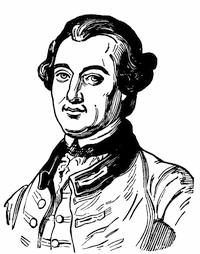
TOWNSHEND.
From Doyle’s Official Baronage, iii. 543.
It has been kept in controversy whether Vaudreuil really directed Ramezay to surrender,[1515] but the note sent by Vaudreuil to Ramezay at nine in the evening, Sept. 13, instructing him to hoist the white flag when his provisions failed, is in N. Y. Col. Docs., x. 1004.
General Townshend returned to England, and when he claimed more than his share of the honors[1516] a Letter to an Honourable Brigadier General (London, 1760) took him sharply to task for it, and rehearsed the story of the fight.[1517] This tract was charged by some upon Charles Lee, but when it was edited by N. W. Simons, in 1841, an attempt by parallelisms of language, etc., was made to prove the authorship of Junius in it. It was answered by A refutation of a letter to an Hon. Brigadier by an officer.[1518] Parkman calls it “angry, but not conclusive.” There were other replies in the Imperial Magazine, 1760. Sabine, in his address, epitomizes the statements of both sides.
On the 17th of January, 1760, Pitt addressed Amherst respecting the campaign of the following season,[1519] and on April 27th Amherst addressed the Indians in a paper dated Fort George, N. Y., April 27.[1520] Letters had passed between Amherst and Johnson in March, about the efforts which were making by a conference at Fort Pitt to quiet the Indians in that direction.[1521] Later there were movements to scour the country lying between Fort Pitt and Presqu’isle, as shown in the Aspinwall Papers,[1522] where[1523] there is a fac-simile of a sketch of the route from Fort Pitt, passing Venango and Le Bœuf, which Bouquet sent to Monckton in August, 1760.
The earliest description of this country after it came into English hands is in a journal (July 7-17, 1760) by Capt. Thomas Hutchins, of the Sixtieth Regiment, describing a march from Fort Pitt to Venango, and from thence to Presqu’isle, which is printed in the Penna. Mag. of Hist. (ii. 849).
Bourlamaque, in a Mémoire sur Canada, which he wrote in 1762, presents Quebec as the key to the military strength of the province.[1524]
The interest of the winter and spring lies in the vigorous efforts of Lévis to recover Quebec. The English commander, Murray, kept a journal from the 18th of September till the 25th of May. The original was in the London War Office, and Miles used a copy from that source. Parkman records it as now being in the Public Record Office,[1525] and says it ends May 17; and the reprint of the Lit. and Hist. Soc. of Quebec credits it to the same source, in their third series (1871).
Parkman[1526] refers to a plan among the King’s Maps (Brit. Mus.) of the battle and situation of the British and French on the Heights of Abraham, 28 April, 1760.
This engagement is sometimes called the battle of Sillery, though the more common designation is the battle of Ste. Foy.
Murray’s despatch to Amherst, April 30, is among the Parkman Papers, and that to Pitt, dated May 25, 1760, is in Hawkins’ Picture of Quebec, and in W. J. Anderson’s Military Operations at Quebec from Sept. 18, 1759, to May 18, 1760, published by the Lit. and Hist. Soc. of Quebec (1869-70), and also separately. It is a critical examination of the sources of information respecting the battle, particularly as to the forces engaged. Parkman (ii., app., p. 442) examines this aspect also.
We have on the English side the recitals of several eye-witnesses. Knox[1527] was such. So were Mante, Fraser, and Johnson; the journals of the last two are those mentioned on a preceding page. Parkman, who gives a list of authorities,[1528] refers to a letter of an officer of the Royal Americans at Quebec, May 24, 1760, printed in the London Magazine, and other contemporary accounts are in the Gentleman’s and English Magazine (1760). There is also a letter in the N. Y. Geneal. and Biog. Record, April, 1872, p. 94.
The principal French contemporary account is that of Lévis, Guerre du Canada, Relation de la seconde Bataille de Québec et du Siége de cette ville,—a manuscript which, according to Parkman, has different titles in different copies, and some variations in text. Vaudreuil’s instructions to Lévis are in the N. Y. Col. Docs., x. 1069. There is a journal of the battle annexed to Vaudreuil’s letter to Berryer, May 3, 1760, in N. Y. Col. Docs., x. 1075, 1077. The Parkman MSS. have also letters of Bourlamaque and Lévis, and there is something to be gleaned from Chevalier Johnston and the Relation of the hospital nun, already referred to.
Of the modern accounts by the Canadian historians, Lemoine[1529] calls that of Garneau[1530] the best, and speaks of it as collated from documents, many of which had never then (1876) seen the light. Smith takes a view quite opposite to Garneau’s, and Lemoine[1531] charges him with glossing over the subject “with striking levity.”[1532]
Col. John Montresor was in the force which Murray led up the river to Montreal, and we have his journal, July 14-Sept. 8, 1760, in the N. Y. Hist. Soc. Coll., 1881, p. 236.
For the progress of the converging armies of Amherst and Haviland, there are the histories of Mante and Knox and the journals of Rogers. Parkman adds a tract printed in Boston (1760), All Canada in the hands of the English. Beside the official documents of the Parkman MSS., he also cites a Diary of a sergeant in the army of Haviland, and a Journal of Colonel Nathaniel Woodhull.[1533] There is a glimpse of the condition of the country to be got from the Travels and Adventures of Alexander Henry in Canada and the Indian territory, 1760-1776 (New York, 1809).
Amherst’s letter to Monckton on the capture of Fort Lévis is in the Aspinwall Papers (Mass. Hist. Soc. Coll., xxxix. 307), and reference may be made to Pouchot (ii. 264), Mante (303), and Knox (ii. 405).[1534]
Parkman uses the Procès verbal of the council of war which Vaudreuil held in Montreal; and the terms of the capitulation (Sept. 8, 1760) can be found in N. Y. Col. Docs., x. 1107; Miles’ Canada, 502; Bonnechose’s Montcalm et le Canada (app.); and Martin’s De Montcalm en Canada (p. 327), and his Marquis de Montcalm (p. 321).
The protest which Lévis uttered against the terms of the capitulation is in the N. Y. Col. Docs., x. 1106, with his reasons for it (p. 1123).
The circular letter about the capitulation which Amherst sent to the governors of the colonies is in the Aspinwall Papers.[1535]
Parkman’s[1536] is the best recent account of this campaign, though it is dwelt upon at some length by Smith and Warburton.
Gage was left in command at Montreal; Murray returned to Quebec with 4,000 men; while Amherst, by the last of September, was in New York.[1537]
Rogers’s own Journals make the best account of his expeditions westward[1538] to receive the surrender of Detroit and the extremer posts. Parkman, who tells the story in his Pontiac (ch. 6), speaks of the journals as showing “the incidents of each day, minuted down in a dry, unambitious style, bearing the clear impress of truth.” Rogers also describes the interview with Pontiac in his Concise Account of North America, Lond., 1765. Cf. Aspinwall Papers (Mass. Hist. Soc. Coll., xxxix. 362) for Croghan’s journal[1539] and (Ibid., pp. 357, 387) for letters on the surrender of Detroit.[1540]
Later Lieutenant Brehm was sent as a scout from Montreal to Lake Huron, thence to Fort Pitt, and his report to Amherst, dated Feb. 23, 1761, is in the N. E. Hist. and Geneal. Reg., 1883, p. 22.
Philippe Aubert de Gaspé, in Les Anciens Canadiens (1863), attempts, as he says, to portray the misfortunes which the conquest brought on the greater portion of the Canadian noblesse.[1541] There is a sad story of the shipwreck on Cape Breton of the “Auguste,” which in 1761 was bearing a company of these expatriated Canadians to France, and one of them, M. de la Corne Saint-Luc, has left a Journal du Naufrage de l’Auguste, which has been printed in Quebec.[1542]
The trials of Bigot and the others in Paris elicited a large amount of details respecting the enormities which had characterized the commissary affairs of Canada during the war. Cf. “Observations on certain peculations in New France,” in N. Y. Col. Docs., x. 1129. There is in Harvard College library a series of the printed reports and judgments in the matter.[1543]
Mr. Parkman has published in The Nation (Apr. 15, 1886) an account of a MS. lately acquired by the national library at Paris, Voyage au Canada dans le Nord de l’Amérique Septentrionale fait depuis l’an 1751 à 1761 par T. C. B., who participated in some of the battles of the war; but the account seems to add little of consequence to existing knowledge, having been written (as he says, from notes) thirty or forty years after his return. It shows, however, how the army store-keepers of the French made large fortunes and lost them in the depreciation of the Canadian paper money.

NOTES.
A. Intercolonial Congresses and Plans of Union.—The confederacy which had been formed among the New England colonies in 1643 had lasted, with more or less effect, during the continuance of the colonial charter of Massachusetts.[1544] As early as 1682 Culpepper, of Virginia, had proposed that no colony should make war without the concurrence of Virginia, and Nicholson, eight or ten years later, had advocated a federation. In 1684 there had been a convention at Albany, at which representatives of Massachusetts, New York, Maryland, and Virginia had met the sachems of the Five Nations.[1545] In 1693 Governor Fletcher, by order of the king, had called at New York a meeting of commissioners of the colonies, which proved abortive. Those who came would not act, because others did not come. In 1694 commissioners met at Albany to frame a treaty with the Five Nations, and Massachusetts, Connecticut, New York, and New Jersey were represented. A journal of Benjamin Wadsworth, who accompanied the Massachusetts delegates, is printed in the Mass. Hist. Collections, xxii. 102. This journal was used by Holmes in his Amer. Annals, 2d ed., i. p. 451.
Such were the practical efforts at consolidating power for the common defence, which the colonies had taken part in up to the end of the seventeenth century. We now begin to encounter various theoretical plans for more permanent unions.[1546] In 1698 William Penn devised a scheme which is printed in the New York Colonial Documents, iv. 296. In the same year Charles Davenant prepared a plan which is found in Davenant’s Political and Commercial Works, vol. ii. p. 11.[1547] In 1701 we find a plan, by a Virginian, set forth in an Essay upon the government of the English plantations;[1548] and one of the same year (May 13, 1701) by Robert Livingston, suggesting three different unions, is noted in the N. Y. Col. Docs., iv. 874.
In 1709 another temporary emergency revived the subject. Colonel Vetch convened the governors of New England at New London (Oct. 14) for a concert of action in a proposed expedition against Canada, but the failure of the fleet to arrive from England cut short all effort.[1549] Again in 1711 (June 21) the governors of New England assembled at the same place, to determine the quotas of their respective colonies for the Canada expedition, planned by Nicholson; and later in the year, the same New England governments invited New York to another conference, but it came to naught.
In 1721 there was a plan to place a captain-general over the colonies. (Cf. a Representation of the Lords of Trade to the King, in N. Y. Col. Docs., v. p. 591.)
On Sept. 10, 1722, Albany was the scene of another congress, at which Pennsylvania and New York joined to renew a league with the Five Nations; and a few days later (Sept. 14), Virginia having joined them, they renewed the conference. (Cf. N. Y. Col. Docs., v. 567.)
The same year, 1722, Daniel Coxe,[1550] in his Carolana, offered another theory of union.
In June, 1744, George Clinton, of New York, submitted to a convocation of deputies from Massachusetts a plan of union something like the early New England confederacy. The Six Nations sent their sachems.
On July 23, 1748, there was another conference for mutual support at Albany, at which the Six Nations met the deputies of New York and Massachusetts.
In 1751, Clinton, of New York, invited representatives of all the colonies from New Hampshire to South Carolina to meet the Six Nations for compacting a league. The journal of the commissioners is in the Mass. Archives, xxxviii. 160.[1551]
In 1751, Archibald Kennedy, in his tract The importance of gaining and preserving the friendship of the Indians to the British interest considered, N. Y., 1751, and London, 1752 (Carter-Brown, iii. 955, 975), developed a plan of his own.[1552]
In 1752 Governor Dinwiddie advocated distinct northern and southern confederacies.
In June, 1754, the most important of all these congresses convened at Albany,[1553] under an order from the home government. The chief instigator of a union was Shirley,[1554] and the most important personage in the congress was Benjamin Franklin, who was chiefly instrumental in framing the plan finally adopted, though it failed in the end of the royal sanction as too subversive of the royal prerogative, while it lost the support of the several assemblies in the colonies because too careful of the same prerogative. Franklin himself later thought it must have hit a happy and practicable mean, from this diversity of view in the crown and in the subject.
This plan, as it originally lay in Franklin’s mind, is embodied in his “Short Hints towards a Scheme for uniting the Northern Colonies,” which is printed in Franklin’s Works.[1555] This draft Franklin submitted to James Alexander and Cadwallader Colden, and their comments are given in Ibid., pp. 28, 30, as well as Franklin’s own incomplete paper (p. 32) in explanation.
It was Franklin’s plan, amended a little, which finally met with the approval of all the commissioners except those from Connecticut.
This final plan is printed, accompanied by “reasons and motives for each article,” in Sparks’s ed. of Franklin’s Works, i. 36.[1556]
An original MS. journal of the congress is noted in the Carter-Brown Catalogue, iii. no. 1,067. The proceedings have been printed in O’Callaghan’s Doc. Hist. N. Y., ii. 545; in the N. Y. Col. Docs., vi. 853; in Pennsylvania Col. Records, vi. 57; and in the Mass. Hist. Soc. Collections, xxv. p. 5, but this last lacks the last day’s proceedings. Cf. rough drafts of plans in Mass. Hist. Coll., vii. 203, and Penna. Archives, ii. 197; also see Penna. Col. Rec., v. 30-97. There are some contemporary extracts from the proceedings of the congress of 1754 in a volume of Letters and Papers, iv. (1721-1760), in Mass. Hist. Soc. Library.
We have four accounts of the congress from those who were members.[1557]
Pownall read (July 11, 1754) at the congress a paper embracing “Considerations towards a general plan of measures for the colonies,” which is printed in N. Y. Col. Docs., vi. 893, and in Penna. Archives, 2d ser., vi. 197.
At the same time William Johnson brought forward a paper suggesting “Measures necessary to be taken with the Six Nations for defeating the designs of the French.” It is printed in N. Y. Col. Docs., vi. 897; Penna. Archives, 2d ser., vi. 203.
Shirley (Oct. 21, 1754) wrote to Morris, of Pennsylvania, urging him to press acquiescence in the plan of union. (Penna. Archives, ii. 181.)
Shirley’s own comments on the Albany plan are found in his letter, dated Boston, Dec. 24, 1754, and directed to Sir Thos. Robinson, which is printed in the Penna. Archives, 2d ser., vi. 213, and in N. Y. Col. Docs., vi. 930. During this December Franklin was in Boston, and Shirley showed to him the plan, which the government had proposed, looking to taxing the colonies for the expense of maintaining the proposed union. Franklin met the scheme with some letters, afterwards brought into prominence when taxation without representation was practically enforced. These Franklin letters were printed in a London periodical in 1766, and again in Almon’s Remembrancer in 1776. They can best be found in Sparks’s ed. of Franklin’s Works, vol. iii. p. 56.[1558]
Livingston’s references to the congress are in his Review of Military Operations (Mass. Hist. Soc. Coll., vii. 76, 77).
A list of the delegates to the congress is given in Franklin’s Works, iii. 28, in Foster’s Stephen Hopkins, ii. 226, and elsewhere.
The report of the commissioners on the part of Rhode Island is printed in the R. I. Col. Records, v. 393. The report of the commissioners of Connecticut, with the reasons for rejecting the plan of the congress, is in Mass. Hist. Soc. Coll., vii. 207, 210.
There is much about the congress in the Doc. Hist. New York, i. 553-54; ii. 545, 564, 570-71, 589-91, 605, 611-15, 672.
Of the later accounts, that given by Richard Frothingham in his Rise of the Republic is the most extensive and most satisfactory.[1559]
After the Albany plan had been rejected by the Massachusetts assembly, another plan, the MS. of which in Hutchinson’s hand exists in the Mass. Archives, vi. 171,[1560] was brought forward in the legislature. It was intended to include all the colonies except Nova Scotia and Georgia. It failed of acceptance. It is printed in the appendix of Frothingham’s Rise of the Republic.
Pownall suggested, in his Administration of the Colonies, a plan for establishing barrier colonies beyond the Alleghanies, settling them with a population inured to danger, so that they could serve as protectors of the older colonies, in averting the enemy’s attacks. Franklin shared his views in this respect. (Cf. Franklin’s Works, iii. 69, and also Pennsylvania Archives, ii. 301, vi. 197.)
Among the Shelburne Papers (Hist. MSS. Commissioners’ Report, no. 5, p. 218) is a paper dated at Whitehall, Oct. 29, 1754, commenting upon the Albany congress, and called “A Representation[1561] to the King of the State of the Colonies,” and “A Plan for the Union of the Colonies,” signed August 9, 1754, by Halifax and others.[1562] This was the plan already referred to, presented by the ministry in lieu of the one proposed at Albany, which had been denied. Bancroft (United States, orig. ed., iv. 166) calls it “despotic, complicated, and impracticable.” It is named in the draft printed in the New Jersey Archives, 1st ser., viii., Part 2d, p. 1, as a “Plan by the Lords of Trade of general concert and mutual defence to be entered into by the colonies in America.”
In the interval before it became a serious question of combining against the mother country, two other plans for union were urged. John Mitchell (Contest in America) in 1757 proposed triple confederacies, and in 1760 a plan was brought forward by Samuel Johnson. (N. Y. Col. Docs., vii. 438.)
B. Cartography of the St. Lawrence and the Lakes in the Eighteenth Century.—Various extensive maps of the St. Lawrence River were made in the eighteenth century. Chief among them may be named the following:—
There is noted in the Catal. of the Lib. of Parliament (Toronto, 1858, p. 1619, no. 65) a MS. map of the St. Lawrence from below Montreal to Lake Erie, which is called “excellent à consulter,” and dated 1728.
Popple’s, in 1730, of which a reduction is given in Cassell’s United States, i. 420.
A “Carte des lacs du Canada, par N. Bellin, 1744,” is in Charlevoix, iii. 276.
A map of Lake Ontario by Labroguerie (1757) is noted in the Catal. of the King’s Maps (Brit. Mus.), ii. 112.
General Amherst caused sectional maps to be made by Captain Holland and others, which are noted in the Catal. of the King’s Maps (Brit. Mus.), i. 608.
Subsequent to the conquest of 1760, General Murray directed Montresor to make a map of the St. Lawrence from Montreal to St. Barnaby Island. This is preserved. (Trans. Lit. and Hist. Soc. of Quebec, 1872-73, p. 99.)
Maps in Bellin’s Petit Atlas Maritime, 1764 (nos. 4 to 8).
Jefferys’ map of the river from Quebec down, added to a section above Quebec, based on D’Anville’s map of 1755, is in Jefferys’ Gen. Topog. of North America, etc., 1768, nos. 16, 17.
The edition of 1775 is called An exact Chart of the River St. Lawrence from Fort Frontenac to Anticosti (and Part of the Western Coast of the Gulf of St. Lawrence), showing the Soundings, Rocks, and Shoals, with all necessary Instructions for navigating the River, with Views of the Land, etc., by T. Jefferys. It measures 24 × 37 inches, and has particular Charts of the Seven Islands; St. Nicholas, or English Harbor; the Road of Tadoussac; Traverse, or Passage from Cape Torment.
A map engraved by T. Kitchen, in Mante’s Hist. of the Late War, London, 1772, p. 30, shows the river from Lake Ontario to its mouth, defining on the lake the positions of Forts Niagara, Oswego, and Frontenac; and (p. 333) is one giving the course of the river below Montreal.
In the Atlantic Neptune of Des Barres, 1781, Part ii. no. 1, is the St. Lawrence in three sheets, from Quebec to the gulf; Part ii., no. 16, has the same extent, on a larger scale, in four sheets; Part ii., Additional Charts, no. 8, gives the river from the Chaudière to Lake St. Francis, in six sheets, as surveyed by Samuel Holland.
Moll made a survey of the Gulf of St. Lawrence in 1729. The most elaborate map is that of Jefferys (1775), which measures 20 × 24 inches, and is called Chart of the Gulf of St. Lawrence, composed from a great number of Actual Surveys and other Materials, regulated and connected by Astronomical Observations.
There is a chart of Chaleur Bay in the North American Pilot (1760), nos. 14, 15; and of the Saguenay River, by N. Bellin, in Charlevoix, iii. 64.
C. The Peace of 1763.—The events in Europe which led to the downfall of Pitt and to the negotiations for peace are best portrayed among American historians in Parkman[1563] and Bancroft.[1564]
The leading English historians (Stanhope, etc.) can be supplemented by the Bedford Correspondence, vol. iii. Various claims and concessions, made respectively by the English and French governments, are printed from the official records in Mills’ Boundaries of Ontario (App., p. 209, etc.). See also the Mémoire historique sur la négociation de la France et de l’Angleterre depuis le 26 Mars, 1761, jusqu’au 20 septembre de la même année, avec les pièces justificatives, Paris, 1761.[1565]
As soon as Quebec had surrendered there grew a party in England who put Canada as a light weight in the scales, in comparison with Guadaloupe, in balancing the territorial claims to be settled in defining the terms of a peace. The controversy which followed produced numerous pamphlets, some of which may be mentioned.[1566]
The surrender of Canada was insisted upon in 1760 in a Letter addressed to two great men on the prospect of peace, and on the terms necessary to be insisted upon in the negotiation (London); and the arguments were largely sustained in William Burke’s Remarks on the Letter addressed to two great men (London, 1760), both of which pamphlets passed to later editions.[1567]
Franklin, then in London, complimented the writers of these tracts on the unusual “decency and politeness” which they exhibited amid the party rancor of the time. This was in a voluminous tract, which he then issued, called Interest of Great Britain considered with regard to her colonies and the acquisition of Canada and Guadaloupe, London, 1760.[1568] In this he repelled the intimation that there was any disposition on the part of the Americans to combine to throw off their allegiance to the crown, though such views were not wholly unrife in England or in the colonies.[1569] He also advocated, in a way that Burke called “the ablest, the most ingenious, the most dexterous on that side,” for the retention of Canada, insisting that peace in North America, if not in Europe, could only be made secure by British occupancy of that region.[1570]
The preliminaries of peace having been agreed upon in November, 1762, and laid before Parliament, the discussion was revived.[1571] The ratification, however, came in due course,[1572] and the royal proclamation was made Oct. 7, 1763.[1573]
D. The General Contemporary Sources Of the War, 1754-1760.—During the war and immediately following it, there were a number of English reviews of its progress and estimates of its effects, which either reflect the current opinions or give contemporary record of its events.
Such are the following:—
John Mitchell’s Contest in America between Great Britain and France, with its consequences and importance, London, 1757.[1574] It was published as by “an impartial hand.”
W. H. Dilworth’s History of the present War to the conclusion of the year 1759, London, 1760.[1575]
Peter Williamson’s Brief account of the War in North America, containing several very remarkable particulars relative to the natural dispositions, tempers, and inclinations of the unpolished savages, not taken notice of in any other history, Edinburgh, 1760,[1576]—a book of no value, except as incidentally illustrating the dangers of partisan warfare.
A review of Mr. Pitt’s Administration, second edition, with alterations and additions, London, 1763. This particularly concerns that minister’s policy in America.
John Dobson’s Chronological Annals of the War (Apr. 2, 1755, to the signing of the preliminaries of peace), Oxford, 1763.[1577]
John Entick’s General History of the late War ... in Europe, Asia, Africa, and America, London, 1764, 5 vols.[1578] The author was a schoolmaster and maker of books. Some contemporary critics speak disparagingly of the book. It includes numerous portraits and maps.
History of the late War from 1749 to 1763. Glasgow, 1765.
J. Wright’s Complete History of the late War, or Annual Register of its rise, progress, and events in Europe, Asia, Africa, and America. Illustrated with heads, plans, maps, and charts. London, 1765.[1579]
Capt. John Knox’s Historical Journal of the campaigns in North America for the years 1757, 1758, 1759, and 1760, containing the most remarkable occurrences, the orders of the admirals and general officers, descriptions of the country, diaries of the weather, manifestos, the French orders and disposition for the defence of the colony, London, 1769, 2 vols.[1580]
The beginning, progress, and conclusion of the late War, London, 1770.[1581]
Thomas Mante’s History of the late War in North America, including the campaign of 1763 and 1764 against his Majesty’s Indian enemies, London, 1772. Mante was an engineer officer in the service, but he did not share in the war till the last year of it.[1582] The book has eighteen large maps and plates. It has been praised by Bancroft and Sparks.
As a supplement to the accounts of the war, we may place Major Robert Rogers’s Concise account of North America, London, 1765;[1583] a description of the country, particularly of use as regards the region beyond the Alleghanies, with accounts of the Indians.
The best contemporary English monthly record before 1758 is to be found in the Gentleman’s Mag., but occasional references should be made to other magazines.[1584] After 1758 the monthly accounts yield in value to the yearly summary of Dodsley’s Annual Register.
Respecting the French territory of North America, the readiest English account is Thomas Jefferys’ Natural and Civil History of the French Dominions in North and South America, London, 1760.[1585] Charlevoix is largely used in the compilation of this work, without acknowledgment.
Foremost among the special histories of the war, which were contemporary on the French side, is the Mémoires sur la dernière guerre de l’Amérique Septentrionale, written by Pouchot, of the regiment of Bearn, who twice surrendered his post, at Niagara and Lévis. The book bears the imprint of Yverdon, 1781,[1586] is in three volumes, and has been published in an English version with the following title:—
Memoir upon the late war in North America, between the French and English, 1755-60, followed by observations upon the theatre of actual war, and by new details concerning the manners and customs of the Indians, with topographical maps, by M. Pouchot, translated by Franklin B. Hough, with additional notes and illustrations. Roxbury, Massachusetts. 1866.[1587] 2 vols.
The Literary and Historical Society of Quebec[1588] published in 1838 contemporary Mémoires sur le Canada, 1749-1760, avec cartes et plans. It was reprinted in 1876. The original MS. has a secondary title, “Mémoires du S—— de C——, contenant l’histoire du Canada durant la guerre et sous le gouvernement anglais.” The introduction to it as printed suggests that its author was M. de Vauclain, an officer of marine in 1759.
Concerning the Histoire de la guerre contre les Anglois, Geneva, 1759-60, two volumes, Rich[1589] says it relates almost entirely to the war in America, and cites Barbier as giving the authorship to Poullin de Lumina.[1590]
There is a contemporary account of the campaigns, 1754-58, preserved in the Archives de la Guerre at Paris, which is ascribed to the Chevalier de Montreuil, and is given in English in the N. Y. Col. Docs., x. 912. In the Penna. Archives, 2d ser., vi. 439, it is made a part of an extensive series of documents relating to the period of the French occupation of western Pennsylvania.
Among the Parkman MSS. is a series called New France, 1748-1763, in twelve volumes, mainly transcripts from the French Archives, with copies of some private papers, all supplementing the selection which Dr. O’Callaghan printed in his N. Y. Col. Docs., vol. x.
The papers of this period make a part of the review given by Edmond Lareau in his “Nos Archives,” in the Revue Canadienne, xii. 208, 295, 347. A paper on the “Archives of Canada,” by a former president of the Lit. and Hist. Society of Quebec, Dr. W. J. Anderson, describes the labors of that society, which have been aided by an appropriation from the government to collect and arrange the historical records.[1591] Of a collection made by Papineau from the Paris Archives, in ten volumes, six were burned in the destruction of the Parliament House in 1849. The transcripts of Paris documents in the Mass. Archives, having been copied for the Province of Quebec, have been included in the publication, issued in four quarto volumes, under the auspices of that province, and called Collection de manuscrits contenant lettres, mémoires, et autres documents historiques relatifs à la Novvelle-France, recueillis aux archives de la province de Québec, ou copiés à l’étranger. Mis en ordre et édités sous les auspices de la législature de Québec. [Edited by J. Blanchet.] (Quebec. 1883-85.)[1592]
It was a stipulation of the capitulation at Montreal in 1760 that all papers held by the French which were necessary for the prosecution of the government should be handed over by the French officials to the victors. These are now supposed to be at Ottawa.[1593]
The papers from the Public Record Office (London) from 1748 to 1763, and referring to Canada, occupy five volumes of the Parkman MSS., in the cabinet of the Mass. Historical Society.[1594]
The State of New York, in its Documentary Hist. of New York and its New York Col. Docs.; New Jersey, in its New Jersey Archives; and Pennsylvania in its Colonial Records and Pennsylvania Archives, have done much to help the student by printing their important documents of the eighteenth century.
In New England, Massachusetts has done nothing in printing; but a large part of her important papers are arranged and indexed, and a commission has been appointed, with an appropriation of $5,000 a year,[1595] to complete the arrangement, and render her documents accessible to the student, and carry out the plan recommended by the same commission,[1596] whose report (Jan., 1885) was printed by the legislature. It gives a synopsis of the mass of papers constituting the archives of Massachusetts. Dr. Geo. H. Moore, in Appendix 5 of his Final Notes on Witchcraft, details what legislative action has taken place in the past respecting the care of these archives.
The other New England States have better cared for their records of the provincial period; New Hampshire having printed her Provincial Papers, Rhode Island and Connecticut their Colonial Records.[1597]
Certain historical summaries—contemporary or nearly so—of the English colonies are necessary to the study of their conditions at the outbreak and during the progress of the war.
First, we have an early French view in George Marie Butel-Dumont’s Histoire et Commerce des Colonies Angloises dans l’Amérique Septentrionale, 1755. A portion of it was issued in London in a translation, as The Present State of North America, Part i.[1598]
The Summary of Douglass has been mentioned elsewhere,[1599] and it ends at too early a date to include the later years of the wars now under consideration.
The work of Edmund Burke, An Account of the European Settlements in America, though published in 1757, was not able to chronicle much of the effects of the war. It has passed through many editions.[1600]
M. Wynne’s General History of the British Empire in America, London, 1770,[1601] 2 vols., is in some parts a compilation not always skilfully done.
Smith’s History of the British Dominions in America was issued anonymously, and Grahame (ii. 253) says of it that it “contains more ample and precise information than the composition of Wynne, and, like it, brings down the history and state of the colonies to the middle of the eighteenth century. It is more of a statistical than a historical work.”
A History of the British Dominions in North America (London, 1773, 2 vols. in quarto) was a bookseller’s speculation, of no great authority, as Rich determined.[1602]
William Russell, the author of a History of America from its discovery to the conclusion of the late war [1763], London, 1778, 2 vols. in quarto, was of Gray’s Inn,[1603]—the same who wrote the History of Modern Europe, which, despite grave defects, has had a long lease of life at the hand of continuators. His America has had a trade success, and has passed through later editions.
A New and Complete History of the British Empire in America (London) is the running-title of a work issued in numbers in London about 1756. It was never completed, and has no title-page.[1604]
Jefferys’ General Topography of North America and the West Indies, London, 1768, has a double title, French and English. It is the earliest publication of what came later to be known as Jefferys’ Atlas, in the issues of which the plates are inferior to the impression in this book.[1605]
The special histories of two of the colonies deserve mention, because their authors lived during the war, and they wrote with authority on some of its aspects. These are Thomas Hutchinson’s Hist. of Massachusetts Bay,[1606] and William Smith’s History of the Province of New York.[1607] The latter book, as published by its author, came down only to 1736, though, being written during the war, he anticipated in his narrative some of its events. He, however, prepared a continuation to 1762, and this was for the first time printed as the second volume of an edition of the work published by the New York Hist. Society in 1829-30. In editing this second volume, the son of the author says that his father was “a prominent actor in the scenes described,” which are in large part, however, the endless quarrels of the executive part of the government of the province with its assembly. Parkman characterizes Smith as a partisan in his views. Smith acknowledges his obligations to Colden for “affairs with the French and Indians, antecedent to the Peace of Ryswick;” and while he follows Colden in matters relating to the English, he appeals to Charlevoix for the French transactions.[1608]
Two special eclectic maps of the campaigns of the war may be mentioned:—
Bonnechose, in his Montcalm et le Canada Français, 5th ed., Paris, 1882, gives a “Carte au théâtre des opérations militaires du Mr. de Montcalm, d’après les documents de l’époque.”
In L. Dussieux’s Le Canada sous la domination française (Paris, 1855) is a general map “pour servir a l’histoire de la Nouvelle France, ou du Canada, jusqu’en 1763, dressées principalement d’après des matériaux inédits conservés dans les Archives du ministère de la Marine, par L. Dussieux, 1851.”
As an instance of the curious, perverse error which could be made to do duty for cartographical aids, reference may be made to a publication of Georg Cristoph Kilian, of Augsburg, in 1760, entitled Americanische Urquelle derer innerlichen Kriege des bedrängten Teutschlands ... historisch verfasset durch L. F. v. d. H.
E. The General Historians of the French and English Colonies.—The bibliography of the general histories of Canada has been already attempted,[1609] and to the sources of such bibliography then given may be added M. Edmond Lareau’s Histoire de la Littérature Canadienne (Montreal, 1874), for its chapter (4th) on Canadian historians; and Mr. J. C. Dent’s Last forty years of Canada (1881), for its review of the historians in its chapter on “Literature and Journalism.” New France and her New England historians is the subject of a paper in the Southern Review (new series, xviii. 337).
It is not necessary here to repeat in detail the enumeration of the historians, both French and English, which have been thus referred to.
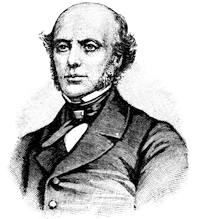
GARNEAU.
After a likeness in Daniel’s Nos Gloires Nationales, ii. p. 107. There is another portrait in his Hist. du Canada, 4th ed., Montreal, 1883, in connection with a memoir of its author.
The leading historian of Canada in the French interests is, without question, François Xavier Garneau, the earlier editions of whose Histoire du Canada depuis sa découverte jusqu’à nos jours have been mentioned elsewhere;[1610] the final revision of which, however, has since appeared at Montreal (1882-83) in a fourth edition in four volumes, accompanied by a “notice biographique” by Chauveau.[1611] English writers question his clearness of vision, when his national sympathies are evoked by his story, and there are some instances in which they accuse him of garbling his authorities. It must be confessed, however, that the disasters of the French do not always elicit Garneau’s sympathy, and his own compatriots have not all approved his reflections upon Montcalm for his last campaign.
Among the later of the French writers on the closing years of the French domination, Mr. J. M. Lemoine, of Quebec, is conspicuous. Such of his writings as are in English have been gathered in part from periodicals, and principal among them are his Quebec Past and Present, and its sequel, Picturesque Quebec, beside his collection of Maple Leaves, in two series (Quebec, 1863, 1873).[1612]
Jean Langevin delivered at the Canadian Institute, in Quebec, a series of lectures on “Canada sous la domination française” (1659-1759), which have appeared in the Journal de Québec.
The latest of the French chronicles are Eugène Réveillaud’s Histoire du Canada et des Canadiens français de la découverte jusqu’à nos jours, Paris, 1884 (pp. 551, with map), and Benjamin Sulte’s Histoire des Canadiens français, 1608-1880 (Montreal, 1882-1884), in eight thin quarto volumes, with illustrations, including portraits of the Canadian historians and antiquaries, Pierre Boucher, Jacques Viger, Garneau, L. J. Papineau, Michel Bibaud, Aubert de Gaspé, Ferland, Abbé Casgrain, and E. Rameau.
The Abbé J. A. Maurault’s Histoire des Abénakis depuis 1605 jusqu’à nos jours, Quebec, 1866, covers portions of the wars of Canada in which those Indians took part.
The American Annals of Dr. Abiel Holmes was published in Cambridge (Mass.) in 1805. It is a book still to inspire confidence, and “the first authoritative work from an American pen which covered the whole field of American history.”[1613] Libraries in America were then scant, but the annalist traced where he could his facts to original sources, and when he issued his second edition, in 1829, its revision and continuation showed how he had availed himself of the stores of the Ebeling and other collections which in the interval had enriched the libraries of Harvard College and Boston. Grahame[1614] gives the book no more than just praise when he calls it perhaps “the most excellent chronological digest that any nation has ever possessed.”
The history of the colonies, which formed an introduction to Marshall’s Life of Washington, was republished in Philadelphia in 1824, as History of the Colonies planted by the English on the Continent of North America to the commencement of that war which terminated in their independence.
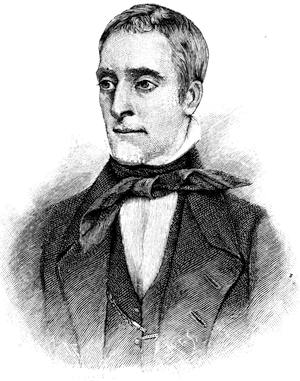
JAMES GRAHAME.
After the engraving in the Boston ed. of his History.
James Grahame was a Scotchman, born in 1790, an advocate at the Scottish bar, and a writer for the reviews. By his religious and political training he had the spirit of the Covenanters and the ideas of a republican. In 1824 he began to think of writing the history of the United States, and soon after entered upon the work, the progress of which a journal kept by him, and now in the library of Harvard College, records. In Feb., 1827, the first two volumes, bringing the story down to the period of the English revolution, were published,[1615] and met with neglect from the chief English reviews. As he went on he had access to the material which George Chalmers had collected. He finished the work in Dec., 1829; but before he published these closing sections a considerate notice of the earlier two volumes appeared in January, 1831, in the North American Review, the first considerable recognition which he had received. It encouraged him in the more careful revision of the later volumes, which he was now engaged upon, and in Jan., 1836, they were published.[1616] His health prevented his continuing his studies into the period of the American Revolution. In 1837 Mr. Bancroft had in his History (ii. 64) animadverted on the term “baseness,” which Grahame in his earliest volumes had applied to John Clarke, who had procured for Rhode Island its charter of 1663, charging Grahame with having invented the allegations which induced him to be so severe on Clarke. Mr. Robert Walsh and Mr. Grahame himself repelled the insinuation in The New York American, and a later edition of Mr. Bancroft’s volume changed the expression from “invention” to “unwarranted misapprehension,” and Mr. Grahame subsequently withdrew the term “baseness,” which had offended the local pride of the Rhode Islanders, and wrote “with a suppleness of adroit servility.” It is not apparent that either historian sacrificed much of his original intention. Josiah Quincy defends Grahame’s view in a note to his memoir of the historian prefixed to the Boston edition of his History, in which Grahame had said he was incapable of such dishonesty as Bancroft had charged upon him. Bancroft wrote in March, 1846, a letter to the Boston Courier, calling the retort of Grahame a “groundless attack,” and charging Quincy, who had edited the new edition of Grahame, with giving publicity to Grahame’s personal criminations. Quincy replied in a pamphlet, The Memory of the late James Grahame, Historian, vindicated from the charges of Detraction and Calumny, preferred against him by Mr. George Bancroft, and the Conduct of Mr. Bancroft towards that Historian stated and exposed, in which use was also made of material furnished by the Grahame family, and thought to implicate Mr. Bancroft in literary jealousy of his rival.[1617] Grahame was not better satisfied with the view which Mr. Quincy had taken of the character of the Mathers in his History of Harvard University. “The Mathers are very dear to me,” Grahame wrote to Quincy, “and you attack them with a severity the more painful to me that I am unable to demur to its justice. I would fain think that you do not make sufficient allowance for the spirit of their times.” This difference, however, did not disturb the literary amenities of their relations; and Grahame, in 1839, demurred against Walsh’s proposition to republish his History in Philadelphia, for fear he might be seeming to seek a rivalry with Mr. Bancroft on his own soil. Three years later, July 3, 1842, Mr. Grahame died, leaving behind him a corrected and enlarged copy of his History. Subsequently this copy was sent by his family for deposit in the library of Harvard College, and from it, under the main supervision of Josiah Quincy, but with the friendly countenance of Judge Story and of Messrs. James Savage, Jared Sparks, and William H. Prescott, an American edition of The History of the United States of North America, from the Plantation of the British Colonies till their Assumption of National Independence, in four volumes, was published in Boston in 1845, accompanied by an engraved portrait after Healy.
Excluding Parkman’s series of histories, upon which it is not necessary to enlarge here after the constant use made of them in the critical parts of the present volume, the most considerable English work to be compared with his is Major George Warburton’s Conquest of Canada, edited by Eliot Warburton, and published in London in two volumes in 1849, and reprinted in New York in 1850. He surveys the whole course of Canadian history, but was content with its printed sources, as they were accessible forty years ago.
Among the other general American historians it is enough to mention in addition Bancroft,[1618] Hildreth,[1619] and Gay;[1620] and among the English, Smollett,[1621] who had little but the published despatches, as they reached England at the time, and Mahon (Stanhope), who availed himself of more deliberate research, but his field did not admit of great enlargement.[1622] The Exodus of the Western Nations, by Viscount Bury, is not wholly satisfactory in its treatment of authorities.[1623]
Henry Cabot Lodge’s Short History of the English Colonies (N. Y., 1881) has for its main purpose a presentation of the social and institutional condition of the English colonies at the period of the Stamp Act Congress in 1765; and the condensed sketches of the earlier history of each colony, which he has introduced, were imposed on the general plan, rather unadvisedly, to fill the requirements of the title. He says of these chapters: “They make no pretence to original research, but are merely my own presentation of facts, which ought to be familiar to every one.”
F. Bibliography of the Northwest.—Concerning the historical literature of the States of the upper lake region and the upper Mississippi, a statement is made in Vol. IV. p. 198, etc. Since that was written some additions of importance have been made. The Northwest Review, a biographical and historical monthly, was begun at Minneapolis in March, 1883; but it ceased after the second number. In Nov., 1884, there appeared the first number of the Magazine of Western History, at Cleveland.
The two most important monographs to be added to the list are:—
S. Breese’s Early history of Illinois, from 1673 to 1763, including the narrative of Marquette’s discovery of the Mississippi. With a biographical memoir by M. W. Fuller. Edited by T. Hoyne. Chicago, 1884; and Silas Farmer’s History of Detroit and Michigan: a chronological cyclopædia of the past and present, including a record of the territorial days in Michigan and the annals of Wayne county. Detroit, 1884,—the latter the most important local history yet produced in the West. The first volume of the Final Report of the Geological Survey of Minnesota, by Winchell, adds something to the early cartography of the region, and gives an historical chart of Minnesota, showing the geographical names and their dates, since 1841. The Historical Society of Minnesota has added a fifth volume (1885) to the Collections, which is largely given to the history of the Ojibways.
The Historical Society of Iowa having ceased to publish the Annals of Iowa in 1874 (1863-1874, in 12 vols.), a new series was begun in 1882 by S. S. Howe, but the society declined to make it an official publication, and began the issue of a quarterly Iowa Historical Record in 1885.
On the Canada side the Historical and Scientific Society of Manitoba have been issuing since 1882, at Winnipeg, its Reports, Publications, and Transactions.