Chapter II · (continued 2)
Reading edition
The House set up a claim to audit all bills for which they granted money, and attaching such a proviso to their grants, such votes successively received the governor’s veto. This denied the public officers their salaries, and occasioned distress that the home government was besought to alleviate. The governor’s position was confirmed, and when the news of it came the House somewhat ludicrously asked him to appoint a day of fasting and prayer, since they were under such a “divine displeasure.” The governor thought the matter more mundane than divine, and refused. So in the autumn of 1733 the House saved its pride one forenoon by passing a bill with the proviso, and in the afternoon satisfied its sense of expediency by reversing the vote. Thus the delegates in their ungraceful way succumbed, as the governor did two years later, respecting the salary question. Each side was humbled, and affairs went smoothly for a while, though the depreciation of the paper in which the governor was paid did not quite fill the measure of his content.[266]
Commercial distress always conduces to emotional disturbance in a community, and the history of the “Great Awakening,” as it was called, is no exception to the rule. This religious revival began to make itself felt in 1734, under an impulse from Jonathan Edwards,[267] and later, under the ministrations of George Whitefield, the wild passion—for it became scarce else—spread through the churches and communities of New England.[268]
Mather Byles, Judge Danforth, and Thomas Prince supported the movement in the New England Weekly Journal. Thomas Foxcroft and others, reinforced by a large part of the country ministers, fought the battle in sermon and pamphlet. Benjamin Colman gave the movement a qualified commendation. It found various classes of opponents. Charles Chauncy condemned it for its hot-bed sustenance, its “commotion in the passions,” and its precarious growth.[269] Thomas Fleet, the publisher of children’s books, turned the wit which enlivened his evening vendu at the Heart and Crown, in Cornhill, into the columns of the Boston Evening Post, which he had just started. Here he held up Whitefield to ridicule, just as Joseph Green and other wits held up in the same place the pomp of Belcher to public derision. Dr. Douglass[270] reckoned up the thousand pounds sterling that were lost to the families of working people by what he called a misuse of time in attending the midday mass-meetings, to which Whitefield ministered. The passion and fervor swelled, lapsed, returned, dwindled, and died; some counted the wrecks it left, some wondered at its transient impressiveness, and a few occasionally struggled to revive it.[271] Amid all the consternation attending what William Cooper in the election sermon of 1740 called “an empty treasury, a defenceless country and embarrassed trade,” New England managed to raise 1,000 men to send off to join the fleet of Admiral Vernon in the West India waters. Scarce a hundred of them ever returned.[272]
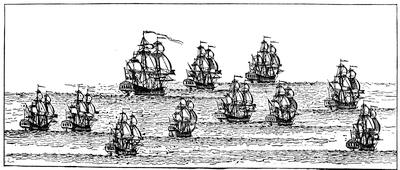
AN ENGLISH FLEET OF THIS PERIOD.
From Popple’s great map, The British Empire in North America, 1732. Admiral Preble says in his “Vessels of war built at Portsmouth” (N. E. Hist. and Gen. Reg., 1868, p. 393) that the “Falkland” was built in 1690, and carried 54 guns; but in some MS. emendations in the copy of his paper in the library of the Mass. Hist. Soc., he says she was probably built between 1694 and 1696. She is considered to be the earliest man-of-war built in the colonies. Within a short time after 1743, three vessels were built in New England for the royal navy,—the “America,” “Boston,” and “Essex.” The same writer, in The United Service, January, 1884, p. 98, etc., describing the changes in armament of vessels during the 18th century, defines ships-of-the-line as carrying 50 guns or more on three decks; frigates, 20 to 50 guns on two decks. Sloops-of-war with guns on one deck, and corvettes with guns on the poop and forecastle only, came in later.
The social life of the chief town of New England passed on, meanwhile, in the shadow of these ominous uncertainties. Jeremy Gridley had as early as 1731 started The Weekly Rehearsal, and had given the more scholarly classes this to ponder upon, and that to be entertained with, in columns more purely literary than they had ever known before. If such people welcomed the poems of Isaac Watts,—and one which Watts addressed to Belcher was just now printed in Boston,—they caused Richard Fry, an English printer, freshly come to Boston, to hold a high opinion of their literary taste, because they relieved his shelves of twelve hundred copies of the poems of Stephen Duck, the Wiltshire bard. In 1731 they listened at a Thursday lecture to Colman’s eulogy of Thomas Hollis as a patron of learning; and the neighboring college mourned in him the principal benefactor of this time. Lemercier, the minister of the Huguenots in Boston, published a Church History of Geneva (1732), which was a passing talk. Cox, a bookseller near the town house, got out (1734) a Bibliotheca Curiosa, describing his stock,—enormous for the times. Thomas Prince, the minister of the Old South, let his antiquarian zeal bring back the early struggles of the first settlers, when he printed (1731) the homely Memoirs of Roger Clap, of Dorchester, while the century sermons of Foxcroft in Boston (1730), and of Callender in Rhode Island (1739), made the pews slumbrous then, and command big prices to-day. Thomas Prince, moreover, was in travail with his Chronological History of New England. He published it in 1736, and the General Court paused to take note of it, and forgot for a moment money schemes and revivals to learn how in the “year 1, first month, 6th day” Adam appeared, to lead the long chronology which Prince felt bound to run down before he got to his proper theme. He had already wearied everybody so much, when he had gone far enough to embrace two or three years only of the New England story, that no one longer encouraged him, and “the leading work of history published in America up to that time” remains a fragment for the antiquaries to regret.[273]
It was in the year 1741 that the Boston Cadets came into existence as the governor’s body-guard. It was earlier, that Thomas Hancock, who had married the daughter of Henchman, the bookseller, by whom he was indoctrinated with the principles of successful trade, built the stone mansion on Beacon Hill which John Hancock, his nephew, later made more famous.[274] It was in this time of commercial distress that, according to Bennett, an observer, the reputation of the ladies of Boston suffered if they went to a dancing-assembly lately set up; but they could drive about with their negro footmen, and “neglect the affairs of their families with as good a grace as the finest ladies in London.” And when the finest lady in Boston, his Excellency’s wife, was buried in 1736, we read of the horses of the hearse covered with broadcloth and escutcheons, and of other parade and adornment, which gave tradespeople something to do and money to earn. Artisans needed then more than now such adventitious help.
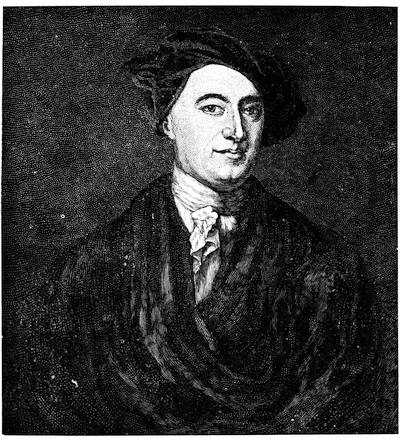
BENJAMIN POLLARD.
This likeness of one of the first captains of the Boston Cadets follows an original by Blackburn in the gallery of the Mass. Hist Society. It was Pollard who received Shirley on his return from Louisbourg. Mem. Hist. Boston, ii. 119. He died in 1756. Cf. Mass. Hist. Soc. Proc., i. 498, xvi. 390; Catal. of the Cabinet, no. 76.
Not a hatter might make as many hats as he would, because he injured by so much the trade of the English hatter, and Parliament interdicted (1732) any such rivalry. The poor man paid dear for his molasses, because Parliament compelled the merchant to buy it of the English sugar islands, instead of the French colonies in the West Indies.[275] He paid more for his rum, because Parliament protected the English distillers. The merchant smuggled and had no pangs of conscience; and what smuggling could do was very likely shown in the stately mansion that Thomas Hancock built.[276] Can we wonder that the new country did not attract as many settlers as it might; that town rates in Boston increased from £8,600 in 1738 to £11,000 in 1741, and the polls fell off from 3,395 to 2,972; and that Sam. Adams, graduating at Harvard in 1740, took for his Commencement part the inquiry, “Whether it be lawful to resist the superior magistrates, if the Commonwealth cannot be otherwise preserved?”
Belcher played the potentate with the Indians, and made his treaties with them as his predecessors had done. He met them at Falmouth (Portland) in 1732, and at Deerfield in 1735. Perhaps he was fairer in his dealings with them than he was with his fellows of the whiter skin, for he has passed into history as the least entitled to esteem of all the line of royal governors in Massachusetts,—a depreciation perhaps helped by his being born on the soil. His political paths were too devious. Hutchinson tells us that when Tailer, the lieutenant-governor, died in 1732, it was Adam Winthrop that Belcher openly favored in New England as the successor, while he intrigued with the Board of Trade to secure the appointment of Paul Mascarene; yet to no avail, for Spencer Phips, the adopted son of Sir William, succeeded to the place.
New Hampshire had been reunited with Massachusetts under Burnet, and she had proved much more tractable than the larger colony in yielding the point of the fixed salary to the governor. She had hopes of being in some way rewarded for it. Under Belcher matters grew worse. He quarrelled with the lieutenant-governor, and David Dunbar, the surveyor-general of the king’s lands, came into the place, but without healing dissensions. Dunbar had the support of influential persons like Benning Wentworth and Theodore Atkinson; and Belcher made what he could out of the friendship of Richard Waldron, the secretary.[277] Massachusetts, as well as her governor, had grievances against her neighbor; and she prohibited by legislation the circulation within her bounds of the promissory notes of New Hampshire whose redemption was not well secured. New Hampshire and Massachusetts were never again under a single executive. Wentworth chanced to be in London when Belcher’s downfall came, and he readily slipped into the executive seat of his province.[278]
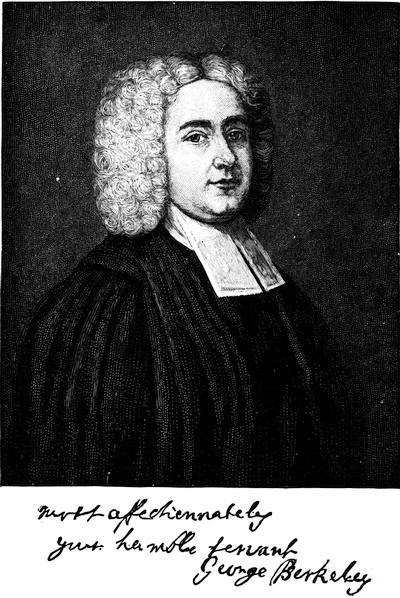
After the picture (in the Mass. Hist. Society’s gallery) painted on the voyage over by Smybert, who accompanied him. Cf. Catal. Cabinet Mass. Hist. Soc., no. 41. A photograph of the picture of Berkeley and his family by Smybert, now at Yale College, is given in Noah Porter’s Two Hundredth Birthday of Bishop George Berkeley, N. Y. 1885; and in Kingsley’s Yale College, i. 59. Smybert later painted many portraits in Boston. Cf. Mem. Hist. Boston, iv. 384, with references. His pictures, together with those of Blackburn, Pelham, and Copley, richly preserve to us the look and costume of the better classes of New England during the provincial time. Cf. Wm. H. Whitmore’s Notes on Peter Pelham, Boston, 1867; Arthur Dexter’s paper on the “Fine Arts in Boston” in Mem. Hist. Boston, vol. iv., with references in the notes; A. T. Perkins on the portraits of Smybert and Blackburn in Mass. Hist. Soc. Proc., Dec. 1878, p. 385, and May, 1879, p. 93. For historic costume see Dr. Edward Eggleston’s “Colonists at Home” in The Century, xxix. 882. It was when Copley was most in vogue that the habits of the upper classes reached in their dress that profusion of silk and satin, brocaded damask and ruffles, ermine and laces, velvet and gilt braid, which makes up the descriptions in Mr. Perkins’ enumeration of Copley’s portraits. (A. T. Perkins’ Life and Works of J. S. Copley, Boston, 1873. Cf. also Martha B. Amory’s “John Singleton Copley” in Scribner’s Monthly, March, 1881, and her Domestic and Artistic life of Copley, Boston, 1882.)
The Rhode Islanders ejected (1732) Jenckes, their governor, because he tried to stay their wild course in the emission of paper money. The lieutenant-governor, John Wanton, led the opponents of Jenckes, and secured the election of his brother, William Wanton, and two years later succeeded to the chair himself.
George Berkeley, in England, had been pronouncing the age barren of every glorious theme. Perhaps to transcend this level he conceived a project of establishing a college in Bermuda for Indians and missionaries.[279] So he came over to Newport (1729) to buy American lands, and await or perhaps force a rise on them. The death of George I. had crossed his pious scheme by drying up his fountains. Newport was now a thriving town of 5,000 souls, the chief town in a colony of perhaps 18,000 inhabitants. It had an Episcopal church in which Berkeley sometimes preached, and to which he gave an organ. He had brought over with him a Scotch artist, John Smybert, and so the patron and his family, happy on the whole, though his glorious project had not fructified, came out of the canvas under Smybert’s pencil; and the picture went to Yale College, where we may see it now,[280] and afterwards so did his books, and the deed conveying his Newport farm,[281] when after two or three years he had gone back to England, a disappointed man.[282]
Not long afterwards another man with a mission ventured on a different project in the little colony. James Franklin, who had found it prudent to leave Massachusetts, when he told the august assembly that they did not do all they might to catch pirates, came to this nest of free-booters, and started a newspaper, the Rhode Island Gazette, the first in the colony, and saw it fail within a year.
When the Spanish war was coming on, in 1739, the plucky little colony put herself on a war footing. She built the “Tartar,” a war-sloop of 115 tons;[283] her merchants, the Wantons, the Malbones, and others, ran five privateers out to sea; and even her quakers found ways to help. Seven watch-towers were built along the coast, Fort George was garrisoned, and a battery frowned on Block Island.[284]
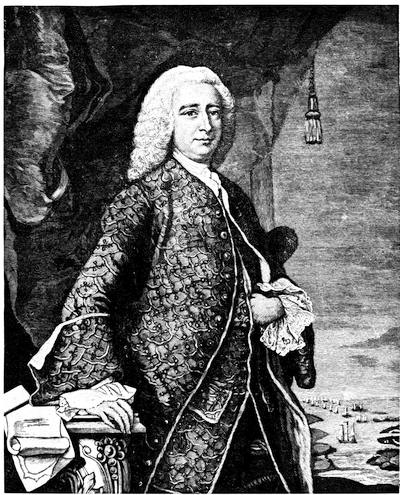
WILLIAM SHIRLEY.
This follows an engraving, “T. Hudson, pinxt.; J. McArdell, fecit,” reproduced in J. C. Smith’s Brit. Mezzotint Portraits, p. 896. Cf. Catal. Cab. Mass. Hist. Soc., p. 26; Mem. Hist. Boston, ii., frontispiece.
In Connecticut, on Saltonstall’s death in 1724, Joseph Talcott succeeded and held office during the rest of Belcher’s time.
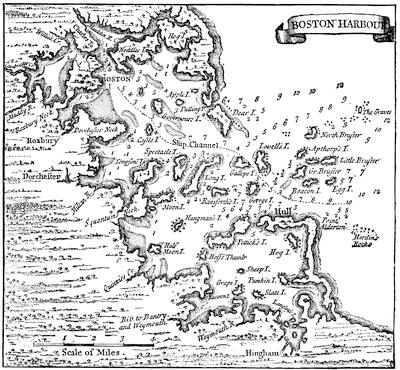
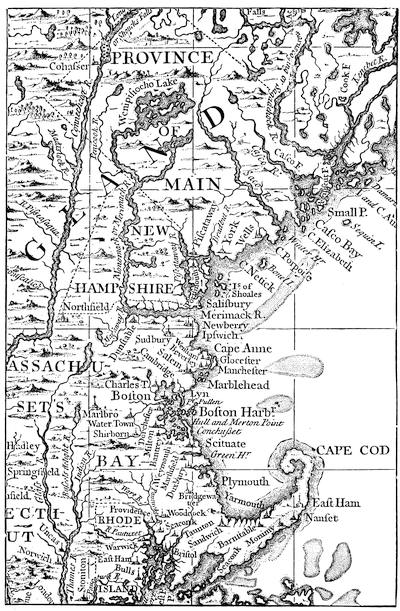
BOSTON HARBOR, 1732.
From Popple’s British Empire in America (1732).
The rule by which good ends sanctified base means came to its limit. Belcher, who had not been without high support,[285] was removed on the 6th of May, 1741; when he had sufficiently indoctrinated his opponents in his own wily ways, and they had not hesitated to use them.
William Shirley, the governor who succeeded on the same day, was an English barrister, who had come to Boston some time before (about 1733-35) to seek his fortune. He looked about for offices in the gift of the home government, and began soliciting them one after another. When the Spanish war came on, he busied himself in prompting enlistment, and took care that the authorities in England should know it; and Mrs. Shirley, then in that country, had, to her husband’s advantage as it turned out, the ear of the Duke of Newcastle. Shirley was in Rhode Island acting upon the boundary question, which was then raised between Massachusetts and her neighbor, when his commission arrived, and he hastened to Boston to take the oath.
Shirley had some excellent qualities for political station. He was courtly and tactful, and when at a later day he entertained Washington he captivated the young Virginian. He was diligent in his duties, and knew how to retreat when he had advanced unadvisedly. He governed his temper, and was commonly wise, though he did not possess surpassing talents.[286] In his speech to the legislature he urged the strengthening of the defences of Boston, for the Spanish war still raged; and he touched without greatly clarifying the financial problem. He tried in a more civil way than his predecessor had followed to get his salary fixed; but he could not force a vote, and a tacit understanding arising that he should be sure annually of £1,000, he desisted from any further attempts to solve that vexed question. A month later, he went to Commencement at Cambridge, and delivered a Latin speech at the proper moment, which was doubtless talked over round the punch in the chambers, as it added one scholarly feature to a festival then somewhat riotously kept. There was more dignity at the Boston lecture, when Benjamin Colman preached, and when his sermon was printed it had in an appendix the address of the Boston ministers to the new governor, and his Excellency’s reply. Spencer Phips was retained in the chair of the lieutenant-governor, but a new collector of Boston came in with Sir Henry Frankland, the story of whose passion for the maid of a Marblehead inn is one of the romances of the provincial history of New England.[287]
Boston was now a vigorous town, and held probably for the next forty years a larger space in the view which Europe took of the New World than has belonged to her since. Forty topsail vessels were at this time building in her ship-yards. She was despatching to sea twice as many sail as New York, and Newport was far behind her. Fortunes were relatively large, and that of John Erving, the father of Shirley’s son-in-law, was perhaps the largest of its day. He earned a few dollars in ferrying passengers across to Cambridge on a Commencement Day; put them into fish for Lisbon, there into fruit for London, and the receipts into other commodities for the return voyages, until the round of barter, abundantly repeated, made him the rich man that he became, and one who could give tea to his guests. The privateers of the merchants brought royal interest on their outlay, as they captured goods from the French and Spanish traders. Yankee wit turned sometimes unpromising plunder to a gain. One vessel brought in “a bale of papal indulgencies,” taken from a Spanish prize. Fleet, the printer, bought them, and printed his ballads on their backs. Another Boston merchant, of Huguenot stock, had given the town a public hall. This benevolent but keen gentleman, of a limping gait, did not live long to add to the fortune which he inherited. The first use that Faneuil Hall was put to was when James Lovell, the schoolmaster and a writer in the local magazines, delivered a eulogy there on this same Peter Faneuil,[288] while the loyal Bostonians glanced from the speaker to the likeness of George II., which had already been hung on its walls.
Shirley with the rest saw that war with France could not be far off. There was preparation for it in the treaty with the Six Nations, which was made at Philadelphia in July, 1742. In August Shirley himself had treated with the eastern Indians at Fort St. George’s. The next year (1743) the line of western settlements in Massachusetts was strengthened by the occupation, under William Williams, of Poontoosuck, now Pittsfield, and Williams was later instructed to establish Fort Shirley (at Heath), Fort Pelham (at Rowe), and Fort Massachusetts (in Adams, near the Williamstown line).
In 1744 the war came.[289] The French, getting advices from Europe earlier, attacked Canseau before the English were aware of the hostile decision. Though France had published her declaration in March, the news did not reach Boston till the 2d of June. Men’s thoughts passed from the “Great Awakening” to the stern duties of a war. “The heavenly shower was over,” said Thomas Prince, who saw with regret what he thought a warfare with the devil pass by; and Fleet, the wit of the newspapers, pointed to an opportune comet, and called it “the most profitable itinerant preacher and friendly New Light that has yet appeared among us,” while all the pulpit orators viewed it after other and their own fashions. Perhaps the lingering puritanism saw an omen or a warning in the chimes just then set in the tower of Christ Church. A lottery in full success was not heinous enough in those days, it would seem, to be credited with all the divine rebukes that it might be now.[290]
There was danger on the coasts. The armed sloops of Rhode Island and Connecticut were cruising between Martha’s Vineyard and New Jersey, and the brigantines of Massachusetts watched the coast north of Cape Cod.[291] But the retaliatory stroke was soon to come in the expedition against Louisbourg.
Dr. Douglass, who had grown into prominence in Boston, prophesied the failure of a scheme which had the barest majority in the assembly, and the chances were certainly on his side: but a desire to show what could be done without the military aid of England aroused the country, and not a little unworthy hatred of Romanism helped on the cause. One parson at least was ready to take along with him a hatchet to hew down the altars of the papist churches. A company from Plymouth, under Sylvanus Cobb, was the earliest to reach Boston. Massachusetts mustered 3,250 men, and the transports which sailed out of Boston harbor with this force made a fleet of a hundred sail, under convoy of nine or ten armed vessels, the whole carrying not far from 200 cannon.
The reader must turn to another chapter for the progress of the siege.[292] Good fortune favored this time the bold as well as the brave. Word coming back to Boston for reinforcements, an express was sent to Captain Williams, at Fort Shirley, and in six days he reported in Boston with 74 men, and sailed on the 23d of June. Louisbourg, however, had already surrendered (June 16), two days after the Rhode Island sloop “Tartar”[293] and two other war-sloops had dispersed the flotilla which was speeding from Annapolis to its assistance. This was the only active force of Rhode Islanders in the campaign; her contingent of foot, which was intended to join the Connecticut regiment, did not reach the ground till after the surrender; but her privateers did good service elsewhere, meanwhile, having sent into Newport during the year a full score of prizes.
It was on a fast day, July 2d, that the news of the success reached Boston, and spread throughout the colonies, occasioning[294] exuberant rejoicing, which the ministers tempered as best they could with ascribing the conquest to the finger of God, shown “more clearly, perhaps,” as Charles Chauncy said, “than since the days of Joshua and the Judges.” Modern historians think that Douglass was right, and that extraordinary good luck was a chief reason of the success.
The colonies beyond the Hudson were now anxious to be partakers in the cost and in the burden of the future defence of the captured fortress, if they had not shared the danger and exhaustion of the victory.[295] Pennsylvania offered £4,000, New Jersey £2,000, and New York £3,000.
The victorious Pepperrell returned to Boston in June, 1746. Cannon from the batteries saluted the frigate which brought him. The governor welcomed him at the Castle and escorted him to the landing of the town, where the Cadets received him and led the way to the council chamber. Here addresses and congratulations were exchanged, and the successful general started for his home in Maine, meeting demonstrations of honor at every town on his way.
Shirley now resolved on further conquest, and plans were being arranged for an armament sufficient for the conquest of all New France, with the help this time of veterans from England, when news came of the speedy arrival of a large French fleet on the coast, with a mission of reprisals and devastation.[296] In August a thanksgiving for the victory at Culloden was held, and Thomas Prince spoke in the Old South in Boston. In September there was little giving of thanks, and there was much fear of the French admiral, D’Anville. Troops were pouring into Boston from the country. Douglass says he saw six or seven thousand of them on Boston Common. The defences of the harbor were being rapidly strengthened. All the coast lookouts were reëstablished, and shore batteries were manned. Rhode Island pushed work on her forts. Connecticut sent promises of large reinforcements, if the attack should fall on Boston. Every Frenchman was put under surveillance, and the times inciting to strong language, the General Court issued orders for greater publicity to be given to the act against profaneness. There was a fast to supplicate for mercy. Thomas Prince in his pulpit heard the windows of the meeting-house rattle with a rising storm. He prayed that it might destroy the French fleet. It did. Divided counsels, disappointments in plans, the sudden death of D’Anville, its commander, the suicide of his lieutenant, disorganized the purpose of the enemy; the waves and the rocks did the rest, and only a fragment of the great armament went staggering back to France. Boston breathed easily, and the hasty soldiers marched home to their harvests; and when news came of the compact which George Clinton had made with the Six Nations at Albany, in August and September, hope and courage prevailed, though the tidings from Fort Massachusetts were distressing. Then came other massacres, and Indians were reported prowling through northern Hampshire. It had been intended to make a demonstration against Crown Point in the autumn. Provisions and munitions were hurried from Boston; Massachusetts men gathered at Albany. Winter came, disconcerting plans, and discouragement ensued.[297]
The next year Boston had a taste of the old-world despotism to which it had not been accustomed. Commodore Knowles, commanding a part of the fleet which had assisted in the capture of Louisbourg, came to Boston. Some of Knowles’ men deserted, and as enlistments did not bring what recruits the fleet needed, the commodore sent a press-gang to town (November 17, 1747), which seized whomever they found about the wharves. Boston was enraged. A mob gathered, and demanded that some of the officers of the fleet, who were in town, should be detained as hostages. The air grew murkier, and Shirley became frightened and fled to the Castle. The legislature tried to settle the difficulty, and Knowles threatened to bombard the town, unless his officers were released. The General Court denounced the riot, but signified to the commodore the necessity of redress. Under its order, the officers returned to the fleet, and Knowles, finding the business had become dangerous, let most if not all of his recruits go, and set sail, but not till the governor, gathering courage from the control over the mob which a town meeting had seemed to acquire, had come back to town, when he was escorted to his house by the same militia that had refused his summons before.
It was a violent reaction for Shirley from the enthusiasm of the Louisbourg victory, thus to experience the fickleness of what he called the “mobbishness” of the people; and his trust in the town meeting and the assembly was not strengthened when the representatives reduced his allowance, on pretence of the burdens which the war had brought. Shirley intimated that the 200,000 population of the province and a capital with 20,000 inhabitants did not mark a people incompetent to pay their rulers equably; but his intimations went for little. The colony was not in very good humor. England, in making the treaty of Aix la Chapelle (October 7, 1748), had agreed to restore Louisbourg to the French, and leave the bounds as before the war. There were discordant opinions among the advisers of the government touching the real value of Louisbourg as a military post; but it was unfortunate that to redress the balance in Europe England had to relinquish the conquests of her colonists. It may not have been wholly without regard to the quelling of the New England pride, which might become dangerous,—since Sam. Adams was pluming his political rhetoric in the Independent Advertiser at this time,—that it was thought best by that treaty to give to the province an intimation of the superior authority of the Crown.[298] The province was not without its own power of warning, for Hugh Orr, a young Scotchman, manufactured about this time at Bridgewater 500 stands of arms for the province of Massachusetts Bay; which are said to have been carried off by the British from Castle William when they evacuated Boston in March, 1776. They are supposed to have been the first made in America.[299]
Meanwhile, Horatio Walpole, the auditor-general, with an eye to his own personal advantage, had brought forward a project of the Board of Trade for overruling the charters of the colonies; but the strenuous opposition of William Bollan and Eliakim Palmer for Massachusetts and Connecticut made the advocates of the measure waver, and the movement failed. Shirley was devising a plan of his own, which looked to such an extension of the parliamentary prerogative as had not yet been attempted. His scheme was to build and maintain a line of posts at the eastward, the expense of which all the colonies should share under a tax laid by Parliament.[300] In the pursuit of this plan, Shirley obtained leave of absence, and went to England (1749), while the conduct of affairs was left in the hands of Spencer Phips, the lieutenant-governor, a man of experience and good intentions, but not of signal ability. Thomas Hutchinson, James Otis, and two others meanwhile went to Falmouth to engage the eastern Indians, who were far from quiet, in a treaty, which was finally brought to a conclusion on October 16, 1749. In the following winter (1749-50), Sylvanus Cobb was in Boston fitting out his sloop for a hostile raid through the Bay of Fundy; but Cornwallis at Halifax thought the preparations for it had become known to the French, and the raid was not accomplished.
The next year (1750), Parliament touched the provinces roughly. The English tanners wished for bark, and they could get it cheap if the English land-owners could sell their wood to the furnaces, and the furnaces would buy it if they could find a sufficient market for their iron and steel, as they could do if they had no rivals in America. It was a chain of possibilities that Parliament undertook to make realities, and so passed an act forbidding the running of slitting and rolling mills in the colonies, and Charles Townshend, who introduced the bill, found no opposer in Shirley. The bold utterances that Jonathan Mayhew was making in indignant Boston carried a meaning that did not warn, as it might, the Board of Trade in England.
Shirley, after four years’ absence, during which he had been employed in an unsuccessful mission to Paris about the Acadian boundaries, came back to Boston in 1753, to be kindly received, but to feel in bringing with him a young Catholic wife, whom he had married in Paris, the daughter of his landlord, that he gave her the position of the first lady in the province not without environing himself and her with great embarrassment, in a community which, though it had departed widely from the puritanism of the fathers, was still intolerant of much that makes man urbane and merry. While Shirley had been gone, the good town had been much exercised over an attempt to introduce the drama, and the performance of Otway’s Orphan at a coffee-house in King Street had stirred the legislature to pass a law against stage plays. The journals of Goelet[301] and others give us some glimpses of life, however, far from prudish, and show that human nature was not altogether suppressed, nor all of the good people quite as stiff as Blackburn was now painting them.
Notwithstanding his hymeneal entanglement, Shirley was unquestionably the most powerful Englishman at this time in America. The fortuitous success of his Louisbourg expedition had given him a factitious military reputation.[302] A test of it seemed imminent. For the sixth time in eighty years the frontiers were now ravaged by the savages. Pepperrell was sent to pacify the eastern Indians. The French were stretching a cordon of posts from the Atlantic to the gulf which alarmed Shirley, and he doubted if anything was safe to the eastward beyond the Merrimac, unless the French could be pushed back from Nova Scotia. He feared New Hampshire would be lost, and with it the supply of masts for the royal navy. A road had been cut along the Westfield River through Poontoosuck (Pittsfield) to Albany, and Shirley planned defences among the Berkshire Hills.
At this juncture a conference of the colonies was called at Albany in 1754, which had been commanded through the governor of New York by the Board of Trade. The reader will find its history traced on a later page. Hutchinson in July brought back to Boston a draft of the plan of action. In the autumn the legislature was considering the question, while Franklin was in Boston (October-December) conferring with Shirley and discussing plans. Boston held a town meeting and denounced the Albany plan, and in December (14th) the legislature definitely rejected it, as all the other colonies in due time did. Rhode Island, particularly, was very vigilant, lest an attempt might be made to abridge her charter-privileges. Connecticut established its first press in this very year, which with the press of the other colonies, was lukewarm or hostile to the plan.[303]
Shirley had not attended the congress. He had left Boston in June (1754) on the province frigate “Massachusetts,” with the forces under John Winslow to build a fort on the Kennebec, which was completed on the 3d of September and called Fort Halifax. On his way he stopped at Falmouth, and on the 28th of June he had a conference with the Norridgewock Indians, and on July 5th another with the Penobscots. Accompanied by some young Indians who were entrusted to the English for education, the governor was once more in Boston on the 9th of September, where he was received with due honor.
This expedition and the congress were but the prelude to eventful years. When Henry Pelham died, on the 6th of March of this year, his king, in remembrance of the wise and peaceful policy of his minister, exclaimed, “Now I shall have no more peace!” For the struggle which was impending, New England had grown in strength and preparation, and had had much inuring to the trials of predatory warfare. She had increased about sixfold in population, while New York and Virginia had increased fivefold. The newer colonies of Pennsylvania, Delaware, New Jersey, and Maryland had fairly outstripped these older ones, and numbered now nine times as large a population as they had sixty-five years earlier. The Carolinas and Georgia had increased in a ratio far more rapid. Massachusetts at this time probably had 45,000 on its alarm list, and in train-bands over 30,000 stood ready for the call.[304] John Adams, when teaching a school in Worcester the next year, ventured to write to a friend, “If we can remove the turbulent Gallicks, our people will in another century become more numerous than England itself.”
In the spring of 1755 Shirley went to Alexandria, in Virginia, being on the way from March 30 till April 12, to meet the other governors, and to confer with General Braddock upon the organization of that general’s disastrous campaign. When the news of its fatal ending reached New England it gave new fervor to the attempts, in which she was participating, of attacking the French on the Canada side,[305] and the war seemed brought nearer home to her people when, by the death of Braddock, the supreme command devolved on the Massachusetts governor.[306] On the 6th of November, at Thomas Hutchinson’s instigation and in expression of their good-will at Shirley’s promotion, the General Court passed a vote of congratulation.
The autumn had been one of excitement in Boston.[307] The forces of nature were conspiring to add to the wonderment of the hour. A part of the same series of convulsions which overturned Lisbon on November 1st and buried Sir Henry Frankland in the ruins, to be extricated by that Agnes Surriage whose romantic story has already been referred to, had been experienced in New England at four o’clock in the morning of the 18th of the same month, with a foreboding of a greater danger; but the commotion failed in the end to do great damage to its principal town, then esteemed, if we may believe the Gentleman’s Magazine, finer than any town in England excepting London. People looked to the leading man of science in New England of that time for some exposition of this mighty power, and Prof. John Winthrop gave at Cambridge his famous lecture on earthquakes, which was shortly printed.[308] The electrical forces of nature had not long before revealed themselves to Franklin with his kite, and it was in November or December that the news was exciting comment in Boston, turning men’s thoughts from the weariness of the war.
That war had not prospered under Shirley, and with a suspicion that he had been pushed beyond his military capacity he was recalled to England, ostensibly to give advice on its further conduct. He had found that Massachusetts could not be led to tax herself directly for the money which he needed, and only pledged herself to reimburse, if required, the king’s military chest for £35,000, which Shirley drew from it. A scale of bounties had failed to induce much activity in enlistments, and the forces necessary for the coming campaign were gathering but slowly.[309] This was the condition of affairs when Shirley left for England, carrying with him the consoling commendations of the General Court.
Spencer Phips, the lieutenant-governor, succeeded to the executive chair in Massachusetts at a time when even Boston was not felt to be secure, so fortunate or skilful were the weaker French in a purpose that was not imperilled by the jealousies which misguided the stronger English. It was now problematical if Loudon, the new commander-in-chief, was to bring better auguries. In January of the next year (1757), he came to Boston to confer with the New England governors. The New England colonies now agreed to raise 4,000 new troops. Meanwhile Phips had died in April (4th) in the midst of the war preparations, and Pepperrell, as president of the council, next directed affairs till Thomas Pownall,[310] who had been commissioned governor, and who had reached Halifax on the fleet which brought Lord Howe’s troops, arrived in Boston, August 3d, on the very day when Montcalm on Lake George was laying siege to Fort William Henry, which in a few days surrendered. The news did not reach Pownall till he had pushed forward troops to Springfield on their way to relieve the fort. He put Pepperrell at once in command of the militia,[311] and a large body of armed men gathered under him on the line of the Connecticut;[312] for there was ignorance at the time of Montcalm’s inability to advance because of desertions, and of the weakening of his force by reason of the details he had made to guard and transport the captured stores. Messengers were hurried to the other colonies to arouse them. John Adams, then a young man teaching in Worcester, kept from the pulpit by reason of his disbelief in Calvinism, stirred by the times, with the hope some day of commanding a troop of horse or a company of foot, was one of these messengers sent to Rhode Island, and he tells us how struck he was with the gayety and social aspect of Sunday in that colony, compared with the staid routine which characterized the day in Massachusetts.[313]
Massachusetts had enrolled 7,000 men for the campaign. Connecticut had put 5,000 in the field, and Rhode Island and New Hampshire a regiment each. Massachusetts had further maintained a guard of 600 men along her frontiers. The cost of all these preparations necessitated a tax of half the income of personal and landed property.
In a commercial sense almost crushed,[314] in a political sense the people were as buoyant as ever. When Loudon sent orders to quarter a regiment of the British troops on the people, the legislature forbade it, and grew defiant, and nothing could pacify them but the withdrawal of the order. The commander-in-chief, however he stormed in New York, found it expedient to yield when he learned of the fury his order was exciting in a colony upon whose vigor the home government was largely depending for the successful prosecution of the war. This had now fallen into the hands of Pitt, and he at once recalled Loudon, who chanced to be in Boston, parleying with the legislature about raising troops, when an express brought him his recall. Abercrombie, who succeeded, was even a worse failure; but there was a burst of light at the eastward. Amherst had captured Louisbourg in July (1758),[315] and bringing his troops by water to Boston had landed them on September 13. Never was there so brilliant array of war seen in the harbor as the war-ships presented, or on Boston Common where the troops were encamped. Amherst delayed but three days for rest, when on the 16th of September he began his march westward to join the humbled Abercrombie. At Worcester the troops halted, and John Adams tells us of the “excellent order and discipline” which they presented, and of the picturesqueness of the Scotch in their plaids, as this army of four thousand men filled his ardent gaze.
During the winter recruiting was going on in Boston with success for the fleet wintering at Louisbourg.[316] In the campaign of the next year (1759), Massachusetts and Connecticut put at least a sixth of all their males able to bear arms into the field. They were in part in the army which Amherst led by way of Lake Champlain to the St. Lawrence, and among them were some of the veterans which Pepperrell had command in 1745 at Louisbourg,—Pepperrell who was to die during the progress of the campaign, on the 6th of July, at Kittery in his sixty-fourth year. Another portion went with Pownall to the Penobscot region, or followed him there, and assisted in the building of Fort Pownall, which was completed in July (1759).[317] The reader must turn to another chapter[318] for the brilliant success of Wolfe at Quebec, which virtually ended the war.
George the Second hardly heard of the victories which crowned his minister’s policy. He died October 25, 1760, but the news of his death did not reach Boston till December 27th. He had already effected a change in the government of Massachusetts. Pownall, who had made interest with the Board of Trade to be transferred to the executive chair of South Carolina, left Boston in June, taking with him the good wishes of a people whom he had governed more liberally and considerately than any other of the royal governors.[319] Two months later (August 2, 1760), Francis Bernard, who had been governor of New Jersey,[320] reached Boston as his successor. He showed some want of tact in his first speech, in emphasizing the advantages of subjection to the home government, and gave the House opportunity to rejoin that but for the sacrifice in blood and expense which these grateful colonies had experienced, Great Britain might now have had no colonies to defend. Notwithstanding so untoward a beginning, Bernard seems to have thought well of the people, and reported fair phrases of encomium to the Lords of Trade.[321]
A few weeks after Bernard’s arrival Stephen Sewall, the chief justice, died (September 11, 1760). Thomas Hutchinson was now the most conspicuous man in New England, and he had put all New England under obligations by his strenuous and successful efforts to better their monetary condition. A train of events followed, which might possibly have been averted, if, instead of appointing Hutchinson to the chief-justiceship, as he did, Bernard had raised one of the other justices, and filled the vacancy with Col. James Otis, then Speaker of the House, father of the better known patriot of that name, and whose appointment had been contemplated, it is said, by Shirley. Hutchinson was already lieutenant-governor, succeeding Spencer Phips, and was soon to be judge of probate also for Suffolk,—a commingling of official power that could but incite remark.
The younger Otis was soon to become conspicuous, in a way that might impress even Bernard. There were certain moneys forfeited to the king for the colony’s use, arising from convictions for smuggling under the Sugar Act; the province had never applied for them, and had neglected its opportunities in that respect. The House instructed Otis to sue the custom-house officers. The superior bench under the lead of Hutchinson decided against the province, and it did not pass without suspicion that Bernard had placed Hutchinson on that bench to secure this verdict.
An event still more powerful in inciting discontent was approaching. Charles Paxton, who had been surveyor of Boston since 1752, had, in his seeking for smuggled goods, used general search warrants,—unreturnable, known as “writs of assistance,” and of course liable to great abuse. It seems probable that this process had been so far sparingly used, and there had been no manifest discontent. Upon the king’s death, the existing writs had only a six months’ later continuance, when new applications must be made under the new reign. These new applications came at a time when the public mind was much exercised, and there was a determination to question the legality of such unrestrained power as the writs implied. The hearing was to be before the court of which Hutchinson was now the chief. Jeremy Gridley appeared for the king, and the younger Otis with Oxenbridge Thacher for the petitioners. The court deferred its decision, but in November, 1761, the case was again discussed. The court meanwhile had had advices from England, and the writs were sustained. In the discontent growing out of this proceeding, we may find the immediate beginning of the controversy between the provinces and the Crown, which resulted in the American Revolution. The subsidence of the war left men time to think deeply of these intestine griefs, and when the Peace of Paris in February, 1763, finally dissipated the danger of arms, events had gone far to shape themselves for bringing another renewal of battle, not with the French, but with the mother country.

CRITICAL ESSAY ON THE SOURCES OF INFORMATION.
NEW England in general.—Of Cotton Mather’s Magnalia Christi Americana, or the Ecclesiastical History of New England from 1620 to 1698, mention has been made in another volume,[322] and, as the title shows, it touches only the few earlier years of the period now under consideration. The book was published in London in 1702, and a solitary forerunner of the edition reached Boston, as we know, October 29 of the same year. It was the most considerable work which had been produced in the British colonies, and was in large part an unshapely conglomerate of previous tracts and treatises. Neal, Mather’s successor in the field, while praising his diligence in amassing the material of history, expressed the opinion of all who would divest scholarship of meretriciousness when he criticised its “puns and jingles,”[323] and said, “Had the doctor put his materials a little closer together, and disposed them in another method, his work would have been more acceptable.”[324] But Mather without Matherism would lose in his peculiar literary flavor; we laugh and despise, while his books nevertheless find a chief place on the shelves of our New England library. Mather was still young when the Magnalia was printed, but he stood by his methods and manner a quarter of a century later, and in publishing (1726) his Manuductio ad Ministerium[325] he defended his labored and bedizened style against, as he says, the blades of the clubs and coffee-houses, who set up for critics. He also belabored Oldmixon in a similar fashion, when that compiler both borrowed the doctor’s labors and berated his reputation, and Mather called him, in his inveterate manner, Old Nick’s son.[326] Sibley not unfairly remarks that these peculiarities of Mather’s style were probably almost as absurd to his contemporaries as to ourselves;[327] and very likely it helped to create something of that curiosity respecting him, which Prince tells us he found in Europe at a later day.
In any estimate of Cotton Mather we may pass by the eulogy of his colleague Joshua Gee,[328] and the Life of Cotton Mather[329] by his son Samuel, as the efforts of a predisposing and uncritical friendliness. We are not quite sure how far removed from the fulsome flattery, if not insincerity, of funeral sermons in those days was the good word upon his contemporary which came from Benjamin Colman.
With the coming of the present century we might suppose the last personal resentment of those who knew Cotton Mather had gone, and as an historical character it might well be claimed that a dispassionate judgment was due to him. When James Savage edited Winthrop’s journal, the public were told how Cotton Mather should be contemned; and the tale was not untruthful, but it was one-sided. Quincy in his History of Harvard University could give no very laudatory estimate of the chronic and envious grumbler against the college.[330] When Dr. Chandler Robbins wrote the History of the Second Church of Boston, he said all he could, and in a kindly spirit, to qualify the derogatory estimate then prevalent respecting his predecessor; and W. B. O. Peabody in his Life of Cotton Mather[331] tempered his judgment by saying, “There is danger lest in our disgust at his fanaticism and occasional folly we should deny him the credit which he actually deserves.” His professed defenders, too, lighten their approval with pointing out his defects. Thus does Samuel G. Drake in a rather feeble memoir in the N. E. Hist. and Geneal. Reg. (vol. vi.), and in the 1855 edition of the Magnalia. Dr. A. H. Quint in the Congregational Quarterly, 1859, and Dr. Henry M. Dexter in the Memorial Hist. of Boston, vol. ii., incline to the eulogistic side, but with some reservations. Mr. Samuel F. Haven in the Report of the Amer. Antiq. Soc., April, 1874, turned away the current of defamation which every revival of the Salem witchcraft question seems to guide against the young minister of that day. The estimates of Moses Coit Tyler in his Hist. of Amer. Literature (vol. ii.), and John Langdon Sibley in his Harvard Graduates (vol. iii.), show that the disgust, so sweeping fifty years ago, is still recognized amid all efforts to judge Mather lightly.[332] Mankind is tender in its judgment of the average man, when a difference of times exists. The historical sense, however, is rigid in its scrutiny of those who posture as index-fingers to their contemporaries; and it holds such men accountable to the judgments of all time. Great men separate the perennial and sweet in the traits of their epoch from the temporary and base,—a function Cotton Mather had no conception of.
The next general account of the New England colonies after the Magnalia, and covering the first thirty years of the present period, was Daniel Neal’s History of New-England containing an account of the civil and ecclesiastical affairs of the country to 1700. With a map, and an appendix containing their present charter, their ecclesiastical discipline, and their municipal-laws. In 2 vols. (London. 1720.)[333]
Dr. Watts, writing to Cotton Mather, Feb., 1719-20, of Neal’s history, said that he had hoped to find it “an abstract of the lives and spiritual experiences of those great and good souls that planted and promoted the gospel among you, and those most remarkable providences, deliverances, and answers to prayers that are recorded in your Magnalia Christi, but I am disappointed of my expectations; for he has written with a different view, and has taken merely the task of an historian upon him.” Watts took Neal to task personally for his freedom about the early persecution; but Neal only answered that the fidelity of an historian required it of him.[334] Neal himself in his preface (p. iv.) acknowledges his freedom in treating of the mistakes into which the government fell.
Prince in the preface to his Chronological History of New England says: “In 1720 came out Mr. Neal’s History of New England.... He has fallen into many mistakes of facts which are commonly known among us, some of which he seems to derive from Mr. Oldmixon’s account of New England in his British Empire in America, and which mistakes[335] are no doubt the reason why Mr. Neal’s history is not more generally read among us; yet, considering the materials this worthy writer was confined to, and that he was never here, it seems to me scarce possible that any under his disadvantages should form a better. In comparing him with the authors from whence he draws, I am surprised to see the pains he has taken to put the materials into such a regular order; and to me it seems as if many parts of his work cannot be mended.”
Rogers and Fowle, printers in Boston, who were publishing a new magazine, begun in 1743, called The American Magazine, announced that they would print in it by instalment a new history of the English colonies. They changed the plan subsequently so as to issue the book in larger type, in quarterly numbers, and in this form there appeared in January, 1747, the first number, with a temporary title, which read: A summary, historical and political, of the first planting, progressive improvements and present state of the British settlements in North America; with some transient accounts of the bordering French and Spanish settlements. By W. D., M. D., No. 1. To be continued. Boston, 1747.[336] The author soon became known as Dr. William Douglass, the Scotch physician living in Boston,—“honest and downright Dr. Douglass,” as Adam Smith later chose to call him. He had drawn (pp. 235-38), in contrast to Admiral Warren, a severe character of Admiral Knowles, whose conduct, which occasioned the impressment riot then recent, was fresh in memory. Knowles seems to have instituted a suit for libel, which led to a rather strained amend by Douglass in the preface to the first volume, when the numbers were collected in 1749, and were issued with a title much the same as before, A Summary, historical and political, of the first planting, etc., containing—here follow five heads.[337] The character which he had given of Knowles, he says, was written out of passionate warmth and indiscretion, merely “in affection to Boston and the country of New England, his altera patria,” and then adds that he has suppressed it in the completed volume.[338] The second volume is dated 1751, and Douglass died in 1752.[339]
To his second volume (1751) he adds what he calls “a supplement to the first volume and introduction to the second volume,” in which he hints at the offence he had given Shirley and Knowles—the latter’s suit for libel forcing him to recant, as we have seen—by saying, “If facts related in truth offend any governor, commodore, or other great officer,” the author “will not renounce impartiality and become sycophant.” He further charges upon “the great man of the province for the time being,” as he calls Shirley, the “impeding, or rather defeating, this public-spirited, laborious undertaking,” as he characterizes his own book.
A large part of the work is given to New England, which he knew best; but his knowledge was at all times subservient to his prejudices, which were rarely weak. He is often amusing in his self-sufficiency, and not unentertaining; but he who consults the book is puzzled with his digressions and with his disorderly arrangement, and there is no index to relieve him.[340] Hutchinson struck the estimate which has not since been disputed: it was his “foible to speak well or ill of men very much as he had a personal friendship for them, or had a personal difference with them.”[341] Prof. Tyler in his Hist. of American Literature[342] has drawn his character more elaborately than others.[343] His book, while containing much that is useful to the student, remains a source of uncertainty in respect to all statements not elsewhere confirmed, and yet of his predecessors on New England history Douglass has the boldness to say that they are “beyond all excuse intolerably erroneous.”[344]
A wider interest than that of ecclesiastical record attaches to a book which all students of New England history have united in thinking valuable. This is the work of Isaac Backus, a Baptist minister in Middleborough, Mass., who published at Boston in 1777 a first volume, which was called A History of New England, with particular reference to the denomination of Christians called Baptists.[345] This volume brought the story down to 1690 only, but an appendix summarized subsequent history down to the date of the book. In the second volume, which appeared at Providence in 1784, the title was changed to A Church History of New England, vol. ii., extending from 1690 to 1784. The same title was preserved in the third volume, which was published in Boston in 1796, bringing the narrative down to that date. In the preface to this volume the author complained of the many typographical errors in the first volume, and professed that though there had been private dislikes of the work by some “because their own schemes of power and gain were exposed thereby,” he knew not of any public dispute about “its truth of facts.” The whole work has been reprinted under the title of the original first volume, with notes by David Weston, and published in two volumes by the Backus Historical Society at Newton, Mass., in 1871.[346]
Miss Hannah Adams published at Dedham, Mass., in 1799, a single volume, Summary History of New England. She does not profess to have done more than abridge the usual printed sources, as they were then understood, and to have made some use of MS. material, particularly respecting the history of Rhode Island.
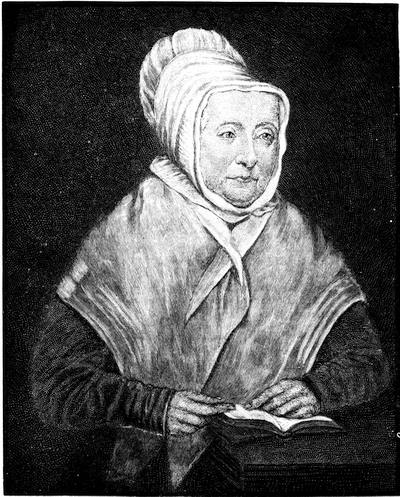
HANNAH ADAMS.
This follows an oil portrait by Alexander in the cabinet of the American Antiquarian Society at Worcester. Hannah Adams was born at Medfield, in 1755, and died at Brookline, Mass., Nov. 15, 1831; and she was the first person interred at Mount Auburn.
It is the fourth and last published volume of Dr. Palfrey’s History of New England (Boston, 1875) which comes within the period of the present chapter, bringing the story, however, down only to 1741, but a continuation is promised from a MS. left by the author, and edited by General F. W. Palfrey, his son, which will complete the historian’s plan by continuing the narrative to the opening of the war of independence. This fourth volume is amply fortified with references and notes, in excess of the limitations which governed the earlier ones. The author says in his preface that he may be thought in this respect “to have gone excessively into details, and I cannot dispute [he adds] the justness of the criticism; such at present is the uncontrollable tendency of my mind.”
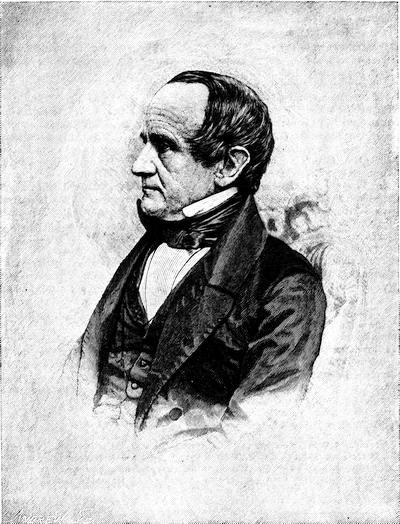
JOHN GORHAM PALFREY.
The editor is indebted to Gen. F. W. Palfrey for the excellent photograph after which this engraving is made.
In 1866 Dr. Palfrey published a popular abridgment of his first three volumes in two smaller ones. These were reissued in August, 1872, with a third, and in 1873 with a fourth, which completed the abridgment of his larger work, and carried the story from the accession of Shirley to power down to the opening of the military history of the American Revolution. In this admirably concise form, reissued in 1884, with a thorough index, the work of the chief historian of New England is known as A compendious History of New England from the Discovery by Europeans to the first general Congress of the Anglo-American Colonies,—the last summarized chapter in the work not being recognized in the title.[347]
Massachusetts.—For this as well as for the period embraced in the third volume of the present history,[348] Thomas Hutchinson’s History of Massachusetts Bay is of the highest importance. Hutchinson says that he was impelled to write the history of the colony from observing the repeated destruction of ancient records in Boston by fire, and he complains that the descendants of some of the first settlers will neither use themselves nor let others use the papers which have descended to them. He seems, however, to have had the use of the papers of the elder Elisha Cooke. He acknowledges the service which the Mather library, begun by Increase Mather, and in Hutchinson’s time owned by Samuel Mather, who had married Hutchinson’s sister, was to him.
While Hutchinson’s continuation of the story beyond 1749 was as yet unknown, George Richards Minot planned to take up the narrative and carry it on. Minot’s Continuation of the History of the Province of Massachusetts Bay from 1748 shows that he made use of the files in the state house as well as their condition then permitted, but he was conscious of the assistance which he might have had, and did not possess, from the papers in the English archives. His first volume was printed in 1798; and he died before his second volume was published, in 1803, which had brought the record down to 1765, but stopped abruptly.[349] Grahame (iii. 446) calls the work “creditable to the sense and talent of its author,” but considers “his style frequently careless, and even slovenly and ungrammatical.” His contemporaries viewed his literary manner much more favorably, and were inclined to give him a considerable share in placing our native historical literature upon a scholarly basis. More painstaking research, with a careful recording of authorities, characterizes the only other History of Massachusetts of importance, that by John S. Barry, whose second volume is given to the period now under consideration,—a work, however, destitute of commensurate literary skill, or its abundant learning would give it greater reputation. Haliburton, in chapters 2 and 3 of book iii. of The Rule and Misrule of the English in America, traces in a summary way the turbulent politics of the province of Massachusetts during its long struggle against the royal prerogative. Emory Washburn’s Sketches of the judicial history of Massachusetts from 1630 to the revolution in 1775, Boston, 1840, contains biographical notices of the judges of Massachusetts, and traces the relations of the study of the law to the progress of political events. William Henry Whitmore’s Massachusetts civil list for the colonial and provincial records, 1630-1774, Albany, 1870, is a list of the names and dates of appointment of all the civil officers constituted by authority of the charters or the local government. The general histories of Maine (during this period a part of Massachusetts) have been sufficiently characterized in another place.[350]
Connecticut.—The History of Connecticut, by Benjamin Trumbull, becomes not of less value as it approaches his own time. Grahame (ii. 165) says of him that he is “always distinguished by the accuracy of his statements, but not less distinguished by his partiality for his own people,” and Palfrey (iv. 226) avers that with all “his gravity Trumbull had a tendency for sensational traditions,” and both are right. He had not brought the story down later than 1713, in the volume published at Hartford in 1797. He says that he availed himself of the material which the ancient ministers and other principal gentlemen of Connecticut had communicated to Thomas Prince, when that writer was engaged upon his Chronological Hist. of New England; and in this collection, he adds, “important information was found, which could have been obtained from no other source.” Trumbull’s first volume was reprinted at New Haven in 1818, with a portrait of the author, together with a second volume, bringing the story down to 1764.
Rhode Island.—Of Rhode Island in the present period, Arnold’s History is the foremost modern authority.[351] Mr. William E. Foster has recently prepared, as no. 9 of the Rhode Island Historical Tracts (1884), a careful and well-annotated study of the political history of the eighteenth century, in a Memoir of Stephen Hopkins.
New Hampshire.—Dr. Belknap, as the principal historian of New Hampshire, has been characterized in another place.[352] The bibliography of his history may find record here. The first volume, The History of New Hampshire, vol. i., comprehending ... one complete century from the discovery of the Pascataqua, was read through the press in Philadelphia (1784) by Ebenezer Hazard.[353] This volume was reprinted at Boston in 1792, where meanwhile vol. ii. (1715-1790) had appeared in 1781, and vol. iii., embracing a geographical description, was issued in 1792. The imprints of these volumes vary somewhat.[354] There was printed at Dover, N. H., in 1812 (some copies have “Boston, 1813”) a second edition in three volumes, “with large additions and improvements published from the author’s last manuscript;” but this assertion is not borne out by the book itself.[355] A copy of his original edition having such amendments by Belknap had been used in 1810, at Dover, in printing an edition which was never completed, as the copy and what had been done in type were burned. Before parting with this corrected copy, the representatives of Dr. Belknap had transferred his memoranda to another copy, and this last copy is the one referred to in the edition which was printed by John Farmer at Dover in 1831, called The History of New Hampshire by Jeremy Belknap, from a copy of the original edition having the author’s last corrections, to which are added notes containing various corrections and illustrations. By John Farmer.[356] This is called vol. i., and contains the historical narrative, but does not include the geographical portion (vol. iii. of the original ed.), which Farmer never added to the publication.[357] Belknap says that he had been educated under the influence of Thomas Prince, and that he had used Prince’s library before it had been despoiled during the Revolution. Of Hutchinson—and Belknap was in early manhood before Hutchinson left New England—he says that while that historian writes many things regarding New Hampshire which Neal and Douglass have omitted, he himself omits others, which he did not think it proper to relate. He refers to Mr. Fitch, of Portsmouth, as having begun to collect notes on New Hampshire history as early as 1728, and says that he had found in Fitch’s papers some things not elsewhere obtainable. He also animadverts on errors into which Chalmers had fallen in his Political Annals of the American Colonies.

EDITORIAL NOTES.
A. The Documentary History of New England.—After the lapsing of the New England Confederacy consequent upon the charter of William and Mary, the governments which made up that group of colonies had no collective archives. It is only as we search the archives of the English Public Record Office, and those of Paris and Canada, including Nova Scotia, that we find those governments treated collectively. The Reports of the English Historical Manuscripts Commission have of late years not only thrown additional light on our colonial history, as papers touching it preserved in the muniment rooms of leading families have been calendared, but the commission’s labors have also been the incentive by which the public depositary of records has been enriched by the transfer of many papers, which the commission has examined. Nine of their voluminous reports (up to 1885) have been printed, and by their indexes clues have been provided to the documents about New England history. The Shelburne Papers, belonging to the Marquis of Lansdowne, which make a large part of the Fifth Report, while of most interest in connection with the American Revolution, reveal not a little concerning the colonial history of the earlier part of the seventeenth century. The volumes enumerated in this Report, which are marked xlv. (1705-1724) and xlvi. (1686-1766), are of particular interest, referring entirely to the American colonies. We find here various papers of the Board of Trade and Plantations (or copies of them), embracing the replies from the provincial governors to their inquiries. In the volume numbered lxi., there are sundry reports of the attorney and solicitor-general, to whom had been referred the appeals of Massachusetts in 1699, and of Connecticut in 1701; his report of 1705 respecting Jesuits and papists in the plantations; that of 1707 on the acts of Massachusetts fining those trading with the French; that of 1710 on the reservation of trees in Massachusetts for masts of the royal navy; that of 1716 on the claim of the governor of Massachusetts to command the militia of Rhode Island; that of 1720 on the negative of the governor reserved in the charter of Massachusetts; that of 1722 on the question of the time when the three years that a province law is open to disapproval properly begins; that of 1725 on the encroachments of the House of Representatives on the prerogative of the Crown; that of 1732 relating to the validity of acts in Rhode Island, notwithstanding the governor’s dissent,—not to name many others.
Another source of documentary help is the manuscripts of the British Museum, of which there are printed catalogues; and the enumeration of the documents in the possession of the Canadian government,—of which the quality can be judged, as they existed in 1858,—in the Catalogue of the Library of Parliament, Toronto, 1858, pp. 1541-1655.
The archives of Massachusetts are probably not surpassed in richness by those of any other of the English colonies. The solicitude which the colonial and provincial government always felt for their preservation is set forth by Dr. George H. Moore in appendix v. of his Final notes on Witchcraft (New York, 1885). In 1821, Alden Bradford, then secretary of the commonwealth, made a printed statement of “the public records and documents belonging to the commonwealth” (pp. 19), but the fullest enumeration of them was included in a Report to the Legislature of Massachusetts, made by the Commissioners ... upon the condition of the records, files, papers, and documents in the Secretary’s department, Jan., 1885 (pp. 42), drawn up by the present writer. An indication of such of them as concern the period of the present volume may be desirable.[358] The series of bound volumes, arranged in 1836-46, by the Rev. Joseph B. Felt, according to a classification which was neither judicious nor uniform, but, as Dr. Palfrey says, betrays “ingenious disorder,”[359] includes not all, but the chief part of the papers illustrative of legislation in the secretary’s office which concern us in the present chapter and make part of one hundred and thirty-one volumes. These come in sequence through vol. 136,—the omitted volumes being no. 107 (the revolution of 1689) and nos. 126 to 129 (the usurpation of the Andros period). The other volumes as a rule begin in the colonial period and come down to about the beginning of the Revolutionary War. They are enumerated with their topical characteristics in the Report already referred to (pp. 8, 9). Four volumes of ancient plans, grants, etc. (1643-1783), accompany the series.
Of the so-called French Archives—documents copied in France—mention has been elsewhere made, and a considerable portion of them cover the period now under examination.[360]
The destruction of the town and court house in 1747 carried with it the loss of many of the original records of the colony and province. The government had already undertaken a transcript of the records of the General Court, which had been completed down to 1737; and this copy, being at the house of Secretary Josiah Willard, was saved. A third copy was made from this, and it is this duplicate character which attaches to the records as we now have them. Transcripts of these records under the charter of William and Mary had by its provisions been sent to the Lords of Trade, session by session, and orders were at once given to secure these from 1737 to 1746, or a copy of them, for the province archives. For some reason this was not accomplished till 1845, when a commissioner was sent to England for that purpose; and these years (1737-1746) are thus preserved. None of these records for the provincial period have been printed.[361] The records of the upper branch or the council were also burned,[362] and were in a similar way restored from England. Of the House of Representatives, or lower branch, we have no legislative records before 1714, nor of the legislative action of either branch have we any complete record before 1714, since neither the journals of the House nor the legislative part of the records of the council were sent over to England, but only the executive part of the latter, which was apparently made up in view of such transmission, as Moore represents. The preservation of the journals of the House is due to the jealousy which that body felt of Dudley when he prorogued them in 1715. Because of their inaction on the paper-money question, the House, in a moment of indignation, and to show that they had done something, if not what the governor liked, voted to have their daily records printed. The set of these printed journals in the possession of the State is defective.[363] There is not known to be a perfect set of them in any collection, perhaps not in all the collections in the state, says Judge Chamberlain,[364] who adds: “Of their value for historical purposes I have formed a very high opinion. In many respects they are of more value than the journals of the General Court, which show results; while the journals of the House disclose the temper of the popular branch, and give the history of many abortive projects which never reached the journals of the General Court.”[365] Of a series of copies called charters, commissions, and proclamations, the second volume (1677-1774) concerns the present inquiry. There is a file of bound letters beginning in 1701, and it would seem they are copies in some, perhaps many, cases of originals in the archives as arranged by Mr. Felt.
Respecting the French and Indian wars, nine volumes of the so-called Massachusetts Archives cover muster-rolls from 1710 to 1774, including the regiments of Sir Chas. Hobby and others (1710), the frontier garrisons, those of Annapolis Royal (1710-11), the expedition to the West Indies (1740), the campaigns of Crown Point, Fort William Henry, and Louisbourg (1758), beside various eastern expeditions and the service by sea. Of the first Louisbourg (1745) expedition, there are no rolls, except as made up in copies from the Pepperrell and Belknap papers in the library of the Mass. Historical Society. In addition to these bound papers there are many others in packages, laid aside by Mr. Felt in his labor, in some cases for reasons, and in other cases by oversight or a varying sense of choice.[366]
The Colonial Records of Connecticut for the present period have come under the supervision of Mr. C. J. Hoadly, and are carefully edited. In 1849 about 50,000 documents in the state archives had been bound in 138 volumes, when an index was made to them.[367] The correspondence of the Connecticut authorities with the home government (1755-58) has been printed in the Connecticut Historical Collections (vol. i. p. 257).
For Rhode Island, the continuation of the Colonial Records, beginning with vol. iii., covers the period now under consideration. The sessional papers of 1691-95, however, are wanting, and were probably sent to England by Bellomont, whence copies of those for May and June, 1691, were procured for the Carter-Brown library. Newport at this time was a leading community in maritime affairs, and the papers of these years touch many matters respecting pirates and privateers. The fifth volume (1741-56) indicates how Rhode Island at that time kept at sea more ships than any other colony, how she took part in the Spanish war, and how reckless her assembly was in the authorizing of paper money. The sixth volume (1757-69) closes the provincial period.
The series of publications of New Hampshire ordinarily referred to as Provincial Papers, from the leading series of documents in what is more properly called Documents and records relating to New Hampshire, is more helpful in the present period than in the earlier one.[368] They may be supplemented by the Shute and Wentworth correspondence (1742-53), and Wentworth’s correspondence with the ministry (1750-60); and letters of Joseph Dudley and others, contained in the Belknap MSS. in the cabinet of the Mass. Historical Society.[369] The Granite Monthly (vol. v. 391) has published a list of the issues of the press in New Hampshire from 1756 to 1773; and B. H. Hall’s History of Eastern Vermont, from its earliest settlement to the close of the eighteenth century, with a biographical chapter and appendixes (2 vols., Albany, N. Y., 1858, and on large paper in 1865), supplements the story as regards the claim of New Hampshire to the so-called New Hampshire grants.
The legislative and judicial methods of the several governments are of the first importance to the understanding of New England history, for it was a slow process by which it came to pass that professional lawyers held any shaping hand in the making or the administering of laws. The first Superior Court of Massachusetts under the provincial charter had not a single trained lawyer on the bench, and its assembly was equipped more with persistency and shrewdness in working out its struggle with the crown officer who tried to rule them than with legal acquirements. E. G. Scott, in his Development of Constitutional Liberty in the English Colonies (N. Y., 1882, pp. 31-58), examines the forms of the colonial governments and the political relations of the colonies. No one has better traced their relations to European politics than Bancroft.
The legislation of the several governments has had special treatment in Emory Washburn’s Sketches of the Judicial History of Massachusetts, 1630-1775 (Boston, 1840); in T. Day’s Historical Account of the Judiciary of Connecticut (Hartford, 1817); in John M. Shirley’s “Early Jurisprudence of New Hampshire,” in the New Hampshire Historical Society’s Proceedings, June 13, 1883. Cf. also H. C. Lodge, Short Hist. of the English Colonies, pp. 412-419.
Of the legislation of Massachusetts, Dr. Moore says[370] that it is “a record which, notwithstanding all its defects, has no parallel in any other American State.” The first edition of the Province Laws, under the new charter, was printed in 1699, and it was annually supplemented by those of the succeeding sessions till 1714, when a second edition was printed, to which an index was added in 1722, and various later editions were issued.[371] In 1869 the first volume of a new edition, of historical importance, was published by the State, with the title Acts and Resolves, public and private, of the Province of the Massachusetts Bay, with historical and explanatory notes, edited by Ellis Ames and Abner C. Goodell. Mr. Ames has since died (1884), and the editing is still going on under Mr. Goodell; five volumes, coming down to 1780, having been so far published.[372]
B. Men and Manners.—Dr. George E. Ellis, in an address[373] which he delivered in October, 1884, on the occasion of erecting a tablet to Samuel Sewall’s memory in the new edifice of the Old South church, in Boston, of which that last of the puritans had been a member, said:—
“Judge Sewall is better known to us in both his outer and inner being than any other individual in our local history of two hundred and fifty years; and this is true not only of himself, but through his pen, curiously active, faithful, candid, kind, impartial, and ever just, his own times stand revealed and described to us. His surroundings and companions, his home and public life, the habits, usages, customs, and events, and even the food which we can almost smell and taste, the clothes, and furnishings, the modes of hospitality, of travel, the style of things,—all in infinite detail; the military service, the formal ceremonials and courtesies, the excitements, panics, disasters,—all these have come down to us through Sewall’s pen, with a fullness and old-time flavor and charm, which we might in vain seek to gather from many hundred volumes. And all this comes from Sewall having kept a daily journal from 1674 to 1729, fifty-five years,”—and forty of these years come within the scope of the present chapter.
These journals had long been known to exist in a branch of Sewall’s family, but as, Dr. Ellis says, they “had been kept with much reserve, sparingly yielding to earnest inquirers the information they were known to contain.” President Quincy had drawn from them in his History of Harvard University, and had called them “curious and graphic,” as his extracts show. They had also been used by Holmes in his American Annals, by Washburn in his Judicial History of Mass., and by others. In 1868, some friends of the Mass. Historical Society purchased the diaries and other Sewall papers of the holders, and gave them to the society.[374] The diaries have since been published, and make part of the Collections of that society.[375] Despite a good deal of a somewhat ridiculous conservatism, linked with a surprising pettiness in some ways, the character of Sewall is impressed upon the present generation in a way to do him honor. His was a struggle to uphold declining puritanism, and the contrasts presented by the viceroyalty of New England at that time to one who was bred under the first charter must have been trying to Christian virtues, even were they such as Sewall possessed.[376] Dr. Ellis has pointed out[377] how universally kindly Sewall was in what he recorded of those with whom he came in contact. “There are no grudges, no animosities, no malice, no bitter musings, no aggravating reproaches of those—some very near him—who caused him loss and grief, but ever efforts to reconcile, by forbearance, remonstrance, and forgiveness.” All this may be truly said, and afford a contrast to what the private diaries of his contemporaries, the two Mathers, would prompt us to say of their daily records. Those who are more considerate of the good names of those divines than they were themselves have thus far prevented the publication of these diaries. Dr. Ellis[378] says of them:—
“The diaries of Increase and Cotton Mather are extant, but only extracts of them have been printed. Much in them is wisely suppressed. Increase, though a most faithful, devoted, and eminently serviceable man, was morbid, censorious sometimes, and suffered as if unappreciated. The younger Mather was often jealous, spiteful, rancorous, and revengeful in his daily records, and thus the estimate of his general worth is so far reduced through materials furnished by himself.”[379]
There is among the Sparks manuscripts in Harvard College library a bound quarto volume which is superscribed as follows: “To Mr. Samuel Savile, of Currier’s Hall, London, attorney-at-law: Dear friend,—I here present you with an abstracted Historical Account of that part of America called New England; to which I have added the History of our voiage thereto, Anno Domini, 1740.” This account presents one of the best pictures of New England life, particularly of that in Boston, from a contemporary pen.[380] There are various other diaries of lookers-on, which are helpful in this study of New England provincial life, like the journals of Whitefield, the diary of Francis Goelet,[381] the journal of Madam Knight’s journey, 1704,[382]—not to name others. Among published personal records, there are George Keith’s Journal of Travels from New Hampshire to Caratuck (London, 1706); Capt. Nathaniel Uring’s Voyages and Travels, published at London in 1727;[383] and Andrew Burnaby’s Travels through the middle settlements in North America in the years 1759 and 1760, London, 1775.[384] Burnaby passed on his way, from Bristol through Providence to Boston. The early part of the autobiography of Benjamin Franklin is of exceptional value as a reflex of the life of New England as it impressed a young man.[385]
Among the modern treatises on the social condition of New England, a chief place must be given to Henry Cabot Lodge’s Short History of the English Colonies, the chapters in which on the characteristics of the colonies and their life are the essential feature of a book whose title is made good by a somewhat unnecessary abridgment of the colonies’ anterior history. Lodge groups his facts by colonies. Dr. Edward Eggleston in some valuable papers, which are still appearing in the Century Magazine, groups similar, but often much minuter, facts by their topical rather than by their colonial relations. Mr. Horace E. Scudder prepared an eclectic presentation of the subject in a little volume, Men and Manners a hundred years ago (N. Y., 1876), which surveys all the colonies. The Rev. Jos. B. Felt’s Customs of New England (1853) has a topical arrangement.[386]
For Massachusetts in particular, most of the local histories[387] contribute something to the subject; and in the Memorial History of Boston there are various chapters which are useful,[388] and a survey is also given in Barry’s Massachusetts (vol. ii. ch. I).
“He that will understand,” says Bancroft,[389] “the political character of New England in the eighteenth century must study the constitution of its towns, its congregations, its schools, and its militia.”[390]
C. Finance and Revenue.—Dr. J. Hammond Trumbull in a pamphlet, First Essays at Banking and the first paper money in New England (Worcester, 1884,—from the Council Report of the American Antiquarian Society, Oct., 1884), traces more fully than has been done by Jos. B. Felt, in his Historical account of Massachusetts Currency (Boston, 1839), and by Paine in the Council Report of the same society, April, 1866,[391] the efforts at private banking previous to the province issue of bills in 1690, and with particular reference to a tract, which he ascribes to the Rev. John Woodbridge, of Newbury, called Severals relating to the fund, printed for divers reasons as may appear (Boston, probably 1681-82).[392] Dr. Trumbull attributes to Cotton Mather a paper sustaining the policy of issuing paper bills in 1690, which was published as Some considerations on the Bills of Credit now passing in New England (Boston, 1691),[393] to which was appended Some additional considerations, which the same writer thinks may have been the work of John Blackwell, who had been the projector of a private bank authorized in 1689. Similar views as there expressed are adopted by Mather in his Life of Phips, as printed separately in 1697, and as later included in the Magnalia.
In Dec., 1690, the bills of the £7,000 which were first authorized began to be put forth. Felt (p. 50) gives the style of them, and though an engraved form was adopted some of the earliest of the issues were written with a pen, as shown by the fac-simile of one in the Proceedings of the Massachusetts Hist. Soc. (1863, p. 428). Up to 1702 there had been emissions and repetitions of emissions of about £110,000, when another £10,000 was put out. A fac-simile of one of these notes is given in Smith’s Hist. and Literary Curiosities, p. xlv. The issues for the next few years were as follows: 1706, £10,000; 1707, £22,000; 1708, £10,000; 1709, £60,000; 1710, £40,000; 1711, £65,000,—a total of £207,000.
In the following year (1712), the province bills of Massachusetts were made legal tender,[394] but the break had come. The public confidence was shaken, and their decline in value rapidly increased under the apprehension, which the repeated putting off of the term of redemption engendered.
In Connecticut the management was more prudent. She issued in the end £33,500, but all her bills were redeemed with scarce any depreciation. A fac-simile of one of her three-shilling bills (1709) is given in the Connecticut Colony Records, 1706-1716, p. 111.[395]
Rhode Island managed her issues wildly. The history of her financial recklessness, by E. R. Potter, was published in 1837, and reprinted by Henry Phillips, Jr., in his Historical Sketches, etc. This paper as enlarged by S. S. Rider in 1880, constitutes no. viii. of the Rhode Island Historical Tracts, under the title of Bills of Credit and Paper Money of Rhode Island, 1710-1786, with twenty fac-similes of early bills. In 1741 Gov. Ward made an official report to the Lords Commissioners of Trade, rehearsing the history of the Rhode Island issues from 1710 to 1740, and this report, with other documents relating to the paper money of that colony, is in the Rhode Island Col. Records, vol. v. (1741-56).
Towards the end of Dudley’s time in Massachusetts, the party lines became sharply drawn on questions of financial policy. The downfall of credit alarmed the rich and conservative. The active business men, not many in numbers, but strong in influence, found a flow of paper money helpful in making the capital of the rich and the labor of the poor subserve their interests, as Hildreth says. There were those who supposed some amelioration would come from banks, private and public, and the press teemed with pamphlets.[396] The aggressive policy was formulated in A Projection for erecting a Bank of Credit in Boston, New England, founded on Land Security, in 1714.[397] Its abettors endeavored to promote subscriptions by appealing to the friends of education, in a promise to devote £200 per annum to the advantage of Harvard College.[398]
The small minority of hard-money men cast in their lot with the advocates of a public bank as the lesser evil of the two.
Gov. Dudley was no favorer of the Land-bank scheme[399] and his son, Paul Dudley, attacked it in a pamphlet, Objections to the Bank of Credit lately projected at Boston[400] (Oct., 1714), to which an answer came in Dec., from Samuel Lynde and other upholders, called A Vindication of the Bank of Credit.[401] “Of nearly thirty pamphlets and tracts, printed from 1714 to 1721,[402] for or against a private bank or a public bank,” says Dr. Trumbull,[403] “that of Dudley was the first, and is in some respects the ablest;” but he places foremost among the advocates of the scheme the author of A Word of Comfort to a Melancholy Country (Boston, 1721), purporting to be by “Amicus Patriæ,” or, as Trumbull thinks (p. 40) there is little doubt, by the famous Rev. John Wise, of Chebacco. (Cf. Brinley Catal., i. nos. 1,442-45.)
To forestall the action of the private bank, the province, by a law, issued £50,000 to be let out on mortgages of real estate, and these bills were in circulation for over thirty years, and the assembly took other action to prevent the Land-bank scheme being operative. The subsequent emissions of paper money can be traced in Felt, who also cites the contemporary tracts, ranged upon opposite sides, and supporting on the one hand the conservative views of the Council, and on the other the heedless precipitancy of the House. One of these, The Distressed state of the town of Boston considered ... in a letter from a gentleman to his friend in the country (1720), excited the attention of the council as embodying reflections on the acts of the government.[404]
In 1722 bills of as small a denomination as one, two, and three pennies[405] were ordered, to provide small change, which had become scarce.
The financial situation was rapidly growing worse. In 1710 an ounce of silver was worth eight shillings in paper, and in 1727 it had risen to seventeen shillings; and at this time, or near it (1728), there was afloat about £314,000 of this paper of Massachusetts indebtedness, to say nothing of a similar circulation issued by the other colonies, that of Rhode Island showing a much greater depreciation.[406] The fall in value was still increasing when in 1731 there were plans of bringing gold and silver into the country for a medium of trade;[407] but naturally the needy mercantile class opposed it. Thomas Hutchinson early (1737-38) distinguished himself in the assembly as a consistent opposer of paper money, and in 1740 he tried to push a scheme to hire in England 220,000 ounces of gold to meet the province bills, but he had little success. Another[408] scheme, however, flourished for a while; and this was one reviving the old name of the Land-bank, though sometimes called “Manufactory bank,” a bill for which was set afoot by Mr. John Colman, a needy Boston merchant, as Hutchinson calls him. Its principal feature consisted in securing the issues of the bank by a mortgage on the real estate of each associate to the extent of his subscription. It found its support in the small traders and the people of the rural districts, and was sustained in general by the House of Representatives. The leading and well-to-do merchants opposed it, and set up what was called a “Silver Scheme,”—an issue of notes to be redeemed in silver after the lapse of ten years.[409] “Mr. Hutchinson,” as this gentleman himself records, “favored neither, but considered the silver plan as without fraudulent purpose, which he did not think could be the case with the Land-bank.”[410]
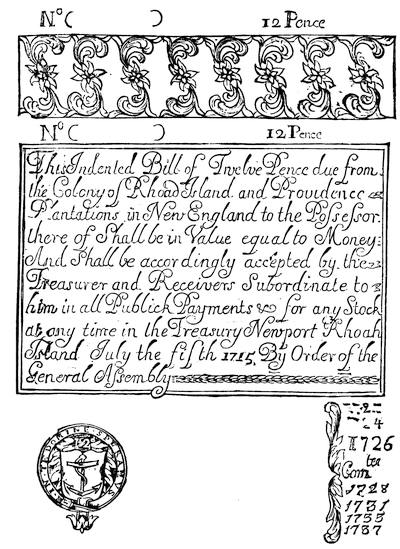
RHODE ISLAND PAPER,—TWELVE PENCE.
From an original bill in an illustrated copy of Historical Sketches of the Paper Currency of the American Colonies, by Henry Phillips, Jr., Roxbury, 1865,—in Harvard College library.
In 1733, Boston instructed its treasurer to refuse the bills of the new emission of Rhode Island. (Records, 1729-42, p. 53.)
The favoring and the opposing of the popular measure of the Land-bank drew lines sharply in the current political contests. The governor was suspected of double dealing, and while he was believed to be personally interested in it, he carried out openly the opposition which the Board of Trade instructed him to pursue: rejected the speaker and committees of the House, who were urging its progress, and displaced justices and militia officers of that way of thinking. All the while rumors of riot began to prevail, but they were not sufficient to coerce the government in a relaxation of their opposition; and the governor on his side carried espionage to a degree which was novel. It is said that something over £50,000 of the bank’s bills actually got out; but some one discovered that an old act of Parliament, which came of the explosion of the South Sea company, held each partner responsible, and nothing else was needed to push the adventure out of existence.[411]
Felt gives the main points in the development of this financial scheme, but here as elsewhere his book is a mere conglomerate of ill-digested items, referring largely to the five volumes (c.-civ.) of the Mass. Archives, marked “Pecuniary,” which cover the monetary movements in Massachusetts between 1629 and 1775. Among the Shelburne Papers, vol. 61,[412] there appears a report of the attorney general to the Lords of Trade on this scheme of erecting a Land-bank in Boston, dated Nov. 10, 1735.
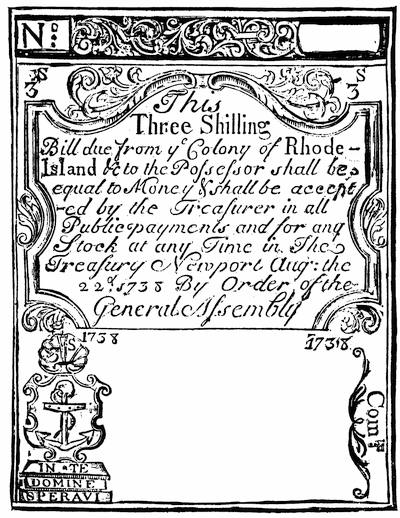
RHODE ISLAND THREE-SHILLINGS BILL, 1738.
From an original bill in the Harvard College copy of Phillips’ Hist. Sketches.
A leading combatant in the wordy conflict which followed was the Scotch physician, William Douglass, then living in Boston. His first publication was Some observations on the scheme projected for emitting £60,000 in bills of a new tenor to be redeemed with silver and gold, Boston, 1738.[413] In the same year he published without date, An Essay concerning silver and paper currencies, more especially with regard to the British colonies in New England, Boston.[414] He next printed in London in 1739 a Discourse concerning the currencies of the British plantations in America, especially with regard to their paper money, more particularly in relation to Massachusetts.[415]
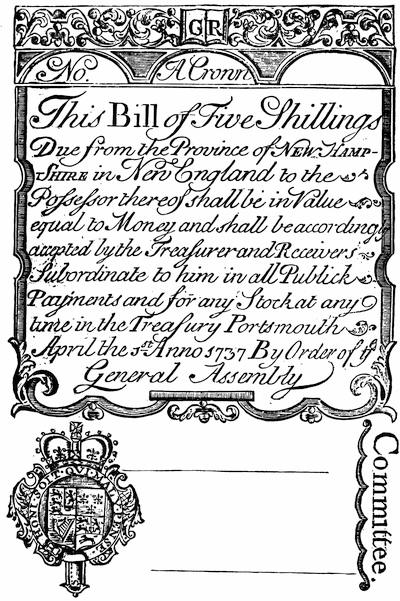
NEW HAMPSHIRE FIVE-SHILLINGS BILL, 1737.
From an original bill in the Harvard College copy of Phillips’ Hist. Sketches of Paper Currency. Fac-similes of bills of 1727 and 1742 are given in Smith’s Lit. and Hist. Curiosities, p. liii. Cf. also Potter’s Manchester.