Chapter V
Reading edition
THE CAROLINAS.
BY PROFESSOR WILLIAM J. RIVERS.
NORTH CAROLINA: Proprietary Government.—It was certainly manifest to England that her claim to vast regions of valuable territory would be substantiated, and her commerce and political power augmented, by the settling of her subjects in North America. Yet the history of her colonies bears, on many pages, evidence of the indifference and inexcusable neglect of the mother country. Instead of a liberal contribution of arms and munitions of war, the means of sustenance, and the protection of her ever-present sovereignty to all who were willing to leave the comforts of home and risk their lives in her service, far away across the Atlantic, enough appeared to have been done if lavish gifts of land were bestowed upon companies, individuals, or proprietors, for their especial emolument, and through them some paltry acres offered to emigrants, with promises of a little more religious freedom and a little larger share of political privileges than they were permitted to enjoy at home. The genesis of a new and potent nationality may be said to have been involved in the acceptance, by the colonists, of these conditions, as inducements to emigration, with all else dependent on their own manly courage.
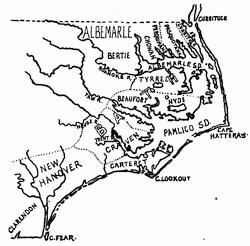
NORTH CAROLINA.
[This is a sketch of the map in Hawks’ North Carolina, ii. 570, showing the grants and divisions from 1663 to 1729.
Quaritch in his Catal. for 1885, no. 29,516, prices at £25 a MS. map of the south part of Virginia (North Carolina), showing the coast line from Cape Henry to Cape Fear, and signed “Nicholas Comberford, fecit anno 1657.” It measures 18¾ × 14 inches.—Ed.]
One of the colonies that struggled, through neglect and almost insurmountable hardships, into permanent existence was Carolina. Before its settlement, other colonies had successfully established themselves in New England, and in Maryland and Virginia. In 1663, Charles II., in the second year after his restoration, granted the region south of Virginia and extending from 31° to 36° north latitude, and westward within these parallels across the continent, to some of his adherents, to whom he was indebted for distinguished services. It is stated in the grant that this extensive region is called “Carolina,” a name used before, and now, no doubt, retained in honor of the king.[704] The favored noblemen are thus introduced to us: “our right trusty and right well-beloved cousins and counsellors, Edward, Earl of Clarendon, our High Chancellor of England, and George, Duke of Albemarle, Master of our Horse and Captain-General of all our Forces, our right trusty and well-beloved William Lord Craven, John Lord Berkeley, our right trusty and well-beloved counsellor, Anthony Lord Ashley, Chancellor of our Exchequer, Sir George Carteret, Knight and Baronet, Vice-Chamberlain of our Household, and our trusty and well-beloved Sir William Berkeley, Knight, and Sir John Colleton, Knight and Baronet;” who, we are deliberately informed, “being excited with a laudable and pious zeal for the propagation of the Christian faith, and the enlargement of” the British dominions, humbly besought leave of the king, “by their industry and charge, to transport and make an ample colony” of his subjects, “in the parts of America not yet cultivated or planted, and only inhabited by some barbarous people who have no knowledge of Almighty God.”[705] Had these high functionaries of the realm acted in accordance with this solemn announcement of their pious zeal for the propagation of Christianity, the blessing of Heaven would, no doubt, have rested more largely upon their noble enterprise.
An adverse claim was soon made to the same territory under a grant obtained in 1629,[706] by Sir Robert Heath, attorney-general of Charles I. But he had failed to form a colony, and the claims of those to whom he had conveyed his rights were on that account set aside. The Proprietors under the new charter began to make immediate exertions to form a settlement, that the king might see they did not “sleep with his grant, but were promoting his service and his subjects’ profit.”[707]
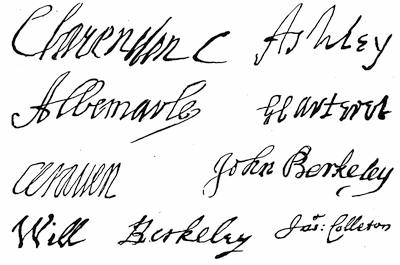
AUTOGRAPHS OF THE LORDS PROPRIETORS.
These follow fac-similes given in the Charleston Year Book, 1883.
Before this, settlers from Virginia had moved at various times southward and taken up their residence on some good lands on and near the river Chowan, in what is now the northeastern part of North Carolina. Among these was a considerable number of Quakers, at that time subject to religious persecution. It happened that Sir William Berkeley, one of the new Proprietors, was governor of Virginia. He was empowered by the other Proprietors to form a government forthwith in this settlement, and appoint its officers; the appointment of surveyor and secretary alone being reserved to the Proprietors in England. “We do likewise send you proposals to all that will plant, which we prepared upon receipt of a paper from persons that desired to settle near Cape Fear, in which our considerations are as low as it is possible for us to descend. This was not intended for your meridian, where we hope to find more facile people, who, by your interest, may settle upon better terms for us, which we leave to your management, with our opinion that you grant as much as is possible rather than deter any from planting there.” Sir William, it is inferred, followed these instructions. William Drummond was appointed governor;[708] the tract of land, at first forty miles square, was named Albemarle in honor of the duke, and a council of six was constituted to make laws with the consent of the delegates of the freemen. These laws were to be transmitted to England for approval by the Proprietors. Lands were granted to all free of rent for three years; and such lands as had been taken by previous settlers were confirmed to them.
Almost simultaneously another colony (Clarendon) was settled in what is now North Carolina. As early as 1660 some adventurers from Massachusetts had gone to the Cape Fear, sometimes called the Charles, River, and purchased lands from the Indians; but in a few years abandoned the situation, leaving their cattle and swine in care of the natives. To the same locality the attention of the inhabitants of Barbadoes[709] was directed on the grant of the territory to the powerful noblemen whose names are given in the charter. The passage already quoted from the letter to Sir William Berkeley had reference to them and their proposal. Explorers, employed by “several gentlemen and merchants” of Barbadoes, were sent out (1663) under command of Hilton, who ascended the Cape Fear far inland, and formed a more favorable opinion of the country than the New Englanders had been enabled to form near the mouth of the river. They purchased from the Indians “the river and land of Cape Fair,” as they express it, and returned to Barbadoes on January 6, 1664. An account of their exploration was published the same year, to which were appended proposals from the Proprietors, through their commissioners, Thomas Mudyford and Peter Colleton, to all who should settle, at their own hazard and expense, south and west of Cape Romano, sometimes called Cape Carteret. This was a bid for volunteer settlers south of the Cape Fear settlement. Nothing whatever, it appears, was accomplished under this offer of the commissioners. In a Description of the Province, with liberal privileges offered to settlers, issued also in London (1666), it is stated that a new plantation had been begun by the English at Cape Fear on the 29th of May, 1664. In the following November, Robert Sandford was appointed secretary and John Vassall surveyor of “Clarendon County.”[710] It was time the Proprietors should agree upon some definite and satisfactory terms for settlement in their territory. While they did not sanction the purchase of lands from Indians, as they had also disallowed the claims of the New England adventurers, they made to all colonists, from Barbadoes and elsewhere, liberal offers for settlement; and under “concessions and agreement” a method of government was framed, and John Yeamans of Barbadoes was knighted by the king (through means of Sir John Colleton), and commissioned, in January, 1665, governor of the newly formed Clarendon County[711] and of the territory southward as far as Florida; for in this direction the Proprietors designed to place a third colony or county.
The two counties, Albemarle and Clarendon, were formed under the charter of 1663. Another charter was granted by the good-natured king in June, 1665, enlarging the limits of the province to 36° 30´ on the north, and on the south to 29°. This extension may be ascribed to the desire of the Proprietors to secure beyond doubt the section on which the Chowan colony happened to be formed near Virginia, and to embrace, southwardly, the limits claimed with respect to Spanish Florida.
We have very little knowledge concerning the administrations of Drummond and of Yeamans. It is said that the latter, being near the sea, began at once to export lumber and opened a trade with Barbadoes; and reports so favorable were carried thither, and so many were induced to follow the first emigrants, that the authorities of the island interposed, and forbade, under severe penalties, “the spiriting off” of their people. In Albemarle, Drummond was succeeded by Samuel Stephens as governor in 1667. In Clarendon, the colony soon ceased to prosper, and most, if not all, of the colonists had abandoned it in 1667. We shall understand better why they did so if we bear in mind that the territory of the Lords Proprietors was very extensive. There were other places, not yet explored, more convenient for commerce, more defensible, more fruitful, more desirable in all respects; the advantages of which would naturally draw off settlers from the less favorable localities selected before a thorough knowledge of the country was obtained. The Proprietors, as we have said, thought of forming, with larger preparations, a colony still further south. The famous harbor of Port Royal, in what is now South Carolina, was the locality they desired to occupy and (with unusual display of wisdom) to fortify. For reasons, however, which will appear hereafter, when we treat of South Carolina, the colonists, after visiting Port Royal, and after a temporary settlement at Albemarle Point on the western bank of the Ashley River, finally settled down on the opposite side, at the confluence of the Ashley and Cooper rivers, and founded the present city of Charleston. There was, indeed, enough to discourage the settlers at Cape Fear independently of the more extensive preparation by the Proprietors to place a colony in a better situation. Secretary Sandford (in his Relation of his voyage in 1666) incidentally mentions: “Wee were in actuall warre with the natives att Clarendon, and had killed and sent away many of them, for they [the more southern Indians] frequently discoursed with us concerning the warre, told us the natives were noughts, their land sandy and barren, their country sickly.” Surveyor-General Vassall, in a letter from Virginia (Oct. 6, 1667), speaks of the loss of the plantation on Charles River and his furnishing shipping to carry away “such weak persons as were not able to go by land.” And a letter from Boston (Dec. 16, 1667) states that Cape Fear was deserted, and the settlers “come hither, some to Virginia.”[712]
Here let us notice the policy and plans of the Proprietors with respect to their distant colonies. The two charters differ only in a few particulars. The second increases the extent of territory, its main object, gives power to subdivide the province into distinct governments, and is a little more explicit with regard to religious toleration. No person was to be molested for difference of religious opinion or practice who did not actually disturb the peace of the community. With regard to political privileges, there is an important clause in both charters conferring upon the Proprietors power to ordain any laws and constitutions whatsoever (if consonant to reason and, as far as possible, to the laws and customs of England), but only “by and with the advice, assent, and approbation of the freemen,” or the majority of them, or of their delegates or deputies, who, for enacting such ordinances, were to be duly assembled from time to time. These privileges, we shall see in the history of the colony, were maintained by the people with a pertinacity commensurate with their importance, whenever their lordships attempted to control the colonists without due regard to their approbation and consent. The charter reserved to the king only allegiance and sovereignty; in all other respects the Proprietors were absolute lords, with no other service or duty to their monarch than the annual payment of a trifling sum of money, and in case gold or silver should be found a fourth part thereof.
On August 6, 1663, a letter to the Proprietors, from members of a Cape Fear company of New England adventurers, claimed full liberty to choose their governors, make and confirm laws, and to be free from taxes, except such as they might impose on themselves, and deprecated “discouragement in reference to their government” as to the accustomed privileges of English colonists. While their claims were not conceded, this letter was answered generally by their lordships, on August 25th, announcing their concessions to all wishing to settle in Carolina.[713] The New England claim of privileges is worthy of notice for what we now call “advanced ideas.” And if we compare the charters of Connecticut (1662) and Rhode Island (1663) with that of Carolina (1663), it will appear that the self-interest of Clarendon[714] and his associates stood in the way of their securing to their colony some civil privileges which it would not have seemed strange at that time to concede. And it may as well be stated here, at once, that besides considerations of self-interest it was also the express policy of their lordships to “avoid erecting a numerous democracy” in their province. To carry out this policy, a grand scheme of government, called the Fundamental Constitutions, was framed by Shaftesbury and the philosopher Locke, and solemnly confirmed as a compact among themselves,—the Proprietors,—and which was to be unalterable forever. A scheme more utopian, more unsuited to the actual condition of the colonists, could hardly have been devised. Yet its adoption by the people was recommended, ordered, stubbornly insisted on by their lordships at the risk of balking—as, for a while, it did balk—the prosperity of their colony. The first set of the unalterable Constitutions is dated 21st July, 1669; the second was issued in March, 1670,—and so on till a fifth set had been constructed. Under the right conferred by the charter, respecting the consent of the freemen, or their delegates, in establishing laws and constitutions, such consent was never formally given; and the code was, at least in South Carolina, again and again rejected. It was a gage of political contention foolishly thrown down; but in taking it up, the colonists were made ardent students of political rights.
By these Constitutions, the eldest Proprietor was made Palatine,—a sort of king of the province. The other seven Proprietors were to be high functionaries: admiral, chamberlain, constable, chief justice, chancellor, high steward, and treasurer.[715] There was to be a Parliament: eight superior courts, one to each Proprietor according to his high office; county and precinct courts; and a grand Executive Council, among whose duties was the preparation and first enactment of all matters to be submitted to Parliament. Among the carefully composed articles in these Constitutions should be noticed such as enjoin that no person above seventeen years of age could have the benefit and protection of the law who was not a member of some church; and no one could hold an estate or become a freeman of the province, or have any habitation in it, who did not acknowledge a God and that He is publicly and solemnly to be worshipped. Moreover, in the set of the Constitutions printed and sent over for adoption, the Church of England[716] was made the established church, and “it alone shall be allowed to receive a public maintenance by grant of Parliament.” It was also enjoined that no one seventeen years old should have any estate or possession or the protection of the law in the province, unless he subscribed the Fundamental Constitutions and promised in writing to defend and maintain them to the utmost of his power.
Their lordships in England, and most, if not all, of their appointed officers in the colonies, as in duty bound, contended strenuously for the adoption of this preposterous form of government till the year 1698; and hardly then did the incontrovertible logic of events convince them of their folly. A late historian of North Carolina remarks, “Their lordships theorized, the colonists felt; the Proprietors drew pictures, but the hardy woodsmen of Carolina were grappling with stern realities. Titles of nobility, orders of precedence, the shows of an empty pageantry, were to them but toys which might amuse children; but there was no romance in watching the savage, or felling the forest, or planting the corn, or gathering the crop, with the ever-present weapon in reach of the laboring hand.”
There was another cause of irritation on the part of the colonists, both in North and South Carolina. The terms of the tenure of land were of paramount interest to them and their children. The quantity offered in 1663 was augmented in 1666, and two years later, by the “Great Deed of Grant,” the fear of forfeiture was removed for not clearing and planting a specified portion of the land; in other words, settlers were permitted to hold lands as they were held in the adjoining royal province of Virginia. At first each freeman received one hundred acres, the same for his wife, each child and manservant, and fifty for each woman-servant; paying a half-penny per acre. After the expiration of servitude, each servant received a liberal quantity of land with implements for tillage.[717] In 1669, in the settling of the colony at Ashley River, one hundred and fifty acres were offered to all free persons above sixteen years of age, and the same for able-bodied men-servants; and a proportionate increase for others, if they arrived before the 25th of March, 1670; then a less number of acres for subsequent arrivals. The annual rent was a penny or the value of a penny per acre (as also announced in the unalterable Constitutions); payments to begin September, 1689.[718] When Governor Sayle died (a year after settling on Ashley River), Sir John Yeamans came from Barbadoes to the new settlement; and having been made a landgrave claimed the government as vice-palatine under the Fundamental Constitutions. Such claim was denied by the colonists;[719] but he soon received a commission, and his first measure, on assuming control, was to have an accurate survey made and a record of lands held by settlers in South Carolina, with a view to the collection of quit-rents for the Proprietors. When ten years of outlay for their province had brought them no pecuniary return, they began to think “the country was not worth having at that rate.” They removed their former favorite Yeamans, because further outlays were incurred, and placed West in authority, who had attended more successfully to their interests. In November, 1682, all prior terms for granting land were annulled, and if a penny an acre (the words “or the value of a penny” being omitted) was not paid, a right of reëntry was claimed: “to enter and distraine, and the distress or distresses then and there found to take, lead, and carry and drive away and impound, and to detain and keep until they shall be fully satisfied and paid all arrears of the said rent.” This produced inequality of tenure, or operated to the injury of many who had previously taken up, on more liberal terms, only part of the lands they were entitled to.[720] Their lordships were too just to interfere with the stability of titles, but the alteration of the tenure for new grants or of the mode of conveyance, from time to time, was at least unwise. Besides, there was scarcely any coin in the province, and the people found it hard that they could no longer pay in merchantable produce. To their reasonable request for relief and a better encouragement to new settlers came the reply, “We insist to sell our lands our own way.” With this reply a peremptory order was sent that the third set of the unalterable Constitutions should be put in force.
A part of this manifest diminution of the generosity of the Proprietors and their unwillingness to bestow further concessions may be accounted for by the opposition their favorite scheme of government had encountered in both colonies, and especially by a rebellious outbreak which had just occurred in Albemarle County. Clarendon County at Cape Fear had broken up and disappeared, as we have related; and henceforth our attention must be directed to Albemarle at the northern end of the province and the Ashley River colony at the south, remote from each other, with a vast forest intervening, the dwelling place of numerous tribes of Indians. Before the province was authoritatively divided (1729), it had divided itself, as it were, into North and South Carolina; and it is best that, in this narrative, we should begin to call them so.
In North Carolina, the Quakers, who were in close association and unison, and so far influential in action,[721] opposed the Fundamental Constitutions and the Church of England establishment; and all the settlers looked upon the enforcement of the recent orders of the Proprietors—the displacement of an easy and liberal method of government without asking their assent—as a violation of the terms of settlement, and of the inducements at first held out to them.[722] Governor Stephens endeavored to enforce the orders of the Proprietors, but he died soon after receiving them, and was succeeded by Carteret, president of the council, till an appointment should be made. Carteret appears not to have been of a nature to contend against the disaffection and turbulence which had arisen, and, in 1675, went to England to make known personally, it is said, the distracted condition of the colony. But two of the colonists, Eastchurch and Miller, had also gone over to represent, personally, the grievances of the people. They seemed, to the Proprietors, the ablest men to carry out their instructions; and the former was made governor and the latter deputy of Earl Shaftesbury and secretary of the province; he was also made, by the commissioners of the king’s revenue, collector of such revenue in Albemarle. They sailed for Carolina in 1677, but the new governor remained a long while in the West Indies (winning “a lady and her fortune”), and died soon after reaching Albemarle. Miller as representing Eastchurch, but really without legal authority to act as governor, ruled with a high hand. He had gone to represent the grievances of his fellow colonists; he returned to harass them still more. The new “model” of government, the denial of “a free election of an assembly” (as the Pasquotank people complained), the attempt to enforce strictly the navigation laws, the collection of the tax on tobacco at their very doors,[723] his drunkenness and “putting the people in general by his threats and actions in great dread of their lives and estates,” as the Proprietors themselves express it, became intolerable to the colonists.
The New Englanders, with their characteristic enterprise, had long been sailing through the shallow waters of the Sound in coasting vessels, adapted to such navigation, and had largely monopolized the trade of North Carolina; buying or trafficking for lumber and cattle, which they sold in the West Indies, and bringing back rum, molasses, salt, and sugar, they exchanged these for tobacco, which they carried to Massachusetts, and shipped thence to Europe without much regard to the navigation laws. Miller, according to instructions sent to Governor Eastchurch, sought to break up this thriving and lucrative business, and to introduce a more direct trade with England. The populace generally, including the Quakers, had their own grievances, and fraternized with the New England skippers. Gillam, one of these bold captains, arrived with his vessel laden with the commodities the people needed, and armed, this time, with cannon. A wealthy Quaker, Durant, was on board with him. On land, John Culpepper, who had lately left South Carolina, where he had created commotions, became a leader of the malcontents. Influenced, no doubt, by the recent rebellion of Bacon in Virginia, some participators in which had taken refuge among them, and led on by men of courage whose hard-earned emoluments were threatened with ruin, the insurgents seized and imprisoned Miller and seven of the proprietary deputies, and took from the former a large amount of money which he had collected for the king. They had won over to their side the remaining deputy, the president of the council; and together they now governed the colony as seemed best to them. But they were aware that violence and usurpation could not be passed over with impunity by higher authority; and as Miller and some of his adherents had escaped and gone to England, Culpepper and Holden were also sent to the Proprietors on a mission of explanation. The explanation of neither party was entirely satisfactory. Miller lost his offices, and Culpepper, though he was unpunished by the Proprietors, was seized by the Commissioners of the Customs to answer for the revenue money which had been used in the time of the disorders. He was put on trial, in 1680, for “treason committed without the realm.” It is said by Chalmers that the judges ruled that taking up arms against the proprietary government was treason against the king. Notwithstanding this view of the case, Culpepper was acquitted of treason, because Shaftesbury asserted that the county of Albemarle had not a regular government, and the offence of the prisoner amounted to no more than a riot.[724]
At this time the Earl of Clarendon sold his proprietary share to Seth Sothel, who was appointed governor. Mr. John Harvey, as president of the council at Albemarle, was to exercise the functions of governor till Sothel’s arrival. The latter, on his voyage, was captured by an Algerine corsair; Harvey died; Jenkins was made governor, and was deposed by the people without reprimand from the Proprietors; and in February, 1681, Wilkinson was appointed. These sudden changes in executive authority were unfortunate for the prestige of proprietary power in the colony; for all this while and until Sothel came in 1683, the old adherents of the Culpepper party, or the popular party, held control in Albemarle. But still more unfortunate for the Proprietors was the coming of Sothel. He seems to have purchased his place as Proprietor and to have come as governor in order to have a clear field for the exercise of his rapacity. If he was “a sober, moderate man,” as his colleagues thought when they intrusted their interests and the welfare of the county to his hands, his association with the Algerines must have materially changed his character. In 1688, the outraged colonists seized him, intending to send him to England for trial. On his appeal this was not done, but the case referred to the colonial assembly, who condemned him. His sentence, however, amounted only to banishment for twelve months and perpetual deposition from authority, Proprietor though he was. He went to South Carolina, and his further career will be noticed when we review the history of that colony.
The next year Philip Ludwell, of Virginia, was made governor, and after four years was transferred to South Carolina and appointed governor of both colonies. For more than twenty years North Carolina was governed by a deputy of the governor at Charleston, or (when there was no deputy appointed) by the president of her own council. The Albemarle colony had become to the Proprietors only a source of vexation. At any rate, they acted wisely in leaving its management, in some measure, under the control of those more conversant with its affairs than their lordships in England could possibly be. Their own mismanagement, in truth, was the principal cause of the turbulent spirit of the people.[725]
After Sothel’s banishment the executive authority belonged, as a rule, to the president of the council till Ludwell received it in 1689. On the latter’s removal to Charleston, S. C., Lillington acted as deputy in Albemarle. In 1695, Thomas Harvey became deputy governor by appointment from Archdale, the Quaker Proprietor (who was sent over to heal grievances in both colonies), and was followed in 1699 by Henderson Walker, president of the council. In 1704, Robert Daniel was appointed deputy by Governor Johnson, of South Carolina. John Porter, a Quaker, or sympathizer with the Quakers (sent to England to complain of Daniel and legislation in favor of the Church of England in the colony by “The Vestry Act”), with the assistance of Archdale, prevailed on the Proprietors to order Daniel’s removal, and Governor Johnson appointed (1705) Thomas Carey in his place. He was as little acceptable to the Quakers in North Carolina as his predecessor had been, and through their influence in England at this conjuncture the appointment of a deputy by the executive in South Carolina was suspended, Carey was removed, and a new Proprietary Council formed, including Porter and several Quakers. Porter returned to North Carolina in 1707, and called together the new council, who chose William Glover, a Churchman, president, and, as such, acting governor. He, however, as Carey had done, required conformity to the English laws respecting official oaths, which were displeasing to the Quakers; and Porter in opposition declared Glover’s election as president illegal, formed a coalition with Carey, whom he had before caused to be displaced, and secured his election to the presidency of the council. There were now two claimants for executive authority, and no power at hand to decide between them. Carey and Glover sat in opposite rooms with their respective councils. Daniel, being a landgrave, and having thereby a right to a seat in the Upper House,—as the council with the governor was styled,—sat alternately with one and the other, and no doubt enjoyed their altercations.
A new rebellion, so-called, now broke out, based apparently on local party strife. At first Carey and his Quaker supporters opposing Glover and his party sought and obtained control of the assembly; and when Edward Hyde came from England with letters on authority of which he claimed executive power,[726] the Carey party, at first favorable to him, finally, on losing control of the next assembly, directed itself against him. Hyde’s life was endangered by Carey’s armed opposition; and Spotswood, the energetic governor of Virginia, sent him military aid and put down his opponents.[727] Carey, on his way through Virginia, was arrested by Spotswood and sent to England for trial. This was the occasion of Lord Dartmouth’s circular letter to all the colonies “to send over no more prisoners for crimes or misdemeanors without proof of their guilt.”
According to the latest history,—that of Rev. Dr. Hawks,—another result of this acrimonious contest was the deplorable massacre of hundreds of defenceless white settlers, men, women, and children, by the Tuscarora Indians. This is doubtless merely post hoc ergo propter hoc. We must ascribe hostilities solely to encroachments on the lands of the natives; to ill treatment by traders and others; and to the killing of one of their number, which called for revenge. The Tuscaroras, it was thought, could muster 1,200 warriors. They suddenly made their onslaught at daybreak, September 22, 1711. Their special task in the diabolical conspiracy was to murder all the whites along the Roanoke, while other tribes conducted a simultaneous attack upon other sections. The wielding of the blood-dripping knife and tomahawk, the conflagration of dwellings and barns, the murderous rush upon the victims who, here and there, had hidden themselves and who ran out from the blazing fires to a fate scarcely less dreadful, with other horrors we are unwilling to relate, continued for three days. One hundred and fifty were slain on the Roanoke, more than sixty at Newbern, an unknown number near Bath; and the carnage was stopped only by the exhaustion and besotted drunkenness of the bloodstained savages. Governor Hyde was powerless to confront the foe. He could not raise half the number of men the enemy had. The Quakers were non-combatants; and with them were affiliated many others who opposed the government. Governor Hyde was compelled to resort to arbitrary measures in impressing vessels and in procuring provisions for such troops as he could muster; and these were so inadequate, and so wide-spread was the Indian combination, that he called for assistance from Virginia and South Carolina. Both responded with alacrity. While Spotswood could not supply troops, he checked the further combination of tribes in his direction. South Carolina sent troops onward through the forests, under Colonel Barnwell, who defeated the Tuscaroras and put an end to the war for the time being. But after he retired to South Carolina, suffering with wounds, the Indians treacherously renewed hostilities; and it was believed they would soon be joined by more powerful northward tribes. To add to the calamities of the people, an epidemic (said to be yellow fever) broke out. The mortality was fearful, and among the victims was the governor of the colony. The council elected Colonel Pollock as their president and to act as commander-in-chief. The following mournful picture is given us from manuscripts left by Colonel Pollock: “The government was bankrupt, the people impoverished, faction abundant, the settlements on Neuse and Pamlico destroyed, houses and property burned, plantations abandoned, trade in ruins, no cargoes for the few small vessels that came, the Indian war renewed, not men enough for soldiers, no means to pay them, the whole available force under arms but one hundred and thirty or forty men, and food for the whole province to be supplied from the northern counties of Albemarle only.” South Carolina, being again called on for help, sent Colonel James Moore, eldest son to Colonel James Moore, late governor of the colony. On the 20th of March, 1713, he conquered the last stronghold of the savages, who soon after, broken and disheartened, left the province in large numbers, and joined themselves with the Iroquois in what is now the State of New York. Such of them as remained in North Carolina entered into a treaty of peace with the whites. During these exhausting calamities the Proprietors were appealed to; and it was a poor response to refer the matter to General Nicholson “to enquire into the disorders of North Carolina.”
The next year (May, 1714) Charles Eden, an excellent officer, was appointed governor. The adherents of Carey, or the popular party, however, seemed to be actuated against all who were sent to rule the colony. What grievances they had to palliate or justify their conduct, on this occasion, we know not; but soon their active opposition had to be dealt with by the constituted authorities. We shall see, when we treat of South Carolina, that a few years later the colonists, in that section, threw off, effectually, the inefficient rule of the Proprietors, and placed themselves under the immediate control of the Crown; deposing the last proprietary governor, and electing Colonel Moore governor in the king’s name. It is probable that the same spirit actuated the people in North Carolina. Yet her historians have not made it evident that the continued disaffection and turbulence and rebellion of the people are indications of their readiness to act as their more southern brethren acted. Perhaps they had not, at that conjuncture, the same amount of provocation. When we read the letter of the Lords Proprietors to the council and assembly (June 3, 1723),[728] “We received an address from you, transmitted some time since by our late governor, Mr. Eden, wherein you signified to us your great dislike to the rebellious and tumultuous proceedings of several of the inhabitants of South Carolina, and your constant and steady adherence to our government and the present constitution,” we are to bear in mind that this governor and council were the appointed officers of their lordships. We are to ask, Where are the records of the assembly,[729]—records of the thoughts and actions of the representatives of the people? These, no doubt, will show, if they can be found, that a spirit of local self-government actuated the people, and is the thread of development to be followed by the future historian of the State. We need the testimony of Porter, of Carey, of the able and virtuous Edward Moseley (chief justice from 1707 to 1711), and of other leaders of the people against the repressive policy of their lordships in England and their governors and councils.
Some interesting subjects, indicative of the condition of the colony in these early times, must be briefly noticed: the emission of paper money consequent upon the expenses of the Indian war; the occasional rating of commodities for exchange; the indigenous products of the soil and staples of export; the forwarding of tobacco abroad through Virginia, and troubles about boundary lines; the customs and modes of life among the gentry or planters and the humbler classes, and among their close neighbors, the Indian tribes; the visits of pirates to the coast, both in North and South Carolina, notably Teach or Blackbeard, and the romantic defeat of him in Pamlico Sound; the settling, at first, along the streams, which became the principal highways for travel and commerce; the ill effects necessarily resulting from the habitations being far apart, and from the fact that there was very little social intercourse; the transmission of letters only by special messengers; the disadvantageous nature of the coast section, retarding the prosperity of the colony.
During the proprietary period, or the first sixty-six years of the colony, the people clung to the seaboard and that part of it which had no good port of entry. This was as great a misfortune as it was to cling to the border line of Virginia. The accession of population, including foreigners, came chiefly through that border. In 1690 and again in 1707, bodies of French Protestants arrived, and settled in Pamlico and on the Neuse and Trent; and three years after some Swiss and Germans settled at Newbern. The whites in the province numbered at this time about 5,000. Large tracts of unoccupied land lay between the selected points of settlement. A few towns had been begun: the first, forty-two years after the first settling in the province. If a good harbor had been selected and a town properly fortified built there for exports, the progress of North Carolina might have been more rapid and substantial. The metropolis was Edenton (founded 1715) on the Chowan. The legislature met there. It contained forty or fifty houses. There was no church there. The Rev. Dr. Hawks says: “For long, long years there were no places of worship. They never amounted to more than some half dozen of all sorts, while the Proprietors owned Carolina; and when their unblessed dominion ended, there was not a minister of Christ living in the province.” There had been, however, missionaries sent out by the Society for the Propagation of the Gospel; and there were some pious gentlemen in the colony who gave them welcome and all the assistance in their power. But while a few of the missionaries were exemplary and accomplished much good, others were a positive hindrance to “the propagation of the gospel.”
Among the misfortunes of the colonists we must not fail to notice the incompetent governors sent from England. Favoritism, and not fitness for office, dictated the selection. Archdale, Hyde, and Eden are considered the only governors sent to the province who did it much service. The last two whom their lordships favored with the dignity of executive authority were Burrington, pronounced “a profligate blackguard,” and Sir Richard Everard, whom his superseded rival railed against as “a noodle and an ape,” and “no more fit to be a governor than Sancho Panza.” It was in the administration of Sir Richard that the colony passed by purchase under the immediate control of the king. Two thousand five hundred pounds sterling were paid for each of seven shares; Lord Carteret declining to dispose of his, as it had come to him by inheritance.[730] The claims for arrears of quit-rent due from settlers were also purchased. Before the surrender of the charter many changes had occurred in the ownership of shares in the province; and not one of the original Proprietors remained alive to witness the failure of their successors in the noble enterprise committed to their management by the munificence of Charles II.
Royal Government.—The method of the royal government will be noticed when we come to write of South Carolina. The more thoughtful in North Carolina no doubt felt relieved in escaping from the negligent rule of the Proprietors; but the transition from the old to the new form of administration appears to have been a matter of indifference to the people at large. All they saw in 1731 was that George Burrington, who had been displaced for Everard in 1725, came back with a commission as the first royal governor, to displace in turn his former rival. Burrington, favored for his father’s services to the king, was unsuited for his position, and soon became involved in disputes with his council, the assembly, and the judges. He appeared to think the foremost duty of the assembly was to provide for him a salary suitable to his new dignity, to raise money for other royal officers and an adequate and permanent revenue for the king. The assembly was prorogued for declining to do so. His violence and tyranny caused complaints against him to be sent, through Chief Justice Smith, to the authorities in the mother country. One service, however, he rendered, in conciliating the Indians on the western border. To this end he sent Dr. John Brickell with a party of ten men and two Indian hunters to assist them.[731] The account of the expedition adds to our knowledge of the condition of that remote section of the province, as the interesting work of Lawson does with respect to other sections. In 1734, on the return of the chief justice, the governor retired to Charleston and sailed thence to England. Soon afterwards he was found murdered in St. James’ Park, in London.[732] Nathaniel Rice, secretary of the province, and the first named of the councillors, administered the government from April till November, when Gabriel Johnston, a Scotchman and man of letters, received, through the influence of his patron, Lord Wilmington, the royal appointment. For nearly twenty years he prudently administered the affairs of the colony. At first he found a formidable obstacle to a successful management of the people in their disregard of laws and of gubernatorial dignitaries, imposed upon them by foreign authority. Many hard things have been said of the people by those who, perhaps, did not consider the neglect, mismanagement, and tyrannical provocation under which they lived for two generations, and the increasing intercolonial influences in behalf of popular sovereignty. One of the Virginia commissioners, for laying off (in 1727) the northern boundary, states that the borderers preferred to belong to the Carolina side, “where they pay no tribute to God or to Cæsar.” Governor Johnston, at this time, was in need of the latter kind of tribute. The salaries of the crown officers were to be paid from quit-rents due to the Crown, the collection of which depended on enactments of the assembly. The governor, finding great difficulty in having a satisfactory enactment passed, prorogued the assembly and attempted to collect the rents on his own authority. Not only was this resisted by the people, but the assembly, being again convened, denied the legality of the acts of the governor, and imprisoned his officers who had distrained for the rents.[733] The assembly was consequently dissolved (March, 1736). At the next session, in the following September, the governor addressed the representatives of the people on the general condition of the province, the lack of moral and educational advancement, and of proper regard for law and good order, and assured them “that while he was obliged by his instructions to maintain the rights of the Crown, he would show a regard to the privileges, liberties, and happiness of the people.” In the spirit of compromise a law was passed with the concurrence of the governor, but which the authorities in England rejected as yielding too much to the demands of the popular assembly.
At this time (1738) commissioners were empowered to run the boundary between North and South Carolina, and completed the work from the Atlantic as far westward as the Pee Dee. The original division of the coast section into three counties—Albemarle with six precincts, Bath with four precincts, and Clarendon with one (New Hanover)—was altered, and the precincts were denominated counties. The very names of the original counties disappeared. Soon other counties westward or inland were formed as the population increased, chiefly by overland immigration. To each county the governor appointed a sheriff, selected from three persons recommended by the county court. The judiciary system was modified to suit the new administration and augmentation of population. The governor had before (1736) deplored the fact that no provision had been made “or care taken to inspire the youth with generous sentiments, worthy principles, or the least tincture of literature;” but not until 1754 was an act passed to establish a public seminary. It did not receive the royal assent. That there were not many schools is doubtless due to the sparseness of settlements, and not to any general indifference to education.[734] During the period of the royal government there were two schools that we read of,—those at Newbern and Edenton. In the building of the former, a wooden structure, the lower house of assembly occasionally held its sessions. In 1749, printing was introduced at Newbern, from Virginia; and a weekly paper styled the North Carolina Gazette, issued “on a sheet of post-sized folio,”—“with freshest advices, foreign and domestic.” In 1752 appeared the first edition of the Provincial Laws.
At the town of Wilmington, so named in honor of the Governor’s patron, and sometimes at Newbern, the assembly now met instead of at Edenton, near the Virginia boundary. A new assembly was convened at Wilmington, and an attempt was made to establish an equalization of representation, with a consequent diminution of the number of representatives from the old and more northern counties,—from five members each to two members.[735] Dissatisfaction was the result; and the six northern counties would neither recognize the assembly at Wilmington nor pay taxes, nor would the jurors attend the courts. The colony, however, was more thriving than it had been at any previous period. It was favored by the mother country with bounties on its exports; and the general prosperity was augmented by the coming in of the banished Highlanders and of emigrants from Ireland, and especially by the beginning of the great flow of overland immigration into the central and more western section of the province. Under the prudent management of Johnston, harmony at last prevailed, and such laws were enacted as were necessary. On the declaration of war between England and France, the defences of the coast received legislative attention, and a fort mounting twenty-four cannon was erected on the south bank of the Cape Fear, and called Fort Johnston, in honor of the governor.[736]
Governor Johnston died in August, 1752. What he had written to the Duke of Newcastle, in 1739, was now even more applicable, that after years of effort he had brought the colony “to system, where disorder had before reigned, and placed it on a firmer foundation.” The administration again devolved on Nathaniel Rice; and on his decease in January, Matthew Rowan, the next councillor, acted as governor till the arrival of Arthur Dobbs, in 1754. Rowan’s short term of service was distinguished by liberal contributions for building churches and purchasing glebe lands for the support of ministers of the gospel; and by the convening of the assembly to provide for aiding Governor Dinwiddie, of Virginia, by whose order George Washington had gone to examine the alarming movements of the French on the Ohio. The militia of North Carolina amounted at that time, as stated by Rowan, to 15,400 men.
Besides the early coast-line settlements, and those along the bottom lands of the northeastern streams, there came, mainly after Braddock’s defeat, a remarkable tide of immigration from the western frontiers of Virginia and Pennsylvania into central and western North Carolina. Between 1750 and 1790 the accession to the population is computed[737] to be as much as 300,000. Many seeking fertile lands moved over into the “Up Country” of South Carolina, and westward into Tennessee. These hardy and liberty-loving German and Scotch-Irish settlers formed a section of North Carolina which for a long time was “distinct in population, religion, and material interests.” Their final fraternization and blending in political union with the people of the eastern section is a subject for the later history of the province and State.
Governor Dobbs, a native of Ireland, and who had been a member of its Parliament, brought to the colony cannon and firelocks, as a present from the king; and, as a present from himself, “a number of his relations, who had hopes of offices and preferments.”[738] While, on the one hand, he sought to conciliate the Indian tribes, on the other he continuously embroiled himself in contests with the assembly and on trivial matters. It was, however, the irrepressible conflict of that day,—the conflict we have been expecting all along in this history,—the outgrowth of antagonism between the royal prerogatives and the rights and privileges of the representatives of the people. Contributions of men and money were called for by the governor for the general defence of the provinces, and for fortifications within the limits of North Carolina. The assembly were ever ready to defend their frontiers and render aid to the neighboring colonies. But in the acts for founding new counties, they disallowed “the royal prerogative of granting letters of incorporation, ordering and regulating elections, and establishing fairs and markets.” In enactments for a new court system, the further emission of paper money, and the appointment of an agent in England to solicit the affairs of the province, disputes ensued between the assembly and the executive. A new assembly being convened was equally jealous of its rights and privileges, and ably maintained them in lengthy communications to the governor, but without moving him from his convictions of duty under the royal instructions. The assembly was prorogued after appointing, by resolution, the agent to England, whom the governor had rejected. Upon reassembling, and again in a new assembly, on various bills the struggle for legislative rights was continued with the Upper House or council.
Two very different events here arrest our attention: the grant of the king, through Parliament, of £50,000 to indemnify Virginia, North and South Carolina, for their war expenses, and the proposal to the colonies to form a union for common defence against general attacks of the French and Indians; the one fostering attachment to the Crown, the other teaching the method of effectual resistance.
Governor Dobbs was now infirm and over eighty years of age, and, having obtained leave of absence, there was sent over, as Lieutenant-Governor, the able and energetic William Tryon, a colonel in the Queen’s Guards, who became, on the decease of Dobbs, in 1765, governor of North Carolina. He was succeeded by Martin, the last royal governor. We close this brief narrative, pondering upon the province’s progress in wealth, population, and political stability; on the intercolonial influences developing union and constitutional self-government; and on the portentous shadow of the approaching Revolution.[739]
SOUTH CAROLINA.
Proprietary Government.—In 1665 the Lords Proprietors placed in charge of Sir John Yeamans—whom they had, in January, commissioned governor of Clarendon county at Cape Fear—the further discovery of the Carolina coast southward of the portion embraced in the report of Hilton, Long, and Fabian in 1663. Yeamans and his party left Barbadoes in three vessels in October. After separation by a storm, they all reached the Cape Fear or Charles River. But there a violent gale wrecked the vessel containing the greater part of their provisions, arms, and ammunition. Being in distress for supplies, their sloop was despatched to Virginia for aid, and Yeamans himself returned to Barbadoes, leaving Robert Sandford in commission to obtain a vessel and complete the exploration of the southern coast. Sandford appears to have first entered the North Edisto River, where he met the Cassique of Kiawah, who had traded with the settlers in Clarendon county, and who now invited Sandford to his country. But the explorers sailed on to Port Royal, arriving there early in July. Their reception was apparently very friendly, and Dr. Henry Woodward remained among the Indians to learn their language, while a nephew of the chief accompanied Sandford. They designed, on their return, to visit Kiawah; but by a mistake of the Indian who acted as guide, they passed beyond the entrance (now Charleston harbor) which led to that country, and the wind not being favorable for putting back, the voyagers proceeded northward and returned to Cape Fear.[740]
In 1667, the Proprietors took measures to found, in the region reported on by Sandford, a colony worthy of themselves and of the munificence of the king in granting them almost royal authority in the extensive territory lavishly bestowed by the charter. The elaborate plan of government which Locke assisted in maturing was devised for this new enterprise, and was solemnly agreed upon as a contract among the Proprietors. Twelve thousand pounds sterling, a large sum at that day, were expended in preparation for founding, in what is now South Carolina, a colonial government calculated to bring both glory and emolument to their lordships. In August, 1669, three vessels were ready to sail from England: the “Carolina” frigate, the “Port Royall,” and the sloop “Albemarle.” On board the first-named were ninety-three passengers. How many were in the other vessels is not at present known; but the intention appears to have been to begin the settlement with at least two hundred. They stopped at Kinsale in Ireland to take in other emigrants, receiving, however, only seven; and according to instructions sailed thence to Barbadoes, which they reached in October. They were to obtain there such plants as the vine, olive, ginger, cotton, and indigo, and some swine for the new colony; and, no doubt, as many emigrants as could be induced to join the expedition. The fleet was consigned to Thomas Colleton, brother of the Proprietor, Sir Peter Colleton. It seems that the Proprietors were not pleased with the management of Sir John Yeamans in the previous expedition and his leaving the perils of exploration to Secretary Sandford; yet his experience and ability rendered his coöperation desirable, and power was given him to fill a blank commission sent to him for the governorship of the new colony. Living in Barbadoes, and familiar with projects of colonization, he acted on this occasion on behalf of their lordships, with authority as their lieutenant-general, and assisted and encouraged the adventurers. But many disasters occurred: at Barbadoes the “Albemarle” was driven ashore in a gale and lost, in November; and in January the “Port Royall” suffered the same fate at the Bahama Islands. A sloop obtained at Barbadoes in place of the “Albemarle” became separated in a storm, and the “Carolina,” in a damaged condition, put in at Bermuda for repairs. A part of the equipments was lost by the wrecks; and Yeamans, to the discontent and indignation of the colonists, withdrew from further participation in their fortunes, saying he was obliged to return to Barbadoes as one of the commissioners appointed to negotiate “with French commissioners the affair at St. Christopher’s.” He persuaded the colonists to take Colonel William Sayle, and inserted his name as governor in the blank commission sent to him by the Proprietors. He describes Sayle as “a man of no great sufficiency, yet the ablest I could then meet with.”[741]
The expedition sailed again on the 26th of February, 1670, in the “Carolina” and a sloop bought at Bermuda (where Sayle had, twenty years before, founded a colony of Presbyterians).[742] The Barbadoes sloop, with about thirty persons on board, had gone to Nansemond, Virginia, and joined the rest of the expedition at Kiawah in the month of May. The other two vessels, about a fortnight after leaving Bermuda, had reached the coast at a place called Sewee,[743] in March, and proceeded thence to Port Royal harbor, their point of destination, and where the instructions of the Proprietors directed them to go. They remained there a few days. Governor Sayle summoned the freemen, according to instructions annexed to his commission, and they elected Paul Smith, Robert Donne, Ralph Marshall, Samuel West, and Joseph Dalton their representatives in the council, which consisted of ten, the other five being deputies named by the Proprietors. The governor and council, by the same instructions, were to select the place for building a fort and a town. Upon examination the land at Kiawah was judged better, and a more defensible position could there be found than at Port Royal. A discussion was held, and, the governor favoring Kiawah, it was determined to remove and settle there permanently. Weighing anchor, they sailed northward as to their home at last, and in the month of April selected for their residence a bluff which they named Albemarle Point, on the western bank of Kiawah River, now called the Ashley, and began to build a town which they named Charles Town, and to erect fortifications. Safely settled after a perilous voyage, when now, borne down with daily toil, they sank to rest, soothing dreams of prosperity and happiness, no doubt, renewed their courage for the labors and dangers of the morrow.[744]
The administration of the colony devolved on the governor, representing the Palatine (the Duke of Albemarle),[745] and the council, representing partly the other Lords Proprietors and partly the people. On the 4th July, 1670, the governor and council—because the freeholders were “nott neere sufficient to elect a Parliament,” as the instructions required—promulgated certain orders for the better observance of the Sabbath; and a certain William Owens, arguing that a parliament was necessary for such legislation, persuaded the people to elect one among themselves, “which they did and returned to said governor.” But this 4th July spirit of independence was not persisted in, the members elect receding from their own “election into dignity.”[746] The council continued to exercise all necessary legislative and judicial as well as executive power, till a parliament was formed.
Sayle was about eighty years of age and in feeble health, and died on 4th March, 1671, transferring his authority, as he was empowered to do, on the man of his choice. He selected Joseph West, his able assistant, who had brought the colonists from England under commission as “Governor and Commander in Chief of the Fleet.”
Scarcely had the English entrenched themselves when the jealous Spaniards sent a party to attack them; but finding them stronger than they expected, they returned to St. Augustine. The chief reason for not settling at Port Royal, as they were directed to do, was evidently the exposure of that situation to attacks, both from hostile Indians and the Spaniards who instigated them, and who, from their early exploration and settlement, claimed the noble harbor, of which Ribault had said, a century before, the largest ships of France, “yea, the argosies of Venice,” might enter therein.[747]
Sayle’s nomination of West, to act with all the authority conferred upon himself, was of force only till the pleasure of the Proprietors could be known. When they were informed of Sayle’s decease, they gave the position of governor to Sir John Yeamans (commission dated August, 1671); continuing West, however, as superintendent of important interests in the colony. He was made governor when Yeamans was displaced (1674); and in December, 1679, their lordships wrote to him, “We are informed that the Oyster Point is not only a more convenient place to build a town on than that formerly pitched on by the first settlers, but that people’s inclinations tend thither; we let you know the Oyster Point is the place we do appoint for the port town, of which you are to take notice and call it Charles Town.” The public offices were removed thither and the council summoned to meet there, and, in 1680, thirty houses were erected. Even before this, some settlers had left old Charles Town and taken up their residence at Oyster Point. Great interest was aroused in all that pertained to the colony by the active exertions and liberal offers of the Proprietors. Every vessel that sailed to Charles Town brought new-comers. The Proprietors’ trading-ship “Blessing” followed the first expedition, its “main end” and chief employment being to transport emigrants from Barbadoes, where Yeamans and Thomas Colleton were to advise and help Captain Halsted in this work of emigration. The “Carolina,” in a return voyage from the same island, had brought sixty-four settlers, and the “John and Thomas” forty-two. In the “Phœnix” from New York a number of German families arrived, who began to build James Town on the Stono River. When Sir John Yeamans came to reside at Charles Town (April, 1672) he brought the first negro slaves into the colony. In 1680, the date of the removal to Oyster Point, the settlers numbered about 1,200; in 1686, they were estimated at 2,500, English, Irish, Scotch, French, and Germans. It is of significance, with respect to the first political acts of these settlers, to bear in mind that they were mostly dissenters. Boone, agent in London for a large portion of the people, stated in his petition to the House of Lords (in 1706) that after the reëstablishment of the Church of England by the Act of Uniformity, many subjects of the Crown, “who were so unhappy as to have some scruples about conforming to the rites of said Church, did transplant themselves and families into said Colony, by means whereof the greatest part of the inhabitants there were Protestant Dissenters from the Church of England.” We must remember, too, that religious freedom was promised as an inducement to emigrate. As Governor Archdale said, the charter “had an overplus power to grant liberty of conscience, although at home was a hot persecuting time.” And this overplus power was at first very fairly used. All denominations lived harmoniously together, till Lord Granville became Palatine, whose tyrannical disruption of the religious privileges of the colonists (by excluding dissenters from the colonial legislature) nearly cost the Proprietors their charter. The felling of forests, clearing of plantations, experimenting in agricultural products, establishing stock farms, building habitations, opening a peltry trade with the Indians, forming military companies for mutual defence against hostile tribes, and against the French at times, and at times against the Spaniards, exploring the adjacent country, caring for and nursing the sick who succumbed to the malarial influences of the sultry low country along the coast, where the settlers were for many years compelled to reside,[748]—amidst such circumstances there was no disposition for religious dissension and none for political differences among themselves. And when political opposition did arise, it was for civil rights, and between the colonists as one party and the Lords Proprietors and their official representatives as the other party. The rights for which they contended against irritating obstacles engendered a persistent spirit of political advancement which led to the overthrow of the proprietary government in 1719, and in further development through the royal administration culminated in constitutional self-government. In this respect, the history of no other colony presents a more interesting and instructive record. The awakening of the people to a determined maintenance of what they deemed right and just began with the stubborn efforts of the Proprietors to force the colonists to adopt their scheme of government, the Fundamental Constitutions. The people declared the charter of Charles II. to be fundamental enough for them. The facts involved in this contention are now to be related.
Locke and Shaftesbury’s elaborate and cumbrous system, solemnly adopted by the Proprietors, suited only (if it could be made to suit) a large population. A copy was sent out for the first governor, but not to be immediately put in force. He was to govern by “instructions” annexed to his commission, and prefaced with the words “In regard the number of the people which will at first be set down at Port Royal will be so small, together with want of Landgraves and Cassiques, that it will not be possible to put our Grand Model of government in practice at first;” the instructions, coming as nigh as practicable to the Grand Model, must be used instead. The same “paucity of nobility” and people is given as the reason for two sets of Temporary Laws (1671, 1672) and the Agrarian Laws (1672). The governor and council are told to follow always the latest instructions; a prudent order, for they came in so quick succession, and with so many alterations, that they may have confused the wisest of governors. In these official papers two principles are prominent: one that nothing should be debated or voted in the parliament (the majority representing the people) “but what is proposed to them by the council” (the majority representing their lordships); the other “that the whole foundation of the government is settled upon a right and equal distribution of land,”—for the Proprietors and provincial aristocracy, first; then the common people could have their subordinate little share.[749]
Contrast with these official regulations framed in London the actions of Governor West and his council as recorded in the “Council Journals” for 1671-72, still preserved in the office of the secretary of state. They were exercising, on account of the “paucity of nobility,” all executive, judicial, and legislative powers with promptness and energy, and were fully supported by the people. They proclaimed war against the Kussoe Indians, had all fire-arms repaired, began to construct a fort, raised military companies, commissioned their officers, and reduced the enemy to submission. They heard and decided complaints and legal issues, and punished criminals, distributed lands, and provided for the health and security of the community. They denied to Sir John Yeamans, Landgrave though he was, any claim to gubernatorial authority, under the Fundamental Constitutions, and had him before their tribunal for cutting timber not his own. It is said he retired again to Barbadoes. But he was commissioned governor and reappeared in the colony, and was “disgusted that the people did not incline to salute him as governor.” In obedience to instructions, he immediately summoned, by proclamation, the freemen to assemble and elect a parliament of twenty members, and to select five of their number to be members of the grand council. This legislative body (April, 1672), the first we have knowledge of in the colony, had at this time very little power, compared with the council; but it was destined to become, as the representative of the people, the most potent factor in the political development of subsequent years. Sir John Yeamans, two years later, gave place again (as before stated) to his rival, Colonel West, whom the Proprietors declared the “fittest man” to be governor.[750] He had, more than any other in the province, promoted the best interests both of the people and of their lordships. There was some scarcity of provisions at the close of Yeamans’ administration, and he was charged with exporting, for his own advantage, too great a quantity of the agricultural products of the colony. Commotions ensued, and John Culpepper, surveyor, was engaged in them or instigated them; and having left Charles Town, he found in North Carolina popular discontents more ready for rebellious activity. The cause of the commotions at Charles Town does not clearly appear. The settlement was so prolific in all that sustains life—in forest, in fields, in a harbor abounding in fish, in herds of swine and cattle—that it is strange to hear of a scarcity of food; even in 1673, when want is said to have threatened the people, provisions were exported to Barbadoes.
Governor Sayle, for reasons already stated, was not to put in force altogether the Fundamental Constitutions; there was, however, a copy “sent under our hands and seales,” as is mentioned in his commission. The project of founding the new colony was based on this special scheme of government. It is positively stated by the colonists, in their letter to Sothel (1691), that this set originally sent bore date July 21, 1669; was “fairly engrossed in parchment, and signed and sealed” by six of the Proprietors; and as all persons were required to swear submission to them before they could take up land, “several hundred of the people arriving here did swear accordingly.” A MS. copy[751] of this set, but without signatures, is in the Charleston library. It does not contain the article establishing the Church of England. In other respects it is as favorable to settlers as the revised set bearing date March 1, 1669-70, and containing that article. That many colonists (the majority being dissenters) preferred the first set sent with Sayle’s commission may thus be reasonably accounted for. It was afterwards repudiated by the Proprietors (those who were then Proprietors) as “but a copy of an imperfect original,” to use the words ascribed to them in the letter to Sothel; and they say themselves in their letter to the Grand Council, May 13, 1691, “The Constitution, so-called, and dated 21 July, 1669, we do not nor cannot own as ours.” The second set was printed, and, it is said, was not known at Ashley River till February, 1673.[752]
In 1687, under Governor Colleton, the endeavor to force the adoption of the Constitutions occasioned such contention between their lordships’ officers and the representatives of the people that no laws were passed for two years; and as all laws were limited to twenty-three months, there was in 1690 not one statute law in force in the colony. A new position was taken and with boldness. “The people having not, according to the royal charters, assented or approved of any fundamental constitutions in parliament, have unanimously declared that the government now is to be directed and managed wholly and solely according to said charters.” Their revolutionary spirit went still further. The representatives in Parliament denied “that any bill must necessarily pass the grand council before it be read in parliament.” They maintained this position, and in consequence were dissolved. The Proprietors instructed their favorite, Landgrave Colleton, brother of one of themselves, to call no more parliaments “unless some very extraordinary occasion should require it.” Colleton proclaimed martial law. The Proprietors thought he did right. In his arrogance, he imprisoned a clergyman and fined him £100 for preaching what he considered a seditious sermon. The Proprietors thought it best to remit the fine. The people, however, raised a cry against his “illegal, tyrannical, and oppressive way of government.” Fortunately for him, Seth Sothel, a Proprietor by purchase of Clarendon’s share, arrived,—having been turned out of North Carolina by its assembly,—and assumed control of affairs in the more southern colony, and acted pretty much as he pleased, till he was turned out of his new position by his colleagues in London. The Proprietors, by their aristocratic folly, had kept the people continually studying and maintaining their rights. A new policy began, about this time, in England,—to revoke proprietary charters. The spirit, too, of the colonists, demanded from the Proprietors some conciliatory concession. Yet it cannot but appear a triumph for the people, and not a good-will concession, when “the true and absolute” lords wrote to the Grand Council (1691), almost in the words which they had written to Andrew Percival and to the provincial authorities,—as if they wished to make an emphatic apology,—that there had been “no alteration made in any of the Constitutions, but for the greater security of the people of Carolina from oppression, either by ourselves or our officers, as any one that will please to peruse the several alterations may plainly perceive; the last in date still bounding our own power most, and putting more into the hands of the people.” But they were forced soon—and it must have been with some little feeling of vexation—to acknowledge the failure of their Grand Model, and to write to their next governor, Ludwell (who could not conciliate the “factious” assembly), that they now thought it best for themselves and the colonists to govern by all the powers of the charter; but that they would part with no power till the people were disposed to be more orderly. This was written to Ludwell; but to the public it was at last definitely announced “that as the people have declared they would rather be governed by the powers granted by the charter without regard to the Fundamental Constitutions, it will be for their quiet and the protection of the well-disposed to grant their request.” The Proprietors, however, still held to the Constitutions as a compact among themselves and as a regulation of their mutual interests; and even endeavored once more to tempt the people to adopt some part of them in the fifth set, reduced to 41 Articles. They were then laid aside entirely.
The assembly (we shall no longer call them parliament), not yet aware of the action of the Proprietors, prepared a summary of grievances: that the latest form of conveying land was not satisfactory; that courts ought to be regulated by laws made by the assent of the people; that the representatives of the people are too few in the assembly and not appointed according to the charter; that the power of enacting necessary laws should not be obstructed; that the application of the laws of England to the province ought not to be by authority of a Palatine Court (established by their lordships), but such laws are applicable of their own force, or are to be so by act of the assembly; that the powers of the assembly and the validity of their enactments are not to be judged by inferior courts, but by the next succeeding General Assembly; that martial law should not be resorted to except in case of rebellion, tumult, sedition, or invasion; that there should be more commoners in the council; that the deputies of the Proprietors were forbidden to confirm a certain set of laws (necessary at times for the immediate welfare of the people) until their lordships’ assent should be given, which could not be known in the province “in less time than one year, sometimes two,” and they do not conceive the Patent of Carolina gives any such powers to their lordships.
There was a further principle announced by the people: that the Proprietors could send what “instructions” they pleased, but they certainly could never have intended that they should have the force of statute laws without the assent and approbation of the people, except in such matters as wholly belonged to their direction according to the charter. With so intelligent and progressive a people to control, the almost impotent “absolute lords” on the other side of the Atlantic might well have written to Ludwell as they did to Morton, “Are you to govern the people, or the people you?” Yet a further signal triumph for the people was at hand. The Proprietors had already seen fit to modify their rule that the assembly of the people should neither debate nor vote on any matter except what the Grand Council should propose to them; but their modification at that time amounted to very little, namely, that if a necessary law was delayed by the council, and “the majority of the grand juries of the counties” presented the matter for legislation, then only might “any of the chambers” take cognizance of it. It was now the good fortune of Governor Smith,[753] successor to Ludwell, to announce that “the Proprietors have consented that the proposing power for the making of laws, which was heretofore lodged in the governor and council only, is now given to you as well as the present council.”[754] Henceforth the assembly claimed the privileges and usages of the House of Commons in England.
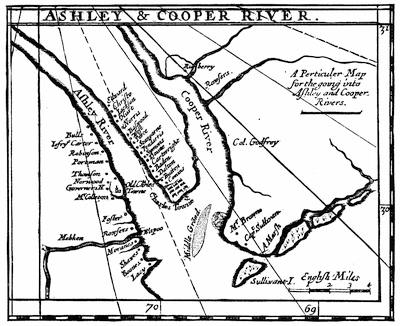
COOPER AND ASHLEY RIVERS.
[This is a side-map in a large folding one called A new map of Carolina, by Philip Lea, at the Atlas and Hercules, in Cheapside, London. Courtenay considers it to be of a date before 1700. There is a fac-simile of the whole in Charleston Year Book, 1883. For the associations and landmarks of these rivers see C. F. Woolson’s “Up the Ashley and Cooper,” in Harper’s Monthly, Dec., 1875; and P. D. Hay’s “Relics of Old South Carolina,” in Appleton’s Journal, xix. 498. In the Charleston Year Book (1883) there is a large map, showing the town and the early farms on the west bank of the Ashley; the present site of the city up to near the Clements’ Ferry road, with all lines of fortifications and historic points. Cf. W. G. Simms’ “Description of Charleston,” in Harper’s Monthly, June, 1857.
Moll’s map of South Carolina (1730) is given in fac-simile in Cassell’s United States, i. 439.—Ed.]
When there was no longer any reasonable expectation for the adoption of the Grand Model of government, a carefully prepared set of Instructions, in 43 Articles, became the rules for the colony, all former Instructions and Temporary Laws being abrogated, except such as related to lands. These rules continued as long as the Proprietors owned the province. It is not necessary to explain them. They were for the interest of their lordships; simple enough, but establishing a proprietary oligarchy. The Palatine and three other Proprietors, and, in the colony, the governor and three other deputies, constituted the governing power, with, apparently, a complete check upon the representatives of the people. The people could not complain if their lordships carried out what they wrote to Ludwell, that “they would part with no power” conferred on them by the charter “till the people were disposed to be more orderly;” for the people had demanded to be governed solely by the charter. The prominent question now would be: Do their lordships properly interpret and apply the powers granted them in the charter?
But fresh political subjects engaged attention: the tenure of lands, naturalization of the French Huguenots, payment of quit-rents, now for some years due, the jury laws, and that relating to elections. Governor Smith lost courage; he could be no champion for their lordships against his friends and neighbors. The only way out of the difficulties occasioned by the maladministration of the Proprietors was that some Proprietor should be sent over “with full power” to heal all grievances. This plan was adopted. The grandson of Earl Shaftesbury was appointed, but declined to come. A pious, benevolent Quaker came, John Archdale, whose policy was a smiling patience, but a strict requisition of every penny that was due to the “true and absolute lords” of the province,—himself among them. He thought his patience would, as he expressed it, allay their heats. But this could only be done by concessions. He yielded to their request to have thirty representatives in the assembly. He also remitted, after a struggle, arrears of quit-rents to Michaelmas, 1695, on condition that the remaining debts were secured, rents for the future strictly provided for, and the town fortified by taxation. Some political advancement was gained by the assembly;[755] the repeal of any law not infringing on the rights of the Crown or of the Proprietors, or relating to land, was not to be made without the consent of the General Assembly. The council, too, was so constituted by the pious Quaker as to be more in harmony with the dissenters. But he seemed to fear that he might be prevailed upon to grant too much, and appointing his friend, Joseph Blake, in his place, hastened away (1696). He lived to see the peace and tranquillity vanish which he hoped he had firmly established. Two years later the “House of Commons” petitioned (among other things) for the privilege of coining; and for the removal of duties on the chief exports from the colony. They also prayed that no more than 1,000 acres be in future granted in one piece; that an authenticated copy of the charter be sent them; and that the colonial authorities have power to repeal laws (if expedient to do so) which had been confirmed by the Proprietors: and though some of these things (they said) were beyond their lordships’ power to grant, their interest with the king was great enough to secure them for their colonists. Their lordships, as might have, been expected, were astonished that Blake, himself a Proprietor,[756] should allow such an address to be issued,—a precedent for so much future evil.
The century now closed. Governor Blake died in 1700. As required under the 43 Articles, the deputies elected a Landgrave to succeed Blake, till the Proprietors could be heard from. At first they chose Morton. He was set aside afterwards by the council, as were all the Landgraves in the colony, and Colonel James Moore, a deputy, appointed. This competition gave origin, for the first time in the history of the colony, to what may be denominated party strife. Besides Moore, several able leaders now appeared,—among them, Major Daniel, Colonel William Rhett, and Sir Nathaniel Johnson; while to Nicholas Trott the foremost place must be assigned for distinguished learning and ability. On his arrival he espoused the popular cause; but with numerous offices and honors bestowed upon him by the Proprietors, he and his brother-in-law, Colonel Rhett, became their zealous champions. These able men so largely influenced their lordships that at a word from them governors and councils were sometimes set at naught.
At the opening of the new century, we must cease to look upon South Carolina as the home of indigent emigrants, struggling for subsistence. While numerous slaves cultivated the extensive plantations, their owners, educated gentlemen, and here and there of noble families in England, had abundant leisure for social intercourse, living as they did in proximity to each other, and in easy access to Charles Town, where the governor resided, the courts and legislature convened, and the public offices were kept. The road that led up from the fortified town between the two broad rivers so enchanted Governor Archdale that he believed no prince in Europe, with all his art, could make a walk for the whole year round so pleasant and beautiful. From the road, to the right and to the left, avenues of water-oaks in mossy festoons, and in spring-time redolent with jasmines, gave the passer-by glimpses of handsome residences, from whose spacious verandas could be seen on the east the beautiful waters of the Bay, on the west the Ashley River. Hospitality, refinement, and literary culture distinguished the higher class of gentlemen.[757]
Governor Moore and his party gained control of the council by filling vacancies with those of whose good-will they were assured. But they ineffectually sought, by every means in their power, to elect a majority of assembly-men in their interest. Even violence was resorted to, and some estimable gentlemen, opponents of the party in power, were set upon and maltreated in the streets. The assembly resolved to investigate the abuses at the election, and were, therefore, prorogued from time to time; and it was reported that martial law would be proclaimed. When at last the assembly convened, they began with recriminations. If the public welfare had required their counsels, why had the governor, through pique, prorogued them? And was it true that he designed to menace them with coercion? “Oh! how is that sacred word Law profaned when joined with Martial! Have you forgotten your Honor’s own noble endeavor to vindicate our liberties when Colleton set up this arbitrary rule?”[758] But further disputation was averted. The governor had planned a secret and sudden attack on St. Augustine. The assembly joined in the scheme. They requested him to go as commander instead of Colonel Daniel, whom he nominated. They voted £2,000; and thought ten vessels and 350 men, with Indian allies, would be a sufficient force. The doors are closed. Men, and even women, who had been to St. Augustine, are interrogated concerning its defences. An embargo is laid on the shipping in the harbor. Moore with about 400 men sets sail, and Daniel with 100 Carolina troops and about 500 Yemassee Indians march by land. But the inhabitants of St. Augustine had heard of their coming, and had sent to Havana for reinforcements. Retreating to their castle, they abandoned the town to Colonel Daniel, who pillaged it before Moore’s fleet arrived. Governor Moore and Colonel Daniel united their forces and laid siege to the castle; but they lacked the necessary artillery for its reduction, and were compelled to send to Jamaica for it. Unfortunately the agent sent put back to Charles Town, and the governor sent Colonel Daniel himself to Jamaica. Before he returned, two Spanish ships appeared off St. Augustine. Moore instantly burned the town and all his own ships, and hastened back by land. Colonel Daniel, coming from Jamaica with the artillery, narrowly escaped the Spanish ships, and was convoyed to Charles Town by an English man-of-war which he met at sea. The expense entailed on the colony was £6,000.
When this attack on St. Augustine was planned, it must have been anticipated in the colony that war would be declared against Spain and France. The impending danger to South Carolina, a frontier to Spanish Florida, induced the Proprietors to appoint as governor the soldierly Sir Nathaniel Johnson (June, 1702). James Moore was made receiver-general; Nicholas Trott, attorney-general; Job Howes, surveyor-general; and Rhett, Broughton, and other men of ability, adhering to the government in its hour of peril, increased thereby the power of the dominant party. Colonel Moore, being sent out by Johnson (December, 1703) with fifty Carolinians and one thousand Indians, ravaged the country of the Apalatchees, allies of the Spaniards, and utterly defeated them and a body of Spanish troops that came to their assistance. Three years later, in August, when yellow fever was prevalent and five or six deaths a day, in the small population of Charles Town, was not a rare occurrence, a French fleet of five vessels under Le Feboure, aided by the Spanish governor at Havana, suddenly appeared off the harbor. Troops were disembarked at several points. A council of war was held, and the Carolinians determined to go out and meet the enemy. Colonel Rhett, Captains Fenwicke, Cantey, Watson, and others, with many gentlemen as volunteers, defeated the invaders, and brought 230 French and Spanish prisoners into town. Thus perished the first attempt to take Charles Town by a naval force, a feat which never yet has been accomplished. The governor, handsomely rewarded by the Proprietors, thanked the troops for their valor and their unanimity at a time when violent estrangements existed between political parties in the colony.
We must now revert to 1704, and relate the occasion of these estrangements. The governor and dominant faction favored Episcopacy. Lord Granville, the new Palatine, was an uncompromising zealot for the Church of England. It was determined to establish that Church in South Carolina. This was not contrary to the charter; but most of the colonists were dissenters, and it would be useless at that juncture to endeavor to win over a majority of the assembly to the support of such a project. The assembly stood prorogued to the 10th of May. They were summoned earlier; and on the 4th a bill was proposed and read, requiring “all persons that shall hereafter be chosen members of the Commons House of Assembly, and sit in the same, to take the oaths and subscribe the declaration appointed by this bill, and to conform to the religious worship of this Province, according to the Church of England, and to receive the Sacrament of the Lord’s Supper according to the rites of said Church.”[759] Some of the members called for the reading of the charter: but the opposition was soon overcome; the bill passed and was ordered to the governor and council, who passed it and returned it to the House; Landgrave Morton, of the council, being denied leave to enter his protest against it. It was pushed through the requisite proceedings and ratified under date of the 6th. It was passed by one majority,—twelve for it and eleven against it; seven members being absent. Some who voted in the negative are said to have been Episcopalians. The assembly was then prorogued till October. It was required by this law that in case a representative elected refused to qualify as directed, the next on the sheriff’s return should be entitled to the seat, or the next, and so on till the list was exhausted; then only should a new writ be issued. The effect was not only to exclude dissenters, but ten men could elect a member against the votes of a thousand. Another tyrannical abuse of party power was exhibited in an Act establishing Religious Worship (passed on the reassembling of the Commons), which authorized a lay commission for the trial of ecclesiastical causes. Dalcho says in his Church History, that they “were authorized to sit in the judgment-seat of spiritual officers, and thus to wrest the ecclesiastical authority out of the hands of the Bishop of London.” This gave offence to Churchmen. The Society for the Propagation of the Gospel, by whose liberality the colony had been greatly benefited, resolved not to send or support any missionaries in South Carolina, till the law, or at least that clause of it, should be repealed. The dissenters, already elected members of assembly, were not allowed (on reassembling in October) to enter their protests against the conduct of the Church party. The Rev. Mr. Marston was called to account by the commission and deprived of his benefice, for opposing the action of the oligarchy. But the case was carried to a higher tribunal, the House of Lords in England. Upon an able representation of the matter, redress having been refused by the Proprietors (under lead of Granville), a report was made to the queen, which caused the annulment of these two provincial laws. Nor was this all; the Board of Trade recommended the annulment of the proprietary charter (April, 1706). Since the accession of James II. there had been a disposition in the English authorities to revoke the charters to companies or individuals, and bring all the American colonies into a closer dependence on the Crown. Though the surrender of the Carolina charter was not on this occasion effected, yet it was manifest to the colony that an authority more potent than that of their lordships was interested in their welfare.
Lord Granville was succeeded in the Palatinate by Lord William Craven, and Colonel Edward Tynte was made governor. The once dominant faction, which had been transmuted, said Archdale, by Johnson’s “chemical wit, zeal, and art” into a High Church party, now fell asunder. Much attention had been awakened in England to the fortunes of the colony by the publications of Archdale and of Oldmixon and the “Case of the Protestant Dissenters;” and Governor Tynte entered upon his duties with kindly assurances and the wish to “render Carolina the most flourishing colony in all America.” He did not live long, and Colonel Charles Craven, brother of the Palatine, and previously an officer in the colony, was appointed in his place (December, 1710). Since the days of Joseph West, “moderate, just, pious, valiant” (says Archdale), no man more capable and beloved than Charles Craven had governed South Carolina. A sentence from an address of his to the Commons (April, 1712) shows the spirit of his administration. However great the honor of this office might be, “yet I shall look on it as a greater glory if, with your assistance, I could bring to pass so noble designs as the safety of this province, the advancement of its riches, and, what is more desirable” than riches, the unanimity and quiet of its people. “To what a prodigious height hath the united provinces risen in less than a century of years, to be able to create fear in some, envy in others, and admiration in the whole world!” The people, aroused by the expectation or apparent reality of their increasing importance, voted £1,500 for the erection of a State House and £1,000 for a residence for the governor. Unparliamentary altercations gave place to a generous emulation for the public welfare. The governor expressed the “greatest tenderness” towards all dissenters and assured them that nothing should ever be done by him injurious to their liberties. Though the law excluding them from the assembly was repealed, yet the Episcopal party retained ascendency and the public support of the Church (by a new Church Act) was continued. The parish system was inaugurated, and the representatives were increased to thirty-six. The turbulence of elections at Charles Town gave place to unmolested elections in the respective parishes. Libraries and a free school were open to all, and religious and educational advancement was promoted. Under Craven’s prosperous administration, it even seemed likely that the public debt would be liquidated, which had begun with the unlucky expedition against St. Augustine. But fresh expenditures were demanded in assisting North Carolina in her conflicts with the Tuscaroras; and scarcely had Barnwell and Moore rested from that campaign, when the most disastrous Indian war that South Carolina ever had to encounter broke suddenly upon her unsuspecting inhabitants. The Yemassees had been employed against the Apalatchees, and, at a later date, against the Tuscaroras. Being enticed by the Spaniards, whom their chiefs often visited, and being largely in debt to the English traders and irritated by their oppressive misconduct, they turned their experience in war against those who had taught them to fight, and, hoping for help from St. Augustine, began an indiscriminate slaughter on the line of settlements westward from Charles Town. Knowing the colonists to be formidable opponents, they had allured into conspiracy with them other Indian nations, notably the Creeks. So wide-spread was the combination formed that the governor asked assistance from other colonies. North Carolina in response sent aid under Colonel Maurice Moore (brother of James Moore), a friendly service which was gratefully appreciated and acknowledged by the assembly. But “expedition is the life of action,” said Craven; and not awaiting assistance, he fought the foe at once, and Colonel Mackay, in another direction, surprised their town, in which they had vast quantities of provisions and plunder, and attacking a fort to which they had betaken themselves carried it by assault and completely routed them. This effectually checked the Yemassees, and dispirited the tribes engaged to assist them. The assembly met, and, despatching such business as was necessary, adjourned to take up their muskets. All available forces were raised and placed under command of Lieutenant-General James Moore and Colonels John Barnwell and Alexander Mackay. The Yemassees, though joined by the Apalatchees, were forced beyond the Savannah, and took up their residence in Florida. We have not space to narrate the heart-rending or romantic incidents of this contest. The Yemassees had acted prematurely; otherwise the disasters to the colony would have been far greater. Many lives were lost (estimated at 400), an immense amount of cattle, produce, and other valuable property destroyed, and it was said that the traders alone lost £10,000 in debts due them. But the invincibility of the colonists was so forcibly impressed upon the minds of the Indians that they entered into no more combinations, and never again, except in straggling parties, penetrated to the vicinity of the fortified English settlements.