Chapter II
Reading edition
NEW ENGLAND, 1689-1763.
BY JUSTIN WINSOR,
The Editor.
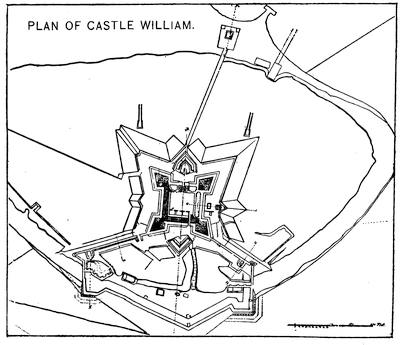
ANDROS, with Joseph Dudley and other satellites, made safe in Castle William, the revolution in New England was accomplished, and the veteran Simon Bradstreet was at the head of the old government on its sudden restoration (1689) to power.
The traditions of the charter-days were still strong among the country people, and their deputies in the resuscitated assembly brought into Boston the old spirit of independence to enliven the stifled atmosphere which the royal governor had spread upon the town. The new government was proposedly a provisional one to await the result of the revolution which seemed impending in England. If the policy of unwavering adherence to the old charter had been pursued with the constancy which characterized the advocacy of Elisha Cooke, the popular tribune of the day, the current of the New England history for the next few years might possibly have been changed. The sturdy assumption of political power did not follow the bold revolution which had prepared the way for it, and, professing dependence upon the royal will, all thoughts were now addressed to placate the new monarch, and regain by law what they had failed to achieve by a dogged assertion of right. King William, of whose accession they soon were notified, unhesitatingly, but for temporary service, confirmed the existing rulers.[157]
A command came for Andros to be sent to England, with a presentation of charges against him, and it was obeyed.[158] Increase Mather had already gone there to join Ashurst, the resident agent of the colony, and the people were not without hope that through the urgency of these representatives the restitution of the old charter might be confirmed. Subsequently Elisha Cooke and Thomas Oakes were despatched to reinforce the others. Mather, either because he felt the project a vain one, or because he hoped, under a new deal, to be better able to direct affairs, was favoring a new charter.
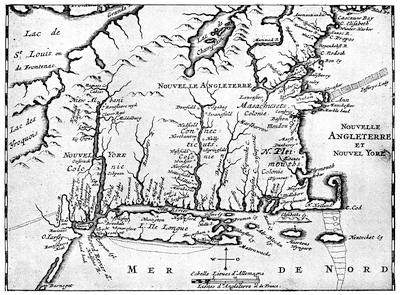
This follows the map in the Amsterdam ed. (1688) of Richard Blome’s L’Amérique, traduit de l’Anglois. This is a different map (on a larger scale) from the one in the original English edition of Blome. See reference to the map given in Mather’s Magnalia (1702) in Vol. III. p. 345. This map is reproduced in Cassell’s United States, i. pp. 492, 516.
Douglass, with some excess, again speaks of Mather’s map (Summary, etc., i. 362) “as composed from some old rough drafts of the first discoverers, with obsolete names not known at this time, and has scarce any resemblance of the country,” and he calls Cyprian Southack’s maps and charts even worse. For Southack see Mem. Hist. of Boston.
Plymouth, which had never had a royal charter, was endeavoring, through the agency of Ichabod Wiswall,[159] the minister of Duxbury, who had been sent over to protect their interests, to make the most of the present opportunity and get a favorable recognition from the king. Between a project of annexation to New York and Mather’s urging of an alternative annexation to the Bay, the weaker colony fared hard, and its ultimate fate was fashioned against its will. In the counsels of the four agents Cooke was strenuous for the old charter at all hazards, and Oakes sustained him. Mather’s course was professedly a politic one. He argued finally that a chance for the old charter was gone, and that it would be wiser to succumb in season to the inevitable, in order better to direct progress. When it came to a petition for a new charter, Oakes so far smothered his sentiments as to sign it with Mather; but Cooke held out to the last.
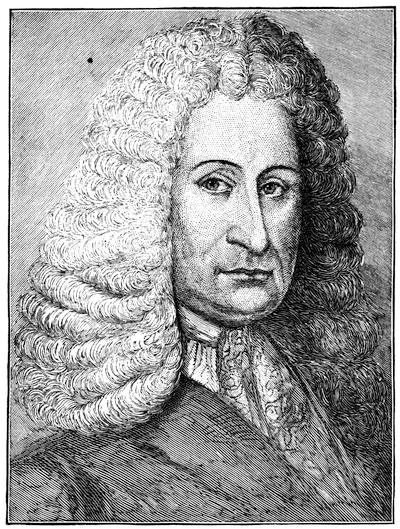
ELISHA COOKE, THE ELDER.
This follows a red-chalk drawing in the gallery of the American Antiquarian Society, which had belonged to the Rev. William Bentley, of Salem, who was born in Boston in 1759, and died in Salem in 1819.
Meanwhile, Massachusetts was governing itself, and had enough to do in looking after its frontiers, particularly at the eastward, where the withdrawal of the troops which Andros had placed there became the signal for Indian outbreaks. New Hampshire, weak in her isolation, petitioned to be taken under the jurisdiction of Massachusetts, and was (March 19, 1690) for the time being annexed.[160] Connecticut, destined to save her charter by delays and a less fiery spirit, entered upon a career characterized in the main by dignified quiet. Though she participated in some of the tumult of the recurrent Indian wars, and let her bitterness against episcopacy sometimes lead to violent acts, she had an existence of much more content than fell to the lot of the other New England colonies.[161]
The first momentous event which the restored governments had to encounter was the disastrous expedition which Phips led against Quebec, in 1690. With confident hope, the fleet on the 8th of August sailed from Boston harbor, and the whole community for three months waited for news with great solicitude. Scarce three weeks had passed when Sewall records (August 28) that they got from Albany intelligence of the Mohawks’ defection, which, as he writes, “puts a great damp here to think that our fleet should be disappointed of their expected aid.”[162] Apprehension of some more imminent danger grew throughout the colony. In September they placed watches at night throughout Boston, and gave as watchwords “Schenectady” and “Salmon Falls,”—fearful reminders.[163] One night at Charlestown there was an alarm because Indians were seen in their back fields,—they proved to be runaway servants. Again, the home guard, eight companies, trained another day. At last tidings came from Plymouth of certain losses which the contingent of that colony, among the forces acting at the eastward, had suffered, news whereof had reached them. This and other matters were made the grounds of an attempt to found a regular channel of communicating the current reports, which in a little sheet called Publick Occurrences was issued at Boston, Thursday, September 25, the precursor of the American newspaper. It told the people of various incidents of their every-day life, and warned them of its purpose to prevent false reports, and to correct the spirit of lying, “which prevails among us.” It represented that “the chief discourse of this month” was the ill-success of the expedition, which, under the command of Gen. Winthrop, of Connecticut, had attempted to advance on Montreal by way of Lake Champlain, to distract the enemy’s attention in that direction while Phips ascended the St. Lawrence.[164]
About six weeks later, on Friday, November 7, word came to the governor from Salem of the disastrous events in the St. Lawrence and the discomfiture of Phips.[165]
The unfortunate expedition had cost Massachusetts £50,000, and while the colony was devising an illusory scheme of paper money as a quick way of gathering taxes, Phips slipped off to England, with the hope that his personal explanations would assist in inducing the home government to lend a helping hand in some future attempt.
When Phips reached England he found that Mather had done good work in preventing the reinstalling of Andros, as at one time was threatened.[166]
Memorials and counter-memorials, printed and manuscript, were pressed upon Parliament, by which that body was now urged to restore, and now implored to deny, the vacated charter. It was at this juncture that Mather, with two other agents, petitioned the king for a new charter; and the law officers reporting favorably, the plan had already been committed to the Lords of Trade at the time when Phips appeared in London. With the assent of the king, the framing of a new charter was entrusted to Sir George Treby, the Attorney General, who was instructed to fortify the royal prerogative, and to make the jurisdiction include not only Massachusetts, but the territory of New Plymouth and all that region, or the better part of it, lying east of the present State of New Hampshire, and stretching from the St. Lawrence to the Atlantic.
It was the dawn of a new existence, in which the province, as it now came to be called, was to be governed by a royal governor, sent to enforce the royal prerogative, to administer the navigation laws in the interests of British merchants, to gratify the sectaries of the Established Church, and to embarrass the old-fashioned theocracy. The chief power reserved to the people was that of the purse,—an important one in any event, and one that the legislative assembly knew how to wield, as the years which followed proved.
Mather professed to think the new charter—and it perhaps was—the best result, under the circumstances, to be attained. He talked about the colony still having a chance of assuming the old charter at some more opportune moment. Cooke, the champion of the old conditions, was by no means backed in his opposition by a unanimity of feeling in the colony itself; for many of the later comers, generally rich, were become advocates of prerogative, and lived in the hope of obtaining more consequence under a changed order of society. Connecticut and Rhode Island were content, meanwhile, with the preservation of their own chartered autonomy, such as it was.
Thus affairs were taking a turn which made Phips forget the object of his visit. Mather seems to have been prepared for the decision, and was propitiated also by the promise of being allowed to nominate the new governor and his subordinates. Phips had been Mather’s parishioner in Boston, and was ambitious enough to become his creature, if by doing so he could secure preferment. So Sir William Phips was commissioned Governor; and as a sort of concession to the clerical party, of which Mather himself was the leader in Boston, William Stoughton was made Lieutenant-Governor. Isaac Addington became Secretary. Bradstreet was appointed first assistant. Danforth, Oakes, and Cooke, the advocates of the old charter, were forgotten in the distribution of offices.
On Tuesday, January 26, 1692, Robin Orchard came to Boston from Cape Cod, bringing tidings that Capt. Dolberry’s London packet was at anchor in the harbor now known as Provincetown, and that she had brought the news of the appointment of Phips under a new charter.[167]
Boston was at this time the most considerable place in the New World, and she probably had not far from 7,000 inhabitants; while Massachusetts, as now constituted, included 75 towns, of which 17 belonged to Plymouth. Within this enlarged jurisdiction the population ranged somewhere between 60,000 and 100,000,—for estimates widely vary. Out of this number twenty-eight persons had been chosen to make the governor’s council, but their places were to be made good at subsequent elections by the assembly, though the governor could negative any objectionable candidate; and the joint approval of the governor and council was necessary to establish the members of the judiciary. The acts of the legislature could for cause be rejected by the Privy Council any time within three years, and to it they must be regularly submitted for approval; and this proved to be no merely formal action. It meant much.
These conditions created a new political atmosphere for Massachusetts. Religion and politics had in the old days gone hand in hand, and the little book which Joshua Scottow, one of the old patriarchs, now printed, Old Men’s Tears, forcibly reminded them of the change. The community was more and more engrossed with trade; and those that concerned themselves with politics were not near so closely of one mind as formerly; and there was lacking that invigorating motive of saving their charter which had so unified the thoughts and banded the energies of the community in former years.
On the 14th of May, 1692, the “Nonesuch” frigate cast anchor in Boston harbor. When Phips and Mather disembarked, eight companies of soldiers received and escorted them to their respective houses. “Made no volleys, because ‘twas Satterday night,” says Sewall, recording the event.[168] The ceremony of inauguration was no sooner over than all parties began to take their bearings; and Mather, not long after,[169] in an election sermon, took occasion to defend the policy of his recent mission. It remained to be seen how much the province was to gain from its closer connection with the home government. Was it to claim and secure larger assistance in repressing Indian outbreaks and repelling French encroachments?—for these things were brought home to them by the arrival of every messenger from the frontiers, by the surveillance under which they had put all Frenchmen who chanced to be in their seaports, and by the loads of wine-casks which paraded the streets of Boston when the “Swan” (September 20, 1692) brought in a French prize. It was not till October 23d that Cooke and Oakes reached home, and the old-charter party had once more its natural leaders; Cooke, at least, bringing to it the influence of wealth.[170]

THE PROVINCE SEAL.
This is the form of the Great Seal of Massachusetts, used in the time of George I. It was recut, and the name of the monarch changed under George II. This last design will be found in the Massachusetts House Doc., no. 345 (1885), being a report on the Arms and Great Seal of Massachusetts. Here, as in the Heraldic Journal, vols. i. and ii., the private seals of the royal governors are given, which were used in sealing military commissions.
In the sermon to which reference has just been made, Mather showed that, however he had carried many of his own points, he had failed in some that much troubled him. The change in the qualification of electors from church membership to the condition of freeholders was alarming to those of the old theocratic sentiments. It meant a diminution of their influence, and that the 120 churches in New England (of which 80 were in Massachusetts) were to direct much less than formerly the legislation of the people. The possible three years which a law might live before the home-veto came must be made the most of. Using his influence with Phips, Mather dictated the choice of the first corporation of Harvard College, freshly chartered under the new rule, and without waiting for the confirmation of the Privy Council, who might well be thought to be opposed to a charter for the college which did not provide some check in a board of visitors, he caused himself, very likely in a passive way, to be made its first Doctor of Divinity, but his admirers and creatures knew the reward he expected. We think, however, to-day less of the legislation which gave such a title to their great man than we do of the smaller ambitions by which the assembly of the province about the same time were originating our public-school system.
The governor, in his communication to the General Court, reminded them of the royal recommendation that they should fix by law a fitting salary for the chief executive. It raised a point that Elisha Cooke was in wait for. Under his instigation, the plan was devised of substituting an annual grant, which might be raised or lowered, as circumstances warranted, and as was necessary to vindicate one of the few rights left to them by the charter. It was the beginning of a conflict that recurred with each successive governor as he attempted to force or cajole the representatives into some recognition of the royal wish.
The baleful influence of the Mathers—for the son Cotton was now conspicuous—conduced to commit the unwary Phips to instituting a court, which disgraced itself by the judicial murders attending the witchcraft frenzy; and in the midst of all, Sir Francis Wheeler’s crippled fleet arrived from the West Indies (June 11, 1693), having lost more than half its men by disease. The fear of infection almost caused a panic among the inhabitants of Boston when, two days later, Wheeler anchored his frigates off Noddle’s Island. Ten days afterwards their commander was entertained at Cambridge by the governor, and by Mather as president of the college.
Connecticut was in the mean while serving both Massachusetts on the east and New York on the west. She sent troops to help defend the eastern dependencies of the Bay. On the retreat of Winthrop’s expedition, New York appealed to Connecticut for help, and she afforded it; but when Governor Fletcher, of New York, came to Hartford and claimed command of her militia, she resisted his pretensions, and, as the story goes, drowned the reading of his proclamation by a vigorous beating of drums.[171] Fitz-John Winthrop was sent to England to compose matters, and it ended in Connecticut placing 120 men at the disposal of the New York governor, while she retained command of her home forces, and Winthrop became in turn her governor.
Phips too went to England, but on a mission not so successful. His testy character had early imperilled his administration. He got into a quarrel with Fletcher, of New York, and he yielded to passions which brought undignified encounters even in the public streets. Representations of such conduct did not fail to reach the king, and Phips was commanded to appear in his own defence. His friends had endeavored to force an address through the House of Representatives, praying the king not to remove him; but it was defeated by the united action of members from Boston, many of whom represented country towns. The governor’s friends resorted to a specious device which appealed to the local pride of the country; and, by the urgency of Mather and others, a bill requiring the representatives to be residents of the town they sat for was forced through the House.[172] With an assembly constituted under the new rule, a bare majority was secured for the address, and Phips took it with him.
Before much progress could be made in the investigation, after his arrival in London, he died on February 18, 1694-5.[173] The news did not reach Boston till early in May. “People are generally sad,” says Sewall. “Cousin Hall says the talk is Mr. Dudley will be governor,” and the next day mourning guns were fired at the Castle.[174]
Joseph Dudley’s hour of pride was not yet come, though he had intrigued for appointment even before Phips’s death. The protests of Ashurst and Constantine Phipps, the colony’s agents in London, were effectual; and the king was by no means prepared as yet to alienate the feelings of his New England subjects in order to gratify the avenging spirit of Dudley. That recusant New Englander was put off with the lieutenant-governorship of the Isle of Wight, a position which he held for nine years.
The government in Boston upon Phips’s leaving had legally fallen into the hands of that old puritan, the lieutenant-governor, William Stoughton, and in his charge it was to remain for four years and more (November, 1694, to May 26, 1699). It was a period which betokened a future not significant of content. It was not long before Thomas Maule could call the ministers and magistrates hard names, and with his quick wit induce a jury to acquit him.[175] But the spirit of Parliament could not be so easily thwarted. As colonists, they had long known what restrictive acts the mother country could impose on their trade in the interests of the stay-at-home merchants, who were willing to see others break the soil of a new country, whose harvests they had no objection to reap. The Parliament of the Commonwealth had first (1651) taken compulsory steps, and the government of the Restoration was not more sparing of the colonists. King William’s Parliament increased the burden, and the better to enforce observance of its laws they established a more efficient agency of espionage than the Plantation Committee of the Privy Council had been, by instituting a new commission in the Lords of Trade (1696), and had followed it up by erecting a Court of Admiralty (1697) to adjudicate upon its restrictive measures.[176] About the same time (1696) they set up Nova Scotia, which had been originally included in the Massachusetts charter of 1691, as a royal province. The war which was waging with France served somewhat to divert attention from these proceedings. French privateers were hovering round the coast, and Boston was repairing her defences.[177] Not a packet came into the Bay from England, but there was alarm, and alertness continued till the vessel’s peaceful character was established. News was coming at one time of Frontenac’s invasion of New York, and at another of Castin’s successes at the eastward. In August, 1696, when Captain Paxton brought word to Boston of Chub’s surrender of Pemaquid, five hundred men were mustered, but they reached Penobscot only to see the French sailing away, and so returned to Boston unrewarded. The enemy also fell on the Huguenot settlement at Oxford, Mass., and the inhabitants abandoned it.[178] When the aged Bradstreet was buried,[179] they had to forego the honor they would pay his memory in mourning guns, because of the scarcity of powder; and good people rejoiced and shivered as word came in June of the scalping exploit of Hannah Dustin at Haverhill, in the preceding March. In the autumn (November 4) there was nothing in all this to prevent the substantial loyalty of the people showing itself in a celebration of the king’s birthday. The Boston town house was illuminated, and the governor and council went with trumpets to Cotton Hill[180] to see the fireworks “let fly,” as they said. No word had yet come of the end of the war, which had been settled by the peace of Ryswick in September. A month later (December 9, 1697) Captain Gillam arrived at Marblehead from London, and the next day, amid the beat of drum and the blare of trumpet, between three and four in the afternoon, the proclamation of the peace was made in Boston. The terms of that treaty were not reassuring for New England. A restitution of captured lands and ports on either side was made by it; but the bounds of Acadia were not defined, and the Sagadahock country became at once disputed ground. The French claimed that it had been confirmed to them by the treaties of St. Germain (1632) and Breda (1668); but the Lords of Trade urged the province to rebuild the forts at Pemaquid, and maintain an ascendency on the spot.
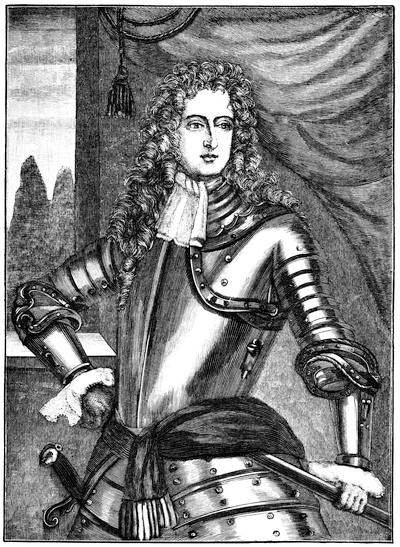
BELLOMONT.
This follows a contemporary engraving preserved in Harvard College library, which is inscribed: “His Excellencie Richard Coote. Earle of Bellomont, Governour of New England, New York and New Hampshire, and Vice Admirall of those seas.” Cf. the picture of doubtful authenticity in the Memorial History of Boston, ii. p. 175.
As early as August, 1695, word had come that Richard Coote, the Earl of Bellomont, was to be the new governor of Massachusetts. Later it was said that he would not arrive till spring; and when spring came the choice had not even been determined upon. It was not till November, 1697, that he was commissioned governor of New York, New Jersey, Massachusetts, and New Hampshire. He landed in New York on the 2d of April, 1698, and on the 12th a sloop reached Boston, bringing tidings of his arrival, and three days later the council received a communication from him. For a year and more he stayed in New York, sending his instructions to Stoughton, who as lieutenant-governor directed the council’s action. On the 26th of May, 1699, the governor reached Boston;[181] and it was not long before he manifested his sympathy with the party of which Elisha Cooke was the leader. This gentleman, who was so obnoxious to the Mather party, had been negatived by Phips, when chosen to the council; but on Phips’s withdrawal, his election had escaped a veto, and he now sat at the council board. Mather had succeeded, in 1697, in forcing upon the legislature a charter, in the main of his own drafting, which gave to Harvard College the constitution that he liked, but he manœuvred in vain to secure his own appointment from the General Court to proceed to England to solicit the sanction of the Privy Council; and it was not long before he found that the new governor had vetoed his charter, and in 1701 the assembly legislated him out of office, as the president of the college.
This first blow to the dominance of the Mathers was reassuring, and Bellomont was a leader for the new life to rally about.[182] He was a man of complacent air. He liked, if we may believe him, to hear sermons well enough to go to King’s Chapel on Sundays, and to the meeting-house for the Thursday lectures. He could patronize the common people with a sufficient suavity; and when the General Court, after their set purpose, voted him a present instead of a salary, if he was not much pleased, he took his £1,000 as the best substitute he could get for the £1,200 which he preferred.
Boston, with its 7,000 inhabitants, was not so bad a seat of a viceroyalty, after all, for a poor earl, who had a living to make, and was debarred the more lucrative methods of trade. He reported back to the Lords of Trade abundant figures of what he found to be the town’s resources and those of his government; but the favor which he was receiving from the good people might have been less had they known that these same reports of his set forth his purpose to find Englishmen, rather than New Englanders, for the offices in his gift.
We have also at this time the report which the scurrilous Ned Ward made of the puritan town and its people;[183] but it is not well to believe all of his talk about the innocence of doves and the subtile wiles of serpents, though life in Boston was not without its contrasts, as we look back upon it now. Samuel Sewall, her first abolitionist, was even then pointing the finger of doom to the insidious evil in his Selling of Joseph. Not altogether foreign to the thoughts of many were the political possibilities of the coming century, when on New Year’s Day, 1701, the bellman’s clangor was heard, as he toned Sewall’s memorial verses through the streets. There was a certain fitness in the century being ushered in, for New England at least, by the man who was to make posterity best acquainted with its life, and who as a circuit judge, coursing statedly the country ways, saw more to portray than any one else. Sewall was an honest man, if in many respects a petty one. He had figured in one of the noblest spectacles ever seen in the self-willed puritan capital, when on a fast day, January 14, 1697, he had stood up in the meeting-house, and had listened with bowed head to the reading of his penitential confession for the sin of his complicity in the witchcraft trials. Stoughton, the lieutenant-governor, and chief justice of those trials, was quite another type of the puritan fatalist, from whom it was futile to expect a like contrition; and when, at a later day (December 25, 1698), Stoughton invited to dinner the council and omitted Sewall, who was one of them, one might fancy the cause was in no pleasant associations with the remembrance of that scene in Parson Willard’s meeting-house. It is characteristic of Sewall that this social slight oppressed him for fear that Bellomont, who had not yet come, might hear of it, and count him less! But poor Sewall was a man whom many things disturbed, whether it was that to mock him some one scattered a pack of playing-cards in his fore-yard, or that some of the godly chose to wear a wig![184]
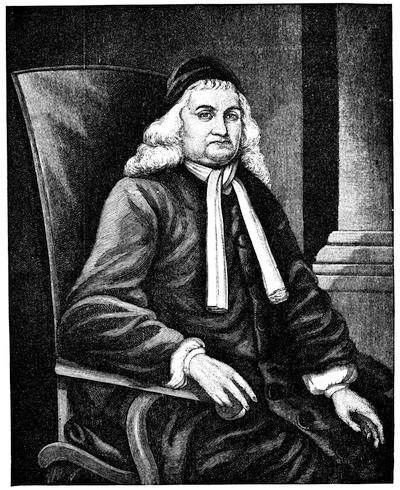
SAMUEL SEWALL.
This follows the steel engraving in Sewall Papers, vol. i. There is another likeness in N. E. H. & Gen. Reg., i. 105. Cf. also Higginson’s Larger Hist. United States, p. 208.
The smiting of the Mathers, to which reference has been made, was a business of serious moment to those theocrats. Whoever was not in sympathy with their protests fared badly in their mouths. “Mr. Cotton Mather,” records Sewall (October 20, 1701), “came to Mr. Wilke’s shop, and there talked very sharply against me, as if I had used his father worse than a neger; spoke so loud that people in the street might hear him.” There is about as near an approach to conscious pleasantry as we ever find in Sewall when, writing, some days later, that he had sent Mr. Increase Mather a haunch of very good venison, he adds, “I hope in that I did not treat him as a negro.”
The Mathers were praised highly and blamed sharply in their lifetime, and have been since. There can be little dispute about what they did and what they said; they were outspoken enough to make their motives and feelings palpable. It is as one makes or refuses allowances for their times that the estimate of their value to their generation is scaled. None ever needed allowances more. They had no conception of those influences which place men in relation to other times than their own. There was in their minds no plane higher than the existence around them,—no plane to which the man of all times leads his contemporaries. Matherism, which was to them their life, was to others a domination, the long-suffering of which, by their coevals, to us of to-day is a study. It would be unjust to say that this mighty influence had not been often of great good; but the gentle observer of an historic character does not contentedly witness outbursts of selfish arrogance, canting humiliation, boastful complacency, to say nothing of social impertinences and public indelicacies, and the bandying of opprobrious epithets in controversy. With this there was indeed mingled much for which New England had reason to be grateful. Increase Mather had a convenient astuteness, which was exerted not infrequently to her no small gain. He had learning, which usually left his natural ability and his education free from entanglements. It was too often quite otherwise with his son Cotton, whose reading smothered his faculties, though he had a native power that occasionally got the upper hand. Between them they gathered a library, which, as John Dunton said, was the glory of New England. The awe which Increase inspired knew little of that lurking rebellion which the too pitiful arrogance of Cotton incited; for the father was essentially a strong and politic man, and though his domination was waning outwardly in 1700, he had the ability to compel the Boston press into a refusal to print the Gospel Order Revised, which his opponents had written in answer to his Order of the Gospel, and to force his adversaries to flee to New York to find a printer.[185]
The old Mather theocracy was attacked on two sides. There was, in the first place, the defection within the old New England orthodoxy, by which an independent spirit had established a church. From the published manifesto of its principles this came to be known as the “Manifesto Church,” and it had invited Benjamin Colman home from England to become its pastor,[186] who, to avoid difficulties, had been ordained in England. He first preached in November, 1699. In the second place, the organization of the Church of England, which had begun in Andros’s time, was gathering strength, though Sewall got what comfort he could from the fact that Mr. Maccarty’s shop and others were not closed on Christmas Day. Attempts had been made to divert the funds of the Society for the Propagation of the Gospel in New England from their application to the needs of the Indians, to strengthen the new Episcopal movement; and the failure to do this, as well as a spirit to emulate the missionary enterprise of the French, had instigated the formation of a new Society in England for Propagating the Gospel in Foreign Parts; but it was not long before its resources were turned into channels which nurtured the Episcopal movement and the royal authority. Strong contrasts to the simplicity of the old order were increasing; and it was not without misgivings that the old people had seen Benjamin Wadsworth, the new associate pastor of the First Church, inducted (1696) into office with an unusual formal parade. Thus the humble manners of the past were becoming in large degree a memory; and when, a little later (June 1, 1702), the new queen was proclaimed, and the representatives were allowed to precede the ministers in the procession, the wail in Sewall’s diary, as well as when he notices the raising of colors at the Castle on the Lord’s Day, betokens in another way the order of things which the new charter was making possible.
While in Massachusetts the defection grew, in Connecticut the old order was entrenching itself in the founding of Yale College, first at Saybrook, and later at New Haven, which was destined, as Harvard declined in the estimation of the orthodox, to become the rallying-point of the old school.[187]
In Rhode Island matters went on much as the heterogeneous composition of that colony necessarily determined. Bellomont could find little good to report of her people, and the burden of his complaint to the Lords of Trade touched their propensity to piracy, their evasion of the laws of trade, and the ignorance of the officials.
Bellomont had returned to his government in New York when, on the 5th of March, 1701, he died. It took ten days for the news to reach Boston (March 15), and four days later (March 19) word came by the roundabout channel of Virginia of the declaration of war between England and France. In the midst of the attendant apprehension, on April 7th, mourning guns were fired for the dead governor at the Sconce and at the Castle, and the artillery company gave three volleys in the middle of the town, Col. Townshend, as Sewall in his antipathy does not fail to record, wearing a wig!
When Bellomont had left for New York in May, 1700, the immediate charge of the government had again fallen upon Stoughton. He did not long survive his chief, and died July 7, 1701, in his seventieth year,[188] and from this time to the coming of Dudley the council acted as executive.
It was on Joseph Dudley, to a large party the most odious of all New Englanders, the ally of Andros, that the thoughts of all were now turned. It was known that he had used every opportunity to impress upon the king his fitness to maintain the royal prerogative and protect the revenue in New England. The people of Boston had not seen him for about ten years. In 1691 he had landed there on his way to New York, where he was to serve as a councillor; and during that and the following year he had made some unobtrusive visits to his home in Roxbury, till, in 1693, he was recalled to England to be made lieutenant-governor of the Isle of Wight. With the death of Bellomont his hopes again rose. Ashurst, as the senior of the Massachusetts agents, still opposed him, though his associate, Constantine Phipps,[189] was led to believe that the king might do worse than appoint the aspirant. Dudley was not deficient in tact, and he got some New Englanders who chanced to be in England to recommend him; and a letter, which he used to some purpose, came not surprisingly, considering his lineage, from Cotton Mather, saying quite enough in Dudley’s praise. Elisha Cooke and his friends were not ignorant of such events, and secured the appointment of Wait Winthrop as agent to organize a fresh opposition to Dudley’s purposes. It was too late. The letters which Dudley offered in testimony were powerful enough to remove the king’s hesitancy, and Dudley secured his appointment, which, on the death of the king a few days later, was promptly confirmed by Anne.[190]
The news of the king’s death and the accession of the queen reached Boston, by way of Newfoundland, on the 28th of May, 1702.[191] The new monarch was at once proclaimed from the town house, and volleys of guns and the merriment of carouse marked a new reign. How New England was to find the change was soon sharply intimated. Amid it all tidings came of the capture of three Salem ketches by the Cape Sable Indians. Later in the same day the eyes of Madam Bellingham, the relict of an early governor, were closed in death, severing one of the last links of other days. Her death was to most a suggestive accompaniment of the mischance which now placed in the governor’s chair the recusant son of Thomas Dudley, that other early governor.
A fortnight later (June 10, 1702), the ship “Centurion,” having Joseph Dudley on board, put in at Marblehead, and the news quickly travelled to Boston. The next day a committee of the council went in Captain Croft’s pinnace to meet him, and they boarded the “Centurion” just outside Point Alderton. Dudley received them on deck, arrayed in a very large wig, as Sewall sorrowfully noted while making him a speech. They saw another man whom they had not heard of, one Thomas Povey, who was to be their lieutenant governor, and to have charge of their Castle. They saw, too, among the passengers, George Keith, the whilom quaker, who was come over on £200 salary, very likely paid by the Society for the Propagation of the Gospel in Foreign Parts, to convert as many as he could to prelacy.[192] Sewall was not happy during that day of compliments. The party landed at Scarlet’s Wharf amid salvos of artillery, and under escort of the council and the town regiment they proceeded to the town house, where the commissions were published and all “had a large treat,” as Sewall says. Major Hobby’s coach, with six horses, was at the door, a guard of horsemen wheeled into ranks, and so Dudley went to that Roxbury home, whence, as many remembered, he had been taken to be imprisoned.
Dudley was not deficient in confidence and forwardness; but he had no easy task before him. He naturally inclined to the faction of which Byfield and Leverett were leaders; but the insidious and envious Cotton Mather, taking him into his confidence, warned him of these very people. Dudley told them of the warning, and it was not long before the sanctimonious Mather was calling his excellency a “wretch.”
When Dudley made his opening address to the General Court,[193] he could not refrain from saying some things that were not very conciliatory. There were two points on which he raised issues, which he never succeeded in compassing. One of these was a demand for a stated salary. The assembly answered it with a present of £500 against the £1,000 which they had given to Bellomont. No urgency, no threats, no picturing the displeasure of the Crown, could effect his purpose.[194] The war which he waged with the representatives never, as long as the province existed, ended in a peace, though there was an occasional truce under pressure of external dangers.
Another of Dudley’s pleas was for the rebuilding of the fort at Pemaquid, to secure possession of the disputable territory between the Kennebec and Acadia.[195] The deputies were immovable. If the Crown wished to secure that region, it must do it by other sacrifices than those of New England.
Thus thwarted, Dudley could make them feel that the royal governor had some prerogatives; and so he rejected the councillors which the deputies accredited. All of this thrust and parry was of course duly reported by Dudley to the home government. The situation was perplexing in the extreme, quite as much so to the governor as to the people, who reluctantly received him. It was for the interests of both that the war against the French should not flag, and money was necessary, but the governor claimed the direction of expenditures, while the representatives stood aloof and firm on the “privilege and right of English subjects to raise and dispose of money, according to the present exigency of affairs.” With the clergy and the ministers, Dudley was not less unhappily placed. His interests turned him to the church people, but they could not find that his profession had any constancy. His lineage placed him with the Congregationalists, and he once had the ministry in view, but his sympathies went altogether with the new school, of which Stoddard, of Northampton, was leader in the west, while Colman, the Leveretts, and the Brattles were the spokesmen in Boston. In the election of a president for Harvard, Dudley favored Leverett, the successful candidate, and made a Latin speech at his installation,[196] and Cotton Mather writhed at the disappointment of his own hopes. The governor encountered (1708), for his decisive opposition to the Mathers, a terrible but overwrought letter from the father, and a livelier epistle from the son. He showed in his reply a better temper, if nothing more.[197] In the opinion of all honest patriots, of whatever party, Dudley was later found in company which raised suspicions. The conflict with France begat, as wars do, a band of miscreants ever ready to satisfy their avarice by trading with the enemy and furnishing them with arms. Dudley did not escape suspicion, and he experienced some of the bitterest abuse in talk and pamphlet,[198] though the council and the House, the latter after some hesitancy, pronounced the charges against him a “scandalous accusation.” It can hardly be determined that he was implicated, and Palfrey gives him the benefit of the doubt.[199]
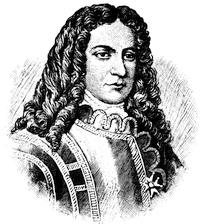
JEAN BAPTISTE HERTEL, SEIGNEUR DE ROUVILLE.
This likeness of the leader of the assault on Deerfield follows one given in Daniel’s Nos Gloires Nationales, i. p. 278, where is an account of the Hertel family. He was thirty-four at the time of his attack.
The war was a fearful one. In 1703, month by month fresh tidings of its horrors among the frontier towns reached Boston. In January it was of Berwick, in Maine. In February came sad tidings from Haverhill. In March there was the story of Deerfield, and how Hertel de Rouville had dashed upon the village. With the early summer Dudley went to Canso to confer with the Indians (June 20); and not long after (July 8), Bombazeen, a noted Indian, appeared in Boston with rumors of the French landing near Pemaquid. In August there were sad messages from Wells, and Capt. Southack was sent off by sea with chaplain and surgeon. With all this need of her troops at home, the colony also despatched two companies of foot to help the British forces at Jamaica. Samuel Sewall mourned as ever, when on Sunday (April 23, 1704) great guns at the Castle signalized the Coronation-Day. “Down Sabbath! Up St. George!” he says. The very next day the first number of the Boston News-Letter (April 24)[200] brought to the minister’s study and to his neighbor’s keeping-room the gossip and news of the town which was witnessing this startling proof of progress. Ten days later Dudley signed Benjamin Church’s instructions (May 4), and the old soldier, whose exploits in Philip’s war were not forgotten, set off by land to Piscataqua, where he was met by Cyprian Southack in his brigantine, who carried him to the eastern garrisons. In the News-Letter, people read of the tribulations at Lancaster; of the affairs at Port Royal; of the new cannon which Dudley got from England for the Castle; of the French captives, whose presence in Boston so disturbed the selectmen that they petitioned the governor to restrain the strangers, and whose imagined spiritual needs prompted Cotton Mather to print in his tentative French his Le vrai patron des saines paroles.
News of this sort was varied by a rumor (December 18, 1705), which a sloop from the English Plymouth had brought, that Sir Charles Hobby was to be made governor,—which meant that the agents of the colony in London were trying to oust Dudley with a new man; but in this they failed.
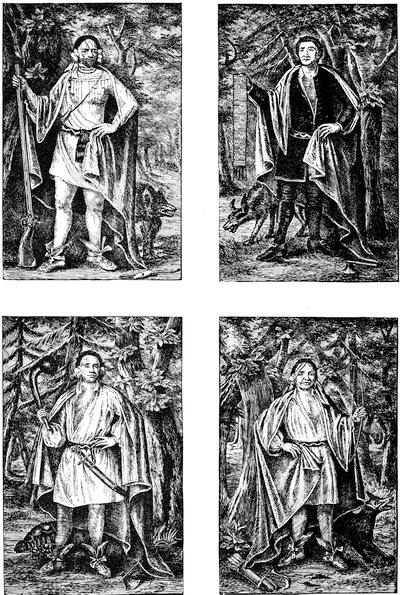
The war made little progress. The expedition against Port Royal in 1707 was a failure, and the frontier towns were still harassed. The news of Marlborough’s victories was inspiriting, and Boston could name a part of its main thoroughfare after the great soldier; but while she planted guns on her out-wharves and hoisted a tar-barrel to her beacon’s top, and while Colonel Vetch marshalled her troops,[201] she waited in vain for the English army to arrive, in concert with which the New England forces were to make a renewed attack on Port Royal in 1709. Rhode Island sent her war-vessels and two hundred men, and they too lay listlessly in Nantasket roads. Schuyler, of Albany, meanwhile started to conduct four Mohawks or Maqua chiefs to England, where he hoped to play upon the imagination of the queen; and in August, while the weary New Englanders were waiting for the signal to embark, Schuyler brought the savages to Boston, and Colonel Hobby’s regiment was mustered for their diversion.[202] Very likely they were taken to see the “celebrated Cotton Mather,” as the man who had not long before “brought in another tongue to confess the great Saviour of the world,” as he himself said of a tract in the language of the Iroquois, which he had printed in Boston (1707) and supplied to the Dutch and English traders among that people. Distractions and waiting wore away the time; but the English forces never came, and another Port Royal attempt proved wretchedly futile.
That autumn (October, 1709) the New England governors met at Rehoboth, and prepared an address to the queen urging another attempt. In the face of these events the Massachusetts colony had to change its London agent. Sir Henry Ashurst died, and the House would have chosen Sir William Ashurst against Dudley’s protest, if Sir William would have accepted. They now selected their own Jeremiah Dummer, but against his desires.
The year 1710 opened with rumors from Albany about preparations in Canada for an onset along the frontier, and it was not till July (15) that flags and guns at the Castle and Sconce, with drum-beats throughout the streets, told the expectant Bostonians that General Nicholson, who was to head a new expedition, had arrived. It was candle-light before he landed, and the letters and despatches at once busied the government. A little later the council (July 24) entertained that commander, with Vetch and Hobby, at the Green Dragon Tavern; and four days afterwards Governor Saltonstall, from Connecticut, reached Boston, and the contingent of that colony, three hundred men, was on the spot in four weeks from the warning. In September the armament sailed,—twelve ships-of-war and twenty-four transports, of which fourteen carried Massachusetts troops, two New Hampshire, three Rhode Island, and five those of Connecticut. On the 26th of October (1710), Nicholson and his force were back in Boston, flushed with the triumph which the capitulation of Port Royal had given them.[203] The town had need of some such divertissement. There had been a scarcity of grain, and when Captain Belcher attempted to despatch a ship laden with it the mob cut her rudder, and the excitement had not passed without more or less inflaming of the passions. The circle of Matherites had also disturbed the equanimity of the liberals in theology by an anonymous document, Question and Proposals, which aimed at ecclesiasticising everybody and everything,—a stroke of a dying cause. There was an antagonist equal to the occasion in John Wise, of Ipswich, and the Mather dynasty had less chance of revival after Wise’s book The Churches’ Quarrel Espoused was launched upon the town.[204]
Nicholson, again in England, had urged the new tory government under Bolingbroke to make a more determined assault on Canada, and Dummer had united with him in a petition to the queen[205] for a royal armament to be sent for the work. Their plea was recognized and what seemed a great force was despatched. Nicholson, with the van of the fleet, arrived on the 6th of June, 1711,[206] and a convention of the New England governors was straightway called at New London to arrange for the campaign. The plan was for Nicholson to lead four thousand men by way of Albany, and the Connecticut contingent of three hundred and sixty men was to make part of this force. The royal ships came straggling into Boston harbor. On the 24th General Hill, who brought under his command seven of Marlborough’s veteran regiments, arrived, and the next day Sewall and others of the council boarded the “Devonshire” and exchanged courtesies with Hill and the admiral of the fleet, Sir Hovenden Walker. The Boston regiments mustered and escorted them to the town house, and the veterans were thrown into a camp on Noddle’s Island. The next six weeks were busy ones, with preparations and entertainments. Mr. Borland, a wealthy merchant, took Hill into his house. The governor offered official courtesies. The transports as they came up into the inner harbor presented a “goodly, charming prospect,” as Sewall thought.[207]
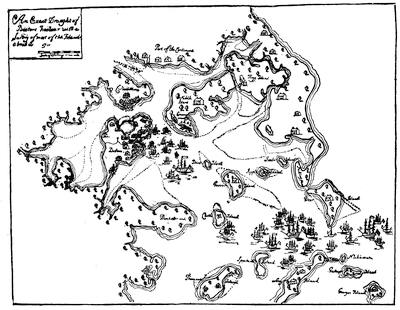
Commencement at Cambridge came on July 4, and all the dignitaries were there. One day some Connecticut Indians exhibited themselves before the admiral, and on another some Mohawks danced on board the flag-ship. By the end of the month, everything was as nearly ready as could be,[208] and the fleet sailed (July 30). They went proudly away, hastened somewhat by large desertions, which the patrolling of the roads leading from Boston had not prevented.
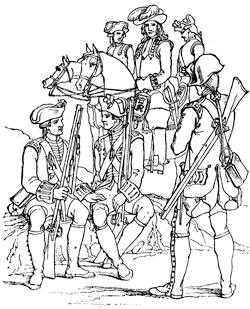
BRITISH SOLDIERS, 1701-1714.
Fac-simile of a cut (pl. xxviii.) in Luard’s Hist. of the Dress of the British Soldier, London, 1852, p. 94. It represents the soldiers of Marlborough’s wars.
Nicholson dallied in Boston for a week or two, eating good dinners, and then started for New York, to take the conduct of the land expedition, Saltonstall accompanying the Connecticut troops as far as Albany. Much farther no one of the land forces went, for word reached them of the sad disaster on the St. Lawrence and of the withdrawal of Walker’s fleet. The New England part of it came straggling back to Boston in October to find the town suffering under the loss of a great fire, which had happened on the night of October 2-3; most unmistakably the result, as Increase Mather told them in a sermon,—and perhaps believed,—of the way in which, during the fitting of the fleet, they had carried bundles on the Lord’s Day, and done other servile work! The cause of the expedition’s failure can be more reasonably indicated: delay in starting, an ill-organized method of supplies, bad pilotage, and incompetent leaders. Walker and Hill sailed direct for England, and in October, while the deputies of the province were bolstering their courage in asking the monarch for another attempt, the English mind was being filled with charges of want of proper coöperation on the part of the New Englanders as the all-sufficient cause of the disaster. Dummer, in London, vindicated his people as well as he could in a Letter to a Noble Lord concerning the late expedition to Canada.[209]
In August of the following year (1712) Bolingbroke made a truce with France, the news of which reached Boston from Newfoundland in October (24th). It resulted in the following spring (March 31, 1713) in the Treaty of Utrecht, by which England acquired Acadia with its “ancient limits,” whatever they might be, for we shall see it was a question. The news arrived amid another corn panic. Two hundred angry and perhaps hungry men broke open Arthur Mason’s storehouse and seized the stock of grain. Capt. Belcher sent off another shipload, despite the remonstrance of the selectmen; but the mob stopped short of pulling down Belcher’s house about his ears. “Hardest fend off,” was his word.
Peace secured, Dudley despatched from Boston, November 6, 1713, John Stoddard and John Williams to proceed to Albany, thence by Lake Champlain to Quebec, to negotiate with Vaudreuil for the restoration of prisoners.[210]
The Mason claim[211] to the province of New Hampshire had been bought by Samuel Allen, a London merchant, and he had become its governor; but the active ruler was his son-in-law, John Usher, who had been the treasurer of Andros’s government, and also, as lieutenant-governor, lived in the province. Memories of old political affiliations had not conduced to make his relations with Sir William Phips, of the neighboring jurisdiction, very agreeable. When Bellomont came he was commissioned to take New Hampshire within his government; and it had fallen in the same way to Dudley’s care. This Boston governor found himself popular in New Hampshire, whose people had opposed the reinstatement of Usher, though this had been accomplished in their spite. Dudley and Usher recriminated, and told their respective grievances, and both made their counter-charges to the home government.[212] Affairs went uncomfortably enough till George Vaughan became the successor of Usher, who now withdrew to Medford, in Massachusetts, where he died at the age of eighty, in 1726.
Upon Rhode Island, Dudley had looked longingly. She would have been brought under his commission but for the exertion of William Penn, then her agent in London. Still, under pretence of consolidating the military strength of the colonies as occasion might require, there was a clause in the commission of Dudley which he construed as giving him command of the Rhode Island militia. Dudley early (September, 1702) went to Newport, and ordered a parade of the militia. Gov. Cranston cited their charter as being against any such assumption of power; and the troops were not paraded.[213] Dudley told the Board of Trade that the colony was “a receptacle of rogues and pirates;” and the people of Rhode Island renewed their fortifications, and sent out their solitary privateer to cruise against French and Spanish. At Dudley’s instigation the Board of Trade (1705) prepared charges of evading the revenue against the colony. Dudley gathered evidence to sustain them, and struggled hard to push the wiry colony to the wall, hoping to crush her charter, and pave the way for a general government for New England, to be the head of which he had not a little ambition. In this Dudley had a confederate in Lord Cornbury, now governor of New York. To him had been similarly given by his commission the control of the Connecticut militia, but a timely prudence saved that colony. Fitz-John Winthrop was now governor,—a second dilution of his race, as Palfrey rather hazardously calls him,—and blameless in purpose always. Dudley’s concert with Cornbury, aimed to crush the charters of both Rhode Island and Connecticut, that each conspirator might get something from the wreck to add to his jurisdiction, utterly failed. In England Sir Henry Ashurst labored to thwart the machinations of Dudley’s friends. In Connecticut Dudley found malcontents who furnished him with allegations respecting the colony’s appropriating unfairly the lands of the Mohegans,[214] and getting a commission appointed to investigate he was made its president. He then proceeded in his own fashion. He omitted to warn Connecticut of the meeting of the court, judged the case peremptorily, and ordered the restitution of the lands. The colony exercised its right of appeal, and prolonging the investigation to 1743 got Dudley’s decision reversed.[215] Gov. Fitz-John Winthrop, of Connecticut, died in Boston while on a visit, November 27, 1707, and was commemorated by Cotton Mather in a funeral sermon, called in his pedantic manner Winthropi justa. The vacant chair was now taken by Gurdon Saltonstall, who did his generation great service and little harm. The policy of Connecticut soon felt his active nature.[216] Her frontier towns towards New York were guarded, and Massachusetts found she had an efficient ally in her warfare at the eastward.
Connecticut, which was steadily rising above 20,000 in population in Saltonstall’s time,—though estimates vary,—was growing more rigorous in observance and creed in contrast to the strengthening of liberalism in Massachusetts. Saltonstall favored the Saybrook platform, which put the management of church affairs in a “consociation of ministers,”—a sort of presbytery. Though a general accord in religious views linked her people together, she harbored some strange sectaries, like the Rogerenes of New London, who were allied in some respects with the Seventh Day Baptists of Westerly, just over the Rhode Island line.
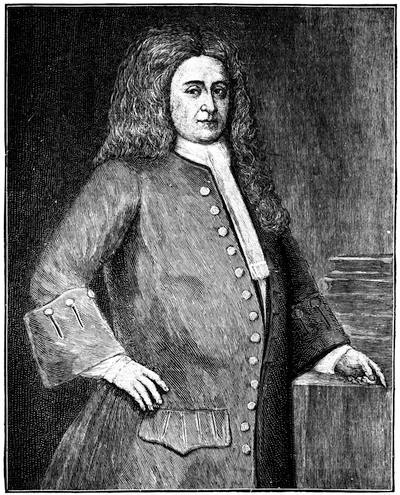
GURDON SALTONSTALL.
This follows the original picture at Yale College by an unknown artist. There is a photograph of it in Kingsley’s Yale College, i. 33. There is another engraving in Hollister’s Connecticut, ii. 584. There is an engraving by Doolittle noted in the Catal. Cab. Mass. Hist. Soc., p. 30.

The annexed autograph is from a MS. in Harvard College library [5325.23], entitled: A Memorial offered to the General Assembly of his Majesties Colony of Connecticut hold in Hartford, May ye 10th, 1716, By Gurdon Saltonstall, Esq., one of the Trustees in Trust of the Mohegan Fields in the Township of New London, for the use of Cesar, Sachem of Mohegan & his Indians, upon the occasion of ye sd Cesar’s Complaint to ye sd Assembly of wrong done him and his Indians in and upon the sd Fields.
It was during Dudley’s time that the emission of paper money had begun to have a portentous aspect. These financial hazards and disputes, as turning people’s thoughts from old issues, had the effect to soften some of the asperities of Dudley’s closing years of service.[217] He ceased to wrangle for a salary, and omitted to reject Elisha Cooke when again returned by the House in 1715 as a member of the council.[218] Massachusetts had grown much more slowly than her neighbors, and five or six thousand of her youth had fallen in the wars. This all meant a great burden upon the survivors, and in this struggle for existence there was no comforting feeling for Dudley that he had helped them in their trials. The puritan class was hardly more content. Sewall’s diary shows the constant tribulation of his representative spirit: sorrowed at one time by the rumor of a play in the council chamber; provoked again on the queen’s birthday at the mocking of his efforts to check the drinking of healths with which it was celebrated on Saturday night; and thankful, as he confessed again, that he heard not the salutes on the Lord’s Day, which were paid to Nicholson when he finally set sail for England.
It was the 15th of September (1714) when news came of the death of Queen Anne. A sloop sent from England with orders was wrecked on Cohasset rocks, and the government was left in ignorance for the time being of the course which had been marked out for it. Dudley’s commission legally expired six months after the sovereign’s demise, if nothing should be done to prolong it. As the time came near, a committee of the council approached him to provide for the entrance of the “Devolution government,” as Sewall termed the executive functions, which then under the charter devolved on the council. Dudley met the issue with characteristic unbending; and some of his appointees knew their places well enough to reject the council’s renewal of their commission, being still satisfied with Dudley’s, as they professed. His son Paul besought the ministers to pray for his father as still the chief executive, and intrigued to prevent the proclamation of the council for a fast being read in the pulpits. In March what purported to be a copy of an order for his reinstatement reached Dudley by way of New York. It was quite sufficient; and with an escort of four troops of horse clattering over Boston neck, he hurried (March 21, 1715) to the town house, where he displayed and proclaimed his new commission. His further lease of power, however, was not a long one.
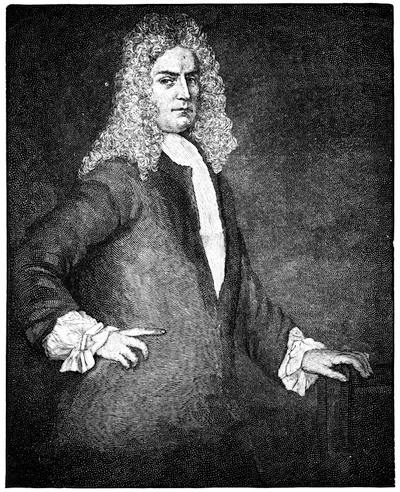
WILLIAM DUMMER.
After a likeness owned by the Misses Loring, of Boston.
There were new times at the English court when the German George I. ruled England; when he gave his ugly Killmansegge and Schulenberg places among the English peeresses, and the new Countess of Darlington and Duchess of Kendall simpered in their uncouth English. The Whig lords must now bend their gouty knees, and set forth in poor German or convenient—perhaps inconvenient—Latin what the interests of distant New England required. We may well suspect that this German dullard knew little and cared less when it was explained to him that the opposing factions of the private and public bank in his American province of Massachusetts Bay were each manœuvring for a governor of their stripe. We may well wonder if he was foolish enough to read the address of the ministers of Massachusetts and New Hampshire, or the address even of the General Court, which came to him a little later. His advisers might have rejoiced that Increase Mather, pleading his age, had been excused from becoming the bearer of these messages, or of that of the ministers, at least.[219]
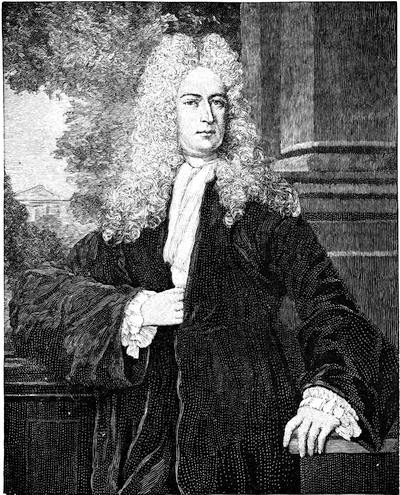
JEREMIAH DUMMER.
After a likeness owned by the Misses Loring, of Boston. It was at one time in the Mass. Hist. Soc. gallery. (Cf. Proceedings, ii. 289, 296, 300, 302.) It has been ascribed to Sir Godfrey Kneller.
The friends of a private bank carried their point far enough to secure to Col. Elisha Burgess the coveted commission, who, however, was better satisfied with the thousand pounds which the friends of a public bank were willing to pay him, and so he declined the appointment. The same power that paid the money now got the commission issued to Col. Samuel Shute, and the news which reached Boston (April 21, 1715) of Burgess’ appointment was swiftly followed by the tidings of Shute’s ascendency, which meant, it was well known, that Jonathan Belcher, of Cambridge, and Jeremiah Dummer had been successful in their diplomacy in this, as well as in the displacing of Tailer as lieutenant-governor by William Dummer. The latter was Dudley’s son-in-law, and the appointment gilded the pill which the late governor was prepared to swallow.
The good people of Massachusetts had not long got over their thanksgiving for the suppression of the Scottish rebellion when, just about sunset, October 3, 1716, a gun in the harbor told of Shute’s arrival. Two days later, at the town house, he laid his hand on the Bible, “kissing it very industriously,” as Sewall records, and swore to do his duty. On the following Sunday he attended King’s Chapel, and on Thursday he was present at the usual lecture of the Congregationalists, when he heard Cotton Mather preach.[220] He seemed very docile, and doubtless smiled when Mather’s fulsome address to him was paraded in a broadside; very docile, too, when he yielded to Sewall’s entreaty one evening that he would not go to a dancing-master’s ball and scandalize his name. But on November 7 (1716), in his set speech to the legislature, there were signs of trouble. New England had peace on her frontiers, and that was not conducive to quiet in her domestic politics. The conflict came, and Shute was hardly equal to it. The legislature could look to a support nearly unanimous of almost a hundred thousand people in the province, being not much short of a quarter of the entire population of the English colonies; and a people like the New Englanders, who could annually export £300,000 worth of products, were not deficient at least in business courage.
Shute’s instructions as to the demands he should make were not novel. It was the old story of a fixed salary, a house to live in, the command of the Rhode Island militia, the rebuilding of Pemaquid, and the censorship of the press. The governor brought their financial plight to the attention of the House, and they voted more bills of credit. He told them of other things which he and the king expected of them, and they did nothing. So he prorogued them.
It was incumbent on the Crown governor to encourage the production of naval stores, as a means of diverting attention from manufactures, which might injure the market in the colonies for English products. One Bridger had already made himself obnoxious, and been suspected of malfeasance as “surveyor-general of woods,” in Dudley’s time, and it was far from conciliatory to a people who found the Crown’s right to mast-timber burdensome[221] that Bridger appeared in the train of Shute with a new commission. The surveyor was arraigned by the younger Elisha Cooke, who was now succeeding to his father’s leadership, and Shute defending him, a rather lively contention followed, which was not quieted till Dummer, in England, finally got Bridger removed.[222] To one of Shute’s speeches the House made a reply, and Shute threatened he would prevent their printing it.
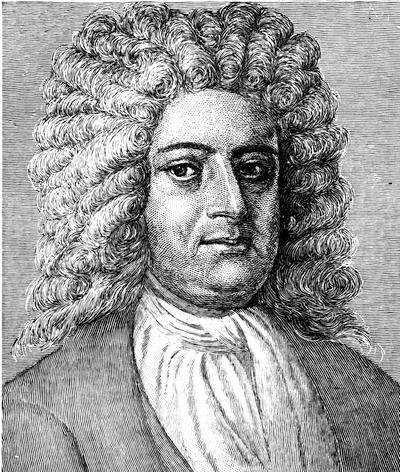
ELISHA COOKE, THE YOUNGER.
This follows a red-chalk drawing once owned by the Rev. Wm. Bentley, of Salem, and now in the gallery of the American Antiquarian Society. Cooke was born in Boston in 1678, and died in 1737. His only publication appears to be the following: Mr. Cook’s just and seasonable vindication, respecting some affairs transacted in the late general assembly at Boston. [Boston, 1720.] The second impression, corrected. [Boston, 1720.] Sabin, iv. 16,305; Brinley, no. 1,474.
Its appearance, nevertheless, in the News-Letter established the freedom of the press in Massachusetts.[223] The governor informed the Board of Trade that the province was bound to wrest from him as much of his representative prerogative as it could, and its action certainly seemed sometimes to have no other purpose than to establish precedents which might in some turn of fortune become useful. The House chose the younger Cooke speaker in palpable defiance, and when he was disapproved the members refused to go into another ballot, and the governor prorogued them. When the new House assembled they contented themselves with publishing a protest, and chose another speaker; and then they diminished the “present” which they voted to the governor. It seems clear that the House, in a rather undignified way, revelled in their power, and often went beyond the limits of propriety. The charter required that all acts should be reviewed by the Crown for approval. The House dodged the necessity by passing resolves. Dummer in England knew that such conduct only helped the Board of Trade to push the plan of confederating all the provinces under a governor-general, and intimated as much. The House was in no temper to be criticised by its own agent, and voted to dismiss Dummer. The council in non-concurring saved him; but the House retaliated by dropping his allowance.
The council was not without its troubles. Shute refused to attend its meetings on Christmas. Sewall, ever alert at any chance of spurning the day, “because,” as he chose to think, “the dissenters had come a great way for their liberties,” broadly intimated that the council still could pass its bills on that day, and the governor might take whatever day he chose to sign them. It was certainly not a happy era in Massachusetts. The legislature was not altogether wise or benign, and Shute did nothing to make them so.[224]
The frontiers, for a space, had but a hazardous peace. In August, 1717, Shute had gone to Arrowsick (Georgetown, Me.) to hold a conference with the Indians, and had learned from a letter received there from Sebastian Rasle, the Jesuit missionary at Norridgewock, that any attempt to occupy the lands beyond the Kennebec would lead to war, and as we shall see the war came.[225] Meanwhile, life in Boston was full of change and shadow. Pirates beset the people’s shipping, and when the notorious “Whidaw” was cast away on Cape Cod (1717) they heard with some satisfaction of the hundred dead bodies which were washed ashore from the wreck. There was consequently one less terror for their coasters and for the paltry sloops which were now beginning to venture out for whales from Cape Cod and Nantucket.[226] There was occasion, indeed, to foster and protect that and all industries, for the purchasing power of their paper money was sinking lower and lower, to the disturbance of all trade. When the province sought to make the English manufacturers afford some slight contribution to restoration of prosperity by imposing a duty of one per cent. on their manufactures sent over, the bill was negatived by the king, with threats of loss of their charter if any such device were repeated. In the same spirit Parliament tried to suppress all iron-working in the province;[227] but after much insistence the people were allowed the boon of making their own nails![228] Some Scotch Irish had come over in 1718, and though most of them went to New Hampshire and introduced the potato,[229] enough remained in Boston to teach the art of linen-making. Spinning under this prompting became a popular employment, and Boston appointed a committee to consider the establishment of spinning schools.[230] Perhaps they could spin, if they could not forge; and Boston, with her 12,000 to 15,000 inhabitants to be clothed and fed, needed to do something, if Parliament would permit. Her spirit was not always subdued. In 1721 she instructed her representatives not to be deterred by frown or threat from maintaining their charter privileges. “When you come to grant allowances,” she said, “do not forget the growing difficulties that we at this day labor under, and that poverty is coming upon us as an armed man.”[231] The General Court emphasized its call for frugality by forbidding the extravagant outlay for funerals, which was becoming the fashion.[232] There might have been some scandal at the haberdashery trade which the profuse habits of bestowing upon their parsons gloves and rings made a possible circumstance, to say the least, in more than one minister’s house. But a little innocent truck in the study was not the ministers’ most pressing diversion. Cotton, or rather Doctor Cotton Mather, as he had been called since Glasgow, in 1712, had given him a Doctorate of Divinity, bid for an ally against the liberals.[233] When he and his father assisted in the ordination of the new Baptist minister, Elisha Callender, in 1718; and when Dudley, two years before his death,[234] joined Sewall in open attacks on Leverett and the government of Harvard College, there is little doubt where the sympathy of the Mathers lay.[235] They had hopes, too, that the new Connecticut college would register their edicts, since they could no longer enforce them at Cambridge. Sewall found the Lord’s Supper unsuggestive of charity, when the deacon offered the cup to Madam Winthrop before it was served to him; and we, to-day, had much rather see him riding about the country on his circuit, distributing tracts and sermons to squires and hostlers, and astonishing the children, as he rode into the shire-towns under the escort of the sheriff and his men.
But Yale College, of which so much was hoped by the lingering puritanism, soon surprised them, when Timothy Cutler, its rector, with one of its tutors, and other Connecticut ministers, embraced Episcopacy in 1722. Governor Saltonstall was powerless to prevent it, when at Commencement the story of that defection was told. Cutler went to England, received Episcopal ordination, and came to Boston in 1724 to take charge of one of its English churches.[236]
But before this the care of the body as well as of souls had proved a source of dispute with the ministers. Cotton Mather had read in the Transactions of the Royal Society, to which he was sometimes a contributor himself, of the method which was employed in Turkey of disarming the small-pox of some of its terrors by the process of inoculation.[237] That disease was now raging. While the town was moving the governor to send the “Seahorse,” man-of-war, down to Spectacle Island, because she had the pest among her crew, Mather urged Dr. Zabdiel Boylston to make trial of the Turkish method. The selectmen of Boston and the town meeting opposed it. The House forbade it by bill; but the council hesitated. One of the most active of the physicians of Boston strenuously objected. This was William Douglass, who had been a student of medicine at Leyden and Paris, and who had come to Boston three years before. Other physicians were likewise in opposition. The passions were excited by the controversy; the press was divided; and Mather, who about this time was finding the people “bloody and barbarous,” the town “spiteful,” and the country “poisoned,”[238] had a grenado thrown through his window.[239]
What with the political, financial, theological, and sanitary disturbances of Shute’s time, and the freedom of the press, which the governor had been foolish enough to give them the opportunity of making the most of, the intellectual activity of the people had never before occasioned so great a fecundity of print. The Boston man of the early part of the eighteenth century resorted to the type-setter as readily as he gossiped, and that was easily enough. In 1719 there were five printing-presses running in Boston,[240] and the Exchange was surrounded with booksellers’ shops. The practice of sales of books at auctions had begun in 1717 with the disposing of the library of the Rev. Ebenezer Pemberton, or at least its catalogue is thought to be the first of such a sale. Thomas Fleet was selling his doggerel ballads, and the boys and girls of New England first knew who Mother Goose was when her nursery tales were published by Fleet in 1719. The News-Letter had been published for fifteen years, but not three hundred were yet sold at an impression. Wm. Brooker, succeeding Campbell as postmaster, felt it necessary to divide the town and give the News-Letter a chance for an altercation, when in 1719 (Dec. 21) he began the Boston Gazette. James Franklin had printed this paper for Brooker, but the printing being taken from him he startled the town with the New England Courant, which first appeared on Aug. 17, 1721. The new sheet was bold and saucy,—a sort of free lance, to which people were not accustomed; and while it gave little news and had few advertisements, its columns swarmed with what the staid citizens called impertinences. It wildly attacked the new inoculation theory, and elicited a public rebuke for its scandalous conduct from Increase Mather, who was in turn attacked by it.[241]
The Mathers, Elisha Cooke, Sewall, and above all Jeremiah Dummer in his Defence of the New England Charters,[242] published not a little of a terse and combative strain, which the student to-day finds needful to read, if he would understand the tides and eddies of the life of the time. Boston was also nourishing some reputable chroniclers of her own story. Thomas Prince, who after his graduation had gone to England, had returned in 1717, yet to live forty years ministering to his people of the Old South, gathering the most considerable of the early collections of books and papers, illustrating in good part the history of New England,[243] and contributing less than we could wish to such stores from his own writing. Dr. William Douglass, as we have seen, had dipped into the controversies of the day, practised his pen in the public journals, not always temperately or with good taste, and thirty years later was to vent so much prejudice in his Summary of the British Settlements that, though the book is suggestive, it is an unsafe guide to the student. Thomas Hutchinson, much the best of our colonial historians, was now a boy of six or seven in the forms of Master Bernard’s grammar school.
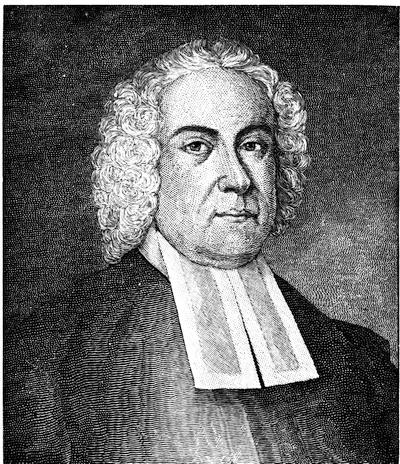
THOMAS PRINCE.
This follows an oil painting in the cabinet of the American Antiquarian Society at Worcester. There is also of Prince a mezzotint engraving of a painting, of which there is a heliotype in the Mem. Hist. Boston, ii. 221. A portrait after a painting by John Greenwood is noted in the Catal. Cabinet, Mass. Hist. Soc., no. 26. Cf. Proceedings, i. 448.
But war was again imminent. As early as 1709 it had been considered advisable to build a line of defences across Boston neck, and up to 1718 much money had been spent upon it. The peaceful aspect of the affairs at that moment had been an inducement to disband the watch which they had kept there; but in 1721 it had been again set. Gov. Phillips, of Nova Scotia, had been in Boston to talk over the situation at the eastward, for the warnings of Rasle rendered a continuance of quiet doubtful. The younger Castin had been seized and taken to Boston,[244] and bloodshed could hardly be averted; for though peace existed between England and France, there was little question but the encroachments and ravages of the Indians were instigated from Quebec. Sewall tried to arrest the progress of events, and published his Memorial relating to the Kennebec Indians,—an argument for persuasion rather than for force. On July 25, 1722, Gov. Shute and his council declared war against the eastern Indians, and a harrowing struggle began.[245] On the 1st of January, 1723, guns at the Castle before sunrise told the town that Shute had sailed for England, and when the people were astir Boston Light was sinking behind him. He went to arraign the colony in person before the Privy Council, and never returned to his government. The conduct of affairs, meanwhile, fell to Dummer, the lieutenant-governor, who made Cotton Mather inexpressibly happy by what the divine called his wise and good administration.
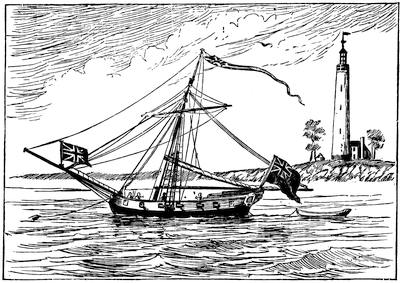
BOSTON LIGHT AND THE PROVINCE SLOOP.
Sketched from an old mezzotint, “W. Burgis del. and fecit,” and inscribed: “To the merchants of Boston this view of the Light House is most humbly presented By their Humble Servt, Wm. Burgis.” Its date is probably not far from 1712. See Boston Record Commissioners’ Reports, vii. 97.
New Hampshire had been included in Shute’s commission, but Vaughan, the lieutenant-governor, claimed that during Shute’s stay in Boston his direct authority lapsed, and his lieutenant was the resident executive. The strife and bickering which followed this assumption had been among Shute’s tribulations, which were somewhat mitigated when influence at London secured the displacement of Vaughan by John Wentworth.[246]
The charters of Rhode Island and Connecticut did not order their enactments to be submitted to the royal supervision, a requirement which at one time there was danger would be made,[247] but which was in good part prevented by the ready reasoning of Dummer in his Defence of the New England Charters. One act of Rhode Island, published at this time, seemingly invalidates that colony’s claim for unfailing toleration. In the edition of her laws printed in 1715 there is one which disfranchises Romanists. No one is able to find beyond dispute when, in the chaotic mass of her enactments, it became a law. To relieve the pride of her people from any imputation so contrary to the professed purport of all her history, Arnold, the historian of Rhode Island, has labored to show that the wording of the statute was simply the interpretation of a committee; but it was an interpretation that successive editors kept up till after the close of the Revolutionary War.[248]
In Massachusetts matters were not much improved under the rule of Dummer. An issue soon arose. The House insisted that Walton and Moody, commanders at the eastward, should be suspended, and refused supplies till it was done. Dummer claimed that as commander-in-chief he had the responsibility of such a change. He was forced, however, to yield, and appointed Thomas Westbrooke in the place of Walton, who, having obeyed the governor rather than the House, found he must retire without the pay which he had earned.
In England Shute was presenting to the king his memorial against the province.[249] When the House heard of it they appropriated £100 to hire counsel for the defence; but the upper branch gave the resolve a negative. So the House sent an address to the king,[250] in which the council would not join. The House would then despatch a new agent; the council was content with Dummer; a compromise was reached, by which Elisha Cooke was sent to join Dummer. Shute and his opponents were in due time heard before the Privy Council. The aspect of affairs grew threatening. A Boston man, John Colman, wrote home that the charter was in danger.[251] It ended in the sealing of a new explanatory and supplemental charter,[252] in which Shute’s demands were fairly met, in that there was in it an undeniable expression of the right of the governor to reject a speaker, while the House itself was denied the right to adjourn beyond two days. With this new order Col. Samuel Vetch had hopes of succeeding Shute; but the old governor was not displaced. The General Court prudently accepted the new charter, January 15, 1725.
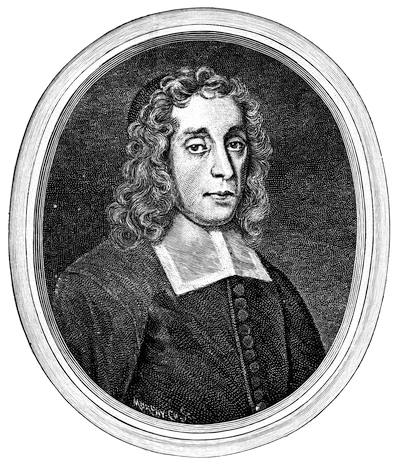
INCREASE MATHER.
This follows a corresponding likeness in Cotton Mather’s Parentator, Boston, 1724 (Harv. Col. lib., 10397.17). Cf. Edmund Calamy’s ed. of Memoirs of the life of the late Rev. Increase Mather, London, 1725 (Ibid., 10397.16). Engravings are noted in the Catal. Cab. MS. Hist. Soc., p. 35; and of the painted portraits in the same catalogue, no. 23 is of Mather. There is an original painting in the American Antiquarian Society at Worcester, which is engraved in the Mem. Hist. of Boston, i. 587.
While the provincial charter had been thus in jeopardy, the father of it died. The most conspicuous of New Englanders in his day, though his fame is somewhat overshadowed by his son’s, breathed his last, when Increase Mather died, on August 23, 1723, at the advanced age of eighty-four. When he was buried, a hundred and threescore scholars of Harvard College walked in such a procession as never before attended the burial of a New England divine. In most respects he was the greatest of a race which was born with traits of prowess. His learning was large, far better assimilated than that of the son, and his power over men far happier and more consistent. His industry was enormous; he sometimes worked in his study sixteen hours out of the twenty-four. What Cotton Mather called the “tonitruous cogency” of his pulpit discourse was often alarming to the timid, but not always effective for the mass. The people grew to be disenthralled in large numbers. There was a growing belief that there could be graces even in dogma,—a gospel that never a Mather preached. The rude Bay Psalm Book, and the nasal cadence of the meeting-house, were beginning to pass when the Franklins, in that obnoxious sheet the Courant, were printing the hymns of Isaac Watts.
A year after the father died, there was a new election of president of Harvard College. Cotton Mather was as anxious as before. The governing board picked out in succession three Boston ministers, and never seem to have considered Cotton Mather. Their first choice was Joseph Sewall, of the Old South, a son of the Judge; “chosen for his piety,” as the disappointed man sneeringly wrote in his diary. The “miserable” college, when Sewall declined, chose the minister of the Manifesto Church, a direct thrust at Matherism; but no choice was accepted till Benjamin Wadsworth was elected. The college had another conflict when Timothy Cutler, after receiving Episcopal ordination in England, came to Boston, and by virtue of his new position as a Church of England ministrant set up his claim to a seat in the Board of Overseers. He sought in vain. Mather meantime was contriving to fortify himself, and determined to have a synod to organize some resistance to this increasing antagonism. Dummer entertained a petition to that end, but John Checkley, one of Cutler’s friends, ferreted out the scheme, and there followed a sharp rebuke from the lords justices, who pronounced the calling of such a body the prerogative of the crown, and the movement came to naught. This same John Checkley, a polemical churchman, in Boston, who kept a toy shop, united with it the publishing of tracts, in which the prevailing theology was attacked. In 1719 he had reprinted Charles Leslie’s Short and Easy Method with the Deists, and later accompanied Cutler and his friends to England. While there he caused another edition of Leslie to be printed (1723), but added to it his own Boston imprint, and what was more important, he appended a Discourse concerning Episcopacy, which seems to have been a refashioning of another of Leslie’s treatises, by which Checkley had pointedly demonstrated the schism of all ordination except an Episcopal one. With a stock of this book he came back to Boston, and at the “Sign of the Crown and Blue gate, over against the west end of the town house,” he began to sell them. The magistrates found in some expressions “a false and scandalous libel” on themselves. A trial followed with an appeal, which dragged its slow length along; and in the midst of it Checkley delivered a memorable speech in his own defence. It ended in his being fined fifty pounds.
Checkley left Boston not long after for England; and came back again to settle in Providence, and administer the rites of the church as he believed they should be administered.
During all this wearisome contention in Boston, there is a glimpse of the humaner, and perhaps more godly, spirit in the gathering of men together under the lead of Joseph Marion to effect the insuring of neighbors’ worldly possessions from the chances of fire and the sea. It is not unlikely that this first trial of a system which to-day contributes so much to the sum of our happiness began then to indicate that mutual helpfulness might conduce as much to Christian comfort as keeping eyes alert for “scandalous libels.”
But there was no way yet, except by keeping other eyes alert along a musket barrel, to meet the dangers of the frontier. When the authorities erected (1724) Fort Dummer[253] near a spot where Brattleboro’ now stands, they made the first English settlement in what is to-day Vermont. On the 22d of August (1724), as Sewall records, “the ‘Sheerness’ comes up and Captain Harmon with his Neridgwack scalps, at which there is great shouting and triumph. The Lord help us to rejoice with trembling!” Another diary of the day makes these scalps twenty-eight, one of them Bombazeen’s, and another that of “fryer Railes,”—and this is the shape in which the tidings came to Boston of that quick onset at Norridgewock, when the Jesuit Sebastian Rasle fell among his Indian neophytes, ten days before this.[254]
In May of the next year, Lovewell the borderer made his last fight at Fryeburg in Maine, and the news reached Boston on the 13th of the same month. The ballad of Pigwacket, commemorating that bloody work, passed into the popular memory, and abided there for many a year.[255] In the following November four eastern sagamores came to Boston, and what is known as Dummer’s treaty was signed there on December 16, and the next summer (August 6) it was ratified at Falmouth (Portland). There was to be little disturbance of the peace thus consummated for a score of years to come. The war had borne heavily on Massachusetts. In such money as they had, it had during its four years’ continuance cost £240,000, and when the assembly voted an issue of another £50,000 of bills, Dummer, under royal instructions, withheld his approval. His fidelity cost him his salary for a while, which the House refused to vote until some compromise was reached.
While this quieting of the eastern frontier was in progress, the western settlements of Massachusetts were being pushed across the mountains beyond the Connecticut, and the peopling of Berkshire began at Sheffield in 1725. The leading agents in this movement were Col. Jacob Wendell, of Boston, and Col. Jonathan Stoddard, of Northampton. The occupation proved a barrier against the Dutch of New York, though it was sixteen years before the next settlement was made in the Housatonic valley at Pittsfield.[256]
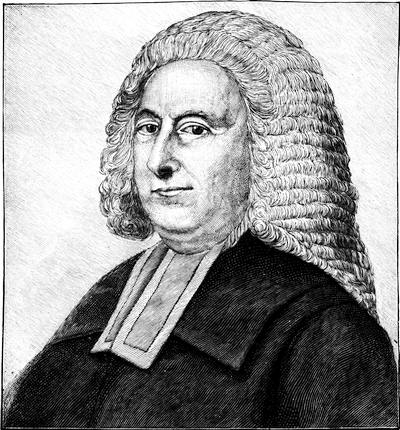
MATHER BYLES.
This follows a red-chalk drawing in the cabinet of the Antiquarian Society at Worcester, which came to it with other portraits by the bequest of the Rev. William Bentley, of Salem (b. Boston, June 22, 1759; d. Salem, December 29, 1819). There is another likeness in the Mem. Hist. Boston, ii. 227. Cf. Catal. Cab. Mass. Hist. Soc., p. 37.
During the night of the 29th of October, 1727, New England experienced one of the severest earthquakes which she had known. The next morning Cotton Mather made a speech in Boston, and this, with an account of the earthquake’s effects, was published at once as The Terror of the Lord, followed shortly by his Boanerges, intended to strengthen the impressions of the awful hour in the minds of the people. Haven’s bibliography shows the affluence of the ministerial mind in the face of this event.[257] Sermon after sermon was published, and the press had not ceased issuing the renewed editions of some of them when Cotton Mather died on the 13th of February, 1728, and gave the preachers another fruitful theme. Here was a man whose views of a fitting mundane life were as repulsive as those of Sebastian Rasle, and whose scalp would have aroused Quebec as Rasle’s did Boston. We have grown to judge each by a higher standard than the prejudices and doctrines of their time.[258]
After the departure of Shute, Wentworth continued as lieutenant-governor in the executive chair of New Hampshire. The assembly tried to insist upon a speaker whom he disapproved, but the explanatory charter of Massachusetts came to Wentworth’s support, and he prevailed; and under his lead the province experienced its share of the Indian warfare. Rhode Island remained all the time under Gov. Cranston, who had held the office by election thirty successive years when he died in 1727. Her chief point of contact with her neighbors was her bills of credit, which had sunk so low that they had become little better than a pest to herself and to the neighboring colonies. Connecticut kept her activity and quiet ways within herself. She took no part in the war beyond putting her border towns in a state of defence.
Shute was pursuing his aim in England. He had succeeded in getting from the king an explicit threat, under whose pressure it was thought the Massachusetts assembly would see the advisability of establishing a fixed salary for the royal governor, when George I. died (June 11, 1727), and Shute’s commission was vacated. He slipped into a pension of £600 a year, and died an old man. The news of the king’s death reached Boston in August, and on the 14th George II. was proclaimed with military parade. The ministers beguiled themselves, as usual, preaching many sermons on the death of a good king, and Mather Byles published a poem.
Since 1720 William Burnet, a son of Bishop Burnet, had been governor of New York and New Jersey, whither he had gone to retrieve a fortune lost in stock speculations; and with a numerous family to support, he felt the necessity of it. The new king relieved him of some embarrassment, occasioned by a growing unpopularity in his government, by directing his transfer to the vacant chair of Massachusetts, signing his commission in March. He reached Boston July 13, and as he was escorted to the Bunch of Grapes tavern[259] the people marked his noticeable presence and his suave manners, and might have predicted a calmer sway from him than proved to be in store. He was flattered by his reception, and even ordered the publication of some eulogistic verses, which Mather Byles, the clerical wit of the time, addressed to him.[260]
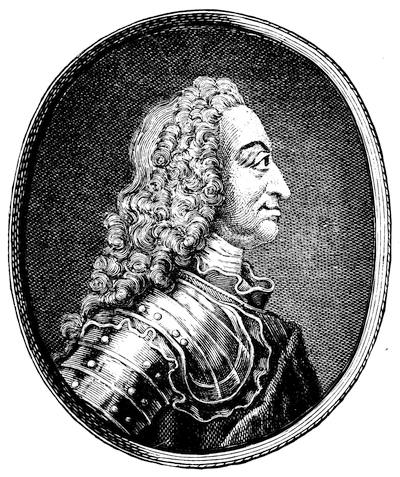
GEORGE II.
From a print in Entick’s Gen. Hist. of the late War (2d ed. 1765) vol. ii., frontispiece.
His instructions were of the sort that the province had got used to, though perhaps they hinted more pointedly of the danger which awaited the charter, if the salary question was not agreeably settled. Burnet’s speech opened the legislative war. The assembly answered it by voting him a larger allowance than was usual,—but still an allowance. The town of Boston had the speech read to it in town meeting, and voted nemine contradicente, as we read in the records,[261] in the assembly’s spirit. The House now asked to be prorogued. The governor refused, thinking the £1,000 a month which the sitting cost might bring them to terms. This failing, he resorted to manœuvres which even Chalmers censures. He removed the General Court to Salem, when, in a sort of grim irony, it recorded a resolve to legalize proceedings passed in an unaccustomed place, and consequently unconstitutional, as they claimed. The House now addressed a memorial to the king and refused the governor a copy of it, and, helped by Boston merchants to pay the cost, the representatives despatched Jonathan Belcher to coöperate with Francis Wilks, now the resident agent in London, in obtaining the king’s favorable attention to their plea. This appeal gave the governor a pretext for releasing the legislature for three months,—and perhaps the device of the House had that purpose.
The Board of Trade heard both sides, sustained the governor, and advised the king to lay the facts before Parliament. The House in turn ordered a historical summary of all the proceedings relating to the salary question from the time of Phips to be edited and printed.[262] The governor dissolved the assembly, and took his revenge in withholding his signature to the bill for their own pay. A new election sent to Boston an assembly which was of the same temper. Burnet told them of the danger from the Board of Trade’s advice to the Crown; their own agents wrote to them there was no danger; and so the House continued as bold as ever. The governor directed their reassembling at Cambridge. Here they voted afresh the allowance, which was scorned as before. Meanwhile the governor got some literary recreation, for which his acquirements well fitted him, by printing moral and entertaining papers in the New England Journal; and if this did not bring him an income, he managed to eke one out by increasing the rate of clearance fees at the custom house, which all went into his own pockets.
Returning one day from Cambridge to Boston, in August, 1729, he was thrown into the water by the overturning of his carriage. A fever ensued, and he died September 7. The legislature gave him an impressive funeral, and voted £2,000 to his children; and his “character,” by Parson Colman, was circulated in a folio half-sheet.[263]
Dummer, as lieutenant-governor, again took the executive’s chair, and fought over the salary question once more; and the council, as before, steadily refused to join in the payment of the agents of the House.
Jonathan Belcher, lately the agent of the province, was now commissioned governor. He came of a New England stock, and his father had gained a fortune in trade, and had secured some political consideration as a member of the council. His mother was a daughter of Thomas Danforth, one of the ablest of the leading politicians under the old charter. The new governor had graduated at Harvard College; and foreign travel had added ease and attraction, with some of the wiles of the world, to a presentable person. He had been accustomed to dispense his fortune in ways to draw attention and give him consequence. He had thrown out intimations in high quarters in England that the view he once held on the prerogative had undergone a change, and that he knew the turbulent spirits of his native province well enough to manage them. Wilks and Shute had seconded his professions, and his appointment followed. With instructions pitched to a higher demand than ever before, he was sent off to try his skill with an intractable people. Meanwhile Dummer had been superseded by Tailer, a former incumbent of the lieutenant-governorship, chiefly because the naval office he was occupying was wanted for another. Tailer was at the time in New England, and received his commission before Belcher arrived, which was not till August 10, 1730. So amid the terror, from a new invasion of small-pox which had withdrawn the town from the observance of its centenary,[264] and with signs of a new life, as well as a new era, in the relief which the law was giving to the baptists and the quakers from the burden of the parish taxes, and with the stranger element of their population developing a new Irish Presbyterian church under John Moorhead,[265] the people of Boston received their recusant townsman as governor. He made his speech in due time to the General Court. Cato, he told them, went beyond reason in letting his obstinacy lure him to destruction. This reference to the salary contention did not intimidate them; for the House had information from its own agents that the jealousies of the party leaders in England were not likely to let any issue affecting the continuance of the charter be forced upon Parliament. In any event there was a disposition rather to accept parliamentary domination, whatever it might be, than surrender one jot of their principles. With such a disposition the House became stubborn,—politely so. It even voted the governor liberal grants for the services which he had rendered as agent, and he took the gratuities though he had abandoned the grantors. The allowances for his services as governor he could not well accept under such instructions as bound him; and as he needed the pay, his son solicited permission from the home government for the father to receive the usual grants. The request was allowed, and the salary contention came virtually to an end. When Belcher approved a grant of £500 to be placed in the Bank of England to the credit of the province’s agent, he little suspected he was furnishing the means to bring about his own overthrow. His conduct of his office rendered such an overthrow likely. The times, with all failings, had not seen before such flagrant attempts to serve party friends with the spoils of office. The public was so sensitive that even the younger Cooke, accepting a judgeship with some traits of sycophancy, fell in their good opinion.