Chapter III
Reading edition
THE MIDDLE COLONIES.
BY BERTHOLD FERNOW,
Keeper of the Historical MSS., N. Y. State.
THE thirteenth volume of the New York Colonial Manuscripts contains a document called “Rolle van t’Volck sullende met het Schip den Otter na Niēu Nederlandt overvaren,” April 24, 1660, being a list of the soldiers who were to sail in the ship “Otter” for New Netherland. Among these soldiers was one Jacob Leisler, from Frankfort, who upon arriving at New Amsterdam found himself indebted to the West India Company for passage and other advances to the amount of nearly one hundred florins.
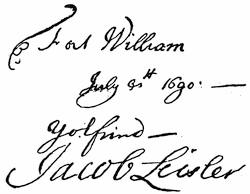
Twenty-nine years later this same quondam soldier administered the affairs of the colony of New York as lieutenant-governor, not appointed and commissioned by the king of England, but called to the position by the people of the colony. When the first rumors of the “happy revolution” in England reached New York, Sir Edmond Andros, the governor-general of New York and New England, was absent in Boston, where the citizens forcibly detained him. Nicholson, the lieutenant-governor, and one or two other high officials belonged to the Church of Rome, and were therefore disliked and suspected by the predominant Protestant population. Rumors had found their way, meanwhile, through the northern wilderness, that the French in Canada were making preparations to invade New York, hoping, with the assistance of the Catholics in the province, to wrest it from the English. The major part of the inhabitants were still Dutch or of Dutch origin, and these were nearly all Protestants. They were easily led to believe that the papists within and without the government had concerted to seize Fort James, in New York, and to surrender that post and the province to a French fleet, which was already on the way from Europe. The prompting of the Protestant party to anticipate any such hostile movement was strengthened when they heard the result of the revolution in England. Leisler, placing himself at the head of this anticipatory movement, seized the fort, and was shortly afterwards proclaimed lieutenant-governor, in order to hold the province for William and Mary until their pleasure should be known. There was little ground for distrusting the Catholics within the province; but the danger from the French was more real, and took a shape that was not expected, in the murderous assault which was made on Schenectady.[466] Leisler’s adherents, as well as his opponents, felt that this coup de main of the French might be only the precursor of greater disasters, if no precautionary steps were taken. Leisler himself believed that the English colonies would never be safe unless the French were driven from Canada. He called a congress of the colonies. Their deliberations led to the naval expedition of Phips against Quebec, and the march of Winthrop and Livingston against Montreal. Their disastrous failure has been described in an earlier volume.[467] Governor Sloughter arrived in New York a few months later, and soon put an end to the hasty revolt. Leisler and his son-in-law, Milbourne, were hanged for what seemed an untimely patriotism and still more uncalled-for religious zeal.
The cry was practically a “No Popery” cry upon which Leisler had risen to such prominence in the affairs of New York. It had appeared scarcely to attract the notice of the king, and he was prone to believe that Leisler was more influenced by a hatred of the Established Church than by zeal for the crown. It was not, however, without some effect. A few words added to the instruction of the new governor had materially changed the condition of religious toleration in the province. Earlier governors had been directed “to permit all persons, of what religion soever, quietly to inhabit within the government.” Under Governor Sloughter’s instructions papists were excepted from this toleration. Was such intolerance really needed for the safety of the English colonies? They had been so far in the main a refuge for those who in Europe had suffered because of their liberal and anti-Roman religious opinions, and had never been much sought by Catholics.[468] The conditions of life in the colonies were hardly favorable to a church which brands private reasoning as heresy; and even in Maryland—which was established, if not as a Catholic colony, yet by a nobleman of that faith—there were, after fifty years of existence, only about one hundred Romanists. Public opinion and the political situation in England had now raised this bugbear of popery. It was but the faint echo of the cry which prompted those restrictions in the instructions to King William’s governor which sought to enforce in New York the policy long in vogue in the mother country. The home government seemed ignorant of the fact that the natural enemies of the Church of Rome, the Reformed and Lutheran clergymen of New York, had not only not shared Leisler’s fears, but, supported by the better educated and wealthier classes, they had opposed him by every means in their power. When, however, with Leisler’s death the motive for their dislike of his cause had been removed, the general assembly, composed to a great extent of his former opponents, willingly enacted a law, the so-called Bill of Rights, denying “liberty to any person of the Romish religion to exercise their manner of worship, contrary to the laws of England.”[469] After the attempt on the life of King William in 1697, further laws, expelling Roman Catholic priests and Jesuits from the province, and depriving papists and popish recusants of their right to vote, were passed in 1700 and 1701. It was reserved for the Revolution of 1776 to change the legal status of the Roman Catholics of New York, and place them on an equal footing with the believers in other doctrines.
In establishing the colony of Pennsylvania on the basis of religious freedom, Penn declared that every Christian, without distinction of sect, should be eligible to public employments. But on the accession of William and Mary it became necessary to adopt and endorse the so-called “penal laws,” in prosecuting followers of the elder church. Penn himself was unable to prevent it, although his liberal spirit revolted at such intolerance, and it seems that the authorities in Pennsylvania were quite as willing as their chief to treat Romanists with liberality, notwithstanding the “penal laws,” since in 1708 Penn was unfavorably criticised in England for the leniency with which this sect was treated by him. “It has become a reproach,” he writes to his friend Logan, “to me here with the officers of the crown, that you have suffered the scandal of the mass to be publicly celebrated.”
Despite all laws, Pennsylvania became of all the colonies the most favorable and the safest field for the priests and missionaries of the Church of Rome. It is true, they had to travel about the country in disguise, but it was known everywhere that Romanists from other provinces came to Philadelphia or Lancaster at regular intervals to receive the sacraments according to the rites of their faith. Before the Revolution, Pennsylvania harbored five Catholic churches, with about double the number of priests and several thousand communicants, mostly Irish and Germans.
The attempt upon the life of the king in 1697 had much the same effect in East New Jersey as in New York. The law of 1698, “declaring what are the rights and privileges of his majesty’s subjects in East New Jersey,” directed “that no person or persons that profess faith in God by Jesus Christ, his only Son, shall at any time be molested, punished, disturbed, or be called in question for difference in religious opinion, &c., &c., provided this shall not extend to any of the Romish religion the right to exercise their manner of worship contrary to the laws and statutes of England.”[470]
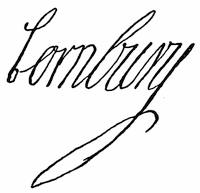
When Lord Cornbury assumed the government of New Jersey in 1701, his instructions directed him to permit liberty of conscience to all persons except papists. Matters remained thus with the Romish Church in New Jersey until the end of British rule.
Another incident of Leisler’s brief administration was of greater importance and farther-reaching consequences than his proscription of persons differing from his religious opinions. It will be remembered[471] that a general assembly of the province had been elected in 1683, holding two sessions that year and another in 1684; also that it had been dissolved in 1687, pursuant to the instructions of King James II. to Sir Edmond Andros, directing him “to observe in the passing of lawes that the Stile of enacting the same by the Governor and Council be henceforth used and no other.” The laws enacted by the first assembly, and not repealed by the king, remained in force, and the government was carried on with the revenues derived from the excise on beer, wine, and liquors, from the customs duties on exported and imported goods, and from tax levies; but the people had no voice in the ordering of this revenue, as they had had none during the Dutch period and before 1683. Leisler and his party, however, firmly believed in the Aryan principle of “no taxation without representation,” and when a necessity for money arose out of the French invasion and the subsequent plan to reduce Canada, Leisler issued writs of election for a general assembly, which in the first session, in April, 1690, enacted a law for raising money by a general tax. Adjourned to the following autumn, it again ordered another tax levy, and passed an act obliging persons to serve in civil or military office.
In calling together this general assembly, notwithstanding the repeal by James II. of the Charter of Liberties of 1683, Leisler assumed for the colony of New York a right which the laws and customs of Great Britain did not concede to her as a “conquered or crown” province. The terms on which New York had been surrendered to the English, both in 1664 and in 1674, ignored a participation by the people in the administration of the government, and the king in council could therefore, without infringing upon any law of England or breaking any treaty stipulation, deal with the conquered province as he pleased; while all the other colonies in America were “settled or discovered” countries, which, because taken possession of as unoccupied lands or under special charters and settled by English subjects, had thereby inherited the common law of England and all the rights and liberties of Englishmen, subject only to certain conditions imposed by their respective charters, as against the prerogatives of the crown. The action of Leisler showed to the English ministry the injustice with which New York had been treated so long, and the instructions given to Governor Sloughter in November, 1690, directed him “to summon and call general Assemblies of the Inhabitants, being Freeholders within your Government, according to the usage of our other Plantations in America.” This general assembly was to be the popular branch of the government, while the council, appointed by the king upon the governor’s recommendation, took the place of the English House of Lords. The governor had a negative voice in the making of all laws, the final veto remaining with the king, to whom every act had to be sent for confirmation. Three coördinate factors of the government—the assembly, the council, and the governor—were now established in theory; in reality there were only two, for the governor always presided at the sessions of the council, voting as a member, and in case of a tie gave also a casting vote. This state of affairs, by which the executive branch possessed two votes on every legislative measure, as well as the final approval, continued until 1733, when, Governor Cosby having quarrelled with the chief justice and other members of the council, the question was submitted to the home government. The law officers now declared that it was inconsistent with the nature of the English government, the governor’s commission, and his majesty’s instructions for the governor in any case whatsoever to sit and vote as a member of the council. Governor Cosby was therefore informed by the Lords of Trade and Plantations that he could sit and advise with the council on executive business, but not when the council met as a legislative body.
The first assembly called by Governor Sloughter enacted, in 1691, the Bill of Rights, which was the Charter of Liberties of 1683, with some modifications relative to churches. It met with the same fate as before, as the Lords of Trade could not recommend it to the king for approval, because it gave “great and unreasonable privileges” to the members of the general assembly, and “contained also several large and doubtful expressions.” The king accordingly vetoed it in 1697, after the ministry had required six years to discover the objections against it. They could not very well give the real reason, which was that this Bill of Rights vested supreme power and authority, under the king, in the governor, council, and the people by their representatives, while it was as yet undecided whether in New York, a “conquered” province, the people had any right to demand representation in the legislative bodies.
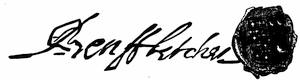
GOVERNOR FLETCHER.
From a plate in Valentine’s N. Y. City Manual, 1851.
Governor Sloughter died within a few months after his arrival in New York (June, 1691), and was succeeded by Colonel Benjamin Fletcher, “a soldier, a man of strong passions and inconsiderable talent, very active and equally avaricious,” who, as his successor Bellomont said, allowed the introduction into the province of a debased coinage (the so-called dog dollars); protected pirates, and took a share of their booty as a reward for his protection; misapplied and embezzled the king’s revenue and other moneys appropriated for special and public uses; gave away and took for himself, for nominal quit-rents, extensive tracts of land; and used improper influence in securing the election of his friends to the general assembly.
A man of such a character could hardly be a satisfactory governor of a province, the inhabitants of which were still divided between the bitterly antagonistic factions of Leislerians and anti-Leislerians, without in a short time gaining the ill-will and enmity of one of them. The men whose official position, as members of the council, gave them the first opportunity of influencing the new governor were anti-Leislerians. Fletcher therefore joined this party, without perhaps fully understanding the cause of the dissensions. His lack of administrative abilities, coupled with his affiliation with one party, gave sufficient cause to the other to make grave charges against him, which resulted in his recall in 1697.
In the mean time the assembly had begun the struggle for legislative supremacy which characterizes the inner political life of New York during the whole period of British dominion.
It enacted two laws which were the principal source of all the party disputes during the following decades. One of these laws established a revenue, and thereby created a precedent which succeeding assemblies did not always consider necessary to acknowledge, while the executive would insist upon its being followed. The other erected courts of justice as a temporary measure, and when they expired by limitation, and a later governor attempted to erect a court without the assent of the assembly, this law, too, was quoted as precedent, but was likewise ignored.
In 1694 the assembly discovered that, during the last three years, a revenue of £40,000 had been provided for, which had generally been misapplied. Governor Fletcher refused to account for it, as, according to his ideas of government, the assembly’s business was only to raise money for the governor and council to spend. This resulted in a dissolution of the assembly, as in the council’s judgment “there was no good to be expected from this assembly,” and very little was done by its successor, elected in 1695. But not satisfied with vetoing the Bill of Rights, the home authorities tried further to repress the growing liberal movement in New York by giving to Fletcher’s successor, the Earl of Bellomont, an absolute negative on the acts of the provincial legislature, so that no infringement upon the prerogatives of the crown might become a law. He was further empowered to prorogue the assembly, to institute courts, appoint judges, and disburse the revenues. The Bishop of London was made the head of all ecclesiastical and educational matters in the province, and no printing-press was allowed to be put up without the governor’s license.
Bellomont, in addressing the first assembly under his administration, made a bid for popular favor by finding fault with the doings of his predecessor, who had left him as a legacy “difficulties to struggle with, a divided people, an empty treasury, a few miserable, naked, half-starved soldiers, being not half the number the king allowed pay for, the fortifications, and even the governor’s house, very much out of repairs, and, in a word, gentlemen (he said), the whole government out of frame.” The assembly was to find remedies, that is, money wherewith to repair all these evils. How they did it is shown by a speech made to them by Bellomont a month later: “You have now sat a whole month ... and have done nothing, either for the service of his Majestie or the good of ye country.... Your proceedings have been so unwarrantable, wholy tending to strife and division, and indeed disloyal to his Majestie and his laws, and destructive to the rights and libertys of the people, that I do think fit to dissolve this present assembly, and it is dissolved accordingly.”
Having come with the best intentions of curing the evils of Fletcher’s rule, and being instructed to break up piracy, of which New York had been represented in England as the very hot-bed, Bellomont soon became popular, and no doubt grew in favor with the people, both by persuading the assembly to enact a law of indemnity for Leisler, whose body, with that of Milbourne, was now granted the honors of a public reinterment, and by bringing Kidd, the celebrated sea-rover, to justice. To-day that which was meted out to Kidd might hardly be called justice; for it seems questionable if he had ever been guilty of piracy.
Bellomont was not allowed to carry out his plans for the internal improvement of the province, for death put an end to his work at the end of the third year of his administration, in 1701. His successor, Lord Cornbury, who entered upon his duties early in 1702 (Lieutenant-Governor Nanfan having had meanwhile a successful contest with the leaders of the still vigorous anti-Leisler party), was sent out as governor by his cousin, Queen Anne, in order to retrieve his shattered fortune. The necessitous condition in which he arrived in New York and his profligate mode of life soon led him to several misappropriations of public funds, which resulted in a law, passed by the disgusted assembly of 1705, taking into their own hands the appointment of a provincial treasurer for the receipt and disbursement of all public moneys. The whole of Cornbury’s administration was occupied with a contest between the assembly and the crown: the former claiming all the privileges of Englishmen under Magna Charta; the latter, through its governor, maintaining its prerogatives, and saying that the assembly had no other rights and privileges “but such as the queen is pleased to allow.” Lord Cornbury’s recall did not mend matters.[472] The assembly of 1708, the last under Cornbury’s administration, had been dissolved, because in its tenacity of the people’s right it had declared that to levy money in the colony without consent of the general assembly was a grievance and a violation of the people’s property; that the erecting of a court of equity without consent of the general assembly was contrary to law, both without precedent and of dangerous consequences to the liberty and properties of the subjects.
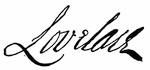
The term of Cornbury’s successor, Lord Lovelace, was very short, death calling him off within six months, while the lieutenant-governor, Ingoldsby, was a man too much like his friends, Sloughter, Fletcher, and Cornbury, to improve the state of affairs. With Governor Robert Hunter’s commission there came, in 1710, the answer to the declaration of the assembly of 1708. He received thereby “full power and authority to erect, constitute, and establish courts of judicature, with the advice and consent of the council.” The assembly’s remonstrance had been met by ignoring its author, and this treatment naturally incensed the representatives of the people so much that all the efforts of Governor Hunter, a man of excellent qualities, the friend of Addison and Swift, availed nothing in the way of settling the existing differences.
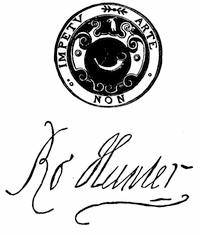
GOVERNOR HUNTER.
Follows an engraving in Valentine’s N. Y. City Manual, 1851, p. 420. Cf. on the seals of the colonial governors, Hist. Mag., ix. p. 176.
After two years’ administration, Governor Hunter had to confess to the Lords of Trade that he could not expect any support of the government from the assembly, “unless her Majesty will be pleased to put it entirely into their own hands;” and in 1715 he appointed Lewis Morris, a wealthy man, as successor to the deceased Chief Justice Mompesson, “because he is able to live without salary, which they [the assembly] will most certainly never grant to any in that station.” He found that he could not carry on the government without yielding, and thereby acting contrary to his instructions, and during the summer of 1715 came to an understanding with the assembly. “I asked,” he says, in a letter to the Lords of Trade, “what they would do for the Government if I should pass it (the Naturalization Bill) in their way, since they did not like mine; I asked nothing for myself, tho’ they well knew that I had offers of several thousands of pounds for my assent; they at last agreed that they would settle a sufficient Revenue for the space of five years on that condition; many rubs I met with, but at last with difficulty carry’d through both parts of the Legislature and assented to both at the same time. If I have done amiss, I am sorry for’t, but what was there left for me to do? I have been struggling hard for bread itself for five years to no effect and for four of them unpitty’d, I hope I have now laid a foundation for a lasting settlement on this hitherto unsettled and ungovernable Province.”
In asserting their rights as representatives of the people and compelling the executive finally to acknowledge them, the assembly had followed the course which has been shown to be effective in the English Parliament since the days of William III. But the legislative supremacy over the executive established by this victory was greater than that obtained by Parliament. In New York the executive could only collect taxes when first authorized by the legislature, while the people, through their representatives, kept the control of the sums collected in their own hands by appointing the receiving and disbursing officers.
Hunter’s wise course in yielding on several points had a better effect on the province than at first he was willing to confess. Fletcher had found the people of New York “generally very poor and the government much in debt, occasioned by the mismanagement of those who have exercised the King’s power.” The revenues of the province were in such deplorable condition that several sums of money had to be borrowed on the personal credit of members of the council to pay the most pressing debts of government; the burden of war, unjustly placed on the shoulders of New York, had impoverished the inhabitants and almost destroyed their usefulness as taxpayers; while the neighboring colonies, either refusing to assist in the defence of the frontiers against the French or being dilatory in sending their quota of money and men, reaped the advantage of New York’s patriotism by receiving within their boundaries the bulk of the foreign trade, and by adding to their population the majority of emigrants. When Hunter left the province, after ten years’ service as its governor, he could congratulate the assembly on increased prosperity and on a better state of public affairs.
His successor was the comptroller of customs at London, William Burnet, the son of the celebrated bishop, who exchanged places with Hunter. Smith, the historian, describes him as “a man of sense and polite breeding, a well-read scholar, sprightly and of social disposition.... He used to say of himself, ‘I act first and think afterwards.’” The good reports which preceded Burnet made a favorable impression on the colonial assembly, and the whole period of his administration was undisturbed by constitutional disputes, even though people opposed to him tried to create trouble by asserting that the appointment of a new governor of the province required, like the accession of a new king, the election of a new assembly, and by representing the continuance of an assembly under two governors as unconstitutional.
Burnet’s distrust of the neighboring French caused some stir in mercantile circles. He had an act passed forbidding all trade in Indian goods with Canada,—an act which would have benefited the province in general by securing all the Indian trade, a large part of which now found its way to Canada; but the merchants of New York and Albany, who disposed of their surplus to Canada traders, would have made less profits. They consequently opposed Burnet’s plans until the end of his administration (1728).
During the three years of John Montgomerie’s rule, which was ended by his death, in 1731, New York enjoyed some rest, to be violently disturbed, however, by the claims of his successor. It had been usual in the royal instructions of the governor to fix the salary of the president of the council at half the amount allowed to the executive, and it was customary to provide that in the absence, resignation, or death of the governor or lieutenant-governor he should assume the reins of the government. Upon Montgomerie’s death, Rip van Dam, as eldest member of the council, became president, and then claimed the full salary of the governor, which the council, after five months’ deliberation, finally allowed. It was upon this decision that the famous Zenger libel suit of a few years later hinged. Soon after the arrival of the new governor, William Cosby, Rip van Dam was called upon (November, 1732) to restore to the treasury a moiety of the full salary, which, under the decision of the council, he had been receiving in contravention, as was claimed, of the royal instructions. On the refusal of the president to comply, the attorney-general of the province was directed to begin an action in the king’s name “to the enforcing a Due Complyance with the said Order [to refund] according to the true Intent thereof and of his Majestie’s Additional Instruction.”
At the trial, the chief justice, Lewis Morris, surprised the governor, the attorney-general, and the whole aristocratic party (Van Dam and his friends representing the popular party) by informing the king’s counsel, in the first place, that the question to be discussed was one of jurisdiction, involving the right of the court to decide cases of equity; and in the second place, that he denied such jurisdiction, and in general the right of the king to establish courts of equity.[473] Jealous to maintain the royal prerogatives, Cosby removed Morris from the chief-justiceship, and put De Lancey, the second justice, in his place. Finding his efforts to be reinstated without result, and having no other means to avenge himself, Morris had recourse to the press, and in Zenger’s New York Weekly Journal he attacked the governor with extreme rancor, and attempted to influence the general assembly, to which he had been elected, against the king’s authority to erect courts. Even Cosby’s death, in 1736, could not conciliate him. The attacks upon his administration continued, and Morris’s vindictiveness finally even disturbed the council and the assembly. President Clarke, who had temporarily succeeded Cosby, was deterred from arresting Van Dam, the younger Morris, Smith the historian, and Zenger the printer, to be sent to England to be tried for treason, only because the forty-fifth paragraph of the instructions required positive proof of the crime in such cases.
The trial of Zenger had, however, already shown that it was not safe to accuse a man of a crime when a jury had already acquitted him. The first number of the Weekly Journal appeared on the 5th of November, 1733; and its editor had from the beginning made war upon the administration with so much vigor that in January following the chief justice, De Lancey, “was pleased to animadvert upon the doctrine of libel in a long charge given in that term to the grand jury,”[474] hoping to obtain an indictment against Zenger. The jury did not share the opinions of the chief justice, and failed to indict Zenger. Nor was the general assembly willing to concur in a subsequent resolution of the council that certain numbers of the Journal should be publicly burnt by the hangman, “as containing in them many things derogatory of the dignity of his majesty’s government, reflecting upon the legislature and tending to raise seditions and tumults in the province,” and that the printer should be prosecuted. The burning of the papers (November 2, 1734), carried out by special order of the council alone, was in appearance far from the solemn judicial act which it was meant to be. The sheriff and the recorder of New York, with a few friends, stood around the pile, while the sheriff’s negro, not the official hangman, set fire to it. The municipal authorities, who usually have to attend such ceremonies ex officio, and were ordered to do so in this case, had refused to come, and would not even allow the order to be entered in the proper records, because they considered it to be neither a royal mandatory writ nor an order authorized by law. Zenger’s trial began on the 4th of August, and resulted in a verdict of “Not guilty.”
The publishing of the alleged libel had been admitted, but it was claimed to be neither false, nor scandalous, nor malicious. When the New York lawyers who had been engaged in the defence were disbarred, Andrew Hamilton, a prominent pleader from Philadelphia, took the case. He managed it so adroitly, met the browbeating of De Lancey so courageously, and pleaded the cause of his client so eloquently that he at once achieved a more conspicuous fame than belonged to any other practitioner at the bar of that day. The corporation of New York fell in with the popular applause in conferring upon him the freedom of their city, enclosing their seal in a box of gold, while they added the “assurances of the great esteem that the corporation had for his person and merits.”[475]
The result of Zenger’s trial established the freedom of the press in the colonies,[476] for it settled here the right of juries to find a general verdict in libel cases, as was done in England by a law of Parliament passed many years later, and it took out of the hands of judges appointed to serve during the king’s pleasure, and not during good behavior, as in England, the power to do mischief.[477] It also gave a finishing blow to the Court of Exchequer, which, after the case of Cosby versus Van Dam, never again exercised an equity jurisdiction, and it suppressed the royal prerogative in an assumed right to establish courts without consulting the legislature. The jurisdiction hitherto exercised by the Supreme Court as a Court of Exchequer—that is, in all matters relating to his majesty’s lands, rights, rents, profits, and revenues—had always been called in question by colonial lawyers, because no act of the general assembly countenanced it. It was, therefore, a relief to everybody in the province when the legislature, in 1742, passed an “Act for regulating the payment of the Quit-Rents,” which in effect, though not in name, established on a firm basis a branch of the Supreme Court as a Court of Exchequer. As then instituted, it passed into the courts of the state, and was only abolished in December, 1828.
The excitement over the Zenger trial had hardly had time to subside when Rip van Dam again disturbed the public mind by claiming, after Cosby’s death, that he as eldest councillor was entitled to be president of the council, and as such to be acting governor, although he had been removed from the council by Cosby. Before the quarrel could attain too threatening dimensions, Clarke’s commission as lieutenant-governor happily arrived, and Van Dam’s claim was set at rest. Clarke’s administration of the province was in the main a satisfactory one. He had lived nearly half a century in New York,[478] and was thoroughly conversant with its resources and its needs, and, assisted by a good education as a lawyer, he found little difficulty in managing the refractory assembly and in gaining most of his important legislative points. His greatest victory was that by certain concessions he induced the assembly of 1739 to grant again a revenue to the king equivalent to the civil list in England, which had been refused since 1736, but was continued during the whole of Clarke’s administration. Although perhaps never unmindful of his own interests, he had also the good of the province at heart, and it must be regretted that a plan, drawn up while he was yet secretary, for colonizing the Indian country was not fully carried out and bore no fruits. He proposed to buy from the Iroquois about 100,000 acres of land, the purchase money to be raised either by subscription or by the issue of bills of credit. Every Protestant family made acquainted with the conditions and wishing to settle was to have 200 acres at nominal quit-rents. All the officials who were entitled to fees from the issue of land patents agreed to surrender the same, so that it would have imposed upon the settlers only the cost of improvements. The neighboring colonies had industriously spread the report that there were few or no lands ungranted in the province of New York, and that the expense of purchasing the remainder from the Indians or obtaining a grant from the crown was greater than the price of land in Pennsylvania and other colonies. Advertisements were therefore to be scattered over Europe, giving intending emigrants a clear view of the advantages of settling in the backwoods of New York. The plan reads very much like a modern land-scheme. If it could, however, have been carried out in those days, with all the governmental machinery to help it, the country from the upper Mohawk to the Genesee would have been settled before the Revolution, and Sullivan’s expedition might have become unnecessary and a Cherry Valley massacre impossible.
The only great event of Clarke’s administration was the negro plot of 1741, which for a while cast the city of New York into a state of fear and attendant precautions, and these conditions were felt even throughout the colonies. A close examination of the testimony given at the trial of the alleged negro conspirators fails to convince the modern investigator that the slaves, who had been misled by the counsels of Roman Catholics, had really arranged a plan to murder all the whites and burn the city. Fires had occurred rather frequently, suspiciously so, during the spring of 1741, the negro riot of the earlier years of the century was remembered, reports of negro insurrections in the West Indies made slave-owners look askance at their ebony chattels, an invasion of the British colonies in America by France and Spain seemed imminent, and a rancorous hatred of the Church of Rome and its adherents prevailed among the English and Dutch inhabitants of New York, while tradition and the journal of the proceedings against the conspirators assure us that some sort of a plot existed; but we must still wonder at the panic occasioned among the ten or twelve thousand white inhabitants by what, after all, may have been only the revengeful acts of a few of the 20 whites and 154 negroes who were indicted on the most insufficient evidence. It is doubtful whether all who were indicted had anything to do with the fires or the intended murder, but the judicial proceedings were of a nature to implicate every one of the two thousand colored people in the county of New York, and two thirds of the accused were found guilty, and were either hanged, burnt at the stake, or transported.
Political astuteness, or perhaps a desire to enjoy in quiet his advancing years, had led Clarke to yield to the popular party on all important points. He had confined himself to wordy remonstrances in surrendering several of his prerogatives. His successor, Admiral George Clinton,—the second son of the Earl of Lincoln, and, as he acknowledged himself, a friend and cousin of Charles Clinton, father of Governor George Clinton of a later date,—found that the position of governor had ceased to be financially desirable. New Jersey had been again placed under a separate governor, thus reducing the income of the governor of New York by £1,000. “Former governors,” it is reported, “had the advantage of one of the four companies, besides the paying of all the four companies, which made at least £2,000 per annum;” but now the assembly had placed this in other hands.
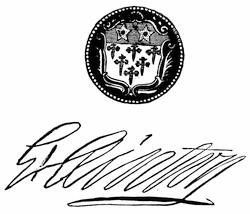
GOVERNOR CLINTON.
From a plate in Valentine’s N. Y. City Manual, 1851.
They had also interfered with a former custom, according to which the governors drew one half of their salary from the date of their commissions; but under the new arrangement for raising and paying the salary he could only draw it from the date of his arrival. Clinton brought with him a prejudice against his lieutenant-governor which was perhaps justified, for he knew him to have led Cosby into all the errors which characterized the latter’s administration. But instead of maintaining an independent position apart from the two political parties, he threw himself into the arms of the cunning Chief Justice De Lancey, the leader of the popular faction. Acting under his advice, Clinton at first was as ready to yield every point to the assembly as Clarke had done, until he discovered that all the powers of a governor were gradually slipping into De Lancey’s hand, who hoped to tire out Clinton’s patience and induce him to resign, thus leaving the field free to him with a commission of lieutenant-governor.
Clinton, upon his arrival at New York, had found, as Clarke predicted, the province “in great tranquillity and in a flourishing condition, able to support the government in an ample and honorable manner.” He perhaps would have had no difficulty with the general assembly about money grants, if he had been less distrustful of Clarke and more willing to acknowledge the rights of the people in such matters. His first measures of dissolving the old assembly, calling a new one, and, perhaps for the first time in America, introducing a kind of civil service reform by continuing in place all officers who had been appointed by his predecessors, were received with great satisfaction throughout the province, but they failed to loosen the strings of the public purse, while the new assembly sought other measures to declare their independence. Clarke’s advice, given before Clinton’s arrival, that henceforth the assembly should allow the government a revenue for a term of years, was not acted upon; but instead they voted the usual appropriations for one year only. In voting salaries for officers, they did not recognize the incumbents by name, and the council pronounced this a device of the assembly to usurp the appointing power, and to change the stipends of the officers at any time.
Walpole had meanwhile turned over the government in England to his friend Pelham, a family connection of Governor Clinton. Macaulay describes Pelham as a man with an understanding like that of Walpole, “on a somewhat smaller scale.” During Pelham’s administration, a bill was considered in the House of Commons in 1744, news of which, upon reaching the colonies, did not fail to arouse their indignation. It forbade the American colonies to issue bills of credit or paper money. As these colonies had but little trade, and had to draw upon Europe for the tools and necessaries of life in the newly opened wilderness, the small amount of coin which they received from the West Indies and the Spanish main in exchange for bread-stuffs and lumber, their only articles of exportation, went across the ocean in part payment of their debts, leaving no “instrument of association,” no circulating medium, in their hands. To replace the coin, they had to have recourse to the issue of paper money, without which all intercolonial and internal trade would have been impossible. The parliamentary intention of depriving the colonies of these means of exchange led the New York assembly to declare that the bill was contrary to the constitution of Great Britain, inconsistent with the liberties and privileges of Englishmen, and subjected the British colonies in America to the absolute will of the crown and its officers.
The efforts of Governor Clinton to reconcile the assembly by giving his assent to all the bills passed by them in their first session did not prevent their assuming greater powers than the House of Commons. He could not obtain from them either money or men for the Cape Breton expedition, set on foot by Governor Shirley of Massachusetts. Trying to regain control of colonial politics, he stirred up a bitter feeling among the popular party men; and after years of struggle, during which the home government afforded him little comfort and support, Clinton was willing to throw up his commission as governor of New York in 1751, and return to England and resume his station as admiral.
The French of Canada had used many artifices and had been indefatigable in their endeavors to gain over the Six Nations. They had cajoled many of them to desert their own tribes and remove to Canada, and had instigated others, whom they could induce to desert, to go to war with the Catawba Indians, friends of South Carolina, thereby endangering and weakening the allegiance of the Southern Indians to the British interest. Commissioners had arrived, or were to come, from all the other colonies, to meet the Six Nations at Albany and renew the covenant chain. If Quidor (the Indian name for the governor of New York) were to be absent on such an occasion, especially a Quidor who already had made an excellent impression on the king’s red allies, the council conceived that the meeting would not only be without result, but that the Indians, considering themselves slighted, would turn a more willing ear to the French, and thus endanger the existence of the colonies. Clinton was luckily a man who considered duty higher than any personal comfort, and on the 1st of July, 1751, opened the conference with the Indians which may be said to have been one of the most important in the history of the English colonies. Colonel William Johnson was induced to withdraw his resignation as Indian agent, which had made the Six Nations very uneasy, and a peace was made between the Iroquois, of New York, and the Catawbas, which also included their friends among the Southern Indians. There is not space to say much of the Indian policy pursued by Governor Clinton and other royal governors of New York. To use the Indian explanation, “they took example from the sun, which has its regular course; and as the sun is certain in its motion, New York was certain to the Indians in the course of their mutual affairs, and deviated not in the least.” New York alone had to bear the expenses (£1,150) of this conference, since Massachusetts, Connecticut, and South Carolina refused to contribute, while New Jersey, Pennsylvania, and Virginia were not represented. The other colonies also refused to help New York in keeping the Iroquois in good humor by supplying smiths to live in the Indian territory and repair the savages’ guns and hatchets. New York has the benefit of the Indian trade, they said; let her bear the burden. Pennsylvania, most interested of all the middle colonies in keeping the Indians friendly, had soon learned the evils of neglecting them. Armed parties of French and savages came down into the valley of the Ohio in 1753, creating great confusion among the Indians of Pennsylvania, and inducing nearly all, the Delawares alone excepted, to join the French, as their best recourse in the indifference of the English. At the same time the New York Indians became dissatisfied at their treatment by the general assembly, which would not allow the forts in the Indian country, at Oswego and at Albany, to be maintained, preferring to trust to the activity of the Indians for keeping the French and their savage allies from devastating the northern frontier. Disgusted with the constant struggle which the jealousy of the assembly and their encroachments upon the royal prerogatives always kept alive, Clinton finally resigned in October of 1753; astonishing the council, and especially his political enemy De Lancey, the chief justice, before he surrendered the office to his newly arrived successor, Sir Danvers Osborn, by the production of a letter from the Duke of Newcastle, secretary of state, dated October 27, 1747, which gave Clinton a leave of absence to come to England, and covered De Lancey’s commission as lieutenant-governor. This stroke of Clinton’s did not succeed very well. It is true, Sir Danvers’ presence deprived the new lieutenant-governor of the pleasure of showing himself as chief magistrate of the province, but it was to be only for a few days. Sir Danvers, perceiving that the assembly of New York was not a body easily led by royal commands, exclaimed, “What have I come here for?” and hanged himself two days after taking the necessary oath; and thus the lieutenant-governor, De Lancey, came into power.
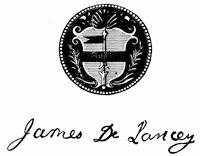
GOV. JAMES DE LANCEY.
From a plate in Valentine’s N. Y. City Manual, 1851. Cf. Lamb’s New York, i. 543.
De Lancey soon discovered himself in a dilemma. The oaths which he had taken when entering upon his new office, and which he must have had self-respect enough to consider binding, compelled him to maintain the royal prerogatives and several obnoxious laws made for the colonies by Parliament. On the other side, his political career and his bearing of past years forced him to work for the continuation of the popularity which his opposition to the very things he had sworn to do had gained him. De Lancey was skilful enough to avoid both horns of this dilemma. The assembly, rejoicing to see a man of their own thinking at the head of affairs, passed money and other laws in accordance with the lieutenant-governor’s suggestions, and quietly pocketed his rebukes, when he saw fit to administer any. The two most important events during his term were of such a nature that he could do nothing, or only very little, to prevent or further action.
On the 11th of January, 1754, a great number of people assembled in the city of New York, on account of a late agreement of the merchants and others not to receive or pass copper half-pence in payment at any other rate than fourteen to the shilling. The crowd kept increasing until two o’clock in the afternoon, when the arrest of the man beating the drum and of two others throwing half-pence into the mass quieted them.
GOV. CADWALLADER COLDEN.
From a plate in Valentine’s N. Y. City Manual, 1851, p. 420.
Later there was the conference of commissioners of all the colonies at Albany in July, 1754, convened to treat anew with the Iroquois, and also to consider, in obedience to orders from England, a plan of confederation for all the colonies. The deliberations and conclusions of the congress in this last respect are made the subject of inquiry in a later chapter of the present volume.[479] De Lancey was accused of opposing this plan of union by his machinations. We may say that such accusation was unjust. The general assembly of the province, to whom the “representation of the state and plan for union” was referred, that they might make observations thereupon, said in their report or address to the lieutenant-governor, on the 22d of August, 1754: “We are of opinion with your Honor, that nothing is more natural and salutary than a union of the colonies for their own defence.” While he transmitted the minutes of the congress at Albany to the Lords of Trade without a word of comment, he may have used his private influence to defeat the union; but there is no reason to believe that he acted even in that wise from other than upright motives, and he had already shown, in the New Jersey boundary question, how personal associations had restrained him from interfering or giving an opinion. His sense of duty in office was perhaps exaggerated, and he could not brook censure by the home authorities. The receiver-general and other officers entrusted with the collection of the king’s revenue desired the passage of an act “for the more easy collecting his majesty’s quit-rents, and for protection of land in order thereto.” The assembly and council having passed such a bill, it came before the governor for his assent, which he readily gave, supposing that an act favored by the king’s officers could not meet with the disapproval of the government in England. The Lords of Trade, however, rebuked him, and he sent in his resignation.
GOV. MONCKTON.
From a plate in Valentine’s N. Y. City Manual, 1851.
In the mean time, the appointment of Admiral Sir Charles Hardy as governor had relieved De Lancey for a time (1755-57) from the cares of the administration. Sir Charles allowed himself to be led by his lieutenant-governor, and therefore the affairs of government went on as smoothly as of late, excepting that the assembly made occasional issues upon money bills, though that body was little inclined to press their levelling principles too strongly against their old friend, the lieutenant-governor, now that he was the adviser of the executive. Sir Charles proved less fond of the cares of office than of the sea, and after two years’ service resigned, to hoist his blue admiral’s flag under Rear Admiral Holbourn at Halifax. De Lancey had therefore to assume once more the government on the 3d of June, 1757, which he administered, with little to disturb the relations between the crown and the assembly, down to the time of his death, on July 30, 1760. This event placed his lifelong adversary, Cadwallader Colden, in the executive chair, first as president of the council, and a year later as lieutenant-governor.
The policy of the royal representative was now very quickly changed. The acquiescent bearing of De Lancey in his methods with the assembly gave place to the more peremptory manner which had been used by Clinton, whose friend Colden had always been. The records of the next few years, during which Monckton, who was connected with the Acadian deportation, was governor, show but the beginning of that struggle between prerogative and the people which resulted in the American Revolution, and a consideration of the immediate causes of that contest belongs to another volume.
The history of Pennsylvania, down to the appointment of Governor Blackwell in 1688, has been told in a previous chapter.[480] The selection of John Blackwell for the governorship was an unfortunate one. A son-in-law of the Cromwellian General Lambert and a resident of puritanical New England, he must have shared more or less in the hatred of the Friends’ religion, so that his appointment to govern a colony settled principally by this sect most likely arose from Penn’s respect and friendship for the man and from his inability to find a suitable Quaker willing to accept the office. Within two months after his arrival, he had quarrelled with his predecessor, Thomas Lloyd, then keeper of the broad seal, and the rest of the council. Shortly after this he succeeded in breaking up the assembly, and before he had been in the province one year he became convinced that his ideas of governing did not meet with the approbation of the people, and returned to England, leaving the administration in the hands of his opponent, Lloyd.
After having acquired from the Duke of York the Delaware territory, Penn endeavored to bring his province and the older settlements under one form of government; but he could not prevent the jealousies, caused often by difference of religious opinion and by desire for offices, from raising a conflict which soon after Blackwell’s departure threatened a dissolution of the nominal union. Lloyd remained president of Pennsylvania, while Penn’s cousin, Markham, was made lieutenant-governor of Delaware, under certain restrictions, as detailed in a letter from Penn, which still left the supremacy to Lloyd in matters of governing for the proprietary.
In the mean time James II. of England had been forced to give up his crown to his son-in-law, and this event brought unexpected results to the proprietary of Pennsylvania. Penn’s intimacy with the dethroned Stuart, unmarred by their different religious views, made him at once a suspicious person in the eyes of the new rulers of England. He had been arrested three times on the charges of disaffection to the existing government, of corresponding with the late king, and of adhering to the enemies of the kingdom, but had up to 1690 always succeeded in clearing himself before the Lords of the Council or the Court of King’s Bench. At last he was allowed to make preparations for another visit to his province “with a great company of adventurers,” when another order for his arrest necessitated his retirement into the country, where he lived quietly for two or three years. This blow came at a most critical time for his province, distracted as it was by political and religious disturbances, which his presence might have done much to prevent. The necessity of keeping remote from observation did not give him opportunity to answer the complaints which became current in England, that a schism among the Quakers had inaugurated a system of religious intolerance in a province founded on the principles of liberty of conscience. The result of this inopportune but enforced inactivity on Penn’s part was to deprive him of his province and its dependency (Delaware), and a commission was issued to Benjamin Fletcher, then governor of New York, to take them under his government, October 21, 1692. Fletcher made a visit to his new territory, hoping, perhaps, that his appearance might bring the opposing sections into something like harmony. Quickly disabused of his fond fancy, and disappointed in luring money from the Quakers, he returned to New York, leaving a deputy in charge. About the same time, 1694, Penn had obtained a hearing before competent authority in England, and having cleared himself successfully of all charges, he was reinvested with his proprietary rights. Not able to return to Pennsylvania immediately, he transferred his authority to Markham, who continued to act as ruler of the colony until 1699, when Penn visited his domain once more.
One of Penn’s first acts was to impress the assembly with the necessity of discouraging illicit trade and suppressing piracy. He did it with so much success that the assembly not only passed two laws to this effect, but also took a further step to clear the government of Pennsylvania from all imputations by expelling one of its members, James Brown, a son-in-law of Governor Markham, who was more or less justly accused of piracy. He was equally successful with his recommendations to the assembly concerning a new charter, the slave-trade, and the treatment and education of the negroes already in the province. But when, in 1701, he asked in the king’s name for a contribution of £350 towards the fortifications on the frontiers of New York, the assembly decided to refer the consideration of this matter to another meeting, or “until more emergent occasions shall require our further proceedings therein.”
The evident intention of the ministry in England to reduce the proprietary governments in the English colonies to royal ones, “under pretence of advancing the prerogatives of the crown,” compelled Penn to return to England in the latter part of 1701. But before he could leave a quarrel broke out in the assembly between the deputies from the Lower Counties, now Delaware, and those of the province. The former were accused of having obtained some exclusive powers or rights for themselves which the others would not allow them, and in consequence the men of the Lower Counties withdrew from the assembly in high dudgeon. After long discussions, and by giving promises to agree to a separation of that district from the province under certain conditions, Penn at last managed to patch up a peace between the two factions. He then went to England.
The new charter for the province and territories, signed by Penn, October 25, 1701, was more republican in character than those of the neighboring colonies. It not only provided for an assembly of the people with great powers, including those of creating courts, but to a certain extent it submitted to the choice of the people the nomination of some of the county officers. The section concerning liberty of conscience did not discriminate against the members of the Church of Rome. The closing section fulfilled the promise already made by Penn, that in case the representatives of the two territorial districts could not agree within three years to join in legislative business, the Lower Counties should be separated from Pennsylvania. On the same day Penn established by letters-patent a council of state for the province, “to consult and assist the proprietary himself or his deputy with the best of their advice and council in public affairs and matters relating to the government and the peace and well-being of the people; and in the absence of the proprietary, or upon the deputy’s absence out of the province, his death, or other incapacity, to exercise all and singular the powers of government.” The original town and borough of Philadelphia, having by this time “become near equal to the city of New York in trade and riches,”[481] was raised, by patent of the 25th of October, 1701, to the rank of a city, and, like the province, could boast of having a more liberal charter than her neighbors; for the municipal officers were to be elected by the representatives of the people of the city, and not appointed by the governor, as in New York.
The government of the province had been entrusted by Penn to Andrew Hamilton, also governor for the proprietors in New Jersey, with James Logan as provincial secretary, to whom was likewise confided the management of the proprietary estates, thus making him in reality the representative of Penn and the leader of his party. Hamilton died in December, 1702; but before his death he had endeavored in vain to bring the representatives of the two sections of his government together again. The Delaware members remained obstinate, and finally, while Edward Shippen, a member of the council and first mayor of Philadelphia, was acting as president, it was settled that they should have separate assemblies, entirely independent of each other.
The first separate assembly for Pennsylvania proper met at Philadelphia, in October, 1703, and by its first resolution showed that the Quakers, so dominant in the province, were beginning to acquire a taste for authority, and meant to color their religion with the hue of political power. According to the new charter, the assembly, elected annually, was to consist of four members for each county, and was to meet at Philadelphia on the 14th of October of each year, sitting upon their own adjournments. Upon the separation of the legislative bodies of the two sections, Pennsylvania claimed to be entitled to eight members for each county, which, being duly elected and met, reasserted the powers granted by the charter; but when the governor and council desired to confer with them they would adjourn without conference. Upon the objection from the governor that they could not sit wholly upon their own adjournment, they immediately decided not to sit again until the following March, and thus deprive the governor and council of every chance to come to an understanding on the matter.
Before President Shippen could take any step toward settling this question, John Evans, a young Welshman, lately appointed deputy-governor by Penn, arrived in Philadelphia (December, 1703). The new-comer at once called both assemblies together, directing them to sit in Philadelphia in April, 1704, in utter disregard of the agreement of separation. He renewed Hamilton’s efforts to effect again a legislative union, and also failed, not because the Delaware members were opposed to it, but because now the Pennsylvania representatives, probably disgusted with the obstinacy of the former, absolutely refused to have anything to do with them. Governor Evans took this refusal very ill and resented it in various ways, by which the state of affairs was brought to such a pass that neither this nor the next assembly, under the speakership of David Lloyd, accomplished anything of importance, but complained bitterly to Penn of his deputy. In the latter part of the same year the first assembly for the Lower Counties met in the old town of New Castle, and was called upon by Governor Evans to raise a militia out of that class of the population who were not prevented by religious scruples from bearing arms,—soldiers being then needed for the war against France and Spain. About a year later, having become reconciled with the Pennsylvania assembly of 1706, Evans persuaded the Delaware representatives to pass a law “for erecting and maintaining a fort for her Majesty’s service at the Town of New Castle upon Delaware.” This law exacted a toll in gunpowder from every vessel coming from the sea up the river.[482]
These quarrels between the governor and the assemblies were repeated every year. At one time they had for ground the refusal of the Quakers to support the war which was waging against the French and Indians on the frontiers. At another they disagreed upon the establishment of a judiciary. These disturbances produced financial disruptions, and Penn himself suffered therefrom to such an extent that he was thrown into a London prison, and had finally to mortgage his province for £6,600. The recall of Evans, in 1709, and the appointment of Charles Gookin in his stead, did not mend matters. Logan, Penn’s intimate friend and representative, was finally compelled to leave the country; and, going to England (1710), he induced Penn to write a letter to the Pennsylvania assembly, in which he threatened to sell the province to the crown, a surrender by which he was to receive £12,000. The transfer was in fact prevented by an attack of apoplexy from which Penn suffered in 1712. The epistle, however, brought the refractory assembly to terms. After exacting a concession of their right to sit on their own adjournment, they consented to the establishment of a judiciary, without, however, a court of appeal, and finally yielded to passing votes to defray the expenses of government. They even gave £2,000 to the crown in aid of the war. Affairs went smoothly under Gookin’s administration until, in 1714, the governor, whose mind is supposed to have been impaired, began the quarrel again by complaining about his scanty salary and the irregularity of payments. He also insisted foolishly upon the illegality of affirmation; foolishly, because the Quakers, who would not allow any other kind of oath, were the dominant party in the province.[483] Not satisfied with the commotion he had stirred up, he suddenly turned upon his friend Logan, and had now not only the anti-Penn faction, but also Penn’s adherents, to contend with. The last ill-advised step resulted in his recall (1717) and the appointment of Sir William Keith, the last governor commissioned by Penn himself; for the great founder of Pennsylvania died in 1718.
While after Penn’s death his heirs went to law among themselves about the government and proprietary rights in Pennsylvania, Governor Keith, who as surveyor of customs in the southern provinces had become sufficiently familiar with Penn’s affairs, entered on the performance of his duties under the most favorable conditions. The assembly had become weary to disgust with the continuous disputes and altercations forced upon them by the last two governors, and it was therefore easily influenced by Sir William’s good address and evident effort to please. Without hesitation it voted a salary of £500 for the governor, and acted upon his suggestion to examine the state of the laws, some of which were obsolete or had expired by their own limitations. The province was somewhat disturbed by the lawsuit of the family for the succession, finally settled in favor of Penn’s children by his second wife, and by a war of the southern Indians with the Susquehanna and New York tribes; but nothing marred the relations between governor and legislature. Under the speakership of James Trent, later chief justice of New Jersey (where the city of Trenton was named after him),[484] an act for the advancement of justice and more certain administration thereof, a measure of great importance to the province, passed the previous year (1718), became a law by receiving the royal assent. Governor Keith’s proposal in 1720 to establish a Court of Chancery met with unqualified approval by the assembly. Under the next governor this court “came to be considered as so great a nuisance” that after a while it fell into disuse.
In 1721 the first great council which the Five Nations ever held with the white people outside of the province of New York and at any other place than Albany, N. Y., took place at Conestoga, and the disputes which had threatened the outlying settlements with the horrors of Indian war were amicably settled. The treaty of friendship made here was confirmed the next year at a council held at Albany, as in the mean time the wanton murder of an Iroquois by some Pennsylvania traders had somewhat strained the mutual relations.
The commercial and agricultural interests of the province began to suffer about this time for want of a sufficient quantity of a circulating medium. Divers means of relief were proposed, among them the issue of bills of credit. Governor Keith and the majority of the traders, merchants, and farmers were enchanted with the notion of fiat money, and overlooked or were unwilling to profit by the experiences of other provinces which had already suffered from the mischievous consequences of such a measure. The result was that, after considerable discussion, turning not so much upon the bills of credit themselves as upon the mode of issuing them and the method of guarding against their depreciation, the emission of £15,000 was authorized, despite the order of the king in council of May 19, 1720, which forbade all the governors of the colonies in America to pass any laws sanctioning the issue of bills of credit. It would lead us too far beyond the limits of this chapter to inquire whether, as Dr. Douglass, of Boston, suggested in 1749, the assembly ordering this emission of £15,000 bills of credit, and another of £30,000 in the same year, was “a legislature of debtors, the representatives of people who, from incogitancy, idleness, and profuseness, have been under a necessity of mortgaging their lands.” All the safeguards thrown around such a currency to prevent its depreciation proved in the end futile. The acts creating this debt of £45,000[485] provided for its redemption a pledge of real estate in fee simple of double the value, recorded in an office created for that purpose. The money so lent out was to be repaid into the office annually, in such instalments as would make it possible to sink the whole original issue within a certain number of years. In the first three years the sinking and destruction of the redeemed bills went on as directed by law; but under its operation the community found itself suffering from the contraction, although only about one seventh of the debt had been paid. The legislature, therefore, passed a law (1726) directing that the bills should not be destroyed, as the former acts required, but that, during the following eight years, they should be reissued. The population of the province, growing by natural increase and by immigration, seeming to require a larger volume of currency, a new emission of £30,000 was ordered in 1729 under the provisions of the laws of 1723. In 1731 the law of 1726 was reënacted, to prevent disasters which threatened the farmer as well as the merchant, and to avoid making new acts for emitting more bills. In 1739 the amount of bills in circulation, £68,890, was increased to £80,000, equal to £50,000 sterling, because the legislature had discovered that the former sum fell “short of a proper medium for negotiating the commerce and for the support of the government.” They justified this step, and tried to explain why a pound of Pennsylvania currency was of so much less value than a pound sterling by asserting that the difference arose only from the balance of Pennsylvania’s trade with Great Britain, which was in favor of the former, since more English goods found their way here now that bills of credit had become the fashion. The act of 1739 had made the bills then in circulation irredeemable for a short term of years, which in 1745 was extended to sixteen years more under the following modifications: the first ten years, up to 1755, no bill was to be redeemed, or, if redeemed, was to be reissued; after 1755 one sixth of the whole amount was to be paid in yearly and the bills were to be destroyed. In 1746 a further issue of £5,000 for the king’s use was ordered, to be sunk in ten yearly instalments of £500 each, and in 1749 Pennsylvania currency, valued in 1723 at thirteen shillings sterling per pound, had, like all other colonial money, so far depreciated that a pound was equal to eleven shillings and one and one third pence.[486]
When the limit of the year 1755 was reached many of the bills of credit had become so torn and defaced that the assembly ordered £10,000 in new bills to be exchanged for the old ones. In the mean time the French war had begun, and to support the troops sent over from England £60,000 were issued in bills to be given to the king’s use.
By this time Pennsylvania had become so largely in debt as to make her taxes burdensome. Notwithstanding a hesitation to increase the volume of indebtedness, her assembly felt called upon by reason of the war to contribute her share of the cost of it, and in September, 1756, a further issue of £30,000 was authorized under a law which provided for the redemption of the bills in ten years by an excise on wine, liquor, etc. If this excise should bring in more than was necessary, the “overplus” was to go into the hands of the king.[487]
Governor Keith took care to increase his popularity with the assembly, and thereby to advance his own personal interest in a greater degree than was compatible with his allegiance to the proprietary’s family. Having managed to free himself from the control of the council, who were men respecting their oaths and friends of the Penn family, he incurred the displeasure of the widow of the great Quaker, and in 1726 was superseded by Patrick Gordon. Keith and his friend David Lloyd had vainly endeavored to persuade Hannah Penn that her views concerning the council’s participation in legislative matters were erroneous, and that the council was in fact created for ornamental purposes and to be spectators of the governor’s actions. This opinion of Keith was of course in opposition to the instructions which he had received. Fully to understand the condition of affairs, we must remember that the government of this colony was as much the private property of the proprietary as the soil; and that in giving instructions to his deputy and establishing a council to assist the deputy by their advice, the proprietary did no more than a careful business man would do when compelled to absent himself from his place of business,—or at least such were the views of the Penns.
The even tenor of political life in Pennsylvania, the greater part of whose inhabitants were either Quakers, religiously opposed to any kind of strife, or Germans, totally ignorant of the modes of constitutional government, was somewhat disturbed during the first two or three years of Gordon’s administration by Keith’s intrigue as a member of the assembly, to which he was soon chosen. We are told that he endeavored by “all means in his power to divide the inhabitants, embarrass the administration, and distress the proprietary family.” He grew, however, as unpopular as he had been popular; and when he finally returned to England, where he died about 1749, the colony again enjoyed quiet for several years.
Governor Gordon had in his earlier life been bred to arms, and he had served in the army with considerable repute until the end of Queen Anne’s reign. As a soldier he had learned the value of moderation; and not forgetting it in civil life, his administration was distinguished by prudence and a regard for the interests of the province, while his peaceful Indian policy secured for the colony a period of almost unprecedented prosperity. Planted in 1682, nearly fifty years later than her neighbors, Pennsylvania could boast in 1735 that her chief city, Philadelphia, was the second in size in the colonies, and her white population larger than that of Virginia, Maryland, and the Carolinas.
The death of Hannah Penn, the widow of the first proprietor, in 1733, threatened to put a sudden stop to Gordon’s rule, since the assembly, deeming his authority to be derived from Hannah Penn, and to end with her death, refused him obedience. The arrival of a new commission, executed by John, Thomas, and Richard Penn, quickly settled this question, as well as another point. The king’s approval of it reserved specially to the crown the government of the Lower Counties, if it chose to claim it. Of the progress in Gordon’s time towards the settlement of the disputed boundary with Maryland, the recital is given in another chapter.[488]
Upon Gordon’s death, in 1736, James Logan, the lifelong friend of Penn, succeeded as president of the council, but gave place, after two uneventful years, to the new governor, George Thomas, who had been formerly a planter in the island of Antigua.
A promise of continued quiet was harshly disturbed when the governor authorized the enrolment of bought or indented servants in the militia. Opposed to the use of military arms under all conditions, the Quakers who owned these enrolled servants, of whom 276 had been taken, were still more aggrieved by having their own property appropriated to such uses. The assembly finally voted the sum of £2,588 to compensate the owners for the loss of their chattels, but the feeling engendered by the governor’s action was not soothed. The relations between governor and assembly became strained; the governor refusing to give his assent to acts passed by the assembly, and the latter neglecting to vote a salary for the governor. This condition of affairs may have led to the serious election riots which disturbed Philadelphia in 1742. The governor, who had only received £500 of his salary, began to be embarrassed, and was in the end induced by his straits to assent to bills beyond the pale of his instructions, while the assembly soothed him by no longer withholding his salary. In this way good feeling and quiet were restored, and when, in 1747, he decided to resign, the regret of the assembly was unfeigned.
After a short interregnum, during which Anthony Palmer, as president of the council, ruled the province, James Hamilton was appointed deputy-governor by the proprietors, Richard and Thomas Penn. He entered upon his duties with good omens. He was born in the country, and his father had somewhat earlier enjoyed an eminence from the result of the Zenger trial such as no lawyer in America had enjoyed before. For a while the assembly and Hamilton were mutually pleased; but as, in time, he withheld his assent to bills that infringed the proprietary’s right to the interest of loans, the assembly was arrayed against him, and rendered his position so unpleasant that in 1753 he sent to England his resignation, to take effect in a year. His place was taken by Robert Hunter Morris, son of the chief justice of New Jersey, who was, like Hamilton, a man thoroughly conscientious and conversant with the political life in the colonies. Very early in his term he came in conflict with the assembly on a money bill, which his instructions would not allow him to sign. Hampered by these orders, he was unable to rely upon his judgment or feelings and to act independently; hence very soon, in 1756, he resigned, and retired to New Jersey, where he died in 1764.
The state of affairs under the next governor, William Denny, is shown by a passage in one of his early messages. “Though moderation is most agreeable to me,” he says to the assembly, “there might have been a governor who would have told you, the whole tenor of your message was indecent, frivolous, and evasive.” Again the instructions were the cause of all trouble. The governor was in duty bound to withhold his assent from every act for the emission of bills of credit that did not subject the money to the joint disposal of the governor and assembly, and from every act increasing the amount of bills of credit or confirming existing issues, unless a provision directed that the rents of proprietary lands were to be paid in sterling money, while the taxes on these lands could not become a lien on the same. The treasury of the province was on the verge of complete bankruptcy, when the governor rejected a bill levying £100,000 on all real and personal property, including the proprietary lands. Seeing no other way out of the dilemma, the assembly amended their bill by exempting the proprietary interests from taxation, but they sought their revenge by sending an agent, Benjamin Franklin, to England to represent their grievances to the crown. Franklin reached London in July, 1757, and entered immediately upon a quarrel with the proprietors respecting their rights, from which he issued as victor. Denny, tired of the struggle, and in need of money, finally disobeyed his instructions, gave his assent to obnoxious bills, and was recalled, to give way to Hamilton, who in 1759 was again installed.
Hamilton went through his second term without strife. There were too many external dangers to engage the assembly’s attention. Parliament, in anticipation of a Spanish war, had appropriated £200,000 for fortifying the colony posts; the assembly took the province’s share of it, £26,000, and made ready to receive the Spanish privateers, to whose attacks by the Delaware the country lay invitingly open. The danger was not so great as it seemed. In 1763 Hamilton was superseded by John Penn, the son of Richard and grandson of William Penn.
During these later years, Pennsylvania could justly be called the most flourishing of the English colonies. A fleet of four hundred sail left Philadelphia yearly with the season’s produce. The colony’s free population numbered 220,000 souls, and of these possibly half were German folk, who had known not a little of Old World oppression; one sixth were Quakers, more than a sixth were Presbyterians, another sixth were Episcopalians, and there were a few Baptists. The spirit and tenets of the first framers of its government, as the Quakers had been, were calculated to attract the attention of oppressed sectaries everywhere, and bodies of many diversified beliefs, from different parts of Europe, flocked to the land, took up their abodes, and are recognized in their descendants to-day. Conspicuous among these immigrants were those of the sect called Unitas Fratrum, United Brethren, or Moravians, who settled principally in the present county of Northampton. Though they labored successfully among the Indians in making converts, it was rare that they succeeded in uniting to their communion any of their Christian neighbors. The Moravians had been preceded by a sect of similar tenets, the adherents of Schwenckfeld. They had come to Pennsylvania in 1732 and mostly settled in the present county of Montgomery. Still earlier a sort of German Baptists, called Dunkers, Tunkers, or Dumplers, coming to America between 1719 and 1729, had found homes in Lancaster County. Another sect of Baptists, the followers of Menno Simon, or Mennonists,—like the Friends, opposed to taking oaths and bearing arms,—had begun to make their way across the ocean as early as 1698, induced thereto by information derived from Penn himself. Like the Dunkers, they chose Lancaster County for their American homes.
But there were other motives than religious ones. There came many Welsh, Irish, and Scotch farmers. The Welsh were a valuable stock; the same cannot be said of the Irish, who began to come in 1719, and continued to arrive in such large numbers that special legislation in regard to them was required in 1729. An act laying a duty on foreigners and Irish servants imported into the province was passed May 10, 1729. This act was repealed, but many features of it were embodied in an act of the following year, imposing a duty on persons convicted of heinous crimes, and preventing poor and impotent persons being imported into the province. It must be acknowledged that the Catholic religion, professed by these immigrants, had not a little to do with the temper of the legislation which restrained them, in a colony which had been modelled on the principles of religious freedom. It was not assuring, on the other hand, for the legislators to discover that the sympathy which the Roman priests showed for the French enemies of the province foreboded mischief.
It has been told in a previous chapter how New Jersey passed from the state of a conquered province to that of a proprietary or settled colony, and how little the change of dynasty in England affected the public affairs of this section of the middle colonies. The proprietors of East New Jersey had grown weary of governing the province, and in April, 1688, had drawn up an act surrendering their share. The revolutionary disturbances in England which soon followed prevented action upon this surrender; but when, at the beginning of the next century, the proprietors of West New Jersey also showed themselves willing to surrender the burden and cares of government to the crown, the Lords of Trade gave it as their opinion that no sufficient form of government had ever been formed in New Jersey, that many inconveniences and disorders had been the result of the proprietors’ pretence of right to govern, and advised the Law Lords to accept the surrender. The proprietors reserved to themselves all their rights in the soil of the province, while they abandoned the privilege of governing. East and West New Jersey, now become again one province, was to be ruled by a governor, a council of twelve members appointed by the crown, and twenty-four assembly-men elected by the freeholders. The governor was given the right of adjourning and dissolving the assembly at pleasure, and of vetoing any act passed by council and assembly, his assent being subject to the approval or dissent of the king.
When surrendering in 1701 their rights of government, the proprietors recommended, for the office of royal governor, Andrew Hamilton, their representative in the colony, in whose ability and integrity they had the fullest confidence, and who during his previous terms as governor had also won the admiration and reverence of the governed. Intrigues against Hamilton, instituted by two influential proprietors, Dockwra and Sonmans, and by Colonel Quary, of Pennsylvania, resulted in Hamilton’s defeat and the appointment of Edward Hyde, Lord Cornbury, who was already governor of New York. Cornbury published his commission in New Jersey on the 11th of August, 1703, and inaugurated, by his way of dealing with the affairs of the colony, the same series of violent contests between the governor and the people, represented by the assembly, that had served under him to keep New York unsettled. Complaints made by the proprietors against him in England had no effect, although he had clearly violated his instructions, by unseating three members of the assembly; by making money the proper qualification for election to the same, instead of land; and by allowing an act taxing unprofitable and waste land to become a law. His successor, John, Lord Lovelace, appointed early in 1708, arrived in New York early in December of the same year. He had various schemes for the improvement of both colonies, but it is doubtful whether his previous position of cornet in the royal horse-guards had fitted him for administrative and executive work. A disease was, moreover, already fastened upon him, which in a few months carried him off. His successor, Major Richard Ingoldsby, is best described by Bellomont, under whom he had previously served in New York. “Major Ingoldesby has been absent from his post four years,” says Bellomont in a letter to the Lords of Trade, October 17, 1700, “and is so brutish as to leave his wife and children here to starve. Ingoldesby is of a worthy family, but is a rash, hot-headed man, and had a great hand in the execution of Leisler and Milburn, for which reason, if there were no other, he is not fit to serve in this country, having made himself hatefull to the Leisler party.” Cornbury understood the man so fully that he would not allow him to act as lieutenant-governor of either New York or New Jersey, to which office he had been appointed in 1704. Ingoldsby’s commission as lieutenant-governor was revoked in 1706, but he was admitted as a member of the council for New Jersey. It seems that the order revoking the commission was not sent out to New York in 1706, for upon Lord Lovelace’s death he assumed the government, and acted so brutally that, when news of it reached England, a new order of revocation was issued. In the short interval before the arrival of his successor, Governor Robert Hunter, who published his commission in New Jersey in the summer of 1710, Ingoldsby had managed to get into conflict with the assembly, largely formed of members from the Society of Friends, and brought about the state of affairs which we may call usual in all the British colonies ruled by a governor appointed by the king, and by an assembly elected by the people. Hunter must be termed the first satisfactory governor of New Jersey. Early in his administration he met with opposition from those who so far had slavishly followed the royal governor. These opponents were the council of the province, who objected to every measure which Governor Hunter, advised by Lewis Morris and other influential members of the Quaker or country party, deemed necessary for the public good. The council was entirely under the thumb of Secretary Jeremiah Basse, who, having been an Anabaptist minister, agent in England for the West Jersey Society, governor of East and West Jersey, had shared in the obloquy attached to Lord Cornbury’s administration. Public business threatened to come to a standstill, as the home authorities were slow in acting on recommendations to remove the obnoxious members of the council. Hunter constantly prorogued the assembly of New Jersey; “it being absolutely needless to meet the assembly so long as the council is so constituted,” he writes to the Lords of Trade, June 23, 1712, “for they have avowedly opposed the government in most things, and by their influence obstructed the payment of a great part of the taxes.” But it was not until August, 1713, that the queen approved of the removal of William Pinhorn, Daniel Coxe, Peter Sonmans, and William Hall from the council, in whose places John Anderson, a wealthy trader and farmer of Perth Amboy, John Hamilton, postmaster-general of North America, and John Reading, of West Jersey, were appointed. William Morris, recommended in place of Sonmans, had died meanwhile. Sonmans stole and took out of the province all public records, and, having gone to England with his booty, he used the papers to injure Governor Hunter in the estimation of the people of New Jersey, while “our men of noise” agitated against him in the province and in its assembly. No effort was spared to prevent a renewal of Hunter’s commission in 1714, and when he was reappointed notwithstanding, Coxe, Sonmans, and their friends had so inflamed the “lower rank of people that only time and patience, or stronger measures, could allay the heat.” At last it became an absolute necessity to summon the assembly again, and an act “for fixing the sessions of assembly in the Jersies at Burlington” was passed in 1715, which became the cause of incessant attacks upon the governor by Coxe and his party. Hunter, seeing the wheels of government stopped by the factious absence of Coxe and his friends from the legislative sessions, said to the assembly, May 19, 1716: “Whereas, it is apparent and evident that there is at present a combination amongst some of your members to disappoint and defeat your meetings as a house of representatives by their wilful absenting themselves from the service of their country ... I have judged it absolutely necessary ... to require you forthwith to meet as a house of representatives, and to take the usual methods to oblige your fellow members to pay their attendance.” The assembly, like a sensible body, aware that Governor Hunter had always acted with justice and moderation, answered his appeal to them by expelling on the 23d of May their speaker, Coxe, as a man whose study it had been to disturb the quiet and tranquillity of the province, and such other members as did not attend and could not be found by the sergeant-at-arms of the house.
Coxe did not consider himself vanquished. An appeal to the king followed. Coxe charged Hunter with illegal acts of every kind, and his petition was numerously signed; but the council certified that his subscribers were “for the most part the lowest and meanest of the people,” and the king sustained and commended the governor. When, a few years later, Hunter resolved to return to Europe to recover his health at the baths of Aix-la-Chapelle, he could with pride assert that the provinces governed by him “were in perfect peace, to which both had long been strangers.”
William Burnet, who succeeded his friend Hunter, was not so amiable a man, and showed the airs of personal importance too much to suit the Quaker spirit which prevailed among the New Jersey people. He needed money to live upon, however, and there was something of the Jacobite opposition in the province for him to suppress. He had difficulty at first in getting the assembly to pass other than temporary bills; but in 1722 the governor and assembly had reached an understanding, and Burnet passed through the rest of his term without much conflict with the legislature, and when transferred to the chair of Massachusetts, in 1728, he turned over the government in a quiet condition, and with few or no wounds unhealed.
The most notable event during the three years’ term of his successor, Montgomerie, was the renewal of an effort, already attempted in Burnet’s time, but defeated by him, to have New Jersey made again a government separate from New York. “By order of the house 4th 5mo, 1730,” John Kinsey, Junr., speaker, signed a petition to the king for a separate governor. Montgomerie died July 1, 1731, and Lewis Morris, as president of the council, governed till September, 1732, when Cosby, the new governor, arrived. The grand jury of Middlesex tried to further the attempt for a separate government in 1736, but nothing was done till Cosby died, when Morris, whom Cosby had shamefully maligned, received the appointment from a grateful king, and New Jersey was again possessed of a separate governor.
Governor Morris published his commission at Amboy on the 29th of August, 1738; at Burlington a few days later. The council, with the assembly, expressed the thanks and joy of the people in unmeasured terms, prophetically seeing trade and commerce flourish and justice more duly and speedily administered under the new rule. The pleasant relations between the governor and the representatives of the people which these expressions of satisfaction seemed to foreshadow were not to be of long duration. “There is so much insincerity and ignorance among the people, ... and so strong an inclination in the meanest of the people to have the sole direction of all the affairs of the government,” writes Morris to his friend Sir Charles Wager, one of the treasury lords, May 10, 1739, “that it requires much more temper, skill, and constancy to overcome these difficulties than fall to every man’s share.” Under these influences, Morris, the former leader of the popular party, betrayed them, and tried to obey his instructions to the very letter. Following the example set by Cosby, of New York, in regard to the salary of an absent governor and a present lieutenant-governor or president of the council, he began to quarrel with John Hamilton, who as president had temporarily acted as governor. Fortunately for Morris’s reputation, this case did not grow into such a public scandal as the Cosby-Van Dam case, mentioned above, and was quietly settled in the proper way. The assembly, having early discovered that Morris was not an easy man to deal with, tried to discipline him by interfering with the disposal of the revenue granted for the support of the government, and finally refused to pass supply bills unless the governor disobeyed his instructions and assented to bills enacted by them. The wheels of the governmental machinery threatened to come to a standstill for want of money, when Morris, after an illness of some weeks, died at Trenton on the 21st of May, 1746, leaving the government of the province to his whilom adversary. John Hamilton, as president of the council, who was then already suffering from ill health, prorogued the assembly, then sitting at Trenton, and reconvened them at Perth Amboy, his own home. Relieved of their political enemy, Morris, the assembly became more amenable to reason, and during Hamilton’s brief administration “chearfully made provision for raising 500 men” for the Canada expedition, and lent the government £10,000 to arm and equip the New Jersey contingent. Hamilton soon succumbed to his disease, and died June 17, 1747. When John Reading, another member of the council, succeeded to power, his administration of a few months was mainly signalized by riots at Perth Amboy,—in which Reading was roughly handled. These disturbances were caused by an act to vacate and annul grants of land and to divest owners of property which had been bought some years before from the Indians.
Jonathan Belcher, after being removed in 1741[489] from the executive office of Massachusetts, had gone to England, where, with the assistance of his brother-in-law, Richard Partridge, the agent at court for New Jersey, he obtained the appointment of governor of this province. When he first met the council and assembly of New Jersey, on the 20th of August, 1747, he said to them, “I shall strictly conform myself to the king’s commands and to the powers granted me therein, as also to the additional authorities contained in the king’s royal orders to me, and from these things I think you will not desire me to deviate.” Belcher had not yet had occasion to arouse the anger of the assembly, when the latter, at their first session, of unusual long duration (fourteen weeks), already showed their distrust of him by voting his salary for one year only, and not “a penny more” than to the late governor, who had “harast and plagued them sufficiently.” Belcher was too well inured to colonial politics openly to manifest his anger at such treatment, or to tell the assembly that he considered them “very stingy,” as he called them in a letter to Partridge. His administration gave evidence of his ability to yield gracefully up to the limits of his instructions; but when a conflict with his assembly could not be avoided, he faced it stubbornly. On the whole, his rule resulted in a much-needed quiet for the province, which was only briefly disturbed by the riots already mentioned, which had begun before Belcher’s arrival. The members of the assembly, who depended largely for their election on the votes of these rioters, sympathized with the lawless element in Essex and other counties; but in the end wiser counsels prevailed, and the disturbances ceased.