Chapter V · (continued 2)
Reading edition
On account of the death of Sir Anthony Craven, the governor returned to England, leaving Colonel Robert Daniel to be deputy (1716) till the arrival of Robert Johnson (son of Sir Nathaniel), who was appointed to succeed him. At this time the French were extending their cordon of forts from Canada down to Louisiana and the Gulf of Mexico, and courting the alliance of the Indians who dwelt on the outskirts of the whole line of English colonies. In view of these new dangers and of the deserted condition of the westward parishes of the colony, the Carolinians were compelled to keep up garrisons and troops of rangers from the Santee to the Savannah. The expense of defending themselves and their great losses in the recent Indian war caused an application to the Proprietors for relief. Lord Carteret, Palatine in place of the Duke of Beaufort (who, before, had offered on his part to give up the colony rather than have it in need of adequate relief and protection), wrote to the Board of Trade, “We, the Proprietors, having met on this melancholy occasion, to our great grief find that we are utterly unable of ourselves to afford our colony suitable assistance in this conjuncture; and unless his majesty will graciously please to interpose, we can foresee nothing but the utter destruction of his majesty’s faithful subjects in those parts.” The board asked if such of the Proprietors as were not minors were “willing to surrender the government to the king.” There was no king upon the throne now gratefully sensible of the distinguished services of a Clarendon, Monk, Berkeley, Carteret, or Craven. It was not, on the other hand, the influences of a Danson, Amy, Blake, or even the descendants of the original Proprietors, that formed a barrier to the manifest interests of the whole British nation; but it was the admirable love of justice in the rulers of England that saved to the Proprietors the lavish gift of Charles II., even after their confession of utter inability to help their colonists. It was evident, however, that the termination of the proprietary authority must come. The colonists made it come. We shall now relate how this was done.
The assembly had been forced to issue bills of credit; at first to meet the debts incurred by Moore’s expedition against St. Augustine. This easy method of making money was continued, and of course the bills depreciated. The London merchants complained, and the bills were ordered to be called in and cancelled. To do this required £80,000. This large sum the assembly undertook to pay in three years by a tax on the lands and negroes of the colonists. Before this could be effected the colonial income, applicable to other expenses, was reduced by a royal order to cease the tax of ten per cent on importations of British manufactures; and at the same time an expensive expedition became necessary to suppress the pirates who infested the coasts, and at times seized every ship leaving the harbor of Charles Town. If the Proprietors were unwilling “to expend their English estates to support much more precarious ones in America,”[760] whom were the colonists to ask for aid, except the king? When Governor Johnson met his first assembly, he inveighed against addresses sent to England without consulting the Proprietors as “disrespectful,” “unjustifiable and impolitic.” He then offered the distressed colonists a “donative” from their lordships of a small remission of quit-rents. The assembly declined the donative. They instructed their committee “to touch slightly (but not by way of argument or submission) on what the last two assemblies have done heretofore in addressing his majesty to take this province under his protection.” The governor was anxious they should accept the donative; and equally anxious they should, in return, order a rent-roll for the benefit of the Proprietors. He said, “As the assembly is to pass wholesome laws even to private persons, much more to the Lords Proprietors, who are our masters.” The assembly replied, “We cannot but approve of your honor’s care of their lordships’ interest, who are, as you say, your masters.” “If you look over their charters,” was the answer, “you will find them to be your masters likewise.” (December, 1717.)
The assembly elected Colonel Brewton powder-receiver. The governor, as military chief, required the assembly to order forthwith the keys to be delivered to Major Blakeway, whom he had commissioned. The House refused. The governor offered a compromise: “My officer shall keep the magazines and give receipts to your officer for all powder delivered into his keeping.” “What is the use,” replied the House, “of a powder-receiver who does not keep the powder?” “But I insist upon keeping it,” said the governor, “for I am his majesty the king’s lieutenant.” He soon saw an advertisement by the House, signed by their Speaker, declaring their right to appoint “all officers who receive a settled salary out of the public treasury of this province,” and to “put out, call to account, and put in place,” at discretion, all such officers; and commanding, under penalty, the powder-tax to be paid by all ships to the officer elected by the assembly.
The people, however, were fond of Governor Johnson. They did not always harmonize with strangers sent over to govern them. But Johnson was almost one of themselves, and they admired him for his conspicuous bravery. He had gone personally in pursuit of the pirate Worley, and after a desperate encounter brought in alive only the chief and one of his crew, they having been smitten down with dangerous wounds; and he had immediately caused them to be tried and executed. At this time, too, Colonel Rhett had captured Bonnet, pursuing him into Cape Fear River, and brought him and about thirty of his crew to Charles Town, for speedy execution. The people knew that the governor was in duty bound to promote the cause of the Proprietors. But some of his adherents they justly regarded with ill-will. There had been, as before mentioned, a change, very acceptable to the people, in the mode of electing their representatives. Trott and Rhett had had great control in elections while the ballot was in Charles Town; and the former had been writing to their lordships against the new method of election by parishes. To the surprise of the governor and of all but Trott, orders came from London to disallow that method, to dissolve the assembly, and to summon another to be chosen by the old method; to repeal also the act for electing the powder-receiver, and other laws, such as that for the rehabitation of the Yemassee lands by bringing over Irish settlers to live there, which the people deemed of great importance to the welfare of the colony.[761] The argument was, with their lordships, What right have the assembly to alter anything determined by us? It is true our deputies sanctioned these laws; but we are not bound by what our deputies do, being ourselves the head and source of legislative power in our colony. The people thought, on the other hand, that an enactment by the assembly ratified by the governor and council, the appointed agents of the Proprietors, should not be set aside by the mere whim of a few persons on the other side of the Atlantic, or by the dictation of a man like Nicholas Trott. This gentleman had now to confront the long-delayed denunciation of Whittaker, Allein, and other prominent lawyers, who had for years endured his arrogance and tyranny in court. Thirty-one articles of complaint against him were presented to the assembly, and by them communicated to the governor and council. They knew the allegations to be well founded, and united with the assembly in requesting the Proprietors to restrict their favorite’s power. It had even been ordered from London that no quorum of the council should sanction a law unless Trott was one of the quorum. For a time, too, the whole judicial power was in his hands. Francis Yonge, a member of the council, deputy of Lord Carteret, and surveyor-general, was deputed, with suitable instructions, to proceed to London and confer with the Proprietors (May, 1719). Lord Carteret was absent on an embassy. The others kept Mr. Yonge waiting, without conference, for three months; then sent him back with sealed orders. In fact, some of the Proprietors were minors; others lived away from London; the few who exercised authority left many matters to their secretary: and thus, says Yonge, “a whole province was to be governed by the caprice of one man.” If the secretary managed the Proprietors, Trott and Rhett managed him. When the sealed orders were opened, it was found that Chief Justice Trott was thanked, the governor reprimanded, his brother-in-law, Colonel Broughton, turned out of the council, together with Alexander Skene and James Kinloch; Mr. Yonge alone being permitted to remain, in courtesy to the absent Palatine (Carteret) whose deputy he was. A new council was appointed, and the governor again ordered to dissolve the assembly and call a new one under the old method of election.
The deputies excluded from the council and other prominent gentlemen now became active among the people. The arguments they used must have been: Have not the Proprietors, spurning all appeals, protected a tyrannical judge, and continued him in power over the lives and property of the people? Have they not refused to part with an acre of their immense uncultivated domains for public use in supporting the garrisons? Have they not obstructed our efforts to bring an increase of settlers here for the strengthening of our frontiers, and divided out the land, by thousands of acres, for their own emolument? To foster the power of a few favorites, have they not annulled our laws for the equitable representation of the people by fair and peaceful elections? Have they helped the colony in its distress, beat back the Spaniards, resisted the invasion of the French, suppressed the pirates, or quelled at any time an Indian horde? Can they now, masters as they claim to be, protect us in any emergency? And if, after all these provocations, we choose to rebel and throw off their vaunted absolutism, where are their forces to check our revolt? Will King George, our sovereign, to whom we appeal for protection, furnish them with an army to reduce us to submission? Influenced by such sentiments, the people came again to the polls at Charles Town, to elect their last assembly under the proprietary government. Mr. Yonge, who was there, tells us, “Mr. Rhett and Mr. Trott found themselves mistaken, in fancying they could influence the elections when in town, so as to have such members chosen as they liked, for it proved quite the contrary; they could not get so much as a man chosen that they desired. The whole people in general were prejudiced against the Lords Proprietors to such a degree that it was grown almost dangerous to say anything in their favor.”
It happened at this conjuncture that war was again declared by England against Spain, and an attack from Havana was in preparation either on Charles Town or the island of Providence. Advices being sent to the colony, the governor called together the council and such members elect of the assembly as he could collect, to provide for repairing the fortifications; and as the recent repeals had left him without adequate funds, he proposed an immediate voluntary subscription. The members of the assembly whom he consulted told him the duties provided by law would suffice. “But the Act raising these duties is repealed by the Proprietors.” They replied, “They did not and would not look on their repeal as anything,” and dispersed to their homes. The governor then ordered a muster of all the provincial troops. This afforded an admirable opportunity for a complete combination. An association of leading citizens was secretly formed; the people assembled at the muster; they almost unanimously signed the resolutions submitted to them by the association, and agreed to support whatever measures they should adopt. The first notice the governor had of these proceedings was a letter signed by Mr. Skene, Colonel Logan, and Major Blakeway (28th November), telling him the whole province had entered into an agreement “to stand by their rights and privileges, and to get rid of the oppression and arbitrary dealings of the Lords Proprietors,” and inviting him to hold his office in behalf of the king. The members elect of the assembly, in the mean while, held private conferences and matured their plans.
On meeting at the time required by their writs (December 17), they waited upon the governor, as was customary; and Mr. Middleton, in their name, informed him that they did not look upon his present council as a legal one (the Proprietors having appointed twelve members, instead of seven, the usual number of deputies), and would not act with them as a legal council. Anticipating, it appears, a dissolution, they had resolved themselves into a convention, delegated by the people, and passed resolutions so revolutionary in character as to alarm the governor and his few adherents, who resorted to every menace and means of persuasion without moving the assembly or convention from their fixed purposes. The governor, therefore, issued a proclamation dissolving them. The proclamation was torn from the marshal’s hands; and the convention issued a proclamation, in their own names, ordering all officers, civil and military, to hold their offices till further orders from them. Having failed to win Johnson to their interest, they elected their own governor, Colonel James Moore.
Johnson, who had gone up to his plantation, hearing that the people intended to proclaim Moore governor in the king’s name, hastened back and used every effort to prevent it. But he found the militia drawn up, colors flying at the forts and on all the ships in the harbor, drums beating, and every preparation made for proclaiming the new governor. An eye-witness says it would be tedious to tell all the frantic ex-governor did. But the leaders of the revolution had sent Mr. Lloyd to keep with him under pretence of friendship and adherence, and prevent any rash action on his part. The troops began their march, inspirited by patriotic harangues, and escorted the members of the convention to the fort: where, by the united acclamations of the people, James Moore was proclaimed governor of South Carolina in the name of the king of England (December 21, 1719).
A council of twelve was chosen, as in other colonies under the royal government; and the convention then resumed its functions as a legislative assembly, and proceeded to enact such laws as the state of the province required. They addressed a letter to the Board of Trade explanatory of their action, and their agent in England (Mr. Boone, with whom also Colonel Barnwell was sent to act) laid before the king an account of the misrule of the Proprietors and implored his protection. Johnson and the Proprietors were equally active, and the decision of the English government was anxiously awaited by both parties. During nearly a year such anxiety continued; and as the clergy in the province were unwilling to perform the marriage ceremony without, as previously, a license from Johnson as governor, and a large number of people followed his advice and example in not paying taxes until executions were issued against them, he supposed he had a party ready to reinstate him. But it was not till he received aid from the crews of several English men-of-war that he formed a plan of seizing the government. The Spanish fleet (to resist which the people had been mustered) had not come to Charlestown, but had gone to the island of Providence, and had been there repulsed by Governor Rogers. The “Flamborough,” Captain Hildesley, and “Phœnix,” Captain Pearce, arrived in Charlestown harbor in May, 1721; and chiefly, it appears, by the advice of Hildesley, Johnson appeared in arms with about 120 men, mostly sailors from the “Flamborough,” and marched against the forts, whose garrisons were obeying the orders of Governor Moore. The forts opened fire upon them. Whereupon, Captain Pearce was deputed by Johnson, together with some of his council, to negotiate with the revolutionists. They refused to negotiate; for they knew from their agents that the regency in England had determined to protect the colony, and that General Francis Nicholson had been appointed provisional royal governor. Johnson requested to see the orders of the regency and the despatches from the agents. As soon as he read them, he disbanded his men and gave up all opposition to the existing government. Nicholson’s commission is dated 26th September, 1720. He arrived in the colony 23d May, 1721, and was gladly received by Governor Moore, the assembly, and the people. The revolution was now complete; although the surrender of the proprietary charter, for such a sum of money as was finally agreed upon, was not effected till 1729.
Royal Government.—We have before us the ninety-six articles of instruction to Nicholson (30th August, 1720) and the additional ones to Governor Johnson (1730), detailing the method of the royal government, and which continued in force, with some modifications, till the separation of the colony from the mother country. It is not necessary to give a full synopsis of this method. The enacting clause is “by the governor, council, and assembly;” and the assembly had the same powers and privileges as were allowed to the House of Commons in England. The Episcopal was the established Church, under jurisdiction of the Bishop of London. School-masters were licensed by the bishop or by the governor. If the governor died or left the province, and there was no commissioned lieutenant-governor, the eldest councillor, as president, acted in his stead. Special care was enjoined for the encouragement of the Royal African Company for the importation of negro slaves. If any part of the instructions was distasteful to the people, it was that which conferred equal legislative authority with the assembly upon the council; a council of twelve, nominated (or suspended) by the governor, and three of whom, with the governor, could form a quorum, in emergencies. On this point contests soon arose, the assembly thinking that the governor and three or more of their own neighbors or relatives, who happened to be councillors, ought not to have the power to counteract the deliberate will of the entire body of the representatives of the people; that is, of the freeholders who alone voted for members of the assembly.
But, for the time being, all were happy at their release from “the confused, negligent, and helpless government of the Lords Proprietors.” Governor Nicholson, on his arrival, found in all parties a cheerful allegiance to the king and zeal for the advancement of the colony.[762] Ex-Governor Moore was made Speaker of the assembly, with Nicholson’s cordial approbation, and all laws demanded by the condition of the province were promptly enacted. Peace having been declared between England and Spain, the new governor applied himself to the regulation of Indian affairs, and succeeded in bringing the tribes on the frontier into alliance with British interests. With peace and security everywhere, he addressed himself to forming new parishes, building churches and obtaining clergymen by the help of the London Society for the Propagation of the Gospel. Additional free schools were established by bequests from three benevolent citizens, and the people generally emulated the public spirit of their good governor. In 1725 he returned to England, and the administration of his office devolved upon Arthur Middleton as president of the council. He had it not in his power to be the generous benefactor Nicholson had been, and his views of duty to the royal authority placed him in opposition to the progressive spirit of those with whom he had been associated in the recent revolution. His stubborn contest with the assembly prevented the enactment of any laws for three years. They thought it necessary for the good of the people to pass a bill for promoting the currency of gold and silver in the province. The council rejected it as contravening an act of Parliament in the reign of Queen Anne; and insisted on the passage of a supply bill by the assembly, to meet the expenses of the government. This the assembly refused unless their bill was first agreed to. Middleton resorted to prorogations and dissolutions. This availed nothing; for the people supported their representatives by reëlecting them. From 1727 to 1731 the same bill was eight times sent up to the president and his council, and always rejected. He prorogued them six times, and six times ordered new elections. Among other things in this contest, the assembly claimed the right to elect their clerk without consulting the council;[763] ordered an officer of the council to their bar, and put him under arrest for delay in making his appearance; and maintained that—as in Nicholson’s time—members elect should qualify by holding up the hand in taking the oath before the council, if they thought that best, instead of swearing on the Holy Evangelists, as the governor required them to do. The contest was not terminated until the arrival of Governor Johnson (December, 1730) as successor to Nicholson.
Sir Alexander Cumming had been sent to form a treaty with the Cherokees who lived near the head of the Savannah River and far westward,—a powerful nation with 6,000 warriors. They sent a deputation of their chiefs to England with Cumming to visit King George. It was important to secure the friendship of these Indians before the French should allure them to their interest. The chiefs returned from England in company with Governor Johnson. Middleton had before sent agents among the Creeks and Cherokees, to avert, if possible, the influence of the French, whose enterprise and energy were likely to become more formidable to the English settlements than the hostility of the Spaniards had been. While guarding against danger in this direction, they had to contend against molestations from their inveterate enemy in Florida. Runaway slaves were always welcomed there, were made free, and formed into military companies. Roving bands of the defeated Yemassees from the same refuge-place plundered the plantations on the frontier. No compensation could be obtained for such ruthless spoliation. At length Colonel Palmer was sent to make reprisals; and with about 300 men, militia and friendly Indians, he completely laid waste the enemy’s country up to the gates of St. Augustine, and taught them their weakness and the superior power of the English colonists. Unfortunately, no definite boundaries were settled upon between the claims of Spain and England.
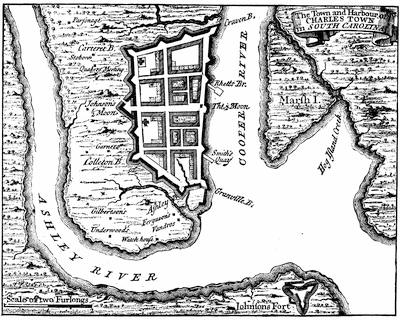
PLAN OF CHARLESTOWN, S. C., 1732. (From Popple’s British Empire in America.)
[This was reëngraved in Paris in 1733, “avec privilège du Roi.” There is a fac-simile of a plan of Charleston (1739) in the Charleston Year Book, 1884, p. 163-4.—Ed.]
The colonial government, however, had erected in Governor Nicholson’s time Fort King George on the Altamaha, and were determined to keep the Spaniards to the westward of that river. A Spanish embassy came to Charlestown to confer with President Middleton about the erection of this fort. But the only definite understanding reached was in the avowal by the ambassadors that his Catholic majesty would never consent to deliver up runaway slaves, because he desired to save their souls by converting them to the Christian faith. Cunning emissaries from St. Augustine continued to tamper with the slaves, and rendered many of them dangerous malcontents. Not long after (1738) an armed insurrection was attempted in the heart of the English settlement; the negroes on Stono River marching about plundering, burning farm-houses, and murdering the defenceless. The planters at that time went to church armed. It was Sunday. Lieutenant-Governor Bull, riding alone on the road, met the insurgents, and escaping them by turning off on another road gave the alarm. The male part of the Presbyterian congregation at Wiltown—notified of the insurrection by a Mr. Golightly—left the women in church, and hastening after the murderous horde found them drinking and dancing in a field, within sight of the last dwelling they had pillaged and set on fire. Their leader was shot, some were taken prisoners and the rest dispersed. More than twenty persons had been murdered. It might have been an extensive massacre, if so many armed planters had not attended divine service that day.[764]
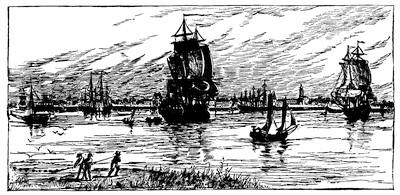
CHARLESTOWN IN 1742.
[This follows a steel plate, “The city of Charleston one hundred years ago, after an engraving done by Canot from an original picture by T. Mellish, Esq.” A long panoramic view of Charlestown in 1762 is given in the Charleston Year Book, 1882; and in Cassell’s United States, i. 355. The name “Charleston” was substituted for “Charlestown” in the act of incorporation of 1783.—Ed.]
There were in the colony above 40,000 negro slaves. The necessity for increasing the number of white inhabitants had long been apparent to the English authorities. Some of the German Palatines in England (1729) and more of them in 1764 were sent over to the colony. Mr. Purry, of Neufchatel, and his Swiss were granted (1732) an extensive tract of land near the Savannah River. Some Irish colonists settled at Williamsburgh (1733). Colonel Johnson, before he came over as royal governor, proposed to the Board of Trade a plan for forming a number of townships at convenient points, with great inducements to both foreigners and Englishmen to remove to the province. Above all, the proposal by Lord Percival (1730) to establish the colony of Georgia (between the Savannah and Altamaha), and the carrying of the project into effect under General Oglethorpe (1733), gave promise of adding materially to the security and strength of South Carolina. With a new fort at Beaufort (Port Royal), and abundant artillery and ammunition furnished by his majesty, and ships of war protecting the harbor, we have but to look forward a few years to the settlement and improvement of the healthy and fertile “up country” by overland immigration from Virginia and Pennsylvania, and the moving up of population from the coast, to reach the period of permanent prosperity and the greater development of the material resources of the province. Many families moved to the upper part of South Carolina when Governor Glen established peace with the Cherokees; many came when Braddock’s defeat exposed the frontiers of the more northern colonies to the French and Indians; while by way of Charlestown Germans came up to Saxegotha and the forks of the Broad and Saluda—as the Scotch-Irish had come to Williamsburg.
From 200 to 300 ships now annually left Charlestown. In addition to rice, indigo, pitch, turpentine, tar, rosin, timber of various kinds, deer-skins, salted provisions, and agricultural products grown along the coast, the interior plantations raised wheat, hemp, flax, and tobacco; fruits, berries, nuts, and many kinds of vegetables were abundant; and fish from the rivers, and turkeys and deer and other game from the forest, furnished luxuries for the table, without counting the ever-present supplies from swine, sheep, and cattle. But we must now go back a few years.
Governor Johnson died 3d May, 1735, and Lieutenant-Governor Thomas Broughton on 22d November, 1737. William Bull, president of the council, succeeded to the administration till the arrival of Governor James Glen (December, 1743).[765] The lieutenant-governor was a prudent ruler. He assisted in the settlement of Savannah and in the war of Georgia upon St. Augustine (sending the Carolina regiment under Colonel Vanderdussen), and managed wisely in every emergency. Governor Glen with greater energy and activity extended the fortification of the province,—visiting every portion of his government, going among the Cherokees, obtaining a surrender of their lands for the erection of forts, and erecting them; as Prince George on the upper part of the Savannah, 170 miles above Fort Moore, and Fort Loudon on the Tennessee among the Upper Cherokees, 500 miles from Charlestown. These forts and those at Frederica and Augusta in Georgia were garrisoned by his majesty’s troops for the protection of both provinces. When Glen, in 1756, was superseded by Governor William Henry Lyttleton, war was declared between England and France. On the termination of hostilities, the Cherokees, who had aided the British troops in the more northern colonies, were returning home through Western Virginia, and committed depredations, appropriating to their use such horses as came in their way, and were set upon and some of them murdered. In retaliation they killed the whites wherever they could, indiscriminately. Among their victims in Carolina were a few of the garrison of Fort Loudon. This was done by roving bands of headstrong young Indians. The troops at Prince George despatched the news to Governor Lyttleton, who instantly began preparations for war. The Cherokees sent thirty-two of their chiefs to settle the difficulty, as the nation at large desired peace and the continuation of their old friendship with the English. Lyttleton kept the chiefs under arrest, and took them with him along with his troops. His ill-usage of them and his folly involved the province in a disastrous war with the whole Cherokee nation. Then, being appointed Governor of Jamaica, he left the calamities he had caused to the management of Lieutenant-Governor Bull. Not till 1761 were hostilities ended by the help of Colonel Grant, of the British army. Dr. Hewatt, who had the advantage of the acquaintance of the last Lieutenant-Governor Bull, and probably his assistance in the compilation of his history, gives a detailed and graphic narrative of this deplorable conflict, carried on in pathless forests, hundreds of miles from Charlestown. So wasted were Colonel Grant’s men “by heat, thirst, watching, danger, and fatigue” that when peace was made “they were utterly unable to march farther.” In the provincial regiment assisting Grant were Middleton, Laurens, Moultrie, Marion, Huger, Pickens, and others who became distinguished in the war of the Revolution.
The Peace of Paris (1763) happily put an end forever to hostilities arising from French possessions in America. The succeeding royal governors of South Carolina were Thomas Boone (1762), Lord Charles Greville Montague (December, 1765), and Lord William Campbell (1773).
The most interesting and continuous thread of events running through all the colonial history of South Carolina is the development of the power of the assembly or representatives of the people. Taking up this subject where we left it at the close of Middleton’s contest with the assembly, we observe that the choice of their clerk was conceded to them by the succeeding governor. In the policy both of the proprietary and royal government, the elective franchise was granted to the people or freeholders only in choosing members of the assembly. We do not find that they balloted for any executive or other officer. The success of the assembly in electing a few administrative officers and holding them accountable to themselves was an important acquisition, and was followed by a further gain of power in the same direction. Governor Glen, addressing the authorities in England (October 10, 1748), said in substance “that a new modelling[766] of their constitution,” in South Carolina, “would add to the happiness of the province and preserve their dependence upon the Crown, any weakening [of the] power of which and deviation from the constitution of the mother country is in his opinion dangerous. Almost all the places of profit or of trust are disposed of by the general assembly.” “Besides the treasurer they appoint also the commissary, the Indian commissioner, the comptroller of the duties upon imports and exports, the powder-receiver, etc. The executive part of the government is lodged in different sets of commissioners,” “of the market, the workhouse, of the pilots, of the fortifications, etc. Not only civil posts, but ecclesiastical preferment, are in the disposal or election of the people, although by the king’s instructions to the governor” this should belong to the king or his representative. The governor is not prayed for, while the assembly is, during its sittings, the only instance in America where it is not done. “The above officers and most of the commissioners are named by the general assembly, and are responsible to them alone; and whatever be their ignorance, neglect, or misconduct, the governor has no power to reprove or displace them. Thus the people have the whole of the administration in their hands, and the governor, and thereby the Crown, is stripped of its power.” In the next place, the assembly claimed, and with success, the sole power of originating tax bills, notwithstanding instructions to the contrary. They refused to the council even the power to amend such bills. In the words of the Journals of the House (no. 21, 1745), they asserted their “sole right of introducing, framing, and amending subsidy bills,”—which they based on the English Constitution as paramount to the royal instructions. It was furthermore intimated that the council had no right to legislative functions at all,—a view soon after ably advocated by Mr. Drayton. It was contended that the council was not a counterpart of the House of Lords, but simply a body advisory to the governor. It was even argued that, similarly with the mother country, colonial usages and precedents were to be regarded as constitutional in South Carolina.
The last development of the power of the assembly tended to check the governor’s prerogative of dissolution and prorogation. In a contest with Governor Boone, beginning in 1762 and continued to May, 1763, dissolution and prorogation failed entirely as a means of controlling the actions or sentiments of the representatives of the people, where the people were of one mind with the assembly. The subject of dispute involved the assembly’s sole right to judge of the validity of the election of its own members, and the argument on the part of the House was conducted chiefly by Rutledge and Gadsden. But about this time came proposals that committees from all the colonial assemblies should meet to consider the British Stamp Act. We conclude this brief narrative with the remark that in the Continental Congress that ensued the leading statesmen of the South Carolina popular assembly stepped as veterans to new battlefields with the dust of recent victories still upon them.[767]


CRITICAL ESSAY ON THE SOURCES OF INFORMATION.
By the Editor.
IT is claimed that Sir Robert Heath conveyed his rights under the grant of 1630 to the Earl of Arundel, and that these eventually became invested in Dr. Coxe, as presented in a memorial to William III., and assumed in the Carolana of his son, Daniel Coxe.[768] The Heath grant,[769] however, was formally annulled August 12, 1663.[770] De Laet’s map, showing the coast of what was subsequently North Carolina at the period of Heath’s grant, 1630, is given in fac-simile elsewhere.[771]
Dr. Hawks, in his North Carolina, prints from Thurloe’s State Papers (ii. p. 273) a letter dated at Linnehaven, in Virginia, May 8, 1654, from Francis Yardley to John Farrar, giving an account of explorations during the previous year along the seaboard. In 1662 (March) the king granted the first charter, and this was printed the same year, but without date, as The first Charter granted by the King to the Proprietors of Carolina, 24 March.[772] In 1665 (June 30) the second charter extended the limits of the grant. Both charters are found in a volume printed in London, but without date, and called The two Charters granted by King Charles to the Proprietors of Carolina, with the first and last Fundamental Constitutions of that Colony. Issues of this book seem to have been made in 1698, 1705, 1706, 1708, etc.[773]

Mr. Fox Bourne, who in his Life of John Locke (London, 1876, vol. i. pp. 235, etc.) gives the most satisfactory account of Locke’s connection with the new colony, writes of the Fundamental Constitutions that Locke had a large share in it, though there can be hardly any doubt that it was initiated by Lord Ashley, modified by his fellow-proprietors. He adds: “The original draft, a small vellum-covered volume of seventy-five pages, neatly written, but with numerous erasures and corrections, is preserved among the Shaftesbury Papers (series viii. no. 3), and this interesting document has been printed, verbatim et literatim, by Mr. Sainsbury, in the Appendix to the Thirty-third report of the Deputy Keeper of the Public Records (1872), pp. 258-269.”
The same author refers to a draft extant in Locke’s handwriting, dated 21 June, 1669, which varies in some respects from that later issued by the Proprietors, in print.
There is, or was, in 1845, in the Charleston Library, presented to it by Robert Gilmor, of Baltimore, in 1833, a MS. copy in Locke’s own handwriting, dated July 14, 1669; but the earliest printed copy is one entitled thus: The Fundamental Constitutions of Carolina, in number a Hundred and Twenty, agreed upon by the Palatine and Lords Proprietors, to remain the sacred and unalterable form and rule of government of Carolina forever. March 1, 1669.[774] Printed first in 1670, the document was reissued, with some modifications, in 1682, and again, with more important modifications, in 1698.[775] It is also contained in A Collection of several pieces of Mr. John Locke, never before printed, and not extant in his works. London, 1720.[776]
It would seem from a map which is given in fac-simile in the Proceedings of the Massachusetts Historical Society, December, 1883 (p. 402), that it describes the “Discovery made by William Hilton of Charles Towne in New England, Marriner, from Cape Hatteraske, Lat: 35° 30′, to the west of Cape Roman in Lat. 32° 30′, In ye yeare 1662, And laid down in the forme as you see by Nicholas Shapley of the town aforesaid, November, 1662.” A small sketch of the map, which is annexed, shows that he passed along the islands which form a barrier to Pamlico Sound, without noticing, or at least indicating, that interior water, and then entering Cape Fear River tracked its shores up to a point where he designated three branches, which he called East, North, and West. The fac-simile given in the Proceedings by Mr. Hassam, from a photograph of the original in the British Museum,[777] is too obscure to make out all the names which occur along the river, while only “Hatterask” and “C. Romana” are noted on the coast. The intervening points, Cape Lookout and Cape Fear, are not named.
Hilton had come to Plymouth (Mass.) while a child, in 1623, whence he followed his father to Piscataqua, but later settled in Newbury and Charlestown, and in the latter place he died in 1675. Shapley is supposed to have been the same who was clerk of the writs in Charlestown in 1662, dying in that town in May, 1663. Although the New England antiquary, James Savage, and others have not supposed this Massachusetts Hilton to have been the same who led the Barbadoes party to Cape Fear the next year, this map and its record would seem to indicate that when the merchants of that island determined to accept the proposals of the Proprietors of Carolina to furnish them with colonists, they placed the expedition which they sent out in August, 1663, under the charge of one who had already explored parts of this coast,—no other than this William Hilton of New England. This exploring party landed at St. Helena and Edisto, and returned to Barbadoes after an absence of five months. Hilton’s True Relation was published in London in 1664.[778]
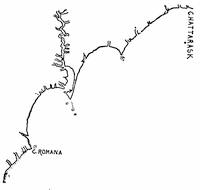
SHAPLEY’S DRAFT.
The year before (1663), according to Hawks,[779] the Proprietors had issued proposals for the encouragement of settlers within their grant, and we have, as Mr. Rivers has stated, the outcome of the Sandford expedition (1665) preserved in a manuscript among the Shaftesbury Papers, and the results of this seem to have been embodied in what is considered a second and expanded edition of their original proposals, which was now published in London, in 1666,—a mere tract of twelve pages, called A brief description of the Province of Carolina, on the coasts of Floreda; and more perticularly of a New Plantation begun by the English at Cape Feare on that river now by them called Charles-River, the 29th of May, 1664. Together with a most accurate map of the whole province.[780]
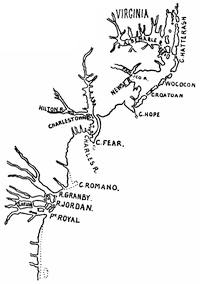
A SKETCH OF THE 1666 MAP.
As indicative of the changes in the North Carolina coast since it was first explored, Mr. Wm. L. Welsh (Bulletin Essex Institute, xvii. nos. 1, 2, and 3, and separately Salem, 1885), in a paper called An Account of the cutting through of Hatteras Inlet, Sept. 7, 1846, says that the present inlet of that name was made by the storm of that date, and that the explorers of 1584 entered through Caffey inlet, since disappeared, and that all the inlets of that day are closed, except the little-used Ocracoke inlet.
It was under the incentive of Sandford’s explorations and this districting of the country that the Proprietors entered upon the expedition which reached the Ashley River in 1670, for whose guidance Locke had prepared his plan of government. The more common knowledge of the geography of the Carolina coast at this time is seen in the map of North Carolina in Ogilby’s America (1671), which is reproduced in Hawks’ North Carolina (ii. p. 53).
In 1671 Sir Peter Colleton wrote to Locke that Ogilby was printing a “Relation of the West Indies,” and desired a map of Carolina, and asked Locke to get the drafts of Cape Fear and Albemarle from “my lord,” and suggest to him also “to draw up a discourse to be added to this map, in the nature of a description such as might invite people without seeming to come from us, as would very much conduce to the speedy settlement.” There remains, in Locke’s handwriting, a list of books to be consulted for this task, but otherwise he does not seem to have done anything to produce such a description.
Meanwhile another explorer had approached this region from the north, entering a country which no European had visited since the incursions of Lane’s company in the preceding century. We have record of this expedition in a tract of the following title: The discoveries of John Lederer in three several marches from Virginia to the west of Carolina, March, 1669-Sept., 1670. Collected out of the latine from his discourse and writings by Sir William Talbot. London, 1672.[781]
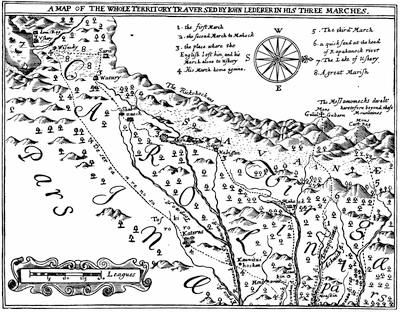
LEDERER’S MAP (1669-1670).
Fac-simile of the original in the Harvard College library copy. There is a sketch of it in Hawks’ North Carolina, ii. 52.
Lederer was a German, and was sent out by Governor Berkeley, of Virginia. He seems to have penetrated westward “to the top of the Apalatœan mountains.” He announced his disbelief in the views of such as held the distance from the Atlantic to the Pacific to be but eight or ten days’ journey, as shown in the “Mapp of Virginia discovered to the Hills,”[782] but was nevertheless inclined to believe that the Indian ocean may indeed stretch an arm into the continent as far as the Appalachian range.
It was on the second of Lederer’s expeditions, going west and southwest from the falls of the James, that he extended his course into North Carolina, and Hawks has endeavored to trace his track. Following him by his names of places, as Ogilby adopted them in his map of 1671, Lederer would appear to have traversed the breadth of South Carolina. “We cannot believe this,” says Dr. Hawks. “The time occupied would not have been sufficient for it. Lederer’s itinerary presents difficulties which we confess we cannot satisfactorily solve.” It seems at least certain that Lederer did not penetrate far enough to encounter the new-comers who were about founding the commonwealth of Locke.
The earliest account which we have of the English settlers at Port Royal, before their removal to the west bank of the Ashley River, is in Thomas Ash’s Carolina, or a description of the present state of that country. London, 1682. The author was clerk on board his majesty’s ship “Richmond,” which was on the coast 1680-82, “with instructions to enquire into the state of the country.”[783]
During the next few years several brief accounts of the new settlements were printed which deserve to be named: Samuel Wilson’s anonymous Account of the Province of Carolina in America; together with an abstract of the Patent and several other necessary and useful particulars, to such as have thoughts of transporting themselves thither. London, 1682 (text, 26 pp.).[784] John Crafford’s anonymous New and most exact Account of the fertile and famous Colony of Carolina.... The whole being a compendious account of a voyage made by an ingenious person, begun Oct., 1682, and finished 1683. Dublin, 1683.[785] Crafford is called supercargo of the ship “James of Erwin.”
Carolina described more fully than heretofore ... from the several relations, ... from divers letters from the Irish settled there and relations of those who have been there several years. Dublin, 1684.[786]
The first edition of Blome’s Present state of his majesty’s isles and territories in America, London, 1687,[787] gave “A new map of Carolina by Robert Morden” (p. 150), and through translations it became a popular book throughout Europe, and did something to bring the new colony to their attention.
Courtenay, in the Charleston Year Book, 1883, p. 377, gives a fac-simile of a map (with a corner map of Charlestown and vicinity) which marks the lots of settlers, and is thought by him to be earlier than 1700.
For the next fifteen years there is little in print about the history of Carolina; but not long after 1700, the attempt of the High-Church party, led by Nicholas Trott, the chief justice, and James Moore, to enforce conformity produced a controversy not without results.
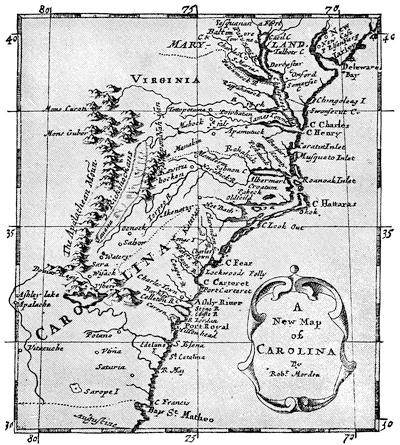
MORDEN’S CAROLINA (1687.)
Cf. “A Generall Mapp of Carolina describeing its Sea Coast and Rivers. London, printed for Ric. Blome,” which appeared in Blome’s Description of the Island of Jamaica, with the other Isles and Territories in America, to which the English are related. London, 1678.
The establishment of the “Society for the Propagation of the Gospel in Foreign Parts,” which had been chartered June 16, 1701, had given a certain impulse to the movement; and the society had its historiographer in David Humphreys, who in 1730 published at London his Historical Account[788] of it. This and the abstracts of the early reports of the society, published with their anniversary sermons, afford data of its work in the colonies.
The first Episcopal church had been built in Charlestown about 1681-2, and its history and that of those later founded in the province, as well as of the movement at this time in progress, can be followed in Frederick D. Dalcho’s Historical Account of the Protestant Episcopal Church in South Carolina, from the First Settlement of the Province to the War of the Revolution; with Notices of the Present State of the Church in each Parish, and some Account of the Early Civil History of Carolina never before published. (Charleston, 1820.)[789]
The early years of the century were distinguished by the sharp retaliatory attacks of the Carolinians and the neighboring Spanish. The letter which Colonel Moore sent to the governor respecting his plundering incursion into Florida is fortunately printed in the Boston News-Letter, May 1, 1704, whence Carroll copied it for his Hist. Collections (ii. 573). Of this and of later attacks, we can add something from the Report of the committee of the South Carolina Assembly, in 1740, on Oglethorpe’s subsequent failure, and from the narratives of Archdale and Oldmixon, later to be mentioned. Of the French and Spanish naval attack on Charlestown in 1706,[790] Mr. Doyle, in his English in America, says that the MS. reports preserved in the Colonial Papers confirm the contemporary account (Sept. 13, 1706) printed in the Boston News-Letter, and the statements in the Report of 1740 on Oglethorpe’s later defeat at St. Augustine. The News-Letter account was reprinted in the Carolina Gazette, at a later day.
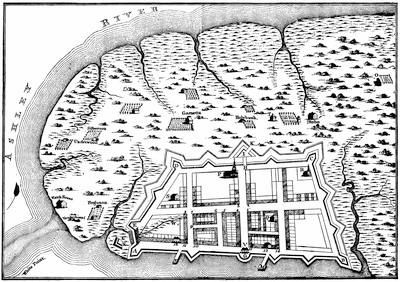
PLAN OF CHARLESTOWN, 1704. (Survey of Edward Crisp.)
The Key: A, Granville bastion. B, Craven bastion. C, Carteret bastion. D, Colleton bastion. E, Ashley bastion. F, Blake’s bastion. G, Half-moon. H, Draw-bridge. I, Johnson’s covered half-moon. K, Draw-bridge. L, Palisades. M, Lieut.-Col. Rhett’s bridge. N. Smith’s bridge. O, Minister’s house. P, English Church. Q, French Church. R, Independent Church. S, Anabaptist Church. T, Quaker meeting-house. V, Court of guard. W, First rice patch in Carolina.—Owners of houses as follows: 1, Pasquero and Garret. 2, Landsack. 3, Jno. Crosskeys. 4, Chevelier. 5, Geo. Logan. 6, Poinsett. 7, Elicott. 8, Starling. 9, M. Boone. 10, Tradds. 11, Nat. Law. 12, Landgrave Smith. 13, Col. Rhett. 14, Ben. Skenking. 15, Sindery.
This same map is one of the three side maps given in H. Moll’s Map of the Dominions of the King of Great Britain in America, 1715. It is repeated in Ramsay’s South Carolina, vol. ii., and in Cassell’s United States, i. 432.]
Rivers points out that Ramsay (i. 135) adds a few details, perhaps from tradition. Professor Rivers had earlier contributed to Russell’s Mag. (Charleston, Aug., 1859, p. 458) a paper from the London State Paper Office, entitled “An impartial narrative of ye late invasion of So. Carolina by ye French and Spanish in the month of August, 1706.” Governor John Archdale printed at London, in 1707, A new Description of that fertile and pleasant province of Carolina, with a brief account of its discovery, settling, and the government thereof (pp. 32).[791]


The next year (1708) we have an account of the condition of the colony in a letter signed by Sir Nathaniel Johnson, and dated September 17. It is quoted in large part by Rivers in his Sketches.[792] The name of John Oldmixon (died in England in 1742) is signed to the dedication of the British Empire in America, London, 1708, and it passes under his name. A second corrected and amended edition appeared in 1741.[793] Herman Moll made the maps which it contains, including one of Carolina, and some have supposed that he wrote the text. Dr. Hawks says of the book that it contains almost as many errors as pages, and unsupported is not to be trusted (ii. p. 481).
In 1708 John Stevens began in London to issue in numbers a work, which when completed in 1710 and 1711 (copies have both dates) was called A new Collection of Voyages and Travels into several parts of the world, none of which ever before printed in English. The second of this series, “printed in the year 1709,” was A new Voyage to Carolina, containing the exact description and natural history of that country, together with the present state thereof and a Journal of a thousand miles travel’d thro’ several nations of Indians, giving a particular account of their customs, manners, etc., by John Lawson, Gent., Surveyor-General of North Carolina. Other issues of the same sheets, with new title-pages, are dated 1714 and 1718.[794]
Lawson was a young Englishman, who arrived in Charleston in September, 1700. After a few months’ tarry in that settlement, he started with five white men and four Indians, and went by canoe to the Santee, where he turned inland afoot, and as he journeyed put down what he saw and experienced. In North Carolina he was made Surveyor-General, and this appointment kept him roaming over the country, during which he came much in contact with the Indians, and made, as Field says,[795] acute and trustworthy observations of them. With this life he practised a literary craft, and wrote out his experiences in a book which was taken to London to be printed,—an “uncommonly strong and sprightly book,” as Professor Tyler calls it.[796] His vocation of land-surveyor was not one calculated to endear him to the natives, who saw that the compass and the chain always harbingered new claims upon their lands. Three years after his book had been printed he was on a journey (1712) through the wilds with the Baron de Graffenreid, when the two were seized by the Tuscaroras, who suffered the German to agree for his release. The Englishman, however, was burned with pine splinters stuck in his flesh, as is generally believed, though Colonel Byrd, in his History of the dividing line between Virginia and Carolina, says he was waylaid and his throat cut.[797]
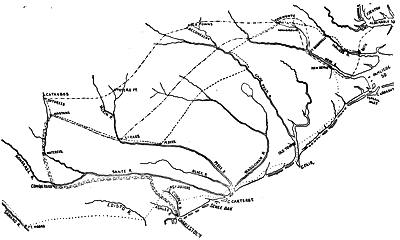
WAR MAP, 1711-1715.
Of about this time we also find a number of tracts, incentives to and records of German and Swiss emigration.[798] For the Carey rebellion and the Indian war of 1711,[799] Hawks used a transcript from an early copy of Governor Spotswood’s letter-book, which had been in his family and was placed by him in the State Department of North Carolina, where it had apparently originally belonged. In 1882, the Virginia Historical Society published the first volume of the Spotswood letters, and the student finds this material easily accessible now.[800]
In 1715 the General Assembly of North Carolina revised and reënacted the body of statute law then in force,[801] and twelve MS. copies were made, one for each precinct court. About a quarter of a century ago, says Mr. Swain, the State Historical Agent, in his Report of 1857, two of these copies, moth-eaten and mutilated, were discovered, and about 1854 a third copy, likewise imperfect, was found. From these three copies the body of laws was reconstructed for the State Library.
The authorities for the Yamassee war of 1715-16, so far as printed, are the account in the Boston News-Letter (June 13, 1715), reprinted in Carroll (ii. 569), where (ii. 141) as well as in Force’s Tracts (vol. ii.) is one of the chief authorities for this and for that other struggle which shook off the rule of the Proprietors, published in London in 1726, under the title of A narrative of the Proceedings of the People of South Carolina in the year 1719, and of the true causes and motives that induced them to renounce their obedience to the Lords Proprietors, as their governors, and to put themselves under the immediate government of the Crown.[802] Yonge, who professes to write in this tract from original papers, is thus made of importance as an authority, since in 1719 the records of South Carolina seem to have been embezzled, as Rivers infers from an act of February, 1719-20, whose purpose was to recover them “from such as now have the custody thereof,” and they are not known to exist. We get the passions of the period in The liberty and property of British subjects asserted: in a letter from an assembly-man in Carolina to his friend in London. London, 1726.[803] It is signed N., and is dated at Charleston, January 15, 1725, and sustains the discontents, in their criticism of the Proprietary government. The preface, written in London, gives a history of the colony.
In 1729 all of the Proprietors, except Lord Granville, surrendered their title in the soil to the Crown;[804] and in 1744 his eighth part was set off to him,[805] being a region sixty-six miles from north to south, adjoining the southern line of Virginia and running from sea to sea. Lord Granville retained this title down to the Revolution, and after that event he endeavored to reëstablish his claim in the Circuit and Supreme Courts, till his death, during the continuance of the war of 1812, closed proceedings.
Meanwhile some sustained efforts were making to induce a Swiss immigration to South Carolina. Jean Pierre Purry, a leader among them, printed in London in 1724 a tract, which is very rare: Mémoire presenté à sa Gr. Mylord Duc de Newcastle sur l’état présent de la Caroline et sur les moyens de l’ameliorer. Londres, 1724.[806] In 1880 Colonel C. C. Jones, Jr., privately printed an English version of it at Augusta, Georgia, as a Memorial ... upon the present condition of Carolina and the means of its amelioration by Jean Pierre Purry of Neufchâtel, Switzerland.
The Gentleman’s Magazine of August, September, and October, 1732, contained an English rendering of a description of Carolina, drawn up by Purry and others, at Charlestown in September, 1731. This last paper has been included by Carroll in his Historical Collections (vol. ii.), and by Force in his Tracts (vol. ii.).[807] Purry’s tracts were in the interest of immigration, and his and their influence seem to have induced a considerable number of Swiss to proceed to Carolina, where they formed a settlement called Purrysburg on the east side of the Savannah River. Hardships, malaria, and unwonted conditions of life discouraged them, and their settlement was not long continued.[808]
Bernheim, German Settlements in Carolina (p. 99), points out how the busy distribution of the rose-colored reports of Purry doubtless also led to the German and Swiss settlement at Orangeburg, S. C., in 1735, the history of which he derives from the journals of the council of the province in the state archives, and from those church record-books, which are preserved. It is to Bernheim we must look for the best accounts of the other German settlements in different parts of the province.
In 1851 the Lutheran synod of South Carolina put the Rev. G. D. Bernheim in charge of its records, and in 1858 he began to collect the minutes of the synod of North Carolina, and to interest himself generally in the history of the German settlements of both States. From 1861 to 1864 he printed much of the material which he had gathered in the Southern Lutheran. He found that the writers in English of the histories of the Carolinas had largely neglected this part of the story, perhaps from unacquaintance with the tongue in which the records of the early German settlers are written. The settlements of these people at Newbern and Salem had not indeed been overlooked; but their plantations in the central and western parts of the State, comprising more than three fourths of the German population, had been neglected. In the histories of South Carolina the settlements of Purrysburg and Hard Labor Creek had alone been traced with attention. In 1872 Mr. Bernheim recast his material into a History of the German settlements and of the Lutheran church in North and South Carolina, from the earliest period [to 1850], and published it at Philadelphia. It may be supplemented by a little volume, The Moravians in North Carolina, by Rev. Levin T. Reichell, Salem, N. C. 1857.[809]
We find some assistance in fixing for this period the extent of the domination of the English Church in a map which accompanies David Humphreys’ Historical Account of the Society for the Propagation of the Gospel in Foreign Parts, London, 1730, which is called “Map of the Province of Carolina, divided into its parishes, according to the latest accounts, 1730, by H. Moll, geographer.” It has a corner “map of the most improved parts of [South] Carolina,” which shows the parish churches and the English and Indian settlements. A fac-simile of this lesser map is annexed. George Howe’s History of the Presbyterian Church in South Carolina, from 1685 to 1800, Columbia, S. C., 1870, is another local monograph of interest in the religious development of the province.[810]
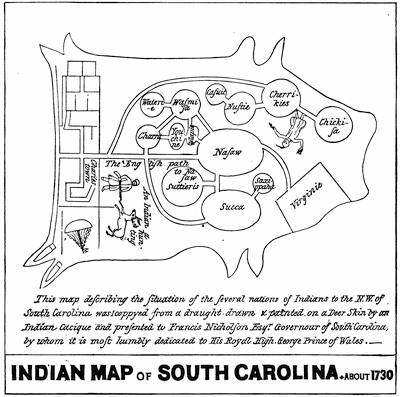
INDIAN MAP, 1730.
In the Kohl collection (no. 220). The original is in the British Museum, describing the situation of the Indian tribes in the northwest parts of South Carolina, and drawn by an Indian chief on a deer-skin, and presented to Gov. Nicholson.
The Huguenot element in Carolina became an important one, and as early as 1737 these French founded in Charleston the “South Carolina Society,” a benevolent organization, which in 1837 celebrated its centennial, the memory of which is preserved in a descriptive pamphlet published at Charleston in that year, containing an oration by J. W. Toomer, and an appendix of historical documents. There is no considerable account yet published of these Carolina Huguenots, and the student must content himself with the scant narrative by Charles Weiss, as given in the translation of his book by H. W. Herbert, History of the French Protestant Refugees (New York, 1854), which has, in addition to the narrative in Book iv. on refugees in America, an appendix on American Huguenots, not, however, very skilfully arranged. There is a similar appendix by G. P. Disosway[811] at the close of Samuel Smiles’ Huguenots (New York, 1868); and briefer accounts in Mrs. H. F. S. Lee’s Huguenots in France and America (Cambridge, 1843, vol. ii. ch. 29), and in Reginald Lane Poole’s History of the Huguenots of the Dispersion (London, 1880).[812]
Professor Rivers contributed to Russell’s Magazine (Charleston, Sept., 1859) a paper on “The Carolina regiment in the expedition against St. Augustine in 1740.”
The natural aspects of the country, as they became better known, we get from Mark Catesby’s Natural History of Carolina, Florida, and the Bahama Islands, etc., which was published in London, from 1732 to 1748, and again in 1754;[813] and a German translation appeared at Nuremberg in 1755. The English text was revised in the second edition by Edwards, and again printed at London in 1771.
The files of the early newspapers of the Carolinas afford needful, if scant, material. Thomas, in his History of Printing, records all there was. The South Carolina Gazette, beginning in January, 1731-2, was published for little more than a year as a weekly; but this title was resuscitated in new hands in February, 1734, when the new journal of this name continued its weekly issues up to the Revolutionary period. No other paper was begun in that province till 1758, when a new weekly, the South Carolina and American General Gazette, was started. Three years before this, the first paper had been established at Newbern, The North Carolina Gazette, which lived for about six years.
To Governor Glen is attributed A description of South Carolina, which was printed in London in 1761,[814] and is reprinted in Carroll’s Historical Collections, vol. ii. It gives the civil, natural, and commercial history of the colony. It is the completest survey which had up to this time been printed.
In the war with the Cherokees some imputations were put upon the South Carolina rangers, under Henry Middleton, by Grant, the commander of the expeditions against those Indians; and this charge did not pass unchallenged, as would seem from a tract published in 1762 at Charleston, entitled Some Observations on the two Campaigns against the Cherokee Indians in 1760 and 1761.[815]
For the geography of this period we have two maps in the New and complete History of the British Empire in America, an anonymous publication which was issued in parts in London, beginning in 1757. One is a map of Virginia and North Carolina, the other of South Carolina and Georgia, both stretching their western limits beyond the Mississippi.
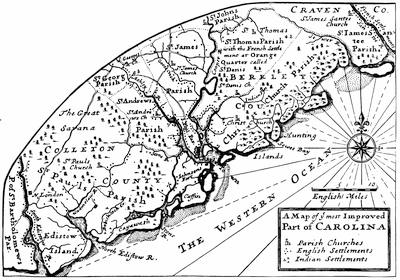
THE SOUTH CAROLINA COAST.
Cf. the Carolina of Moll in his New Survey, no. 26 (1729), and a reproduction of Moll in Cassell’s United States, i. 439. A map of Carolina and Charlestown harbor (1742) is in the English Pilot, no. 19.
At the very end of the period of which we are now writing the MS. description of South Carolina by the engineer William De Brahm, which is preserved in the library of Harvard University, becomes of importance for its topographical account, and its plans and maps, executed with much care. It is included in a volume, containing also similar descriptions of Georgia and Florida, which portions are noticed in the following chapter. There are transcripts of this document which have an early date,[816] and some at least have a title different from the Harvard one, and are called A Philosophico-historico-Hydrography of South Carolina, Georgia, and East Florida. From such a one, which is without the drawings, that portion relating to South Carolina was printed in London in 1856, by Mr. Plowden Charles Jennett Weston, in a volume of Documents connected with the History of South Carolina. An engraved map by De Brahm, Map of South Carolina and a part of Georgia, composed from surveys taken by Hon. Wm. Bull, Capt. Gascoigne, Hugh Bryan, and William De Brahm, published in four sheets by Jefferys, also appeared in the General Topography of North America and the West Indies, London, 1768. The map itself is dated Oct. 20, 1757, and gives tables of names of proprietors of land in Georgia and Carolina.[817]
The earliest account of the history of South Carolina cast in a sustained retrospective spirit is the anonymous Historical Account of the rise and progress of the Colonies of South Carolina and Georgia (London, 1779), which is known to have been prepared by Dr. Alexander Hewatt,—as his signature seems to fix the spelling of his name, though in the bibliographical records it appears under various forms.[818] Carroll, in reprinting the book in the first volume of his Historical Collections, added many emendatory notes.[819] The next year (1780) produced a far more important book, in respect to authority, in George Chalmers’ Political Annals of the Present United Colonies, from their Settlement to the Peace of 1763 (London), the first volume of which, however, was the only one published.[820] Chalmers, who was born in 1742, had practised law in Maryland, but he could not sympathize with the revolution, and at the outbreak returned to England, where in time (August, 1786) he became the clerk of the Board of Trade and died in office, May 31, 1825, at the age of eighty-two.
When Williamson was engaged on his History of North Carolina (i. p. 9), he applied for assistance to Chalmers, whose Political Annals shows that he had access to papers not otherwise known at that time, but was refused. Grahame, in his Colonial History of the United States (i. p. xii.), says he got ready access to Chalmers’ papers, but as he disclosed in his text little new, it was conjectured that before Grahame’s opportunity much had passed out of Chalmers’ hands. Sparks, in a letter (1856) to Mr. Swain, the historical agent of North Carolina, says of Chalmers that “he undoubtedly procured nearly the whole of his materials from the archives of the Board of Trade. His papers, after having been bound in volumes, were sold by his nephew a few years ago (1843) in London. I purchased six volumes of them, relating mostly to New England. They are not important, being memoranda, references, and extracts, used in writing his Annals.”[821] Two large volumes of Chalmers’ notes and transcripts also came into the hands of George Bancroft, and were entrusted by him to the care of Dr. Hawks and Mr. Rivers, when they were at work upon their histories of North and South Carolina. Bancroft, from his own use of them, and of Chalmers’ printed Annals, and speaking particularly of the Culpepper revolution (1678), in the original edition (ii. p. 162) of his United States, says: “Chalmers’ account in all cases of the kind must be received with great hesitancy. The coloring is always wrong; the facts usually perverted. He writes like a lawyer and disappointed politician, not like a calm inquirer. His statements are copied by Grahame,[822] obscured by Martin, and, strange to say, exaggerated by Williamson.” Dr. William Smyth, in his Lectures on Modern History, calls the work of Chalmers an “immense, heavy, tedious book, to explain the legal history of the different colonies; it should be consulted in all such points, but it is impossible to read it.”[823]
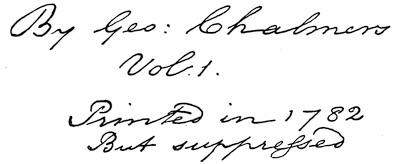
Near the close of the Revolutionary War Chalmers began the printing of another work, a succinct sketch of the history of the colonies. A very few copies exist of the first volume, which is without title or preliminary matter, and in the copy before us a blank leaf contains a manuscript title in Chalmers’ own handwriting as follows: An Introduction to the History of the Colonies, giving from the State Papers a comprehensive view of the origin of their Revolt. By George Chalmers, Vol. I. Printed in 1782, But suppressed. This volume, beginning with the reign of James I. and ending with that of George I., was the only one printed. The present copy[824] is marked as being the one from which Mr. Sparks printed an edition published in Boston in 1845,[825] in which the preface says that the original issue was suppressed, “owing to the separation of the colonies, which happened just at the season for publication, December, 1782, or the prior cause in April precedent, the dismission of a tory administration.”[826]
When Chalmers’ papers were sold, a manuscript continuation of this Introduction in the handwriting of the author was found, completely revised and prepared for the press. When Sparks reprinted the single volume already referred to, he added this second part to complete the work, and it was carefully carried through the press by John Langdon Sibley. Sparks in his introductory statements speaks of the book as “deduced for the most part from the State Papers in the British offices, or to speak with more precision, from the confidential correspondence of the governors and other officers of the Crown in the colonies.” In regard to its suppression he adds that “no political ends could now be answered by its publication, and it is probable that he thought it more politic to sacrifice the pride and fame of authorship than to run the hazard of offending the ministers.”[827]
Of the later histories it is most convenient to treat each province separately, as will be done in the annexed note.
NOTE.
The Later Histories of the Carolinas.
I. North Carolina.—The first published of the general accounts of this State was the History of North Carolina, by Hugh Williamson,[828] at Philadelphia, in 1812, in two volumes. Dr. Hawks, the later historian, says (ii. p. 540) that North Carolinians do not recognize Williamson’s work as a history of their State. It is inaccurate in a great many particulars, and sometimes when there is proof that the original record was lying before him. Sparks calls it “meagre and unsatisfactory,” and adds that it contains but few facts, and these apparently the most unimportant of such as had fallen in his way.[829] More care and discrimination, though but little literary interest, characterized another writer. François Xavier Martin had a singular career. He was born in Marseilles, became a bankrupt in Martinique, went friendless to Newbern, in North Carolina, and rose to distinction as a jurist, after beginning his career in the State as a translator and vendor of French stories. He had removed to Louisiana, when he published at New Orleans his History of North Carolina, in 1829 (two volumes), and in that State he rose to be chief justice, and published a history of it, as we have seen. Martin’s accumulation of facts carries no advantage by any sort of correlation except that of dates. A painstaking search, as far as his opportunities permitted, and a perspicuous way of writing stand for the work’s chief merits. He stops at the Declaration of Independence. Up to Martin’s time Bancroft[830] might well speak of the carelessness with which the history of North Carolina had been written.
Next came John H. Wheeler’s Historical Sketches of North Carolina from 1584 to 1851, compiled from original records, official documents, and traditional statements, with biographical sketches of her distinguished Statesmen, Jurists, Lawyers, Soldiers, etc., Philadelphia, 1851. It is not unfairly characterized by Mr. C. K. Adams, in his Manual of Historical Reference (p. 559), as “a jumble of ill-digested material, rather a collection of tables, lists, and facts than a history.”
David L. Swain,[831] who had been governor of the State, had done much to collect transcripts of documents from the archives of the other States and from England, and in 1857, as historical agent of the State, he made a report, which was printed at Raleigh, in which, speaking of the statutes at large, which Virginia and South Carolina had published, he referred to “both of these collections, especially the former, the earlier and better work, as deeply interesting in connection with North Carolina history.”
Of the History of North Carolina, by Francis Lister Hawks, D. D., LL. D., the second volume, published at Fayetteville in 1858, covers the period of the Proprietary government from 1663 to 1729, the first volume being given to the Raleigh period, etc. He availed himself of the fullest permission by state and local authorities to profit by the records within his own State; and he had earlier himself procured in London many copies of documents there. The author claims that more than three fourths of this volume has been prepared from original authorities, existing in manuscript. He tells at greater length than others the story of the law and its administration, of the industrial and agricultural arts, navigation and trade, religion and learning.
The latest local treatment is that of Mr. John W. Moore’s History of North Carolina from the earliest discoveries to the present time, Raleigh, 1880, in two volumes. There is not much attempt at original research, and he does not reprint documentary material, as Hawks did, in too great profusion to make a popular book. Mr. Moore aims to give a better literary form to the story; but his style somewhat overlays his facts.
II. South Carolina.—To turn to the more southern province,—Dr. David Ramsay, who was a respectable physician from Pennsylvania, domiciled and married in Charleston, gained some reputation in his day as a practised writer, and as an historical scholar of zeal and judgment. He published first, in 1796, a Sketch of the Soil, Climate, etc., of South Carolina; and later, in 1809, at Charleston, a History of South Carolina, 1670-1808, in which he made good use of Hewatt, as far as he was available.
In 1836 Carroll republished many of the early printed tracts upon South Carolina history in his two volumes of Historical Collections. Referring to this publication, a writer in the Southern Quarterly Review, Jan., 1852, p. 185, says: “But for a timely appropriation by the legislature of two thousand dollars for his relief, Carroll would have been seriously the sufferer by his experiment on public taste and sectional patriotism.”
Grahame in 1836 had published the first edition of his Colonial History of the United States, including the early history of the Carolinas, and Bancroft, in 1837, published the second volume of his History of the Colonization of the United States, and in chapter xiii. he discussed how Shaftesbury and Locke legislated for South Carolina,—a chapter considerably changed in his last edition (1883).
The South Carolina novelist, William G. Simms, first published a small history of the State in 1840, which served for school use. This he revised in 1860 as a History of South Carolina, which was published in New York. It was spirited, but too scant of detail for scholarly service.[832]
The South Carolina Historical Society was formed in 1855, Mr. Rivers, the writer of the preceding chapter, being one of the originators. The first volume of their Collections, published in 1857, contained, beside an opening address by Professor F. A. Porcher, the beginning of a list and abstracts of papers in the State Paper Office, London, relating to South Carolina. This enumeration was continued in the second and third volumes.[833] There are also in the second volume, beside Petigru’s oration, a paper on the French Protestants of the Abbeville district, an oration by J. B. Cohen, and O. M. Lieber’s vocabulary of the Catawba language. In vol. iii. we find an oration by W. H. Trescott. No further volumes have been printed.
Mr. Rivers’ Sketch of the History of South Carolina to the Close of the Proprietary Government by the Revolution of 1719, published in Charleston in 1856, was continued by him in A Chapter in the Early History of South Carolina, published at Charleston in 1874, which largely consists of explanatory original documents. This section of a second volume of his careful history was all that the author had accomplished towards completing the work, when the civil war of 1861 “rendered him unable to continue its preparation.” Mr. Rivers says, in a note in this supplementary chapter, that an examination of the records at Columbia has shown him that, to perfect this additional task, it would be necessary to make examination among the records of the State-Paper Office in London.
Of these latter records Mr. Fox Bourne, in his Life of John Locke (London, 1876), says: “Locke’s connection with the affairs of the colony lasted only through its earliest infancy. Down to the autumn of 1672 he continued his informal office of secretary to the Proprietors. Nearly every letter received from the colony is docketed by him; and of a great number that have disappeared there exist careful epitomes in his handwriting. We have also drafts, entered by him, of numerous letters sent out from England, and his hand is plainly shown in other letters. Out of this material it would be easy to construct almost the entire history of the colony during the first years of its existence.”
It was some time before the period of Mr. Fox Bourne’s writing that the Earl of Shaftesbury deposited with the deputy keeper of the Public Records the collection of documents known as the Shaftesbury Papers, the accumulation which had been formed in the hands of his ancestor, and which yield so much material for the early history of the Carolina government.[834]
The latest use made of these and other papers of the State-Paper Office is found in The English in America, Virginia, Maryland, and the Carolinas (London, 1882), written by Mr. John A. Doyle, librarian of All Souls, Oxford. In a note to his chapter on the “Two Carolinas,” Doyle says (p. 427), respecting the material for Carolinian history in the English archives: “To make up for the deficiency of printed authorities, the English archives are unusually rich in papers referring to Carolina. There are letters and instructions from the Proprietors, individually and collectively, and reports sent to them by successive governors and other colonial officials. It is remarkable, however, that while we have such abundant material of this kind, there is a great lack of records of the actual proceedings of the local legislatures in North and South Carolina. In North Carolina we have no formal record of legislative proceedings during the seventeenth century. In South Carolina they are but few and scanty till after the overthrow of the Proprietary government.[835] Moreover, the early archives of Carolina, though abundant, are necessarily somewhat confused. The northern and southern colonies, while practically distinct, were under the government of a single corporation, and thus the documents relating to each are most inextricably mixed up. Again, while the Proprietors were the governing body, the colonies in some measure came under the supervision of the Lords of Trade and Plantations, and at a later day of the Board of Trade. Thus much which concerns the colony is to be found in the entry books of the latter body, while the Proprietary documents themselves are to be found partly among the colonial papers,[836] partly in a special department containing the Shaftesbury Papers.”
In the Fifth Report of the Historical Manuscripts Commission there is a calendar of the Shelburne Papers, belonging to the Marquis of Lansdowne, which shows a considerable number of documents of interest in the history of Carolina: as, for instance (p. 215), Governor Barrington’s account of the State of North Carolina, January 1, 1732-33; Governor Glen’s answers with respect to inquiries about South Carolina; an offer (p. 218) of a treaty for the sale of Lord Granville’s district in North Carolina to the Crown, signed by the second Lord Granville; and (p. 228, etc.) various reports of law officers of the Crown on questions arising in the government of the colonies.