Chapter III · (continued 2)
Reading edition
In another part of the province the dispute over the boundary line with New York, as it affected titles of land, was also a source of agitation, which in Belcher’s time was the cause of constant remonstrance and appeal and of legislative intervention, but he left the question unsettled, a legacy of disturbance for later composition.
Age and a paralytic disorder, which even the electrical apparatus that Franklin sent to Belcher could not remove, ended Belcher’s life on the 31st of August, 1757, leaving the government in the hands of Thomas Pownall, who, on account of Belcher’s age and infirmity, had been appointed lieutenant-governor in 1755. Pownall was at the time of Belcher’s death also governor of Massachusetts. After a short visit to New Jersey he found “that the necessity of his majesty’s service in the government of the Massachusetts Bay” required his return to Boston, and his absence brought the active duties of the executive once more upon Reading, as senior counsellor, who, through age and illness, was little disposed towards the burden.
The arrival, on the 15th of June, 1758, of Francis Bernard, bearing a commission as governor, relieved Reading of his irksome duties. Bernard had, during his short term, the satisfaction of pacifying the Indians by a treaty made at Easton in October, 1758. The otherwise uneventful term of his administration was soon ended by his transfer to Massachusetts. His successor, Thomas Boone, after an equally short and uneventful term, was replaced by Josiah Hardy, and the latter by William Franklin, the son of the great philosopher. The latter had secured his appointment through Lord Bute, but nothing can be said in this chapter of his administration, which, beginning in 1762, belongs to another volume.[490]
The possible injury which a development of the manufacturing interests in the colonies might inflict on like interests in Great Britain agitated the mind of the English manufacturer at an early date. Already in Dutch times this question of manufactures in the province of New Netherland had been settled rather peremptorily by an order of the Assembly of the Nineteen, which made it a felony to engage in the making of any woollen, linen, or cotton cloth. The English Parliament, perhaps influenced by the manufacturers among their constituents, or not willing to appear as legislating in the interest of money, declared, in 1719, “that the erecting of manufactories in the colonies tends to lessen their dependence on Great Britain,” and a prohibition similar to that of the Dutch authorities was enacted. During the whole colonial period this feeling of jealousy interfered with the development of industries and delayed their growth. Whatever England could not produce was expected to be made here, such as naval stores, pearlash and potash, and silks; but the English manufacturer strenuously set himself in opposition to any colonial enterprise which affected his own profits.
Shipbuilding and the saw-mill had early sprung from the domestic necessities of the people. The Dutch had made the windmill a striking feature in the landscape of New York. The people of Pennsylvania had been the earliest in the middle colonies to establish a press, and it had brought the paper-mill in its train, though after a long interval; for it was not till 1697 that the manufacture of paper began near Philadelphia, and not till thirty years later (1728) was the second mill established at Elizabethtown in New Jersey. The Dutch had begun the making of glass in New York city, near what is now Hanover Square, and in Philadelphia it was becoming an industry as early as 1683; though if one may judge from the use of oiled paper in the first houses of Germantown, the manufacture of window-glass began later. Wistar, a palatine, erected a glass-house near Salem, in West New Jersey, in 1740, and Governor Moore, of New York, in 1767, says of a bankrupt glass-maker in New York that his ill success had come of his imported workmen deserting him after he had brought them over from Europe at great cost.
The presence of iron ore in the hills along the Hudson had been known to the Dutch, but they had made no attempt to work the mines, relying probably to some extent upon Massachusetts, where “a good store of iron” was manufactured from an early date. Towards the end of the seventeenth century, when the ore was tried, the founders discovered the iron to be too brittle to encourage its use. Lieutenant-Governor Clarke tried to arouse interest for the iron industry in 1737, and induced the general assembly to consider the advisability of encouraging proprietors of iron-works; but the movement came to nothing, and Parliament did what it could to thwart all such purposes by enacting a law “to encourage the importation of pig and bar iron from his Majesty’s Colonies in America, and to prevent the erection of any Mill or other Engine for Slitting or Rolling of Iron; or any plating Forge to work with a Tilt Hammer; or any Furnace for making Steel in any of the said Colonies.” When this act was passed in 1750 only a single plating-forge existed in the province of New York, at Wawayanda, Orange County, which had been built about 1745, and was not in use at the time. Two furnaces and several blomaries had been established about the same time in the manor of Cortland, Westchester County, but a few years had sufficed to bring their business to a disastrous end.
In 1757 the province could show only one iron-work at Ancram, which produced nothing but pig and bar iron. At this same establishment, owned by the Livingstons, in the present Columbia County, many a cannon was cast some years later to help in the defence of American liberties. In 1766 we find a little foundry established in New York for making small iron pots, but its operations had not yet become very extensive.
The first iron-works in New Jersey seem to have been opened by an Englishman, James Grover, who had become dissatisfied with the rule of the Dutch and the West India Company, and had removed from Long Island to Shrewsbury, New Jersey, where he and some iron-workers from Massachusetts set up one of the first forges in the province.
In 1676 the Morris family, which later became so prominent in colonial politics, was granted a large tract of land near the Raritan River, with the right “to dig, delve, and carry away all such mines for iron as they shall find” in that tract. The smelting-furnace and forge mentioned in an account of the province by the proprietors of East New Jersey, in 1682, employing both whites and blacks, was probably on the Morris estate. The mineral treasures of the province, however, remained on the whole undiscovered at the end of the century; but in the following century several blomary forges and one charcoal-furnace were erected in Warren County, the latter of which was still running twenty-five years ago. Penn had early learned of the richness of his province in iron and copper, though no attempt was made to mine them till 1698. At this early period Gabriel Thomas mentions the discovery of mineral ores, which were probably found in the Chester County of that day, and the first iron-works in the province were built in that region. Governor Keith owned iron-works in New Castle County (Delaware) between 1720 and 1730, and had such good opinion of the iron industry in the colonies that he considered them capable of supplying, if sufficiently encouraged, the mother country with all the pig and bar iron needed.
In 1718 we read of iron-works forty miles up the Schuylkill River, probably the Coventry forge, on French Creek, in Chester County; also of a forge in Berks or Montgomery County, which in 1728 became the scene of an Indian attack. The mineral wealth of Lancaster County soon attracted the attention of the thrifty Germans who had settled there. In 1728 this county had two or more furnaces in blast, and the number of them in the province increased rapidly up to the time of the Revolution.
Upon the Delaware, the Dutch and Swedes seem to have neglected the ores of silver, copper, iron, and other minerals, which they did not fail to discover existed in that region; but an Englishman, Charles Pickering, who lived in Charlestown, Chester County, Pennsylvania, appears to have been the earliest to mine copper, and was on trial in 1683 on the charge of uttering base coin. A letter written by Governor Morris, of New Jersey, to Thomas Penn in 1755, speaks of a copper-mine at the Gap in Lancaster County, which had been discovered twenty years previous by a German miner.
It was New Jersey, however, which led in the working of copper ore. Arent Schuyler, belonging to a Dutch family of Albany, New York, prominent in politics and in other matters, had removed in 1710 to a farm purchased at New Barbadoes Neck, on the Passaic River, near Newark. There one of his negroes re-discovered a copper-mine, known to the Dutch and probably worked before by them, asking as a reward for it all the tobacco he could smoke, and the permission “to live with massa till I die.” The ore taken from this mine proved to be so very rich in metal, copper and silver, that Parliament placed it on the list of enumerated articles, in order to secure it for the British market. Arent Schuyler’s son John introduced into the middle colonies the first steam-engine, requiring it to keep his copper-mine free from water. The copper-mining industry found another adherent about 1750 in Elias Boudinot, who opened a pit near New Brunswick, and erected there a stamping-mill, the products of which were sent to England and highly valued there. When Governor Hunter, in a letter to the Lords of Trade, November 12, 1715, speaks of “a copper mine here brought to perfection,” he undoubtedly refers to a New Jersey or Pennsylvania undertaking, for five years later he answers the question, “What mines are in the province of New York?” with, “Iron enough, copper but rare, lead at a great distance in the Indian settlement, coal mines on Long Island, but not yet wrought.” The coal mines, which have added so much to the wealth of Pennsylvania during the present century, had not been discovered during the period preceding the Revolution.
It has been said above that the colonies were expected to engage in the production of potash and pearlash. This was an industry already recommended as profitable by the secretary of New Netherland in 1650. The dearness of labor, however, interfered with its development, for “the woods were infinite,” and supplied all the necessary material. The attempt, about 1700, to employ Indians at this work failed, for “the Indians are so proud and lazy.” About 1710 a potash factory was established in the province of New York at the expense of an English capitalist, who found it, however, a losing investment. Not discouraged by previous failures, John Keble, of New Jersey, proposed to set up a manufacture of potash. He petitioned for authority to do so, and from his statements we learn that in 1704 Pennsylvania alone of the middle colonies exported potash, and only to the amount of 630 pounds a year. There is no information as to Keble’s success, but a memorial of London merchants to the Lords of Trade in 1729, asking that the manufacture of this important staple in the colonies might be encouraged, drew forth the opinion that not enough was thought of this industry to “draw the people from employing that part of their time (winter) in working up both Wooling and Linen Cloth.”
Tradition points to many a house, in the region originally settled by the Dutch, as having been built with bricks imported from Holland. That such was not the rule, but only an exception, in the days of the West India Company’s rule, is proved by the frequent allusion to brick-kilns on the Hudson, near Albany and Esopus, and on the Lower Delaware. For the convenience of transportation, the trade has centred in these localities to this day.
The making of salt, either by the solar process or by other means, was a necessity which appealed to the colonists at an early period. The Onondaga salt-springs had been discovered by a Jesuit about 1654, but, being then in the heart of the Indian country, they could not be worked by the French or Dutch. Coney Island had been selected in 1661 as a proper place for salt-works, but the political dissensions of the day did not allow operations to go on there. The Navigation Act of 1663, prohibiting the importation into the colonies of any manufactures of Europe except through British ports, made an exception in favor of salt. The result was that this industry was carried on in the middle colonies during the colonial period only in a few small establishments, furnishing not enough for local consumption.
When the palatines began to emigrate, and there was fear that they would carry with them the art of making woollens, Parliament in 1709 forbade such manufactures in the colonies. In 1715 the towns-people of New York and Albany, probably also of Perth Amboy, Burlington, and Philadelphia, are reported as wearing English cloth, while the poor planters are satisfied with a coarse textile of their own make. Nearly two thirds of such fabrics used in the colonies were made there, and the Lords of Trade were afraid that, if such manufacture was not stopped, “it will be of great prejudice to the trade of this kingdom.” Governor Hunter very sensibly opposed any legislation which would force the people to wear English cloth, as it would be equivalent to compelling them to go naked. A report of the Board of Trade, made in 1732, tells us that “they had no manufactures in the province of New York that deserve mentioning;... no manufactures in New Jersey that deserve mentioning.” “The deputy-governor of Pennsylvania does not know of any trade in that province that can be considered injurious to this kingdom. They do not export any woollen or linen manufactures; all that they make, which are of a coarse sort, being for their own use.”
The statements embodied in reports of this kind were made upon information acquired with difficulty, for the crown officers in the colonies interrogated an unwilling people, who saw no virtue in affording the grounds of their own business repression, and concealed or disguised the truth without much compunction of conscience; and in Massachusetts the legislative assembly had gone so far as to call to account a crown officer who had divulged to the House of Commons the facts respecting the exportation of beaver hats.
An address of the British House of Commons to the king, presented on the 27th of March, 1766, called forth a description of the textile manufactures in the province of New York at the close of the period of which this chapter treats. The Society of Arts and Agriculture of New York City had about this date established a small manufactory of linen, with fourteen looms, to give employment to several poor families, hitherto a charge upon the community. No broadcloth was then made in the province, and some poor weavers from Yorkshire, who had come over in the expectation of finding remunerative work, had been sadly disappointed. But coarse woollen goods were extensively made. One of these native textile fabrics, called linsey-woolsey, and made of linen warp and woollen woof, became a political sign during the Stamp Act excitement. People “desirous of distinguishing themselves as American patriots” would wear nothing else. The manufacture of these coarse woollens became an ordinary household occupation, and what was made in excess of family needs found its way to market. Governor Moore says, “This I had an opportunity of seeing during my late tour;... every house swarms with children, who are set to work as soon as they are able to spin and card; and as every family is furnished with a loom, the itinerant weavers, who travel about the country, put the finishing hand to the work.”
The making of beaver hats was an industry in which the colonial competition with the English hatters led to most oppressive legislation in Parliament. The middle colonies, particularly from their connection with the beaver-hunting Indians, had carried the art to a degree which produced a cheaper if not a better covering for the head than was made in England, and they found it easy to market them in the West Indies, where they excluded the English-made article. Accordingly the export of hats from England fell off so perceptibly that in 1731 the “Master Wardens and Assistants of the Company of Feltmakers of London” petitioned the Lords of Trade to order that the inhabitants of the colonies should wear no hats but such as were made in Great Britain. The prayer was denied, but Parliament was induced, in 1732, to forbid the exportation of hats from American ports.
But most trades in the colonies failed of the natural protection which arises from cheap labor, while the opportunities of acquiring lands and establishing homes with ample acres about them served further to increase the difficulties of competition with the Old World, in that artisans were attracted by lures of this kind to the new settlements, and away from the shops of the towns.
The commerce of the colonies easily fell into four different channels: one took produce to England, or to such foreign lands as the navigation laws permitted; the second bound the colonies one with the other in the bonds of reciprocal trade; a third was opened with the Indians; and the fourth embraced all that surreptitious venture which was known as smuggling.
The ports of New York and Philadelphia absorbed the foreign and transatlantic trade of the middle colonies, notwithstanding the efforts which New Jersey made to draw a share of it to Perth Amboy. Before Governor Dongan’s time, ships coming to Amboy had to make entry at New York, as it was feared that goods brought to the New Jersey port and not paying New York duties might be smuggled to New York by way of Staten Island. “Two or three ships came in there [at Amboy] last year,” writes Governor Dongan in 1687, “with goods, and I am sure that country cannot, even with West Jersey, consume £1,000 in goods in 2 years, so that the rest must have been run into this colony.” Some years later the Lords of Trade decided that the charter did not give to either West or East Jersey the right to a port of entry, but she, nevertheless, in due time obtained the right to open such ports at Amboy and Burlington. The displeasure of the New York authorities was manifest in the refusal of their governor to make proclamation of such decree, and the larger province was strong enough occasionally to seize a vessel bound for Amboy. New Jersey could protest; but her indignation was in vain, and she never succeeded in establishing a lucrative commerce. How steadily the commerce of her neighbor increased is shown in the record that in 1737 New York had 53 ships with an aggregate of 3,215 tons; in 1747, there were 99 ships of 4,313 tons; and in 1749, 157 with a capacity of 6,406 tons. The records of the New York custom-house show that the articles imported from abroad or from the other British colonies on this continent and from the West Indies were principally rum, madeira wine, cocoa, European goods, and occasionally a negro slave,[491] while the exports of the colonies were fish and provisions.
New Jersey had little Atlantic trade, since New York and Philadelphia could import for her all the European and West India goods which she needed. In intercolonial trade, however, she had a large share, and she supplied her neighbors with cereals, beef, and horses. New York, on the contrary, was sometimes pressed to prevent certain exportations, when she needed all her productions herself, as was sometimes the case with cereals. This intercolonial trade naturally grew in the main out of the products of the several colonies; while for their Indian trade, they were compelled to use what the avidity of the natives called for,—blankets, weapons, rum, and the trinkets with which the Indian was fond of adorning his person, and for all which he paid almost entirely in furs. The nature of this traffic was such, particularly in respect to the sale of arms and spirits, that legislation was often interposed to regulate it in the interest of peace and justice.
As respects the illegal or last class of commercial channels, we find that before Bellomont’s time there had grown up, as he found, “a lycencious trade with pyrats, Scotland and Curaçao,” out of which no customs revenue was obtained. As a consequence, the city and province of New York “grew rich, but the customes, they decreased.” Certain Long Island harbors became “a great Receptacle for Pirates.” The enforcement of the law gave Bellomont a chance to say, in 1700, that an examination of the entries in New York and Boston had shown him that the trade of the former port was almost half as much as that of the other, while New Hampshire ports had not the tenth part of New York, except in lumber and fish. The Philadelphia Quakers objected to fight the West Indian enemies of the crown; but they had little objection to trade with them, and to grow rich on such more peaceful intercourse.
Towards the end of the period spoken of in this chapter, a “pernicious trade with Holland” had sprung up, which the colonial governors found hard to suppress, but which was successfully checked in 1764 by the English cruisers; but shortly before the War of Independence it began again to flourish.
A diversity of trade brought in its train a great variety in the coin, which was its medium, and a generation now living can remember when the great influx of Spanish coin poured into the colonies in the last century was still in great measure a circulating medium. The indebtedness to the mother country which colonists always start with continued for a long while to drain the colonies of its specie in payment of interest and principal. As soon as their productions were allowed to find openly or clandestinely a market in the Spanish main and the West Indies, the return came in the pieces of eight, the Rix dollars, and all the other varieties of Spanish or Mexican coinage which passed current in the tropics. So far as these went to pay debts in Europe, the colonies were forced to preserve primitive habits of barter in wampum, beaver, and tobacco. By the time of Andros, foreign trade and the increasing disuse of these articles of barter had begun to familiarize the people with coin of French and Spanish mintage, and at that time pieces of eight went for six shillings, double reals for eighteen pence, pistoles for twenty-four shillings. Soon after this the metal currency began to be very much diminished in intrinsic value by the practice of clipping. Both heavy and light pieces were indiscriminately subjected to this treatment, and the price of the heavier pieces of eight advanced in consequence, so that in 1693 a standard of weight had to be established, and it was determined by a proclamation that “whole pieces of eight of the coins of Sevill, Mexico, and Pillar pieces of 15 pennyweight not plugg’d” should pass at the rate of 6 shillings; pieces of more weight to increase or lose in value 4-1/2 pence for each pennyweight more or less. Pieces of eight of Peru were made current at fourpence for each pennyweight, and Dog dollars at five shillings sixpence. English coin was of course current in the colonies, and the emigrants of that day brought their little hoard in the mintage of their European homes, instead of buying, as to-day, letters of exchange or drafts payable in a currency unknown to them. In 1753 it became necessary to enact, in New York, a law to prevent the passing of counterfeit English half-pence and farthings, and in the second half of the last century the coins mostly current, besides English ones, were the gold Johannis of eighteen pennyweight, six grains; Moidores of six pennyweight, eighteen grains; Carolines of six pennyweight, eight grains; Double Loons (Doubloons) or four Pistoles of seventeen pennyweight, eight grains; double and single Pistoles; French Guineas (louis d’ors) of five pennyweight, four grains; and Arabian Chequins of two pennyweight, four grains.
Of the middle colonies, New Jersey was the first to follow Massachusetts in issuing paper money, which she did by authorizing the issue of £3,000 in bills for the expedition against Canada in 1709.
The people of the Netherlands and the Belgic provinces had profited as little under religious persecution as the puritans and separatists of New England, to become tolerant of other faiths when in the New World they had the power of control. The laws of New Netherland were favorable only to the Protestant Reformed Dutch Church, although Swedes and Finns, who had come to New Sweden on the Delaware, were allowed to worship according to the Lutheran ritual. The directors of the West India Company, the supreme authority, did not approve of any religious intolerance, and expressed themselves forcibly to that effect when Stuyvesant tried to prosecute members of the Society of Friends. When New York and New Jersey became English provinces, complete freedom of religion was granted to them. This drew to them members of all established churches and of nearly every religious sect of Europe, the latter class largely increased by such as fled to New York from Massachusetts to enjoy religious toleration. In 1686, in New York at least, “the most prevailing opinion was that of the Dutch Calvinists.” How the Roman Catholics were treated has been shown above. The same reasons which had led to their proscription tried to impose upon the colonies the Church of England, by directing the governors not to prefer any minister to an ecclesiastical benefice unless he was of this order. This royal command to the governors of New York and New Jersey produced results which its originators probably did not contemplate. It led to the incorporation of Trinity Church in New York, with the celebrated and ever-reviving Anneke Jans trials growing out of it as a fungus, and to the creating a demand for ministers of the Anglican or Episcopal church which necessitated a school to educate them. This was the King’s College, known to us of the present day as Columbia College, chartered in 1754. The non-Episcopalians saw in this movement the fulfillment of their fears, first aroused by the Ministry Act under Governor Fletcher in 1693, tending towards the establishment of a state church. Out of this dread and out of the difficulty in obtaining ministers for the Dutch Reformed Church grew another educational institution, the Queen’s College, now known as Rutgers College, in New Brunswick, N. J. Another institution preceded it, the College of New Jersey at Princeton. This was first founded by charter from President Hamilton in 1746, and enlarged by Governor Belcher in 1747, who left, by will, to its library a considerable number of books. The proprietors of Pennsylvania, always thoughtful of the weal of their subjects, gave, in 1753, $15,000 to a charitable school and academy, founded four years before in Philadelphia by public subscription. Two years later, in 1755, it grew into the “College, Academy, and Charitable School of Philadelphia,” by an act of incorporation, and to-day it is the “University of Pennsylvania.”
Urged thereto by the founder of the independence of the Netherlands, William the Silent, Prince of Orange, the states-general had adopted in the sixteenth century the system of universal education, which, in our days, the New England States claim as their creation. Hence we find schools mentioned and schoolmasters at work from the beginning of the New Netherland; and though at first no classics were taught, even at so early a date as 1663 we read of a government schoolmaster who taught Greek and Latin. The assembly of New York passed, in 1702, an act for the encouragement of a free grammar school, and favored generally the primary education of the children of their constituents. New Jersey did not lag in the good work. In 1765 she had 192 churches of all denominations except the Roman Catholic, and we may safely suppose that a school was connected with nearly every church. The Moravians of Pennsylvania imitated the example set to them at home, and established boarding-schools at Nazareth, Bethlehem, and Litiz. The small number of schools among the “Dissenters,” as the Rev. Samuel Johnson calls all non-Episcopalians, induced him, however, to say, in 1759, that “ministers and schools are much wanted in Pennsylvania.”

CRITICAL ESSAY ON THE SOURCES OF INFORMATION.
I. The Manuscript Sources of New York History. (By Mr. Fernow.)—New York has taken the lead among the American States in the extent of the printed records of her history.[492] In the archives at Albany there are certain manuscript documents illustrating the period now under consideration deserving mention.
“When first his Royall Highnesse, the Duke of York, took possession of this Province [New York], he ... gave him [Govr Nicolls] certain Laws, by which the Province was to be governed.” Several copies of these, Duke’s Laws (1674), were made, and they were sent to the different districts, Long Island, Delaware, the Esopus, and Albany, into which the province was then divided.[493]
The so-called Dongan’s Laws (1683 and 1684) make a manuscript volume, containing the laws enacted by the first general assembly of the province during the years 1683 and 1684. It has upon its original parchment cover a second title, evidently written at a later date: “The Duke of York’s Charter of Liberty & Priviledges to the Inhabitants of New York, anno 1683, with Acts of Assembly of that year & the year 1684.” The laws are mainly a reënactment of the Duke’s Laws, and are now deposited in the State library. They have never been printed.
The Original Colonial Laws (1684-1775) make nineteen volumes of manuscripts, now in the office of the secretary of state at Albany, of which such as had not in the mean time expired by their own limitation were printed in 1694,[494] 1710, and 1726, by William Bradford; in 1719 by Baskett; in 1762 by Livingston and Smith; in 1768 by Parker, and in 1773 by Van Schaack. The Bradford edition of 1710 contains also the journal of the general assembly, etc.
Those Bills which failed to become Laws (1685-1732) make three volumes of manuscript, and though the measures proposed never became operative they show the drift of public opinion during the period covered by them. Several of these bills have been bound into the volumes of laws.
The student of colonial commerce and finances will find much to interest him in other manuscript volumes, now in the State library at Albany, to wit: Accounts of the Treasurer of the Province, under various titles, and covering the period from 1702 to 1776, eight volumes, and Manifest Books and Entry Books of the New York Custom House, 1728 to 1774, forty-three volumes. Much information coveted by the genealogist is hidden in the Indentures of Palatine Children, 1710 and 1711, two volumes; in forty volumes of Marriage Bonds, 1752 to 1783, of which an index was published in 1860 under the title New York Marriages; and in the records kept in the office of the clerk of the Court of Appeals,—Files of Wills, from 1694 to 1800, and of Inventories, 1727 to 1798.
Out of the 28 volumes of Council Minutes, 1668 to 1783, everything relating to the legislative business before the council has been published by the State of New York in the Journal of the Provincial Council. The unpublished parts of these records—the seven volumes of “Warrants of Survey, Licenses to Purchase Indian Lands,” 1721 to 1766, the fourteen “Books of Patents,” 1664 to 1770, the nineteen “Books of Deeds,” 1659 to 1774, and the thirty-four volumes of “Land Papers,” from 1643 to 1775—give as complete a history of the way in which the colony of New York gained its population as at this day it is possible to obtain without following the many private histories of real estate. The above-mentioned “Books of Deeds” contain papers of miscellaneous character, widely differing from deeds, such as commissions, letters of denization, licenses of schoolmasters, etc. Of the “Land Papers” a Calendar was published by the State in 1864.[495]
A public-spirited citizen of Albany, General John Tayler Cooper, enriched in 1850 the State library with twenty-two volumes of manuscripts, containing the correspondence of Sir William Johnson, the Indian commissioner. This correspondence covers the period from 1738 to 1774, and is important for the political, Indian, social, and religious history of New York. Extracts from it appeared in Dr. O’Callaghan’s Documentary History of New York (vol. ii.).[496]
Less important for the period treated of in this chapter are the Clinton Papers, especially the later series; but of the first importance in the study of the French wars are the Letters of Colonel John Bradstreet, deputy quartermaster-general, and The Letters of General Sir Jeffrey Amherst, commander-in-chief in America, dated New York, Albany, etc., from 1755 to 1771, a manuscript volume presented to the State library by the Rev. Wm. B. Sprague, D. D.[497]
An Abridgment of the Records of Indian Affairs, transacted in the Colony of New York from 1678 to 1751, with a preface by the compiler, is the work of Peter Wraxall, secretary for Indian affairs. It is a manuscript of 224 pages, dated at New York, May 10, 1754.[498] It is to be regretted that Wraxall’s complete record of these transactions has not been preserved, as the few extracts of them handed down to us in the Council Minutes and in the Documents relating to the Colonial History of New York give us a great deal of curious and interesting information.[499]
The religious life in the colony of New York during the early part of the eighteenth century, as seen from the Episcopal point of view, is well depicted in a manuscript volume (107 pp. folio), Extracts from Correspondence of the Venerable Society for the Propagation of the Gospel in Foreign Parts with the Missionaries T. Payer, S. Seabury, and others, from 1704 to 1709.[500] The history of trade and business is likewise illustrated in the Commercial Letters of the firm P. & R. Livingston, New York and Albany, from 1733 to 1738, and of Boston and Philadelphia merchants during the same period, giving us a picture of mercantile transactions at that time which a number of account-books of N. De Peyster, treasurer of the colony and merchant in the city of New York, and of the firm of Beverley Robinson & Morrison Malcom, in Fredericksburg, now Patterson, Putnam County, N. Y., help to fill out.[501]
II. Cartography and Boundaries of the Middle Colonies. (By Mr. Fernow and the Editor.)—The following enumeration of maps includes, among others, those of a general character, as covering the several middle colonies jointly, and they run parallel in good part with the sequence named in an earlier section[502] on the “Cartography of Louisiana and the Mississippi Basin under the French Domination,” so that many of the maps mentioned there may be passed over or merely referred to here.[503]
There was little definite knowledge of American geography manifested by the popular gazetteers of the early part of the last century,[504] to say nothing of the strange misconceptions of some of the map-makers of the same period.[505]
A German geographer, well known in the early years of the eighteenth century, was Johann Baptist Homann, who, having been a monk, turned Protestant and cartographer, and at nearly forty years of age set up, in 1702, as a draftsman and publisher of maps at Nuremberg,[506] giving his name till his death, in 1724, to about two hundred maps.[507] Homann’s career was a successful one; he became, in 1715, a member of the Academy of Science at Berlin, and was made the official geographer of the Emperor Charles of Germany and of Peter the Great of Russia. A son succeeded to the business in 1724, and, on his death in 1730, the imprint of the family was continued by “the heirs of Homann,” at the hands of some university friends of the son. Under this authority we find a map, Die Gross Britannischen Colonial Laender in Nord-America in Special Mappen (Homannsche Erben, Nuremberg), in which nearly the whole of New York is called “Gens Iroquois,” or “Irokensium.”
Contemporary with the elder Homann, the English geographer Herman Moll was publishing his maps in London;[508] and of his drafting were the maps which accompanied Thomas Salmon’s Modern History or the State of all Nations, first issued between 1725 and 1739.[509] His map of New England and the middle colonies is not carried farther west than the Susquehanna.[510]
Mention has already been made of the great map of Henry Popple in 1732,[511] and of the maps of the contemporary French geographer D’Anville;[512] but their phenomenal labors were long in getting possession through the popular compends of the public mind. We find little of their influence, for instance, in the Gazetteer’s or Newsman’s Interpreter, being a geographical Index of all the Empires, Kingdoms, Islands, etc., in Africa, Asia, and America. By Laurence Echard, A. M., of Christ’s College, Cambridge (London, 1741).[513] In this New York is made to adjoin Maryland, and is traversed by the Hudson, Raritan, and Delaware rivers; New Jersey lies between 39 and 40° N. L., and is bounded on the east by Hudson’s Bay; and Pennsylvania lies between 40 and 43° N. L., but no bounds are given.
The French geographer’s drafts, however, were made the basis in 1752 of a map in Postlethwayt’s Dictionary of Commerce, which was entitled North America, performed under the patronage of Louis, Duke of Orleans, First Prince of the Blood, by the Sieur d’Anville, greatly improved by M. Bolton.
The maps which, three years later (1755), grew out of the controversies in America on the boundary claims of France and England have been definitely classified in another place,[514] and perhaps the limit of the English pretensions was reached in A New and Accurate Map of the English Empire in North America, representing their Rightful Claim, as confirmed by Charters and the formal Surrender of their Indian Friends, likewise the Encroachments of the French, etc. By a Society of Anti-Gallicans. Published according to Act of Parliament, Decbr., 1755, and sold by Wm. Herbert on London Bridge and Robert Sayer over against Fetter Lane in Fleet Street. This map is of some importance in defining the location of the Indian tribes and towns.
The English influence is also apparent in a reissue of D’Anville, made at Nuremberg by the Homann publishing house the next year: America Septentrionalis a Domino D’Anville in Gallia edita, nunc in Anglia Coloniis in Inferiorem Virginiam deductis nec non Fluvii Ohio cursu aucta, etc., Sumptibus Homanniorum Heredum, Noribergiæ, 1756.[515] It makes the province of New York stretch westerly to Lake Michigan.
Respecting the special maps of New York province, a particular interest attaches to The Map of the Country of the Five Nations, printed by Bradford in 1724, which was the first map engraved in New York. The Brinley Catal. (ii. no. 3,384, 3,446) shows the map in two states, apparently of the same year (1724). It originally accompanied Cadwallader Colden’s Papers relating to an Act of the Province of New York for the encouragement of the Indian trade. It was reëngraved from the first state for the London ed. of Colden’s Five Nations, in 1747, and from this plate it has been reproduced on another page (chapter viii.).[516]
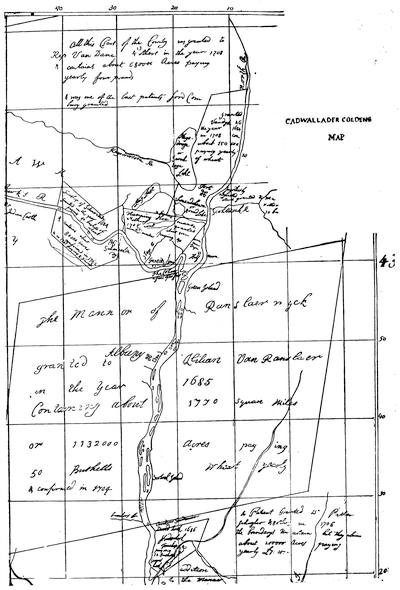
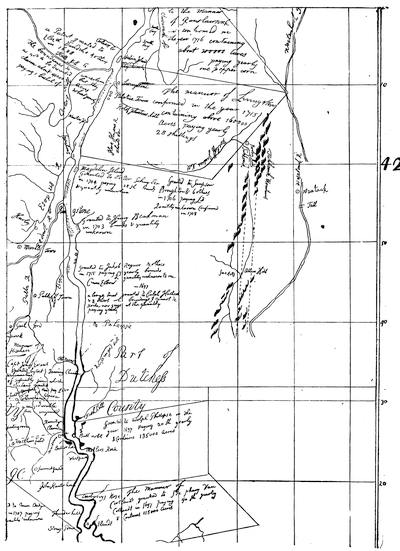
CADWALLADER COLDEN’S MAP OF THE MANORIAL GRANTS ALONG THE HUDSON.
Another of Colden’s maps, made by him as surveyor-general of the province, exists in a mutilated state in the State library at Albany, showing the regions bordering on the Hudson and Mohawk rivers. It was drafted by him probably at the end of the first quarter of the eighteenth century,[517] and fac-similes of parts of it are annexed (pp. 236, 237).
A map of the northern parts of the province, called Carte du Lac Champlain depuis le Fort Chambly jusqu’au Fort St. Frédéric, levée par le Sieur Anger, arpenteur du Roy en 1732, faite à Québec, le 10 Octobre, 1748, signé de Lery, indicates the attempted introduction of a feudal system of land tenure by the French. The map is reproduced in O’Callaghan’s Doc. Hist. of New York.
The province of New York to its western bounds is shown in A Map of New England and ye Country adjacent, by a gentleman, who resided in those parts. Sold by W. Owen (London, 1755).
The New York State library has also a manuscript Map of part of the province of New York on Hudson’s River, the West End of Nassau Island, and part of New Jersey. Compiled pursuant to order of the Earl of Loudoun, Septbr. 17, 1757. Drawn by Captain [Samuel J.] Holland. This is a map called by the Lords of Trade in 1766 “a very accurate and useful survey, ... in which the most material patents are marked and their boundaries described.”
Something of the extension of settlements in the Mohawk Valley at this period can be learned from a manuscript Map of the Country between Mohawk River and Wood Creek, with the Fortifications and buildings thereon in 1758, likewise preserved in the State library.[518]
A drawn map of New York province and adjacent parts (1759), from Maj. Christie’s surveys, is noted in the King’s Maps (Brit. Mus.), ii. 527.
The boundary controversy between New York and New Jersey has produced a long discussion over the successive developments of the historical geography of that part of the middle colonies. An important map on the subject is a long manuscript roll (5 × 2-6/12 feet), preserved in Harvard College library, which has been photographed by the regents of the University of the State of New York, and entitled A copy of the general map, the most part compiled from actual survey by order of the commissioners appointed to settle the partition line between the provinces of New York and New Jersey. 1769. By Berd. Ratzer. [New York, 1884.] 7-5/8 × 12-3/4 in.[519]
Respecting the controversy over the New Hampshire grants, see the present volume (ante, p. 177), and Isaac Jennings’s Memorials of a Century (Boston, 1869), chapters x. and xi.
Of the special maps of Pennsylvania, the Holme map a little antedates the period of our survey.[520] The Gabriel Thomas map of Pennsylvania and New Jersey appeared near the end of the century (1698), and has already been reproduced.[521] In 1728 we find a map of the Delaware and Chesapeake bays in the Atlas Maritimus et Commercialis, published at London. In 1730 we note the map of Pennsylvania which appeared in Humphrey’s Historical Account of the Society for the Propagation of the Gospel in Foreign Parts.[522]
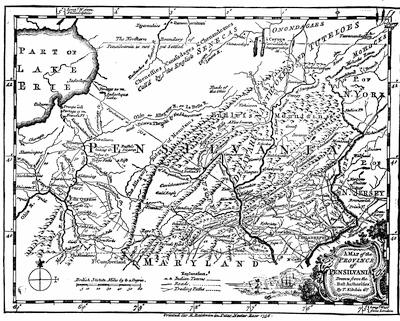
About 1740, in a tract printed at London, In Chancery. Breviate. John Penn, Thomas Penn, and Richard Penn, plaintiffs; Charles Calvert, defendant,[523] appeared A map of parts of the provinces of Pennsylvania and Maryland, with the counties of Newcastle, Kent, and Sussex in Delaware, according to the most exact surveys yet made, drawn in the year 1740. The controversy over this boundary is followed in chapter iv. of the present volume.
A map of Philadelphia and parts adjacent, by N. Scull and G. Heap, was published in 1750, of which there is a fac-simile (folding) in Scharf and Westcott’s Philadelphia, vol. i.
The annexed fac-simile (p. 239) is from a plate in the London Mag., Dec., 1756.
A map to illustrate the Indian purchases, made by the proprietary, is given in An Enquiry into the Causes of the Alienation of the Delaware and Shawanese Indians (London, 1759).[524]
Surpassing all previous drafts was a Map of the Improved Part of Pennsylvania, by Nicholas Scull, published in 1759, and sold by the author in Second Street, Philadelphia. Engraved by Jas. Turner. It was reproduced in Jefferys’ General Topography of North America (Nos. 40-42), and was reissued in London in 1770, and again as A Map of Pennsylvania, exhibiting not only the improved parts of the Province, but also its extensive frontiers, laid down from actual surveys, and chiefly from the late Map of N. Scull, published in 1770. Robert Sayer & Bennett (London, 1775). The edition of 1770 was reëngraved in Paris by Le Rouge.
Upon the boundary controversy between Pennsylvania and Virginia respecting the “Pan handle,” see N. B. Craig’s Olden Time (1843), and the St. Clair Papers, vol. i. (passim).
EDITORIAL NOTES.
The Leisler Papers constitute the first volume of the Fund Publications of the N. Y. Hist. Society’s Collections, and embrace the journal of the council from April 27 to June 6, 1689 (procured from the English State Paper Office), with letters, etc., and a reprint of a tract in defence of Leisler, issued at Boston in 1698, and called Loyalty Vindicated, being an answer to a late false, seditious, and scandalous pamphlet, entitled “A letter from a Gent,” etc.[525] The Sparks Catal. (p. 217) shows a MS. copy made of a rare tract in the British Museum, printed in New York and reprinted in London, 1690, called A modest and impartial narrative of the great oppressions that the inhabitants of their majestie’s Province of New York lye under by the extravagant and arbitrary proceedings of Jacob Leisler and his accomplices. Sparks endorsed his copy as “written by a violent enemy to Leisler; neither just, candid, nor impartial.”[526] Various papers relating to the administration of Leisler make a large part of the second volume of the Documentary History of New York, showing the letters written by Leisler to Boston, the papers connected with his official proceedings in New York, and his communications with the adjacent colonies; the council minutes in Dec., 1689; proceedings against the French and Indians; the papers relating to the transfer of the fort and arrest of Leisler; the dying speeches of Leisler and Milbourne; with a reprint of A letter from a gentleman of the city of New York to another (New York, 1698). There are a few original letters of Leisler in the Prince Letters (MSS.), 1686-1700, in Mass. Hist. Soc. cabinet.
The career of Leisler is traced in the memoir by C. F. Hoffman in Sparks’s Amer. Biog., xiii. (1844), and in G. W. Schuyler’s Colonial New York (i. 337). Peleg W. Chandler examines the records of the prosecution in his American Criminal Trials (i. 255). Cf. also Historical Magazine, xxi. 18, and the general histories, of which Dunlap’s gives the best account among the earlier ones.[527]
The student must, of necessity, have recourse to the general histories of New York for the successive administrations of the royal governors, and H. B. Dawson, in his Sons of Liberty (printed as manuscript, 1859), has followed the tracks of the constant struggle on their part to preserve their prerogatives.[528] Schuyler (Colonial New York, i. 394-460) follows pretty closely the administration of Fletcher. The chapter on New England (ante, no. ii.) will need to be parallelized with this for the career of Bellomont.
Under Nanfan, who succeeded Bellomont temporarily, Col. Bayard, who had brought Leisler to his doom, was in turn put on trial, and the narrative of the proceedings throws light on the factious political life of the time.[529]
One of the most significant acts of Cornbury’s rule (1702-1708) was the prosecution in 1707 of Francis Mackemie, a Presbyterian minister, for preaching without a license.[530]
J. R. Brodhead, who gives references in the case (Hist. Mag., Nov., 1863), charges Cornbury with forging the clause of his instructions under which it was attempted to convict Mackemie, and he says that the copy of the royal instructions in the State Paper Office contains no such paragraph. “History,” he adds, “has already exhibited Lord Cornbury as a mean liar, a vulgar profligate, a frivolous spendthrift, an impudent cheat, a fraudulent bankrupt, and a detestable bigot. He is convicted of having perpetrated one of the most outrageous forgeries ever attempted by a British nobleman.”[531]
The few months of Lovelace’s rule (1708-9) were followed by a funeral Sermon when he died, in May, 1709, preached by William Vesey (New York, 1709), which is of enough historical interest to have been reprinted in the N. Y. Hist. Coll. (1880).
During 1720-1722, the Shelburne Papers (Hist. MSS. Commission Report, v. 215) reveal letters of Peter Schuyler and Gov. Burnet, with various other documentary sources.
There is a portrait of Rip van Dam, with a memoir, in Valentine’s Manual (1864, p. 713).
In 1732 and 1738 we have important statistical and descriptive papers on the province from Cadwallader Colden.[532]
The narrative of the trial of Zenger was widely scattered, editions being printed at New York, Boston, and London; while the principles which it established were sedulously controverted by the Tory faction.[533]

The main printed source respecting the Negro Plot of 1741 is the very scarce book by the recorder of the city of New York, Daniel Horsmanden, A Journal of the proceedings in the Detection of the Conspiracy formed by some white people in conjunction with negro and other slaves for burning the City of New York, and murdering the inhabitants, etc., containing, I., a narrative of the trials, executions, etc.; II., evidence come to light since their execution; III., lives of the several persons committed, etc. (New York, 1744).[534]
The history of Pennsylvania during this period is a tale of the trials of Penn,[535] the misgovernment of the province by representatives of the proprietors, the struggles of the proprietary party against the people, the apathy of the Quakers in the face of impending war, and the determination of the assembly to make the proprietors bear their share of the burdens of defence. The published Pennsylvania Archives give much of the documentary evidence, and the general histories tell the story.
The Pennsylvania Hist. Soc., in vols. ix. and x. of their Memoirs, published the correspondence of Penn with Logan, his secretary in the colony, beginning in 1700. This collection also embraced the letters of various other writers, all appertaining to the province, and was first arranged by the wife of a grandson of James Logan in 1814; but a project soon afterwards entertained by the American Philosophical Society of printing the papers from Mrs. Logan’s copies was not carried out, and finally this material was placed by that society at the disposal of the Penna. Hist. Society. The correspondence was used by Janney in his Life of Penn, and liberal extracts were printed in The Friend (Philadelphia, July, 1842-Apr., 1846) by Mr. Alfred Cope. Mr. Edward Armstrong, the editor of the Historical Society’s volumes, gathered additional materials from other and different sources. A portrait of Logan is given in the second volume, which brings the correspondence down to 1711. The material exists for continuing the record to 1750, though Logan ceased to hold official connection with the province in 1738.
Sparks (Franklin’s Works, vii. 25) says that “a history of James Logan’s public life would be that of Pennsylvania during the first forty years of the last century.” See the account of Logan in the Penn and Logan Correspondence, vol. i.
The correspondence of Thomas and Richard Penn with a later agent in Philadelphia, Richard Peters, is also preserved. In 1861 this correspondence was in the possession of Mr. John W. Field, of Philadelphia, when Mr. Charles Eliot Norton gave transcripts of a portion of it (letters between 1750 and 1758) to the Mass. Hist. Society.[536]
Of an earlier period, when Evans was deputy-governor, there are some characteristic letters (1704, etc.) in a memoir of Evans communicated by E. D. Neill to the N. E. Hist. and Geneal. Reg., Oct., 1872 (p. 421).
There is a biographical sketch of Sir William Keith in the Penna. Historical Society’s Memoirs (vol. i.).
There is a pencil-drawn portrait of Sir William Keith, with a painting made from it, in the gallery of the Penna. Hist. Society. Cf. Catal. of Paintings, etc. (nos. 77, 162), and Scharf and Westcott’s Philadelphia (i. 177). Some of the rare tracts in the controversy of Governor Keith and Logan are noted in the Brinley Catal., ii. pp. 197-8. Cf. Hildeburn’s Century of Printing.
As to the position of the Quakers upon the question of defensive war, there is an expressive letter, dated in 1741, of James Logan, who was not in this respect a strict constructionist of the principles of his sect, which is printed in the Penna. Mag. of History (vi. 402). Much of this controversy over military preparation is illustrated in the autobiography and lives of Benjamin Franklin; and the issues of Franklin’s Plain Truth (1747) and Samuel Smith’s Necessary Truth, the most significant pamphlets in the controversy, are noted in the bibliographies.[537] Sparks, in a preliminary note to a reprint of Plain Truth, in Franklin’s Works (vol. iii.), states the circumstances which were the occasion and the sequel of its publication. In Ibid. (vii. 20) there is a letter of Richard Peters describing the condition of affairs.
A mass of papers, usually referred to as the Shippen Papers, and relating to a period in the main antedating the Revolution, have been edited privately by Thomas Balch as Letters and Papers relating chiefly to the Provincial History of Pennsylvania, with some notices of the writers. (Philad., 1855, one hundred copies.)
First of importance among the published travels of this period is the narrative of an English Quaker, Thomas Story, who came over in 1697. From that time to 1708 he visited every part of the colonies from New Hampshire to Carolina, dwelling for much of the time, however, in Pennsylvania, where he became, under Penn’s persuasion, a public official. The Journal of the life of Thomas Story, containing an account of his remarkable convincement of and embracing the principles of truth, as held by the people called Quakers, and also of his travels and labours in the service of the Gospel, with many other occurrences and observations, was published at Newcastle-upon-Tyne in 1747.[538]
George Clarke, born in 1676, was made secretary of the province of New York in 1703, and came to America, landing in Virginia. We have an account of his voyage, but unfortunately the book does not follow his experiences after his arrival;[539] but we have the Letters of his private secretary, Isaac Bobin, which, under the editing of Dr. O’Callaghan, were printed in a small edition (100 copies) at Albany in 1872.
George Keith’s Journal of Travels from New Hampshire to Caratuck, on the Continent of North America, London, 1706, is reprinted in the first volume (1851) of the Collections of the Prot. Episc. Hist. Society, together with various letters of Keith[540] and John Talbot.[541]
Benjamin Holme, another Quaker, came to the colonies in 1715, and extended his missionary wandering to New England, and southward beyond the middle colonies,[542] as did, some years later, 1736-1737, still another Quaker, John Griffeth, whose Journal of his life, labours, and travels in the work of the ministry passed through many editions, both in America and Great Britain.[543]
The records of missionary efforts at this time are not wholly confined to the Quakers. The narrative of the Rev. Thomas Thompson reveals the perplexities of the adherents of the Established Church in the communities through which he travelled in the Jerseys.[544] Similar records are preserved in the journals of Whitefield[545] and his associates, like the Journal of a Voyage from Savannah to Philadelphia and from Philadelphia to England, MDCCXL., by William Seward, Gent., Companion in Travel with the Reverend Mr. George Whitefield (London, 1740).
We have a few German experiences, among them Gottlieb Mittelberger’s Reise nach Pennsylvanien im Jahr 1750 und Rŭkreise nach Teutschland im Jahr 1754 (Stuttgart, 1756)[546]—which is the record of a German teacher and organist, who was in the province for three years. He had no very flattering notion of the country as an asylum for such Germans as, having indentured themselves for their passage, found on their arrival that they could be passed on from master to master, not always with much regard to their happiness.
Michael Schlatter, a Dutch preacher, published his observations of the country and population, and particularly as to the condition of the Dutch Reformed churches. He was in the country from 1746 to 1751, and made his report to the Synod of Holland. Though the book pertains mostly to Pennsylvania, his experiences extended to New York and New England.[547]
We have the reports of a native observer in the Observations on the inhabitants, climate, soil, rivers, productions, animals, and other matters worthy of notice, made by Mr. John Bartram in his travels from Pensilvania to Onondago, Oswego, and the lake Ontario in Canada. To which is annexed a curious account of the Cataracts at Niagara, by Mr. Peter Kalm (London, 1751).[548] Bartram was born in Pennsylvania, and made this journey in company with Conrad Weiser, the agent sent by Pennsylvania to hold friendly conference with the Iroquois, as explained in another chapter.[549] Bartram’s principal object was the study of the flora of the country, in which pursuit he acquired such a reputation as to attract the notice of Linnæus, but his record throws light upon the people which came in his way, and enable us in some respects to understand better their manners and thoughts. Evans’ map, already mentioned,[550] was in part the outgrowth of this journey.
We also owe to the friendly interest of the great Swedish botanist the observations of Peter Kalm, a countryman of Linnæus, whom the Swedish government sent to America on a botanical tour in 1748-1751. He extended his journeys to Pennsylvania, New York, and Canada, and we have in his three volumes, beside his special studies, not a little of his comment on men and events. He published his En risa til Norra America at Stockholm, 1753-1761. (Sabin, ix. 36,986.)[551]
The Rev. Andrew Burnaby’s Travels through the middle settlements in North America in 1759-1760, with observations upon the state of the Colonies, was published in London, 1775.[552] Burnaby was an active observer and used his note-book, so that little escaped him, whether of the people’s character or their manners, or the aspect of the towns they dwelt in, or of the political and social movements which engaged them.
The relations of the middle colonies to the Indians will be particularly illustrated in a later chapter on the military aspects of the French wars,[553] but there are a few special works which may be mentioned here: Colden’s Five Indian Nations (only to 1697); Morgan’s League of the Iroquois; Wm. L. Stone’s Life of Sir William Johnson; and Geo. W. Schuyler’s Colonial New York—Peter Schuyler and his family (Albany, 1885). The successive generations of the Schuylers had for a long period been practical intermediaries between the colonists and the Indians. Something of the Indian relations in Bellomont’s time is indicated elsewhere.[554] For the agreement between William Penn and the Susquehanna Indians in 1701, see the Penna. Archives (i. 145). Of similar records in Cornbury’s time, Schuyler (ii. 17) says the remains are meagre, but he gives more for Hunter’s time (ii. pp. 42-79) and Burnet’s (ii. p. 83). The Shelburne Papers (Hist. MSS. Commission Report, v.) reveal various documents from 1722 to 1724, and there is a MS. of a treaty between the governors of New York, Virginia, and Pennsylvania (Albany, Sept., 1722) in the library of Harvard College.
For the treaty of 1735, see the Penna. Mag. of Hist. (vii. 215).
For 1742 there was a treaty with the Six Nations at Philadelphia, and its text was printed at London.[555]
In 1747 there were treaties in July at Lancaster, Penna., with the Six Nations, and on Nov. 13 with the Ohio Indians at Philadelphia. (Haven in Thomas, ii. 497.) Again, in July, 1753, Johnson had a conference with the Mohawks (2 Penna. Archives, vi. 150); and in Oct. a treaty with the Ohio Indians was made at Carlisle (Hildeburn, i. 1328; Haven, p. 517). There exist also minutes of conferences held at Easton, Oct., 1758, with the Mohawks;[556] at Easton, Aug., 1761, with the Five Nations; and in Aug., 1762, at Lancaster, with the northern and western Indians. (Hildeburn, i. 1593, 1634, 1748, 1908.)
The Moravians, settling first in Georgia, had founded Bethlehem in Pennsylvania in 1741, and soon extended the field of their labors into New York;[557] and in no way did the characteristics of this people impress the life of the colonies so much as in the intermediary nature of their missions among the Indians. David Zeisberger was a leading spirit in this work, and left a manuscript account (written in 1778 in German) of the missions, which was discovered by Schweinitz in the archives of the Moravian church at Bethlehem. (Schweinitz’s Zeisberger, p. 29.) It proved to be the source upon which Loskiel had depended for the first part of his History of the Mission of the United Brethren among the Indians in North America, in three parts, by Geo. H. Loskiel, translated from the German by Christian Ignatius Latrobe (London, 1794);[558] and Schweinitz found it of invaluable use to him in the studies for his Life of David Zeisberger (Philad., 1870). The other principal authority on the work of the Moravians among the Indians is Rev. John Heckewelder, whose Narrative of the Mission of the United Brethren (Philad., 1820) has been elsewhere referred to,[559] and who also published An account of the History, Manners, and Customs of the Indian Nations who once inhabited Pennsylvania and the neighboring States (Philad., 1818).[560] Schweinitz also refers to another manuscript upon the Indians, preserved in the library of the American Philosophical Society, by Christopher Pyrlaeus, likewise a Moravian missionary.[561] We have again from Spangenberg an Account of the manner in which the Protestant Church of the Unitas Fratrum preach the Gospel and carry on their missions among the heathen (English transl., London, 1788); and his notes of travel to Onondaga, in 1745, which are referred to in the original MS. by Schweinitz (Zeisberger, p. 132), have since been printed in the Penna. Mag. of History (vol. iii.).[562]
Perhaps the most distinguished of the English missionaries was David Brainerd, a native of Connecticut, of whose methods and their results, as he went among the Indians of Pennsylvania and New Jersey, we have the record in his life and diaries.[563]
The question of the population of the middle colonies during the eighteenth century is complicated somewhat by the heterogeneous compounding of nationalities, particularly in Pennsylvania. In New Jersey the people were more purely English than in New York. We find brought together the statistics of the population of New York, 1647-1774, in the Doc. Hist. of N. Y. (i. 687), and Lodge (English Colonies, p. 312) collates some of the evidence. The German element in New York is exemplified in F. Kapp’s Die Deutschen im Staate New York während des achtzehnten Jahrhunderts. (New York, 1884.)
In Pennsylvania the Swedes were beginning to lose in number when the century opened, and the Dutch were also succumbing to the English preponderance; but there were new-comers in the Welsh and Germans in sufficient numbers to keep the characteristics of the people very various.[564] Religion had brought the earliest Germans,—Dunkers[565] and Mennonists,[566] all industrious, but ignorant. By 1719 the Irish began to come, in part a desirable stock, the Scotch-Irish Presbyterians; but in large numbers they were as unpromising as the dregs of a race could make them. The rise of Presbyterianism in Pennsylvania is traced in C. A. Briggs’s Amer. Presbyterianism (New York, 1885).[567]
The influx of other than English into Pennsylvania in the eighteenth century had an extent best measured by A collection of upwards of 30,000 names of German, Swiss, Dutch, French, and other immigrants in Pennsylvania, 1727-1776, with notes and an appendix containing lists of more than one thousand German and French in New York prior to 1712, by Professor I. Daniel Rupp (2d enlarged ed., Philad., 1876).
Respecting the Welsh immigrants, compare the Pennsylvania Mag. of Hist., i. 330; Howard M. Jenkins’s Historical collections relating to Gwynedd, a township of Montgomery County, Penn., settled, 1698, by Welsh immigrants, with some data referring to the adjoining township of Montgomery, also a Welsh settlement (Phila., 1884), and J. Davis’s History of the Welsh Baptists (Pittsburgh, 1835).
The Huguenot emigration to the middle colonies, particularly to New York, is well studied in C. W. Baird’s Huguenot Emigration to America (1885). Cf. references ante, p. 98; and for special monographs, W. W. Waldron’s Huguenots of Westchester and Parish of Fordham, with an introduction by S. H. Tyng (New York, 1864), and G. P. Disosway on the Huguenots of Staten Island, in the Continental Monthly, i. 683, and his app. on “The Huguenots in America” to Samuel Smiles’s Huguenots (N. Y., 1868).
The best summary of the manners and social and intellectual life of the middle colonies will be found in Lodge’s Short History of the English Colonies (New York, New Jersey, and Pennsylvania), and he fortifies his varied statements with convenient references. For New York specially the best known picture of life is Mrs. Anne Grant’s Memoirs of an American Lady,[568] but its recollections, recorded in late life, of experiences of childhood, have nearly taken it out of the region of historical truth. For Pennsylvania there is a rich store of illustration in Watson’s Annals of Philadelphia, and much help will be derived from the Penn and Logan Letters, printed by the Penna. Hist. Soc.;[569] from the journal of William Black, a Virginian, who recorded his observations in 1744, printed in the Penna. Mag. of Hist. (vols. i. and ii.).[570]
The exigencies of the Indian wars, while they colored the life and embroiled the politics of the time, induced the search for relief from pecuniary burdens, here as in New England, in the issue of paper money, which in turn in its depreciation grew to be a factor of itself in determining some social conditions.[571]
The educational aspects of the middle colonies have been summarily touched by Lodge in his English Colonies. Each of them had founded a college. An institution begun at Elizabethtown in 1741, was transferred to Princeton in 1757, and still flourishes.[572] In 1750 the Academy of Philadelphia made the beginning of the present University of Pennsylvania. In 1754 King’s College in New York city began its mission,—the present Columbia College.[573]
The development of the intellectual life of the middle colonies, so far as literary results—such as they were—are concerned, is best seen in Moses C. Tyler’s History of American Literature (vol. ii. ch. 16).[574] The list by Haven in Thomas’s Hist. of Printing (vol. ii.) reveals the extent of the publications of the period; but for Pennsylvania the record is made admirably full in Charles R. Hildeburn’s Century of Printing,—issues of the press in Pennsylvania, 1685-1784.[575]
William Bradford, the father of printing in the middle colonies, removed to New York in 1693, where he died in 1752, having maintained the position of the leading printer in that province, where he started, in 1725, the N. Y. Gazette, the earliest New York newspaper.[576] His son, Andrew Bradford (born 1686, died 1742), was the founder of the newspaper press in Pennsylvania, and began the American Weekly Mercury in 1719, and the American Magazine in 1741.[577]
The records of the publication of Franklin and his press have been more than once carefully made,[578] and Col. William Bradford, grandson of the first William, has been fitly commemorated in the Life of him by Wallace.[579]
The general histories of New York, Pennsylvania, and New Jersey have been sufficiently described elsewhere.[580] The documentary collections of New York State have likewise been explained;[581] but the historical literature respecting the province and State has never been bibliographically arranged. The city of New York has some careful histories of its own.[582] The capital, Albany, by reason of the attention of its devoted antiquarian publishers, has recently had its own bibliography traced.[583] The extent of the other local histories of the State, particularly as far as the Dutch period was represented in it, has been already indicated;[584] but the list as touching the period covered by the present chapter could be much enlarged.[585]
The several official and documentary collections published by Pennsylvania have been described elsewhere.[586] Something of her local history has been also indicated, but the greater part of the interest of this class of historical records falls within the period of the present volume.[587]
Respecting the histories of Philadelphia, since the memoranda were noted in Vol. III. (p. 509), the material gathered by Thompson Westcott has been augmented by the labors of Col. J. Thomas Scharf, and the elaborate History of Philadelphia (Philad., 1884) with this joint authorship has been issued in three large volumes. Two chapters (xiii. and xv.) in the first volume cover in the main the period now dealt with. There is still a good deal to be gleaned from the old Annals of Philadelphia, by John F. Watson, of which there is a new edition, with revisions and additions by Willis P. Hazard.[588] It is a work somewhat desultory in character and unskilful in arrangement, but it contains a great body of facts.[589]
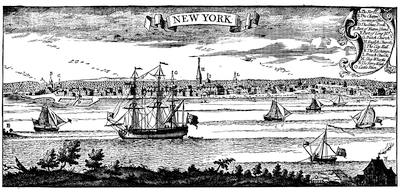
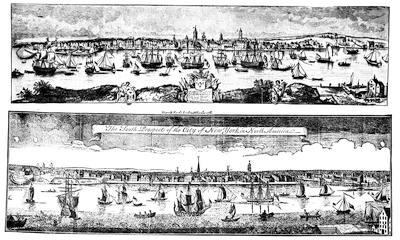
The views of New York here annexed (pp. 250, 251) are the principal ones of the earlier half of the seventeenth century. The larger (New York, on the scroll) is from the great map of Popple, British Empire in America, published in 1732. The upper of the two (p. 251) is reduced from a large panoramic South Prospect of ye Flourishing City of New York (6-6/12 × 2-4/12 ft.), dedicated to Gov. George Clinton by Thomas Blakewell, which was published March 25, 1746. A lithographic reproduction appeared in Valentine’s N. Y. City Manual, 1849, p. 26, and in his Hist. of N. Y. City, p. 290. (Cf. Cassell’s United States, i. 480.) Originals are reported to be in the N. Y. Society library and in the British Museum (King’s Maps, ii. 329, and Map Catal., 1885, col. 2,975).
The reduced fac-simile view, called a “South Prospect,” follows a copperplate engraving in the London Magazine, Aug., 1761.
Key: 1, the fort; 2, the chapel in the fort; 3, the secretary’s office; 4, the great dock, with a bridge over it; 5, the ruins of Whitehall, built by Gov. Duncan [Dongan]; 6, part of Nutten Island; 7, part of Long Island; 8, the lower market; 9, the Crane; 10, the great flesh-market; 11, the Dutch church; 12, the English church; 13, the city hall; 14, the exchange; 15, the French church; 16, upper market; 17, the station ship; 18, the wharf; 19, the wharf for building ships; 20, the ferry house on Long Island side; 21, a pen for cattle designed for the market; 22, Colonel Morris’s “Fancy,” turning to windward, with a sloop of common mould.
This print is clearly based on the one placed above it.
The official documentary collections of New Jersey have already been indicated,[590] as well as some traces of its local history.[591]
A view of New York about 1695 is no. 39 in the gallery of the N. Y. Hist. Society. Cf. Mrs. Lamb’s New York, i. p. 455, for one assigned to 1704.
A view purporting to be taken in 1750 is found in Delisle’s Atlas (1757).
A collection of views of towns, which was published by Jan Roman at Amsterdam in 1752, included one of Nieu Amsterdam, namaels Nieu York. (Muller’s Catal. of American Portraits, etc., no. 310.)[592]
The earliest plan of New York of the period which we are now considering is one which appeared in the Rev. John Miller’s Description of the Province and City of New York, with the plans of the City and several forts, as they existed in the year 1695, now first printed from the original MS. (London, Rodd, 1843), and in a new ed., with introd. and notes by Dr. Shea (N. Y., Gowans, 1862). See Vol. III. p. 420, of the present History, and Mrs. Lamb’s New York (i. 421).
A fac-simile of this plan, marked “New York, 1695,” is annexed. It is reproduced several times in Valentine’s New York City Manual (1843-44, 1844-45, 1845-46, 1847, 1848, 1850, 1851, 1852), and is explained by the following:
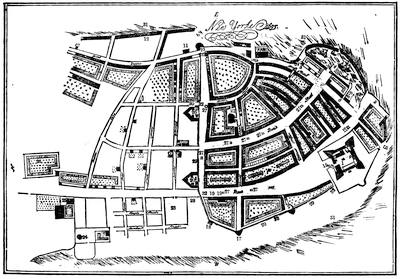
Key: 1, the chapel in the fort of New York; 2, Leysler’s half-moon; 3, Whitehall battery of 15 guns; 4, the old dock; 5, the cage and stocks; 6, stadt-house battery of 5 guns; 7, the stadt or state house; 8, the custom-house; 8, 8, the bridge; 9, Burgher’s or the slip battery of 10 guns; 10, the fly block-house and half-moon; 11, the slaughter-house; 12, the new docks; 13, the French church; 14, the Jews’ synagogue; 15, the fort well and pump; 16, Ellet’s alley; 17, the works on the west side of the city; 18, the northwest block-house; 19, 19, the Lutheran church and minister’s house; 20, 20, the stone points on the north side of the city; 21, the Dutch Calvinists’ church, built 1692; 22, the Dutch Calvinists’ minister’s house; 23, the burying-ground; 24, a windmill; 25, the king’s farm; 26, Col. Dungan’s garden; 27, 27, wells; 28, the plat of ground designed for the E. minister’s house; 29, 29, the stockado, with a bank of earth on the inside; 30, the ground proper for the building an E. church; 31, 31, showing the sea flowing about New York; 32, 32, the city gates; 33, a postern gate.
There is a MS. plan of this date (1695) in the British Museum. A plan of the fort in New York (1695) is also given by Miller, and is reproduced in Gowan’s ed. of Miller, p. 264. (Cf. Appleton’s Journal, viii. p. 353.)
The Brit. Mus. Map Catal. (1885), col. 2,972, notes a map by J. Seller, London; and a Novum Amsterdamum, probably by Vander Aa, at Leyden, in 1720.
A large Plan of the City of New York, from an actual survey, made by Iames Lyne, was published by William Bradford, and dedicated to Gov. Montgomerie, while Col. Robt. Lurting was mayor, in 1728. It has been reproduced wholly or in part at various times.[593]
Popple’s plan of New York (1733) was later re-engraved in Paris. His map of the harbor, from his great map The British Empire in America (inscribed on a scroll, “New York and Perth Amboy harbours”), is annexed (p. 254) in fac-simile.
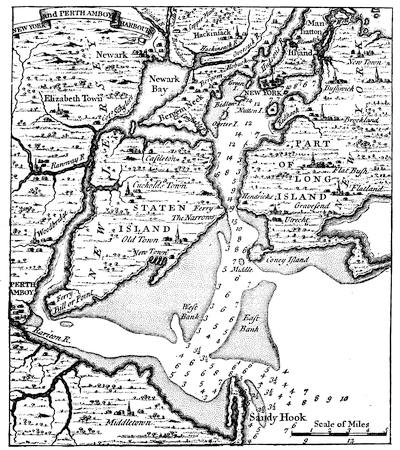
Key: A, the fort; B, Trinity Church; C, old Dutch church; D, French church; E, new Dutch church; F. Presbyterian meeting; G, Quakers’ meeting; H, Baptist meeting; J, Lutheran church; L, St. George’s Chapel; M, Moravian meeting; N, new Lutheran meeting; 1, governor’s house; 2, secretary’s office; 3, custom-house; 4, Peter Livingston & Co., supg. hu.; 5, city hall; 6, Byard’s sugar-house; 7, exchange; 8, fish market; 9, old slip market; 10, meal market; 11, fly market; 12, Burtin’s market; 13, Oswego market; 14, English free school; 15, Dutch free school; 16, Courtland’s sugar-house; 17, Jas. Griswold; 18, stillhouse; 19, Wileys Livingstone; 20, Laffert’s In. Comp.; 21, Thomas Vatar Distilhouse; 22, Robert Griffeth’s Distilhouse; 23, Jno. Burling’s Distilhouse; 24, Jas. Burling’s Distilhouse; 25, Jno. Leake’s Distilhouse; 26, Benj. Blagge’s Distilhouse; 27, Jews’ burial-ground; 28, poor house; 29, powder-house; 30, block-house; 31, gates.
Other drafts of New York harbor during the first half of the last century will be found in Southack’s Coast Pilot, and in Bowen’s Geography (1747). A chart of the Narrows is in a Set of Plans and Forts in America, London, 1763, no. 12.
A large plan of The City and environs of New York, as they were in the years 1742-1744, drawn by David Grim in the 76th year of his age, in Aug., 1813, as it would seem from recollection, is in the N. Y. Hist. Society’s library, and is engraved in Valentine’s N. Y. City Manual, 1854.
The plan of 1755 (also annexed), made after surveys by the city surveyor, and bearing the arms of New York city, follows a lithograph in Valentine’s N. Y. City Manual, 1849, p. 130, after an original plate belonging to Trinity Church, N. Y.
Cf. Valentine’s New York, p. 304, and the Hist. of the Collegiate Reformed Dutch Church in New York (New York, 1886). It was also given in 1763 in a Set of plans and forts in America (no. 1), published in London.
A plan of the northeast environs of New York, made for Lord Loudon, in 1757, is in Valentine’s Manual, 1859, p. 108.
The plan of 1755 (p. 255) needs the following
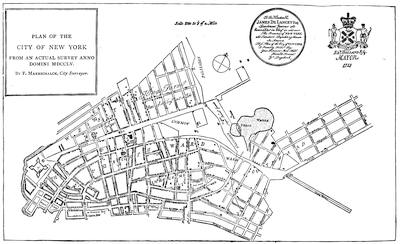
Key: A, the fort; B, Trinity Church; C, old Dutch church; D, French church; E, new Dutch church; F, Presbyterian meeting; G, Quakers’ meeting; H, Baptist meeting; I, Lutheran church; K, Jews’ synagogue; L, St. George’s Chapel; M, Moravian meeting; N, new Lutheran meeting; O, custom-house; P, governor’s house; Q, secretary’s office; R, city house; S, exchange; T, fish market; V, old slip market; X, meal market; Y, fly market; Z, Burtin’s market; 1, Oswego market; 2, English free school; 3, Dutch free school; 4, block-house; 5, gates.
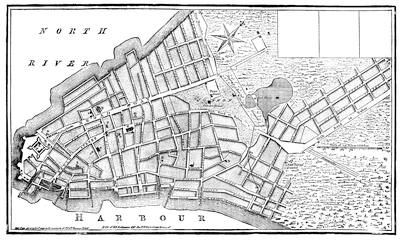
Maerschalck’s plan of 1755 was used as the basis of a new plan, with some changes, which is here reproduced (p. 256) after the copy in Valentine’s Manual (1850), and called a Plan of the City of New York, reduced from an actual survey, by T. Maerschalkm [sic], 1763. The following key is in the upper right-hand corner of the original (where the three blanks are in the fac-simile), of a lettering too small for the present reduction:—
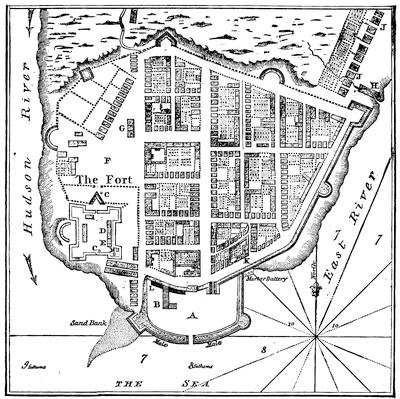
BELLIN’S PLAN, 1764.
Key: A, shipping port; B, bridge for discharging vessels; C, fountain or wells; D, house of the governor; E, the temple or church; F, parade ground; G, meat-market; H, slaughter-house; J, lower town; K, city hall; L, custom-house and stores; M, powder-magazine.[594]
The latest of the plans here reproduced is one which is given in Valentine’s Manual (1861, p. 596), and was made by Bellin by order of the Duke de Choiseul, in 1764:—
The view of Philadelphia (reproduced, p. 258) is the larger part of George Heap’s “East Prospect,” as reduced from the London Mag., Oct., 1761:—
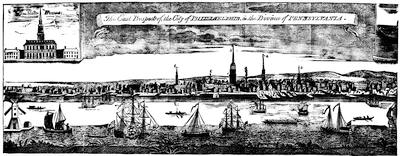
Key: 1, Christ Church; 2, state-house; 3, academy; 4, Presbyterian church; 5, Dutch Calvinist church; 6, the court-house; 7, Quakers’ meeting-house; 8, High Street wharf; 9, Mulberry Street; 10, Sassafras Street; 11, Vine Street; 12, Chestnut Street (the other streets are not to be seen from the point of sight); 13, draw-bridge; 14, corn-mill.
The style of the domestic buildings in Pennsylvania during this period may be seen from specimens delineated in Scharf and Westcott’s Philadelphia (particularly the Christopher Saur house in Germantown, in vol. iii. p. 1964); Egle’s Pennsylvania; Watson’s Annals of Philadelphia; Smith’s Delaware County, Rupp’s Lancaster County; and other local histories, especially Thompson Westcott’s Historic buildings of Philadelphia, with notices of their owners and occupants (Philad., 1877). The Penna. Mag. of Hist., July, 1886, p. 164, gives a view of the first brick house built in New Jersey, that of Christopher White, in 1690.
The original was first published in London in 1754, and was engraved by Jefferys, and reissued in his General Topog. of N. America, etc., 1768, no. 29. It was reproduced on the same scale in Philadelphia, in 1854. In 1857, through the instrumentality of George M. Dallas, then minister to England, a large oil-painting, measuring eight feet long and twenty inches high, was received by the Philadelphia library; and attached to it was an inscription, The southeast prospect of the City of Philadelphia, by Peter Cooper, painter, followed by a key to the public and private buildings. Confidence in its literal fidelity is somewhat shaken by the undue profusion of a sort of cupola given to buildings here and there,—one even surmounting the Quaker meeting-house. Antiquaries are agreed that it must have been painted about 1720. Among the private houses prominent in the picture are that of Edward Shippen, at that time occupied by Sir William Keith, then governor of the province, and that of Jonathan Dickinson. (Cf. Hist. Mag., i. 137.) It has been reëngraved on a small scale in Scharf and Westcott’s Hist. of Philadelphia, vol. i., where will also be found (p. 187) a view of the old court-house, from an ancient drawing (1710). Cf. view of 1744 in Ibid., p. 207.