Volume 2 / Part 3 — XXXVIII.—RESPONSE OF PLANTS TO WIRELESS STIMULATION
Reading edition
By Sir J. C. Bose, Assisted by Guruprasanna Das.
A growing plant bends towards light, and this is true not only of the main stem but also of its branches and attached leaves and leaflets. Light affects growth, the effect being modified by the intensity of radiation. Strong stimulus of light causes a diminution of the rate of growth, but very feeble stimulus induces an acceleration. The tropic effect is very strong in the ultra-violet region of the spectrum with its extremely short wave length, but the effect declines practically to zero as we move towards the less refrangible rays—the yellow and the red with their comparatively long wave length. As we proceed beyond the infra-red region, we come across the vast range of electric radiation, the wave lengths of which vary from 0·6 cm., the shortest wave I have been able to produce, to others which may be miles in length. There thus arises the very interesting question, whether plants perceive and respond to the long ether waves including those employed in signalling through space.
At first sight this would appear to be very unlikely; for the most effective rays are in the ultra-violet region with wave length as short as 20 × 10-6 cm.; but with electric waves used in wireless signalling we have to deal with waves 50 million times as long. The perceptive power of our retina is confined within the very narrow range of a single octave, the wave lengths of which lie between 70 × 10-6 cm. and 35 × 10-6 cm. It is difficult to imagine that plants could perceive radiations so widely separated from each other as the visible light and the invisible electric radiation.
But the subject assumes a different aspect, when we take into consideration the total effect of radiation on the plant. Light induces two different effects which may broadly be distinguished as external and internal. The former gives rise to movement; the latter finds no outward manifestation, but consists of an 'up' or assimilatory chemical change, with concomitant increase of potential energy. Of the two reactions then, one is dynamic attended by dissimilatory 'down' change; the other is potential, associated with the opposite 'up' change. In reality the two effects take place simultaneously; but one of these becomes predominant under definite conditions.
The modifying condition is the quality of light; with reference to this I quote the following from Pfeffer: "So far as is at present known, the action of different rays of the spectrum gives similar curves in regard to heliotropic and phototactic movements, to protoplasmic streaming and movements of the chloroplastids as well as the photonastic movements produced by growth or by changes of turgor. On the other hand, it is the less refrangible rays which are most active in photo-synthesis."[26] The dynamic and potential manifestations are thus seen to be complementary to each other, the rays which induce photo-synthesis being relatively ineffective for tropic reaction and vice versâ.
Returning to the action of electric waves, since they exert no photo-synthetic action they might conceivably induce the complementary tropic effect. These considerations led me to the investigation of the subject fourteen years ago, and my results showed that very short electric waves induce a retardation of rate of growth; they also produce responsive movements of the leaf of Mimosa, when the plant was in a highly sensitive condition.[27] The energy of the short electric waves is very feeble, and undergoes great diminution at a distance; hence the necessity of employment of a specimen of plant in a highly sensitive condition.
I resumed my investigations on the subject at the beginning of this year. I wished to find out whether plants in general perceived and responded to the long ether waves which reached it from a distance. The perception of the wireless stimulation was to be tested not merely by the responsive movement of sensitive plants, but by diverse modes of response given by all kinds of plants.
Stimulus induces, as we have seen, three different types of response in plants. It causes excitation in sensitive plants like Mimosa, in consequence of which the leaf undergoes a fall; this is the mechanical response to stimulus. Stimulus also induces electric response in plants, both sensitive and ordinary, the excited tissue undergoing an electric change of galvanometric negativity. Finally, the effect of stimulus on growing plants is a variation in the rate of growth, an acceleration under feeble, and a retardation under strong stimulus. I undertook to investigate the effect of electric waves on plants by the methods of mechanical and of electrical responses, and also by that of induced variation of growth.
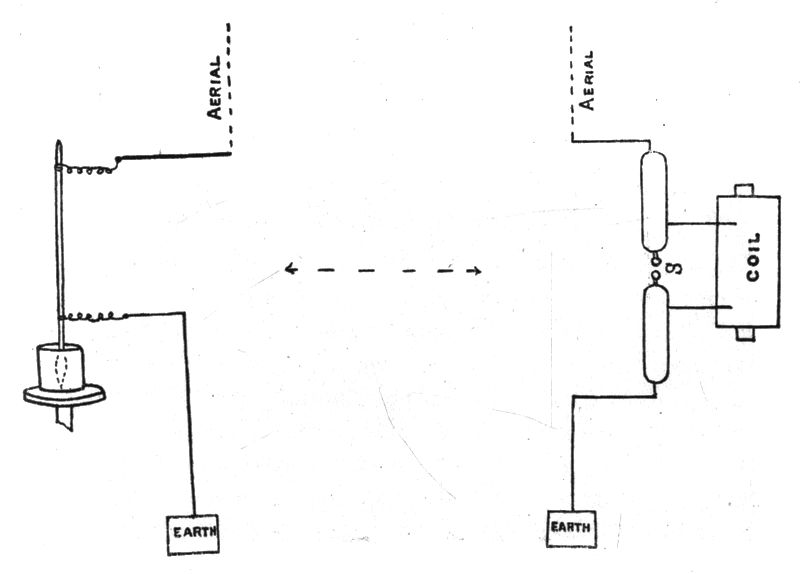
Fig. 153.—Diagrammatic representation of method employed for obtaining response to wireless stimulation. Transmitting apparatus seen to the right. Receiving aerial connected to upper part of plant, the lower part of the plant or the flower-pot being connected with the earth.
THE WIRELESS SYSTEM.
For sending wireless signals, I had to improvise the following arrangement, more powerful means not being available. The secondary terminals of a moderate sized Ruhmkorff's coil were connected with two cylinders of brass, each 20 cm. in length; the sparking took place between two small spheres of steel attached to the cylinders. One of the two cylinders was earthed, and the other connected with the aerial 10 meters in height. The receiving aerial was also 10 meters in height and its lower terminal led to the laboratory, and connected by means of a thin wire to the experimental plant growing in a pot; this latter was put in electric connection with the earth (Fig. 153). The distance between the transmitting and receiving aerial was about 200 meters, the maximum length permitted by the grounds of the Institute.
MECHANICAL RESPONSE OF Mimosa.
Experiment 159.—One of the leaves of Mimosa was connected with the aerial by means of a thin tinsel of loose wire, which did not interfere with the free movement of the leaf. This latter was attached to the recording lever. Wireless signals induced a responsive fall of the leaf (Fig. 154) which was gradual as under action of light, and not so abrupt as under a mechanical blow.
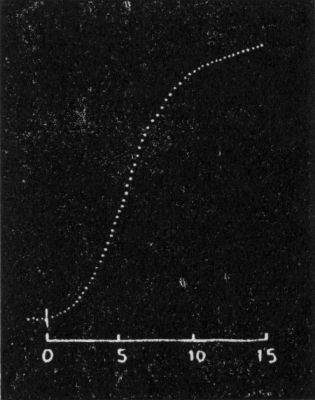
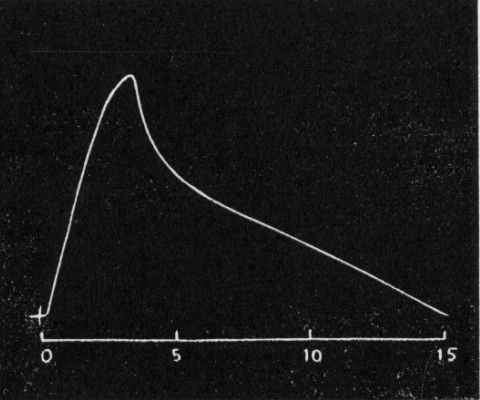
Fig. 154.Fig. 155.
Fig. 154.—Mechanical response of leaf of Mimosa to electric wave.
Fig. 155.—Electric response of Mimosa pudica to wireless stimulation.
THE ELECTRIC RESPONSE.
Experiment 160.—The leaf of Mimosa was in this experiment held securely, and two electrical connections made, one with the less excitable upper and the other with the more excitable lower half of the pulvinus. The incident ether-wave induced an electric response in the pulvinus, the more excitable lower half exhibiting galvanometric negativity. On the cessation of stimulus there was a recovery (Fig. 155).
It is not at all necessary to employ the sensitive Mimosa for exhibition of electric response; for this is universally exhibited by all plants. The only condition for electric response is that the points of electric contacts should be made with two unequally excitable areas in the plant. This may be secured by artificial means as by causing 'injury' to one point of contact.[28] It is however much better to take advantage of the natural difference of excitability of two different areas in the organ as in the pulvinus of Mimosa. This difference of excitability is also found between the inner and outer sides of a hollow tubular organ as in the peduncles of various lilies. I was thus able to secure specimens which were far more sensitive to the action of electric waves than the pulvinus of Mimosa.
EFFECT OF WIRELESS STIMULATION ON GROWTH.
There now remains the very interesting question as to whether the effect of long ether waves induce any variation of growth. The results given below show that growing plants not only perceive but respond to the stimulus of electric waves. The effects to be presently described are exhibited by all plants.
I shall, however, content myself in describing a typical experiment carried with the seedling of wheat. The specimen was mounted on the Balanced Crescograph, and the growth exactly balanced. This gives a horizontal record; an acceleration of growth above the normal is, in the following records, represented by a down curve, and a retardation by an up-curve.
Effect of feeble stimulus: Experiment 161.—I first studied the effect of feeble stimulus. This was secured by decreasing the energy of sparks of the radiator. The response was an acceleration of rate of growth as seen in figure 156a. The analogy of this with the accelerating effect of sub-minimal intensity of light (p. 224) is very remarkable.
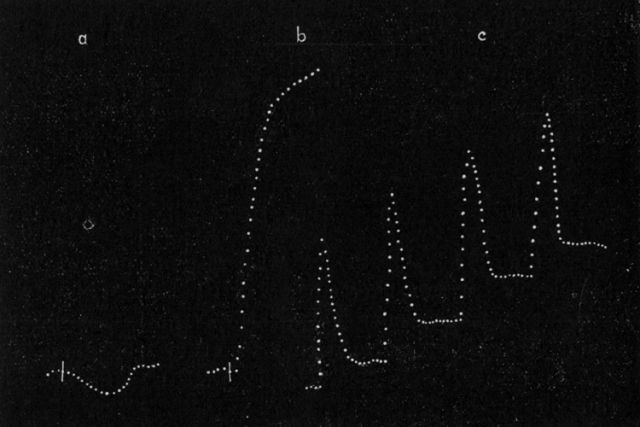
Fig. 156.—Record of responses to electric wave by the Balanced Crescograph (a) response to feeble stimulus by acceleration of growth, (b) response to strong stimulus by retardation, (c) responses to medium stimulation—retardation followed by recovery. Down-curve represents acceleration, and up-curve retardation of growth: (Seedling of wheat.)
Effect of strong stimulus: Experiment 162.—The maximum energy radiated by my transmitter, as stated before, was only moderate. In spite of this its effect on plants was exhibited in a very striking manner. The balance was immediately upset, indicating a retardation of the rate of growth. The latent period, i.e., the interval between the incident wave and the response, was only a few seconds (Fig. 156b). The record given in the figure was obtained with the moderate magnification of 2,000 times only. But with my Magnetic Crescograph, the magnification can easily be raised ten million times; and the response of plant to the space signalling can be exalted in the same proportion.
Under an intensity of stimulus slightly above the sub-minimal, the responses exhibit retardation of growth followed by quick recovery, as seen in the series of records given in Fig. 156c.
A remarkable peculiarity in the response was noticed during the course of the experiments. Strong stimulation by ether waves gives rise, as we have seen, to a very marked retardation of the rate of growth. Repeated stimulation induces fatigue, and temporary insensitiveness of the organ. Under moderate fatigue the effect is a prolongation of the latent period. Thus in a particular experiment the plant failed to give any response to a short signal. But after an interval of five minutes a marked response occurred to the wireless stimulus that had been received previously. The plant had perceived the stimulus but on account of fatigue the latent period was prolonged, from the normal 5 seconds to as many minutes.
SUMMARY.
Plants not only perceive, but also respond to long ether waves employed in signalling through space.
Mechanical response to wireless stimulation is exhibited by the leaf of Mimosa pudica.
All plants give electric response to the stimulus of long ether waves.
Growing plants exhibit response to electric waves by modification of rate of growth. Feeble stimulus induces an acceleration, while strong stimulus causes a retardation of the rate of growth.
The perceptive range of the plant is far greater than ours; it not only perceives but responds to the different rays of the vast ethereal spectrum.