Volume 2 / Part 4 — XLVIII.—DIURNAL MOVEMENT DUE TO VARIATION OF TEMPERATURE AFFECTING GROWTH
Reading edition
By Sir J. C. Bose, Assisted by Lalit Mohan Mukerjee.
It has been stated that there are two classes of diurnal movements caused by variation of temperature; one of these is due to differential growth induced on two sides of the organ, and the other is brought about by the induced variation of geotropic curvature. The former may be distinguished as Thermonastic, and the latter as Thermo-geotropic movement. Before laying down the criteria to distinguish the one class of phenomenon from the other, it would be advisable to refer to the somewhat arbitrary distinction that has been made between nastic and tropic reactions.
TROPIC AND NASTIC MOVEMENTS.
The explanation, which I shall offer about the night and day movements in plants, has been reached through the study not only of pulvinated, but also of growing and fully grown organs. A distinction is made between the movement due to growth, and the 'variation movement' due to change of turgor. I have shown (p. 239) that the same diminution of turgor which induces a contraction in a pulvinus, also induces in a growing organ an incipient contraction, and retardation of growth. Enhancement of turgor, on the other hand, induces in both the opposite effect of expansion. Unilateral stimulus induces curvature, and there is no essential difference in the production of such curvatures in pulvinated, growing, and fully grown organs. The exhibition of nyctitropic movement by the fully grown, and rigid 'Praying Palm' is a striking demonstration of the unity of response of all plant organs.
As regards the distinction between the tropic and nastic movements, it will be found that there is no sharp line of demarcation between the two. A movement is said to be tropic, when unilateral stimulus acts on an organ and induces in it a directive movement. Curvature induced by diffused stimulus on a dorsiventral or anisotropic organ (with differential excitabilities of the two halves) is termed nastic. Daylight is supposed to act diffusely (i.e., equally on all sides) on leaves; this is, however, not strictly true, since the light from sky above is stronger than from ground below. Moreover, the tropic action of unilateral light may become nastic by internal diffusion of excitation. This is seen in the response of the pulvinus of Mimosa to light acting from above. The leaf at first moves upwards towards the stimulus, the response being positively phototropic. But under the continued action of light, excitation becomes internally diffused, and the leaf undergoes a fall by the greater contraction of the more excitable lower half of the organ (p. 331). No sharp distinction can therefore be made between the movements of growth and of variation, between tropic and nastic curvatures.
The employment of the term 'nastic' is, however, convenient when used in a well-defined and restricted sense. "We speak of tropism when the organ takes up a resting position definitely related to the effective stimulus. Nastic movements, on the other hand, are curvatures which bring about a particular position in relation to the plant, and not to the direction of the stimulus".[41] It will sometimes be necessary, in the course of this paper, to discriminate the movements which are autonomous from others which are paratonic, i.e., brought about by external stimulus, to the former class belongs a large number of automatic activities ranging from the quick pulsations of Desmodium gyrans to the slow movements, exhibited by epinastic and hyponastic organs. Under the category of nastic movements may also be included those of the flower of Crocus and Tulip, in which variation of temperature induces differential growth on two sides of the organ. The direction of the movement, though initiated by change of temperature, is determined by the difference of growth-activity on the two sides. In these instances of nastic movement, the induced curvature is in relation of the plant; the opening of the flower due to rise of temperature will remain the same, whether the flower be kept in an erect or in an inverted position. Had the movement, on the other hand, been paratonic, that is to say, due to the external stimulus of gravity, the responsive movement would have been determined not in relation to the plant but to the direction of external force of gravity.
In the description of direction of responsive movements, confusion is likely to arise unless the point of view be carefully defined. An up-movement of a leaf or a petal means approach towards the growing point of the axis. This may be variously described as movement of closure or of folding. A down-movement may, on the other hand, be described as a movement of opening or of unfolding. If the plant be held inverted, two different effects will be noticed depending on the character of the movement, whether nastic or tropic. In the case of nastic movement, the former up-movement in erect position would appear, on inversion of the plant, to be a down-movement; but in relation to the plant the closure movement will remain closure movement, whether the plant be held in the normal position or upside down. If, on the other hand, the direction of movement be determined by the paratonic effect of external stimulus, gravity for example, an up-movement due to fall of temperature will continue to be an up-movement, whether the plant be held in its normal or inverted position. The responsive movement in relation to the plant will, however, be different; the closure movement will, on inversion, be reversed into a movement of opening. The reversal of closure into an opening movement or vice versâ will thus be a test of the paratonic effect of external stimulus.
We may thus distinguish thermonastic from thermo-geotropic action by the following tests:
1. Thermonastic movements are, generally speaking, due to differential growth, and are therefore characteristically present in growing organs. Thermo-geotropic action is independent of growth.
2. Thermonastic movements take place in relation to the plant, and is not determined by external force of a directive nature. Opening or closing movement will remain unchanged after inversion of the plant. But thermo-geotropic reaction being determined by the external stimulus of gravity, becomes reversed on inversion of the plant. Closure movement is thus converted into opening movement, and vice versâ.
I shall now take up the diurnal movement due to variation of growth induced by change of temperature. Of this the flower of Nymphæa furnishes an example.
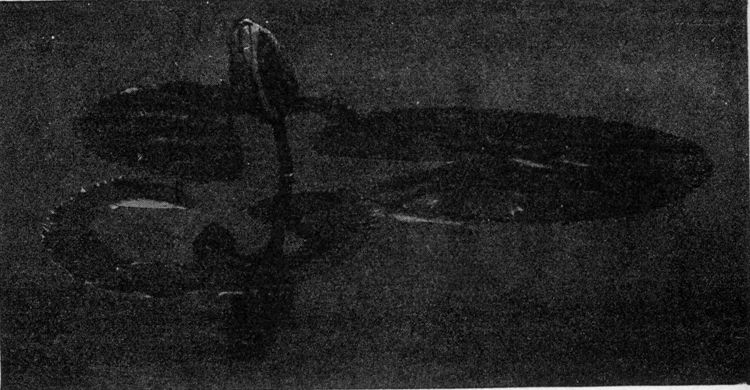
Fig. 195.—Nymphæa closed at daytime.
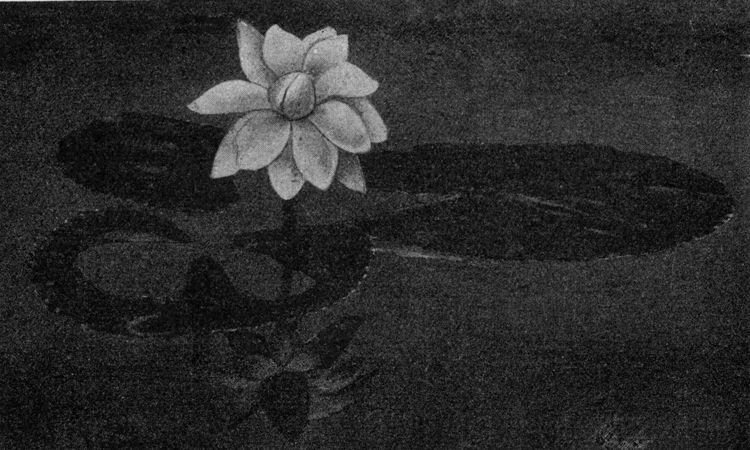
Fig. 196.—Nymphæa open at night.
DIURNAL MOVEMENTS OF Nymphæa.
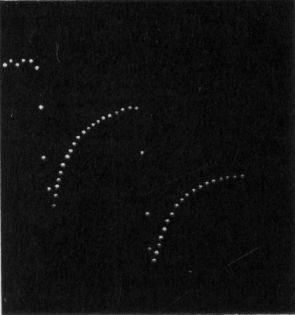
Fig. 197.—Response to light applied successively for 1 minute. Down-curve shows movement of opening followed by recovery in darkness. (Nymphæa).
The flower of Nymphæa remains closed during the day and opens at night. Figures 195 and 196 are from photographs of the day and night positions of the flower. The closure and opening movements of this flower have been regarded as being mainly due to recurrent variations of light and darkness.[42] If the opening be due to darkness, closure of the flower should take place in the morning with the appearance of light. But the flowers often remain open till ten or eleven in the forenoon. I have sometimes succeeded in keeping the flower open for greater part of the day by lowering the temperature of the plant-chamber. The movement of the flower thus appeared to be associated with variation of temperature rather than of light.
Action of light: Experiment 208.—I investigated the effect of light on the movement of opening or of closing of the flower. One of the petals was attached to the recording lever; light from an arc lamp was made to act diffusely on the petal; this was done by means of two inclined mirrors by which the divergent horizontal beam of light was thrown on the upper and lower sides. The record in figure 197 shows that light induced a movement of opening, followed by closure in darkness. Since light induces a movement of opening, and darkness brings about a closure, the opening of the flower at night could not be due to darkness. We have therefore to look for a different cause for the diurnal movement of the flower.
Effect of variation of temperature.—I have already described an experiment which proves that rise of temperature induces a movement of closure of the floral leaves of Nymphæa, lowering of temperature producing the opposite effect (p. 311).
From the study of the action of light and of variation of temperature, it will be seen that the flower of Nymphæa is acted on in the evening by two antagonistic forces; darkness induces a movement of closure, and fall of temperature gives rise to a movement of opening. Since the flower opens in the evening, the predominant effect is that of falling temperature.
The above conclusions are fully borne out by the diurnal record which I obtained with Nymphæa.
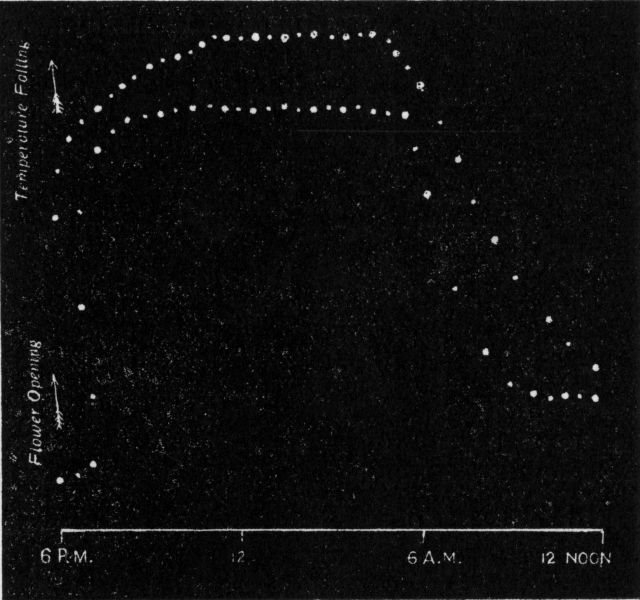
Fig. 198.—Diurnal record of Nymphæa. Upper record gives variation of temperature; the up-curve representing fall, and down-curve rise of temperature. The lower record exhibits the movement of the flower, up-curve representing the opening, and down-curve the closure of the flower.
Experiment 209.—One of the perianth leaves was attached to one of the recording levers, the differential thermometer being attached to the other. It will be seen (Fig. 198) that the movement of the flower follows very closely the curve of variation of temperature. The flower was tightly closed in the day time; and the perianth leaves began to open out in the evening at first slowly, then very rapidly, and the flower becoming fully expanded by 10 p.m. at night. Though the temperature continued to fall, there was no possibility of further expansion beyond the maximum. The temperature began to rise after passing through the minimum at 6 a.m., and the movement of closure set in with rising temperature, the flower becoming completely closed by 10 a.m. That geotropism has little effect is seen from the fact that the inversion of flower does not interfere with the normal opening or closing of the flower.
The phenomenon of diurnal movement of Nymphæa is therefore thermonastic, the floral leaves exhibiting movement of opening at night owing to fall of temperature. Luffa acutangula, which opens in the afternoon, and closes early in the morning, gives a diurnal record similar to that of Nymphæa.
SUMMARY.
The flower of Nymphæa exhibits a movement of closure during rise of temperature, and of opening during fall of temperature.
It is shown further that the effects of light and of rise of temperature are antagonistic to each other. Light is shown to induce in Nymphæa the movement of opening, and darkness to cause the movement of closure. The diurnal movement of Nymphæa is not therefore due to periodic variation of light and darkness, but to the predominant effect of variation of temperature.
The diurnal record shows that the perianth leaves begin to open in the evening with falling temperature, and the flower becomes fully expanded by 10 p.m. The movement of closure sets in with rising temperature in the morning, and the flower becomes fully closed by 10 a.m.