Volume 2 / Part 3 — XXXVII.—RADIO-THERMOTROPISM
Reading edition
By Sir J. C. Bose, Assisted by Guruprasanna Das.
We have studied the tropic curvature induced by different rays of light. We saw that while the more refrangible rays of the spectrum were most effective, the less refrangible rays were ineffective. Below the red, there are the thermal rays about whose tropic effect very little is definitely known.
The intricacies of the problem are very great owing to the difficulty of discriminating the effect of temperature from that of radiation; to this must be ascribed the contradictory results that have been obtained by different observers, of which Pfeffer gives the following summary:[24]
"In addition to the action of ultra-red rays which are associated with the visible part of the spectrum, dark heat-rays of still greater wave length, as well as differences of temperature may produce a thermotropic curvature in certain cases. Wortmann observed that seedlings of Lepidium sativum and Zea Mays, as well as sporangiphores of Phycomyces curved towards a hot iron plate emitting dark heat-rays. Steyer has, however, shown that the sporangiphore of Phycomyces has no power of thermotropic reaction.... Wortmann observed that the seedling shoot of Zea Mays was positively, but that of Lepidium negatively, thermotropic.... Steyer, however, found that both plants were positively thermotropic. Wortmann has also investigated the radicles of seedlings by growing them in boxes of saw-dust, one side being kept hot, the other cold."
It will be noted that in the investigations described above, thermotropic reaction has been assumed to be the same under variation of temperature (as in experiments with unequally heated saw-dust), and under radiation from heated plate of metal. With reference to this Jost maintains that "so far as we know, thermotropism due to radiant heat cannot be distinguished from thermotropism due to conduction."[25]
The effect of temperature, within optimum limits, is a physiological expansion and enhancement of the rate of growth. The effect of visible radiation is, on the other hand, a contraction and retardation of growth. Should radiant heat act like light, the various tropic effects in the two cases would be similar; the temperature effect would in that case be opposite to the radiation effect. In order to find whether the thermal radiation produces tropic curvature similar to that of light, we have to devise a crucial experiment in which the complicating factor of rise of temperature on the responding organ is eliminated.
Experiment 156.—I have described the effect of light applied unilaterally to the stem of Mimosa, at a point diametrically opposite to the indicating leaf (Expt. 104). It was shown that the effect of indirect stimulus induced at first an erectile movement of the leaf, and that this was followed by a fall of the leaf on account of transverse transmission of excitation. In the present experiment I applied thermal radiation instead of light. The source of radiation was a spiral of platinum wire heated short of incandescence by means of electric current. The intensity of incident radiation could thus be maintained constant, or increased or decreased by approach or recession of the radiating spiral. The effect of unilateral stimulus of heat-rays was found exactly similar to that of light; i.e., there was at first an erectile movement due to indirect stimulation, followed by the fall of the leaf due to transmitted excitation. It will be noticed that under the particular condition of the experiment, the responding pulvinus was completely shielded from temperature-variation. The reaction to thermal radiation is thus similar to that of light.
As regards the effects of rise of temperature and radiation I have shown that they are antagonistic to each other (pp. 211, 308). Thus in positive types of thermonastic organs like the flower of Zephyranthes, while rise of temperature induces a movement of opening, radiation causes the opposite movement of closure. Again, in the negative type exemplified by Nymphæa, rise of temperature induces a movement of closure; radiation on the other hand, brings about the opposite movement of opening. The tropic effect of thermal radiation thus takes place in opposition to that of rise of temperature, and the resultant effect is therefore liable to undergo some modification, depending on the relative sensibility of the organ to radiation and to variation of temperature.
The facts that have been given above prove that infra-red radiation is as effective a mode of stimulation as the more refrangible rays of the spectrum. Phototropic and radio-thermotropic reactions would therefore prove to be essentially similar. The following experiments fully confirm the similarity of the two reactions.
POSITIVE RADIO-THERMOTROPISM.
Experiment 157.—I shall now describe the normal reaction of a growing organ to the unilateral stimulus of thermal radiation. Figure 151 gives a record of response of the stem of Dregea to stimulus of short duration; the induced curvature is positive or towards the source of heat. On the cessation of stimulus, there is a recovery which is practically complete, and which takes place at a slower rate than the excitatory positive curvature. Repetition of stimulus gives rise to responses similar to the first. Successive stimuli of moderate intensity thus give rise to repeated responses of growth curvature. An arbitrary distinction has been made between the responses of pulvinated and of growing organs. The former is distinguished as a movement of variation, with its supposed characteristic of repeated response. But the experiment described shows that this is also met with in the response by growth curvature. It is only under long continued stimulation that the curvature is fixed by growth.
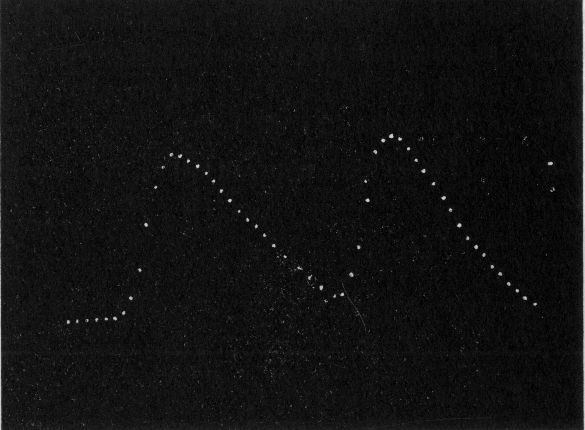
Fig. 151.—Positive response to short exposure to thermal radiation. Successive dots at intervals of 5 seconds. (Dregea volubilis.)
DIA-RADIO-THERMOTROPISM.
The positive curvature is induced by retardation of growth at the proximal side, and enhancement of growth at the distal side. This latter effect is, as we have seen, brought about by the effect of indirect stimulation.
But under long continued action of stimulus, the negative or excitatory impulse reaches the distal side, inducing diminution of turgor and retardation of the rate of growth. This leads to neutralisation, the organ placing itself at right angles to the orienting stimulus.
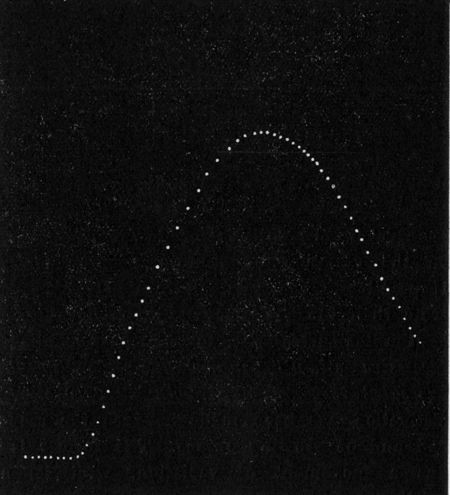
Fig. 152.—Record of positive, neutral and reversed negative curvature under continued action of thermal radiation. The negative response went off the plate. Successive dots at intervals of 5 seconds. (Dregea volubilis).
Experiment 158.—This neutralisation is seen in the record given in figure 152, where under continuous unilateral stimulation, the growing organ exhibited its maximum positive curvature, after which the movement became arrested by the arrival of the excitatory impulse at the distal side, on account of which the first positive curvature became neutralised. Further continuation of stimulus caused a reversal into negative in the course of 7 minutes. It will thus be seen that in inducing phototropic curvature, the heat rays in sunlight play as important a part as the more refrangible rays of the spectrum.
SUMMARY.
The effects of rise of temperature and of radiation are antagonistic to each other.
Under unilateral action of thermal radiation a positive curvature is induced by the retardation of growth at the proximal, and acceleration of growth at the distal side of the organ.
There is a complete recovery on the cessation of stimulus of moderate intensity and short duration. Repeated responses may thus be obtained similar to repeated responses in pulvinated organs. In certain tissues the power of conduction in a transverse direction is wanting; excitation remains localised at the proximal side, and the responsive curvature remains positive.
In other cases, there is a slow conduction of excitation to the distal side. The result of this under different circumstances is dia-radio-thermotropic neutralization, or a reversed negative curvature.
In inducing phototropic curvature, the heat rays in sunlight play as important a part as the more refrangible rays of the spectrum.