Volume 2 / Part 4 — L.—THE AFTER-EFFECT OF LIGHT
Reading edition
By Sir J. C. Bose, Assisted by Surendra Chandra Das.
We have considered two types of diurnal movement, one due to the predominant action of variation of light, and the other, to that of changing temperature. There are, however, other organs which are sensitive to variations both of light and of temperature. The effect of light is, generally speaking, antagonistic to that of rise of temperature; hence the resultant of the two becomes highly complex.
Still greater complexity is introduced by the different factors of immediate and after-effect of light. This latter phenomenon is very obscure, and I attempted to determine its characteristics by electrical method of investigation. A fuller account of after-effect of light on the response of various plant-organs and of animal retinæ will be found elsewhere.[44] I shall here refer only to one or two characteristic results which have immediate bearing on the present subject.
Direct stimulation under light induces excitatory reaction, which is mechanically exhibited by contraction, and electrically by induced galvanometric negativity. Under continuous stimulation, the excitatory effect, either of positive curvature or of induced galvanometric negativity, is found to attain a maximum. This is often found to undergo a decline and reversal; for under continuous stimulation there is a fatigue-decline, as seen in the relaxation following normal contraction in animal muscle. The positive tropic curvature, and the induced galvanometric negativity may thus undergo a decline, and neutralisation. This neutralisation is also favoured, in certain cases, by transverse conduction of excitation to the distal side.
The character of the after-effect will presently be shown to be modified by the duration of previous stimulation, the different phases of which will for convenience, be distinguished as pre-maximum, maximum and post-maximum. Since stimulus simultaneously induces positive "A" and the negative "D" changes (p. 143), their intensities will undergo relative variation during the continuance and cessation of stimulus. The after-effect will therefore exhibit unequal persistence of the expansive "A" and contractile "D" reaction at different phases of stimulation.
ELECTRIC AFTER-EFFECT.
Confining our attention to the electric response, it is found that under continued action of light the excitatory galvanometric negativity increases to a maximum, after which there is a decline, and neutralisation. Figure 205 gives the galvanographic record of the electric response of the leaf stalk of Bryophyllum under light; the up-curve represents increasing negativity which, after attaining a maximum, undergoes neutralisation as seen in the down-curve. I shall, with the help of the diagram given in the next figure, describe and explain the various after-effects I observed on sudden stoppage of light: before the attainment of maximum, at the maximum, and after the maximum.
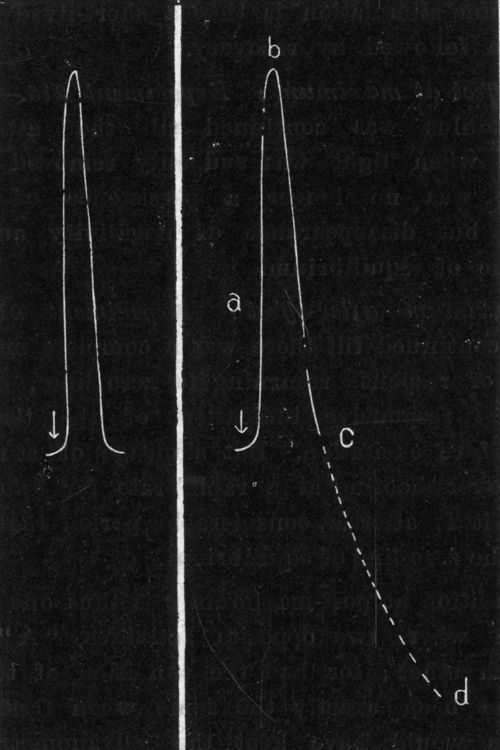
Fig. 205.Fig. 206.
Fig. 205.—Electric response of the leaf-stalk of Bryophyllum under continuous photic stimulation. Increasing negativity represented by up-curve; neutralisation by down-curve.
Fig. 206.—Diagrammatic representation of electric after-effect of stimulation. Pre-maximal stimulation produced by stoppage of light at a, gives rise to continuation of previous response followed by recovery. Stoppage of light at maximum b gives rise to recovery to equilibrium position. Stoppage of light at post-maximum c, gives rise to over-shooting below zero line.
After-effect of pre-maximum stimulation: Experiment 214.—Light is applied at arrow and stopped in different experiments at a, b, and c (Fig. 106). Continuous stimulation induces increasing galvanometric negativity; when stimulus is stopped at a before the maximum, the after-effect is a persistence of excitatory galvanometric negativity, which carries the response record higher up; after a certain interval recovery takes place and the record returns to the zero line of normal equilibrium. The after-effect of pre-maximum stimulation is thus a short-lived continuance of response followed by recovery.
After-effect at maximum: Experiment 215.—In this the photic stimulus was continued till the attainment of maximum, when light was suddenly removed at b. The after-effect was no longer a persistence of responsive movement, but disappearance of negativity and recovery to zero line of equilibrium.
Post-maximum after-effect: Experiment 216.—In this light was continued till there was a complete neutralisation, the curve of response returning to zero line; to all outer seeming the responsive indication of the tissue is the same as before excitation. But stoppage of stimulus at c causes an over-shooting at a rapid rate far below the zero line; and it is after a considerable period that the curve returns to the zero line of equilibrium.
The condition at post-maximum c is thus one of dynamic equilibrium where two opposite activities, "A" and "D," balance each other; for had the condition of the 'neutralised' tissue been exactly the same when fresh, cessation of stimulus would have kept the galvanometric spot of light at the zero position.
The electric investigation described above shows that the after-effect is modified by duration of stimulation, and that:
(1) the after-effect of pre-maximum stimulation is the continuation of response in the original direction (upward, and away from zero line), followed by recovery,
(2) the after-effect of the maximum is an electric recovery towards zero position, and
(3) the after-effect of post-maximum stimulation is an over-shooting downward below the zero line.
TROPIC RESPONSE UNDER LIGHT AND ITS AFTER-EFFECT.
I shall now describe the after-effect of light as seen in mechanical response, and the results will be found parallel to those given by the electric response. The specimen employed is the terminal leaflet of Desmodium gyrans, the pulvinus of which is very sensitive to light. Pulvinated organs, generally speaking, exhibit a diurnal variation of turgor in consequence of which the position of equilibrium of the leaf or leaflet undergoes a periodic change. But this equilibrium position of the organ remains fairly constant for nearly two hours about midday, the variation of temperature at this period being slight. We may therefore obtain the pure effect of light by carrying out the experiment at this period, and completing it within a short time to avoid complication arising from the autonomous variation of turgor.
The period of experiment of the plant may be shortened by a choice of suitable intensity of light; a given tropic effect induced by prolonged feeble light may thus be obtained by short exposure to stronger light. The source of light for the following experiment was a 50 c.p. incandescent lamp. The intensity was increased to a suitable value by focussing light on the upper half of the pulvinus by means of a lens. The intensity was so adjusted that the maximum positive curvature was attained in the course of about 6 minutes, and complete neutralisation after an exposure of 17 minutes.
Pre-maximum after-effect: Experiment 217.—Light was allowed to act on the upper half of the pulvinus for two minutes and twenty seconds; this induced an up-movement i.e., a positive curvature. On the stoppage of light the up-movement continued for one minute and twenty seconds, after which the down-movement of recovery was completed in six minutes and twenty seconds (Fig. 207). The immediate after-effect is thus a movement upward, away from the zero line of equilibrium. The result is seen to be the same as the electric after-effect of pre-maximum stimulation.
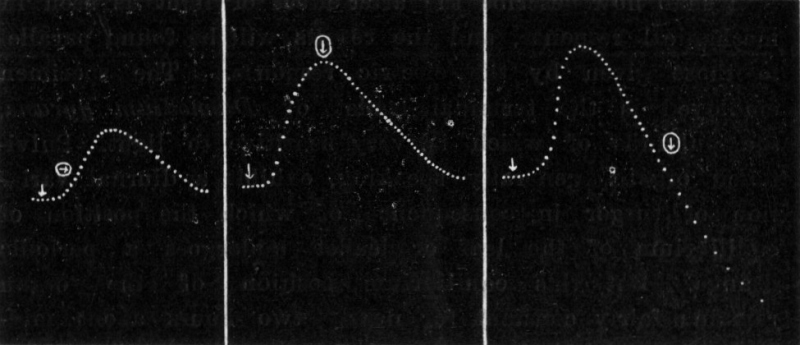
Fig. 207.Fig. 208.Fig. 209.
Fig. 207.—Light applied at arrow, and stopped at the second arrow within a circle. After-effect of pre-maximum stimulation is continuation of positive curvature followed by recovery.
Fig. 208.—After-effect at maximum; recovery towards zero position of equilibrium.
Fig. 209.—After-effect at post-maximum is a rapid overshooting below the position of equilibrium. Light was applied in all cases on upper half of pulvinus of terminal leaflet of Desmodium gyrans.
After-effect at maximum: Experiment 218.—Application of light for 5 minutes and twenty seconds induced a maximum positive curvature. Stoppage of light was followed at once by recovery which was completed in about 10 minutes (Fig. 208).
After-effect at post-maximum: Experiment 219.—As the plant was fatigued by previous experiments, a fresh specimen was taken and light was applied continuously on the upper half of the pulvinus. This gave rise first to a maximum positive curvature, subsequently diminished by transverse transmission of excitation. Neutralisation took place after application of light for 17 minutes. On the stoppage of light, there was a sudden overshooting below the zero line (Fig. 209), and the rate of the movement on the cessation of light was nearly twice as quick as during the process of neutralisation.
SUMMARY.
The after-effect of light is modified by the duration of exposure to light.
Under continued action of light, the electric response of galvanometric negativity in plants attains a maximum after which it undergoes decline, and neutralisation.
The electrical after-effect exhibits characteristic differences depending on the duration of previous exposure to light.
The pre-maximal after-effect is a temporary continuation of response under light followed by recovery.
The after-effect at the maximum is a recovery to the normal equilibrium.
The after-effect at post-maximum is an 'overshooting' below the position of equilibrium.
The immediate and after-tropic response of light are similar to the corresponding photo-electric effects.
The pre-maximum after-effect is a continuation of positive tropic movement followed by recovery; the after-effect at maximum is a recovery to the normal equilibrium position of the organ. The post-maximum after-effect is an overshooting below the position of normal equilibrium.