Volume 2 / Part 3 — XXXIV.—ON PHOTONASTIC CURVATURES
Reading edition
By Sir J. C. Bose, Assisted by Guruprasanna Das.
Phototropic response, positive or negative, is determined by the directive action of light. But photonastic reaction is supposed to belong to a different class of phenomenon, where the movement is independent of the directive action of light. I shall, however, be able to establish a continuity between the tropic response of a radial and the nastic movement of a dorsiventral organ. The intermediate link is supplied by organs originally radial, but subsequently rendered anisotropic by the unilateral action of stimulus of the environment. In a dorsiventral organ, owing to anatomico-physiological differentiation, the responsive movement is constrained to take place in a direction perpendicular to the plane of separation of the two unequally excitable halves of the organ. Even in such a case, it will be shown, that light does exert a directive action; the direction of movement will further be shown to be distorted by the lateral action of light.
PHOTOTROPIC RESPONSE OF ANISOTROPIC ORGANS.
The different sides of a radial organ, such as the young stem of Mimosa, are equally excitable. The response to unilateral light of moderate intensity is therefore positive; owing to equal excitabilities of the two sides the response of the opposite sides are alike. Diffuse stimulation therefore induces no resultant curvature. If, however, the plant is allowed to form a creeping habit, the excitabilities of the dorsal and ventral sides will no longer remain the same. Thus in the creeping stem of Mimosa the lower or the shaded side is, generally speaking, found to be the more excitable. In fact such anisotropic stem of Mimosa acts somewhat like the pulvinus of the same plant. Diffuse stimulation induces, in both, a concavity of the more excitable lower half with the down movement of the leaf or the stem.
Experiment 141.—I took four creeping stems of Mimosa in vigorous condition and tied them in such a manner that their free ends should be vertical. The shaded sides of the four specimens were so turned that each faced a different point of the compass—east, west, north and south. Subjected thus to diffuse stimulus of light from the sky, they all executed curvatures. The specimen whose under side faced the east, became bent towards the east; the same happened to those which faced north, south, and west, that is to say they curved towards the north, south, and west respectively (Fig. 140). The fundamental action by which all these were determined was the induced concavity of the under or normally shaded side, which was the more excitable. I obtained similar results with various other creeping stems.
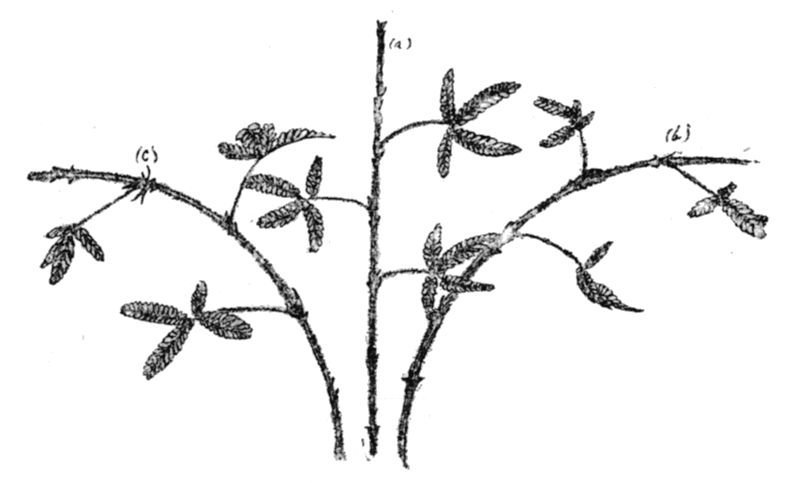
Fig. 140.—Photonastic curvature of creeping stem of Mimosa pudica: in the central figure the stem is seen to be vertical: action of diffuse light induced appropriate curvatures by greater contraction and concavity of the more excitable lower or shaded side, as seen in figures to the right (b) and left (c).
It has been shown that under prolonged unilateral stimulation, excitation becomes internally diffused; this gives rise to an effect similar to that of external diffuse stimulus. Under strong light the shaded side becomes concave, and thus press against the ground or the support; this will be the characteristic response of creeping stems in which the shaded side is the more excitable. The facts given above will probably explain the response of midribs of leaves, of the creeping stem of Lysimachia, all of which, in response to the action of strong light acting from above, exhibit concavity of the shaded and more excitable side.
PARA-HELIOTROPISM.
Under strong sunlight, the leaflets of various plants move sometimes upwards, at other times downwards, so as to place the blades of leaflets parallel to incident light. This 'midday sleep' has been termed para-heliotropism by Darwin. It has been thought that para-heliotropic action has nothing to do with the directive action of light, since many leaflets either fold upwards or downwards, irrespective of the direction of incident light. I shall for convenience distinguish the leaflets which fold upwards under light as positively para-heliotropic, and those which fold downwards as negatively para-heliotropic. This is merely for convenience of description. There is no specific irritability which distinguishes one from the other.
POSITIVE PARA-HELIOTROPISM.
Para-heliotropic response of Erythrina indica and of Clitoria ternatea: Experiment 142.—For the purpose of simplicity I have described the type of movement of these leaflets as upwards; but the actual direction in which the leaflets point their apices is towards the sun. Both the plants mentioned here are so remarkably sensitive that the leaflets follow the course of the sun, in such a way that the axis of the cup, formed by the folding leaflets at the end and the sides of the petiole, is coincident with the rays of light. The pulvinus makes a sharp curvature which is concave to light, the blade of the leaflet being parallel to light. I have taken record of continuous action of strong light acting on the responding pulvinus of the leaflets from above. The result is an increasing positive curvature which reached a limit (Fig. 141). There was no neutralisation or reversal, demonstrating the absence of transverse conduction (cf. Fig. 132).
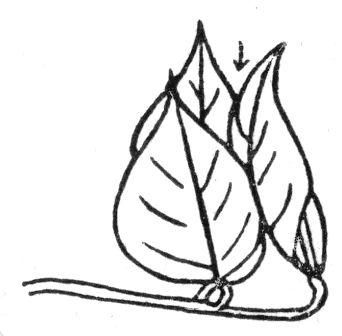
Fig. 141.—Positive para-heliotropic response of leaflets of Erythrina indica.
Para-heliotropic movement of leaflets of Mimosa pudica: Experiment 143.—These leaflets, as previously stated, fold themselves upwards, when strongly illuminated either from above or below. Diffuse electric stimulation also induce a closing movement upwards; hence the upper half of the pulvinule of these leaflets are the more excitable. In order to obtain a continuous record of the leaflet under the action of unilateral light, I constructed a very delicate recording lever magnifying about 150 times. Light of moderate intensity from a 100 candle-power incandescent lamp was applied on the less excitable lower side of the pulvinule. The record (Fig. 142) shows that the immediate response is positive, or a movement towards the light. But owing to transverse conduction, through the thin and highly conducting pulvinule, the response was quickly reversed into a very pronounced negative, or movement away from light. Had a delicate means of obtaining magnified record not been available, the slight positive twitch, and the gradual transition from positive to negative phototropic curvature would have passed unnoticed. Application of light from above gave, on account of the greater excitability of the upper half of the pulvinule, a pronounced positive response or movement towards light. The anomaly of an identical organ appearing as positively heliotropic when acted by light from above, and negatively heliotropic when acted from below, is now fully removed. The response of the leaflets is also seen to be determined by the directive action of light, though the short-lived response of the less excitable lower side is quickly masked by the predominant reaction of the more excitable upper side of the organ.
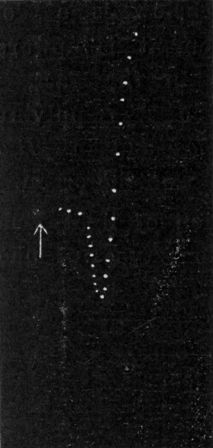
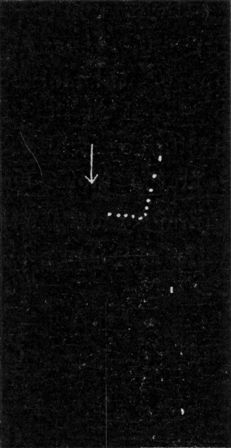
Fig. 142.Fig. 143.
Fig. 142.—Response of leaflet of Mimosa to light applied below: transient positive followed by pronounced negative curvature.
Fig. 143.—Response of leaflet of Averrhoa, to light applied above: transient positive followed by pronounced negative curvature.
Up-curve represents up-movement, and down-curve, down-movement.
NEGATIVE PARA-HELIOTROPISM.
Response of leaflet of Averrhoa carambola: Experiment 144.—The leaflets of this plant, and also those of Biophytum sensitivum fold downwards under action of strong light, applied above or below. In these leaflets diffuse electric stimulation induce a fall of the leaflets demonstrating the greater excitability of the lower half of the pulvinule. The analysis of reaction under light is rendered possible from the record of response of leaflet of Averrhoa, given in Fig. 143. Light of moderate intensity from an incandescent electric lamp acted from above: the result was a feeble and short-lived positive response, quickly reversed to strong negative by transmission of excitation to the more excitable lower side. Illumination from below gave rise only to strong positive response. Thus in Averrhoa the effect of continuous light applied above or below is a downward movement; in Mimosa the movement is upwards. The explanation of this difference lies in the fact, that in Mimosa leaflet it is the upper half of the pulvinule that is more excitable; while in Averrhoa and in Biophytum the lower is the more excitable half of the organ.
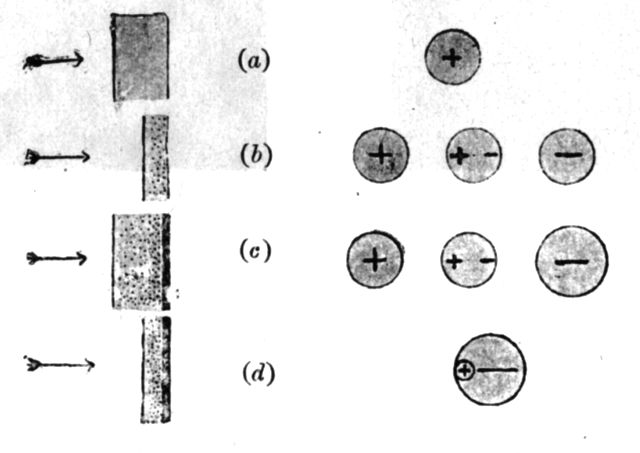
Fig. 144.—Diagrammatic representation of different types of phototropic response. (See text.)
As a summary of the tropic action of light I shall give diagrammatic representations of various types of phototropic response, including the photonastic (Fig. 144). The direction of the arrow indicates the direction of incident light. Dotted specimens are those which possess transverse conductivity. Thick lines represent the more excitable side of an anisotropic or dorsiventral organ. The size of the circles, with positive and negative signs, represents the amplitude and sign of curvature.
a. Radial thick organ, in which transverse conduction is absent. Curvature is positive, i.e., movement towards light. The result will be similar when light strikes in an opposite direction, i.e., from right to left.
b. Radial thin organ. There is here a possibility of transverse conduction. Sequence of curvature: positive, neutral, and negative. Reversal of direction of light gives rise to similar sequence of responses as before (e.g., seedling of Sinapis).
c. Anisotropic thick organ; transverse conduction possible. Thick line represents the more excitable distal side. Sequence of curvature: positive, neutral and pronounced negative. When light strikes from opposite direction on the more excitable side the curvature will remain positive, since the pronounced reaction of the more excitable side cannot be neutralised or reversed by transmitted excitation to the less excitable distal side (e.g., leaf of Mimosa).
In the absence of transverse conduction, the curvature remains positive (e.g., leaflet of Erythrina).
d. Anisotropic thin organ with high transverse conductivity. Sequence of curvature: transient positive, quickly masked by predominant negative. Light striking on the more excitable side will give rise only to positive. The response in relation to the plant, will apparently be in the same direction whether light strikes the organ on one side or the opposite (e.g., leaflets of Mimosa, Averrhoa and Biophytum).
I have shown that tissues in sub-tonic condition exhibit an acceleration of the rate of growth under stimulus (p. 224) the corresponding tropic reaction would therefore be away from stimulus or negative curvature. The tonic condition is, however, raised to the normal by the action of stimulus itself, and the tropic curvature becomes positive.
I give below a table which will show at a glance all possible variations of phototropic reaction.
TABLE XXXI.—MECHANICAL RESPONSE OF PULVINATED AND GROWING ORGANS UNDER LIGHT.
Description of tissue. Action.Effect observed.
I Tissue sub-tonic.Stimulus causes increase of internal energy.Expansion or enhanced rate of growth, e.g., Pileus of Coprinus drooping in darkness, made re-turgid by light. Renewed growth of dark rigored plant exposed to light.
II Normally excitable organ under unilateral light.A 1. Moderate light, causing excitatory contraction of proximal and positive expansion of distal.1. Curvature towards light, e.g., flower bud of Crinum.
A. Organ radial.A 2. Strong light. Excitatory effect transmitted to distal, neutralising first.2. Neutralisations, e.g., seedling of Setaria.
A 3. Intense and long-continued light. Fatigue of proximal and excitatory contraction of distal.3. Reversed or negative response, e.g., seedling of Zea Mays.
B. Dorsiventral organ.B 1. Excitatory contraction of proximal predominant, owing either to greater excitability of proximal or feeble transverse conductivity of tissue.1. Positive response, e.g., upward folding of leaflets in so-called "diurnal sleep" of Erythrina indica and Clitoria ternatea.
B 2. Transmission of excitation through highly conducting tissue to more excitable lower or distal. Greater contraction of distal.2. Negative response, e.g., downward folding of leaflets in so-called "diurnal sleep" of Biophytum and Averrhoa.
III Rhythmic tissue.Considerable absorption of energy, immediate or prior.Initiation of multiple response in Desmodium gyrans previously at standstill; multiple response under continuous action of light in Biophytum.
SUMMARY.
There is no line of demarcation between tropic and nastic movements.
In a differentially excitable organ the effect of strong unilateral stimulus becomes internally diffused, and causes greater contraction of the more excitable side of the organ.
In the absence of transverse conduction, the positive curvature reaches a maximum without neutralisation or reversal. The leaflets of Erythrina indica and of Clitoria ternatea thus fold upwards, the apices of the leaflets pointing towards the sun.
Internally diffused excitation under strong light induces greater contraction of the more excitable half of the pulvinule, causing upward folding of Mimosa leaflet, and downward folding of the leaflets of Biophytum and Averrhoa.