Volume 2 / Part 3 — XXXI.—THE RELATION BETWEEN THE QUANTITY OF LIGHT AND THE INDUCED PHOTOTROPIC CURVATURE
Reading edition
By Sir J. C. Bose, Assisted by Surendra Chandra Das, M.A.
I shall in this chapter describe experiments in support of the important proposition that the intensity of phototropic action is dependent on the quantity of incident light. The proportionality of the tropic effect to the quantity of light will be found to hold good for the median range of stimulation; the deviation from this proportionality at the two ends of the range of stimulation—the sub-minimal and supramaximal—is, as we shall find, capable of explanation, and will be fully dealt with in the next chapter.
The quantity of light incident on the responding organ depends: (1) on the intensity of light, (2) on the angle of inclination or the directive angle,[14] and (3) on the duration of exposure. I shall give a detailed account of the investigation relating to the individual effects of each of these factors on the tropic reactions not merely in pulvinated but also in growing organs.
EFFECT OF INCREASING INTENSITY OF LIGHT ON TROPIC CURVATURE.
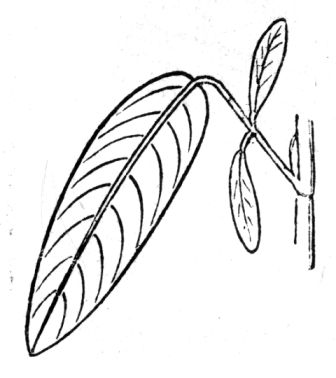
Fig. 122.—Leaf of Desmodium gyrans, with the terminal large, and two lateral small leaflets. These latter exhibit automatic pulsations.
The intensity of light was increased in successive experiments, in arithmetical progression 1:2:3 by suitably diminishing the distance between the plant and the source of light, and the resulting tropic curvatures recorded.
Effect of increasing intensity of light on the pulvinus of Desmodium gyrans: Experiment 129.—The source of light was a 50 candle-power incandescent lamp, and the duration of exposure was 1 minute. The specimen employed was a terminal leaflet of Desmodium gyrans (Fig. 122) the pulvinus of which is very sensitive to light. It is more convenient to manipulate a cut specimen of the leaf, instead of the whole plant. The petiole is placed in water contained in a U-tube; the depressing effect of wound passes off in the course of an hour or so. Light of increasing intensity is applied from above; this induces a contraction of the upper half of the pulvinus, and the resulting response is recorded by means of the Oscillating Recorder (Fig. 123).
The first record was obtained under a given intensity, and the second, under an intensity twice as great. The tropic effects are seen to increase with the intensity (Fig. 124). If the tropic curvature increased proportionately to the intensity, the two responses should have been in the ratio of 1:2; the actual ratio was however slightly greater, viz. 1:2·6. In this connection it will be shown in the next chapter, that strict proportionality holds good only in the median range, and that the susceptibility for excitation undergoes an increase at the beginning of the phototropic curve.
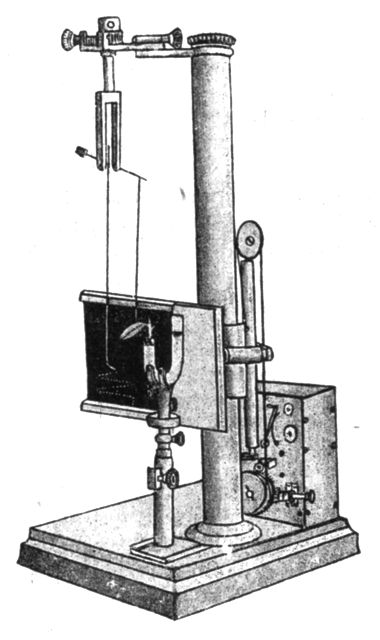
Fig. 123.—The Oscillating Recorder (From a photograph).
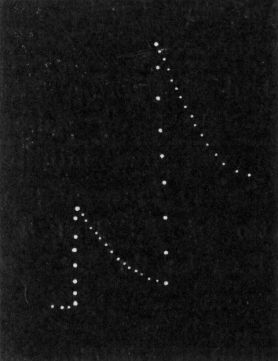
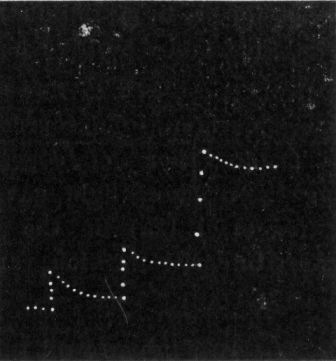
Fig. 124.Fig. 125.
Fig. 124.—Tropic effect of increasing intensity of light 1:2; on the response of terminal leaflet of Desmodium gyrans.
Fig. 125.—Tropic effect of increasing intensity of light 1:2:3 on growing organ (Crinum).
Effect of increasing intensity of light on the tropic curvature of growing organs.—As the tropic curvature is primarily due to the retardation of growth induced by light at the proximal side of the organ, it will be of interest to recapitulate the results I obtained (p. 208) on the effects of increasing intensity of light on growth itself. The normal rate of growth of the specimen in the dark was 0·47 µ per second; this was reduced to 0·29 µ under an intensity of one unit, to 0·17 µ under two, and to 0·10 µ under three units. Growth became arrested when the intensity was raised to four units. Thus increasing intensity of light induces an increasing retardation of growth at the proximal side of the organ. This aided by the effect of indirect stimulus at the distal side brings about an increasing positive curvature.
Experiment 130.—The flower bud of Crinum was used for the experiment, the source of light being a small arc lamp. The duration of exposure was one minute. Increasing intensity of light gave rise to increasing positive curvatures (Fig. 125) in the ratio of 1:2·5:5 under increasing intensities which varied as 1:2:3.
THE EFFECT OF INCREASING ANGLE.
The quantity of light which falls on an unit area of the responding organ varies as sin θ where θ is the directive angle i.e. the angle made by the rays with the surface. Some allowance has to be made for the amount of light reflected from the surface, this being greater at 45° than at 90°.
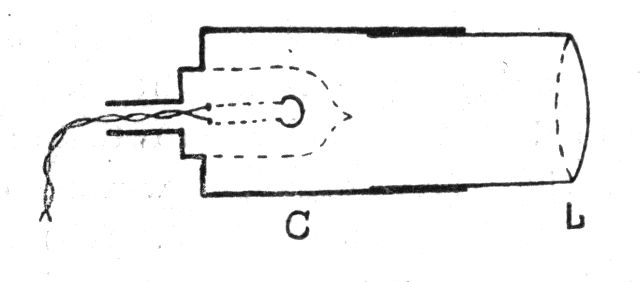
Fig. 126.—The Collimator.
Tropic response of pulvinus of Desmodium gyrans: Experiment 131.—For application of light at various angles an incandescent electric lamp was mounted at one end of a brass tube, a collimating lens being placed at the other (Fig. 126). The parallel beam of light from the collimator could be sent at various angles by rotating the collimator tube round an axis at right angles to the tube. The specimen employed was the terminal leaflet of Desmodium gyrans; light was applied for a minute in the two successive experiments for the two angles of 45° and 90°. The record (Fig. 127) shows that the phototropic effect increases with the directive angle. In the present case the ratio of the two effects is 1·6:1, which is not very different from the ratio sin 90°⁄sin 45° = 1·4.
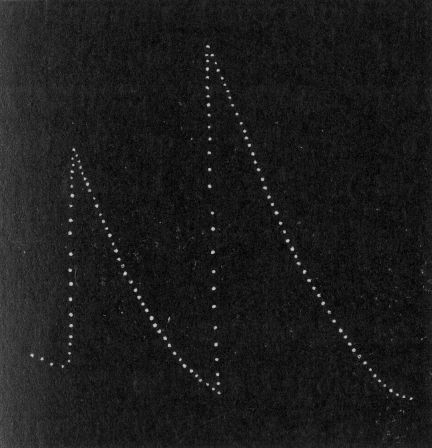
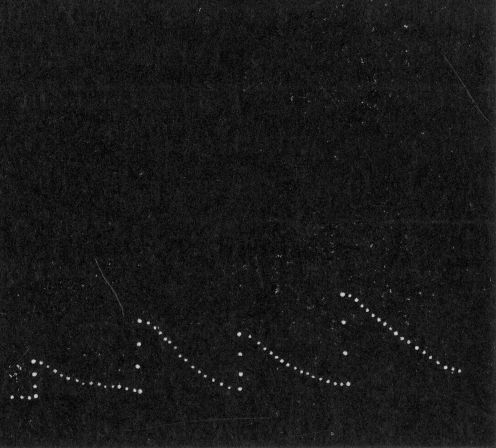
Fig. 127.Fig. 128.
Fig. 127.—Effect of angle of inclination of light on the tropic curvature of pulvinus. The first response is to light at 45° and the second, to 90°. (Desmodium gyrans).
Fig. 128.—Series of tropic curvatures of growing bud of Crinum to alternate stimulation by light at 45° and 90°.
Tropic response of growing organs: Experiment 132.—Similar experiment was carried out with the flower bud of Crinum, held vertical. Light was applied alternately at 45° and 90°, in two successive series. The object of this was to make due allowance of possible variation of excitability of the organ during the course of the experiment. I have explained (p. 147), how the excitability of a tissue in a condition slightly below par, is increased by the action of previous stimulation. Series of responses obtained under alternate stimulations at 45° and 90° enable us to find out, whether any variation of excitability occurred during the course of the experiment and make allowance for it. The records show that stimulation did enhance the excitability of the organ to a small extent. Thus the first stimulation at 45° induced an amplitude of response of 5 mm.; the second stimulation at 45° i.e. the third response of the series, induced a slightly larger response 7 mm. in amplitude. Similarly the two responses at 90° gave an amplitude of 9 mm. and 11 mm. respectively (Fig. 128). Taking the mean value of each pair, the ratio of tropic effects for 90° and 45° is = 10⁄6 = 1·7 nearly.
EFFECT OF DURATION OF EXPOSURE.
Experiment 133.—The specimen employed for the experiment was a flower bud of Crinum in a slightly sub-tonic condition. Successive responses exhibited on this account, a preliminary negative[15] before the normal positive curvature. The successive durations of exposure were for 1, 2, and 3 minutes. The amplitudes of responses (Fig. 129) are in the ratio of 1:2·5:5.
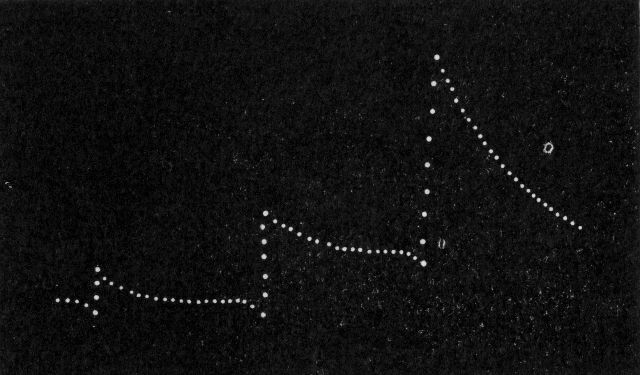
Fig. 129.—Effect of increasing duration of exposure 1:2:3 minutes, on phototropic curvature. Note preliminary negative response. (Crinum).
We may now recapitulate the tropic effects of light of increasing intensity, directive angle, and duration of exposure. It has been shown that the tropic effect is enhanced under increasing intensity of light; it is also increased with the angle increasing from grazing to perpendicular incidence. And finally, the tropic effect is enhanced with the duration of exposure. Taking into consideration the effects of these different factors we arrive at the conclusion that phototropic effect increases with the quantity of incident light. It will be shown in the next chapter that strict proportionality of cause and effect holds good in the median range of stimulation, and the slight deviation from this, above and below the median range, is due to the fact that susceptibility for excitation is low at these two regions.
SUMMARY.
Increasing intensity of light induces increasing tropic curvature.
Tropic curvature increases with the directive angle, the effect being approximately proportional to sin θ, where θ is the angle made by the rays with the responding surface.
Tropic curvature also increases with the duration of exposure.
The intensity of induced tropic effect is determined by the quantity of incident light.