Volume 2 / Part 3 — XL.—GEO-ELECTRIC RESPONSE OF SHOOT
Reading edition
By Sir J. C. Bose, Assisted by Satyendra Chandra Guha, M.Sc.
The experiments that have been described in the preceding chapter show that the upper side of a horizontally laid shoot undergoes excitatory contraction, in consequence of which the organ bends upwards. The fundamental geotropic reaction is, therefore, not expansion, but contraction which results from all modes of stimulation.
In confirmation of the above, I wished to discover and employ new means of detecting excitatory reaction under geotropic stimulus. In regard to this, I would refer to the fact which I have fully established that the state of excitation can be detected by the induced electromotive change of galvanometric negativity. This electrical indication of excitation may be observed even in plants physically restrained from exhibiting response by mechanical movement.[34]
ELECTRIC RESPONSE TO STIMULUS.
Before giving account of the results of investigations on the detection of geotropic excitation by means of electric response, I shall describe a few typical experiments which will fully explain the method of the electrical investigation, and show the correspondence of mechanical and electric responses. I have explained how tropic curvatures are brought about by the joint effects, of contraction of the directly excited proximal side A, and the expansion of the distal side B. In the diagram of mechanical response to stimulus (Fig. 164a) the excitatory contraction is indicated by - sign, and the expansion, by + sign. The resulting movement is, therefore, towards the stimulus as shown by the curved arrow.
I shall now describe the corresponding electric effects in response to unilateral stimulus. We have to determine the induced electrical variation at the proximal side A, and at the distal side B.
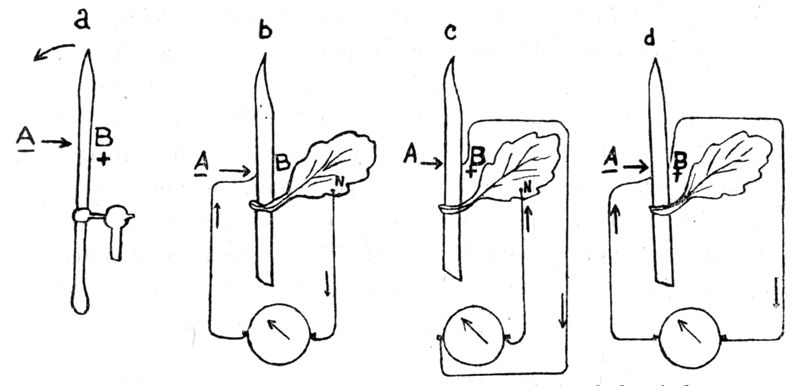
Fig. 164.—Diagrammatic representation of the mechanical and electrical response to direct unilateral stimulation indicated by arrow:—
(a) Positive mechanical response (curved arrow) due to contraction of directly stimulated A, and expansion of indirectly stimulated B.
(b) Electric response of induced galvanometric negativity of A under direct stimulation.
(c) Electric response of induced galvanometric positivity at the distal point B.
(d) Additive effects of direct and indirect stimulations; galvanometric negativity of the directly stimulated proximal A, and galvanometric positivity of the indirectly stimulated distal point B.
Electric response to direct stimulation: Experiment 168.—For the determination of electric response at the directly excited proximal side A, we take a shoot with a lateral leaf. The point A, which is to undergo stimulation, is connected with one terminal of the galvanometer, the other terminal being led to an indifferent or neutral point N on the leaf. Application of any form stimulus at A, gives rise to an electric current which flows through the galvanometer from the neutral to the excited point A (Fig. 164b). The directly stimulated point A thus becomes galvanometrically negative. The "action" current lasts during the application of stimulus and disappears on its cessation.
Electric response to indirect stimulation: Experiment 169.—We have also seen that application of stimulus at A causes indirect stimulation of the distal point B resulting in an increase of turgor and expansion. The corresponding electric change of the indirectly stimulated point B is found in the responsive current, which flows now through the galvanometer from the indirectly stimulated B to the neutral point N (Fig. 164c). The indirectly stimulated point thus becomes galvanometrically positive.
Having thus obtained the separate effects at A and B, we next modify the experiment for obtaining the joint effects. For this purpose the neutral point N is discarded and A and B connected directly with the indicating galvanometer. On stimulation of A that point becomes negative and B positive, and the current of response flows through the galvanometer from B to A. The deflection is increased by the joint electrical reactions at A and B (Fig. 164d).
The results may thus be summarised:—
TABLE XXXIII.—ELECTRIC RESPONSE TO DIRECT UNILATERAL STIMULUS.
Electrical change at the proximal side A. Electrical change at the distal side B.
Galvanometric negativity indicative of contraction and diminution of turgor.Galvanometric positivity indicative of expansion and increase of turgor.
The corresponding tropic curvature is positive movement towards stimulus.
Galvanometric negativity is thus seen to indicate the effect of direct stimulus, and galvanometric positivity that of indirect stimulus. We thus see the possibility of electric detection of the effects of geotropic stimulation. This method would, moreover, enable us to discriminate the side of the organ which undergoes greater excitation.
EXPERIMENTAL ARRANGEMENTS FOR OBTAINING GEO-ELECTRIC RESPONSE.
Returning to the investigation on electric response to geotropic stimulus, the specimen of plant is at first held erect; two electrodes connected with a sensitive galvanometer are applied, one to an indifferent point, and the other to one side of the shoot. The sensitiveness of the galvanometer was such that a current of one millionth of an ampere produced a deflection of the reflected spot of light through 1,000 divisions of the scale. An action current is produced on displacement of the plant from vertical to horizontal position.
Non-polarisable electrodes.—The electrical connections with the plant are usually made by means of non-polarisable electrodes (amalgamated zinc rod in zinc-sulphate solution and kaolin paste with normal saline). I at first used this method and obtained all the results which will be presently described. But the employment of the usual non-polarisable electrodes with liquid electrolyte is, for our present purpose, extremely inconvenient in practice; for the plant-holder with the electrodes has to be rotated from vertical to horizontal through 90°. The reliability of the non-polarisable electrode, moreover, is not above criticism. The zinc-sulphate solution percolates through the kaolin paste and ultimately comes in contact with the plant, and seriously affects its excitability. The name non-polarisable electrode is in reality a misnomēr; for the action current (whose polarising effect is to be guarded against) is excessively feeble, being of the order of a millionth of an ampere or even less; the counter polarisation induced by such a feeble current is practically negligible.
The idea that non-polarisable electrodes are meant to get rid of polarisation is not thus justified by the facts of the case. The real reason for its use is very different; the electrical connections with the plant has to be made ultimately by means of two metal contacts. If we take two pieces of metal even from the same sheet, and put them in connection with the plant, a voltaic couple is produced owing to slight physical differences between the two electrodes. Amalgamation of the two zinc rods with mercury reduces the electric difference but cannot altogether eliminate it.
I have been able to wipe off the difference of potential between two pieces of the same metal, say of platinum, and by immersing them in dilute salt solution from a voltaic couple. The circuit is kept complete for 24 hours, and the potential of the two electrodes by this process is nearly equalised. A perfect equality is secured by repeated warming and cooling of the solution and by sending through the circuit, alternating current which is gradually reduced to zero. I have by this means been able to obtain two electrodes which are iso-electric. The specially prepared electrodes (made of gold or platinum wire) are put in connection with the plant through kaolin paste moistened with normal saline solution. Care should be taken to use opaque cover over the plant-holder, so as to guard against any possible photo-electric action; moistened blotting paper maintains the closed chamber in a uniform humid condition.
The direct method of contact described above is extremely convenient in practice; the resistance of contact is considerably reduced, and there is no possibility of its variation during the necessary process of rotation of the plant for subjecting it to geotropic action.
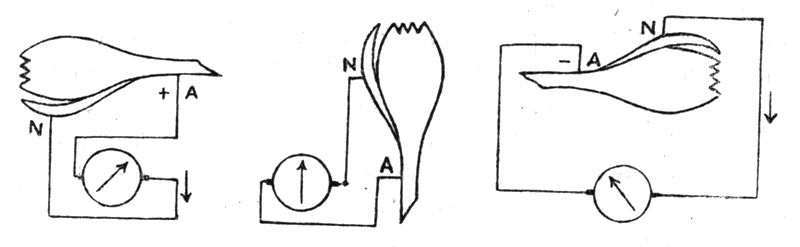
Fig. 165.—Diagrammatic representation of geo-electric response. The middle figure represents vertical position. In figure to the right rotation through +90° has placed A above with induced electric change of galvanometric negativity of A. In the figure to the left, rotation is through -90° A being below; the electric response is by induced galvanometric positivity of A. For simplification of diagram, vertical position of sepal is not always shown in the figure.
GEO-ELECTRIC RESPONSE OF THE UPPER AND LOWER SIDES OF THE ORGAN.
We have next to discover the electric change induced by geotropic stimulus on the upper and lower sides of the organ. For this purpose it is necessary to find a neutral point which is not affected by the inclination of the organ from vertical to horizontal position. For the present experiment, I employed the flower of the water lily Nymphæa, the peduncle of which is sensitive to geotropic action. One electrical contact is made with a sepal, which is always kept vertical; the other electric contact is made at the point A, on one side of the flower stalk (Fig. 165). On making connections with a sensitive galvanometer a very feeble current was found, which was due to slight physiological difference between the neutral point, N, and A. This natural current may be allowed to remain, the action current due to geotropism being superposed on it; or the natural current may be neutralised by means of a potentiometer and the reflected spot of light brought to zero of the scale.
Induced electric variation on upper side of the organ: Experiment 170.—While the sepal is held vertical, the stalk is displaced through +90° so that the point A is above. Geotropic stimulation is at once followed by a responsive current which flows through the galvanometer from N to A, the upper side of the organ thus exhibiting excitatory reaction of galvanometric negativity (Right-hand figure of 166). When the stalk is brought back to vertical position geotropic stimulation disappears, and with it the responsive current.
Electric response of the lower side: Experiment 171.—The stalk is now displaced through -90°; the point A, which under rotation through +90° pointed upwards, is now made to point downwards. The direction of the current of response is now found to have undergone a reversal; it now flows from A on the lower side to the neutral point N; thus under geotropic action the lower side of the organ exhibits galvanometric positivity indicative of increase of turgor and expansion (Left-hand figure 166).[35]
Having thus found that the upper side of the organ under geotropic stimulus becomes galvanometrically negative, and the lower side, galvanometrically positive, we make electric connections with two diametrically opposite points of the shoot A and B, and subject the organ to alternate rotation through +90° and -90°. The electro-motive changes induced at the two sides now became algebraically summated. I employ two methods for geotropic stimulation: that (1) of Axial Rotation, and (2) of Vertical Rotation.
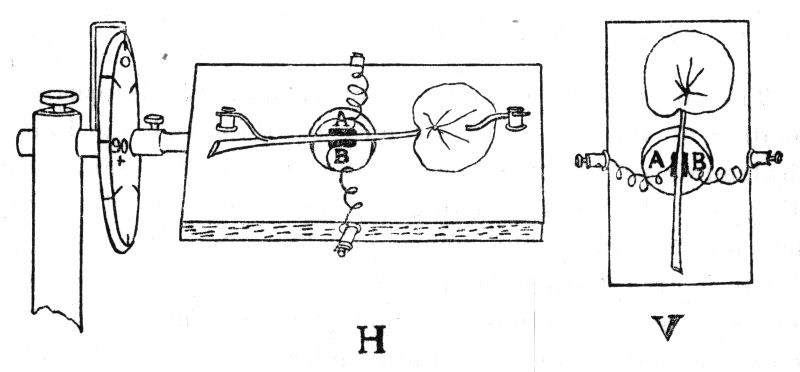
Fig. 166.—Diagrammatic representation of the Method of Axial Rotation H, and of Vertical rotation V (see text).
METHOD OF AXIAL ROTATION.
In the method of Axial Rotation, the organ is held with its long axis horizontal (Fig. 166 H). We have seen that the geotropic action increases with the angle which the responding surface of the organ makes with the vertical lines of gravity. When the organ is held with its length horizontal, the angle made by its two sides, A and B, with the vertical is zero and there is thus no geotropic effect. There is, moreover, no differential effect, since the two sides are symmetrically placed as regards the vertical lines of force. The plant is next rotated round its long axis, the angle of rotation being indicated in the circular scale. When the rotation is through +90°, A is above and B below; this induces a differential geotropic effect, the upper side exhibiting excitatory electric change of galvanometric negativity.
Experiment 172.—I shall, as a typical example, give a detailed account of experiments with the petiole of Tropæolum which was found so highly excitable to geotropic stimulus (p. 434). The specimen was held horizontal with two symmetrical contacts at the two sides, the electrodes being connected in the usual manner with the indicating galvanometer. When the plant is rotated through +90° there is an immediate current of response, the upper side becoming galvanometrically negative. This excitatory reaction on the upper side finds, as we have seen, mechanical expression by contraction and concavity, with positive or up-curvature.
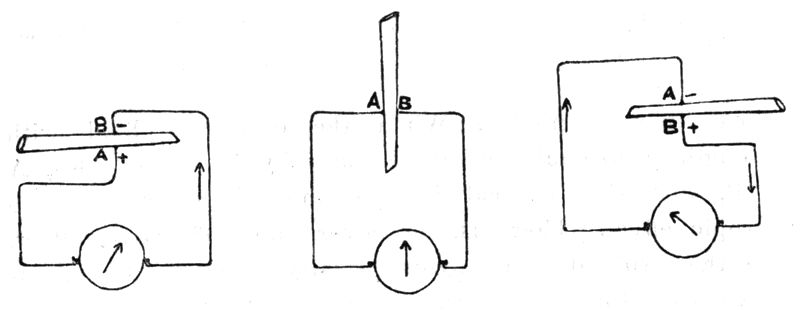
Fig. 167.—Diagrammatic representation of the geo-electric response of the shoot (see text).
The differential stimulation of A and B disappears on rotation of the axis back to zero position, and the induced electro-motive response also disappears at the same time. If now the axis be rotated through -90°, A will become the lower, and B the upper and the excited side. The electro-motive change is now found to have undergone a reversal, B becoming galvanometrically negative. This induced electro-motive variation under geotropic stimulus is of considerable intensity often exceeding 15 millivolts. The characteristic electric change is shown diagrammatically in figure 167 in which the middle figure shows the symmetrical or zero position. On rotation through +90° (figure to the right) A occupies the upper and B the lower position. A is seen to exhibit induced change of galvanometric negativity. Rotation through -90° reverses the current of response, as B now occupies the upper and A the lower position.
CHARACTERISTICS OF GEO-ELECTRIC RESPONSE.
There are certain phenomena connected with the electric response under geotropic stimulus which appear to be highly significant. According to statolithic theory
"Geotropic response begins as soon as an organ is deflected from its stable position, so that a few starch-grains press upon the ectoplasts occupying the walls which are underneath in the new position; an actual rearrangement of the starch-grains is therefore not an essential condition of stimulation. As a matter of fact, the starch-grains do very soon migrate on to the physically lower walls, when a positively or negatively geotropic organ is placed horizontally, with the result that the intensity of stimulation gradually increases attaining its maximum value when all the falling starch-grains have moved on to the lower region of the ectoplast. The time required for the complete rearrangement of the statoliths may be termed the period of migration; its average length varies from five to twenty minutes in different organs."[36]
Stimulation, according to the statolithic theory, is induced by the displacement of the particles. The diameter of the geotropically sensitive cells is considerably less than 0·1 mm.; and the stimulus will be perceived after the very short interval taken by the statoliths to fall through a space shorter than 0·1 mm. This may be somewhat delayed by the viscous nature of the plasma, but in any case the period for perceptible displacement of the statoliths should be very short, about a second or so, and the latent period of perception of stimulus should be of this order.
The mechanical indication of response to stimulus is delayed by a period which is somewhat indefinite; for the initiation of responsive growth variation will necessarily lag behind the perception of stimulus.
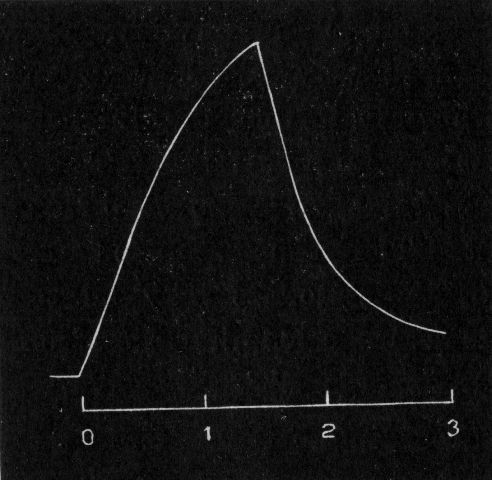
Fig. 168.—Geo-electric response of the petiole of Tropæolum.
Experiment 173.—The mechanical response with its drawbacks is thus incapable of giving an accurate value of the latent period. The electrical method of investigation labours under no such disadvantage, since the excitation is here detected even in the absence of movement. The perception of stimulus will thus be followed by response without undue delay. I shall in this connection give a record of electric response of the quickly reacting petiole of Tropæolum, when the angle of inclination is increased from zero to 90°. The responsive movement of the galvanometer spot of light was initiated in less than 5 seconds and the maximum deflection was reached in the course of 90 seconds. The angle was next reduced to zero, and the deflection practically disappeared in the further course of a minute and a half (Fig. 168). There was a small "excitation remainder". But with vigorous specimens the recovery is complete.
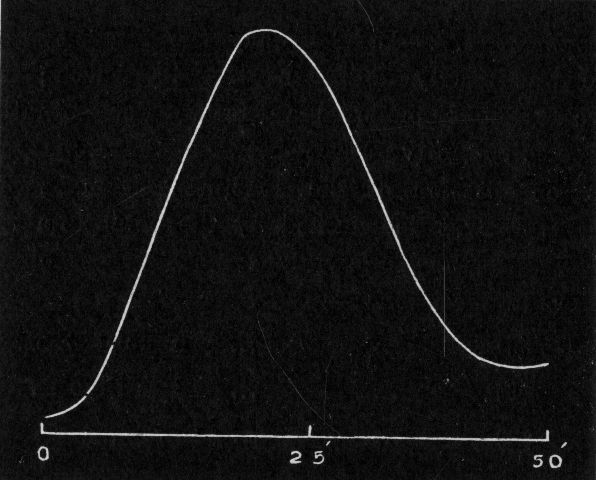
Fig. 169.—Geo-electric response of the scape of Uriclis.
The latent period of quickly reacting petiole of Tropæolum is thus about 5 seconds, a value which is more consonant with the idea of particles inducing excitation by their fall through an exceedingly short distance. In very sluggish organs latent period may be as long as a minute (Fig. 169), which is considerably shorter than an hour, the generally accepted value. Further even in the electric response, the latent period will be delayed beyond the period of perception. For this perception takes place in some unknown sensitive layer in the interior of the tissue, while electric contact is made with the epidermis outside. It is obvious that certain time must elapse before the excitation, initiated at the sensitive layer, should reach the epidermis. Under ideal conditions of experiment which will be described in a subsequent chapter, the latent period for geotropic excitation, I find, to be sometimes as short as a second.
PHYSIOLOGICAL CHARACTER OF GEO-ELECTRIC RESPONSE.
The intensity of the electro-motive variation is found to depend on the physiological vigour of the specimen. The Tropæolum plant, used for most of the above experiments, are at the best condition of growth in Calcutta in February; after this the plants begin to decline in March and die off by the end of April.
Experiment 174.—In February the intensity of electric response was nearly double of that in March; it was only in March that I made quantitative determination of the induced electro-motive force between the upper and lower contacts on rotation of the specimen from zero to 90°. The E. M. F. was determined by the potentiometer method. I give below the following typical values obtained with two different specimens:—
Specimen Induced E. M. F.
(1)12millivolts.
(2)15"
In the most favourable season the induced electro-motive force is likely to exceed the above value very considerably.
Effect of Age.—While a young petiole gave the above value, an old specimen from the same plant exhibited no response. The plants were in a dying condition in April and all indications of electrical reaction were found abolished. The physiological character of the response was also demonstrated by first obtaining the normal electric response in a vigorous specimen; after death, by immersion in boiling water, the plant gave no electric response to geotropic stimulus.
EFFECT OF DIFFERENTIAL EXCITABILITY OF THE ORGAN.
I have hitherto described the geo-electric effect of radial and isotropic organs. The induced E. M. F. at 90° was found practically the same whether A was above and B below, and vice versâ. In the mechanical response of the pulvinus of Mimosa, the geotropic excitability was, however, found to be greater in the lower half than in the upper (p. 440). I wished to investigate the question of differential geotropic excitability anew, by means of electric response.
Experiment 175.—Electric connections with the galvanometer were made with the upper and lower halves of the pulvinus, the organ being placed in the vertical or neutral position. The angle of inclination was then increased to 90° in the positive and negative directions alternately.
TABLE XXXIV.—DIFFERENCE OF GEO-ELECTRIC RESPONSE OF UPPER AND LOWER HALVES OF THE PULVINUS OF Mimosa.
Specimen.Position of particular half of pulvinus. Induced E. M. F.
(1)Upper half above Lower half above 23 millivolts. 30 "
(2)Upper half above Lower half above 16 " 29 "
In the former case the upper half of the pulvinus occupied the up-position; in the second case the up-position was occupied by the lower half of the pulvinus. In both cases strong electric responses were obtained, the upper point of contact being always galvanometrically negative. There was, however, a difference between the two responses, the excitatory electro-motive variation was invariably greater when the lower half of the organ occupied the favourable up-position. This will be seen from the results of two typical experiments in table given above.
The electrical mode of investigation thus leads to confirm the result obtained with mechanical method that the lower half of the pulvinus of Mimosa is geotropically more excitable than the upper half.
RELATION BETWEEN ANGLE OF INCLINATION AND GEOTROPIC EFFECT.
In the Method of Axial Rotation, the condition of the experiment is ideally perfect; in the neutral position the sides A and B are both parallel to the vertical lines of gravity, and are little affected by geotropic reaction. As the specimen is rotated on its long axis the vertical component of the force of gravity increases with the angle of inclination. The hypothetical statolithic particles will become displaced all along the cell, and the vertical pressure exerted by them will also increase with the angle.
The geo-electric response will then afford us a measure of the intensity of excitation induced at various angles of inclination. The mechanical response on account of its inherent defects does not afford us the true relation between the angle of inclination and intensity of geotropic reaction. But the electric method of inquiry is free from the defects of the mechanical method.
Experiment 176.—The specimen was rotated so that the angle of rotation was 45°, and the maximum electric response observed. The angle was next increased to 90° and the reading for the enhanced response taken. The ratio of the geo-electric response at 90° and 45°, thus affords us a measure of the effective stimulations at the two angles. I give below a table which gives results obtained with 24 different specimens.
TABLE XXXV.—RELATION BETWEEN ANGLE OF INCLINATION AND GEOTROPIC EFFECT.
No. of specimen.Galvanometric deflection.Ratio b⁄a.
(a) at 45° (b) at 90°
1 70 divisions 110 divisions 1·5
2 30 " 45 " 1·5
3 90 " 126 " 1·4
4 70 " 100 " 1·4
5 21 " 33 " 1·6
6 30 " 50 " 1·6
7 12 " 20 " 1·6
8 14 " 20 " 1·4
9 10 " 16 " 1·6
10 45 " 75 " 1·5
11 25 " 40 " 1·6
12 14 " 20 " 1·4
13 13 " 20 " 1·5
14 30 " 50 " 1·5
15 38 " 54 " 1·4
16 50 " 75 " 1·5
17 55 " 90 " 1·5
18 13 " 20 " 1·5
19 17 " 25 " 1·4
20 80 "130 " 1·5
21 15 " 22 " 1·4
22 45 " 75 " 1·5
23135 " 220 " 1·6
24 55 " 93 " 1·5
Mean ratio = 1·49
The mean ratio 1·49 may thus be regarded as the relative geotropic effects at 90° and 45°; this is practically the same as Sin 90°⁄Sin 45° = 1·4. Hence we arrive at the following law:
The intensity on geotropic action varies as the sine of the directive angle.
METHOD OF VERTICAL ROTATION.
I have hitherto described results obtained with the Method of Axial Rotation; I shall now take up the second method, that of Vertical Rotation, diagrammatic representation of which is given in figure 166V. The specimen is held vertical and two electrical contacts, A and B, made with the two lateral sides; it is then rotated round a horizontal axis perpendicular to the length of the specimen. Rotation may be carried in a right-handed direction with increasing angle with the vertical. The point A is thus subjected to enhanced geotropic stimulation and exhibits increasing electric change of galvanometric negativity; continuous decrease of angle of inclination to zero by rotation in the reverse direction causes a disappearance of the induced electric change. The rotation is next continued in the negative direction by which the point B is increasingly subjected to geotropic action. B is now found to exhibit excitatory reaction, the current of response having undergone a reversal. Rotation to the right and left will be distinguished by plus and minus signs.
ELECTRIC RESPONSE THROUGH AN ENTIRE CYCLE.
Experiment 177.—When the specimen is vigorous, characteristic response with its changing sign may be obtained through an entire cycle from 0° to +45° to +90°; then back to 45° to 0° to -45° to -90°. With less vigorous specimens the responses becomes enfeebled under fatigue. I give below the results of a typical experiment carried out with a vigorous specimen, the response being distinguished as - when A is above, and + when A is below, the inversion bringing about a reversal direction of the responsive current.
Angle of inclination+45°+90°+45° 0°-45°-90°
Galvanometer deflection-19-35-18 0+14 +25
RELATION BETWEEN ANGLE OF VERTICAL ROTATION AND INTENSITY OF GEOTROPIC REACTION.
The relation between the angle of inclination and the resulting geotropic action has already been determined by the Method of Axial Rotation. The ratio between the geotropic effects at 90° and 45° was thus found to be 1·49, which is nearly the same as Sin 90°⁄Sin 45°. I was next desirous of determining the relative excitations at the two angles by the Method of Vertical Rotation. It is necessary here to refer to certain differences of condition in the two methods. In the Axial Method, the hypothetical statoliths are distributed uniformly through the length of the cell, and rotation round the long axis causes displacement of the statoliths, the resulting pressure thus increasing with the sine of the angle of inclination. But in the case of vertical rotation through 45° to the right, the statoliths originally at the base of the cell accumulate to the right hand corner of the cell; a portion of the basal side of the cell is thus subjected to pressure. When the angle is increased to 90° the statoliths pass along the whole length including the basal and apical sides of the cell; but the excitability of the apical half may prove to be greater than that of the basal half. Hence excitatory geotropic effect is not likely to vary strictly as in sine of angle of inclination.
Whatever the reason may be, I find as a result of experiments with 12 different specimens that the mean ratio of the effects at 90° and 45°, obtained by the Method of Vertical Rotation, is 1·8:1 which is greater than 1·49:1 obtained by the Method of Axial Rotation, this latter value being practically the same as Sin 90°⁄Sin 45°.
SUMMARY.
It is shown that the state of excitation under direct stimulus is exhibited by an electrical change of galvanometric negativity; the effect of indirect stimulus induces, on the other hand, an electrical change of galvanometric positivity. The negative electric change corresponds to contraction and diminution of turgor; the positive electric change indicates, on the other hand, an expansion and increase of turgor.
The electric response to geotropic stimulus is studied by the two methods of Axial and Vertical Rotation. The upper side of a horizontally laid shoot is found to undergo an excitatory change of galvanometric negativity.
In quick reacting organs the latent period of geo-electric response is about 5 seconds, and the maximum excitation is induced in the course of 2 minutes.
The geo-electric response is due to physiological reaction. The intensity of response declines with age and is abolished at the death of the plant.
Under symmetrical conditions, the intensity of geotropic reaction is found proportional to the sine of the angle of inclination.
Electric investigation shows that the lower half of the pulvinus of Mimosa is geotropically more excitable than the upper half.