Volume 2 / Part 3 — XXV.—TROPIC CURVATURE WITH TRANSVERSE TRANSMISSION OF EFFECT OF STIMULUS
Reading edition
By Sir J. C. Bose, Assisted by Guruprasanna Das.
We have next to consider a very large class of phenomena arising out of the direct stimulation of one side and its transversely transmitted effect on the opposite side. The unilateral stimuli to which the plant is naturally exposed are those of contact, of light, of thermal radiation, and of gravity. There is besides the stimulation by electric current. I shall presently show that these tropic curvatures are determined by the definite effects of direct and indirect stimulations.
Under unilateral stimulus, the proximal side is found to become concave and the distal side convex; the organ thus moves towards stimulus, exhibiting a positive curvature. This movement may be due: (1) to the diminution of turgor, contraction or retardation of rate of growth of the proximal side, (2) to the increase of turgor, expansion or acceleration of rate of growth on the distal side, or (3) to the joint effects of contraction of the proximal and expansion of the distal side.
As regards the reaction of the proximal side, it has been shown that direct stimulation induces local contraction in a pulvinated organ, and retardation of growth in a growing organ. The effect induced on the distal side had hitherto remained a matter of uncertainty. In regard to this we must bear in mind that it is the effect of indirect stimulus that reaches the distal sided, inducing an enhancement of turgor and expansion of that side.
For obtaining a complete explanation of tropic curvatures in general, it is important that the induction of enhanced turgor at the distal side (by the action of stimulus at the proximal side) should be corroborated by independent methods of enquiry. One of the methods I employed for this purpose was electrical. Two electric connections were made, one with the distal point (diametrically opposite to the stimulated area), and the other, with an indifferent point at a distance. On application of stimulus of various kinds, the distal point was found to exhibit galvanometric positivity, indicative of enhancement of turgor.[3]
I have since been able to devise a new experiment by which the enhancement of turgor on the distal side is demonstrated in a very striking manner.
I have shown (p. 39) that the movement of the motile leaf of Mimosa is a reliable indicator of the state of turgor, increase of turgor inducing erection, and diminution of turgor bringing about the fall of the leaf. I shall employ the mechanical response of the leaf to demonstrate the enhancement of turgor induced by transverse transmission of effect of stimulus.
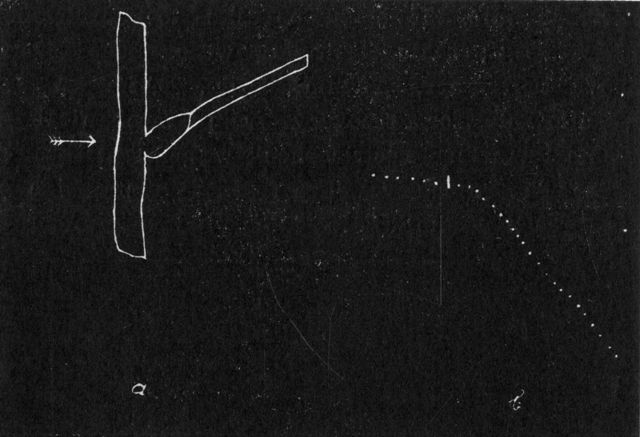
Fig. 100.—Increased turgor due to indirect stimulation, inducing erection of Mimosa leaf: (a) diagram of the experiment, point of application of stimulus indicated by arrow. (b) erectile response (shown by down-curve) followed by rapid fall (up-curve) due to transverse conduction of true excitation. (Successive dots at intervals of 10 seconds.)
TURGOR-VARIATION UNDER TRANSVERSE TRANSMISSION OF STIMULUS-EFFECT.
Unilateral photic stimulation: Experiment 104.—A Mimosa plant was taken, and its stem was held vertical by means of a clamp. We apply a stimulus at a point on one side of the stem, and observe the effect of this on the state of turgor at the diametrically opposite side. In my first experiment on the subject of detection of induced change of turgor I employed the stimulus of light. A narrow beam from a small arc lamp was made to fall on the stem, at a point diametrically opposite to the motile leaf, which was to serve as a indicator for induced variation of turgor at the distal side. The leaf was attached to the recording lever, the successive dots in the record being at intervals of ten seconds. Stimulation by light caused a positive or erectile movement within 20 seconds of application. The positive response afforded a conclusive proof of the induction of an increase of turgor at the distal point. When the stimulus is moderate or of short duration, the response remains positive. But with strong or prolonged stimulation, the slower excitatory negative impulse is conducted to the distal point and brings about the sudden fall of the leaf (Fig. 100). In the present case the excitatory impulse reached the motile organ 200 seconds after the initiation of the positive response. The stem was thin, only 2 mm. in diameter. The velocity of excitatory impulse in a transverse direction is thus 0·01 mm. per second; transverse transmission is, for obvious reasons, a much slower process than longitudinal transmission of excitation; in the Mimosa stem this is about 4 mm. per second.
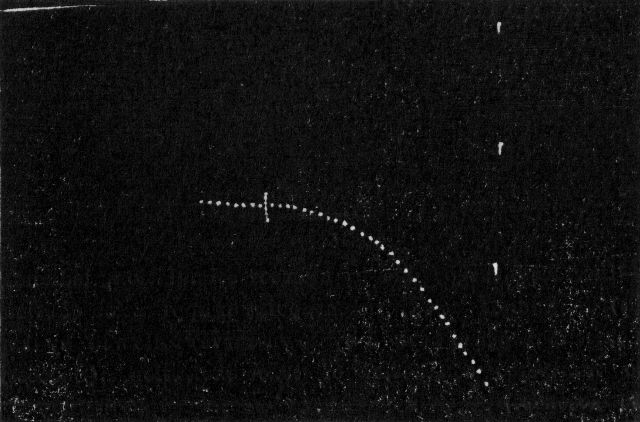
Fig. 101.—Response of leaf of Mimosa under transverse transmission of electric stimulus. (Compare this with fig. 100.)
Unilateral electric stimulation: Experiment 105.—In order to show that the effects described above are not due to any particular mode of stimulation but to stimuli in general, I carried out an additional experiment, the stimulus employed being electrical. Two fine pin-electrodes were pricked into the stem, opposite to the responding leaf of Mimosa; these electrodes were placed vertically one above the other, 5 mm. apart. After a suitable period, allowed for recovery from mechanical irritation, feeble tetanising electric shock was passed through the electrodes. The responsive effects at the distal side of the stem is precisely similar to those induced under unilateral photic stimulation; that is to say, the first effect was an erectile movement of the leaf, indicative of an induced enhancement of turgor; the excitatory negative impulse then reached the distal point and caused a sudden fall of the leaf (Fig. 101).
The experiments that have just been described are of much significance. An organ like the stem of Mimosa, since it exhibits no contraction, may appear insensitive to stimulation; but its perception of stimulus is shown by its power of transmitting two characteristic impulses, one of which is the positive, giving rise to an enhancement of turgor, and the other, the true excitatory negative, inducing the opposite reaction or diminution of turgor. Unilateral stimulation gives rise to both these effects in all organs: pulvinated, growing, and non-growing. It was the fortunate circumstance of the insertion of the motile leaf on one side of the Mimosa stem that enabled us to demonstrate the important facts given above.
The underlying reactions, which give rise to tropic curvature, could have been foretold from the Laws of effects of Direct and Indirect stimulation, established in previous chapters (pp. 136, 216). The resulting curvature is thus brought about by the joint effects of direct stimulation of the proximal, and indirect stimulation of the distal side. We may now recapitulate some of the important facts relating to tropic curvatures:
Indirect stimulation gives rise to dual impulses, positive and negative; of these the positive impulse is practically independent of the conducting power of the tissue; but the transmission of the excitatory negative impulse is dependent on the conducting power. No tissue is a perfect conductor, nor is any a perfect non-conductor of excitation, the difference is a question of degree. In a petiole or a stem the conducting power along the direction of length is considerable, but very feeble in a transverse direction. In a semi-conducting tissue, a feeble stimulus will transmit only the positive impulse; strong or long continued stimulation will transmit both positive and negative impulses, the positive preceding the negative. The transmitted positive gives rise to increase of turgor, expansion, and acceleration of rate of growth; the negative induces the opposite reaction of diminution of turgor, of contraction, and of retardation of rate of growth. Transverse transmission is only a particular instance of transmission in general; the only difference is that the conducting power for excitation is very much less in the transverse than in the longitudinal direction. Owing to feeble transverse conductivity, the transmitted impulse to the distal side often remains positive; it is only under strong or continued stimulation that the excitatory negative reaches the distal side and neutralises or reverses the previous positive reaction. If the distal is the more excitable side, the reversed response will appear as pronounced negative. I give a table which will clearly exhibit the effects of stimulus on the proximal and distal sides of the responding organ.
TABLE XXIV.—SHOWING RESPONSIVE EFFECTS COMMON TO PULVINI AND GROWING ORGANS UNDER UNILATERAL STIMULATION.
Effect of direct stimulation on proximal side.Effect of indirect stimulation on distal side.
Diminution of turgor Increase of turgor.
Galvanometric negativity Galvanometric positivity.
Contraction and concavity Expansion and convexity.
When stimulus is strong or long continued, the true excitatory effect is conducted to the distal side, neutralising or reversing the first response.
The diagram which I have already given (Fig. 98) clearly explains the different tropic effects induced by changing the point of application of stimulus. We may thus have stimulus applied at the responding region itself (Direct Stimulation) or at some distance from it (Indirect Stimulation). The final effect will be modified by the conducting power of the tissue.
DIRECT UNILATERAL STIMULATION.
Type I.—The tissue has little or no power of transverse conduction: stimulus remains localised, the proximal side undergoes contraction, and the distal side expansion. The result is a positive curvature.
Type II.—The tissue is transversely conducting. Under strong and long continued stimulation the excitatory impulse reaches the distal side, neutralising or reversing the first effect.
INDIRECT UNILATERAL STIMULATION.
Type I.—The intervening tissue is an indifferent conductor: transmitted positive impulse induces expansion and convexity on the same side, thus giving rise to negative curvature (i.e., away from stimulus).
Type II.—Intervening tissue is a fairly good conductor: the effect of positive impulse is over-powered by the predominant excitatory negative impulse, the final result is a concavity and positive curvature, with movement towards the stimulus.
The following is a tabular statement of the different effects induced by Direct and Indirect stimulation.
TABLE XXV.—SHOWING DIFFERENCE OF EFFECTS INDUCED BY DIRECT AND INDIRECT STIMULATION.
Stimulation.Nature of the tissue.Final effect.
Direct (Feeble)Semi-conducting tissue.Positive curvature.
Indirect " " "Negative curvature.
Direct (Strong)Better conducting tissue.Neutral or negative curvature.
Indirect " " " "Negative followed by positive curvature.
The results of investigations already described, enable us to formulate the general laws of tropic curvature applicable to all forms of stimuli, and to all types of responding organs, pulvinated or growing.
LAWS OF TROPIC CURVATURE.
1. (a) DIRECT APPLICATION OF UNILATERAL STIMULUS OF MODERATE INTENSITY, INDUCES A POSITIVE OR CONCAVE CURVATURE, BY THE CONTRACTION OF THE PROXIMAL AND EXPANSION OF THE DISTAL SIDE.
(b) UNDER STRONG OR LONG-CONTINUED STIMULATION, THE POSITIVE CURVATURE IS NEUTRALISED OR REVERSED, BY TRANSVERSE CONDUCTION OF EXCITATION; THIS EFFECT IS ACCENTUATED BY THE DIFFERENTIAL EXCITABILITY OF THE TWO SIDES OF THE ORGAN.
2. (a) INDIRECT APPLICATION OF UNILATERAL STIMULUS OF FEEBLE INTENSITY INDUCES A NEGATIVE CURVATURE.
(b) IN A CONDUCTING TISSUE THE EXCITATORY EFFECT BEING TRANSMITTED UNDER STRONG AND LONG CONTINUED STIMULATION, INDUCES A POSITIVE CURVATURE.
It will thus be seen that the tropic effect is modified by:
(1) the point of application of stimulus,
(2) the intensity and duration of stimulus,
(3) the conducting power of tissue in the transverse direction,
(4) the relative excitabilities of the proximal and distal sides of the organ.
In the following series of Papers the tropic effects of various forms of stimuli will be studied in detail.
SUMMARY.
In a semi-conducting tissue Direct stimulation induces a diminution of turgor and contraction, Indirect stimulation inducing the opposite effect of increase of turgor and expansion.
Unilateral stimulation thus induces a positive curvature by the joint effects of contraction at the proximal, and expansion at the distal side.
Under strong and long continued unilateral stimulation, the excitation at the proximal side is transmitted to the distal side. Transverse conduction thus neutralises or reverses the normal positive curvature.